NINETY-FIFTH SEASON
Sunday, May 17, 2026, at 3:00
Evgeny Kissin Piano
BEETHOVEN
Piano Sonata No. 7 in D Major, Op. 10, No. 3
Presto
Largo e mesto
Menuetto: Allegro
Rondo: Allegro
CHOPIN
Selected Mazurkas
Mazurka in E Minor, Op. 41, No. 2
Mazurka in A-flat Major, Op. 41, No. 4
Mazurka in C Minor, Op. 56, No. 3
Mazurka in B Major, Op. 63, No. 1
Mazurka in F Minor, Op. 68, No. 4
INTERMISSION
SCHUMANN
Kreisleriana, Op. 16
Extremely agitated
Very fervent and not too lively
Very agitated
Very slow
Very lively
Very slow
Very lively
Fast and playful
LISZT Hungarian Rhapsody No. 12 in C-sharp Minor
This concert is generously sponsored by Ling Z. and Michael C. Markovitz. The Chicago Symphony Orchestra Association acknowledges support from the Illinois Arts Council.
The Chicago Symphony Orchestra thanks Ling Z. and Michael C. Markovitz for sponsoring this program.
COMMENTS
by Richard E. Rodda
LUDWIG VAN BEETHOVEN
Born December 16, 1770; Bonn, Germany
Died March 26, 1827; Vienna, Austria
Piano Sonata No. 7 in D Major, Op. 10, No. 3
COMPOSED 1798
Among the nobles who served as Beethoven’s patrons after his arrival in Vienna in 1792 was one Count Johann Georg von BrowneCamus, a descendant of an old Irish family who was at that time fulfilling some ill-defined function in the Habsburg Imperial city on behalf of Empress Catherine II of Russia. Little is known of Browne-Camus. His tutor, Johannes Büel, later an acquaintance of Beethoven, described him as “full of excellent talents and beautiful qualities of heart and spirit on the one hand, and on the other full of weakness and depravity.” He is said to have squandered his fortune and ended
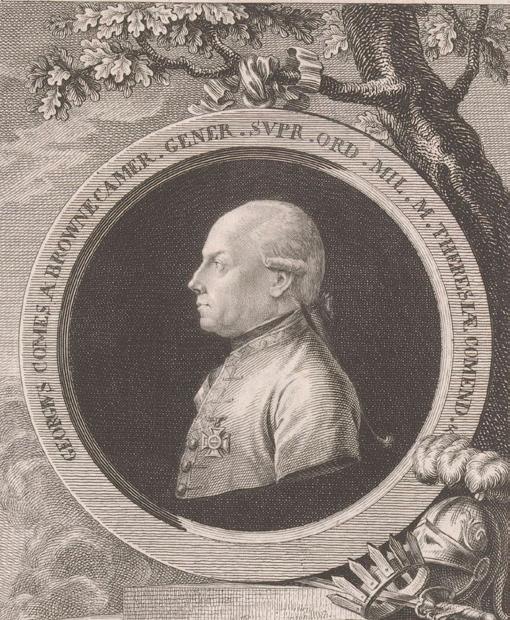
his days in a public institution. In the mid-1790s, Beethoven received enough generous support from Browne-Camus, however, that he dedicated several of his works to him and his wife, Anne Margarete, including the Variations on “Bei Männern, welche Liebe fühlen” from Mozart’s Die Zauberflöte for Cello and Piano (WoO 46), the three op. 10 piano sonatas, B-flat piano sonata (op. 22), and three string trios of op. 9. In appreciation of these dedications, Browne-Camus presented Beethoven with a horse, which a preoccupied composer promptly forgot, thereby allowing his servant to rent out the beast and pocket the profits.
The three sonatas of op. 10 were begun during the summer of 1796 and completed by July 1798, when the Viennese publisher Joseph Eder issued them as
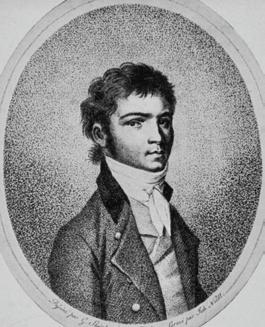
this page, from top: Ludwig van Beethoven, copperplate engraving by Johann Joseph Neidl (1776–1832) after a lost portrait by Gandolph Ernst Stainhauser von Treuberg, (1766–1805), ca. 1800–01 | Count Johann Georg von Browne-Camus, etching print and engraving over paper, by Joseph Georg Mansfeld (1764–1817), between 1774 and 1817. Rijksmuseum, Amsterdam, the Netherlands | next page: A View of Vienna from the Josefstadt by Carl Schütz and Johann Ziegler, engraving by Joseph and Peter Schaffer, Artaria & Co. (ca. 1799–1840s)
swings of mood of his manic-depressive personality forced itself to the fore with such determination that the music gushed forth in just four days. “Extraordinary music, at times mad, at times solemn and dreamy,” he warned Clara.
You will open your eyes wide when you decipher it. Do you know, sometimes I have the notion that I shall finish up by bursting with music, the ideas so press and seethe within me when I dream of our love. . . . Have you played my Kreisleriana? Some of the pages contain a truly savage love. . . .
“You shock me sometimes,” Clara replied. “I wonder if it is true that this man will be my husband. Sometimes I have the idea that I will never be able
to satisfy you, but in spite of that, you could always love me.” This was music drawn equally from Schumann’s nearly obsessive infatuation with Clara and his conviction that art—especially music and literature—was the mirror of the soul.
Kreisleriana, as much as any of Schumann’s compositions, embodies the romantic penchant for distilling powerful but evanescent emotions in aphoristic piano sketches that retain the spirit of inspired improvisation. Joseph Wasielewski, student and early biographer of Schumann, wrote of Kreisleriana, “In no other of his piano compositions does the composer offer us so rich and fanciful a world of sound, so poetically rich, soul-absorbing and refined a vision. Never was he more a tone-poet in the deepest sense of the word than in this instance.”
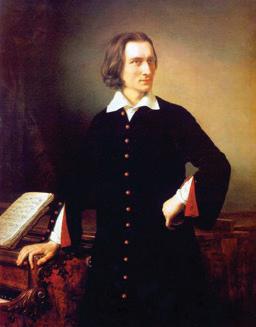
FRANZ LISZT
Born October 22, 1811; Doborján, Hungary (now Raiding, Austria)
Died July 31, 1886; Bayreuth, Germany
Hungarian Rhapsody No. 12 in C-sharp Minor
COMPOSED before 1853
Franz Liszt was a most unusual Hungarian patriot. Though born in Hungary, he was raised in the French language (he never learned Hungarian very well
despite several attempts), moved with his family to Vienna at age ten, and visited his homeland only infrequently thereafter. Yet he maintained an interest in Hungarian music throughout his life and wrote numerous works incorporating national melodies: the nineteen Hungarian rhapsodies and several other pieces for solo piano (six of the rhapsodies were later transcribed
COMMENTS
for orchestra), a symphonic poem, a mass written for the coronation of Emperor Franz Josef as king of Hungary in 1867, and the Hungarian Fantasy for Piano and Orchestra. In addition to his original compositions, he published and edited ten volumes of Hungarian folk melodies between 1839 and 1847 and followed them with a 450-page thesis on “The Gypsies and Their Music in Hungary,” issued in French (!) in 1859. Liszt was convinced that he was immortalizing the true folk music of his native country in these compositions, among the earliest works of the nationalism movement that would gain such importance in the following decades. As the nineteenth century neared its end, however, systematic research into Eastern European music showed that Liszt’s basic theory was wrong.
Liszt believed that Hungarian folk music originated with the Romas. However, it was shown that exactly the opposite was true—that the Romas, who can be traced only to the fifteenth century in Hungary, assimilated the local idioms into their songs and methods of performance, mixed them with musical formulas from other lands, especially those of the Near East, and had, by the nineteenth century, evolved a kind of
urban salon music that Liszt mistook for original folk art.
Liszt’s ethnomusicological misunderstanding, however, in no way diminishes the intrinsic value of his original “Hungarian” compositions, which remain excellent examples of his art and atmospheric souvenirs of a particularly colorful kind of music, whether based on authentic folk song or not. Many of these works were built around the performance method of the Hungarian national dance, the czardas, which alternates (at a sign from the dancer to the musicians) between a slow movement—lassu—and a fast one—friss. To describe their resultant free structure and quick contrasts, Liszt borrowed the term rhapsody from literature, saying that it was meant to indicate the “fantastic, epic quality” of this music. He may have been the first to use this title in a musical context, just as he had introduced the word recital to describe his solo concerts of the 1840s.
Richard E. Rodda, a former faculty member at Case Western Reserve University and the Cleveland Institute of Music, provides program notes for many American orchestras, concert series, and festivals.
REFRESHMENTS AT SYMPHONY CENTER
You can order drinks and snacks before the performance or during intermission at various bars located throughout Symphony Center, including the Bass Bar in the Rotunda and most of the lobby spaces in Orchestra Hall.
PROFILES
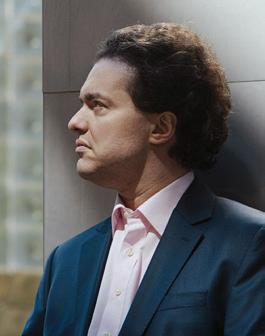
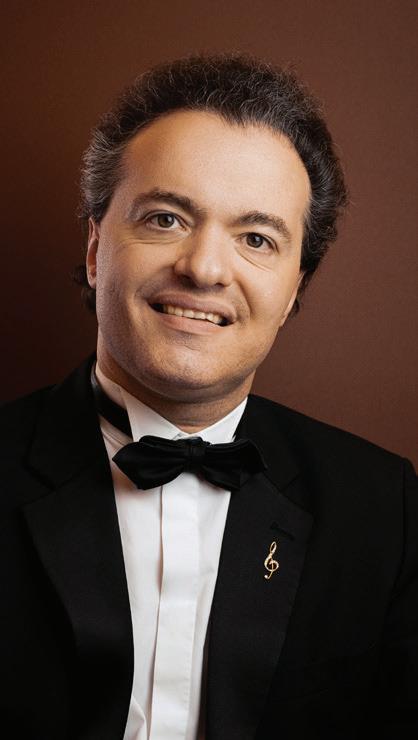
Evgeny Kissin Piano
Evgeny Kissin’s musicality, the depth and poetic quality of his interpretations, and his extraordinary virtuosity have earned him the veneration deserved only by one of the most gifted classical pianists of his generation and, arguably, generations past. He is in demand worldwide, appearing with leading orchestras under esteemed conductors, including Abbado, Ashkenazy, Barenboim, Giulini, Karajan, Levine, Maazel, Muti, and Ozawa.
Kissin was born in Moscow in October 1971 and began playing by ear and improvising on the piano at age two. At six, he entered the Moscow Gnessin School of Music, a special school for gifted children. There, he studied with Anna Pavlovna Kantor, who would remain his only teacher. He made his concerto debut at ten and, a year later, gave his first solo recital in Moscow. Kissin came to international attention in March 1984 when, at twelve, he performed Chopin’s piano concertos 1 and 2 in the Great Hall of the Moscow Conservatory with the Moscow State Philharmonic.
This season, Kissin tours internationally in recital with programs featuring music by Beethoven, Chopin, Schumann, and Liszt. The U.S. tour takes him to New York’s Carnegie Hall
and Kansas City, where he plays chamber music with Joshua Bell and Steven Isserlis. He also performs concertos by Mozart and Scriabin with top American orchestras, including the Chicago and Boston symphony orchestras and the New York Philharmonic.
Kissin received the Crystal Prize of the Osaka Symphony Hall for Best Performance of the Year in 1986. He was special guest at the 1992 Grammy Awards ceremony, broadcast live to an audience estimated at over one billion, and three years later became Musical America’s youngest Instrumentalist of the Year. In 1997 he received the prestigious Triumph Award for his outstanding contribution to Russia’s culture, becoming the youngest recipient of one of the highest cultural honors in the Russian Republic. Kissin has been awarded the Shostakovich Award, one of Russia’s highest musical honors; an honorary membership of the Royal Academy of Music in London; and an honorary doctorate of letters from the Hong Kong University.
Kissin’s latest release is an album of Beethoven’s sonatas on Deutsche Grammophon. He won a Grammy in 2006 for Best Instrumental Soloist and a Grammy in 2010 for Best Instrumental Soloist Performance (with orchestra). His extraordinary talent inspired Christopher Nupen’s documentary Evgeny Kissin: The Gift of Music, released in 2000 on video and DVD by RCA Red Seal.
Evgeny Kissin
Lisa Batiashvili
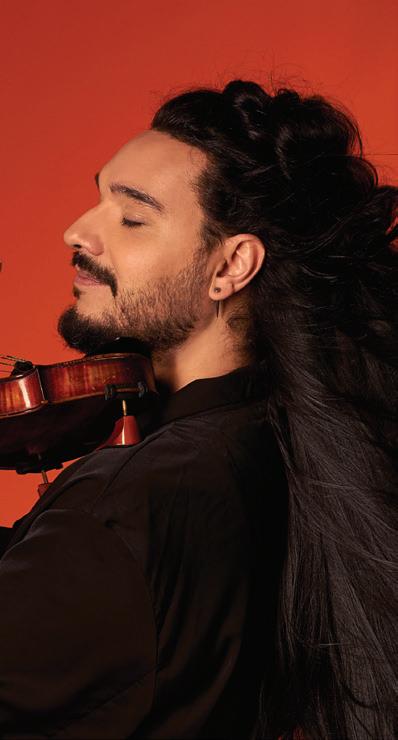
Maxim Vengerov
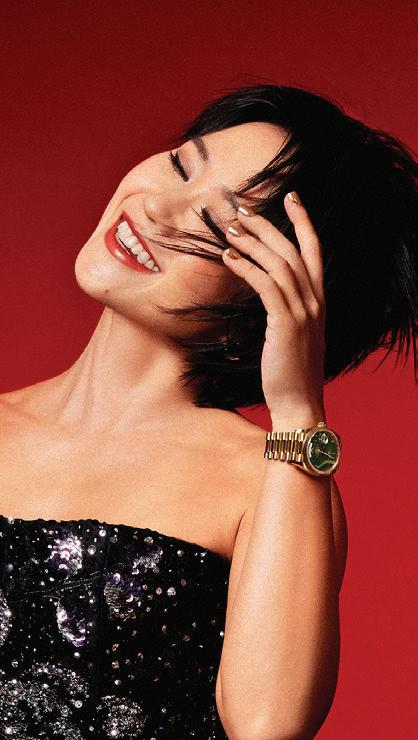
Yuja Wang Nemanja Radulović
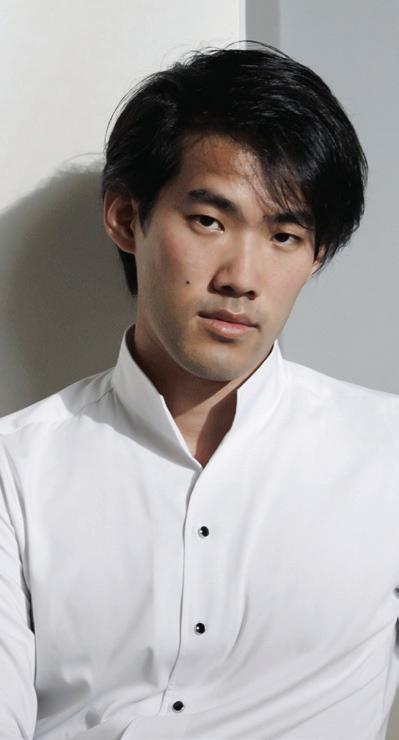
Bruce Liu
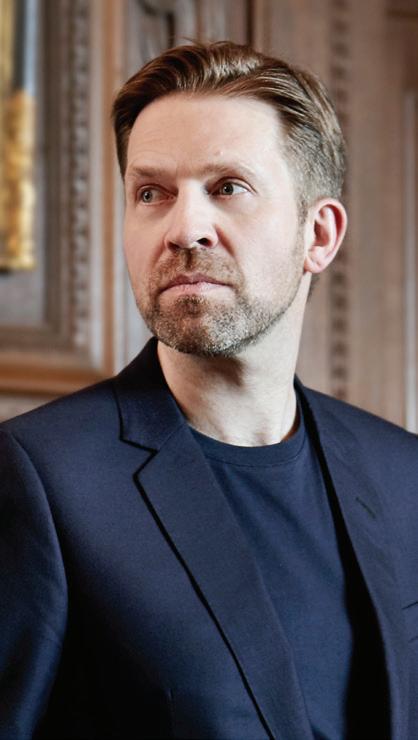
Leif Ove Andsnes
Jean-Yves Thibaudet