ONE HUNDRED THIRTY-FIFTH SEASON
Sunday, June 7, 2026, at 3:00
South Shore Cultural Center
LINCOLN STRING QUARTET
Qing Hou Violin
Gabriela Lara Violin
Lawrence Neuman Viola
Daniel Katz Cello
HAYDN String Quartet in G Major, Op. 9, No. 3
Moderato
Menuetto: Allegretto
Largo
Finale: Presto
GABRIELA LARA
QING HOU
LAWRENCE NEUMAN
DANIEL KATZ
INTERMISSION
BEETHOVEN String Quartet No. 13 in B-flat Major, Op. 130
Adagio ma non troppo—Allegro
Presto
Andante con moto ma non troppo
Alla danza tedesca: Allegro assai
Cavatina: Adagio molto espressivo
Grosse Fugue, Op. 133
Overtura
Fugue: Allegro—Meno mosso e moderato—
Allegro molto e con brio—Meno mosso e moderato—
Allegro molto e con brio
QING HOU
GABRIELA LARA
LAWRENCE NEUMAN
DANIEL KATZ
The Chicago Symphony Orchestra Association acknowledges support from the Illinois Arts Council.
COMMENTS
by Richard E. Rodda
JOSEPH HAYDN
Born March 31, 1732; Rohrau, Lower Austria
Died May 31, 1809; Vienna, Austria
String Quartet in G Major, Op. 9, No. 3
COMPOSED 1768
Upon joining the Esterházy household musical establishment in May 1761, Haydn was nearly overwhelmed by his duties. His immediate superior was Gregor Joseph Werner, who retained his post as kapellmeister but, due to his age and infirmity, was required to oversee only the sacred choral music. Haydn was in charge of all other musical activities, to wit: organizing, outfitting, conducting, and disciplining the Esterházy orchestra for its performances at the palace, chapel, or opera house; accepting and implementing the prince’s daily requests for music; coaching the vocalists; performing on violin, viola, or keyboard; and composing “such music as His Serene Highness may command,” all to be done, his contract specified, in a manner that “becomes an honorable official of a princely house.” He composed furiously during the next decade, producing thirty-five symphonies, four masses, a Stabat mater, a Te Deum, a
number of operas, and nearly a hundred trios for viola, cello, and baryton, a species of viola da gamba that Prince Nicholas played with great relish and for which he insisted that Haydn provide a steady stream of new music. The press of his responsibilities and the lack of demand from his employer prevented Haydn from composing string quartets during the mid-1760s, a form of which he had produced ten lightweight, divertimento-like examples before joining the Esterházy household. When he did return to the genre in 1768 to create the half-dozen works published the following year by J.J. Hummel of Amsterdam as his op. 9, it was with a marked expansion of his compositional skills and a grander vision of the expressive potential of music for four string instruments.
Haydn’s 1768 quartets are his earliest fully developed works in the form, a circumstance the composer himself acknowledged when he requested in later years that the Viennese publisher Domenico Artaria omit the op. 1 and op. 2 quartets from a complete edition that he was planning, and begin with op. 9. (The attribution of op. 3 to Haydn
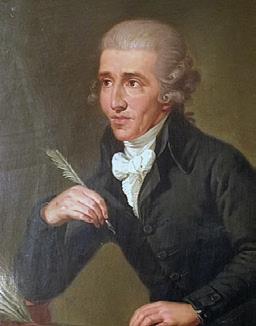
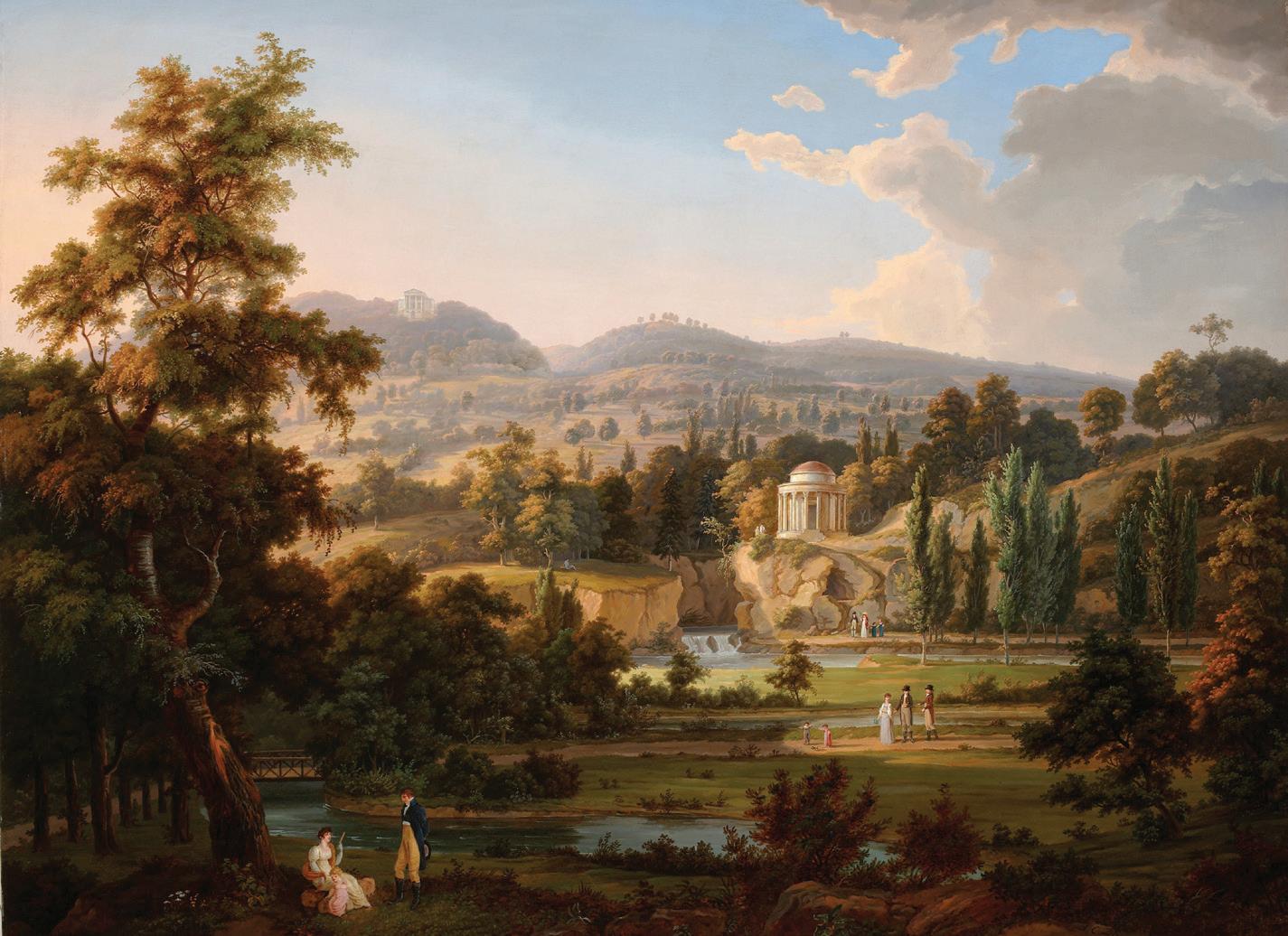
this page: Joseph Haydn, portrait in oil by Ludwig Guttenbrunn (1750–1819), ca. 1770 | opposite page: View of the gardens at Schloss Esterházy in Eisenstadt, Austria, 1807, by Albert Christoph Dies (1755–1822), who also was an early biographer of the composer
is apparently spurious, since they seem to have been composed by a Benedictine monk from Germany named Roman Hoffstetter.) The op. 9 quartets, which proved by their numerous publications and wide distribution to have been among Haydn’s most popular chamber works during his lifetime, show several important stylistic advances over his earlier compositions in the genre. The quartets are in four movements, eschewing the second minuet that brought op. 1 and op. 2 close to the form and manner of the divertimento. They show evidences of the technique of thematic development that was to provide the basis of the masterful compositional language of Haydn’s maturity, and their
style is generally more graceful and refined, often indulging a penchant for the idioms of Empfindsamkeit, the heightened sentimental expression of late-eighteenth-century music that presaged romanticism. The quartets also allow for a higher level of instrumental virtuosity, a quality inspired by the playing of Luigi Tomasini, the excellent principal violinist of the Esterházy orchestra (“no one plays my quartets like Luigi,” Haydn explained), and the instruments are brought together with greater equality, with the cello often becoming a full participant in the musical conversation rather than just its bass support. The op. 9 string quartets, in other words, mark the emergence of the genre as the equal in expressive content
and formal maturity of the symphony, whose evolution it would parallel for the next quarter century in the astounding artistic adventure that was the career of Joseph Haydn.
The prominence and showy figurations of the first violin part in the G major quartet’s opening movement suggest that it was composed to feature the Esterházy court orchestra’s concertmaster, Luigi Tomasini. (Haydn included solo passages in many of his works to show off the skills of his musicians to their mutual employer.) The movement follows a sprightly sonata form that passes through some shadowy harmonic areas in its compact development section. “The minuets of op. 9
LUDWIG VAN BEETHOVEN
Born December 16, 1770; Bonn, Germany
Died March 26, 1827; Vienna, Austria
require special praise,” wrote American musicologist H.C. Robbins Landon, who made the study of Haydn his lifetime’s work. “If there is any single genre in which Haydn was now a supreme master, it is here. He manages to retain the rhythmic vitality of his best symphonic minuets and couple it with a fine sense of chamber-music fitness.” The Largo is a wordless song of expressive restraint, tender emotion, and nocturnal tranquility. The witty, sonata-form finale is yet another of Haydn’s irresistible creations that prompted the noted British music scholar Bernard Jacobson to write, “A lack of appreciation for Haydn is a species of the inability to enjoy the good things in life.”
String Quartet No. 13 in B-flat Major, Op. 130
Grosse Fugue, Op. 133
COMPOSED 1825–26
On November 9, 1822, Prince Nikolas Galitzin, a devotee of Beethoven’s music and an amateur cellist, wrote from St. Petersburg asking Beethoven for “one, two, or three quartets, for which labor I will be
glad to pay you whatever amount you think proper.” Beethoven was elated by the commission, and he replied immediately to accept it and set the fee of fifty ducats for each quartet, a high price, but one readily accepted by Galitzin. The music, however, took somewhat longer. The Ninth Symphony was completed in February 1823, but Beethoven, exhausted, was unable to begin Galitzin’s quartets until May. The first of the quartets for Galitzin (E-flat major, op. 127) was not completed until
February 1825; the second (A minor, op. 132) was finished five months later; and the third (B-flat major, op. 130) was written between July and November, during one of the few periods of relatively good health Beethoven enjoyed in his last decade. He completed the op. 131 and op. 135 quartets the following year to round out this ultimate series of his compositions.
The premiere of the op. 130 quartet was given on March 21, 1826, by the ensemble of violinist Ignaz Schuppanzigh, a champion of Beethoven’s works in earlier years and the first musician in Austria to undertake public quartet concerts. The premiere went well, though the listeners seemed puzzled by the quartet’s slow movements and, especially, by its finale, a gigantic construction in fugal style. Karl Holz, the second violinist of the ensemble and a close friend of Beethoven (who had waited out the performance in a local tavern), tried to humor the composer by telling him that the audience demanded encores of the lighter second and fourth movements. Beethoven was incensed. “Yes, these delicacies! Why not the fugue?” The first hearers of this quartet were a highly sophisticated lot, perhaps the most knowledgeable and sympathetic
audience in all of Europe at the time, and Beethoven must have ultimately found some merit in their misgivings because nine months later he replaced the Grosse Fugue with an alternate finale of more modest dimensions. It was the last music he completed. The fugue, in both its original version and in a piano duet transcription, was published separately as op. 133 two months after his death.
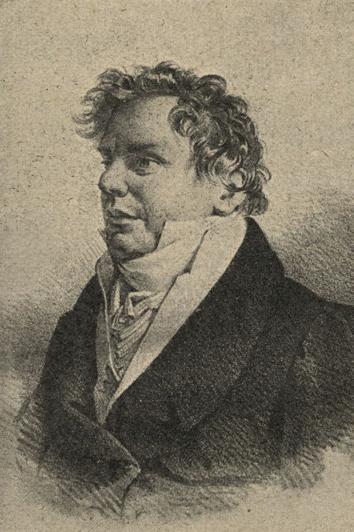
The B-flat quartet comprises six movements, balancing profundity and humor. Indeed, both of these sentiments are embodied in the first page of the quartet, which boldly contrasts a solemn Adagio proclamation with a skittering Allegro strain of rhythmic vivacity. These two thematic cells together comprise the main theme and are juxtaposed throughout the movement. A lyrical episode, embellished with the Allegro’s fast scales, provides contrast as a second theme. The following Presto movement is a tiny, quicksilver scherzo. The Andante con moto develops logically and inexorably from the motivic germs sown in its opening measures. Placed as an emotional and stylistic foil between this movement and the deeply felt Cavatina (short aria) is a Danza tedesca (German Dance) in
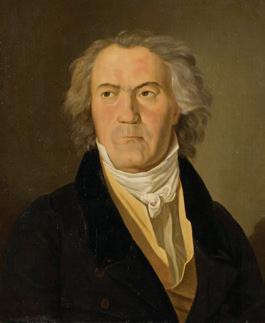
opposite page: Ludwig van Beethoven, portrait in oil attributed to Ferdinand Georg Waldmüller (1793–1865), 1823. Collection of Ancient Musical Instruments, Kunsthistorisches Museum, Vienna | this page: Ignaz Schuppanzigh, ca. 1830
COMMENTS
the popular manner of Beethoven’s day. Holz reported that Beethoven “wrote the Cavatina amid sorrow and tears; never did his music breathe so heartfelt an inspiration, and even the memory of this movement brought tears to his eyes.”
Beethoven left the question of the quartet’s finale unsettled, so that the work may be performed with either the Grosse Fugue of the original version or the substitute movement that he provided for it shortly before his death. The Grosse Fugue, grand in size and Promethean in thought, bursts from the strict model of the baroque genre by inextricably combining counterpoint, variation, and thematic development: it is a virtual compendium of Beethoven’s techniques at their highest level. (Beethoven placed upon the score the legend, tantôt libre, tantôt recherchée—sometimes free, sometimes
PROFILES
Qing Hou Violin
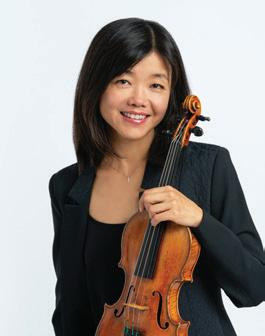
Qing Hou has been a member of the Chicago Symphony Orchestra since 1997. Before joining the Orchestra, she was a member of the San Francisco Symphony. An avid chamber musician, she has performed at the Manchester Music Festival, Music in the Vineyards,
studied.) English musicologist Philip Radcliffe noted that the Grosse Fugue “is best understood if regarded not as a highly eccentric fugue, but as a kind of symphonic poem consisting of several contrasted but thematically related sections and containing a certain amount of fugal writing.” The work’s principal thematic material is presented dramatically in a short, introductory “overture.” There follow a long fugue, four sections of motivic development in dense counterpoint (Meno mosso e moderato in 2/4 time; Allegro molto e con brio in 6/8; and altered returns of the 2/4 and 6/8 sections), and a modification of the opening fugue as conclusion.
Richard E. Rodda, a former faculty member at Case Western Reserve University and the Cleveland Institute of Music, provides program notes for many American orchestras, concert series, and festivals.
El Paso Pro Musica, ChamberFest Brown County, Token Creek Chamber Music Festival, and Chamber Music Quad Cities. She has performed with Mistral Music (Boston) for many years. Chamber music collaborators have included artists such as Pinchas Zukerman, Daniel Barenboim, and Yefim Bronfman. Hou has toured Germany, France, Italy, Switzerland, and Luxembourg with musicians from the German Radio Philharmonie Saarbrücken.
In 1997 Hou founded the Lincoln String Quartet with three other CSO colleagues, including her sister, violinist Lei Hou, and violist Lawrence Neuman, who is now her husband. The quartet has been featured many times in performances at the Northwestern University Winter Chamber Music Festival, on WFMT radio, and at venues all around Chicago. In addition, the quartet has performed in Santiago, Chile, as part of the Beethoven Foundation concert series.
As a soloist, Qing Hou has appeared with orchestras in Boston, Baltimore, Chicago, and China. In the fall of 2003, she made her debut as a soloist with the Chicago Symphony Orchestra under Daniel Barenboim.
A native of China, Hou studied at the Central Conservatory in Beijing before coming to the United States in 1988 to continue her training. She holds degrees from the Peabody Conservatory and the New England Conservatory. Hou is an artist-faculty member at the Chicago College of Performing Arts at Roosevelt University.
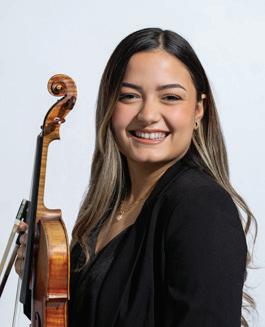
Originally from Barquisimeto, Venezuela, Gabriela Lara began her violin studies at age eight and later joined the Latin American Violin Academy. She was also part of Venezuela’s El Sistema,
touring Europe in 2014 with the Teresa Carreño Symphony Orchestra.
In 2016 she performed with Gustavo Dudamel and the Simón Bolívar Symphony Orchestra on a European tour that included a concert at the Berlin Philharmonic. She also performed with Sir Simon Rattle on a tour featuring concerts at the Salzburg Festival.
Since moving to the United States in 2017, Lara has been recognized as the second-place winner in the 2021 Sphinx Solo Competition and the winner of the 2021 Frank Preuss International Violin Competition. She was the recipient of a 2022 Project Inclusion Fellowship from the Grant Park Symphony Orchestra. Lara completed her bachelor’s degree in violin performance at Roosevelt University in 2022 under Almita Vamos and her master’s degree in Suzuki pedagogy there in 2024.
Lara was a member of the Civic Orchestra of Chicago in the 2022–23 season, serving as concertmaster from January to June 2023.
She was the inaugural CSO Fellow, holding that position and performing with the CSO first in the 2022–23 season and continuing in the 2023–24 season as the Michael and Kathleen Elliott Fellow before joining the Milwaukee Symphony Orchestra. Lara began her position as a member of the CSO first violin section in January 2025, becoming the first Orchestra musician appointed by Zell Music Director Designate Klaus Mäkelä.
Lawrence Neuman Viola
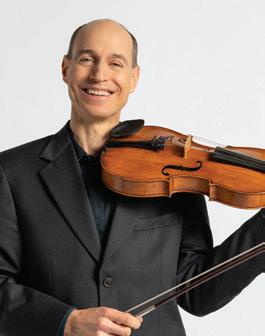
Lawrence Neuman has been a member of the Chicago Symphony Orchestra since 1991. Before coming to Chicago, he was violist with the Miami String Quartet. As a chamber musician, he is frequently heard throughout the Chicago area and has performed across the United States and Europe. He has appeared at festivals and chamber music series in Boston, Marlboro, La Jolla, Madison, Napa, Portland, and Davenport. Chamber music collaborators have included Daniel Barenboim, Pinchas Zukerman, Yefim Bronfman, Lydia Artymiw, Gil Shaham, and Aaron Rosand.
During the 1998–99 season, Neuman took a leave of absence from the CSO to serve as principal viola of the Saint Paul Chamber Orchestra. For several years, he has taught viola and chamber music at the Chicago College of Performing Arts at Roosevelt University.
Daniel Katz Cello
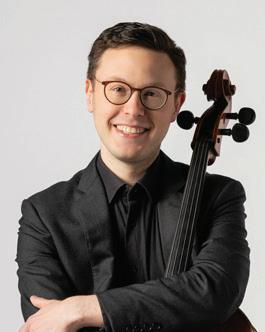
A Chicago native, Daniel Katz was appointed to the Chicago Symphony Orchestra in 2011 by Riccardo Muti. Prior to joining the Orchestra, he was a regular substitute with the CSO and the Cleveland Orchestra and was also a member of the Grant Park Symphony Orchestra. Under the guidance of Hans Jensen, he received a doctor of musical arts degree with honors from Northwestern University, a master’s degree from the New England Conservatory under Laurence Lesser, and a bachelor’s degree from Northern Illinois University with Marc Johnson. Other teachers include Paul Katz, Richard Hirschl, and Gilda Barston. As a dedicated teacher, Katz serves on the faculty at Roosevelt University’s Chicago College of Performing Arts and maintains a private studio. Previously, he was an adjunct assistant professor and artist-in-residence at the University of Notre Dame. Katz has participated in several major music festivals, including Tanglewood, Verbier, Sarasota, and Norfolk. He has performed on live solo and chamber music broadcasts on WFMT Chicago. Recently, Katz recorded an album of works by Victoria Bond (Naxos) and a disc of James Stephenson’s works (Liquid Melancholy: Clarinet Music of James M. Stephenson, Cedille), both with the ensemble Chicago Pro Musica.