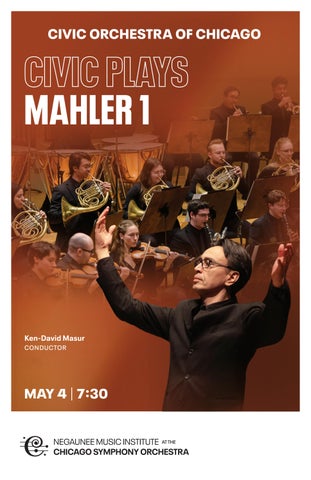
CIVIC PLAYS MAHLER 1
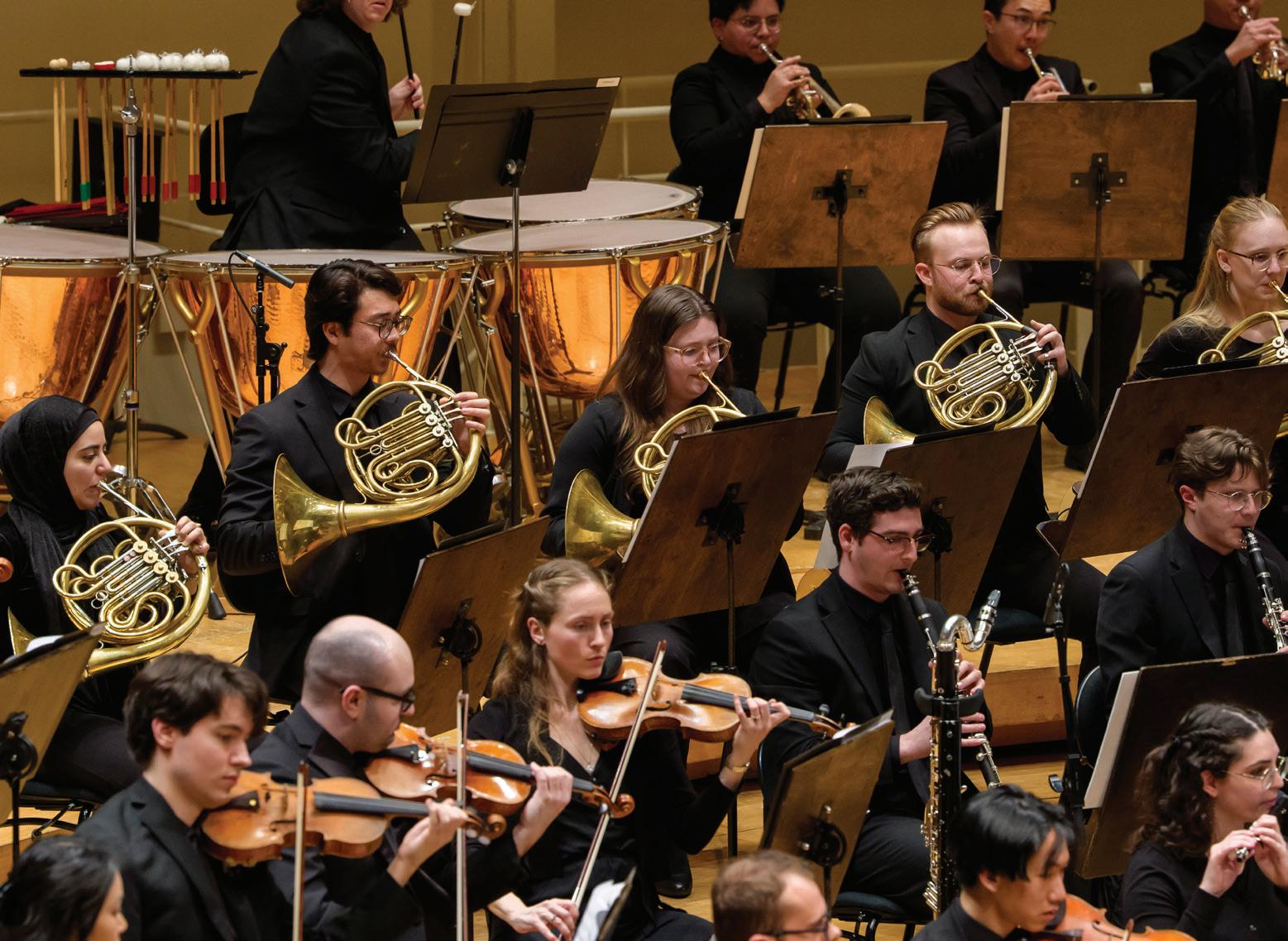


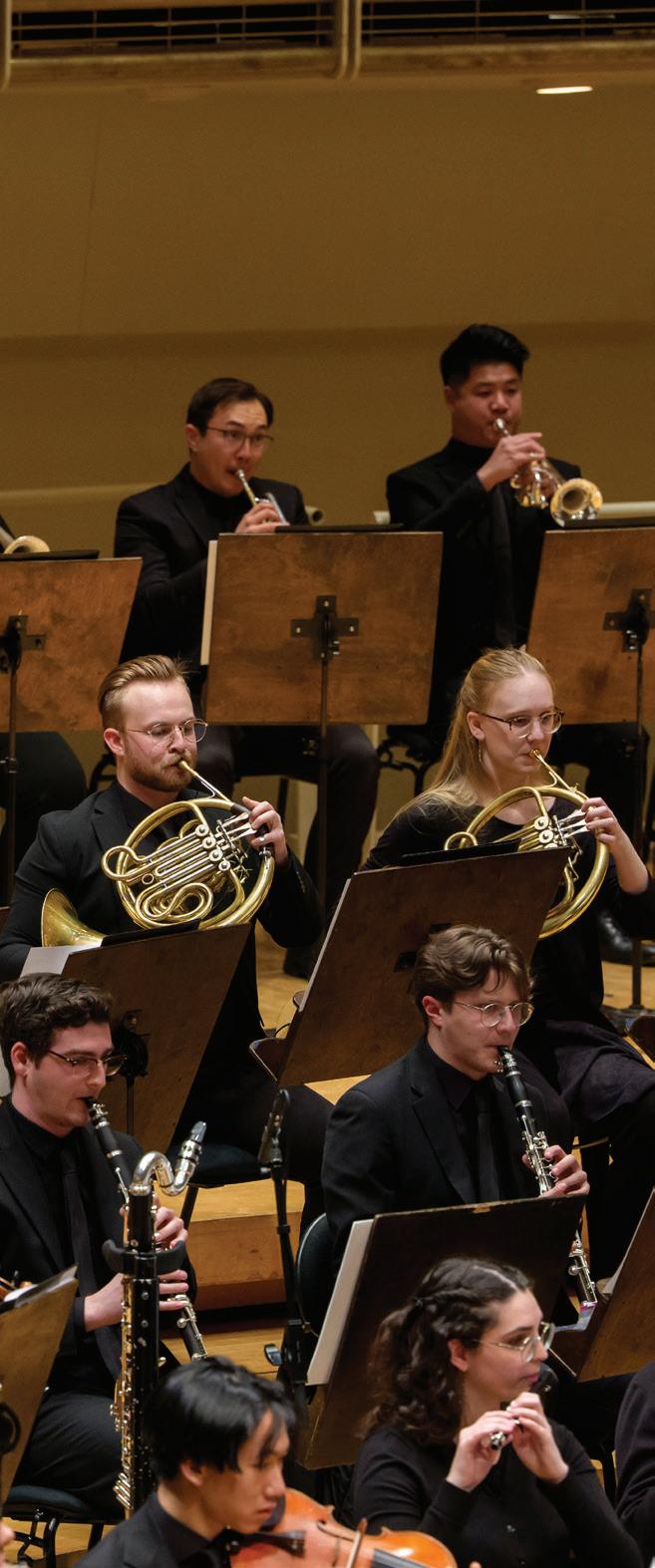
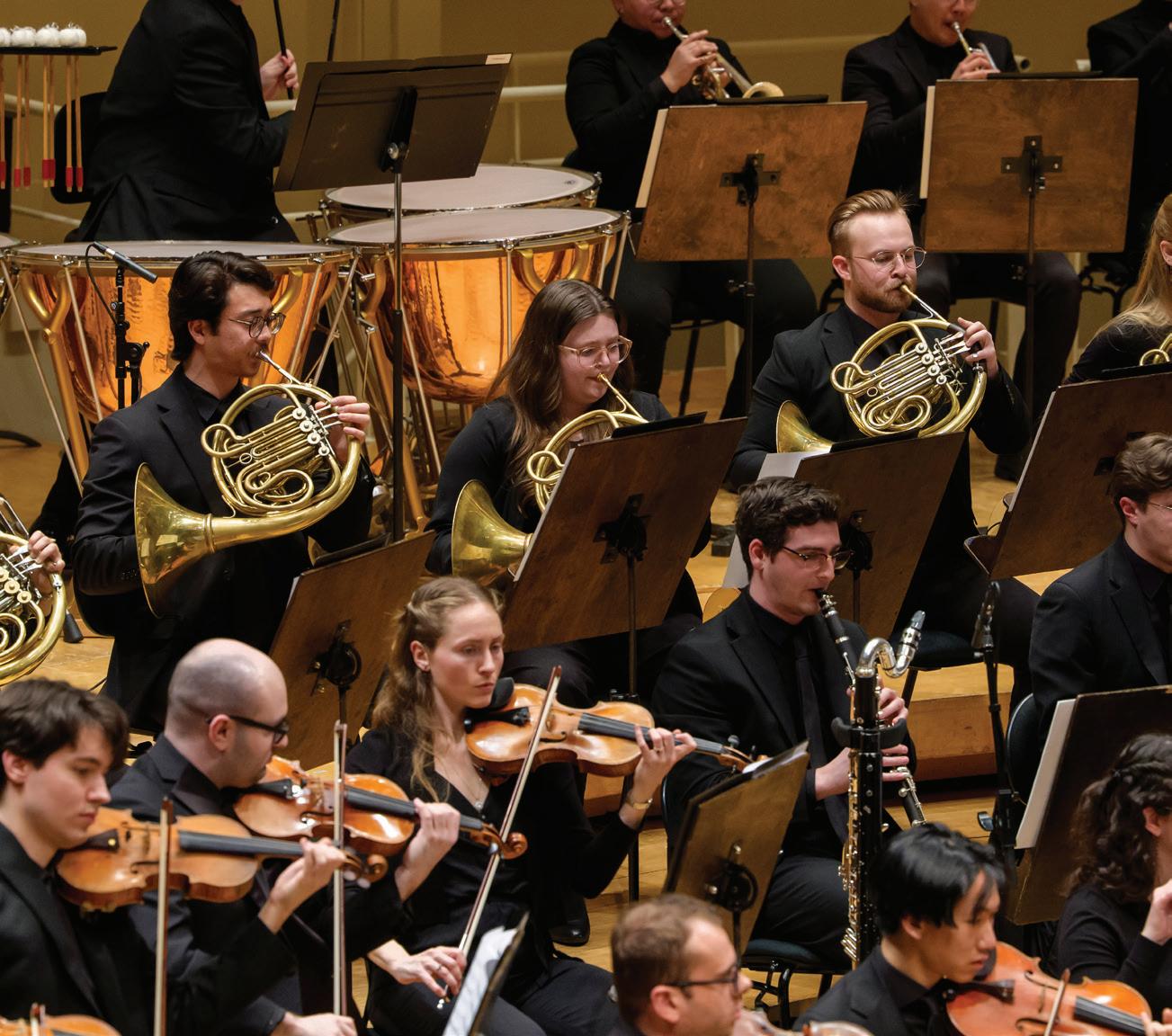
MAY 4 | 7:30
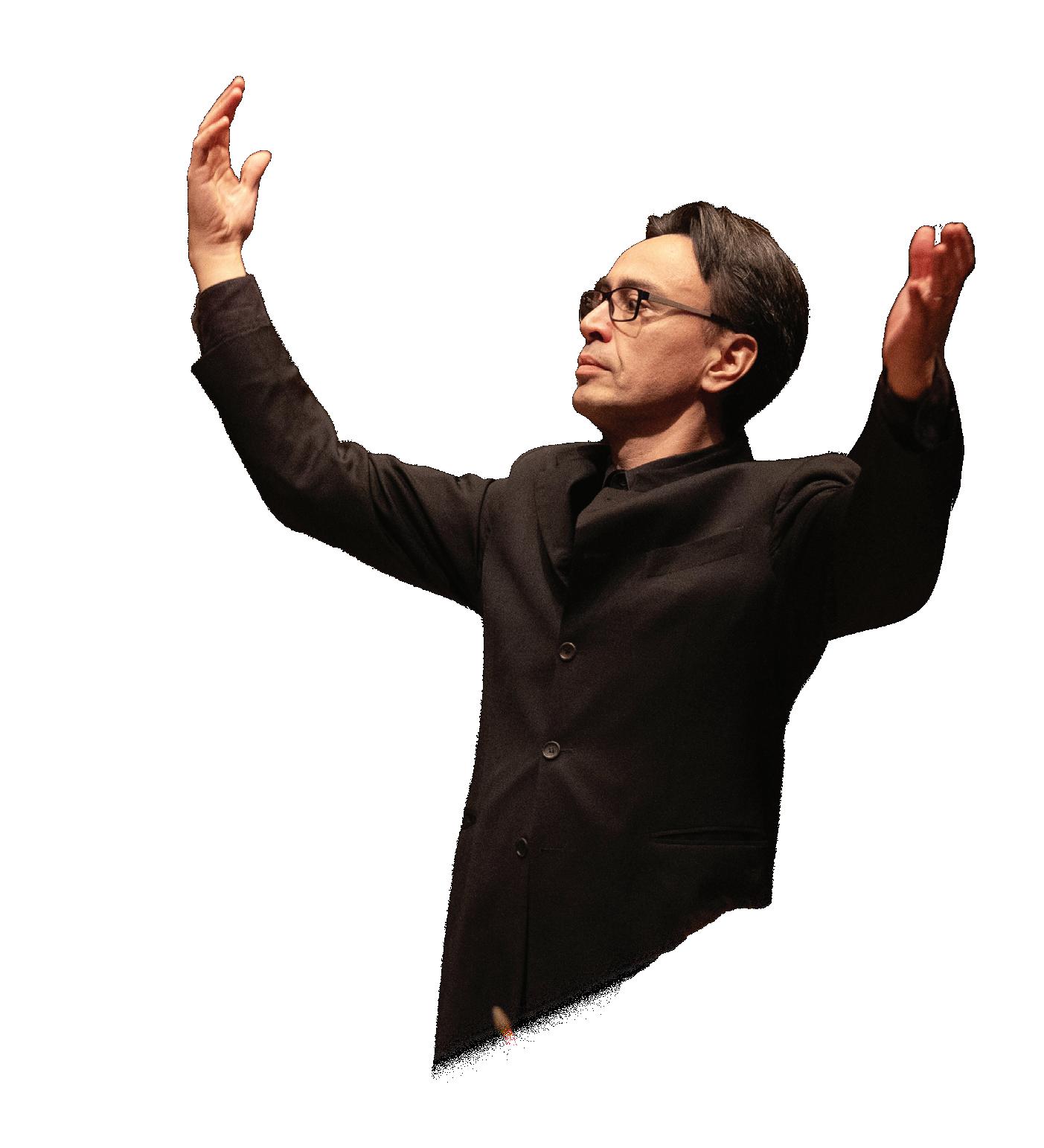
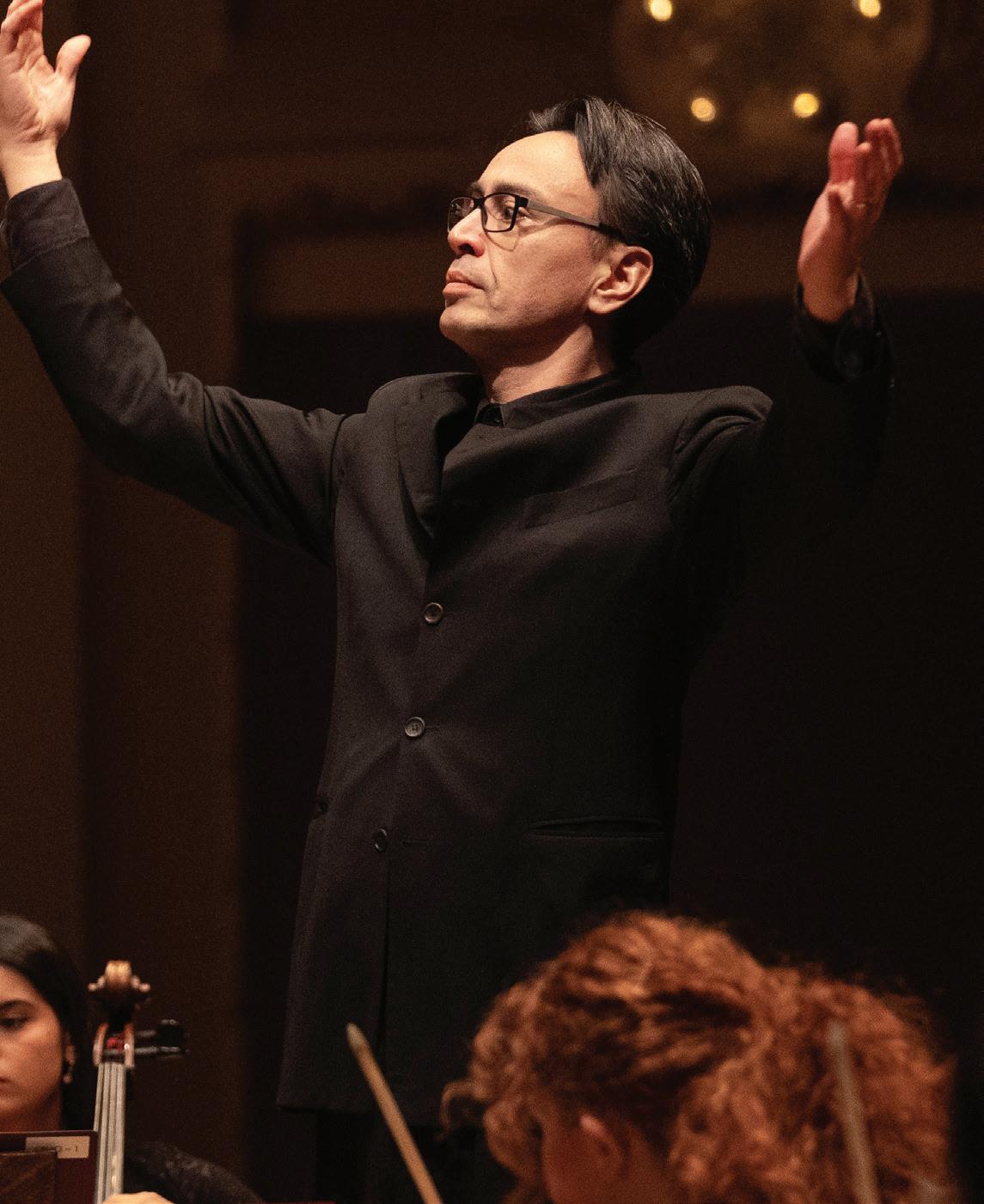
Ken-David Masur conductor
The 2025–26 Civic Orchestra season is generously sponsored by Lori Julian for the Julian Family Foundation, which also provides major funding for the Civic Fellowship program.
ONE HUNDRED SEVENTH SEASON
CIVIC ORCHESTRA OF CHICAGO
KEN-DAVID MASUR Principal Conductor
The Robert Kohl and Clark Pellett Principal Conductor Chair
Monday, May 4, 2026, at 7:30
Ken-David Masur Conductor
WAGNER Prelude to Die Meistersinger von Nürnberg
TAKEMITSU Visions Mystère Les yeux clos
INTERMISSION
MAHLER Symphony No. 1 in D Major Slow. Dragging. Like a sound of nature— At the beginning, very leisurely With strong movement, but not too fast Solemn and measured, without dragging Stormily
The 2025–26 Civic Orchestra season is generously sponsored by Lori Julian for the Julian Family Foundation, which also provides major funding for the Civic Fellowship program.
The Civic Orchestra of Chicago acknowledges support from the Illinois Arts Council.
COMMENTS by Phillip Huscher
RICHARD WAGNER
Born May 22, 1813; Leipzig, Germany
Died February 13, 1883; Venice, Italy
Prelude to Die Meistersinger von Nürnberg
COMPOSED
1862–67
FIRST PERFORMANCE
June 21, 1868; Munich, Germany
INSTRUMENTATION
2 flutes and piccolo, 2 oboes, 2 clarinets, 2 bassoons, 4 horns, 3 trumpets, 3 trombones, tuba, timpani, percussion, strings
APPROXIMATE PERFORMANCE TIME 10 minutes
Die Meistersinger von Nürnberg has always stood apart from the rest of Wagner’s output because it is, on the surface, a comic opera; it warrants comparison with few other comic operas beyond those of Mozart because it is essentially so serious and moving. The American composer and critic Virgil Thomson said that “it is all direct and human and warm and sentimental and down-toearth. It is unique among Wagner’s theatrical works in that none of the characters takes drugs or gets mixed up with magic.” Wagner wrote Die
Meistersinger in a slump, financially and emotionally. After having abandoned work on the Ring, the greatest undertaking of his career, with little hope of ever getting it on the stage, he turned out two enormously successful masterpieces, Tristan and Isolde (arguably the most important score of that masterpiece-packed century) and Die Meistersinger von Nürnberg.
Die Meistersinger tells the story, in Thomson’s words, of a “never-never land where shoemakers give vocal lessons, where presidents of music societies offer their daughters as prizes in musical contests, and where music critics believe in the rules of composition and get mobbed for preferring young girls to young composers.” Despite all the shenanigans and frivolity, Die Meistersinger includes some of Wagner’s most deeply touching music. “I laugh and cry while writing it,” Wagner himself said, and many listeners since have responded similarly.
The prelude to the opera begins in the majesty of C major with the important music of the mastersingers’ guild and then includes
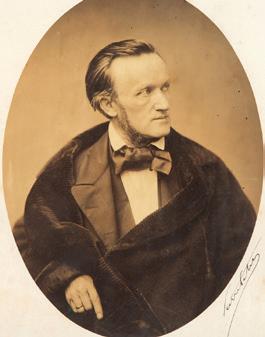
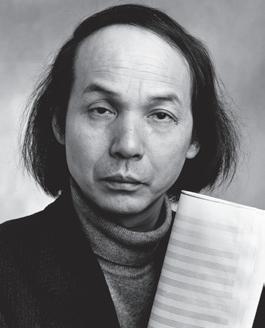
this page: Richard Wagner, photographed by Pierre Petit (1831–1909), 1861, Paris, France, during the premiere of Tannhäuser | opposite page: Tōru Takemitsu, portrait, 1981, by Jack Mitchell (1925–2013)/ Getty Images
the prize-winning song of the young aspirant Walther, followed by the festive processional of the masters. Those are the three main themes, though Wagner also works into the prelude the eager apprentices and the chattering
TŌRU TAKEMITSU
Born October 8, 1930; Tokyo, Japan
Died February 20, 1996; Tokyo, Japan
Visions
COMPOSED 1990
FIRST PERFORMANCE
March 8, 1990, Chicago Symphony Orchestra. Daniel Barenboim conducting
INSTRUMENTATION
4 flutes and piccolo, alto flute, bass flute, 3 oboes, oboe d’amore, english horn, 3 clarinets, E-flat clarinet, bass clarinet, contrabass clarinet, 3 bassoons and double bassoon; 4 horns, 3 trumpets and bass trumpet, 3 trombones; celesta, piano, 2 harps, glockenspiel, vibraphone, suspended cymbals, tam-tam, chinese cymbal, antique cymbal, tubular bells, strings
APPROXIMATE PERFORMANCE TIME 14 minutes
Commissioned by the Chicago Symphony Orchestra to honor the Orchestra’s centennial
spectators at the song competition. The prelude is a brilliant achievement, crowned by the stroke of the triangle, marking the moment when Wagner brings together, in magnificent polyphony, his three principal themes.
At the age of sixteen, while mountain climbing in his native Japan, Tōru Takemitsu dropped his camera into a waterfall. Trying to retrieve it, he caught pneumonia and was forced to spend many weeks at home, convalescing. It was there that he listened to music on his radio almost continually and decided—even though he had not studied music before—to become a composer. He began studying scores and teaching himself to play the piano. At eighteen, he sought out Yusuji Koyose as his teacher; although he studied with him off and on for a brief time, Takemitsu remained largely self-taught. (His main source of education was “this daily life, including all of music and nature.”) Significantly, Takemitsu first studied Western, not traditional Japanese music. (During the war in Japan, listening to Western music
was forbidden,” Takemitsu has said. “And so, when the war was over, we young people were thirsty for Western music.”) It was another decade before he became aware of the music of his own land. Ultimately, in a way that makes his work utterly unique, he lived out two different things at once: Western innovation and Japanese tradition.
Today, Tōru Takemitsu is recognized as the most important composer to bridge the musical worlds of the East and West, but the gesture has not been simple. Takemitsu pointed out that the word East implies great diversity in itself. So, too, the word West. But it is the complex relationship between the two—those things in common as well as the differences—that inspired him. The assimilation has not always been easy, nor, in some ways, possible. As he admitted to the American pianist, Peter Serkin, for example, it is very difficult for Japanese composers to write fast music.
Takemitsu had a larger understanding of music than most composers. He learned our music as a foreigner, and he studied his own country’s music as someone who knew Western music first. He did not limit himself even to those musics. He walked the mountains of Indonesia, stopping in the villages to listen to music. In the early 1980s, he spent a few days on a small, remote Australian island with a group of bushmen—Takemitsu was the first Japanese person to visit the island—and found music unlike any we know. Song and dance among the Aboriginal people are not distinct from the whole of human experience, and he found it
difficult to draw a distinction between what is music and what is life—these men did not even have a special word for music. Again, he recognized what he had always known: that some music is so much a part of its landscape—musical expression is so embedded in life itself—that it is not easily transplanted, or understood, elsewhere.
In February 1968, Takemitsu was stranded in Chicago for nearly a week by a blizzard that closed down the airport, bringing many lives to a halt. For Takemitsu, however, it provided time to explore the Art Institute of Chicago, where he stopped, in particular admiration, before the work of Odilon Redon. Some twenty years later, when he was asked to write a piece honoring the centennial of the Chicago Symphony Orchestra, he thought first not of that prodigious snowfall and a bitter cold to which he was still unaccustomed, but of Odilon Redon.
Two Redon images in particular, Mystère and Les yeux clos, came to mind, and suggested this music for the Chicago Symphony. Twice before, Takemitsu had written music inspired by Les Yeux clos. Those works, composed in 1979 and 1989, are both for solo piano. The new version, for full symphony orchestra, is the final one. Takemitsu has said that the three pieces are all quite different, although they do share an emphasis on certain characteristic intervals, the major 7th in particular.
Like virtually all his music written after 1970, Visions was composed in a cottage in the woods, near a volcano,
two hours by train northwest of Tokyo. He worked on this music on and off for nearly one year in his tiny, meticulous studio there, equipped with little more than an upright piano and a view of the forest. Knowing of the virtuosity of the Chicago Symphony, Takemitsu wrote Visions for a very large array of instruments, with an unusual preponderance of low instruments not often encountered—the bass flute, the bass clarinet, the contrabass clarinet, the double bassoon, and the bass trumpet. The bass trumpet, which Takemitsu found suitable for his music, plays a
GUSTAV MAHLER
Born July 7, 1860; Kalischt, Bohemia
Died May 18, 1911; Vienna, Austria
Symphony No. 1 in D Major
COMPOSED
February–March 1881, incorporating much earlier music, and later frequently revised
FIRST PERFORMANCE
November 20, 1889; Budapest, Hungary. The composer conducting
INSTRUMENTATION
4 flutes and 3 piccolos, 4 oboes and english horn, 4 clarinets, 2 E-flat clarinets and bass clarinet, 3 bassoons and contrabassoon, 7 horns, 4 trumpets, 3 trombones, tuba, timpani, bass drum, cymbals, triangle, tam-tam, harp, strings
APPROXIMATE PERFORMANCE TIME
62 minutes
particularly important role throughout Visions; in the final page of Les yeux clos, it sounds from offstage.
Although Takemitsu often wrote for large orchestra, his orchestration in Visions is unusual, and even adventurous, not only because of the exceptional use of lower instruments but also because he wrote for this enormous orchestra as if it were a chamber ensemble, with much delicate and exposed music—a kind of daring that was only possible, he said, because he trusted the players of the Chicago Symphony so very much as musicians.
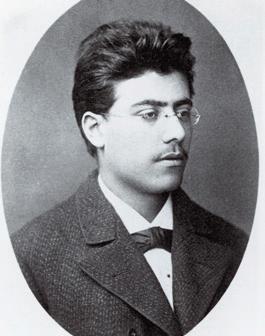
When Alma Schindler first met Gustav Mahler, whom she later married, she could only remember how much she had disliked his First Symphony. She wasn’t alone. The history of this symphony, even into relatively recent times, is one of misunderstanding and rejection. The first performance, in Budapest in 1889, was greeted with indifference, bewilderment, and, in the words of the local critic, “a small, but, for all that, audible element of opposition.” Mahler seldom
COMMENTS
understood the animosity his music aroused. A few years later, after Alma had taken his name and converted to the cause, Mahler wrote to her after conducting the First Symphony: “Sometimes it sent shivers down my spine. Damn it all, where do people keep their ears and their hearts if they can’t hear that!”
But as Alma knew, people didn’t always feel what Mahler felt. For years, the First Symphony led an unhappy existence, greeted by chilly receptions whenever it was played and plagued by the composer’s continual fussing, both over details and the big picture. No other symphony gave him so much trouble. He couldn’t even decide if this music was a symphonic poem, a program symphony, or a symphony plain and simple—or whether it should contain four or five movements. Figuring all that out was not an act of indecisiveness, but of exploration. And by the time Mahler published this music as his Symphony no. 1 some fifteen years after he began it, he had not only discovered for himself what a symphony could be, but he had also changed the way we have defined that familiar word ever since.
We begin in Kassel in 1884, with Johanna Richter, a soprano destined for fame not as a singer, but as the inspiration for Mahler’s first true masterpiece, the Songs of a Wayfarer, and as a stimulus for this symphony. Mahler had gone to Kassel as a conductor, but he found the working conditions unsatisfactory. Whatever he missed in his work he gained in life and love. Johanna Richter—or, more precisely, unreturned love—unlocked Mahler’s deepest feelings that year and set his course, not as an accomplished conductor, which he surely was, but as a composer of vision and daring. It took the rest of the musical establishment awhile to see it that way.
Mahler followed an unorthodox path in getting from Johanna Richter to his First Symphony, but it’s one he would choose again and again when writing music, and it’s the process as much as the composer himself that gives Mahler’s symphonies their unconventional stamp. Henry James once described a novelist as someone on whom nothing is lost. For Mahler, that defined a symphonist. The First Symphony is indebted, in various ways, to Johanna Richter; the Wayfarer songs;
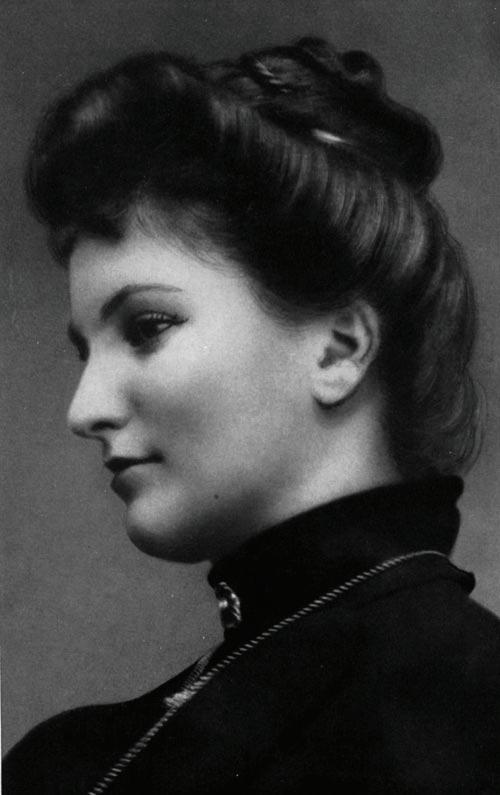
previous page: Gustav Mahler, portrait, ca. 1880. Hulton Archive/Imagno/Getty Images | this page: Alma Schindler (1879–1964), portrait, ca. 1900, who became Mahler’s wife in 1902 | opposite page: The Hunter’s Funeral Procession, a woodcut after a drawing by Moritz von Schwind (1804–1871), 1850, that inspired the music of the third movement of Mahler’s Symphony no. 1. Munich, Germany
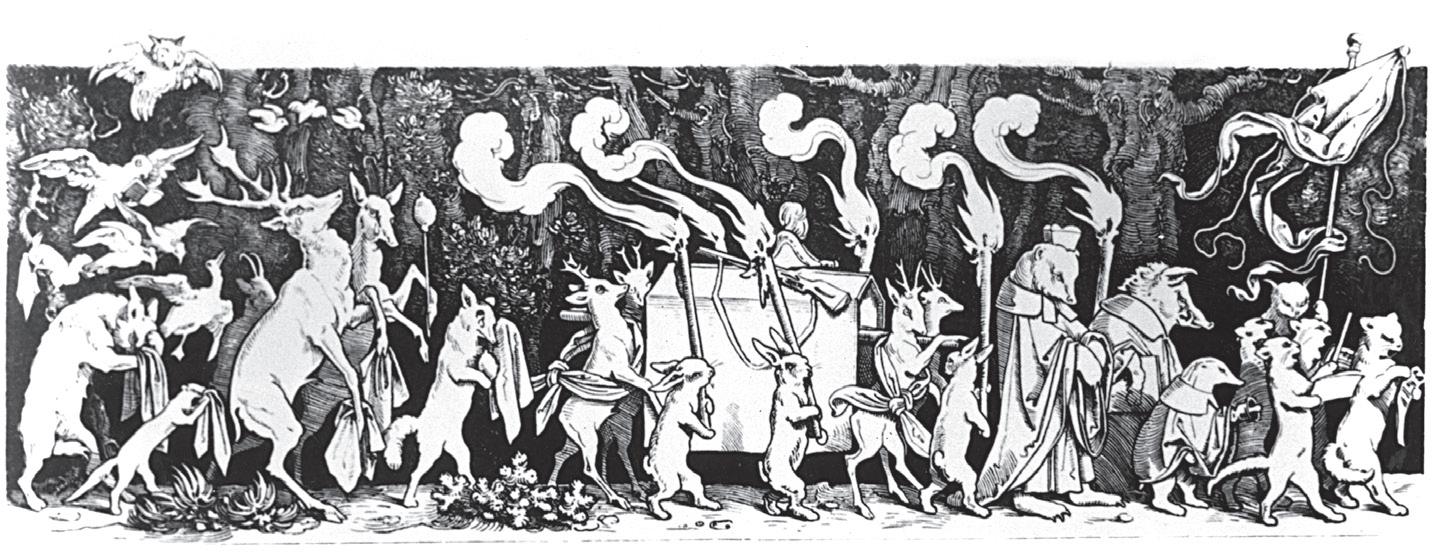
incidental music Mahler wrote for a production of Joseph Victor von Scheffel’s Der Trompeter von Säkkingen; a familiar children’s round; Marion von Weber, the wife of the composer Carl Maria von Weber’s grandson; yodeling; military fanfares; an early nineteenth-century woodcut; café music; the opening of Beethoven’s Ninth Symphony; birdsong at dawn; a love song he wrote in 1880; reveille; the German ländler—and sights, sounds, and feelings we will never know. Since Mahler hadn’t written a large, purely orchestral work before, it took him some time to find the right way to bring all his resources together and to make a convincing whole of so many parts. In the meantime, life presented new choices, and love was reawakened by Marion von Weber.
The piece Mahler introduced in Budapest on November 20, 1889, was billed as a “Symphonic Poem in two parts”—with three movements in part 1 and two in part 2. Only the funeral march was labeled to help listeners coming to the music cold. Today it’s easy to see that it wasn’t the lack of labels or comments, but simply the
staggering range and provocative juxtaposition of materials that bothered the first audience. For the next performances, in Hamburg and Weimar (in 1893 and 1894), Mahler drew up a descriptive program, gave titles to the movements, and called the whole piece “Titan, a tone poem in symphonic form,” after the popular novel by Jean Paul. For Berlin in 1896, Mahler again changed his mind, dropped the titles and the programmatic explanation, omitted the second movement (Blumine) that opens this week’s concert, and settled on “Symphony in D major, for large orchestra.” In Vienna in 1900, a notice in the program indicated that Mahler wanted no explanatory notes of any kind. Why such indecision? In March 1896, at the time of the Berlin performance, Mahler wrote to the critic Max Marschalk about adding the program in the first place:
At the time, my friends persuaded me to provide a kind of program for the D major symphony in order to make it easier to understand. Therefore, I had thought up this title and explanatory material
COMMENTS
after the actual composition. I left them out for this performance, not only because I think they are quite inadequate and do not even characterize the music accurately, but also because I have learned through past experiences how the public has been misled by them.
Still, Mahler’s First Symphony wasn’t understood. Critics in Frankfurt complained about the program; those in Berlin missed it. (At this same time, Strauss was writing Till Eulenspiegel, Also sprach Zarathustra, and Ein Heldenleben, which begged the same questions.) Even though Mahler finally decided to present this symphony as abstract music with no story to tell, he wrestled with the same dilemma again in writing symphonies nos. 2 and 3 and came to slightly different conclusions each time. Mahler’s final thoughts on this music were published in 1899 as Symphony no. 1, in four movements, and that’s how it’s known today.
The first movement begins “like a sound of nature,” with fanfares and birdcalls sounding from the distance over the gentle hum of the universe, tuned to A-natural and scattered over seven octaves. The method is one learned by every composer since Beethoven, whose Ninth Symphony opens with bits and pieces that gradually become music. It took Mahler a long time to get the opening to sound the way he wanted it; every effect is precisely calculated, with consideration given not only to the most delicate
shades of dynamics, but to the placement of the players on and off the stage.
A cuckoo—unlike Beethoven’s cuckoo in the Pastoral Symphony, it sings the interval of a fourth instead of a third— eventually pushes the sounds of nature into a lovely, rolling melody. That tune, beginning with the cuckoo’s descending fourth, comes from the second Wayfarer song, “Ging heut’ Morgen übers Feld” (I Went Through the Fields This Morning), and its proud walking music takes Mahler a long way. Mahler reinvents the song as he goes, reshuffling phrases and motives so that even someone who knows the song finds this music continually fresh.
Next comes a brief scherzo set in motion by the foot-stomping dances and yodeling that Mahler heard and had already put to good use in one of his first songs, “Hans und Grete,” in 1880. “Dance around, around!,” the song goes. “Let whoever is happy weave in and out! Let whoever has cares find his way home.” There is a wistful trio, music Mahler might have heard in a Viennese café, fuller of cares than joy, and then the ländler resumes.
The third movement used to upset audiences, and even today it’s puzzling to those hearing it for the first time. What are we to make of this odd assortment: a sad and distorted version of “Frère Jacques” (Mahler knew it as “Bruder Martin”); a lumbering funeral march; some cheap dance-band music remembered by pairs of oboes and trumpets over the beat of the bass drum; and the ethereal closing pages of the Wayfarer songs—heaven and earth all
rolled into one. Mahler’s only clue is The Hunter’s Funeral Procession—a woodcut made earlier in the century by Moritz von Schwind, a friend of Schubert— which he claimed was the inspiration for this music. About the vulgar band music, Mahler leaves no doubt: “With parody,” he writes at the top of the page, just as the drum and cymbal join in.
The finale begins with a “flash of lightning from a dark cloud,” Mahler tells us. “It is simply the cry of a wounded heart.” This is music in search of victory, and Mahler retreats from battle several times before he triumphs. The first stop allows us to savor some lovely pastoral music we would
recognize if Mahler hadn’t ultimately chosen to omit his original second movement, Blumine. Later we return to the fields of the first movement, but we’re no longer setting off on our journey—we’re headed straight for the triumph that Mahler’s wayfarer couldn’t achieve. This time, success is swift and unequivocal, and when the horns are asked to play out—“even over the trumpets”—victory is won.
Phillip Huscher is the program annotator for the Chicago Symphony Orchestra. A gift to the Civic Orchestra of Chicago supports the rigorous training that members receive throughout the season, which includes coaching from musicians of the Chicago Symphony Orchestra and world-class conductors. Your gift today ensures that the Chicago Symphony Orchestra Association will continue to enrich, inspire, and transform lives through music.
PROFILES
Ken-David Masur Conductor
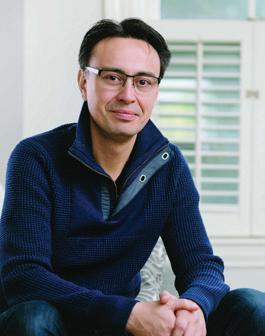
Ken-David Masur celebrates his seventh season as music director of the Milwaukee Symphony Orchestra and principal conductor of the Civic Orchestra of Chicago.
Masur’s tenure in Milwaukee has been notable for innovative thematic programming and bridge building, including a festival celebrating the music of the 1930s, when the Bradley Symphony Center was built; the Water Festival, which highlighted local community partners whose work centers on water conservation and education; and a new annual citywide Bach Festival, celebrating the abiding appeal of J.S. Bach’s music in an ever-changing world. He has also instituted a multi-season artist-in-residence program and led highly acclaimed performances of major choral works, including a semi-staged production of Peer Gynt.
In 2025–26 Masur will lead celebrations of the fiftieth anniversary of the Milwaukee Symphony Chorus. He and the MSO will reunite with longtime collaborators Augustin Hadelich, Orion Weiss, Stewart Goodyear, Nancy Zhou, and Bill Barclay and Concert Theatre Works to celebrate America’s 250th birthday with a program interweaving the music of Aaron Copland with the words of Mark Twain.
Passionate about contemporary music, Ken-David Masur has conducted and commissioned numerous new works, such as Wynton Marsalis’s Harold Haller and Hallelujah, Augusta Read Thomas’s Bebop Kaleidoscope— Homage to Duke Ellington, and Unsuk Chin’s Mannequin.
Masur has recorded with the English Chamber Orchestra and with the Stavanger Symphony, whose album was named WQXR’s Best New Classical Release. He also received a Grammy nomination from the Latin Recording Academy for Best Classical Album of the Year for his work as a producer of Salon Buenos Aires.
Masur and his wife, pianist Melinda Lee Masur, are founders and artistic directors of the Chelsea Music Festival, an annual summer festival in New York City, which celebrated its sixteenth anniversary in 2025. Its programs range from baroque and classical to contemporary and jazz, with an emphasis on intersecting with the culinary and visual arts.
Born and raised in Leipzig, Germany, Masur was trained at the Mendelssohn Academy in Leipzig, the Gewandhaus Children‘s Choir, Detmold Academy, and the Hanns Eisler Conservatory in Berlin. While an undergraduate at Columbia University in New York, Masur became the first music director of the Bach Society Orchestra and Chorus.
PHOTO
Civic Orchestra of Chicago
The Civic Orchestra of Chicago is a training program of the Chicago Symphony Orchestra’s Negaunee Music Institute that prepares young professionals for careers in orchestral music. It was founded during the 1919–20 season by Frederick Stock, the CSO’s second music director, as the Civic Music Student Orchestra, and for over a century, its members have gone on to secure positions in orchestras across the world, including over 160 Civic players who have joined the CSO. Each season, Civic members are given numerous performance opportunities and participate in rigorous orchestral training with its principal conductor, Ken-David Masur, distinguished guest conductors, and a faculty of coaches comprised of CSO members. Civic Orchestra musicians develop as exceptional orchestral players and engaged artists, cultivating their ability to succeed in the rapidly evolving music world.
The Civic Orchestra serves the community through its commitment to present free or low-cost concerts of the highest quality at Symphony
Center and in venues across Greater Chicago, including annual concerts at the South Shore Cultural Center and Fourth Presbyterian Church. The Civic Orchestra also performs at the annual Crain-Maling Foundation CSO Young Artists Competition and Chicago Youth in Music Festival. Many Civic concerts can be heard locally on WFMT (98.7 FM), in addition to concert clips and smaller ensemble performances available on CSOtv and YouTube. Civic musicians expand their creative, professional, and artistic boundaries and reach diverse audiences through educational performances at Chicago public schools and a series of chamber concerts at various locations throughout the city.
To further expand its musician training, the Civic Orchestra launched the Civic Fellowship program in the 2013–14 season. Each year, up to twelve Civic members are designated as Civic Fellows and participate in intensive leadership training designed to build and diversify their creative and professional skills. The program’s curriculum has four modules: artistic planning, music education, social justice, and project management.
Civic Orchestra of Chicago
Ken-David Masur Principal Conductor
The Robert Kohl and Clark Pellett Principal Conductor Chair
VIOLINS
Natalie Boberg
Pavlo Kyryliuk
Maria Paula Bernal
Kimberly Bill+ Kaylin Chung
Adam Davis
Rose Haselhorst
John Heo
Amina Knapp
Ben Koenig
Hobart Shi
Mia Smith
Justine Jing Xin Teo*
Jingjia Wang
Lina Yamin
Abigail Yoon
Naomi Powers
Sage Chen
Iwona Augustyn
Carlos Chacon
Evan Chen
Joyce Chen
Ebedit Fonseca
Hojung Christina Lee
June Lee
Lara Madden Hughes
Nelson Mendoza+ Matthew Musachio
Lorena Uquillas
Yulia Watanabe-Price
VIOLAS
Sava Velkoff*
August DuBeau
Lucie Boyd
Darren Carter
Eugene Chin
Jacob Davis
Elena Galentas
Matthew Nowlan**
Benjamin Perez
Yat Chun Justin Pou
CELLOS
Buianto Lkhasaranov
David Caplan
Krystian Chiu
Luis Gonzalez
J Holzen*
Nick Reeves
Ashley Ryoo
Somyong Shin
Santiago Uribe-Cardona
Shun-Ming Yang
BASSES
Gisel Dominguez
Alexander Wallack
Albert Daschle
Walker Dean
Bennett Norris
Jonathon Piccolo
Jared Prokop
Tony Sanfilippo, Jr.
FLUTES
Isabel Evernham
Cierra Hall
Daniel Fletcher
Xander Day
PICCOLOS
Daniel Fletcher
Isabel Evernham
Xander Day
Cierra Hall
ALTO FLUTE
Isabel Evernham
BASS FLUTE
Xander Day
OBOES
Guillermo Ulloa
Orlando Salazar*
Will Stevens
Hannah Fusco
ENGLISH HORN
Will Stevens
OBOE D’AMORE
Orlando Salazar*
CLARINETS
Henry Lazzaro
Elizabeth Kapitaniuk
Nathan Soto
Michael Thompson
E-FLAT CLARINETS
Nathan Soto
Michael Thompson
BASS CLARINET
Michael Thompson
CONTRABASS CLARINET
Henry Lazzaro
* Civic Orchestra Fellow **NMI Arts Administration Fellow +Civic Orchestra Alum
BASSOONS
Hannah Dickerson
William George
Jason Huang
CONTRABASSOON
Jason Huang
HORNS
Layan Atieh
Eden Stargardt*
Emmett Conway
Samantha Coulter
Erin Harrigan
Katy Meffert
Jordan Petan
Samantha Strickland
TRUMPETS
Sean-David Whitworth
Hamed Barbarji*
Abner Wong
Sarah Heimberg
TROMBONES
Dustin Nguyen
Arlo Hollander
BASS TRUMPET
Ellie Abbott
BASS TROMBONE
Timothy Warner
TUBA
Chrisjovan Masso
TIMPANI
Kyle Scully
Kevin Tan
PERCUSSION
Alex Chao
Daniel Kinney
Cameron Marquez*
Tae McLoughlin
HARPS
Kari Novilla*
Tiffany Julienne
PIANO
Chungho Lee
CELESTA
Marissa Kerbel
LIBRARIAN
Andrew Wunrow
NEGAUNEE MUSIC INSTITUTE AT THE CSO
The Negaunee Music Institute connects people to the extraordinary musical resources of the Chicago Symphony Orchestra. Institute programs educate audiences, train young musicians, and serve diverse communities across Chicago and around the world.
Current Negaunee Music Institute programs include an extensive series of CSO School and Family Concerts and open rehearsals; more than seventy-five in-depth school partnerships; online learning resources; the Civic Orchestra of Chicago, a prestigious ensemble for earlycareer musicians; intensive training and performance opportunities for youth, including the Percussion Scholarship Program, Chicago Youth in Music Festival, Crain-Maling Foundation CSO Young Artists Competition, and Young Composers Initiative; social impact initiatives, such as collaborations with Chicago Refugee Coalition and Notes for Peace for families who have lost loved ones to gun violence; and music education activities during CSO domestic and international tours.
the board of the negaunee music institute
Leslie Burns Chair
Steve Shebik Vice Chair
John Aalbregtse
David Arch
James Borkman
Jacqui Cheng
Ricardo Cifuentes
Richard Colburn
Charles Emmons
Judith E. Feldman
Toni-Marie Montgomery
Rumi Morales
Mimi Murley
Margo Oberman
Gerald Pauling
Kate Protextor Drehkoff
Harper Reed
Melissa Root
Amanda Sonneborn
Eugene Stark
Dan Sullivan
Paul S. Watford
Ex Officio Members
Jeff Alexander
Jonathan McCormick
Vanessa Moss
NEGAUNEE MUSIC INSTITUTE ADMINISTRATION
Jonathan McCormick Managing Director
Katy Clusen Associate Director, CSO for Kids
Rachael Cohen Program Manager
Katherine Eaton Coordinator, School Partnerships
Charles Jones Program Assistant
Carol Kelleher Assistant, CSO for Kids
Anna Perkins Orchestra Manager, Civic Orchestra of Chicago
Zhiqian Wu Operations Coordinator, Civic Orchestra of Chicago
Kevin Gupana Associate Director, Education & Community Engagement Giving
Frances Atkins Director of Publications & Institutional Content
Kristin Tobin Designer & Print Production Manager
Petya Kaltchev Editor
civic orchestra artistic leadership
Ken-David Masur Principal Conductor
The Robert Kohl and Clark Pellett Principal Conductor Chair
Coaches from the Chicago Symphony Orchestra
Robert Chen Concertmaster
The Louis C. Sudler Chair, endowed by an anonymous benefactor
Baird Dodge Principal Second Violin
Teng Li Principal Viola
The Paul Hindemith Principal Viola Chair
Brant Taylor Cello
The Ann Blickensderfer and Roger Blickensderfer Chair
Alexander Horton Assistant Principal Bass
William Welter Principal Oboe
Stephen Williamson Principal Clarinet
Keith Buncke Principal Bassoon
William Buchman Assistant Principal Bassoon
Mark Almond Principal Horn
Esteban Batallán Principal Trumpet
The Adolph Herseth Principal Trumpet Chair, endowed by an anonymous benefactor
Michael Mulcahy Trombone
Charles Vernon Bass Trombone
Gene Pokorny Principal Tuba
The Arnold Jacobs Principal Tuba Chair, endowed by Christine Querfeld
David Herbert Principal Timpani
The Clinton Family Fund Chair
Cynthia Yeh Principal Percussion
Chair sponsored by an anonymous benefactor
Justin Vibbard Principal Librarian
CIVIC ORCHESTRA OF CHICAGO SCHOLARSHIPS
CIVIC ORCHESTRA OF CHICAGO SCHOLARSHIPS
Members of the Civic Orchestra receive an annual stipend to offset some of their living expenses during their training. The following donors have generously helped to support these stipends for the 2025–26 season.
Ten Civic members participate in the Civic Fellowship program, a rigorous artistic and professional development curriculum that supplements their membership in the full orchestra. Major funding for this program is generously provided by Lori Julian for the Julian Family Foundation
Nancy Abshire
Darren Carter, viola
Dr. & Mrs. Bernard H. Adelson Fund
Elena Galentas, viola
Robert & Isabelle Bass Foundation, Inc.
Timothy Warner, bass trombone
Rosalind Britton^ Ashley Ryoo, cello
Leslie and John Burns**
Matthew Nowlan, viola
Robert and Joanne Crown Fund
Alyssa Goh, violin
John Heo, violin
Pavlo Kyryliuk, violin
Buianto Lkhasaranov, cello
Matthew Musachio, violin
Mr.† & Mrs.† David Donovan
Chrisjovan Masso, tuba
Susan Duda^
Max Reese, clarinet
Charles and Carol Emmons^ Will Stevens, oboe
Mr. & Mrs. David S. Fox^
Daniel Fletcher, flute
Paul † and Ellen Gignilliat
Naomi Powers, violin
Joseph and Madeleine Glossberg
Adam Davis, violin
Richard and Alice Godfrey
Ben Koenig, violin
Jennifer Amler Goldstein Fund, in memory of Thomas M. Goldstein
Alex Chao, percussion
Chester Gougis and Shelley Ochab
Tony Sanfilippo, Jr., bass
Mary Green
Walker Dean, bass
Jane Redmond Haliday Chair
Mona Mierxiati, violin
Merle L. Jacob
Keshav Srinivasan, violin
Lori Julian for the Julian Family Foundation
David Caplan, cello
Orlando Salazar,* oboe
Lester B. Knight Trust
Tricia Park, violin
Jonathon Piccolo, bass
Shun-Ming Yang, cello
The League of the Chicago Symphony Orchestra
Kari Novilla,* harp
Leslie Fund, Inc.
Cameron Marquez,* percussion
Phil Lumpkin and William Tedford
Mason Spencer,* viola
Glenn Madeja and Janet Steidl
Erin Harrigan, horn
Maval Foundation
Arlo Hollander, trombone
Dustin Nguyen, trombone
Sean-David Whitworth, trumpet
Judy and Scott McCue and the Fry Foundation
Cierra Hall, flute
Leo and Catherine † Miserendino
Sava Velkoff,* viola
Ms. Susan Norvich
Yulia Watanabe-Price, violin
Margo and Mike Oberman
Hamed Barbarji,* trumpet
Julian Oettinger and Gail Waits, in memory of R. Lee Waits
Kyle Scully, timpani
Bruce Oltman and Bonnie McGrath†^
Alexander Wallack, bass
Earl† and Sandra Rusnak
Ebedit Fonseca, violin
Barbara and Barre Seid Foundation
Emmett Conway, horn
Micah Northam, horn
The George L. Shields Foundation, Inc.
Yat Chun Justin Pou, viola
Guillermo Ulloa, oboe
Abigail Yoon, violin
Dr. & Mrs. R. J. Solaro
Lara Madden Hughes, violin
David W. and Lucille G. Stotter Chair
Mia Smith, violin
Ruth Miner Swislow Charitable Fund
Rose Haselhorst, violin
Ms. Liisa Thomas and Mr. Stephen Pratt
Nick Reeves, cello
Peter and Ksenia Turula
Abner Wong, trumpet
Lois and James Vrhel
Endowment Fund
Albert Daschle, double bass
Paul and Lisa Wiggin
Layan Atieh, horn
Eden Stargardt,* horn
Marylou Witz
Justine Jing Xin Teo,* violin
Women’s Board of the Chicago Symphony Orchestra Association
Elizabeth Kapitaniuk, clarinet
Anonymous J Holzen,* cello
Anonymous^
Carlos Chacon, violin
Anonymous
Hojung Christina Lee, violin
Anonymous^
Judy Huang, viola