KLAUS MÄKELÄ Zell Music Director Designate | RICCARDO MUTI Music Director Emeritus for Life
Monday, June 8, 2026, at 7:30
Chris Thile Mandolin and Vocals
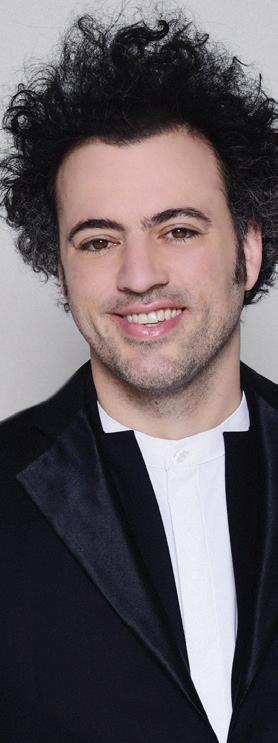
Eric Jacobsen Conductor
Alex Sopp Vocals
Musicians from the Chicago Symphony Chorus
Cheryl Frazes Hill Associate Director
BARBER Overture to The School for Scandal
SHAW
And So from Is a Rose
CHRIS THILE
COPLAND Fanfare for the Common Man
THILE ATTENTION!
Attention
Lord Starbucks
The Rooftop—
Carrie Freaking Fisher
CHRIS THILE
ALEX SOPP
MUSICIANS FROM THE CHICAGO SYMPHONY CHORUS
There will be no intermission.
The Chicago Symphony Orchestra Association acknowledges support from the Illinois Arts Council.
This month, as we present a series of concerts honoring our country’s 250th anniversary, it is clear that the music of our land has come of age. In 1892, near the end of the Chicago Orchestra’s opening season, the ensemble played its first all-American program: works by four male composers born within 250 miles of each other along a narrow slice of New England. Their music was “made according to German models,” a local critic pointed out. “Any idea or orchestral effect that can be considered as distinctively and peculiarly American is not found in them.”
What you will hear this month is distinctively American, not because it has a singular instantly identifiable accent or style, but because it reflects the breadth and variety of the landscapes, traditions, and peoples of America. There is music from Charles Ives, often called the father of American music, to John Adams, who, as his presidential name suggests, is a founding father of a new world of contemporary music that has swept the land: from Jessie Montgomery, born, raised, and trained in New York City, to Kurt Weill, who fled the Nazi takeover of his native Germany to settle in that same city, where the luxury of freedom inspired some of his most successful scores; from Duke Ellington, who wove jazz and symphony together in unexpected harmony, to Wynton Marsalis, who imbues that tradition with unforeseen power and provocation today; from Leonard Bernstein to Aaron Copland, whose very names bring to mind the music of the urban jungle and our open prairies. There are pieces inspired by “The Star-Spangled Banner” and by Plymouth Rock. There is music as timeless as the singing of Black spirituals and as genre-defying as Chris Thile’s mandolin playing, and there are the indelible words of Abraham Lincoln, still potent after all these years.
The music of America has broadened to encompass the full richness— and the complexity—of our land and our citizenship. The European models are still with us, but there is now a wealth of new music unlike anything being written on the other side of the ocean. Some of the pieces we perform this month have roots as old as our country; some are brand new. That is what these concerts celebrate: an American music that is too diverse to be pigeonholed because it mirrors the dizzying wealth of styles and backstories and ambitions of the composers working here. These programs reflect how far we have come as a land of music and musicians. And in the end, they speak to us about who we are now.
SAMUEL BARBER
Born March 9, 1910; West Chester, Pennsylvania
Died January 23, 1981; New York City
Overture to The School for Scandal
Samuel Barber was one of the lucky ones. His talent was discovered early and nourished by an unusually musical family. (His aunt was the distinguished Metropolitan Opera contralto Louise Homer.) He began playing piano at the age of six and composing at seven. When, at nine, he informed his parents he intended to be a composer—words parents seldom greet with joy or sympathy—he was encouraged. “I was meant to be a composer and will be I am sure,” he wrote, in a letter to his mother, “I’ll ask you one more thing—Don’t ask me to try and forget this unpleasant thing and go and play football.”
At the age of fourteen, Samuel became a charter student at the new Curtis Institute of Music, with a triple major: piano, voice, and composition. He studied conducting briefly with Fritz Reiner (later music director of the Chicago Symphony Orchestra), who said he had no talent on the podium. Several of his student compositions, however, were the work of an advanced composer, and a few, including Dover Beach and the Cello Sonata, have earned permanent places in the repertoire. His very first orchestral score, the Overture to The School for Scandal performed to open this concert, was an immediate hit—and when the Philadelphia Orchestra gave the world premiere in 1933, Barber was just twenty-three.
Success followed success. In 1937 his Symphony no. 1 was the first music by an American to be performed at the Salzburg Festival. (Later, his Vanessa was the first American opera to be staged there.) Barber’s music was performed and championed by some of the most celebrated figures of his day—Vladimir Horowitz introduced the Piano Sonata; Arturo Toscanini the First Essay for Orchestra and the famous Adagio for Strings; Leontyne Price regularly sang many of the songs; Barber wrote Knoxville: Summer of 1915 for Eleanor Steber and his ballet Medea for Martha Graham.
While Barber was still a student, he decided to write this concert overture based on Sheridan’s comedy of manners, The School for Scandal, while he was vacationing on the shores of Lake Lugano in northern Italy. The
COMPOSED 1931
FIRST PERFORMANCE
August 30, 1933; Philadelphia, Pennsylvania
INSTRUMENTATION
2 flutes and piccolo, 2 oboes and english horn, 2 clarinets and bass clarinet, 2 bassoons, 4 horns, 3 trumpets, 3 trombones, tuba, timpani, percussion, harp, celesta, strings
APPROXIMATE PERFORMANCE TIME 8 minutes
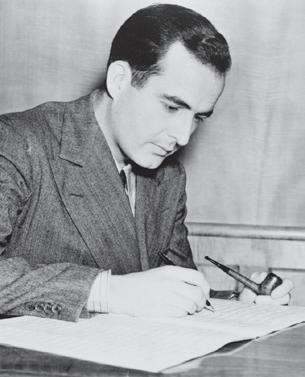
above: Samuel Barber, seated, making notes on his music, 1938. Library of Congress, Prints and Photographs Division, Washington, D.C.
Curtis Institute accepted it as his graduation thesis but made no effort to help Barber get it performed. After the overture won Columbia University’s Bearns Prize, the Philadelphia Orchestra surprised both Barber and the music world by deciding to play it at a Robin Hood Dell concert—the first orchestral score by an unknown composer premiered by one of the country’s leading orchestras.
The overture is so brilliant and assured that it is hard to remember that it is the work of a twenty-one-year-old student. It was Barber’s idea to capture the wit and spirit of the eighteenth-century play rather than suggest
CAROLINE SHAW
Born August 1, 1982; Greenville, North Carolina
And So from Is a Rose
the narrative thrust of Sheridan’s comedy. After an introductory flourish, Barber begins with delightfully animated music—it breathes the air of the theater, even though this music was never intended as part of a staging of the play—and follows with the earliest of his grand lyrical orchestral themes. The overture is cannily paced and masterfully structured—there is a quick, dazzling coda to wrap things up. It is a work of considerable promise, but more surprisingly, one that stands firmly on its own, even in the light of all the music that was soon to follow.
—Phillip Huscher
Roses are admittedly rather beautiful— rich in color, deliciously fragrant, slightly dangerous. Alas, by the twentieth century, this flower had been so drowned by cliches that its delights had to be tempered with a certain amount of irony, or at least distance, when it was presented in literary settings. The poet Gertrude Stein made sure we would remember that, before it is the object of love or the badge of a noble house or a source of overwhelming olfactory nostalgia, “a rose is a rose is a rose.”
In her orchestral song cycle Is a Rose, Caroline Shaw navigates both ironic and earnest perspectives on the flower. She wrote the piece between 2016 and 2019 for the Philharmonia Baroque Orchestra & Chorale for its project commissioning contemporary composers to write new music for period instruments. Over the course of the three-movement work, Shaw draws on “The Edge,” a new text by Jacob Polley that ends by describing “the light that sings off the edge of the rose”; “A Red, Red Rose,” a famous love poem by Scottish poet Robert Burns; and words by Stein and Shakespeare. She wrote “And So,” the middle movement of the piece, last, and it acts as a kind of umbrella for the rest of the work, in which she weaves together her own original verses and a variety of historical texts on the subject.
COMPOSED 2019
FIRST PERFORMANCE
March 12, 2019; Lincoln Center, New York, Philharmonia Baroque Orchestra & Chorale, Nicholas McGegan, conductor
INSTRUMENTATION
voice, strings
APPROXIMATE
PERFORMANCE TIME 6 minutes
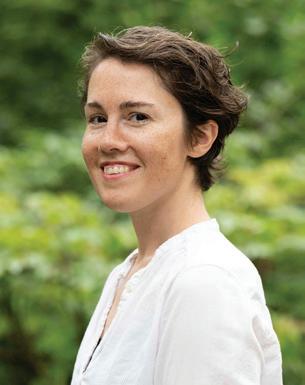
above: Caroline Shaw, photo by Elena Olivo
“And So” begins with a spare section in which the vocalist sings “would a song by another name sound as sweet and true”—a variation on iconic words of reassurance and love spoken by Juliet in Shakespeare’s Romeo and Juliet. The accompaniment, which is played by harpsichord in the original version and by an array of string players imitating the decaying arcs of baroque instruments in the present arrangement, consists of a sequence of three chords chiming repeatedly, as if strummed on a lute. The harmonies eventually lurch forward expressively and the textual focus changes to a rendition of Stein’s famous adage—“A rose is a rose is a tired rhyme”—before Shaw toggles back to the initial, plaintively simple progression. From there, she oscillates between presentations of her own words set in the style of a pure, slightly poppy Renaissance
And So
Would a song by any other name
Sound as sweet and true?
Would all the reds be just the same Or violets as blue?
If you were gone
Would words still flow
And would they rhyme with you?
If you were gone
Would I still know
How to love, and how to grow
And how the vowel threads through?
And so, you say, the saying goes
A rose is a rose is a rose is a rose Is a rose is a rose is a tired rhyme
But in the verse there’s always time.
song and allusions to Stein that are accompanied by more tense, chromatic harmonies. The chord progression heard at the outset also forms the basis of the bouncier, more syncopated section of the movement, in which she refers to Burns’s “Red, Red Rose.” This continuity creates a feeling of cyclic harmonic repetition akin to that found in baroque variation forms like the passacaglia or chaconne, in which a fixed bass pattern is heard ad infinitum while the voices and figuration above create a varied, developing structure. At the end of the movement, after Shaw has examined the merits of the flower and of pursuing beauty itself, she settles on a satisfying and quite sincere conclusion to Stein’s line: “a rose is a rose is a thing sublime.”
—Nicky Swett
Would scansion cease to mark the beats if I went away?
Would a syllable interrupt the feet with tetrametric iambs when I am gone?
Listen, and I will sing a tune of love and life, and of the ocean’s prose
And the poetry of a red, red rose that’s nearly sprung in June.
And so, you say, the saying goes
A rose is a rose is a rose is a rose Is a rose is a rose is how I’m
Keeping track of time.
COMMENTS
When all the seas rise high, my dear
And the rocks melt with the sun
Will the memory of us
Still rhyme with anyone?
Will we still tune our violins?
Will we still sing of roses?
Will we exist at all, my love
Or will we fade to stanzas of the dust
That, I suppose, is all we were and all we’ll be?
And so, the saying, “So it goes”
Depends a lot on if a rose
Is a rose is a rose is a rose is a rose Is a rose is a rose is a thing sublime And so we stay on borrowed time.
—Caroline Shaw
AARON COPLAND
Born November 14, 1900; Brooklyn, New York
Died December 2, 1990; North Tarrytown, New York
Fanfare for the Common Man
Eugene Goossens left England for the United States in 1923 to become music director of the Rochester Philharmonic. He moved to the Cincinnati Symphony in 1931 and remained chief conductor there for fifteen years. After America entered World War II, he determined to use his orchestra as a means of unifying his community and keeping them invested in the ongoing conflict. In this spirit, he asked several prominent American composers to write fanfares that could be heard at the start of concerts.
Goossens wrote to Aaron Copland about the project in 1942, suggesting something explicitly militaristic like a “Fanfare for Soldiers, or for Airmen or Sailors.” Copland agreed to contribute a fanfare, though it took him longer than he expected to complete the short piece to his satisfaction. He writes in his autobiography that he considered many different titles, including “Fanfare for a Solemn Ceremony, for the Day of Victory, for Our Heroes, for the Rebirth of Lidice [a Czech town obliterated by the Nazis], for the Spirit of Democracy, for the
COMPOSED 1942
FIRST PERFORMANCE
March 12, 1943; Cincinnati Symphony Orchestra, Eugene Goossens, conductor
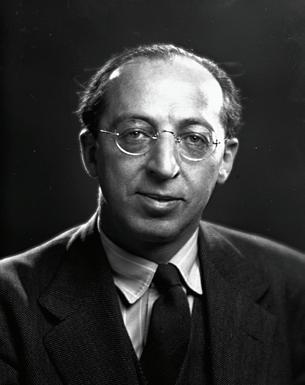
this page: Aaron Copland, 1940. Photo by Oscar White (1921–2020)/ Corbis/VCG via Getty Images
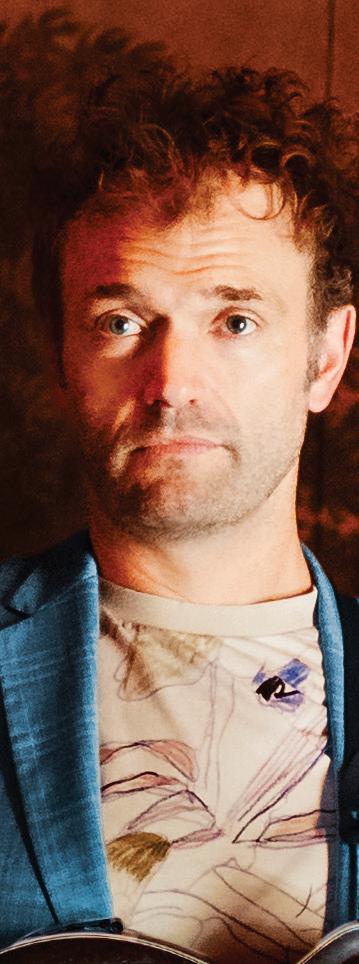
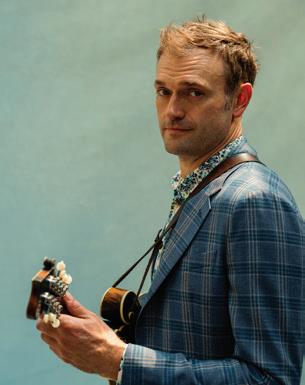
opposite page: Chris Thile, photo by Josh Goleman
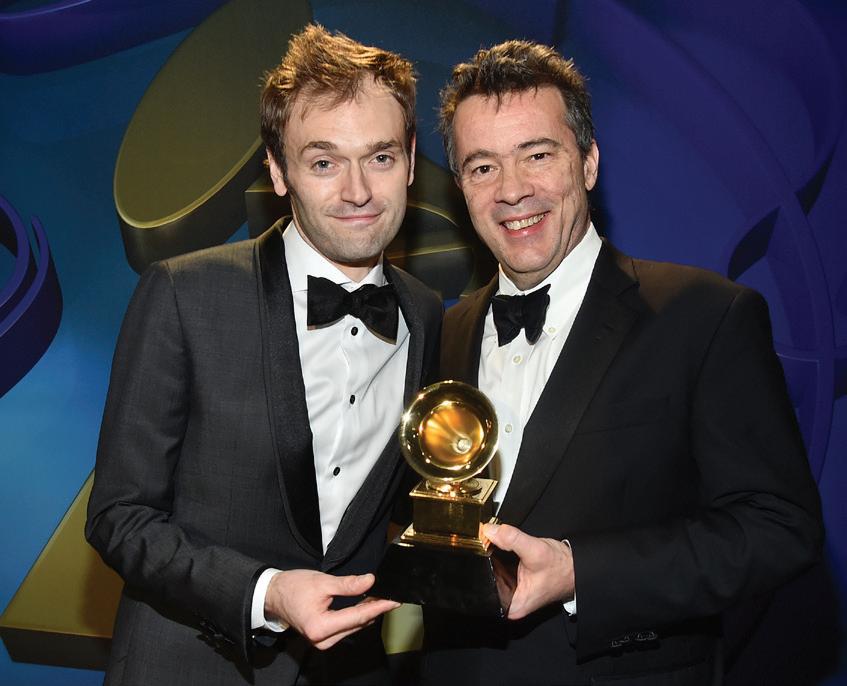
next spread: Winners in the Best Contemporary Instrumental Album category, Chris Thile and Edgar Meyer pose during the 57th Annual Grammy Awards, February 8, 2015, Los Angeles. Photo by Alberto E. Rodriguez/ WireImage
Paratroops, for Four Freedoms.” He ultimately chose to make it a “Fanfare for the Common Man,” honoring the everyday American men and women living and working at home, whose labor and tax dollars were essential to the war effort. Goossens decided the piece should be first heard on March 12, 1943, around when income tax was due, linking patriotic sentiments to paying taxes in the manner of other propaganda songs of the era like Irving Berlin’s chipper 1942 tune “I Paid My Income Tax Today.”
Copland noted that it was a challenge “to compose a traditional fanfare, direct and powerful yet with a contemporary sound.” He sets up a rhythmic framework in which the larger sense of pulse is highly irregular, though the individual melodic motifs are quite catchy and clear. The wide-open call heard at the start in the trumpets is repeated several times, with each rendition involving more instruments and more fleshed-out harmonies. As the music develops in the second part of the fanfare, Copland adds clanging, dissonant chords that he hoped would give “bite” to the sound of the brass instruments. At the very end, these chords help him to achieve
CHRIS THILE
Born February 20, 1981; Oceanside, California
a surprise modulation—a touching twist that is uplifting in a strangely sober way.
The fanfare has had a remarkable legacy. It is regularly performed by symphony orchestras, military bands, and school string ensembles alike. Copland himself reused his fanfare almost verbatim, to great effect, in the finale of his Third Symphony, a piece he wrote between 1944 and 1946. Other composers regularly riff on Copland’s milestone brass piece. Joan Tower wrote six Fanfares for the Uncommon Woman between 1987 and 2014 that celebrate women conductors, and Valerie Coleman composed a Fanfare for Uncommon Times that unites soaring Copland-esque Americana with a virtuosic protest dance inflected with Caribbean rhythms. It was probably Copland’s choice to avoid an explicit military call-out in the title of the fanfare and to use it instead as an opportunity to celebrate the contributions every individual makes to society, which has made this piece such a fruitful source of inspiration and an enduring, powerful concert opener.
—Nicky Swett
ATTENTION! (A narrative song cycle for extroverted mandolinist and orchestra)
Chis Thile on ATTENTION! *
I adore orchestras. Whether scaled up for grandeur, or down for intimacy, nothing makes me prouder to be a human than hearing a stage full of highly skilled orchestral musicians practicing their craft together. It’s magic, and it’s something I’ve been desperate to participate in since the early aughts, when a hero of mind, Edgar Meyer, walked me through the score of a violin concerto he wrote for another hero of mine, Hilary Hahn. In the late aughts, I wrote a mandolin concerto, but after
COMPOSED 2023
FIRST PERFORMANCE August 22, 2023; Hollywood Bowl, Los Angeles Philharmonic
performing it quite a bit for a year or so with some truly lovely orchestras, I realized that it was basically the musical equivalent of fan fiction (like I’m tempted to rename it “Bartók meets Adès for coffee at Edgar’s”). So, I went back to admiring orchestra music from afar, even as I continued to monitor my inner ear for something that might justify another attempt. A year or two ago, a tantalizing text from my pal Eric Jacobsen (“Thile, whatever you wanna do with orchestra, we can make it happen!”) prompted more proactive monitoring, and I started hearing bits of what would eventually become ATTENTION! I was confused at first, because these little aural visions included not just mandolin and orchestra, but singing AND talking as well. Whoa, ok . . . FUN. Further dreaming led to the conviction that there should be an actual STORY, not just loosely related vignettes (which has pretty much been my MO
on long-form pieces with vocals to this point). But WHAT story? I’ve always loved writing songs based on short stories, so I started there, widened the search to essays, then read a bunch of plays, but every time I got excited about something, a nagging little voice (probably remembering my last orchestral piece) would say, “Yeah, but why would YOU be the one to musicalize this story?” Ugh. Fair. Ok, fine then: what is a story I like to tell about something that happened to me that my friends seem to like hearing? Ah HA! THIS ONE, hands down, no contest. If you’ve ever had a couple rounds with me at a good cocktail bar, chances are I’ve trotted this out, and the thought of turning it into a piece of orchestral music got my inner ear cranking like never before. It’s a ridiculous story, but it’s 100% true, and the more I’ve worked on the telling of it, the more aware I’ve become of what a profound impact the whole experience had on me as a person who loves to make things and show them to other people.
You can find the lyrics at christhile.com/ attention, but I recommend only referring to them when my diction isn’t up to snuff. Now, if you’ll just give me your attention . . .
Phillip Huscher has been the program annotator for the Chicago Symphony Orchestra since 1987.
Cellist, writer, and music researcher Nicky Swett holds a PhD in music from the University of Cambridge, where he was a Gates Scholar. From 2016 to 2018, he was a section member and community engagement fellow in the Civic Orchestra of Chicago.
REFRESHMENTS AT SYMPHONY CENTER
You can order drinks and snacks before the performance or during intermission at various bars located throughout Symphony Center, including the Bass Bar in the Rotunda and most of the lobby spaces in Orchestra Hall.
PROFILES
Chris Thile Mandolin and Vocals
Acclaimed Grammy Award–winning mandolinist, singer, songwriter, composer, and MacArthur Fellowship recipient of the prestigious Genius Grant, Chris Thile is a multifaceted musical talent, praised in such publications as the Guardian, NPR, and the New York Times. Thile is a founding member of the highly influential string bands Punch Brothers and Nickel Creek, and he has collaborated with countless luminaries from Yo-Yo Ma to Fiona Apple to Brad Mehldau. For four years, Thile hosted public-radio favorite Live from Here with Chris Thile (formerly known as A Prairie Home Companion). With his broad outlook, Thile creates a distinctly American canon and a new musical aesthetic for performers and audiences alike.
Over the last couple of years, Chris Thile toured with Nickel Creek in support of the critically acclaimed 2023 release Celebrants. Most recently, he has captivated audiences with a playfully ambitious biographical composition titled ATTENTION! (a narrative song cycle for extroverted mandolinist and orchestra), and he has been focused on the production of a new musical variety show, The Energy Curfew Music Hour, created with Claire Coffee and featuring Punch Brothers. Season one is available on all podcast platforms, with season two exclusively out on Audible.
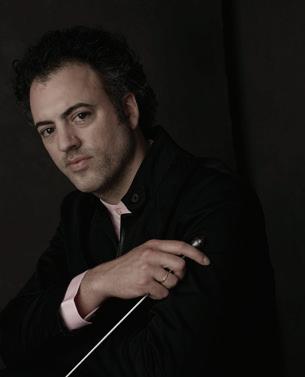
Eric Jacobsen Conductor
Already well established as one of classical music’s most exciting and innovative young conductors, Eric Jacobsen combines fresh interpretations of the traditional canon with cutting-edge collaborations
across musical genres. As both conductor and cellist, he has built a reputation for engaging audiences with innovative and collaborative programming.
Jacobsen joined the Virginia Symphony Orchestra in 2021 as the twelfth music director in the orchestra’s one-hundred-plus-year history. Recent projects have included the world premiere of Reena Esmail’s Double Concerto written for Orli and Gil Shaham, as well as Anna Clyne’s DANCE, Concerto for Cello and Orchestra, with Jan Vogler.
He was named music director of the Orlando Philharmonic Orchestra in 2015, and he continues to pioneer the ensemble’s programming and community engagement in new and exciting directions. He was also recently named principal guest conductor of the Classical Tahoe Music Festival and Institute.
Eric Jacobsen is also artistic director and cofounder—with his brother, violinist Colin Jacobsen—of the Knights, the New York City–based chamber orchestra, which grew out of late-night music-reading parties with friends, good food and drink, and conversation. Current endeavors include a multi-year rhapsody project as well as a Carnegie Hall residency. Under Jacobsen’s baton, the Knights has developed an extensive recording collection, including albums with longtime collaborators Yo-Yo Ma, Gil Shaham, Aaron Diehl, Gabriel Kahane, and Anna Clyne.
Jacobsen’s musical life started from a very young age surrounded by a musical family, where he discovered his love of pulling a bow across a string as a cellist. He and his brother founded the string quartet Brooklyn Rider and performed regularly with Yo-Yo Ma as a member of the Silkroad Ensemble, touring around the world.
A frequent guest conductor, Jacobsen has established continuing relationships with the Colorado Symphony, Detroit Symphony Orchestra, New Jersey Symphony, and the Dresden Music Festival. Recent and upcoming engagements also include concerts with the Philadelphia Orchestra, Kansas City Symphony, Milwaukee Symphony Orchestra, Grant Park
Music Festival, Utah Symphony, and the Atlanta Symphony Orchestra.
Eric Jacobsen brings joy, storytelling, and a touch of humor to what he describes as “musical conversations” that delight audiences around the world, including those who do not traditionally attend classical music concerts.
Jacobsen is married to Grammy Award–winning singer-songwriter Aoife O’Donovan, and together they have a daughter.
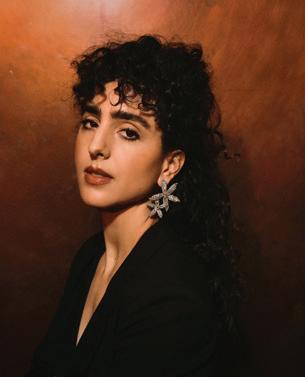
Alex Sopp Vocals
Alex Sopp is a flutist, singer, composer, and visual artist living in Brooklyn, New York. As a singer and songwriter, she released her debut album of original songs, The Hem & The Haw, on New Amsterdam Records. She is the flutist and founding member of yMusic, the Knights, Between Worlds Ensemble, and NOW Ensemble. Sopp has appeared as principal flute with the New York Philharmonic and the Orpheus Chamber Orchestra, and she has premiered solo works written for her by Allison Loggins-Hull, Judd Greenstein, Nico Muhly, and Gabriel Kahane.
Performing iconic vocal lines and whistle solos, Alex Sopp toured the world with yMusic in support of their album with Paul Simon. Her unique visual artwork and hand-painted stop-motion animation has been used by such musicians as Osvaldo Golijov and Joshua Bell, and by cutting-edge organizations like Castle of Our Skins to bring their projects to life. She believes that you are creative.
alexsopp.com
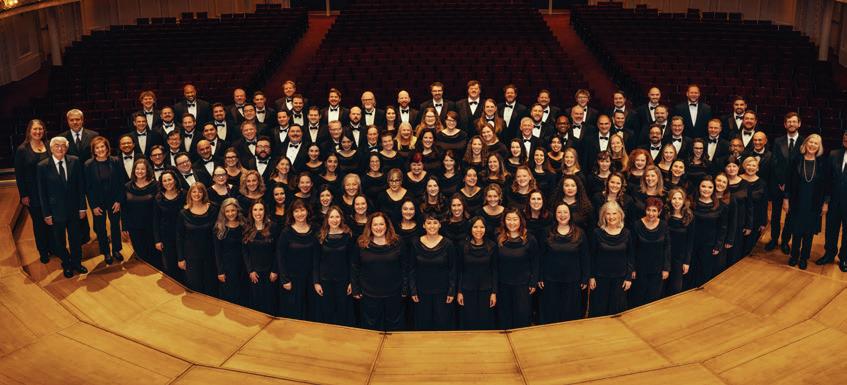
Chicago Symphony Chorus
The Chicago Symphony Chorus regularly performs with the Chicago Symphony Orchestra in Orchestra Hall and at the Ravinia Festival.
The history of the Chorus began in 1957, when sixth music director Fritz Reiner invited Margaret Hillis to establish a chorus to equal the quality of the Orchestra. Hillis accepted the challenge, and the Chicago Symphony Chorus debuted in March and April 1958, in Mozart’s Requiem under Bruno Walter and Verdi’s Requiem under Reiner. Hillis served the Chorus for thirty-seven years. In 1994 ninth music director Daniel Barenboim appointed Duain Wolfe, who served as the Chorus’s director and conductor until his retirement in 2022. Donald Palumbo was appointed as the Chorus’s third director in 2025.
The Chorus first performed in Carnegie Hall in 1967 in Henze’s Muses of Sicily and Ravel’s Daphnis and Chloe under seventh music director Jean Martinon, and most recently in 2015 with Riccardo Muti for Scriabin’s Prometheus and Prokofiev’s Alexander Nevsky. Touring internationally with the Orchestra, the Chorus traveled to London and Salzburg in 1989 with Sir Georg Solti for performances of Berlioz’s The Damnation of Faust and to Berlin in 1999 with Barenboim for Brahms’s A German Requiem and Pierre Boulez for Schoenberg’s Moses und Aron.
World premieres featuring the Chorus have included Ned Rorem’s Goodbye My Fancy, John Harbison’s Four Psalms, and Bernard Rands’s apókryphos. With visiting orchestras, the Chorus has collaborated with the Berlin Philharmonic under Claudio Abbado, the Boston Symphony Orchestra and Seiji Ozawa, the Israel
Philharmonic Orchestra with Zubin Mehta, and the Staatskapelle Berlin under Barenboim.
Since first recording commercially in 1959—Prokofiev’s Alexander Nevsky under Reiner—the Chorus has amassed a discography that includes hallmarks of the choral repertoire and several complete operas. The Chorus most recently received a 2010 Grammy Award for Best Choral Performance for Verdi’s Requiem, led by Riccardo Muti on CSO Resound. The Chorus has received an additional nine Grammy awards for Best Choral Performance for Verdi’s Requiem, Beethoven’s Missa solemnis, Brahms’s A German Requiem, Berlioz’s The Damnation of Faust, Haydn’s Creation, and Bach’s Mass in B minor with Solti; Brahms’s Requiem and Orff’s Carmina Burana with James Levine; and Bartók’s Cantata profana with Boulez.
The Chorus also has appeared on two movie soundtracks with the Orchestra: Fantasia 2000 led by Levine, and John Williams’s score for Lincoln conducted by the composer. Recordings on CSO Resound featuring the Chorus include Mahler’s Second and Third symphonies, Poulenc’s Gloria and Ravel’s Daphnis and Chloe under Bernard Haitink; and Berlioz’s Lélio, Verdi’s Otello, Schoenberg’s Kol Nidre, choruses by Verdi and Boito’s Prologue to Mefistofele, Shostakovich’s Symphony no. 13 (Babi Yar), and most recently Mascagni’s Cavalleria rusticana under Riccardo Muti.
Cheryl Frazes Hill Associate Chorus Director
Cheryl Frazes Hill is associate director of the Chicago Symphony Chorus. Now in her fiftieth season, she began with the ensemble as a singer in 1976 and in 1987 was appointed to the conducting staff by Margaret Hillis, the Chorus’s founder and first director. She assisted Hillis until her retirement in 1994 and continued in that role
with second director Duain Wolfe until his retirement in 2022, and she currently works with Donald Palumbo, who became director in 2025. Since 2017, Frazes Hill has been director of the Milwaukee Symphony Chorus, whose performances in recent seasons included joining forces with the Chicago Symphony Chorus in Mahler’s Symphony no. 8 at the Ravinia Festival under the direction of Marin Alsop.
Frazes Hill has also prepared the Chicago Symphony Chorus for Marin Alsop, Pierre Boulez, Daniel Barenboim, James Conlon, James Levine, Zubin Mehta, Michael Tilson Thomas, and Esa-Pekka Salonen, among many others. Recordings of her Chorus preparations have been released on the CSO’s From the Archives series, including tracks on Beethoven: A Tribute to Daniel Barenboim and Chicago Symphony Chorus: A Fiftieth Anniversary Celebration.
In addition to her roles in Chicago and Milwaukee, Frazes Hill is a professor emerita, where she was director of choral activities for Roosevelt University’s Chicago College of Performing Arts from 2002 to 2022. Under her direction, the Roosevelt University choruses were featured in prestigious and diverse events, including appearances with the Chicago Symphony Orchestra, Chicago Sinfonietta, Civic Orchestra of Chicago, Illinois Philharmonic Orchestra, and three performances with the Rolling Stones. Among other performances, the Roosevelt Conservatory Chorus received enthusiastic reviews for the U.S. premiere of Jacob ter Velduis’s Mountaintop, in addition to the internationally acclaimed Defiant Requiem and a semi-staged production of Craig Hella Johnson’s Considering Matthew Shepard.
An accomplished vocalist, Frazes Hill is a featured soloist on the Grammy Award–nominated recording of the CBS Masterworks release Mozart: Music for Basset Horns. During her years of teaching, Frazes Hill has received numerous distinctions, including the Illinois Governor’s Award, the Northwestern University Alumni Merit Award, the Commendation of Excellence in Teaching from the Golden
Apple Foundation, the Outstanding Teaching Award from the University of Chicago, and the Roosevelt University Presidential Award for Social Justice. In addition, she is the recent recipient of the prestigious Harold Decker Conducting Award from the American Choral Directors Association and the Mary Hoffman Award of Excellence in Music from the Illinois Music Education Association.
Frazes Hill has added the title “author” to her résumé with her book Margaret Hillis: Unsung Pioneer (GIA Publications), which received a
Chicago Symphony Chorus
Donald Palumbo Director
Cheryl Frazes Hill Associate Director
Jennifer Kerr Budziak Assistant Director
Benjamin Rivera Assistant Director
commendation from the Midwest Book Awards in 2023.
Cheryl Frazes Hill is a frequent guest conductor and speaker. An advocate for women conductors past and present, Frazes Hill joined conductor Marin Alsop as a featured speaker for the 2022 Ravinia Festival Symposium Breaking Barriers: Forging Paths for Women Conductors. Frazes Hill shares her scholarship through published articles for national-education and choral journals on topics of her research in choral conducting and music education.
MUSICIANS FROM THE CHICAGO SYMPHONY CHORUS
SOPRANOS
Katelyn Lee
Amanda Compton LoPresti
ALTOS
Carla Janzen Norton
Emily Price
TENORS
Aaron Short
Alan Taylor
BASSES
Christopher Filipowicz
Dimitri German
CHORUS MANAGER
Melissa Hilker
CHORUS LIBRARIAN, ASSISTANT CHORUS MANAGER, AND EXECUTIVE ASSISTANT TO THE VP FOR ARTISTIC PLANNING
Olive Haugh
REHEARSAL PIANISTS
John Goodwin
Sharon Peterson
Chuck Foster
The Chorus was prepared for this performance by Cheryl Frazes Hill.
The Chicago Symphony Orchestra—consistently hailed as one of the world’s best—marks its 135th season in 2025–26. The ensemble’s history began in 1889, when Theodore Thomas, the leading conductor in America and a recognized music pioneer, was invited by Chicago businessman Charles Norman Fay to establish a symphony orchestra. Thomas’s aim to build a permanent orchestra of the highest quality was realized at the first concerts in October 1891 in the Auditorium Theatre. Thomas served as music director until his death in January 1905, just three weeks after the dedication of Orchestra Hall, the Orchestra’s permanent home designed by Daniel Burnham.
Frederick Stock, recruited by Thomas to the viola section in 1895, became assistant conductor in 1899 and succeeded the Orchestra’s founder. His tenure lasted thirty-seven years, from 1905 to 1942—the longest of the Orchestra’s music directors. Stock founded the Civic Orchestra of Chicago— the first training orchestra in the U.S. affiliated with a major orchestra—in 1919, established youth auditions, organized the first subscription concerts especially for children, and began a series of popular concerts.
Three conductors headed the Orchestra during the following decade: Désiré Defauw was music director from 1943 to 1947, Artur Rodziński in 1947–48, and Rafael Kubelík from 1950 to 1953. The next ten years belonged to Fritz Reiner, whose recordings with the CSO are still considered hallmarks. Reiner invited Margaret Hillis to form the Chicago Symphony Chorus in 1957. For five seasons from 1963 to 1968, Jean Martinon held the position of music director.
Sir Georg Solti, the Orchestra’s eighth music director, served from 1969 until 1991. His arrival launched one of the most successful musical partnerships of our time. The CSO made its first overseas tour to Europe in 1971 under his direction and released numerous award-winning recordings. Beginning in 1991, Solti held the title of music director laureate and returned to conduct the Orchestra each season until his death in September 1997.
Daniel Barenboim became ninth music director in 1991, a position he held until 2006. His tenure was distinguished by the opening of Symphony Center in 1997, appearances with the Orchestra in the dual role of pianist and conductor, and twenty-one international tours. Appointed by Barenboim in 1994 as the Chorus’s second director, Duain Wolfe served until his retirement in 2022.
In 2010, Riccardo Muti became the Orchestra’s tenth music director. During his tenure, the Orchestra deepened its engagement with the Chicago community, nurtured its legacy while supporting a new generation of musicians and composers, and collaborated with visionary artists. In September 2023, Muti became music director emeritus for life.
In April 2024, Finnish conductor Klaus Mäkelä was announced as the Orchestra’s eleventh music director and will begin an initial five-year tenure as Zell Music Director in September 2027. In July 2025, Donald Palumbo became the third director of the Chicago Symphony Chorus.
Carlo Maria Giulini was named the Orchestra’s first principal guest conductor in 1969, serving until 1972; Claudio Abbado held the position from 1982 to 1985. Pierre Boulez was appointed as principal guest conductor in 1995 and was named Helen Regenstein Conductor Emeritus in 2006, a position he held until his death in January 2016. From 2006 to 2010, Bernard Haitink was the Orchestra’s first principal conductor.
Mezzo-soprano Joyce DiDonato is the CSO’s Artist-in-Residence for the 2025–26 season.
The Orchestra first performed at Ravinia Park in 1905 and appeared frequently through August 1931, after which the park was closed for most of the Great Depression. In August 1936, the Orchestra helped to inaugurate the first season of the Ravinia Festival, and it has been in residence nearly every summer since.
Since 1916, recording has been a significant part of the Orchestra’s activities. Recordings by the Chicago Symphony Orchestra and Chorus— including recent releases on CSO Resound, the Orchestra’s recording label launched in 2007— have earned sixty-five Grammy awards from the Recording Academy.
A Musical Tribute to
JOHN WILLIAMS & STEVEN SPIELBERG
Tuesday, June 23, 2026
6:00 PM Drinks & Bites
7:30 PM Concert
Celebrate the legendary collaboration between composer John Williams and filmmaker Steven Spielberg as the Chicago Symphony Orchestra brings to life some of cinema’s most iconic music.
Enhance your evening by ordering the event package, which includes preconcert drinks and bites plus prime seating at the concert. Ample food and drink stations will feature heavy hors d’oeuvres and refreshments. Mingle with other guests while enjoying lounge seating in Symphony Center’s Forte event space.
SCAN TO LEARN MORE
Chicago Symphony Orchestra
Klaus Mäkelä Zell Music Director Designate
Joyce DiDonato Artist-in-Residence
VIOLINS
Robert Chen Concertmaster
The Louis C. Sudler Chair, endowed by an anonymous benefactor
Stephanie Jeong § Associate Concertmaster
The Cathy and Bill Osborn Chair
David Taylor*
Assistant Concertmaster
The Ling Z. and Michael C.
Markovitz Chair
Yuan-Qing Yu* Assistant Concertmaster
So Young Bae
Cornelius Chiu
Gina DiBello
Kozue Funakoshi
Russell Hershow
Qing Hou
Gabriela Lara
Matous Michal
Simon Michal
Sando Shia
Susan Synnestvedt
Rong-Yan Tang
Baird Dodge Principal
Danny Yehun Jin
Assistant Principal
Lei Hou
Ni Mei
Hermine Gagné
Rachel Goldstein
Mihaela Ionescu
Wendy Koons Meir
Ronald Satkiewicz ‡
Florence Schwartz
VIOLAS
Teng Li Principal
The Paul Hindemith Principal Viola Chair
Catherine Brubaker
Youming Chen
Sunghee Choi
Paolo Dara
Wei-Ting Kuo
Danny Lai
Weijing Michal
Diane Mues
Lawrence Neuman
Jikun Qin
Max Raimi
CELLOS
John Sharp Principal
The Eloise W. Martin Chair
Kenneth Olsen
Assistant Principal
The Adele Gidwitz Chair
Karen Basrak
The Joseph A. and Cecile Renaud Gorno Chair
Richard Hirschl
Olivia Jakyoung Huh
Daniel Katz
Katinka Kleijn
Brant Taylor
The Ann Blickensderfer and Roger Blickensderfer Chair
BASSES
Alexander Hanna Principal
The David and Mary Winton
Green Principal Bass Chair
Alexander Horton
Assistant Principal
Dan Carson
Ian Hallas
Robert Kassinger
Mark Kraemer
Stephen Lester
Bradley Opland
Andrew Sommer
FLUTES
Emma Gerstein
Jennifer Gunn
PICCOLO
Jennifer Gunn
The Dora and John Aalbregtse Piccolo Chair
OBOES
William Welter Principal
Lora Schaefer
Assistant Principal
The Gilchrist Foundation, Jocelyn Gilchrist Chair
Scott Hostetler
ENGLISH HORN
Scott Hostetler
Riccardo Muti Music Director Emeritus for Life
CLARINETS
Stephen Williamson Principal
John Bruce Yeh
Assistant Principal
The Governing
Members Chair
Gregory Smith
E-FLAT CLARINET
John Bruce Yeh
BASSOONS
Keith Buncke Principal
William Buchman
Assistant Principal
Miles Maner
HORNS
Mark Almond Principal
James Smelser
David Griffin
Oto Carrillo
Susanna Gaunt
Daniel Gingrich ‡
TRUMPETS
Esteban Batallán Principal
The Adolph Herseth Principal Trumpet Chair, endowed by an anonymous benefactor
John Hagstrom
The Bleck Family Chair
Tage Larsen
TROMBONES
Timothy Higgins Principal
The Lisa and Paul Wiggin
Principal Trombone Chair
Michael Mulcahy
Charles Vernon
BASS TROMBONE
Charles Vernon
TUBA
Gene Pokorny Principal
The Arnold Jacobs Principal Tuba Chair, endowed by Christine Querfeld
* Assistant concertmasters are listed by seniority. ‡ On sabbatical § On leave
The CSO’s music director position is endowed in perpetuity by a generous gift from Zell Family Foundation. The Louise H. Benton Wagner and Erika and Dietrich M. Gross Principal Flute chairs are currently unoccupied.
TIMPANI
David Herbert Principal
The Clinton Family Fund Chair
Vadim Karpinos
Assistant Principal
PERCUSSION
Cynthia Yeh Principal Chair sponsored by an anonymous benefactor
Patricia Dash §
Vadim Karpinos
LIBRARIANS
Justin Vibbard Principal
Carole Keller
Mark Swanson
CSO FELLOWS
Ariel Seunghyun Lee Violin
Jesús Linárez Violin
The Michael and Kathleen Elliott Fellow
ORCHESTRA PERSONNEL
John Deverman Director
Anne MacQuarrie
Manager, CSO Auditions and Orchestra Personnel
STAGE TECHNICIANS
Christopher Lewis
Stage Manager
Blair Carlson
Paul Christopher
Chris Grannen
Ryan Hartge
Peter Landry
Joshua Mondie
The Chicago Symphony Orchestra string sections utilize revolving seating. Players behind the first desk (first two desks in the violins) change seats systematically every two weeks and are listed alphabetically. Section percussionists also are listed alphabetically.
Discover more about the musicians, concerts, and generous supporters of the Chicago Symphony Orchestra Association online, at cso.org.
Find articles and program notes, listen to CSOradio, and watch CSOtv at Experience CSO.
cso.org/experience
Get involved with our many volunteer and affiliate groups.
cso.org/getinvolved
Connect with us on social @chicagosymphony
Chicago Symphony Orchestra Association Board of Trustees
OFFICERS
Mary Louise Gorno Chair
Chester A. Gougis Vice Chair
Steven Shebik Vice Chair
Helen Zell Vice Chair
Renée Metcalf Treasurer
Jeff Alexander President
Kristine Stassen Secretary of the Board
Stacie M. Frank Assistant Treasurer
Dale Hedding Vice President for Development
Chicago Symphony Orchestra Association Administration
SENIOR LEADERSHIP
Jeff Alexander President
Stacie M. Frank Vice President & Chief Financial Officer, Finance and Administration
Dale Hedding Vice President, Development
Ryan Lewis Vice President, Sales and Marketing
Vanessa Moss Vice President, Orchestra and Building Operations
Jonathan McCormick Managing Director, Negaunee Music Institute at the CSO
Visit cso.org/csoa to view a complete listing of the CSOA Board of Trustees and Administration.
For complete listings of our generous supporters, please visit the Richard and Helen Thomas Donor Gallery.
cso.org/donorgallery
CHICAGO SYMPHONY ORCHESTRA
90th SUMMER RESIDENCY
JULY 11 - AUGUST 16 •
HIGHLAND PARK
Featuring three weeks with Ravinia Chief Conductor MARIN ALSOP
Six weeks of guests include Yunchan Lim, Lizzo, Emanuel Ax, St. Vincent, Stella Chen, María Dueñas, Daniel Lozakovich, Carlos Simon, Laura Karpman, and many more —plus two concerts with Zell Music Director Designate Klaus Mäkelä— performing in the newly renovated Hunter Pavilion!
LOOKING FOR SOMETHING INDOORS?
James Conlon leads Mozart’s The Abduction from the Seraglio semi-staged in the Martin Theatre