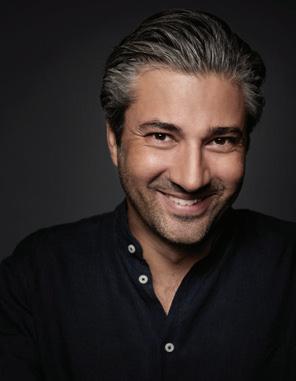
The Chicago Symphony Orchestra welcomes David Afkham, who has graciously agreed to conduct these performances. He replaces Nikolaj Szeps-Znaider, who is recovering from an injury that does not yet allow for international travel.
ONE HUNDRED THIRTY-FIFTH SEASON CHICAGO SYMPHONY ORCHESTRA
KLAUS MÄKELÄ Zell Music Director Designate | RICCARDO MUTI Music Director Emeritus for Life
Thursday, May 28, 2026, at 7:30
Friday, May 29, 2026, at 1:30
Saturday, May 30, 2026, at 7:30
Sunday, May 31, 2026, at 3:00
David Afkham Conductor
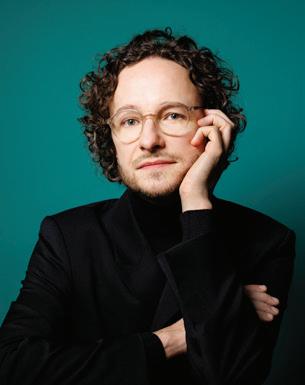
Martin Helmchen Piano
BRAHMS Piano Concerto No. 1 in D Minor, Op. 15 Maestoso
Adagio
Rondo: Allegro non troppo
MARTIN HELMCHEN
INTERMISSION
STRAUSS Suite from Der Rosenkavalier, Op. 59
RAVEL La valse
These concerts are generously sponsored by Zell Family Foundation. The Chicago Symphony Orchestra Association acknowledges support from the Illinois Arts Council.
The Chicago Symphony Orchestra thanks Zell Family Foundation for sponsoring these performances.
JOHANNES BRAHMS
Born May 7, 1833; Hamburg, Germany
Died April 3, 1897; Vienna, Austria
Piano Concerto No. 1 in D Minor, Op. 15
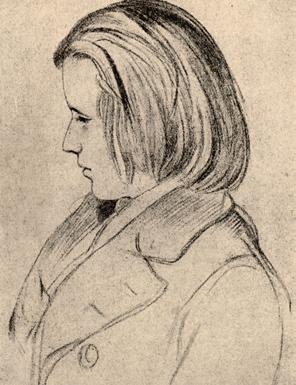
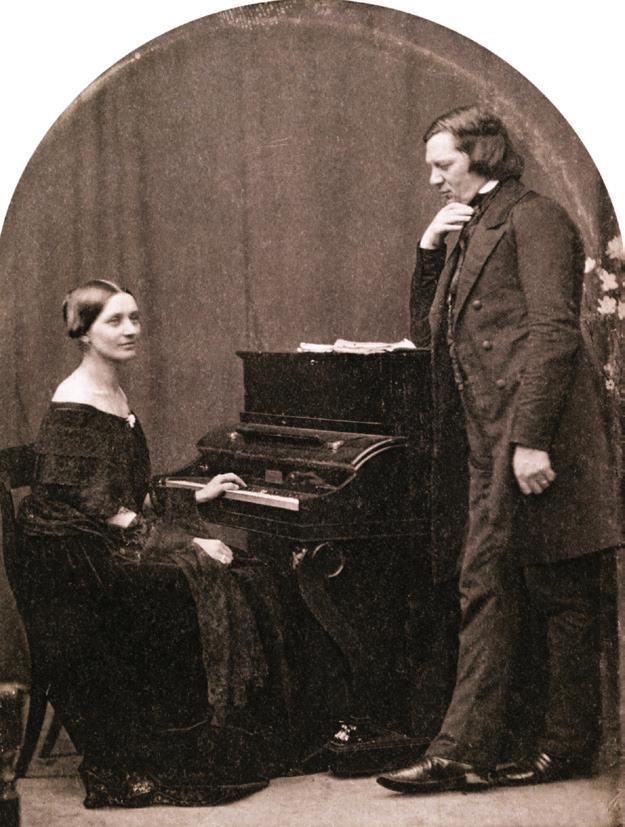
When Johannes Brahms was twenty years old, he summoned the courage to present himself at the home of Robert and Clara Schumann, the first couple of music. To his relief, the Schumanns were the perfect hosts, and Robert was genuinely overwhelmed once this odd young man—shy, boyish, and nearsighted—sat down at their piano to play his own music.
Schumann was so deeply moved that he came out of retirement as a critic to introduce Brahms to the music world. “Even outwardly,” Schumann writes of that afternoon in September 1853, “he bore the marks proclaiming, ‘This is a chosen one.’ ” Clara also was impressed, although perhaps it was something else about this delicate man with the flowing blond hair and poetic eyes that caught her attention. Within months, she and Brahms would play duets at that same keyboard, cautiously launching, then more deeply cementing, a relationship that sometimes dared to be more than friendship.
In 1853 Robert and Clara were happily married, the proud parents of six young children (a seventh would arrive the following year), and celebrated musicians. Robert was one of the leading composers of the day, although he was destined to write no more important music. Clara somehow found time to maintain her reputation as a profound and thoughtful pianist while raising the children, and, despite social convention, to compose as well. But in February 1854, Robert suddenly began to suffer from syphilis. Pain alternated with delirium, and he frequently experienced auditory and visual hallucinations. On February 27, while Clara was out running errands, he left the house and threw himself off a bridge into the Rhine. He was rescued by fishermen and taken home, but within the week he
this page: Johannes Brahms, silverpoint drawing by Jean-Joseph Bonaventure Laurens (1801–1890), 1853, at the request of Robert Schumann (1810–1856), Düsseldorf, Germany. Bibliothèque-musée Inguimbertine, Carpentras, France. Photo by Photo12/Universal Images Group via Getty Images | next page: Clara (1819–1896) and Robert Schumann, daguerreotype portrait by Johann Anton Völlner, March 1850, Hamburg, Germany. Robert-Schumann-Haus, Zwickau, Germany
COMPOSED 1854–58
FIRST PERFORMANCES
March 30, 1858; Hanover, Germany. The composer as soloist (private)
January 22, 1859; Hanover, Germany. The composer as soloist (public)
March 2 and 3, 1900, Auditorium Theatre. Leopold Godowsky as soloist, Theodore Thomas conducting
July 31, 1945, Ravinia Festival. Leon Fleisher as soloist, Leonard Bernstein conducting
MOST RECENT
CSO PERFORMANCES
August 1, 2019, Ravinia Festival. Yefim Bronfman as soloist, Rafael Payare conducting
September 22, 23, and 27, 2022, Orchestra Hall. Yefim Bronfman as soloist, Riccardo Muti conducting
CSO RECORDINGS
1954. Artur Rubinstein as soloist, Fritz Reiner conducting. RCA
1979. Lazar Berman as soloist, Erich Leinsdorf conducting. CBS
1983. Emanuel Ax as soloist, James Levine conducting. RCA
was admitted to the asylum in nearby Endenich, where he would die two and a half years later.
This would have been an even more difficult time for Clara if Brahms hadn’t returned to Düsseldorf to be with her. We don’t know for certain what transpired over these months. Brahms went to visit Robert in the asylum periodically, but Clara was not allowed to see him. On Robert’s birthday in 1856, Brahms found him making alphabetical lists of towns and countries. Finally, on July 17, Clara went along with Brahms and, for the first time in more than two years, saw the sad spectacle of her husband. Two days later, Robert Schumann died.
What all this had to do with Brahms’s music was not clear at first. In 1853, when he visited the Schumanns, he had nothing but chamber music and piano pieces to his credit, and during the next four years he didn’t venture into other genres. But Brahms was struggling with the urge to say something grand and important, and he secretly was itching to command the rich resources of a full orchestra. In March 1854 Brahms heard Beethoven’s Ninth Symphony for the first time, and the impact of that still-revolutionary-sounding music threw him off track. It would be twenty-two years before he would complete a symphony of his own, although more and more that was what he most wanted to do.
admitted to Clara and wrote to his friend, the celebrated violinist Joseph Joachim, he realized that he needed more than two pianos to satisfy his musical impulses. Brahms continued to struggle with his sonata—parts of it were scored for full orchestra and sent to Joachim for his verdict. One movement was eventually discarded and ended up, considerably reworked, in the German Requiem. In 1857 he wrote to Joachim, “I have no judgment about this piece anymore, nor any control over it.”
What finally emerged from the doubt and difficulty was a big piano concerto in D minor, Brahms’s first major orchestral work. (The two serenades, which date from the same time, are sketches in comparison.) The Hanover premiere, on January 22, 1859, with the composer at the piano, was well received, but the performance in Leipzig a few days later was a disaster. Brahms took it in stride: “I think it’s the best thing that could happen to one—it forces you to collect your thoughts and it raises your courage. After all, I’m still trying and groping.”
One of the pieces that Brahms and Clara played together during these months of uncertainty was a big sonata for two pianos that he had begun as early as the spring of 1854, shortly after Robert was institutionalized. This music would take nearly four years to find its ideal form; at times Brahms believed his sonata was becoming a symphony, despite the intimidating shadow of Beethoven, and at others, a concerto in Beethoven’s key of D minor. By now, as he
The concerto, however, was a mature and fully finished work even then, and although Brahms talked about reworking its structure, in the end he only touched up some details. It is a powerful and dramatic score, and it bears the imprint of Brahms’s grief over Robert Schumann’s breakdown and death, as well as the conflict and the passion of his growing relationship with Clara.
Brahms begins with a menacing timpani roll and a fierce unison theme. There is not only drama in this opening, but also ambiguity, for over the first low D, the strings suggest not D minor, but B-flat major. It will take several pages before Brahms (already a master of long-range planning) unequivocally establishes D minor as the concerto’s presiding tonality.
He marks each of the crucial moments in the sonata-form design with something unexpected, so that we not only take notice, but also stop and think. For example, the soloist does not begin with the powerful first theme, but instead enters alone, commanding our attention with quiet and eloquent new music. (It is, in fact, not new, but a transformation of the immediately preceding orchestral music.) And when the pianist arrives at F major—the movement’s primary harmonic destination—Brahms introduces a majestic, very expansive, truly new theme that he has been saving just for the occasion. (Joachim, who once suggested that Brahms compose a theme that was “appropriately magnificent . . . commensurately elevated and beautiful” at this point, must have been particularly pleased.)
The biggest surprise comes at the most dramatic moment in any sonata-form movement, the start of the recapitulation, when the opening music and the main key are reunited. Here Brahms disrupts our expectations by following the fierce timpani roll on D with the piano entering emphatically in E major, as if the
RICHARD STRAUSS
Born June 11, 1864; Munich, Germany
soloist’s hands simply landed on the wrong keys. Although this large movement was often shaped by the rhetoric and demeanor of Beethoven’s Ninth Symphony, each masterstroke here is entirely Brahms’s own.
The glorious, rapt Adagio has been interpreted as either a homage to Robert or an ode to Clara, but in some sense, it is both, with music being every bit as complicated as life. The piano line, by turns meditative, rhapsodic, impassioned, and even aggressive, never resorts to sheer display. (As American pianist William Mason commented after watching Brahms perform, “It was the playing of a composer, not that of a virtuoso.”)
The brief cadenza is all the more captivating for being soft and slow.
Joachim enjoyed the “pithy bold spirit of the first theme” of the finale and admired the subsequent “intimate and soft B-flat major passage.”
The entire rondo is carried by the immense energy of its main theme, although near the end Brahms makes room for more than one cadenza, followed by what Joachim called “the solemn reawakening toward a majestic close.”
Died September 8, 1949; Garmisch-Partenkirchen, Germany
Suite from Der Rosenkavalier, Op. 59
Salome made Richard Strauss the most famous composer alive. It also made him rich. Shortly after the Dresden premiere in 1905, Strauss built himself a villa in the foothills of the Bavarian Alps, which he paid for with royalty checks. He moved in at the beginning of June 1908, and the first work he completed there, at a large oak desk positioned for a postcard view of the mountains, was Elektra,
based on an adaptation of Sophocles’s play by Hugo von Hofmannsthal. But it was Strauss’s next opera, Der Rosenkavalier, with an original libretto by Hofmannsthal, that made the two of them the most celebrated composer-poet team since Mozart and Da Ponte, and brought Strauss his greatest popular success. To accommodate the public, special Rosenkavalier trains ran from Berlin to Dresden following its premiere there in January 1911. (Fifty performances were given in Dresden within the year.) Later, Rosenkavalier brands of champagne and cigarettes were sold. In 1926 a silent film was
made—the opera was so popular that even without singing it had an audience.
“We were born for one another and are certain to do fine things together,” Strauss wrote to Hofmannsthal before they had even settled on the eighteenth-century Viennese tale that became their “comedy for music,” Der Rosenkavalier. These two made an unlikely pair. A poet of exquisite and refined tastes, Hofmannsthal tended to be withdrawn and aloof. (He lived outside Vienna in a small rococo castle, which he refused to equip with modern bathrooms or central heating.) Strauss was a showman and a good businessman; he could be crass, but he was eminently practical, and he possessed a shrewd sense of theater—what would play and what wouldn’t. They were, in other words, a perfect match; their professional relationship lasted twenty-three years and produced six operas. They did nearly all their communicating by mail—partly because Hofmannsthal disliked Strauss’s wife, whom he thought loud and pushy—and even at the end of two decades they still weren’t on a first-name basis (Strauss’s letters are usually
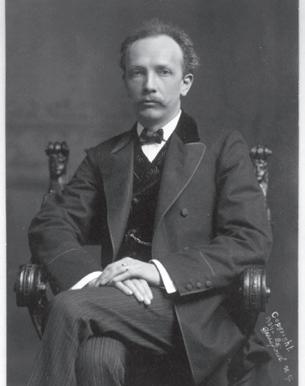
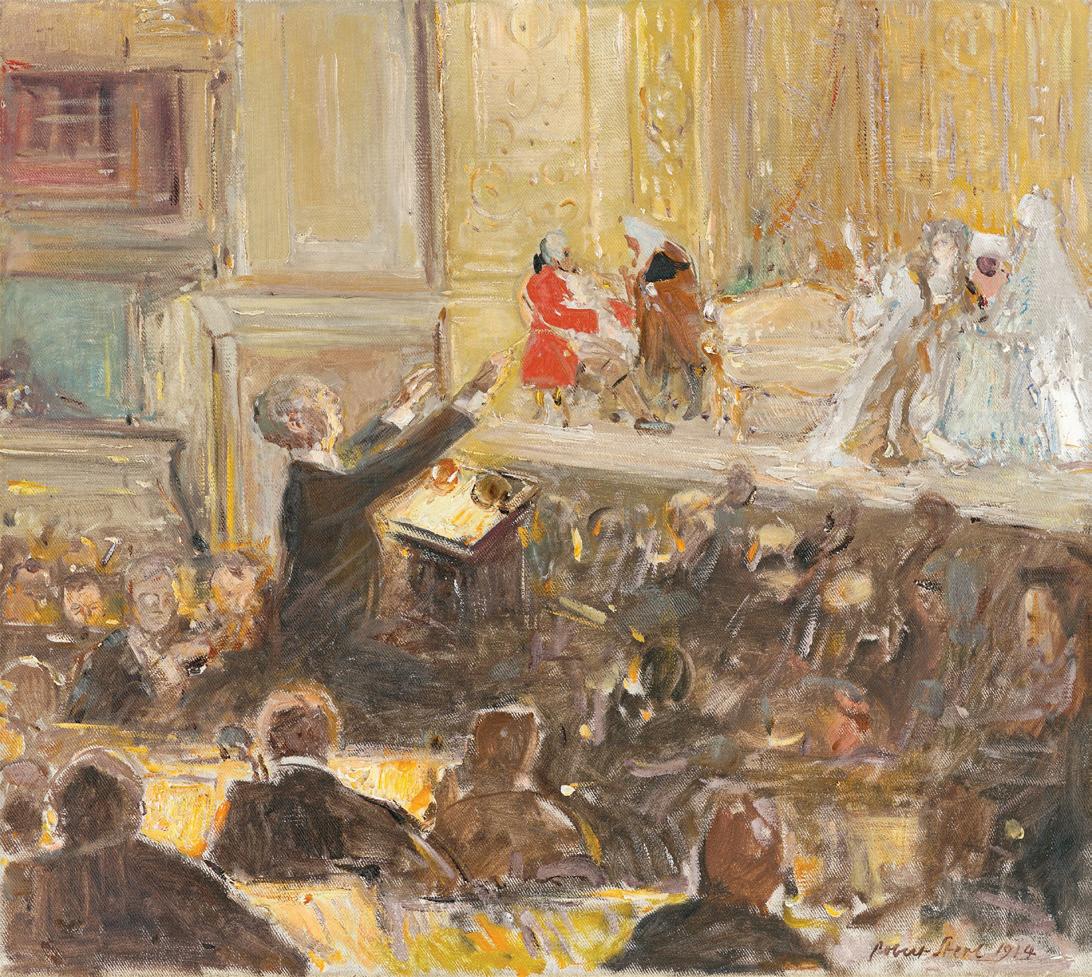
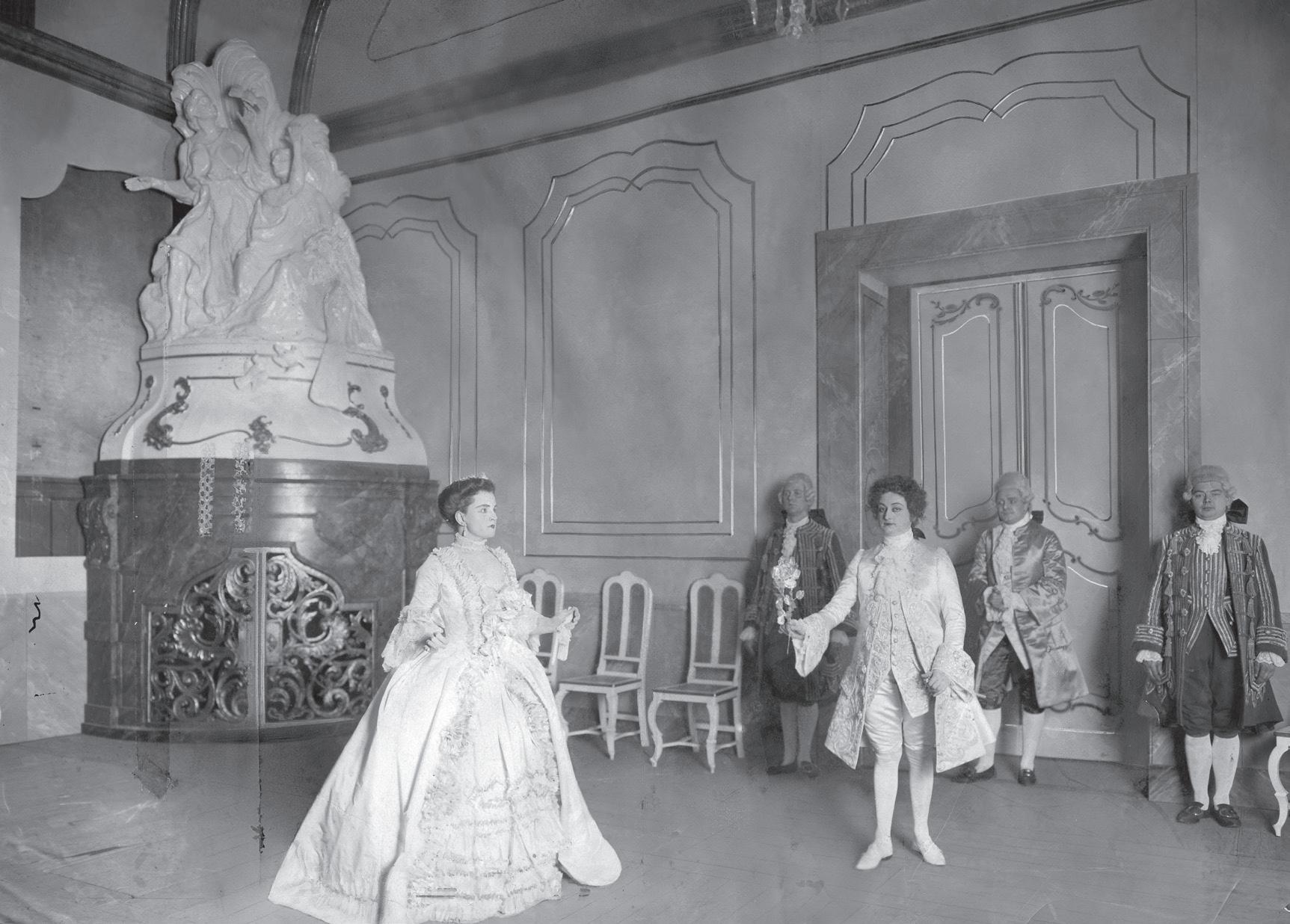
previous page: Richard Strauss, portrait by American photographer Joseph Gaylord Gessford (1866–1942), New York City, 1904 | this page: Painting in oil by Robert Sterl (1867–1932), 1914, depicting Ernst von Schuch (1846–1914) conducting Der Rosenkavalier. Alte Nationalgalerie, Berlin, Germany | opposite page: Der Rosenkavalier, Dresden Court Opera, 1911. Opening night cast members Minnie Nast (1874–1956) as Sophie von Faninal (left) and Eva von der Osten (1881–1936) as Octavian. Photo by Ullstein Bild via Getty Images
COMPOSED 1909–10
FIRST PERFORMANCE
January 26, 1911, Dresden Court Opera (complete opera)
October 5, 1944; New York City, under Artur Rodziński, who is traditionally credited as its arranger (suite)
December 1 and 2, 1911, Orchestra Hall. Frederick Stock conducting (waltzes)
July 31, 1936, Ravinia Festival. Werner Janssen conducting (waltzes)
October 16 and 17, 1947, Orchestra Hall. Artur Rodziński conducting
MOST RECENT CSO PERFORMANCES
August 1, 2017, Ravinia Festival. Michael Stern conducting
April 13, 14, and 15, 2023, Orchestra Hall. Thomas Adès conducting
CSO RECORDING 1957. Fritz Reiner conducting. RCA
addressed to “Lieber Freund,” Hofmannsthal’s to “Lieber Doktor Strauss”).
After the premiere of Elektra, with its searing dissonances, powerhouse orchestra, and Wagnerian voices, Strauss felt the need for a change of pace, and he was overheard saying, “Now I shall write a Mozart opera.” Hofmannsthal knew precisely what Strauss wanted, and the new libretto he mailed in installments practically set itself to music, as the composer later commented. Nevertheless, it took Strauss a year and a half to complete the score. It was a labor of love, and Strauss worked with such enthusiasm that he even set one of Hofmannsthal’s stage directions to music by mistake. Der Rosenkavalier is one of opera’s landmarks, particularly in its balance of music and words, and even Hofmannsthal, always a tough critic, was nearly brought to tears by its “whole beauty, by a complete unity, by absolute harmony.”
For this “Mozart opera,” Strauss assumed a new musical personality, one steeped in tradition rather than poised on the brink of the avantgarde. Der Rosenkavalier was later criticized as a signal retrenchment in the course of twentieth-century music, the first step in Strauss’s abrupt turning away from the music of his day in favor of old-world artistic sensibilities. But as a musical response to a period comedy, and as a way of imbuing the music of the past with all the modern conveniences, it’s an ingenious, completely successful, and ultimately influential work of art.
Der Rosenkavalier abounds in orchestral virtuosity, and symphony orchestras have long enjoyed playing selections from the opera, reminding us that before Strauss became the most popular opera composer of his day, he produced an astonishing decade-long series of hit tone poems, beginning with Don Juan. (Four of them were given their U.S. premieres
by the Chicago Symphony Orchestra). Of all the orchestral condensations of Der Rosenkavalier, only one, the delightful First Waltz Sequence, was actually made by Strauss himself, but the suite performed this week, most likely put together by the conductor Artur Rodziński, is the most satisfying as a bird’s-eye view of the whole score. (Rodziński, who was conductor of the New York Philharmonic at the time, led the premiere of the suite in New York in 1944—only five years before Strauss’s death—and conducted the first Chicago Symphony performances in October 1947, during his only season as the Orchestra’s fourth music director.)
The action in Der Rosenkavalier revolves around the Marschallin, who has taken the seventeen-year-old Count Octavian as her lover; and the bumbling, lecherous Baron Ochs auf Lerchenau, who lacks both money and social graces, and who has arranged to marry Sophie von Faninal, who has both in spades. When Octavian is selected to present Sophie with a silver rose—an elaborate engagement “custom” of a Rosenkavalier devised by Hofmannsthal—the two fall in love. In the end, inevitably, Octavian leaves the Marschallin for the pretty young Sophie, and Ochs is revealed as the silly old fool he is.
The suite begins where the opera starts, famously, with the bold, erotic horn music that is Der Rosenkavalier’s calling card and always a welcome sound to opera lovers. The following music introduces first the Marschallin, swooning over her young lover Octavian, and then Sophie, in the rapturous Presentation of the Rose scene, with its wondrous shimmering halo of chords (magically scored for flutes and piccolo, celesta, harps, solo violins). We next meet Baron Ochs, bursting in to promise a chambermaid, preposterously, that “with me
no night is too long,” in the most famous of the opera’s waltzes. Despite his surname, it wasn’t Strauss who had the idea of putting waltzes in Der Rosenkavalier, an anachronistic touch that quickly became the opera’s signature. “Try and think of an old-fashioned Viennese waltz,” Hofmannsthal wrote as he was preparing their libretto, “sweet and saucy, which should pervade the whole of the last act.”
The suite now shifts to the celebrated act 3 trio (actually three separate, simultaneous monologues) for the Marschallin, Octavian, and Sophie, reflecting on love from their different points of view, followed by the final duet of Octavian and Sophie as they go off together. This is one of opera’s most touching and glorious scenes, and for sheer melodic splendor and high-calorie harmonic richness, it’s unsurpassed in Strauss’s output. (In the now-distant days of LPs, a famous New Yorker cartoon showed a man on his deathbed asking to hear side 8 of Der Rosenkavalier one last time.) The trio leads, as it does in the opera, to the lovely duet for Octavian and Sophie, now blissfully united. Unlike the opera, the suite ends with yet another waltz.
Although his career lasted another thirty-plus years, Strauss never surpassed the popular success of Der Rosenkavalier. During World War II, when American soldiers showed up at the door of his Bavarian villa, he introduced himself simply by saying, “I am Richard Strauss, the composer of Der Rosenkavalier and Salome.” In June 1949, to celebrate his eighty-fifth birthday, Strauss went to Munich, where he attended rehearsals of Der Rosenkavalier conducted by a young—and future Chicago music director—Georg Solti. The composer picked up the baton and led the very end of act 2. He died that September. The music performed at his memorial service, under Solti’s baton, was the great trio from Der Rosenkavalier.
MAURICE RAVEL
Born March 7, 1875; Ciboure, Basses-Pyrénées, France
Died December 28, 1937; Paris, France
La valse (Choreographic Poem for Orchestra)
In 1911 Ravel’s Valses nobles et sentimentales were intended as a loving tribute to the “useless occupation” of social dancing. By 1919, when he wrote La valse, the world was a changed place, and after the war the public had lost patience with mere frivolity. La valse is not the piece Ravel planned to write. In 1906 he began to sketch Wien (Vienna), a tribute to Johann Strauss, Jr., and “. . . a kind of apotheosis of the Viennese waltz, with which is mingled in my mind the idea of the fantastic whirl of destiny.” This is still true of the music Ravel finally composed in 1919, at the request of the impresario Sergei Diaghilev. But fate now made the waltz a bitter reminder of a vanished era and newsreels showed that Vienna was no longer a city in its glory. Due to widespread famine, in 1918 the official daily food rations there were 5.8 ounces of bread, 1.2 ounces of flour,
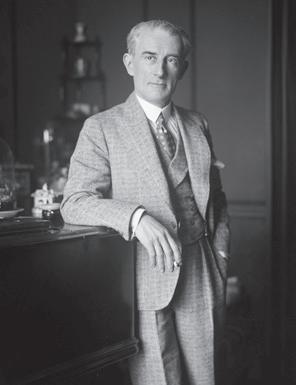
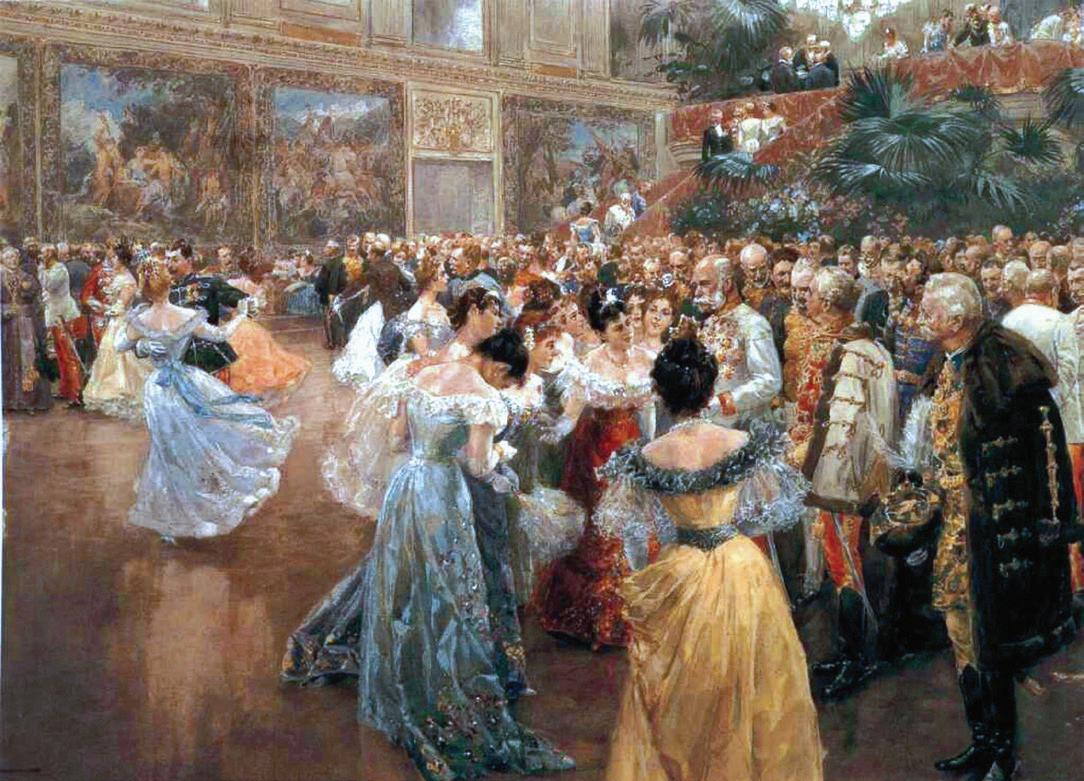
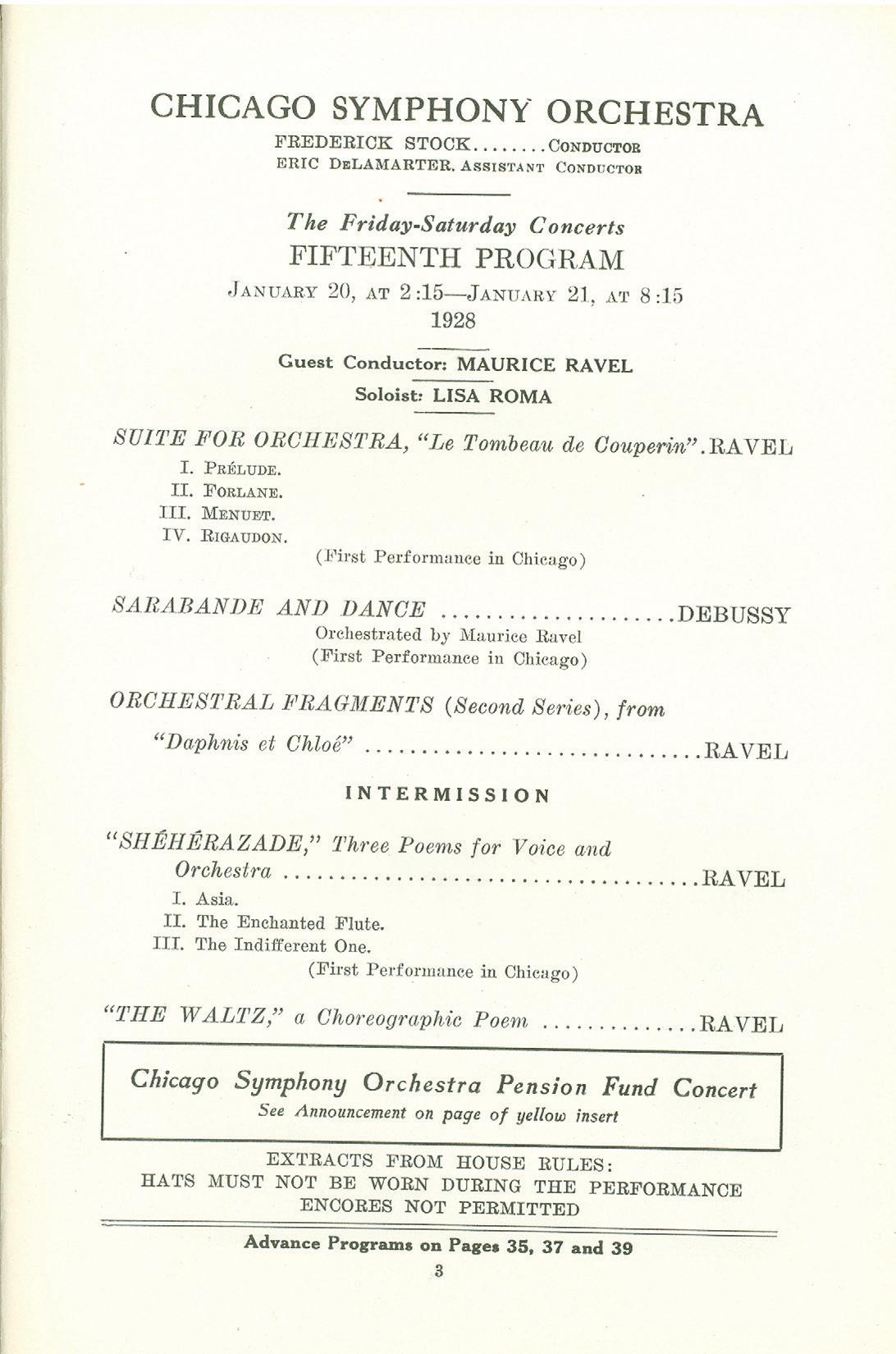
this page, from top: Maurice Ravel, ca. 1925. Photo by Hélène Roger-Viollet (1901–1985) via Getty Images | Court Ball at the Hofburg, watercolor by Wilhelm Gause (1853–1916), 1900, depicting Emperor Franz Joseph I of Austria-Hungary (1830–1916), in white uniform, surrounded by members of the court | next page: Program book page for Ravel’s January 1928 guest conducting appearance with the Chicago Symphony Orchestra
July 5, 1936, Ravinia Festival. Ernest Ansermet conducting
CSO PERFORMANCES, THE COMPOSER CONDUCTING January 20 and 21, 1928, Orchestra Hall
MOST RECENT
CSO PERFORMANCES
August 1, 2017, Ravinia Festival. Michael Stern conducting
June 1, 2, 3, and 6, 2023, Orchestra Hall. David Afkham conducting
CSO RECORDINGS
1960. Fritz Reiner. CSO (Chicago Symphony Orchestra: The First 100 Years)
1967. Jean Martinon. RCA
1976. Sir Georg Solti. CSO (From the Archives, vol. 4: A Tribute to Solti)
1.6 ounces of meat, 0.175 ounces of fat, 0.9 ounces of sugar, and 2.45 ounces of potatoes per person. That year, a flu epidemic broke out, killing the painter Gustav Klimt, the architect Otto Wagner, and Sigmund Freud’s daughter Sophie.
Ravel finished La valse in 1920. It wasn’t what Diaghilev expected, and he refused to stage it: “this is not a ballet; it is a portrait of a ballet, it is a painting of a ballet.” The two men never worked together again. Nonetheless, Ravel published the piece as a “choreographic poem for orchestra,” and it was finally danced in Antwerp in 1926 and in Paris in 1928 by Ida Rubinstein’s troupe, which also gave the premiere of Boléro just two days later.
The first page of the score is marked “mouvement de Valse viennoise.” The music is a masterful evocation of the evasions and collisions between a brilliant surface and dangerous undercurrents.
Ravel provided a brief scenario:
Swirling clouds afford glimpses, through rifts, of waltzing couples. The clouds scatter little by little; one can distinguish an immense hall with a whirling crowd. The scene grows progressively brighter. The light of the chandeliers bursts forth at the fortissimo. An imperial court, about 1855.
Phillip Huscher has been the program annotator for the Chicago Symphony Orchestra since 1987.
REFRESHMENTS AT SYMPHONY CENTER
You can order drinks and snacks before the performance or during intermission at various bars located throughout Symphony Center, including the Bass Bar in the Rotunda and most of the lobby spaces in Orchestra Hall.
Thank you to our members for planning a gift that supports the CSO’s future.
We are honored to play a part in your legacy.
The Theodore Thomas Society recognizes individuals who have included the Chicago Symphony Orchestra in their will, trust or beneficiary designation — supporting the legacy of artistic excellence built by founder and first music director Theodore Thomas.
Contact Joe Bauer at 312-294-3192 or visit cso.org/plannedgiving for more information.
PROFILES
David Afkham Conductor
FIRST CSO PERFORMANCES
November 20 and 21, 2009, Orchestra Hall. Selections from works by Humperdinck, Mendelssohn, Rachmaninov, Ravel, Rimsky-Korsakov, and Tchaikovsky (Very Special Promenade and Family concerts)
June 7, 2010, Orchestra Hall. Mozart’s Sinfonia concertante with Daniel Glynn, Sergey Gutorov, Andrew Thompson, and Anna Spina; and Mendelssohn’s Violin Concerto with Philippe Quint
MOST RECENT CSO PERFORMANCES
February 14, 15, and 16, 2025, Orchestra Hall. Wagner’s Prelude to act 3 of Lohengrin, Sibelius’s Violin Concerto with Christian Tetzlaff, and Schoenberg’s Pelleas and Melisande
Known for his impeccable technique and compelling artistry, David Afkham is one of the most sought-after conductors of his generation. He is chief conductor and artistic director of Madrid’s National Orchestra and Choir of Spain since 2019, having enjoyed a successful tenure as its principal conductor from 2014 to 2019.
Afkham’s impressive career has been marked by a series of critically acclaimed performances and collaborations with some of the world’s leading orchestras, including the Royal Concertgebouw Orchestra Amsterdam, London Symphony Orchestra, Bavarian Radio Symphony Orchestra, Munich Philharmonic, Staatskapelle Berlin, Deutsches SymphonieOrchester Berlin, Frankfurt Radio Symphony, Vienna Symphony Orchestra, Orchestre National de France, Swedish Radio Symphony Orchestra, Oslo Philharmonic, Orchestra dell’Accademia Nazionale di Santa Cecilia in Rome, Chamber Orchestra of Europe, Staatskapelle Dresden, and the Mahler Chamber Orchestra, among others.
With regular appearances in North America, Afkham has led the Cleveland Orchestra, Boston Symphony Orchestra at Tanglewood, Los Angeles Philharmonic, Philadelphia Orchestra, Minnesota Orchestra, Pittsburgh Symphony Orchestra,
St. Louis Symphony Orchestra, and the Seattle Symphony.
Recent successes in opera include Beethoven’s Fidelio and Strauss’s Arabella at Semperoper Dresden and a new production of the work at Teatro Real in Madrid. Afkham has also conducted Humperdinck’s Hansel and Gretel at Oper Frankfurt, Wagner’s The Flying Dutchman at Staatsoper Stuttgart, Ginastera’s Bomarzo at Teatro Real, and Verdi’s La traviata at the Glyndebourne Festival Opera and for Glyndebourne on Tour. In addition, he has led semi-staged projects with the National Orchestra and Choir of Spain, including Wagner’s The Flying Dutchman and Tristan and Isolde, Strauss’s Elektra and Salome, and Bartók’s Bluebeard’s Castle.
Highlights of the 2025–26 season have included his return to the NHK Symphony Orchestra for a tour of Japan and debuts with the San Francisco Symphony and the Lucerne Symphony Orchestra. He also made debuts at Deutsche Oper Berlin with Elektra in February 2026 and at Seattle Opera with concert performances of Strauss’s Daphne in January 2026. Afkham toured Germany and Austria with the National Orchestra and Choir of Spain and cellist Pablo Ferrández in February–March 2026. Other engagements included return appearances with the Minnesota Orchestra and at the Grafenegg Festival with the Tonkünstler Orchester.
Born in Freiburg, Germany, David Afkham began piano and violin lessons at an early age. He went on to study piano, music theory, and conducting at the Hochschule für Musik Freiburg before continuing his studies at the Hochschule für Musik Franz Liszt Weimar. Afkham was the first recipient of the Bernard Haitink Fund for Young Talent, and he has assisted Haitink on projects including symphonic cycles with the Chicago Symphony Orchestra, Royal Concertgebouw Orchestra, and the London Symphony. From 2009 to 2012, he was assistant conductor of the Gustav Mahler Youth Orchestra.
Afkham won first prize at the Donatella Flick Conducting Competition in London in 2008 and was the inaugural recipient of the Nestlé and Salzburg Festival Young Conductors Award in 2010.
Martin Helmchen Piano
FIRST CSO PERFORMANCES
June 9, 10, and 11, 2016, Orchestra Hall. Beethoven’s Piano Concerto no. 2, Christoph von Dohnányi conducting
MOST RECENT CSO PERFORMANCES
May 16, 17, 18, and 21, 2024, Orchestra Hall. Beethoven’s Piano Concerto no. 1, Kazuki Yamada conducting
German pianist Martin Helmchen has been performing on the world’s most prestigious stages for two decades and is one of the most sought-after pianists of today. His originality and intensity of interpretation set him apart as a musician. In 2020 he was honored with the prestigious Gramophone Classical Music Award. He has performed with numerous renowned international orchestras, including the Vienna and Berlin philharmonics, Royal Concertgebouw Orchestra Amsterdam, Leipzig Gewandhaus Orchestra, Staatskapelle Dresden, TonhalleOrchester Zürich, NDR Elbphilharmonie Orchestra in Hamburg, Orchestre de Paris, Vienna Symphony, Boston Symphony Orchestra, New York Philharmonic, and the Cleveland Orchestra. He regularly collaborates with such conductors as Herbert Blomstedt, Alan Gilbert, Manfred Honeck, Jakub Hrůša, Paavo Järvi, Vladimir Jurowski, Fabio Luisi, Andrew Manze, Klaus Mäkelä, Andris Nelsons, Sakari Oramo, Tarmo Peltokoski, and Kazuki Yamada, among others.
Upcoming engagements bring him to the Danish National Symphony Orchestra in October 2026, followed by a tour with the Hong Kong Philharmonic Orchestra under Tarmo Peltokoski in November–December 2026, performing at venues including Palau de la Música Catalana Barcelona, Kuppelsaal Hannover, Konzerthaus Dortmund, and Wiener Konzerthaus. He also continues extensive duo and chamber projects with his wife, cellist Marie-Elisabeth Hecker, appearing at major venues in the coming seasons. Chamber music holds a special place for him, a passion for which Boris Pergamenschikow provided inspiration. His close chamber music partners include Marie-Elisabeth Hecker, Frank Peter Zimmermann, Julian Prégardien, Augustin Hadelich, and Antje Weithaas. He appears at major festivals, including the BBC Proms, Schubertiade, Lucerne, Marlboro, and Aspen, and codirects the Fliessen International Chamber Music Festival with Hecker.
Helmchen records for the Alpha Classics label, where he recently launched a recording project of all of Schubert’s piano sonatas, with its first volume released to critical acclaim in October 2025 and awarded the German Record Critics’ Prize. In addition, his 2024 album, Bach: Six Partitas, received Gramophone’s Critics’ Choice.
Born in Berlin, Germany, Martin Helmchen studied with Galina Iwanzowa and Arie Vardi, won the Clara Haskil Competition (2001) and Credit Suisse Young Artist Award (2006), teaches at the Kronberg Academy, and lives in Germany with his wife and four daughters.
Martin Helmchen is represented worldwide by Tanja Dorn at Dorn Music.
The Chicago Symphony Orchestra—consistently hailed as one of the world’s best—marks its 135th season in 2025–26. The ensemble’s history began in 1889, when Theodore Thomas, the leading conductor in America and a recognized music pioneer, was invited by Chicago businessman Charles Norman Fay to establish a symphony orchestra. Thomas’s aim to build a permanent orchestra of the highest quality was realized at the first concerts in October 1891 in the Auditorium Theatre. Thomas served as music director until his death in January 1905, just three weeks after the dedication of Orchestra Hall, the Orchestra’s permanent home designed by Daniel Burnham.
Frederick Stock, recruited by Thomas to the viola section in 1895, became assistant conductor in 1899 and succeeded the Orchestra’s founder. His tenure lasted thirty-seven years, from 1905 to 1942—the longest of the Orchestra’s music directors. Stock founded the Civic Orchestra of Chicago— the first training orchestra in the U.S. affiliated with a major orchestra—in 1919, established youth auditions, organized the first subscription concerts especially for children, and began a series of popular concerts.
Three conductors headed the Orchestra during the following decade: Désiré Defauw was music director from 1943 to 1947, Artur Rodziński in 1947–48, and Rafael Kubelík from 1950 to 1953. The next ten years belonged to Fritz Reiner, whose recordings with the CSO are still considered hallmarks. Reiner invited Margaret Hillis to form the Chicago Symphony Chorus in 1957. For five seasons from 1963 to 1968, Jean Martinon held the position of music director.
Sir Georg Solti, the Orchestra’s eighth music director, served from 1969 until 1991. His arrival launched one of the most successful musical partnerships of our time. The CSO made its first overseas tour to Europe in 1971 under his direction and released numerous award-winning recordings. Beginning in 1991, Solti held the title of music director laureate and returned to conduct the Orchestra each season until his death in September 1997.
Daniel Barenboim became ninth music director in 1991, a position he held until 2006. His tenure was distinguished by the opening of Symphony Center in 1997, appearances with the Orchestra in the dual role of pianist and conductor, and twenty-one international tours. Appointed by Barenboim in 1994 as the Chorus’s second director, Duain Wolfe served until his retirement in 2022.
In 2010, Riccardo Muti became the Orchestra’s tenth music director. During his tenure, the Orchestra deepened its engagement with the Chicago community, nurtured its legacy while supporting a new generation of musicians and composers, and collaborated with visionary artists. In September 2023, Muti became music director emeritus for life.
In April 2024, Finnish conductor Klaus Mäkelä was announced as the Orchestra’s eleventh music director and will begin an initial five-year tenure as Zell Music Director in September 2027. In July 2025, Donald Palumbo became the third director of the Chicago Symphony Chorus.
Carlo Maria Giulini was named the Orchestra’s first principal guest conductor in 1969, serving until 1972; Claudio Abbado held the position from 1982 to 1985. Pierre Boulez was appointed as principal guest conductor in 1995 and was named Helen Regenstein Conductor Emeritus in 2006, a position he held until his death in January 2016. From 2006 to 2010, Bernard Haitink was the Orchestra’s first principal conductor.
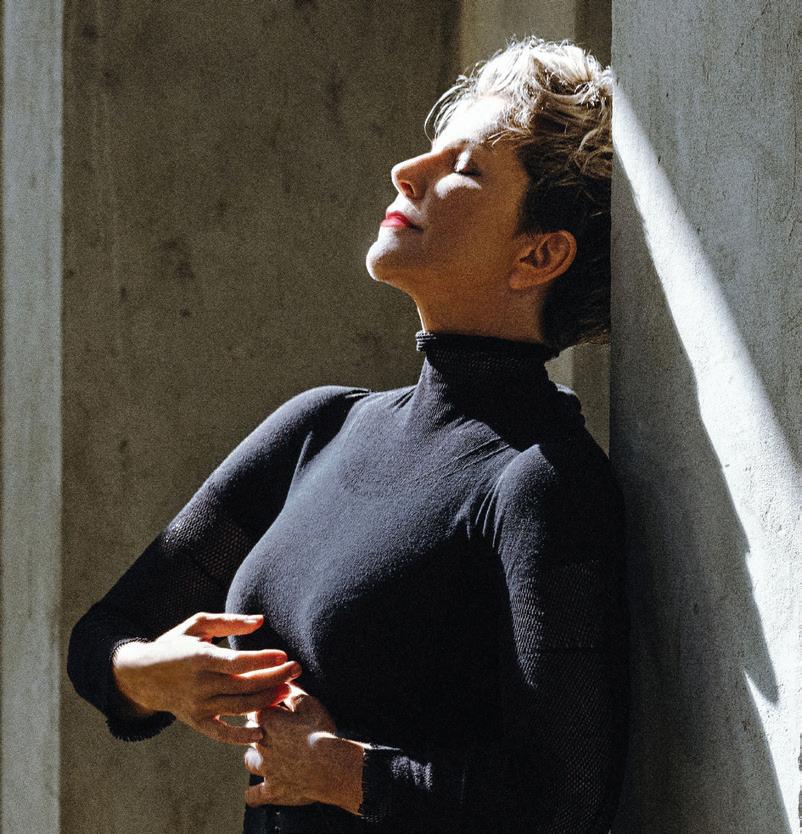
Mezzo-soprano Joyce DiDonato is the CSO’s Artist-in-Residence for the 2025–26 season.
The Orchestra first performed at Ravinia Park in 1905 and appeared frequently through August 1931, after which the park was closed for most of the Great Depression. In August 1936, the Orchestra helped to inaugurate the first season of the Ravinia Festival, and it has been in residence nearly every summer since.
Since 1916, recording has been a significant part of the Orchestra’s activities. Recordings by the Chicago Symphony Orchestra and Chorus— including recent releases on CSO Resound, the Orchestra’s recording label launched in 2007— have earned sixty-five Grammy awards from the Recording Academy.
Chicago Symphony Orchestra
Klaus Mäkelä Zell Music Director Designate
Joyce DiDonato Artist-in-Residence
VIOLINS
Robert Chen Concertmaster
The Louis C. Sudler Chair, endowed by an anonymous benefactor
Stephanie Jeong § Associate Concertmaster
The Cathy and Bill Osborn Chair
David Taylor*
Assistant Concertmaster
The Ling Z. and Michael C.
Markovitz Chair
Yuan-Qing Yu* Assistant Concertmaster
So Young Bae
Cornelius Chiu
Gina DiBello
Kozue Funakoshi
Russell Hershow
Qing Hou
Gabriela Lara
Matous Michal
Simon Michal
Sando Shia
Susan Synnestvedt
Rong-Yan Tang
Baird Dodge Principal
Danny Yehun Jin
Assistant Principal
Lei Hou
Ni Mei
Hermine Gagné
Rachel Goldstein
Mihaela Ionescu
Wendy Koons Meir
Ronald Satkiewicz ‡
Florence Schwartz
VIOLAS
Teng Li Principal
The Paul Hindemith Principal Viola Chair
Catherine Brubaker
Youming Chen
Sunghee Choi
Paolo Dara
Wei-Ting Kuo
Danny Lai
Weijing Michal
Diane Mues
Lawrence Neuman
Jikun Qin
Max Raimi
CELLOS
John Sharp Principal
The Eloise W. Martin Chair
Kenneth Olsen
Assistant Principal
The Adele Gidwitz Chair
Karen Basrak
The Joseph A. and Cecile Renaud Gorno Chair
Richard Hirschl
Olivia Jakyoung Huh
Daniel Katz
Katinka Kleijn
Brant Taylor
The Ann Blickensderfer and Roger Blickensderfer Chair
BASSES
Alexander Hanna Principal
The David and Mary Winton
Green Principal Bass Chair
Alexander Horton
Assistant Principal
Dan Carson
Ian Hallas
Robert Kassinger
Mark Kraemer
Stephen Lester
Bradley Opland
Andrew Sommer
FLUTES
Emma Gerstein
Jennifer Gunn
PICCOLO
Jennifer Gunn
The Dora and John Aalbregtse Piccolo Chair
OBOES
William Welter Principal
Lora Schaefer
Assistant Principal
The Gilchrist Foundation, Jocelyn Gilchrist Chair
Scott Hostetler
ENGLISH HORN
Scott Hostetler
Riccardo Muti Music Director Emeritus for Life
CLARINETS
Stephen Williamson Principal
John Bruce Yeh
Assistant Principal
The Governing
Members Chair
Gregory Smith
E-FLAT CLARINET
John Bruce Yeh
BASSOONS
Keith Buncke Principal
William Buchman
Assistant Principal
Miles Maner
HORNS
Mark Almond Principal
James Smelser
David Griffin
Oto Carrillo
Susanna Gaunt
Daniel Gingrich ‡
TRUMPETS
Esteban Batallán Principal
The Adolph Herseth Principal Trumpet Chair, endowed by an anonymous benefactor
John Hagstrom
The Bleck Family Chair
Tage Larsen
TROMBONES
Timothy Higgins Principal
The Lisa and Paul Wiggin
Principal Trombone Chair
Michael Mulcahy
Charles Vernon
BASS TROMBONE
Charles Vernon
TUBA
Gene Pokorny Principal
The Arnold Jacobs Principal Tuba Chair, endowed by Christine Querfeld
* Assistant concertmasters are listed by seniority. ‡ On sabbatical § On leave
The CSO’s music director position is endowed in perpetuity by a generous gift from Zell Family Foundation. The Louise H. Benton Wagner and Erika and Dietrich M. Gross Principal Flute chairs are currently unoccupied.
TIMPANI
David Herbert Principal
The Clinton Family Fund Chair
Vadim Karpinos
Assistant Principal
PERCUSSION
Cynthia Yeh Principal Chair sponsored by an anonymous benefactor
Patricia Dash §
Vadim Karpinos
LIBRARIANS
Justin Vibbard Principal
Carole Keller
Mark Swanson
CSO FELLOWS
Ariel Seunghyun Lee Violin
Jesús Linárez Violin
The Michael and Kathleen Elliott Fellow
ORCHESTRA PERSONNEL
John Deverman Director
Anne MacQuarrie
Manager, CSO Auditions and Orchestra Personnel
STAGE TECHNICIANS
Christopher Lewis
Stage Manager
Blair Carlson
Paul Christopher
Chris Grannen
Ryan Hartge
Peter Landry
Joshua Mondie
The Chicago Symphony Orchestra string sections utilize revolving seating. Players behind the first desk (first two desks in the violins) change seats systematically every two weeks and are listed alphabetically. Section percussionists also are listed alphabetically.
Discover more about the musicians, concerts, and generous supporters of the Chicago Symphony Orchestra Association online, at cso.org.
Find articles and program notes, listen to CSOradio, and watch CSOtv at Experience CSO.
cso.org/experience
Get involved with our many volunteer and affiliate groups.
cso.org/getinvolved
Connect with us on social @chicagosymphony
Conductor Joe Hisaishi with the CSO, June 2024; CSO Artist-in-Residence Joyce DiDonato
Chicago Symphony Orchestra Association Board of Trustees
OFFICERS
Mary Louise Gorno Chair
Chester A. Gougis Vice Chair
Steven Shebik Vice Chair
Helen Zell Vice Chair
Renée Metcalf Treasurer
Jeff Alexander President
Kristine Stassen Secretary of the Board
Stacie M. Frank Assistant Treasurer
Dale Hedding Vice President for Development
Chicago Symphony Orchestra Association Administration
SENIOR LEADERSHIP
Jeff Alexander President
Stacie M. Frank Vice President & Chief Financial Officer, Finance and Administration
Dale Hedding Vice President, Development
Ryan Lewis Vice President, Sales and Marketing
Vanessa Moss Vice President, Orchestra and Building Operations
Jonathan McCormick Managing Director, Negaunee Music Institute at the CSO
Visit cso.org/csoa to view a complete listing of the CSOA Board of Trustees and Administration.
For complete listings of our generous supporters, please visit the Richard and Helen Thomas Donor Gallery.
cso.org/donorgallery
CHICAGO SYMPHONY ORCHESTRA
90th SUMMER RESIDENCY
JULY 11 - AUGUST 16 •
HIGHLAND PARK
Featuring three weeks with Ravinia Chief Conductor MARIN ALSOP
Six weeks of guests include Yunchan Lim, Lizzo, Emanuel Ax, St. Vincent, Stella Chen, María Dueñas, Daniel Lozakovich, Carlos Simon, Laura Karpman, and many more —plus two concerts with Zell Music Director Designate Klaus Mäkelä— performing in the newly renovated Hunter Pavilion!
LOOKING FOR SOMETHING INDOORS?
James Conlon leads Mozart’s The Abduction from the Seraglio semi-staged in the Martin Theatre