NEWS: UChicago Introduces Seven New Study Abroad Programs
PAGE 2
The Chicago Maroon
JANUARY 14, 2026 SECOND WEEK VOL. 138, ISSUE 6
nathaniel rodwell-simon
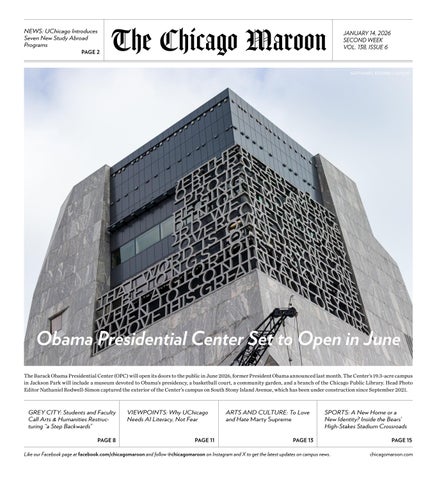
Obama Presidential Center Set to Open in June The Barack Obama Presidential Center (OPC) will open its doors to the public in June 2026, former President Obama announced last month. The Center’s 19.3-acre campus in Jackson Park will include a museum devoted to Obama’s presidency, a basketball court, a community garden, and a branch of the Chicago Public Library. Head Photo Editor Nathaniel Rodwell-Simon captured the exterior of the Center’s campus on South Stony Island Avenue, which has been under construction since September 2021.
GREY CITY: Students and Faculty Call Arts & Humanities Restructuring “a Step Backwards” PAGE 8
VIEWPOINTS: Why UChicago Needs AI Literacy, Not Fear PAGE 11
ARTS AND CULTURE: To Love and Hate Marty Supreme
SPORTS: A New Home or a New Identity? Inside the Bears’ High-Stakes Stadium Crossroads
PAGE 13
Like our Facebook page at facebook.com/chicagomaroon and follow @chicagomaroon on Instagram and X to get the latest updates on campus news.
PAGE 15 chicagomaroon.com
THE CHICAGO MAROON — JANUARY 14, 2026
2
UChicago Cautiously Optimistic About Further Deficit Reductions After Fast Drop This Year By ELENA EISENSTADT | Deputy Editor-in-Chief and GABRIEL KRAEMER | Head News Editor Administrators projected cautious optimism about UChicago’s financial outlook at their fifth invite-only budget town hall on December 11. Provost Katherine Baicker and Enterprise Chief Financial Officer Ivan Samstein expressed confidence that the University’s $160 million operating deficit could be eliminated by 2028 as planned. But “we also understand there’s a lot more uncertainty in the external environment than there was when we made this plan,” Baicker said. After lowering its deficit by 44 percent—nearly twice the decrease initially predicted by administrators—in 2025, the University expects a slower pace for deficit reductions over the next two years, Baicker and Samstein said. The presentation also revealed compensation and other expense figures in fiscal year (FY) 2025 that were not included in UChicago’s publicly available financial statements. Compensation increased by nearly 8 percent overall in FY2025, according to the presentation. Salaries and benefits in the Biological Sciences Division rose by 9 percent, while salaries and benefits for all other divisions increased by roughly 7 percent.
Supplies, services, and other expenses—a miscellaneous spending category that Baicker said includes travel, meals, and other non-personnel expenditures— decreased by about 7 percent, from $657 million to $610 million, in FY2025 after adjusting for accounting changes not reflected in financial statements. External headwinds could affect future deficit reduction The shifting federal policy landscape, including further reductions in federal grants, changing policies towards international students, and hikes in federal taxes on university endowments, still poses financial risks to deficit reduction, Baicker and Samstein said. UChicago has not yet seen significant financial effects from any of those threats, but the University is planning in anticipation of future impacts, according to Baicker. “The unprecedented external risks and uncertainty make it all the more important to implement additional measures to moderate spending and accelerate revenue growth,” a University spokesperson wrote to the Maroon. “That’s why we’re working closely with academic units to monitor any changes throughout the
academic year, including by monitoring international student trends as the application season ramps up.” Since the federal government’s termination of more than 70 grants in FY2025, UChicago has successfully secured more significant grant income in the first few months of FY2026, as federal agencies
“were getting money out the door” before the federal fiscal year ended, Baicker said. “We did very well in those months, but then we don’t know what the budget is going to look like going forward [in FY2027] for NIH [the National Institutes of Health], for NSF [the National Science CONTINUED ON PG. 4
UChicago Introduces Seven New Study Abroad Programs By BORIS ARCHIPOV | Senior News Reporter Last month, the UChicago Study Abroad Office announced seven new study abroad opportunities for the 2026–27 academic year. These programs include Cambodia: History, Tragedy and Renewal, London: Theorizing the Present, Paris and Its World Fairs: 19th and Early 20th-Century Expositions Universelles, Paris: Machine Learning for Networked Systems, and Sydney: Colonization, Health, and the Environment (all scheduled for September 2026 with an application deadline of February 9),
as well as Paris: Visual Arts, and a direct enrollment program at Cardiff University (both set for Autumn 2026, with March 30 and January 3 application deadlines, respectively). Dana Currier, the deputy director of the Study Abroad Office, told the Maroon that the new opportunities would help meet high demand for September Term programs, which cover one course in three weeks. The Sydney and Cambodia programs are UChicago’s first offerings in Oceania
and Southeast Asia, respectively, according to Currier. Sydney: Colonization, Health, and the Environment “will explore the historical and current implications of colonialism in the city,” according to the Study Abroad website. “Sydney offers a compelling case study for examining colonial history,” said Christopher Kindell, the program’s faculty director and an assistant instructional professor in the Committee on Environment, Geography and Urbanization. “As a global seaport that rapidly developed during the long 19th century, it
served as both a site of British imperial experimentation and a crucial node in Pacific World networks of trade, migration, and disease transmission.” Cambodia: History, Tragedy, and Renewal, designed by anthropology professor Alan Kolata, will evaluate Khmer history through readings, discussions, and an exploration of various archaeological and historical sites across Cambodia. “Students interested in the historical and contemporary contexts of social, cultural, and environmental change and economic development in the Global South CONTINUED ON PG. 6
THE CHICAGO MAROON — JANUARY 14, 2026
3
ISAC’s New Data Research Center Brings the Ancient World Into the Digital Age By CLARA TRIPP | Senior News Reporter The Institute for the Study of Ancient Cultures (ISAC) launched its new Data Research Center (DRC) in November, consolidating the institute’s information science resources and introducing a digital component to help researchers research, analyze, and visualize the archives more effectively. Since its founding in 1919, ISAC—a research institute at UChicago focused on the study of ancient West Asia and North Africa—has primarily relied on analog methods to document excavations and conduct research. By employing new data analysis tools, the center aims to help students and faculty push the frontiers of contemporary scholarship. “With powerful analytical, computational tools like AI, we can analyze high-quality, diverse data that’s been very carefully curated,” ISAC Director and professor of Near Eastern archaeology Timothy Harrison told the Maroon. “It enables us to engage in research that wasn’t possible to imagine before.” AI will be used to synthesize and model language-based and archaeological data in ways that enable users to draw their own conclusions. For example, Foy Scalf, the director of the DRC, explained that AI could map regions where a certain term was used and layer a chronological framework to demonstrate how the word developed across time and space. The center will support ongoing faculty and student projects, serving as a facilitator between academia and the programming realm. The initiative began roughly two years ago, and the idea received overwhelmingly positive feedback from stakeholders, according to Scalf. As it enters its next phase, the DRC is hiring a web application developer to help researchers leverage the new tools effectively. The center is also collaborating with departments across the University to advance interdisciplinary research in the biological and physical sciences, Harrison explained. As home to one of the largest repositories of knowledge on the past 15,000 years
of human history, ISAC can be a resource for studying topics ranging from urbanization to genetics to climate change. For example, ISAC is partnering with an atmospheric physicist at another university who creates simulations of global climate models using supercomputers. “They’re very interested in testing their models against the data sets that we have, because their basic empirical data is climate and weather patterns from the past 100 or 200 years,” Harrison said. “We can bring into the conversation thousands of years of carefully archived and processed data about very specific places and periods of time.” By collaborating with additional campus partners, including the Forum for Digital Culture, UChicago IT Services, the UChicago Library, and the Chicago Center for Cultural Heritage Preservation, Scalf explained, ISAC also seeks to steward a robust digital infrastructure that can evolve. “You can’t just put something online and then stop working on it,” he said. “Our [Assyrian] dictionary took 90 years to complete, so we’re looking ahead to the next century.” Both Harrison and Scalf believe that the DRC will build on ISAC’s previous attempts to manage its vast quantities of information about the ancient world. In 1933, ISAC’s founder, James Henry Breasted, proposed the Archaeological Corpus Project, a card catalogue that was an early version of what is today called a database. “In the 21st century, databases, online platforms, artificial intelligence— all this kind of stuff is at the cutting edge, so we’re trying to continue ISAC’s legacy,” Scalf said. During Breasted’s tenure, ISAC acquired artifacts through partage and colonial mandates, but it pivoted toward research and fieldwork after World War II. According to Harrison, ISAC’s archives comprise multimedia items including paper field records, biological artifacts, material culture, and even data from remote sensing and satellite imagery. Now, the information ISAC has amassed over the past century—which
includes millions of physical notecards— has to be digitized. Scalf explained that ISAC’s physical documents are scanned with simple flatbed scanners and feeders before undergoing optical character recognition (OCR), which makes the text searchable and machine-readable. However, because many ancient languages, such as cuneiform, include unique diacritics and stylings, past technology has not always produced accurate results. Researchers have struggled to manage the volume of information. “It’s very hard to control 45,000 ancient texts, all in your mind, or even in a spreadsheet or book,” Scalf said. AI provides a new solution to organize this massive data corpus and can enhance OCR accuracy. While many users interact with AI in a simple question-and-answer format, for Scalf, its innovation lies in its
ability to organize and model information. “People often think that we’ll just teach AI to understand ancient texts, but to me, that’s so boring,” he said. “It’s part of the romantic beauty of what we do— you have a 1,000-year-old document that nobody’s ever read, and you get to read it first.” Most of ISAC’s discussions about responsible AI usage focus on protecting intellectual property and promoting open access. “We want to be publicly accessible, but, if we throw everything out there, big tech companies might find commercial applications for it, at the potential expense of our researchers,” Harrison said. “I don’t think we have ready answers for all of these questions, but I think the DRC will help us deal with them.” CONTINUED ON PG. 7
M
The Chicago Maroon Tiffany Li, editor-in-chief Elena Eisenstadt, deputy editor-in-chief Evgenia Anastasakos, managing editor Haebin Jung, chief production officer Adam Zaidi and Arav Saksena, chief financial officers The Maroon Editorial Board consists of the editors-in-chief and select staff of the Maroon.
NEWS
Gabriel Kraemer, co-head editor Anika Krishnaswamy, co-head editor Nathaniel Rodwell-Simon, editor GREY CITY
Celeste Alcalay, editor Anika Krishnaswamy, editor Vedika Baradwaj, editor VIEWPOINTS
Sofia Cavallone, co-head editor Camille Cypher, co-head editor ARTS AND CULTURE
Nolan Shaffer, co-head editor Shawn Quek, co-head editor Emily Sun, co-head editor SPORTS
PHOTO AND VIDEO
Nathaniel Rodwell-Simon, head editor DESIGN
Eliot Aguera y Arcas, editor COPY
Mazie Witter, chief Megan Ha, chief Feifei Mei, chief Vanessa Yelder, chief Olivia Rae Okun-Dubitsky, chief SOCIAL MEDIA
Katherine Bolte, manager NEWSLETTER
Evgenia Anastasakos, editor BUSINESS
Shrivas Raghavan, editor Josh Grossman, editor
Maria Lua, co-director of operations Patrick Xia, co-director of operations
DATA AND TECHNOLOGY
Executive Slate: editor@chicagomaroon.com
Nikhil Patel, editor Jinny Kim, editor Emily Sun, editor CROSSWORDS
Eli Lowe, head editor
For advertising inquiries, please contact ads@chicagomaroon.com. Circulation: 2,500. © 2026 The Chicago Maroon Ida Noyes Hall 1212 East 59th Street Chicago, IL 60637
THE CHICAGO MAROON — JANUARY 14, 2026
4
“University administrators ‘want to keep driving down the deficit so [they] have more free cash flow to invest in the capital infrastructure of the University.’” CONTINUED FROM PG. 2
Foundation], for DOE [the Department of Energy], [or] for the other agencies that have traditionally supported a lot of the work done at the University,” Baicker said. Similarly, UChicago saw little change in international student numbers in FY2025 and has only seen a “localized impact” so far in 2026. International student enrollment in the College rose by less than 2 percent across all units between fall 2024 and fall 2025, according to University census reports. “We’re watching very carefully who’s applying for next year,” Baicker said. The University sees early indications that federal actions will show larger impacts on international student enrollment in FY2027 and beyond. Although Thursday’s presentation focused on the external pressures affecting UChicago’s university enterprise alone, Samstein added that substantial cuts to Medicaid in the coming years could also have significant impacts for UChicago Medicine. The hospital sees more inpatient Medicaid patients than any other hospital in Illinois. Looking forward, University administrators “want to keep driving down the deficit so [they] have more free cash flow to invest in the capital infrastructure of the University” and reduce growth in the total amount of the University’s debt, Samstein said. The University’s debt increase this year was comparable to FY2024’s $150 million debt increase. UChicago has faced criticism for taking on a heavy debt load in the past, but Samstein defended the University’s decision to make leveraged investments in infrastructure, saying in the presentation that the approach would help build the long-term wealth of the University. Baicker also noted that, with “interest expense staying relatively flat and a growing enterprise, that means [interest on debt] is comprising a smaller share of total spending for the University.” Administrators repeatedly pointed to master’s programs as an area of possible revenue growth. Master’s program enrollment has increased for the past two
years, according to figures from the town hall presentation, but is only up slightly from the past four years.
stant. But “we need to be thinking about where we are allocating resources” within major spending categories, she said.
Master’s students are “a great population to bring to the University, and one that [the administration is] keeping a close eye on,” Baicker said. She added that there were faculty committees examining how to make master’s and Ph.D. programs more sustainable at the University. Graduate tuition revenue in FY2025 grew by close to $24 million, a 9 percent increase, according to University financial statements. Baicker also defended UChicago’s pending $375 million sale of its Center for Research in Security Prices (CRSP)— which critics have speculated was motivated by the University’s financial troubles—calling it a “wonderful transaction” that “just increases value.” CRSP “got so big and so useful to so many people that it would have more value if it was developed in a bigger way, commercially, by a partner,” she said. “Spinning that off and taking the proceeds… and putting [them] back into endowment for ongoing use by Booth and the University unlocks a lot of value.”
Additionally, Baicker said the University would need to make trade-offs to keep compensation expenses steady. “We had many years of very limited [salary] increases for people, and that is not sustainable,” she said in response to an audience question about the timeline of the University’s staff reduction strategy. In order to keep pay competitive, she continued, “we probably need to do fewer things to make sure that everything we do is well resourced.” “Our immediate tasks are to continue applying spending discipline, augmenting sources of revenue, and investing in the remarkable faculty and students at the University of Chicago,” the University spokesperson wrote in response to the Maroon’s follow-up question about what areas might face cuts. “We’re also working with the deans and faculty to develop additional strategies that are tailored to the goals of individual schools and divisions, keeping them at the forefront of their fields.” Staff reductions were “modest” in FY2025, Samstein said, attributing small expense increases to restrained hiring rather than layoffs. He added that reductions were larger in FY2024, when the University offered a voluntary retirement incentive that approximately 200 people accepted.
Trade-offs necessary in resource allocation, Baicker says Baicker said the University does not expect the FY2026 budget to change much from its FY2025 budget, with shares of expenses projected to stay mostly con-
Baicker said the voluntary retirement packages and “not fully replacing positions where there’s been attrition leav[e] more compensation to give increases to the people who are here.” Additionally, she pointed to reassessments across academic units to determine “which centers and institutes are robust… versus which ones have outlived their most useful years, or were great ideas and gambles that didn’t quite pay off, and being a little tough about pruning where that’s warranted.” But she emphasized that, despite pauses and reductions in Ph.D. admissions announced earlier this year in response to federal policy changes, spending on Ph.D.s has still increased, citing growing per-student costs. She also said that spending on the Division of the Arts & Humanities “has increased year over year,” notwithstanding cost-cutting reorganization plans for the division. “I don’t want that discussion about how we organize ourselves and [how] programs should grow versus shrink to add confusion to how much we’re actually spending on Ph.D. students, which continues to grow as is commensurate with our mission,” Baicker said. University defends investments amid criticism of financial strategy In response to an audience question about whether administrators felt the University had made mistakes that contributed to the deficit, Baicker called the University’s borrowing decisions over the past two decades to finance new initiatives “purposeful” and an “investment in our mission and eminence.” “If you had the choice of being in the University of 30 years ago versus the University of today, this is a remarkable university that has accomplished a huge amount during that period,” Baicker said. “When we look at our stature, I think it speaks well of the investment and suggests that we have a lot of momentum to build on as we close the deficit.” Still, concerns persist about UChicago’s heavy investments in expanding the CONTINUED ON PG. 5
THE CHICAGO MAROON — JANUARY 14, 2026
5
“We have a plan that’s doing the pieces that we need to do as an institution that will make us strong [and] innovative... with a more sustainable budget.” CONTINUED FROM PG. 4
College and making it more appealing to applicants, alongside a focus on hard-science programs, and how the University’s approach may have contributed to its financial issues. President Paul Alivisatos, appearing
at the end of the presentation, conceded that the University “could have paid more attention to aspects of how we created more revenues with those investments.” “I don’t think you really ought to fault the academic choices that were made,” he
said. “You could say maybe we could have done more to create the underlying web that supports all of that.” But he pointed to the University’s recent moves, including “4+1” programs and other master’s programs, as ways of “bring[ing] those revenue sources into
alignment with what the academic areas are.” “We have a plan that’s doing the pieces that we need to do as an institution that will make us strong [and] innovative, academically… with a more sustainable budget,” Alivisatos said.
Current and Former Trustees Pritzker, Brooks Appear in Newly Released Photos From Epstein Estate By EVGENIA ANASTASAKOS | Managing Editor
ment at the time of publication. Several other photographs show Brooks at a separate event, seated next to Google co-founder Sergey Brin. In another, he is pictured by himself, smiling at the camera.
From left to right: magician David Blaine, businessman and trustee Thomas Pritzker, former Israeli Prime Minister Ehud Barak, financier and sex offender Jeffrey Epstein, and filmmaker Woody Allen. courtesy of the house oversight committee.
Brooks with Google co-founder Sergey Brin in the background. courtesy of the
Longtime trustee and businessman Thomas Pritzker (M.B.A. ’76, J.D. ’76) and New York Times columnist and former University of Chicago trustee David Brooks (A.B. ’83) appear in newly released photographs from the estate of Jeffrey Epstein. The images, which were made public Thursday by the House Oversight Committee, are part of a collection of more than 95,000 photographs obtained from the late financier and convicted sex offender’s estate. One undated photograph released by the House Oversight Committee appears to show Pritzker seated at a table alongside Epstein, filmmaker Woody Allen, former
The photographs of Brooks match images taken by former Microsoft executive Nathan Myhrvold at a dinner event hosted by the Edge Foundation in 2011. Other attendees included Tesla and SpaceX founder Elon Musk, 23andMe co-founder Anne Wojcicki, musician Peter Gabriel, and Amazon founder Jeff Bezos. The images do not indicate any wrongdoing by those depicted. Although Epstein is not listed on the Edge website as an attendee, one of the newly released photographs shows him at what appears to be the same dinner. The event occurred three years after Epstein pled guilty to state charges that he had solicited prostitution from a minor.
Israeli Prime Minister Ehud Barak, and magician David Blaine. Emails and correspondence released last month indicate that Pritzker and Epstein shared a close personal relationship. Among the nearly 20,000 pages of documents shared by the House Oversight Committee were more than two dozen emails between them. The documents also show that Pritzker was still in contact with Epstein as late as February 2019, just months before his July 2019 arrest on federal sex trafficking charges. Pritzker’s name also appears in Epstein’s “little black book” and the flight logs of Epstein’s private planes. Pritzker could not be reached for com-
house oversight committee.
Brooks was elected to the University of Chicago Board of Trustees in 2012. His term ended sometime prior to 2023. Brooks also served on the Board of Advisors for the University of Chicago Institute of Politics from 2013 to 2018. He is currently a senior advisor to the UChicago Leadership & Society Initiative. In a statement, a New York Times spokesperson said that “as a journalist, David Brooks regularly attends events to speak with noted and important business leaders to inform his columns, which is exactly what happened at this 2011 event. Mr. Brooks had no contact with him before or after this single attendance at a widely-attended dinner.” In an interview with PBS News Hour, Brooks said he did not meet Epstein or speak to him at the dinner. “I had no idea who Jeffrey Epstein was in 2011… and I have had no contact with him,” Brooks said. The pictures come less than a month after Brooks published an op-ed in the New York Times titled “The Epstein Story? Count Me Out,” in which he criticized Democrats for pushing for the release of documents related to Epstein. Brooks did not disclose his attendance at the event in his column. “They may believe that the Epstein file release will somehow hurt [President Donald] Trump,” he wrote. “But they are undermining public trust and sowing public cynicism in ways that make the entire progressive project impossible. They are contributing to a public atmosphere in which right-wing populism naturally thrives.”
THE CHICAGO MAROON — JANUARY 14, 2026
6
“With these new programs, the Boyer Center will now have 32 unique study abroad opportunities.” CONTINUED FROM PG. 2
will find the course particularly intriguing,” Currier said. The three new Paris programs will take place at UChicago’s John W. Boyer Center in Paris. With these new programs, the Boyer Center will now have 32 unique study abroad opportunities. UChicago is also expanding its study abroad programming in the United King-
dom, with its new Cardiff University and London: Theorizing the Present programs. With these new programs, the University now offers 13 study abroad opportunities in the United Kingdom. The Cardiff University program is a direct enrollment program, allowing students to study for either the autumn quarter or for the entire academic year at Cardiff University.
Daragh Grant, a senior lecturer in social sciences and the faculty director for London: Theorizing the Present, said the program “will invite students to interrogate systems of power and value, to propose methods and frameworks for making sense of recent events and ongoing transformations.” Allyson Nadia Field, a cinema and media studies professor who will teach
the course for the program this year, explained that the class will explore the ways that speculative thinking is used as a creative technique in Black British cinema. “The course will focus on speculation as a key practice in contemporary Black British cinema, looking at artists who reimagine history in their negotiation of archival absences, silences, and erasures in the wake of empire,” Field said.
Student Develops EdTech Startup to Streamline High School Club Communication By CLARE STRUZZIERY | News Reporter
iOS and desktop displays of ClubHub’s software. courtesy of ilan puterman.
student Sam Buck, who joined ClubHub’s team early last summer, previously worked in a charter school on Chicago’s South Side and hopes the program will expand to reach more public schools. “I’m excited for the opportunities for ClubHub to expand outside of [the current] market, because I think what we offer could help really get more opportunities,” Buck said. But ClubHub’s rapid growth during CNVC also created new challenges, as Puterman struggled to balance schoolwork with the demands of running a startup at a larger scale. “I realized that I’d have to ei-
In his senior year of high school, thirdyear Ilan Puterman set out to streamline his school’s club landscape as a part of his campaign for student government. What began as a simple website for posting club announcements has since grown into ClubHub, a subscription software program that allows high school administrators to centralize data—such as attendance records and announcements—from all student-run clubs. Though Puterman’s first client was his own high school, ClubHub now serves 80 high schools nationwide. Participating schools pay an annual fee for access to the platform’s resources. The current iteration offers a centralized database where club rosters and events are easily accessible and allows clubs to communicate directly with current and potential members. New features include
Puterman at an education conference with ClubHub. courtesy of ilan puterman.
options for clubs to share data directly with college counselors and parents. Puterman attributes much of ClubHub’s recent growth to his participation in last year’s College New Venture Challenge (CNVC), a venture capital competition which UChicago undergraduates can participate in for course credit. During the competition, Puterman was able to focus solely on ClubHub’s development and grow its client base from 27 to 80 schools. He placed second and won $95,000 in funding. “I’ve never worked so much on something,” Puterman said. “CNVC helped me think about the vision [for ClubHub] and just how big it can get. The mentorship is really great and helped me get to that realization.” After CNVC, Puterman sought to expand his team. Second-year Booth M.B.A.
ther focus my attention to [my] classes and let ClubHub run on the sidelines like it had been the past two years, or I was going to fully focus on it and actually hit the goals we wanted to,” Puterman said. Since spring quarter last year, Puterman has been on a leave of absence, pursuing the start-up full time. ClubHub now has three developers working on its website, as well as rotating team members in the summer. “As long as I can set ambitious goals and keep on learning and growing towards them, then I love what I’m doing,” Puterman said. “I’m learning a ton.”
THE CHICAGO MAROON — JANUARY 14, 2026
7
“... [A]cademia and the humanities need to have a seat the table if we want to negotiate the challenges that we’re going to face as new technology spreads.” CONTINUED FROM PG. 3
Scalf views the project as part of a wider movement to use developing technologies as a supplement—not a replacement—for traditional scholarship. “I think we’re aligning ourselves with the larger goals of the University, and it’s
very prescient,” he said. “All three University leaders [involved]—our director of the museum [Harrison], the library dean [Torsten Reimer], and the University president [Paul Alivisatos]—see that academia and the humanities need to have a seat at the table if we want to negotiate
the challenges that we’re going to face as new technology spreads.” Scalf and Harrison agreed that the demand for new skill sets will influence how students are trained across fields, creating the potential for exciting connections. “If we have atmospheric phys-
icists and archeologists and historians and language people working together, and each of these disciplines have their own culture, it’s almost like a different language,” Harrison said. “If I was a student, that nexus is where I’d want to be, because it’s pure discovery.”
2026 Rhodes Scholar Elect Tori Harris to Study African Diasporic Archaeology By VITTORIA ANGELONI | News Reporter Fourth-year Tori Harris has been awarded a 2026 Rhodes Scholarship to pursue research in African diasporic archaeology, making her the third UChicago student to receive the scholarship in the past two years. The Rhodes Scholarship, which fully funds a graduate degree from Oxford University, is one of the most prestigious awards for postgraduate study. Harris plans to pursue master of science degrees in African studies and archaeology with a specialization in landscape archaeology.
Tori Harris will research African diasporic archaeology at Oxford University. courtesy of tori harris .
Oxford does not currently have any African diasporic scholars, but, for Harris, this is not an impediment. “A critique of African diasporic archaeologists is that they don’t learn enough about West African cultures and societies around the late 16th century or early 17th century, when the transatlantic slave trade
was happening. So, I am going to study this in the master’s program and then go from there to archaeology,” she told the Maroon. Harris began working on archaeological research while in high school at age 16, mapping the historical trauma that occurred in her hometown of Tulsa, Oklahoma during the 1921 Tulsa Race Massacre. According to Harris, the experience helped her connect to her own history and inspired a need to learn more: “I went there, and I felt very connected to, or I felt a real need to be doing this history. So, I think that’s when I really started wanting to do archaeology.” “It felt like I was discovering something new about my own history all of the time,” she said. Initially intending to study creative writing and archaeology at UChicago, Harris progressively turned to exploring African cultures and Black history. During her study abroad program in Paris, she was encouraged by a professor to apply for the Rhodes Scholarship, but not knowing what it was at the time, she was initially hesitant to apply. “I’m sitting there, and I’m like, ‘This isn’t me, this isn’t what I do. I dig around in the dirt, right?’” she said, reflecting on the application process. “I wouldn’t be here without my professors writing me my recommendation letters, guiding me through this, literally telling me at every step of the way: ‘You are a good candidate.’” In addition to the research, Harris said
that she is particularly excited to work alongside other Rhodes Scholars, many of whom she already met as a finalist. “It was like being in an incubator with 15 or 16 other people and getting to bounce ideas off of each other about our different projects,” she said. She hopes that the community
will continue to inspire her throughout her time at Oxford. She also offered some advice to anyone considering the scholarship: “Even if it doesn’t end up in the result that you’re expecting, it will end up in a different direction, and that is good.”
THE CHICAGO MAROON — JANUARY 14, 2026
8
Photo Essay: Obama Presidential Center Set to Open in June By NATHANIEL RODWELL-SIMON | Head Photo Editor
The Obama Presidential Museum through a chain-link construction fence.
The Obama Presidential Museum from across the Jackson Park Lagoon.
The Obama Presidential Museum’s northern and western faces.
The Obama Presidential Museum from across the Metra tracks at East 60th Street.
A close-up of the letters that comprise a quote from Obama’s “You Are America” speech.
An 83-foot-tall painted glass window by artist Julie Mehretu, titled Uprising of the Sun.
The OPC’s Home Court, which will include a basketball court and community space.
A playground on the south end of the Obama Center’s campus.
Students and Faculty Call Arts & Humanities Restructuring “a Step Backwards” Small departments worry about staying afloat. By KACI SZIRAKI | Deputy Grey City Editor Sophia Rodriguez-Bell (A.B. ’24) had not planned to major in Slavic and Russian studies. But after taking her first Russian and East European studies class—drawn in by the professor’s evident passion and its small class size—she was sold. The Department of Slavic Languages and Literatures, housed in the Division of
the Arts & Humanities, is one of several small, highly specialized departments that distinguish the University even among its elite peers. These departments have cultivated close-knit communities dedicated to the language and cultural studies they provide. In July, the Maroon reported on sig-
nificant restructuring efforts in the Division of the Arts & Humanities occurring in light of new Trump administration policies and federal budget cuts. The cuts come at a time when the University is facing ongoing financial difficulties, though administrators recently expressed cautious optimism after the University’s budget deficit shrank from $288 to $160 million in 2025.
Among the changes was a proposal to consolidate the Division of the Arts & Humanities from 15 departments to just eight. According to multiple sources, departments with fewer than 15 tenure-track faculty members could face consolidation. This includes the Departments of Comparative Literature, Germanic Studies, Slavic Languages and Literatures, and CONTINUED ON PG. 9
THE CHICAGO MAROON — JANUARY 14, 2026
9
“[T]he small departments... are providing spaces to think about why and how we teach those cultures today.”
The Division of the Arts & Humanities has 309 master’s students and 413 doctoral students. emily sun. CONTINUED FROM PG. 8
South Asian Languages and Civilizations. “We won’t build a stronger future for these beloved subjects by treating them as static or frozen in time,” wrote Deborah Nelson, dean of the Division of the Arts & Humanities, in a Chicago Tribune op-ed addressing the future of the division and possible results of restructuring. “The humanities can never be contained within a final, completed form,” she added. “They must be responsive to the constancy of change.” Restructuring efforts remain ongoing. Although no departments have been officially confirmed to have been consolidated, some faculty within these smaller departments have expressed concern that the process has already resulted in decreased department stability and fewer language programs being offered in the future. “This feels like a step backwards— having to justify your [department’s] existence,” Nisha Kommattam, associate instructional professor in comparative literature, told the Maroon. A Closer Look at These Small Departments Comparative literature, Germanic studies, Slavic languages and literatures, and South Asian languages and civilizations all have relatively few graduate and Ph.D. students, according to the autumn quarter 2025 census reports published by the Office of the University Registrar. Small departments tend to offer small classes, which many students are drawn to for the opportunity for more individual attention and student-professor interaction that larger, lecture-style classes might not
be able to offer. “Having those small classes were really helpful for me—[it was] really intellectually stimulating,” said Rodriguez-Bell, who majored in linguistics and Russian and East European studies and previously wrote for the Maroon. Recounting her first year taking classes in the Slavic department, Rodriguez-Bell explained how her professor would joke about turning all of his students into Russian and East European studies majors. “That actually did happen with a good number of us,” she added, including herself. “I fell in love with the language and the coursebook because of the professors,” Rodriguez-Bell said. Anne Eakin Moss, chair of the Department of Slavic Languages and Literatures,
echoed her statement: “Not only do the small departments preserve the highest quality teaching of language and culture, [but] they also are providing spaces to think about why and how we teach those cultures today.” Moss, whose research focuses on literature, culture, and gender theory in relation to the Russian-speaking diaspora, joined the Slavic department in 2021. She described a sense of relief at the way UChicago approached and appreciated specialized area studies. “I didn’t need to explain why studying Russian literature of the 19th century or learning about underappreciated women writers of the 19th-century tradition was important,” Moss said. “It was important because it was a contribution to understanding this field.” Many of these small departments contribute substantial global research to cultural studies in areas outside of English or American cultures, which some students—including Rodriguez-Bell—have the opportunity to participate in. “[I] was looking at the current conflicts between Russia and Ukraine,” Rodriguez-Bell said, describing her experience working as a research assistant for one of her professors. “My job essentially would be to look at articles from Russian news
The Department of South Asian Languages and Civilizations has 19 total doctoral students. The Department of Comparative Literature has 18, the Department of Slavic Languages and Literatures has nine, and the Department of Germanic Studies has eight. emily sun.
media and save them and pass them along if they had anything to do with those sorts of actions.” On top of research opportunities, these small departments provide extensive language-learning courses for students at their core. The Department of Slavic Languages and Literatures has faculty covering eight different Eastern European languages. The Department of South Asian Languages and Civilizations teaches Urdu, Hindi, Sanskrit, Tamil, and more. The Department of Germanic Studies offers Norwegian and Yiddish courses on top of German. The Department of Comparative Literature offers courses engaging with an even wider range of languages, from Japanese to Lakota. “It’s one of the key assets of the University of Chicago that we teach 50-plus languages, and not one of them is redundant,” Kommattam said. “Regardless of whether 30 people sit in first-year Japanese or whether two people sit in first-year Hittite, that’s wealth. That’s an asset.” Small Departments, Big History and Deep Ties to UChicago’s Identity Some of these small departments have long histories at UChicago. Germanic studies, for example, has existed as a field at UChicago since the University’s founding in 1890 and has since provided intensive studies on German literature, philosophy, and visual arts. Slavic studies at the University also dates back to as early as 1896. Today, the department researches and teaches a variety of Eastern European cultures, not just Russian. These include Bosnian, Croatian, Serbian, Bulgarian, Czech, Polish, and Ukrainian. “Many Slavic departments around the country are just Russian departments,” said Moss. She described UChicago’s Slavic department as unique in its focus on hiring people who specialize in less dominant languages: “We’re decolonizing the Slavic department by hiring [these] faculty.” The Department of Slavic Languages and Literatures’ emphasis on multicultural studies is a shared theme among some of these small departments. The departCONTINUED ON PG. 10
THE CHICAGO MAROON — JANUARY 14, 2026
10
“We are a world-renowned institution for liberal arts and humanities. Why would we want to destroy that?” CONTINUED FROM PG. 9
ments of Comparative Literature and South Asian Languages and Civilizations both have similar approaches. Founded in 1966, the Department of South Asian Languages and Civilizations at UChicago offers extensive linguistic study, textual analysis, and research in many different South Asian languages. According to Andrew Ollett, an associate professor in the department, challenging and reflecting on Western ideologies of knowledge is one of the main goals of the department. “One of the things that we try to do is have a broader, comparative conversation about literature, religion, [and] state formation,” Ollett said. “We have to understand that these are things that did not only take place in Europe. They have a longer history outside of Europe, and we are constantly reminding people of that.” Kommattam, who focuses on South Asia from within the comparative literature department, also emphasized the importance of these programs at UChicago: “South Indian languages, Dravidian languages—very few places in the U.S. even teach them and offer them, and one of the main strengths of UChicago is that we do.” Dravidian languages originate primarily in South India and are spoken by 220 million people globally; Telugu, Tamil, Kannada, and Malayalam are among the most common. According to the South Asian Language Teachers Association, only nine North American universities teach any Dravidian languages, with most only offering Tamil. UChicago has historically offered courses in Telugu, Tamil, and Malayalam. But, like many of the programs offered by these small departments, restructuring efforts have already changed the way these studies are approached. “This is the first year in a number of decades—if ever—that, because of Tamil research being frozen and delayed, we are not currently offering first-year Tamil,” Kommattam said. “How is that fair?” “It’s Not Obvious Where the Savings Come From” In June, Nelson created five working
groups made up of 40 division staff members. Current proposed changes, including the potential consolidation of the 15 humanities departments into eight, were submitted in charge sheets to each of these groups. Within the charge sheets, Nelson described the restructuring as a result of “historical funding pressure” at institutional and national levels. In addition to current restructuring efforts, the Division of the Arts & Humanities has paused most doctoral program admissions and master’s program admissions for the 2026–27 academic year. Consolidation of departments and changes to Ph.D. programs are not new to the University of Chicago or the Division of the Arts & Humanities. Early on in the University’s history, the studies of ancient Greek and Latin merged to become the Classics department. The Department of Archaeology reorganized in 1903 before eventually becoming the Department of Art History in 1996. In 2024, the Department of Near Eastern Languages and Civilizations was renamed the Department of Middle Eastern Studies. In the past 30 years alone, the division has added three new departments: visual arts, cinema and media studies, and comparative literature. For many students and faculty, however, the new changes have raised questions about the University’s ultimate goals. “It is really detrimental to the community of Ph.D. students as a whole to have admissions paused in this way,” said Chana Toth-Sewell, a third-year Ph.D. student in the Department of Slavic Languages and Literatures. Currently, her department has just 10 total doctoral students. With admissions now paused, “our community isn’t growing, so the number of interlocutors that we have who are focusing on studying topics, regions, or cultures that resonate with ours is much smaller,” she added, describing how fewer people means fewer chances for researchers to work together and generate new knowledge. Some faculty have expressed skepticism over the financial reasoning behind restructuring decisions, calling into question the extent Trump administration
attacks have influenced policy changes compared to poor financial decisions on the University’s part. “It’s not obvious where the savings comes from,” said Clifford Ando, Robert O. Anderson Distinguished Service Professor in the Departments of Classics and History, in an interview with the Maroon. Since late 2023, Ando has published almost a dozen op-eds in the Maroon on University finances. The University has not released any statements about reducing faculty size or removing programs. According to Ando, merging departments without doing either would not save the University any money. “The only way that this [restructuring] saves money is if you cut [the] things that they claim they’re not going to cut.” Since the proposal’s announcement in June, the University has released financial statements that show its budget deficit shrank from $288.4 million in 2024 to just $160 million in 2025. Ando has written two op-eds discussing the University’s budget as it relates to restructuring efforts. In them, he called into question the extent to which financial pressures justify divisional changes. In “Reorg 101: The Past and Future of the Race to the Bottom,” Ando writes: “[F] aculty in humanistic fields and the interpretive social sciences are the only faculty in the arts and sciences who systematically pay for themselves.” He explains that humanities departments do not need expensive buildings or equipment, making instruction in these fields comparatively cheap. “If money isn’t really the issue at all, why do this? Why attempt to?” Ando told the Maroon. “I think, long-term, the intent is to reduce the number of faculties here.” University administrators have not specified whether the departmental consolidation would lead to reduced faculty. In an article answering frequently asked questions about the reorganization efforts, Nelson noted that humanities are not as inexpensive as Ando suggests, writing that “the net cost of supporting Arts & Humanities is substantial because faculty research, PhD education, and related ac-
tivities require resources while generating relatively little external grant support or other revenue streams.” She added that the University will continue to invest in the arts and humanities despite the cost. According to Ollett, however, this concern that his department may be disappearing is already a reality. “We ended the year teaching two fewer languages than we taught at the beginning of the year,” Ollett said. “We had professors leave, and we don’t know whether those people are going to be replaced, whether those languages are going to be replaced.” For Ollett, the restructuring would reflect a loss in what he describes as one of the largest South Asian programs available in the United States: “We’ve stood for 60 years, [providing] advanced disciplinary training in South Asian area studies. If we can’t provision that, then there’s no point for us to exist.” The Future of the Division of the Arts & Humanities Last August, the Atlantic published an article responding to the restructuring titled “If the University of Chicago Won’t Defend the Humanities, Who Will?” In it, staff writer Tyler Austin Harper recalls the anxiety he felt preparing to interview for a tenure-track position “near Boston,” recounting a faculty mentor from his Ph.D. program who jokingly told him, “Don’t be nervous. It’s just Harvard.… It’s not like it’s Chicago.” Even from the outside, this University has long held a reputation as a nearly unparalleled institution in the world of humanities scholarship. For years, UChicago has funded the continued research of specialized humanities departments for much of its history. Its small, focused departments have provided academic contributions for cultural, linguistics, and language studies that contribute to the niches of knowledge produced by their fields. Now, the future of these small departments is unsure. As Kommattam puts it: “We are a world-renowned institution for liberal arts and humanities. Why would we want to destroy that?”
THE CHICAGO MAROON — JANUARY 14, 2026
11
VIEWPOINTS
Why UChicago Needs AI Literacy, Not Fear Failure to integrate AI into University life leaves students ill-prepared. By YEONWOO CHO “Our teaching has become indelibly entwined with AI,” wrote the Artificial Intelligence and Education Working Group at UChicago in July 2025. Despite this assertive statement, the University’s stance toward AI is unclear, inconsistent, and ineffective— leaving both students and the University unprepared for a new world where AI is everywhere. Frankly, the University’s blurry policy is ineffective in controlling AI exploitation. On UChicago’s student resources web page on generative AI, the University only provides vague guidance, noting that “[s]tudents at UChicago are expected to engage with generative AI tools responsibly.” It adds that students “must also consider issues related to information security, privacy, compliance, and academic integrity,” but it does not define any of these factors or offer specific guidance. With growing access to the technology and a lack of meaningful checks, AI regulation is now a myth. As a result, many professors have started to transition from a no-AI policy to an AI-disclosure policy, but both policies virtually imply the same thing; Viewpoints Editor Camille Cypher expresses this concern in her Maroon article “College Writing Is Fundamental to Deep Learning,” stating that, under these policies, “students are left to decide for themselves how and when to use AI.”
Amid this chaos, the University is neglecting even a basic solution: education about the internal mechanisms of AI and its ethical use. Many professors warn students about the dangers of AI. Ironically, likely only a few instructors will invest time in explaining the hazards of blind AI usage. Consequently, many students simply view AI as a magic lamp that generates whatever they ask, with no idea what they’re dealing with. As Cypher claims in her article, students now carry the burden of judging when and where AI usage is effective while resisting the temptation to finish their tasks in a few clicks. UChicago instr uctors— those responsible for providing an operative education to students—face this issue on a daily basis. Professor Mark Payne of the classics and comparative literature departments addressed this issue in an interview: “Students were using AI to generate what to say in classroom discussions [such that] people weren’t really talking to each other anymore.” However, Payne has not banned the usage of large language models (LLMs) in his classes given that such a ban would be unenforceable. On the other hand, some University adminstrators, including President Paul Alivisatos, are more optimistic. Payne noted a discrepancy between the “top-down” and “bottom-up point[s] of view.” While many professors reject AI, University deans encourage its presence in the classroom,
making an effective and clear policy difficult to implement. Naturally, the University is falling behind—and will continue to do so. UChicago’s current stance sharply contrasts with other institutes of higher education that are incorporating AI in the classroom. In contrast to our policies, Stanford University provides faculty members with guides and videos showcasing how to incorporate AI into teaching, and students can easily find tips on approaching AI in studies on official school websites. Furthermore, UChicago is failing to prepare students for dramatically shifting workforce requirements. W hile Meta, one of the biggest technology companies in the world, announced that AI will be allowed in their coding tests and interviews to recruit candidates who have adapted to an AI-friendly work environment, effective AI-incorporated tasks are hardly implemented at UChicago. So, what has the University done to catch up to its latest trends? One example is PhoenixAI, the University’s desperate attempt to remain competitive in AI developments. Many, including Kaci Sziraki in her article “The AI Epidemic,” have claimed that this UChicago-branded ChatGPT is nearly obsolete, unused by students or faculty. The University has also released an “Understanding Generative AI” video series, but the low viewer count shows that they haven’t effectively reached their target audience.
This leaves us with the question: What can and should the University and its members do next? The primary and most apparent answer is to establish intentional, structured AI education for students and faculty members. Increased AI literacy lays the foundation for further discussions; knowledge of how LLMs function and their limitations raises awareness about current AI abuse and provides more insightful ideas. However, education alone is insufficient. The University must adopt a unified, clear AI policy that eliminates confusion across departments, is shaped by a broad group of faculty members directly affected by and aware of the difficulties
adelyn sim.
related to AI in the classroom, and is stated without ambiguity. Most importantly, UChicago must embrace the reality that AI has become an integral part of academics and the workplace. In other words, the University must put more effort into familiarizing students with a changing world, whether through education or increased exposure. In the meantime, students are left to grapple with the nature of AI: Is the machine in front of us merely a labor-saving device? Or is it something that enables us to do what we never thought possible? Yeonwoo Cho is a first-year in the College.
THE CHICAGO MAROON — JANUARY 14, 2026
12
ARTS AND CULTURE Inside the World of Bike Routes During a stop in Chicago, David Osterhout reflected on songwriting and the evolution of Bike Routes. By GABBY MANSILLA | Senior Arts Reporter It’s not every day you find your new favorite artist on TikTok—not because the talent isn’t there, but because there’s simply so much of it. Since the app took off around the world, musicians of every genre have used it as a launching pad. The sheer volume makes it hard for anything to break through. Last summer, one video did. In the video, a tall guy in a blue Seattle Mariners crewneck sings directly to the camera from the middle of his living room. The deep, velvety tone of his voice caught my attention, but it was the lyrics that stopped me short: “It’s my God-given right to block your number/ You’re the love of my life but not by choice.” 15 seconds. Two lines. No gimmicks or theatrics, just a pure vulnerability that’s rare in any genre. He stood out. “He” is New Jersey–based singer-songwriter David Osterhout, whose project, Bike Routes, is currently on tour as a supporting act on Young Culture’s First and Final Headline Tour. Chicago remains a special stop for him: it is one of the first cities where crowds began singing his lyrics back to him. Bike Routes began as a solo project when Osterhout was in high school writing songs for his friends. While there wasn’t a single moment that pushed him toward music as a career, the love for live performance secured his choice. “It was… once I started playing shows, not just for my friends, but in the local scene and opening for my friends’ bands,” Osterhout said in an interview with the Maroon. “Playing shows was always the allure for me.” That thrill Osterhout speaks of is immediately evident onstage. Bike Routes’s set at Beat Kitchen alternated between stripped-down, acoustic-leaning songs and the high-energy sound of his newer music, performed with a full band: bassist Conner DeMuro, guitarist Jorge Es-
trada, and drummer Mike Corrao. While Osterhout slips easily into the role of an alternative rock frontman, he is just as convincing once he picks up his acoustic guitar. “Realistically, at the base of all the songs, I start them on an acoustic guitar and just my voice. Sometimes, during the process, it becomes obvious that a song would really benefit from a full band. But then sometimes I’ll write a song and think, ‘No, this doesn’t need a big production.’” One of the night’s most moving moments came with “Delayed Gratification,” a song that forgoes that “big production” in favor of a catchy, folksy rhythm. The lyrics trace through spirals of anxiety and artistic self-doubt before landing on a tender memory of his dad singing to him when he was little. It is a clear nod to the people and moments that helped shape his relationship with music: “No one in this family is so musically inclined/ But I remember when I was young/ You’d sing to me every single night.” On the recorded version, Osterhout trails off softly with a fragment of Bruce Springsteen’s 1992 “Pony Boy.” Live, the crowd filled in, chanting, “Pony boy, pony boy/ Won’t you be my pony boy.” A huge smile flashed across his face. The audience’s response is rooted in recognition. Rather than obscuring his writing with heavy metaphor or abstraction, Osterhout speaks directly, allowing listeners to see their own experiences reflected back across his catalog. He describes his feelings about the family car being scrapped, the fears and thoughts that follow him on the drive home, and the quiet loyalty he finds in his dog’s eyes. At heart, he’s a storyteller. “I usually start with a memory,” Osterhout said. “I’m constantly writing in the Notes app on my phone. I start with a one-liner, a very specific one or two lines, put it to melody, and then build off that emotion.”
David Osterhout performs with an acoustic guitar at Beat Kitchen. Bike Routes’s set balanced high-energy, pop-punk-inspired tracks with intimate, pared-down songs. gabby mansilla. Bike Routes’s biggest success to date is its latest EP, Rush of Energy. Released in 2024, the EP marked the beginning of Osterhout’s shift toward a louder, more aggressive pop-punk and post-hardcore sound reminiscent of bands like Movements. The EP’s centerpiece “World Apart,” which is “the soul” of the record for Osterhout, almost didn’t exist. “That was the last song we recorded,” he said. “We had all the other songs done, and only about a 45-second instrumental that eventually became ‘World Apart.’” With just one studio day left in Los Angeles, his producer challenged him to arrive with a fully written song. While the friend with whom he was sharing a hotel room slept, Osterhout spent the night holed up in the bathroom writing until nearly 6 a.m. The next day, they recorded the song in full. “When we were done, it just felt like lightning in a bottle,” he said. That lucky strike now serves as his set closer, a moody, angsty song about longing for connection. “Driving back to Philadelphia/ But there’s nothing for me there,” he
sings. In a characteristically Bike Routes turn, the song then cuts straight to the emotional core: “I just want someone to look at me/ The way my father looks at nature.” So, what’s next for Bike Routes? A soldout date opening for The Wonder Years at Philadelphia’s iconic Theatre of Living Arts, followed by a run supporting Chicago’s own Worry Club on the Southern U.S. leg of their spring tour. In a surprise announcement, Osterhout also shared that fans can expect a full-length album by next summer. Working again with Zach Tuch, who produced Rush of Energy, this release suggests a continuation of the EP’s spirit. Osterhout described their partnership as one shaped by different creative strengths: “He’s very good with instrumentation, while I [focus more] on lyrics and melodies. We complete each other.” With 11 songs already written, mixed, and mastered, 2026 is shaping up to be a big year for Bike Routes. While there’s no set date for Osterhout’s return to Chicago, it wouldn’t be surprising to see him headlining a tour of his own next time around.
THE CHICAGO MAROON — JANUARY 14, 2026
13
To Love and Hate Marty Supreme In Marty Supreme, director Josh Safdie uses ping-pong as the engine for a ferocious, funny meditation on ambition and obsession. By SHAWN QUEK | Head Arts Editor In “Brave Sperm and Demure Eggs: Fallopian Gender Politics on YouTube,” academic Pamela Nettleton explores the implications of media depicting sperm as subject and egg as object, framing it as a perpetuation of problematic notions of patriarchal power. As I watched a prolonged macro two-shot of Timothée Chalamet’s sperm and Odessa A’zion’s egg inching toward insemination on a 40-foot screen, it all seemed to make sense. But what on earth did this have to do with table tennis? I soon got an answer: a match cut snapped me from a close-up of an egg to a table tennis ball spinning down the court, its white blur carving the air. The introduction is jarring, hilarious, and unmistakably intentional, a visual sleight of hand that announces the film’s obsession with momentum and surprise above all else. Marty Supreme is always in motion. To say that Marty Supreme is a film about table tennis would not be entirely incorrect. It would be akin to saying something like “La La Land is about jazz” or “Inception is about dreams.” The film—which flirts with ideas ranging from power to subjugation, capitalism to expansionism, greatness to desire—is far from a straightforward sports picture. Marty Supreme merely uses table tennis as a narrative device, a paddle used
by Director Josh Safdie to keep the ball in the air. Set in the early 1950s, Marty Supreme unfolds across New York, London, Paris, Tokyo, and Cairo. Despite its international sprawl, the film has a stunning visual consistency, thanks to legendary cinematographer Darius Khondji, known for his work with David Fincher and Bong Joon-ho, as well as the Safdie brothers. Khondji paired Arriflex cameras shooting 35mm film with vintage anamorphic lenses, engrossing the audience through the timeless richness of each frame. This cinematographic accomplishment, however, is only half of the mise-en-scène executed to pure perfection. Costume designer Miyako Bellizzi and production designer Jack Fisk craft a world of wide lapels and towering skyscrapers, flawlessly immersing the viewer in a world undergoing post– World War II reconstruction and the economic expansion that followed. Grounded in this backdrop, Marty Supreme is a gritty, time-tested tale about chasing dreams. Marty Mauser, the film’s titular protagonist played by Chalamet, is the most driven person you know who is also the worst person you know. In every scene, one yearns to reach into the screen and punch Marty in the face, yet one cannot help
but cheer for him with the same closed fist. Chalamet embodies the insufferable table tennis talent whose life mission is to win the world’s first title for America, hurting himself and everyone around him along the way to get there. The brilliance of Chalamet’s performance captures both the post-WWII cockiness of the United States and the frantic, scrappy, underdog nature of a protagonist chasing his dreams. This tension is equal parts performance and wit, with Safdie and Ronald Bronstein putting on a masterclass in screenwriting. Chekov’s gun proves insufficient; Safdie and Bronstein instead opt for a whole armory. Despite the twisting tangents the protagonist finds himself on, every thread of the story is somehow woven together, resulting in a cinematic fabric consisting of diabolical digressions that makes you forget entirely that Marty Supreme is technically a sports movie. Marty spends the most memorable moments of the picture on such side quests. Often, Marty is accompanied by Wally (Tyler Okonma, usually known as Tyler, the Creator, in a scene-stealing feature debut), an accomplice whose loyalty oscillates between genuine friendship and the sheer persuasive power of inertia, who finds himself trapped on the roller coaster ride that is being the protagonist’s partner in crime. Marty hustles for cash. He burns racists. He
crosses the mob. He cons women. He gets conned himself. Every object, line, and glance is loaded. Every gun fires. The film is a properly chaotic, beautifully deranged picture from Safdie. At a perpetually breakneck pace, each scene is like a ping-pong paddle that bludgeons the audience into submission, inciting laughs, squirms, tears, and everything in between.
The film poster for Marty Supreme. courtesy of a 24.
Our Strange World Resurfaces at the Art Institute’s Symbolist Exhibition Reality loses its hold on the pictorial surface in the Strange Realities: The Symbolist Imagination exhibition, replaced by dreams and potent symbols. By NOËL DA | Associate Arts Editor Things are not as they seem inside the Art Institute of Chicago’s new exhi-
bition. On view since October 4, 2025, Strange Realities: The Symbolist Imagi-
nation displays a series of late 19th- and early-20th-century works by artists like Edvard Munch, Paul Gauguin, Odilon Redon, and even Vincent van Gogh. Artists
who worked in the Symbolist movement rejected visible reality in favor of fantasies, nightmares, psychological triggers CONTINUED ON PG. 14
THE CHICAGO MAROON — JANUARY 14, 2026
14
“Oddity abounds here, passing through the very lines of nature to reach us.” CONTINUED FROM PG. 13
and barely conscious desires. Symbolist art latched onto a literary project that began in France and quickly spread throughout Europe’s colder regions in the late 1880s. By attempting to uncover that which lies below the surface of everyday reality, Symbolism found contrast from Realism, materialism and even Impressionism, its brighter and more externally focused precursor. Instead, Symbolist works dealt with the obscure, dancing through the poorly lit back alleyways of our memories and imaginations. The Art Institute simulates this shadowy mental world in its exhibition, dividing its pieces across six dimly lit grey rooms. Visitors enter through the largest of these spaces, which contains a version of Munch’s The Scream. Unlike the more famous, colored versions, this 1895 lithograph includes an inscription by the artist which reads: “I felt the great scream through nature.” Along with the anxious ripples that characterize the composition, this caption provides a worthy introduction to the rest of the exhibit, whose landscapes and faces threaten to transmit great emotions at every instant.
the same room. One of the lesser-known artists in the Strange Realities lineup, Fjæstad worked between the 1890s and 1940s, specializing in delicate yet heavily texturized paintings of the Swedish landscape. In Moonlight, Örebro, the reflection of the water comes to life in mystical squiggles that seem to both mimic and beckon the figure standing at the river’s edge. Like Munch’s The Scream, something strange ripples through the lines of nature, something we feel distinctly but must strain our eyes to see.
Moonlight, Örebro (1897) by Gustaf Fjæstad. on display at the art institute of chicago.
The Scream (1895) by Edvard Munch. on
display at the art institute of chicago.
Another star of the show, Gustaf Fjæstad’s Moonlight, Örebro, hangs in
Each of the outer rooms of the exhibit focuses on a different theme, from religion to femininity, that fascinated certain pockets of Symbolist artists. In the room titled “Devotion and Skepticism,” James Ensor’s etchings dominate one wall. These highly dense works span only a few inches on each side, such that one has to lean in to see the artist’s depictions of religious intervention in the modern world. As the figures Christ and Death burst into Brussels and the streets, respectively, crowds of nonplussed people turn their faces towards the intrusion. “Despite being an atheist,” the label of one piece explains, “Ensor used Christian motifs to comment on political and social injustice.” Elsewhere in the exhibition, the commentary on traditional symbols and their changed meanings continues. A classi-
cally dressed figure emulates the ancient Greek muses in a piece titled Inspiration, but the landscape around her is rendered in dry and loose strokes of watercolor. A sphinx drawn by Odilon Redon broods over a dark charcoal landscape, its head bent resolutely against a stormy world. In the exhibition’s largest painting, spanning an entire wall, a stylized Joan of Arc listens to the voices emanating from her heavily decorated surroundings. By inserting these historically charged characters into unfamiliar settings, the Symbolists draw out the strangeness of their world and the ways in which it rejected or remolded around old values. The room dedicated to “Imagining Women” contained a particularly well-curated selection of paintings, each picturing a different kind of woman and further complicating the issue of portraying femininity. The Symbolist movement was by no means progressive, and, in fact, the wall text informs us that “Symbolists regarded gender equality as yet another symptom of societal degeneration.” Still, the women on the surrounding walls entice, mystify, and compel us in their various shades. Munch’s Madonna presents a new kind of seductress, her deep-set eyes turned towards the sky; Eugène Grasset’s Morphine Addict confronts us with the crazed expression of a girl whose black hair swells around her shoulders. Female artists add their women to the visual conversation as well: Cornelia Paczka-Wagner’s Fate shows a severe goddess in profile, while Marie Laurencin’s Song of Bilitis depicts sapphic love. The show’s poster child, Jean Delville’s Medusa, stares both at and through us with hazy eyes that turn our thoughts to stone. By far the most exciting work in the exhibit is Max Klinger’s series of etchings collectively called A Glove. In 10 tiny but exquisite works, each measuring slightly larger than a postcard, Klinger quietly tells the story of a man whose mind becomes wretched after picking up a woman’s glove. In one etching, he dreams of plucking the glove from a tumultuous ocean; in the next, the glove rides a heavenly chariot at dawn. The scenes imbue the glove with a life of its own, along with the power to mold the man’s psychological world.
Triumph, an etching from A Glove (1881) by Max Klinger. on display at the art institute of chicago.
Symbolism’s strangeness comes to a head in Klinger’s etchings, which also sit at the end of the exhibit. Reality has lost its hold on the pictorial surface by now, replaced by dreams and potent symbols. Like many of us today, the Symbolists held a deeply suspicious view of single-minded technological advancement, wary of the opportunities for moral decline in its emphasis on materialism. Concerned with the state of society, Symbolists supplanted this literalism with alternative realities, visions, and dreamscapes. The imagination finds a rich breeding ground in their paintings, playing off of traditional iconography and haunted by a kaleidoscopic cast of female archetypes. Oddity abounds here, passing through the very lines of nature to reach us. In the highly probable case that our world is just as strange today as it was then, one ought to take a trip to the Art Institute’s exhibit for inspiration and redress.
Detail from The Dream (1897) by Hans Thoma. on display at the art institute of chicago.
Strange Realities: The Symbolist Imagination was on view at the Art Institute of Chicago through January 5, 2026.
THE CHICAGO MAROON — JANUARY 14, 2026
15
SPORTS
A New Home or a New Identity? Inside the Bears’ High-Stakes Stadium Crossroads The team’s push toward a domed stadium raises questions that stretch far beyond dollars and blueprints. By RAHUL MURTHY | Sports Reporter At Soldier Field on December 14, the scoreboard read 31–3, showing a dominant Bears win over Cleveland that briefly warmed a stadium otherwise defined by low-single-digit temperatures. The team followed it up six days later with an overtime win against Green Bay as the night hovered in the mid-30s, cooled by a lakefront breeze cutting through the stands. Together, the two games captured a Chicago winter at its extremes: one brutally frigid, the other deceptively mild. Yet, as fans filed out with frozen fingers, the Bears were already looking toward a future that may not resemble days like these at all.
Soldier Field, the current home of the Chicago Bears. nathaniel rodwell-simon. A New Stadium, Still on Paper The Bears’ ambitions for a domed stadium in Arlington Heights have long been clear: the team has pursued a new stadium on the site of the former Arlington International Racecourse since purchasing the property in 2023, repeatedly returning to Arlington Heights as their preferred option throughout 2024 and 2025. The team envisions a climate-controlled venue surrounded by restaurants, housing, and entertainment. Some view the project as a step toward modernizing
the franchise, with Bears President and CEO Kevin Warren highlighting the opportunity to host major events such as the 2031 Super Bowl. But, for all the planning and renderings, the project has stalled at a familiar obstacle: funding. The team has committed to covering the stadium’s direct construction cost, estimated at well over $2 billion. Bears leadership has repeatedly emphasized that they are not asking for taxpayer dollars to build the stadium itself, framing the project as one of the largest private investments in Illinois sports history. However, the infrastructure around the stadium, including highway ramps, Metra adjustments, utility upgrades, and the transformation of a 326-acre site, would come with an additional price tag of $862 million. While the Bears have argued that the state should help cover those infrastructure costs, the fall legislative session in Springfield closed without granting that support. For now, the stadium remains a vision. A Public Still Carrying Past Frustrations If the Bears were hoping for widespread enthusiasm, the response across the city has been more complicated. A recent Mansueto Institute for Urban Innovation survey reported that 65.2 percent of residents oppose using taxpayer money for a stadium of any kind, whether in the city or the suburbs. Chicagoans have a long history with publicly subsidized stadiums, and the results have not always matched the promises. The 2003 Soldier Field renovation left many fans and taxpayers feeling burned after a costly, publicly funded overhaul that continues to carry unre-
solved debt. Additionally, the financing of Guaranteed Rate Field, the Chicago White Sox’s South Side home, remains a point of civic debate. For many, the idea of another publicly backed stadium project is less exciting than it is familiar. Even supporters of the team are cautious. The Bears may be ready for a new era, but Chicagoans are not sure whether they want to help pay for it. Those concerns have been echoed by state leaders, including Governor J. B. Pritzker, who has publicly raised paying down the unresolved debt from the 2003 Soldier Field renovations as a prerequisite for further stadium negotiations. Timing Adds Pressure To submit a competitive bid for the 2031 Super Bowl, the Bears would need commitments soon, as hosting the league’s biggest event would bring global exposure and significant economic activity to the region. Infrastructure plays a central role in that urgency. A new Metra station, modified ramps near Route 53, and redesigned traffic grids would be essential for the stadium’s operations and cannot be delayed indefinitely. The longer that legislative approval takes, the narrower the construction window becomes. On a separate front, rising property taxes on the Arlington Heights site create a deadline of their own. If construction does not begin by 2027, costs will escalate sharply. Bears officials have warned that continued delays risk derailing construction timelines altogether, with ripple effects for planned development around the proposed stadium site. A Fanbase Caught Between Affection and Change What makes all of this feel so consequential is that it touches on more than
budgets and blueprints. It touches identity. For generations, Chicago’s football experience has been shaped by the lake, the cold, and the stubborn pride of enduring it. Soldier Field is part of the team’s emotional landscape. The Bears are proposing something different: comfort, efficiency, and predictability. Some fans would welcome the change. Others feel that the cold is the point. Many are somewhere in the middle, supportive of modernization yet unsure whether leaving the city and the wind also means leaving something harder to define. The Road Ahead The Bears’ December home wins over Cleveland and Green Bay were a reminder of what the team can look like on the field. Those victories were soon followed by a playoff berth and an NFC North title, clinched as division rivals fell out of contention. The stadium issue, however, is rooted in everything surrounding the field, and that conflict will not be resolved by a final score, regardless of its magnitude. To move forward, the Bears need legislative partners. To win over the public, they need trust. To meet their Super Bowl hosting aspirations, they need speed. That urgency sharpened in mid-December when Warren’s open letter announced it was expanding its stadium search beyond Illinois to include Northwest Indiana, signaling growing frustration with the lack of legislative movement in Springfield. In the meantime, the team will continue playing on the lakefront, where winter asserts itself and fans still bundle up for something that feels uniquely Chicago. The future may be indoors, but, for now, Chicago Bears football is played in the cold.
THE CHICAGO MAROON — JANUARY 14, 2026
16
CROSSWORD 98. Time for a Road Trip By CARTER OTIS | Associate Crossword Editor
ACROSS 1 Commonly used interface for audio and video 5 Frequently injured ligaments 9 Assume guardianship of 14 Declaration of distress 15 Ideal environment for a seedling 16 Longed for, in a romantic way 17 *Constantinople, Interior China, and Southeast Asia 19 “Previously on... ” montage 20 Ramadan sunset meal 21 Dalai ___ 23 Actress de Armas of “Knives Out” and “No Time to Die” 24 Flings haphazardly 26 *The Bahamas, Cuba, and Hispaniola 29 One, in Austria 30 Nibble, in beverage form 32 Personae non gratae at a middle school sleepover 33 “Legendary, dude” 35 “You thought!” 38 Wallet occupants, perhaps 39 *Mare Tranquillitatis 42 Verified 44 Sporty sunroof option 45 Prefix with -pus and -ber 49 Milieu for a pirate or privateer 51 “Cry ___ river!” 53 British collegiate reference source: Abbr. 54 *Guam, the Philippines, and Patagonia 57 Partner of nook 59 “Make ___ double!” 60 Man’s name which is a citrus fruit backwards 62 Precursor of species 63 Director Christopher 66 Dora and Diego, for instance, or 17-Across, 26-Across, 39-Across, and 54-Across vis-à-vis the locations in the starred clues 68 First principle of Kwanzaa For more puzzles, visit chicagomaroon.com/crosswords. 69 Like an aborted rocket launch 70 Branded brain freeze inducer 71 Morally disreputable 7 Scented spring shrub 34 “Probable” thing to obtain, for a pros72 What an ill-composed plan might hit 8 Long-term camera setting ecuting attorney 73 Digital marketplace for artisan gifts 9 Fools’ Day mo. 36 Cousin from “The Addams Family” 10 Cubic casino component 37 Originating at DOWN 11 Like a San Francisco streetcar 40 Hook, line, and sinker component 1 “Ohh, I get it now!” 12 Cheap price to work for 41 Barrel bunch, briefly 2 Request from a trampoline bystander 13 Successful Hail Mary 42 Selection from a pastry case 3 James Bond likes his “shaken, not 18 WHO, UN, and AAA, to name a few 43 Clothing fit for a king stirred” 22 “In the style of,” in a culinary sense 46 What an enterprising detective 4 Pre-Columbian Andean resident 25 Thailand, formerly might do to dots, perhaps 5 Venemous viper variant 27 East Asian soup add-in 47 Terms for teachers 6 You can lose it while mad, or try to 28 Jerry of “In the Summertime” 48 Honda variant aptly suited for long keep it while balmy 31 Utterance in a quiet room journeys
49 50 52 55 56 58 61 64 65 67
Countdown abbr. for 39-Across Ending for ginger or pale 2012 film about the rescue of American diplomats from Tehran Spiritual signoffs Ford forerunner Home for an eagle or condor Tee time group for women Barometric pressure unit: Abbr. Bronx-based baseball team, on a scoreboard Write down for recordkeeping purposes