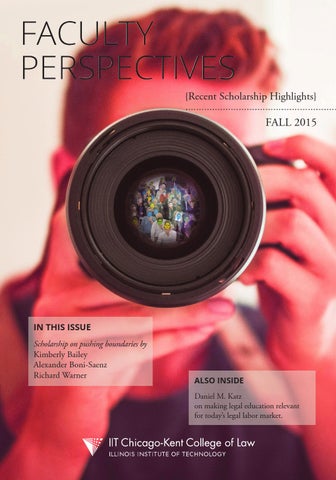
{Recent Scholarship Highlights}
FALL 2015
IN THIS ISSUE Scholarship on pushing boundaries by Kimberly Bailey Alexander Boni-Saenz Richard Warner
ALSO INSIDE Daniel M. Katz on making legal education relevant for today’s legal labor market.
FACULTY PERSPECTIVES
FALL 2015
Featuring scholarship on pushing boundaries {Privacy}
1
Watching Me: The War on Crime,
Privacy, and the State Kimberly D. Bailey
{Sexuality and Law}
7
Sexuality and Incapacity Alexander Boni-Saenz
{Privacy and Government}
13
The Self, the Stasi, the NSA: Privacy, Knowledge,
and Complicity in the Surveillance State Richard Warner and Robert H. Sloan
{Legal Education}
19
The MIT School of Law? A Perspective on
Legal Education in the 21st Century
Daniel Martin Katz
25
Bookshelf
About IIT Chicago-Kent Faculty Perspectives
IIT Chicago-Kent Faculty Perspectives is published regularly to highlight recent faculty scholarship at IIT Chicago-Kent College of Law. Issues can be accessed online at www.kentlaw.iit.edu/faculty/ recent-scholarship. For questions, email facultyscholarship@kentlaw.iit.edu. Layout and production by Josiah Harrist, IIT Chicago-Kent Faculty Marketing Coordinator. Cover image by Josiah Harrist, “Protection for Snowden” by greensefa, modified and used under CC License. Additional photo used courtesy of Pexels under CC0 License. *Footnotes omitted.
{Privacy}
WATCHING ME
THE WAR ON CRIME, PRIVACY AND THE STATE
published in U.C. Davis Law Review
FALL 2015 [ 1 ]
Kimberly D. Bailey
[Hi-res image]
Associate Professor of Law
AB, Indiana University JD, University of Michigan Law School
K
imberly Bailey joined the IIT Chicago-Kent faculty in fall 2007. Prior to joining Chicago-Kent’s faculty, she was a visiting scholar and adjunct professor at the University of Houston Law Center. She also practiced labor and employment law in Houston, Texas, where she was an associate at Fulbright & Jaworski LLP. Professor Bailey was a Clarence Darrow Scholar at the University of Michigan Law School. She graduated cum laude, and she was an associate editor and contributing editor of the Michigan Law Review. Professor Bailey earned her bachelor of arts degree from Indiana University in Bloomington, Indiana. She graduated with highest distinction, and she was a member of Phi Beta Kappa. Professor Bailey’s research focuses on how social, political and economic inequalities are reflected in criminal law. She has written extensively about gender violence, and she has also written about the criminal justice system’s negative effects on the privacy interests of poor communities of color. She teaches Criminal Law, Criminal Procedure, and Evidence at Chicago-Kent. For more, visit her faculty webpage here.
[ 2 ] IIT CHICAGO-KENT FACULTY PERSPECTIVES
WATCHING ME The War on Crime, Privacy, and the State BY KIMBERLY D. BAILEY
I
n the criminal justice context, the state engages in an unjustifiable privacy invasion whenever the monitoring of its citizens results in the abuse of its power. This abuse can come in the form of the prohibition of activities that society views as valuable; the creation of a sense of being constantly monitored by the state, which then has a chilling effect on these activities; or the unjustifiable aggregation of data on the state’s citizens. These abuses result in serious dignitary harms because of the level of suspicion and distrust they thrust upon the individual. According to Anglo-American ethicists in the Kantian tradition, “[s]elf consciousness, free-will, rationality, moral agency, and the ability to form life plans are essential traits of personhood.” Privacy creates, sustains, and enhances personhood because it provides individuals with the space to develop these traits without the fear of being monitored, judged, and sometimes even unjustifiably punished. The war on crime creates such an oppressive feeling of being watched by the state, that it at minimum has a chilling effect on poor people of color’s self-determination, self-expression, and freedom of association. Excerpted from Watching Me: The War on Crime, Privacy, and the State, 47 U.C. Davis Law Review 1539 (2014)
FALL 2015 [ 3 ]
Kimberly Bailey
Self-determination enables an individual to create the life that one wants to create. Self-expression and freedom of association allow for the free exchange of ideas and experimentation with one’s identity, which are both important for self-development. They also make it easier for one’s ideas and cultural identity to become part of mainstream political discourse. In addition, freedom of association, particularly with a diverse group of people, increases a poor person of color’s social capital and chances for upward mobility. Because privacy is the foundation for freedoms that enable the creation of one’s identity and life plans, the more privacy one has, the less vulnerable he is to oppressive state social control. For this reason, the level of privacy granted by the state has historically tracked the level of one’s political power and status. Wealthy, white men historically have had the greatest amount of privacy; women, the poor, and people of color have had the least amount of privacy, and, therefore, they have been vulnerable to more severe policies of state social control.
S
cholars have documented the fact that the poor and people of color continue to have the least amount of privacy in our society and, therefore, they are still the most vulnerable to more extreme state social control policies.
I
n addition to making poor people of color more vulnerable to oppressive state social control, the war on crime has also created serious dignitary harms. When the state curtails privacy, it sends a powerful message: an individual cannot be trusted to use his privacy in legitimate ways. For example, parents tend to give their children less privacy because they do not yet trust that the children have the maturity and wisdom not to make choices
[ 4 ] IIT CHICAGO-KENT FACULTY PERSPECTIVES
that could potentially harm themselves or others. Likewise, one reason we limit the privacy of prisoners is because their past acts suggest that we cannot trust them not to engage in criminal and potentially dangerous activities, at least for a set period of time. The lack of trust expressed by the state through the war on crime, therefore, at best resembles a form of paternalism; at worst, it resembles a form de facto criminalization of individuals simply because they are poor and of color. These individuals logically conclude that the state does not respect them nor does it view their identities and viewpoints as equal to those of white and wealthier citizens. It is important to stress just how intrusive stops-and-frisks and motor stops are; they are more than just minor annoyances. Many individuals, particularly young men of color, must endure these stops monthly, weekly, and sometimes even daily. The intensity and frequency of these stops makes these individuals feel as if they are constantly being watched by the state. As a result, some inner-city residents of New York have reported that they limit the amount of time that they spend on the street and that they go outside only when necessary in order to mitigate constant monitoring by the police and to maintain some sense of anonymity from the state. This limitation on their mobility necessarily undermines their ability to create the types of lives that they want to create through self-determination. This limitation also has a chilling effect on their associations with their neighbors, and it makes associations with those outside of their neighborhood, particularly those who are of other races, very difficult. In addition, the fact that some poor people of color feel the need to look less “ethnic” in order to avoid being a target for constant monitoring, because of racial and socioeconomic biases, shows that the war
Watching Me
on crime has led some to severely limit their sense of self-expression out of desire to keep some of their privacy. This fact is significant because how one dresses and how one wears one’s hair are important expressions of one’s personal and cultural identity.
T
hese stops are also problematic because this constant barrage of questioning regarding one’s activities and comings and goings expresses the lack of trust that the state has for poor people of color. It does not matter that innocent individuals do not have anything to hide, this lack of trust shows a suspicion that these individuals need to be constantly watched in order to keep them in line.
have such a chilling effect, especially for innocent individuals who have nothing to hide or for those who do not even know that the data collection is happening. The problem is that even innocent conduct can sometimes be embarrassing or simply politically unpopular. This type of information could potentially affect one’s job prospects, housing opportunities, and social relationships if made public. Furthermore, the volume of information that the state can gather through technology is much greater than traditional police surveillance techniques. For these reasons, some anonymity from the state via technology is essential in order to prevent this type of information from providing opportunities for state abuse.
“Because privacy is the foundation for freedoms that enable the creation of one’s identity and life plans, the more privacy one has, the less vulnerable he is to oppressive state social control.” The fact that this sentiment is often expressed in a public setting intensifies the insult to their dignity because these individuals must bear the shame that others might assume that the stops confirm that poor people of color must always be watched. Furthermore, the fact that white and wealthier individuals do not have to endure these stops with the frequency that poor people of color do expresses that whites and wealthier individuals are worthy of more privacy, and, therefore, more trust and respect. Another troubling aspect of the war on crime is the practice of data collection through technology . . . Some may think it alarmist to consider whether the aggregation of data through technology will really
A
nother weapon in the war on crime arsenal is the snitch. It is important to differentiate snitches from law-abiding citizens who report crime in their communities. A snitch is someone who engages in crime and then reports criminal activity to the government in order to obtain lesser punishment or no punishment at all ... Because drug arrests disproportionately affect African-Americans and Latinos, there are a disproportionate number of snitches in their neighborhoods as “criminal offenders actively [seek] information in order to ‘work off’ their own charges.”
T
he use of snitching instills the realistic fear that one’s neighbors, family members, or friends might be spying on FALL 2015 [ 5 ]
Kimberly Bailey
him. Snitching, therefore, potentially chills freedom of expression and association because individuals do not know whom they can trust with knowledge about their thoughts, feelings, and conduct. Anything they say or do might later be used against them by the state. Indeed, snitches increase the access that the state has to an individual’s private information because they supplement the limited resources the state typically has to monitor its citizens. The harms caused by snitching are heightened by the fact that a snitch might be a family member. Snitching is another way that poor people of color feel mistrust and suspicion from the government. Furthermore, creating an atmosphere where individuals mistrust members of their own household expresses complete contempt for the privacy of poor people of color, since privacy in the home is supposed to be highly valued. Each of the tactics I have described in this Part is troubling in its own right. Yet, many individuals, particularly poor, young urban males of color, endure many of them simultaneously. They endure constant stops-and-frisks, which could potentially lead to their personal information being placed in a gang database. They might also have to provide a DNA swab in order to terminate their encounters with
[ 6 ] IIT CHICAGO-KENT FACULTY PERSPECTIVES
the police. Law enforcement might track them further through their cell phones and social networking pages. Due to oppressive overcharging policies regarding minor offenses, they are in more danger of being convicted of crimes, which also leads to heightened surveillance. Even if a young man of color avoids a conviction, he still has to worry about a close friend or neighbor snitching on him so that he might avoid his own potentially hefty sentence. As already described, the aggregation of these forms of monitoring by the state have the potential for substantial chilling effects on activities we typically value in our democratic society, and they ■ also create serious dignitary harms. KIMBERLY BAILEY SELECTED PUBLICATIONS Articles It’s Complicated: Privacy and Domestic Violence, 49 American Criminal Law Review 1777 (2012). Lost in Translation: Domestic Violence, “The Personal is Political,” and the Criminal Justice System, 100 Journal of Criminal Law and Criminology 1255 (2010). The Aftermath of Crawford and Davis: Deconstructing the Sound of Silence, 2009 Brigham Young University Law Review 1.
{Sexuality and Law}
SEXUALITY AND INCAPACITY
forthcoming in Ohio State Law Journal
FALL 2015 [ 7 ]
Alexander Boni-Saenz
[Hi-res image]
Assistant Professor of Law BA, Harvard College MSc, London School of Economics JD, Harvard Law School
A
lexander Boni-Saenz earned a J.D. magna cum laude from Harvard Law School, where he was a notes editor on the Harvard Law Review. He also holds a M.Sc. with distinction in Social Policy from the London School of Economics and an A.B. magna cum laude with highest honors in Psychology and Government from Harvard College. Prior to joining the IIT Chicago-Kent faculty, Professor Boni-Saenz was a Bigelow Fellow and Lecturer at University of Chicago Law School. He practiced law as a Skadden Fellow at the Legal Assistance Foundation of Metropolitan Chicago, where he created a medical-legal partnership for low-income seniors. He also clerked for Judge Diane P. Wood of the United States Court of Appeals for the Seventh Circuit. Professor Boni-Saenz’s scholarship focuses on how legal doctrines and institutions can respond to the challenges and opportunities of an aging population. His scholarly work is interdisciplinary in nature and touches on several areas, including disability law, family law, health law, and trusts and estates. He teaches courses in Health Law, Property, and Trusts and Estates. For more, visit his faculty webpage here.
[ 8 ] IIT CHICAGO-KENT FACULTY PERSPECTIVES
SEXUALITY AND INCAPACITY BY ALEXANDER BONI-SAENZ
H
enry Rayhons and Donna Young did not expect to find love again after being widowed. They met in their late 60s, and first flirted in church while singing for the choir. Two years later, they were getting married in front of over 350 guests. Now in their 70s, they enjoyed several activities together, such as beekeeping, farming, and long leisurely drives. They also had sex. In 2010, Donna was diagnosed with Alzheimer’s Disease. As her condition worsened, two of her daughters from a previous marriage moved her to a residential care facility. Henry would regularly visit her, and on one visit in May 2014, Donna’s roommate thought she heard sexual noises coming from across the privacy curtain in their shared room. This led Donna’s daughters to seek guardianship over Donna and to limit Henry’s interactions with her. On August 8, 2014, Donna passed away. A week later, Henry was arrested and charged with felony sexual abuse on the basis that Donna Rayhons suffered a “mental defect” that made her unable to consent. Henry abandoned his run for another term as a state legislator, and the criminal case garnered national media attention. A week-long trial exposed details of Donna and Hen-
An excerpt from Sexuality and Incapacity, 76 Ohio State Law Journal ___ (forthcoming)
FALL 2015 [ 9 ]
Alexander Boni-Saenz
ry’s relationship, Donna’s medical condition, and their alleged sexual encounter in May. After two days of deliberations, the jury acquitted Henry of wrongdoing. Henry and Donna’s romance highlights how important sexuality can be to human flourishing, even in later life. Sexuality represents a unique source of pleasure, meaning, and social connection. The Supreme Court has recognized a sexual liberty interest in Lawrence v. Texas, though its dimensions are actively debated by scholars. Other areas related to sexuality have also received constitutional protection. Marriage, which is the social institutionalization of a form of sexuality, has been deemed fundamental by the
responsible for safeguarding those with cognitive impairments. The threat of this liability often leads institutions to establish highly restrictive sexual environments, especially in response to family member requests. The law also has expressive effects when it invalidates the apparent consent choices of those who are deemed to lack legal capacity. This is clearest in the case of criminal prohibitions, which carry the weight of societal condemnation for the acts that are deemed criminal. But both civil and criminal doctrines act to construct the sexualities of citizens by demarcating the boundaries of acceptable and unacceptable sex and reinforcing ex-
“The right to sexual expression should not be withheld due to cognitive impairment alone.” Court. The Court has also closely guarded the related principle of bodily integrity, though the constitutional justifications for this principle vary. Whatever the contours of a right to sexual expression might be, the degree to which it extends to people who have cognitive impairments remains unexplored.
T
he criminal charges against Henry show how the law can be used to regulate relationships and sexuality. The sexual incapacity doctrines that were at play in that case are perhaps the most important form of sexual regulation, as they control access to sex by designating who is legally capable of sexual consent. When someone is deemed to lack legal capacity, the law imposes civil and criminal liability on sexual partners for battery and rape. In addition, it triggers vicarious liability and regulatory consequences for institutions that are
[ 10 ] IIT CHICAGO-KENT FACULTY PERSPECTIVES
isting understandings of the sexuality of certain groups. To the degree that a class of individuals is deemed to lack sexual consent capacity, this can devalue them and construct them either as asexual and undesirable or as hypersexual and in need of control. Sexual incapacity doctrines, however, shape more than just the older adult sexuality of Henry and Donna Rayhons. They have a wide reach, affecting sexually precocious minors, intoxicated teenagers on college campuses, and younger adults with Down Syndrome as well. Most states have adopted incapacity tests for adults that focus narrowly on assessing an individual’s cognitive abilities. These tests serve an important protective function for individuals with temporary and transient incapacity, such as those rendered incapable due to alcohol or drugs. However, this comes at the cost of barring many people
Sexuality and Incapacity
with persistent forms of incapacity from any sexual activity. This is despite the fact that said individuals often still have sexual desires and are able to engage in sexual decision-making with support from caregiving networks. By applying a test that focuses narrowly on cognitive abilities to individuals with persistent impairments, courts are unnecessarily and permanently restricting the sexual expression of millions of individuals, with intensely negative social, psychological, and health consequences.
T
he central claim of this Article is that sexual incapacity doctrine should grant legal capacity to adults with persistent cognitive impairments if they are embedded in an adequate decision-making support network. In other words, the right to sexual expression should not be withheld due to cognitive impairment alone. It then sets forth a novel sexual consent capacity test for this population: cognition-plus. To justify this claim and corresponding legal test, the Article provides a theory of sexual incapacity doctrine that is normatively grounded in sexual capability, or the opportunity to pursue functionings associated with sex and sexuality. This could include having sexual pleasure, forming a sexual identity, or feeling sexy. The focus of sexual capability is on ensuring opportunities rather than on guaranteeing happiness, economic resources, or freedom from state interference. However, capability can overlap significantly with these other measures of well-being. For example, a society that socializes its citizens to think that sex is dirty, that criminalizes non-marital sexual conduct, and that provides no protections against sexual violence, denies its citizens the capability for a healthy sexual life. Its citizens may also be less likely to be happy. Even if society does provide all that is necessary for a healthy sexual life,
individual members of that society might, however, still pursue unhealthy sexual relationships or deny themselves sexual partners altogether, despite the desire for them. In other words, they might not take advantage of the opportunities to which they have access. Ultimately, it is the right of each individual to decide whether to pursue the functionings that are within reach. In this way, sexual capability is agnostic as to people’s sexual choices, as the focus is on creating the ability to have meaningful choice. An individual’s sexual capability is a product not only of that person’s cognitive abilities, but also of her social resources and the legal treatment of those abilities and resources. An analogy to driving is helpful. In order to have the ability to drive to work, one must possess physical and mental capacities to drive, the resources to buy a vehicle to transport oneself, the legal entitlement of a driver’s license, and adequately paved roads to get from point A to point B. The inability to drive to work might reflect any or all of these factors. Disability theorists have long emphasized that disabilities are not only created by the physical or mental impairments of the individual, but also by a society that refuses to accommodate these impairments. One important resource that many people with persistent cognitive impairments possess is a decision-making support network composed of a single caregiver, a set of family members, or an institution’s staff. These capability-enhancing networks, however, are not recognized by the law in this area. The cognition-plus test represents the legal implementation of the sexual capability value for people with persistent cognitive impairments. It derives its name from a joint focus on the mental capacities of the subject (cognition) and the recognition that some individuals achieve sexual decision-making capacity through FALL 2015 [ 11 ]
Alexander Boni-Saenz
the assistance of a decision-making support network (plus). The test proceeds in three general steps. The first step is to gauge whether the individual has the threshold capacity to express volition with respect to a sexual decision. Without this manifestation of desire, one cannot proceed to be a sexual agent. If the first step is satisfied, the second step is to assess whether the individual has the necessary mental capacities to understand and reason about the nature and consequences of a given sexual decision. If one meets this requirement, then one has sexual consent capacity without the need for assistance.
I
f one does not meet that requirement, however, the third step is to evaluate whether there is an adequate decision-making support network in place. These networks can provide support to an individual in formulating her purposes, connecting her desires with options, communicating with others, and creating a safe space to engage in sexual expression. Assessment of the system would be contextual in nature, guided by the principles of loyalty and care from fiduciary law. Thus, courts would evaluate whether the system is free from conflicts of interest, has adequate knowledge of the individual and the sexual decision, and has taken reasonable steps to protect the individual with cognitive impairments from the threat of sexually transmitted diseases and pregnancy. If
[ 12 ] IIT CHICAGO-KENT FACULTY PERSPECTIVES
the system is adequate, then the individual possesses sexual consent capacity. Both sexuality and incapacity are inescapable features of the human condition. They need not be mutually exclusive, but current sexual incapacity doctrines make them so for many by creating unduly restrictive sexual environments and contributing to pernicious social norms. The cognition-plus approach strikes the correct balance between protection and restriction, has a sound theoretical basis, guards against courts dictating which sexual acts are appropriate, and provides more predictability to institutions in formulating resident sexual policies and â– practices. ALEXANDER BONI-SAENZ SELECTED PUBLICATIONS Contributions to Books The Economic Burden of End-of-Life Illness, in Palliative Care: Core Skills and Clinical Competencies (Elsevier 2d ed. 2011) (with K. Covinsky & S Moody).
Articles Baselines in Trust Term Extension, 67 Florida Law Review Forum 30 (2015). Personal Delegations, 78 Brooklyn Law Review 1231 (2013). Public-Private Partnerships and Insurance Regulation, 121 Harvard Law Review 1367 (2008).
{Privacy and Government}
THE SELF, THE STASI, THE NSA:
PRIVACY, KNOWLEDGE AND COMPLICITY IN THE SURVEILLANCE STATE
forthcoming in Minnesota Journal of Law, Science & Technology
FALL 2015 [ 13 ]
Richard Warner
[Hi-res image]
Professor of Law BA, Stanford University JD, University of Southern California PhD, University of California, Berkley
R
ichard Warner is Professor and Norman and Edna Freehling Scholar at the Chicago-Kent College of Law, where he is also the Faculty Director of Chicago-Kent’s Center for Law and Computers. From 1994 to 1996, he was president of InterActive Computer Tutorials, a software company, and from 1998 to 2000, he was director of Building Businesses on the Web, an Illinois Institute of Technology executive education program. He was the principal investigator for “Using Education to Combat White Collar Crime,” a U.S. State Department grant devoted to combating money laundering in Ukraine from 2000 to 2006. Prof. Warner is currently a member of the U.S. Secret Service’s Electronic and Financial Crimes Taskforce. He is a visiting foreign professor at University of Gdańsk, Poland, and the founder and director of the School of American Law with branches in Poland, Ukraine, Georgia, and Armenia. He teaches Contracts, Remedies, Jurisprudence, Online Privacy and Security, and E-Commerce. His most recent book is Unauthorized Access: The Crisis in Online Privacy and Security, co-authored with Robert Sloan. For more, visit his faculty webpage here.
R
obert H. Sloan is professor and Head of the Computer Science Department at the University of Illinois, Chicago. He has collaborated on numerous works with Richard Warner about the impact of technology and changing social dynamics on privacy.
[ 14 ] IIT CHICAGO-KENT FACULTY PERSPECTIVES
THE SELF, THE STASI, THE NSA
Privacy, Knowledge, and Complicity in the Surveillance State BY RICHARD WARNER AND ROBERT H. SLOAN
I
n 2007, the security expert Bruce Schneier noted that, History will record what we, here in the early decades of the information age, did to foster freedom, liberty, and democracy. Did we build information technologies that protected people’s freedoms even during times when society tried to subvert them? Or did we build technologies that could easily be modified to watch and control?
Is the answer already obvious? A large literature now details the “watch and control” practices of businesses and governments. Add Edward Snowden’s revelations, and it is hard to avoid Schneier’s own 2013 “watch and control” conclusion: So we’re done. Welcome to a world where Google knows exactly what sort of porn you all like, and more about your interests than your spouse does. Welcome to a world where your cell phone company knows exactly where you are all the time. Welcome to the end of private conversations, because increasingly your conversaA summary of The Self, the Stasi, the NSA: Privacy, Knowledge, and Complicity in the Surveillance State, ___ Minnesota Journal of Law, Science & Technology ___ (forthcoming)
FALL 2015 [ 15 ]
Richard Warner and Robert H. Sloan
tions are conducted by e-mail, text, or social networking sites. And welcome to a world where all of this, and everything else that you do or is done on a computer, is saved, correlated, studied, passed around from company to company without your knowledge or consent; and where the government accesses it at will without a warrant. Welcome to an Internet without privacy, and we’ve ended up here with hardly a fight. Are we done? Our answer is, “Not yet.” An adequate degree of privacy may still be possible. We conclude with a suggestion about what is necessary to make that possibility a reality.
W
e focus exclusively on governmental surveillance. We also confine our attention to informational privacy, the ability to determine what others do with your information. Advances in information processing technology reduce privacy by giving others immense and increasing control over your information. This is particularly true of privacy in public. The notion of privacy in public dates back over a century, at least to the work of the German sociologist Georg Simmel, who observed that people voluntarily limit their knowledge of each other as they interact in a wide variety of social and commercial roles. The mutual restraint ensures that information remains private relative to the interaction even if it is otherwise publicly available. Current governmental surveillance reduces privacy in public. But to what extent? The question matters because adequate self-realization requires adequate privacy in public. That in turn depends on informational norms, social norms that govern the collection, use, and distribution of information. Current surveillance [ 16 ] IIT CHICAGO-KENT FACULTY PERSPECTIVES
practices threaten to undermine norm-enabled coordination and thereby to undermine privacy in public. The 1950 to 1990 East German Stasi illustrates the threat. The “hidden, but for every citizen tangible omnipresence of the Stasi, damaged the very basic conditions for individual and societal creativity and development: Sense of one’s self, Trust, Spontaneity.” The United States is not East Germany, but it is on the road that leads there. And that raises the question of how far it will travel. Sections I – IV support the “on the road” claim. Section V explores how far the United States will go down that road.
“The United States certainly outdoes the Stasi in the amount it knows . . .” Section I characterizes the concept of privacy in public and argues that informational norms play a central role in the creating of privacy in public. Section II connects the loss of privacy in public to the loss of self-realization. Section III presents five surveillance concepts essential to our explanation of why governmental surveillance undermines norm-enabled privacy in public. Section IV uses that conceptual framework to construct a model of how surveillance undermines privacy in public. Section V uses that model to address the question of how far the United States may travel down the road toward a Stasi-like world.
R
ealizing a multifaceted self means realizing multiple social roles, and that requires privacy in public. Perhaps the most obvious reason is that combining roles may violate others’ expectations. Avoiding disapproval and reprisal are not, however, the only reasons to seek
The Self, the Stasi, the NSA
privacy in public. Imagine, for example, that you eat frequently in a small Italian trattoria. You want to play the role of “customer they know very little about” in order to have an experience as disconnected as possible from the rest of your life. You want a pleasant break from that life. Your concern is not with their approval or disapproval. It is just with what they know. You do not merely care that more knowledge would change the way they relate to you. You do not want to have even to think about whether it might do that. The restaurant example illustrates two key points. First, social roles are typically defined in part by the way you appear to others when you are in them. Second, how you appear to others depends on what those others know. In general, different requirements on what one is allowed, expected, or required to reveal or not reveal define different relationships with governmental authorities, acquaintances, colleagues, friends, family, employers, and so on. The point is a familiar one in sociology. As the sociologist Nippert-Eng emphasizes:
“Statue of workers and Police officer in front of Stasi archives, Mitte district, Berlin,” photo by Sanandros. From Wikipedia, November 11, 2015. Image modified under CC License.
At its core, managing privacy is about managing relationships between the self and others. ... privacy ... [is] a “boundary regulatory process by which a person (or group) makes himself more or less accessible and open to others.” When we regulate our accessibility to others—including the accessibility of information, objects, space, time, or anything else that we deem private—we simultaneously regulate our relationships with them.
T
he history of the Stasi makes current surveillance practices stand out in sharp relief. Four features characterized the Stasi’s surveillance practices. First, massive knowing: As we noted earlier, the Stasi engaged in massive data collection and hence knew a great deal about East German citizens. Second, complicity: Informants “spied on friends, workmates, neighbours and family members. Husbands spied on wives.” Even if the people with whom you interacted were not Stasi informants, the 1 in 50 distribution of informants made it likely that friends and acquaintances of your friends and acquaintances would be. “Relations between people were conditioned by the fact that one or the other of you could be one of them [the Stasi]. Everyone suspected everyone else and the mistrust this bred was the foundation of social existence.” Third, pervasive repressive use: The Stasi translated its massive merely knowing into pervasive repressive use: At its heart, the Stasi was an organization that monitored society for those who . . . ‘thought differently.’ Stasi officers worked tirelessly to insure that a disruption to the socialist order—be it anti-state graffiti, the establishment of groups that FALL 2015 [ 17 ]
Richard Warner and Robert H. Sloan
did not conform to the SED’s world-view, defections, or whatever form it might take—did not occur. As the novelist Anna Funder notes in her study of the Stasi, it “arrested, imprisoned and interrogated anyone it chose.” Fourth, curtailed self-realization: Merely knowing, complicity, and repressive use severely curtailed possibilities for self-realization. As Gary Bruce puts it in his study of the Stasi, One does not detect from East Germans’ reflections on their past that they were gripped by a paralyzing fear, in the psychological sense of the word—although one interview subject did say she “was always afraid”—but rather a deep resignation that one was not the master of one’s own destiny, that to run afoul of the Stasi, even unintentionally, was to sacrifice power over one’s life and the life opportunities of family members.
T
he United States certainly outdoes the Stasi in the amount it knows and— perhaps—even in the extent of citizen complicity. In this way, the United States has traveled down the road that leads to the Stasi. But it is far from Stasi-like surveillance. It differs—only but critically—in being far more restrained in its use of information to discourage and prevent behavior the government finds undesirable. This is less reassuring than it may seem, however. As James Rule notes, there is a “tendency of surveillance systems to spread. It simply lies in the interests of both government and private surveillance operations to expand—to cover more people and more of the lives of the people they cover.”
[ 18 ] IIT CHICAGO-KENT FACULTY PERSPECTIVES
W
e conclude with Glen Greenwald’s 2014 version of Schneier’s 2007 question with which we began:
We stand at a historic crossroads. Will the digital age usher in the individual liberation and political freedoms that the Internet is uniquely capable of unleashing? Or will it bring about a system of omnipresent monitoring and control, beyond the dreams of even the greatest tyrants of the past? Right now, either path is possible. Our actions will determine where ■ we end up. RICHARD WARNER SELECTED PUBLICATIONS Books Unauthorized Access: The Crisis in Online Security (CRC Press 2013) (with R. Sloan).
Articles and Contributions to Books The Harm in Merely Knowing, 19 Journal of Internet Law 3 (2015) (with R. Sloan). Self, Privacy, and Power: Is It All Over?, 17 Tulane Journal of Technology & Intellectual Property 61 (2014) (with R. Sloan). Beyond Notice and Choice: Privacy, Norms, and Consent, 14 Suffolk University Journal of High Technology Law 370 (2014) (with R. Sloan). Behavioral Advertising: From One-Sided Chicken to Informational Social Norms, 15 Vanderbilt Entertainment and Technology Law Journal 49 (2013) (with R. Sloan). The Undermining Impact of Information Processing on Informational Privacy, in Rights of Personality in the XXI Century (Wolters-Kluwer 2012) (with R. Sloan).
{Legal Education}
THE MIT SCHOOL OF LAW? A PERSPECTIVE ON
LEGAL EDUCATION IN THE 21ST CENTURY
published in University of Illinois Law Review, no. 5
FALL 2015 [ 19 ]
Daniel Martin Katz
[Hi-res image]
Associate Professor of Law JD, University of Michigan Law School MPP, Gerald R. Ford School of Public Policy PhD, University of Michigan
D
aniel Katz is a scientist, technologist and law professor who applies an innovative polytechnic approach to teaching law, meshing litigation and transactional knowledge with emerging software and other efficiency-enhancing technologies to help create lawyers for today’s challenging legal job market. Both his scholarship and teaching integrate science, technology, engineering, and mathematics. Katz teaches Civil Procedure, E-Discovery, and Entrepreneurial Lawyering at Chicago-Kent and spearheads new initiatives to teach law students how to leverage technology and entrepreneurship in their future legal careers. He joined Chicago-Kent in 2015 from Michigan State University College of Law, where he co-founded the ReInvent Law Laboratory, an innovative multi-disciplinary center that focused on the intersection of entrepreneurship, informatics, programming and design thinking to better understand, analyze and design the law. Professor Katz received his Ph.D. in political science and public policy with a focus on complex adaptive systems from the University of Michigan. He graduated with a Juris Doctor cum laude from the University of Michigan Law School and simultaneously obtained a Master of Public Policy from the Gerald R. Ford School of Public Policy at the University of Michigan. Prior to joining the MSU College of Law faculty, he was a fellow in Empirical Legal Studies at the University of Michigan Law School and a National Science Foundation IGERT fellow at the University of Michigan Center for the Study of Complex Systems. For more, visit his faculty webpage here.
[ 20 ] IIT CHICAGO-KENT FACULTY PERSPECTIVES
THE MIT SCHOOL OF LAW? A Perspective on Legal Education in the 21st Century BY DANIEL MARTIN KATZ
D
espite some of the blustery rhetoric attendant to the ongoing market transition, lawyers and the market for legal services are not going away. Lawyers serve integral roles in a wide variety of social and political systems. Their work supports the proper functioning of markets and helps individuals and organizations vindicate their respective rights. At the same time, the processes associated with completing their work—as well as the contours of their respective expertise and judgment—are already changing. These changes are being driven by a number of economic and technological trends, many of which Larry Ribstein identified in a series of important articles published in the years before his untimely death. At the outset, it is worth noting that the legal services industry is not a monolith, and change has and will continue to manifest in different ways across different tranches of work. At the high end of the market, lawyers often help their clients navigate increasingly complex legal, regulatory, and institutional environments. Indeed, helping navigate complexity is part of the core value proposition offered by a significant number of lawyers. Arguably, the legal system and society are getting more An excerpt from The MIT School of Law? A Perspective on Legal Education in the 21st Century, 5 University of Illinois Law Review 1431 (2014).
FALL 2015 [ 21 ]
Daniel Martin Katz
complex; given complexity is at the core of bespoke work, the market for lawyers that can thrive in complex environments should remain robust. The ongoing question for legal educators is how best to equip future legal professionals to deliver value for their respective clients in a variety of complex multi-disciplinary environments. Whether it is a multi-billion dollar M&A deal, the construction of a comprehensive and legally defensible document management and retention system, a challenging piece of bio-tech centered patent infringement litigation, or Dodd Frank compliance, high-end lawyering is an exercise in helping clients navigate in opaque environments.
D
espite growth in complexity and likely inelastic demand for the very best lawyers, a non-trivial fraction of today’s legal work is not high-end legal architecting and does not require nearly as many individuals in order to see the work accomplished. For a certain range of tasks, high cost human capital can be substituted for less expensive alternatives—whether this is through labor arbitrage, better processes, or software. In the medium and long term, some of the largest financial returns likely will be obtained by the set of individuals who are able to help transition the legal industry to the proper reallocation of the legal production function. Both existing lawyers and law students are awakening to this reality and a non-trivial number are building companies that will help support the transition. The transition is underway in high to medium complexity work and to a lesser extent in the retail segment of the legal market. So-called “regular people law”—i.e., affordable legal services for the middle class, pro-bono and “low bono” market segment—still remains illusive. Using technology, process, and lower cost
[ 22 ] IIT CHICAGO-KENT FACULTY PERSPECTIVES
infrastructure, there are a number of notable efforts to better serve the underserved and thereby meaningfully and sustainably provide access to justice. However, much more work remains to be done. As Larry predicted, law’s information revolution is very much underway. Whether the clients are institutions or just regular folks, it is a process and efficiency revolution. For lawyers, substantive expertise is (of course) a minimum expectation, but going forward it may not be the primary dimension of competition. Within legal organizations (both law firms and, more importantly, corporate law divisions) and in the legal entrepreneurship community, process, workflow, metrics, efficiency, and analytics are beginning to take hold. It is transforming the practice of law in ways that are not yet fully realized. Complete change typically takes longer than it should. Organizations are sticky, due to noisy signaling and other factors, and markets take time to clear. But there are signs that this time is indeed different. Taking stock of these changes, this Essay is a thought exercise about a hypothetical MIT School of Law—an institution with the type of curriculum that might help prepare students to have the appropriate level of substantive legal expertise and other useful skills that will allow them to deliver value to their clients as well as develop and administer the rules governing markets, politics, and society as we move further into the 21st Century. It is a blueprint based upon the best available information, and like any other plan of action would need to be modified to take stock of shifting realities over time. It is not a solution for all of legal education. Instead, it is a targeted description of an institution and its substantive content that could compete very favorably in the existing and future market. It is a depiction of an institution whose students
The MIT School of Law?
would arguably be in high demand. It is a high-level sketch of an institution that would be substantively relevant, appropriately practical, theoretically rigorous, and world class. In other words, it is a plant that can survive and thrive outside those hothouse walls.
I
f Larry was right and law schools now have to deal with markets, the question is how best to do so. As of this very minute, there are approximately two graduating law students for each available law job. This situation will hopefully improve in
ria, while many others fall short. As Bill Henderson has argued: “[T]he new gold standard employment outcome is fulltime, long-term professional law-related jobs. The issue of how to maximize this outcome is so pressing and intricate that it may warrant trade-offs in the admissions process, favoring students will lower credentials but more rock-solid employment prospects on the backend at graduation.” The key is to build a better product and demonstrate its superiority to the marketplace. Obviously, this is a non-trivial endeavor. The first question to ponder
“[L]aw’s information revolution is very much underway. Whether the clients are institutions or just regular folks, it is a process and efficency revolution.” the coming years, but, generally speaking, changing the macroeconomic environment is not within the province of an individual educational institution. The demand for legal services is set exogenously by the dynamics of the relevant market(s). What an individual institution can do is compete and do the best possible with respect to its students. For many institutions, if they accept the status quo contours of the market as given, they will underperform. The way to win is to stop trying to be the “50th or 100th best Harvard and Yale” and instead to concentrate on outflanking these and other institutions by becoming leaders in law’s major emerging employment sectors. The objective function that educational institutions must seek to optimize is high quality jobs that support the respective educational investment by students. Some institutions easily satisfy this crite-
is what precisely constitutes a better product? Better for what set of tasks that lawyers undertake? The legal education and legal services market contain a series of market distortions, information asymmetries, and agency problems. In addition, both the market for legal education and a market for legal services feature a variety of noisy signals. Namely, it is difficult to overcome strong brands and the noisy lagging signals that surround the classification of quality. At all places within the industry—law schools, law professors, practicing lawyers, law firms, and general counsels—assessing the quality of the relevant product or service is extremely difficult. On the education side of the equation, students historically seek branded institutions. Specifically, they tended to seek institutions with higher U.S. News rankings. The general assumption held FALL 2015 [ 23 ]
Daniel Martin Katz
by students (and faculty) is that a higher ranked institution would result in better labor market outcomes (as measured by dollars or other related quality measures). From the perspective of many students, whether those outcomes were due to sorting or the treatment effect of the underlying education is actually immaterial. The would-be students voted with their feet and they often did so with little deep understanding of the quality of the product being offered or how their respective skills or background were suited to offerings at particular institutions. In many unfortunate instances, would-be students were often myopic about their own likely prospects—their own “lives in the law.” Incoming students too often selected programs, academic tracks, and institutions that were poorly configured to the economic realities of their current and future legal labor market.
T
he legal labor market (particularly at the entry level) is also very noisy. Large law firm partners sell their time as well as the time of their associates to their clients. To the extent there were questions raised regarding why a particular associate was working on their matter, the firm could answer with statements such as “well they went to XYZ elite institution or were at the very top of their class at ABC regional institution.” This brand signal served as a placeholder for quality because, as noted above, lawyer quality is among the most difficult of measurement problems. Both in law and in consumer markets generally, in the absence of clearly better alternative measures, firms and clients fixate on well-established brands. An entrepreneurially-minded law school has to overcome the existing brand signals. This is necessary as the institution seeks to obtain an increasing share of the existing jobs, and it is important in order
[ 24 ] IIT CHICAGO-KENT FACULTY PERSPECTIVES
to position its students to take advantage of places where new labor market openings are created. The high level workflow is simple—train, attract, and place students (in that order). To understand where the placement opportunities lie, one must work backwards starting with the employment end of the pipeline and ask employers this question: “What would it take for you to hire one (or more) of our graduates?” This information is a useful starting point but not complete because the target is shifting and thus even the employers are not quite sure what they want. For example, a recent MacArthur Foundation study noted sixty-five percent of grad school students will end up undertaking a job that has not yet been invented. While such extreme uncertainty is arguably not present in the legal services industry, this statistic points us to a basic insight regarding labor markets—past performance is not necessarily indicative of future results. This is particularly true ■ in periods of disruption. DANIEL M. KATZ SELECTED ARTICLES
Measuring, Monitoring and Managing Legal Complexity, 101 Iowa Law Review 191 (2015) (with J.B. Ruhl). How Smart Resolution Planning Can Help Banks Improve Transparency, Increase Profitability, and Reduce Risk, 3 Banking Perspective 34 (2015) (with P. Lippe, J. Putnis & I. Hurst). Measuring the Complexity of Law: The United States Code, 22 Journal of Artificial Intelligence and Law 337 (2014) (with M. Bommarito). Quantitative Legal Prediction - or - How I Learned to Stop Worrying and Start Preparing for the Data Driven Future of the Legal Services Industry, 62 Emory Law Journal 909 (2013). Distance Measures for Dynamic Citation Networks, 389 Physica A 4201 (2010) (with M. Bommarito, J. Zelner & J. Fowler).
BOOKSHELF
New books by faculty
Sungjoon Cho Professor of Law
The Social Foundations of World Trade: Norms, Community and Constitution (Cambridge University Press, winter 2014)
Based on an enlightened reassessment of the contemporary trade environment, this book by Professor Cho critiques the conventional contract model of the World Trade Organization and proposes the notion of “community” as an alternative paradigm. Reconstructing the WTO as a community provides a prescriptive response to the WTO’s structural limitations and the resulting Doha crisis. Incorporating relevant literature from political science, sociology, and international law, this work provides a richer and more complete understanding of the WTO.
For more faculty scholarship, visit IIT Chicago-Kent’s Scholarly Commons at http://scholarship.kentlaw.iit.edu.
FALL 2015 [ 25 ]
CONNECT IIT Chicago-Kent College of Law http://www.kentlaw.iit.edu IIT Chicago-Kent Faculty Blog http://blogs.kentlaw.iit.edu/faculty @CKFacultyBlog A forum that brings together all the rich intellectual contributions of the IIT Chicago-Kent faculty and that encourages respectful and scholarly dialogue within the extended IIT Chicago-Kent community. Posts cover the latest faculty news and a wide range of legal topics, from in-depth analyses of U.S. Supreme Court rulings to insights on law and culture.
IIT CHICAGO-KENT FACULTY PERSPECTIVES
FALL 2015
565 West Adams Street Chicago, IL 60661-3691 (312) 906-5000