Week of October 4, 2017 | Vol 1 • No 8 • www.cstweekly.com
weekly
ST
SuburbanTimes
Community
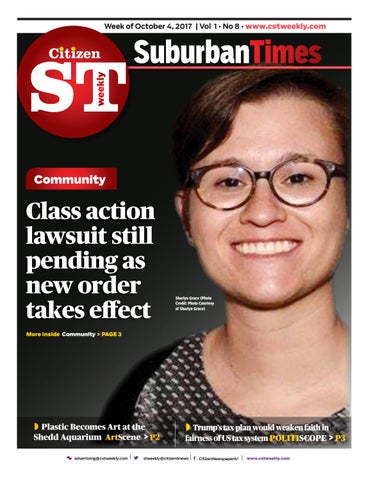
Class action lawsuit still pending as new order takes effect
Sharlyn Grace (Photo Credit: Photo Courtesy of Sharlyn Grace)
More Inside Community > PAGE 3
w Plastic Becomes Art at the Shedd Aquarium ArtScene > P2 advertising@cstweekly.com
w Trump’s tax plan would weaken faith in fairness of US tax system POLITISCOPE > P3
stweekly@citizen6news
CitizenNewspaper6/
www.cstweekly.com
2
October 4 2017
ST
SuburbanTimes
ARTSCENE
Plastic Becomes Art at the Shedd Aquarium By Christopher Shuttlesworth
The Shedd Aquarium recently unveiled 10 new giant sea life sculptures that were made entirely from plastic marine debris. The sculptures represent a traveling exhibit entitled, “Washed Ashore: Art to Save the Sea,” which illustrates how plastic pollution has become one of the gravest threats facing ocean and freshwater animals. Jaclyn Wegner, director of conservation action at the Shedd Aquarium, said plastic is a threat to wildlife animals because plastic items can break down into smaller pieces of plastic that animals can accidently ingest. As a result, animals can choke from the plastic or the plastic can make the animals’ stomach feel full and eventually prevent them from eating without any nutrients. Some scientists predicted that the amount of plastic in the ocean will outweigh the amount of fish poundfor-pound by 2050, according to a Shedd Aquarium press release. The amount of plastic debris that enters Lake Michigan each year is currently equivalent to 100 Olympic-sized swimming pools full of plastic bottles. The Shedd Aquarium recently launched, “Shedd the Straw” which is a campaign that encourages Chicago
ST
The Shedd Aquarium recently unveiled a new exhibit entitled “Washed Ashore: Art to Save the Sea,” which illustrates how plastic pollution has become one of the gravest threats facing ocean and freshwater animals. Photo Credit: Shedd Aquarium
restaurants and consumers to refrain from using single-use straws, and 10,000 fewer straws were used on this past Earth day, according to a Shedd Aquarium press release. “The Shedd Aquarium caring about the wildlife in our
waters, locally and nationally, we really wanted to bring awareness about the plastic population problem and how animals are impacted by this issue,” Wegner said. Wegner explained that the Shedd Aquarium partnered with The Recycling Partnership to inspire guests to develop a desire to join recycling programs that protect oceans, lakes and rivers. “This is a completely unique and new type of exhibit for the Shedd Aquarium,” Wegner said. “So, often we’ve had really exciting animals to display and connect people with. But this is our first time displaying an exhibit that connects people to a conservation problem.” The Shedd aquarium has eliminated single-use plastics, such as straws, utensils, individual condiment containers and shopping bags, from its restaurants and stores while also providing plastic recycling receptacles for guests and staff members, according to a Shedd Aquarium press release. “We don’t want people to come to the Shedd Aquarium and get depressed, but we want them to experience the beautiful sculptures and learn from them,” Wegner said. “There are beautiful pieces of art and it’s a fun, playful yet eye opening moment for people to think about one of our ways that we impact the ocean and the animals that live in it.”
TRAVEL
Take Your Getaway From Vacation Stressed To Vacation Ready Unplug from work: Creating separation from work can help you get into a vacation-ready mind-set. More than half felt not checking work e-mail and voice mail reduces stress. The majority of travelers said taking an extra day off work before leaving for vacation or coming back a few days before returning to work would also help.
(NAPSI)—Raising families, navigating jobs, balancing social commitments—there’s a lot on Americans’ plates these days. In fact, 51 percent of U.S. vacationers admit they’re more stressed today compared to a year ago, according to a recent study from Wyndham Vacation Rentals. When you add to that the pressure of vacation planning, the stress is not only preventing many from enjoying their vacation to the fullest but stopping them from going in the first place! Fortunately, there are a number of simple tips that the majority agree reduces stress and helps them get the most out of vacation by being more vacation ready. • Don’t wait until the last minute to pack:According to the same study, packing is so dreaded that half of all vacationers said they would give up alcohol for a month or social media for a week to avoid doing it! Travelers can reduce the stress of packing, though, without making too much of a sacrifice. Nearly two in three say not procrastinating on packing your bags minimizes stress. • Unplug from work: Creating separation from work can help you get into a vacation-ready mind-set. More than half felt not checking work e-mail and voice mail reduces stress. The majority of travelers said taking an extra day off work before leaving for vacation or coming back a few days before returning to work would also help. • Space, clean clothes and closed doors:More than three in five vacationers
advertising@cstweekly.com
think booking accommodations with space and privacy would make their next vacation less stressful and half of vacationers think that being able to do laundry would help. Consider booking a vacation home with Wyndham Vacation Rentals for a kitchen, laundry room, multiple bedrooms and lots of living space. • Plan out your budget: Three in five vacationers reported being stressed about spending too much money on vacation. Thankfully, planning ahead of time by making a budget (and sticking to it!), saving enough before you leave, and bringing along your own road trip snacks and drinks can help. If you’re staying in accommodations with a kitchen, cooking in for a few meals while you’re away can also keep your wallet fuller. • Seek advice from others: Many travelers feel burdened by the overYou’ll likely enjoy your vacation more if you plan properly before you load of vacation planning information go. available, but nearly half would find preit comes to dining and shopping. made itineraries valuable. There are a lot of great In addition to these destination guides, resources out there for top things to do, see and Wyndham has also created a planning hub that eat in every destination. For example, Wyndham includes more tips for overcoming travel pain Vacation Rentals’ local market experts curated destination experience guides that strike the per- points and great summer travel deals to further help the everyday traveler get vacation ready. To fect balance between downtime and “go” time, visit the Wyndham planning hub, go to www. so travelers can relax while still seeing the best of BeVacationReady.com. each location and experience hidden gems when
stweekly@citizen6news
CitizenNewspaper6/
www.cstweekly.com
October 4 2017
SuburbanTimes
ST
3
COMMUNITY
Class action lawsuit still pending as new order takes effect
CONTINUED FROM PAGE 1
By Lisette Gushiniere
Imagine being jailed without the benefit of a trial only because you couldn’t afford to post a bond. While sitting in jail awaiting a trial, you remain separated from your loved ones, lose your job or may even lose your home. According to lawyers representing the plaintiffs in a class action lawsuit, that’s the experience of thousands of arrestees who’ve landed in Cook County Jail. Fallout from the issue became the basis of a 2016 class action lawsuit filed in the Circuit Court of Cook County. According to the lawsuit, thousands of arrestees presumed innocent and eligible for pretrial release are being kept in Cook County Jail solely because they cannot afford to pay the amount of bail set by circuit court judges. Attorneys for the plaintiffs are calling the alleged conduct, “a clear violation of their right to pretrial liberty and other constitutional rights.” While state law in Illinois requires judges to consider a defendant’s financial circumstances before setting bond, critics argue judges often openly disregard that requirement. Moreover, advocates for the plaintiffs say bond court judges are still not following General Order Number 18.8A which requires only money bonds people can pay. Under General Order Number 18.8A, entered under Cook County Chief Judge Timothy C. Evans, judges in Cook County are now required to set affordable bond amounts for defendants who do not pose a danger to the public. Evans’ order took effect on September 18 for all felony cases and goes into effect on January 1, 2018 for misdemeanors. In a released statement, Evans said, “All
ST
defendants are assumed innocent until proven guilty, and nobody should be held in jail simply because they cannot afford bail.” The General Order entered by Evans, “is a voluntary policy change by the Chief Judge,” said Sharlyn Grace, senior policy analyst and staff attorney for the Chicago Appleseed Fund for Justice and also co-founder of the Chicago Community Bond Fund. “It could be rescinded in the future by Chief Judge Evans or his successors,” she said, adding, “the order doesn’t change or create new law; it merely creates an administrative process to facilitate following existing state law.” Grace said problems associated with pretrial detentions can only be resolved through the implementation of statewide reforms such as those brought by an Illinois Supreme Court rule. But the Office of the Attorney General in Illinois led by Lisa Madigan, takes a different stand. In an August 28, 2017 brief, the Illinois Attorney General’s Office used Evans’ order as part of its argument to dismiss the case for mootness. Calling any claims that a future chief judge might rescind the order, “speculative,” lawyers added, the plaintiff’s claims do not, “provide a reasonable basis to expect the alleged misconduct to recur...” Citing Us. Bank v. Dzis, they continued the order is within Evans’ authority which, “extends to the issuance of procedures for bail hearings.” Meanwhile, as Evans’ new order remains in effect, the 2016 class action lawsuit is still pending. Brought on by Zachary Robinson and Michael Lewis, the plaintiffs allege they were incarcerated in Cook County Jail only because they could not post bond. The two men represent a class of all people jailed due to inability to post bond. Lawyers for the plaintiffs say they want a
declaration from the court that the practice of jailing people solely because they cannot pay bond is unconstitutional. The plaintiffs are represented by attorneys from the Roderick and Solange MacArthur Justice Center; the Chicago law firm of Hughes Socol Piers Resnick & Dym, Ltd.; and the Civil Rights Corps, a non-profit organization based in Washington, DC., according to the complaint. Defendants include Cook County Circuit Court Judge Leroy Martin, Jr., presiding judge of the Criminal Division; Cook County Circuit Court Judge E. Kenneth Wright, Jr., presiding judge of the Municipal Division; and three other judges who make release determinations in criminal cases. Originally, Cook County Sheriff Tom Dart, who operates the jail, was named as the custodian of the detained plaintiffs, but his office was later dismissed from the litigation by the plaintiffs, according to reports. On October 3, in a Chicago Community Bond Fund (CCBF) press release, community groups watching bond court argued judges are still not following Evans’ General Order. According to the release, advocates say they tracked whether defendants who were not able to post a monetary bond within seven days were given a review hearing as required by Evans’ order. Since September 18th, when the order went into effect for felony cases, courtwatchers say they observed uneven implementation of the order by the new judges appointed to carry it out. While Evans’ order stipulates that those incarcerated because they cannot afford their bond be given a review within seven days of their initial bail decision, this review was ineffective for most people, the CCBF new release stated. In response to public defenders’ requests for review of unpaid money bonds, judges in the preliminary hearing courtrooms merely entered
Plaintiffs in a 2016 class action lawsuit are seeking a declaration from the court that the practice of jailing people solely because they cannot pay bond is unconstitutional. The Illinois Attorney General’s Office is using a new order as part of its argument to dismiss the case for mootness. The new order, entered under Cook County Chief Judge Timothy C. Evans, requires judges in Cook County to set affordable bond amounts for defendants who do not pose a danger to the public.
CONTINUED ON PAGE 6
POLITISCOPE
Trump’s tax plan would weaken faith in fairness of US tax system planning at best and President Donald Trump outright evasion at and GOP leaders just released worst, while prompta plan to significantly change the taxation of individuals ing more companies to and businesses in what would adopt this type of busibe the biggest overhaul of the ness structure to gain By Gil B. Manzon Jr. tax code in decades. the huge benefits. Among its many elements is a proposal to change the way the govMore fundamentally, we argue, this ernment taxes so-called pass-through would cause faith in the fairness of the tax entities, something first suggested in system – a cornerstone of our voluntary April. method of taxation – to falter. The consequences of that could be dire. In a nutshell, the Trump proposal Just passing through? would dramatically lower the rates this The universe of pass-throughs is very category of filers pays. While the cut large, including anything from freewould not be as large as first proposed, lancers and corner grocery stores to it would still lead to very creative tax advertising@cstweekly.com
medical partnerships and hedge funds that file under legal categories like sole proprietorships, partnerships and S corporations. The name “pass-through” refers to how income “passes through” to owners. Pass-throughs avoid the double taxation that hits regular C corporations. More of U.S. business income is actually generated by pass-through entities than conventional corporations like Apple and General Electric. Currently, owners of pass-throughs report both compensation and business income on their personal tax returns and pay the same tax rates on both. To illustrate how this works, imagine
stweekly@citizen6news
CitizenNewspaper6/
a doctor’s sole proprietorship generates US$1 million of taxable earnings. Let’s say half of that would be considered reasonable compensation for the owner’s work, while the other half would be deemed ordinary business income. On her tax return, the doctor would report an income of $1 million, all of which would be taxed at personal income tax rates, for a federal levy of $396,000 (assuming a flat rate of 39.6 percent). Under Trump’s proposal, the tax rates on compensation and business income would no longer be the same. A new top rate of 35 percent would apply to compensation, and a proposed rate of
www.cstweekly.com
CONTINUED ON PAGE 4
4
October 4 2017
ST
SuburbanTimes
FOOD FABULOUS FOOD
Make Time For Quick Family Meals (NAPSI)—Here’s food for thought: Experts say mealtime may be the best time for families to relax, reconnect and enjoy each other’s company after a busy day. In fact, research suggests that having dinner together as a family at least four times a week has positive effects on child development. According to a report by the University of Florida, children who eat dinner with their family are more likely to understand, acknowledge and follow the boundaries Enjoying family meals together, scientists say, helps children grow smarter and better behaved. This tasty, easy and nutritious noodle dish can help you and expectations set by their have more time for family meals together. parents. A decrease in high-risk then add green onions. Cook until softened, 2 Quick, Sweet and Spicy Lingonberry behaviors is related to the amount of time spent minutes. Add peppers and mushrooms and cook with family—especially during family dinners. Noodles until tender, 5 minutes. Add bok choy and stir One reason may be because eating dinner 1 Tbsp. olive oil until wilted. Make sauce, whisking together oyster together as a family provides an opportunity for sauce, soy sauce, rice vinegar, brown sugar and conversation without distractions from screens. 2 cloves garlic, minced Felix Lingonberry jam. Combine with vegetables As you engage your children in conversation, you 1 Tbsp. freshly grated ginger and then add noodles and toss until coated. Serves can teach them how to listen and provide them ¼ c. sliced green onions 6. 2 bell peppers, thinly sliced into strips with a chance to express their own opinions. In Because this is made with lingonberries, it can 1 c. sliced mushrooms (such as cremini) addition, conversations at the dinner table can be good for your family in many ways. The popular 2 small bok choy expand a child’s vocabulary and, thus, reading fruit from Sweden is loaded with antioxidants and 12 oz. prepared Udon noodles ability. has even been featured as a superfruit on “The Dr. 5 Tbsp. oyster sauce So when you want to dine with your family but ¼ c. low-sodium soy sauce Oz Show.” there’s practically no time to cook and you’re 1 Tbsp. rice vinegar Learn More tired of takeout, consider this simple, delicious 3 Tbsp. brown sugar meal you can make in just minutes. These savory 5 Tbsp. Felix Lingonberry jam For further facts, recipes and tips on lingonspicy noodles get their flavor from a surprising Heat oil in a large skillet over medium heat. Add berry and other jams, go to https://felixjams. source: tart-sweet lingonberries. garlic and ginger and stir until fragrant, 1 minute, com.
Trump’s tax plan would weaken faith in fairness of US tax system CONTINUED FROM PAGE 3
15 percent). Going back to our example, the doctor’s federal tax bill would be reduced to about $300,000, assuming she followed the rules. Not bad. But she now has a very strong incentive to characterize her compensation as business income. If she reported her compensation as $0 and business income as $1 million, her tax bill would be reduced still further, to $250,000. Put differently, for every dollar of compensation she reports as business income instead of compensation, she saves 10 cents in tax. Clearly, the potential tax savings are huge. Many owners of pass-throughs are going to be tempted to report reasonable compensation as business income. And who wouldn’t be? The reward for cheating is just too large. And the likelihood of getting away with advertising@cstweekly.com
cheating is as high as it’s ever been because of the reductions in enforcement in recent years, a trend Trump has shown no intention of reversing. Defining reasonable compensation The history of taxation bears this out: If taxpayers are given flexibility in how to report their income, many will do what they can to lower their tax as much as possible. For example, S corporation ownershave long tried to reduce their Social Security and Medicare taxes by calling their compensation business income. Unlike partnership earnings, the earnings of S corporations that are not paid to shareholders as “compensation” are not subject to Social Security and Medicare taxes. This clearly creates a strong incentive to characterize as much “compensation” as possible as regular business income. The challenge for the Internal Revenue Service stweekly@citizen6news
CitizenNewspaper6/
has been defining what constitutes “reasonable compensation” for S corporation shareholders. The issue has been well-litigated over the years, resulting in a 2012 circuit court ruling that was deemed a win for tax evaders. The court’s guidanceboiled down to saying each case is unique and offered no ready recipe for the income allocation problem. What happened in Kansas The state of Kansas offers a ready example of what happens when you change how pass-throughs are taxed. In 2012, Kansas eliminated its income tax on passthrough companies, whose owners previously had to report any earnings on their personal state returns. The response to this change, which took effect in 2013, was quick and large. The center-right Tax CONTINUED ON PAGE 6
www.cstweekly.com
October 4 2017
SuburbanTimes
H T T E I G DW E K IN
ly week
T S of Week
No 7 ol 1 • 17 | V 7, 20 ber 2
om kly.c twee w.cs
• ww
mes
nTi a b r u b Su m
Septe
ly week
ST
ber ptem
of Se Week
17 6, 20
1 • No
| Vol
ly week
HomHungry and .com eekly cstw www.
es, roach s how r app e winte discuss people e h t w o As ices to ond N Resp tting serv st . e it’s g eed it mo 3 n PAGE o > ity wh mmun
eekly cstw
ly week
ST
Jo es Kim 3 t mak
w Wha ISCOPE > P OLIT
g@
rtisin
he
ing t p l s e e H eless nTim
3•w
P ering 2 iscov P ne: D er6/ ene > spap nNew ArtSc ral Sto Citize news w Natuorms of Art n6 ize @cit eekly F stw New .com adve
More
r A. o t c e H evara Gu g
lin Profi
Inside
Co
orable
y Famil
A Mem > P2 w Plan on TRAVEL Vacati
adver
om eekly.c @cstw
ia ophob Islam ghting OPE > P3 C s are fi erican ts POLITIS m A Muslim vil righ w How ring their ci .com eekly cu cstw and se www. r6/
news izen6 ly@cit stweek
tising
y munit Com How es are sa g Colle Student and g Givin ce to Lead Chan ed . e Succ E3 More
Inside
G > PA
re
ary r Milit > P2
as Fo
g Ide
E in w Mov s ARTSCEN
ie Famil
advertising@cstweekly.com
stweekly@citizen6news
tu e as fu alanc the b 3 ang in COPE > P h ts e IS budg OLIT w State uncertainP .com eekly A cstw of AC www. /
er6 spap nNew
ws n6ne citize kly@ stwee
Citize
g@
rtisin
adve
.com eekly cstw
bson
nie Ho
Stepha
om ity ekly.c mun tick? stwe Com ng Un ww.c
a
Suburb
es
Davis
More
ST
Inside
om kly.c stwee ww.c
6•w
tem
f Sep
o Week
lores e exp mbers e cours GSU ilitary m s ie m how eir famil and h r and t ience wa r e exp a GE 3 m u y > PA it ra t mun Com
1 • No
nTim a b r u b Su | Vol , 2017 ber 20
Dan Credit:
for details
a raum T , r a W the and anities Hum
Photo
Do you have an idea for a great column with the Suburban Times? Join our “Get Inked Campaign Call 773.783.1251
ity
mun
Com
CitizenNewspaper6/
www.cstweekly.com
spape nNew
Citize
5
6
October 4 2017
ST
SuburbanTimes
NEWS
Agency Developing Online Tool of Local Recycling Services The Illinois EPA intents to use the survey as a reference to develop a statewide recycling and collection availability tool to publish on the Agency’s website. In addition, Illinois EPA anticipates using the responses to identify areas of the state that are not adequately served by relevant collection locations.
SPRINGFIELD — Illinois Environmental Protection Agency (Illinois EPA) Director Alec Messina announced the Agency has released a statewide survey to county recycling coordinators to identify the types of items recycled or collected and what type of collections are available throughout Illinois. The information will be used to develop an online statewide locator tool for residents to identify recycling options in their area. Surveys must be completed and returned to the Illinois EPA by October 19, 2017. County recycling coordinators may participate in the Waste Recycling Survey by completing a hard copy or an electronic form that may also be submitted online. Participants are asked to identify whether any of the following items are recycled or independently collected in their county: aluminum, batteries, carpet, comingled recyclables, compostable materials, construction and demolition debris, electronics, food scraps, glass, household hazardous waste, landscape waste, metals, paint, paper, plastics, tires, and white goods. Respondents should also provide information on the type of collections available (curbside,
Class action lawsuit still pending as new order takes effect CONTINUED FROM PAGE 3
drop-off, or one-day collection events) and any fees associated with participating in those collections. The Illinois EPA intents to use the survey as a reference to develop a statewide recycling and collection availability tool to publish on the Agency’s website. In addition, Illinois EPA anticipates using the responses to identify areas of the state that are not adequately served by relevant collection locations. By completing the survey, participants will ensure that information related to their county/counties is taken into account when the Illinois EPA develops its collection availability tool and identifies underserved areas of the state. If a county recycling coordinator has not received a survey from Illinois EPA, the electronic form can be accessed on the Agency’s website: http://www.epa.illinois. gov/Assets/iepa/forms/land/ waste-management/waste-recycling-survey.pdf. The Agency anticipates publicizing the results in conjunction with the development and completion of the online collection availability tool, which is expected to be published in early 2018.
and continued the motions, delaying the review of bond for another 2-3 weeks. Only three people with money bonds set in amounts higher than they could pay during week one under the new order were granted a review within seven days of having their bond set, the CCBF continued in its release. “Judge Evan’s order clearly states that anyone held for more than seven days because they cannot afford to post bond is supposed to get a review of that bond and be released on a I-bond or have their bond set at a rate which they can pay. This also extends to the 4,000 people being held at Cook County Jail because they can’t post bond. Every last one of those people is owed a review of their bond, and judges refusing to give these reviews are acting with flagrant disregard to people’s rights,” said Matt McLoughlin, a co-founder of Chicago Community Bond Fund. Approximately 4,000 people remain incarcerated in Cook County Jail on bonds set before September 18th of this year. CCBF said it has received 61 calls for assistance since the order came into effect, including several people who had unpayable money bonds set after September 18th. “While we are pleased to see the number of people receiving unpayable D-bonds declining, we are greatly disturbed to see judges that were put on the bench to implement this order continuing to set monetary bonds in amounts designed to unconstitutionally detain legally innocent people. We are very concerned that many judges in Cook County are not fully implementing the Chief Judge’s order, and that there has been no transparency about the order’s impact nor about plans to improve implementation,” said Grace. Evans commented recently on plans to evaluate the new order. According to a press release from the Circuit Court of Cook County, after the first year of the order’s implementation, Evans plans to review statistics to see what effect the order has on: the size and makeup of the jail population; whether defendants attend future court hearings; and whether defendants commit new offenses while their case is pending. Evans also recently announced the judges he assigned to a new Pretrial Division of the Circuit Court of Cook County, an initiative that accompanied the new order. Evans appointed Circuit Judge John P. Kirby to serve as the Pretrial Division’s presiding judge for what was formerly referred to as Central Bond Court in the Leighton Criminal Court Building. Kirby became a judge in 1998 and has served in the First Municipal District, the Criminal Division and the Law Division.
Trump’s tax plan would weaken faith in fairness of US tax system CONTINUED FROM PAGE 4
Foundation estimated that it caused the number of pass-through companies in the state to double and resulted in $589 million in lost revenue in 2015 alone, based on an analysis of Kansas tax expenditure reports. A recent paper examining the impact of the change concluded it resulted in “overwhelmingly” more tax avoidance. Kansas abandoned this experiment earlier this year. The reasonable inference from the S corporation history and Kansas’ experiment is what everyone is taught in their first economics class: People are rational and self-interested. They recognize and exploit opportunities to enrich themselves. And the Trump administration’s proposed changes to pass-through rules would create a huge opportunity and greater incentives to recharacterize income. A blow against fairness
Just as worrisome as the significant loss in revenue, however, is that Trump’s proposed change and the potential evasion could undermine the perceived fairness of the tax system. The effectiveness of the U.S. system depends on voluntary compliance, and voluntary compliance, in part, depends on the belief by taxpayers that they’re not being treated like chumps. That belief is already being strained. An April CBS News poll found that 56 percent of Americans think the income tax system is “somewhat” or “quite” unfair. And a 2011 Pew survey noted that 57 percent of respondents said their biggest complaint about the system is that the wealthy don’t pay their fair share. Trump’s tax proposal would likely worsen the problem as more people try to game the system. Research
advertising@cstweekly.com
stweekly@citizen6news
CitizenNewspaper6/
suggests that this would create a growing perception of structural unfairness and lead more taxpayers to collectively challenge the system. If that happens, our tax system’s effectiveness would decline, and the consequences of that could be devastating. Back in 2016, Trump said “hedge fund guys are getting away with murder” because of their use of the “carried interest loophole,” which allows them to significantly lower the taxes they pay. Trump’s pass-through proposal amounts to encouraging more companies to do exactly the same thing. In our view, this is the manifestation of unfairness. Gil B. Manzon Jr. is an Associate Professor of Accounting at Boston College. This is an updated version of an article originally published on May 1, 2017. Tim Gray, a freelance business writer and editor, co-authored the original piece.
www.cstweekly.com
SuburbanTimes
ST
October 4 2017
7
NEWS
In honor of Hispanic Heritage Month, CommonWealth Edison Company (ComEd) Solar Spotlight program recently hosted an event where 50 Latino students had the opportunity to incorporate fashion and solar energy. Photo Credit: Christopher Shuttlesworth
ComEd Partners with Latino Fashion Week By Christopher Shuttlesworth CommonWealth Edison Company (ComEd) Solar Spotlight program hosted a two-day immersion session and brought together 50 Latino high school students to help design two solar-powered fashion designs for the Latino Fashion Week. The Solar Spotlight program, which is focused on Science, Technology, Engineering, Arts and Math (STEAM), honored the Hispanic Heritage Month through hands-on student activities on solar energy and solar panels. Fidel Marquez, senior vice president of ComEd’s Governmental and External Affairs, explained that ComEd partnered with Latino Fashion Week so local students could have the opportunity of designing a dress and blazer lit up with LED lights, which were solar-powered with a battery back-up.
advertising@cstweekly.com
“Fashion is clearly a very visual art and it makes it fun for the students so engineering doesn’t have to be boring,” Marquez said. “This lets students know how you can apply STEAM in a very fun way.” High school student Esmeralda Facio said she was hesitant about joining the program but decided to participate because the incorporation of fashion design and engineering was something new. “At first I thought it would be boring but the experience was really good,” Facio said. “I like how ComEd made it fun and how we were able to design a dress and incorporate our cool [Latino] heritage.” Marquez continued to explain that statically the percentage of Black and Latino students entering careers in Science, Technology, Engineering and Math (STEM) is small, but he says STEM careers provide great stability for students to take care of their families.
stweekly@citizen6news
CitizenNewspaper6/
“ We belie ve through programs like Solar Spotlight, we at least make the introduction of the possibilities of STEM,” he said. “When ComEd thinks of STEM we see this program as the future of our company. Hopefully, these students will replace us one day but we have to find creative ways to make them excited.” ComEd engineers will serve as volunteer mentors to help the students learn more about solar energy and creative ways to improve public spaces using technology, according to a ComEd press release. The dress and blazer filled with LED lights will also be on display at the Mexican Museum of National Art and the Puerto Museum of Art in the coming weeks. For more information, you can visit www.ComEd. com/SolarSpotlight to learn more about the students’ “Solar Spotlight” journey.
www.cstweekly.com
8
October 4 2017
SuburbanTimes
weekly
ST SuburbanTimes GET SOCIAL WITH THE CITIZEN SUBURBAN TIMES WEEKLY
Like Us On Facebook at www.facebook.com/CitizenNewspaper6/
Follow Us On Twitter at: Twitter: cstweekly@citizen6news
Follow Us On Instagram at: www.instagram.com/cstweekly/
Send press releases to editorial@cstweekly.com Send advertising inquiries to advertising@cstweekly.com
Citizen Suburban Times Weekly
w Bloom Township w Chicago Heights w Flossmor w Ford Heights w Greenwood w Home Wood w Lansing w Lynwood w Olympia Fields w Park Forest w Sauk Village w South Chicago w Steger 60411, 60422, 60425 , 60430, 60438
Visit us online at www.cstweekly.com