Citizen Week of June 20, 2018
| Vol. 1 | No. 45 | www.thechicagocitizen.com
SUBURBAN TIMES WEEKLY
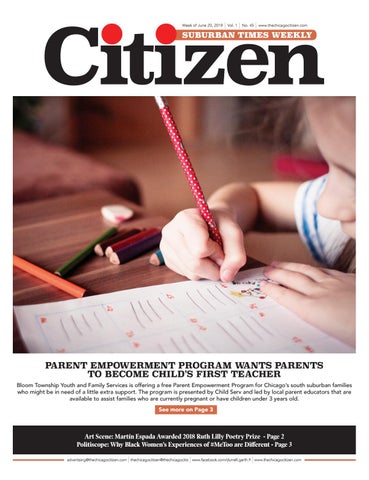
PARENT EMPOWERMENT PROGRAM WANTS PARENTS TO BECOME CHILD’S FIRST TEACHER
Bloom Township Youth and Family Services is offering a free Parent Empowerment Program for Chicago’s south suburban families who might be in need of a little extra support. The program is presented by Child Serv and led by local parent educators that are available to assist families who are currently pregnant or have children under 3 years old. See more on Page 3
Art Scene: Martín Espada Awarded 2018 Ruth Lilly Poetry Prize - Page 2 Politiscope: Why Black Women’s Experiences of #MeToo are Different - Page 3 |
|
|
advertising@thechicagocitizen.com thechicagocitizen@thechicagocitiz www.facebook.com/durrell.garth.9 www.thechicagocitizen.com
2 | CITIZEN | Suburban Times Weekly | Week of June 20, 2018
ART SCENE
Martín Espada Awarded 2018 Ruth Lilly Poetry Prize
T
he Poetry Foundation recently presented Martín Espada with the 2018 Ruth Lilly Poetry Prize, which honors a living US poet for outstanding lifetime achievement. Martín Espada was awarded the prize in recognition of his contribution to poetry. He is the first Latinx poet to win this award since its inception in 1986. The Ruth Lilly Poetry Prize is presented annually to a living US poet whose lifetime accomplishments warrant singular recognition. It is one of the most prestigious awards given to American poets and, with a prize of $100,000, one of the nation’s largest literary prizes. The award is sponsored and administered by the Poetry Foundation, publisher of Poetry magazine. “Martín Espada’s work and life tell the real and lived story of America, in which the importance of poems and legal rights go hand in hand,” said Don Share, editor of Poetry magazine. “A tenants’ rights attorney before he became a celebrated and cherished poet, Espada’s passions are as compelling
and apt as his precisions—both now more timely than ever.” Espada was born in Brooklyn, New York, in 1957. He earned a BA in history at the University of Wisconsin–Madison and a JD from Northeastern University. As an attorney, he served as supervisor of Su Clínica Legal, a legal services program for low-income, Spanishspeaking tenants in Chelsea, Massachusetts, outside Boston. As a poet, an essayist, an editor, and a translator, he has dedicated himself to the pursuit of social justice, fighting for the rights of Latinx communities and reclaiming the historical record from oblivion.
His greatest influence is his father, Frank Espada, a community organizer, civil rights activist, and documentary photographer who created the Puerto Rican Diaspora Documentary Project. “To receive a lifetime achievement award in the form of the Ruth Lilly Prize is a great honor that causes me to reflect: on my father, as artist and activist, who died four years ago; on Jack Agüeros, the first poet I ever met; on the days I sat outside the courtroom, scribbling poems on legal pads; on the people in the poems I write, Whitman’s ‘numberless unknown heroes equal
to the greatest heroes known.’” Espada’s latest collection of poems from Norton is Vivas to Those Who Have Failed (2016). Other books of poems include The Trouble Ball (2011), The Republic of Poetry (2006), Alabanza (2003), A Mayan Astronomer in Hell’s Kitchen (2000), Imagine the Angels of Bread (1996), and Rebellion is the Circle of a Lover’s Hands (1990). He has received a Shelley Memorial Award, a Robert Creeley Award, a National Hispanic Cultural Center Literary Award, a PEN/Revson Fellowship, and a Guggenheim Fellowship. The Republic of Poetry was a finalist for the Pulitzer Prize. The title poem of his collection Alabanza, about 9/11, has been widely anthologized and performed. Collections of Espada’s poems have been published in Puerto Rico, Spain, Chile, France, Germany, England, and Turkey. His book of essays, Zapata’s Disciple (1998), was banned in Tucson as part of a Mexican American studies program outlawed by the state of Arizona and has been issued in a new edition by Northwestern University Press.
Espada is a professor of English at the University of Massachusetts Amherst. Examples of Espada’s poetry are available on the Poetry Foundation’s website. Also honored at the event was acclaimed author Liesl Olson who was named the 2018 Criticism Award winner for her most recent book, Chicago Renaissance: Literature and Art in the Midwest Metropolis (Yale, 2017). Olson is director of Chicago Studies at the Newberry Library and author of Modernism and the Ordinary (Oxford University Press, 2009). She has received fellowships from the National Endowment for the Humanities and from the Newberry Library, where she also directed the Scholl Center for American History and Culture. She is currently on a fellowship from the American Council of Learned Societies and is a scholar-inresidence at the Newberry Library. From 2004–2009, she taught at the University of Chicago as a HarperSchmidt Fellow in the Humanities Division. She earned a BA from Stanford University and a PhD from Columbia University.
TRAVEL
Despite Political Uncertainty, Discover Corps Launches New Cuba Trip for Families
S
an Diego-based tour company, Discover Corps, has launched a new 6-day itinerary to Cuba. Called the Cuba: Family Island Exploration, the trip allows travelers to enter Cuba on a “Support for the Cuban People” visa. Travel to Cuba experienced a massive surge when President Obama loosened restrictions in 2016. Since then, President Trump has tightened these restrictions and issued a travel warning, creating confusion about Americans’ ability to legally travel to Cuba. Discover Corps is known for using responsible travel to improve the world. With this in mind, it has created an itinerary to allow families to discover the island in a meaningful way that supports the Cuban people. “Now more than ever it is imperative for Americans to become unofficial ambassadors of goodwill around the world. We need to show the world - and especially the Cuban people - that the American people care for them and want to build bridges of friendship and understanding. Politics aside, these trips build direct connections between American and Cuban families,” said Andrew Motiwalla,
Founder of Discover Corps. “As the father of two young daughters, I designed a trip that is fun for kids but will also shape the next generation of global citizens.” While the trip includes fun activities such as beach visits, convertible car rides, and art workshops, it also directly works to support the Cuban people through hands-on projects, interactions with Cuban families, and supporting small-scale entrepreneurs. For a limited time, Discover Corps is offering free roundtrip flights to Havana from Miami International Airport on all Discover Corps Cuba itineraries below. If flying out of another destination, the organization will offer a $200 rebate per traveler. • Havana Weekend Getaway – Four-day trip covering culture and life in Havana. • Building Bridges – Eight-day volunteer vacation promoting community development in Havana, with time spent in Cienfuegos and Trinidad. • Celebration of Arts & Culture – Eightday cultural immersion visiting Havana, Trinidad, and Cienfuegos.
New Cuba trip for families directly works to support the Cuban people through hands-on projects, interactions with Cuban families, and supporting small-scale entrepreneurs.
•P reserving Natures’ Wonders – Eight-day exploration of the Cuban countryside in Viñales Valley, a UNESCO World Heritage Site. •F amily Island Exploration – Six-day exploration focusing on families in Havana, Viñales Valley, and the coast.
www.thechicagocitizen.com
All trips qualify as “Support for the Cuban People” programs and are therefore permitted under current State Department regulations. Discover Corps also vows that in the event the Trump Administration ends legal travel to Cuba, all trips are 100% refundable.
CITIZEN | Suburban Times Weekly | Week of June 20, 2018
|
3
COMMUNITY
Parent Empowerment Program Wants Parents to Become Child’s First Teacher Continued from page 1 BY KATHERINE NEWMAN
B
loom Township Youth and Family Services is offering a free Parent Empowerment Program for Chicago’s south suburban families who might be in need of a little extra support. The program is presented by Child Serv and led by local parent educators that are available to assist families who are currently pregnant or have children under 3 years old. Child Serv is a Chicago based organization that works to protect, heal, and educate children and families so that they can build better lives. “In our program, we do a lot of early intervention. We communicate with families who are either pregnant or have children that are under the age of 3 and we do one-on-one home visits with the families. We come to them and make sure the children are developing okay and we also check to see what’s going on and how we can help them to be a better parent,”
said Darrin Bolling, parent educator for the Parent Empowerment Program in Bloom Township. The Parent Empowerment Program not only offers advice on child development, but it also helps create a support system for the families that participate. “A lot of times, we work with single moms or teenage moms and they don’t know what to do or who to go to or who they can look to when they have questions because their support system might not be that great,” said Bolling. “As a parent educator, we come in and we become that person that they can communicate with and reach out to when they need somebody.” The program holds monthly meetings where parents and children can come together and learn new positive ways to interact with each other. The ultimate goal is to help parents become their child’s first teacher. “Every month we have a nice activity that usually involves parent and child interaction and forces the idea of having some type of communication with their
child or even some stuff that they could do at home with their child. Usually, in the summertime or in the fall, we might go on a field trip,” said Bolling. The monthly community building events are optional for families, but they are also all free and include food and fun learning experiences. Whether or not a family attends the monthly meetings, the Parent Empowerment Program is a place that they can always turn to in times of need. “We provide resources like if they need help finding jobs or if they need diapers and wipes, clothing for the child, help to get to a doctors appointment or even if something is going on and they just need to talk to somebody,” said Bolling. “Parents can have somebody to help support them and they don’t have to support themselves and they are able to meet other people just like them so they don’t have to feel alone as a parent.” For more information on joining the Bloom Township Youth and Family Services Parent Empowerment Program, call Darrin Bolling at 773-391-3810.
Rep. Kelly Burke Backs Efforts to Expand MAP Grants, Improve Access to Higher Education
S
tate Rep. Kelly Burke, D-Oak Lawn led the charge on a measure to expand access to grants for low-income students and is urging the governor to sign the measure into law. Burke is the chief co-sponsor of House Bill 5020, a measure that prioritizes students currently receiving funds from Monetary Assistance Program, or MAP grants, to continue their college education. Students that remain eligible for MAP and renew by the established priority deadline each year would receive the grant as long as the program is funded. House Bill 5020 passed both the House and the Senate without opposition and is expected to be sent to the governor for approval in the near future. The proposal is one of a number of measures to strengthen higher education that came from a bipartisan higher education working group that Burke serves on.
POLITISCOPE
Why Black Women’s Experiences of #MeToo are Different
BY YOLONDA WILSON
I
n April, a 25-year-old black woman named Chikesia Clemons was violently arrested by police at a Waffle House restaurant in Alabama. A video of the arrest that went viral shows police pulling Clemons from her chair and throwing her to the floor. In the process, her breasts are exposed and her dress rides up
in the back. When she attempts to cover her breasts, the two officers on top of her threaten to break her arm for “resisting.” Clemons’ experience is not unique. In the U.S., black women are not afforded the same regard for bodily privacy as white women. Another example: In an investigation of the Baltimore City Police Department, the Department of Justice found that the Baltimore Police Department frequently engaged in unjustified strip searches of African-Americans. In one instance, Baltimore police conducted a strip search of a black woman, including an anal cavity search, on a sidewalk in broad daylight and in full public view. The woman’s pleas to not be forced to disrobe in public were ignored. Her offense? A broken headlight. While the #MeToo movement has been successful in bringing down several high-profile assailants, critics continue to argue that it
has been monopolized by middleand upper-class white women, particularly white Hollywood actresses. This, despite the fact that a black woman, Tarana Burke, created the Me Too campaign more than a decade ago. These criticisms reflect the fact that black women have experienced sexual violence differently than white women. As a philosopher of race and gender who has written about sexual harassment, I offer historical context on the ways that black women experience sexual abuse, often by the authority of the state, as a way to think about black women’s contemporary experiences as the kinds of experiences that #MeToo should address. HISTORY OF BLACK WOMEN’S BODIES ON DISPLAY As early as the 17th century, European men wrote travel www.thechicagocitizen.com
narratives about their trips to West Africa to capture, enslave and trade African people. Their writings offer a window into how they perceived African women and what they thought primarily European male readers would find titillating. In particular, their descriptions of West African women’s style of dance played a role in shaping European perceptions of black women’s sexual immorality and availability. These travel accounts were the popular media of their day and offered some of the first reports of continental Africa to average Europeans. For example, Frenchman Jean Barbot wrote of African men and women “knocking bellies together very indecently” while “uttering some dirty mysterious words.” Meanwhile, naval officer Abraham Duqesne characterized African women as desiring the “caresses of white men.” Continued on page 6
Darrell Garth President / Publisher Janice Garth Sales Manager/ General Manager CST Weekly, published weekly on Wednesdays and distributed in the Township of Bloom, (publishing 52 issues annually). Written permission is required to reproduce contents in whole or part from the General manager or the publisher. CST Weekly does not assume the responsibility for nor are we able to return unsolicited marterials. Deadline for advertising is every Monday at noon. For information on subscriptions or advertising call us at (773) 783-1251. Our office is located at 8741 S. Greenwood Ave., Ste# 107, Chicago, Illinois 60619.
Editorial:
Send press releases, news tips, calendar listing etc. to: editorial@cstweekly.com
Advertising
advertising@cstweekly.com Classifieds call us at (773) 783-1251
4 | CITIZEN | Suburban Times Weekly | Week of June 20, 2018
FOOD
Easy Ways to Boost Your Family’s Veggie Intake (StatePoint) Nutritious, delicious and low-calorie, vegetables should be the star player of all your meals. But sometimes providing veggies for your family can be time consuming and costly. Luckily, there are a number of simple ways to boost your veggie intake, and it all starts in your grocery store’s freezer aisle. GO FROZEN Frozen vegetables are often one of the most affordable options and the quickest to prepare, reducing time spent slicing and dicing on busy weeknights. What’s more, by opting for frozen veggies, your family will likely reduce its food waste. Frozen vegetables are easy to store for long periods of time, and recent studies have found that freezing actually helps lock nutrients in. SWAP IT OUT Little ones and even some adults can be resistant to certain vegetables at first. But there are ways to incorporate them into family meals with no one the wiser. Consider cooking with vegetables that offer the look, feel and taste of traditional starches such as rice, pasta and potatoes. For example, Green Giant’s frozen Veggie Swap-Ins line, which includes Green Giant Riced Veggies, Green Giant Veggie Spirals and Green Giant Mashed Cauliflower are easy go-to items in any kitchen for
quick family meals. Indeed, 52 percent of American consumers who noted they had purchased Green Giant Swap-Ins products within three months of taking the survey, said they have introduced the product into their kids’ meals without their kids knowing they weren’t traditional potatoes, rice and/ or pasta, and 49 percent admit to swapping these items for potatoes, rice and pasta 1-2 times per week. BE MINDFUL Dining out can be especially tricky territory for those looking to eat more vegetables. Be mindful of what you order. Read the menu carefully and ask questions. Many restaurants are happy to make substitutions to accommodate your preferences. For example, see if you can replace a side of fries with a garden salad or
sautéed seasonal vegetables like green beans. GET CREATIVE Whether you’re hosting a barbecue, attending a potluck or simply making your family dinner, consider reducing calories in salads and sides by upping your vegetable intake in these dishes. Make an Italian pasta salad out of zucchini or carrot spirals. Swap out traditional rice with riced cauliflower to make a simple pilaf. Create a tasty alternative to traditional potato tots with such products as Green Giant Veggie Tots. The possibilities are endless. Are you looking to simplify your family’s clean-eating routine and increase your vegetable intake? With a few tips and tricks, you can incorporate broccoli, beets, squash and more into your family’s diet while saving time and money in the process.
Almost All Chicagoans Scream for Ice Cream, but Millennials were Out-Witted in Latest Survey
A
ccording to a recent survey* of Chicago residents, nearly all enjoy the sweet, creamy taste of ice cream (98 percent), but not all understand how the good stuff is made. Exactly one in ten surveyed think cows should be kept at a temperature below 32 degrees when being milked for ice cream. Not just that, Millennials were five times as likely to believe it! Results of the survey demonstrated strong opinions on how Chicago enjoys its ice cream. Nearly 75 percent of respondents feel Chicago is a city of ice cream cones, not cups. And, when asked which Chicago food staple pairs best with ice cream, 50 percent chose Chicago dogs over deep-dish pizza (39 percent) and Italian beef (11 percent). Rivalries also appeared in Chicagoans’ ice cream flavor preferences. Millennials were more than 2.5 times more likely to choose chocolate chip cookie dough as their favorite flavor (34 percent) than Baby Boomers, who overwhelmingly chose chocolate (30 percent) over any other flavor.
According to a survey of Chicago residents commissioned by Hudsonville Ice Cream, nearly all Chicagoans enjoy the sweet, creamy taste of ice cream (98 percent), but not all understand how the good stuff is made. Hudsonville’s team of artisans have been perfecting the art of ice cream making since 1926 and have introduced consumers to a variety of flavors that have become beloved favorites throughout the Midwest. Be on the lookout for Hudsonville Ice Cream flavors like Creamery Blend Vanilla, Mint Chocolate Chip and Mackinac Island Fudge at Chicagoland grocery stores. Also, stay tuned for summer events happening July 14-15 and 21-22 at Mariano’s stores across Chicagoland.
NEWS
Micro Pantry Installed in Matteson BY KATHERINE NEWMAN
P
rairie State College recently installed a Micro Pantry at their Matteson Area Center, 4821 Southwick Dr., as a new resource for students and resident who may be struggling to
access food. The micro pantry is accessible any time of any day and relies on the honor system to ensure that people are taking what they need and leaving what they don’t. A micro pantry is a small outdoor cabinet that can withstand all weather conditions and is
There is new Micro Pantry located at 4821 Southwick Dr. for students and residents who may be struggling to access food.
stocked with a variety of dry and non-perishable foods. The micro pantry is always accessible and acts as a no-questions-asked food resource. “Often times if somebody is Continued on page 7 www.thechicagocitizen.com
Photo: Prairie State College
CITIZEN | Suburban Times Weekly | Week of June 20, 2018
|
IT’S TIME TO GET OUTSIDE AND
FIND YOUR FIRST HOME! What better time to explore new possibilities? As you begin your journey, we’ll be with you every step of the way with the tools and resources to make your dreams a reality. We’re here to help you find a new space so you can live life your way. In your own home, the change of seasons brings new opportunities to enjoy and memories to cherish.
GET FREE ATMS NATIONWIDE WITH
TOTAL ACCESS CHECKING! Only $100 required to open.
Use any ATM nationwide and we’ll refund the fee!1
Plus, for a limited time
GET $100!
when you open a new Total Access Checking account by 12/31/18.2 Enroll in e-statements and complete a direct deposit within the qualification period.* BRING IN OR MENTION THIS POSTCARD AT ACCOUNT OPENING TO REDEEM THE $100 BONUS!
wintrustmortgage.com
W F C00DMTA 100
Give us a call to get started at 847-939-9424 or visit wintrust.com/myhome. All approvals are subject to underwriting guidelines. Programs, rates, terms and conditions are subject to change at any time. Wintrust Mortgage is a division of Barrington Bank & Trust Company, N.A., a Wintrust Community Bank, NMLS# 449042. *The bank must receive the direct deposit for it to be “complete”. The “qualification period” is two consecutive calendar months following the month of account opening. 1. The bank does not charge its customers a monthly card usage fee. No transaction charge at any ATM in the Allpoint, MoneyPass, or Sum surcharge-free networks. Other banks outside the network may impose ATM surcharges at their machines. Surcharge fees assessed by owners of other ATMs outside the network will be reimbursed. Reimbursement does not include the 1.10% International Service fee charged for certain foreign transactions conducted outside the continental United States. 2. Limit one per customer. Current Wintrust checking customers and employees of Wintrust Financial Corp. and its subsidiaries are ineligible. $100 deposit bonus is IRS 1099-INT reportable. $100 deposit bonus applies only to new Total Access Checking customers. $100 deposit bonus will be deposited into the Total Access Checking account within the subsequent calendar month following the qualification period.
5
6 | CITIZEN | Suburban Times Weekly | Week of June 20, 2018
NEWS
Coalition Says Candidates Need to Address Housing Disparities BY JOHANNA MEDRANO
H
ousing Action Illinois is a statewide coalition that has been leading the movement to protect and expand the availability of quality, affordable housing in Illinois for more than 30 years. Recently, Out of Reach 2018: The High Cost of Housing, a national report jointly released by Chicago based Housing Action Illinois and DC based National Low Income Housing Coalition, reported that the current housing wage in the Chicago metropolitan area is $22.69. The highest housing wage is set at $23.56 in Kendall County, Illinois and the lowest housing wage is $12.88. The housing wage represents the minimum earnings that a full-time employee must receive to afford a moderate two bedroom rental home without spending more than 30% of his or her income on housing costs. “The high cost of living in Chicago’s metro area is an instrumental component to the
A new report says the current housing wage in the Chicago metropolitan area is $22.69, but Housing Action Illinois, a statewide coalition that has been leading the movement to protect and expand the availability of quality, affordable housing says the high cost of living in Chicago’s metro area is a component to extreme income inequality and segregation, adding candidates and elected officials should prioritize housing predicaments and adequately fund programs that protect and expand affordable housing.
extreme income inequality and segregation,” states Housing Action Illinois Communications Manager Kristin Ginger. Out of Reach 2018 calculates the housing wage by first determining average costs of both rent and
utilities on a two bedroom rental ($1,058.) In order to sustain these living arrangements, the household must earn at least $42,304 annually, assuming a 40-hour work week, 52 weeks out of the year, setting the
housing wage at roughly $20.34. Currently, under Illinois’ minimum wage ($8.25), a person must work 99 hours a week in order to subsist. In addition, Housing Action Illinois states that nationally, no full-time employee on a minimum wage salary, working a 40 hour work week can afford a one bedroom rental unit at the average Fair Market Rent. Housing Action Illinois Communications and Marketing Consultant Timm Krueger believes that the solution does not rely solely on raising the minimum wage, but it also involves holding elected officials responsible for providing additional housing assistance. Krueger said, “Illinois lacks necessary affordable housing stock. For every 100 very low-income households in Illinois, there are only 34 available units of affordable housing.” Krueger added he and his team are, “focused on how [their] coalition of housing counseling agencies, homeless service providers, developers of affordable housing and others who care about
affordable homes can act collectively to influence elected officials. “Every legislator should be talking about the fact that nowhere in Illinois can a full-time minimum wage worker afford rent and every candidate seeking an elected office should have a plan for how to change this.” said Kreuger. He also said there are overall economic benefits to the system when people can regularly afford housing. “When Illinoisans aren’t spending more than 30% of their income on housing costs, it gives them more opportunities for economic growth, such as through education and job training, or building a savings safety net in the event of a crisis.” Krueger said. He and Ginger hope that elected officials will prioritize housing predicaments and adequately fund programs such as HOME, CDBG and Housing Choice Vouchers in order to protect and expand affordable housing in Illinois. Housing Action Illinois. believes investments communities programs like these, will help everyone to thrive.
POLITISCOPE
Why Black Women’s Experiences of #MeToo are Different Continued from page 3 Because African women differed from European women both in attire and bodily movement, European travel writers regarded African women as sexually available and immoral. European settlers carried these attitudes to the United States where enslaved black women were subjected to violent sexual abuse and forced nudity as routine social practice, in ways that would have been unthinkable toward white women. SEXUAL VIOLENCE AND THE FATHER OF GYNECOLOGY By the 19th century, treating black and white women differently was firmly entrenched in society. Nowhere was this more evident than in the practice of J. Marion Sims, the physician widely regarded by gynecologists as the “father of modern gynecology.” The convention of the period was for physicians to conduct gynecological examinations of white women with averted gazes while the patients remained as clothed as possible. However, Sims also conducted medical experiments on enslaved black women that ultimately resulted in a technique to repair vesicovaginal fistula, an opening that can develop between the vaginal wall and the bladder or large intestine, sometimes as
a result of childbirth. The enslaved black women were stripped completely naked and examined on all fours, as Sims and other physicians took turns using a specially created speculum that enabled full viewing of the vagina. Private citizens were also allowed to watch these experiments and they, too, were invited to witness the full exposure of enslaved women’s vaginas. Sims conducted his experiments without anesthesia, despite the fact that ether was known and in use by the time he performed later surgeries. Black women were denied anesthesia on the grounds that black people did not feel pain in the same ways that white people felt pain, a perception that still exists today. For example, one study found that when people viewed images of blacks receiving painful stimuli, like needle pricks, they responded with less empathy than when they viewed similar images of white people in pain. SEXUAL VIOLENCE IN A COURT OF LAW In New York in 1925, another historical example shows how black women’s exposed bodies have been treated with indifference. Kip Rhinelander, a member of New York’s high society, was set to wed Alice Beatrice Jones, a working-class biracial woman. Their union drew national attention. Although New York did not legally prohibit
interracial marriage as other states did at that time, society strongly disapproved of interracial marriage. Once their marriage was made public, Kip filed for divorce on the grounds of fraud. The salient question in the divorce hearing was whether Kip knew that Alice was black at the time of their marriage. In order to answer that question, Alice’s attorney suggested that Alice bare her breasts in front of the all-white male jury, judge and attorneys in order to prove her racial identity. By viewing the shading of her areolas and legs, he said, the jurors could assess whether Kip – who had admitted to premarital sex with her – should have known her racial identity. The judge directed Alice to follow through. Neither Alice Rhinelander’s tears nor her connection to a prominent white family could save her from the indignity of forced nudity in front of strangers. Ultimately, the jury decided that Alice was, in fact, “of colored blood” and that she did not conceal or misrepresent her racial identity. THE PAST IS PRESENT The hostility to black women’s bodily privacy and dignity in these examples isn’t accidental. Rather, it is part of the history of how black women have been cast in U.S. society. In the Sims and Rhinelander examples, the
www.thechicagocitizen.com
legal status of enslavement and weight of the court validated the coercive display of black women’s bodies. The Department of Justice found that the Baltimore police used the weight of their badges to force compliance with public strip searches. Likewise, in the Waffle House example, although Clemons’ initial exposure may not have been intentional, the police responded to her cries and her attempts to cover herself by using their authority to threaten her with further harm. This is a unique form of sexual violence experienced by black women. The convergence of race and gender in black women’s lives has created the social conditions in which black women are coerced and often expected, under threat of punishment by the government, to suffer the exposure of intimate body parts. Race and gender converge in black women’s lives and have created the social conditions under which black women are coerced and expected to suffer the exposure of intimate body parts, or else face punishment. If movements like #MeToo are serious about combating sexual violence, then they have to also understand these practices as sexual violence. Yolonda Wilson is an Assistant Professor of Philosophy at Howard University.
CITIZEN | Suburban Times Weekly | Week of June 20, 2018
TO YOUR HEALTH
Daniel J. Flannery
Mark I. Singer
Here’s how witnessing violence harms children’s mental health BY DANIEL J. FLANNERY AND MARK I. SINGER
C
aroline was having a hard time getting her daughter to go to school. The night before, her daughter saw the news about a terrorist bombing that had occurred that day where several children and adults were killed and schools were immediately closed. Her daughter had a difficult time sleeping and was refusing to eat her breakfast. When Caroline asked her daughter what was wrong, she replied in a hushed tone, “I’m scared mommy. If I go to school, will somebody come in and shoot me? I don’t want to die.” Though Caroline was reacting to news here in the United States, she could just as easily have been reacting to the recent bombing at the Ariana Grande concert in Manchester, England – and its coverage in the media. Both underscore children’s constant exposure to troubling events and depictions of violence throughout the world. As researchers and clinicians who have studied the problem of violence over the past three decades, we have witnessed a steady increase in levels of children’s exposure to violence and its damaging effect on their mental health. How does this exposure to violence affect children and adolescents – especially their mental health? And how should we handle the increased fear and insecurity that results from such events? EXPOSURE TO VIOLENCE Today, children use many different forms of media and at unprecedented levels – 92 percent of teens go online daily and 24 percent are online constantly. As
a result, children get exposed to violence through multiple media. So, even when violence happens in another part of the world, children are exposed to the event and its consequences immediately, intensely and repeatedly as a result of media exposure. And there is increasing evidence that exposure to violence in everyday life has a significant impact on children’s mental health. But then, children today are growing up in a world where fear and insecurity rule over confidence and safety. This is not just driven by media but also by what they experience in the real world. So, in addition to terrorist acts, children could witness or be victims of violence in many other ways. For example, when we surveyed high school students, between 13 and 45 percent reported they had been beaten up at school. Between 23 and 82 percent said they had witnessed someone else being beaten up at school in the past year. We have also seen how school shootings with multiple victims have increased in prevalence in the past five years. HERE IS WHAT HAPPENS TO CHILDREN Children who report high levels of exposure to violence (either as witness or victim) report the highest levels of depression, anger and anxiety. Our study with children in grades three to eight who witnessed someone being hit, slapped, or punched found that 12 percent of these children reported levels of anxiety that could require treatment. Similarly, six months after the September 11, 2001 terrorist attacks, a survey of over 8,000 New
York City students in grades four through 12 showed that nearly 30 percent of children reported symptoms of anxiety or depression. Exposure to violence could have other long-term impacts as well: children could get desensitized to violence and its effects. Studies have shown how children can get desensitized to violence: that is, children can come to believe that violence is an acceptable way to solve problems and that it is without consequence. They could also come to believe that violence could happen anywhere and to anyone at any time. Further, such children are also at a risk of perpetrating violence against others. Our studies have shown that children who witness or are victimized by violence are more aggressive toward others. These children also show problematic levels of post-traumatic stress symptoms. We have consistently found relationships between violence exposure and trauma symptoms, whether we surveyed children in schools, youth in the community or juveniles who were receiving treatment as a result of diversion from the prison system. Adolescents exposed to high levels of violence reported higher levels of anger and depression. They also reported higher rates of wanting to hurt or kill themselves compared to adolescents in lower violence exposure groups. MEDIA EXPOSURE More recent studies have confirmed that high exposure to television violence for children and adolescents is also associated with higher levels of aggression and violent behavior. Exposure to violence shown through media is consistently associated with problem behaviors, such as increases in aggression and anxiety. Children could also end up with lower empathy and compassion for others. Some children exposed to various forms of media violence (not just television violence but violence on the Internet, in movies and in video games) can come to view the world as a mean, scary place where they are not safe and they can do little to protect themselves from harm. This is a particular problem for very young children such as those under the age of six who have difficulty distinguishing reality from fantasy. Exposure to violence could harm the emotional and mental development of young children and adolescents. Children at that age aren’t able to effectively process what they are seeing and hearing. www.thechicagocitizen.com
This may be due in part to the fact that chronic exposure to violence can affect parts of their brain. For adolescents, the front part of their brains is the last to develop and mature. This part of the brain is called the prefrontal cortex, and it is responsible for processing information, impulse control and reasoning. Adolescents exposed to violent video games experience a decrease in activity in their prefrontal cortex, leaving them more vulnerable to having difficulty with problem-solving and controlling their emotions. WHAT CAN PARENTS DO? Parents have an important role to play. Knowing where their children are, what they are doing and with whom are some of the best ways to help support children. That improves their ability to cope with what is going on in the world around them. The same is true for adolescents as well. It is sometimes assumed that as children reach adolescence, they need less support and monitoring as they spend more time with their peers and make increased demands to be more independent. That is not the case. Adolescents have more access to social media, to drugs and alcohol, and to transportation. Coupled with this is the growing evidence that the problem-solving and impulse control parts of their brains are not yet fully developed. Parents are often the first to recognize their children are struggling with mental health and behavioral issues. And they could be the best providers of mental health first aid whenever and however their children need them. The immediacy, intensity and imagery of the coverage of the concert bombing in Manchester may be very disturbing to both youth and adults. It is important that we continue to discuss this with our children and help them express their emotions and viewpoints, while assuring them that these extreme acts of violence, while deeply disturbing, are the exception and not the rule. Editor’s note: The above was written in response to children in the United States witnessing coverage of school shootings. It has been updated to reflect the May 22 attack in Manchester. Daniel J. Flannery is a Professor and Director of the Begun Center for Violence Prevention Research and Education at Case Western Reserve University. Mark I. Singer is a Professor of Family and Child Welfare at Case Western Reserve University
|
7
Micro Pantry Installed in Matteson Continued from page 4 in need of food resources, to go through a food pantry they need to meet certain eligibility requirements and there are sometimes restricted hours. Micro Pantries allow the flexibility to have open access and not have to meet any sort of requirements to access food for those that may be in need,” said Kelly Lapetino, dean of Corporate and Continuing Education at Prairie State College. Prairie Space College received it’s micro pantry through a generous donation from Micro Pantries, an organization based in Joliet, IL that has been placing micro pantries all around Illinois since late 2016. Micro Pantries operate under the motto “if you need food, take food. If you have extra, then leave food.” After receiving the donated micro pantry, Prairie State College decided
Micro Pantries operate under the motto “if you need food, take food. If you have extra, then leave food.” to place it at the Matteson Area Center because they saw a need among their students and Matteson is currently a food desert. “We did specifically pick the Matteson Area Center because currently there is no grocery store in Matteson and it is considered a food desert because the grocery stores that were there have since closed. Because of the lack of accessibility when it comes to food and certain resources, we chose the Matteson Area Center as the location and we also have a lot of non-traditional students at that location,” said Lapetino. Many students at the Matteson Area Center are enrolled in vocational training and often times do not qualify for financial assistance. Through student surveys, Prairie State College learned that students at the Matteson Area Center saw inadequate food accessibility as a barrier to academic success. “Based on student feedback and identifying that not having adequate access to food could certainly hinder their education, we wanted to be mindful of how we could offer maybe a small solution
8 | CITIZEN | Suburban Times Weekly | Week of June 20, 2018
CHEVROLET AND NNPA JOIN TOGETHER TO OFFER HISTORICALLY BLACK COLLEGE AND UNIVERSITY STUDENTS A $15K FELLOWSHIP! The National Newspaper Publishers Association (NNPA) is excited to partner with the all-new 2018 Chevrolet Equinox to present Discover the Unexpected (DTU) – an amazing journalism fellowship. Selected DTU Fellows from Historically Black Colleges and Universities earn a $10,000 scholarship, $5,000 stipend and an exciting summer road trip in the all-new 2018 Chevrolet Equinox. Join our DTU Fellows on this multi-city journey as they discover unsung heroes and share stories from African-American communities that will surprise and inspire. DTU is back and better than ever! Are you ready to ride? #ChevyEquinox, #Chevy, #NNPA
#DTU2018