Week of September 6, 2017 | Vol 1 • No 4 • www.cstweekly.com
weekly
ST
SuburbanTimes
Profiling
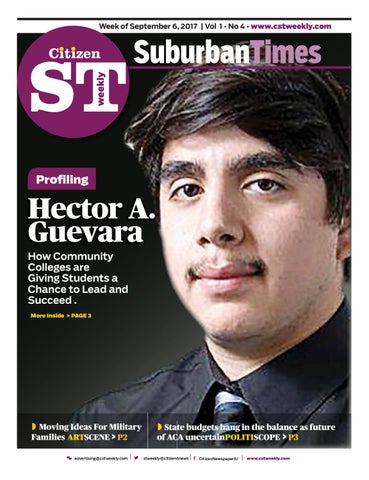
Hector A. Guevara How Community Colleges are Giving Students a Chance to Lead and Succeed . More Inside > PAGE 3
w Moving Ideas For Military Families ARTSCENE > P2 advertising@cstweekly.com
w State budgets hang in the balance as future of ACA uncertainPOLITISCOPE > P3 stweekly@citizen6news
CitizenNewspaper6/
www.cstweekly.com
2
September 6 2017
ST
SuburbanTimes
ARTSCENE
ST
South Side Community Art Center’s 52nd Annual Art Auction Harry Lennix is an accomplished film, television and stage actor born and raised in Chicago’s South Shore neighborhood. He is widely-regarded as one of the hardest working men in Hollywood and can currently be seen on NBC’s “Blacklist.”
ST
(CHICAGO) -- The South Side Community Art Center (SSCAC) will host its 52nd Annual Art Auction & Fundraiser on Sunday, September 24 at the South Shore Cultural Center from 5:00 P.M. to 9:00 P.M. Special invited celebrity guests include actors Harry Lennix, T’Keyah Crystal Keymah and Tim Reid. Included in the auction this year will be works by Keymah, Reid and Windy City Live’s Val Warner. As throughout its history, the Juried Auction will feature art from local, national and internationally recognized artists. The Art Auction serves as the SSCAC’s primary fundraiser, and this year is a celebration of the 100th Birthday of one of its key members, Dr. Margaret Burroughs. Funds raised will support the SSCAC’s mission to
preserve, conserve and promote the legacy and future of African American art and artists, while educating the community on the value of art and culture. The SSCAC Annual Art Auction also gives emerging artists the opportunity to have their works viewed and purchased alongside their nationally and internationally established colleagues. Harry Lennix is an accomplished film, television and stage actor born and raised in Chicago’s South Shore neighborhood. He is widely-regarded as one of the hardest working men in Hollywood and can currently be seen on NBC’s “Blacklist.” He has also had leading roles in “Ray”, “The Matrix Reloaded”, The “Matrix Revolution”, “Barbershop 2”, “Love and Basketball”,
“The Five Heartbeats”, “The Human Stain”, and “State of Play.” He is known for his commanding stature, baritone voice, diligent work ethic and multiple talents. Featured artist Tim Reid, an Emmy nominated actor, director and producer, has appeared on television for over three decades, from Venus Flytrap on “WKRP in Cincinnati” through Simon & Simon, Frank’s Place, “Sister to Sister”, “That 70’s Show” and recently HBO’s “Treme” and OWN’s “Greenleaf”. He made his directorial debut with his critically acclaimed feature film, “Once Upon a Time… When We Were Colored.” He also created and produced the critically acclaimed Showtime TV Series “Frank’s Place “and “Linc’s.”
TRAVEL
Moving Ideas For Military Families (NAPSI)—America’s military men and women are known to be up for anything. For some things, however, such as moving their families, many could use some advice, such as these helpful suggestions:
• Work with companies that understand each military branch’s different rules and regulations, especially if you need to move in a hurry. For instance, Penske Truck Rental has a specialized toll-free call center at 844-4TROOPS (844-487-
Before You Move • The first thing to do is to make an appointment with the military base property transportation office to schedule your move. • Next, tell the base landlord or housing office of your dates and plans. • Figure out what size truck you’ll need and reserve it. • Get boxes and other packing supplies. • Pack out-of-season and nonessential items early. • Donate unwanted items to charity or hold a garage sale. • Determine what you’ll do about any pets you may have. • Copy all your medical records, birth certificates and so on. Store them all in one safe place. • Change your address with the post office, banks, credit card companies and magazines. When it’s time to move, proper planning can help it all go smoothly. • Call service providers and utilities to schedule turn-on. 6677) to assist active and veteran members of the • Secure moving-day help. U.S. military and their families with do-it-your• Pick up your truck the day before to save time self moves. All call center associates are either on moving day. veterans themselves or are related to someone who has been or is currently in active or reserve
advertising@cstweekly.com
stweekly@citizen6news
CitizenNewspaper6/
duty. The company not only has trucks at over 2,200 convenient locations, it offers a military discount of 10 percent. If you book your rental online, you’ll save an additional 10 percent automatically. In addition, it’s the only national truck rental company with free unlimited miles on one-way rentals anywhere in the country. When You Move • Finish packing, taping and labeling boxes. • Prepare major appliances and electronics. • Secure dresser drawers and appliance doors with rope and tape. • Assemble a moving-day kit, including directions, map, GPS, checkbook, credit cards, military and other IDs, eyeglasses, sunglasses, prescription drugs, flashlight, water, snacks, games for kids, and old and new house keys. • Watch your weight. A military do-it-yourself move requires that you weigh your vehicle before you load it and after. To help, Penskeoffers a free Certified Public Scale Locator to make finding a scale easier.
Learn More For further facts and tips, visit www.pensketruckrental.com/discounts/military.
www.cstweekly.com
September 6 2017
SuburbanTimes
3
COMMUNITY
Prairie State College in Chicago Heights Gives Students a Chance to Lead and Succeed CONTINUED FROM PAGE 1
By Lisette Gushiniere
According to statistics obtained from the College Board, more than 40 percent of U.S. undergraduate students attend community colleges. Students who are 18 to 24 years old make up the largest age group. While a four-year degree might be out of reach for some due to costly tuition commitments, community colleges open doors for all types of students including working adults, retirees and others who want a shot at an affordable education. Besides saving money, community colleges offer additional advantages. Students can use the experience to transfer to a four-year college, prepare for a chosen profession, knock out general education courses or explore a suitable major. Located in Chicago Heights, Illinois (approximately 30 miles south of downtown Chicago) is Prairie State College (PSC). The institution, which sits on 130-acres on South Halsted Street and Vollmer Road, was the first Illinois community college to guarantee all credits will transfer to other Illinois colleges and universities, an assurance that has grown through the Illinois Articulation Initiative. The College’s north campus facilities includes the Health/ Tech Center and the Fitness Complex, a unique partnership among Prairie State College, the Chicago Heights Park District, and St. James Hospital and Health Centers. At PSC, students like 21 year-old Hector A. Guevara are making the most out of the community college experience. Recently, Guevara, who is now in his third year, was sworn in as the newest student trustee on the Prairie State College Board of Trustees. He said he’ll use the opportunity to grow as a leader and serve as a role model to his peers. “What I really like about PSC is that it’s not just a school where you come by for class then leave,” Guevara said. “It feels like a home where you explore great new things and opportunities---whether it’s getting involved in sports
ST
or clubs, seeking connections with student leaders, being a part of a club where it makes you feel like you’re part of the family and doing everything together in and out of campus.” Currently studying biological science at PSC, Guevara plans to attend either the University of Illinois at Chicago or Indiana University Northwest after graduating from Prairie State. In his role as student trustee, Guevara plans to get more involved with student club activities including outreach, fundraising and events. “As student trustee, my role is to make sure students are living a great college experience and trying to reach out to people if there are any events or involvement opportunities happening on campus, especially if there’s anything they should be aware of,” he said. Attending PSC is certainly giving Guevara a chance to hone his leadership skills. Besides being active in numerous clubs and organizations, he served as a leader for All Latin Alliance as a Student Government Association (SGA) Representative. While community colleges haven’t always offered the same experience as four-year universities, experts point out those statistics are changing. The American Association of Community Colleges reports that nearly one quarter of community colleges now offer dorms. It’s also possible to find extra-curricular activities, scholarships and networking opportunities. Participating in extra-curricular activities in a community college setting has been a positive experience for Guevara. It was a great opportunity to be part of the SGA, he said, adding, “I learned a lot about becoming a better person and building myself. If it wasn’t for the club, I wouldn’t be where I’m at right now.” On yesterday, Attorney General Jeff Sessions announced that the Trump administration is rescinding the Deferred Action for Childhood Arrivals or (DACA) program. Congress will have six months to come up with a fix for the program. Calling the program “unconstitutional,” Sessions said the
Department of Homeland Security would be responsible for an “orderly” and “lawful wind-down,” of the program. An Obama era policy, the DACA Program has allowed nearly 800,000 undocumented people who were brought to the United States as minors to live and work in the country without fear of deportation. Days before Sessions made the announcement, Guevara was looking forward to working on creating a DACA scholarship for students who aren’t qualified to apply for other scholarships. “I believe it’s fair that everyone deserves to receive financial help, no matter where they’re from,” Guevara said. “It’s a huge challenge to make this scholarship official, but it’s something I’ll be trying to fight for,” he said. Now in his third year at Prairie State College (PSC), Hector A. Guevara was recently sworn in as the newest student trustee on PSC’s Board of Trustees. He said he’ll use his new position to be a role model for his peers.
POLITISCOPE
State budgets hang in the balance as future of ACA uncertain Many state budget direcof Americans to lose tors are starting to plan for health care coverage. the next fiscal year – even Less has been said about as debate over repealing and the impact of Obamacare replacing Obamacare has changes on individual stalled in Congress. state budgets or local Capri Cafaro In such an uncertain envieconomies. ronment, responsible budgeting is no easy As a former Ohio state senator, I have task. firsthand experience with the complexities Congressional Budget Office analysisof of state budgeting. the various Affordable Care Act (ACA) Of course, most people realize states repeal-and-replace proposals report that rely on federal dollars as part of their overall of them would cause tens of millions all budget. When the federal government
advertising@cstweekly.com
takes away funding – as would happen under an ACA repeal – states are left with holes that must be filled either by implementing budget cuts or increasing revenues. At the moment, there is no guarantee that an ACA repeal-and-replace bill will become law. There is also no certainty that Obamacare will remain the law of the land. So, states are left to operate under a worse case scenario as they plan budgets. What does bracing for the worst mean? Looming funding crisis
stweekly@citizen6news
CitizenNewspaper6/
A study conducted by the Urban Institute estimated federal health care spending would be reduced by US$926 billion between 2018 and 2026 should a bill to repeal and replace Obamacare pass. Medicaid, a federal program that provides coverage for some low-income people, families and children, pregnant women, the elderly and people with disabilities, also could have a big impact on a state’s bottom line. In all states, Medicaid is paid for with both state and federal
www.cstweekly.com
CONTINUED ON PAGE 4
4
September 6 2017
ST
SuburbanTimes
SuburbanTimes
September 6 2017
FOOD SMART SNACKING
Crispy Fruit Snacks In The Lunchbox Get An A+ (NAPSI)—What your child eats for lunch matters more than you might realize, say the experts at the U.S. Centers for Disease Control and Prevention (CDC). A healthy lunch and nutritious snacks can help keep your little scholars happy and attentive throughout the school day. The CDC recommends making sure you include a “combination of foods” when you pack school lunches and, for “something sweet, grab a piece of fruit.” Your kids can “enjoy the naturally sweet taste while loading up on vitamins, fiber and other nutrients” instead of empty calories. Making that easier are freeze-dried, 100 percent pure fruit snacks that come in convenient single-size serving bags. There are no preservatives and no added sugar, oils or fats—just fruit. What’s more, they’re nonGMO Project Verified, kosher and have 55 calories or less per bag. The snacks come in seven flavors that kids like: apple, Asian pear, banana, cantaloupe, mango, pineapple and tangerine. All these Crispy Fruit flavors are available in convenient 6-pack or individual, single-serving “Grab & Go” bags. Why Freeze Dried Major benefits of freeze-dried fruit are: • Light and flavorful • Retain nearly all the nutrients of fresh fruit • Long shelf life. Power That Lunchbox When it comes to providing healthy meals and snacks, parents can be “Pro-Pack-tive” in two other ways.
First, visit www.poweryourlunchbox.com to find a wide variety of creative and delicious lunch options, such as:
Next, take the Power Your Lunchbox Pledge to eat a healthier lunch. For every parent who does, Produce for Kids will donate $1 to Feeding America.
Buffalo Chicken Pinwheels
Learn More
8 oz. cooked shredded chicken breast 2 Tbsp. Vegy Vida Cool Buffalo dip 1 Tbsp. shredded carrots 2 (8-inch) tortillas ½ cup Pero Family Farms sliced mini sweet peppers 2 Tbsp. Vegy Vida Kids’ Dip ‘n More Creamy Ranch 1 pkg. Crispy Green freeze-dried fruit Mix chicken, dip and carrots in small bowl. Divide between tortillas. Wrap up and cut into pinwheels.
For further facts, tips and recipes, visit www.crispygreen.com. You can also sign up for a one-time 20 percent discount and free shipping, plus a free, helpful, healthy lifestyle newsletter at www.crispygreen.com/crispygreen-vip-promotion/. To find a retailer nearby that carries Crispy Fruit, go to www. crispygreen.com/where-to-buy.html.
State budgets hang in the balance as future of ACA uncertain
INTRODUCING OUR
HOMEBUYER GRANT PROGRAM
We want to help make your dream of homeownership a reality. If the down payment is the only thing standing between you and your own home, we may have a tool for you. We’ve partnered with local nonprofits to offer the Homebuyer Grant Program to help first-time homebuyers overcome the challenge of covering a down payment. This program can offer up to $2,000 to qualifying borrowers purchasing a home as their primary residence and can be paired with federal, state, and local grants or loans. If purchasing a home seems out of reach because of the down payment, we’ve got a solution for you.
TO QUALIFY, HOMEBUYERS MUST: • Be applying for your first mortgage • Have an annual household income at or below 80 percent of the U.S. Department of Housing and Urban Development’s median income of the county in which the property is located, adjusted for household size
CONTINUED FROM PAGE 3
funds with the federal government bearing more of the cost. The ACA called for the federal government to pay for 100 percent of the costs to states that expanded Medicaid to citizens earning up to 138 percent of the federal poverty level. That means that in 2017, a family of four earning less than $33,948 would be eligible for coverage. The rule included single childless adults, a departure from previous Medicaid eligibility requirements. Baked into the ACA funding of Medicaid expansion is a scheduled reduction of money from the federal to the state governments from 100 percent to 90 percent by 2020. Not all states took up the federal government’s offer. Nineteen states – 17 of which had Republican governors – saw refusal of Medicaid expansion dollars as a way to buck Obamacare. Now, the 31 states that did advertising@cstweekly.com
expand Medicaid stand to lose the most if one of the current Obamacare revamp proposals is implemented. For example, my home state of Ohio could loseup to $3.5 billion in federal funds related to health care. Larger states like California are looking at a loss of as much as $15 billion. Furthermore, many Medicaid expansion states assumed they would be saving money by including the expansion population. Eliminating this younger – and presumably healthier – group from Medicaid is likely to lead to additional costs to states because healthier people help reduce insurance costs overall when included in the risk pool. Axing innovation Repealing the ACA could also ax the Center for Medicare and Medicaid Innovation. The center allows states stweekly@citizen6news
CitizenNewspaper6/
to apply to the federal government for waivers to try new ways to deliver and pay for health care. This process grants states special permission from the federal government to experiment and modify how Medicaid and Medicare is structured in an individual state. For example, seven states were awarded waivers to pursue integrating care for those who are eligible for both Medicare and Medicaid. These demonstration waivers allowed states to try to replace fee-for-service payments with a “capitated rate.” Capitated rates mean providers are paid one rate per person and need to stay within that dollar amount when delivering care to a group of patients. Essentially, it rewards physicians for controlling costs. A straight repeal of the ACA would take away this tool. So what are
• Contribute at least $1,000 from personal funds toward the purchase of your home • Complete an approved homebuyer counseling program • Be applying for a minimum five-year loan term and, on adjustable rate mortgages, an initial interest rate lock period of five years minimum
CELEBRATING 25 YEARS OF COMMUNITY BANKING!
For a full list of our nonprofit partners and what area each covers, visit wintrust.com/buyergrant.
WE’RE PROUD TO BRING IT HOME. As a company made in this area, for this area, Wintrust and its family of true community banks is dedicated to the unique neighborhoods each serves. For 25 years, we’ve been banks that invest in, give back to, and get to really know our communities and the people living in them. When you bank with a Wintrust Community Bank, you can be confident your money is going back into the things that matter most to you.
Mortgage Lending is provided through our affiliate Wintrust Mortgage. Wintrust Mortgage is a division of Barrington Bank and Trust N.A. NMLS # 449042
CONTINUED ON PAGE 6
www.cstweekly.com
advertising@cstweekly.com
stweekly@citizen6news
CitizenNewspaper6/
www.cstweekly.com
5
6
September 6 2017
ST
SuburbanTimes
NEWS
SuburbanTimes
ST
Illinois Workers, Leaders Continue to Challenge Rauner’s Minimum Wage Veto By Christopher Shuttlesworth
Illinois Senator Kimberly A. Lightford said Rauner’s stance on SB 81 doesn’t In the recent wake of Governor Bruce surprise her because he is known for Rauner’s veto of an $15 minimum wage irresponsibly cutting programs that help hike, community workers from the Fight impoverished communities. for $15 organization gathered and held a “Throughout his term he has irresponprotest inside of the James R. Thompson sibly cut the child care assistance program, Center, located 100 W Randolph St. held up grant money for low-income colIllinois’ current minimum wage has lege students and caused severe damage stood at $8.25 cents for more than a to our social services through a historic decade. Rauner vetoed Senate Bill (SB) 81, budget stalemate,” Lightford said. which was set to raise the statewide miniLightford said she will remain optimistic mum wage to $15 an hour by year 2022. and will continue to fight for the minimum SB-81 bill would have generated $2.3 wage increase of $15 per hour because billion in revenue and raised wages for working families deserve to live and thrive. more than 2 million Illinois workers, “I think our families deserve it,” Lightincluding half of the state’s African Ameriford said. “When you work every day on a can and women workers and 60 percent of full time job, you want to make sure your Latino workers, according to a Fight for $15 ends meet. You really don’t want to rely press release. on government assistance because you’re “Billionaire Rauner just stole food out of working and you want to make sure you’re my son’s mouth and blocked raises for 1 in able to take care of your family.” 3 working people across Illinois,” Adriana Illinois taxpayers pay $5 billion per In the recent wake of Governor Bruce Rauner’s veto of an $15 minimum wage hike, several workers Alvarez, a McDonald’s worker stated in the gathered on the floor of the James R. Thompson Center lobby chanting, “Rauner Vetoed $15, Vetoyear in public assistance to make up for low Fight for $15 press release. “We’re here to let Rauner in 18!” Photo Courtesy of Fight for $15 wages, paid by corporations like McDonhim know that this isn’t the end, it’s just the ald’s, according to a Fight for $15 press while helping low-income families get out of poverty is start.” release. a top priority, recent economic evidence proves this bill The proposed $15 wage increase would have begun to “The millions of underpaid workers in this state will would have done the total opposite. rise to $9 per hour from January 1, 2018 to December 31, remember Rauner taking food off our families’ tables “Researchers at the University of Washington, found 2018; to $10 per hour from January 1, 2019 to December when we go to the polls in 2018,” Alvarez said. that for every 10 percent increase in the hourly earn31, 2019; to $11.25 from January 1, 2020 to December 31, Rauner expressed in his veto message for SB 81 that ings of low-wage workers, there would be a 30 percent 2020; to $13 per hour from January 1, 2021 to December Illinois needs to seek comprehensive solutions that grow reduction in employers providing those jobs,” Rauner 31, 2021; and to $15 per hour on January 1, 2022, accordthe economy and the number of jobs available where said. “This research implies that Senate Bill 81 will result ing to the Illinois General Assembly. individuals can train, grow and attain better lives for in a net reduction of earnings for low-wage Illinoisans in Rauner explained in his veto message for SB 81 that them and their families. excess of $1,500 per year.”
September 6 2017
7
NEWS
Chicago Football Classic Kicks off at Soldier Field
State budgets hang in the balance as future of ACA uncertain CONTINUED FROM PAGE 4
states to do? Governors from both parties recognize the gravity of losing significant federal funding for health care. Another report published by the Urban Institute estimates a repeal of the ACA could cost states $1.1 trillion in uncompensated care costs which would amplify the impact of losing federal dollars. Since a budget shortfall of this magnitude is almost insurmountable, many governors have joined together to express their concerns to Congress. Programs and services provided by state and local governments would probably be reduced or eliminated in order to balance budgets with gaping holes. Some states may choose to increase taxes to raise revenue. In others, a combination of cuts and revenue increases would be needed to even make a dent in the budget shortfall. Of the 29.8 million people expected to lose insurance, 75 percent will go without coverage as a result of dismantling Medicaid expansion. When health providers are not being paid, they have to reduce staff and services, just like any other business. The health care foundation Commonwealth Fund projects 2.6 million jobs would be lost nationwide as a result of repealing Obamacare. Job loss leads to less revenue generation and increased
demand for social services, further compounding a state’s ability to compensate for the loss of federal dollars. Arizona, Colorado, Kentucky, New Mexico, North Carolina, Oregon, Rhode Island, Vermont, Washington and West Virginia lead the pack in estimated job and tax revenue losses should repeal-and-replace take hold. With so much at stake, some policymakers are starting to attempt to address at least parts of the ACA that need shoring up. Chief among the concerns is federal funding for subsidies that help low-income people pay for co-payments and deductibles, also called cost sharing. While the Trump administration decided to fund the cost sharing payments to insurance companies for August, it is unclear if Trump will authorize continued funding for these subsidies. Yet many health care and insurance experts have recognized that maintaining funding for CSRs would stabilize the insurance market and help states facing increased costs of uncompensated care. Recently, a bipartisan bill was introduced in the U.S. House of Representatives to continue the CSRs. Such legislation may gain more traction in light of a recent report out of the Congressional Budget Office that suggests eliminating the CSRs would result in the need for an additional $7 billion from the federal government
advertising@cstweekly.com
stweekly@citizen6news
CitizenNewspaper6/
to fund an increase in Medicaid enrollment. When it becomes more expensive for individuals to purchase coverage on the health insurance exchange, people will likely decide to remain uninsured, resulting in increased uncompensated care. It could also increase Medicaid enrollment in states with expanded Medicaid eligibility. If the federal government chooses to walk away from sharing Medicaid funding with states, individual state governments would be responsible for finding even more money for health care. Reinsurance is a program to provide dollars to health insurance plans that extend coverage to higher-risk patients to offset the higher costs associated with serving more complex beneficiaries. The concept has also been suggested as another state-level solution to address the uncertain fate of the ACA nationally. Regardless of what path lawmakers chose, it is clear state and federal officials should work together to ensure policy decisions will not jeopardize individual state budgets. Most statesare required to balance their budgets and could risk not meeting their obligations without a solution shaped by state and federal governments alike. Capri Cafaro is an Executive in residence at American University.
www.cstweekly.com
Illinois Cook County Board President Toni Preckwinkle and local community leaders announced the 20th annual Chicago Football Classic, which will take place on Sept. 30 at Soldier Field. Photo Credit: Christopher Shuttlesworth
By Christopher Shuttlesworth
The 2017 Chicago Football Classic (CFC) will celebrate its 20th annual CFC game on Sept. 30 as the Grambling State University Tigers and the Clark Atlanta University Panthers face off at 3:30 p.m. at Soldier Field. “This year we are excited to welcome the fans and family from Grambling State University and Clark-Atlanta to Chicago and Cook County,” said Toni Preckwinkle, who is the Illinois Cook County Board President. “The Football Classic and related activities provide us with the perfect opportunity to showcase the values of our historic Black colleges and universities and the pride and accomplishments of student athletes.” Preckwinkle explained that the Chicago Foot Ball Classic has been displaying an exciting showcase since 1997 which encourages African American high school and college students to strive and achieve their personal best in academics. “The Chicago Football Classic is about achieving excellence on and off the field,” she said. “It always shows the positive look of the talent of our young people from the teams on the field to the cheerleaders and band members.” The Chicago Football Classic’s mission is to inspire
advertising@cstweekly.com
African-American students and increase the awareness of Historically Black Colleges and Universities (HBCU) and its opportunities, according to a Chicago Football Classic press release. “When I was a teacher we always encouraged our young people to go to historic Black colleges because we knew they would find someone there who would nurture and support them because the point is not just to go to college, but to graduate,” Preckwinkle said. For the first time in the history of the Chicago Football Classic (CFC), both the Black City Council Caucus and the Hispanic City Council Caucus, under the leadership of Alderman Rod Sawyer (6th Ward) and Alderman Gilbert Villegas (36th Ward) respectively, have joined together to support the efforts of this important initiative in the City of Chicago. Two of the city’s top Hispanic high school bands, Kelly High School and the Back of the Yards College Preparatory High School, will compete in the “Battle of the High School Bands”, according to a Chicago Football Classic press release. Tickets range from $18.00 to $45.00 and can be purchased at Midway Wholesalers, Riteway-Huggins Construction, online @ Ticketmaster and beginning September 1st tickets are available at all Walgreens locations at a discount of $5.00.
stweekly@citizen6news
CitizenNewspaper6/
www.cstweekly.com
September 6 2017 8 SuburbanTimes
weekly
ST SuburbanTimes GET SOCIAL WITH THE CITIZEN SUBURBAN TIMES WEEKLY
Like Us On Facebook at www.facebook.com/CitizenNewspaper6/
Follow Us On Twitter at: Twitter: cstweekly@citizen6news
Follow Us On Instagram at: www.instagram.com/cstweekly/
Send press releases to editorial@cstweekly.com Send advertising inquiries to advertising@cstweekly.com
Citizen Suburban Times Weekly
w Bloom Township w Chicago Heights w Flossmor w Ford Heights w Greenwood w Home Wood w Lansing w Lynwood w Olympia Fields w Park Forest w Sauk Village w South Chicago w Steger 60411, 60422, 60425 , 60430, 60438
Visit us online at www.cstweekly.com