Citizen Week of Dec. 5, 2018
| Vol. 2 | No. 17 | www.thechicagocitizen.com
SUBURBAN TIMES WEEKLY
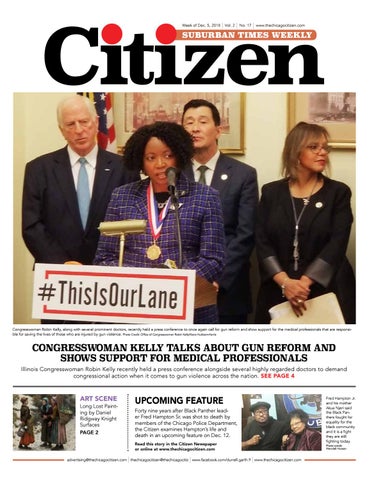
Congresswoman Robin Kelly, along with several prominent doctors, recently held a press conference to once again call for gun reform and show support for the medical professionals that are responsible for saving the lives of those who are injured by gun violence. Photo Credit: Office of Congresswoman Robin Kelly/Kiera Hubbert-Harris
CONGRESSWOMAN KELLY TALKS ABOUT GUN REFORM AND SHOWS SUPPORT FOR MEDICAL PROFESSIONALS
Illinois Congresswoman Robin Kelly recently held a press conference alongside several highly regarded doctors to demand congressional action when it comes to gun violence across the nation. SEE PAGE 4
UPCOMING FEATURE
ART SCENE
Long Lost Painting by Daniel Ridgway Knight Surfaces PAGE 2
Fred Hampton Jr. and his mother Akua Njeri said the Black Panthers fought for equality for the black community and it is a fight they are still fighting today.
Forty nine years after Black Panther leader Fred Hampton Sr. was shot to death by members of the Chicago Police Department, the Citizen examines Hampton’s life and death in an upcoming feature on Dec. 12. Read this story in the Citizen Newspaper or online at www.thechicagocitizen.com
|
|
Photo credit: Wendell Hutson
|
advertising@thechicagocitizen.com thechicagocitizen@thechicagocitiz www.facebook.com/durrell.garth.9 www.thechicagocitizen.com
2 | CITIZEN | Suburban Times Weekly | Week of Dec. 5, 2018
ART SCENE
Long Lost Painting by Daniel Ridgway Knight Surfaces Born in 1839, Ridgway Knight received his formal training at the Pennsylvania Academy of Fine Arts where he was a classmate of Mary Cassatt and Thomas Eakins. In 1861, he continued his studies in Paris under Alexandre Cabanel and Charles Gabriel Gleyre. Knight returned to the United States in 1863 to serve in the Civil War and then traveled back to France in 1872, where he would remain for the rest of his life. Once Knight settled in France, he befriended Renoir, Sisley, and Meissonier. In 1874, he traveled to Barbizon to visit Jean-Francois Millet whose peasant subject he admired. During his visit, Knight realized that Millet's depictions and views of French peasant life were a bit too fatalistic. Instead, Knight chose to capture rural life in France in its happier moments. In Winter (1880), one of Knight's early genre paintings, depicts three young peasant girls in a moment of conversation on a snow-covered path in the French countryside. Sometime after its creation, the work was acquired by American collector John D. Ross (1842-1917),
who made his fortune in the lumber business. Since that time, In Winter remained in the family's possession; passed down from one generation to another. In 2018, John Ross' descendants decided to sell the painting and contacted Rehs Galleries, the world's experts on Knight's work (the gallery is currently researching the life of Daniel Ridgway Knight for the forthcoming catalogue raisonné). Howard Rehs, the gallery's owner, stated that, "He had been searching for this painting since the project began in the early 1990s, and only knew of its existence through old photographs in the gallery's archives and an illustration in George Sheldon's book Recent Ideals of American Art that was published in 1888." The gallery acquired this important painting and sold it before they even had the opportunity to display it. Mr. Rehs commented that, "It is nice to see strong interest in high quality 19th century Academic works of art, but sometimes they go too fast." For more information, visit https://www.rehs.com, or call Howard Rehs at (212) 355-5710
Daniel Ridgway Knight, "In Winter"
TRAVEL
National Geographic Travel Reveals the Best Trips of 2019 With the publication of its annual Best Trips issue, National Geographic Traveler magazine reveals its 28 must-see destinations and travel experiences for 2019. Together, Traveler editors and National Geographic Explorers have selected their top places to travel across four categories: Cities, Nature, Culture, and Adventure. The year's Best Trips list is relevant, surprising and inspiring, highlighting a globe-spanning mix of destinations from the Peruvian Amazon to Kansas City, Missouri. "Our Best Trips issue features 28 destinations and experiences that can inspire us, change our perspectives and connect us with cultures, places and ideas that matter in the world," says George Stone, National Geographic Traveler editor in chief. "The issue is packed with spectacular National Geographic photography and is driven by our mission to explore, conserve, respect and engage with our planet." National Geographic's Best Trips destinations for 2019 are:
CITIES l Dakar, Senegal l Salvador, Brazil l Kansas City, Missouri l Toronto, Canada l Matera, Italy l Perth, Australia l Mexico City, Mexico NATURE l Peruvian Amazon l Montenegro l Belize l Gorongosa National Park, Mozambique l South Walton County, Florida l Fanjingshan, China l Tahiti, French Polynesia
PRNewsfoto/National Geographic Traveler
CULTURE l Cairo, Egypt l Hoang Lien Son, Vietnam l Galway, Ireland l Bauhaus Trail, Germany l Oakland, California l Vervey, Switzerland l Dordogne, France
www.thechicagocitizen.com
ADVENTURE l Greenland l Bisti/De-Na-Zin Wilderness, New Mexico l Isla de los Estados, Argentina l Macedonia l Canterbury Region, New Zealand l Caño Cristales River, Colombia l Oman The December/January 2019 issue of Traveler magazine, is now available on newsstands and online at NatGeoTravel. com/BestTrips2019. The Best Trips digital experience includes highlights on each destination selected for the list as well as National Geographic's iconic photography that transports audiences to the chosen locales. Visitors are able to dive even deeper into four of the Best Trips destinations—Mexico City, Tahiti, Dordogne and Oman— with feature stories in the issue. To learn more about each destination, visit: NatGeoTravel.com/BestTrips2019.
CITIZEN | Suburban Times Weekly | Week of Dec. 5, 2018
|
3
4 | CITIZEN | Suburban Times Weekly | Week of Dec. 5, 2018
POLITISCOPE
College-educated cops enforce the law more aggressively BY RICHARD WRIGHT, RICHARD ROSENFELD AND THADDEUS L. JOHNSON
In the wake of controversial and widely publicized incidents involving the use of deadly force by the police against racial and ethnic minorities, President Obama appointed the President’s Task Force on 21st Century Policing in 2015 to propose ways to improve policing in the U.S. One of the task force’s many recommendations called for efforts to encourage higher education for police officers. Underpinning this recommendation was an optimistic assumption that having a college education makes police officers more sensitive and responsive to the distinctive needs of the communities they serve. But is this true? Despite the fact that the proportion of college-educated officers has risen 11-fold since 1960, researchers know surprisingly little about whether and how such officers differ from their less educated peers in their day-to-day encounters with citizens. To find out, we collected data on more than 63,000 traffic stops made by 842 officers in St. Louis, Missouri during 2013 to see if those made by officers with a college degree – a little less than 30 percent of the total – differed significantly from those made
Richard Wright
Richard Rosenfeld
Thaddeus L. Johnson
by others. We chose traffic stops because they are the most common point of contact between police and citizens, and often have served as flashpoints for community unrest. Officers with college degrees were significantly more likely to pull over drivers for less serious violations. For example, they were 50 percent more likely than officers without a college degree to stop drivers for a moving violation other than speeding, such as failure to signal when changing lanes. They were three times as likely to perform consent searches of drivers or their vehicles, and twice as likely to make arrests on discretionary grounds. These findings are in line with a study of racial profiling in St. Louis in 2007. That study also found
college-educated officers were more likely than others to search the vehicles they pulled over. Do such differences reflect attitudes that predate the officers’ college degree or somehow were acquired during their pursuit of that degree? That cannot be determined from the data available to us. Our preliminary interpretation is that having a college degree is a proxy for ambition, which expresses itself in the officers’ routine enforcement practices. College-educated officers may be more focused than their peers on achieving promotions and so are more closely attuned to the traditional reward structure of policing, which is based primarily on stops, finding contraband and arrests. A
study of American officers’ promotional aspirations shows that those with a bachelor’s degree are almost twice as likely to covet promotion as officers with only a high school diploma. Whatever the explanation, the fact that college-degreed officers appear to be more zealous than others in enforcing the law in traffic stops calls into question the effectiveness of simply hiring more of them as a way to improve police-community relations. We are not suggesting that departments should avoid recruiting college-educated men and women. Far from it. A savvy reform-oriented police manager might be well-advised to capitalize on college-degreed officers’ apparently
greater ambition, using it as a vehicle for implementing change. They could start by taking a page out of the St. Louis Metropolitan Police Department’s book. The agency recently has introduced a scheme that expands the performance measures by which patrol officers are evaluated, requiring them to document their community engagement. So instead of being rewarded solely for enforcement activities, such as number of arrests and traffic stops, officers are rewarded for activities such as attending neighborhood meetings or volunteering for a community organization. Once that is done, our study suggests that college-educated officers will be first to recognize and adopt the new set of policy priorities. Richard Wright Regents' Professor of Criminal Justice and Criminology, Andrew Young School of Policy Studies, Georgia State University. Richard Rosenfeld Founders Professor of Criminology and Criminal Justice, University of Missouri-St. Louis Thaddeus L. Johnson Ph.D Candidate in Criminal Justice and Criminology, Georgia State University
COMMUNITY
Congresswoman Kelly Talks About Gun Reform And Shows Support For Medical Professionals Continued from page 1 BY KATHERINE NEWMAN
Illinois Congresswoman Robin Kelly recently held a press conference alongside several highly regarded doctors to demand congressional action when it comes to gun violence across the nation. The press conference was held in Washington D.C. and included comments from Dr. Niva Lubin-Johnson who is a physician at Mercy Hospital in Chicago. “We are all here today for one simple reason. We are sick and tired of watching our fellow Americans, our friends, our neighbors, our kids, and our colleagues, needlessly dying from gun violence. Period. That’s it. This is about saving lives, pure and simple,” said Kelly. Kelly went on to talk about how, from her viewpoint, too many members of Congress are beholden to the financial support they receive from the National Rifle Association (NRA) and not to the lives of their constituents. She also talked about the Conceal Carry Reciprocity Act
that recently passed through the House and is awaiting a Senate vote. “This Republican-controlled Congress has done nothing for the last eight years to prevent gun violence. Instead, they tried to make it worse. They rammed through the NRA’s baby, conceal carry reciprocity, despite evidence that the policy is dangerous and the strong objection of law enforcement organizations,” said Kelly. The Conceal Cary Reciprocity Act would allow any person with a concealed carry permit in their home state to carry their concealed weapon in any other state that permits the concealed carry of a firearm. The Act also specifies that certain retired and off-duty law enforcement officers who are authorized to carry concealed firearms will not be restricted by the federal prohibition of possessing and discharging a firearm in a school zone, according to Congress.gov. Aside from the politics of gun reform, Kelly used this press conference as an opportunity to shed light on the tough jobs that doctors must do every day as caregivers of gunshot victims.
“The people who see the daily reality of this gun violence and the people who fight vigilantly to stop the bleeding, reduce the damage, and save lives are our nation’s doctors, nurses and healthcare professionals,” said Kelly. “They have seen things that would make most of us sick. They have been covered in blood desperately trying to save the life of a young person who was at the wrong place at the wrong time.” In October, the American College of Physicians published a paper on firearm injuries and death. In response to that publication, the NRA tweeted that, “someone should tell self-important anti-gun doctors to stay in their lane.” During the press conference, Dr. Niva Lubin-Johnson, president of the National Medical Association and a physician at Mercy Hospital in Chicago, made it clear that she believes gun reform is her lane. “From a servant leader to you, the NRA, stay out of our lanes while we continue to save the lives of those that are far too often taken away or severely injured much, much too early,” said Lubin-Johnson.
www.thechicagocitizen.com
Darrell Garth Darrell Garth President // Publisher President Publisher Janice Garth Janice Garth Sales Manager/ Manager/ General Sales General Manager Manager CST publishedweekly weekly CSTWeekly, Weekly, published onon Wednesdays and distributed distributed Wednesdays and in in thethe Township Bloom,(publishing (publishing Township of of Bloom, 5252 issues annually). Written issues annually). Written permission is required permission is required to to reproduce wholeor or reproduce contents contents inin whole part Generalmanager manager partfrom from the the General or or the publisher. CST Weekly does the publisher. CST Weekly does not assume the responsibility for not assume the responsibility for nor are we able to return nor are we able to return unsolicited marterials. Deadline for unsolicited marterials. for at advertising is every Deadline Monday advertising For is every Monday aton noon. information noon. For information call on us subscriptions or advertising or advertising us is atsubscriptions (773) 783-1251. Our call office at (773) at783-1251. office is located 8741 S.OurGreenwood located at 107, 8741 Chicago, S. Greenwood Ave., Ste# Illinois Ave., Ste# 107, Chicago, Illinois 60619. 60619.
Editorial:
Send pressEditorial: releases, news tips, calendar listing etc. Send press releases, newsto: tips, editorial@cstweekly.com calendar listing etc. to: editorial@cstweekly.com
Advertising
advertising@cstweekly.com Advertising Classifieds call us at advertising@cstweekly.com (773) 783-1251 Classifieds call us at
(773) 783-1251
T:10”
CITIZEN | Suburban Times Weekly | Week of Dec. 5, 2018
|
5
S:9”
IT’S NOT THE
THE LEADING LADY GETS HER CLOSEUP.
Call 1-800-xfinity, visit an Xfinity Store or go to xfinity.com
Restrictions apply. Not available in all areas. Xfinity On Demand requires Xfinity TV service. ©2018 Comcast. All rights reserved.
T:13”
S:12”
The best connections have always been wireless, and you can stay connected this season with Xfinity. Watch Netflix and YouTube right on your TV. Even stream your holiday favorites on any device with the Xfinity Stream app, powered by the best WiFi experience. Plus, save money when you switch to Xfinity Mobile. That’s how Xfinity makes the holidays simple, easy, awesome.
6 | CITIZEN | Suburban Times Weekly | Week of Dec. 5, 2018
NEWS
2019 National Junior Wheelchair Basketball Tournaments Lansing, Ill. – The National Wheelchair Basketball Association Board of Directors recently announced that the 2019 NWBA National Junior Wheelchair Basketball Tournament (NJWBT) presented by ABC Medical, will be held in New Lenox, Illinois (a southwest suburb of Chicago) March 29-31, 2019. This tournament will host the three postseason competitions for the organization’s Junior Division including: - National Junior Wheelchair Basketball Tournament (NJWBT) - National Junior Invitational Tournament (NJIT) - National Prep Wheelchair Basketball Tournament (NPWBT) The bid to host the 2019 NJWBT was submitted by Lincoln Special Recreation Association. Since 1976, LWSRA has provided adaptive and special recreation services for individuals with disabilities through a cooperative agreement with Frankfort, Manhattan, Mokena, New Lenox, Peotone and Wilmington Island Park Districts. “LWSRA is humbled by the opportunity to host such an important event for the NWBA community,” said Keith Wallace, LWSRA Executive Director. “We are excited for our LWSRA Hawks Varsity and Prep to work hard this season to earn spots to compete in our backyard.” The top 16 ranked teams for Varsity level of play in the
“LWSRA IS HUMBLED BY THE OPPORTUNITY TO HOST SUCH AN IMPORTANT EVENT FOR THE NWBA COMMUNITY. WE ARE EXCITED FOR OUR LWSRA HAWKS VARSITY AND PREP TO WORK HARD THIS SEASON TO EARN SPOTS TO COMPETE IN OUR BACKYARD.” KEITH WALLACE LWSRA Executive Director
Junior Division will earn an invite to compete in the National Junior Wheelchair Basketball Tournament (NJWBT), based on their performance throughout the season. Varsity teams ranked 17-32 will receive an invite to participate in the NJIT. Similarly for the Prep Division, the top 16 ranked teams from Prep earn an invitation to participate in the NPWBT. Sarah Castle, NWBA President said, “We are excited for the 27th installment of Junior Division Nationals, and we are grateful to LWSRA for their willingness to put on what we know will be a high quality tournament for the Junior Division. I’d also like to thank the NWBT Committee for their tireless efforts to secure a host in our first year post-Louisville.” This will mark the fourth time that the Prairie State has hosted the NJWBT for the NWBA; the first time dates back
to 1994. “LWSRA submitted a compelling bid that will definitely showcase the talent in the Junior Division”, said Mike Bauler, commissioner of the Junior Division. “I am excited to see the entire Junior Division to converge on the Midwest were the roots of our great sport were formed.” NWBA members will be welcomed to the 2019 NJWBT by the Chicago Southland Convention & Visitors Bureau. Chicago Southland is comprised of 63 South and Southwest suburbs of Chicago. Chicago Southland encompasses over 400 square miles of urban and open area Chicago’s most affordable region, offering 70 plus hotels. There is easy accessibility to and through O’Hare or Midway Airports and the several major interstates (including I-55, I-57, I-80, I-94, I-294 and I-355). Jim Garrett, who is the president and chief executive officer of the Chicago Southland CVB stated, “We are excited to host the 2019 National Junior Wheelchair Basketball Tournaments in the Chicago Southland and are proud sup- porters of adaptive recreation.” The Chicago Southland Convention & Visitors Bureau is the official destination management and marketing organization for Chicago’s 63 south and southwest suburbs. The Chicago Southland CVB markets the Chicago Southland region as a destination for meetings, conventions, group tours, sports events and leisure. For more information, go to VisitChicagoSouthland.com
Cunningham measure clears the way for Chicago Ridge redevelopment An initiative that will help spur redevelopment of a key piece of industrial property in Chicago Ridge will become law after state legislators voted recently to override the governor’s veto of the plan. The measure, sponsored by State Senator Bill Cunningham, prohibits land owners from disconnecting their property from a municipality if the land is contained within a tax increment financing district. The current owner of the long-abandoned Yellow Freight trucking yard on Harlem Avenue wants to
disconnect from the city’s TIF district, but a developer looking to rehabilitate the 90-acre property wants to utilize the benefits of the TIF district. “This bill will stop the current owner of the property from scuttling the Chicago Ridge economic redevelopment plan for the property and the entire Harlem Avenue corridor,” Cunningham said. Democrats and Republicans in the Senate voted recently to override the governor’s veto. The House voted to override the veto on Nov. 14.
Justice Department Awards $56 Million to Support Law Enforcement Health and Safety
State Senator Bill Cunningham
New Data: Illinois College Students Facing Mounting Affordability Crisis Young Invincibles and Lumina Foundation recently released a new series of fact sheets highlighting the financial challenges facing Illinois college students as they struggle to afford a college education. By taking a hard, objective look at the affordability of Illinois universities and how the deck is stacked against students - especially non-traditional students - these fact sheets shed further light on the mounting obstacles facing Illinois’ students as they pursue their degrees. Among the most troubling findings: l Out of the 690,000 college students in Illinois, 100,000 students experience housing insecurity - and no Illinois institution is affordable. l Only 3% of Illinois institutions
are affordable for student parents l Only 8% of Illinois institutions are affordable for returning students l Only 8% of Illinois institutions are affordable for student workers The fact sheets also identify the universities which are the most - and least - affordable for Illinois students. For instance: l Median Net Cost of a School in Illinois: $27,708 per year l Most Affordable Four-Year Public School: Chicago State University - $11,293 per year l Least Affordable Four-Year Public School: Northern Illinois University - $19,782 per year l Most Affordable Four-Year Private Non-Profit School: Saint Augustine College - $6,889 per year l Least Affordable Four-Year
Private Non-Profit School: School of the Art Institute of Chicago $43,494 per year Note that all prices are average net prices, meaning it’s the price students pay after grant aid is applied. “This new analysis shows what we’ve heard from students across the Land of Lincoln: college is beyond the reach of too many young people,” said Erin Steva, Midwest Director for Young Invincibles. “The skyrocketing cost of college, the increasing need for a college degree to find a job that pays well, and decreasing financial aid has put Illinois’ young people behind the eight ball and policymakers need to step up. We know that a college degree is still the best path toward financial security but too many students, eswww.thechicagocitizen.com
pecially non-traditional students, are being left behind as college becomes even more unaffordable.” These fact sheets were created in collaboration by Young Invincibles and Lumina Foundation. Lumina Foundation’s affordability benchmark, known as The Rule of 10, states that students should pay no more for college than 10% of their discretionary income for 10 years, and the earnings from working 10 hours a week while in school. Using the U.S. Census, the groups applied median incomes of different groups of students to test all of Illinois’ institutions’ net prices (cost of attendance minus grant aid, drawn from Integrated Postsecondary Education Data Systems) on the Rule of 10 to determine if they are affordable.
Acting Attorney General Matthew Whitaker recently announced awards of over $56 million in grant funding awarded last month through the Department of Justice’s Office of Justice Programs (OJP) to enhance state, local, and tribal law enforcement safety and wellness. OJP’s Bureau of Justice Assistance and National Institute of Justice awarded grants to law enforcement departments, local jurisdictions, and training, technical assistance and research organizations throughout the United States. The funds will be used to provide services designed to protect officers and improve overall public safety. Whitaker announced the grants during remarks to the Joint Terrorism Task Force in New York City. More than $29.8 million will reimburse jurisdictions for up to 50 percent of the cost of body armor vests purchased for law enforcement officers; $12 million will support law enforcement safety and wellness programs, research and services; and $12.2 million will support the implementation of law enforcement agencies’ body-worn camera programs.
CITIZEN | Suburban Times Weekly | Week of Dec. 5, 2018
|
7
NEWS
UNCF Chicago Joins the Global #GivingTuesday Movement UNCF Chicago joined #GivingTuesday to encourage philanthropy through education. Benefiting historically black colleges and universities, UNCF Chicago aims to change the narrative of HBCUs across the nation by equipping minority students with the resources necessary to transition into college and ultimately the workforce. With the recent release of UNCF’s new publication, HBCUs Make America Strong: The Positive Economic Impact of Historically Black Colleges and Universities, the value can be seen in how HBCUs perform in annual job creation and economic development: 134,000 jobs nationwide and almost
$15 billion in total national economic impact. In Chicago alone, UNCF Chicago awarded 784 scholarships to IL students. #GivingTuesday is a global day of giving which takes place annually on the Tuesday after Thanksgiving (in the U.S.) “The foundation of UNCF was built on the act of giving,” said Dr. Michael L. Lomax, president and CEO of UNCF. “UNCF’s participation in Giving Tuesday shows our steadfast commitment to educating our students and providing resources to our HBCUs; ultimately having a great impact on the nation. And, of course, securing a better world for the next generation starts with a quality education.”
Aethlon Medical's Cancer Therapy Receives 'Breakthrough Device' Designation Aethlon Medical, Inc. (Nasdaq: AEMD), a therapeutic technology company focused on unmet needs in global health, recently announced that it has received a "Breakthrough Device" designation from the U.S. Food and Drug Administration (FDA) to support
the advancement of the Aethlon Hemopurifier® for the treatment of cancer. The Aethlon Hemopurifier is a first-in-class technology designed for the rapid depletion of cancer-promoting exosomes and life-threatening viruses. FDA's Breakthrough Device
program was established under the 21st Century Cures Act to facilitate more rapid patient access to breakthrough technologies with the potential to address life threatening disease conditions for which no approved or cleared treatment alternatives exist.
Eli Lilly Announces Lilly Diabetes Solutions Center to Assist People With Insulin Affordability The American Diabetes Association estimates that over 30 million Americans are affected by diabetes and is the seventh leading cause of death in the United States. In the African American population, studies show that we are disproportionately affected by diabetes in comparison to the general population. The rates of diagnosed diabetes among African Americans is 12.7% compared to 7.4% of whites. Not only does the African American community face the dilemma of an increased diabetes diagnoses, they also face numerous health care challenges when trying to manage diabetes such as cost for treatments, medications, limited supplies and access to primary care to maintain a quality of life. Eli Lilly and Company, a global leader in diabetes care, understands these gaps and burdens of costs in the African American community. They understand that there are gaps in health care for communities of color and working to help close it by reducing the cost of insulin and making sure that
everyone will have equal access to their medicines. For this reason, Eli Lilly has launched Lilly Diabetes Solution Center and Helpline in the African American community to ensure people receive comprehensive treatment for diabetes. To spread the word on this effort, Lilly will launch this announcement with full page ads in African American newspapers across the country. Beginning this week, the National Newspapers Publishers Association representing Black newspapers will be running advertising in selected markets announcing the solutions center as an opportunity for African Americans to receive affordable diabetes medication. This is especially great news for African Americans who are disproportionately affected by diabetes and its effects. This collaboration with the Lilly Diabetes Solution Center will help decrease the complications of diabetes by making sure that access to affordable insulin is available to improve the quality of life in the African American community.
8 | CITIZEN | Suburban Times Weekly | Week of Dec. 5, 2018
Make rent a thing of the past. With a down payment as low as 3% for modest-income buyers, Bank of America makes affording a new home easier than ever.1 To get started call 1-800-641-8603 or visit your local financial center. BankofAmerica.com /FirstHome
Available for fixed-rate purchase loans with terms of 25 or 30 years and on primary residences only. Certain property types are ineligible. Borrower(s) must not have an individual or joint ownership interest in any other residential property at time of closing. Maximum purchase loan-to-value is 97% and maximum combined purchase loan-to-value is 103%. For loan-to-values >95% any secondary financing must be from an approved Community Second Program; ask for details. Homebuyer education may be required. Restrictions apply regarding co-borrowers. Maximum income and loan amount limits apply.
1
Bank of America, N.A.,
Equal Housing Lender Š2018 Bank of America Corporation. Credit and collateral are subject to approval. Terms and conditions apply. This is not a commitment to lend. Programs, rates, terms and conditions are subject to change without notice. AR98CFM5