Citizen Week of Sept. 5, 2018
| Vol. 2 | No. 4 | www.thechicagocitizen.com
SUBURBAN TIMES WEEKLY
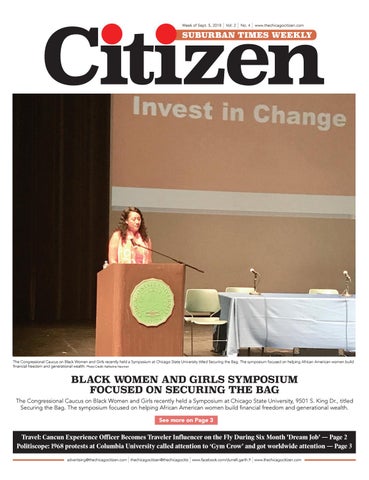
The Congressional Caucus on Black Women and Girls recently held a Symposium at Chicago State University titled Securing the Bag. The symposium focused on helping African American women build financial freedom and generational wealth. Photo Credit: Katherine Newman
BLACK WOMEN AND GIRLS SYMPOSIUM FOCUSED ON SECURING THE BAG
The Congressional Caucus on Black Women and Girls recently held a Symposium at Chicago State University, 9501 S. King Dr., titled Securing the Bag. The symposium focused on helping African American women build financial freedom and generational wealth. See more on Page 3
Travel: Cancun Experience Officer Becomes Traveler Influencer on the Fly During Six Month 'Dream Job' — Page 2 Politiscope: 1968 protests at Columbia University called attention to ‘Gym Crow’ and got worldwide attention — Page 3 |
|
|
advertising@thechicagocitizen.com thechicagocitizen@thechicagocitiz www.facebook.com/durrell.garth.9 www.thechicagocitizen.com
2 | CITIZEN | Suburban Times Weekly | Week of Sept. 5, 2018
ART SCENE Christon Gray Releases Single 'Together Forever' Christon Gray has released the new song “Together Forever,” the lead single from his upcoming fourth solo album Clear The Heir (Fo Yo Soul/Essential Sound/Sony Music). “Together Forever” kicks off a new chapter for the chart topping rapper, singer, songwriter, and producer, following a period of personal trials after the release of his acclaimed second album The Glory Album. In the song, Gray shares his experience dealing with being a Christian and facing divorce along with the life changes that follow. Reaffirming a strong declaration of faith in Jesus to inspire listeners, “Together Forever” will be followed by the release of additional singles in the coming weeks. Clear The Heir will be released on Friday Oct. 19, 2018. Christon Gray has continued to rise as one of the preeminent Christian artists to watch. He released his album, School of Roses in 2014, followed by The Glory Album in 2016, which featured the hit song “Stop Me,” a cross-
over hit that was licensed by ESPN, HBO, FOX, and most recently serving as the theme to Madden ‘19 and Warner Bros Pictures, ‘Rampage’. Both albums were a Top 5 hit on Billboard’s Top R&B Albums chart, and Top 15 hit on Billboard’s Top R&B/Hip-Hop Albums chart. Christon Gray: “Together Forever” is available now. Amazon: https://amzn.to/2Myk0Kx Apple Music: https://itunes.apple.com/us/album/together-forever-single/1426544122?ls=1&app=itunes iTunes: https://itunes.apple.com/us/album/together-forever-single/1426544122?ls=1 Spotify: http://open.spotify.com/album/3xIBKtuMnCX5SdRoyUeKRL To connect with Christon Gray, visit: Facebook: https://www.facebook.com/ChristonGray/ Instagram: @ChristonGray Twitter: @ChristonGray
Christon Gray releases new music.
TRAVEL
Cancun Experience Officer Becomes a Traveler Influencer on the Fly During Six Month 'Dream Job' in Cancun Ivan Nanney, from Boise, Idaho, has learned a thing or two since winning a 'dream job' with Cancun. com. In March, he became the company's Cancun Experience Officer (CEO), earning $10,000 a month for six months, exploring one of the most visited and beautiful vacation destinations for travelers in North America. The CEO position came from Best Day Travel Group and TravelPass Group, who together operate Cancun.com, a one-stop shop for those looking to vacation in Cancun and the surrounding areas of the Riviera Maya. What was it like having the most enviable job on the planet? "Crazy," Nanney said. "I'm often walking around trying to capture everything with 10 storylines in my head, talking to my camera while trying to be funny. I've loved every minute of this." Nanney said he's also learned the some "unexpected lessons" during his dream CEO job that he would recommend to others experiencing new locations: 1. Value good, reliable wi-fi 2. Talk to locals and ask for their recommendations 3. Plan downtime to relax and soak in the moment 4. Be flexible and pack light. Instead of booking one destination, split it up to explore somewhere new. Be open to the possibilities. 5. Get wet. Some of the best experiences, like swimming with 40,000 lb whale sharks in Cancun, are in the water!
In March, Ivan Nanney became Cancun.com’s Cancun Experience Officer (CEO), earning $10,000 a month for six months, exploring one of the most visited and beautiful vacation destinations for travelers in North America.
"Ivan has been a wonderful ambassador sharing the wonders of Cancun with the rest of world," said Lizzie Cole, director of Promotion for the Quintana Roo Tourism Board. "From adventure travelers to those looking for complete relaxation, Cancun is so much more beyond its incredible water and beautiful beaches." "Cancun provided Ivan incredible
experiences--too many to count," said Chad Meyerson, general manager of Cancun.com. "It's a dream destination when creating video and looking for unique experiences. Ivan was able to cover so much of the variety and richness the entire area has to offer." Nanney's highlights included a solo road trip down the Grand Costa Maya to less visited areas, www.thechicagocitizen.com
sampling ice cream from a family that has been making it for more than 60 years, kayaking to see hundreds of flamingos and bioluminescent plankton, exploring caves with native Mayans, and enjoying Hotel Xcaret, one of the newest and most incredible properties in the entire country. "My heart is full to the brim with gratitude from the hospitality I have
received down here," Nanney said. "I've also been extremely fortunate to share this experience with friends and family who have visited from back home." To check out Nanney's journey as CEO of Cancun.com, follow Cancun.com's Facebook, Instagram, and Twitter. For more information on traveling to Cancun, visit www. cancun.com.
CITIZEN | Suburban Times Weekly | Week of Sept. 5, 2018
|
3
COMMUNITY
Black Women And Girls Symposium Focused On Securing The Bag Continued from page 1 BY KATHERINE NEWMAN
The Congressional Caucus on Black Women and Girls recently held a Symposium at Chicago State University, 9501 S. King Dr., titled Securing the Bag. The symposium focused on helping African American women build financial freedom and generational wealth. The hosts of the event were Congresswoman Robin Kelly (D-IL) and Congresswoman Yvette Clarke (D-NY) who serve as co-chairs of the Congressional Caucus on Black Women and Girls along with Congresswoman Bonnie Watson Coleman (D-NJ) who was not in attendance at the recent symposium. “When Yvette, Bonnie, and I founded the Congressional Caucus of Black Women and Girls we made a commitment to encourage and uplift black women across the country by providing fundamental resources to help cultivate and mold them into women of integrity and possibility. For this year's symposium, we are focusing on the topics of financial health and wealth building,” said Kelly. Both Clark and Kelly spoke about the importance of understanding the wage gap that exists between men and women and the even more significant wage gap that exists between white men and black women. “Compared to all men, women on average are paid 80 cents on the dollar even though they are doing equal work. When compared to white men, black women who work full-time year-round are typically just paid 63 cents on the dollar. What does 63 cents mean? Over a 40 year career, it’s nearly a million dol-
lars and we all could use that,” said Kelly. Similarly, Clarke posed the question of how to “make lemonade out of lemons when discrimination and wages have had a really bad impact on black families and female head of households.” “One of the areas that I have really grabbed hold of within [the Caucus on Black Women and Girls] context has been economic development and education and what I’m looking at is how economic access, or lack thereof, impacts the growth and development of families, black families in particular, and upward mobility for black women,” said Clarke. Through panels and interactive sessions, the symposium was able to proactively address the discrimination and the gender-based wage gap that has placed Black women at an economic disadvantage despite their level of education or professional achievements. “What we want to do is give black women and girls the tools for financial success whether that is learning how to invest and save a nest egg, how to pass on generational wealth, or how to start a business, and really anything involving money and finances and success because it’s not really taught in school and it may not be taught at home and it’s very important,” said Kelly. Aside from the Congresswomen, the symposium featured Dorri McWhorter, CEO of the YWCA of Metropolitan Chicago, as the keynote speaker along with special guests Marcia Young Cantarella, daughter of Civil Rights Movement icon Whitney Young Jr., and the newly appointed Chicago State University President, Zaldwaynaka “Z” Scott.
Hosts of the Black Women and Girls Symposium, Congresswoman Robin Kelly (DIL), right, and Congresswoman Yvette Clarke (D-NY), left, serve as co-chairs of the Congressional Caucus on Black Women and Girls. Photo Credit: Katherine Newman
POLITISCOPE
1968 protests at Columbia University called attention to ‘Gym Crow’ and got worldwide attention BY STEFAN M. BRADLEY “If they build the first story, blow it up. If they sneak back at night and build three stories, burn it down. And if they get nine stories built, it’s yours. Take it over, and maybe we’ll let them in on the weekends.” This is what Student Nonviolent Coordinating Committee and Black Panther Party affiliate H. Rap Brown told a crowd of Harlem residents at a community rally in February 1967. They were there to protest Columbia University’s construction of a gymnasium in Morningside Park, the only land separating the Ivy League university from the historic black working-class neighborhood. The gym, along with the discovery that Columbia was affiliated with the Institute for Defense Analysis – a national consortium of flagship universities and research organizations that provided strategy and weapons research to the U.S. Department of Defense – stirred students to protest for more deci-
Stefan M. Bradley
sion-making power at their elite university. When considering the key events of 1968, such as the Tet Offensive, the assassinations of national leaders, demonstrations at the Democratic National Convention and the Olympics, as well international events concerning democracy, the Columbia uprisings merit attention. ISSUES CONVERGE ON CAMPUS As I detail in my book – “Harlem vs. Columbia University: Black
Student Power in the Late 1960s” – all the issues of the 1960s and New Left collided on the Morningside Heights campus of Columbia. Students contended with the war in Vietnam, institutional racism, the generational divide, sexism, environmentalism and urban renewal – all while trying to find dates and attend classes. Everything came to a head on April 23, 1968 – just weeks after the assassination of Rev. Martin Luther King Jr. That was when members of the Columbia chapter of Students for a Democratic Society hosted a rally on campus to decry the war – and, what many considered the racist gym in Morningside Park. Members of the Students’ Afro-American Society, or SAS, and Columbia varsity athletes – known as jocks – were in attendance as well. SAS followers showed up to resume an earlier fight they had with the jocks who supported the construction of the gymnasium. Some students had been working www.thechicagocitizen.com
with Harlem community groups. They saw the gym as a symbol of the university’s “power” over a defenseless and poverty-stricken black neighborhood. They joined local politicians who opposed the gym for a myriad of reasons, including its concrete footprint in a green park and the inability of the community to have access to the entire structure once built. TROUBLED RELATIONS The situation was, of course, complex. Columbia had long been a contentious neighbor to Harlem and Morningside Heights. The campus gym was decrepit and prevented the university from competing with its Ivy peers effectively in terms of facilities and space. Regarding the park, Columbia had constructed softball fields that initially community members could use. By 1968, however, only campus affiliates could access the fields. Then, white Continued on page 4
Darrell Garth President / Publisher Janice Garth Sales Manager/ General Manager CST Weekly, published weekly on Wednesdays and distributed in the Township of Bloom, (publishing 52 issues annually). Written permission is required to reproduce contents in whole or part from the General manager or the publisher. CST Weekly does not assume the responsibility for nor are we able to return unsolicited marterials. Deadline for advertising is every Monday at noon. For information on subscriptions or advertising call us at (773) 783-1251. Our office is located at 8741 S. Greenwood Ave., Ste# 107, Chicago, Illinois 60619.
Editorial:
Send press releases, news tips, calendar listing etc. to: editorial@cstweekly.com
Advertising
advertising@cstweekly.com Classifieds call us at (773) 783-1251
4 | CITIZEN | Suburban Times Weekly | Week of Sept. 5, 2018
FOOD What's in the Can May Surprise You Cooking with canned foods combines convenience and nutrition Family Features - Simple, convenient and versatile, canned foods provide an array of options for families looking to increase nutrition during mealtimes. However, some home chefs may not be aware of the benefits canned foods bring to the table. Consider these common consumer misnomers cleared up by the Canned Food Alliance:
of the Science of Food and Agriculture" shows canned foods can be as nutritious, and in some cases more nutritious, than fresh and frozen counterparts.
Myth: Canned foods don't count toward dietary goals. Fact: Canned foods provide important nutrients that deliver on the USDA's Dietary Guidelines, as all forms of fruits, vegetables, beans, meats and seafood whether fresh, frozen, canned or dried are recommended to help ensure a proper balance of nutrients. In fact, according to a survey conducted by the Canned Food Alliance, 95 percent of health professionals surveyed agree that all forms of food, including canned, can help consumers meet the USDA's MyPlate fruit and vegetable recommendations.
Myth: Canned foods are highly processed. Fact: Once canned fruits and vegetables are picked and packed near peak ripeness, they're cooked quickly at high temperatures to lock in nutrients, similar to the home-canning process.
Myth: Canned foods aren't as nutritious as fresh or frozen foods. Fact: Research published in the "Journal
Myth: Canned foods are filled with preservatives. Fact: Because canned foods have already been cooked, preservatives aren't necessary to prevent spoilage. The canning process itself preserves the food.
Myth: Canned foods are high in sodium. Fact: Salt and sodium aren't required for preservation of canned foods, and low- and no-sodium canned food options are available. Additionally, draining and rinsing canned foods can further reduce sodium by up to 41 percent. Find more canned food facts and recipes at mealtime.org.
CHIPOTLE PUMPKIN BLACK BEAN CHILI Recipe courtesy of the Canned Food Alliance Prep time: 20 minutes Cook time: 60-70 minutes Servings: 4-6 2 tablespoons vegetable oil 1 onion, chopped 1 rib celery, chopped 2 jalapenos, seeded and chopped 3 cloves garlic, minced 1 teaspoon ground cumin 1 teaspoon dried oregano 1/4 teaspoon ground pepper 2 tablespoons tomato paste 1 can (28 ounces) no-salt added canned diced tomatoes 1 cup canned pureed pumpkin 1 cup no-salt-added canned chicken broth 1 can no-salt-added canned black beans, drained and rinsed 1 can (12 1/2 ounces) no-salt-added chicken, drained 1 chipotle in adobo sauce, finely chopped 1 teaspoon brown sugar salt, to taste 2 green onions, finely chopped lime wedges, for serving In Dutch oven or large saucepan over medium heat, heat oil. Add onions, celery, jalapenos, garlic, cumin, oregano and
pepper. Cook, stirring, 5-8 minutes, or until vegetables soften. Add tomato paste and cook 2 minutes. Add tomatoes, pumpkin puree, chicken broth, black beans, chicken, chipotles and brown sugar. Bring to boil. Reduce heat to low. Simmer, stirring occasionally, 1 hour, or until chili thickens. Add salt, to taste. Garnish with green onions and serve with lime wedges. Tip: Add preferred canned beans, such as white kidney beans, pinto or Romano beans, in place of or in addition to black beans. Nutritional information per serving: 240 calories; 6 g fat; 35 mg cholesterol; 210 mg sodium; 29 g carbohydrates; 8 g fiber; 8 g sugar; 18 g protein; 7,390 IU vitamin A; 35 mg vitamin C; 98 mg calcium; 3.2 mg iron. Source: Canned Food Alliance
POLITISCOPE 1968 protests at Columbia University called attention to ‘Gym Crow’ and got worldwide attention Continued from page 3 faculty members had been mugged in the park. The university, seeking to expand in the postwar period, purchased US$280 million of land, mortgages and residential buildings in Harlem and Morningside Heights. That resulted in the eviction of nearly 10,000 residents in a decade, 85 percent of whom were black or Puerto Rican. Columbia acted in coordination with Morningside Heights, Inc., a confederacy of educational and religious institutions in the neighborhood that also sought to “renew” the area to serve their mostly white patrons. David Rockefeller, grandson of oil magnate John D. Rockefeller, acted as MHI’s first president. Columbia was the lead institution. Despite being close to a black neighborhood, the university admitted few black students and employed a handful of black instructors. For instance, as I report in my book, in the 1964-1965 school year, there were only 35 black students out of 2,500 students enrolled in Columbia’s College of Arts and Sciences, and just one tenured black professor. By spring 1968, there were more than 150 black students enrolled.
On April 23, protesting students attempted to take over the administration building but were repelled by campus security. Then, they walked to the gym construction site where they tore down fencing and physically confronted police. From the park, they returned to campus where they finally succeeded in taking over a classroom building, Hamilton Hall. In doing so, they surrounded the dean of the college, Henry Coleman, who chose to stay in his office with his staff. To “protect” Coleman, several jocks stood guard outside his door. CLASHES WITH POLICE What started as a racially integrated demonstration of students took a turn in the late night when H. Rap Brown and several community activists showed up at the invitation of the Students’ Afro-American Society. The student group, Brown and the community activists agreed that black people solely should occupy Hamilton Hall and that white activists should commandeer other buildings. The white demonstrators accommodated, leaving Hamilton and taking over four other buildings. That forced Columbia officials to contend with not just a student
protest but a black action on campus at that height of Black Power Movement. Incidentally, the community activists removed and replaced the jocks as sentries of the dean’s office. To the ire of many white university administrators of the period, Stokely Carmichael of SNCC and the Black Panthers fame showed up to explain – through the press – that either the university deal either with the student activists on campus or militants coming from Harlem. This insinuated the tone of the demonstrations would change drastically. Rev. Martin Luther King Jr. had been assassinated less than three weeks before. From offices in Morningside Heights, Columbia administrators had watched Harlem burn as residents mourned and reacted to the black leader’s death. The only thing that separated the elite white institution from angry black rebels was the park in which the university was building a gymnasium against the will of many community members. In consultation with New York Mayor John Lindsay, Columbia administrators chose to end the demonstrations by calling 1,000 New York police officers to clear the five occupied campus buildings on April 30. www.thechicagocitizen.com
Chaos and brutality prevailed. As the NAACP and other Harlem community organizations stood watch, black students vacated Hamilton, which SAS had renamed Malcolm X Hall, and were arrested peacefully. In the building that national Students for a Democratic Society leader and Port Huron Statement author Tom Hayden occupied, police and demonstrators collided physically. One of the most iconic documents of the postwar period, the 1962 Port Huron Statement outlined the need for young people to be in the vanguard of the movement to eradicate racism and grind the military-industrial complex to a halt; it centered the notion of participatory democracy, which called for greater inclusion of the citizenry in decision-making. In other buildings, students found themselves on the hurt end of police batons when they resisted arrest. WORLDWIDE ATTENTION In opening the door to violence, the university turned what was a local matter into an international story and radicalized moderate students and neighborhood residents. Young radicals abroad learned of “Gym Crow” and university-sponsored defense research. In solidar-
ity, they supported the Columbia student activists’ causes and chanted “two, three, many Columbias” – a refrain that gained popularity among American student protesters. After the demonstrations in April, ensuing violent demonstrations in May, and a six-week student strike, the university did not build the gym in the park and renounced its membership in the Institute for Defense Analysis. In my view, elements of the 1968 Columbia rebellion are inspiring and instructional for today’s students, protesters and community residents. As gentrification threatens the homes of poor black people in urban areas today, activists should recall that 50 years earlier young people believed they could cut their university’s ties to war research and prevent a prestigious white American institution from expanding into black spaces at the same time. They succeeded. Our new podcast “Heat and Light” features Prof. Bradley and Columbia University’s Michael Kazin discussing this issue in depth. Stefan M. Bradley is Chair of the Department of African American Studies at Loyola Marymount University
CITIZEN | Suburban Times Weekly | Week of Sept. 5, 2018
|
5
NEWS Hold on to those receipts, back-to-school expenses could yield tax benefits With back-to-school time upon us, the Illinois Department of Revenue (IDOR) is reminding taxpayers that they may be able to claim school expenses for their K-12 student on their 2018 Illinois individual income tax return. Qualified education expenses include tuition, and book and lab fees in excess of $250 paid to the school where the student is enrolled on a full-time basis. For home schooled students, tuition, book rental and lab fees greater than $250 are eligible when attending a qualified home school program. IDOR reminds parents to keep their receipts if they plan to take advantage. “Parents invest a great deal in their children’s education year in and year out,” said Connie Beard, IDOR Director. “I encourage them to save the receipts for qualifying expenses to take advantage
of Illinois’ education expense credit when it comes time to file taxes.” The Illinois Education Expense Credit allows parents or legal guardians of a full-time student under the age of 21 to take a 25% tax credit on qualified education expenses over $250. The total credit may not exceed $750 for tax years ending on or after December 31, 2017, regardless of the number of qualifying students. Based on the latest final IL-1040 return data, 297,994 taxpayers claimed the Illinois Education Expense Credit in TY2016. The total amount claimed was $77.6 million, with an average credit of $261. To learn more about the Illinois Education Expense Credit, read IDOR Publication 132 and Publication 119 (for home schooled students) located on IDOR’s website tax.illinois.gov.
Taxpayers may be able to claim school expenses for their K-12 student on their 2018 Illinois individual income tax return.
6 | CITIZEN | Suburban Times Weekly | Week of Sept. 5, 2018
NEWS Public Hearing Held To Discuss Proposed Gaming Expansion In Illinois BY KATHERINE NEWMAN
State Rep. Bob Rita (D-Blue Island) recently brought together two House committees on Gaming and on Sales and Other Taxes to participate in a public legislative hearing, held at the Bilandic Building in Chicago, where they discussed a proposed Illinois gaming expansion that could also increase economic opportunity in the state. As far as gaming issues go, Rita has been a major proponent of expansion and an aficionado for the Illinois House Democrats since 2013. During his time in office, Rita has proposed several bills on gaming expansion, including a large amendment, House Amendment 3, to Senate Bill 7 that combined new casinos, race tracks slot machines and other concepts at the end of the spring legislative session, according to a press release from the Office of State Rep. Bob Rita. “I first got involved in this issue more than five years ago, because I believed then and I believe now that gaming expansion has tremendous potential to help the residents and businesses in the 28th House District, in the City of Chicago and south suburbs, and the state of Illinois. We produce billions of dollars in economic activity every year from casinos, horse tracks, video gaming machines and other gaming sources. I think if we do an expansion package right, we’ll bring even more players to the table and many important economic benefits,” said Rita. The recent Gaming Expansion hearing in Chicago was one of two public hearings on the topic. The first hearing, that already took place, focused on the topics of traditional gaming at casinos, horse tracks, and video gaming locations. The second hearing will be held on Oct. 3 at the Capitol in Springfield. Rita who plans to address online gaming like fantasy sports and sports betting. said they intentionally divided the two hearings into different topics. At the first hearing, Rita said he learned a few important things. The latest version of the gaming expansion bill that he sponsored in May does create significantly more money than the original version however, there were some concerns brought up at the hearing about whether the money would be new or just shifting from one gaming center to another. “We’d be generating about $400 million the first year and $200 million a year in tax revenue, according to the Legislature’s Commission on Government Forecasting and Accountability. But, we also have to be careful that we are bringing new dollars into Illinois, and not merely shifting existing dollars around within the gaming industry and picking winners and losers. The casinos, horse tracks, and video gaming industries all have detailed plans to bring in more money. It’s on us to make sure they are not taking from each other but are bringing in new players and new dollars to help everyone,” said Rita. Overall, gaming has the potential to help everyone whether they participate in gaming or not, according to Rita who also said that he has “proposed spending all of our new gaming dollars on three critical areas, education, pensions and construction projects.”
State Rep. Bob Rita (pictured) recently brought together two House subcommittees on Gaming and on Sales and Other Taxes to participate in a public legislative hearing where they discussed a proposed Illinois gaming expansion that could also increase economic opportunity in the state. Photo Credit: Ryan Keith
Back-to-School Festival & Parade Held in Robbins
The Reverend Jessie Jackson recently served as Grand Marshall for a Back-to-School Festival & Parade in Robbins.
Mayor Tyrone Ward, the Village of Robbins, and The Robbins Festival Committee recently held a Back to School Festival & Parade on festival grounds at 13800 S. Trumbull Ave., in Robbins, Illinois where the Reverend Jessie Jackson served as Grand Marshall. The free annual event included a
www.thechicagocitizen.com
gospel concert featuring Lavanga Hubbard, plus a video game truck and pony rides. Other entertainers, including the King of House- D.J. Jack Fawley, Rico -Michael Jackson impersonator, the Past Life Band, D.J. Sam Chatman and others entertained the audience. A supply and book-bag give away by ComEd was also presented to students.
CITIZEN | Suburban Times Weekly | Week of Sept. 5, 2018
|
7
NEWS Illinois Department Of Public Health Moves To Lower Action Level For Lead In Blood Provisional data shows that of the approximately The Illinois Department of Public Health 229,000 children tested in 2017, more than 7,000 (IDPH) moves to lower the level at which public had blood lead levels at or above 5 µg/dL. health interventions are initiated for children with Illinois law requires that all children six years blood lead levels from 10 micrograms per deciliter of age or younger be assessed for lead risk, and (µg/dL) to 5 µg/dL. physicians must perform a blood lead test for IDPH has submitted rules to the Joint Comchildren who live in high-risk areas or meet other mittee on Administrative Rules (JCAR) to adopt risk criteria. the Centers for Disease Control and Prevention Ashley and Tyler Scudder learned that their (CDC) childhood lead reference level. JCAR oldest daughter Phoebe had a high level of lead must approve the proposed change. in her blood when she was a year old. It was 23 “The new lower action level means that more children will be identified as having lead exposure, micrograms per deciliter. Although she’s not sure it was due to lead exposure, Ashley said she allowing parents, doctors, public health officials, noticed her daughter was having sleeping issues and communities to take action earlier to reduce and slipped from the 90th percentile in weight to the child’s future exposure to lead,” said Goverthe 60th percentile in just a couple months. Little nor Bruce Rauner. “We’ve made great strides in Phoebe had lost her appetite, which can be one of reducing the number of children exposed to lead, the symptoms of lead poisoning. and now we’re taking it to the next level to protect The Scudder’s were renovating a home that was our future generations.” around 100 years old while living in an apartment “There is no safe level of lead exposure, which that was about the same age. Lead paint was often is why it is important to identify children with used on walls and window sills in older homes. elevated blood lead levels quickly and take steps Either place could have been the source of lead. to intervene,” said IDPH Director Nirav D. Shah, Ashley is now an advocate for lead education M.D., J.D. “Even low levels of lead in blood have and getting the word out. “Even as a nurse, I had been shown to contribute to learning disabilities, no idea that lead poisoning was so easy. That developmental delays, behavioral problems, as children can get it from dust, they don’t have to be well as a number of other negative health effects. gnawing on the walls or window sills.” The health effects of lead exposure cannot be Ashley says she thinks lowering the level from entirely reversed.” 10 to 5 is important because more people will The burden of Illinois childhood lead poiIMPFY19_Sept_ChicagoCitizen_Totebag_HalfPg_5.29.18 know about the dangers of lead. “It’s in the soil. soning remains one of the highest in the nation.
6.5”x10.75”
It’s in the environment. It’s everywhere and people have no idea. I have friends that still didn’t know that lead poisoning can cause permanent damage.” With the news rules, children who test at or above the new intervention level of 5 µg/dL will receive a home visit from a public health nurse who will educate families on ways to lower the blood lead level and reduce lead exposure, including proper nutrition, hygiene, and housekeeping. Public health environmental experts will also inspect residences for all children with an elevated blood lead level of 10 µg/dL or greater to determine the source(s) of the child’s lead exposure. The rules also propose increased enforcement authority for violations of the Lead Poisoning Prevention Act and Code, including property owners who fail to perform lead remediation on a property where children with elevated blood levels live. Additionally, the proposed rules increase the maximum fine for violators so that they comply with the U.S. Environmental Protection Agency rules and impose penalties for returned checks or insufficient payments. This rulemaking establishes the safest way for lead to be removed from homes and ensures that workers engaged in this work are appropriately remediating lead hazards and are not creating additional risk to residents. Other State efforts to reduce childhood exposure to lead include: • The passage of recent legislation requiring
Cancer doesn’t wait . . . so why should you?
schools and daycares to sample for lead contamination in water. • The Governor’s Cabinet on Children and Youth chose reducing childhood lead poisoning as one of its three priority projects. The Children’s Cabinet team has worked to improve identification of and response to affected children; ensure safe homes by working on strategies to remediate lead hazards and prevent future exposure; improve the quality and management of collected lead data to support data driven decision making; connect lead prevention and case management strategies with additional social service supports; and drive lead prevention and education initiatives. • The state budget includes $15 million for the Comprehensive Lead Education, Reduction, and Window Replacement Program (Clear-Win). The primary goal of Clear-Win is to partner with the Illinois Housing Development Authority and the Department of Commerce and Economic Opportunity in hiring local contractors to remove sources of lead exposure from the residences of children with elevated blood lead levels. • The state budget also includes $50 million for K-12 schools to mitigate sources of lead. This initiative will be administered by the Capital Development Board through grants issued from the School Construction Fund. The proposed rules can be found in the Illinois Register on the Illinois Secretary of State website.
q YES, please send me my St. Jude tote bag. I want to help continue the lifesaving mission of St. Jude. NDS1809G5106 I’m enclosing my gift of: q $10* q $20 q $35 q Other $____ *Minimum donation of $10 to receive a St. Jude tote bag.
q NO, I do not wish to receive a St. Jude tote bag, but please use my gift to provide hope to children. NDS1809G5206
S
t. Jude Children’s Research Hospital is leading the way the world understands, treats and defeats childhood cancer and other deadly diseases. Families never receive a bill from St. Jude for treatment, travel, housing or food, because all a family should worry about is helping their child live. Your donation today will help children like Stella . . . and with a gift of $10 or more, you can receive a St. Jude tote bag.
(While supplies last. Please allow 6-8 weeks for delivery.)
Please charge my credit card with my contribution of: $__________ (All amounts will be charged in U.S. dollars.)
Credit Card # _____________________________________Exp. Date:_______ Authorizing Signature:______________________________________________ Print Name:______________________________________________________ Address:_________________________________________________________ City:_________________________________State:_______ZIP:____________ Email Address:____________________________________________________ St. Jude does not sell or rent our donor information.
Please make your check payable to St. Jude Children’s Research Hospital and mail it to St. Jude Children’s Research Hospital, PO Box 1000 Dept. 495, Memphis, TN 38101. *Tote has fair market value of $4. The percentage of the donation that is tax deductible will vary based on the donation amount. ALSAC is the fundraising and awareness organization for St. Jude Children’s Research Hospital (“St. Jude”). ALSAC is an Illinois nonprofit, tax-exempt organization which exists to raise funds and awareness for St. Jude whose mission is to find cures for children with cancer and other life-threatening diseases through research and treatment. American Lebanese Syrian Associated Charities, Inc. (ALSAC) is located at 501 St. Jude Place, Memphis, TN 38105. For questions, Donor Services can be reached at 1-800-822-6344. We honor our donors’ right to change their communication preferences at any time. If you would like to make any changes, please write to us, call us at 1-800-822-6344, or e-mail us at donors@stjude.org. To ensure the privacy of our friends and supporters, St. Jude does not sell, lease, rent or loan any personally identifiable information to anyone not acting on our behalf. However, we do share this data with service providers that have agreed to adhere to our privacy policy. We are enrolled in a credit card account updater service. To learn more, visit stjude.org/legal. Since this mailing may reach both U.S. and Canadian residents, please review the following information for your residence: For U.S. Residents: Contributions may be eligible for a tax deduction as allowed by law. For questions about financial information or about ALSAC’s purpose, programs and activities, call Donor Services at 1-800-822-6344, visit www.stjude.org, or write to ALSAC, or for residents of the
California: ALSAC’s audited financial statement is available upon request to ALSAC. following states, as stated below.
Florida: A COPY OF THE OFFICIAL REGISTRATION AND FINANCIAL INFORMATION MAY BE OBTAINED FROM THE DIVISION OF CONSUMER SERVICES BY CALLING TOLL-FREE WITHIN THE STATE, 1-800-435-7352, OR AT WWW.FLORIDACONSUMERHELP.COM. REGISTRATION DOES NOT IMPLY ENDORSEMENT, APPROVAL, OR RECOMMENDATION BY THE STATE. ALSAC’s REGISTRATION NUMBER IS CH-431. Georgia: Upon request, ALSAC will provide a full and fair description of this and its other programs, and a financial statement or summary. Maryland: A copy of the current financial statement for American Lebanese Syrian Associated Charities, Inc. is available by sending the request to 501 St. Jude Place, Memphis, TN 38105 or calling 1-800-822-6344. Documents and information submitted under the Maryland Solicitations Act are also available, for the cost of postage and copies, from the Maryland Secretary of State, State House, Annapolis MD 21401, (410) 974-5534. Michigan: MICS No. 3799. Mississippi: The official registration and financial information of American Lebanese Syrian Associated Charities, Inc. may be obtained from the Mississippi Secretary of State’s office by calling 1-888-236-6167. Registration by the Secretary of State does not imply endorsement by the Secretary of State. New Jersey: INFORMATION FILED WITH THE ATTORNEY GENERAL CONCERNING THIS CHARITABLE SOLICITATION AND THE PERCENTAGE OF CONTRIBUTIONS RECEIVED BY THE CHARITY DURING THE LAST REPORTING PERIOD THAT WERE DEDICATED TO THE CHARITABLE PURPOSE MAY BE OBTAINED FROM THE ATTORNEY GENERAL OF THE STATE OF NEW JERSEY BY CALLING 1-973-504-6215 AND IS AVAILABLE ON THE INTERNET AT http://www.state.nj.us/lps/ca/charfrm.htm. REGISTRATION WITH THE ATTORNEY GENERAL DOES NOT IMPLY ENDORSEMENT. New York: A copy of ALSAC’s last financial report filed with the Attorney General is available by sending the request to ALSAC
To donate by credit card, see right side, visit stjude.org/GiveToday or call 1-800-810-8940.
North Carolina: Financial information about this organization and a copy of its license are available from the State Solicitation Licensing Branch at 1-888-830-4989 or 919-807-2214. The license is not an endorsement by the state. Pennsylvania: The official at 501 St. Jude Place, Memphis, TN 38105 or the Attorney General Charities Bureau, Department of State, 120 Broadway, 3rd Floor, New York, NY 10271.
St. Jude patient Stella thanks you!
registration and financial information of American Lebanese Syrian Associated Charities, Inc. may be obtained from the Pennsylvania Department of State by calling toll-free within Pennsylvania, 1-800-732-0999. Registration does not imply endorsement. Virginia: Upon request, a financial statement is available from State Office of Consumer Affairs in the Department of Agriculture and Consumer Services, 102 Governor Street, Richmond, VA 23219. Washington: The registration required by the Charitable Solicitation Act is on file with the Secretary of State’s office. You may obtain financial disclosure information by contacting the Secretary of State at 1-800-332-4483 or www.sos.wa.gov. West Virginia: West Virginia residents may obtain a summary of the registration and financial documents from the Secretary of State, State Capitol, Charleston, WV 25305. Registration does not imply endorsement. Wisconsin: A financial statement of the charitable organization disclosing assets, liabilities, fund balances, revenue, and expenses for the preceding fiscal year will be provided to any person upon request. REGISTRATION IN A STATE DOES NOT IMPLY ENDORSEMENT, APPROVAL, OR RECOMMENDATION OF ALSAC BY THE STATE.
For Canadian Residents: The organization is not a Canadian registered charity at this time and donations do not qualify for Canadian tax recognition. The privacy policy for Canadian residents can be found at stjude. org/canada/privacy.
8 | CITIZEN | Suburban Times Weekly | Week of Sept. 5, 2018
Tiahna
Kyle
Marjorie
here
to make a difference
.
Sickle cell disease (SCD) is the most common rare inherited blood disorder in the United States affecting nearly 100,000 Americans. Greater education and improved treatment options are desperately needed. For 30 years, Pfizer has been a part of the journey with the rare disease community to make a lasting impact through potentially life-changing innovations, trusted partnerships, and unwavering passion. Pfizer Rare Disease RECOGNIZES
NATIONAL SICKLE CELL AWARENESS MONTH
Pfizer_SCDAM_Ad2_10x13_BANNER_D01.indd 1
There is only one way we succeed—together. Visit Pfizer.com/RareDisease to learn more.
8/13/18 1:09 PM