Citizen Week of June 27, 2018
| Vol. 1 | No. 46 | www.thechicagocitizen.com
SUBURBAN TIMES WEEKLY
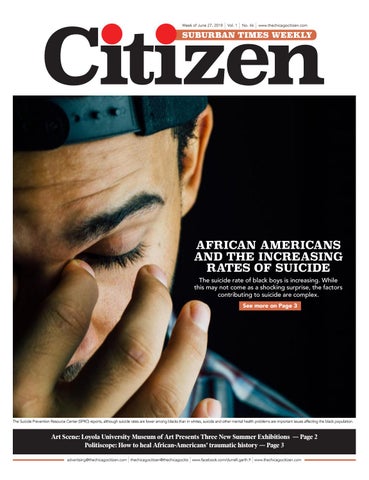
AFRICAN AMERICANS AND THE INCREASING RATES OF SUICIDE The suicide rate of black boys is increasing. While this may not come as a shocking surprise, the factors contributing to suicide are complex. See more on Page 3
The Suicide Prevention Resource Center (SPRC) reports, although suicide rates are lower among blacks than in whites, suicide and other mental health problems are important issues affecting the black population.
Art Scene: Loyola University Museum of Art Presents Three New Summer Exhibitions — Page 2 Politiscope: How to heal African-Americans’ traumatic history — Page 3 |
|
|
advertising@thechicagocitizen.com thechicagocitizen@thechicagocitiz www.facebook.com/durrell.garth.9 www.thechicagocitizen.com
2 | CITIZEN | Suburban Times Weekly | Week of June 27, 2018
ART SCENE Loyola University Museum of Art Presents Three New Summer Exhibitions CHICAGO — Global meets local at the Loyola University Museum of Art’s (LUMA) three exhibitions this summer: Following the Box, Folded Map, and Celestial House. Investigating themes of memory and space at home and abroad, these exhibitions will be on view from July 3 to October 20. Following the Box is an innovative contemporary art exhibition and a visual dialogue between American and Indian artists over time. In 1945, an American soldier stationed in India took a series of photographs depicting everyday life in West Bengal. Nearly sixty years later, artists and curators Jerri Zbiral and Alan Teller discovered a box filled with these photographs at a Chicagoland estate sale. After tracing the photographs back to India, Zbiral
and Teller invited 10 contemporary Indian artists to respond to the original images through painting, film, graphic illustration, folk art, and conceptual art. Each work explores the elusive nature of memory, political and military histories, and cultural identity. LUMA is the first museum in the United States to host this exhibition. Tonika Lewis Johnson’s ongoing Folded Map project connects residents who live at corresponding addresses in North and South Side neighborhoods of Chicago. Documenting architectural aspects of the neighborhoods and conversations between residents, Johnson demonstrates how a city of renowned institutions and robust tourism is also a city that struggles with issues of racial inequality and
segregation. By comparing images of homes in Englewood in the south to Edgewater, Rogers Park, and West Ridge in the north, Folded Map invites the viewer to consider how segregation impacts Chicago neighborhoods and their residents. Celestial House showcases vibrant mixed media work inspired by artist Victoria Martinez’s childhood home in the Pilsen community. Martinez weaves together domestic, soft materials such as wallpaper, curtains, and plastic flowers with images found throughout the neighborhood on Chicago’s West Side. Celestial House evokes the poetics of the urban environment and memories of home. For additional information on these exhibitions, museum hours, and more, visit LUC.edu/luma.
PUBLIC PROGRAMMING All of the following events take place at LUMA, 820 N. Michigan Avenue. Summer Exhibition Opening Reception Friday, July 6, 5:30-7:30 p.m. Join LUMA in celebrating the opening of this summer’s three featured exhibitions. Following the Box Tour with Guest Curators and Visiting Artist Saturday, July 7, 1-2:30 p.m. Guest curators Jerri Zbiral and Alan Teller will lead a tour of their exhibition, Following the Box, with visiting artist Chhatrapati Dutta. Get a firsthand account of what inspired the exhibition, how it evolved, and how it came to Chicago. Artists in Conversation: Victoria Martinez and Edra Soto Tuesday, August 7, 6-8 p.m. Featured artist Victoria Martinez and Edra Soto, a Chicago-based interdisciplinary artist, educator, and curator, will discuss Martinez’s work on view in Celestial House. Artists in Conversation: Tonika Lewis Johnson and Paola Aguirre Tuesday, September 4, 6-8 p.m. Join LUMA for a conversation with featured artist Tonika Lewis Johnson and Paola Aguirre, an architectural and urban designer and professor at the School of the Art Institute of Chicago. Lewis Johnson and Aguirre will discuss the process of creating the interactive map featured in the Folded Map exhibition.
TRAVEL
W Hotels Worldwide Rewrites The Festival Rules With WAKE UP CALL W Hotels recently announced the global roll out of WAKE UP CALL, the brand’s signature music festival series that will make stops at three W Hotels this year: W Hollywood (Sept 1-3); W Barcelona (Sept 21-23); and W Bali (Oct 4- 6). Combining the brand’s longstanding passion for music with its signature Whatever/Whenever® philosophy, WAKE UP CALL takes the festival experience off the field and onto the hotel grounds. Available exclusively for members of Marriott International’s award-winning Starwood Preferred Guest (SPG) and Marriott Rewards loyalty program, anybody is welcome to join the programs and book. Members can check in and then check out performances throughout the hotel – from WET deck parties to DJ masterclasses and live performances – by some of the hottest acts in music today including Phantogram, Charli XCX, Martin Solveig, Gorgon City, Sam Feldt and Angus & Julia Stone. It’s all access (and perhaps a bit of excess), all the time. W is throwing out the festival playbook. Where the day begins and ends in luxe accommodations (that don’t require surge prices to get back to). Where pools of mud are replaced by poolside performances. Where endless seas of people give way to Instaworthy views of the sea. Think day beds, not day passes. In other words, it’s time for a real WAKE UP CALL. “Music is a universal language, one we have spoken since day one at W,” said Anthony Ingham, Global Brand Leader, W Hotels Worldwide. “We’ve brought the Whatever/ Whenever mentality to recording artists and guests for years – through concepts like our W Sound Suite recording studios and countless performances in W Living Rooms – all to bring people closer to the music they love. Now we are taking our groundbreaking WAKE UP CALL music festival around the world, disrupting the festival scene in ways that only a W hotel stay can.”
W Hotels is bringing this upgraded and elevated experience exclusively to members of SPG and Marriott Rewards. But elite membership is not a requirement—by simply joining the program online guests can quickly gain access to everything WAKE UP CALL has to offer. When guests visit www.wakeupcallfest.com, existing members of either program can log in with their account information to get festival access; nonmembers can quickly sign up through SPG. THE STOPS WAKE UP CALL will launch in the U.S. festival capital of Los Angeles at W Hollywood before traveling to the iconic seaside haunt of W Barcelona. From there, WAKE UP CALL will touch down and close out in paradise at the luxe escape of W Bali. This year’s multicity tour is an expansion of the inaugural WAKE UP CALL, the first music festival to be held entirely at a hotel, which took place at W Scottsdale in 2016. This year the party is bigger, better and goes longer than ever before. THE LINEUP With a mix of big name artists as well as new/next talent, WAKE UP CALL will include performances by: Phantogram, Charli XCX, Chromeo (DJ Set), Betty Who, Léon and Dancing Pineapple Presents: Codeko, Papa Ya (DJ Set), Christofi and Phil N Good at W Hollywood; Martin Solveig, Gorgon City, Thomas Jack, Boston Bun and special guest Pete Tong at W Barcelona; and Angus & Julia Stone, Sam Feldt and Nightmares On Wax (DJ Set) at W Bali, with more to be announced soon. The WAKE UP CALL experience will go well beyond the music, serving up the W experience every step of the way. Festival revelers can expect everything from workout sessions with top fitness masters to exclusive dishes and cocktails www.thechicagocitizen.com
PRNewsfoto/Marriott International, Inc.
created by W chefs and mixologists only for festival goers. WAKE UP CALL combines the pre-party, the main event, and the post-party, all in one perk-filled package. Plus, SPG and Marriott Rewards members can bid for even more exclusive WAKE UP CALL Moments, including 60-minute DJ master classes, in-suite afterparties with featured artists, and off-site adventures curated by festival talent. To book, visit www.wakeupcallfest.com. For tickets and to join SPG and Marriott Rewards, visit www. wakeupcallfest.com.
CITIZEN | Suburban Times Weekly | Week of June 27, 2018
|
3
POLITISCOPE
How to heal African-Americans’ traumatic history BY TAASOGLE DARYL ROWE AND KAMILAH MARIE WOODSON Do you smell it? That foul odor that floats in the air, when something you thought was dead is unearthed. That’s the smell of ole man Jim Crow crawling back into our daily lives. One of the most horrendous and abhorrent forms of Jim Crow violence – the racial caste system that operated between 1877 and the mid-1960s, primarily in Southern states – was the publicly sanctioned use of “racial terror lynchings.” These killings were perpetrated by those who enjoyed the protection of white supremacist social policies designed to maintain strict control of African-Americans through the systemic use of terror. Documenting those lynchings is the goal of the National Memorial for Peace and Justice, or NMPJ, which opened on April 26, 2018. But our question is: How do memorials to that dehumanizing violence help the African-American descendants of such treatment heal from their history?
History as trauma
Jim Crow was grounded in the lie of Black inferiority. Dismantling the impacts of that lie on individuals and communities has been an ongoing effort of members of the Associa-
Taasogle Daryl Rowe
Kamilah Marie Woodson
tion of Black Psychologists, of which we both are members. The organization was founded almost 50 years ago so that “psychologists of African descent … can assist in solving problems of Black communities and other ethnic groups.” As psychologists, we ask the complex question: Can memorials to a dehumanizing and traumatizing history, the Jim Crow history, provide a path to restorative justice, psychologically, socially and politically? For African-Americans, history and trauma aren’t just in the past. Indeed, it would be simpler to help our communities heal if Jim Crow were but a memory. In the last 50 years or so, black Americans thought ole Jim Crow had died. But really, ole man Crow had simply gone to finishing school and emerged as James Crow, Esq. He had polished up his language and was operating in an alleged system of diversity and
multiculturalism, soft-selling his system of exclusivity as “traditions.” Those traditions were called “states’ rights” and “customs,” “school choice” and “law and order.” Then there are the Jim Crow practices that disproportionately target Black Americans: mass incarceration, police brutality and the war on drugs. One of the clearest examples of ole man Jim Crow resurfacing has been the documented public assaults and assassinations of Black bodies during the last 10 years. Men, women and children of African ancestry are being beaten, bruised and executed by police across the country simply for being Black and alive. Our communities experience direct and vicarious trauma every day. Now, to this daily terror, add historical trauma for Black Americans. Historical trauma is the cumulative phenomenon where those who never directly experienced trauma (enslavement, rape, lynchings, murder) can still exhibit signs and symptoms of the trauma. That historical trauma can be observed in African-Americans’ unresolved grief, expressed as depression and despair and their harboring of unexplained anger, expressed as aggression and rage. Often they internalize oppression by accepting the lie of inferiority, which can then lead to self-loathing.
This historical trauma must be addressed. It functions as a persistent sickness, a deadly virus – in the family, in the African-American community and in the larger society.
Memory as medicine
The establishment of the National Memorial for Peace and Justice begins a long-awaited process of healing from the unspeakable and unacknowledged acts in our history, whose echoes can still be heard today. It is an excellent example of one step towards the process of healing historical trauma for persons of African ancestry. By accurately documenting the gravity of the massacres, the NMPJ names the nameless, counts the uncounted and frees the victims, who were savagely desecrated, from the perpetrators of the atrocities of racial terror lynching. The NMPJ was established in an effort to promote social justice that can be liberating and validating to African-American people. Its mission aligns with that of the Association of Black Psychologists, which is the “liberation of the African Mind, empowerment of the African Character, and enlivenment and illumination of the African Spirit” – all with the goal of restoring humanity, promoting Continued on page 4
COMMUNITY
African Americans and the increasing rates of suicide Continued from page 1 BY DANITA A. DYESS
The suicide rate of black boys is increasing. While this may not come as a shocking surprise, the factors contributing to suicide are complex. The recent suicides of Kate Spade, iconic fashion designer, and Anthony Bourdain, celebrity chef and television personality, have sparked a national discussion, especially in the African American community. The statistics are startling. The American Foundation for Suicide Prevention (AFSP) reports the following: - On average, there are 123 suicides per day. - Men are 3 times more likely to commit suicide than women. - Each year, 44,965 Americans die by suicide. - In 2016, the highest U.S. suicide rate was (15.17) among whites and (6.03) among blacks.
Suicide is linked to culture. Blacks are more likely to experience hardships such as discrimination, unemployment, housing issues, and violence. The Suicide Prevention Resource Center (SPRC) reports, although suicide rates are lower among blacks than in whites, suicide and other mental health problems are important issues affecting the black population. Segments or subgroups of the black community are more susceptible to suicide. A recent trend indicates that black boys are experiencing an increased rate of suicide. According to a JAMA Pediatrics article published in May 2018, suicide rates increased among black children aged 5 to 11 years from 1.36 to 2.54 per million between the years 2008 and 2012. Moreover, the Centers for Disease Control and Prevention reports that suicide is the third leading cause of death among youth between the ages of 10 and 24.
Suicide is not caused by one thing. Abuse, chronic medical conditions, addiction, mental illness, bullying at school or in cyberspace are contributing factors. Dr. Huberta Jackson-Lowman, president of The Association of Black Psychologists said, the role of media and the impact of exposure to media which regularly contains stories of young black men being killed or assaulted by police must also be examined. According to SPRC, suicide prevention efforts should be respectful and responsive to a group’s beliefs, preferences, cultural and linguistic needs. These efforts should also include community leaders, pastors, and other respected members. Parents tend to avoid a conversation about suicide. Ironically, a dialogue about suicide could be a major preventative measure. According to the Nevada Division of Public and Behavioral Health, listening to teenagers www.thechicagocitizen.com
and paying attention to covert messages are key factors in the prevention of suicide. Providing a stable environment even if parents are going through a divorce is also crucial. The organization also advises participating in your child’s activities. Additionally, parents should speak to other parents and friends of their child since youth often talk about suicide with their peers. According to AFSP, “Ninety percent of people who die by suicide have a mental disorder at the time of their deaths.” Antidepressants, antipsychotics, and lithium have been proven to be highly effective. Cognitive behavioral therapy is also used. Religion also plays a role. Dr. Huberta Jackson-Lowman said, “Religion has been found to be a protective factor with regard to suicide.” Suicide is preventable. For more information, contact the National Suicide Prevention Lifeline at 1-800-273-8355.
Darrell Garth President / Publisher Janice Garth Sales Manager/ General Manager CST Weekly, published weekly on Wednesdays and distributed in the Township of Bloom, (publishing 52 issues annually). Written permission is required to reproduce contents in whole or part from the General manager or the publisher. CST Weekly does not assume the responsibility for nor are we able to return unsolicited marterials. Deadline for advertising is every Monday at noon. For information on subscriptions or advertising call us at (773) 783-1251. Our office is located at 8741 S. Greenwood Ave., Ste# 107, Chicago, Illinois 60619.
Editorial:
Send press releases, news tips, calendar listing etc. to: editorial@cstweekly.com
Advertising
advertising@cstweekly.com Classifieds call us at (773) 783-1251
4 | CITIZEN | Suburban Times Weekly | Week of June 27, 2018
FOOD
POLITISCOPE
How to heal African-Americans’ traumatic history Continued from page 3 optimal functioning and insuring psychological wellness. Most trauma experts recognize that the restoration of memory is healing. Developing a story in which the victim is held blameless from the infliction of abuse is essential for rebuilding a sense of independence and self efficacy. In our work as psychologists, we understand that helping our clients manifest resilient, powerful stories can help them negotiate the distress of historical trauma. Focusing on strengths can help descendant African-Americans learn to overcome challenges and tap into reservoirs of strength and self-determination. For example, understanding that many of the
African-Americans represented in the NMPJ were killed because they stood up for injustice, had the strength to resist and fought for the freedoms of subsequent generations can be healing.
Stories that heal
In an earlier work, we advanced an argument that there is a set of general healing goals that are important to consider for persons of African ancestry. Those healing goals, taken together, allow us to reconstruct understandings our community and ourselves. This is done through helping us take back our individual and collective identities and stories, especially those that replicate and reflect our true and righteous African heritage. The goals also allow us to restore
our spirits, sense of self, sense of wonderment and potential. We then can recognize the divine within, as well as promote our community members’ interdependence and interconnectedness – truly embodying the African proverb, “I am because we are and since we are, therefore I am.” Recently, scholar Shawn Ginwright argued that addressing the ongoing exposure of African-Americans to dehumanizing experiences calls for a shift to healing-centered engagement instead of trauma-informed care. That departure shifts the focus from “what’s wrong with you” to “what’s right with you.” For example, rather than locating the trauma within the individual, a healing-centered engagement would
www.thechicagocitizen.com
address the issues that created the trauma in the first place, and would view the individual holistically, highlighting strengths and resilience. The National Memorial for Peace and Justice helps restore memories that demonstrate the violence perpetrated against black people during the horrific epoch of publicly sanctioned lynching was not the fault of the victims and survivors of African ancestry. The memorial defies the lie of Black inferiority. The danger of accurately retelling the horrific stories of people of African ancestry in the U.S. is that it may create new trauma. Pairing accurate histories with healing-centered engagement can limit this risk. For example, the Association of
Black Psychologists, in partnership with the Community Healing Network, conducts Emotional Emancipation Circles. These national selfhelp groups focus on overcoming the lie of black inferiority and the emotional legacies of enslavement and racism. We believe that the restorative memories developed in public spaces like the National Memorial for Peace and Justice create a shared story that can inoculate African-Americans from ongoing dehumanization. Taasogle Daryl Rowe is a Professor of Psychology at Pepperdine University. Kamilah Marie Woodson is an Associate Professor of Counseling Psychology (Clinical Psychology by Training) at Howard University.
CITIZEN | Suburban Times Weekly | Week of June 27, 2018
|
5
6 | CITIZEN | Suburban Times Weekly | Week of June 27, 2018
NEWS
Chicago Southland Named Favorite Destination For Sporting Events BY KATHERINE NEWMAN
The Chicago Southland Convention and Visitors Bureau (CVB) was recently named a favorite destination for community engagement and a favorite destination for accessibility through the Sports Destination Management 2018 readers choices awards. The Chicago Southland CVB is the official destination management and marketing organization for Chicago’s 63 south and southwest suburbs. The Chicago Southland CVB markets the Chicago Southland region as a destination for leisure, meetings and conventions, group tour and sports events. “The Chicago Southland CVB is different from a traditional convention and visitor bureau. What I tell people is that we are more of a business-to-business CVB and we are saying that because we are not a destination CVB, we are not Vegas or Colorado, we are on the cusp of the area that surrounds Chicago proper,” said Loren Petrakis-Mueller, communications manager for Chicago Southland CVB. Sports Destination Management, an organization that provides planning and location strategies for hosting a successful sporting event, selected the Chicago Southland as one of the best destinations for accessibility because of the close proximity to downtown Chicago, access to several interstates, and access to two major airports, Midway and O’Hare International Airports. “We really are the most centralized location in the United States, there is no other place where this many freeways connect. A lot of
participants now, because gas prices have gone down, choose to drive to these events so we see a huge spike in folks coming to town via car,” said Joel Koester, sports management specialist for the Chicago Southland CVB. Sports Destination Management also named Southwest Airlines as the favorite airline and Midway International Airport is home to a major hub for Southwest Airlines. “Midway Airport is one of the largest Southwest hubs in the country so we also see a lot of teams that are flying into town on Southwest and I think that plays into the accessibility portion of us winning that award as well,” said Koester. The second award that Chicago Southland CVB received named the area a favorite destination for community engagement. Aside from wanting to attract major sporting events, the Chicago Southland CVB also wants to give visitors a great experience and
The Chicago Southland Convention and Visitors Bureau (CVB) was recently named a favorite destination for community engagement and a favorite destination for accessibility through the Sports Destination Management 2018 readers choices awards. Photo provided by Chicago Southland Convention and Visitors Bureau.
make the Chicago Southland stand out compared to other destinations. “When folks come into town for their sporting event, they don’t want to just come in and go to their sporting event, have the event, and then leave. They are coming in and they want to have full buy-in,
Morgan State Study Details University’s Nearly $1-Billion Economic Impact Statewide, $574 Million on Baltimore City Morgan State University President David Wilson recently announced the results of a statewide impact study, after the conclusion of a comprehensive analysis of the University’s economic and fiscal contributions conducted by Econsult Solutions, Inc., an independent Philadelphia-based economics firm. The detailed study reveals that Morgan is a valuable economic engine, making an annual $990-million financial impact on Maryland and $574 million within
Baltimore City. In addition, the University supports more than 6,500 jobs statewide, nearly 4,000 of which are located in the city. The study’s conclusions are based on data spanning fiscal year 2014 to fiscal year 2019. It examines seven key areas: operations, capital investments, student and visitor spending, wage premium, commitment to community, innovation and economic opportunities to local and diverse populations.
they want to go out to eat at our restaurants and go shopping and check out the attractions not only in the Southland but in the City of Chicago,” said Koester. The Chicago Southland CVB staff gets involved with each event as much as possible, according to Koester.
“Every time we bring these events in we want our community to feel ownership of them as well. It’s all about making everyone feel welcome when they come to town,” said Koester. For information about upcoming events visit www.visitchicagosouthland.com.
New Screening Guidelines Reflect National Trend Colon and rectal cancers are on the rise in America, and at an alarming rate for younger adults. According to the American Cancer Society, since 1994, colon and rectal cancers have increased 51% among adults under the age of 50. According to Dr. Omar Khokhar, an OSF HealthCare Gastroenterologist, these changes reflect what he and his colleagues see in practice. “I think it’s a relevant change. It captures what we are seeing,” said Dr. Khokhar. “Anecdotally I have seen patients in their early
www.thechicagocitizen.com
30s now with colon cancer or rectal cancer, so I think it’s important that we start to get involved and start intervening earlier to capture those folks earlier to prevent more cancer from being diagnosed.” These screenings don’t have to be intimidating. The gold standard in colorectal cancer screening is a colonoscopy. However, patients can also choose one of several other non-invasive tests, including home stool tests available by prescription. Dr. Khokhar says to talk to your doctor about your options.
CITIZEN | Suburban Times Weekly | Week of June 27, 2018
|
7
NEWS
South Suburban Resident Performs On America’s Got Talent BY KATHERINE NEWMAN
Dolton resident Kathryn Granberry known as Ms. Trysh on NBC’s America’s Got Talent, recently successfully auditioned on the show. The 57-year-old singer received a yes from all four judges after performing her rendition of If I Were Your Woman by Gladys Knight. “I haven’t had any training. Singing was a gift that was really handed down in my family. Mostly all my sisters are singers and I have a couple of brothers who play guitar, my niece and nephew sing, so we have a family of singers and artists,” said Granberry. After singing for years, a close friend of Granberry’s secretly submitted a video of her performing to America’s Got Talent and she was selected to audition. “I was floored, I was like oh my God, you did not send my tape to America’s Got Talent? ‘And she’s like yes girl, you need to be seen by the world”,” said Granberry. “I would have never had the nerve to send my video to them because I never thought that I was that good, to be honest. But when you have friends who believe in you more than you believe in yourself, it’s a good feeling.” Throughout her life, Granberry has performed on several stages of many different sizes, but none quite as big as the America’s Got Talent stage. “I’ve been on big stages, but not that big and knowing that it’s not just a stage but millions of people are going to be watching, that didn’t really set in until after the fact. If I had all that in mind, I probably would have fainted on stage. I was just so happy to get out there. After waiting all day to perform I was ready to go out there so when I got on stage it didn’t even hit me that the audience was huge or that the cameras were rolling. I guess I was just being myself and I thought about it afterward and was like, wow I did that?” said Granberry. The video of Granberry’s audition has been making waves online with over 2.2 million views on youtube. She brought her true personality to stage when she dedicated her performance to Simon Cowell and told the world that she has a crush on the celebrity judge. “I really wanted to go out on a date with Simon and my husband said it was okay, I’m like honey how many times do you get the opportunity to go out with a celebrity?” said Granberry. When she is not singing, Granberry works for Thornton Township as an energy service technician helping residents who need assistance with their energy bills. Every Wednesday when the Thornton Township food pantry is open Granberry cooks hot meals for everyone to enjoy. To see more of Granberry’s journey on America’s Got Talent, tune into NBC at 7 p.m. on Tuesdays.
Season 13 of NBC’s America’s Got Talent recently featured an audition from Dolton resident Kathryn Granberry (pictured), known on the show as Ms. Trysh. Provided by Kathryn Granberry
www.thechicagocitizen.com
8 | CITIZEN | Suburban Times Weekly | Week of June 27, 2018
CONGRATULATIONS! CHEVROLET AND NNPA OFFICIALLY ANNOUNCE
OUR 2018 DISCOVER THE UNEXPECTED FELLOWS! The wait is over! Chevrolet and the National Newspaper Publishers Association (NNPA) are proud to announce our six Fellows selected for Discover the Unexpected (DTU) 2018 - a life-changing journalism fellowship.
S TYVAN BURN IVERSITY
UN NORFOLK STATE
DIAMOND DURA
MORGAN STATE UN
NT
IVERSITY
ENRY DAJA UHNIVERSITY D
HOWAR
Chosen from Historically Black Colleges and Universities (HBCUs) nationwide, our DTU 2018 Fellows each receive a $10,000 scholarship, $5,000 stipend and a journalism adventure in the 2018 Chevrolet Equinox. Our DTU 2018 Fellows are geared up and ready to go discover stories of inspiration and innovation in our African American communities. Follow us and show our HBCU students some love along the way. The journey begins!
NATRA WN M
A
IN UNIV XWELL ERSIT Y
CLAFL
IL A WILBOIVRERNSITY
UN FLORIDA A&M
DENVER LARK
NORTH CAROLIN
A A&T UNIVERSITY
NNPA.ORG/DTU #DTU2018, #ChevyEquinox, #Chevy, #NNPA