CELEBRATING BLACK HISTORY MONTH
Citizen Week of Feb. 27, 2019
| Vol. 2 | No. 29 | www.thechicagocitizen.com
SUBURBAN TIMES WEEKLY
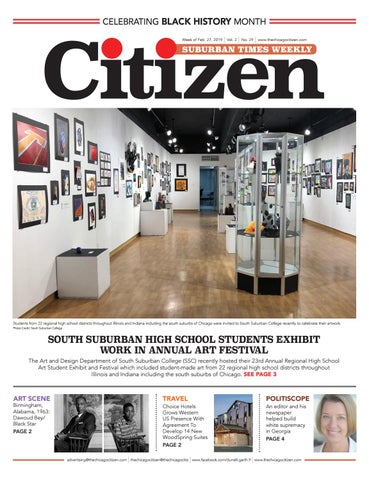
Students from 22 regional high school districts throughout Illinois and Indiana including the south suburbs of Chicago were invited to South Suburban College recently to celebrate their artwork. Photo Credit: South Suburban College
SOUTH SUBURBAN HIGH SCHOOL STUDENTS EXHIBIT WORK IN ANNUAL ART FESTIVAL
The Art and Design Department of South Suburban College (SSC) recently hosted their 23rd Annual Regional High School Art Student Exhibit and Festival which included student-made art from 22 regional high school districts throughout Illinois and Indiana including the south suburbs of Chicago. SEE PAGE 3
ART SCENE
TRAVEL
Birmingham, Alabama, 1963: Dawoud Bey/ Black Star PAGE 2
POLITISCOPE
Choice Hotels Grows Western US Presence With Agreement To Develop 14 New WoodSpring Suites PAGE 2
|
|
An editor and his newspaper helped build white supremacy in Georgia PAGE 4
|
advertising@thechicagocitizen.com thechicagocitizen@thechicagocitiz www.facebook.com/durrell.garth.9 www.thechicagocitizen.com
2 | CITIZEN | Suburban Times Weekly | Week of Feb 27, 2019
ART SCENE
Birmingham, Alabama, 1963: Dawoud Bey/Black Star The Museum of Contemporary Photography at Columbia College Chicago (MoCP) will present Birmingham, Alabama, 1963: Dawoud Bey/Black Star from April 11 – July 7, 2019, featuring work from photographer and recent MacArthur genius grant fellow Dawoud Bey (American, born 1953), who is also a professor of photography at Columbia College Chicago. His work has been collected by the MoCP since 1993, with over 60 pieces by Bey in the museum’s permanent holdings. This will be his second solo exhibition at the museum. Birmingham, Alabama, 1963: Dawoud Bey/Black Star responds to the September 15, 1963 bombing of the 16th Street Baptist Church in Birmingham, Alabama—an event that resulted in six deaths of black children by white supremacists. Organized by Dr. Gaëlle Morel, Exhibitions Curator at the Ryerson Image Centre in Toronto, the exhibition pairs Dawoud Bey’s The Birmingham Project (2012) with a selection of prints from the Black Star archive of photojournalism, providing a historical context for the bombing, and revealing the political and social turmoil that placed the American Civil Rights Movement in the media spotlight during the
The Museum of Contemporary Photography at Columbia College Chicago (MoCP) will present Birmingham, Alabama, 1963: Dawoud Bey/Black Star from April 11 – July 7, 2019, featuring work from photographer and recent MacArthur genius grant fellow Dawoud Bey (American, born 1953), who is also a professor of photography at Columbia College Chicago.
months leading up to the explosion. Commissioned by the Birmingham Museum of Art, Bey’s The Birmingham Project was created in memory of the children who were killed in the city that day, nearing the 50th anniversary of the tragedy.
Each diptych features a portrait of a child at the exact age of one killed in 1963 paired with a portrait of an adult at the age the child would have been in the year 2013. Also on view will be Bey’s 9.15.63, a split screen video explor-
ing communal spaces of the black community and the contested and segregated spaces of the white community in Birmingham alongside a route to the 16th Street Baptist church from the vantage point of a child in the back seat of a car. Bir-
mingham, Alabama, 1963: Dawoud Bey/Black Star is coordinated by Karen Irvine, MoCP Chief Curator and Deputy Director. Birmingham, Alabama, 1963: Dawoud Bey/Black Star will be presented alongside Chicago Stories: Recent works by Carlos Javier Ortiz and David Schalliol, an exhibition of photographs and films by Carlos Javier Ortiz and David Schalliol pulled from the museum’s permanent collection and the Midwest Photographers Project (MPP). Both artists separately investigate forms of systemic racism in Chicago and beyond through the lens of individual stories. Chicago Stories is curated by MoCP Curator of Academic Programs and Collections, Kristin Taylor. On April 11, Dawoud Bey will engage in a conversation with Gaëlle Morel, exhibitions curator at the Ryerson Image Centre, about the links between his Birmingham projects and photojournalistic images documenting the civil rights movement of the 1960s. This conversation is part of Columbia College Chicago’s Collective Impact series, an initiative that seeks to explore community engagement and social justice in art making. For more information, visit http://www.mocp.org
TRAVEL Choice Hotels Grows Western US Presence With Agreement To Develop 14 New WoodSpring Suites Choice Hotels International, Inc. (NYSE: CHH) awarded an agreement to ServiceStar Hospitality to develop 14 new WoodSpring Suites hotels throughout Colorado, Arizona, and Nevada. "The WoodSpring Suites brand continues to draw strong interest from developers across the country, furthering its position as a leader both in extended stay and the economy segment overall," said Ron Burgett, vice president, extended stay hotels development, Choice Hotels. "This transaction builds on WoodSpring's record-setting 2018 growth and will accelerate the brand's presence across the western United States. ServiceStar Hospitality has an intimate knowledge of the region and is the ideal developer to bring WoodSpring to these new markets for travelers." All WoodSpring Suites hotels are pur-
PRNewsfoto/Choice Hotels International, In
pose-built for the unique needs of extended-stay travelers. Hotels offer suites with in-room kitchens and full-size refrigerators in addition to amenities like fitness centers, guest laundry rooms, and complimentary Wi-Fi. ServiceStar Hospitality is part of ServiceStar Capital Management, a Colorado real
estate investment firm. "We are very impressed with WoodSpring Suites' brand equity, operating model, franchisor support, and expected return on investment," said Jim Stilwell, co-founder and principal with ServiceStar Capital Management. "ServiceStar and our development
CELEBRATING BLACK HISTORY MONTH
partners are looking forward to welcoming guests across Colorado, Arizona and Nevada to experience this top-notch, extended-stay product. Our objective is to build a long and successful relationship with Choice Hotels." To learn more about WoodSpring Suites, visit www.woodspring.com/ourbrand/.
CITIZEN | Suburban Times Weekly | Week of Feb 27, 2019
|
3
COMMUNITY
South Suburban High School Students Exhibit Work In Annual Art Festival Continued from page 1 BY KATHERINE NEWMAN
The Art and Design Department of South Suburban College (SSC) recently hosted their 23rd Annual Regional High School Art Student Exhibit and Festival which included student-made art from 22 regional high school districts throughout Illinois and Indiana including the south suburbs of Chicago. In February, there were approximately 300 pieces of student artwork on display at SSC in the Art and Design Department’s galleries. Additionally, the High School Art Faculty Exhibition was also on display in the Lee E. Dulgar Gallery and featured art that was created by local high school art teachers. As part of the Regional High School Art Student Exhibit and Festival, all the participating high school students and teachers were invited to visit the South Suburban College’s campus in South Holland to listen to an inspirational lecture from visiting artist Cesar Conde who is a Chicago-based con-
temporary painter who uses his art to make statements about relevant social issues. “Since I was in fifth grade I wanted to be an artist, but my parents didn’t want me to be an artist. I was doing all these really cool drawings with crayons and the art teacher would put them up on display and then my parents would look at them and just say it was pretty, but that you can’t make money out of it,” Conde told the students during his lecture. As a Filipino American artist and activist, Conde believes that art is a powerful tool for social change and uses his work to address issues across color lines and communities, according to his online artist portfolio. During his lecture, Conde told students that he did not always use his art to make political statements and it wasn’t until he left the country that he realized how he could use his art as a platform for activism. “I studied in Mexico at the University of Guadalajara and that is where I was politicized. I knew nothing about American politics until I left this country and got
another world view of what is happening in this country and how our country has a massive influence on what happens all over the world,” said Conde. Since returning to America, Conde has gone on to create several works of art that carry an underlying message including his most current series called AmeriKKKa – Reflection of a Divided Nation. The art shows his interpretation of the current racial tensions that exist in America and is specifically depicting the rhetoric of our current President. Throughout the lecture, Conde told stories of his experiences, but ultimately he wanted the students to know that just by being there, and by being young artists, they have already succeeded. “You are the luckiest person to be able to pursue your passion to create because this work is hard,” said Conde. “You will define your own success. Showing your art in a museum doesn’t mean you are successful, you being here means you are successful because you have already taken the first step.”
DarrellGarth Garth Darrell President / Publisher President / Publisher Janice Garth Janice Garth Sales Manager/ General Sales Manager/ ManagerGeneral
Manager
CST Weekly, published weekly on CST Weekly, published weekly on Wednesdays and distributed in the Township of and Bloom, (publishing 52 Wednesdays distributed in the issues ofannually). Written Township Bloom, (publishing 52 permission is required to issues annually). Written reproduce contents in whole to or permission is required part from the General or reproduce contents in manager whole or the from publisher. CST Weekly does part the General manager or not assume the responsibility for the publisher. CST Weekly does nor are we able to return not assume the responsibility for unsolicited marterials. Deadline for nor are weis every able Monday to return advertising at unsolicited marterials. Deadline for noon. For information on advertising is orevery Monday subscriptions advertising call at us noon. For information at (773) 783-1251. Our officeon is subscriptions or advertising call us located at 8741 S. Greenwood atAve., (773)Ste# 783-1251. Our office is 107, Chicago, Illinois 60619. at 8741 S. Greenwood located
Ave., Ste# 107, Chicago, Illinois 60619. Editorial: Send press releases, news tips, calendar listing etc. to: Editorial: Sendeditorial@cstweekly.com press releases, news tips,
calendar listing etc. to: Advertising editorial@cstweekly.com
advertising@cstweekly.com Classifieds call us at Advertising (773) 783-1251
advertising@cstweekly.com Classifieds call us at (773) 783-1251
NEWS
Awareness Resource Created for Front Lines of Opioid Crisis Cook County Sheriff Thomas J. Dart recently released new episodes of the podcast “Breaking Free” featuring content aimed at supporting those on the front lines of the opioid crisis – the friends and family helping loved ones with substance use disorders. The four new episodes include interviews with medical professionals answering some of the tough questions that come up when a loved one has a substance use disorder: Why don’t they stop using? How do I get them to accept treatment? What is the best treatment? Do they need medication? Am I an enabler? When should I walk away? Listeners will learn about how addiction impacts behavior, when to consider medication-assisted treatment and the latest thinking on how to engage someone battling an addiction. Featured in the podcast are: Dr. Christopher Holden, director of addiction services at the University of Illinois Hospital & Health Sciences System; Dr. Jonathan Adelstein, an assistant professor of psychiatry and behavioral sciences with Northwestern Medicine; Dr. Nicole Gastala, a clinical physician and researcher, and Philip Maes, a certified addiction specialist at the University of Illinois Mile Square Health Center. “Helping a loved one with a substance use disorder can be incredibly challenging and the treatment system is evolving and difficult to navigate,” Sheriff Dart said. “If we are going to have a shot at ending this crisis, we need to
get the best information possible to the people living it every day.” The podcast is available on iTunes, Spotify, Stitcher, Google Play Music and SoundCloud. Previous installments of Breaking Free provided a unique window into the thoughts of those suffering from substance use disorder. They included interviews with women in drug treatment at the Cook County jail and an interview with a man receiving treatment after he was discovered unresponsive on the floor of the Skokie courthouse bathroom. Officers were able to save his life last year with the overdose-reversing drug naloxone. The podcast is one of many efforts by the Sheriff ’s Office to address the opioid crisis. Approximately one-in-five detainees at the jail admit to opioid abuse and hundreds receive treatment every day. The Office has expanded treatment options for those in custody and on electronic monitoring while also distributing life-saving naloxone kits to address overdoses in the community. More than 3,500 kits have been distributed to individuals released from custody since August of 2016. Opioid-related overdoses kill more people in Cook County than car crashes or gun violence. Cook County saw more than 1,000 opioid-related overdose deaths in 2017, up 90 percent from 2015, according to state public health department data. Preliminary data for last year shows the trend has not abated.
State Board Of Education Names Leaders To Increase Teacher Diversity The Illinois State Board of Education (ISBE) recently announced 22 leaders from across the state selected to provide recommendations on increasing teacher diversity and promoting culturally responsive teaching. The Diverse and Learner Ready Teacher (DLRT) Network includes students and representatives from higher education, K-12 classrooms and administration, and policy and advocacy groups. Having teachers of different races and ethnicities benefits all students as they prepare to enter a global society. “Research demonstrates that students’ exposure to people who are different from themselves, and the ideas and challenges that such exposure brings, leads to improved cognitive skills, including critical thinking and problem solving,” according to A Vision and Guidance for a Diverse and Learner-Ready Teacher Workforce from the Council of Chief State School Officers (CCSSO). Only 15 percent of teachers in Illinois’ public schools are teachers of color, compared to 52 percent of students. “This effort is about capitalizing on the tremendous expertise we possess as a state,” said Deputy Superinten-
CELEBRATING BLACK HISTORY MONTH
dent for Teaching and Learning Jason Helfer, Ph.D. “Using the insights and experiences of students, educators, and advocates in this work will build upon the excellent teaching already occurring in Illinois schools. Creating the space in which students and educators can develop rich connections can lead to safer schools and stronger student outcomes.” The DLRT Network first will focus on developing culturally responsive teaching standards for educator preparation programs, so every teacher enters the classroom ready to engage and connect with diverse learners on day one. Culturally responsive teaching ensures educators of all backgrounds recognize the importance of culture to learning and incorporate students’ individual cultures in instructional strategies and content. CCSSO selected Illinois as one of 10 states to lead the national Diverse and Learner Ready Teacher initiative. The initiative supports the results of ISBE’s Teach Illinois: Strong Teachers, Strong Classrooms project, which proposed solutions to ensure Illinois has a highly qualified and diverse teaching corps across its K-12 classrooms.
4 | CITIZEN | Suburban Times Weekly | Week of Feb 27, 2019
POLITISCOPE
An editor and his newspaper helped build white supremacy in Georgia IN THE LATE 19TH CENTURY, HENRY W. GRADY,
BY KATHY ROBERTS FORDE
The press is an essential guardrail of democracy. As The Washington Post tells its readers, “Democracy Dies in Darkness.” But the press has not always been a champion of democracy. In the late 19th century, Henry W. Grady, one of the South’s most prominent editors, worked closely with powerful political and business interests to build a white supremacist political economy and social order across Georgia – and the entire South – that lasted well into the 20th century. One of his primary tools was his newspaper, The Atlanta Constitution – which merged with The Atlanta Journal in 2001 to become The Atlanta Journal-Constitution. My research, a collaboration with Ethan Bakuli and Natalie DiDomenico, undergraduate research partners in the Journalism Department at the University of Massachusetts Amherst, uncovers this history. The ‘New South’ and racial terror Grady enraptured white Americans with his speeches and columns about the “New South,” a narrative meant to attract Northern investment in the South’s emerging industrial economy. “The relations of the Southern people with the negro are close and cordial,” Grady proclaimed in the 1886 New York speech that made him famous. It was a brazen lie. Many white Americans believed it, or pretended they did, but black editors, journalists and leaders challenged it at every turn. Grady promoted the New South’s reconciliation with the North, its industrial development and the availability of cheap Southern labor. What’s more, he insisted the “race problem” must be left to the South to resolve. He meant, of course, the white South. T. Thomas Fortune, a militant black newspaper editor in New York, would have none of it. “Mr. Grady appeals to the North to leave the race question to ‘us’ and ‘we’ will settle it,” he wrote. “So we will; but the we Mr. Grady had ‘in his mind’s eye’ will not be permitted to settle it alone. Not by any means, Mr. Grady. Not only the White we, but the Colored we as well, will demand a share in that settlement.” Grady didn’t listen. Instead, he explained to adoring white crowds why the South was committed to one-party rule: to deprive black men of electoral power. In 1889, the year he died unexpectedly at 39, Grady told a crowd at the Texas State Fair, “The supremacy of the white race of the South must be maintained forever, and the domination of the negro race resisted
ONE OF THE SOUTH’S MOST PROMINENT EDITORS,
WORKED CLOSELY WITH POWERFUL POLITICAL AND BUSINESS INTERESTS TO BUILD A WHITE SUPREMACIST POLITICAL ECONOMY AND SOCIAL ORDER
ACROSS GEORGIA – AND THE ENTIRE SOUTH – THAT LASTED WELL INTO THE 20TH CENTURY.
“The strength and power of any secret organization rests in the attribute of mystery and hidden force,” he wrote. Its members “can be called together by a tiny signal, and when the work is done, can melt away into shadowy nothing.”
Kathy Roberts Forde
at all points and at all hazards – because the white race is the superior race.” The pioneering black journalist Ida B. Wells understood his meaning. In “Southern Horrors,” a pamphlet that documented lynching and the all-too-frequent collaboration of the white Southern press, Wells drew a straight line from Henry Grady’s New South ideology to the white South’s practice of racial terror: “Henry W. Grady in his well-remembered speeches in New England and New York pictured the Afro-American as incapable of self-government. Through him … the cry of the South to the country has been ‘Hands off ! Leave us to solve our problem.’ To the Afro-American the South says, ‘the white man must and will rule.’ There is little difference between the Antebellum South and the New South.” Under Grady’s editorial guidance, the Constitution wrote about lynching with disturbing levity, condoning and even encouraging it. One headline read “The Triple Trapeze: Three Negroes Hung to a Limb of a Tree.” Another rhymed “Two Minutes to Pray Before a Rope Dislocated Their Vertebrae.” Yet another headline read: “Lynching Too Good For the Black Miscreant Who Assaulted Mrs. Bush: He Will Be Lynched.” And appallingly, the man was lynched. Today, his name – Reuben Hudson – appears on the National Memorial for Peace and Justice, a monument in Montgomery, Alabama, for victims of “racial terror lynchings.” Some historians have called Grady a racial moderate for his time and place, but his own words suggest he was comfortable with racial violence. Well before he became managing editor and part owner of the Constitution, Grady addressed an editorial in the Rome Commercial, a Georgia newspaper he edited early in his career, to his “friends” and “brothers” in the “Ku Klux Klan.”
Convict labor in the ‘New South’ Lynching was not the only white tool of racial terror and control in the South. Another was the convict lease, which, along with lynching, Wells termed the “twin infamies” of the region. Grady’s New South promise of cheap labor for industrialists was fulfilled in part by convict leasing – a penal system targeting black men, women and even children, who were routinely arrested for vagrancy, minor offenses and trumped up charges. Once convicted, victims were leased to private companies to serve their sentences working in coal mines, laying railroad tracks and making bricks. Horrors awaited in these private labor camps: shackles, chains, rancid food, disease, filthy bedding, work from sunup to sundown and tortures like the “sweat box,” flogging, hanging by the thumbs, a water treatment akin to waterboarding and rape. Convicts were killed during escape attempts, in mine explosions and railroad accidents and by sadistic camp bosses. Grady knew the convict lease system well. His newspaper reported on it frequently, as I discovered by reading material in his personal archive at Emory University and contemporaneous issues of the Constitution. What’s more, from 1880 to his death in 1889, Grady served as kingmaker for a group of white supremacist Democrats – variously termed the “Atlanta Ring” and the “Bourbon Triumvirate” – who enriched themselves by leasing convicts from the state to work in their private businesses. In an era of machine politics and a press aligned with political parties, Grady proved a master of both. Using the Constitution as a tool of public influence, Grady helped appoint or elect Joseph E. Brown to the U.S. Senate (1880-1890), Alfred H. Colquitt to the governorship (1880-1882) and U.S. Senate
CELEBRATING BLACK HISTORY MONTH
(1883-1894), and John B. Gordon to the governorship (1886-1890). Brown made a fortune working convicts at his Dade Coal Mines, where Colquitt was a major investor. Gordon worked convicts on his plantation and subleased others to companies and farmers. In 1886, Grady sent a Constitution reporter to cover a rebellion at Brown’s coal mines. The prisoners were “ready to die, and would as soon be dead as to live in torture,” one convict said. The governor ordered the convicts starved into submission, and Grady’s reporter witnessed the flogging that followed their surrender. He called it “a special matinee” in his news report. Black Georgians protested their powerful white neighbors profiteering off forced black labor. William White, editor of the black newspaper the Georgia Baptist, put it plainly: “The fortunes of many a prominent white Georgia family [are] red with the blood and sweat of Black men.” Grady’s legacy Grady may have been a pioneering journalist, but his journalism served profoundly anti-democratic purposes. The University of Georgia’s journalism school is named for Grady – a fitting namesake, it was recently said, because of Grady’s “work in uniting the country, not dividing the country.” Grady may have united Southern and Northern whites, but he did not unite the country. Rather, he excluded black Americans from the union of North and South and the national democratic project that union represented. The Grady College motto is “We Are Grady.” Thomas Fortune might well have asked Grady who he would include in that “we.” University of Massachusetts Amherst journalism students Ethan Bakuli and Natalie DiDomenico helped research and write this article. Kathy Roberts Forde is an Associate Professor in the Journalism Department at the University of Massachusetts Amherst.
CITIZEN | Suburban Times Weekly | Week of Feb 27, 2019
|
5
NEWS
South Suburban School District Will Expand Vocational Programs With $130,000 Donation BY KATHERINE NEWMAN
Thornton Township High School District 205 recently accepted a $130,000 donation from the Thornton Alumni Legacy Fund which will be used to create a Machine Shop Program in the district. This new addition will further support the goals of the district’s Board of Trustees who are committed to developing useful vocational programs for students that will lead them straight into sustainable careers after high school. The schools that make up Thornton Township High School District 205 are Thornridge High School, Thornton Township High School, and Thornwood High School, all of which will have access to the new Machine Shop Program along with community members who will be able to utilize the program during nights and weekends. “In education, success looks different for each student. Not everybody is going to be successful in the college career track and not everybody is interested in that
college career track but we know that the manufacturing industry is demanding jobs right now and we are going to be able to provide that kind of training and support for students so that by the time they graduate, they can enter the workforce,” said Don Holmes, principal of Thornwood High School. Data from the Illinois Department of Employment Security shows that by 2026, there will be over 15,000 new jobs added to the state’s manufacturing industry and these jobs typically come with a starting wage of $20.00 an hour. “I am so excited that the Thornton Alumni Legacy Fund donated $130,000 for our district and for our children,” said Nina Graham, president of the Thornton Township High School District 205 Board of Trustees. “Every child is not going to college and every child doesn’t want to go to college but these vocational jobs pay very well so that is one of our missions right now, to start trying to see how we can bring those vocational programs back.” The Thornton Alumni Legacy Fund
dates back to the 1940s and is made up of former Thornton Township High School students whose vision is to create and sustain their legacy by generating annual funding for Thornton Township High School District 205. “A lot of this has to do with just the school pride. The alumni come back and they give back to our students in so many different ways. It’s not just limited to them giving money, they’re actively involved in our overall school culture and we see them quite a bit in our buildings. It’s wonderful,” said Ebonie Williams, principal of Thornridge High School. Once completed, the new machine shop program will open new doors to success for students in Thornton Township. “A lot of the students will go into very high paying jobs right after high school, or even before they graduate, and then some of them will go off to school and major in things like engineering, so it’s going to be a benefit to them all around,” said Tony Ratliff, principal of Thornton Township Highschool.
CELEBRATING BLACK HISTORY MONTH
Former inmates wouldn’t be charged for prison stay under proposal by Peters Former inmates would no longer need to reimburse the Illinois Department of Corrections for the cost of their incarceration under a measure sponsored by State Senator Robert Peters (D – Chicago) which passed out of a Senate committee recently. “It’s ridiculous that a provision like this even exists in the first place,” Peters said. “These people already have a major burden placed on them by the criminal justice system. It’s unconscionable that there’s an additional financial burden placed on them once they’re finally released, and only makes a return to a life of crime more likely.” Under current law, recently released persons are required to reimburse the DOC for any expenses incurred as a result of their incarceration. The measure, Senate Bill 1158, strikes this requirement from the statute. The bill passed through the Senate Committee on Criminal law and will now proceed to the full Senate for consideration.
6 | CITIZEN | Suburban Times Weekly | Week of Feb 27, 2019
NEWS
Pritzker’s pot revenue depends on unfiled legalization legislation Senate sponsor hopes to introduce bill ‘in the next month or so,’ with aim for passage by May 31 BY JERRY NOWICKI Capitol News Illinoist jnowicki@capitolnewsillinois.com
Springfield – Gov. J.B. Pritzker’s proposed budget for the 2020 fiscal year includes $170 million in new revenue from licensing fees for legalized recreational marijuana, but the details of such legislation are not yet finalized. State Sen. Heather Steans and state Rep. Kelly Cassidy, both Chicago Democrats who have been working on marijuana legislation for two years, said they wouldn’t rush the process on behalf of revenue. “Assuming that we want to have some revenue, I think we’d like to pass it by the end of May,” Steans said. “But I think both Representative Cassidy and I have been very clear that the revenue is not what is motivating or should drive this legislation, but obviously it’s a side benefit piece that can also come.” Cassidy and Steans both said they are waiting for information from a demand study before moving legislation forward. They also want to ensure minority inclusion for vendors and social justice for persons incarcerated for cannabis crimes which no longer would be illegal under the bill. “We’re still trying to find the best path forward for equity and inclusion, still looking at what’s worked and not worked in other states and trying to put together a combination of solutions on that front,” Cassidy said. “We want to do this not by guess but by fact. That is why we’ve com-
missioned the study. We expect the results very, very shortly and that will inform how we grow the program.” Steans said she would hope to have language filed for a Senate bill “in the next month or so,” and both said they would like to see it passed by May 31, provided they can iron out the final details. Neither would speak to the governor’s $170 million revenue projection for the fiscal year. “I haven’t gotten the details behind (the governor’s $170 million projection). So I really can’t comment on that yet,” Steans said. “It seems like a reasonable approach. All the revenue estimates we’ve had so far, when you have a fully mature program in place, have been around $500 million. So this is clearly well below that and based much more on upfront licensing fees, not from receipts based on sales tax.” The licensing fee structures for recreational marijuana are not yet clear. But for medicinal marijuana cultivation centers, a permit costs $200,000 up front with a $100,000 annual renewal fee and a $25,000 nonrefundable application fee, according to the Department
of Agriculture. Illinois allows 22 cultivation center licenses – one in each state police district. Steans said the legislation could add other licensing for smaller craft cultivators, and for the processing and transportation of cannabis products. She said she would like the location and placement of craft cultivators to be up to local zoning boards and municipalities, rather than being subject to the same strict regulations as existing medicinal cultivation centers. “Right now the cultivation centers really are all pretty rural and have very big footprints,” she said. “Craft growers could maybe be located in a manufacturing district if a local municipality wants it there.” While the Department of Agriculture regulates cultivation centers, the Department of Financial and Professional Regulation is in charge of the state’s 60 dispensary licenses, five of which are unused, and fees are much lower. Dispensary licenses cost $30,000 initially with a $25,000 annual renewal fee and a $5,000 nonrefundable application fee. Cassidy said she expects the state to need “more dispensaries very quickly” to meet recreational demand, but exact figures will not be available until the demand study is released. Both senators also emphasized bipartisan support for the legislation, and newly-seated Democratic Attorney General Kwame Raoul has voiced his conditional support for legalization. “I’m a proponent generally, but the devil is
in the details,” Raoul said. “I’m particularly concerned about anything that’s done to target cannabis and legalization to children through flavoring or production of candies or products aimed toward kids.” Cassidy said gummies and flavored products are already on the medicinal market, but there are regulations on packaging, dosage, shapes and coloring of such items. She also said Illinois’ medicinal program is one of the best tracked and regulated in the country, and black market leakage of Illinois cannabis to other states is minimal to non-existent. There are slightly less than 30,000 active medical marijuana cardholders, she said. “We have one of the smallest covered conditions lists in country, so it really limits who can get access,” she said, adding that separate legislation from Rep. Bob Morgan (D-Deerfield) could increase the reach of the medicinal conditions list as the pilot program sunsets. Steans said her pending legislation could also mandate more transparency for marijuana facilities. “We can’t even use (the Freedom of Information Act) to find out who actually owns the cultivations or dispensaries, so we want to fix that,” she said. With all the moving parts, Cassidy said the earliest possible implementation would be Jan. 1, 2020, but that could be pushing it. “That’s a goal, but that involves everything going right,” she said.
Robbins to host minority business symposium BY WENDELL HUTSON Contributing Writer
The village of Robbins will host an upcoming business summit with the goal of connecting black entrepreneurs with one another to help them grow their businesses. The Minority Entrepreneur Interactive Solution Symposium (MEISS) will take place from noon to 6 p.m. on Friday, March 1 at the Robbins Community Center, 13800 S. Trumbull Ave. in south suburban Robbins. And Robbins Mayor Tyrone Ward said he plans to make the first-ever event annual. “This summit was created to make sure small businesses have the opportunity to network with other businesses. By doing so that will allow them to learn, gain and build off of each other,” explained Ward. “We [Robbins administrators] wanted to also make sure they are able to gain access to important information like how to
get certified for public programs and grants.” The six-hour event is free for business owners to attend but they should register online at meissexpo.org. A continental breakfast will be served from 10:30 a.m. to 11:30 a.m. followed by an afternoon lunch. According to Ward, 40 vendors have already registered to attend. “There will be panel discussions talking about how to maintain and grow a business after starting up,” said Ward. “Kenny Lewis, founder of Kenny Ribs and Dusties Buffett, and Mae Whiteside, president and CEO of CKL Engineering LLC will lead panel discussions.” Several elected officials also are expected to attend, said Ward, such as U.S. Rep. Robin Kelly (D-IL) and Cook County Commissioner Deborah Sims (D-5th Dist.), whose districts include Robbins. There will also be keynote speakers from the business industry and representatives
from the state, federal, county, and Chicago procurement departments. And Ward said representatives from Wintrust Bank and First Midwest Bank will discuss funding options. “It’s hard to grow without funding and too many black businesses struggle with getting enough funding to keep things going,” said Ward. “Sometimes a business owner may not meet all requirements for a bank loan, so they might have to secure funding elsewhere like applying for grants. But to do any of this you have to know what’s available and how best to go about doing it.” One small business owner said he plans to attend the symposium to learn more about funding. Johnny Francis operates a car repair shop in south suburban Dixmoor but does not have enough funding to hire employees or purchase more equipment, which he said would allow him to offer more services.
“Like so many entrepreneurs, I started my business by saving my money up and paying for things as I go along and I know that is not the best way to maintain and grow a business,” said Francis. Normally, a local Chamber of Commerce would provide information to businesses about how to grow their businesses and secure funding, but Robbins no longer has a chamber. “It [Chamber of Commerce] sort of died out shortly after I took office but there are discussions from people who previously were involved to get it going again,” said Ward. Economically, Robbins is among the poorest municipalities in Illinois, according to census data, which list the predominately black south suburb with a 5,480 population and the average median income at $32,175, compared with the state median income at $60,960. But Ward said the village is making progress with attracting
CELEBRATING BLACK HISTORY MONTH
new families to the area and improving its economic stance. “Our annual budget is $2 million and yes, we have had some struggles and continue to have them, much like any other government, but we are improving day by day,” contends Ward. At a time when Ward said crime is down in Robbins, the village’s police department consists of 35 officers, all parttime and a full-time police chief, while the fire department is made up of 15 employees. And with so many families moving out of Chicago due to rising taxes, inadequate neighborhood schools and crime, Ward said those families should consider moving to Robbins. “Our property taxes are among the lowest in the state; schools in the district are getting better and furthermore Robbins is a safe place to live,” said Ward, who is also a teacher at Keller Middle School in Robbins. “Robbins is a citizen friendly town.”
CITIZEN | Suburban Times Weekly | Week of Feb 27, 2019
|
7
CYAN MAGENTA YELLOW BLACK
© 2019 The Coca-Cola Company.
8 | CITIZEN | Suburban Times Weekly | Week of Feb 27, 2019
COKE ORANGE VANILLA_ZERO_CHERRY - 10"w x 13”h - Chicago Citizen Watts Times - Twist On Delicious
Job No: 401272525_05a Client Name: Coca-Cola Description: Coke Orange/Vanilla Publication: Multiple
Trim: 10" x 13" Line Screen: 133