CELEBRATING BLACK HISTORY MONTH
Citizen Week of Feb. 13, 2019
| Vol. 2 | No. 27 | www.thechicagocitizen.com
SUBURBAN TIMES WEEKLY
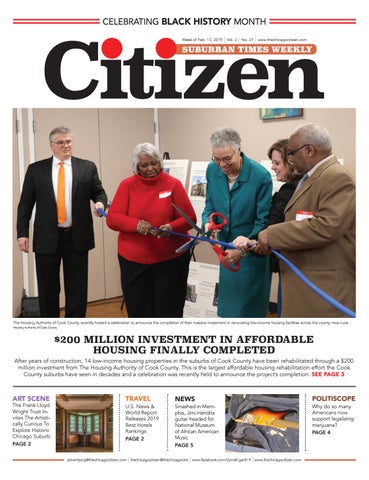
The Housing Authority of Cook County recently hosted a celebration to announce the completion of their massive investment in renovating low-income housing facilities across the county. Photo Credit: Housing Authority of Cook County
$200 MILLION INVESTMENT IN AFFORDABLE HOUSING FINALLY COMPLETED
After years of construction, 14 low-income housing properties in the suburbs of Cook County have been rehabilitated through a $200 million investment from The Housing Authority of Cook County. This is the largest affordable housing rehabilitation effort the Cook County suburbs have seen in decades and a celebration was recently held to announce the project’s completion. SEE PAGE 3
ART SCENE
The Frank Lloyd Wright Trust Invites The Artistically Curious To Explore Historic Chicago Suburb PAGE 2
TRAVEL
U.S. News & World Report Releases 2019 Best Hotels Rankings PAGE 2
|
POLITISCOPE
NEWS
Why do so many Americans now support legalizing marijuana? PAGE 4
Smashed in Memphis, Jimi Hendrix guitar headed for National Museum of African American Music PAGE 5
|
|
advertising@thechicagocitizen.com thechicagocitizen@thechicagocitiz www.facebook.com/durrell.garth.9 www.thechicagocitizen.com
2 | CITIZEN | Suburban Times Weekly | Week of Feb 13, 2019
ART SCENE
The Frank Lloyd Wright Trust Invites The Artistically Curious To Explore Historic Chicago Suburb The Frank Lloyd Wright Trust presents its 2019 Wright Plus Housewalk on May 18, inviting the artistically curious to explore a variety of architectural forms located in the historic Chicago suburb of Oak Park. The Wright Plus Housewalk offers the unique opportunity to tour stunning interiors of eight private residences - open to the public only on this tour. Wright-designed buildings on the walk include the William G. Fricke House (1901), a study in architectural geometry with distinctive wood banding and leaded glass windows; the William E. Martin House (1903), a stunning Prairie composition featuring original murals and a water garden; and the Francis J. Woolley House (1893), an example of his pre-Prairie style work, on the walk for the first time. Also making their Wright Plus debut are the John S. Van Bergen-designed George L. Smith House (1914) featuring original art glass windows throughout; the Ernest P. Waud House (1914), an open plan Tallmadge & Watson design with Prairie style furniture; and the Ashley B. Smith House (ca. 1925), a charming French Eclectic style home designed by Wright’s contemporary Robert E. Seyfarth. The walk also features two lavish Prairiestyle homes, the Barrett C. Andrews House (Tallmadge & Watson, 1906), a blend of Prairie style and Arts & Crafts details, and the
George D. Webb House (Henry K. Holsman, 1910), a grand country home featuring elegant woodwork and original light fixtures. In addition, visitors are invited to tour Frank Lloyd Wright’s Home and Studio where Wright experimented with space, light, materials, furnishings, and decorative arts, as well as Unity Temple, Wright’s greatest public building of his Prairie era. Ticket sales are now underway with ticket prices starting at $90 (until February 28), then increasing by $5 to $10 monthly on a tiered pricing schedule. Fast Passes are available for priority access to all ten sites. Trust members enjoy discounts and special privileges at the Housewalk. The Wright Plus ticket includes free basic admission through the end of 2019 to: Frank Lloyd Wright Home and Studio, newlyrestored Robie House, The Rookery, and Unity Temple (self-guided tour). For more information, visit flwright.org/wrightplus. ADDITIONAL OFFERINGS: May 16-19: Ultimate Plus Weekend Package The offerings include a Wright Night at Chicago’s renowned Rookery Building; a special excursion to Crab Tree Farm, Wright’s Glore House and Heurtley House; priority entry to the Wright Plus Housewalk; private luncheon at Oak Park’s historic Nineteenth Century Club; and gourmet dining at the newly restored Robie House.
Dining room prow, William E. Martin House (Frank Lloyd Wright, 1903), Oak Park, IL, Credit: Courtesy of Frank Lloyd Wright Trust. Photographer: James Caulfield
May 19: Renewing Wright’s Vision: Restoring the Robie House Panel discussion about the recently completed restoration of Wright’s iconic Robie House in Hyde Park, followed by a cocktail reception. Panelists include Chicago’s cultural historian Tim Samuelson, preservation architect Gunny Harboe of Harboe Architects, and Karen Sweeney of the Frank Lloyd Wright Trust, moderated by Frank Lloyd Wright Trust curator David Bagnall. May 20: Wright on the Farm – Muirhead
Farmhouse and Fabyan Villa Tour of Fabyan Villa, Colonel George and Nelle Fabyan’s residence remodeled by Wright in 1907, creating a focal point for the family’s expansive riverbank complex. The tour includes a stroll through the estate’s c. 1910 Japanese Garden, designed by famed landscape architect, Taro Otsuka. Lunch in Geneva, followed by a tour of Muirhead Farmhouse, Wright’s Usonian solution for a working farm and a growing family. An award-winning restoration won the site a spot on the National Register of Historic Places.
TRAVEL
U.S. News & World Report Releases 2019 Best Hotels Rankings U.S. News & World Report, the global authority in rankings and consumer advice, recently announced the 2019 Best Hotels, which evaluate more than 30,000 luxury hotels and resorts across the USA, Europe, Canada, Mexico, Bermuda and the Caribbean. In the Best Hotels in the USA rankings, Hawaii's Four Seasons Resort Hualalai took the No. 1 spot, followed by The Peninsula Chicago at No. 2 and the Four Seasons Hotel at The Surf Club, Surfside, Florida at No. 3. These high-ranking hotels are known for outstanding service, ample on-site amenities and elegant accommodations. U.S. News awards the top 10 percent of ranked hotels with a Gold badge. These five destinations are home to the highest number of Gold badge-winning hotels in the U.S. for 2019: l New York City has 39 Gold badge winners l Las Vegas has 14 Gold badge winners l Los Angeles has 14 Gold badge winners l Washington, D.C. has 12 Gold badge winners l Chicago has 12 Gold badge winners For the Best Hotels in Mexico, Esperanza, an Auberge Resort in Cabo San Lucas takes the top spot, while Le Blanc Spa Resort in
Cancun is the Best All-Inclusive Resort in Mexico. Jade Mountain in St. Lucia is the Best Hotel in the Caribbean and snags the top spot as the Best All-Inclusive Resort in the Caribbean, thanks to its various dining package options. The Rosewood Hotel Georgia earns recognition as the Best Hotel in Canada for the second year running, and The Loren at Pink Beach ranks No. 1 on this year's Best Hotels in Bermuda list. La Réserve Paris – Hotel and Spa is the No. 1 Best Hotel in Europe, followed by Copenhagen's Hotel Sanders at No. 2 and Rome's Hotel Eden at No 3. U.S. News has also introduced additional destination-specific rankings to the Best Hotels in the USA portfolio, ranging from vacation spots like Lake Placid, New York, to smaller cities like Carlsbad, California, to college towns like State College, Pennsylvania, and Tuscaloosa, Alabama. New this year, the rankings include 3.5-star hotels on select U.S.
ranking lists to help a wider variety of travelers find the right hotel for them. "The U.S. News Best Hotels rankings combine data from industry expert evaluations as well as traveler-focused reviews and insight to provide a more holistic idea of what each hotel has to offer," said Hannah Cheney, senior travel editor at U.S. News. "Readers can use the rankings to find a variety of options for every type of vacation. Whether that's a luxurious stay in Paris or a weekend getaway to a college or beach town, we've expanded the hotel rankings to give readers information on even more hotels." Hotel Rankings in More Than 400 Destinations U.S. News' 2019 Best Hotels rankings span more than 400 destinations. This time of year, the most popular hotel searches are in warm-weather spots, including Maui, Miami Beach and Playa del Carmen. Meanwhile, cold-weather fans flock to winter ski destinations like Aspen and Whistler. The Caribbean is making a comeback this year as well, with numerous hotels reopening after a devastating hurricane season in 2017. What's more, the Best All-Inclusive Resorts in the Caribbean and the
CELEBRATING BLACK HISTORY MONTH
Best All-Inclusive Resorts in Mexico rankings assist travelers seeking a no-hassle getaway – where drinks, meals and activities are covered – everywhere from Punta Cana to Cancun. Those looking for a resort getaway a bit closer to home can browse the Best Resorts in the USA and Best Resorts in Canada rankings. The U.S. News Best Hotels rankings also highlight properties in traveler-favorite European hot spots like Paris, London and Rome, in addition to scenic but less-visited destinations like Istanbul, Dubrovnik, Croatia, and San Sebastian, Spain. For vacationers who have points with loyalty programs, such as Marriott Rewards or Hilton Honors, a Best Hotels by Brand directory is also available. U.S. News scored luxury hotels using a methodology that combines each hotel's industry awards with its star rating and guest reviews. These rankings are part of the expanding U.S. News Travel channel, which evaluates the Best Vacations, Best Cruise Lines and Best Travel Rewards Programs. For more information, visit Best Hotels and use #BestHotels on Facebook, Twitter and Instagram.
CITIZEN | Suburban Times Weekly | Week of Feb 13, 2019
|
COMMUNITY
$200 Million Investment in Affordable Housing Finally Completed Continued from page 1 BY KATHERINE NEWMAN
After years of construction, 14 low-income housing properties in the suburbs of Cook County have been rehabilitated through a $200 million investment from The Housing Authority of Cook County. This is the largest affordable housing rehabilitation effort the Cook County suburbs have seen in decades and a celebration was recently held to announce the project’s completion. In total, 1225 units of affordable housing located in Harvey, Robbins, Chicago Heights, Park Forest, and several north suburban neighborhoods have been updated and specific upgrades have been made to better accommodate seniors, individuals living with disabilities and families, according to a press release from the Housing Authority of Cook County. “When we started this whole mission and effort to invest in our communities, I don’t think any of us knew that seven years later we would have rehabilitated 14 public housing communities and invested over $200 million in these communities,” said Richard Monocchio, execu-
tive director of the Housing Authority of Cook County. "It is really a testament to everybody's hard work and also to great partnerships. Things like this don’t happen, especially nowadays with resources being so tight, without some great partnerships.” The mission of the Housing Authority of Cook County is to provide adequate and affordable housing, economic opportunity, and a suitable living environment free from discrimination throughout suburban Cook County, according to its website. Some of the partners that were involved in the massive renovation effort were the Illinois Housing Development Authority, Bank of America, US Bank, Citibank, BMO Harris Bank, Enterprise Community Partners and the National Equity Fund. By combining public and private partnerships and utilizing the Rental Assistance Demonstration program, the Housing Authority of Cook County was able to access funds that were not previously available to them and use them to complete this massive project, according to a press release from the Housing Authority of Cook County. “I am pleased to be here to support the Hous-
ing Authority of Cook County and the work they do on behalf of all our residents,” said Toni Preckwinkle, Cook County Board president. “Projects associated with this investment will have meaningful and significant impacts on suburban communities by providing low-income families with affordable housing for decades to come.” The recent event celebrating the completion of the rehabilitation project was held at Richard Flowers Homes in Robbins where $19.8 million was invested in interior and exterior improvements as well as creating nine handicap accessible units on the ground floor and converting two units into visual/hearing impaired units. Overall, $74.4 million was invested in renovating affordable housing facilities in Chicago’s South Suburbs. In addition to the Richard Flowers Homes, renovations were done at Juniper Tower in Park Forest, Golden Towers in Chicago Heights, and Turlington West Apartments in Harvey. “The Housing Authority has reinvented its affordable housing portfolio throughout Cook County and this has led to the preservation of more than 1200 units,” said Preckwinkle. To learn more visit www.thehacc.org.
CELEBRATING BLACK HISTORY MONTH
DarrellGarth Garth Darrell President/ /Publisher Publisher President JaniceGarth Garth Janice SalesManager/ Manager/General General Sales Manager Manager CST Weekly, published weekly on
CST Weekly, published weekly on Wednesdays and distributed in the Wednesdays distributed in the Township of and Bloom, (publishing 52 Township Bloom, (publishing 52 issues ofannually). Written issues annually). Written permission is required to permission is required reproduce contents in whole to or reproduce contents in manager whole or part from the General or part the General manager or the from publisher. CST Weekly does the CST Weekly does notpublisher. assume the responsibility for not the responsibility for norassume are we able to return unsolicited marterials. for nor are we able Deadline to return advertisingmarterials. is every Deadline Monday for at unsolicited noon. Forevery information advertising is Monday on at subscriptions us noon. Foror advertising informationcall on at (773) 783-1251. Our office subscriptions or advertising call usis at 8741 S.Our Greenwood atlocated (773) 783-1251. office is Ave., Ste# 107, Chicago, Illinois located at 8741 S. Greenwood 60619. Ave., Ste# 107, Chicago, Illinois 60619.
Editorial:
Send press releases, news tips, Editorial: calendar listing etc. to: Sendeditorial@cstweekly.com press releases, news tips,
calendar listing etc. to: editorial@cstweekly.com Advertising
advertising@cstweekly.com Advertising Classifieds call us at advertising@cstweekly.com (773) 783-1251
Classifieds call us at (773) 783-1251
3
4 | CITIZEN | Suburban Times Weekly | Week of Feb 13, 2019
POLITISCOPE
Why do so many Americans now support legalizing marijuana? BY AMY ADAMCZYK, CHRISTOPHER THOMAS AND JACOB FELSON
American views on marijuana have shifted incredibly rapidly. Thirty years ago, marijuana legalization seemed like a lost cause. In 1988, only 24 percent of Americans supported legalization. But steadily, the nation began to liberalize. By 2018, 66 percent of U.S. residents offered their approval, transforming marijuana legalization from a libertarian fantasy into a mainstream cause. Many state laws have changed as well. Over the last quarter-century, 10 states have legalized recreational marijuana, while 22 states have legalized medical marijuana. So why has public opinion changed dramatically in favor of legalization? In a study published this February, we examined a range of possible reasons, finding that the media likely had the greatest influence. It’s not about use, geography or demographics Our study ruled out a few obvious possibilities. For one, it’s not about marijuana use. Yes, marijuana use has increased. Data from the National Survey on Drug Use and Health show that, in 2002, about 10 percent of adults reported using marijuana the previous year. By 2015, 13.5 percent reported using. But that increase is too small to have had much of an impact on attitudes. And it’s not about older, more conservative Americans being replaced by younger generations who are more familiar with marijuana.
Both younger and older people developed more liberal views about the legalization of marijuana at a similar pace over the last 30 years. In this way, changes in attitudes about marijuana legalization mirror recent increases in support for LGBTQ individuals. We looked to see if people who lived in states where it was illegal, but resided next to ones where it became legal, were more likely to have changed their views. But the rate of change has been no different in states that legalized marijuana than in others. Likewise, the pace of change has been similar across political parties, religions, educational levels, racial and ethnic groups and gender. As politically polarized as the country may seem, when it comes to marijuana, Americans have been changing their attitudes together, as a nation. We did find that a small part of the increase in support was related to more people disaffiliating with religion. The proportion of people who do not identify with a religion has increased some, by about 7 percent between 2007 and 2014. People who do not have a religion tend to be more liberal than others. However, this factor accounts for only a small proportion of the change. Media medical framing So what’s going on? What has likely made the biggest difference is how the media has portrayed marijuana. Support for legalization began to increase shortly after the news media began to frame marijuana as a medical issue. We took The New York Times as a case
study, looking at the number of published articles from 1983 to 2015 about marijuana. Just before the number of Americans supporting legalization began to increase, we found a sharp increase in the proportion of articles about marijuana that discussed its medical uses. In the 1980s, the vast majority of New York Times stories about marijuana were about drug trafficking and abuse or other Schedule I drugs. At that time, The New York Times was more likely to lump marijuana together in a kind of unholy trinity with cocaine and heroin in discussions about drug smuggling, drug dealers and the like. During the 1990s, stories discussing marijuana in criminal terms became less prevalent. Meanwhile, the number of articles discussing the medical uses of marijuana slowly increased. By the late 1990s, marijuana was rarely discussed in the context of drug trafficking and drug abuse. And marijuana had lost its association with other Schedule I drugs like cocaine and heroin in the New York Times. Gradually, the stereotypical persona of the marijuana user shifted from the stoned slacker wanting to get high to the aging boomer seeking pain relief. Of course, many Americans do not read The New York Times. But analysis of newspapers of record, like this one, provide insight into how the news media has changed its framing of marijuana, especially during an era when newspapers were still a primary news source. Harsh criminal justice system As Americans became more supportive of marijuana legalization, they also increasing-
ly told survey researchers that the criminal justice system was too harsh. In the late 1980s, the “war on drugs” and sentencing reform laws put a large number of young men, often black and Latino, behind bars for lengthy periods of time. As Americans started to feel the full social and economic effects of tough-on-crime initiatives, they reconsidered the problems with criminalizing marijuana. Because support for the legalization of marijuana and concerns about the harshness of the criminal justice system changed at about the same time, it’s difficult to know what came first. Did concern about the harshness of the criminal justice system affect support for legalization – or vice versa? By contrast, the cause and effect is clearer with respect to the media framing of marijuana. The news media’s portrayal of marijuana began to change shortly before the public did, suggesting that the media influenced support for the legalization of marijuana. Once attitudes begin to change, it is difficult to know what keeps the momentum moving. Whatever the initial impetus, attitudes today are drastically more supportive, and legalization is increasing fast. Amy Adamczyk is a Professor of Sociology and Criminal Justice at City University of New York, Christopher Thomas is a Ph.D Candidate in Criminal Justice at John Jay College of Criminal Justice and Jacob Felson is an Associate Professor of Sociology at William Paterson University.
NEWS Morrison, Fritz say website changes will make it easier to access neighborhood-level data Cook County Commissioner Kevin Morrison and Cook County Assessor Fritz Kaegi jointly announced changes to the Assessor’s website (cookcountyassessor. com) which will make it easier for taxpayers to access neighborhood-level data about comparable properties in their area. These changes will make it easier to review upcoming re-assessments in the northern suburbs as well properties throughout the county, according to a press release. Prior to these changes, Cook County taxpayers would need to search multiple areas of the Assessor’s website to review how a property’s square footage, building assessed value and land assessed value compare to similar properties within a neighborhood. A discussion between Commissioner Morrison and Assessor Kaegi’s offices created a more streamlined design and data solution for the website, which was launched immediately. Allowing residents quick access to their property’s square footage, land assessment, and building assess-
ment will provide important information needed to determine a property’s assessed value and provide a more transparent understanding of the fairness of a particular assessment. This information is also useful for taxpayers who wish to file an appeal. “Our office will be transparent in how we determine a taxpayer’s assessment,” said Assessor Kaegi. “We’ll be publishing our models and code in the coming months and relaunching our website at a future date. But there are other smart changes, like this, that we can make immediately. We look forward to continuing a dialogue with Commissioner Morrison and other elected officials on the improvements in our office.” Re-assessment notices for the northern suburbs of Cook County will be sent out between the end of February and end of September 2019. The southern suburbs will be re-assessed in 2020 and the city of Chicago will be completed in 2021. For comparable property data and other information on assessments, residents can visit cookcountyassessor.com.
Underwood Introduces Legislation to Protect Americans with Pre-Existing Conditions, Ban “Junk” Insurance Plans Congresswoman Lauren Underwood (IL-14) recently introduced legislation with Representatives Kathy Castor (FL-14), Mark DeSaulnier (CA-11), Nanette Diaz Barragán (CA-44), Steven Horsford (NV-4), and Gwen Moore (WI-4) that would help protect Americans with pre-existing conditions by overturning an Administration rule that expands limited duration insurance, commonly known as “junk plans.” In August, the Administration finalized a rule that expanded short-term, limited-duration health insurance plans that do not have to offer patient protections like coverage for pre-existing conditions or essential health benefits like ma-
CELEBRATING BLACK HISTORY MONTH
ternity care, prescription drugs, and hospitalization that the Affordable Care Act requires. “A pre-existing condition shouldn’t be some kind of scarlet letter Americans have to wear around their neck as they try to get the quality, affordable healthcare everyone deserves,” Congresswoman Underwood said. “I’m one of the 300,000 people in Illinois’ 14th Congressional District who have a pre-existing condition, so this is personal: no insurer should ever have the option to discriminate against us.” Underwood is on the Health, Education, Labor, and Pensions subcommittee of the Education and Labor Committee.
CITIZEN | Suburban Times Weekly | Week of Feb 13, 2019
|
5
NEWS
Comcast honors civil rights activists with new exhibit BY WENDELL HUTSON Contributing Writer
Comcast Corporation honored six, local civil rights activists with a new exhibit recently unveiled at the DuSable Museum of African American History on Chicago’s South Side. Recognized for their efforts to fight for equality were Timuel Black, a historian; Rev. Clyde Brooks, former Chicago branch president of the Southern Christian Leadership Conference; Josie Childs, founder and president of the Harold Washington Legacy Committee; Rev. Jesse Jackson, founder and president of the Rainbow PUSH Coalition organization; James Montgomery, an attorney; and Robert Starks, an educator and political consultant. The exhibit, “Voices of the Civil Rights Movement,” is available online and features interviews from all six honorees discussing how they got involved with the civil rights movement, what contributions they made to help improve equality for blacks and the status of the black community as they see it today. Youth will especially find the interactive, technology-based exhibit interesting because it teaches about the role local, civil rights activists played in history, said Perri Irmer,
Honored at a Feb. 7, 2019 unveiling of a new civil rights exhibit at the DuSable Museum of African American History were (from left) Timuel Black, a historian; Robert Starks, an educator and political consultant; Rev. Jesse Jackson, founder and president of the Rainbow PUSH Coalition organization; James Montgomery, an attorney; Josie Childs, founder and president of the Harold Washington Legacy Committee; and the Rev. Clyde Brooks, former Chicago branch president of the Southern Christian Leadership Conference. Photo Credit: Wendell Hutson
president and chief executive officer of the DuSable Museum. “This exhibit is a permanent fixture at the museum, so it’s not going anywhere. Comcast is the sponsor of this exhibit and we are thrilled to have it here,” said Irmer. “One of our most popular exhibits here at DuSable is on Harold Washington, who we know was the first black mayor of Chicago.”
And while the nation recognizes February as Black History Month, Irmer said every month is Black History Month. “We designate February but every day is a day for us to celebrate our history, our people and our culture,” explained Irmer. “The overriding mission of the DuSable Museum is really educating all people about our history,
contributions and accomplishments.” She continued, America wouldn’t exists without blacks. Montgomery said while a lot has been done to advance the black race more work is needed. “Black people are more impoverished today than we were 50 years ago. And as long as we [blacks] remain poor, we will be powerless. At the end of day, we need to get rid of poverty if we, as a race, are going to move forward and become powerful,” said Montgomery. He added that unlike other ethnicities like Jewish, Hispanics and whites, blacks do not stick together and support one another. “Almost every race supports their own businesses and circulate their dollars back into their community but us. For some reason we believe the white man’s ice is colder because that’s what they taught us during slavery,” said Montgomery. “We can’t even support our (black) public officials because many of us do not vote.” Speakers at the event included Alderman Roderick Sawyer (6th) and Mayor Rahm Emanuel. “Eighteen months ago, Supt. Eddie Johnson and I were here at the DuSable Museum, and we announced that all new police recruits will come to the DuSable Museum as part of their
training,” said Emanuel. “For years, new recruits would (only) go to the Holocaust Museum. And it was kind of ridiculous, when you think about it, that this incredible museum in recognition of the person who actually put Chicago on the map, was not part of their training or education.” For its part, Comcast officials said the exhibit is part of an effort it started six years ago to chronicle the lives and experiences of those who fight for the equality of all people. “Chicago has so much history and we are thrilled to have this project make it’s way to Chicago. This is the city that gave birth to the Chicago chapter of the NAACP (National Association for the Advancement of Colored People) and gave us our first black president, Barack Obama,” said David Cohen, senior executive vice president and chief diversity officer for Comcast Corp. “We’re especially proud to make this exhibit part of the DuSable’s permanent collection, celebrate Chicago’s rich contributions to our nation’s civil rights movement, and enrich the experience of museum visitors.” Comcast will sponsor a free screening of a new documentary, “Hope & Fury: MLK, The Movement and The Media,” at 6 p.m. on Thursday, Feb. 21 at DuSable Museum, 740 E. 56th Pl.
Smashed in Memphis, Jimi Hendrix guitar headed for National Museum of African American Music BY GEORGE TILLMAN Special to The New Tri-State Defender
Many years ago, I started a project to bring HIV and AIDS awareness to the Memphis community. In 1998, I coordinated a World AIDS Day awareness benefit and that’s where my journey to owning a piece of Jimi Hendrix’s guitar began. John Tigrett, the owner of Memphis’ Hard Rock Cafe, opened his doors so a community of Stax musicians and singers could put together a fundraiser for World AIDS Day that year. This is where I met Larry Lee, a guitarist who played with Jimi Hendrix, Al Green and many other great stars. And as fate would have it, we would meet again. This next meeting was happenstance as Larry happened to be living in the same rooming house as my girlfriend at the time. He called me over and said, “I want to give you something.” I said OK, and when he came out of the back room, he had something wrapped in this black towel, just as you see in this photo. I unwrapped the towel and saw a broken guitar. I asked, “What is this? Is this some kind of joke?” “No,” he replied. “You know whose guitar this is?” I told him no and then he said it was Jimi Hendrix’s guitar.
I asked him if he played with Jimi Hendrix and when he said yes, I was shocked. Of course, I wanted to know more about how he ended up with the guitar all these years later. He said they were on stage playing and Jimi was breaking up the guitars and breaking up the equipment and doing what he always does at the end of playing. Larry said the guitar broke and part of it hit him on the leg. After the show, he picked it up and kept it. I was amazed to hear this history and touched at the same time. To this day, I’ve never really talked about it for fear something would happen to it before I could share this story and precious artifact. Now, it will be placed temporarily in the National Museum of African American Music (NMAAM) in Nashville, where visitors can view this smashed guitar – with its neck and fretboard
[The guitar] will be placed temporarily in the National Museum of African American Music (NMAAM) in Nashville, where visitors can view this smashed guitar – with its neck and fretboard still intact – for themselves.
still intact – for themselves. “Jimi Hendrix is one of the most important figures in American pop culture, not just American music,” said Dr. Steven Lewis, curator at NMAAM. “This guitar provides a physical reminder of the power of his music, his personality and his brand of self-expression that was as influential in the 1960s as it is today.” NMAAM, set to open this year, is envisioned as the only museum dedicated to educating,
CELEBRATING BLACK HISTORY MONTH
preserving and celebrating the influence African-Americans have had on music. I am happy to contribute to this endeavor. Along with the guitar, NMAAM will feature the guitar in its Crossroads Gallery along with other items of Jimi’s, vintage concert materials. George Tillman, a screenwriter and filmmaker, has been in the entertainment industry for 40 years.
6 | CITIZEN | Suburban Times Weekly | Week of Feb 13, 2019
CITIZEN | Suburban Times Weekly | Week of Feb 13, 2019
|
7
8 | CITIZEN | Suburban Times Weekly | Week of Feb 13, 2019
Committed To Keeping You Informed… Join Us Weekly
On Apple iTunes For An Episode Of
“Conversations With The Citizen” A Place Where Real News Can Be Heard! Listen To Our Weekly Podcast For The Latest In Community News. When Tuning Into Our Podcast You Can Expect To Hear News Topics Such As: Community Improvement, Entrepreneurship, Education, Politics, Or Simply The Honoring Of Our Own Community Unsung Heroes.
If You Have A Story Idea That You Would Like For Us To Cover On An Episode of “Conversations With The Citizen”, Drop Us An Email at: Editiorial@thechicagocitizen.com