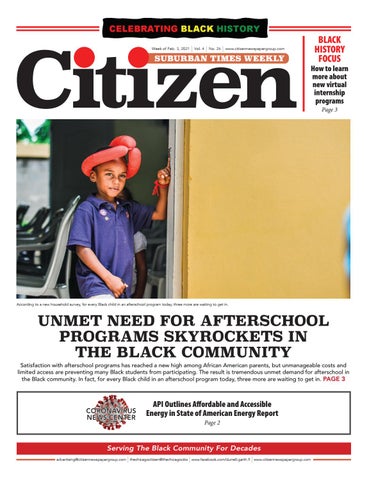
Citizen Week of Feb. 3, 2021
| Vol. 4 | No. 26 | www.citizennewspapergroup.com
SUBURBAN TIMES WEEKLY
BLACK HISTORY FOCUS
How to learn more about new virtual internship programs Page 3
According to a new household survey, for every Black child in an afterschool program today, three more are waiting to get in.
UNMET NEED FOR AFTERSCHOOL PROGRAMS SKYROCKETS IN THE BLACK COMMUNITY
Satisfaction with afterschool programs has reached a new high among African American parents, but unmanageable costs and limited access are preventing many Black students from participating. The result is tremendous unmet demand for afterschool in the Black community. In fact, for every Black child in an afterschool program today, three more are waiting to get in. PAGE 3
API Outlines Affordable and Accessible Energy in State of American Energy Report Page 2
Serving The Black Community For Decades |
|
|
advertising@citizennewspapergroup.com thechicagocitizen@thechicagocitiz www.facebook.com/durrell.garth.9 www.citizennewspapergroup.com
2 | CITIZEN | Suburban Times Weekly | Week of Feb. 3, 2021
POLITISCOPE
Neighborhoods with MLK streets are poorer than national average and highly segregated, study reveals BY SWETA TIWARI AND SHRINIDHI AMBINAKUDIGE
have seen a recent increase in their Latino population.
The big idea Poverty rates are almost double the national average in areas surrounding streets named after Martin Luther King Jr., according to our recent study, and educational attainment is much lower. Our geography research, published in the GeoJournal in September 2020, analyzed the racial makeup and economic well-being of 22,286 census blocks in the U.S. with roadways bearing the slain civil rights leader’s name. Streets named after Martin Luther King typically run through multiple census blocks; we identified a total of 955 such streets in the United States. The areas surrounding MLK streets are predominantly African American, with very few white residents, we found. This is particularly true in the South and Midwest. A notable exception includes California, where MLK neighborhoods
Why it matters American cities began naming streets for the Rev. Martin Luther King Jr. after his 1968 assassination to commemorate the civil rights movement and King’s fight against social inequality. Chicago was the first. In 1968, Mayor Richard Daley renamed 14 miles of Grand Boulevard, in the historically Black South Side, as Martin Luther King Jr. Drive. Today cities in 41 states, Washington, D.C., and Puerto Rico have streets named for King. According to the University of Tennessee geographer Derek Alderman, the streets that bear his name were selected from areas that have higher African American populations than citywide averages. MLK avenues, boulevards and drives are, the journalist Jonathan Tilove once wrote, “Black America’s Main Street.” Most of America’s MLK neigh-
borhoods, from east Montgomery, Alabama, to Harlem in New York City, were born of legal or de facto racial segregation. And in the second half of the 20th century, they experienced the sharpest decline in urban industry, sending local jobs from the cities to suburbs. These historic events first caused, then structurally perpetuated, deprivation in MLK neighborhoods. Concentrated urban poverty affected the funding required to support schools, hospitals and other community services, especially after the economic recession of the 1970s. In many cities, the sinking socioeconomic status of African Americans was compounded by government neglect of their neighborhoods, leading to property devaluation, industrial pollution and disrepair. The result is that MLK neighborhoods have become what Alderman calls a “racialized” landscape. Systematically ignored for investment and government services, they are now negatively stereotyped
as marginal places where poverty, disorder, dereliction and crime are considered normal. What other research is being done Our study builds on Alderman’s 2000 investigation on MLK streets by revealing that the neighborhoods around them are highly racially segregated. But they are also vibrant commercial districts. In 2007, geographer Matthew Mitchelson and co-authors analyzed businesses on streets named after King, examining their numbers, annual sales and staff size. His study concluded these businesses are comparable in terms of revenue and jobs provided to those located on other commercial arteries – namely, Main Streets and streets named after President John F. Kennedy. Mitchelson’s analysis also found that MLK streets have proportionally more churches and government offices than Main Streets or JFK streets.
What still isn’t known Research on urban resilience suggests the marginalization of MLK neighborhoods could make their residents more vulnerable to natural disasters and pandemics like the coronavirus, but this connection has yet to be studied. Finally, the arrival of Latinos to MLK neighborhoods left us wondering: Will increasing diversity bring an end to the negative stereotyping of these areas – or simply change those stereotypes? Sweta Tiwari is a Postdoctoral Research Fellow in Geospatial Institute at Saint Louis University. She received her Ph.D. degree in Earth and Atmospheric Sciences from Mississippi State University. Dr. Shrinidhi Ambinakudige, is a Professor in the Department of Geosciences at Mississippi State University. His research comprises both physical and human geographical approaches.
NEWS API Outlines Affordable and Accessible Energy in State of American Energy Report BY STACY M. BROWN NNPA Newswire Senior National Correspondent @StacyBrownMedia
American Petroleum Institute (API) President and CEO Mike Sommers said there’s growing confidence that America’s future will be brighter and cleaner because of today’s natural gas and oil abundance and an adapting, evolving industry. “Today, I’m going to outline a path, a vision, for an affordable, secure, reliable cleaner energy future one marked by a shared commitment across many industries to innovation, action, and problem-solving,” Sommers avowed. The remarks kicked off API’s annual State of American Energy address. Sommers outlined actions the natural gas and oil industry is taking to support the nation’s economic recovery and a vision for an affordable, reliable, and cleaner energy future. The virtual event drew more than 2,000 attendees. It featured young professionals and energy leaders, including a New Mexico teacher, a Pennsylvania-based union trade leader, and the National Newspaper Publishers Association President and CEO, Dr. Benjamin F. Chavis, Jr. “We’ve become conditioned to pitting using energy against making environmental progress, yet history has shown that this is a false choice,” Sommers expressed. “Both developing energy and reducing emissions are essential to advance our society and protect the environment with-
out energy and environmental progress.” The State of American Energy report revealed that the natural gas and oil industry remains a reliable foundation for America’s economic recovery. The industry stands ready to help the country build – today, tomorrow, and in the future – through innovation and new technologies, to supply affordable, dependable energy while continuously improving environmental performance, Sommers outlined. “Natural gas and oil are both supporting our nation’s recovery, and eventually come back from the Covid-19 pandemic,” Sommers maintained. “Our products served as critical building blocks for millions of face masks, surgical gowns, and other PPE worn by frontline workers. Our crews worked long shifts to make those products and power hospitals and plants.” He noted that the industry had refrained from political battles and focused on the essential work the nation depends upon in producing and delivering American energy, which contributes to national security, answering the climate changes with action and ingenuity while keeping energy affordable. “Thanks to American technology and innovation, the United States is now the world’s leading producer of natural gas and oil,” Sommers told the gathering. “Securing America’s energy future has long been a point of unity since the 1970s, and nine US presidents have focused on American energy security and advocated for reducing
our nation’s dependence on foreign oil.” He insisted that energy affordability is more important than ever as the country recovers from the pandemic. “A government that’s focused on recovery for all should reject policies that could drive up energy costs and hurt those who can least afford them,” Sommers said. “That is the case we’re making, and we are working with President Joe Biden and his administration. Our country has a lot of economic ground to make up, millions of more jobs to recover, and when the business at hand is the economic revival, no industry can help more than this one. The pandemic offered reminders of just how crucial the natural gas and oil industry is to everyday life.” Dr. Chavis, a longtime environmental justice advocate, said the more than 230-member NNPA, which represents the Black Press of America, has enjoyed a great partnership with API and expects to continue as both strive to ensure that all residents have access to affordable energy. “There are energy poverty places in America where we don’t get access to energy and natural gas that’s affordable,” Dr. Chavis declared. “We need to make sure that natural gas is accessible to all communities. We want to overcome these so-called energy poverty places in America.” Chavis continued: “One of the things we’ve enjoyed over the years is the close working relationship between the American Petroleum Institute and NNPA. As we begin 2021,
www.citizennewspapergroup.com
the outlook is how to make progress, how to expand opportunities. “I’m hopeful that 2021 would not only be a year of transition, but a year where we focus on diversity and inclusion not only in terms of words but with deeds, and I think there are so many opportunities in the oil and natural gas industry in America. And, of course, API is leading the [way].” During the event, Sommers announced the launch of API Energy Excellence, which establishes benchmarks on safety, security, and environmental protection that every API member will be expected to pursue and reach. API Energy Excellence defines superior and ever-improving performance that will unify the industry’s future progress in critically important areas to the nation, local communities, and ourselves, Sommers remarked. Core elements range from safety culture and community engagement to employee training and equipment design and aim to accelerate safety and environmental progress by sharing best practices and new technologies and annual progress reporting. “With this new program, we’re creating a roadmap for accelerating performance across all segments of our industry,” Sommers said. “For nearly a century, API’s standards have supported the safe and environmentally responsible development, production, and transportation of natural gas and oil operations. API Energy Excellence is the next big step.”
CITIZEN | Suburban Times Weekly | Week of Feb. 3, 2021
|
3
NEWS Unmet Need for Afterschool Programs Skyrockets in the Black Community Continued from page 1
How to learn more about new virtual internship programs BPT - It’s not news that the COVID-19 pandemic has put a damper on learning opportunities for high school and college students. Unfortunately, that’s been especially true for underrepresented students, who often face roadblocks in accessing professional opportunities. One glaring issue is that the in-person internships so crucial to on-the-job experience have been largely unavailable in this time of remote learning. As a result, students are missing out on the chance to participate in real-world work settings, gaining practical new skills, networking with other professionals and growing further in their careers. That’s a big deal, given the importance of that experience to both employers, who are seeking to hire future leaders, and job applicants. Prior to the pandemic, a 2019 survey by the National Association of Colleges and Employers found that 58% of graduating college seniors who received full-time job offers had completed internships and notably, they received 16% more job offers than those not privy to internships. The good news? Nonprofit organization The Center for Excellence in Life (TCEL) has stepped up to launch the first-ever paid virtual internship program geared specifically toward underrepresented students and uniquely focused on nurturing students beyond job skills in a specific field. This program already has served more than 80 Black, Latinx and Asian students in the U.S. in 2020. And with help from new supporters, its founders hope to provide many more with valuable work experiences throughout 2021 and beyond. “Today’s students are our future workforce and leaders, but even with hope on the horizon for COVID-19, the negative consequences for underrepresented students can be long-lasting,” notes TCEL founder Mary Stutts. “At TCEL, we seek to help students understand what is possible and achieve their goals, by providing access, connections, exposure, and development of the ‘whole person.’” Here’s what you should know about the program, whether you’re a prospective intern, a company wishing to participate or a donor interested in providing financial support for underrepresented students: Internships are available in multiple fields. TCEL arranges remote learning opportunities in disciplines ranging from STEM fields to communications, finance, life sciences, fashion, digital entertainment and more. The internships are structured so company mentors regularly work online with participants to help them experience practical, real-life settings and situations,
as they develop the multifaceted skillsets and perspectives the future workforce needs. And the program is intended to be accessible to all - for example, in 2020, 13% of the TCEL interns without access to a computer completed the program using only their phones. Supporting the “whole person” is key. For TCEL interns, education goes beyond specific career tracks, with every intern participating in the “Whole Person” track. Access to this unique training teaches interns how to define a personal brand, build a career while balancing multiple interests, better understand personal finances and care for their mental health. “The TCEL interns I spoke with wanted to better understand financial topics,” notes John Clay, a vice president at Morgan Stanley and TCEL mentor. “As a result, I joined forces with TCEL to continue providing financial mentoring sessions for all cohorts, to build foundations for future interns’ personal and professional successes.” Mental health struggles are at a dangerous high for young people. More than 90% of TCEL’s 2020 interns wrote in their application essays of experiences with anxiety and depression, which have been exacerbated by the COVID-19 pandemic, racial and social unrest, and a lack of opportunity. That’s why Kaiser Permanente became a TCEL sponsor. Its mental health professionals will provide mental health-focused mentoring sessions - so that participants are more equipped to help themselves and others. Would-be interns should apply now. Because the goal is to impact students early in their education, interns can apply as high school juniors and seniors or college freshmen and sophomores. In 2021, internships will be available in the spring, summer and fall. Throughout the program, students receive stipends to help cover expenses as they work, since unpaid internships present a barrier for some students. “My goal is to serve as an ambassador for the United Nations, and I know that there’s a great need for more women and people of color in ambassadorship roles,” notes TCEL intern Kaylyn Goode, a George Washington University sophomore studying international affairs. “The TCEL internship provided me with important connections and knowledge as I work to achieve great things.” Donors and supporters are needed. To thrive, TCEL needs more financial support from individual and corporate donors who believe in the importance of supporting Continued on page 5 www.citizennewspapergroup.com
Satisfaction with afterschool programs has reached a new high among African American parents, but unmanageable costs and limited access are preventing many Black students from participating. The result is tremendous unmet demand for afterschool in the Black community. In fact, for every Black child in an afterschool program today, three more are waiting to get in. That is a key finding from America After 3PM, a new household survey commissioned by the Afterschool Alliance and conducted by Edge Research. It finds that the families of 24.6 million children in the United States — more than ever before — are unable to access an afterschool program and many report that cost is a barrier. America After 3PM exposes significant inequities, with the parents of 58% of Black, 55% of Latinx, and 46% of white children not currently in an afterschool program saying they would enroll their child if they could. The new study finds that, due to barriers including cost, access and transportation, the number of Black children in afterschool programs has declined from 2.4 million in 2014 to just 1.5 million today. The decline means more Black students lack essential supports that can help them succeed. It also signals that, while publicly funded afterschool programs have helped millions of students, public dollars are not nearly sufficient to keep up with demand today. The study is based on responses from more than 30,000 U.S. families, including 3,774 African American families. Building on household surveys conducted in 2004, 2009 and 2014, it offers a pre-pandemic snapshot of how children and youth spend their afternoons and has significant implications for our post-pandemic world. It also includes a separate survey of parents conducted this fall; in it, nearly half of Black parents (47%) report stress due to providing learning support while their child’s school is operating virtually, and concerns about their ability to juggle work with monitoring their child’s distance learning (46%).
“Black parents say afterschool programs are doing stellar work in helping meet many of their children’s academic, social/ emotional and other needs. But investments in afterschool have not kept up with demand, and that puts millions of children and youth at risk. The pandemic, which is taking an especially high toll on communities of color, is exacerbating the harm,” said Afterschool Alliance Executive Director Jodi Grant. “Quality afterschool programs are essential to student success in school and life. If we want to emerge from this pandemic strong, we need to provide all our children and youth access to the enrichment opportunities and resources afterschool programs provide. We’re not doing that now, and Black families are among those who are struggling even more as a result.” Read more findings from the report at http://afterschoolalliance.org/press_archives/ AA3PM-2020/Black-Communities-AA3PM-2020-NR.pdf.
Darrell Garth President / Publisher Janice Garth Sales Manager/ General Manager CST Weekly, published weekly on Wednesdays and distributed in the Township of Bloom, (publishing 52 issues annually). Written permission is required to reproduce contents in whole or part from the General manager or the publisher. CST Weekly does not assume the responsibility for nor are we able to return unsolicited marterials. Deadline for advertising is every Monday at noon. For information on subscriptions or advertising call us at (773) 783-1251. Our office is located at 8741 S. Greenwood Ave., Ste# 107, Chicago, Illinois 60619.
Editorial:
Send press releases, news tips, calendar listing etc. to: editorial@cstweekly.com
Advertising
advertising@cstweekly.com Classifieds call us at (773) 783-1251
4 | CITIZEN | Suburban Times Weekly | Week of Feb. 3, 2021
NEWS
Expressing Thanks to Illinois Legislators for Putting People Before Politics As faith and community leaders, we were so grateful to see legislators come together a few weeks ago and take serious steps to improve health equity across the state. As faith-based leaders and community organizers, we applaud the unanimous decision of our state legislators to officially start the process for allocating $150 million this year in health transformation funding for neighborhoods where the needs are greatest—especially on our city’s South Side. Their actions open the door to long-needed change and opportunity in the way healthcare is delivered in our neighborhoods — literally a lifesaver for thousands of residents – and not only for today, but for generations to come. The healthcare disparities that exist in Black and Brown communities are profound, systemic, and growing. Just look at the impact that the COVID-19 pandemic is having on communities of color as evidenced daily in the numbers of those who test positive, are hospitalized, and are dying from this insidious virus. Our community has long needed a process to drive better access, prevention, health literacy and, ultimately, a healthier South Side.
We are acutely aware of the enormous disparity in health outcomes depending upon where you live in Chicago. Residents in Streeterville have a life expectancy of 90 years, 30 years longer than residents in Englewood — due in large part to chronic health issues. Unlike those who live north of Roosevelt Road, the 600,000 residents on the South Side suffer a shortage of easy access to primary care, community-based specialty care programs, and supporting ambulatory and urgent care sites which results in inpatient admissions on the South Side being twice as high as other neighborhoods throughout the city. Likewise, emergency room visits for manageable conditions are two to three times higher. And, when compared with other Chicagoans, South Side residents have a 10 times higher infant mortality rate and are four times more likely to die of complications from diabetes. COVID-19 has made these long-festering issues that much more urgent. That’s why our community has been actively engaged in a process for transformation, working with health providers — including hospitals and clinics
Girls’ nights IN are gonna take COVID-19 OUT.
throughout the South Side — to create a plan that would address the critical needs in our neighborhoods. Called the South Side Health Transformation Project, together we envision better collaboration among the resources already available in our community while also adding physicians, community healthcare workers, and connectivity to address the needs and issues that will bring better outcomes and better equity. We need more care programs — including specialists — to support people with diseases or concerns common on the South Side such as behavioral health, chronic disease management, and maternal and infant health. Our residents need people who care every step of the way —community health workers and care coordinators who form connections between different types of care and help people easily find the health resources and patient education they need. And we know technology must play a big role in connecting all the dots — bringing together healthcare providers and community health workers in support of programs that will make a real difference in the health and mortality of our residents. So, thank you to every member of the Illinois
House and Senate for voting unanimously to put something real in place around these systemic issues. Everyone deserves the right to quality and accessible healthcare and we are ready and anxious to start transforming lives on the South Side. Special thanks go to the Illinois Black Caucus and legislative leaders on the South Side who demanded investment and change. It is a major step forward toward equity. We look forward to seeing the state’s process for these funds and are very hopeful that the South Side will see significant support to transform health. As we begin 2021, for the first time, we can truly see the finish line to better health. Pastor Chris Harris, Bright Star Church, and CEO/Founder of Bright Star Community Outreach Rev., Dr. Otis Moss, III, Senior Pastor, Trinity United Church of Christ Rev. Julian DeShazier, Senior Pastor, University Church Christa Hamilton, CEO, Centers for New Horizons
We don’t get enough laughs these days. But, wherever they are, our friends are as close as a click. Vaccines are coming. But until enough of us are vaccinated, we still need to slow the spread. We can watch our distance, and not let COVID-19 keep us apart. Learn more about vaccines and slowing the spread at cdc.gov/coronavirus
Brought to you by the U.S. Department of Health and Human Services
www.citizennewspapergroup.com
CITIZEN | Suburban Times Weekly | Week of Feb. 3, 2021
NEWS How to learn more about new virtual internship programs Continued from page 3 underrepresented young people and helping to build paths to success. Additionally, TCEL is actively searching for industry leaders and companies willing to share their expertise. Recently, TCEL was one of the first nonprofits to receive a contribution from Life Science Cares, a newly formed consortium of Bay Area life science companies leveraging employee expertise and corporate profits to tackle society’s greatest social issues including pervasive racial and socioeconomic inequalities. The program arose from humble beginnings. Stutts, a foster child from a young age, credits her foster mother (a special education teacher) with teaching her that all people are valuable regardless of their labels. While achieving a successful career in the biotech industry, Stutts developed a passion for nurturing underrepresented youth and founded TCEL to cultivate creative, academic,
professional, entrepreneurial and life skills. She and her daughter Loren created the TCEL internship program to address disadvantages from the combined forces of the pandemic and racial injustice. Supported by major corporations such as Blue Shield, W2O Group and others, the virtual internship program has been enormously uplifting. Donors and supporters can visit TheExcellentLifeCenter.org for more information. TCEL’s overall mission is to mentor, inspire and empower youth and adult professionals in the pursuit of excellence. Potential participants in the TCEL Virtual Internship Program are encouraged to apply at TheExcellentLifeCenter.org.
|
5
6 | CITIZEN | Suburban Times Weekly | Week of Feb. 3, 2021
ENTERTAINMENT
Michele Ghee named CEO of EBONY & JET MAGAZINE Bridgeman Sports & Media has installed Michele Ghee as CEO of iconic brands EBONY & JET. This historically rooted brand celebrates 75 years of chronicling Black life in America. With that, it now embarks on its future with Ghee boldly holding the reigns. A brand known for unapologetically documenting the courageous contribution of Blackness to the American landscape, its new CEO states, “Everything we say will come through the lens of Black journalists. We will ensure there is a safe space for Black journalism to thrive. I’m a little Black girl from Oakland, CA. I’m not apologizing for any of it. Our voices matter. We are History in the making!” This titan of industry understands the privilege and responsibility of stepping into a leadership role within the culturally embedded Ebony and Jet brands. “Mr. Johnson was “I’M A LITTLE a visionary who operated BLACK GIRL FROM with courage. He made a commitment to the Black OAKLAND, CA. I’M NOT APOLOGIZING American journey and FOR ANY OF IT. OUR in the process, he left an unforgettable legacy,” says VOICES MATTER. WE ARE HISTORY IN Ghee. According to the new THE MAKING!” CEO, Ebony and Jet will Michele Ghee CEO of EBONY & JET hold true to those simple fundamental principles of documenting stories of Black Culture as it raises the brands’ profile to reach a global community. “Our brands’ main responsibility will be to focus completely on what our beloved audience wants and needs with bold informed editorial, brilliant content, and the opportunity to connect with like minded people. Paying homage to Mr. Johnson’s legacy means that my team will carve-out and create our own path. We will NOT succumb to the status quo.” Of this appointment new owner Eden Bridgeman states, “We are honored to have Michele Ghee at the helm to steward these iconic brands. With a proven track record over a storied career thus far and a passion to bring her life experiences to Ebony and Jet we are excited at the future she will create. The next chapter of Ebony and Jet’s history will be told for generations to come and having her continue to authentically document, innovate, and uplift the culture will be keys to our success.” Ghee serves as the CEO of 1145 Holdings LLC. The company includes all assets related to Ebony and Jet. She is charged with creating the vision and activating the strategy for these iconic brands as she steers them into the 21st century. The Brand value proposition will be embedded in Information|Inspiration|Inclusion. Ghee has worked in the media and entertainment space for over a quarter of a century. She has generated billions of dollars in revenue while working for some of the most powerful companies in the world including WME, CNN, A&E, The History Channel and BET Networks. While at BET, Ghee created and ran the first and only network for black women: BETHer. This award-winning titan of industry is an expert in many areas including; leadership, culture, strategy, customer service, revenue generation, diversity, equity and inclusion and relationship building. She currently resides in New Jersey with her husband Tony and two kids Taylor and Jordan.
“Let It Be Known:” NNPA Rolls Out Live Daily Breaking News Broadcast BY STACY M. BROWN NNPA Newswire Senior National Correspondent @StacyBrownMedia
Michele Ghee, Photo Credit: Maya Darasaw
www.citizennewspapergroup.com
For 194 years, the Black Press of America has remained the voice of the African American community and the soul of the nation. With more than 230 Black-owned newspapers and media companies comprising the National Newspaper Publishers Association (NNPA), the Black Press’ contributions have remained indelibly associated with the fearlessness, determination, and the strive for excellence of the African American community across the nation. Wholly embracing the print, social, and digital worlds, the NNPA finished 2020, having broadcast hundreds of livestreams over its many social media channels and on its primary news site, www.BlackPressUSA.com. The NNPA’s latest initiative into live broadcasts in 2021 is the new daily morning breaking news program, “Let it Be Known,” hosted by NNPA Newswire Senior National Correspondent Stacy Brown. NNPA President & CEO Dr. Benjamin F. Chavis, Jr, emphasized, “We are the only national trade association of Black owned newspapers, digital and social media companies in America. As such, we begin 2021 committed to publishing, distributing, and broadcasting the essential news not only for Black Americans, but also for the entire nation and the international community. These are trying times. But this is also the time to reassert the value, impact, engagement, and commitment of the Black Press to speak truth to power. Let It Be Known: We break the news. We distribute the news. We advocate for freedom, justice and equality.” The new program, which kicked off earlier this month, features an interactive rundown of the hot topics of the day – providing news and information to an audience that demands Black inclusion. Special guests will include NNPA publishers, reporters, photographers, and members of both chambers of Congress. It will also include global influencers, change-makers, and celebrities. The program builds upon NNPA’s loaded vault of livestreams that have attracted such superstars as Ice Cube, Chuck D, Ziggy Marley, Kurtis Blow, Stephanie Mills, Mary Wilson, Sinbad, LL Cool J, and many others. Previous guests include former ESPN anchor Jemele Hill, Meharry Medical College President Dr. James Hildreth, New York Democratic Congresswoman Alexandria Ocasio-Cortez, Infectious Disease Leader Dr. Anthony Fauci, Temptations Legend Otis Williams, Democratic Majority Whip Congressman Jim Clyburn, New York Billionaire Michael Bloomberg, President Joe Biden and Vice President Kamala Harris. The program adds to the long list of contributions of the Black Press of America, which includes the celebrated works of their founders and predecessors like John Russwurm, Samuel Cornish, Frederick Douglass, WEB DuBois, Ida B. Wells, Patrice Lumumba, Kwame Nkrumah, Robert Abbott, John Sengstacke, and other former NNPA Chairmen such as Dr. Carlton Goodlett and Garth Reeves Sr. Tune in to NNPA’s “Let It Be Known” weekdays at 7:30 a.m. EST at Facebook.com/BlackPressUSA.
CITIZEN | Suburban Times Weekly | Week of Feb. 3, 2021
CST Weekly
Classifieds REAL ESTATES
SERVICES
SERVICES
AC 1-27-2021 IN THE CIRCUIT COURT OF COOK COUNTY, ILLINOIS COUNTY DEPARTMENT - CHANCERY DIVISION CITIMORTGAGE, INC.; Plaintiff, vs. ELANDA HILL; STATE OF ILLINOIS; MORTGAGE ELECTRONIC REGISTRATION SYSTEMS, INC. AS NOMINEE FOR CITIMORTGAGE, INC. ITS SUCCESSORS AND ASSIGNS; ILLINOIS HOUSING DEVELOPMENT AUTHORITY; Defendants, 19 CH 3096 NOTICE OF SALE PUBLIC NOTICE IS HEREBY GIVEN that pursuant to a Judgment of Foreclosure and Sale entered in the above entitled cause Intercounty Judicial Sales Corporation will on Monday, March 1, 2021 at the hour of 11 a.m. in their office at 120 West Madison Street, Suite 718A, Chicago, Illinois, sell at public auction to the highest bidder for cash, as set forth below, the following described mortgaged real estate: P.I.N. 31-23-412-073-0000. Commonly known as 540 Homan Avenue, Park Forest, IL 60466. The mortgaged real estate is improved with a single family residence. If the subject mortgaged real estate is a unit of a common interest community, the purchaser of the unit other than a mortgagee shall pay the assessments required by subsection (g-1) of Section 18.5 of the Condominium Property Act. Sale terms: 10% down by certified funds, balance, by certified funds, within 24 hours. No refunds. The property will NOT be open for inspection. For information call Sales Department at Plaintiff's Attorney, Manley Deas Kochalski, LLC, One East Wacker Drive, Chicago, Illinois 60601. (614) 2205611. 19-008147 F2 INTERCOUNTY JUDICIAL SALES CORPORATION intercountyjudicialsales.com I3162966 ____________________________ HUD/BANK FORECLOSURES CITY & SUBURBS Call: FRED D. CLINK (773) 294-5870 REALTY SERVICES CONSORTIUM ____________________________ 3+ Bedroom HOMES FOR SALE SELLER FINANCING Call: FRED D. CLINK (773) 294-5870 REALTY SERVICES CONSORTIUM ____________________________
RESTORE YOUR CREDIT SCORE TODAY! CALL US TODAY AT: CREDIT RESTORATION SERVICES
(218) 833-3769 9:00 p.m. - 5:00 p.m
Shaymar Media Productions LLC Promoting you using TV, Radio, Videos, Google Awards & Social Networking WE Make Great TV Shows! Call Us Today! 773-416-7555
http://shaymarmedia.com shaymarmedia@gmail.com STATEPOINT CROSSWORD THEME: U.S. PRESIDENTS ACROSS 1. Newton's first name 6. Part of smog 9. Hissy fit 13. Human trunk 14. Form of "to be" 15. Illegal booze 16. Editorial changes 17. Crematorium jar 18. #56 Down, alt. sp. 19. *One of six Presidents named James 21. *First President previously divorced 23. Civil War's Johnny 24. Manage without help 25. Military procedures 28. Cone-shaped quarters 30. MLB bench 35. Cowboy's necktie 37. A whole lot 39. *Whig, e.g. 40. Resembling wings 41. Nightly necessity 43. Experience emotion 44. Large ray 46. Glacier's deposit 47. "Watch out!" on a golf course 48. Traditional sock pattern 50. Reduced Instruction Set Computer 52. Knight's title 53. Bypass 55. Foot digit 57. *President Chester ____ 60. *He signed legislation to create Medicare 64. Fauna, Merryweather and ____, fairy godmothers 65. Expert 67. Convex molding 68. Bumpkins 69. Café alternative 70. Car ways 71. Trans-Siberian Railroad city 72. Piercing part 73. Slightly drunk DOWN 1. Any thing
2. *Trump had button on desk to order his favorite one 3. Desertlike 4. Up and about 5. Coddle 6. Half-man, half-goat 7. Legendary NHLer 8. Tragedy, or comedy, or satire 9. Cheap form of payment? 10. Before Scotia 11. Clickable picture 12. Olden day "your" 15. Be in charge, two words 20. Newspaper notices 22. What all of #70 Across do 24. Painting or poetry 25. *He beat McCain and Romney 26. Kind of cap 27. Colloquialisms 29. *First "dark horse" 31. Gamecock's spur 32. Dessert sandwiches 33. Wombs 34. *#29 Down predecessor 36. Creative 38. 18-wheeler 42. Green pasta sauce 45. Big Island greetings 49. Australian flightless bird 51. Group of people, often in research 54. Extremely angry 56. Concluding stanza in poetry 57. *G. W. Bush to Yale, e.g. 58. Schneider and Lowe, e.g. 59. Major bike maker 60. Audience's rejection 61. Sold in bars 62. Auto pioneer 63. Like a busybody 64. Back, to a pendulum 66. Latin dance three-step move, once
|
7
8 | CITIZEN | Suburban Times Weekly | Week of Feb. 3, 2021
Taking care of teammates
In a year unlike any other, our company and teammates were called upon to address unprecedented challenges and headwinds in the broader environment, working in support of each other, our clients and the communities where we work and live. In appreciation of these outstanding efforts, we are recognizing eligible employees with Delivering Together compensation awards. A cash bonus of $750 or additional stock award is the latest step our company has taken to invest in our employees during the health crisis. We’ve also significantly invested in industry-leading solutions and resources. To help many of our teammates balancing family and work, we provided an enhanced benefit of up to $100 per day for in-home childcare — funding nearly 3 million days of support. And in 2020, we accelerated the move of our U.S. minimum hourly rate of pay to $20, more than a year earlier than originally planned. Here in Chicago, my teammates and I are here to help. We’re proud of this community and remain committed to making it a better place for us all.
For the fourth time since 2017, Bank of America is recognizing teammates with a special award in cash or restricted stock. This year, approximately 97% of teammates will receive a Delivering Together award.
These awards are in addition to any regular annual incentives that eligible employees may receive.
Paul Lambert Chicago Market President
To learn more, please visit bankofamerica.com/community Bank of America, N.A. Member FDIC. Equal Credit Opportunity Lender. © 2021 Bank of America Corporation. All rights reserved.