Citizen Week of Jan. 29, 2020
| Vol. 3 | No. 25 | www.citizennewspapergroup.com
SUBURBAN TIMES WEEKLY
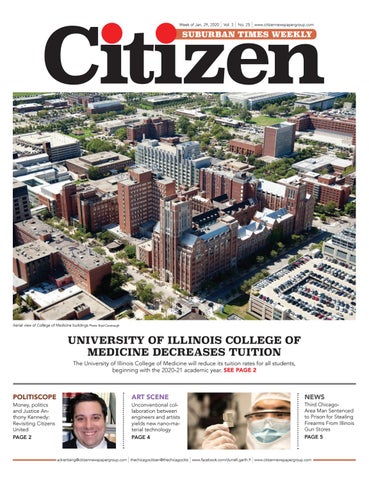
Aerial view of College of Medicine buildings Photo: Brad Cavanaugh
UNIVERSITY OF ILLINOIS COLLEGE OF MEDICINE DECREASES TUITION The University of Illinois College of Medicine will reduce its tuition rates for all students, beginning with the 2020-21 academic year. SEE PAGE 2
POLITISCOPE
NEWS
ART SCENE
Money, politics and Justice Anthony Kennedy: Revisiting Citizens United PAGE 2
Third ChicagoArea Man Sentenced to Prison for Stealing Firearms From Illinois Gun Stores PAGE 5
Unconventional collaboration between engineers and artists yields new nano-material technology PAGE 4
|
|
|
advertising@citizennewspapergroup.com thechicagocitizen@thechicagocitiz www.facebook.com/durrell.garth.9 www.citizennewspapergroup.com
2 | CITIZEN | Suburban Times Weekly | Week of Jan. 29, 2020
COMMUNITY
University of Illinois College of Medicine decreases tuition Continued from page 1 The University of Illinois College of Medicine will reduce its tuition rates for all students, beginning with the 2020-21 academic year. The decision was approved recently by the University of Illinois Board of Trustees. Tuition rates at the College of Medicine will decrease by 2.1% for in-state students and 16% for out-of-state students. “The rising indebtedness of medical students upon graduation is an issue across the country,” said Dr. Mark Rosenblatt, executive dean of the University of Illinois College of Medicine. “As one of the nation’s largest medical schools, the College of Medicine remains committed to providing a high-quality,
accessible and affordable education for all our students. Most dramatically, these reductions translate to a savings over the four years of study totaling more than $60,000 for out-ofstate students. “As we considered the rising debts faced by medical students both here and across the country, we felt it was critical to take this measure,” Rosenblatt said. “The decision to reduce tuition is not something we commonly see from institutions of higher education, however, this move will help ensure that our College of Medicine continues to attract and educate the brightest and most diverse students. And while this move decreases tuition for all students, we can assure students that our commitment to providing an innovative education of the
highest quality will never waver.” “At the University of Illinois at Chicago we are steadfast in our commitment to delivering opportunity and a world class education to students from all backgrounds who want to study in a diverse, urban and public-serving environment,” said UIC Chancellor Michael Amiridis. “Our College of Medicine attracts some of the brightest students in the country – many of whom are eager to tackle significant social issues like public health policy and the health disparities experienced by underrepresented communities – and we believe reducing tuition will give these students their best chance for success.” “The decision to reduce tuition is consistent with our commitment to diversity and
inclusion, and should result in increased access to an affordable medical education for all interested applicants,” said Dr. Trevonne Thompson, associate dean for admissions at the college. The University of Illinois College of Medicine is one of the largest and most diverse medical schools in the country, with an entering class roughly twice the size of the average medical school. More than 25% of students are from traditionally underrepresented groups. One in five physicians in Illinois received his or her medical degree from the University of Illinois College of Medicine and more than 40% of Illinois physicians completed some portion of their medical school, residency or fellowship training through the college.
POLITISCOPE
Money, politics and Justice Anthony Kennedy: Revisiting Citizens United BY MICHAEL T. MORLEY
The decision in Citizens United v. Federal Election Commission, issued ten years ago, is one of retired U.S. Supreme Court Justice Anthony Kennedy’s most maligned rulings. Many condemn the opinion for treating corporations as people, money as speech, and elections as commodities to be sold to the highest bidder. President Barack Obama lambasted Citizens United in a State of the Union address. During her 2016 presidential campaign, Hillary Clinton promised to nominate a Supreme Court justice who would overturn it. Citizens United does not deserve such scorn. As an election law scholar who has litigated campaign finance cases, including in the U.S. Supreme Court, I believe Citizens United is a straightforward application of free speech principles and, like Kennedy’s jurisprudence as a whole, reflects a balance of conservative and liberal legal conclusions. The history Citizens United was a non-profit corporation that received “a small portion of its funds” from for-profit corporations. In 2008, while Hillary Clinton was seeking the Democratic Party’s nomination for President, it released a documentary called Hillary: The Movie. The film featured numerous
Michael T. Morley
interviews with people who, the Supreme Court explained, were “quite critical” of her. Citizens United wanted to pay a cable company $1.2 million to make the documentary available for free, on demand, to the company’s subscribers. It also wished to air paid advertisements for the movie. Federal law, however, prohibited corporations from spending money to expressly advocate a federal candidate’s election or defeat. This restriction applied to Hillary: The Movie because Citizens United had accepted some corporate funding and the film amounted to express advocacy. Citizens United sued, arguing these restrictions violated its First Amendment rights. The ruling Kennedy’s opinion in Citizens United blended conservative
concern for free speech with a more liberal focus on transparency. The conservative majority held corporations have the right to create and distribute political advertisements and other election-related communications such as Hillary: The Movie. All the justices except Clarence Thomas joined in the final part of the opinion, which held that the government may require speakers like Citizens United to publicly report such expenditures and include disclaimers on their election-related communications, revealing who paid for them. Citizens United ended unnecessary restraints on political expression and gave voters access to a wider range of election-related information. It also afforded corporations a fair chance to present their perspective on elections that could have tremendous consequences for them. Corporations are taxed and subject to government regulation. They play vital roles in providing the jobs, goods and services that drive our economy. It is only fair to allow corporations to voice their institutional views about candidates for public office — views that voters, of course, are free to completely disregard. Money, speech and collective political action Critics claim Citizens United allowed corporate America to buy elections. www.citizennewspapergroup.com
The central question in the case, however, was whether corporations could spend money to engage in election-related speech. It remains illegal for corporations to contribute money to candidates, political parties or traditional political action committees (PACs). Moreover, most of the principles Citizens United relied upon were established in cases decided decades earlier. The 1976 landmark case Buckley v. Valeo set forth the constitutional principles governing modern campaign finance law. It reaffirmed that election-related speech lies at the heart of the First Amendment. And it recognized that, while money is not literally speech, it is essential to virtually every form of political speech. Political signs require poster board and markers. Political flyers must be duplicated. Political advertisements cost money to broadcast or publish. Limiting political spending, the Supreme Court explained, reduces “the number of issues discussed, the depth of their exploration, and the size of the audience reached.” The government may not limit political expression, the court emphasized, just because it costs money. Rather, such “independent expenditures” remain pure political speech entitled to maximum constitutional protection. In the decades after Buckley, the Supreme Court held that people
retain this right to engage in pure election-related expression when they join together to achieve political goals collectively. Groups such as political action committees, political parties and certain non-profit corporations have the First Amendment right to spend money to fund election-related speech without government limits. Several liberal justices joined in many of these rulings. Citizens United extended to for-profit corporations the same constitutional right to advocate for or against candidates that other types of private associations - as well as the corporations’ stockholders, directors, executives and employees - already possessed. A trickle, not a flood Critics proclaimed that Citizens United would open the floodgates to a deluge of corporate political spending. They were wrong. University of New Mexico Professor Wendy Hansen and her co-authors discovered that, in the 2012 election, “not a single Fortune 500+ company” made independent expenditures. And only nine Fortune 500 companies made contributions to SuperPACs, totaling less than $5 million. This trend persisted in ensuing elections. The Conference Board’s Committee for Economic Development reports that only 10 corporaContinued on page 3
CITIZEN | Suburban Times Weekly | Week of Jan. 29, 2020
|
3
NEWS ACLU Responds To Supreme Court Review Of Contraceptive Coverage Challenge The Supreme Court recently announced it would review Trump v. Commonwealth of Pennsylvania, which is a challenge to the Trump Administration’s rules that allows employers and universities to deny their employees and students insurance coverage for contraception. The rule is blocked by
a nationwide injunction. “Allowing employers and universities to use their religious beliefs to block employees’ and students’ birth control coverage isn’t religious liberty — it’s discrimination,” said Brigitte Amiri, deputy director at the ACLU Reproductive Freedom Project.
Hospital CEOs are Preparing for Major Change in the Health Care Industry For CEOs of large health care organizations, accelerating change has become the norm for the industry. However, making progress to accommodate these changes has been harder than expected, as seen in new research from the Deloitte Center for Health Solutions. In the “Deloitte 2019 Health Care CEO Perspectives Study “ CEOs rated three top drivers of health care industry change within the next 10 years including a shift in care settings, the adoption of value-based payment
models and an increase in the demands of proactive consumers. “The industry change that CEOs are witnessing firsthand reflects our predictions of a more consumer-centered future of health,” said Michael Main, managing director, Deloitte Consulting LLP. “Consumers want to take control of their health — they have been responding well to virtual care visits and are interested in tools that make their experience personalized, affordable and convenient.”
“The Trump administration’s attempt to take away people’s insurance coverage for contraception is one of the administration’s many attacks on access to abortion and contraception, and we hope the Supreme Court will uphold the lower court’s ruling blocking this awful law.”
POLITISCOPE
Money, politics and Justice Anthony Kennedy: Revisiting Citizens United Continued from page 2 tions made independent expenditures in 2016, and they totaled less than $700,000. Such results are unsurprising. Most major corporations do not want to alienate up to half their potential customers by spending millions of dollars publicly aligning themselves with a particular candidate or political party. What about SuperPACs? A more substantial objection is that Citizens United paved the way for “SuperPACs.” SuperPACs are political committees that only fund election-related speech and activities without input from candidates. Because SuperPACs cannot
contribute to candidates or political parties, people may give unlimited amounts of money to them. Citizens United didn’t create the principles that led to SuperPACs; Buckley did. SuperPACs simply let people join together to engage in the same political speech and spending they were already free, under Buckley, to perform on their own. Kennedy’s opinion in Citizens United did not cause a corporate Armageddon for our political system. It was a victory for the fundamental First Amendment right of all Americans, individually or collectively through corporations, to engage in pure political speech about federal elections. Michael T. Morley is an Assistant Professor of Law at Florida State University.
If it were up to me, we’d have all the healthcare we need. The 2020 Census informs funding for walk-in clinics, Medicare and all types of health services. Rest assured your answers are safe and secure.
Learn more at:
2020CENSUS.GOV Paid for by U.S. Census Bureau.
2019_Census_Seniors_Newspaper_HalfPage_SizeA_9_5x6.indd 1
www.citizennewspapergroup.com
1/15/20 7:03 PM
4 | CITIZEN | Suburban Times Weekly | Week of Jan. 29, 2020
ART SCENE
Unconventional collaboration between engineers and artists yields new nano-material technology A collaboration between Simon Fraser University (SFU) researchers from the School of Engineering Science and renowned visual artists to explore and co-create nano-material technology has led to a unique nano-optical art medium, and a new, cost-effective production process for fabricating it. The project, dubbed Nano-Verses, was devised by professor Bozena Kaminska with former postdoctoral fellow and media studies researcher Aleksandra Kaminska and engineering science postdoctoral fellow Hao Jiang. They welcomed visual artists Christine Davis and Scott Lyall to the Centre for Integrative Bio-Engineering Research (Ciber labs) for a collaboration that blended nanotechnology, art and communication. The field of nanotechnology explores structures at the nanometre level—there are one million nanometres in one millimetre—and allows customizations at such a small scale that the resulting new materials can revolutionize technologies for a variety of applications including data transmission and storage, security and visual media. However, the development of new nano-materials is a challenging process. “We started from a problem that exists when working with nanostructured materials,” says Jiang, who helped to develop the processes that were fundamental to Nano-Verses. “Before this, if we wanted to make an image that was one centimetre by one centimetre in size using nano-optical image-making, it would take an entire week in the laboratory and thousands of dollars for each unique image,” he says. These images, known as nano-optical variable devices, are the foundation for the shimmering anti-counterfeit images used in
A collaboration between Simon Fraser University (SFU) researchers from the School of Engineering Science and renowned visual artists has led to a unique nano-optical art medium, and a new, cost-effective production process for fabricating it.
banknotes and concert tickets. “We created a whole new production process where it costs just as much to make one image as it does to make one thousand,” says Jiang. “That was an important development in terms of cost and scalability for this kind of technology and material.” Interested in exploring the newfound potential of their technology, Aleksandra introduced the Ciber team to Davis and Lyall with the intent of developing unique artwork that explores issues of scale, light and surface interactions. They called the result NanoMedia. To make NanoMedia, the Ciber researchers, led by Bozena and Jiang at SFU’s 4D LABS, applied light-sensitive chemicals onto a surface (substrate) that contains one billion nanostructures per square centimetre. These nanostructures can reflect any colour of light and be tuned to
display pixels of specific colours. Then, in a process similar to developing film photographs, the chemicals/substrate are exposed to UV light or a UV laser writer and the pixels, now reflecting select colours in a predetermined arrangement, reveal the artist’s intended image or colour motif. “The whole process was very handson with the artists,” says Bozena. “We had to learn from each other to make the technology correspond to what they had in mind, and vice versa. We also had to learn to think about our technology differently, with different objectives and criteria.” And because the production process was so new to both the artists and the researchers, the team was challenged to experiment with many different combinations of substrates, chemicals, and finishing materials such as polymers, textiles
and metals to best produce each of the artist’s visions. The finished images can have high resolution—up to 12,700 pixels per inch—and appear iridescent as light reflects off each of the billions of tiny nanostructures in the finished medium. They can also tune the structures to reflect information in infrared light, the same as how a QR- or bar code functions. The team’s first work resulted in 1,000 copies of a front-page insert for the 50th-anniversary edition of the Canadian interdisciplinary journal, PUBLIC. The image, designed with Davis, depicted iridescent nano-optical stars shimmering on a transparent material overlaid onto a photograph of a night-time forest. Later, with Lyall, they developed a series of framed art pieces on metal foils for an exhibition in New York City. Davis then used the foils to
make luminescent objects, which she exhibited in Toronto, Canada. The artists have since produced additional shows of those pieces in Toronto and New York, as well as new artwork for shows in London, England and Paris, France, including at the prestigious Frieze art fairs. Since demonstrating the new production process for NanoMedia, the Ciber team is now commercializing it with industry partners. Because of NanoMedia’s complex fabrication process and unique structure, the resulting products are nearly impossible to counterfeit, making them ideal for the security printing industry for products such as banknotes and passports. Davis and Lyall, meanwhile, continue to work with the nano-optical material. In December, Aleksandra (who is now a professor at the University of Montreal) launched a website at https://nano-verses.com that presents the multi-faceted nature of the project—“the many verses of NanoMedia.” The website itself was built through experimentation with artists/web designers Frédérique Laliberté and Boris Dumesnil-Poulin. Together, they explored how to best present and communicate Nano-Verses from its inception, and how to communicate the way that a scientific idea was probed and studied by a variety of researchers and artists. “This was truly interdisciplinary,” says Bozena. “We took the highest fabrication techniques in nanotechnology and made an entirely new medium that is as intriguing for artists as it is useful for authentication and communication.” Says Jiang, “This project was a result of the efforts of our lab, the artists and our partners coming together to make something new. It was an amazing experience for everyone involved.”
TRAVEL Gogo and Hispasat Sign Capacity Deal to Meet Rising Inflight Connectivity Demand Gogo (NASDAQ: GOGO), a provider of broadband connectivity products and services for aviation, and Spanish satellite operator, Hispasat, recently announced a capacity agreement on Amazonas Nexus satellite to meet the growing global demand for high-speed inflight connectivity services. Gogo has leased multi-gigahertz of Ku-band
capacity onboard Hispasat’s new satellite, set to launch in the second half of 2022, to provide service to its customers in the Americas and the Atlantic region. Hispasat
and Gogo worked closely to optimize the satellite design to provide performance and capacity for inflight connectivity. Amazonas Nexus is a High Throughput Satellite (HTS) with architecture that replaces the Amazonas 2 in the 61º West position. The new satellite will have a payload specifically dedicated to aero connectivity and will offer
additional capacities oriented to vertical segments like mobile connectivity, corporate communications and cellular network deployment. It will feature an advanced Digital Transparent Processor (DTP), a technological breakthrough that will substantially increase satellite flexibility when dealing with changes in demand. “Amazonas Nexus will significantly enhance our Ku
www.thechicagocitizen.com
network over the Americas and the Atlantic region, providing Gogo with scaled capacity at the right economics,” said Oakleigh Thorne, president and CEO of Gogo. “Through our partnership with Hispasat, Gogo 2Ku will continue to meet the growing demand for high-speed inflight connectivity.” “We are excited to support Gogo in providing the best service for their global
airline partners,” said Miguel Ángel Panduro, CEO of Hispasat. “This partnership demonstrates the important role Hispasat will play in providing capacity for aerial services. The inflight connectivity market is a growing segment for satellite capacity, and this is one of the foundational elements for Hispasat’s future growth,” Panduro concluded.
CITIZEN | Suburban Times Weekly | Week of Jan. 29, 2020
|
5
NEWS
Third Chicago-Area Man Sentenced to Prison for Stealing Firearms From Illinois Gun Stores A suburban Chicago man was sentenced recently in federal court before U.S. District Judge Matthew F. Kennelly to eight years in prison for stealing firearms from a licensed firearms dealer and conspiring to steal firearms from licensed firearm dealers. Kelvin Culps, also known as “Forty,” 23, of Dolton, was sentenced in two separate but related cases after pleading guilty on Sept. 17, 2019. According to a press release and with respect to the first case, Culps admitted that in the early hours of April 18, 2017, he and codefendant Bruce Walker, 24, of Calumet City, and another individual obtained a stolen vehicle and drove from Cook County to a federally-licensed firearms dealer in Manteno. The three individuals used a hammer to shatter one of the
business’s glass exterior doors and entered the premises. After entering, they attempted to break into a firearms safe inside the gun store, but were unsuccessful. Culps, however, stole a rifle with a 30-round magazine from the office of the gun store. Culps, Walker, and the other individual also stole boxes of ammunition before returning to Cook County with the stolen rifle and ammunition. About three hours later, Culps, Walker, and the other individual used the same stolen vehicle to drive to a federally-licensed firearms dealer in Tinley Park. There, they attempted to shatter the front glass door and front window of the gun store, but fled after failing to do so. With respect to the second case in which Culps was sentenced, the press release further stated that Culps and his codefendant
in that case, Paris L. Brown, also known as “Pairo,” 24, of Chicago, admitted that they drove in a stolen vehicle from Cook County to a licensed firearms dealer in Loves Park. Culps used a hammer to break through the glass exterior door, and Culps and Brown stole 12 handguns and rifles from the store. Culps and Brown concealed the stolen firearms in the trunk of the stolen vehicle and drove back to Cook County, where they intended to sell and distribute the stolen firearms. The sentencing for Culps was announced by John R. Lausch, Jr., United States Attorney for the Northern District of Illinois, and Timothy Jones, Special Agent-inCharge of the Chicago Field Division of the U.S. Bureau of Alcohol, Tobacco, Firearms & Explosives. The Police Departments of Loves Park, Manteno, Chicago, Tinley
Park, and Lombard assisted in the investigation, as did the Winnebago County Sheriff ’s Office. The government was represented by Assistant U.S. Attorney Talia Bucci. Walker pleaded guilty on Feb. 20, 2019, to one count of conspiring to steal a firearm from a licensed firearms dealer and one count of possessing a stolen firearm. Walker was sentenced on May 30, 2019, to seven years and eight months in prison. Brown pleaded guilty on Jan. 9, 2019, to stealing firearms from a licensed firearms dealer and conspiring to do so. Brown was sentenced on June 28, 2019, to six years in prison. As part of their sentences, Culps, Brown, and Walker were also ordered to pay restitution to the gun stores that they burglarized.
Darrell Darrell Garth Garth President President / Publisher Publisher Janice Janice Garth Garth Sales General Sales Manager/ Manager/ General Manager Manager CST Weekly, published weekly on CST Weekly,and published weekly Wednesdays distributed in on the Wednesdays and distributed in the Township of Bloom, (publishing 52 Township of Bloom, (publishing 52 issues annually). Written issues annually). Writtento permission is required permission contents is required reproduce in whole to or reproduce contents whole oror part from the Generalinmanager partpublisher. from the General manager or the CST Weekly does not responsibility for the assume publisher.theCST Weekly does nor are wethe able to return not assume responsibility for unsolicited for nor are marterials. we able Deadline to return advertising is every Deadline Monday forat unsolicited marterials. noon. For information on advertising is every Monday at subscriptions or advertising us noon. For informationcallon atsubscriptions (773) 783-1251. Our office or advertising call usis located at 8741 S. Greenwood at (773) 783-1251. Our office is Ave., Ste# 107, Chicago, Illinois located at 8741 S. Greenwood 60619.
Ave., Ste# 107, Chicago, Illinois 60619.
Editorial:
Send press releases, news tips, Editorial: calendar listing etc. to: Send press releases, news tips, editorial@cstweekly.com
calendar listing etc. to: editorial@cstweekly.com Advertising
advertising@cstweekly.com Classifieds call us at Advertising (773) 783-1251 advertising@cstweekly.com
Classifieds call us at (773) 783-1251
www.citizennewspapergroup.com
6 | CITIZEN | Suburban Times Weekly | Week of Jan. 29, 2020
CITIZEN | Suburban Times Weekly | Week of Jan. 29, 2020
|
7
8 | CITIZEN | Suburban Times Weekly | Week of Jan. 29, 2020
WWW.CITIZEN NEWSPAPERGROUP.COM
Publisher Of The:
* Chatham-Southeast Citizen * South End Citizen * Chicago Weekend Citizen * Hyde Park Citizen * South Suburban Citizen * Citizen Suburban Times Weekly
8741 S. Greenwood Ave., Ste# 107, Chicago, Illinois 60619 (773) 783-1251