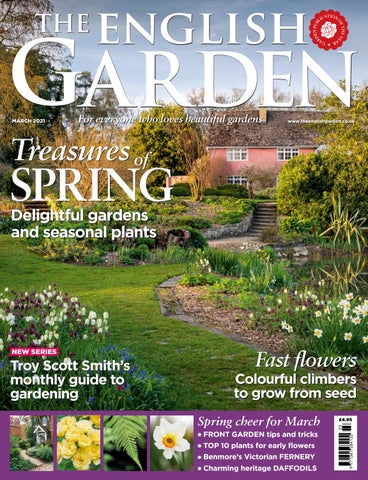
THE
english
GARDEN MARCH 2021
For everyone who loves beautiful gardens
www.theenglishgarden.co.uk
Treasures of
SPRING Delightful gardens and seasonal plants
Fast flowers
NEW SERIES
Troy Scott Smith’s monthly guide to gardening
Colourful climbers to grow from seed Spring cheer for March ●
FRONT GARDEN tips and tricks
●
TOP 10 plants for early flowers
●
Benmore’s Victorian FERNERY
●
Charming heritage DAFFODILS
£4.95
G R E E N H O U S E S A N D C O N S E R VAT O R I E S
www.alitex.co.uk
01730 826900
More than just a greenhouse
CONTRIBUTORS
Troy Scott Smith A gardener for over 30 years, Troy was head gardener at both Bodnant and Sissinghurst. He now combines his work at Iford Manor with writing, lecturing and designing. His new column starts on p12.
Matthew Biggs Matthew is a gardener, writer and broadcaster and a regular on BBC Radio 4’s Gardeners’ Question Time. He has a passionate interest in plant history and bulbous plants. He visits Waddesdon and Eythrope on p30.
Welcome T
he new year hasn’t got off to the most promising start, with unrelentingly gloomy news at every turn. It is easy to lose heart, in another lockdown and faced with this barrage, so I am trying to concentrate instead solely on things that cheer me up, and right now that is bulbs. The simplest things are often the most cheering: snowdrops and crocuses are peeping through the soil in my garden; in the house, a huge striped hippeastrum looks spectacular in full bloom; and I have a bowl of pink hyacinths just starting to flower as well as paperwhites on the way (they were both supposed to be for Christmas, but I was a little late planting them). This issue is full of the happy sight of masses of bulbs, too, from snowdrops in the gardens at Waddesdon Manor and at The Lyndalls, where they are joined by cyclamen and a host of other treasures, to heritage daffodil varieties and ongoing efforts to conserve them. It’s looking forward to things that keeps us going at times like these and, thankfully, we gardeners have the power to schedule future joy for ourselves simply by going outside and sowing seeds or planting bulbs. So just keep on gardening and focusing on those little things that lift the spirits when they come to fruition, grow and bloom, and we’ll muddle through. Do enjoy the issue, while keeping safe and well.
IMAGES NEIL HEPWORTH; ALUN CALLENDER
CLARE FOGGETT, EDITOR
Anna Omiotek-Tott London-based photographer Anna specialises in gardens, plants and florals. She loves finding amazing gardens to capture, like the frosty scenes at Benington Lordship on page 46.
ON THE COVER Snake’s head fritillaries, daffodils and other spring delights fill the borders at charming Fullers Mill in Suffolk. Photographed by Richard Bloom.
The-English-Garden-Magazine
@TEGmagazine
DIGITAL PLATFORMS Purchase digital editions of The English Garden for phone and tablet from the App Store for iPhones, and Google Play for Android.
englishgardenuk
theenglishgardenmagazine
MARCH 2021 THE ENGLISH GARDEN 3
TRADITIONAL WORKWEAR FOR MEN AND WOMEN
carriercompany.co.uk +44 ( 0 ) 1328 820699 Photographed by Richard Allenby-Pratt at Pensthorpe, Norfolk
For everyone who loves beautiful gardens theenglishgarden.co.uk The Chelsea Magazine Company Ltd, Jubilee House, 2 Jubilee Place, London SW3 3TQ Tel: 020 7349 3700 Email: theenglishgarden@chelseamagazines.com
Editorial
editor Clare Foggett
deputy editor Vivienne Hambly art editor Jeremy Bird
production editor Vanessa Longworth
Phoebe Jayes
editorial assistant
Advertising
Catherine Chapman Astrid Elsen Tel: 020 7349 3743; astrid.elsen@chelseamagazines.com senior sales executive Kyle Stephenson Tel: 020 7349 3715; kyle.stephenson@chelseamagazines.com advertising production allpointsmedia group account director
advertising manager
Publishing
chairman Paul Dobson
Vicki Gavin James Dobson managing director sales & create Steve Ross publisher Caroline Scott circulation manager Daniel Webb acting ea to chairman Sophie Easton chief financial officer
LEARN TO BECOME A GARDEN DESIGNER At the London College of Garden Design our aim is to provide worldclass, inspirational garden design training. Visit our website to hear how our students are creating successful garden design careers.
director of media
Online
group digital manager Ben Iskander
email and digital creative manager Jenny Choo
Production
reprographics manager Neil Puttnam
printing William Gibbons Ltd, Willenhall, UK The English Garden (UK issue) ISSN no 1361-2840. Printed in England.
Manage your print and digital subscriptions online, stay up to date with the latest issues, update your personal details and even renew your subscription with just a click of a button. Sign up at https://www.subscription.co.uk/chelsea/Solo/
SUBSCRIPTION ENQUIRIES
01858 438854
EMAIL theenglishgarden@subscription.co.uk SUBSCRIPTION OFFICE The English Garden, CDS Global, Sovereign Park, Market Harborough, Leicestershire LE16 9EF, UK. Tel: 01858 438854. Europe and Rest of World: +44 (0)1858 438854.
SUBSCRIPTION RATES UK £72 (13 issues) Overseas £84 (13 issues) NEWS DISTRIBUTION Seymour Distribution Ltd, 2 East Poultry Avenue, London EC1A 9PT, UK. Tel: +44 (0)20 7429 3667.
Our one year Garden Design Diploma and six month Planting Design Diploma were created to enable students to learn from the very best practicing professionals. LCGD students have consistently won the annual Society of Garden Designers’ prestigious ‘Student of the Year Award’ competition as well as other international awards. With classes at the Royal Botanic Gardens, Kew and short courses at RHS Garden Wisley and Regent’s University you can be sure to get inspirational teaching from worldclass designers in the heart of London. To find out about our courses at our Australian home in the Royal Botanic Gardens Victoria, Melbourne Gardens please visit lcgd.com.au
The Professional Publishers Association Member
CONTACT US © The Chelsea Magazine Company Ltd 2020. All rights reserved. Text and pictures are copyright restricted and must not be reproduced without permission of the publishers. The information in The English Garden has been published in good faith and every effort has been made to ensure its accuracy. However, where appropriate, you are advised to check prices, opening times and dates etc before making final arrangements. All liability for loss, disappointment, negligence or damage caused by reliance on the information within this publication is hereby excluded. The opinions expressed by the contributors of The English Garden are not necessarily those of the publisher. www.chelseamagazines.com: Publishers of The English Home, Artists & Illustrators, Baby, Little London, Wedding Ideas, BRITAIN, Discover Britain, Cruise International, Independent School Parent and associated guides, Racecar Engineering, Classic Boat, Sailing Today, Yachts & Yachting and Popshot.
+44 (0)1483 762955 info@lcgd.org.uk
lcgd.org.uk
LCGD Ad – Gardens Illustrated – March
MARCH 2021 THE ENGLISH GARDEN 5
March 2021
CONTENTS
SAVE
37%
The English Garden subscription PAGE 37
Gardens 20 The Lyndalls Galanthophile and passionate plant collector Stuart Donachie has an obsessive love of the new, constantly updating the planting at his ever-changing Herefordshire country garden. 30 Waddesdon These noteworthy English de Rothschild gardens were created and extended by the family over the ages, directed by famous and talented designers. 38 Fullers Mill Bernard Tickner’s former garden in Suffolk is now cared for by horticultural charity Perennial and maintained in line with its creator’s vision. 46 Benington Lordship Dating back to the 8th century and honouring its timeless landscape, this snowdrop-smothered Hertfordshire garden is refreshing its outlook.
46
55 Benmore Fernery This sensitively restored Victorian fernery in Argyll enjoys a spectacular mountainside location and is home to over 70 species of fern.
79
Design 65 Front Gardens Make your front garden a street sensation with a combination of low-maintenance planting and smart design. 95 Craftspeople At Farm Soap Co., Silvana de Soissons uses home-grown and locally sourced ingredients to produce her range of natural, ethical, plant-based soaps from a former dairy farm in Dorset.
Plants 73 Top 10 Plants Steal a march on spring by planting flowers suggested by Richard Harmes, head gardener of Myddelton House, to enjoy a dazzling early performance.
17 20 6 THE ENGLISH GARDEN MARCH 2021
79 Plant Focus Prolific breeding in the 19th century introduced masses of new daffodils, but many historic cultivars are now at risk. Louise Curley meets their guardians. 87 Climbers From Seed Conrad McCormick explores the wealth of possibility and speedy results that can be obtained when you grow annual climbers from seed. 101 William Purdom Compared to the big names of the Victorian era, Will Purdom is an overlooked plant hunter, but he nevertheless left his mark on British gardens.
9
30
Roses Taught by world expert Michael Marriott
Upgrade your gardening skills Choose from over 30 online courses and learn under the watchful eye of some of the world's biggest names in gardening.
IMAGES ANNA OMIOTEK-TOTT; RICHARD BLOOM; RAY COX; CLIVE NICHOLS; SHUTTERSTOCK; ALAMY
73 Regulars 9 This Month Our regular guide to people, gardens, events, news, tasks and nature. 17 Shopping Citrus-print gifts, plus kit to get you off to an early start with seed sowing. 107 The Reviewer The best new books on the shelves this month, plus an interview with photographer Hugo Rittson Thomas.
Taught in our friendly online classroom, where you get to enjoy inspirational lessons and easy to follow assignments you will learn the full range of skills needed to become the complete gardener. Learning with Experts is the only online course provider to offer you personalised feedback from the very best experts all from the comfort of your own home.
Buy today and start anytime at: learningwithexperts.com With over 30 courses to choose from including:
114 Last Word Gardeners must consider the elements when choosing outdoor attire, says Katherine Swift – but pockets are an essential.
Offers 37 Subscribe & Save A subscription to The English Garden makes the perfect gift.
Jacqueline van der Kloet
Annie Guilfoyle
Spring Flowering Bulbs with Perennials
Designing Small Gardens
71 Home Insurance Specialist insurance quotes for readers of The English Garden. MARCH 2021 THE ENGLISH GARDEN 7
A Place In The Garden PLANTERS
WATER FEATURES
LIGHTING
DECORATIVE OBJECTS
The Online Luxury Garden Company Located in West Sussex, UK
WWW.APLACEINTHEGARDEN.CO.UK TEL: 01403 864 866
FIRE PITS
MARCH
People to Meet
Introducing the gardeners and public figures we most admire in British horticulture
Stefan Buczacki
RECOMMENDED
Stefan’s favourite gardens
INTERVIEW PHOEBE JAYES IMAGE RGB KEW/JEFF EDEN
The horticulturist, botanist, author, broadcaster and expert witness describes his sources of inspiration and particular passion for fungi Inspiration for my books comes from three places: my head, where ideas occur to me for no obvious reason; my own garden, where I discover something new every day; and the British countryside – I’ve travelled all over the world, but I always love returning to it. I hated doing rehearsals before camera while I was a regular broadcaster and had a reputation for doing things in one take. It’s the same with writing: I like to keep ideas fresh. I’ve now written over 60 books. Ground Rules for Gardeners was an original idea as an attempt to analyse gardens in ecological terms. A fairly eminent reviewer described it as ‘seminal’. The Marmalade Pot is a powerful book and my first work of fiction. What fascinated me was that the characters took on a life of their own. It’s set in a village in Norfolk, so there are resonances from my early upbringing in the countryside. I am working on the sequel and plan to continue with novels as well as non-fiction. The problem is, there aren’t enough hours in the day! I think of myself now as a writer, although I did spend many wonderful years in broadcasting, and I also enjoy working as an expert witness
Lip na Cloiche Isle of Mull Gardens are deeply personal places. This tiny little sloping garden in the Hebrides is completely idiosyncratic. Owner Lucy Mackenzie collects seashore debris to display among her amazing plant collection here. Tel: 01688 500257; lipnacloiche.co.uk
Royal Botanic Gardens, Kew
on occasional cases, from a personal accident claim where someone had slipped on a plant to a multi-million pound crop loss. It’s fascinating work, but it comes and goes. Beneath it all I am a botanist. My undergraduate degree was in botany, and I went on to study diseases of forest trees, which are caused by fungi. Eventually I became president of the British Mycological Society and an author of the Collins Fungi Guide. Fungi are so interesting and my fellow mycologists have worked
hard to educate people on their importance. Those seeking to grow mushrooms should be persistent. If you get a growing kit, follow the directions carefully. Fungi are not as forgiving as plants. My garden in Stratfordupon-Avon has given me ceaseless joy. It was largely ruined when we got it 36 years ago, but developing it has been a pleasure. Gardens never stand still: the moment you step indoors they’re already changing. That’s the fascination and the challenge.
London A botanical treasure house. You can see more representations of the botany of the world at Kew than anywhere else on the planet. As a plant collection, it is absolutely without peer. Tel: 020 8332 5655; kew.org
MARCH 2021 THE ENGLISH GARDEN 9
MARCH
Out & About
Unmissable events, news and the very best gardens to visit this month
‘A short history of the glasshouse’ 20 March, online
Fundraising lecture on RHS Bridgewater 29 March, online Award-winning designer Tom Stuart-Smith will discuss the development of the first new RHS garden in nearly 20 years, looking at how Bridgewater was built and planted through a difficult time. In collaboration with the RHS and other specialists, Tom developed the masterplan for the entire garden, which is situated in Greater Manchester and is set to open this May. Tickets: £10. To book, visit eventbrite.co.uk
NGS Garden
Summerdale House
Exbury develops new areas to herald spring Hampshire The gardening team at Exbury have been busy developing several new attractions for visitors to enjoy from spring. The new River Walk will let walkers explore half a mile of previously hidden woodland within this New Forest garden, with information boards along the way explaining how to spot native trees. There will also be opportunities to enjoy 48 newly planted blossoming Japanese cherry trees in all their spring glory and to admire the new Dragonfly Pond and its learning zone. exbury.co.uk
10 THE ENGLISH GARDEN MARCH 2021
Cumbria This 1.5-acre, part-walled country garden at a former 18th-century vicarage shows what hard work and a passion for plants can achieve. Structure provides a framework for lush planting, while a specialist nursery next door sells auriculas, primulas and plants for shade. Summerdale House, Cow Brow, Nook, Lupton, Cumbria LA6 1PE. Opens every Saturday in March, 11am-4.30pm. Adult: £5; Child: Free. Visit ngs.org.uk to book tickets.
WORDS PHOEBE JAYES IMAGES ENGLISH HERITAGE TRUST; EVA VERMANDEL; CAROLE DRAKE; CATHRYN BALDOCK. CHECK WEBSITES FOR UPDATED OPENING INFORMATION PRIOR TO YOUR VISIT.
In this pre-recorded talk over Zoom, garden historian and illustrator Susan Campbell will provide a brief history of the glasshouse, from the cultivation of citrus fruits in 16th-century orangeries, to growing pineapples in pineries and grapes in vineries, and finishing with glasshouses of the modern day. Susan is the chair and co-founder of the Walled Kitchen Gardens Network and has written several books. Tickets: £4 members; £6 nonmembers. To book tickets or find out about other virtual lectures, visit surreygardenstrust.org.uk
MARCH
Things to Do Keep up to date in the garden with our monthly guide to the most important tasks from Troy Scott Smith, head gardener at Iford Manor in Wiltshire
Spring SOWINGS Straddling the spring equinox, March can be an unpredictable month – “In like a lion, out like a lamb”, as the old saying goes – but with the change of season comes
12 THE ENGLISH GARDEN MARCH 2021
lengthening days, a warming of the soil and a surge in plant growth with the promise of a feast of flowers to come. You may have already sown in August or September last
year the seed of annuals that you want to flower later this year. These late-summer sowings will provide you with earlier-flowering, larger plants, but now, from mid-February
to mid-May is the perfect time for annual seed propagation. Annuals complete their life cycle in a single season, flowering, setting seed and dying over a few months. They can be divided into two groups: hardy and half-hardy. Hardy annuals that we grow at Iford Manor include ammi, nigella, centaurea, atriplex, orlaya and cosmos. These are all sown directly in their flowering site in spring and then simply left to self-seed in subsequent years. Some editing may be necessary for prolific seeders such as the nigella. Half-hardy annuals on the other hand are those that would be damaged by a spring frost. These need to be sown under glass in early spring and hardened off in a coldframe before being planted out when danger of frost has completely passed. March is also the ideal time to take basal shoot cuttings of perennials including lupins, helianthus and heleniums. A healthy and vigorous 5cmlong piece removed from near the base and inserted into a pot of compost will result in plants that flower later in the season after the parent plant’s blooms have faded. There is something very satisfying about raising your own plants. The effects are not immediate, but the rewards are immensely satisfying. Iford Manor, Iford, Bradford on Avon, Wiltshire BA15 2BA. Tel: 01225 863146; ifordmanor. co.uk. Follow Troy on Instagram @troyscottsmith1
March checklist Carefully select new plants, mulch soil and plan containers Don’t forget
Choose new plants With so many plants available, it is easy to end up with a garden that looks a little like a ‘fruit salad’. When designing borders, I’ve learned to pare down my plant selection and think about the narrative of the border. Repeating white foxgloves throughout, for example, adds unity and rhythm, which can be further strengthened by echoing the same minaret shape at a different height with ‘Noble Maiden’ lupins (below).
l Finish pruning bush roses,
before their new shoots put on too much growth. Most can be cut back by half. l Divide snowdrops once
their flowers have faded to increase existing clumps. l Browse catalogues for
summer-flowering bulbs and tubers such as dahlias. l Plant seed potatoes and
onion and shallot sets, if the soil isn’t too wet and cold.
Daffodil displays
Plan container displays
IMAGES ALUN CALLENDER; ALAMY; GAP/HEATHER EDWARDS; SHUTTERSTOCK
I love the indulgence of using pots and containers in the garden, both in spring to display treasured bulbs or in summer, brimming over with generosity and flowering exuberance. They can add a dash of colour where there is none or, as at Iford, by using a narrow palette of Mediterranean plants, evoke an atmosphere of elsewhere.
I favour simple daffodils, choosing species or those that are close in appearance. I sometimes thread lightlimbed Narcissus ‘Jack Snipe’ or ‘Jenny’ through perennial planting in borders, but my preference is to scatter narcissi through grass that is allowed to grow long after they have flowered. My go-to narcissi for this are earlyflowering N. pseudonarcissus and the later-flowering N. poeticus var. recurvus (below), which is wonderfully scented.
Mulch the soil March is the ideal month to improve your soil by mulching. In preference, particularly at Iford on our thin soil, I like to add an organic mulch, such as well-rotted garden compost, leafmould, mushroom compost or spent hops. Spread the mulch in a generous layer on top of the soil – use about a barrowload per two square metres. For a nutrient boost, add a dressing of organic slow-release fertiliser first.
MARCH 2021 THE ENGLISH GARDEN 13
MARCH
Nature to Note
The wonder of wildlife in the garden and countryside this month
March HARES The frenetic behaviour of brown hares during their breeding season in early spring is thought to have given rise to the phrase ‘mad as a March hare’. It is quite hard to spot these long-legged creatures in nature since they are Britain’s fastest land mammal and don’t stick around at the sight of humans. In March and April, male hares (bucks) begin their testosterone-fuelled search for female hares (does) who have come into season. An amorous buck will chase a doe at a speed of around 40mph in an effort to mate. Often the doe does not enjoy this relentless pursuit, resulting in a boxing match between the two: the doe whips around and starts fighting with her front paws. This fast and furious display will catch your attention if you’re lucky enough to be nearby.
BLACKTHORN (Prunus spinosa)
WILDLIFE NEWS
How to identify it Mature trees can grow to a height of 7m and are densely branched with smooth black twigs. Blackthorn is one of the first trees to blossom. Delicate white flowers appear in March and April, and are later followed by toothed oval leaves that are pointed at the tip. After pollination, the flowers develop into sloes, which can be used to flavour gin. Where to find it Native to Europe and western Asia, blackthorn grows in scrubs, copses and woodland and is widely used as a hedging plant. Value to wildlife This tree provides a valuable source of nectar and
Launch of the ‘Nature Recovery Network’
14 THE ENGLISH GARDEN MARCH 2021
The UK government has launched a new initiative led by Natural England to tackle biodiversity loss, climate change and people’s isolation from the natural world. The Nature Recovery Network aims to restore protected areas across the UK and create new sites to encourage wildlife. Organisations including National Parks England and the RSPB have expressed their support for the scheme.
WORDS PHOEBE JAYES IMAGES SHUTTERSTOCK
pollen for bees due to its early flowering time. Its leaves are also enjoyed by several moth caterpillars such as the lackey and magpie, as well as by black and brown hairstreak butterflies. Birds like to nest in its dense branches and feast on the autumn sloes. Did you know? The blackthorn has long been associated with witchcraft, and witches’ wands are said to be made from its wood. The timber is certainly hardwearing and tough, which is why it has traditionally been used to make walking sticks and tool handles.
Natural Connection
THE
SALE
THE VICTORIAN MANOR, West Sussex
THE VICTORIAN TERRACE Derbyshire
THE MODERN MAGNUM OPUS RHS Hampton Court Palace Show
THE HERITAGE TRADITION 6 PLANTHOUSE Cheshire
Discover the secret of Hartley Botanic by calling 0800 783 8083 or visit www.hartley-botanic.co.uk
NOTHING ELSE IS A HARTLEY The only aluminium Glasshouses and Greenhouses endorsed by the RHS © The Royal Horticultural Society 2020. Endorsed by the Royal Horticultural Society. Registered Charity No 222879/SC038262. rhs.org.uk
‘Boscobel’ English Shrub Rose
Create an idyllic cottage garden with English Roses FRAGRA NT | CO L O UR F UL | B RI T I SH G ROW N
SHOP ONLINE at www.davidaustinroses.co.uk and request a FREE NEW ‘2021 Handbook of Roses’
SHOPPING
1
3
2
4
Head Start
Sow seed now with the help of protective growing gear to guarantee early rewards
10
9
1. Victorian garden cloche, £395. Tel: 07521 467371; clavertoncloches.com 2. Arturo Nature hanging paraffin patio heater, £27.99. Tel: 0800 1690423; wayfair.co.uk 3. Cielito 3 Ft W x 2 Ft D cold-frame greenhouse, £58.99. Tel: 0800 1690423; wayfair.co.uk 4. Seed tray tamper, £6.99.
5
Tel: 01142 338262; burgonandball.com
5. Eco Soil Blocker – Mini 4, £29.95. Tel: 03456 052505; worm.co.uk 6. Round fibre pot bulk pack,
£8.99. Tel: 01344 578000; crocus.co.uk
7. Seedlings tray, £12. Tel: 01993 845559; gardentrading.co.uk 8. Electric starter propagator,
WORDS PHOEBE JAYES. ALL PRICES ARE CORRECT AT TIME OF GOING TO PRESS.
£25.95. Tel: 0333 4001500; harrodhorticultural. com 9. Three in one folding cloche, from £44.99. Tel: 01344 578000; crocus.co.uk 10. Verve propagator insert – pack of 5, £3.27. Tel: 03330 143098; diy.com
6
7
8
MARCH 2021 THE ENGLISH GARDEN 17
SHOPPING
3
1
2
10
Juicy Fruit
Enjoy an early taste of summer with this selection of citrusthemed homeware and gifts
9
1. Vintage lemons umbrella, £149. Tel: 0800 5877645; amara.com 2. Carlotta bottle coaster, £25. Tel: 03332 401228; sophieconran.com 3. White porcelain large statement bowl, £62. Tel: 03332 401228; sophieconran.com 4. Schumacher citrus garden pillow, $275. store.lynnchalk.com 5. Lemon twig carafe, £30.49. trouva.com 6. Catcher citrus reamer, £12. trouva.com 7. Citrus hand lotion, £14. Tel: 0800 4703245; nealsyardremedies.com 8. Marmalade trio gift pack, £14.95. Tel: 020 7734 8040; fortnumandmason.com 9. Excelsa Amalfi sugar bowl with spoon, £15.23. amazon.co.uk 10. ‘Oranges et Citrons’ print, from £10. Tel: 01273 021685; rhsprints.co.uk
4
5 8
7
6
18 THE ENGLISH GARDEN MARCH 2021
The finest quality home shading solutions • Wide range of bespoke awnings, Call us today for a FREE no obligation quotation pergolas, patio roofs and glass rooms • Optional heating & Lighting • Flexible finance packages visit our website to download • Professionally installed our product brochure • 5 Year guarantee TheTerraceRoomCompany.co.uk • Award Winning products
0330 057 9666
20 THE ENGLISH GARDEN MARCH 2021
A frosty morning highlights the graceful curves of the borders Stuart Donachie created from scratch in his Herefordshire garden.
The Thrill of
THE CHASE
Galanthophile and passionate plant collector Stuart Donachie has an obsessive love of the new, constantly updating the planting at The Lyndalls, tucked away in the Herefordshire countryside, where there’s always something different to see or a new project on the go WORDS CLARE FOGGETT PHOTOGRAPHS RICHARD BLOOM MARCH 2021 THE ENGLISH GARDEN 21
C
at least made an excellent puddled lining for the new, hat to Stuart Donachie for a few minutes, and you’ll soon discover his larger ponds. When the new borders were ploughed, vast quantities of manure were incorporated, which, passion for plants – and especially together with mountains of bark mulch, has created for collecting them. “I love the thrill a nice layer of good soil to plant into. “Ploughing of the chase!” he says, when asked the borders was terrible really because it uncovered about his drive to gather together and grow certain a huge space very quickly, so every weed in the land plants. “I love trying out new things, new plantings, moved in. It meant a lot of work to begin with and and the wonderful thing about the garden is that it’s the only way to handle it was to cover it every year primarily herbaceous so you can just dig it up and with vast quantities of bark,” says Stuart. “But change it.” But then, he freely admits, “I tend to lose continually shovelling on bark in the early days has interest. I’m gratified by the new, so when I get to made a big difference.” about 20 or 30 different varieties of something I’ll Now, on an early spring morning with a light think ‘time to move on’!” touch of frost, the wider scene is one of settled It’s been 20 years since Stuart and his partner beauty, while closer up, treasures are there to be Chris Carter moved to The Lyndalls, a timberdiscovered. In the crevices between stone flags framed house set in an idyllic valley in rural just outside the house, magenta cyclamen flowers Herefordshire, spurred on by the need for a bigger hover above metallic pewter leaves, daphnes and garden when Stuart – and his plants – outgrew the space at their former home in the Cotswolds. Parts of edgeworthia fill the air with their sweet scent, while the building date back to the 16th century, and on an intricately patterned hellebores, early daffodils such as ‘February Gold’ and reticulata irises stud grass early spring morning, with the sun shining down the and borders with their subtle blooms. Clipped yew valley from the east and a light haze of mist hanging above the ponds, the landscape appears timeless, as if provides a steadfast counterpoint to the herbaceous planting. “It’s nice to have the odd thing creating it had always been like this. Not so, however: one of shadow and relief in winter,” says Stuart. the first things Stuart did on moving in was to bring Mixed throughout is one genus that Stuart has in “gigantic earth-moving machinery – a monster” to never tired of: his collection of different snowdrops create the beautifully natural garden you see today. didn’t stop at 20 or 30 but has grown to around 700. “There was a small pond up at the house, which It started slowly, “a tall one, a short one, a yellow ran down a little rill into a big hole in the field, and one, a green one, ones with thick leaves and thin every winter the hole filled up with water to about leaves”, but gradually developed into a full-blown 10 foot deep, 30 foot across. Then in summer it just case of galanthophilia. “The variety drained away and became a great big is so enormous and you realise there mass of weeds. So we did a lot of work Below The spicily scented flowers of are many, many differences between with an earth mover to rework the Hamamelis x intermedia them,” Stuart says. “And the most part where the ponds are, and with the ‘Frederic’, one of many exciting thing is that you’ve got rest I’ve tried to fit in with what was winter and early spring something right through winter. I’ll already there,” Stuart explains. stars at The Lyndalls. have snowdrops flowering The borders follow the from September and in contours of the land, December right through their positions decided by to March and April – Stuart walking in front beautiful drifts just when of a tractor and plough, you want them, at a time which followed behind when nothing else is doing turning over the soil. “It’s anything. They are a pleasing to the eye and it godsend in winter.” looks quite natural, I hope. Most of Stuart’s That was the aim: not too snowdrops are planted in formal, very relaxed.” the ground, but in aquatic While the farmland in baskets, which stop the the area enjoys beautiful bulbs being disturbed by red Herefordshire soil, moles and also makes Stuart’s garden seems to locating, lifting and sit on its own pocket of dividing the clumps, which claggy clay. “I think there’s he does in the summer a geological fault that when their leaves have runs along our garden,” disappeared, an easier task. he notes ruefully, but It also helps him keep tabs acknowledges that the clay 22 THE ENGLISH GARDEN MARCH 2021
Euphorbia characias, clipped yew and other topiary ensure the timber cottage is surrounded by greenery all year.
MARCH 2021 THE ENGLISH GARDEN 23
Hellebores and snowdrops pepper the borders with flowers and bring cheer to a chilly time of year.
24 THE ENGLISH GARDEN MARCH 2021
on the original plants as snowdrops tend to mingle and hybridise among themselves. “You can get all kinds of exciting, wonderful things,” Stuart exclaims. Seedlings he’s spotted from Galanthus elwesii ‘Big Boy’ for example, with big green splodges, or a hybrid that’s popped up between ‘Amy Doncaster’ and ‘Trymposter’, which has blended the striped green lines of the former with the green patches of the latter. Given his urge to collect, it’s apt that Stuart volunteers for Plant Heritage, the charity that aims to conserve cultivated plant varieties through its network of National Plant Collections. Having served on the charity’s council and as a trustee for many years, he’s now treasurer and newsletter editor for the Herefordshire branch. “I was gardening and collecting before I had any involvement with Plant Heritage, but I always admired what they did and they are such a good reference base when you are collecting,” he says. “It’s a very worthwhile charity that deserves support.” What next in the garden, for this self-described ‘mad collector’ and ‘project junkie’? “There’s always
Top Stuart landscaped
the ponds to take scenic advantage of the valley’s propensity to become waterlogged in winter. Above Galanthus ‘South Hayes’, one of Stuart’s 700-strong collection. Right Silver birch cast long winter shadows. MARCH 2021 THE ENGLISH GARDEN 25
Cavendish Contemporary
01747842214 | info@cavendishstone.com | www.cavendishstone.com/ellipse
The Lyndalls’ SPRING DELIGHTS Stuart’s choice cultivars have impact that belies their often diminutive size
CYCLAMEN COUM SILVER GROUP
ERANTHIS HYEMALIS CILICICA GROUP
A highly decorative cyclamen with almost entirely metallic-silver leaves.
Seek out this winter aconite for flowers a little later than those of the species.
HEPATICA JAPONICA
IRIS ‘FRANK ELDER’
Japanese hepaticas are often the most intricate, but usually need to be grown under cover rather than in the garden.
This cultivar is similar to more familiar ‘Katharine Hodgkin’, but is an even paler and more delicate shade of blue.
EDGEWORTHIA CHRYSANTHA
CROCUS HEUFFELIANUS ‘SHOCK WAVE’
A deciduous shrub bearing clusters of lightly fragrant yellow flowers in winter.
On the outside, the tips of this crocus’s pale mauve petals are tinted darker lilac.
GALANTHUS ‘GREENISH’ Fine green lines adorn this snowdrop’s outer segments and, unlike other green varieties, it’s a little less finicky to grow.
HELLEBORUS ASHWOOD GARDEN HYBRIDS These hellebores are renowned for their detailed markings and clear colours.
NARCISSUS ‘WEE DOTE’ This tiny daffodil reaches just 20cm high, its flowers combining a creamy white perianth with sunny yellow corolla.
MARCH 2021 THE ENGLISH GARDEN 27
something going on,” Stuart admits. One of his latest projects is creating paths along the stream with new snowdrop beds in terraced pockets on the banks. The idea is to raise the snowdrops from the ground so their flowers can be backlit by spring sunshine, and their scent better appreciated. He’s also just acquired a new, three-acre piece of land, for which he’s choosing trees. “An arboretum would be a grand word for some trees in the corner of a field,” he jokes, but the crab apples, berrying sorbus, colourful acers and autumn-flowering cherries he’s planning sound like a wonderful combination. “I always concentrate on having something interesting for spring and something for autumn,” he says. “You can’t help your garden looking good in June or July because so many things flower in the summer, so the principle I work on through the whole of the garden is concentrate on spring and autumn and then everything else will fall into place.” n Top left With its apple green bells, Helleborus foetidus sparkles at this time of year. Above Stuart Donachie labels snowdrops in his vast collection. Above right Colourful, self-seeded cyclamen.
28 THE ENGLISH GARDEN MARCH 2021
Immaculate COLLECTION Stuart’s advice for new snowdrop collectors Improve your soil with sand and grit, and ensure the snowdrops have some form of shade in the summer. It doesn’t need to be a tree, it can just be a geranium, so long as it keeps the soil cool.
garden for a couple of years. They
Use upturned wire hanging baskets to keep clumps safe as they emerge in spring, both from your feet as you work in the borders, and from pheasants. I’d rather trip up over them than destroy my snowdrops!
Good varieties to start a
I quarantine all my new snowdrops in the vegetable
honey fragrance. ‘Colossus’ has
can be prone to fungal disease and you don’t want that getting into the garden. It also gives them a chance to bulk up, and for you to check they are the right thing. collection include ‘Lady Beatrix Stanley’, which is really pretty and a good doer. ‘Augustus’ has petals with an almost seersucker effect, while ‘S. Arnott’ is a large, impressive snowdrop with a a predictably huge flower.
“Every single person went above and beyond to provide an exceptional service. The guys on site were fantastic and for a big job to get wrapped up in 7 days was amazing. Thank you all”. Matt Keightley
Garden Design by Matt Keightley
Come and explore our 27 acre nursery, where you can personally select your trees with the assistance of our experienced horticultural advisors.
Employer of the Year
Over 450 varieties of semi-mature and mature trees and hedging, grown in 35 to 4,000 litre AirPot containers
Supplier of the Year 2020
Grower of the Year: Nursery Stock 2008 • 2011 2015 • 2017
• ADVICE • DELIVERY • PLANTING • AFTERCARE • www.majestictrees.co.uk | 01582 843881 | info@majestictrees.co.uk Chequers Hill, Flamstead, Nr St.Albans, Herts, AL3 8ET
The Great &
THE GOOD
One of the noteworthy English de Rothschild estates, Waddesdon Manor and neighbouring Eythrope in Buckinghamshire, have historic gardens created and extended by the wealthy family over the ages, directed by a roll-call of famous and talented designers WORDS MATTHEW BIGGS PHOTOGRAPHS CLIVE NICHOLS
30 THE ENGLISH GARDEN MARCH 2021
The lush parkland surrounding Eythrope is studded with white snowdrops in late winter and early spring.
MARCH 2021 THE ENGLISH GARDEN 31
T
he showcase gardens developed by Baron Ferdinand de Rothschild and his younger sister Alice on adjacent estates in Buckinghamshire are the foundations of the spectacular Waddesdon Manor and Eythrope gardens we know today. “In 1874, Ferdinand bought around 2,700 acres from the Duke of Marlborough to create his own country estate,” explains garden historian Dr Sophie Piebenga. “He employed Hippolyte Destailleur to design the manor house in the style of a 16-17th-century French chateau and Elie Lainé to lay out the garden. They had already worked together on the restoration of Vaux le Vicomte.” Once established, Ferdinand bought the estate next door and immediately transferred ownership to his younger sister, ‘Miss Alice’, who employed George Devey to design a house for her by the River Thame at Eythrope. She never moved in. Advised by her doctor not to spend nights there due to bronchial problems, she used it as a daytime pavilion, spent nights at the manor, and wintered at her house in Grasse in the south of France. When Ferdinand’s wife died in 1865, his younger sister became his host and companion. Alice was a passionate gardener and, with the help of head gardener George Frederick Johnson, brought style and finesse to the gardens. She was very exacting, demanding that everything – from bedding plants to fruit and orchids – be grown in vast numbers, to perfection. The gardens became renowned for their colourful, large-scale shrub combinations, massed rose beds containing hundreds of plants and strawberries in pots under glass, in their thousands. Extravagant bedding schemes decorated the parterre. It was Alice who pioneered the technique of creating sculptures 32 THE ENGLISH GARDEN MARCH 2021
Above Long-stemmed Galanthus ‘Limetree’ is a good choice for cutting, says Suzie Hanson. Right Pretty drifts of snowdrops colonise a bank alongside a lake. Below The tiny winter flowers of Cornus mas. Bottom Great sheets of white in the parkland below the boughs of stately, mature trees.
IMAGES WADDESDON IMAGE LIBRARY
with plants, a style of three-dimensional bedding that was widely adopted by the parks departments of Britain. Alice was in total control. Her cousin, Lady Constance Battersea (1843-1931) noted: “Alice reigns absolutely, there is nothing constitutional about this monarchy. No wonder the Queen [Victoria] has named her ‘The All Powerful’... She was most precise and punctual in all her habits, visiting daily her gardens, glass-houses and farm… and never resting until perfectly satisfied. No detail, however small, escaped her notice.” Sophie agrees: “Her standards of perfection were demonstrated when Lady Warwick arrived late one night as a torrential storm was flattening the bedding plants in the parterre. By
Above Alice de Rothschild. Right Dorothy de Rothschild.
MARCH 2021 THE ENGLISH GARDEN 33
the time she awoke the following morning, they had already been replaced by an army of gardeners.” While overwintering in Grasse, Alice wrote to Johnson several times a week, detailing exactly what he should be doing. Her attention to detail was evident everywhere. “There are records in the archives of vast volumes of the soil in the kitchen garden at Waddesdon being replaced with some from the nearby village of Brill, because she felt that the existing soil made the fruit too acidic,” Sophie notes. “Jam made from the best fruit was marked no. 1; second class jam was given to friends.” When Alice died in 1922, her great nephew James and his wife Dorothy inherited both estates. On bequeathing the Manor to the National Trust, Dorothy moved to Eythrope, reviving the Victorian kitchen garden there and breathing new life into the garden at Waddesdon with her friend, the garden designer Lanning Roper. Lord Rothschild and Lady Rothschild (Jacob and Serena) followed in 1988. They engaged another garden designer, Mary Keen, employed Sue Dickinson as head gardener and handed them a brief to turn Eythrope into a ‘Rothschild-quality’ garden once again. Lady Serena, Mary Keen and Sue Dickinson loved snowdrops, so one of the projects was the development of a collection within the woodland garden. “The first ones were planted in 1991, and these are now added to annually with purchases from specialist nurseries. Bulbs have also been gifted by notable galanthophiles like Richard Nutt, Bill Baker and Mrs Merton of The Old Rectory Burghfield, who bred and selected their own forms,” explains Eythrope’s current head gardener Suzie Hanson. In 2010, Galanthus elwesii ‘Mrs Macnamara’, an early-flowering snowdrop that began life as a clump of six bulbs, a gift from Mary Keen, was one of the first groups to be lifted and divided. “Some were replanted in the same area, others were moved to new locations where they have multiplied and are now established in large numbers; the collection is always expanding,” says Suzie. Most are in rough grass by the river, where desirable ‘Magnet’, ‘Limetree’ and ‘Ophelia’ have naturalised under mature trees. Robust varieties like ‘Magnet’ have been planted in the parkland beyond and the kitchen garden orchard is now embellished with Galanthus nivalis and double-flowered G. nivalis f. pleniflorus. “We select snowdrops for their interesting shapes rather than fine detailing and order annually in 34 THE ENGLISH GARDEN MARCH 2021
This image A snowdrop
island, complete with an urn, makes for an intriguing feature. Below Elegant flowers of Lonicera elisae, a rare species of winterflowering honeysuckle. Bottom Snowdrops cluster around a grotto.
As the snowdrops fade the trees will burst into leaf, reflected in the river’s calm waters.
MARCH 2021 THE ENGLISH GARDEN 35
Above ‘Atkinsii’ is known mid-January, buying for its scent and size. a maximum of three Right Shrubs, hellebores of each kind. They are and snowdrops mingle planted in a nursery in borders by the house. Below Robust ‘Magnet’ bed inside the kitchen is a good choice for garden to increase the growing through grass. numbers, then planted out in the woodland garden,” Suzie explains. In 2020 there were 13 new introductions, bought as single bulbs, among them: tall, elegant ‘Honeysuckle Cottage’; ‘Pagoda’, whose curved petals reflect the name; ‘Sentinel’, which is vigorous with large flowers; and the oddly named ‘Wasp’, whose moving flowers, with wing-like, elongated petals, suggest an insect hovering over the clump. But it is not just about developing a collection of such connoisseur cultivars. In spring 2019, 83,000 Galanthus nivalis and G. nivalis ‘Flore Pleno’ were planted in a grove of lime trees on the main route around Waddesdon Pleasure Grounds as a tribute to the late Lady Serena; 1,000 for each year of her life. It took 25 staff, nine days to plant 83 crates of bulbs ‘in the green’, massed in groups of 50, to create a naturalistic style. Mary Keen’s daughter, Alice Oswald, wrote several poems while working as a gardener at Eythrope. Several of them are written on individual slates, mounted on the walls of the passage leading to the Kitchen Garden. Given the flower’s historic association with lady gardeners at Waddesdon, it’s no surprise that one poem is entitled ‘Snowdrop’. n
Waddesdon Manor, Aylesbury, Buckinghamshire HP18 0JH. Up-to-date visitor information for both Waddesdon and Eythrope can be found at waddesdon.org.uk and booking is essential. 36 THE ENGLISH GARDEN MARCH 2021
White MAGIC Suzie Hanson’s top tips for growing snowdrops Snowdrops are happy anywhere in shade and will tolerate most soils, apart from the heaviest clay or the sourest acid conditions.
until the foliage has started to die
These are hungry plants and will appreciate the application of an annual dressing of bonemeal and leafmould in autumn.
planter, replace the bottom half of
back. Protect the leaves from slugs. When naturalising snowdrops in grass, take out a core with a bulb the core in the hole, put the clump on top and crumble the soil around it. Alternatively, cut a T shape with
Lift and transplant snowdrops ‘in the green’ after flowering and before they die back, planting at three times the depth of the bulb.
an edging iron, fold back the turf,
New clumps should contain somewhere in the region of five bulbs. Do not let the soil dry out
perfect for naturalising, ‘Atkinsii’ is
then plant at the junction of the T with the foliage above ground. ‘Magnet’ and ‘Mrs MacNamara’ are good for fragrance and ‘Limetree’ makes an excellent cut flower.
Enjoy every issue delivered straight to your home SAVE up to
37%
FREE
y deliver Subscribe to The English Garden and receive
13 issues from just £39.95 plus FREE welcome gift* Available exclusively to our subscribers, these strictly limited-edition The English Garden secateurs by Burgon & Ball are presented in a beautiful box.
The English Garden is a glossy, inspirational magazine for everyone who loves beautiful gardens. Every issue brings Britain’s prettiest gardens to life through glorious photography, expert planting advice and inspirational design. Special benefits for The English Garden subscribers: ●
Every new subscriber receives a FREE welcome gift*
●
All subscriptions include FREE delivery
● *Gift offer applies to UK annual Direct Debit orders only.
Never miss an issue and SAVE up to 37% on the shop price
“The English Garden is a constant reminder of the beauty of English gardens.” Alan Titchmarsh MBE
Subscribe now
Order online: www.chelseamagazines.com/CTEGQ121 Or by phone: +44 (0)1858 438833 quoting CTEGQ121 Free gift offered to UK mainland residents when paying £39.95 by annual Direct Debit only. Unless you request otherwise, gift subscriptions will commence with the next issue. Your free gift will be posted within 28 days of the receipt of your order and will arrive independently of your first issue.
A view of the house, garden and pond at Fullers Mill takes in spring bulbs such as snake’s head fritillaries and daffodils.
38 THE THEENGLISH ENGLISHGARDEN GARDENMARCH MARCH2021 2021
Faith, Hope & Charity Bernard Tickner’s former garden at Fullers Mill in Suffolk is now cared for by horticultural charity Perennial and maintained in harmony with its creator’s vision WORDS BARBARA SEGALL PHOTOGRAPHS RICHARD BLOOM
MARCH 2021 THE ENGLISH GARDEN 39
T
Below left Annie Dellbridge has been head gardener at Fullers Mill for over a decade. Below middle Pink buds open into paler flowers on deciduous Viburnum carlesii ‘Charis’. Below right Covered in delicate spring blossom, Magnolia x loebneri ‘Leonard Messel’.
he bumpy track that leads to Fullers Mill doesn’t prepare you for the awakening spring mix of connoisseur’s plants that spills from the brimming borders, nor for the mists and shapes that rise from lake and stream. Over the course of 50 years, plantsman and head brewer of the Greene King brewery, Bernard Tickner (1924-2017), transformed a wild and untamed sevenacre site deep in the forest at West Stow, Suffolk, into a magical, secluded haven for plants and wildlife. The garden he created has overflowed into the spaces alongside the twin watercourses of the River Lark and the Culford Stream that meander gently by. Nestled snugly at the end of a track in the Kings Forest, the original small garden set around a former fuller’s cottage, is full of plants, both unusual and commonplace. Bernard renovated the cottage extensively in the 1960s, and slowly but surely filled the garden with choice trees, shrubs, bulbs and perennials. First and foremost, he chose species plants rather than what he considered to be blowsy, flouncy hybrids. But inevitably he let things evolve, allowing some leeway, depending on a plant’s attributes. Since he was red-green colour-blind, plants had to offer him more subtle pleasure beyond vibrant flower colour. For Bernard, an interesting plant was interesting for many reasons. Leaf texture, tree bark, seedheads and shapes were aspects that attracted him to particular plants, and with those in mind he created a woodland and waterside garden that changes daily and seasonally. The views shimmer and dissolve as seasons change, mimicking the misty and watery reflections found in the waters of the Culford Stream, the River Lark and the Mill Pond, which add character to the planting.
As he worked his way outwards from the house, Bernard improved the land, digging out curved beds for planting and putting in sinuous paths. He was insistent that there should be minimal hard landscaping, with no statues and no straight lines. He felt that curved barked, gravelled or grass paths that followed the shapes of the beds enhanced rather than detracted from the natural world. He acquired more land as his enthusiasm for plants grew. He had strong ideas and was clear that he wanted the garden to evolve, rather than being created as a designed space. He didn’t start with a plan, but it must have been hard work over a long period of time, transforming the site from woodland scrub into a garden filled with such choice plants. As is the case at any garden, Fullers Mill comes to life in early spring, and for head gardener Annie Dellbridge this is an extra-special time of year.
“Walking around is always interesting as there are exciting plants at every turn, but in spring it is like greeting old friends you had almost forgotten were there,” she explains. “Some announce themselves with unfurling foliage, others with sensational perfume that hangs in the early-morning air.” Annie has been at Fullers Mill for the past decade, and with her team of gardeners and volunteers is able to interpret Bernard’s thoughts about the garden and how he hoped it might develop over time. In 2004, Bernard and his wife Bess donated the garden to The Fullers Mill Trust to manage and ensure its future. In January 2013 the Trust gifted the garden to Perennial, the charity for people in horticulture. At that stage Perennial had just one garden in its portfolio: York Gate, in Leeds. Fullers Mill and York Gate have now been joined by The Laskett, the garden created by Sir Roy Strong in Herefordshire.
Above The lake was de-silted when Perennial took over the garden, and a new, safer bridge installed; candelabra primulas, darmera and skunk cabbage will soon fringe its banks.
MARCH 2021 THE ENGLISH GARDEN 41
SPRING STARS at Fullers Mill Delicate seasonal blooms turn heads from March as this Suffolk garden quietly awakens
HYACINTHOIDES ITALICA The Italian bluebell has starry flowers held on conical flowerheads. Order the bulbs for planting in autumn.
OSMANTHUS X BURKWOODII A leathery-leaved evergreen shrub with scented flowers in March and April.
EUPHORBIA ‘BLACKBIRD’ Gorgeous purple-tinged foliage contrasts beautifully with zingy lime-green flowers in late spring.
42 THE ENGLISH GARDEN MARCH 2021
ANEMONE BLANDA ‘WHITE SPLENDOUR’
EUPHORBIA AMYGDALOIDES VAR. ROBBIAE
Ideal for naturalising in areas of sun or dappled shade for drifts of white.
Excellent groundcover for the dry soil beneath large trees, flowering in spring.
PRIMULA DENTICULATA
ORNITHOGALUM NUTANS
Drumstick primulas can be relied on for bright colour in spring. Grow in moist, well-drained soil in sun or light shade.
Plant this attractive bulb in light, freedraining soil in autumn for sprays of silver-grey blooms in spring.
FRITILLARIA VERTICILLATA
MAGNOLIA X LOEBNERI ‘LEONARD MESSEL’
Slender stalks bear nodding, pale green, chequered, bell-shaped flowers.
Pale pink flowers become star-shaped as they open on medium-sized, 4m trees.
Left Near the house, the Alpine Terrace is home to daintier specimens. Middle left Pulmonaria ‘Diana Clare’ is one of the best for silver leaves. Middle right Fronds of the shuttlecock fern, Matteuccia struthiopteris unfurl through blueflowered Scilla bithynica. Bottom Euphorbia characias seeds about in the woodland areas.
Horticultural excellence is the aim at all three gardens, which help to fund Perennial’s vital work helping people in horticulture in times of need. Each garden is maintained by a garden team and volunteers, its management evolving in conversation with individual Garden Committees, consisting of professional and practical horticulturists, working to the remit of Perennial’s trustees. Since Bernard’s death in 2017, the Fullers Mill Garden Committee has been involved, along with Annie and her team, in refurbishing and developing many areas of the garden, working to the agreed conservation management plan while keeping in mind Bernard’s views about his garden. One of the most imposing and statuesque plantings is at the furthest reach of the area known as the Top Garden, between the entrance drive and the River Lark. It’s formed from a stand of 12 birch trees, Betula pendula subsp. pendula ‘Silver Grace’, originally discovered by Bernard near to the lake. Planted around the birch, the silver foliage of Elaeagnus ‘Quicksilver’ begins to add colour in spring, before Tulipa sprengeri shows up en masse in May. Near the birch grove, rising out of the shingle, are massed groups of self-sown Euphorbia characias and mounds of Ferula communis, whose stately flower stems stand tall in summer. In the Low Garden, across the river and to the west of the Mill Pond, spring carpets of Crocus tommasinianus are followed by Anemone blanda, and later the shuttlecock fern begins to unfurl its iconic shepherds’ crook fronds. The Mill Pond itself was rescued early on in Bernard’s tenure, after it had more or less sunk into the Culford Stream. One of the first garden interventions by Perennial was MARCH 2021 THE ENGLISH GARDEN 43
to arrange for it to be de-silted and to build a new, safer bridge and walkway at its south side. In spring, candelabra primula, darmera and skunk cabbage are among the early waterside performers. Also south of the Lark are two areas known quirkily as The Inner and Outer Quandaries, where massed snowdrops are followed by the delicate, soft pink flowers of Euonymus oxyphyllus and the foliage of emerging herbaceous perennials. Two stands of bamboo, one green and the other yellow, dominate the stream bank. Running alongside the Culford Stream, The Strip separates the garden from the Lake. There are future plans to open a walk around the lakes to visitors, but for the moment the view across the lake to the island and weeping willow is tantalisingly out of reach. The daily life of the garden goes on whether open for visitors or not and Annie and her garden team are fortunate to have additional help from a bevy of 30 garden volunteers. “We also have several 44 THE ENGLISH GARDEN MARCH 2021
Above left Statuesque
trunks of ‘Silver Grace’ birch in the Top Garden. Top middle Libertia peregrinans adds strong foliage shape and colour. Top right Rare species tulip Tulipa kurdica flowers in April. Above right A brick path through the Low Garden.
horticultural apprentices training here and I so enjoy passing on knowledge to the next generation of gardeners,” Annie enthuses. “I have a sense of pride that Fullers Mill and Perennial are producing wellrounded, good horticulturists for the future.” Special snowdrop open days usually take place throughout February, which give visitors a glimpse of the re-awakening spring scene. “And then,” says Annie, “By the time the garden fully re-opens in April, the garden will be in full swing.” n Fullers Mill, West Stow, Suffolk IP28 6HD. Snowdrop open days are due to take place every Wednesday in February, 11am to 3pm. Booking is essential. The garden opens from 2 April to 31 October on Wednesdays, Fridays, Saturdays and Sundays and for the National Garden Scheme on Sunday 9 May and Sunday 3 October. Check the website before visiting for updates on opening. Tel: 01284 334 396; fullersmillgarden.org.uk
Tall, stately trees filter the winter sunlight through their bare boughs, illuminating the rose garden.
LOOK Both Ways Benington Lordship dates back to the 8th century and honours its timeless Hertfordshire landscape. Yet under the fourth generation of the Bott family, this tranquil garden with historic snowdrop plantings is slowly refreshing its outlook WORDS VIVIENNE HAMBLY PHOTOGRAPHS ANNA OMIOTEK-TOTT 46 THE ENGLISH GARDEN MARCH 2021
The grounds of Benington Lordship are attached to St Peter’s church, which dates from the 8th century.
MARCH 2021 THE ENGLISH GARDEN 47
Above Yew, Euphorbia characias and box balls bring a sharp green accent to the winter landscape at historic Benington Lordship. Right Snowdrops have grown here for centuries. This dimpled variety is Galanthus ‘Diggory’.
C
andlemas bells, fair maids, Mary’s taper, Eve’s tear, white cup, white queen and snow dropper: the many regional names for snowdrops in English folklore point to their value in our gardens and churchyards when the year is on the cusp of spring and little else is bold enough to bloom. Like the Roman god Janus, the snowdrops at Benington Lordship, a seven-acre garden near Stevenage, Hertfordshire, are at once about looking back and looking forward. They mark the turn of winter to spring, but here they also signify the long history of the property and how a new generation has taken on the mantle of its custodianship. “The snowdrops look beautiful in February, especially in the wilder areas where there are lovely paths to walk along,” says Susanna Bott, who, with her husband Richard, is the fourth generation of the Bott family to live here. She suspects some of
48 THE ENGLISH GARDEN MARCH 2021
Above A Victorian addition, the neoNorman gatehouse is a striking architectural element here. Below The Queen Anne house overlooks the rose garden and dates from the 18th century.
the snowdrops in the garden have migrated from neighbouring St Peter’s church, believed to date from the 8th century. The church offers a clue to the great age of this settlement. Benington Lordship appears in the Domesday Book where it is recorded under the name Belintone. Later, following the Norman Conquest, the estate belonged to Peter de Valognes who built a defensive moated castle in the 1130s. Demolished in 1212, all that remains of the castle from this time are the earthworks of the moat and the keep, and it is here that swathes of naturalised snowdrops, mostly Galanthus nivalis and G. nivalis ‘Flore Pleno’, emerge at the end of winter. Over the following 700 years, waves of ownership brought diverse changes to this landscape. In 1700, an Elizabethan farmhouse gave way to a dower house built in Queen Anne style, which forms the basis of the Botts’ home today. In the 1830s, a neo-Norman gatehouse, folly summerhouse and curtain wall were built from the ruins of the old castle. In 1905, Arthur Bott, an engineer who enjoyed the challenge of a new project, bought the property, which by then also included stables. Intent on making a home that would reflect their status, Arthur and his wife Lillian extended house and garden using land from the surrounding park and added a walled garden in the style of the day. The couple took pride in the garden, turning the site into a classic Edwardian showpiece. Lillian was an enthusiastic watercolourist and her paintings are now an essential – and beautiful – record of her detailed, floriferous garden. “I think Lillian planted a lot of snowdrops in the Snowdrop Walk on top of the moat,” says Susanna. “They’re happy here, so they’ve naturalised but they’ve also crept around, which is what snowdrops do. There are places that were empty when my husband was a child that are now a very populated bank.” When Richard and Susanna took on the property, a century after Richard’s great-grandparents bought it, snowdrops, both naturalised and named, were a key part of the garden, which has been opening to the public since 1926. “Richard Webb, the gardener who was with us at the time, was very keen on snowdrops. He had started a collection by swapping with other galanthophiles and it was, I suppose, something that evolved over time. At the peak, we had over 200 different varieties,” Susanna recalls. “There are probably still 200 varieties, but we now only have about 50 labelled ones.” Varieties include ‘Mighty Atom’, ‘Diggory’, ‘Blewbury Tart’ and ‘Primrose Warburg’ but, as Susanna points out, snowdrops migrate – and they are eaten by mice.
“Snowdrops are happy here, so they’ve naturalised but they’ve also crept around”
MARCH 2021 THE ENGLISH GARDEN 49
Borders abutting the Walled Garden contain select snowdrop varieties that come to the fore in winter.
50 THE ENGLISH GARDEN MARCH 2021
Above Susanna wanted to allow the garden setting to speak for itself. Left Galanthus ‘Magnet’ is one of the dominant snowdrop varieties here, with large flowers held on long pedicels. Below Clipped yew ‘bobbles’ give structure to the garden rooms close to the house.
“We were very lucky that Richard was so keen on the snowdrops, but when he left, we decided to take a different tack. It’s an extremely specialised area, so I’m consolidating the very distinctive ones and being a bit more selective about what we showcase. The galanthophiles will see what they want to see.” Although they had help from Richard’s mother when they first moved in, the pair didn’t have time to manage the garden as intensively as it had been at earlier points, so they have had to think carefully about the kind of garden they would like, while making sure it will continue to pay its way. Over time, Susanna grasped the proverbial nettle, removing thuggish plants and turfing over older borders to allow the landscape to speak for itself. Julie Wise, whose own garden at Rustling End in Hertfordshire is well-known, has been instrumental in helping Susanna establish a more streamlined design that can be managed easily. “The site is so beautiful that you don’t want too much labourintensive activity going on,” says Susanna. “The calmness of the view and the simplicity of the planting give you something quite restful. Well, that’s the theory. It’s always slightly less restful for those of us who live here and keep thinking: ‘Oh! Look at that which needs doing.’” The first major task was to refresh the rose garden, on which work began in 2016. Julie and Susanna improved its proportions to better suit the imposing scale of the house. They introduced height with weeping pears (Pyrus salicifolia ‘Pendula’) and structure with Yorkstone paving, box hedging and what Susanna calls “yew bobbles”. Then they removed woody lavender and replaced the elderly, somewhat sickly, mauve and apricot roses with beds of Rosa ‘Kent’. This white, lightly scented, groundcover rose is repeatflowering up to the first frosts. “You don’t have to deadhead it all the time; you just chop it back when you feel like it,” says Susanna. Perennial species tulips also grow here now, including Tulipa ‘Little Star’ and T. humilis ‘Persian Pearl’, along with Iris reticulata ‘George’. “I did plant other tulips, but it was a bother having to redo them and deal with the dead foliage. It was a bit of a nightmare, so we’ve gone back to the original plan with species tulips. Hopefully this will be much better,” she explains. Herbaceous borders, too, have come under scrutiny. “They’re massive and we’ve really started to be a bit more brutal with them,” says Susanna. They’ve cut back or dug up dominant plants, flowed through Miscanthus sinensis ‘Ferner Osten’, planted more perennial tulips such as ‘White Triumphator’ and added Allium ‘Globemaster’. The sense was that
“The calmness of the view and the simplicity of the planting give you something quite restful”
MARCH 2021 THE ENGLISH GARDEN 51
Far left With its rich
golden ovary and stem, G. ‘Primrose Warburg’ is a stand-out variety. Left In winter, snowdrops bloom in some of the long borders that Susanna and Julie have been streamlining. Below Shadows fall on the old moat, dating from the 12th century, where snowdrops have slowly naturalised.
KEEP IT simple Susanna Bott’s good ideas for streamlining a garden Choose good plants There is such a wonderful palette of lovely things to choose from. Have something that you like and that looks good when it’s coming up, when it’s flowering and when it’s going down. If it doesn’t work well, it goes. If it doesn’t behave well, it goes. Invest in mulch This is money well spent in my opinion. It improves the soil, keeps in water and reduces weeds. Be disciplined In terms of border design, I think less is more and the effect is more lovely if you limit your palette. It disciplines you if you say to yourself: ‘I can only have two new plants, they’ve got to perform, they mustn’t be thugs and can’t demand too much attention.’ Work with nature I take the view that we’re very much working with nature, not against it, so in the wilder areas of the garden, what will be will be. 52 THE ENGLISH GARDEN MARCH 2021
it was better to refresh the borders and to include more structure than to pull everything out and start again. “I hope that if we carry on like this for a few years, it will come together over time.” The Bott’s main project with Julie has been in the Edwardian walled garden, which is still in development. Like many walled gardens that no longer need to produce the quantities of food and cut flowers once required of them, this was underused. Hornbeam hedges and two meadow beds sown with a wildflower mix created by Julie now feature. “Julie is a naturalist and absolutely understands what works in a place, so we’ve done a careful mix. We’ve also planted thousands of bulbs in there, with a lot of crocus and camassia,” says Susanna. The pair have planted Narcissus pseudonarcissus, the quietly understated, lemon-yellow native species. On a shady side of the walled garden, there is a new arrangement that Susanna hopes will be a winter bed in which to showcase the named varieties of snowdrop, along with hellebores, Iris reticulata and some cyclamen. “We’ve managed to consolidate a lot,” she says, “and in a year it’s going to be great. It’s very simple, but it’s got year-round interest and the whole point is that it’s very low maintenance.” Elsewhere, Susanna has put in other earlyflowering plants such as aconites and more cyclamen, which catch the sunlight and add
A winter bed will showcase the named varieties of snowdrop, along with hellebores cheer on a sunny February day. “But the snowdrops are so pretty. What’s lovely is that as soon as they’re over, spring is really here. Things are waiting in the wings and I just love that.” n Benington Lordship Gardens, Benington, Stevenage SG2 7BS. Tel: 01438 869668; beningtonlordship.co.uk. Julie Wise, Wise Planting and Design. Tel: 01438 821509; rustlingend.com
Create your perfect garden with fine quality stonework, hand crafted by Haddonstone Call 01604 770711 Visit haddonstone.com
54 THE ENGLISH GARDEN MARCH 2021
Fern FEVER
The creation of an avid Victorian collector, sensitively restored Benmore Fernery enjoys a spectacular mountainside location on the Argyll coast and is home to over 70 species of fern, curated by Peter Baxter WORDS LOUISE CURLEY PHOTOGRAPHS RAY COX
The restored Victorian fernery at Benmore Botanic Garden houses and conserves ferns from around the world.
MARCH 2021 THE ENGLISH GARDEN 55
T
he burgeoning middle classes, scientific advances and plant discoveries of the 19th century resulted in an unprecedented interest in the natural world. ‘Fern fever’, or pteridomania as it became known, gripped the country, with these beautiful but often understated plants becoming the inspiration for Victorian design, ranging from textiles, pottery and glass to stone and metalwork. They also became a must-have for plant collectors, and the advent of the railways combined with a plethora of articles and books about ferns spurred thousands of amateur botanists to head off on fern forays into remote countryside, where they’d risk life and limb climbing rocky outcrops and descending steep, slippery gorges in search of additions to their collections. The craze led to accidents and even fatalities, and over-collecting caused some ferns to become extinct in the wild. A further development that fuelled the interest in growing ferns was the Wardian case, a sealed, glazed container designed by Dr Nathaniel Ward in 1833. 56 THE ENGLISH GARDEN MARCH 2021
Above Climb paths to Benmore’s ‘Tasmanian Ridge’ for a view of the fernery and its beautiful glass roof from above. Left Doodia media, the common rasp-fern, has red-tinged new fronds. Below Australian fern Microsorum pustulatum.
Elegant tree fern Dicksonia squarrosa dominates the planting in the upper, lighter levels of the fernery.
MARCH 2021 THE ENGLISH GARDEN 57
Top left Blechnum nipponicum is good in shady woodland spots. Top right Epiphytic fern Pyrrosia lingua. Middle right Small tree fern Dicksonia fibrosa needs frost protection. Bottom right Garden fern Blechnum chilense. Bottom left A gulley just outside the fernery.
58 THE ENGLISH GARDEN MARCH 2021
Right Just over a decade Ward was a fern lover ago the fernery was but struggled to grow restored, using steel them in the polluted where there had been air of East London timber for longevity. Below right The leathery until one day when, fronds of Blechnum by chance, he spotted palmiforme. a tiny fern growing in Below left Benmore’s a glass bottle where curator, Peter Baxter. he was watching the development of a moth chrysalis. He concluded that the conditions inside the bottle were conducive to fern growing. His invention became famous because it meant that plants being transported across the world, at that time on gruelling long journeys by sea, had a much greater chance of survival in an environment where they didn’t dry out and the humidity was constant. Wardian cases with ferns inside also became popular in drawing rooms across the country, but wealthier Victorians could indulge their obsession on a significantly larger scale with a fernery – a greenhouse dedicated to these plants. Benmore Fernery, now part of Benmore Botanic Garden in Argyll on the west coast of Scotland, was built for James Duncan, a sugar trader and refiner, in the 1870s. Unfortunately the building fell into decline in the early part of the 20th century and, as the roof disintegrated, many of the ferns exposed to the Scottish climate perished. In 2008, however, a project to restore the structure began, and the following year this rare and historically significant building opened to the public for the first time. “It’s a unique structure because it’s set on three levels, each providing different growing conditions,” explains Peter Baxter, curator of Benmore Botanic Garden. “The lower level, where you first enter the fernery, never gets any direct sunlight, so the planting there thrives in deep shade. You then go up to the middle level where the light is filtered by the tree ferns and there’s a range of understorey plants. There’s also a small pond in this section, which was a typical feature in ferneries to provide moisture to keep the humidity stable. The pond was renovated during the restoration and here we’ve planted delicate, filmy ferns. Then you move up to the upper level where the plants can take direct sun.” Despite a lack of plans or photographs of the fernery from its Victorian heyday, the architects were able to use the remaining fragments of timber and steel to piece together what the roof would have looked like. “Historic Scotland wanted us to make sure the new roof was seen as a modern addition rather than a replica so that gave us the opportunity to design something with the same profile and the same size panes of glass but using low-maintenance, long-lasting steel rather than timber, and we were also able to include a ventilation system,” says Peter. The fernery has an elevated location, overlooking the mountains of Argyll and nestled into the side of
MARCH 2021 THE ENGLISH GARDEN 59
a rocky ravine. It has a church-like presence with its impressive stone gable end soaring high above a natural gulley where a path snakes up to the entrance through massed plantings of Osmunda regalis, the royal fern, alongside other native British ferns, some more exotic specimens and perennials and shrubs chosen to complement the ferns. From paths that climb up to the Tasmanian Ridge, there’s a view over the magnificent vaulted glass roof, and here stands of the hardy tree fern, Dicksonia antarctica, will create a dramatic sight when mature. Inside the fernery, specimens such as Pyrrosia lingua emerge from planting pockets in between moss and algae-covered rocks, crevices in walls, and creep across the ground. Larger ferns, such as Woodwardia unigemmata form cascading mounds, while majestic Dicksonia squarrosa, a tree fern from New Zealand, towers above the rest, the delicate tracery of its fronds silhouetted against the sky. In Duncan’s day the fernery would have been heated. “Although this would have allowed him to grow tender ferns, it must have been quite an operation to haul coke up to the building to heat the boiler,” Peter remarks. Rather than permanently heating the fernery, the gardening team now use a propane heater during the winter months, but only to keep the temperature from dropping below -2ºC. “We chose ferns that could cope with a bit of frost and we wanted a diverse range from Japan, China, the Himalayas, both North and South America and New Zealand. Most of the plants came from the Royal Botanic Garden Edinburgh, where we have a very gifted fern grower. Once the planting was complete we had over 70 different species in the collection,” says Peter. “Whether you’re a fern lover or not, the idea was to create something that would wow the visitor.” To keep the collection in tip-top condition the gardening team use chicken manure as a fertiliser and mulch with composted bark. “We try not to walk on the root zones of the plants because we don’t want to compact the soil,” Peter explains. “The ferns require an open, airy growing medium, so if we need to get in among them we’ll position stones in the beds and step on these instead.” This magnificent building was originally built at a time when little thought was given to how plants were acquired and the impact of this on the environment. However, its restoration means it has now become a safe haven for ferns, where they can be conserved for future generations. n
“The fernery has a churchlike presence, its impressive stone gable end soaring high above a natural gulley” Top left The royal fern Osmunda regalis is known for its bronze, spore-bearing fronds. Top right Young fronds of hardy Woodwardia unigemmata are an attractive rusty-red. Left The lush green path leading to the fernery.
Benmore Botanic Garden, Dunoon, Argyll PA23 8QU. Currently open to visitors, but a time-slot ticket must be booked online in advance. Check the website for updates. Tel: 01369 706261; rbge.org.uk 60 THE ENGLISH GARDEN MARCH 2021
FREE DELIVERY
THE TOOL YOU NEED
WINNER OF THE GREEN THUMB AWARD RootSlayer is a unique, multi-functional tool, this 6 in 1 carbon steel spade allows you to complete a multitude of jobs in your garden such as, digging, sawing, cutting, slicing, moving and raking surfaces.Its serrated edges allow you to cut through roots and stumps more quickly and easily, its sharp blade making the job faster. The 360° handle is comfortable and helps with precision and movement. Available on www.rootslayer.uk @rootslayerfr @RootSlayerfr
www.rootslayer.uk
e im t y an 2 n 2 e ak e 20 t e un nb eJ a c or ize bef r P
WIN A GREAT BRITISH HOLIDAY Your once-in-a-lifetime trip includes: ● Free international flights (if applicable) ● One-night London stay ● Two-night stay in Edinburgh ● Visit to Edinburgh Castle ● Tickets to Blenheim Palace ● A night in a Cotswolds hotel ● West End tickets with dinner
Enter our competition for your chance to win a holiday in Britain for two worth up to £5,000, including free international flights What would your dream holiday to Britain include? A five-star stay in London and tickets to a West End show? A trip to historic Edinburgh? How about a stay in the Cotswolds, including a visit to one of Britain’s finest stately homes? Well, with our Great British Holiday competition, you can win all of this and more. London luxury Starting with free flights (for overseas entrants), the winner and their guest will travel to London for a luxury one-night stay at the Athenaeum, a five-star hotel in the heart of Mayfair – just a short stroll from Buckingham Palace, Piccadilly
62 THE ENGLISH GARDEN MARCH 2021
Circus and the Royal Parks. Your visit will also include tickets to a top West End show of your choice, with a lavish three-course meal with wine at Prezzo to make your night one to remember. Historic Edinburgh Next, our winner and their guest will head to Edinburgh for a stay at the luxury Radisson Collection Edinburgh, located on the famous Royal Mile, with stunning views of the Old Town. During your stay you’ll visit the iconic Edinburgh Castle, followed by a special three-course dinner.
The charming Cotswolds To conclude your trip, it’s time to escape to the countryside to visit one of Britain’s finest stately homes and the birthplace of Winston Churchill: Blenheim Palace. Accommodation for the night will be at Minster Mill, a glamorous and luxurious hotel on the banks of the River Windrush in the historic village of Minster Lovell. After a full English breakfast, you can take advantage of the hotel’s top-class facilities – from its spa to its croquet lawn – or explore the idyllic Oxfordshire Cotswolds, home to some of England’s most beautiful villages.
Two annual tickets to Blenheim Palace, one of the country's finest stately homes and the birthplace of Winston Churchill. www.blenheimpalace.com
One-night stay for two at The Athenaeum, a fivestar hotel in London's Mayfair district, near Buckingham Palace. www.athenaeum hotel.com
One-night stay for two at Minster Mill, a luxurious Cotswolds hotel near Blenheim Palace. Includes breakfast. www.minstermill.co.uk
Two-night stay for two including breakfast at the Radisson Collection Edinburgh on the city's Royal Mile. www.radissonhotels.com
Two premium theatre tickets, plus a threecourse meal at Prezzo for two with wine, from Buyagift, the UK’s leading provider of experience days. www.buyagift.co.uk
Visit Edinburgh Castle, the Scottish capital's unmissable historic attraction, followed by a three-course dinner for two from go-to gift experience company Red Letter Days. www. redletterdays.co.uk
HOW TO ENTER Go to www.chelseamagazines. com/GBH2021 or fill in the coupon on the right with the answer to the question:
SEND YOUR COUPON TO: US readers: Great British Holiday Competition 2021, The English Garden, C/O NPS Media Group, 2 Corporate Drive, Suite 945, Shelton, CT 06484 UK and ROW: Great British Holiday Competition 2021, The English Garden, Jubilee House, 2 Jubilee Place, London, SW3 3TQ, UK
Question: Which famous Brit was born at Blenheim Palace? a) Isaac Newton b) Queen Victoria c) Winston Churchill
My answer: Name: Address:
✁
IMAGES SHUTTERSTOCK
Postcode:
TERMS AND CONDITIONS Closing date for entries is 31 July 2021. The winner will be announced on www.theenglishgarden.co.uk on 7 August 2021, and the holiday can be taken between 1 September 2021 and 31 May 2022, subject to availability. For full terms and conditions, go to www.chelseamagazines.com/GBH2021
Tel no: Email: Terms and conditions apply. For full details go to chelseamagazines.com/ terms-and-conditions Please tick here if you subscribe to The English Garden ■ Please tick if you are happy to receive relevant information about new products or services from our competition partners via email ■ , post ■ , or phone ■ , and/or The Chelsea Magazine Company via email ■ , post ■ , or phone ■
MARCH 2021 THE ENGLISH GARDEN 63
Stuart Garden Architecture
Classic Rose Arch and Moon Gates offer 6ft ÂŁ1995 (Inc VAT) 4ft ÂŁ1795 (Inc VAT)
Includes; Arch Four posts, Trellis Panels within arch, Moon Gates and gate furniture Installation price on request. Free Delivery (UK mainland) not including Scotland.
sales@stuartgarden.com
01984 667458 www.stuartgarden.com
FRONT GARDENS
Make the space at the front of your house as welcoming, well-planned and planted as the rest of your garden.
IMAGE MARIANNE MAJERUS
Eyes to the Front Make your front garden a street sensation with low-maintenance planting and smart design, says Arabella St. John Parker
MARCH 2021 THE ENGLISH GARDEN 65
FRONT GARDENS
W
hy do so many English houses, from Victorian villas to Betjemanesque suburban dwellings and post-war council estates, have front gardens? The answer is not difficult: they were designed to protect privacy, enhance dignity, provide a sense of spaciousness, and keep the town-dweller in touch with the sense of a rural idyll that underlies so much of the English approach to town living. So what do we see today? Car parks, dustbin enclosures, and brutal stretches of tarmac and concrete. A recent study carried out by the Royal Horticultural Society and the Universities of Sheffield, Westminster and Virginia urges the rediscovery of value in our front gardens: properly
66 THE ENGLISH GARDEN MARCH 2021
Above Keep hard surfaces to a minimum so rainfall can soak into the ground; pavedover front gardens can contribute to flooding.
Making plans Realising the value of the front garden need not require huge expenditure. The first essential is a clear design plan – a judicious selection and positioning of planting and decorative or functional elements. The second is a commitment to a realistic scheme of maintenance – “a well-tended garden can actually deter unwanted visitors,” says Tom Massey. Working with a qualified garden designer (try the Society of Garden Designers, sgd.org.uk) is recommended but if your budget is tight, planning in detail is crucial. Of course, there may be special constraints to consider. “Gardens in a Conservation Area are subject to very distinct guidelines that you ignore at your peril,” warns garden designer Rob John (robjohn. london). “They can dictate the type of brick for walls, paint colours for woodwork – even how many plants you can put in – and you may need to submit a planning application to make significant changes to the existing garden.” Then there are the common-sense horticultural considerations: how much sunlight does the garden receive? How much shade do you want to create? What about rainfall expectation, drainage and all the other practicalities of planting and cultivation? Equally important is the social dimension: how will your garden sit alongside those of your neighbours? Do you want to ‘fit in’ or ‘make a statement’? Rob John advises a sensitive approach.
IMAGES CLIVE NICHOLS; GAP/HOWARD RICE; DAVID HARBER/CLIVE NICHOLS; ELEANOR WALPOLE
treated, they can contribute to happiness and relaxation, not only in terms of our mood, but actually having an effect on cortisol levels. “They are the forgotten spaces but they can be so much more,” says garden designer Tom Massey (tommassey.co.uk) of BBC Two’s Your Garden Made Perfect who, during lockdown last year, created a wild garden at the front of his new home in South London. “They can improve our view and enjoyment from inside the house as well as from the street, and they can enable us to engage with our community and be places for learning about and sharing in nature. They can act also as wildlife corridors between houses and contribute to the greening of our towns and cities.”
Above Symmetry and
a discreet bin store, by Butter Wakefield (butterwakefield. co.uk). This image Ensure items such as this David Harber armillary sphere are secure (davidharber.co.uk). Left A pretty escallonia hedge is easy to prune.
MARCH 2021 THE ENGLISH GARDEN 67
Planting There is no such thing as a no-maintenance garden, but you can create a colourful, seasonal space that requires only occasional attention throughout the year using slow-growing, compact shrubs. Good examples include such varieties as Nandina domestica ‘Fire Power’ with its colourful autumn foliage and red berries, and the whitepink Hydrangea macrophylla ‘Miss Saori’. Add herbaceous perennials (try geraniums, wallflowers or yarrow), bulbs such as narcissus and crocosmia, picturesque alpines, herbs (lavender and thyme are classics) and hardy ornamental grasses. Front gardens can become outdoor sitting rooms, during the summer months at least – a function that has acquired additional significance from the 68 THE ENGLISH GARDEN MARCH 2021
Above Hydrangea anomala subsp. petiolaris is a characterful climber for the front of a house, with the advantage of being self-clinging.
lockdown experience. Consider enhancing this use by arranging a sunny or, alternatively, shaded corner for sitting or playing, and fragrant plants to supply comfort for you and the passer-by. Many of us absolutely need to use part of the front garden for car parking, or for storing bikes and bins, but none of these should be allowed to dominate: lining car tyre tracks with gravel and filling the rest of the space with planting can make the vehicle an element in the scene rather than the centrepiece. A sedum-roofed store set in one corner will house and hide bins and bikes. Overall, the fewer impermeable hard surfaces used in the garden the better, since these reduce the garden’s absorption capability, which can contribute to flooding. For those fortunate enough not to need car parking, why not convert the ground to a productive garden? Raised beds for salad and herb crops, or a potager-inspired layout can be useful as well as beautifully decorative. Boundaries need careful treatment. Overly high or unduly heavy hedging can become a maintenance nightmare and possibly a security risk, providing shelter for intruders. “A row of pleached trees, or even tall herbaceous planting, is to be preferred to the ubiquitous conifers,” says designer Nigel Philips (nigelphilips.co.uk). Even beech hedging, although attractive, can become overwhelming and problematic if it isn’t pruned regularly. Something for height and structure is important. Claire Vokins, of Wilson Vokins (wilsonvokins. com), recommends “a multi-stemmed tree such as an amelanchier. From spring blossom to autumn berries and fabulous structure visible in winter, it provides year-round interest and its roots are less likely to interfere with the structure of the house. Prunus serrula and Acer griseum, with their coppery bark, are valuable alternatives.” In a city environment, houses with basements may still have small, sunken front gardens and Tom Massey suggests using the microclimate to create a miniature sub-tropical scene, which will also provide pleasure when seen from above. Climbing plants and succulents can add character to walls as well as disguise functional structures such as garages, and bike or bin stores. They can also provide insulation, heating and cooling – but they come with important maintenance considerations.
Accessorise with care “The front door is an obvious focal point,” explains Nigel Philips. A stylishly designed porch (try garden-requisites.co.uk) will offer protection from the elements and shed a soft glowing light (try coxandcox.co.uk) that will help you locate the lock safely at night without disturbing the neighbours. Patterned paths are a nice way to add decorative style and draw both the eye and visitor through the space without cluttering it up.
IMAGES GAP/HOWARD RICE/LIZ EVERY; GARDEN REQUISITES; MARIANNE MAJERUS/DESIGN: SEAN MURRAY; GARDEN EXPOSURES
FRONT GARDENS
Top left Choose compact
shrubs to lower the maintenance required. Top right Paved tracks for car wheels with planting in between. This image Pleached trees increase a garden’s sense of privacy. Bottom left A smart front door canopy from Garden Requisites. Middle left Floriferous Hydrangea ‘Miss Saori’.
MARCH 2021 THE ENGLISH GARDEN 69
FRONT GARDENS
Below left Prunus serrula is a great choice for front gardens – not too big, with interest year-round. Below right Easy-going hardy geraniums. Bottom right Adding a seating area in a front garden is a friendly and engaging touch. Bottom left A greenroofed bin disguise.
attempts to settle the matter yourself first. HM Government’s ‘Over the garden hedge’ document gives guidance on how to do this and is worth reading before you plant up. Under Natural England guidance, regional planning bodies and local planning authorities must promote and contribute to the enhancement of biodiversity and local geological conservation, so bear this in mind if you need to apply for planning permission. Your local authority website should have all the details relevant to you but, in general, green roofs and walls, and new habitats for wildlife are among the things that are likely to put your planning application in a good light. n
IMAGES SHUTTERSTOCK; GAP/NICOLA STOCKEN/ANDREWMAYBURY
Here comes the legal bit Know where your land stops and that of others begins, especially if the layout is open-plan. Making it as visible as possible is essential to maintaining good neighbourly relationships. Check your property deeds and your local planning department for details of what is permissible. For example, are you allowed to put up a fence or to use planting? Trees on private land are the responsibility of the landowner in the first instance, and you must take care that they do not cause damage, disturb or affect, among other things, the privacy, light, security, access, safety or buildings of your neighbours, the street and wider community. Tree Preservation Orders (TPOs) protect trees in the interests of amenity and can cover single trees and groups of them. You may not cut them down, top, lop, or uproot them, or cause wilful damage or destruction without written permission from your local planning authority so make sure you have checked for any TPOs before you go any further. Trees that are not subject to a TPO but which are in a conservation area are protected by provisions in section 211 of the Town and Country Planning Act 1990 (find all the details about both at gov.uk/ guidance/tree-preservation-orders-and-trees-inconservation-areas#order-for-unprotected-tree). Fast-growing trees and hedges are frequent subjects of disputes. Part 8 of the Anti-social Behaviour Act 2003 covers such matters, but any complaints to your local council can be rejected if they believe that you have not made reasonable
70 THE ENGLISH GARDEN MARCH 2021
The English Garden INSURANCE OFFER
Inside or out...
make sure your valuables are protected Protecting your home, your garden and your lifestyle couldn’t be easier. Now, as a reader of The English Garden you can benefit from expert advice, a personal claims concierge service and competitive terms on home and contents cover placed through leading insurance advisers Smith Greenfield.
Here at The English Garden we understand the importance of protecting our cherished possessions and obtaining the best and most appropriate home and contents cover. This carefully researched insurance opportunity has been specially created for homeowners with valuables and contents worth more than £75,000. This can include
garden antiques, garden furniture and garden technology. It comes with many benefits that standard high-street policies do not offer, and readers of The English Garden will receive access to products only available through expert independent advisers. Equally important, any claims will be settled promptly and without fuss.
Special benefits can include: for equipment and machinery • Cover kept in outbuildings for malicious damage or theft • Cover of plants and trees
• Cover for garden furniture and statues cover if your garden is open • Liability to the public for summerhouses and • Cover non-standard properties
For a free quote or more information: Call: 020 8603 3730 Visit: www.smithgreenfield.co.uk
Adderley Travel
small group garden tours for garden lovers everywhere
adderleytravel.com
for your 2021 small group garden tour
the gardens at Dunbeath Castle, Sutherland
plankbridge.com plankbridge.com 01300 01300 348414 348414
Established Established for 20 foryears, 20 years, Plankbridge Plankbridge shepherd’s shepherd’s hutshuts are exclusively are exclusively endorsed endorsed by the by RHS the RHS
72 THE ENGLISH GARDEN MARCH 2021
© The © Royal The Horticultural Royal Horticultural SocietySociety 2020. 2020. Endorsed Endorsed by the by Royal the Horticultural Royal Horticultural Society. Society. Registered Registered CharityCharity No No 222879/SC038262. 222879/SC038262. rhs.org.uk rhs.org.uk
TOP 10 PLANTS
Matinée Show
M
Steal a march on spring by planting flowers suggested by Richard Harmes, head gardener of Myddelton House, to enjoy a dazzling early performance
WORDS VIVIENNE HAMBLY IMAGE GAP/ANNIE GREEN-ARMYTAGE
yddelton House Gardens in Enfield, North London, was the home of Edward Augustus Bowles, who lived there until his death in 1954. His influence on British gardening is enduring, evident not least in the number of plants named for him. Consider Anemone ‘Bowles’s Pink’, Crocus sieberi ‘Bowles’s White’ and of course Galanthus plicatus ‘E. A. Bowles’.
In the Alpine Meadow, snowdrops, narcissus and camassia bring soft colour to early spring, along with two National Collections of crocus. Here, Myddelton’s head gardener Richard Harmes selects ten time-honoured favourites for early flowers. Myddelton House Gardens, Enfield EN2 9HG. Tel: 0300 0030610; visitleevalley.org.uk and eabowlessociety.org.uk
1 Pulmonaria rubra ‘Bowles’s Red’ Red lungwort flowers from late winter through spring. I favour varieties with a more distinctive pattern on their leaves, but these striking coral blooms are a delight in spring when blues and yellows often dominate. It offers good groundcover to brighten up a shady spot.
MARCH 2021 THE ENGLISH GARDEN 73
TOP 10 PLANTS
2 Clematis armandi
3 Rosa banksiae ‘Lutea’
This excellent Group 1 clematis gives a terrific show of single, fragrant, creamy-white flowers in early to mid-spring. It holds onto its glossy green leaves all year, but the flowers are the real treat with this plant. Look out for pink-tinged ‘Apple Blossom’ as an alternative and take care to keep roots in cool, well-drained soil.
This rambling rose is prolific, but it is still my favourite for this time of year. It flowers in April, blooming way before most other roses. The double, primrose-yellow flowers aren’t fragrant, but they look magnificent against a wall or garden structure. We train them against the house here, just as E.A. Bowles did.
4 Chaenomeles speciosa ‘Moerloosei’
5 Akebia quinata
A very attractive Japanese quince that will bring a display of apple blossom pink-and-white flowers to all but the shadiest of gardens. ‘Moerloosei’ flowers later than others and is easy to train against a wall. It can be worth cutting back the shoots without buds by half for better flowering the following year.
Semi-evergreen, with clusters of chocolate-scented, maroon flowers, this climber can often take some time to bloom, but once it is settled it brings a worthwhile reward. We grow it along a sheltered pergola, and I adore the contrast between the colours of the petals and the much darker shade of those distinctive stamens.
74 THE ENGLISH GARDEN MARCH 2021
IMAGES SHUTTERSTOCK; CLIVE NICHOLS; GAP/HOWARD RICE/NICOLA STOCKEN
6 Puschkinia libanotica Russian snowdrops are hardy spring bulbs that are easy to establish and naturalise, very much like our own snowdrops. The flowers are best enjoyed en masse in March and April and look superb when planted beneath Betula utilis var. jacquemontii or similar, ornamental, white-barked specimens.
MARCH 2021 THE ENGLISH GARDEN 75
7 Fritillaria meleagris
8 Erythronium californicum
These curious nodding flowers are just the thing for a variety of situations, including pots. We recently began a mass planting in the arboretum, where they will eventually naturalise, but I find patience pays off with most fritillaria. Flowering is slow during the first year, but in subsequent years it can last throughout spring.
These lily-shaped flowers are something to marvel at. Also known as fawn lilies, their reflexed petals reveal fetching, cream-coloured stamens. Although they look exotic, they are surprisingly easy to grow. The large, mottled brown leaves also deserve some attention as each one has a slightly different pattern.
9 Crocus chrysanthus ‘Cream Beauty’
10 Iris reticulata
E.A. Bowles’ favourite plant was the crocus. In spring, this is evident throughout the gardens at Myddelton House, since Bowles collected over 150 different varieties. C. chrysanthus ‘Cream Beauty’ is my personal favourite because of the contrast between the creamy-yellow flowers and bright orange stamens.
This fragrant dwarf iris flowers very early in spring with rather tropical-looking flowers that have fascinating markings on the falls. They will naturalise if left undisturbed, but at Myddelton House we tend to replant every autumn. My personal favourite is I. reticulata ‘Pauline’, which has the darkest, most velvety flowers.
76 THE ENGLISH GARDEN MARCH 2021
IMAGES SHUTTERSTOCK; GARDEN WORLD IMAGES; ALAMY
TOP 10 PLANTS
®
Choice.
01386 750585 lindsay@readyhedge.com matthew@readyhedge.com
Our instant hedging is available to order in a huge range of varieties and sizes, ready-spaced in troughs or Readybags.
www.readyhedge.com
MARCH 2021 THE ENGLISH GARDEN 77
Long established as the leader in all matters horticultural and based at the historic Chelsea Physic Garden
ll
ONE YEAR GOODNOW GARDENING DIPLOMA BOOK FOR SEPTEMBER
September 2021 – June 2022 DIPLOMA COURSES
ll
ll
2015
n
n
Covers the best in planting design while training in the more serious aspects of horticultural techniques. Practical
One Year Good Gardening Diploma – A Planting Design Course sessions held at Arundel Castle under the guidance of head gardener Martin Duncan and at Sandhill Farm House, September 2015 – June 2016 Rogate. Lectures by many leading gardening personalities and regular visits to outstanding private gardens. Students also Covers the best in planting design while training in the more learn to draw up planting plans. serious aspects of horticultural (1 day a week (Tues), 10.30am–3.15pm, over three terms)techniques (1 day a week (Tues), 10am–3.15pm, over three 10 week terms).
THE ESSENTIAL GARDEN DESIGN DIPLOMA
January-March 2022 10 WEEK INTENSIVE GARDEN DESIGN DIPLOMA
Based at the Chelsea Physic Garden January – March 2016and led by Rosemary Alexander and architect Catriona Rowbotham, the course is an overview Gardenneed Design, covering all the in elements to rethink an average garden. Taking students step Covers allofyou to know thisneeded diverse subject, including by step real throughdesign site surveying, using the grid, horizontal and tuition. vertical features, layouts and planting costing TWO projects and CAD (3garden days a week in plans, school, and specification, plus drawing and homework on design and plant portfolios. Tutors are well respected in the 10am-3.15pm, plustuition 2 days homework) industry and will guide students on how to succeed in this diverse profession. (2 days a week (WedMAKERS & Thur) 10.30am-3.15pm, plus 2 days homework) GARDEN DAY October 2015 GARDENING
FOR BEGINNERS
Wednesday & Thursday 21/22 April and 5/6 May 2021
Distance Learning Courses study anytime, anywhere in to the One of our most popular courses, led by -master horticulturalist Ben Pope, which aims takeworld. each student through all 1-3 years elements to complete. the practical of caring for a garden from soil, tools, maintenance, seed sowing and propagating, weed control and pests and diseases. The first 3 days will be spent at the Chelsea Physic Garden and the final day will be spent gaining GARDEN & CARING FOR YOUR practical experienceDESIGN in Rosemary Alexander’s much praised garden near Petersfield and theGARDEN garden nearby, where Ben is Ainstep stepwill guide designing your own garden: drawing up charge. by Participants be given to a chance to prune, plant, sow seeds and regular maintenance tasks will be discussed. A light lunch and refreshments will be provided plans, hard landscaping, sitedaily. analysis, planting etc. Taught through a comprehensive course book, with projects submitted by post.
GARDEN DESIGN & CARING FOR YOUR GARDEN Distance Learning Courses study anytime, anywhere in the world
A stepping stone to a new career. These two correspondence courses are a step by step guide to either designing your own garden or learning how to plant and maintain an existing garden: drawing up plans, hard landscaping, site analysis, 1 planting, month by month tasks etc. Taught through a comprehensive course book, with projects submitted to us. 1-3 years to complete and individual assessment.
Gardening School_B634393_2mg.indd
78 THE ENGLISH GARDEN MARCH 2021
Garden of Medicinal Plants – Chelsea Physic Garden
Photo: R Alexander
© Marianne Majerus
Not sure which Diploma course is for you? We prefer potential students to attend an Information Session when Rosemary explains the Not sure which course is for you? Come along whole course content and you can seeto ourfifacilities to an Information Session nd out more. at the historic Chelsea Physic Garden. For CONTACT full details, prices visit our website JUST USdates, TO SET UP A DATE/TIME www.englishgardeningschool.co.uk www.englishgardeningschool.co.uk Email: info@englishgardeningschool.co.uk Email: info@englishgardeningschool.co.uk Tel: 020 7352 4347 Tel: 020 7352 4347
Garden of Rosemary Alexander, Principal EGS Sandhill Farmhouse, Hampshire
Long established as the leader in all design and gardening tuition and based at the unique and historic Chelsea Physic Garden
02/07/2015
PLANT FOCUS Taking on the mantle of her daffodil-breeding ancestors’, Caroline Thomson bred this yet-to-be-named narcissus herself.
Hidden Gold Prolific breeding in the 19th century introduced masses of new daffodils, but many of these historic cultivars are at risk of disappearing. Louise Curley meets their guardians PHOTOGRAPHS RAY COX MARCH 2021 THE ENGLISH GARDEN 79
PLANT FOCUS
U
p until the mid-19th century, all the daffodils growing in Britain would have been the wild species, Narcissus pseudonarcissus, immortalised by William Wordsworth. It was only in the mid-1800s, when botanists began to understand how hybridisation worked, that new forms of daffodils were created. Daffodils weren’t popular garden plants at the time; the Victorians thought of them as wild flowers, and their dainty blooms couldn’t compete with more exotic plants being introduced from abroad. There were, however, a couple of daffodil lovers who were also enthusiastic plant breeders. Edward Leeds and William Backhouse began their hybridising in the mid-19th century, building 80 THE ENGLISH GARDEN MARCH 2021
Above With nodding flowers in pristine white, Narcissus ‘Niveth’, bred by Henry Backhouse, is a lovely choice for naturalising in meadows.
up important collections, while the Reverend George Engleheart became known for his work breeding the poeticus species of daffodils. Peter Barr, a Scot who owned a nursery in London, was an early pioneer in cultivar conservation, raising the funds to purchase the bulb collections of Leeds and Backhouse when they died. Barr did much to popularise the daffodil as a garden bulb. He made perilous trips to remote parts of Spain and Portugal in search of wild daffodils and produced many new hybrids. Breeders in Cornwall were also spurred on by the booming cut flower trade, where new daffodils with large trumpets proved popular. The International Daffodil Register lists over 30,000 daffodil cultivars, but most of these are no longer in commercial production, and many of the older cultivars have been lost over time. A shortage of labourers in the Cornish bulb fields during World War I resulted in what became known as the ‘Daffodil Plague’, when hundreds of acres of bulbs rotted due to a nematode infection, and World War II’s Dig for Victory campaign meant daffodil fields were turned over to food production. Other cultivars were simply dropped by nurseries in favour of new introductions. Many heritage varieties have disappeared forever, but others could still be out there in gardens, hedgerows and parks, waiting to be rediscovered. Today there are several Plant Heritage National Collections of daffodils, whose guardians catalogue what they have, track down cultivars believed to have been lost, look after the bulbs in their care and distribute any surplus, in the hope of preserving these spring beauties for future generations. At the National Trust for Scotland’s Brodie Castle near Inverness there is a National Collection of daffodils raised by Major Ian Brodie from 18991942. “We have 116 Brodie cultivars out of some 500 he raised,” explains head gardener Ed Walling. “Daffodils are a huge part of the history and heritage of Brodie Castle.” Major Brodie was one of the greatest pioneers in daffodil hybridisation in the first half of the 20th century. Since 1982, the Trust has been trying to gather together as many of the Brodiebred varieties as it can find, and they are still coming
Top left Narcissus
‘Weardale Perfection’.
Top right Bred by Brodie,
Narcissus ‘Smyrna’.
Centre Backhouse’s
Narcissus ‘Emperor’.
This image Narcissus
‘Mrs R.O. Backhouse’.
Left Narcissus ‘Istria’,
named by Major Brodie.
MARCH 2021 THE ENGLISH GARDEN 81
GROW BETTER CROPS AND PLANTS • Strong, withstand large snow build up • Outstanding heat retention • Any length in 2m multiples
3-SEASON GARDENING TROUSERS
• 10-year UV guarantee on the cladding
Designed by gardeners for gardeners. Technical outdoor clothing for men and women packed with:
• Cladding totally eliminates shadowing
— Waterproof kneepads — Waterproof seat panel — Stab-proof pockets — Showerproof fabric
t: +44 (0) 1386 49094 | e: sales@kedergreenhouse.co.uk
www.kedergreenhouse.co.uk
Buy the best. Buy Keder. Keder Greenhouse, Newtown, Offenham, Evesham, Worcestershire WR11 8RZ
HP591_EnglishGardenMarch2021_QPAD_V01.indd 1
© The Royal Horticultural Society. Endorsed by the Royal Horticultural Society. Registered Charity No 222879/SC038262. rhs.org.uk
WOODPECKER JOINERY
30/12/2020 16:29 Genus_THE ENGLISH GARDEN SEPTEMBER 2020_129mm x 99mm FINAL.indd 1 BY APPOINTMENT TO HRH THE PRINCE OF WALES TIMBER GREENHOUSE AND COLDFRAME MANUFACTURERS WOODPECKER JOINERY UK LTD BRAMSHALL, STAFFORDSHIRE
10/07/2020 11:36
WESTERN RED CEDAR GREENHOUSES, COLDFRAMES AND GARDEN BUILDINGS
For more information Telephone: 01889 562 610 www.woodpeckerjoinery.co.uk 82 THE ENGLISH GARDEN MARCH 2021
PLANT FOCUS
Flaming FANFARE Six heritage daffodils with the pink and orange trumpets so coveted by narcissus breeders
‘GLOWING PHOENIX’
‘MERKARA’
A Backhouse cultivar with double primrose-yellow petals and a frilly orange centre.
This cultivar, bred by Sarah Elizabeth Dodgson, has creamy-white petals and a large orange cup.
‘SCARLET LEADER’
‘ROSY TRUMPET’
A large-cupped daffodil bred by Sarah Dodgson, with creamy-yellow petals and a short, orange-red trumpet.
A pretty daffodil created by Robert Ormston Backhouse with creamy-white petals and a fluted apricot trumpet.
‘DESERT FOX’
‘RED IKE’
Bred by William Ormston Backhouse, with golden yellow petals and a fiery orange trumpet.
The pure white petals and bright orange cup of this daffodil, bred by Major Brodie, make a striking contrast.
to light. Some have come from local collections, and others from as far away as Australia, where there are leads still worth pursuing. “It’s thought Brodie named daffodils such as ‘Istria’ and ‘Smyrna’, after places he visited during his military service. He and his wife loved music, especially the opera, hence the daffodils ‘Salome’ and ‘Sarastro’, and there are several with names inspired by the local area such as ‘Rosemarkie’ and ‘Invergordon’,” says Ed. Caroline Thomson, a direct descendant of William Backhouse, is the custodian of her ancestors’ Narcissus cultivars at the Backhouse Rossie Estate in Fife. “Several members of the Backhouse family were bankers and botanists from the North East of England,” says Caroline. “William was born in 1807 and his hobby from an early age was hybridising plants, with his lasting legacy being N. ‘Emperor’, N. ‘Empress’ and N. ‘Weardale Perfection’,” she explains. “His sons Henry and Robert also took an interest; Henry registered his own cultivars including N. ‘Niveth’. Robert married Sarah Elizabeth Dodgson, who was also a talented plant breeder, creating lilies, colchicums and some extraordinary daffodils, such as the pink-cupped ‘Mrs R. O. Backhouse’, which is still very popular. “When my family moved back to Fife we restored the walled garden and I wanted to connect our horticultural heritage with the rich history of the area. That’s when my mum said someone in the family should gather together what remains of the plants our ancestors created. She was worried the history and the plants were disappearing. I agreed, not realising I was taking on a lifetime commitment. The Backhouses created 956 cultivars, of which only 13 were still commercially available in 2008.” Caroline visited relatives, gathering bulbs from their gardens; spent a year researching plant catalogues and studying photographs and botanical paintings at the RHS and Kew libraries; and delved into the family history at the archives in Darlington where the family was originally from. “Serendipity has played a part, too,” she notes. “I went to visit a friend in Cornwall and I spotted a flower in her garden that looked like a Backhouse daffodil. She did a bit of research and discovered a member of the Backhouse family had, at one point, lived there.” Some daffodils have proved very difficult to find. “The breeding process for the red trumpet daffodils created by William Ormston Backhouse, took years and required multiple crosses, which created an instability in some cultivars – they don’t bulk up quickly, which is possibly why they weren’t a commercial success. We do have three red-trumpet cultivars though, including Narcissus ‘Desert Fox’.” Meeting botanist and daffodil expert Dr David Willis was pivotal. “He rediscovered N. ‘Weardale Perfection’, bred by William Backhouse, and propagated it so it is now widely distributed, not MARCH 2021 THE ENGLISH GARDEN 83
PLANT FOCUS
only in the village where William lived in County Durham, but in other gardens as well,” Caroline explains. The Backhouse daffodil collection has been accredited by Plant Heritage and contains 82 identified cultivars, with others still under review. Continuing the family tradition, Caroline has turned her hand to breeding, registering a new cultivar named after her mum, who passed away last year. The family also holds Scotland’s National Daffodil Festival every April when visitors to the estate can enjoy the spectacular sight of over 20,000 daffodils. Caroline is dedicated to curating and creating a relevant future for her family’s horticultural legacy, but growing heritage varieties goes deeper than a link with our past. They contain irreplaceable genetic material and, with the ever-increasing risk of pests and diseases and a changing climate, preserving plant collections like these may well be crucial for future generations. n
Left Narcissus ‘Empress’,
a grandparent to many modern-day daffodils. Above Major Brodie’s Narcissus ‘Rosemarkie’.
GROWING ADVICE
Propagating daffodils Caroline Thomson explains the technique of ‘chipping’ to propagate precious bulbs A good way to bulk up a favourite daffodil that you might not know the name of or be able to find in plant catalogues is by vegetative propagation of the bulbs, which is known as chipping. At the end of the summer, carefully lift a bulb from the soil. Trim any roots and remove the bulb’s papery outer skin. Divide the bulb into six equal pieces using a sharp knife,
84 THE ENGLISH GARDEN MARCH 2021
ensuring that each one has a portion of the bulb’s basal plate. Dust each piece with sulphur to prevent fungal infections. Place in a clear plastic bag on a bed of moist vermiculite, seal and keep in a warm dark place such as an airing cupboard for about 12 weeks. Each section should develop bulblets. Pot up the sections into seed trays or 9cm pots and put in a coldframe to grow on.
Brodie Castle, Forres, Moray IV36 2TE. Tel: 01309 641371; nts.org.uk. Backhouse Rossie Estate, Fife KY15 7UZ. Tel: 0844 414 5803; backhouserossie. co.uk. Check websites for updated opening details.
SUPPLIERS Croft 16 Tel: 01445 781717; croft16daffodils.co.uk Thomas Etty Tel: 01460 298249; thomasetty.co.uk Scamp’s Daffodils Tel: 07826 067175; qualitydaffodils.com
Leander Quarter Page Advert V1 (English Garden).pdf
1
29/01/2018
09:25
C
M
Y
CM
MY
CY
CMY
K
PLANT SUPPORTS & Garden Artefacts Made in England
We Make The Seats, You Make The Memories
Beautiful designs for perennials, roses, shrubs & climbers www.leanderplantsupports.co.uk Tel. 01773 550495
The only bespoke swing and bench maker licensed by the RHS
sittingspiritually.co.uk 01297 443084 Š The Royal Horticultural Society 2020. Endorsed by the Royal Horticultural Society Registered Charity No 222879/SC038262. rhs.org.uk
SI0159 English Garden 1/4 Page-March 2021.indd 1
04/01/2021 12:12
10% discount aders, for all GYO re l omotionaGreat ter prSupporting enSupporting Supporting Great British Gardens Great British British Gardens Gardens il code GYOapr
Support where it’s needed Supporting Great British Gardens
A range of beautiful hand crafted steel plant supports and obelisks designed to provide architectural structure within the garden whilst also complimenting and enhancing the plants features.
Plant Supports (UK) Ltd have the largest range of Plant Supports within the UK. All handmade in Tenbury Wells, Worcestershire. Made by Gardeners for Gardeners.
Plant Plant Supports Supports (UK)(UK) Limited Limited is(UK) a is family-run a family-run business business Plant Supports Limited isbusiness a family-run with a passion for and wesay aresay proud to say withwith a passion a passion for gardening for gardening andgardening and we are we are proud proud to to wehigh manufacture high quality we manufacture we manufacture high quality quality products products in Britain, inproducts Britain, in Britain, using British using British materials. materials. using using British British materials. materials. For details or to For details or to order order visit visit For For details details or to ororder to order visit visit
www.plantsupports.co.uk www.plantsupports.co.uk www.plantsupports.co.uk www.plantsupports.co.uk or call 01584 781578
or call 01584 781578 or call or call 01584 01584 781578 781578
Plant Supports (UK) Ltd. Skipperley, Rochford, Tenbury Wells, Worcs WR15 8SL
Plant (UK) Ltd. Skipperley, Rochford, Tenbury Wells, PlantPlant Supports Supports (UK) (UK) Ltd.Supports Skipperley, Ltd. Skipperley, Rochford, Rochford, Tenbury Tenbury Wells, Wells, Worcs Worcs WR15 WR15 8SL Worcs 8SL WR15 8SL MARCH 2021 THE ENGLISH GARDEN 85
STAN FAIRBROTHER GARDEN STRUCTURES BEAUTIFULLY HAND CRAFTED BESPOKE DESIGNS
01772 814274 WWW.STANFAIRBROTHER.CO.UK WWW.STANFAIR
Beautiful
Enhance Your Garden Space Today With Traditional Wooden Rustic Garden Furniture
Inside and Out!
All the beauty of wood but without the maintenance Griffin’s Greenhouses are handcrafted & custom built in England from profiled aluminium to resemble wood in traditional designs
www.griffinglasshouses.com or call us on 01962 772512
All of my furniture items are handmade to the highest quality from the very finest materials, and I have a wide selection of options made from sustainable woods such as Chestnut, Oak and Pine. For expert advice or for further information, call me today on mobile 07976 315984 or landline 01227 832910 Email: info@woodenrusticfurniture.co.uk
www.woodenrusticfurniture.co.uk
86 THE ENGLISH GARDEN MARCH 2021
CLIMBERS FROM SEED
IMAGE GAP/PERNILLA BERGDAHL
Lophospermum ‘Magic Dragon’, an annual climber with snapdragon-like flowers; seeds are often sold as Asarina or Maurandya.
High Society Conrad McCormick explores the wealth of possibility and speedy results that can be had when you grow annual climbers from seed MARCH 2021 THE ENGLISH GARDEN 87
CLIMBERS FROM SEED
O
ften, I dread the gift of plants from others. What if it’s something that doesn’t suit the style of my garden or, worse still, a plant I downright dislike? A couple of years ago as I left the garden of a friend, she pressed a small brown envelope labelled Asarina ‘Joan Lorraine’ into my hand. I was unsure what exactly I had been gifted. “Grow this climber and you won’t be disappointed,” she told me. Feeling like Jack of the beanstalk I duly sowed the seeds a few days later. They sprouted within a couple of weeks and grew quickly, I planted them out mid-June and by early August the first flowers appeared, each a velvety purple-blue trumpet with a flared mouth. Over the following months, the plant rampantly twined up its support to reach a height of over 2m, pumping out a tumbling, frothing mass of blooms until it was knocked back by frost. I had always been aware of annual climbers, but had never considered growing them myself. Buoyed by my success with the asarina and looking at the bare wooden fences in my relatively new garden I set out on a voyage of discovery, perusing online seed catalogues and filling my virtual shopping basket with annual climbers that were entirely new to me. Since then I have used them to cover walls, clothe bare fences and to clamber over and weave through shrubs, adding layers of colour. They can also be grown in large containers: strategically placed on 88 THE ENGLISH GARDEN MARCH 2021
Above left Cobaea
scandens, revealing the reasons behind its common name of ‘cup and saucer’ vine. Above right Pricking out Cobaea scandens seedlings to grow on.
the patio and provided with a sturdy framework that allows them to climb to heady heights, they add vertical elements among the usual suspects. I have also used them as trailing plants in tall containers, as well as in large reclaimed galvanised water tanks. When grown without support they will spill over the rim of the container, creating luxuriant swags of foliage, studded with blooms for months on end. I’ve had great success in my garden with Cobaea scandens, commonly known as the cup and saucer vine. It’s a sturdy climber easily reaching 3m in one year from a spring sowing. Climbing by tendrils, it requires support to reach heady heights, and in late summer covers itself with large downward-facing, bell-shaped blooms, each with a pronounced ruff at the base. The flowers open from creamy buds, ageing to deep purple. In their native Mexico they are pollinated by bats; here they must make do with bees. In my mild coastal garden it survived its first winter, getting a head start in its second year. Also from Mexico, Rhodochiton atrosanguineus produces unusual dangling flowers, the hanging central corolla almost black in colour, each one topped with a little, umbrella-like, purple calyx. Even after the tubular central flower has fallen, the calyx remains in place for many weeks, extending the season of colour. I’ve had best results from an autumn sowing, with the young plants overwintered under glass and planted out in June.
IMAGES CLIVE NICHOLS; GAP/JONATHAN BUCKLEY/SARAH RAVEN
Dangling Rhodochiton atrosanguineus ‘Purple Bells’ makes a delightful partnership with peach Thunbergia alata ‘African Sunset’.
MARCH 2021 THE ENGLISH GARDEN 89
CLIMBERS FROM SEED
Lablab purpureus ‘Ruby Moon’ combines pink, sweet pea-like flowers, with statement dark purple seedpods.
90 THE ENGLISH GARDEN MARCH 2021
IMAGES GAP/JONATHAN BUCKLEY; ANDREA JONES/GARDEN EXPOSURES; CLIVE NICHOLS; GARDEN WORLD IMAGES
Generally I do not mix my climbers, preferring to grow them separately, since one can easily overwhelm the other. I made an exception last year though, mixing the dark flowered rhodochiton with Thunbergia alata. Hailing from East Africa, thunbergia does surprisingly well in our northerly gardens despite its tropical origins. It’s commonly seen in shades of yellow, often with a black centre, hence the common name black-eyed Susan. Many new shades have become available in recent years, ranging through shades of pink in ‘Rose Sensation’, to the coppery, sunset shades of ‘African Sunset’, and it was the latter that combined so well with the rhodochiton in a patio container, the duo entwined on a wigwam, providing months of flowers.
Top left Thunbergia alata
‘Spanish Eyes’ clambers its way around a rustic, woven archway. Top right The dark-eyed blooms of Thunbergia alata ‘African Sunset’. Above Ipomoea lobata ‘Jungle Queen’, a fiery combination of scarlet, orange and yellow.
Lablab purpureus is an ornamental variety of the hyacinth bean, bearing fragrant, pink, sweet pea-like flowers followed by racemes of inedible, dark rhubarb-purple seedpods. In a warm summer it grows rampantly, covering structures with lush dark green foliage. However in a bad year it can sulk a little, growing slowly and being late to flower, so it’s best treated to the warmest spot you can find. Part of the fun is trialling climbing annuals on different shrubs, adding layers of interest with contrasting foliage and blooms, especially on early flowering shrubs that don’t contribute much to the summer garden. In a sheltered corner of my windy garden, Ipomoea lobata ‘Jungle Queen’ has romped up a pollarded Sambucus nigra ‘Black Lace’. Racemes of tubular flowers, looking like little chillies, erupt all over, starting out red and fading through yellow to creamy white as they mature. A relative of our native bindweed, but without its antisocial habits, the delicate filigree leaves of Ipomoea quamoclit ‘Cardinalis’ are studded with exotic trumpets of scarlet blooms. It reaches 3-4m, yet it doesn’t overwhelm, delicately clambering through its host to provide pops of cardinal red. Although common, hardy annual nasturtiums should not be overlooked. While it’s a bit of a stretch to call them climbers, they will clamber and wander over and through shrubs, or, with a little coaxing, scramble up a support. Tropaeolum majus ‘Indian Chief’ has flowers of bold red, against dark green foliage, and I’ve surprised myself by falling for ‘Purple Emperor’. Its smoky purple-burgundy flowers, fading through shades of rose and lavender as they age, aren’t my usual colour choice but where MARCH 2021 THE ENGLISH GARDEN 91
CLIMBERS FROM SEED
quamoclit ‘Cardinalis’ blooms provide pops of bright, lipstick red. Above right Tropaeolum ‘Purple Emperor’ will clamber over a support or trail from containers. Above left Silky seedheads follow the flowers on Clematis tangutica ‘Radar Love’.
92 THE ENGLISH GARDEN MARCH 2021
How to grow annual climbers Sow most climbers in March, in order to allow as long a growing season as possible, and cosset them in a warm, brightly lit spot under cover. The exception is ipomoea which I sow in late April since it grows rapidly and doesn’t like its growth to be checked. Avoid root disturbance, which most of these climbers seem to resent when young. To ensure their roots are damaged as little as possible, I sow seeds individually into modules or small pots, potting on once, if necessary, to ensure stocky growth when I plant out after the risk of frost has passed. Sow nasturtiums outdoors in situ in April or May or, if you want to
give them a head start, they can be planted out in pots indoors in March or early April, and then moved into their final position in late May. Collect seeds from climbing plants in early autumn before they’re struck by frost, storing them in labelled envelopes over winter. This ensures replacement plants the following year. Plant your climbers in a sheltered, sunny position in good soil for them to give their best. They will need support if grown against a wall, either wires, netting or trellis or, alternatively, let them clamber through shrubs or trail seductively from tall containers.
IMAGES GAP/JONATHAN BUCKLEY/FRIEDRICH STRAUSS/DAVE ZUBRASKI
I’ve allowed it to trail over the rim of tall containers it has been gratifyingly generous with its blooms in antique shades. Hardy Clematis tangutica ‘Radar Love’ is unusual: it’s a perennial plant but will produce its yellow lantern blooms in its first year from seed. I’ve let it tumble from a tall, narrow, dark grey, concrete fibre container, the yellow blooms contrasting with the slate grey of the pot. If allowed to have its head it will easily climb to 4m with support. Annual climbers are often overlooked in favour of hardy perennial and woody specimens, I count myself among those who previously considered them too much effort and too labour-intensive for something that lasts only a year. However, that stance means missing out on months of exotically intense flowers, and an astonishing ability to scale great heights at lightning speed. Give them a go this spring and you’ll be converted too. n Top left Ipomoea
GREENHOUSES UK
WALL GARDENS
IBU
COLD FRAMES ACCESSORIES
GREENHOUSES GARDEN ROOMS ORANGERIES
For more information on Vitavia or Janssens Greenhouses, contact your nearest retailer or visit vitavia.co.uk @VitaviaLtd
01473 218100
DIS TR
info@vitavia.co.uk
TO R
Nine months of flowers
rare | unusual | exciting
BUY 3 POTS JUST
£8 EACH
Odora Aureomarginata H&S: up to 1.5m
Highly Fragrant Evergreen Daphnes
Marianni H&S: up to 1.5m
A
SPECIALLY SELECTED COLLECTION of evergreen Daphnes to provide fragrance and flowers from late winter through to autumn. In our opinion this trio of shrubs is the best for glossy green foliage, heady fragrance and clusters of pretty pink blooms for up nine months each year. Odora Aureomarginata’s flowers sparkle from as early as February and through to end of spring, along with Marianni with sweetly fragrant blooms and striking variegated foliage. Last, but by no means least, Eternal Fragrance produces clusters of light pink buds in early summer and can continually flower through to October. They will cherish a sunny spot in the garden and be a joy for bees and butterflies. Hardy perennials. Your order is covered by our No Quibble Guarantee and will be confirmed together with a copy of our latest catalogue. Your 9cm pots will be delivered within 14 days.
ORDER ONLINE hayloft.co.uk NAME & ADDRESS
Eternal Fragrance H&S: 60-90cm
• BY PHONE 0333 358 2006 – QUOTE EG0321 • PLEASE SEND
ITEM CODE
PRICE QTY
1 × AUREOMARGINATA
PTDA01-EG0321
£15
1 × MARIANNI
PTDM01-EG0321
£16
1 × ETERNAL FRAGRANCE
PTDF01-EG0321
£16
COLLECTION OF 3 (1 OF EACH) SAVE £23
PTDX01-EG0321
£24
P&P (UK ONLY)
£4.95
TOTAL DUE
Postcode Tel
Please enter the last 3 digits of your security code (CV2)
I enclose Cheque/PO made payable to Hayloft Plants Ltd or please debit my Mastercard/Visa/Maestro Card no.
TOTAL
Expiry date
Start date
Issue no
CV2
SEND THE COUPON TO: Hayloft Plants, FREEPOST RTGR-JAGJ-JETG, Pensham, Pershore WR10 3HB
Your order confirmation will be sent by email along with any future special offers and you may unsubscribe at any time.
We may send Hayloft gardening catalogues in the future, if you prefer not to receive them, please call 01386 562999. Occasionally the advertised delivery date may change, however, this will be clearly stated on your order confirmation.
HAYLOFT PLANTS, MANOR FARM NURSERY, PENSHAM, PERSHORE, WORCESTERSHIRE WR10 3HB
EG0321
CRAFTSPEOPLE
Clean Living
Silvana de Soissons has taken over an old dairy farm in Dorset to launch Farm Soap Co. Here she produces her own range of natural, ethical, plant-based soaps, with a focus on home-grown botanicals and other locally sourced ingredients WORDS PHOEBE JAYES PHOTOGRAPHS CAROLE DRAKE
Silvana de Soissons in her garden, where she grows her own botanicals for use in her natural soaps.
MARCH 2021 THE ENGLISH GARDEN 95
CRAFTSPEOPLE
Above Flowerheads
including lavender and calendula are snipped from plants for drying. Above right Calendula seedheads drying for use in Silvana’s soaps.
I
n the cheese room of what used to be a dairy farm in Cheselbourne, Dorset, you’ll find curing racks stacked not with hunks of cheddar or Dorset Blue Vinny, but with petal-scattered soap bars, great orange moulding blocks and countless glass bottles of essential oils. Here, whiffs of lavender, geranium, pine and clementine have replaced the more earthy odours of fermentation and cow flank. “Saponification is the name given to the process of soap making,” explains Silvana de Soissons of Farm Soap Co., “and it’s just like cheese making. You’ve got to be very accurate.” Silvana is no slouch. Hailing from Italy but raised on farms all over Africa, she moved to England
96 THE ENGLISH GARDEN MARCH 2021
to take a degree in Economics at the University of Bath, before embarking on a corporate career in the capital where she dabbled in finance, marketing, sales and retail. After years of hard graft, Silvana decided to forge a new path, abandoning her city career to start up a food and lifestyle business in Bath. So began the very successful The Foodie Bugle, later sold to another family so she could turn her attentions to a new project at The Newt in Somerset. In this recently renovated country estate and gardens, Silvana established a farm shop where you will find all sorts of fresh produce grown on site, as well as lifestyle goods. Once her work at The Newt was wrapped up, Silvana once again moved on to pastures new – and so began the Farm Soap Co. The natural soap and skincare business went live, unintentionally on the first day that the UK went into lockdown. Luckily for Silvana, the pandemic didn’t affect sales. In fact, it was quite the opposite. As hand-washing became something of a national pastime, soap was just the product everyone wanted – along with tinned tomatoes and a lot of toilet roll, of course. The endeavour swiftly took off. “I’ve been so busy I can’t tell you!” she exclaims. “Within six months I’ve already got to move somewhere else to be able to upscale.” But the Farm Soap Co.’s success is not just down to fortuitous timing. Silvana’s enthusiasm, passion and knowledge shines through. “I did a lot of research before I invested my money in this business,” she explains, “and I’d previously worked as a buyer of
skincare products in retail. It’s shocking how many chemicals there are in most toiletries, including those meant for babies. The skincare toiletries industry is huge, and dominated by massive corporates that use chemicals derived from the petrochemical industry. Thankfully, there’s recently been a revolution in the skincare industry, which has given rise to more small, local businesses and plant-based products.” That’s exactly what you can expect from the Farm Soap Co.’s range – each product is vegan and chemical-free, made without plastic and using transparently sourced materials. In fact Silvana grows many of her ingredients in her garden, and last year enjoyed a brilliantly successful harvest due to the hot summer weather. But the keen plantswoman has plans to improve and expand on this front. “I should have started growing way earlier in the year and organised successional planting, so I’m going to get a greenhouse or a polytunnel for this growing year,” she explains. “I’m also going to have a bed dedicated to cut flowers so I can start sharing the beauty of dried flowers with my customers.” So how does Silvana make her soaps? The first step is to create essential oils using home-grown botanicals. Petals, leaves and flowerheads are steeped in locally produced base oils including almond, flax, rapeseed, borage and hemp, and left to infuse in the sun for a month. Once the plant’s properties have transferred to the oil, the soapmaking process can begin. Saponification occurs when an acid and an alkaline meet, and since oils are acidic, an alkaline substance called ‘lye’ is necessary to complete the process. This is where
it gets complicated. In order to mix the essential oils with the lye to form soap, it’s important that the two substances are at the same temperature – somewhere around 40-48°C. “I can almost make soap blindfolded now, but when you first start, it’s important to have two thermometers and to keep checking them as the liquids cool,” Silvana emphasises. “It can be a challenge to make sure the temperatures are right if you’ve got a lot of batches on the go. Then, once you’ve combined the liquids, you pour them into moulds to set overnight.” Silvana has a wealth of knowledge about the beneficial properties of plants. Her childhood was
Above Freshly harvested herbs are hung upside down from frames in the garden to dry naturally. Below left Macerated calendula oil is sieved through a muslin cloth prior to use in the soaps. Below middle Calendula petals are left to steep in a mixture of base oils. Below right Unctuous chunks of rich shea butter, a natural moisturiser, ready to be melted down.
MARCH 2021 THE ENGLISH GARDEN 97
CRAFTSPEOPLE
spent outdoors, and this is perhaps what cemented her love of all things natural. “My family grew all sorts of fruit, vegetables and herbs,” she explains, “We were usually located about eight hours from the nearest shop, so there was never any “popping out” to go and pick something up. My mum picklepotted everything.” Now Silvana concentrates on growing plants with antibacterial and antioxidant properties. There’s the geranium soap, for example, with its antimicrobial, anti-ageing properties, or the pine soap that soothes itchy and inflamed skin. The Dorset Sea Salt bar is made using salt that threebrother team ‘Dorset Sea Salt Co.’ collects on the nearby Jurassic Coast. This raw material is more of a challenge than the other ingredients Silvana works with, since sodium chloride sets quickly and firmly, creating a need for a speedy transferral of liquid into soap mould. It is worth the effort, according to Silvana: “Sea salt is one of the oldest ingredients used in spas, and it is extremely good for your skin as it detoxes, mineralises and cleanses.” Although she has created many beautifully scented products, Silvana’s personal favourite is her unfragranced soap. “It’s a good, old-fashioned soap that I can use to wash my skin, my hair and even the dog! It’s just so liberating to smell completely clean, and then I put a few drops of an essential oil like lavender on my wrists to feel calm.” Perusing the Farm Soap Co.’s online shop reveals Silvana’s natural skincare range, as well as carefully chosen products along the same lines. Customers can order a soap dish handmade in Wiltshire by Libby Ballard Ceramics, or one made in Somerset by You Are Farm. Silvana is on the lookout for talented local makers and hopes to expand her curated line to include textiles such as towels and bathrobes. Once she upscales, she wants to create further products 98 THE ENGLISH GARDEN MARCH 2021
Above left Home-
grown lavender is used for its calming and antibacterial properties. Above centre A mixture of sea salt and seaweed harvested locally from Dorset’s Jurassic Coast. Above right The liquid soap is poured into moulds to set overnight. Below The finished bars of soap, moulded into the Farm Soap Co.’s signature rounded shape.
like calendula, borage and seaweed soaps, oils for the whole body and herbal teas specifically for skincare. And if reading this has piqued your interest in the art of saponification, you may be in luck. “At some point, I would love to teach workshops,” Silvana muses. “But the most important thing for now is that every product from the Farm Soap Co. is handmade in small batches, with purpose and honesty. You cannot get purer than that.” n Visit farmsoapco.com to order products, or follow Silvana on Instagram using @farmsoapco
LIFE SIZE ANIMAL SCULPTURE LIFE SIZE ANIMAL SCULPTURE Free UK delivery Free UK delivery
www.andrewkaysculpture.co.uk www.jsgardens.co.uk 01905 381679 / 07930 576881
07740 306412 www.andrewkaysculpture.co.uk
MARCH 2021 THE ENGLISH GARDEN 99
Andrew Crace
High Quality Traditional, Contemporary and Bespoke Interior and Garden Furniture Genuine British Products. Crafted and made in the UK
Made from hardwood Iroko or Oak
32 Bourne Lane, Much Hadham, Hertfordshire SG10 6ER, UK. Tel 01279 842685 www.andrewcrace.com
WILL PURDOM
IMAGE ALAN PURDOM
Relaxing in Peking, plant hunter Will Purdom packed a great deal into his relatively short life.
The Forgotten Man Compared to the big names of the Victorian era, Will Purdom is an overlooked plant hunter, but he nevertheless left his mark on British gardens, says Francois Gordon MARCH 2021 THE ENGLISH GARDEN 101
WILLIAM PURDOM
W
Purdom’s first trip illiam Purdom, who died to China was in 1909; suddenly in Peking 100 years he learnt Mandarin ago this November, packed in preparation. a great deal into his short life. A head gardener’s son from Westmoreland (now Cumbria) he trained at Kew where he was elected Secretary of the Kew Employees Union. In 1905, aged just 25, he lobbied the Board of Agriculture for better pay and conditions at Kew and was promptly sacked for “agitation” by the director, William ThiseltonDyer. Labour Members of Parliament protested that civil servants were entitled to join a union and Thiselton-Dyer was ordered to reinstate Will. Faced with this humiliating public reversal, he resigned – an extraordinary outcome to a David-andGoliath dispute between the director and a ‘student gardener’, the most junior grade of Kew employee. In 1907, Will led the only ever strike by Kew student gardeners and drew public attention to their low wages. It is perhaps not surprising that in 1908 the new director, Colonel Prain, enthusiastically recommended Will to Harry Veitch, the premier British nurseryman of the age, and Charles Sprague Sargent, the director of the Arnold Arboretum in Boston, as the very man they needed for a three-year expedition to China in search of plants and trees new to Western science and horticulture! Whether or not there was any ulterior motive behind the recommendation, Will was well qualified for the job. On leaving school at 14, he had trained with his father, the head gardener at Brathay Hall in Windermere, and had worked for two leading London nurseries before training at Kew, where he was sub-foreman of the arboretum. He would also prove to have a good eye for a plant worth collecting and an impressive capacity for the sheer hard work, often in difficult, sometimes dangerous, circumstances, required of him. Sargent was the driving force behind the expedition. He was convinced there were new Sargent tasked Will with collecting seeds from pines and larches plants and trees waiting to be discovered in northern and norththat were not in cultivation in the West, but the wet summer of western China and in eastern Tibet where winters are so bitterly 1909 meant the trees did not set seed. Although Will sent cuttings cold he hoped they would be fully hardy in New England. (In and seedlings, many died on the six-week journey to Boston and fact, although plants from this region will survive very low winter Sargent was only partly mollified by the 30 parcels of seeds and temperatures, they are also acutely vulnerable to late spring frosts, bulbs from more than 300 other plant species that Will despatched which do not occur in their native range.) Veitch, for his part, had to Boston and London over the course of the year. These included made a handsome profit from the sale of the handkerchief tree, rhododendrons and primulas, a fine blue anemone, several Davidia involucrata, and other Chinese plants collected by Ernest peonies and three clematis, of which, ‘downy clematis’, Clematis Wilson and hoped that Will would find “some really good things” macropetala, has graceful, deep blue, bell-shaped flowers. It which would redound to his firm’s credit, figuratively and literally. first flowered in Veitch’s Coombe Wood nursery in 1912 and Will worked hard to learn Mandarin Chinese and, unusually remains popular today. For Sargent, there were poplars, elms and for a Westerner in China at this time, consistently treated a new bird cherry, Prunus padus, a small tree with copious white administrators and local farmers as his social equals. As a result, racemes, red berries and fine foliage. P. padus thrived in the Arnold he was allowed into areas of China where foreign travellers were Arboretum, where today it makes a spectacular autumn display. actively discouraged, not least for their own safety. He spent the In 1910, Will left Peking for western China and the Tibet’s Amdo 1909 collecting season in northern China and Mongolia, mostly in region. Sargent had asked him to investigate the Moutan-shan, the the Wutai-shan, the former Imperial hunting reserve. 102 THE ENGLISH GARDEN MARCH 2021
IMAGES ALAN PURDOM; GAP/PERNILLA BERGDAHL/NOVA PHOTO GRAPHIK; STEN RIDDERLÖF; SHUTTERSTOCK
“peony mountain” west of the ancient city of X’ian where he hoped Will would find the original wild peony, but the plants had long ago been grubbed up for traditional medicines and the mountain was bare. Will fared better in Kansu (now Gansu) province, where he found the winter-flowering Viburnum fragrans. He sent seeds to Veitch, who grew them on and sold his stock to Gerald Loder, owner of Wakehurst Place in Sussex, where in 1920 they flowered for the first time in Britain. Will also found a rhododendron with pink buds shading into white flowers, subsequently named R. purdomii, and collected over 500 seeds of a dark red peony, Paeonia x suffruticosa, which was raised in both Boston and Coombe Wood. He also sent seed from an edible honeysuckle, Lonicera caerulea, whose curious cylindrical fruits are today sold as honeyberry. 1911 found Will in Amdo, and then in Minchow, Kansu, where he had to wait for order to be restored following the chaos that flowed from the Xinhai Revolution in October. Fortunately, he had more or less completed the season’s collecting, which included several fine primulas and asters, and in spring 1912 he was able to return to Peking, thence home to England on the Trans-Siberian Express. Both Veitch and Sargent were disappointed by how few ‘novelties’ Will had sent home but while Veitch was philosophical, saying “If the plants weren’t there, he couldn’t send them”, Sargent felt Will simply hadn’t tried hard enough. Today we know that the region where Will was collecting, which had been chosen by Sargent, is not rich in endemic species, especially when compared to Yunnan, where Wilson had collected successfully for the Arnold Arboretum. His sponsors’ lack of enthusiasm meant that Will’s achievements went largely unrecognised on both sides of the Atlantic. In the summer of 1913, Will was invited by Reginald Farrer to join him, for his expenses only,
Clematis macropetala
Purdom in Peking; he went on to settle in China and became the Chinese government’s forestry adviser.
Rhododendron purdomii
Paeonia x suffruticosa
Lonicera caerulea
MARCH 2021 THE ENGLISH GARDEN 103
WILLIAM PURDOM
on a plant-hunting expedition to China. Will was by now fluent in Mandarin with good contacts in China, and Farrer wanted him to act as manager and guide. Will was hoping to join the nascent Chinese Forestry Service and would be better able to pursue this from China than from Cumbria. He accepted Farrer’s offer and in January 1914 returned to Peking to be joined by Farrer in March. The two men travelled to Will’s 1911 and 1912 stamping-ground of Kansu and Amdo, where they discovered Viburnum fragrans growing in the wild (this entitled Farrer, as the leader of the expedition, to name it: with typical vanity he called it Viburnum farreri), a very fine hellebore, beautiful Buddleja alternifolia, and a stunning white peony. But Farrer was mainly interested in alpines, so they headed west towards the high Tibetan plateau, where they made a rich harvest of anemones, primulas and poppies. Like many others, Will and Farrer thought World War I would “all be over by Christmas”, and they spent the autumn collecting seeds from plants they had marked over the course of the summer. By 104 THE ENGLISH GARDEN MARCH 2021
the end of 1914, the devastating impact of the war on British horticulture had become plain and Farrer’s plans to fund the next year’s expedition from sales of seeds and plants were unfeasible. Undaunted, they continued to collect in 1915, finding probably the best single plant of the whole expedition, Gentiana farreri, a lovely blue alpine, fully hardy in Britain, before returning to Peking in autumn. The following spring, Farrer made the perilous journey home via Moscow and Norway while Will began his new career as Forestry Adviser to the Chinese government. Readers who want to know more about Will’s work to restore China’s forests, his capture of the heart of the daughter of an earl, and his tragically early death, may enjoy the biography of Purdom published this month. I hope readers will also think of Will the next time they see “his” viburnum or clematis, a bird cherry or Buddleja alternifolia. n Will Purdom: Agitator, plant-hunter, forester by Francois Gordon is published by RBGE. Readers can buy the book for the special price of £16.99 (RRP £18.99). Visit rbgeshop.org and enter the code PURDOMFEB21 at checkout. Delivery charges apply.
IMAGES ROYAL BOTANIC GARDEN EDINBURGH; GAP/JONATHAN BUCKLEY
Left Setting up camp during a 1914 expedition. This image It was during their 1915 expedition that Farrer and Purdom discovered Gentiana farreri while seeking out new alpine plants. Below Pretty blossom of Prunus padus.
AS SEEN ON
ADVERTISEMENT
TV
Why have a stairlift when you can have a real lift? A Stiltz Homelift will help you continue living in the home you love. STAIRLIFT? NO THANKS! A Stiltz Homelift is an ideal and affordable alternative to a stairlift. You can now safely travel between the floors in your home while keeping your stairs the way they have always been. NEAT & DISCREET A Stiltz Homelift can be installed into almost any room in your home. A Stiltz is uniquely compact with the smallest model taking up just over half a square metre – now that IS discreet. The homelift plugs directly into a standard domestic socket and uses less power than boiling a kettle. The homelifts run on selfsupporting rails so there is no need to drill into walls and the
motor is fully self-contained within the lift car. Neat. YOUR FOREVER HOME While some Stiltz customers have an immediate need for a homelift, others are looking to future-proof their existing home for when the stairs do eventually become a challenge: “We’ve had our lift for 2 years and were so impressed with how it was fitted from our hallway to our landing in what at first appeared to be an impossible space. And in such a short time.” Mr. Eames Don’t go through the unnecessary expense and emotional upheaval of moving house or the disruption of adapting your home for
downstairs living. Save money instead; live comfortably and independently in the home you love for as long as you want, with a Stiltz Homelift. PEACE OF MIND Stiltz are proud to hold the highly-regarded Which? Trusted Trader status meaning they are a reputable, established and trustworthy company. Stiltz customers love them too, rating them ‘Great’ on Trustpilot. “Excellent product installed by polite and very competent tradesmen. Fits perfectly into my home. Made a huge difference to my ability to live independently”. Mark via Trustpilot They use their own teams of expert installers, so you
can choose a Stiltz Homelift with complete peace of mind, knowing you and your home are in a safe pair of hands. TEST DRIVE A HOMELIFT When you’re ready, a Stiltz Homelifts consultant will conduct a FREE, no obligation survey in your home. There may also be the opportunity to meet with an existing Stiltz customer local to where you live to see a homelift and ‘test drive’ it for yourself!
So, why not give your lifestyle a lift with Stiltz. Call FREE today.
Trusted trader
Call FREE on 0808 296 6886
Rated ‘Excellent’
Elegant, practical and discreet. A Stiltz Homelift will transform your home and your life.
The UK’s Number 1 Homelift • Urgent install service • Ready to take your call now • Cost-effective • Freestanding design - no wall needed
• Small footprint • Wheelchair model available • Manufactured, installed and fully guaranteed by Stiltz • 3-floor travel available
For a FREE brochure or no obligation survey or visit www.stiltz.co.uk
MARCH 2021 THE ENGLISH GARDEN 105
Heavenly Helleborus
rare | unusual | exciting
FILL DIFFICULT SHADY AREAS OF YOUR WINTER GARDEN WITH SPARKLING HUES Inject your garden with a touch of magic this winter with this cold weather staple. While most other plants slumber, watch as your Helleborus blooms peek out through soft Christmas snow. Once known for its supposed medicinal qualities, this fully hardy perennial is now praised for its tolerance of drought and neglect. Deer and rabbit resistant these winter beauties thrive in moist but well-drained soil in part shade. H&S: 35cm. Your order is covered by our No Quibble Guarantee and will be confirmed together with a copy of our latest catalogue. Your 9cm pots will be delivered within 14 days.
INCREDIBLE VALUE
£5
JUST
THEN GET A FURTHER 6 FOR JUST £2 PER POT FOR 3 EACH
ORDER ONLINE hayloft.co.uk NAME & ADDRESS
• BY PHONE 0333 358 2006 – QUOTE EG0321 • PLEASE SEND
ITEM CODE
PRICE QTY
3 POTS (MIXED COLOURS) PTHEL03-EG0321
£15
9 POTS (MIXED COLOURS) PTHEL09-EG0321
£27
P&P (UK ONLY)
£4.95 TOTAL DUE
Postcode Tel
Please enter the last 3 digits of your security code (CV2)
I enclose Cheque/PO made payable to Hayloft Plants Ltd or please debit my Mastercard/Visa/Maestro Card no.
TOTAL
Expiry date
Start date
Issue no
CV2
SEND THE COUPON TO: Hayloft Plants, FREEPOST RTGR-JAGJ-JETG, Pensham, Pershore WR10 3HB
Your order confirmation will be sent by email along with any future special offers and you may unsubscribe at any time.
We may send Hayloft gardening catalogues in the future, if you prefer not to receive them, please call 01386 562999. Occasionally the advertised delivery date may change, however, this will be clearly stated on your order confirmation.
HAYLOFT PLANTS, MANOR FARM NURSERY, PENSHAM, PERSHORE, WORCESTERSHIRE WR10 3HB
EG0321
BOOKS
The Reviewer
A selection of the best writing on the shelves this month
Great Dixter: Then & Now by Fergus Garrett Pimpernel, £12.99
The ease with which we can create an image on a mobile phone these days often means thousands of pictures end up languishing on a digital cloud, perhaps unseen until storage space runs out and some must be deleted. Contrast this, with, say, 50 or 100 years ago, when film and print-making were costly and images far less prolific. The value of making, archiving and retrieving an image is brought home in Great Dixter: Then & Now. This is a wonderful compilation of photographic material dating from the earliest days of Great Dixter as we know it, from just after World War I to the present day. Images come from various sources, including family snaps, and garden portraiture by Carol Cassenden, who has a long association with the property. Lloyd himself had over 4,000 slides that needed cataloguing before they could be selected and published here. Looking at the garden through these images is much like scrutinising family portraiture: certain features are prominent across generations; others shift or disappear. In the case of Great Dixter, where the gardening baton has passed from Daisy Lloyd, to her son, Christopher, to Fergus Garrett, it’s clear how the overall mood of the garden has been maintained with nods to fashions and personal taste influencing the detail. This insightful record of one of our best-loved gardens may also inspire you to review your own snaps of the garden, holidays and family.
The RHS Book of Garden Verse by the RHS Frances Lincoln, £9.99
In times of difficulty it can help to have a poem or two up your sleeve to take your mind off things. Of all the topics, gardening is probably one of the most reassuring, and The RHS Book of Garden Verse would be a good place to begin. You might not wish to ‘wander lonely as a cloud’ as Wordsworth did, so consider instead, ‘Brave flowers – that I could gallant it like you, And be as little vain!’ from Henry King, Bishop of Chichester (1592-1669). Six topics receive a chapter each: seasons, gardening, plants, creatures and gardens, and time. Included poems cover the gamut of styles with William Morris and Christina Rossetti appearing alongside John Agard and Dorothy Parker. Also released by Frances Lincoln this month is a sister title, The RHS Book of Flower Poetry & Prose. Each would make a fine book to keep at the bedside.
A Woman’s Garden by Tanya Anderson Cool Springs Press, £18.99
Author Tanya Anderson writes: “A woman’s garden is a living expression of creativity filled with plants that can improve our lives”. That description could apply to anyone’s garden, regardless of gender, so to access the useful information in this book, it may help to overlook the limitations of the title. Over three sections, it covers the edible garden, health and beauty, and home and crafts. The book is heavily illustrated, which helps with more practical subjects, such as making a calendula skin salve or building a herb garden. A section on growing a dyer’s garden is timely, given the current popularity of vegetable dyes. There are recipes and ideas to inspire, and case studies to keep projects within reach. Experienced gardeners may be familiar with such material, but for those starting out, it is a handy addition to the library. MARCH 2021 THE ENGLISH GARDEN 107
ALITAGS
PLANT
LABELS www.alitags.com
www.giftsandgardens.com
Annual labelling is a thing of the past with Alitags. Simply write on Alitag aluminium labels with Alitag or HB pencil. The pencil will react with our specially made aluminium tags and become permanent. Alitag labels can also be punched with Alitag character punches & jig. Copper, Teak, Bamboo and Oak labels are also available.
Hanging Wooden Signs 70 texts
Wooden Keyrings 90 locations
32 Bourne Lane, Much Hadham, Hertfordshire SG10 6ER United Kingdom. Tel 01279 842685 www.alitags.com
www.thebronzecollection.com
Small Snail 8 cms long
Owl on Stump 26 cms high
GARDEN FRIENDS. Made from aluminium that will not rust, and hand painted on both sides with a very resilient finish. Suitable for outdoor.
Hare 50 cms high
Chinese Lantern 20 x 49 cms high
Griffin 72 cms long
Boulder Stone Pot, several sizes
Teak Baskets & Wire Hangers
Stone Labels
Lazy Frog 42 cms long
32 Bourne Lane, Much Hadham, Hertfordshire SG10 6ER, UK. Tel 01279 842685 www.thebronzecollection.com
32 Bourne Lane, Much Hadham, Hertfordshire SG10 6ER, UK. Tel 01279 842685
Q&A
BOOKS
Photographed by Hugo Rittson Thomas, Wildflowers for the Queen celebrates the achievements of the Coronation Meadows established by HRH The Prince of Wales What makes these meadows so distinctive?
The Plantlife Coronation Meadows have unique combinations of location, soil and climate, so you have whole meadows dedicated to particular plants. Each one has a special feature that touches the heartstrings. If people consult the map in the book, they can go on a magical journey around the UK and take inspiration from the joys of nature. There are 20 meadows profiled in the book and the intention is to have a Coronation Meadow in every county. Which meadows stand out for you?
If I were to pick two for their sheer, pristine exuberance, one would be Muker in North Yorkshire, which has the dramatic setting of a deep glacial valley and a path that seems to lead on forever. The other would be Joan’s Hill, in Hertfordshire. The colour range of the flowers there is dazzling and it is a reminder of how farms used to be. The meadows at Blenheim Palace appeal in a very different way. After World War I, Winston Churchill sought refuge there and found his touch of humanity again. He benefitted from the healing power of nature, which is now well documented. What did you hope to achieve with this book?
I wanted to highlight the unique meadows of England and our wildflower inheritance. I wanted to show that our native wildflowers, which have exotic and often charming names like creeping ladies’ tresses and snake’s head fritillary, are irreplaceable and valuable forms of life on our green planet. There is a map of all the meadows in the book and there will be a meadow near everyone. The Coronation Meadows managed by the charity Plantlife have public access, and all the others are open to the public, putting them within everyone’s grasp.
How did your experience of portraiture influence the way you photographed the wildflowers in the book?
Two of my heroes are the Queen and the Dalai Lama, and to have been given a chance to photograph both of them was a photographer’s dream. I’ve used some of the same studio techniques on the plant portraits as I did when photographing Her Majesty. The idea is to turn the flowers into the supermodels I think they are. I’d like to photograph more of the orchids in this country. The monkey orchid was so hard to find that, when I did, I couldn’t believe it.
INTERVIEW VIVIENNE HAMBLY
What is the state of our meadows presently?
Unlike trees and woods, wildflower meadows are not protected by wildlife legislation at all. Collectively, meadows of all kinds support 800 different flowers and 1,400 pollinators, so on the basis of what they’re achieving in terms of biodiversity, their legal status needs to be changed. Wildflower meadows are as important a part of our heritage as Buckingham Palace or St Paul’s Cathedral.
How long did you spend working on this project?
Shooting took place over one summer. It was only possible to achieve this with the help of Dr Trevor Dines and Joanna Bromley of Plantlife. Timing had to be precise because there was such a small window of opportunity for catching the meadows in far-flung places at anywhere near their peak, in the correct light conditions. That was the biggest challenge. n
Wildflowers for the Queen by Hugo Rittson Thomas. Wildflower Press, £50. Profits go to British conservation charity Plantlife.
MARCH 2021 THE ENGLISH GARDEN 109
NURSERIES FOR NEW YEAR INSPIRATION TENDERCARE NURSERIES
WEASDALE NURSERIES
Specialising in more mature and specimen plants, from Hostas to Hamamelis, Tendercare’s 12 acres are a joy to visit for anyone with a garden in the making.
Weasdale Nurseries have been growing hardy trees and shrubs on our site at 850ft elevation in the Howgill Fells, at the heart of beautiful Cumbria, since 1950. Specialising in mail order from the outset, our careful packaging system has become legendary and guarantees safe arrival of the delicate contents anywhere in the UK. Contact us for your free copy of our highly readable, illustrated catalogue, listing over 900 different plants available from November to April. EG03/21.
Our site visit and warrantied planting service is very popular to help rejuvenate a tired garden or change the focus of the garden after building works. Our award-winning design service will create a beautiful garden for you to enjoy all year through. Book your visit for assistance with one of our horticulturists, by golf buggy, or pop into our office and we can give you a map, a route to follow, and suggestions to get you started. Tel: 01895 837120 sales@tendercare.co.uk | www.tendercare.co.uk. Southlands Road, Denham UB9 4HD. Next to Junction 2 on the M40.
Tel: 015396 23246 sales@weasdale.com | www.weasdale.com Newbiggin on Lune, Kirkby Stephen, Cumbria CA17 4LX
SPRING REACH NURSERY
ASHWOOD NURSERIES A plant fanatic’s paradise on the edge of the beautiful Surrey Hills, just 10 minutes from the A3/M25.
A plantsman’s paradise and an independent nursery situated in the West Midlands. We specialise in Hellebores, Hardy Cyclamen, Salvias, Hepaticas, Lewisias, Hydrangeas, Dwarf Conifers, Snowdrops, Primula auriculas and many more beautiful plants.
Brilliant home-grown Shrubs, Climbers, Grasses, Perennials, Roses, Ferns, Trees, Hedging and Fruit, plus these midwinter gems: Cornus ‘Anny’s Winter Orange’, Daphne ‘Jacqueline Postill’, Daphne ‘Pefume Princess’ and scented Sarcococca digyna. New season roses and yew hedging now ready.
Our mail order service sends plants, garden essentials and gifts to mainland UK destinations. Please visit our website for up to date information regarding opening times and events. For a free colour brochure, quote ENGGAR21.
Tel: 01483 284769 info@springreachnursery.co.uk | www.springreachnursery.co.uk Long Reach, Ockham, Surrey GU23 6PG
Tel: 01384 401996 mailorder@ashwoodnurseries.com | www.ashwoodnurseries.com Ashwood Lower Lane, Kingswinford, West Midlands DY6 0AE
DAISY CLOUGH NURSERIES LTD
GROW AT BROGDALE
A busy nursery in rural Lancashire, Daisy Clough specialises in a carefully selected range of over 700 perennials and grasses. Open seven days a week, the nursery also offers a good selection of shrubs, trees, container plants and fruit. Plenty of homegrown vegetable plants are available through spring and summer. A full plant list is available to view on our website. Our garden shop sells seeds, tools and essential garden sundries. We have a beautiful homeware and clothing shop, a deli and a tearoom to round off your visit. Covid restrictions apply. 0Tel: 01524 793104 info@daisyclough.com | www.daisyclough.com Station Lane, Scorton, Preston, Lancs PR3 1AN
We are the on-site nursery at the National Fruit Collection, Brogdale. Our fruit trees are grafted by hand from the trees in the Collection, with rare and heritage varieties being our specialism. We offer a complete service, from grafting and growing on your trees to planting and pruning. We also offer a design service tackling any sized scheme, from small gardens to large orchards. Love fruit, GROW fruit. OPEN: Please see website for details. Tel: 01795 531888 www.brogdaleonline.co.uk Brogdale Farm, Brogdale Road, Faversham, Kent ME13 8XZ
GARDENS FOR SNOWDROPS & EARLY SPRING WALKS LEONARDSLEE LAKES & GARDENS Visit the famous Grade I Listed gardens to enjoy outstanding spring displays and our new sculpture park, as the gardens come alive with a riot of colour. Enjoy magnolias, camellias in groves, footpaths winding through hills carpeted in bluebells and hundreds of rhododendrons and azaleas. There’s so much to see and do: Dolls’ House Museum, cafés, garden centre, Michelin Starred Restaurant and year-round event calendar. Visit our website to see what’s on during Covid-19.
CHIPPENHAM PARK The 40-acre formal and woodland gardens set around a large lake and ancient canals, boast spectacular displays of snowdrops and aconites in February followed by a succession of hellebores, scillas, cyclamen, iris, deliciously scented daphnes and viburnums and a crescendo of daffodils. New RHS Partner Garden for 2020. OPEN: Tearooms and Gardens open 23 January to 1 April 2021 10am to 4pm.
Tel: 08718 733389 info@leonardsleegardens.co.uk | www.leonardsleegardens.co.uk. Brighton Road, Lower Beeding, Horsham RH13 6PP
Tel: 01638 721416 info@chippenhamparkevents.co.uk www.chippenhamparkgardens.info Chippenham, Ely, Cambridgeshire CB7 5PT
TWELVE NUNNS
MEADOWGATE NURSERY At Twelve Nunns we are well known for our Harvington Hellebores® and have many beautiful colours and forms to choose from. They are available to order from our website now, so why not brighten up your winter garden.
© Clive Nichols
We also specialise in Trilliums, Erythroniums and Roscoea – all plants that enjoy dappled shade in the garden. Our plants are bred and grown by us in rural Lincolnshire and come carefully packed in our ecofriendly packaging. Visit our website to find out more.
Here at Meadowgate, we specialise in growing a diverse and unusual collection of ornamental grasses. With over 10 years’ experience in the cultivation of ornamental grasses, we are pleased to offer tailored and personal advice on the use and care of all the ornamental grasses we sell. So whether you’re looking for grasses for shade, or the perfect coastal grass for your seaside garden, we are happy to help. Now, through our online shop, it’s even easier for you to purchase that unusual grass you’ve been searching for.
Tel: 01778 590455 penny@twelvenunns.co.uk www.twelvenunns.co.uk
Tel: 01243 641997 info@meadowgatenursery.co.uk | www.meadowgatenursery.co.uk Street End Lane, Sidlesham, West Sussex PO20 7RG
HEDGING UK
BLUEBELL ARBORETUM & NURSERY Hedging UK are specialist growers of quality hedging plants. Plants are available to purchase at wholesale prices across the UK through our mail order service. Buy direct from the grower, delivered direct to your door. Readers of The English Garden get a 5% discount (quote TEG2021).
Tel: 01704 827224 or 07789 922457 sales@hedginguk.com | www.hedginguk.com Boundary House Farm, Holmeswood Road, Holmeswood, Lancashire L40 1UA
Specialists in hardy trees, shrubs and climbers including a huge selection of unusual and rare species and varieties. Expert advice is available from our helpful staff. The nursery is surrounded by a nine-acre woodland garden (RHS Partner Garden), and visitors are welcome all year round. Informative website and reliable mail order service if you would like plants delivered.
Tel: 01530 413700 sales@bluebellnursery.com | www.bluebellnursery.com Annwell Lane, Smisby, Ashby de la Zouch, Leicestershire LE65 2TA
BULBS
COURSES
Gardening Courses Home-study
The Horticultural Correspondence College
• For leisure or for a career • Over 30 courses in Gardening, Garden Design, Arboriculture, Forestry, Floristry and more • Many courses prepare you for RHS or RFS/ABC quals. Free info FREEPHONE 0800 083 9191 or 01409 220 777 Or email: info@hccollege.co.uk www.hccollege.co.uk
The Horticultural Correspondence College
The Horticultural Correspondence College
WWW.EUROBULBS.CO.UK
PLAYHOUSES AND GARDEN ARCHES
TO ADVERTISE • TEL: 020 7349 3700 • EMAIL: info@chelseamagazines.com
HCC The English Garden 40x99.indd TOP QUALITY BULBS Spend £50 and receive 10 Plicatus Warham FREE
25 £3.25 £5.25 £11.00
Single Snowdrops Double Snowdrops Elwessi Snowdrops
50 £5.75 £8.75 £19.00
100 £9.75 £15.25 £36.00
500 £45.00 £72.50
The Horticultural Correspondence College
1
22/10/2020 15:31
1000 £85.00 £135.00
Collection Pack 25 of each £15.00 50 of each £26.00 Single Snowdrops, Double Snowdrops, Winter Aconites, English Bluebells Leucojum Vernum Spring Snowflake Hyamalis (Winter Aconite) Cultivated English Bluebells Tete é Tete Narcissus Primula Vulgaris (Wild Primrose)
£12.00 per 5 £22.50 per 10 £5.25 £9.00 £15.50 £72.50 £5.25 £8.50 £15.00 £70.00 £4.50 £8.50 £15.00 9cm pots 3 pots £4.65
£135.00 £135.00
CYCLAMEN IN 9 CM POTS £6.75 3 pots £20.00 9 pots Same Variety Coum Mix Pink, Coum White, Coum Silverleaf, Hedrifolium Pink, Hed White, Hed Silverleaf
Many more varieties on our website. All bulbs are flowering size including free gift Delivery is £3.95 UK mainland only Payment with order please, tel number or email for delivery essential. Eurobulbs 314,Smeeth Rd, Marshland St James, Wisbech.Cambs PE14 8EP Tel: 01945 430009 Email: info@eurobulbs.co.uk ALL MAJOR DEBIT AND CREDIT CARDS ACCEPTED
HEDGING
GLEBE FARM HEDGING Over 100 varieties of field and pot grown hedge plants and young trees. Nationwide delivery. for advice or a catalogue contact us on
t: 01206 323200 www.glebefarmhedging.co.uk Glebe Farm, Langham, Colchester, Essex CO4 5PP e: hedge-plants@btconnect.com
THE HEDGING SPECIALISTS GARDEN TWINE
No 1 choice for Gardeners worldwide Sustainable, Biodegradable Tried & Tested www.nutscene.com Practical Gifts
Nutscene's a twine you will learn to treasure with a spool in your pocket tying's a pleasure! UK Produced
Chairworks Ltd www.chairworks.info | 0208 247 3700 | info@chairworks.info
SKINCARE
DermaGuard Excellent protection for your hands against the damaging effects of soils, sap, water and all garden chemicals. Just one application of our lotion guarantees to protect for up to four hours – even when hands are wet. Safe for horticulture.
250ml £6.85 • 500ml £12.50 POST FREE The Skin Care Company Ltd, St Asaph LL17 0HH
FREE Order Hotline: 0800 917 2219
www.dermaguard.com To advertise in the English Garden magazine please call 020 7349 3700
FOR MORE INFORMATION VISIT US AT WWW.THEENGLISHGARDEN.CO.UK
Next issue
O S 24 A N FE LE BR UA
IMAGES MIMI CONNOLLY; NICOLA STOCKEN; CLIVE NICHOLS
Tulips take centre stage • Gorgeous bulbs in the historic setting of Arundel Castle • Spring colour in an Arne Maynard-designed garden in Norfolk • A florist’s perfectly proportioned, small town garden in West Sussex • Colourful tulip displays in a Leicestershire country garden • An idyllic Cotswolds garden packed with blossom and bulbs PLUS Choosing, growing and pruning wisteria for spectacular spring displays; the story of Cally Gardens and its plant centre; and Batsford Arboretum’s choice cherries
Don’t miss out. Buy single copies or subscribe now at theenglishgarden.co.uk
01858 438854
RY
LAST WORD
Hort Couture The English gardener must always consider the elements when selecting their outdoor attire, says Katherine Swift, but comfort – and pockets – are essential
114 THE ENGLISH GARDEN MARCH 2021
“
Rachel wore her guernsey with pearls and a long skirt, while I wore mine with dungarees”
former selves. The least tattered is kept for going out, or garden visiting. The dress code for garden visiting is different. On one’s own patch, the degree of disrepair is a badge of honour. When visiting someone else’s garden it just looks like showing off. On my feet I usually wear green wellington boots. Not slim, green, buckled Hunters (I keep them for garden visiting), or the cosy neoprene-lined boots available from Le Chameau (which I would love to be able to afford), but cheap, old, farmyard wellies, one size too big to allow for extra socks. Proper gardeners of course wear laced-up leather boots – I gather that people doing practical garden courses are told to equip themselves with boots with a steel toe-cap, to prevent accidents. But I seem always to be popping in and out of the house in search of something, and unlacing boots always seemed such a faff. Otherwise I wear Dunlop green rubber garden shoes (like short versions of wellies, available online for about £12), which I kick off at the door. I daresay the complete ensemble, with ancient waxed hat, makes me look like Worzel Gummidge. But I’m warm and dry and comfortable. Ironically, on the front cover of my book, The Morville Hours, I found myself portrayed as gardening in a dress. That’s a self I have yet to grow into. ■
ILLUSTRATION JULIA RIGBY PORTRAIT BEVERLEY FRY
‘A
dam the Gardener’ was a Sunday Express cartoon strip that raised the morale of the nation during World War II. With his craggy features and Abraham Lincoln-style beard, Adam could be seen, week by week, steadfastly digging in, tying up and potting on, no matter what was happening in the world outside and always in shirtsleeves and waistcoat, whatever the weather. The original Adam would have gardened, one presumes, without benefit of clothes – doubtless the climate of Eden was kinder than that of the British Isles – but one would surely miss the pockets. I gather there are people who garden naked. I confess to having gardened in a bikini in very hot weather, but in general I wear bib-and-brace dungarees. They’re large enough to go over a pair of trousers and a sweater in winter, light enough to wear on their own in warmer weather, and come with plenty of pockets: a big zipped pocket across the front of the bib for notepad, pencil, labels and mobile phone; a long, thin pocket down the side of the leg, which is perfect for scissors; deep pockets at either side for secateurs and string; plus another pocket at the back. When I first started gardening, my neighbour Rachel (she who was heroically renovating the very large and much neglected garden of the big house next door) and I both wore navy blue guernseys to garden in – admirable garments made of oiled wool, windproof and rain resistant. Rachel wore hers with pearls and a long skirt, while I wore mine with dungarees. I did for a time experiment with a vintage, navy blue, serge waistcoat, but there just weren’t enough pockets. Before hitting on the idea of dungarees, I tried Vita’s jodhpurs – the kind of cavalry-twill, baggy-topped jodhpurs adopted by the girls of the Land Army. But, again, there were just not enough pockets. Vita got over that by wearing a tweed jacket. I wear a waxed jacket instead. I have far too many roses to wear tweed. There is a series of tattered waxed jackets that hang in the hall like sloughed-off skins or the remains of
The only Timber Greenhouse company endorsed by the RHS
The RHS Bridgewater
The Classic Eight
The RHS Portico
The Greenhouse your Garden deserves. Whether you choose our smallest cold frame or a large bespoke greenhouse, you can expect the same class-leading quality, value and attention to detail that we’re famous for.
Grow and Store
All our greenhouses are constructed using precision mortise and tenon joints, only the highest quality Western Red Cedar and come with our renowned automatic full length ridge ventilation system, even the fixings are solid stainless steel or brass.
Visit our website at www.gabrielash.com
©The Royal Horticultural Society 2021. Endorsed by the Royal Horticultural Society. Registered Charity No. 222879/SC038262. rhs.org.uk