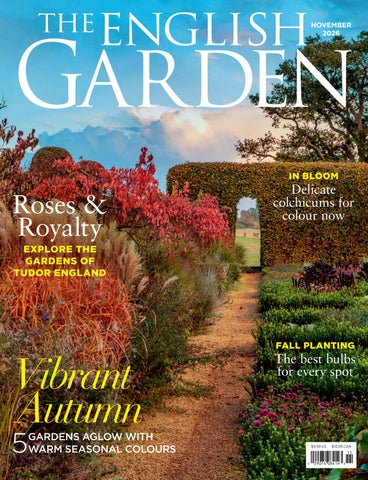
NOVEMBER 2026
IN BLOOM
Roses & Royalty
Delicate colchicums for colour now
EXPLORE THE GARDENS OF TUDOR ENGLAND
Vibrant Autumn
5
GARDENS AGLOW WITH WARM SEASONAL COLOURS
FALL PLANTING
The best bulbs for every spot
$9.99 US
$10.99 CAN
Himalayan HOMAGE The Himalayan Sculpture Park and Garden in North Yorkshire is a modern tribute to the Victorian horticultural obsession with the Himalayas. Begun in the 1990s with a focus on spring specialities, it’s now bursting with year-round colour thanks to carefully selected trees WORDS CLARE FOGGETT PHOTOGRAPHS JOE WAINWRIGHT
Conifers, magnolias and beech form part of a fascinating and deeply forested backdrop at the Himalayan Garden and Sculpture Park in North Yorkshire.
22 THE ENGLISH GARDEN NOVEMBER 2026
E
ver since the botanist Joseph Dalton Hooker ventured to the Himalayas on his 1847 plant-hunting expedition, this species-rich, biodiverse region has held a fascination for British plant lovers. It’s no wonder – on that trip alone, Hooker brought back a plethora of exciting plants, including rhododendrons, conifers and orchids and paved the way for future expeditions that brought us drumstick primulas and blue meconopsis poppies. The ‘big names’ in Victorian plant hunting followed – George Forrest, Frank Kingdon-Ward, Reginald Farrer, Joseph Rock – bringing home more rhododendrons, plus primulas, poppies, gentians, anemones, corydalis, lilies and bamboos. To accommodate all these thrilling new plants, Himalayan gardens sprung up in botanic and private gardens across the UK, from the Royal Botanic Garden in Edinburgh to Bodnant in North Wales. Today, botanists and plant lovers still make trips to the Himalayas, although visits now are usually for the purposes of conservation and research, or simply to admire plants in their natural habitat, rather than extracting plants from the wild as the Victorians did. It’s all made the Himalayas slightly magical in gardeners’ eyes – a far-flung region of incredible plant diversity, misty forests in the clouds, tall trees towering over valleys, slopes carpeted by ferns and moss, studded with sky-blue meconopsis and the flouncy flowers of rhododendrons in spring. But if you’re as likely to make it to the Himalayas as you are to scale Mount Everest, don’t feel you need miss out on the spectacle. Hidden down a narrow lane, not far from the North Yorkshire village of Grewelthorpe, is a pretty good facsimile: The Himalayan Garden and Sculpture Park. Set in a steep-sided valley with a series of lakes at its bottom, this homage to the Himalayas is the creation of Peter and Caroline Roberts, but it’s relatively young compared to its Victorian counterparts: the Roberts moved here with their family in 1996. “It started small,” says Will Roberts, Peter’s son, who, with his wife Sophie, has cared for the garden since 2018. “Dad wanted to do something with the garden and met with a few people who suggested a Himalayan garden would be perfect for this spot. The undulating topography of the site creates a microclimate within different parts of the garden, and the soil is acidic, which lends itself nicely to rhododendrons, azaleas and magnolias. He visited lots of other gardens for inspiration along the way, including Bodnant, Castle Howard and Muncaster Castle, and he met a rhododendron expert, Alan Clark, who was famous for going to the Himalayas and collecting seed,” Will explains. The garden now extends to 45 acres of woodland, and is believed to house the North East’s largest collection of rhododendrons, azaleas and magnolias. NOVEMBER 2026 THE ENGLISH GARDEN 23
Grass ROOTS
Over 32 years, Neil Lucas has been quietly effecting change through his use of grasses, love of wildlife and innovative way of cutting back perennials. The result is a textural dream of a landscape at Knoll Gardens in Dorset WORDS AMBRA EDWARDS PHOTOGRAPHS ANNA OMIOTEK-TOTT
30 THE ENGLISH GARDEN NOVEMBER 2026
Superb autumn colour from scarlet euonymus with a supporting cast including Pennisetum ‘Black Arrow’ and Aster ‘Silver Spray’.
NOVEMBER 2026 THE ENGLISH GARDEN 31
Second SHOW
On a shoestring budget, John and Lorna Howell work the wonderful woodland gardens of Lukesland in Devon to coax from them an autumn display of colour after the springtime spectacular put on by a collection of rhododendrons and azaleas WORDS & PHOTOGRAPHS CAROLE DRAKE
A bridge over the Addicombe Brook at Lukesland, the banks of the brook scattered with colourful autumn leaves. 38 THE ENGLISH GARDEN NOVEMBER 2026
NOVEMBER 2026 THE ENGLISH GARDEN 39
P L A N T FO C U S One of the darkest pink goblet-shaped colchicums of all is C. speciosum ‘Atrorubens’ with purple-black stems.
Dare to Go Bare Denuded of foliage there’s something magical about the stark appearance of colchicums. In delicate shades of pink and white, these leafless lovelies bring welcome colour once summer is over WORDS VAL BOURNE PHOTOGRAPHS ANNAÏCK GUITTENY NOVEMBER 2026 THE ENGLISH GARDEN 53
P L A N T FO C U S
T
here’s something very special about colchicums, which are also known as autumn crocus. Their dainty pink or white flowers emerge as if by magic, long before the leaves appear. Like elegant young débutantes, they appear just as the rest of the garden is starting to look somewhat jaded. Evocative Old English names include ‘naked ladies’, ‘naked virgins’, ‘naked boys’ and ‘meadow saffron’. These epithets were used in the west of the UK to describe our only native autumn crocus, Colchicum autumnale, a plant of low-lying meadows, although it’s also found across temperate areas of Europe. However, there are 104 species in total, their name deriving from Colchis, an ancient region at the eastern end of the Black Sea just south of the Caucasus, where many of them are found.
54 THE ENGLISH GARDEN NOVEMBER 2026
Above Colchicum ‘Pink
Star’ produces masses of starry flowers with narrow lilac petals on short white stems, its strappy foliage appearing in spring.
It’s easy to confuse colchicums with autumn-flowering crocuses. Look inside, though, and you’ll see that colchicums have six stamens, rather than the three found inside crocus flowers. C. autumnale was once widespread in the UK but was eradicated from meadows because every part is toxic to cattle. It’s deadly to human beings too, and William Turner’s mid-16th century A New Herball states that it ‘will strangell a man and kyll him in the space of one daye, even as some Tode Stolles do’. Handle with care! Despite its toxicity, early herbalists prescribed small doses of colchicine, an alkaloid found in colchicums, to treat gout – and it’s still used for that purpose today. Colchicine has also been used in plant breeding to alter chromosome counts and produce polyploidy. There is an elephant in the room. Because colchicum foliage emerges early and fades to tan-brown by midsummer, it stands out like sore thumbs. The state of the foliage varies, but must be considered when choosing where to plant. There are two Plant Heritage National Collections of Colchicums. One can be found at RHS Hyde Hall in Essex where some of the daintier colchicums grow in the Dry Garden amid shrubs and perennials. Jeanette Jones, the plant records officer, explains that they “seem to thrive in full sun and welldrained areas”. Larger-flowered colchicums in grassy areas of the Queen Mother’s Garden are mixed in with spring bulbs, and they can also be found in the Woodland Garden. Jeanette advises: “Once planted, leave them be as they do not like being disturbed.” Alan Gray, of East Ruston Old Vicarage in Norfolk, holds the other collection. He says: “I take their spent foliage away as soon as it starts to yellow, tickle the ground with a fork and then sow fastmaturing hardy annuals like linum or limnanthes. These are then swept away to reveal the naked ladies in all their late-summer glory.” Colchicum autumnale has smaller flowers than other species, but it kickstarts the season, often appearing in August. Its leaves are small and emerge later, so they’re less of a problem. ‘Nancy Lindsay’, collected by its namesake in Romania in 1936, has long-stemmed, mauve-pink goblets emerging from
BULBS
Get the Show on the Road
IMAGE CLIVE NICHOLS
Can anything beat the anticipation of getting spring bulbs in the ground? Spend winter dreaming of the colour to come, with our pick of the best bulbs for every spot
A pot packed full of the richly coloured flowers of Tulipa ‘Gavota’ and muscari, all the result of autumn planting.
NOVEMBER 2026 THE ENGLISH GARDEN 57