An
English Christmas
A supplement to THE
english
GARDEN
From Book to Bronze www.robertjamesworkshop.com +44 (0)7515 126119 | james@robertjamesworkshop.com
WELCOME
16
COVER IMAGE ALAMY IMAGES SHUTTERSTOCK; CLIVE NICHOLS; ALAMY
W
hen the clamour of the festive season becomes too much, head into the garden. In the quiet dawn of an icy morning, gather greenery to bring inside and fashion into garlands and wreaths. Wander from shrub to shrub, engaging with the purest of scented blooms and marvelling at intricate forms picked out by frost. Replenished, head into the warmth of the kitchen and larder to inspect stocks of sloe gin and chutneys and begin a Christmas bake. Perhaps there will be carols to sing later. Over the following pages you will find all you need for a garden-inspired Christmas. Shane Connolly, florist by Royal Appointment, offers thoughts on special arrangements using foliage from the Land Gardeners. There are suggestions for plants to grow for winter interest, ideas for gifts, and a reminder that when we celebrate this season we partake in traditions as old as time itself. Happy Christmas. VIVIENNE HAMBLY, EDITOR
11
27
Contents 4 Christmas Decorations Shane Connolly, florist by Royal Appointment, creates spectacular seasonal arrangements for The Land Gardeners at Wardington Manor. 11 Festive Foliage What could be better as Christmas approaches, than a home dressed with holly, ivy, mistletoe and other festive foliage, fresh from the garden. Find out what to grow and use – and how.
16 Home-made Gifts Look to the garden and the natural world beyond to make your own thoughtful gifts and decorations. 22 Christmas Outdoors Head outside to watch or take part in a great English festive tradition. 27 Top 10 Plants Fragrant winter flowers and unusual textures and forms to suit any style of garden. THE ENGLISH GARDEN 3
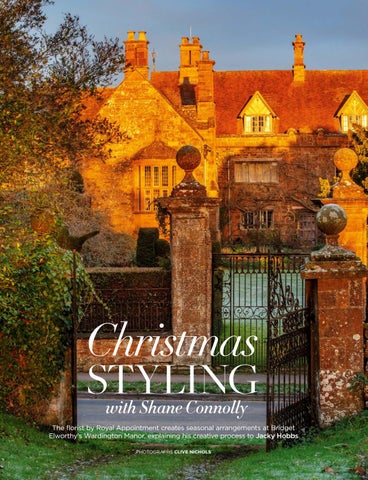
Christmas STYLING with Shane Connolly
The florist by Royal Appointment creates seasonal arrangements at Bridget Elworthy’s Wardington Manor, explaining his creative process to Jacky Hobbs PHOTOGRAPHS CLIVE NICHOLS 4 THE ENGLISH GARDEN
Opposite Bridget
Elworthy’s Wardington Manor near Banbury.
Clockwise from right
The cutting gardens offer rich pickings even in winter; a soft wreath of garden moss; Wardington’s boat house; Shane Connolly carries cuttings to the house; Shane with mistletoe from Netherwood Estates.
W
rap up warmly and a winter forage for nature’s seasonal decorations will always be most rewarding. The traditional trappings, holly, ivy and mistletoe, come gloriously gift-wrapped in Christmas custom, but there is a wealth of more imaginative and ethereal pickings to be gleaned from nature’s larder. A hedgerow interwoven with drifts of old man’s beard, teasels and downy thistleheads is a real treasure trove. In the garden, scented or colourstained twigs and stems and salvaged, desiccated seedheads will provide additional alternative decoration. These are the finds that Shane Connolly, florist by Royal Appointment, values the most: “Making beauty out of things we find rather than things we buy or which come at great cost,” as he puts it. Shane works in tandem with the seasons and his artisan-style is “led by nature”: loose, organic and freeflowing. Underpinned by environmental
consciousness, he campaigns for more sustainable floristry (#nofloralfoam and #sustainablefloristrynetwork) employing alternative solutions, composting spent flowers and replanting living plants worked into arrangements. Even the living native field maples and hornbeams he orchestrated, afforesting the aisle of Westminster Abbey for the wedding of Catherine Middleton and Prince William in 2011, were replanted at the royal couple’s Anmer Hall residence afterwards. Shane’s creativity incorporates the language of flowers and Catherine’s bouquet was brimming with symbolism: lily of the valley signifying ‘the return to happiness’; sweet William for ‘gallantry’; and myrtle as an ancient symbol of ‘a happy marriage’. The Land Gardeners, Bridget Elworthy and Henrietta Courtauld, invite Shane, a regular client, to plunder their cutting gardens and vessel-filled Flower Room at Wardington Manor in Oxfordshire to show us how to make wreaths, garlands and arrangements, that ring with the spirit of Christmas and chime with Mother Nature.
THE ENGLISH GARDEN 5
Make a Wreath Hedgerow Halo
“T
‘
he Christmas wreath symbolises the cycle of life, its circular shape being without beginning or end – a ring of eternity,” explains Shane, deftly intertwining coloured dogwood stems coppiced from his own garden to create a loosely woven wreath base. Shane has used tip clippings of Cornus sanguinea ‘Midwinter Fire’ and ebony Cornus alba ‘Kesselringii’, their colours rich and glossy. “Pre-soaking the stems makes them more pliable and easier to work with,” he advises, and he leaves a third of each stem free, radiating outwards for a more handcrafted feel. Shane adds cardoon, thistle and other dried seedheads, with filigree
Clockwise from top left
Shane starts with a circle of pre-soaked dogwood stems; cardoon heads are tied in with garden twine; soft texture comes from the wispy heads of old man’s beard; Shane hangs his finished wreath with colourful Indian braid; the wreath can be reused and refreshed every year.
6 THE ENGLISH GARDEN
fern fronds gilded with gold, silver or copper spray paint: “Less is more!” he maintains. Heavier heads must be tied in at the base with garden twine, but delicate elements can simply be inserted between the dogwood stems. “Arrange rhythmically, don’t regiment. Dress the circlet with flurries of old man’s beard, woven casually through the fixed cardoon heads, mimicking its habit in the hedgerow,” Shane explains. Indian braid is used here to bring together the halo of colours, but any natural binding will work: think jute, hessian or raffia. This mantelpiece or door wreath is potentially everlasting and can be revived every year.
Shane at work in The Land Gardeners’ Flower Room, where buckets, vases, urns and dry flowerheads are stored.
THE ENGLISH GARDEN 7
Wardington’s Minstrels’ Gallery becomes a seasonal spectacle with the addition of Shane’s woodland garland.
8 THE ENGLISH GARDEN
Tie a Garland Winter Woodland
S
hane’s creativity is spontaneous and fluid – he was due to dress the manor’s fireplace but was drawn instead to the Minstrels’ Gallery. Here he allows the unleashed, natural gait of branch and bough to fashion a garland that sweeps across it. Taking his lead from nature, he harnesses the inherent organic movement of each incorporated element, explaining that “there’s no preconceived, fixed design”. This woodland garland was forged through layering to create a natural canopy of foliage. “Begin by tying in a loose framework, binding tight with twine (or reusable cable ties for really heavy boughs) airy lengths of lichened larch and weightier boughs of fragrant fir and scented spruce,” he explains. Shane aims for movement rather than symmetry. Variegated holly, which gives more lift, and long trails of ivy are
symbolically woven into the seasonal design, whilst living pots of false holly, Osmanthus heterophyllus ‘Goshiki’, straddle gaps, tied securely to the base of the gallery’s balustrading. A bough of berried mistletoe, gifted from his neighbour’s farm on the Netherwood Estate in Worcestershire, takes lofty centre-stage. “Druids held mistletoe as sacred, never letting it touch the ground,” he notes. There are no wires, cables or lights: instead, Shane organically illuminates the gallery with light-catching sprays of silvered honesty and glints of gilded bracken fronds. Bolder, brighter garlands can be created by adding orange or red berries and hedgerow hips, tasselled catkins or large flowerheads like hydrangeas. Complement with small living pots of shrubs, such as winter-flowering heather, viburnum or skimmia.
Clockwise from top left
The garland is built around branches of lichened larch and evergreen cedar; long trails of ivy are woven into the design; bracken fronds are gilded with copper paint; a bough of symbolic mistletoe takes centre stage; natural ‘lights’ are created with silver honesty seedcases.
THE ENGLISH GARDEN 9
Lay a table Simply and Seasonally in Silent White
S
hane raids Bridget’s Flower Room, claiming the array of silvered candlesticks and assorted tarnished vessels, sugar bowls, sauce boats, tankards and trophies for table decoration. Non-prescriptive and adept at improvisation, Shane encourages using any similar assortment of small containers, linked by colour or material, such as white china or glass bottles. Simplicity is at the heart of Shane’s creative process: “It’s the idea that fewer elements can be used abundantly, using the most beautiful seasonal flowers and letting them shine,” he explains. Just a handful of flowers of each type can be used to create a stunning and versatile display that can shrink and grow in accordance with its setting. “Lots of low vessels facilitate maximum decoration with minimal social interruption – you can talk over or about them,” he adds. The winter-white Christmas rose, Helleborus niger, brings simple elegance to scattered silverware and can be
floated in wide-mouthed bowls or held in the woody crooks of perfumed winter honeysuckle, Lonicera fragrantissima. Scented narcissi, wintersweet or witch hazel are good alternatives. “Scent adds an unexpected dimension, but use it in moderation, since it can taint the taste buds,” explains Shane. The hellebores are pre-conditioned, a day ahead, to prolong the display. To do this, stand cut stems in an inch of just-boiled water. When it cools, top up with cold water to condition overnight. Growing hellebores, which will be planted outdoors after Christmas, spill from larger vessels, urns and ice buckets, decorating the room’s sideboards and sills. The dining room’s dark wood is blanketed in Bridget’s snow-white linen sheets, although “a decorator’s dust sheet will do,” argues Shane. White candles add the finishing touch: random in spacing and height, they illuminate Shane’s almost reverent, made-inminutes, seasonal table setting.
Seek inspiration in Shane’s books, Table Flowers, The Language of Flowers and A Year in Flowers, and Bridget and Henrietta’s The Land Gardeners Cut Flowers.
10 THE ENGLISH GARDEN
Clockwise from top left
White linen cloth and silvered candlesticks on the Wardington dining room table; pots of living Christmas roses will be replanted in the garden; silver vessels filled with Helleborus niger and winter-flowering honeysuckle; candles of random heights add the finishing touch; vessels have come from Bridget’s Flower Room.
CHRISTMAS FOLIAGE
DECK THE HALLS
WORDS VIVIENNE HAMBLY. IMAGE THE WHITE COMPANY
What could be better as Christmas approaches, than a home traditionally dressed with holly, ivy, mistletoe and other festive foliage, fresh from the garden
Accompany your festive wreaths with seasonal lighting. Candles in Winter from £20, by The White Company, thewhitecompany.com THE ENGLISH GARDEN 11
CHRISTMAS FOLIAGE
This image Evergreen
foliage is ideal for creating a stylish seasonal table setting. Below A fulsome gathering of spruce and mistletoe makes a fetching decoration.
T
here are few things more satisfying at Christmas than gathering armfuls of greenery to bring into the house to use as decoration. Gardeners tend to have a head start on this, for with a little creative thought there is a bounty of foliage to be had from most gardens. This can form the basis of garlands, wreaths and table decorations. Add to that a few well-chosen pieces – faux branches or berries, glossy and jewel-bright, a string of twinkling fairy lights, and a cluster of votives – and the setting for a memorable Christmas is complete: for little cost but with all the triumph of having created something yourself.
TRADITIONAL PRACTICE It is of course holly, ivy and mistletoe that are most keenly associated with the festive season. Throughout the period, churches ring with the well-known carol ‘The Holly and the Ivy’. While its famous tune is contemporary, arranged by Sir Henry Walford Davies (1869-1941), the roots of its words are much older. It is reputed to be one of few songs to have survived the puritanical assault of the 17th century, in which many Christian 12 THE ENGLISH GARDEN
festivities were prohibited because of their Pagan or Roman Catholic associations. Holly is associated with Saturnalia, the riotous, egalitarian Roman festival celebrating the god Saturn, although Christians came to see the red berries of the plant as a symbol of the blood of Christ. The ubiquity of this evergreen must surely have led to the popularity of holly over the millennia. It is one of the most common native trees in England and, in the past, it was believed to be bad luck to cut down a holly tree. This meant that many older trees continue to survive, both in ancient woods around the country as well as in the hedgerows that divided the large arable flatlands of East Anglia. Grown domestically, traditional holly (Ilex aquifolium), bearing the familiar leaf with multiple spines, makes a near impenetrable hedge. Hybrids such as Ilex x altaclerensis ‘Golden King’ and ‘Lawsoniana’ are more accommodating, however, with smooth, oval-shaped variegated leaves ending in a single, spiny tip, ideal for cutting and using in decorative schemes. Holly has male and female plants and they must be grown together if berries are to be produced.
GORGEOUS GREENERY The second of the two plants in ‘The Holly and the Ivy’, ivy will romp its way over garden walls, across forest floors, up trees and along hedgerows. It is linked to ancient fertility beliefs, no doubt because, like holly and mistletoe, it remains very much alive throughout winter when so much else has died back. Ivy (Hedera helix) is most often found growing alongside holly in woods where it supports wildlife by offering food, nesting and roosting sites, as well as a degree of groundlevel protection from frost. Its small yellow flowers, which appear in autumn, are followed by clusters of attractive purple-black berries borne on short stems in winter. These, along with that familiar trailing foliage, are ideal for inclusion in Christmas floral arrangements and work well with the papery forms of dried hydrangeas, for instance. In the garden, Hedera helix ‘Glacier’ is a longstanding favourite for use as groundcover, and its variegated leaves will brighten dull corners of dry shade. It is ‘Ivalace’, however, that is ideal for festive arrangements. Its long stems wrap easily into wreaths and will give a flourish to any bouquet.
MYTH AND ROMANCE In midwinter, when the countryside is layered with glittering frost and fallen snow and leaves have long since gathered on the roadsides, look up to skeletal trees on the brow of the next hill and, if you are fortunate, for it is not so common now, you
Top The glassy white berries of mistletoe are a distinctive winter delight. Above Male and female hollies must be planted in proximity to one another for the female plants to bear fruit.
may see unruly balls of mistletoe silhouetted in the branches. A plant of myth and legend, English mistletoe (Viscum album) possesses an otherworldly character, bearing near-translucent white berries and slim, springy branches, which, at times, appear to have a life of their own. Mistletoe was beloved of the Celts and Druids, perhaps because it is very much alive when so much else is seemingly inactive. This parasitic plant will, in fact, grow only on bare branches, and on some 200 tree and shrub species. Given its vitality, it is little wonder that the plant is also closely associated with fertility. Like many Christmas traditions, kissing beneath mistletoe has very early origins; the plant is also associated with the worship of Frigg, the Viking goddess of love and marriage. In their book, England in Particular, Sue Clifford and Angela King note that mistletoe’s heartland is the West Country and the West Midlands. It’s at home in the cider-apple and perry-pear orchards of Somerset, Gloucestershire, Herefordshire and Worcestershire, where “in some old cider orchards, mistletoe is encouraged for cutting at the Christmas market”. Tenbury Wells in Worcestershire, is the heart of the mistletoe-growing region. The jolly Tenbury Mistletoe Festival takes
EXPERT ADVICE
Perfect ARRANGEMENTS
IMAGES; ALAMY; SHUTTERSTOCK
Florist Judith Blacklock advises on creating the best displays l When gathering foliage for festive
l Remove all leaves that aren’t
l Oasis Floral Foam Maxlife with
arrangements, always cut the stem at an angle above a leaf node. Doing so allows water to flow more freely up the stem than if it were cut below.
actually necessary to the overall look of an arrangement. This way, water will be able to reach the flowerhead more easily and won’t be wasted on supporting unnecessary foliage.
Enhanced Biodegradability is a new and environmentally friendly type of florists’ foam that fully degrades after 567 days. Older foams do not biodegrade, but break down into fine particles that can pollute water systems. Be sure to soak your foam fully before use to obtain maximum water retention. • More at judithblacklock.com
l Flowers such as hydrangeas and
roses may droop if an air bubble in the stem stops water moving up. Avoid this by trimming an inch off stems and cutting at an angle to aid water flow.
l Keep vases scrupulously clean to
prevent a build-up of bacteria, which will shorten the life of cut material. Change the water regularly.
THE ENGLISH GARDEN 13
Great Plants FOR FOLIAGE
CHRISTMAS FOLIAGE
Grow these evergreen shrubs to cut and bring into the house for festive decoration
ARBUTUS UNEDO
EUONYMUS
SARCOCOCCA HUMILIS
These bright, edible fruits give rise to the common name of strawberry tree, but the winter foliage is just as appealing.
Choose variegated Euonymus fortunei ‘Emerald ‘n’ Gold’, ‘Emerald Gaiety’ or Euonymus japonicus ‘White Spire’.
Use the berries and fragrant flowers of this hardy shrub, which tolerates shade and adds structure in winter months.
HEDERA HELIX ‘IVALACE’
CAMELLIA X WILLIAMSII
LAURUS NOBILIS
This variety has glossy, crimped-edged leaves with long stems, making it perfect for use in Christmas wreaths.
Small-leaved Williamsii varieties of camellia, such as ‘Jenefer Carlyon’, make an excellent foil for textured leaves.
Bay trees are a superb year-round source of fragrant leaves, which have culinary as well as decorative uses.
SKIMMIA JAPONICA
ROSEMARY
TAXUS BACCATA
Varieties such as ‘Rubella’ offer the bonus of pink-blushed flower buds, which complement its shiny foliage.
Every garden should have a rosemary bush. Use the branches of this culinary herb in wreaths for its fresh, clean scent.
With its robust stems and glossy needles, yew, widely used in hedging, is a traditional element of festive garlands.
14 THE ENGLISH GARDEN
place each year in December. See tenbury-mistletoe-festival.co.uk for more information.
IMAGES ALAMY; SHUTTERSTOCK
INSPIRED CHOICES Beyond these three traditional choices, a world awaits. Florist Judith Blacklock suggests growing a few key plants for foliage, and supplementing them with bought cut flowers and decorative pieces. Cypress is ideal for making striking garlands and wreaths, and its scent, at once sharp and sweet, epitomises Christmas. Add to this scented spruce, perhaps Picea pungens ‘Hoopsii’, the blue-green needles of which resemble ice crystals, for paler tones in floral schemes. Or incorporate the trimmings from the Christmas tree for effective use of materials. There are less obvious choices, too. Rosemary, for remembrance, of Christmases past or loved ones lost, offers delightful, fragrant stems to wrap into garlands and include in table arrangements. A simple sprig resting on a napkin makes an inviting setting. Common bay offers contrast to more textured, spiny offerings, and is usually robust enough to withstand some cutting back. Camellias, especially the small-leaved C. x williamsii varieties, as well as arbutus and skimmia, offer similar. For the sweet, unmistakable scent of winter flowers, consider using Sarcococca confusa, Lonicera fragrantissima and Daphne bholua, but try to keep these well away from dining tables where the aroma can be overpowering. To add to a white flower scheme, include forced bulbs, such
as paperwhite Narcissus papyraceus ‘Ziva’, N. ‘Inbal’, or lily of the valley. Dried stems of astrantia, agapanthus and hydrangea, plus saved poppy seedheads, will add form to schemes. Leave them in their natural colours or spray them with a touch of white, gold, bronze or silver.
LITTLE EXTRAS Top left A trug is ideal for
gathering prickly sprays of holly. Berries can fall off easily and need gentle handling. Top right Embellish a homemade wreath with wired ribbon that will hold a shape neatly. Above Tie on natural pieces, including walnuts and dried orange slices.
Whatever bounty the garden offers, it can help to have a few favourite pieces of faux material to hand. Some suppliers label these pieces ‘everlasting’ – a somewhat euphemistic term to differentiate their product from fake pieces of lesser quality. The White Company and The Chelsea Gardener offer sprigs of spruce and yew, as well as knots of berries to twist into garlands, as do Sarah Raven, Sophie Conran and Oka. And while it is possible to dry slices of orange in an oven on a low setting, the citrus scent filling a warm kitchen, if time is of the essence, outlets such as Petersham Nurseries and Daylesford have a good choice. Formal floristry suppliers such as Country Baskets will have a sound online offering. All good floral designers have an online presence. On Instagram, Miss Pickering, Aesme, Susanne Hatwood of The Blue Carrot, Jo Flowers and Florence Kennedy at Petalon are just a few of the florists who will offer inspired ideas for Christmas celebrations, assembling foraged, gathered and bought materials to glorious effect. THE ENGLISH GARDEN 15
CHRISTMAS GIFTS & DECORATIONS FOLIAGE
Cooking apples from garden trees make a delicious addition to home-made mince pies.
Made from the HEART This Christmas look to the garden and the natural world beyond for inspiration – and ingredients – to make your own stylish and thoughtful gifts and decorations
Wrap up a pudding Christmas pudding making traditionally begins on Stir Up Sunday, the last Sunday before Advent. It takes its name from a line in The Book of Common Prayer: ‘Stir up, we beseech thee, O Lord, the wills of thy faithful people...’ This is motivation to start baking, for the more time fruit cakes and puddings have to mature, the better. ChristmaS pudding has medieval origins in figgy pudding, a kind of pottage that was served at the start of a meal and, like the mince pies of the time, included some meat. It is straightforward to make: look to Delia Smith and Mary Berry for classic recipes and then spend a cold winter’s day enjoying the steam in the kitchen. Let everyone in the household take a turn at stirring the mixture and make a wish for the season to come. Make a few puddings to give away, too: wrap them in jute and holly for festive flair.
IMAGES SHUTTERSTOCK; ALAMY
Dry sweet oranges January is the time for making marmalade with seasonal Seville oranges, but before that comes December, a month to dry slices of clementines and oranges for stylish Christmas decorations. Heat the oven to around 1100C or use the simmering oven of an Aga with the door left ajar. Line a baking sheet with paper, then leave oranges to dry for around five hours, turning them occasionally. The trick is to achieve just the right thickness – too thin and the oranges won’t hold their shape; too thick and they will take forever to dry – so aim for slices of around 1cm thick. To dry whole oranges, make four evenly spaced, vertical slashes around the fruit and leave it in the oven overnight: it will fill the house with a wonderful citrus fragrance as it dries. Afterwards, thread the oranges into garlands for the mantelpiece or Christmas tree, inserting bundles of cinnamon sticks or star anise for interest. THE ENGLISH GARDEN 17
GIFTS & DECORATIONS
Remember the birds A cheerful robin redbreast in a snowy scene may be a classic Christmas image but, in truth, winter is a difficult time for birds. The cold aside, food sources are scant, so help them by hanging out a few homemade fat balls – or fat stars for a festive touch. The RSPB recommends starting off with good-quality bird seed supplemented with raisins, peanuts and grated cheese. Place these in a mixing bowl, then pour in enough melted suet or lard to bind the ingredients together. Quantities can be varied. Stir the mixture well, then either pour into small yoghurt pots, or similar, to set. Remove the cakes from the pots then thread twine through the centre, knotting at the base. Alternatively, spread the mixture on a baking sheet and, when it is half-set, shape it into festive stars using a cookie cutter before leaving it to cool and harden.
Bake a few biscuits When the house is full of visitors or you simply don’t know what to give the person who has everything, an easy bake can hit just the right note. For a basic butter biscuit, cream together 120g butter, 120g sugar and one egg yolk. Work in 185g cake flour and a scant half teaspoon of baking powder. Roll the mixture into a 20cm-long log and refrigerate for an hour. Slice into rounds 1cm thick and bake on a sheet at 1400C for 30 minutes. You can also roll the dough between two sheets of cling film and cut it into star or angel shapes, or make a hole and add a boiled sweet to create a ‘stained-glass window’. Decorate bakes with gold leaf, fold in chocolate chips, sandwich biscuits together with homemade raspberry jam, include cinnamon, or use sugar flavoured with dried lavender saved from summer.
Play with paper One of the great joys of Christmas is to take down the box of decorations from storage and be reminded of Christmases past. Glass baubles wrapped in tissue paper, Father Christmases and angels fashioned from loo rolls, paper doilies and cotton wool; a crystal treasure – each has its place. If your decorations need supplementing, instead of rushing to the nearest supermarket for trinkets everyone else will have, make your own. Set aside a few winter evenings to sit down with your crafting materials. Quality paper supplier Cambridge Imprint offers a range of excellent designs for these origami stars (right). Try also Jemma Lewis for hand-marbled paper or Caspari, which prints luxurious, reusable sheets with traditional Christmas motifs. 18 THE ENGLISH GARDEN
Draw on preserves
IMAGES CAMBRIDGE IMPRINT; SHUTTERSTOCK; ALAMY
Gardeners have a distinct advantage when it comes to giving presents and that is a pantry almost invariably harbouring jars of preserves, some admittedly of indeterminate vintage. To those who do not make their own, homemade jam, jelly, chutney and even marmalade hold a mystique that belies how straightforward they are to produce. For inspiration, look to Lillie O’ Brien’s Five Seasons of Jam (Kyle), The Modern Preserver by Kylee Newton (Square Peg), which also includes pickles, and The River Cottage Preserves Handbook by Pam Corbin (Ten Speed Press). It’s traditional to top a jar with a circle of fabric, but for a modern twist you could use some special paper secured with jute twine, paint the lid white or gold, or buy a neat collection of jars with checked lids for the purpose. Sarah Raven, Lakeland and Nutley’s Kitchen Gardens can supply materials.
THE ENGLISH GARDEN 19
GIFTS & DECORATIONS
Set a place Amid the busyness of daily life, meal times are all too often compromised. Put that to rights in the quiet spell between Christmas and New Year. Take your time over laying the table with family china, linen and silverware. These mealtimes will help mark out the days, and children might enjoy the ceremony of helping to set the table, even if they won’t admit to it. To embellish the table for Christmas feasts and other meals, raid the garden for decorations that will last some time. Pick out evergreen foliage to form the base of arrangements and accent them with special pieces. Even a few lengths of ivy sprayed with a little gold paint will look special. If you have guests to stay but insufficient napkin rings, you can make your own by twisting a little evergreen foliage with a few berries for colour. Florists’ tape will help keep the ends together neatly.
Keep it simple When Maria in The Sound of Music sang that “brown paper packages tied up with string” were among her favourite things, she really was on to something. Each Christmas the UK sends tonnes of wrapping paper to landfill. As a rule of thumb, if you can scrunch the wrapping paper into a ball without it springing back it can probably be recycled. However, national recycling campaign Recycle Now explains that if paper is laminated or contains glitter, it becomes more difficult to recycle. Sticky tape also prevents recycling, so remove it before the paper is put in the bin. Use butcher’s twine for colour, or reusable fabric ribbon, which can look very smart. More expensive paper lasts longer and can be reused for years – iron it gently with a tea towel if it’s creased. Or wrap presents in brightly coloured tissue paper. It always looks jolly and breaks down easily. 20 THE ENGLISH GARDEN
Fold tree decorations If you are in the habit of rummaging through charity shops and car boot sales, you will inevitably come across old books and sheet music. It may feel slightly criminal to cut them up, but they do make excellent and elegant decorations that are easy to theme around a colour. Making them will also occupy housebound children for some time, and a good result doesn’t require much skill at all – both paper chains and bows are easily achievable. One simple technique is to cut six or eight circles all the same size but upwards of 5cm in diameter. Fold each circle in half, then glue one half circle to another half, and half of that circle to the next, so that all the circles are stuck to one another to make a ball. Affix a ribbon or piece of string to the top of the ball to hang it from the Christmas tree.
Gather pine cones A bright, frosty day is one of the great joys of early winter and the perfect time to set off on a country walk, stretching the legs and clearing the head. Pine cones and cypress balls are wonderful things to collect on these walks, although you should take care not to remove too many from one spot – and leave them in place if you are in a nature reserve. Back at home, dry them in a basket beside the fire and use them later as fragrant kindling. If you have listless children in the house, set them to work and have them paint the cones in white or metallic colours. The cones make a wonderful display piled up in a bowl in the hall or on a table in the sitting room.
IMAGES SHUTTERSTOCK;ALAMY
Flavour a drink It may not be too late to find sloes on the hedgerows to add to gin. Experienced makers will have earmarked the blackthorn trees bearing good blossom in early spring and will know where to look later in the year for the best sloes. These small, sour fruits need a hard frost before they can be used for sloe gin, but with winters becoming milder and competition for sloes always stiff, a few days in the freezer will achieve the same effect. In truth, any fruit can be used to flavour alcohol and vodka works as well as gin. Rhubarb is fashionable right now, while damsons are as traditional as sloes. Try quinces, cherries or pears with brandy. A handy ratio is to use one third fruit, one third sugar and one third alcohol. Leave this to steep for a month or two, then strain through muslin to achieve a delicious, clear, flavoured liquid. THE ENGLISH GARDEN 21
Frost glazes the grass and mist hangs heavy in the air at Stowe landscape gardens in Buckinghamshire.
22 THE ENGLISH GARDEN
Christmas OUTDOORS
IMAGES NATIONAL TRUST/JERRY HARPUR; SHUTTERSTOCK
Escape the heat of the kitchen and a houseful of visitors and blow away the cobwebs by heading outside to enjoy one of these great English Christmas traditions – from an icy dip in the sea to carols by candlelight
D
uring winter, the natural world, not least our gardens, are in deep slumber, gathering strength for the growing season to come. But while there may not be much work to do outside, this special time of year is filled with pastimes rooted in the long history of habitation of these northern isles. The winter solstice marks a turning point in the year, and it’s easy to see how enduring prehistoric solstice celebrations could
be transferred to remembering the birth of a child known as the Light of the World and honoured by wise men following a bright star. Today our cities are permanently lit up by street lights, cranes and tall buildings, much of our work is no longer so closely associated with the land, and we can easily take holidays in warmer climates. We have no particular need to celebrate light, yet something inspires us not only to hold onto these age-old practices but also to adapt them to modern life. THE ENGLISH GARDEN 23
Old England On cold dark nights around Christmas, it’s still not all that unusual to see a mumming play, particularly in more remote villages surrounded by farmland. Written records of these date from the 1700s and the primary purpose of the plays was to raise money during the lean times of the year, since harvest work has long dried up by December. Mummers dress in rag-tag costumes and sometimes blacken their faces or wear masks to conceal identities – historically because it was easier to collect more money this way. The plays are short and usually take place outdoors on a market square, with a hat passed around during and after a performance. In Marshfield, Gloucestershire, mummers perform 24 THE ENGLISH GARDEN
Top left Colourfully
dressed Morris dancers join a mummers parade in Gloucester. Top right The mummers folk play, performed on Boxing Day in Wantage Market Place. Above Wassailers in Somerset sing to the trees for a strong harvest.
annually at 11am on Boxing Day. Yet the detail of mumming plays is particular to regions. In the North West, a hobby horse – or even a horse’s skull – is sometimes included among the props. Each group has a name, too: look out for the Jollyboys in Cumberland and the Tosspotters in Lancashire. Folk historian Violet Alford (1881–1972) wrote widely on the subject of folk plays, and included descriptions of sword dancing in her work. Once performed around Christmas to encourage providence in the coming year, these dances are still enacted in parts of the North East around Yorkshire and Durham particularly. More familiar, to gardeners at least, might be wassailing, which is linked to cider making and apple trees. In their book, England in Particular, Sue Clifford and Angela King note that to wassail – or sing to – a fruit tree around Christmas or New Year was to encourage a good crop of apples. Cider would be thrown into the tree or poured on its roots, and a clatter or pots and pans would ward off evil spirits. Naturally any wassail included a tasting of the cider, which may have been mixed with honey, spices, roast apples or cream. Wassailing still takes place in Brockhampton, Herefordshire, and Moseley Old Hall in Staffordshire. And there is surely nothing wrong with privately wassailing your own fruit trees!
Naturally any wassail included a tasting of the cider, which may have been mixed with honey, spices, roast apples or cream
Carols and Choirs
There are few things quite so moving as a horn playing ‘In the Bleak Midwinter’ and Christina Rossetti’s lines remain timeless
IMAGES SHUTTERSTOCK; ALAMY
Top row A young carol singer performing by candlelight, while choristers sing in church. Above Salvation Army bands play outdoor carol concerts across the country at Christmas. Left A traditional Christmas tree outside St Paul’s Cathedral in the City of London.
Many traditional carols have roots in much older folk songs, which often mentioned plants and the natural world. Consider ‘The Holly and the Ivy’, and ‘While Shepherds Watched’. Both the composer Ralph Vaughan Williams and folk-song revivalist Cecil Sharp worked hard to collect and popularise songs from around the country. Today, composers such as John Rutter pick up the mantle and carols such as ‘Shepherd’s Pipe Carol’ are now Christmas staples around the country. But it is the Festival of Nine Lessons and Carols performed by the King’s College Choir Cambridge that will move even the most Scrooge-like of souls. This service was devised in 1918 and since 1919 every service has begun with the hymn ‘Once in Royal David’s City’. The performance is broadcast live on BBC Radio 4 at 3pm on Christmas Eve every year. Around the country more informal choirs join in the fun, with ‘Fairytale of New York’ by The Pogues just as likely to feature as more traditional songs. You will encounter clusters of carollers in train stations raising money for a charity often close to their hearts, or in pubs, or walking from home to home in country villages. Let us not overlook the distinctive sound of brass bands and the Christmas carols played by the Salvation Army, either. There are few things quite so moving as a horn playing ‘In the Bleak Midwinter’, and whether it’s to the tune written by Gustav Holst or Harold Darke’s version, Christina Rossetti’s lines remain timeless: ‘In the bleak mid-winter, frosty wind made moan / Earth stood hard as iron, water like a stone / Snow had fallen, snow on snow, snow on snow / In the bleak mid-winter, long ago.’ THE ENGLISH GARDEN 25
Certain gardens come into their own over the winter months, and the lull around Christmas and New Year is an ideal time to visit them. The brilliant red stems of cornus are a highlight of the Winter Garden at Anglesey Abbey, the National Trust property in Cambridgeshire, for instance, and the air will be filled with the sweet scents of sarcococca, mahonia, wintersweet and the gorgeous perfume of winter-flowering honeysuckle. This is also a good time to stroll through some of the country’s great landscape parks. Without the distraction of summer planting, it is plain to see exactly what the landscape gardeners wished to achieve in their gardens. Stowe, another National Trust property, in Buckinghamshire, is an excellent example.
After the indulgences of Christmas feasting, there is nothing quite like a winter dip or a bracing walk to get the blood circulating. Christmas and Boxing Day swims take place up and down the coast of England, from St Ives in Cornwall, through Devon and Dorset to Whitby in Yorkshire. The point of these icy dips, stripping down to a costume, running into the sea and emerging, lobster-pink but triumphant, is usually to raise funds for local charities. Some take ‘costume’ literally and run in wearing Santa outfits. In London, Christmas Day swims take place on Hampstead Heath, but the most evocative swim of all takes place in the Serpentine in Hyde Park. For members of the Serpentine Swimming Club only, the Peter Pan Cup has been contested since 1864 becoming associated with author JM Barrie in 1903. It is raced at 9am sharp over a 100-yard course. 26 THE ENGLISH GARDEN
Deciduous trees take on a stark, architectural beauty without their leaves, and frost has a transformative effect Top left Robins are one
of the most cheering and unmistakable natural sights of winter. Top right The colourful Winter Garden at Anglesey Abbey in Cambridgeshire. Above Around the coast, swimmers gather for bracing Christmas and Boxing Day dips.
Boxing Day is, of course, the traditional day for an enlivening country walk, offering welcome respite from indoor overindulgence. Never underestimate the restorative powers of the countryside in winter. Deciduous trees take on a stark, architectural beauty without their leaves, and frost has a transformative effect when picked out by the weak rays of a December sun. Wrap up warmly, pack a flask and a picnic of mince pies and ham sandwiches and set off in search of peace and quiet. Walks through certain parks could yield wonderful sightings of deer or small birds busying themselves against the cold.
IMAGES SHUTTERSTOCK; NATIONAL TRUST/ROD EDWARDS
Outdoor swims and walks
TOP 10 PLANTS
Winter Wonderland The Christmas garden is filled with interest if you know where to look for it. There are fragrant winter flowers and unusual textures and forms to suit gardens of any style
S
WORDS VIVIENNE HAMBLY IMAGES CLIVE NICHOLS
cent becomes a highly prized asset in the garden in winter, a season devoid of the fullness and rich palette of colours that are enjoyed in summer and savoured in autumn. There are delicate fragrances to reward intrepid gardeners venturing out on even the coldest days – and perhaps, if the plant in question is generous enough, a few stems can be clipped and brought into the house to provide
fresh scents to accompany the glow of a warming fire. Many of winter’s most aromatic plants can make sizeable shrubs, but there are also more diminutive, container-friendly options. Form and texture are just as important, so look to plants that will hold their shape when frosted – or bloom in even the darkest hour. Whatever the space available in winter, there is always room for one more plant at this time of year.
1 Eryngium ‘Picos Blue’ This is the ideal plant for dry, free-draining and gravelly soils, where it will offer striking, intense blue flowers all through summer. It is tempting to cut dead blooms back, but leave them in place over winter for eye-catching structure that a frost will pick out. Add the stems to Christmas arrangements for extra detail.
THE ENGLISH GARDEN 27
TOP 10 PLANTS
2 Viburnum farreri ‘Candidissimum’ 3 Hamamelis x intermedia ‘Jelena’ When this sizeable deciduous shrub begins to flower, its sweetly fragranced blooms appear amid fiery autumn foliage. Later, when the leaves have fallen, the pure white flowers continue to brighten bare stems throughout winter. This versatile shrub grows well in sun or part shade, although a site with dry soil is best avoided.
The intense colours of witch hazels defy winter frosts to stay intact until the weather warms, and ‘Jelena’ is no exception. Witch hazels are grafted onto a rootstock, making them expensive plants to buy, so take care to find the right spot in the garden. They grow best in well-drained, slightly acidic soil, ideally in full sun.
4 Daphne laureola
5 Clematis cirrhosa ‘Jingle Bells’
This evergreen shrub grows well in the shadiest of corners, soldiering on even in dry soil, and its perfumed flowers bloom in late winter. It carries the common name of spurge laurel, possibly because its sweet honey scent is similar to that of Euphorbia mellifera, which is also known as the honey spurge.
The pure-white, scented blooms of this clematis flourish when others are in decline, while the fluffy seedheads add structural contrast to the evergreen foliage. Low-maintenance ‘Jingle Bells’ grows best in full sun or semi-shade in well-drained but moist soil to which manure or well-rotted compost has been added.
28 THE ENGLISH GARDEN
IMAGES ALAMY; CLIVE NICHOLS; GARDEN WORLD IMAGES; SHUTTERSTOCK
6 Mahonia x media ‘Charity’ Seedlings of this naturally occurring hybrid of M. lomariifolia and M. japonica were discovered in the 1950s. One seedling, subsequently named ‘Charity’, was selected by Sir Eric Savill and planted in the Savill Garden in Windsor Great Park. Wands of yellow blossom produce a fresh lily-of-the-valley scent.
THE ENGLISH GARDEN 29
7 Helleborus x ericsmithii
8 Erica lusitanica
Hellebores are known as the Christmas rose for good reason: this is when the demure, nodding blooms of several species come into their own. Look out for the pure white flowers of Helleborus niger, or consider H. niger crossed with H. x sternii to create H. x ericsmithii. ‘Pirouette’ bears white flowers that fade to buff pink.
Put aside ideas about heathers being groundcover plants: this superb species reaches 2.5m tall and 1.5m wide. Its white winter blossom starts off as a dusky pink in bud and hangs from upright stems like decorations on a Christmas tree. Foliage damage or stem dieback can occur in cold winter temperatures below -10°C.
9 Lonicera x purpusii ‘Winter Beauty’ 10 Skimmia x confusa ‘Kew Green’ This free-flowering honeysuckle bears some of the season’s most strongly scented flowers, so place it near a path where its fragrance can be savoured. It can reach up to 2.5m across when mature, but spring pruning will help keep it in check. Suitable for all but the heaviest of soils, it flowers well in sun or partial shade. 30 THE ENGLISH GARDEN
Glossy evergreens are always welcome in winter but Skimmia ‘Kew Green’ also brings clusters of pale green buds for contrasting texture. These open to reveal flowers with the sweetest of scents. Often used in containers, ‘Kew Green’ also makes an impressive show in the ground if the soil is acidic – spreads to 1.5m.
IMAGES ALAMY; GARDEN WORLD IMAGES
TOP 10 PLANTS
Having a critique from someone who is clearly an expert gives you confidence - they really know what they are talking about. - David
Roses taught by Michael Marriott Planting the Piet Oudolf Way with Piet Oudolf & Noel Kingsbury
With over 30 courses to choose from including:
Upgrade your gardening skills Choose from over 30 online courses and learn under the watchful eye of some of the world's biggest names in gardening. Taught in our friendly online classroom, where you get to enjoy inspirational lessons and easy to follow assignments you will learn the full range of skills needed to become the complete gardener. Learning with Experts is the only online course provider to offer you personalised feedback from the very best experts all from the comfort of your own home.
Buy today and start anytime: learningwithexperts.com
Tom Stuart-Smith
Chris Beardshaw
Design & Create Your Dream Country Garden
Container Gardening
Learn the philosophy, technique and skill behind one of the greatest minds in garden design, Tom Stuart-Smith
Get your pots & containers looking their best this season, with multi award winning lecturer Chris Beardshaw.
It is amazing to be able to learn and receive feedback directly from the experts. - Julia
WORKWEAR FOR
EVERYONE
exclusively made in the UK
carriercompany.co.uk +44 ( 0 ) 1328 820699
Photographed by Richard Allenby-Pratt at Walsingham Abbey