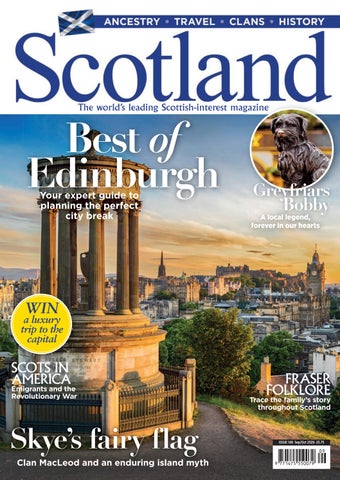
The world’s leading Scottish-interest magazine
Best of Edinburgh Your expert guide to planning the perfect city break
WIN
a stay in a fairytale castle
Greyfriars Bobby
A local legend, forever in our hearts
WIN
a luxury trip to the capital
SCOTS IN AMERICA
Emigrants and the Revolutionary War
Skye’s fairy flag
Clan MacLeod and an enduring island myth
FRASER FOLKLORE
Trace the family’s story throughout Scotland
ISSUE 148 Sep/Oct 2026 £5.75
News & events
CLAN COURIER Success for Scottish cider, Kelso Abbey reopens and a long-lost Burns portrait returns home
[ P L AC E S T O S TAY ]
© STORIED COLLECTION
CHECK IN AND GIVE BACK
How would you like to go to sleep in a Scottish castle knowing that your stay is helping protect our nation’s heritage for future generations? Thanks to a new partnership between exclusive-hire company Storied Collection and the Society of Antiquaries of Scotland, you can do just that. Guests staying on one of the Storied Collection’s private estates, which includes Blairquhan Castle in Ayrshire (pictured), will be helping the Society of Antiquaries of Scotland in its bid to raise £1.5m for a new national heritage hub in Edinburgh by January 2027. Justin Hauge, CEO of the Storied Collection, says: “Every stay supports the upkeep of a historic property
6 Scotland
and the community around it. Through this partnership we go further: we are promoting the Society’s appeal to our guests and members and making a financial contribution to the campaign, so a stay with us now supports not just one building’s story but Scotland’s wider heritage sector.” And that’s not all, Storied Collection guests will be able to find out even more about the history of the places they stay in, thanks to the expertise of the Society and its diehard researchers. To book a stay at the Storied Collection, go to storiedcollection.com or to donate to the campaign, visit socantscot.org/heritagehub
Scotland 7
| Clan trails
© JOHN BRACEGIRDLE/ALAMY
travel
18 Scotland
Clan trails | travel
HIGHS & the LOWS of the FRASERS From the heart of the Highlands to the Aberdeenshire coast, the two branches of this family held huge influence Words by GRAEME JOHNCOCK
Scotland 19
| Clan trails
C PREVIOUS PAGE: Castle Fraser, in Aberdeenshire CLOCKWISE FROM TOP LEFT: Monument to the Battle of Roslin (1303); portrait of Simon Fraser by William Hogarth 1746; Wallace's Cave, Roslin Glen
20 Scotland
lan Fraser has a long and complicated history. With two distinct branches sprouting from a shared origin, but forging very different paths, the story of the clan stretches from the Borders to the Beauly Firth, producing patriotic knights, rebellious chiefs and one of the most fascinating figures of the Jacobite age – Simon Fraser, the ‘Old Fox’. The first Frasers likely arrived in Scotland from modern-day France in the 1100s, though their exact origins remain a mystery. Even the meaning behind the name is up for debate, but clan tradition claims Fraser derives from the French word ‘fraise’ for strawberries. Both Highland and Lowland clan coats of arms even boast three strawberry flowers on a blue field. Before the clan split into separate branches and spread across the country, one prominent member etched himself into the history books: Simon Fraser the Patriot. One of the most important early figures of the Wars of Independence, he fought alongside William Wallace and Robert the Bruce before giving his life for the cause. Simon’s power base had been in the Borders, but
© PIEMAGS/RMN/MIKE CLARK/ELIZABETH LEYDEN/ALAMY. ILLUSTRATION © MICHAEL A HILL
travel
Scotland 21
PLACES TO STAY
| Grand hotels
Edinburgh’s
Grand Dame We step inside The Balmoral hotel, which has been an iconic part of the capital’s skyline for more than 120 years Words by SALLY COFFEY
32 Scotland
Grand hotels | PLACES TO STAY LEFT TO RIGHT: The famous clock tower at The Balmoral hotel on Princes Street; take afternoon tea in the domed Palm Court
E
ven without knowing it, you’ve seen The Balmoral. Its striking clock tower peers back from many an Edinburgh photo, adding an air of grandeur to an already regal scene of church spires and ancient buildings framing the famous castle. Indeed for those taking their holiday photos from atop Calton Hill, it’s almost as much of a landmark as the castle behind it. But though its clock is so integral to city life it’s set three minutes fast (an attempt to make sure dallying city folk don’t miss their train from Waverley Station, or perhaps more romantically to allow lovers a little longer to say goodbye), it’s a relatively recent fixture in a city that is more than 900 years old. The Balmoral’s story is forever entwined with the ‘Golden Age’ of the railways. Opened in 1902 as The North British Station Hotel, it was designed to appeal to a new wave of extravagant Edwardians who arrived in Edinburgh keen to follow in the footsteps of the recently departed Queen Victoria, whose love affair with Scotland had been well documented. VIPs could step right from Platform 19 into the lower floors of the hotel, before taking a staircase to the fancy foyer, escorted by liveried bell boys who would deliver their luggage to their sumptuous rooms and suites. However, those who entered through the front door were met by a grand building, indicative of the ambitions of an Edinburgh still keen to build on its reputation as the Athens of the North and signal its desire for progress just seven years after the city’s first electric street lights were switched on. Designed by W Hamilton Beattie and AR Scott and situated between the Old Town and New Town, the
hotel exhibited a range of architectural styles, with the hallmarks of Scottish baronial buildings in its towers, turrets and balconies, as well as nods to the French Renaissance and Dutch dormers. With its position at 1 Princes Street, The North British Station Hotel boasted the grandest address of all and it soon became the place to be seen in Edinburgh – its name alone attracted a certain ‘class’ of clientele with many of the landed families in Scotland rather snobbishly preferring to write their address as ‘North Britain’. Its glamorous reputation soon caught on – in 1932 comic duo Laurel and Hardy were mobbed by fans as they arrived at the five-star hotel and everyone from Elizabeth Taylor to Sophia Loren and the late Queen Mother has been known to stay here. JK Rowling famously completed Harry Potter and the Deathly Hallows while staying in Room 552 and today the renamed JK Rowling Suite features a Hedwig door knocker as well as the Hermes bust she signed on completion of the final book in her blockbuster series. When the hotel reopened under its new name, The Balmoral, in 1991 – a name which translates from Gaelic as ‘majestic dwelling’ – it fell to Scottish legend and James Bond actor Sean Connery to cut the ribbon. Since then it’s changed hands again and has been owned by Rocco Forte Hotels since 1997. Today, The Balmoral still exudes an old-world aura, and from the moment you ascend the small flight of stairs at the front of the building, aided by a porter smartly dressed in bespoke tartan, it’s like stepping back to another era, almost as though the revolving doors are some kind of time machine.
Scotland 33
© HOTEL PHOTOGRAPHY SRL/ROCCO FORTE HOTELS
VIPs could step right from Platform 19 into the hotel
Cruises & Tours | travel
WHERE THE WILD THINGS ARE Get up close to Scotland’s wildlife on these immersive nature tours
© CHRIS GOMERSALL
Words by LAURA SUTHERLAND
Scotland 73