ANCESTRY • HISTORY • HERITAGE • TRAVEL
The world’s leading Scottish-interest magazine
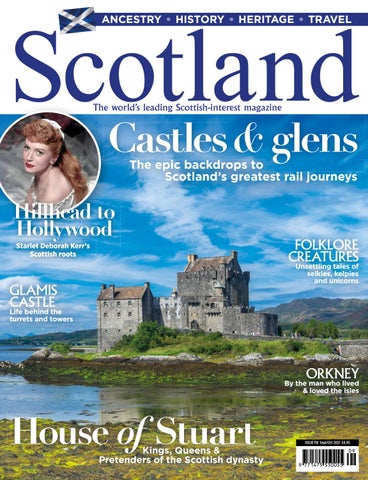
Castles & glens The epic backdrops to Scotland’s greatest rail journeys
Hillhead to Hollywood Starlet Deborah Kerr’s Scottish roots
FOLKLORE CREATURES
Unsettling tales of selkies, kelpies and unicorns
GLAMIS CASTLE
Life behind the turrets and towers
ORKNEY
By the man who lived & loved the isles
House of Stuart
Kings, Queens & Pretenders of the Scottish dynasty
ISSUE 118 Sept/Oct 2021 £4.95
S. J. Peploe’s Studio Life at 150 October 2021
www.scottish-gallery.co.uk
2 Jubilee Place, London SW3 3TQ Tel: 020 7349 3700 Fax: 020 7349 3701 Email: editor@scotlandmag.com www.scotlandmag.com
EDITORIAL
ADVERTISING SALES
PUBLISHING
Editor Sally Coffey Production Editor Jenny Rowe Consultant Editor Roddy Martine Art Editor Clare White PR Requests pr@chelseamagazines.com
Contact Publicity Suite 4b, Platinum House Eagle Street, Glasgow Tel: 0141 204 2042 Fax: 0141 204 2043
Chairman Paul Dobson Managing Director James Dobson Publisher Simon Temlett Chief Financial Officer Vicki Gavin EA to Chairman Sarah Porter
Contact Stacy Knoud stacy@contactpublicity.co.uk
Printed in England by William Gibbons Ltd Production All Points Media
SUBSCRIPTIONS UK and Rest of World: www.scotlandmag.com/subscribe Tel: +44 (0) 1293 312 197 Email: scotland@subscription.co.uk SCOTLAND magazine, Intermedia, Unit 6 Enterprise Centre, Kelvin Lane, Manor Royal, Crawley, RH0 9PE, UK USA and Canada: www.britsubs.com/scotland Tel: 1-800-925-8215 (toll free) Email: SCOcustserv@cdsfulfillment.com Post: SCOTLAND, PO Box 37518, Boone, IA 50037-0518 (USA only); OR SCOTLAND, 1415 Janette Avenue, Windsor, Ontario, N8X 1Z1 (Canada only) Annual subscription rates (6 issues) UK – £21.95; USA and Canada – $44.95 Rest of World – £33.95 New Zealand & Australia AUD $66.95 Did you know you can manage your subscription online? Oversee your print and digital subscriptions online today simply by signing up at https://www.subscription.co.uk/chelsea/Solo/. Stay up to date with the latest issues, update your personal details, and even renew your subscription with just a click of a button. Back Issues www.chelseamagazines.com/shop Distribution Scotland Magazine Issue #118, (ISSN 1475-5505) (USPS 020-429) is published six times a year (bi-monthly) by The Chelsea Magazine Company, Jubilee House, 2 Jubilee Place, London SW3 3TQ, UK. Distributed in the U.S. by NPS Media Group, 2 Enterprise Drive, Suite 420, Shelton, CT 06484. Periodicals Postage paid at Shelton, CT and additional mailing offices. POSTMASTER: Send address changes to Scotland magazine, PO Box 37518, Boone, IA 50037-0518. UK and Rest of World: Seymour, 2 East Poultry Avenue, London EC1A 9PT, UK Tel: +44 (0)20 7429 4000 SCOTLAND IS PROUD TO SUPPORT THE SCOTTISH HOTEL AWARDS
© GEORGY KRIVOSHEEV/ISTOCK
Simon Temlett, Awards Director simon.temlett@chelseamagazines.com © The Chelsea Magazine Company Ltd, 2021. All rights reserved. Text and pictures are copyright restricted and must not be reproduced without permission of the publishers. The information contained in Scotland magazine has been published in good faith and every effort has been made to ensure its accuracy. However, where appropriate, you are strongly advised to check prices, opening times, dates, etc, before making final arrangements. All liability for loss, disappointment, negligence or damage caused by reliance on the information contained within this publication is hereby excluded. The opinions expressed by contributors to Scotland magazine are not necessarily those of the publisher.
Editor’s letter My favourite way to travel is by train: all you have to do is sit back and watch the world pass by your window before alighting at your designated station, feeling fully rested. There’s no traffic, no chance of getting lost, and you can stretch your legs and grab some refreshments whenever you want. And so, this issue in Making tracks (p14), we highlight some of the greatest rail journeys in Scotland, from the famous West Highland Line, to the under-theradar Kyle Line and the ‘Harry Potter’ Jacobite Steam Train, where you can see blockbuster scenery without leaving your seat. However, travel to Scotland is still some way off for some of you, so this issue, we’ve packed our pages with fascinating stories to entertain you if you’re stuck at home. In The House of Stuart (p34), our very own Jenny Rowe has done the seemingly impossible: squeezed over 300 years of Stuart history into eight pages. Of course, this is just a taster, as Scotland’s royal dynasty is a bottomless mine of unbelievable tales and so from next issue, please look out for our new series on Secret Stuart stories. Elsewhere this issue, we meet a modern-day blacksmith who uses traditional techniques to make thoroughly modern artworks in The king of metal (p44). Plus, we lift the lid on what life was like for the Queen Mother behind the turrets and towers of her childhood home in Elizabeth of Glamis (p24) and reveal some of the origins of Scotland’s obsession with mythical creatures in Magical mystery tour (p48). I hope you enjoy the issue.
ANCESTRY • HISTORY • HERITAGE • TRAVEL
COVER IMAGE:
The world’s leading Scottish-interest magazine
Castles & glens The epic backdrops to Scotland’s greatest rail journeys
Hillhead to Hollywood Starlet Deborah Kerr’s Scottish roots
FOLKLORE CREATURES
Unsettling tales of selkies, kelpies and unicorns
GLAMIS CASTLE
Life behind the turrets and towers
ORKNEY
By the man who lived & loved the isles
House of Stuart
Kings, Queens & Pretenders of the Scottish dynasty
001_UK_COVER_SM118 v8.indd 1
ISSUE 118 Sept/Oct 2021 £4.95
10/08/2021 12:47
Eilean Donan Castle at Dornie near Kyle of Lochalsh © Jan Miracky/ AWL Images Inset: Deborah Kerr © Everett Collection Inc/ Alamy
SALLY COFFEY
Editor
editor@scotlandmag.com
@Scotland_Mag
facebook.com/ScotlandMagazine
@scotlandmagazine
Scotland 3
34 Stromness p57 Scapa Flow p66
Douneside p52
48
Footdee p71 Mallaig p14 Glamis Castle p24
Kelpies p48 Bonnet Toun p62
CONTENTS ISSUE 118
03 Editor’s letter 06 The Clan Courier Local news and the latest travel tip-offs
09 Dates for your diary This season’s best events on both sides of the Atlantic
10 Notes from the isles Why go abroad when you live in the Highlands?
12 We’ve got mail Your letters and stories of Scotland
14 Making tracks Follow Scotland’s greatest rail journeys through remote train stations and incredible countryside
24 Elizabeth of Glamis Explore Glamis Castle, the childhood home of Queen Elizabeth, the Queen Mother
30 Old versus new Have modern techniques changed the flavour of whisky, and what is a craft distiller anyway?
32 Military precision If your Scottish ancestors served in the British Army, chances are there’s a record of it somewhere
34 The House of Stuart Survey three centuries of Stuart monarchs that saw Scotland become part of a United Kingdom
71 So much of Footdee is touched by whimsy [...] a soulful affront to Aberdeen’s oil industry
62
© ANTONIA REEVE/NATIONAL GALLERIES OF SCOTLAND/PAUL STAFFORD/ARCO IMAGES/ROBERT HARDING/ VISIT SCOTLAND/KENNY LAM. ILLUSTRATION © MICHAEL A HILL
24 44 The king of metal Meet Kevin Paxton, a talented blacksmith forging ahead with his creative inventions
48 A magical mystery tour Go in search of unicorns, selkies, kelpies and Nessie on a tour of Scotland’s most tantalising mythical creatures
52 MacRobert’s reply Learn the story behind Douneside House, an Aberdeenshire hotel born out of tragedy
54 Beautiful Britain calendar Buy a 2022 calendar featuring stunning images of iconic sights such as Skye’s Old Man of Storr
57 For the islands he wrote Visit Orkney and view the isles through the eyes of local-born poet, George Mackay Brown
62 The bonnet toun Explore the art of bonnet making in ‘Bonnet Toun’, the place most renowned for this traditional craft
66 Under attack How the Germans’ Second World War U-boat campaign was determined by Orkney’s Scapa Flow
71 Life in a fishbowl Welcome to Footdee, a former fishing village using creativity to keep Aberdeen’s oil industry at bay
76 The king and Kerr Celebrate Deborah Kerr, the glamorous Hollywood star who hailed from Glasgow’s Hillhead
82 The story behind... Folk musician Ainsley Hamill tells the inspiring tale of Scottish Olympic Gold swimmer, Belle Moore
Scotland 5
News & events
CLAN COURIER
© DAVID CHESKIN/ROYAL COLLECTION TRUST/THE FOLIO SOCIETY
Highland hotels, coach tours and a retort to the notorious Sutherland Clearances
[SHOPPING]
RARE ROB ROY To celebrate the 250th anniversary of Sir Walter Scott, The Folio Society has released a limited edition of his historic novel Rob Roy, with special illustrations by renowned artist June Carey. Featuring a foreword by Outlander author Diana Gabaldon, just 750 copies of the leather-bound, hand-numbered edition have been made and each is signed by both Carey and Gabaldon. Price £250. foliosociety.com
[EXHIBITION]
THE PRINCE AT THE PALACE As an additional treat for visitors to the Palace of Holyroodhouse this year, there is a special exhibition on the life and legacy of HRH The Prince Philip, Duke of Edinburgh. Starting with his early life and naval career, the exhibition includes items from his marriage to Her Majesty The Queen in 1947, including the invitation, order of service and wedding breakfast menu, leading on to an appreciation of his remarkable 70 years as Royal Consort. Among the exhibits is a casket (pictured) holding the Freedom of the City of Edinburgh, known in the Royal Navy as ‘The Burg,’ which he received in 1947. Prince Philip was Colonel-in-Chief of the Queen’s Own Cameron Highlanders from 1953-1961 and his informal kilt in the Balmoral tartan is also on display. There is a particularly striking triptych portrait painted on his 90th birthday by David Poole. The Duke was both an art collector and painter himself, and in addition to the beautiful wedding gift of an oil painting by Edward Atkinson Hornel, there is a selection of works personally chosen by him by distinguished Scottish artists such as John Houston and Elizabeth Blackadder. Prince Philip: A Celebration runs until 31 October 2021 and access is included in palace tickets. rct.uk RODDY MARTINE
Scotland 7
[ T R AV E L ]
WHERE MOUNTAINS MEET MOORS
For people travelling on the West Highland Line, one of the world’s most awe-inspiring rail journeys (see page 14), the Bridge of Orchy Hotel is an ideal place to stop and take it all in before re-joining the route. Located just to the north of the Loch Lomond and The Trossachs National Park, with the vast wilderness of Rannoch Moor spreading out to the east and the mountains of Glen Coe looming to the northwest, it’s a place of unparalleled landscapes that deserves to be appreciated. There are 32 rooms in the hotel – 10 in the main building – many of which have beautiful views. There’s a roaring fire in the lively bar, and a separate dining room and a library. Plus, the sense of history is palpable here: the hotel takes its name from the nearby 18th-century bridge built to pacify the Highland clans following the Battle of Culloden. www.bridgeoforchy.co.uk
[PODCAST]
LISTEN UP Want to immerse yourself in Scottishstorytelling, visit parts of Scotland that you’ve never been to before without leaving home, or just pick up some tips for your next trip? Kathi Kamleitner, who has travelled Scotland extensively over the past seven years, is getting ready to launch the new series of her podcast Wild for Scotland, which aims to highlight lesser-known road trips in Scotland and encourage visitors to
8 Scotland
slow down when they come. Wild for Scotland includes first-person travel stories, complete with detailed descriptions and sound effects that will help transport you to Scotland, even when you are stuck far away. You can listen to the new series of the Wild for Scotland podcast from mid-September on our website at scotlandmag.com/wildforscotland.
[TOURS]
DRIVING AMBITION
D&E Coaches has provided bus services to some of the most remote corners of the Highlands over the past couple of decades. Now, the company is branching out to offer scenic tours, providing new links with some of the region’s most popular attractions, such as Loch Ness. It has taken over operations of the hop-on, hop-off Inverness City Sightseeing bus service, too. Donald Mathieson, owner of D&E Coaches, said: “The Highlands has long been a popular tourist destination and, as people are starting to feel optimistic about travelling again in the summer, we are delighted to be launching D&E Tours to allow them the chance to explore the Highlands in comfort. “The Highlands is home to some of the country’s most stunning scenery and world-renowned attractions, and it is our aim to make these as easily accessible to visitors as possible.” decoaches.co.uk/tours
News & events [LAND OWNERSHIP]
NEW LIFE FOR CLEARED VILLAGE
© VISIT SCOTLAND/KENNY LAM/KATHI KAMLEITNER/EWAN WEATHERSPOON PHOTOGRAPHER/NATIONAL TRUST FOR SCOTLAND
Community groups in the north Highlands are considering a land buyout, which could bring people back to land last inhabited over 200 years ago when its residents were forced out. The North Sutherland Community Forest Trust (NSCFT), Bettyhill, Strathnaver and Altnaharra Community Council, Strathnaver Museum and North Sutherland Wildlife Group are considering a buyout of Rosal, a village, which was cleared between 1814 and 1818 during the notorious Sutherland Clearances (as outlined in issues 116 and 117 of Scotland). One idea being discussed is the creation of a new settlement on land near the cleared village. Speaking to The Scotsman, Jim Johnston, of Bettyhill, Strathnaver and Altnaharra Community Council said: “There is a huge amount of land in the Highlands which was depopulated and remains depopulated which could be given over to the opportunity for people living on the land once again.”
DATES FOR YOUR DIARY As the world slowly reopens, here are some forthcoming events you might want to mark on your calendar
SCOTLAND 1-4 October 2021 CULZEAN BY THE SEA, AYRSHIRE A new willow sculpture trail has opened around Culzean Castle & Country Park as part of Scotland’s Year of Coasts and Waters 20/21. nts.org.uk
[C E L E B RAT I O N S ]
MAGICAL MEMORIES Twenty-five years ago, Paul and Katriona Goode felt like king and queen of the castle when they got married in the ballroom at Floors Castle, so when Covid-19 put paid to silver anniversary plans for a big get-together or special holiday, they decided to return. Katriona said: “We wrote to The Duke asking whether this would be possible, and he and the estate have been as welcoming as ever. We were utterly thrilled to be given champagne by a butler and to receive a gift to mark the occasion.”. The Duke of Roxburghe said: “We’re all very happy that Katriona and Paul wanted to celebrate their anniversary back at Floors. They and their family have our warmest congratulations and we hope they have enjoyed another memorable day at Floors.” floorscastle.com
15-31 October 2021 ALFRED DUNHILL LINKS CHAMPIONSHIP, ANGUS & FIFE Watch your golfing stars at this hotly anticipated European Tour event. alfreddunhilllinks.com Until 16 October 2021 SCOTTISH INTERNATIONAL STORYTELLING FESTIVAL, EDINBURGH Celebrate the joy of storytelling, oral traditions and cultural diversity. The 2021 programme will be announced in September. www.sisf.org.uk 31 October 2021 CINESCAPES 2021, VARIOUS VENUES
A touring film festival showing the best Scottish-themed films ever produced. cinescapes.co.uk 2-7 November 2021 BELTANE FIRE SOCIETY’S SAMHUINN 2021, EDINBURGH Witnesses to this fiery spectacular must register in advance by getting a ticket. beltane.org 27 November 2021 THE BAILLIE GIFFORD BORDERS BOOK FESTIVAL, SCOTTISH BORDERS Baillie Gifford’s sparkling cast of authors and stars of stage and screen will speak from the glorious setting of Abbotsford House, the home of Sir Walter Scott. bordersbookfestival.org
US & CANADA
2 October 2021 SCOTLAND COUNTY HIGHLAND GAMES, NC Advance tickets are on sale for this Highland games, which offers the full
spectrum of events. carolina-highlandgames. com 15-17 October 2021 OKLAHOMA HIGHLAND GATHERING, OK This Highland games kicks off with a Scottish fire festival and ceilidh on the Friday night. Among the usual attractions, there are clan tents, genealogy researchers, a crofters’ village and Gaelic lessons and readings. unitedscotsok.com 30-31 October 2021 RICHMOND HIGHLAND GAMES, VA From whisky tasting to the harp, fiddle and Gaelic song tent, this event has it all. More details coming soon. vacelticfestival.com 6-7 November 2021 AUSTIN CELTIC FESTIVAL, TX The host of the 2021 Scottish Highland Games Masters World Championships. More details to come. austincelticfestival.com
Scotland 9
JOURNAL
| Window into Scotland
Notes from the Isles
Why does anyone ever want to go abroad when they live in the magical Highlands? Words by KATE FRANCIS
T
his morning, as I watched an oyster catcher strutting along the beach and a heron eyeing the water for fish, a fellow dog-walker approached. His summer had been ruined, he moaned: Covid restrictions meant he’d had to cancel a Mediterranean holiday. I commiserated, refraining from comment. Cronie and I then climbed the hill from the shore, up across a meadow carpeted with foxgloves, speedwell, buttercups, daisies, violets and vetch, into woods vibrant with birdsong. We didn’t see the osprey today, but red kites hovered above the trees and a chevron of honking geese flew overhead. I managed to grab Cronie before she spotted the family of roe deer cantering through the trees, and again when a red squirrel ran across the path. At the top of the hill, I stood among the jumble of rocks, which are all that remain of a Pictish fort – one of many relics in the area of those ‘Painted People’ who caused the Romans to build Hadrian’s Wall to keep them at bay. Although it was inhabited by Picts, the fort dates back to the Iron Age. History lay all round me. To
10 Scotland
the south, Loch Ness with its famous inhabitant, who was seen off by St Columba in the 6th century after attacking one of his companions – an act so impressive, it is said, that the Picts converted to Christianity. The battlefield at Culloden Moor to the east, where Bonnie Prince Charlie met his fate, is still preserved, with an excellent visitor centre that offers a
© PAUL TOMKINS/VISIT SCOTLAND
Window into Scotland |
five-minute film of the battle that’s so good I could watch it a hundred times. To the west, Ben Wyvis, the only ‘Munro’ in Easter Ross, dominates the skyline; keen eyes will see traces of snow in its gullies year round. It was a kinsman of the Munros who, in 1891, compiled a list of all Scottish hills over 3,000 feet, hence their name; ever since, climbers have competed in Munro bagging. For fishermen, there are rivers and lochs teeming with salmon and trout and a sea full of fish to be hauled in by the bucketful, from mackerel and red gurnard to lobsters and crabs. Mussels cling to the rocks, cockles can be dug up from the sand, shrimps can be caught in nets. For sailors with a good chart and reasonable navigational skills, nothing could match the unbelievable beauty of the west coast and the outer isles, easily accessible from here via the Caledonian Canal. And who wants a beach crammed with people, deckchairs and parasols if they can skinny dip in a remote hill loch or run down a deserted beach and dive into the sea where dolphins frolic in the waves. Those seeking guaranteed sunshine will get guaranteed crowds of people thronging every attraction. Who would want to go abroad when they live in the magical Highlands? I’ve been trying to tame my wild garden. As I struggle to rescue cuttings of ‘proper’ plants from being swamped by voracious natives, I think of Charles Darwin’s Evolution theories. I was reminded of this recently driving past the Hugh Miller Birthplace Cottage and Museum in Cromarty. One of Scotland’s great men, Miller was born in 1802 and, among his many accomplishments, he was a geologist, a writer and deeply religious. Some of the fossils he discovered in rocks along the eastern shore dated back more than 400 million years. He died of suicide at the age of 54, partly because he couldn’t equate his strong Christian faith with Darwin’s theories. Gardening certainly exercises the brain, as well as the muscles. If evolution is ‘survival of the fittest’, I mutter to myself as I rip out the goose grass, docks, nettles and bind-
JOURNAL
To the west, Ben Wyvis, the only ‘Munro’ in Easter Ross, dominates the skyline; keen eyes will see traces of snow in its gullies year round weed, wouldn’t it be best if I stopped trying to interfere and let nature take over my garden? And if weeds evolved from less hardy plants, does this explain why mankind, another product of evolution, is by no means perfect and often extremely harmful? With a nod to evolution, I’ve resisted cutting out the suckers from the cultivated rose bushes, so most of them have reverted to their ancestry, sprouting rampant briars. They flower abundantly and look lovely, though I have to confess that I rather miss some of the conquered aristocrats. Two widow friends came to stay recently, keen gardeners and both in the second half of their 80s. One of them likes a neat, controlled garden: clumps of well spaced plants, elegant shrubs, not a weed in sight, velvet lawns with trimmed edges. The other shares my ‘survival of the fittest’ approach. On their first day, I left them in the sunroom with the newspapers, while Cronie and I went for our afternoon hike. I returned to find them both on hands and knees on my terrace, armed with kitchen knives, trying to dig out the invasive weeds between the granite flag stones. As I came through the gate, I heard: “no, no, Jill, don’t dig up that moss, it’s much prettier than bare earth, and leave those little pink rock plants; just take out the uglier and bigger weeds...”. One half of my terrace is now naked, the other is like a charming horizontal rockery. Some neighbours two fields away recently inherited a peacock – Lord Fandango, nicknamed Ponty. Thinking he might be lonely, they bought him a mate, Priti (Patel?) For some reason, the pair didn’t hit it off and Priti ran away to an adjacent farm. Very sadly, she then ventured up onto the main road and was run over by a passing lorry. Ponty has now decided to spread his wings and is testing out a series of local gardens. Each day, the community grapevine reports his latest whereabouts and his owners set off to try and lure him home, but so far without success. I miss his distinctive, if somewhat assertive, call. Once again, I’m found thinking, there’s nowhere more magical than the Highlands of Scotland. S
TOP LEFT: Kate and Cronie, her faithful Border Terrier BELOW LEFT: The view from the Black Isle across the Cromarty Firth to Dingwall and Ben Wyvis
Scotland 11
MAILBAG
| Your letters
WE’VE GOT MAIL A selection of messages from our readers across the globe
Looking towards Luskentyre Beach on the Isle of Harris, Outer Hebrides
My name is Magie, and I’ve been reading Scotland for just over a year now. I first visited Scotland in 2019 with my boyfriend David and we loved it so much we planned an immediate trip back in 2020. Of course, we all know how that went. Your magazine has not only made me feel more connected with Scotland, but it’s also kept the dream of going back a real thing in my mind. I’m an aspiring writer so I not only want to visit again for my own pleasure but because I want my next book to be based in Scotland and therefore need to be able to soak up all I can of the culture, history and people. The issue that included the Outer Hebrides (116) has made me realise my desire to get to those more remote locations when I can get back there. Wish me luck. Margaret Gable, by email EDITOR WRITES: Haste ye back, Magie.
The Editor, Scotland, 2 Jubilee Place, London, SW3 3TQ
12 Scotland
SEMPILL NOT SO SIMPLE
I wish to point out an error in your editorial on Craigievar Castle (117). It was not the seat of Clan Sempill. It is incorrect to use the term clan with the name Sempill. The Sempills were a Lowland family with lands in Renfrewshire. It was the seat of my ancestors who held the Sempill title, an old Scottish peerage, which was inherited by my great grandfather, Sir William Forbes of Craigievar, in the late 1800s. Following the inheritance, the family surname was changed to Forbes-Sempill. Yours sincerely Jamie, The Lord Sempill enjoyed an old TV show about Inveraray Castle, in Argyll, and I thought it would be nice if you ran a series on clan bases in Scotland (I know that some have been written about already). Just a thought. Karen Rasmussen, USA
EDITOR REPLIES: Please accept our apologies for this mistake Jamie and thank you for clarifying.
YOUR HOME IS YOUR CASTLE
I am a reader transferred from Scottish Life and I love your magazine. Last night I watched and
Can’t see yours or want to read more letters? Go to
scotlandmag.com/ yourviews
editor@scotlandmag.com facebook.com/ScotlandMagazine
EDITOR REPLIES: Karen, I think this is an excellent idea. Watch this space.
@Scotland_Mag @scotlandmagazine
© VISIT SCOTLAND/PAUL TOMKINS. WE RESERVE THE RIGHT TO EDIT LETTERS FOR PUBLICATION
SCOTLAND DREAMING
BRIDGE of ORCHY HOTEL
Rooms, Restaurant and Bar Experience Highland hospitality in a luxurious four-star setting Bridge of Orchy Hotel, Bridge of Orchy PA36 4AD Tel 01838 400 208 Email info@bridgeoforchy.co.uk Web www.bridgeoforchy.co.uk
Scotland 13
TRAVEL
| Great Rail Journeys
Making Tracks In Scotland, the journey is all part of the adventure, and this is never truer than when you are travelling by train
Words by SALLY COFFEY
14 Scotland
Great Rail Journeys |
travel
Scotland 15
| Great Rail Journeys
E PREVIOUS PAGE: The famous Jacobite Steam Train crosses the Glenfinnan Viaduct CLOCKWISE, FROM TOP LEFT: The West Highland Line passes Loch Nan Uamh; the Glenfinnan Monument at the head of Loch Shiel; the Club Car on the Caledonian Sleeper Train; the sun sets over Rannoch Moor
16 Scotland
arlier this year I travelled by Caledonian Sleeper train from London to Fort William with a friend. We boarded the train at 8.30 on a Sunday evening, ordered a glass of bubbles each to our cabin – sadly the Club Car was still out of bounds due to the pandemic – had a celebratory toast and then settled down for a relaxing read in our bunks before being rocked to sleep by the motion of the train. The next thing I knew, I woke to the exclaim: “Sally, Sally, there are deer!” as my by-now very excitable friend, pointed to the window. Dragging my groggy self out of bed to the window to join her, I looked out as we passed deer after deer as the railway line crossed Rannoch Moor and I smiled. It was Anna’s first time on a Sleeper, so her excitement was justified, but having already travelled by Sleeper several times, perhaps more surprisingly, my excitement was almost on par. If the Club Car was open, we would have taken a seat there and eaten our breakfast as we watched through the window as the train pulled into Corrour, the most remote train station in Britain (where deer can sometimes be seen on the platform – this is known as the Deer Stalker route). We would have sipped our coffee as the boggy moorland of Rannoch Moor gave way to the lochs and mountains of the
© BRADLEY PAGE/ALAMY/AIRBORNE LENS/KENNY LAM/PAUL TOMKINS/VISIT SCOTLALND/ CHARLIE FRASER-HOPEWELL
travel
Musi EIF’s
Great Rail Journeys |
travel
The Sleeper train stops at Corrour, the most remote train station in Britain, where deer can sometimes be seen on the platform
ic, theatre and dance sprang from the founding vision that art can be used to heal divisions Scotland 17
travel
| Great Rail Journeys Thurso Wick
Inverness Kyle of Lochalsh Mallaig
Aviemore
Fort William
Glasgow
RIGHT: The scenic Kyle Line passes through the charming village of Plockton in the Highlands
18 Scotland
Highlands as we clattered towards Tulloch and then onwards to Spean Bridge. As it was, we had to make do with looking out the window in the narrow corridor outside our door as we drank our coffee and ate our bacon rolls, for though the Sleeper trains offer a real adventure, there’s not really space for side-byside wildlife watching from the one window within the cabins themselves. There are lots of routes you can travel on the Caledonian Sleeper – to Inverness, Oban and Aberdeen – and all trains set off from London Euston, so it is a great way to travel to Scotland if you want to factor in some London shopping and sights first. However, for me, it’s the Fort William route, where there’s a good couple of hours of scenery to take in when you wake before you alight, that is the true show-stopper. This route travels a large section of the West Highland Line, repeatedly put forth as one of the greatest rail journeys in the world and you’ll find no argument here. If you’re travelling by Sleeper, set your alarm for 6am to really make the most of the views, for very shortly after Glasgow you enter the Loch Lomond and The Trossachs National Park, skirting Loch Long before travelling along the northern section of Loch Lomond itself. North of the park, the railway line makes a horseshoe curve around the foot of three mighty hills: Beinn Dorain, Beinn a’ Chaisteil and Beinn Odhar. Soon you’ll enter the beautifully bleak landscape of Rannoch Moor with the Glen Coe mountains in the distance.
© ANDREW HOPKINS/ALAMY
Caledonian Sleeper West Highland Line Jacobite Steam Train The Kyle Line The Far North Line Strathspey Railway
Great Rail Journeys |
travel
Scotland 19
travel
| Great Rail Journeys
CLOCKWISE, FROM TOP LEFT: A ScotRail train travels along the Kyle Line; Attadale Gardens near Strathcarron can be reached on the Kyle Line; the Skye Bridge leads to the island from Kyle of Lochalsh
20 Scotland
Sleeper guests are deposited at Fort William in view of Ben Nevis around 10am and from here you can complete the West Highland Line route to Mallaig, from where you can catch the ferry to Skye, either by boarding one of ScotRail’s diesel trains, or in summer by making the onward connection with the Jacobite Steam Train. If the latter, there is a choice of ways to travel, from the very affordable seats in the standard class carriage, to a firstclass carriage with private tables for two, lamps and luxurious upholstered seating, to private compartments. Known to many these days as the ‘Harry Potter train’, as it was on this train that students of Hogwarts travelled to school in the film franchise, the most jaw-dropping part of the journey is crossing over the Glenfinnan Viaduct, a huge, arced bridge that spans 1,000ft, offering awesome views of the Glenfinnan Monument, which stands on the shores of Loch Shiel. The full route of the West Highland Line, which travels from Glasgow to Mallaig, can also be done on a ScotRail diesel train and is best completed in the daytime, when you won’t miss any of the epic showreel. Whichever way you travel, make sure you get a seat on the left-hand side of the train, you’ll thank me when you reach Glenfinnan. While the West Highland Line may have had the press, and certainly has the visitors, there are other rail routes in Scotland that offer extraordinary scenery, too.
©JOHN BRACEGIRDLE/ALAMY/PAUL TOMKINS/VISIT SCOTLAND/ANGUS DUNCAN
If you are travelling onto Skye, or planning a visit to Eilean Donan Castle, or perhaps just want to see some of the lesserknown Highlands, then consider travelling from Inverness to Kyle of Lochalsh along the Kyle Line. A route primarily used by locals, providing some essential connections for small Highland towns and villages, with exceptional views of Skye as you near Kyle of Lochalsh, it is a real hidden gem. The 80-mile route, which takes around two-and-a-half hours is considered by some to be Scotland’s most scenic route – the late travel writer Alexander Frater likened it to a symphony in three parts: “pastoral, mountain and marine”. The fact it is still here at all is thanks to the tireless work of The Friends of the Kyle Line, since it has been earmarked for closure many times. There are around three to four trains a day along the line, with occasional visiting trains such as the Orient Express, the Royal Scotsman and occasionally steam trains. Though there are connections to Inverness, the line actually starts a little outside the city in Dingwall, an attractive market town. As you leave Dingwall and travel west towards Muir of Ord, look out for Ben Wyvis to the north, its whaleback ridge commanding the skyline. From here you’ll pass by lochs and moorland as you cross inland to the coast. As you near Achnashellach Forest, Wester Ross’s Torridon Peaks can be seen to the north, and
horticulturists should probably disembark shortly afterwards at Attadale to view the famous gardens backed by the outline of Skye. Another highlight is the pretty-as-a-picture village of Plockton, where the TV series Hamish Macbeth was filmed, and which still retains a sense of unhurriedness, with a beautiful sea loch, a smattering of good pubs and giftshops and some excellent seal tours. When the train reaches its final destination of Kyle of Lochalsh, you can jump on a bus and cross the Skye Bridge to the Misty Isle itself. Another railway line missed by many, is the Far North Line, again an essential network for those living in the north Highlands, which tracks along the east coast of the North Coast 500 route, through Ross and Cromarty, all the way to Caithness and Sutherland. Setting off from Inverness, it trudges north past a number of distilleries – Dalmore and Glenmorangie to name a couple – salmon rivers, historic sites and old fishing communities, following the hug of the North Sea, initially. You can alight at Tain to cross the Dornoch Firth to visit the seaside resort (and famous golf course) of Dornoch. The line then swings inland to pick up and drop off in Lairg, before returning to the coast just in time to make a stop at Dunrobin Castle (only in summer), Brora and Helmsdale, before heading inland again.
Scotland 21
travel
| Great Rail Journeys
CLOCKWISE, FROM TOP LEFT: Dornoch Beach and Royal Dornoch golf course; a firstclass compartment on the Jacobite; the Far North Line travels through the Highlands; one of the Strathspey Steam Railway locomotives chugs alongside the River Spey
22 Scotland
It’s a great way to get a sense of just how remote some of these places are, with the train repeatedly pulling into the most unlikely of stations, such as Altnabreac in the heart of the Flow Country, a vast area of blanket bog and one of the RSPB’s most important peat habitats. The route stops at Thurso – the most northerly train station in the British Isles – where there are some good seafood dining options nearby, before returning via the historic fishing town of Wick. And finally, though there are a fair few steam trains in Scotland, the Strathspey Steam Railway in the Cairngorms has to be up there in terms of the most scenic. This year the Victorian railway celebrates 40 years of being brought back to life and though it is a short journey in comparison – a 20-mile round trip from Aviemore to Broomhill and back – it offers a real slice of nostalgia. Inside, there are several options for seating and eating, including afternoon tea and luncheon. There are standard seats and first-class compartments, though the best seats on board are in the Officer’s Saloon Car, a restored 1940s car with wood panelling, red carpets and compartments for six. En route you’ll have views of the River Spey, the Cairngorms mountains and plenty of wildlife. Run by a team of volunteers, its future will only be assured if people continue to use it, so next time you’re in the Cairngorms, take a little trip back in time. S
Great Rail Journeys |
travel
© KAV DADFAR/AWL IMAGES/DOUGLAS CARR/SCOTTISH VIEWPOINT/ALAMY
PLAN YOUR RAILWAY ADVENTURE CALEDONIAN SLEEPER
WEST HIGHLAND LINE
With overnight trains six nights a week (not Saturdays), the Caledonian Sleeper will whisk you all the way from London to Fort William. sleeper.scot
ScotRail runs several trains a day along the whole route of the West Highland Line at a snippet of the price of the Caledonian Sleeper and the Jacobite Steam Train. scotrail.co.uk
JACOBITE STEAM TRAIN From April to October, travel the final section of the West Highland Line aboard this vintage steam train westcoastrailways.co.uk/jacobite/ steam-train-trip
THE FAR NORTH LINE
THE KYLE LINE
STRATHSPEY RAILWAY
Saved from closure several times, this railway route is the most romantic way to travel from Inverness to Skye. kylerailway.co.uk
These vintage trains travel through the Cairngorms and will transport you into a bygone era. strathspeyrailway.co.uk
Venture into the heart of the north Highlands, where visitors rarely go, on this train route. fofnl.org.uk
Scotland 23
STATELY HOMES
| Glamis Castle
THIS IMAGE: Glamis Castle in Angus, Scotland INSET: The then Duke and Duchess of York spent part of their honeymoon at Glamis, where Lady Elizabeth had grown up
24 Scotland
STATELY HOMES
| Glamis Castle
Words by RODDY MARTINE
© IMAGEBROKER/ALAMY
ELIZABETH of GLAMIS
As Queen consort and mother of Her Majesty the Queen, Elizabeth Bowes-Lyon lived in many palaces, but perhaps none felt more like hers than her childhood home Scotland 25
STATELY HOMES
| Glamis Castle
26 Scotland
© ADAM WOOLFITT/ROBERT HARDING
O
n an overnight visit to Glamis Castle in the early 19th century, Sir Walter Scott wrote, “I began to consider myself as too far from the living and somewhat too near the dead.” No such thoughts troubled the future bride of King George VI, Her Majesty Queen Elizabeth the Queen Mother, for whom Glamis Castle with its bulky towers and turrets was her much beloved family home. In common with other scions of the old Scottish aristocracy, her parents also owned properties in England, notably in London and at St Paul’s Walden Bury in Hertfordshire, but it was amid the straths of the Angus countryside that the young Lady Elizabeth spent her happiest formative years. While attending a charity garden party in the grounds at Glamis, an old woman informed her that when she grew up, she would become Queen of England. “In that case,” said the seven-year-old Elizabeth to her governess, “The laws of England will have to be changed!”. When war was declared against Germany on 4 August 1914, coincidentally the day of Elizabeth’s 14th birthday, the 14th Earl of Strathmore and Kinghorne decided to relocate his Countess and 10 children more permanently to Scotland. Soon after their arrival, Glamis Castle, in common with other great UK country houses, was requisitioned as a convalescent hospital for wounded soldiers. The family nevertheless remained in their private quarters but soon after, a serious fire broke out. On seeing the smoke, it was the 16-year-old Elizabeth who raised the alarm and who is largely credited with securing the rescue of the castle’s contents.
stately homes
CLOCKWISE, FROM BELOW: The Duke and Duchess of York (centre) surrounded by members of the
| Glamis Castle Bowes-Lyon family, c.1923; the Dining Room; the vaulted Drawing Room, created by the 3rd Earl of Kinghorne
Those were difficult times for the close-knit Bowes-Lyon family. Four brothers enlisted in the army and Elizabeth’s eldest brother Fergus, an officer in the Black Watch, was killed at the Battle of Loos in 1915. Another brother, Michael, was reported missing, but later discovered to have been a prisoner-of-war. However, amid the green rolling countryside and big skies of Scotland’s northeast coast, the troubles of the world were kept at a distance. Aside from volunteering as a nurse, Elizabeth was able to enjoy all of her favourite country pursuits, such as riding and fishing for trout and salmon, at which she excelled. The Italian Garden, with its raised terrace set between two small gazebos to the east of the castle, was laid out by her mother, Countess Cecilia, to designs by Arthur Castings. It was from this example that her daughter inherited a love of plants, which in later life she introduced at Clarence House, Birkhall and Castle of Mey. And it was in Scotland that the young Elizabeth socialised with nearby landed families, notably the children of King George V when on holiday at Balmoral. In 1922, she was a bridesmaid at the wedding of Princess Mary. Following their wedding in 1923, she and the then Duke of York chose Glamis Castle as one of their honeymoon locations, and it was here that their second daughter, HRH The Princess Margaret, Countess of Snowdon was born in 1930, becoming the first royal baby in direct line to the throne of the United Kingdom to be born in Scotland for 300 years. Queen Elizabeth the Queen Mother clearly loved Glamis and at an official ceremony in 2008, her grandson, the Duke of Rothesay, officially named the specially designed wrought-iron entrance gates to the one-mile front drive, The Queen Mother Memorial Gates. Show me a Scot who does not revere his or her ancestral
Scotland 27
CLOCKWISE, FROM ABOVE: The Queen Mother’s bedroom at Glamis; the Italian Garden was laid out by Countess Cecilia, the Queen Mother’s mother; the cosy sitting or family room
28 Scotland
roots. Descent from the royal line of Stewart was important to Elizabeth of Glamis, and throughout her long life she retained a deep emotional attachment to the land of her ancestors. Once, when approached at a reception by a South African who informed her that he detested the English, she replied. “Oh, I do so understand. You see I am Scottish.” Long before it became a hunting lodge, Glamis had been a religious retreat for the Irish Christian missionary Saint Fergus. One thousand years ago it was among the territorial titles held by the much-maligned Macbeth, Mormaer of Moray, and she was well aware of that. The de Lyons family from Upper Normandy, were originally followers of William the Conqueror when he invaded England in 1066. In a future generation, family members arrived in Scotland where they were given Charters of Land at Forteviot and Forgandenny in Perthshire. Succeeding generations prospered and in 1376, Glamis was a gift from King Robert II to Sir John Lyon of Forteviot, Lord Chancellor of Scotland, when he married the King’s daughter Princess Joanna. Another royal connection followed when Sir John’s son married his cousin Lady Elizabeth Graham, a great granddaughter of King Robert. Politics and power dominated medieval Scotland and in the 16th century, out of jealousy directed at the powerful Douglas family, King James V accused Janet Douglas, wife of the 6th Lord Glamis, of witchcraft. The estate of Glamis was confiscated by the Crown and the unfortunate Lady Glamis was burned at the stake on Castle Hill in Edinburgh in 1537. The King even took up residence in the castle until his death in 1542, after which the vandalised property was handed back to the family. Such incidents linger long in the Scottish psyche, and it says a lot for the 7th Lord Glamis that he was prepared to serve under
Descent from the royal line of Stewart was important to Elizabeth of Glamis
| Glamis Castle
© ADAM WOOLFITT ROBERT HARDING/STEFANO VALERI/ALAMY
stately homes
the regents Morton and Lennox, and, like his ancestor, he too became Lord Chancellor of Scotland. He even invited Mary, Queen of Scots to stay at Glamis in August 1562. In 1603, the 9th Lord Glamis, Captain of the Royal Guard to James VI, accompanied the King to London when James became King of England, and was created Earl of Kinghorne in 1606. His son unfortunately backed the wrong side during the religious wars and Glamis was occupied by Cromwell’s soldiers in 1650. With debts of £40,000, the 3rd Earl of Kinghorne restored the situation and created the West Wing (to his own design) and turned the old hall into a spectacular vaulted Drawing Room. In 1677, he acquired a new patent for his peerage which enabled him to style himself Earl of Strathmore & Kinghorne. The 4th Earl had seven sons. Four predeceased him and the surviving four brothers were each to succeed in turn. The 5th Earl supported the Jacobite Cause and was killed at the Battle of Sheriffmuir in 1715; Charles, 6th Earl entertained the exiled Old Pretender and was subsequently killed in a local skirmish in Forfar. Then came financial salvation in 1767 when the 9th Earl married the 18-year-old Mary Eleanor Bowes, heiress to a substantial coal fortune in County Durham. To acknowledge this union, their son, the 10th Earl, hyphenated the Bowes surname with that of Lyon and quartered the family arms. A five-acre walled garden was created in 1866 to provide vegetables, fruit and flowers. The servants’ quarters beyond the east wing were refaced and a Dutch garden created in front of the castle. Further interior improvements were introduced by
Mary, wife of the 17th Earl, when her husband inherited the estate from his cousin in 1972. A remarkable lady, her sense of style became apparent throughout. She confesses that when first married, the castle did not charm her at all, but afterwards her attitude completely changed and the Glamis which passed on to her son remains the much-loved family home it is today. Simon, 19th Earl, inherited the estate and titles from his father in 2016. By then, the castle’s popularity as a visitor destination and working estate was well established. There are 4,000 acres of arable and commercial cattle farming, and 100 domestic houses let out to residential tenants. The castle PLAN YOUR VISIT annually hosts exhibitions, large-scale events, concerts and theatrical Just 12 miles north of Dundee, performances. 28 miles northeast of Perth and The gardens are beautifully maintained 50 miles southwest of Aberdeen, and include ‘The Macbeth Trail’, which there are lots of travel options for sets out to explain the links with William visiting Glamis and there is even Shakespeare’s iconic Scottish play of a direct bus service from Dundee which there are several. Glamis had been to the castle. Guests can also stay one of the territorial titles held by the in Glamis House, which sits on the much-maligned Macbeth, Mormaer of estate and provides luxury selfMoray, while the battle of succession of catering accommodation with Malcolm II’s three daughters after the four en-suite bedrooms and king died at Glamis, was the inspiration one single bedroom. behind the interplay of William glamis-castle.co.uk Shakespeare’s highly partisan Scottish play, written in the 16th century. S
The gardens at Glamis are beautifully maintained and include ‘The Macbeth Trail’
Scotland 29
made in scotland
| Whisky
OLD VERSUS NEW Have modern techniques changed the flavour of whisky, and what is a craft distiller anyway? Words by JOHN LAMOND
are that the grains of the barley are larger than they were, the maltsters have moved from using peat as a primary fuel in malt kilns to secondary smoke generators, and distillers no longer use longer, cooler fermentations. Yes, these changes have been done for efficiency and economy, but they have also been done to appeal to consumers’ tastes: by lightening the spirit, modern whiskies are more appealing to a larger market. Of course, as these new consumers have been experimenting, they are now demanding heavier spirits again. Ultimately, it is the talent and ability of the staff at the distilleries that determines the quality of the spirit. S
ABOVE: The new Macallan distillery near Craigellachie in Moray RIGHT: Ardbeg Wee Beastie 5 Years Old
30 Scotland
A Master of Malt, John Lamond is one of the world’s leading authorities on whisky and author of The Malt Whisky File, The Whisky Connoisseur’s Companion and Le Snob: Whisky.
TASTING NOTES ■ The first whisky of this issue is Aberfeldy 16 Years Old. This is rich and quite full-bodied with aromas of rhubarb crumble, honey and white chocolate; with water the nose opens with some sooty smoke, toffee apple and a little pepper. The flavour is medium-dry, quite fresh and clean with some notes of cinnamon, butterscotch and smoky apples, finishing long, quite ethereal with some old leather and gentle spice. Price: £55 (US$107). dewars.com ■ Ardbeg has released a youthful 5-year-old whisky: Ardbeg Wee Beastie. It is quite big-bodied with notes of a smoky bonfire on the beach and a touch of citrus; with water, the smoke becomes sootier with a touch of toffee, some black pepper and stewed apples. The palate is big, powerful, medium-dry, youthful and rich with notes of charred oak, espresso coffee, smoked trout, some ginger spice and a touch of orange. It finishes long, tangy and quite unctuous with the spice lingering. Price: £39 (US$50). ardbeg.com ■ WoodWinters is a small chain of drink shops in Bridge of Allan, Edinburgh and Inverness. Its whisky selection is very eclectic, focusing on smaller independent bottlers and less widely available whiskies. The staff are knowledgeable and, pre-Covid, tastings were held in store. At the moment, Zoom tutorials are educating a much wider audience. woodwinters.com
© MRK POWER/MAGNUM PHOTOS
I
n Scotland, the terms ‘craft’ and ‘artisan’ suggest authenticity, and consumers of alcoholic liquids pay good money for drinks labelled such. The words suggest the spirit is hand-made, a small production, and probably uses old-school distilling techniques. However, some of the world’s biggest companies are active in the craft distilling sector. Macallan, for example, can be considered a craft distiller even though its new distillery, which opened in 2018, produces 10 million litres of alcohol each year, in excess of 33 million bottles annually. You could also justifiably argue that Springbank in Campbeltown is a ‘craft distillery’, as its annual output is only 750,000 litres or 2.5 million bottles. So, the question we have to ask ourselves is: what do the terms ‘craft’ or ‘artisan’ distillery really mean? Modern technology has allowed distilleries to become more efficient. There is a body of people out there who argue that these recent technological breakthroughs have removed flavours and lessened quality. They would suggest that by comparing bottlings from the 1960s with their present alternatives, you are able to taste what the modern-day whiskies have lost. Roderick Kemp, who owned Macallan in the 19th century, refused to make any changes to the process in case it changed the character of the whisky and that included the removal of spiders’ webs in the stillhouse. He sounds like a man after my own heart – I am not very good at housework either. In recent years, we have seen Glen Grant return to directfired stills and Benriach re-installing their floor maltings, something that Kilchoman on Islay has done and nearby Bruichladdich is in the process of completing. Glen Garioch has recently announced that it is going to spend £6 million returning production to direct-fired stills and a maltings floor. These hands-on procedures are most definitely old school. But do they mean ‘craft’, and do they improve the whisky? Three of the things that have changed in the past 60 years
Edinburgh’s famous fossil shop
5 Cowgatehead, Grassmarket, Edinburgh EH1 1JY 0131 220 1344 • www.mrwoodsfossils.co.uk Scotland 31
ancestry
MILITARY PRECISION If your Scottish ancestors served in the British Army, chances are there’s a record of it somewhere
S
cots have served with distinction in the British Army for centuries, and in the process have generated many records that can be used to research their careers and periods of military action in which they may have been engaged, or in which they may have made the ultimate sacrifice. For those who have served from 1920 onwards, service records can be obtained from the Ministry of Defence. If seeking your own record there is no fee, but if seeking a copy for a relative, you will need to get the consent of the relative or the next of kin, unless you are the next of kin. There is also a fee of £30, and information will be restricted unless the soldier concerned died more than 25 years ago. Historic records of service are held by the National Archives at Kew, with most now digitised and available through the subscription-based websites Findmypast and Ancestry. For the First World War, only a third of all service records have survived, which can be found on Ancestry within two separate databases: ‘British Army WWI Service Records, 1914-1920’ and ‘British Army WWI Pension Records, 1914-1920’. Findmypast includes them within its ‘British Army Service Records’ collection. If a service record is unavailable, some information on USEFUL RESOURCES
Ministry of Defence
ScotlandsPeople
gov.uk /get-copy-military-service-records
scotlandspeople.gov.uk
National Archives, Kew
snwm.org
nationalarchives.gov.uk
Findmypast findmypast.co.uk
Ancestry ancestry.co.uk
Commonwealth War Grave Commission cwgc.org
32 Scotland
Scottish National War Memorial National Library of Scotland
soldiers’ service may be found in Ancestry’s ‘UK, British Army World War I Medal Rolls Index Cards, 1914-1920’ collection, or if injured in the line of duty, within its ‘UK, Silver War Badge Records, 1914-1920’ database. If your ancestor was killed in action, the Commonwealth War Grave Commission can help to identify where they were buried or commemorated, while a will might be located in the ‘Soldiers’ and airmen’s wills collection’ at ScotlandsPeople. Various rolls of honour may be found at regimental museums, and the Scottish National War Memorial, based in Edinburgh Castle, has a website that hosts an online roll of honour for Scots who served in both World Wars, as well as subsequent conflicts. For those who served with the British Army between 1760 and 1914, Findmypast’s ‘British Army Service Records’ collection includes information on soldiers who were discharged to pension either at Chelsea in London, or Kilmainham in Dublin. The National Library of Scotland is also a useful resource, with Army Lists from 1839-1946. The British Army has included many Scottish regiments over time, and a useful guide to these is John S Farmer’s excellent book The Regimental Records of the British Army, which is worth getting a copy of. Many regimental museums can also help to tell the stories of past campaigns, some of which, such as the Gordon Highlanders Museum offer a family history research service through their localised holdings. Other museums include the Royal Scots Regimental Museum at Edinburgh Castle, and the recently re-opened Argyll and Sutherland Highlanders Regimental Museum at Stirling Castle, which has just undergone a £4 million renovation. S
digital.nls.uk/british-military-lists
Gordon Highlanders Museum gordonhighlanders.com
Royal Scots Regimental Museum theroyalscots.co.uk/museum
Argyll & Sutherland Highlanders argylls.co.uk
Chris Paton runs the Scotland’s Greatest Story service (scotlandsgreateststory.co.uk) and is author of Tracing Your Scottish Ancestry Through Church and State Records and Tracing Your Scottish Family History on the Internet. He holds a Postgraduate Diploma in Genealogical Studies from the University of Strathclyde, and blogs at scottishgenes.blogspot.com
© TRINITY MIRROR/MIRRORPIX/ALAMY
Words by CHRIS PATON
SUBSCRIBE AND SAVE UP TO 26%
includes
FREE delivery to your hom e
Published 6 times a year, delve into the rich history of Scotland and become a subscriber today UK & ROW go to www.chelseamagazines.com/CSCOSO21 Or phone +44 (0)1858 438 789 (quoting code CSCOSO21) USA & Canada go to www.britsubs.com/Scotland Or phone 800-925-8215 (quoting code X156N1) Saving calculated off the shop price. If for any reason you’re not happy with your subscription, you may cancel within 14 days of placing your order
© SHUTTERSTOCK
Order an annual subscription to Scotland magazine for you or as a gift: UK £21.95 | Rest of World £33.95 | Europe €38.95 | USA $24.95 | Canada $34.95 |Australia $66.95
history
| The Stuarts
Words by JENNY ROWE
THE HOUSE OF STUART Survey three centuries of the kings and queens that saw Scotland rise above its clan divisions and move towards a future as rulers of the United Kingdom
W
RIGHT: An engraving of the first Stewart king, Robert II
hile in England the Stuart dynasty did not begin until the Union of the Crowns in 1603, the family ruled the Scots from 1371, which makes 2021 the 650th anniversary of Robert II’s founding of the supreme House of Stuart. The son of Marjorie, the eldest daughter of Robert the Bruce, Robert Stewart ascended to the throne when Robert I’s only son, David II, died. The Stewarts, historically crucial Bruce allies, were the hereditary High Stewards of Scotland (first officers of the king), and it is thought the surname developed from this title. It was Mary, Queen of Scots who introduced the variant spelling ‘Stuart’, because the French language rarely used the letter ‘w’; there are at least 20 spellings in use today. The establishment of the Stewarts on the Scottish throne in the 14th century was the beginning of an epic royal line that saw assassination, rebellion, betrayal, incarceration, execution, and thankfully, a couple of altogether happier reigns that enjoyed relative peace and stability. Over their cumulative 343 years of
The family ruled the Scots from 1371, so 2021 is the 650th anniversary of Robert II’s founding of the supreme House of Stuart 34 Scotland
reign, the Stuarts oversaw increased centralisation of the Scottish government through James I, the Renaissance ushered in by James IV, the Union of the Crowns under James VI and eventually a united Parliament of the United Kingdom of Great Britain under Queen Anne. By way of introduction to a new series spotlighting some of Scotland’s most illustrious and intriguing Stuart monarchs, here we present the royal line in full, beginning with Robert II and ending with the death of Queen Anne in 1714.
ROBERT II (1316-1390) R:1371-1390 A difficult birth at Paisley Abbey, west of Glasgow, sadly led to Robert’s mother Marjorie’s death. It is also thought to have been the cause of the future king’s visual impairment, for which he was nicknamed ‘King Blearie’. Nevertheless, he grew into a charming man that attracted many love interests; Robert had about 21 children to two wives and numerous mistresses. Though many were illegitimate, his prolificacy did much to strengthen the position of the family within Scotland, with the Stewarts holding more than half of the nation’s earldoms during his reign. Made High Steward of Scotland at just 10 years old after the death of his father, Walter, Robert wasn’t made king until he was 54, when David II died aged 46. In the end his was a nominal kingship. His sons took the reigns while his daughters were strategically married off to powerful families; Isabella to a Douglas and Margaret to the Lord of the Isles. Robert died aged 74 and his eldest son John succeeded him.
© FLORILEGIUS/ALAMY. ILLUSTRATION: © MICHAEL A HILL
history
| The Stuarts ROBERT III (C.1337-1406) R:1390-1406
TOP TO BOTTOM: James I by unknown artist, after 1578; James II, by unknown artist, after 1578
At 53, John Stewart became King Robert III, changing his first name because of its association with the unpopular King John Balliol of Scotland. Two years prior to his coronation, John was involved in a riding accident that left him lame and possibly damaged his mental state too. He struggled with clan rivalries over his 16-year reign, during which he was rarely the real ruler of the country. One notable clash occurred at the 1396 Battle of North Inch in Perth, when Robert III suggested a 30-man team of champions from the so-called Chattan and Quhele clans fight it out to the death. The last Quhele man standing swam across the Tay to safety, leaving the Chattan fighters victorious and relative peace in the area. Meanwhile the king’s nearest and dearest were causing problems. His brother, Robert, Earl of Fife, created Duke of Albany in 1398, governed throughout most of his reign, except for three years (1399–1402) when Robert III’s eldest son, David, Duke of Rothesay, took his place. A disgraced Rothesay was imprisoned by Albany in Falkland Palace in 1402 – he died there under suspicious circumstances. The king’s second surviving son, James, was sent to France to save him from Albany’s clutches. Unfortunately, he was captured by English pirates, possibly with help from Albany’s men – the king died shortly after receiving this devastating news.
JAMES I (1394-1437) R:1406-1437 Though James had a rocky start, he certainly pulled his weight later in his reign. From the age of 12 James was prisoner and then ‘guest’ of Kings Henry IV and V in England until 1424. His extended exile was likely due to his uncle, the Duke of Albany’s, deliberate delay to pay his ransom – Albany was Regent in Scotland during most of James I’s absence. While the king waited, he became fluent in Latin and French and wrote his own poetry such as The Kingis Quair, a poem supposedly narrating the love story of James’s marriage to Joan Beaufort that is often attributed to the king. However, between 1424-37 King James I was able to put into practice some of the other talents he had learned in England. A strong leader, James restored order to the Scottish government by taking power from the nobility (sometimes beheading them to be on the safe side). Popular during his reign, having improved the justice system for the common people, unfortunately it was not enough to avoid brutal assassination in his own quarters by a group of conspirators.
JAMES II (1430-1460) R:1437-1460 James II was only six years old when he succeeded to the throne after his father’s gory exit. Various Regents and co-Regents were appointed during his minority, which destabilised the country, undoing his father’s work. When he did finally gain control in 1449, he had to wrest power from three rival families: the Crichtons, the Livingstons and the Douglases. This was easier said than done. His unstable relationship with the Douglases came to a head when James II murdered William, 8th Earl of Douglas, in 1452. He was kindly exonerated by the Scots Parliament. Three years later he also confiscated the Douglas estates. The money was put to good use. As Charles Kinder Bradbury and Henry Steuart Fothringham note in their
The king’s unstable relationship with the Douglases came to a head when James II murdered the 8th Earl in 1452 36 Scotland
comprehensive book of biographies, Stewart Heritage: “Like his English and French counterparts, [James II] set himself well above his nobles as an autocratic ruler, hailed by his subjects and by Parliament for the restoration of law and order in Scotland.”
JAMES III (1451-1488) R:1460-1488 Like his father, James III had a lengthy minority reign. However, unlike his father, he never managed to restore a strong central government when he eventually gained control in 1469. It was perhaps a case of surrounding himself with the ‘wrong’ people. James III was more interested in the arts than politics and frustrated nobles by picking talented though powerless commoners as his favourites, among them Robert Cochrane, an architect and Leonard, a shoemaker. There were many rebellions, including those led by his brothers, Alexander, Duke of Albany, and John, Earl of Mar, whom he arrested on suspicion of treason. The latter was murdered, but Albany escaped to England, and in 1482 English troops entering Scotland forced James to restore Albany to his domains, while dissident nobles hung his unpopular favourites – without trial – at Lauder Bridge. In March 1483 the king recovered enough power to expel Albany, yet in 1488 the tables turned once more and James III’s own 15-year-old son, James, Duke of Rothesay, led two powerful rebel border families, the Homes and the Hepburns, against him at the Battle of Sauchieburn. The king’s army was defeated, and he died shortly afterwards, allegedly, and bizarrely, killed by an unknown assassin dressed as a priest.
James III frustrated nobles by picking talented though powerless commoners as his favourites, among them an architect and a shoemaker
© NATIONAL GALLERIES OF SCOTLAND/ANTONIA REEVE
JAMES IV (1473-1513) R:1488-1513 As summarised by Bradbury and Fothringham, James IV was “probably the most talented and successful of the Medieval Royal Stewarts and was a much-loved and respected king”. Though only 16, there was no need for a minority period. The circumstances of his succession were unusual, and James IV was the first to accept this: in penance for his part in the death of his father he wore an iron chain around his waist, which led him to be called ‘James of the Iron Belt’. He was a warrior by nature but had a more cultured side too: he was a keen linguist, scientist and historian. He even found time, between pursuits, to go undercover and in disguise to speak personally with his subjects, a tradition that his son, James V, would continue. During his reign, James IV introduced printing into Scotland, having eagerly followed Caxton’s innovation in England. He also built up the nation’s navy and established a gun foundry at Edinburgh Castle. While internally stable, James did twice break a truce with England, the first time to support Perkin Warbeck, a pretender to the English throne. Fortunately, his marriage to Margaret Tudor in 1503, the eldest daughter of the English King Henry VII and sister to the future Henry VIII, strengthened relations. This match formed the basis of the Union of the Crowns 100 years later.
JAMES V (1512-1542) R:1513-1542 Thrown into the deep end at 17 months old, James V was James IV and Queen Margaret Tudor’s only child to survive infancy. During his minority reign, James V was essentially used as a pawn by pro-French and pro-English factions. After
TOP TO BOTTOM: James III by unknown artist, after 1578; James V by unknown artist, c.1579
Scotland 37
history
| The Stuarts he assumed personal control of the government, he upheld Roman Catholicism against the Protestant nobles, allying his country with France with his two marriages to Madeleine of Valois and later Mary of Guise. He was a cruel ruler, particularly in his later years, and a greedy one too. Bradbury and Fothringham remark that “during his reign, royal expenditure on luxuries, tours at home and abroad, jewellery, apparel and other items reached astonishing levels, funded by raids on the coffers of the Church, the dowries of his two marriages and profits from the administration of justice, customs and feudal rights.” One outcome of this was the remoulding of some of the jewels that today are known as the Honours of Scotland: James V had the sceptre lengthened in 1536 and the crown enlarged using gold from Crawford Moor in 1540. In 1542, soon after his mother, Queen Margaret, had died, Henry VIII’s army defeated James V’s at the Battle of Solway Moss. Shortly afterwards James fell ill and died, just a week after the birth of his daughter and only surviving legitimate child: Mary, Queen of Scots.
Queen at just six days old, Mary was sent to France aged five, where she was brought up at the court of King Henry II and Queen Catherine de’ Médici. French was her first language and she married Francis, the eldest son of Henry and Catherine, in April 1558; in many ways she was a Frenchwoman rather than a Scot. When Francis II ascended to the French throne, Mary was made Queen Consort of France and the nations were united. Her Tudor blood meant that she also had claim to the English throne: when Elizabeth Tudor became queen in November 1558, Mary was next in line. So, when the Roman Catholic Mary finally returned to Scotland in 1561, aged 19, she had to battle with Elizabeth’s hostility as well as an alienated nation, which had been reformed to Protestantism in her absence, and feuding Scottish nobles. For a time the charismatic queen managed well (aided by her half-brother James, Earl of Moray) but her unpopular second marriage to her English cousin Henry Stuart, Lord Darnley, was the beginning of her fall from grace, which saw Darnley murdered in February 1567 and the queen imprisoned on an island on Loch Leven for almost a year during which she was forced to abdicate in favour of her one-year-old son. When she escaped, Mary fled to England only to be incarcerated again, this time by her cousin Queen Elizabeth, for 18 years. Perceived as a beacon of hope by English Catholics, Elizabeth judged that Mary, Queen of Scots would remain a threat so long as she remained living and breathing. Mary was executed in 1587 at 44 years old.
JAMES VI/I (1566-1625) R:1567-1625 [UNION OF THE CROWNS 1603] The son of star-crossed lovers Lord Darnley and Mary, Queen of Scots, James succeeded to the Scottish throne aged 13 months in July 1567. He had four successive regents (the earls of Moray, Lennox, Mar, and Morton) and was well-educated as a child. Once free from their clutches, his chief aim, since Elizabeth I remained childless, was to lay his claim to the throne of England. By staying on the right side of her, even after the execution of his own
38 Scotland
© ANTONIA REEVE/NATIONAL GALLERIES OF SCOTLAND/DERRICK E WITTY/JOHN HAMMOND/NATIONAL TRUST IMAGES
MARY, QUEEN OF SCOTS (1542-1587) R:1542-1567
mother, James VI’s policy worked. He had been King of Scotland for 36 years when he became King of England and Ireland, thus achieving the Union of the Crowns in 1603. However, while James governed Scotland competently, his encounters with the English Parliament were more fraught. Nevertheless, he accomplished much during his reign. He became a notorious witch-hunter, busted the Gunpowder Plot (1605), introduced a new translation of the Bible (1611); and wrote The True Lawe of Free Monarchies (1598), expounding his belief in the Divine Right of Kings. The outbreak of the Thirty Years’ War (1618-48) in Europe meant that on James’s death in 1625, his barely ‘united’ kingdom was on the verge of war with Spain.
CHARLES I (1600-1649) R:1625-1649 The second surviving son of James VI of Scotland and Anne of Denmark, Charles’s poor health meant that when his father became King of England, he was left behind in Scotland. He maintained a Scots accent (and a stammer) throughout his life. Small, reserved and renowned for his good manners, he nevertheless had a stubborn streak, rarely mixed with ordinary people, and inherited from his father a strong desire for authoritarian rule and a distrust of the English House of Commons. There was friction from the beginning. In 1629, the king dissolved English Parliament (for the third time) and ruled without one until 1640 in a period known as the Eleven Years’ Tyranny. He also got off on the wrong foot with the Scots. When he was eventually crowned there in 1633, he outraged them by conducting the ceremony with full Anglican rites, perceived as a threat by Scots Presbyterians. They were angered further in 1637 when Charles I imposed a new liturgy upon them. This led to the Bishops’ Wars (163940), marking the beginning of the English Civil War (more properly known as the Wars of the Three Kingdoms), which is conventionally recorded as having begun in 1642, when Charles I declared war on the English Parliament. Charged with high treason in 1649, Charles I was beheaded – like his grandmother – but his marriage to Henrietta Maria, daughter of Henry IV of France, had at least produced two future monarchs, the to-be Charles II and James VII/II.
CHARLES II (1630-1685) R:1649-1685 Charles II was born in St James’s Palace, London, and proclaimed king by the Scottish Parliament in 1649. However, the English army under Oliver Cromwell defeated the Scots at Dunbar in September 1650, and in 1651 Charles’s invasion of England ended in defeat at Worcester, transforming him from king to fugitive. Hunted through England for 40 days, he made a desperate escape to France in October 1651. The Restoration of the Monarchy took place two years after Cromwell’s death in May 1660, though Charles II’s reign was not plain sailing to say the least. He faced the plague (1665), the Great Fire of London (1666) and then the AngloDutch Wars (1665-7). In a similar fashion to his father, Charles
CLOCKWISE, FROM ABOVE: Charles I by Sir Anthony van Dyck, 1641; Charles II after Peter Lely, c.1675; James VI and I by John de Critz, 1604; Mary, Queen of Scots by unknown artist, c.1610-15
A beacon of hope for English Catholics, Elizabeth judged her cousin remained a threat so long as she lived, so Mary was executed Scotland 39
history
| The Stuarts dissolved Parliament in 1681 and ruled as an absolute monarch. Though Charles II had married the Portuguese Princess Catherine of Braganza, they had no children, and he was succeeded on his death in 1685 by his brother, James. (Charles did leave at least 17 illegitimate children by his various mistresses, the most famous of which was Nell Gwyn.)
JAMES VII/II (1633-1701) R:1685-1688
TOP TO BOTTOM: James VII and II by unknown artist, 1690; Mary II by Willem Wissing, c.1685; Queen Anne by Sir Godfrey Kneller, c.1705
Exiled in France with his mother and brother, and later serving in both the French and Spanish armies, in 1668/9 James was admitted to the Roman Catholic Church. This panicked Parliament who tried hard to exclude James from succession by statute. Nevertheless, James came to the throne in February 1685. Soon though, there were rebellions led by the Duke of Monmouth in England and the Duke of Argyll in Scotland. In 1673 James had married his second wife, Mary of Modena, an Italian Catholic Princess (described by James’s opposition as ‘an agent of the Pope’), and her pregnancy in November 1687, underlining the possibility of a Roman Catholic succession, was one of the main factors leading to his deposition in the Glorious Revolution of 1688. Charles II had ensured that James’s daughters, Mary and Anne, were raised in the Protestant faith, and so Mary, with her husband, her first cousin William, were invited by the English Parliament to take the throne in February 1689 and therefore restore Protestantism and democracy. The Scots followed suit in May.
Born in The Hague in the Netherlands, William III of England, II of Scotland, and Mary II reigned jointly over England, Scotland, and Ireland. Their marriage smoothed ragged relations between England and The Netherlands, but they had no surviving children. Meanwhile, Parliament’s Bill of Rights in 1689 preventing Catholics from succeeding to the throne ensured that Mary’s sister Anne would become the next queen and limited the powers of monarchs – wishing to avoid history repeating itself – so that they could neither pass laws nor impose taxes without the consent of Parliament. While the revolution in England was unopposed, in Scotland and Ireland there was armed resistance. In 1689 William and Mary also faced two Jacobite attempts to regain the throne, their supporters adamant that James VII/II’s son, James Francis Edward Stuart, and his descendants were the rightful monarchs of England, Scotland and Ireland (the movement took its name from the Latin form of James, ‘Jacobus’). In 1692, reluctant support for the newly established monarchy in parts of Scotland led to bloodshed when Alexander MacDonald of Glen Coe and some of his clansmen were coldly murdered in the Glen Coe Massacre.
QUEEN ANNE (1665-1714) R:1702-1714 The younger daughter of King James VII of Scotland, II of England, Queen Anne married Prince George of Denmark. Although she had 16-18 pregnancies, her only surviving child died aged 11 in 1700. Meanwhile, the 1701 Act of Settlement established Protestant succession to the throne through Sophia, granddaughter of James VI/I. Anne’s reign also (finally) saw the formation of a Parliament of the United Kingdom of Great Britain when the Treaty of Union was signed by
40 Scotland
© NATIONAL PORTRAIT GALLERY, LONDON/NATIONAL TRUST IMAGES/NATIONAL GALLERIES OF SCOTLAND
WILLIAM III/II (1650-1702) & MARY II (1662-1694) R:1689-1702
both the English and Scots parliaments in 1707. Foreign policy related to the War of the Spanish Succession occupied much of her rule, with John Churchill, Duke of Marlborough, taking victory in a series of battles between 1704-9. Anne was already 37 when she ascended the throne, and in her later years she developed crippling gout. On her death in 1714 her body had swollen so large that her coffin was almost square in shape. The Act of Settlement ensured that the crown fell to George I, great-grandson of James VI/I and son of Sophia, Electress of Hanover, who incidentally had died just two months before she would have become queen.
JAMES FRANCIS EDWARD STUART, THE OLD PRETENDER (1688-1766) The son of James VII of Scotland, II of England, and his second wife Mary of Modena, James Francis Edward Stuart had a shaky start, as his mother was judged too old to have children and his legitimacy questioned from the off. Luckily, when James VII/II was deposed, Mary smuggled her son to France, and King Louis XIV took up his cause. Following the accession of King George I, a Jacobite rebellion, known as ‘the Fifteen Rebellion’ brewed in Braemar and the Old Pretender, attempting to capitalise on his support, sailed to Scotland. Unfortunately, he didn’t arrive until December 1715, after the Jacobites had lost at Sheriffmuir (13 November) and Preston (14 November). The Old Pretender, the so-called King James VIII of Scotland, returned to France with his tail between his legs in February 1716.
TOP TO BOTTOM: Prince James Francis Edward Stuart by E Gill, 1727-8; Prince Charles Edward Stuart by Allan Ramsay, c.1745
Following the accession of the Hanoverian King George I, a Jacobite rebellion, known as ‘the Fifteen’ brewed in Braemar
CHARLES EDWARD STUART, THE YOUNG PRETENDER (1720-1788) ‘The Forty-five Rebellion’ was the most serious of the Jacobite uprisings. While the Scottish Lowlands remained apathetic, there was still considerable support in the Highlands, encouraged by the enthusiasm and youth of James Stuart’s son, Charles Edward. In July, so-called ‘Bonnie Prince Charlie’ landed on Eriskay off the west coast of Scotland, and supporters gathered at Glenfinnan where the standard was raised, and his father declared King James VIII. The Jacobites won the Battle of Prestonpans in September 1745 and defeated George II’s army again at Derby in England in December. However, forced to retreat when the anticipated French and Spanish backup did not materialise, the uprising was crushed at Culloden in April 1746. Charles escaped by the skin of his teeth back to the continent that September, famously aided by heroine Flora MacDonald. Jacobitism, though retaining some sentimental meaning in the Highlands, lost its political undertones as the 18th century went on. George III even went so far as to give the last pretender, Henry Stuart, a pension. S FURTHER READING Stewart Heritage by Charles Kinder Bradbury and Henry Steuart Fothringham is a modern pictorial history of the Stewart line, at home and abroad, from the Middle Ages to the present day. Made up of more than 100 biographies, its chapters extend far beyond the royals. (Braykcpublishing, £25) braykcpublishing.com
Scotland 41
Scottish Gourmet USA Great Gifts & Food for the Holidays
Iconic Scotland Metal Ornament $12 Christmas Classsics Crate $95
Whisky Bottle Glass Ornament $16
ORDER TODAY!
By Phone (877) 814-3663
On-line at scottishgourmetusa.com By Mail: Scottish Gourmet USA 1908 Fairfax Road, Suite B Greensboro, NC 27407
Prices are effective through January 31, 2022
Sweet Tooth Gift Box $40
Explore our website today for all your holiday food & gift needs.
scottishgourmetusa.com
Cookie Nutcracker 15” tall, wooden $50
Scottish Gourmet USA Great Gifts & Food for the Holidays
CHRISTMAS BREAKFAST
Smoked Salmon, whole side, 2-2.5 lbs, sliced Smoked Salmon. 7 ounces sliced Whisky Finished Salmon, 7 ounces sliced Smoked Kippers, one pair
$90.00 $20. 00 $21.50 $20.00
CHRISTMAS DINNER
Christmas Pudding, 1 lb. $20 Brandy Butter, 8 oz. $11 Strathspey Cake,17.6 oz. $30 Mincemeat Tarts,13.1 oz. $14 Glenfiddich Mincemeat Tarts, 13.1 oz. $16 Glenfiddich Whisky Cake, 14.1 oz. $ 24
COMFORT FOODS
Bridies, 4.5 oz. each, Set of 3 Sausage Rolls, 3.4 oz. each, Set of 4 Meat Pies, 4.5 oz. each, Set of 8
$28 $18 $36
Tartan Christmas Crackers Box of eight, 10” long $24 SATISFACTION GUARANTEED
CHRISTMAS CAKE
Christmas Cake, 35.3 ounces $65 with brandy soaked fruits, marizpan layer and royal icing
We make every effort to insure the products we ship to you are the finest available. If, for any reason, you are not completely satisfied, we will gladly replace your purchase or offer a refund upon the return of the product. Please call us at 336-663-7467
everyday heroes
44 Scotland
| Meet a…Blacksmith
Meet a…Blacksmith |
everyday heroes
LEFT: Kevin Paxton began work as an apprentice blacksmith in 1989
Words and photos by JEREMY FLINT
THE KING OF METAL Kevin Paxton is a blacksmith forging ahead with his creative inventions
T
he ancient art of blacksmithing has been around for centuries. In Scotland during the medieval period, blacksmiths were highly regarded and a staple of every town. Following the Industrial Revolution, the Scottish United Operative Blacksmiths’ Protective and Friendly Society was established in 1857 to support blacksmiths, which was later renamed the Associated Blacksmiths of Scotland in 1872 and the Associated Blacksmiths’ Forge and Smithy Workers’ Society in 1925. Historically, blacksmiths worked with a forge or furnace to heat metal – shaping and joining together metal such as wrought iron, steel, brass, bronze and copper in the Scottish ‘smiddys’. Despite the fall in demand for blacksmiths due to industrialisation, blacksmithing has enjoyed a resurgence in recent years, fuelled by modern appetites for crafting and sustainability, and modern-day blacksmiths continue to advance the trade into the future. Kevin Paxton is a master blacksmith who preserves this ancient skill yet adds his own unique spin. With over 30 years’ experience, Kev has perfected his craft of transforming recycled, scrap metal and steel into stunning works of art by hand. Kev discovered blacksmithing when he trained as an apprentice at a local smiddy after leaving school. He became fascinated with the job, often working long hours and weekends to develop his skills. He learnt the traditional blacksmithing techniques from a local blacksmith (and chairman of the British Artists Blacksmiths Association) who ran the business, passing down the family expertise gathered over generations. Kev instantly felt at home in the smiddy and soon realised blacksmithing and making things with his hands was a natural fit. Coming from a working-class background, he recognised the need to work hard for a living and was grateful for this early chance in life when he could have easily taken the wrong turn. Over the next 10 years, Kev mastered the craft and established his own business, K Paxton Blacksmith, in 1999 doing industrial work such as making decorative gates and some art. He evolved into a sculpture craftsman and formed ArtFe in 2010. Kev and his team of four now work at the old smiddy in Ratho, where ancient tools and pieces of metal hang in every corner of the workshop. His work comprises a mix of public, private and
Kev instantly felt at home in the smiddy and soon realised blacksmithing and making things with his hands was a natural fit Scotland 45
everyday heroes
| Meet a…Blacksmith
CLOCKWISE, FROM NEAR RIGHT: Kevin and his team at ArtFe have created more than 300 Highland cattle sculptures; a giant thistle sculpture made from scrap metal; hidden details inspired by nature are often incorporated into Kevin’s designs; a human-sized scarecrow, which will go on display at the RHS Chelsea Flower Show; Kevin uses traditional blacksmithing techniques
commercial commissions, with clients including the artist Damien Hirst and Olympic Gold show jumping medallist, Scott Brash MBE. Kev and his team have made close to 1,000 sculptures, including over 300 Highland cows and 150 thistles, besides other bespoke items, such as pigs, goats, sheep, giraffe, cats, springbok, octopus, and human sculptures of pirates and scarecrows. A 3.3m-tall horse and rider was made for Brash from 2.2 tonnes of horseshoes. The skill and craftsmanship that goes into making the pieces is incredible. Kev likes to use the traditional, age-old blacksmithing techniques of shaping metal using fires, hammers and anvils. “Everything is hand-made, personalised and tailored to suit every client. Each product is unique, and I strive to do better every time I make something,” he says. Initially, ideas are created from what the client wants and the environment where it will be on display. “A typical piece such as a Highland cow sculpture can take between 150-200 hours to complete” says Kev. The process involves a frame being built from a template where metal is heated and hammered into shape over an anvil before being welded. The constituent parts are made by hand where small pieces of metal that form the sculpture are cut, chiselled and shaped before Kev sets to work on designing and making the creation with a welder.
46 Scotland
Meet a…Blacksmith |
Lastly, modern techniques like galvanising (a hot zinc bath to prevent rusting) and acid washing (to burn off purities and prevent corrosion) are applied to help create individual and enduring finishes. “The aim of our work is to make people smile” says Kev. Some of the latest creations include a human-sized scarecrow (valued at £30,000), a giant thistle and Highland cows that will be on display at the RHS Chelsea Flower Show in September 2021. The sculptures are usually environmentally friendly: “The thistle is made of metal salvaged locally from two diesel cars, two old lamp posts and reinforcing bars,” says Kev. Kev’s inspiration comes from a respect for mother nature and he likes to show his love of the countryside in his work, where he will encourage you to think about your relationship with the natural environment. He includes wildlife and hides certain features in his sculptures. For example, the scarecrow made for the Chelsea Flower Show has a robin on one arm and a hidden mouse placed inside the scarecrow’s hat for people to discover. He says, “I love to reflect the excitement and fascination I felt the very first time I saw the hidden aspects of the natural world on a bird-watching field trip as a child.” With the value of metal going up and an increased demand for garden sculptures, the industry is thriving. According to
everyday heroes
Kev: “over the last 18 months the pandemic and periods of no travel have increased our work for garden sculptures as more people are spending time in their gardens.” He loves to attend shows and art fairs to sell and showcase his work, including the Royal Highland Show and RHS Hampton Court Palace Garden Festival, where he is making a name for creative metal sculptures. Kev also supports charities and finds value in giving one in six pieces to charity. Every year, he donates a sculpture to the charity It’s Good 2 Give to raise funds for children with cancer. When a Highland cow sold at the charity ball auction for £22,000 in 2019, someone offered to match the bid, raising £44,000 for the charity. Another side-line of Kev’s amazing achievements is working as an artisan on the TV programmes Money for Nothing and Scrap Kings, where he turns old junk metal into art forms and items such as decorative mirrors. Although getting burnt daily is part of the job, Kev is driven by keeping his clients and staff happy and continuing his passion, which is evident in all the magnificent sculptures he produces, long may this continue. S If you would like to find out more about Kevin’s work or commission a piece yourself, go to artfe.co.uk
Scotland 47
folklore
| Mythical creatures
A MAGICAL MYSTERY TOUR Want to know where you can see a unicorn in Scotland or come face-to-face with a selkie? Let us lead the way… Words by JANICE HOPPER
S
© PETER ALVEY/ROB CRANDALL/ALAMY/RICHARD BRYANT/VISIT SCOTLAND/PAUL TOMKINS
cotland is a land of myths and legends, shape-shifting creatures and cautionary tales. These stories have enraptured listeners young and old for centuries, drawing people close around the fireside with fear, passion and wonder in their eyes. The pull of these tales is still strong today, and you can take a journey around Scotland to discover these wondrous beasts, great and small, rooted in mythology.
UNICORNS A prominent place to begin a tour of Scotland’s mythical creatures is with the unicorn, adopted as Scotland’s national animal in the 15th century. The concept of the unicorn dates back to roughly 400 BC in India. Over time the unicorn became associated with speed, magical properties, purity, and its horn was said to protect from poison. Those who sought and ‘found’ the unicorn include Marco Polo and his encounter with Javan Rhinoceroses in Sumatra, and the western discovery of Okapi in the Congo. The beast captivated Scotland and when European kings began incorporating exotic beasts into their coats of arms, James I opted for a striking unicorn. Perhaps the animal’s fierce sense of independence and the challenge of snaring and taming the creature struck a chord. Legend has it that only a
48 Scotland
Mythical creatures |
folklore
SELKIES
monarch can overpower a unicorn, so the chain and crown depicted around unicorns’ necks and bodies suggests they are under the command of a king or queen. From that point onwards, unicorns were spotted the length and breadth of Scotland. The first Great Seal of Mary, Queen of Scots, a red, sulphur cast, depicts two rearing unicorns on the royal arms. A grand coat of arms can be admired at Falkland Palace, or you can drop by Stirling Castle to admire intricate ‘Hunt of the Unicorn’ tapestries and dine in its Unicorn Café. Ultimately, Edinburgh, the Scottish capital, is ideal unicorn hunting ground. A royal unicorn stands proudly atop Edinburgh’s Mercat Cross and adorns glass windows and wood carvings in St Giles’ Cathedral. The Palace of Holyroodhouse welcomes visitors with a proud unicorn on the gate post, etched into walls, on plaster ceilings and painted in stone. DON’T MISS Within Edinburgh Castle, unicorns can be seen in an embroidery and on a coat of arms in the Ante Room of the Royal Apartments. Further unicorn-embellished coats of arms are within the castle’s Laich Hall and Great Hall. And a carved sandstone unicorn is discovered outside the Scottish National War Memorial. For those who really wish to celebrate, 9 April is National Unicorn Day.
Selkies are eerie creatures, predominantly associated with the northern islands of Shetland and Orkney. These shapeshifters shed their seal skins on the beach and take on the human form, walking, living and loving among us. In many stories, their human form is strikingly attractive and hard to resist. For example, a handsome man that seeks shelter on a stormy night and seduces the woman of the house returns to the sea with her the following day. Other variations suggest that human men hide the skin of beautiful selkie women, thus trapping and wedding them onshore. Often it’s the tension between land and sea that brings melancholy to the tale. Listen out for a particularly beautiful folk song called The Great Silkie of Sule Skerry, named after a tiny Orkney island to the west of the archipelago’s mainland. The lyrics tell the tale of a selkie father reclaiming his human son from his mother, and the boy returns to the sea. The distraught woman eventually settles down with a new husband. Her spouse is a hunter, who naturally fishes to earn a living and provide for his family, but unwittingly hunts and kills the selkie father and son – a tragic haunting tale, yet melodic and captivating, too. DON’T MISS While on the Orkney Islands, take time to seek out seals and, potentially, selkies. As much as 15 per cent of the world’s seal population makes Orkney its home, and the Brough of Birsay, South Ronaldsay, Rousay and the Outer Isles are ideal for seal spotting. In Lerwick, be sure to walk along the harbour next to the fish processing factories where seals swim exceptionally close to shore hoping for tidbits. Or, hop on a ‘Seabirds and Seals’ boat trip from Lerwick with Noss Wildlife Boat Trips. shetlandseabirdtours.com/noss-boat-trip
WHERE TO STAY Merkister Hotel on Orkney Mainland is a good base for exploring the isles and has a lovely loch-side setting. merkister.com
WHERE TO STAY
CLOCKWISE, FROM THIS IMAGE: The unicorn adorning Edinburgh’s Mercat Cross; a section of the ‘Hunt of the Unicorn’ tapestry series in Stirling Castle; seals on North Ronaldsay, Orkney; Kimpton Charlotte Square
For Edinburgh accommodation close to the Palace of Holyroodhouse, the Macdonald Holyrood Hotel is reliable. For a base close to Edinburgh Castle and the New Town, try the gorgeous Kimpton Charlotte Square. macdonaldhotels.co.uk; kimptoncharlottesquare.com
Scotland 49
folklore
| Mythical creatures
LOCH NESS MONSTER A global headline-grabbing creature, the Loch Ness Monster is believed to be based on a prehistoric plesiosaur. Sightings began as early as the 6th century when St Columba witnessed a monster attacking a man in the loch, as documented by his biographer Adomnán. When photography became affordable in the 20th century, iconic images began to appear, such as Hugh Gray’s action shot of 1933 and the ‘Surgeon’s Photograph’ of 1934; both are now assumed to be hoaxes. On the other hand, the loch is so vast, stretching around 800 feet deep and 23 miles long, that a monster could feasibly inhabit its murky depths. Whether visitors wish to search for Nessie or not, it’s a wonderful experience taking to the water with cruise companies such as Loch Ness by Jacobite (jacobite.co.uk) and Cruise Loch Ness (cruiselochness.com). The boats often feature sonar, outdoor seating, and indoor seating with huge windows, so listening and looking for the monster is surprisingly tempting. DON’T MISS For in-depth coverage of the loch, stop at the Loch Ness Centre and Exhibition in Drumnadrochit. This objective museum charts the story of the Loch Ness Monster, highlighting key scientific experiments launched to find her, and shares lots of other curious facts and hidden gems regarding this deep, dark loch. lochness.com
WHERE TO STAY Discover unbeatable views over the loch and boutique accommodation at Foyers Lodge in Foyers on the southern shore of the loch. For a smart family-friendly offering consider the Whitebridge Hotel in Whitebridge, also on the south shore. foyerslodge.co.uk; whitebridgehotel.co.uk
50 Scotland
Mythical creatures |
folklore
© VISIT SCOTLAND/KENNY LAM
KELPIES
CLOCKWISE, FROM ABOVE: The Kelpies at the Helix in Falkirk; the south shore of Loch Ness as seen from Dores Beach; the Whitebridge Hotel; the Loch Ness Centre and Exhibition features a model of ‘Nessie’
The kelpie is a sinister water spirit that provides a cautionary tale, especially for little ones. It takes the form of a gentle horse, often quietly grazing by a river or loch, but any child who approaches the beast comes to a sticky end. Once on the back of the kelpie its hide turns to glue and the rider is stuck fast. The kelpie gallops into the water, taking the child with it to drown and devour. Kelpies can also take human form. Often, again, desperately striking individuals, luring unsuspecting admirers to their deaths. Generally, these stories prevent children from straying too close to the water’s edge, and presumably discourage people from flirting with attractive strangers. The ultimate kelpie destination in Scotland is Falkirk, with its stunning 100-foot metal equine sculptures created by artist Andy Scott. Set near the watery depths of the Forth and Clyde Canal, they are mesmerisingly handsome creations, and visitors are naturally drawn towards them – to reach out and touch them – just like the creatures of folklore. S
DON’T MISS Tours inside the Kelpies allow visitors to appreciate their story, design and engineering. Tours cost £5 for adults (two children go free with one adult). thehelix.co.uk/kelpies-tour
WHERE TO STAY Inglewood House and Spa is a beautiful Jacobean mansion set in 25 acres, less than eight miles from the Kelpies. inglewoodhouseandspa.co.uk
Scotland 51
MacRobert’s REPLY
The Aberdeenshire hotel that is the legacy of one mother’s remarkable resilience in the face of tragedy Words by SALLY COFFEY
HOTELS WITH HISTORY
© DOUNESIDE HOUSE
D
ouneside, an elegant country retreat in Cromar, Aberdeenshire, on the edge of the Cairngorms National Park and just 20 miles from Balmoral, may not be the oldest of Scotland’s historic houses but its story, and particularly the reason you can stay here today, is one of the most affecting. Sir Alexander MacRobert, a self-made millionaire, who rose from humble beginnings to found the British India Corporation, bought the Burnside Estate (now known as Douneside) in 1888. Initially intended as a holiday home for Sir Alexander and his first wife, Georgina, the house was modest compared with what you see today. Georgina died of cancer in 1905 and in 1909, on a voyage back from India, Sir Alexander met Rachel Workman, a wealthy US geologist who was to become his second wife, known as Lady MacRobert. The couple transformed Douneside into a splendid Edwardian country house and gardens, which sits on a large estate, adding extra rooms and a tower, in which they lived with their three sons: Alasdair, Roderic and Iain. Sir Alexander MacRobert died of a heart attack in 1922 – the same year he was made a baronet – but it was a tragic series of events in the lead up to and during the Second World War that led the house to turn from a private home into a charitable trust. In 1938, the couple’s eldest son, Alasdair, was killed in a civil flying accident, aged just 26. Three years later, Roderic, a pilot in the Royal Air Force, was lost in action on 22 May 1941, also aged 26. Less than six weeks afterwards, the unthinkable happened: the youngest son Iain was reported missing when he failed to return from an RAF mission. He was aged 24 and his body was never found. Still reeling from her unfathomable grief, Lady MacRobert’s immediate response was to donate £25,000 to the RAF to buy a Short Stirling bomber on condition that it be named ‘MacRobert’s Reply’ to honour her sons. Other RAF aircraft have since carried the name. In 1942, Lady MacRobert donated a further £20,000 to the RAF for four Hurricane fighters: one named after each of her sons, and one named after her. According to the MacRobert Trust, she subsequently set up a series of trusts to “provide the means and organisation to foster the traditional ideals and spirit, which she believed had prompted so many young people, including her own sons, to fight in the Second World War.”
| Douneside
These have since been amalgamated into one charitable trust. Following the death of Lady MacRobert in 1954, the house was placed into the MacRobert Trust, in line with her wishes, and opened to members of the armed forces and their families as a place to spend quality time together and convalesce in tranquillity and peace. In 2016, following a £5m revamp, the house became a luxury hotel open to everyone. Despite now welcoming all guests, military personnel (both serving and retired) and their families, as well as widows and widowers of members of the armed forces, are still offered special rates. Today, Douneside is of the standard you would expect of the most genteel of country houses. The grand drawing room leads through to a cosy bar area and tables out front look out over the infinity lawn and garden, which were landscaped under Lady MacRobert’s watchful eye. There is also a spa with pool and two restaurants: the main Conservatory and the more intimate Library. Accommodation comprises 13 elegant rooms in the main house, plus a selection of cottages and apartments in the grounds. The Lady MacRobert Suite, with its tripleaspect windows – including a corner turret – is undoubtedly the best and exudes the classic contemporary style that can be found throughout the hotel, with a mix of antique furnishings, modern Scottish fabrics and personal artworks. And that’s just it, the family’s story is never far away. Newspaper cuttings and old family photos fight for space on the walls throughout the house and a Louis Vuitton travel case that once belonged to Lady MacRobert has been requisitioned as a table in the entrance hall. Most poignantly, on entering the building, there are paintings of each of the three boys as children. With their angelic faces looking down at you, with no thought of what was to come, it would take a hard heart not to be moved. A model of the MacRobert’s Reply plane CENTRE: Lady stands on the lawn as another reminder of MacRobert and a mother’s resolve and determination to honour her three sons, Alasdair, Roderic her sons and to ensure that they are never and Iain S forgotten. dounesidehouse.co.uk
OPPOSITE PAGE: The country house hotel today
Scotland 53
2 EASY WAYS TO ORDER
$17.95/ £10
www.thebritainshop.com/SCOP10 or complete & post the form
✁
per calendar with FREE delivery*
BEAUTIFUL BRITAIN Calendar 2022 order form The easiest way to order is online: www.thebritainshop.com/SCOP10 Want to order more than 2 gift calendars? Simply photocopy this form and attach it to the order.
January
STEP 1 YOUR DETAILS (Please complete in BLOCK CAPITALS) Mr / Mrs / Miss / Ms Address City State/Prov/Country
ZIP/Postal code
Tel
GIFT RECIPIENT 1 Mr / Mrs / Miss / Ms
February
Address City State/Prov/Country
ZIP/Postal code
GIFT RECIPIENT 2 Mr / Mrs / Miss / Ms Address City State/Prov/Country
ZIP/Postal code
March
STEP 2 YOUR ORDER PERSONAL ORDER Please send
(write quantity) calendar(s) to me, at my address
GIFT ORDER Please send
STEP 3 ORDER SUMMARY AND PAYMENT PAY BY CHEQUE I enclose a cheque made payable to Britain Calendar ORDER SUMMARY
TOTAL COST OF ORDER
Total number of BRITAIN calendars ordered Total cost of calendars ordered Total of additional postage costs
$/£ $/£
. .
FREE delivery to the US & UK; add $5 per calendar for delivery to Canada; add £2.50 per calendar for delivery to ROW countries
$/£
.
BEAUTIFUL BRITAIN Calendar PO Box 3932 Danbury, CT 06813-3932 Order code: SCOP10 I would like to receive discounts and other opportunities from The Chelsea Magazine Company by email by post by phone by SMS. *Prices include P&P to the US and UK. Please add $5 for delivery to Canada; add £2.50 for delivery to ROW countries. For any order queries please email info@chelseamagazines.com. Calendars will be shipped from mid-November 2021. If ordering as a Christmas gift, we recommend that you order by the 10th December 2021. Last order date 31st December 2021.
PHOTOGRAPHS: ALAN COPSON/KAV DADFAR/J BANKS/JEREMY FLINT/ALAN COPSON/TOM MACKIE/AWL IMAGES
(write quantity) calendar(s) direct to my friends/relatives
May
October
Journey through Britain with the
BEAUTIFUL BRITAIN
Calendar 2022 Featuring stunning images that will remind you of your favourite places in Britain, every day of the year
A Special Offer from Scotland Enjoy picturesque views of Britain’s landscapes and landmarks for the next 12 months with this luxury 2022 wall calendar, brought to you by the award-winning BRITAIN magazine. The perfect gift for family and friends – or even yourself.
The more you order, the more you save! BRITAIN Calendar 2022
Price per calendar
1 calendar
US$17.95 / £10
2 calendars
$16.95 / £9
3 calendars
$14.95 / £8
Ample space for notes and reminders
2 pages to view per month
US & UK public holidays 2022 & 2023 2 forward planners Great gift idea – delivered direct to you or your recipient
Melart Scotland
INSPIRED BY THE PAST. CRAFTED FOR THE PRESENT. There’s an essence of Orkney that’s often hard to define. It’s the influence of our historical past, our unique culture, and the natural environment, which, when combined, creates a kind of magic. A magic that Aurora Jewellery has been capturing in its carefully crafted pieces for over 20 years.
aurora-jewellery.co.uk Follow us on:
Hand Crafted in Scotland
My name is Melanie Whitson. I live just south of Edinburgh city and currently work as a dinner lady in a primary school and I’m also a carer for my son. I have a huge passion for castles and history and it’s from this that I find my inspiration for my drawings. Castles and Scotland’s landscape have a haunting atmosphere about them and by using graphite pencil I can recreate that atmosphere. Melart Scotland is only a year old so it’s early days for my new career but I hope to fill homes across the globe with a little bit of Scotland! To find out more visit:
www.woodenbathsltd.com 56 Scotland
melwhitsonart/ @melart_scotland www.melartscotland.com
George Mackay Brown |
anniversaries
© HERITAGE IMAGE PARTNERSHIP LTD/ALAMY
THIS IMAGE: Portrait of the poet George Mackay Brown (1921-96), taken on Orkney
For the islands he WROTE In the centenary year of George Mackay Brown’s birth, we revisit Orkney and view the isles through the eyes of the local-born poet Words by GAVIN D SMITH
Scotland 57
| George Mackay Brown
CLOCKWISE, FROM TOP RIGHT: Rackwick bothy on Hoy, Orkney; Stromness in Orkney, where Mackay Brown was born and bred; the Neolithic remains of Skara Brae, a UNESCO World Heritage Site
M
any writers are identified with specific places. Take Thomas Hardy and Dorset, and William Wordsworth and the Lake District, for example. However, perhaps no author has been so intimately associated with their locale as George Mackay Brown. For Mackay Brown, the Orkney Islands, where he was born, grew up and spent almost all his adult life, are at the heart of practically everything he wrote. For a writer of international reputation, he rarely strayed far from the little port of Stromness, where he first saw the light of day 100 years ago, on 17 October 1921. His father, John, was a postman and tailor, while his mother, Mhairi Mackay, was a native Gaelic speaker from northern Sutherland. George was the youngest of their six children, and his early life was blighted by tuberculosis. The illness did, however, mean that he had time to read and write, first contributing to the Orkney Herald newspaper in 1944. In later years he wrote a weekly column for The Orcadian, featuring musings on everything from a wartime German bombing raid on Orkney to his latest batch of home-brewed beer. Having discovered alcohol when the first bar opened in Stromness after a period of prohibition, Brown had a lifelong love affair with a pint and a dram. He studied at Newbattle Abbey College near Edinburgh 1951-52 and later read English Literature at the University of Edinburgh, going on to commence teacher training, before deciding he was not cut out to teach and returning to Orkney in 1961. Back
© CHRONICLE/IMAGEBROKER/ALAMY/DOUGIE MILNE PHOTOGRAPHY/AERYON/SHUTTERSTOCK
anniversaries
in Orkney, he converted to Roman Catholicism. During his time in Edinburgh, Brown caroused in the ‘writers’ pubs’ of Rose Street with Scottish literary greats such as Hugh MacDiarmid, Sorley MacLean and Norman MacCaig, and fell in love with ‘the Muse of Rose Street’ Stella Cartwright, to whom he was briefly engaged. He wrote a birthday poem for her every year until she died in 1985, aged just 47. Brown’s first volume of verse, The Storm, was privately published in 1954, with just 300 copies being printed, making it an extremely rare volume today. Five years later, his collection of poems titled Loaves and Fishes was published by Hogarth Press and was very well received by critics and public alike. It was followed in 1965 by the poem cycle The Year of the Whale, which includes the poem ‘Hamnavoe Market’, (Stromness was formerly known as Hamnavoe). The opening lines of the poem typify Brown’s poetic style and subject matter. “They drove to the Market with ringing pockets. Folster found a girl Who put wounds on his face and throat, Small and diagonal, like red doves. Johnston stood beside the barrel. All day he stood there. He woke in a ditch, his mouth full of ashes.” The style is spare and lean, and characters such as Folster and Johnston populate much of his poetry and fiction. Despite the apparently parochial nature of his work, Brown’s themes are universal, and resonate far beyond Orkney. He did not believe in ‘inspiration,’ declaring in a 1976 interview for a Scots Magazine feature, “I have my work to do, and I must just get on with it.”
© DAVID ROBERTSON/ALAMY/VISIT SCOTLAND/KENNY LAM
anniversaries
| George Mackay Brown
BELOW: Stromness Museum, which exhibits Orkney’s natural history and maritime past
Nonetheless, inspiration in some form came from the ordinary people of Orkney, the fishermen, the crofters, the landscapes and seascapes and the great heritage of the Orkney Islands, stretching back beyond the surviving Neolithic settlement of Skara Brae, established more than 5,000 years ago. As Fleming wrote, “…he drinks deep of the wells of inspiration when reading the history and legends of the islands, in talking with his friends and when shopping along the main street in the afternoon.”As Brown himself said, “Every doorway has its own story. There’s history every step of the way. To me it’s like a tapestry.” Apart from Stromness, Brown’s favourite place in the world was the island of Hoy, and in particular, Rackwick Bay, located on the island’s Atlantic coast. His 1971 poem cycle Fishermen with Ploughs was set around Rackwick Bay, where derelict crofts litter the landscape above the shore, telling a sad story of depopulation, of rural dwellers abandoning smaller islands and moving into the towns of Stromness and Kirkwall, or leaving Orkney altogether. There is a melancholy beauty about Rackwick Bay, and Brown captures its essence perfectly. One of the finest poems in Fishermen with Ploughs is titled ‘Dead Fires’, and opens with the lines: “At Burnmouth the door hangs from a broke hinge And the fire is out. The windows of Shore empty sockets And the hearth coldness.”
A sense of yearning for a lost and better past is a crucial element of Brown’s work. In his book of essays and poems An Orkney Tapestry (1969) he writes “The notion of progress is a cancer that makes an elemental community look better, and induces a euphoria, while it drains the life out of it remorselessly.” The sense of change destroying some of the finest aspects of existence is central to his best-known novel Greenvoe (1972). Brown was far from being all doom and gloom, however, with his dry sense of humour and strong affection for his fellow Orcadians. He also entertained many admirers of his work, who stopped by his modest flat in Stromness for a chat and to have a book signed. His work was widely praised by other fellow writers. Reviewing the short story collection, A Time to Keep (1969), the Cornish poet and teacher Charles Causley declared that “I don’t know anyone writing in this particular genre today who comes within a thousand miles of him.” Among his many awards and prizes, Brown received an OBE in 1974 and was shortlisted for the Booker Prize in 1994 for his novel Beside the Ocean of Time. He died on 13 April 1996, aged 74, and is buried in the Warbeth Kirkyard, overlooking Hoy Sound. His simple gravestone bears the inscription ‘Carve the runes then be content with silence,’ taken from his poem ‘A Work for Poets’. His autobiography For the Islands I Sing was published posthumously. Perhaps David S Robb sums up George Mackay Brown best in an essay for the Dictionary of Literary Biography, declaring him to be “…unique among modern British writers in the scope, nature, and integrity of his achievements ... Another dimension that sets him apart ... is the vision that informs his work, a vision made up of values drawn from his religion, his sense of history, his literary allegiances, and his devotion to Orkney.” S
© VISIT SCOTLAND/KENNY LAM
Apart from Stromness, Brown’s favourite place in the world was the island of Hoy
60 Scotland
Scottish Heritage USA, Inc.
Putting pride in your heritage to work for you A Non-profit Organization providing student scholarships for highland dance and bagpiping and making charitable donations to the National Trust for Scotland and other non-profit organizations that promote Scottish tradition, history, crafts and culture here in the states and abroad Scottish Gaelic studies at UNC Chapel Hill was largely funded by Scottish Heritage USA for the academic years of 2018-20 and plans are currently in process to fund a Department of Gaelic Studies at UNC! WE ARE ALSO A PROUD SPONSOR OF THE GRANDFATHER MT. HIGHLAND GAMES CULTURAL VILLAGE!
ARE YOU PLANNING A TRIP TO SCOTLAND? Before you go check out the deals you get from membership in Scottish Heritage USA • • • • • •
Hill House - Scottish Heritage contributed funds to help preserve this iconic building
• •
Reciprocal membership to the National Trust for Scotland Foundation, USA Free Admission to all (over 70) National Trust for Scotland properties Free Admission to 27 National Trust for Historic Preservation (in the US) Annual subscription (six issues per year) to “Scotland” magazine Annual subscription to the National Trust’s magazine (3 times per year) INVITATION to members only reception following the GMH Games AND for all new members, the first time you attend the reception it is FREE! DISCOUNTS on all Scottish Heritage USA tartan merchandise Plus, Scottish Heritage’s Newsletter
Memberships range from $35 and up and are well worth the price! Call now or visit our website for more information
P.O. Box 457, Pinehurst, NC 28370-0457
♦
www.scottishheritageusa.org
Eisenhower Suite at Culzean Castle-Scottish Heritage funded the refurbishing and reconstruction of this guest suite
♦
910.295.4448
Lochcarron of Scotland weavers of authentic tartans, Highland Wear, accessories and homeware ...
... from kilt to catwalk Visit our online shop
www.lochcarron.com hello@lochcarron.com | +44 (0)1750 726025 For Private Fittings by appointment contact Anna in our Head Office in Selkirk anna.douglas@lochcarron.com +44 (0)1750 726100 Or visit The Weavers Shop in Wester Ross IV54 8YH +44 (0)1520 722212
Scotland 61
made in scotland
| Stewarton bonnets
Words by MIRIAM LAMONT
The Bonnet Toun Bonnet making has long been a tradition in Scotland and there’s one place renowned for it more than anywhere else…
S
tewarton in east Ayrshire has been known in Scotland as The Bonnet Toun (town) for centuries. Records show that the bonnet trade existed by 1650, but it is likely that woollen bonnets were being knitted in and around the town well before that. The history of bonnet making in Stewarton is believed to date back to the end of the 16th century and the records of the original guild of bonnet makers date from the 17th century onwards. However, while Stewarton is undoubtedly the most famous place in Scotland for bonnet making, it was not the only place making them. The nearby town of Kilmarnock was known for the ‘Big Kilmarnock Bunnet’. The craft was also quite widespread among farmers in the Lowlands, who knitted in the winter when they could not work outside. Bonnets were first mentioned in the late 14th century and most likely were fairly crude items of headgear then. The first professional bonnet makers were recorded in the 15th century. They created the flat caps, known locally as bonnets, which were very fashionable among men at the time. It was a simple craft, requiring inexpensive materials and little special equipment. While English bonnets were made from cloth or velvet, the Scots bonnet was knitted using wool from local sheep. Rather than using fleece wool, they used skin-wool as this
ABOVE: A MacGillivray clan member wears a feathered bonnet OPPOSITE PAGE: Mackie is continuing the tradition of bonnet making in Stewarton
Stewarton was most famous for its regimental beret-style hats, including the Glengarry, the Balmoral and the Tam o’ Shanter 62 Scotland
was thought to waulk (felt or thicken) more readily. This wool was obtained from slaughtered sheep. The wool would have been coloured using blue woad, a natural dye from plant leaves famously used by the Picts as body paint. Indian indigo would be used later, once the trade routes were established. The dyed wool was then heated with pungent mordant urine before being washed and spun in the river. Originally, bonnets were made from course blue wool – plain, rough, heavy and in one basic form. Set on a narrow headband, the crown might be a little wider than the head, or broad enough to shade the face of the wearer. Commonly worn in Scotland, they would have provided some protection against the inclement Scottish weather and would have been in a Tam o’ Shanter style, but without the toorie (the tassel or bobble). Bonnets were knitted in the round on three needles or pins about 3/8 inch in diameter and 16 inches long. The weight of the work was supported by sticking one needle into a leather picque or knitting belt, which was strapped around the knitter’s waist. Then the two free needles, in combination with the fixed one in the belt, were used to create the stitches. Extra needles were pushed into the belt and pulled out when required, as the bonnet increased in size. When completed, the bonnets were washed and milled
© MARY EVANS PICTURE LIBRARY/MACKIE
made in scotland
| Stewarton bonnets
Thomas Mackie founded a business in Stewarton. It is said he arrived from a nearby town pushing a barrow load of dyestuff and feathers to felt the yarn, a process known as waulking. Sometimes this was done by hand, although most bonnet makers had access to a water-powered waulk mill. They were then stretched to the regulation size on a circular board or stretcher. This technique ensured they would not lose their shape in the rain. Once dry, the pile was raised with a steel brush. These bonnets were about 12 inches in diameter and vented at the back to give a more secure fit. The Kilmarnock bonnet was much larger, measuring approximately 15 inches. The weight and quality of the Stewarton bonnets was important and to ensure that they were up to the high standards demanded in Glasgow, the Bonnet Court of Corsehill appointed inspectors, known as sichers. Their job was to inspect and approve the caps. There were both town and county sichers, and both issued fines.
64 Scotland
TOP TO BOTTOM: Quality control has always been central to the craft of bonnet making; a specially starched hessian is sewn into the crown, giving the Glengarry its distinctive shape
The caps were to weigh one pound, 15 ounces per dozen; if they were found to be underweight, they were destroyed. When some traders complained of having received ‘wet caps’ (bonnets soaked in water to make them heavier) the makers were duly fined. By 1729 the Bonnet Court consisted of 35 members. Occasionally, to maintain the price of the bonnets, the Court would order all work to be stopped in the town, a practice known as an idlesett. These idlesetts could sometimes last for weeks. An order issued on 17 January 1754, stated: “No bonnets to be made, only caps (night caps) for the space of six weeks, under the penalty of 5 shillings for each day’s transgression.” In 1729, this entry appears in the Minutes of The Bonnet Court: “None to go through the town of Glasgow with bonnets after the 22nd Inst excepting those wrought before that day, under the penalty of £50 Scots.” It was not until the 18th century that new shapes in bonnets appeared. A flourishing trade also developed for military headgear. Stewarton was most famous for its regimental beret-style hats, including the Glengarry, the Balmoral and the Tam o’ Shanter, which all met the rigorous Ministry of Defence requirements. Toories became fashionable, then dicing, plumes and rosettes were added to enhance the style. Headbands and dicing strengthened the garment, with padding and stiffening, to enhance the shape. Toward the end of the 18th century, the Industrial Revolution brought transformation of manufacturing in Stewarton as well as across the country. Machinery invented by James Hargreaves, Richard Arkwright and Samuel Crompton made the process for spinning cotton and wool faster and cheaper than old spinning wheels. New factories were erected in the area. This effectively put an end to the cottage industry, much to the discontent of the small farmers and cottagers who lost their much-needed earnings from the winter work. Mostly the craftsmen were humble folk, earning a modest living, but against the odds, a few enterprising craftsmen made their fortunes. The first bonnet factory was established in Stewarton in 1820 by Robert Sim. This factory was built on the banks of the Annick Water at Robertland Mills and remained in existence until 1987 when Mrs Jenny Sim retired. Thomas Mackie (1791-1869) founded a spinning and dyeing business in Stewarton. It is said he arrived from the nearby town of Irvine, pushing a barrow load of dyestuff and feathers, with the intention of supplying the dyeing requirements of local bonnet makers. In the 1840s Robert Mackie decided to leave the family spinning and dyeing business to set up his own bonnet making business, which he did in Holm Street in 1845. By the 1860s, there were 10 bonnet makers in Stewarton, three woollen spinners and eight manufacturing agents. The industry continued to grow and other forms of headgear began to replace the traditional Scottish cap or bonnet. This meant that they had to widen their range, expanding into stockings and heavy underwear. The first rib vest was also produced in Stewarton. Mackie still in operates in Stewarton, supplying products to retailers and military regiments, which are worn by clans and pipers across the world. For a list of stockists of its bonnets, go to robertmackie.com/stockists. S For more information, go to stewartonhistoricalsociety.org
THE ROBERT BURNS SOCIETY
OF CHARLESTON THE ROBERT BURNS SOCIETY OF CHARLESTON
Cocktails and Clarsach * Haggis Ceremony * Four-Course Plated Meal
Regimental Pipes
And Drums, the Citadel
* Dance * Valet Service
MMXX MMXX PRESENTS
THE CHARLESTON PRESENTS TARTAN BALL THE CHARLESTON TARTAN BALL
5 November 2021
The Daniel Island Club2021 Charleston, SC 5 November • Cocktails and Clarsach • Haggis Ceremony The Daniel Island Club
• Four-Course Plated Charleston, SC Meal •Black Regimental PipesEvening And Drums, the Citadel Tie, Highland Dress, Mess Dress
(Miniatures) • Dance • Valet Service Black Tie, Highland Evening Dress, Mess Dress (Miniatures) Tickets: www.burnscharleston.org Tickets: www.burnscharleston.org
Scotland 65
history
| The Scapa Flow
Words by JOHN MILES
How the U-boat campaign essentially began and ended in Scotland
T ABOVE: Scapa Flow in the Orkney Islands RIGHT: U-47, which sunk HMS Royal Oak at Scapa Flow, approaches the German battleship Scharnhorst
66 Scotland
he Second World War German U-boat campaign posed a major peril to the Allies. Great Britain, being an island nation, was the one most threatened. Since most supplies needed to keep the United Kingdom functioning had to be shipped in, U-boats sinking that transport was a serious concern. Scapa Flow is a body of water in the Orkney Islands, Scotland. Its waters are sheltered by six islands, and it has played an important role in travel, commerce, and conflict throughout the centuries.
Vikings anchored their longships in Scapa Flow more than a thousand years ago and it became the UK’s chief naval base during the First and Second World Wars, until its closure in 1956. The British naval base at Scapa Flow was established in 1914 as its location was almost directly in the path of German naval traffic coming out of the North Sea. After the First World War Armistice was signed, it was the place where the German High Seas Fleet was interred while the Allies debated what to do with it. Once the German Fleet Admiral learned that the victorious Allies had decided to take
© COLIN KELDIE/VISIT SCOTLAND/CORBIS/GETTY IMAGES
UNDER ATTACK
The Scapa Flow |
over his entire fleet and divide it amongst themselves, he decided to act. Reportedly, he scuttled, or deliberately sank, his ships in Scapa Flow harbour. With the corpses of their once mighty fleet at the bottom of Scapa Flow, it became a very melancholy location for German sailors. Accordingly, when the Second World War erupted almost 20 years after the First World War ended, the Kriegsmarine was eager to attack Scapa Flow to rescue their professional pride. Karl Dönitz became a Rear Admiral and Commander of German Submarines. He was constantly asserting the need for hundreds of U-boats to achieve decisive success against England. Dönitz quickly realised that if he was going to convince Hitler to dedicate the funds and manpower to increase the U-boat arm, a
Karl Dönitz determined to attack the Royal Navy anchorage at Scapa Flow
history
spectacular success was needed. Therefore, he determined to attack the Royal Navy anchorage at Scapa Flow and win a victory for his command. Luftwaffe aerial photos of Scapa Flow showed that antisubmarine booms and sunken ships were blocking the bay’s seven entrances. A U-boat scouting the inlets reported intense rip tides. Navigation, even in daylight, would be problematic at best. In the northernmost of the Flow’s three eastern inlets, there were three sunken blockships. Dönitz estimated that there was an 18-yard gap in the northeast entrance, between the sunken blockships. Therefore, the three hulks were laying just far enough apart that Dönitz believed a U-boat might zigzag through, providing that the water was still just after a high tide. Dönitz selected Günther Prien commanding U-47
Scotland 67
history
| The Scapa Flow
LEFT: The remains of a blockship, which was deliberately sunk in the channels of Scapa Flow to minimise German access RIGHT: The Ard Neackie lime kilns at Loch Eriboll INSET: A German submarine crew bring their U-boat to the assembly point at Loch Eriboll, from where it was towed to a destruction point as part of Operation Deadlight in 1946
68 Scotland
for the task. The tides on the night of the 13–14 October were projected to be the highest for 1939. And there would be no moon, so that was the date chosen for the attack. U-47 approached Orkney during the evening of 14 October and then surfaced. At 10pm the Orkney navigation lights came on for 30 minutes, which allowed Prien to fix his position precisely. Prien decided to carry out his bold attack on the surface. Prien approached and initially selected the wrong channel but recognised his mistake in time. He was able to sail between the centre and northern blockships. U-47 ran aground and only by reversing its props at maximum revolutions did she free herself. Prien spotted the battleship HMS Royal Oak and fired two salvoes of torpedoes. All three of the second salvo struck amidships and detonated. The explosions blew a hole in the armoured deck and
ignited a powder magazine. The ensuing fireball passed rapidly through the ship’s internal spaces. Royal Oak disappeared beneath the surface at 1.30am. As many as 835 sailors went down with the ship or died later of wounds. U-47 returned to Germany receiving instant fame. Winston Churchill would call it “a remarkable exploit of professional skill and daring.” Prien and the U-47 sailed on 10 war patrols in total that also sank 30 commercial ships. U-47 attacked an Allied convoy on 7 March 1941. Prien’s attack prompted multiple depthcharge barrages from two Royal Navy destroyers escorting the convoy and the U-47 was lost. As the war in Europe came to an end, the fates of the surviving U-boats needed to be determined. After all the U-boats in European waters had surrendered, the Allies needed to do something with them. After the Great War, Scapa Flow was chosen as the collection point for the surrendered German Navy and since the German fleet had scuttled itself there, the British did not want to risk that happening again.
© HULTON-DEUTSCH COLLECTION/CORBIS/GETTY IMAGES/VISIT SCOTLAND/KENNY LAM/RICHARD ELLIOT
The Scapa Flow |
Eventually, Loch Eriboll was chosen. Loch Eriboll is a Sutherland sea loch on Scotland’s northern coast, 150km north of Inverness. The 10-mile-long sea loch, close to Cape Wrath, was the only Scottish rendezvous point for surrendered U-boats. Between 10 and 25 May 1945, the loch became the scene of the largest surrender of German Second World War submarines at one location. The commanders of 33 U-boats sailed into the loch to give up their vessels. The U-boats were disarmed soon after arrival and torpedoes, explosive shells and any weaponry were tipped into the loch. After all the U-boats had entered the loch to surrender, they had to be disposed of. Operation Deadlight was the code name for the operation to scuttle German U-boats surrendered to the Allies. The last U-boats were sunk on 11 February 1946 off the northwest coast of Scotland.
Between 10 and 25 May 1945, Loch Eriboll became the scene of the largest surrender of German WWII submarines at one location
history
Scapa Flow is now used as a civilian anchorage. Because of the scuttled First World War German Fleet and HMS Royal Oak lying there, it is a world-renowned Scuba diving location. Even though U-47 departed Scapa Flow more than 80 years ago, its presence still resonates. In 2002, part of a torpedo fired during the attack resurfaced. The warhead had detached but the missile contained compressed air necessitating its destruction. In 2016 Royal Navy bomb disposal experts were sent to the same area to detonate a Second World War torpedo that was thought to have been fired at HMS Royal Oak by U-47. Most recently, in June 2019, another torpedo was found on the seabed during a survey of Scapa Flow. The Kriegsmarine U-boat threat to Allied shipping during the Second World War had been significant. The U-boat arm sunk 6,000 ships totalling 21 million tons. While thousands of British sailors hailing from Scotland played their part in blunting the U-boats’ menace, the facts of Scotland’s geographic impact on the start and finish of the U-boat war should be remembered as well. S
Scotland 69
THE TWO BYRES contemporary design and comfort with timeless views
Photo: ©Alistair Nicholls
Photo: ©Alistair Nicholls
Photo: ©Margaret Soraya
Photo: ©Margaret Soraya
Private chauffeured tours of the North Scottish Highlands Travel in style as you discover all the North Highlands and North Coast 500 has to offer. Whether you are treating yourself to a holiday of a lifetime or simply wish to learn more about the area, we would love to host you in our premium 4x4 with your own bespoke itinerary.
Join us and become a North Coast Explorer! T: +44 1847 851852 • E: info@northcoast.scot W: www.northcoast.scot
Photo: ©Curtis Budden
Enjoy the wild beauty of the Isle of Skye from our 5i holiday home. “To achieve such levels of luxury whilst also adhering to the strictest sustainable practices is truly admirable… amongst the region’s leading lights.” Visit Scotland info@thetwobyres.co.uk
Deveron Valley Deveron Valley
_________ cottages _________ DEVERON VALLEY _________ cottages _________ log cabins COTTAGES && LOG CABINS & log cabins
https://thetwobyres.co.uk
Welcome to your next holiday destination. Dreaming of a place to peacefully retreat? Look no further than Deveron Valley Cottages & Log Cabins. With five self-catering properties situated on the Deveron River, we have the ideal location nestled between wooded mountains and a radiant sea. Deveron Valley is a quiet. picturesque home base for your Scottish adventures. We’re in the midst of Castle & Whisky Trails. home of the world’s best golf courses, and close to the local towns of Aberchirder and Huntly.
veron Valley
cottages _________ & log cabins
Our Moray Firth Coastline provides us with spectacular views and some of the most beautiful costal villages in the country, such as Banff, Portsoy, Cullen and Gardenstown. Whether you are looking for a quick getaway or a longer stay its sure to be something memorable here at Deveron Valley and we look forward to welcoming you to our home.
For cottage and log cabin availability Quoting ‘SCOTLAND 2021’ T: 07983770561 / 07926611833 deveronvalleycottages@gmail.com www.deveronvalleycottages.co.uk lnverkeithny, Huntly AB54 7XE
70 Scotland
Footdee |
quirky scotland
Words and photos by PAUL STAFFORD
LIFE IN A FISHBOWL Huddled at the edge of the River Dee, the former fishing village of Footdee provides a quirky splash of colour in the face of Aberdeen’s encroaching heavy industry
Scotland 71
quirky scotland
ILLUSTRATION: © MICHAEL A HILL
PREVIOUS PAGE AND THIS PAGE, TOP LEFT AND RIGHT: The defiant spirit of the Footdee community is emblazoned across their doors, windows and walls BELOW RIGHT: The local oil industry’s infrastructure encroaches on Footdee to this day
| Footdee
A
berdeen has, somewhat unfairly, acquired a reputation over the years as a grey, dreary place. Unable to shake this image and despite plenty of evidence to the contrary, artistic Aberdonians have increasingly made their creative endeavours public-facing. A visit to Scotland’s third largest city usually includes a trip to Aberdeen Art Gallery, an unmissable celebration of art from around the city and further afield. And in the charming neighbourhood of Footdee (affectionately named ‘Fittie’ by locals), the subtler, artisanal sprinkling of creative flair has been turning heads for some time. Like any self-respecting modern city, Aberdeen has street art aplenty. Be it the enlivening artworks of Jopp’s Lane or Harriet Street, you’ll find big, bold murals exploring the city’s often challenging relationship with both land and sea. Many of the murals were painted by British street artists, although there’s a strong global presence in paint around the city centre too, with some creatives coming from as far away as Argentina to complete their artwork on the granite walls. Footdee however, seems a world away from the global melting pot that central Aberdeen has become in the long wake of significant oil discoveries offshore starting in the 1960s. The art you see dotted around the neighbourhood was often created by residents. It doesn’t exist as a show of flair to the outside world; its purpose is to brighten up a small, resilient community that has survived despite the encroaching oil industry. “Our sister village Torry didn’t survive. It was razed to create space for the oil tankers,” said Pauline Brown, who is Chair of the Fittie Community Development Trust, but who asked to speak with me solely as a proud Fittie resident. She was quick to dispel any notion of divine providence. “I think Footdee survived just because it wasn’t in the way.” In the 1970s, Aberdeen Harbour’s spacious docks and solid infrastructure made it the favoured choice as a hub for the offshore oil industry, which quickly commandeered the entire port and everything around it. Given that the north
I came across dozens of little flourishes of creativity that felt both eccentric and cosy 72 Scotland
side of the River Dee hosted many of the city centre’s historic buildings, it was the smaller settlements on the south side, including Old Torry, that were condemned to the bulldozers instead, making way for dry docks and warehouses in service of capricious hydrocarbons. The walk from the city centre to Footdee passes through one long, continuous industrial park. Most of Footdee was razed around the same time as Old Torry. For example, the land around York Street would once have held the homes of fisher folk, fronted by whalebone arches. In their place now exist quays, yards filled with rusting old anchors and spare parts, and rows of huge blue or white oil reservoirs, which loom ominously over the village like a viscous threat.
FISH TOWN The surviving section of Footdee, also known as the Fittie Squares, was arguably the most unique bit of the neighbourhood. It looks as though it has no business being there still, hemmed in on all sides by either water or heavy industry. This small cluster of pleasant, terraced homes was built later than the rest of Footdee. The first historical recognition of its existence is on a map dated 1828, which labels the area ‘Fish Town’. It’s not clear when that name fell out of usage. Designed by the architect John Smith, the houses are laid out in squat rows ranged around two communal squares. The frontages all face inwards, immediately engendering a sense of community around the shared lawns, where inhabitants still hang their washing out to dry. “The original design of the squares was to protect the houses from the elements,” said Brown. And who would have been better positioned to understand the ferocity of the North Sea’s regular wintry squalls than the fisherfolk who earned a living from the sea? From the outside, Footdee has a hardy, uninviting carapace. What is surprising however, is the delicate beauty within the squares, as though the thick, outer seawall can entirely protect an interior that includes various wooden or corrugated metal sheds from the elements. It’s hard to know for sure now, with such scant historical documentation available, whether the ‘Fittie fowk,’ as they were oft called, were as insular as some records made them out to be. Perhaps it was a misunderstanding derived from the uninviting exterior of Footdee by those who had never ventured in, but they had a reputation for being quite singular, even speaking their own strong dialect. While not a great deal is known about the inhabitants of early Footdee, it is thought that life and fish were inseparable. Children were said to have been prevented from schooling in order to learn the trade early on. Primogeniture prevailed, so that fishing boats passed down from father to the first son, keeping business in the family. An exception to this impenetrable lifestyle is a poem attributed to former Footdee resident Ann Allardyce (17771857), who only lived for part of her life in the neighbourhood before moving away. We brak nar breid o’ idlecy Doon by in Fittie Square; A’ nicht oor men toil on the sea An’ wives maun dee their share; Sae fan the boats come laden in I tak’ my fish tae toon,
Footdee |
quirky scotland
Scotland 73
quirky scotland
ABOVE: The ‘Fittie Squares’ are protected from the elements by thick seawalls
| Footdee
An’ comin’ back wi’ empty creel Tae bait the lines set doon. The poem neatly presents the dynamic of married life for the hard-working Fittie fowk: husbands would haul their catch in from the sea; wives would sell the catch in town and then return home to bait the lines ready for the next day’s fishing. A well-oiled family unit.
A FITTIE REFIT As in many places along the Scottish coast, fishing declined immeasurably in the 20th century, leading to the demise of its communities. “The demography has really changed. It used to be fisher folk here, and then a lot of people either died or moved away as they moved up in the world, or emigrated to places like America, but that old community they left doesn’t really exist anymore,” explained Brown. The clamour of families that once reverberated around Footdee’s inner courtyards is rarely heard now. “Houses in Fittie used to cost a fortune but now it’s hard to get rid of them,” said Brown. “If you couldn’t smell the salt-tinged air or hear the gulls, you might not even be sure this was a seaside neighbourhood anymore, let alone a former fishing community. But one thing Footdee has in spades is creativity.” “Joyce Cairns, president of the Royal Scottish Academy of Art and Architecture, has a home here. So, she was the original creative force in the village. And that has inspired others to do artistic things,” explained Brown. These artistic flourishes are the true source of Footdee’s charisma today. When I first arrived in the neighbourhood it was golden hour, with the warm sun casting elongated shadows over the squares. There were very few people about, but with each house’s windows all facing inwards, I felt like an impostor, being observed by an attentive compound eye.
If there was ever a resilient community capable of weathering a storm, it is one built by North Sea fisherfolk 74 Scotland
There were no art displays or installations, like with the city centre murals. Instead, I came across dozens of little flourishes of creativity that felt simultaneously eccentric and cosy, like curated flotsam: a fat little porcelain blackbird perched on a wall; an old pump gushing water through a lion’s mouth; three floating sailor heads named Tom, Dick, and Harry; a mermaid mosaic; a Buddha faced off with a gargoyle; and a blue wooden house covered in mosaic salamanders. So much of Footdee was touched by whimsy. It was a soulful affront to the oil industry that had parked up on their doorstep. A quiet ode to patience and resilience. There was nothing carnivalesque about it at all. In fact, despite the open-plan layout, I felt as though I shouldn’t have been there. The neighbourhood was just too personal to afford the residents privacy from my prying intrigue. And that is Footdee’s latest existential crisis. “There’s no fundamental code of conduct or basic principles for visitors. We’re becoming very beleaguered in the high season, with several tour buses a day of up to 80 people each coming through the village. Thirty years ago, you used to get the occasional couple coming or a niche tour. Now it’s full tilt with tour guides in kilts,” said Brown. “It feels like visitors think they’re at a theme park, traipsing through and looking at us as if we are a bunch of bonobos.” It’s difficult to even imagine 80 people milling around this small space. There are no cafes or pubs, shops, or museums within the Fittie Squares (thought the Fittie bar is not far away), in fact no building at all into which visitors can filter, only the two intimate squares, fronted by private homes. The pity is that the creativity of the community has fallen prey to the Instagram generation. “But it’s not a case of us and them at all,” said Brown. “We are just trying to find a way to make it work. To make it manageable.” The current lack of public facilities or even sufficient refuse receptacles is making life for today’s Fittie fowk difficult to say the least. Yet if there was ever a resilient community capable of weathering a storm, it is one built by North Sea fisherfolk. With community creativity in abundance, there are some signs of positive change on the horizon.“The [Fittie] Trust is a secular community initiative that has bought the old gospel hall and is refurbishing it to make a community facility. We bought it through the Community Empowerment Act of 2015 via Aberdeen Council,” said Brown. It’ll be the first time in a while that the increasingly disparate community has had a focal point, allowing them to gather for things like special events. As time has shown here before, with a strong sense of community and a little good fortune, a village like Footdee can endure whatever changes may take place around it. And if nothing else, Footdee continues to prove that Aberdeen is anything but grey and dreary. S
Promotion for North American readers
SCOTLAND MAGAZINE PRESENTS AN EXCLUSIVE READER TRAVEL OFFER Dunrobin Castle
DISCOVER THE BEST OF SCOTLAND.
Passionately focused on small group travel for 20 years.
REQUEST MORE INFORMATION BY MAIL:
Scotland Magazine Travel Offers, c/o Discover Europe, Ltd., 122 Island Street, Keene, NH 03431, USA To learn more about Discover Europe, call their toll-free number or visit their website: (866) 563-7077 | www.discovereuropeltd.com
Please send me the itineraries for your most popular trips to Britain and your free European Travel newsletter.
N���: A������: C���: S����: Z�� C���: P����: E����: □ C���� ���� �� B� A���� T� D������� E�����’� ����� ���������� ����. (Non US/Canadian residents can only receive the email newsletter)
Scotland magazine programmes are designed and operated in conjunction with Discover Europe, Ltd., of Keene, New Hampshire and London, England.
76 Scotland
Deborah Kerr |
great scots
The King & Kerr The glamorous Hollywood star who hailed from Glasgow’s Hillhead would have been 100 this year Words by STEPHEN ROBERTS
I
f truth be told, we probably all wish we could romp illicitly and passionately amidst crashing waves on a Hawaiian beach. A lass hailing from Glasgow’s Hillhead did precisely that, albeit in a movie, and it’s possibly still the scene she’s most remembered for. The film was From Here to Eternity (1953) and the actress was our own Deborah Kerr. Deborah Jane Trimmer was born 100 years ago in September 1921 and found fame as ‘Deborah Kerr’, a star of theatre, film and TV. ‘Kerr’ was a family name that went back to a great-great-grandmother on her father’s side and was the moniker she adopted when she became a movie actress. Kerr was quality personified, up six times for Best Actress at the Oscars, yet rather undeservedly holding the record for most nominations in this category without winning. She did receive an honorary Academy Award in 1994 to add to two Golden Globes and a BAFTA Special Award. One of those Golden Globes came for The King and I (1956), in which Kerr played schoolmistress Anna Leonowens getting to grips with the King of Siam in the early-1860s. American tough guy Yul Brynner took home a Best Actor Oscar for his portrayal of the king, whilst his leading lady got no further than her third nomination for Best Actress. It was fair LEFT: Deborah going though for the daughter of a civil engineer Kerr in ‘The King and I’ (1956) and First World War captain who’d lost a leg in ABOVE: Kerr and the Somme, who spent her formative years in her Lancaster star grandparents’ home in Helensburgh, and whose in ‘From Here to Eternity’ (1953) first career choice had been ballet.
If you watched the TV mini-series Black Narcissus (2020), you may want to watch the 1947 film version, in which Deborah Kerr plays the role of Sister Clodagh – The New York Film Critics’ Circle (NYFCC) voted Kerr Best Actress (Kathleen Byron, AKA ‘Sister Ruth’, was another nominee). This was the first of three NYFCC Best Actress awards Kerr collected. That iconic scene in From Here to Eternity helped Kerr receive another Best Actress nomination at the Oscars for her portrayal of Karen Holmes, while her frolicsome friend, Burt Lancaster, or First Sergeant Milton Warden, was similarly nominated, yet thwarted as Best Actor. The film is set in 1941, in Hawaii, so unsurprisingly the Japanese attack on Pearl Harbour features towards the end. Kerr’s filmography extended to almost 50 movies from 1940 to 1985. As well as those already mentioned, she appeared in Tea and Sympathy (1956), An Affair to Remember (1957), Heaven Knows, Mr Allison (1957) and The Innocents (1961), all when her star was in the ascendant. She was also an accomplished theatre actress, making her debut in Harlequin and Columbine in 1937 in Weston-Super-Mare, and she also did TV and radio work, although it was her big screen roles that resonated. When Deborah Kerr received her Honorary Oscar, the citation praised her movie career for its “perfection, discipline and elegance”. She was made a CBE (1998) and was given a star on the Hollywood Walk of Fame. Deborah died at home (Botesdale, Suffolk) in 2007 and was buried in a family plot in Alford, Surrey. Fiercely proud of her Scottish roots, she came home in 1990 for the European Film Awards when Glasgow was European Capital of Culture. S
© EVERETT COLLECTION INC/AA FILM ARCHIVE/ALAMY
The daughter of a civil engineer and First World War captain, Kerr spent her formative years in her grandparents’ home in Helensburgh
Scotland 77
SCOTLAND | Scottish Societies
SCOTTISH SOCIETIES If you are interested in joining any of these Scottish Societies, please contact them at the address shown and they will be happy to provide you with membership information.
CL AN ANDERSON and the Chief, Hope-Vere Anderson, invites membership from Anderson descendants and those bearing the name Anderson. Contact casltd73@gmail.com for more info, or Clan Anderson, 3734 Hunting Ridge Dr. SW, Lilburn, GA, 30047 or c/o Barbeth, New Abbey, Dumfries DG2 8DB Scotland.
W W W. C L A N A N D E R S O N S O C I E T Y. O R G
Armstrong Clan Society
Arms awarded by the Lord Lyon in 1985. We invite descendants of the Armstrongs, Crosiers, Fairburns, Groziers and Nixons thru their paternal or maternal lines to join this famous family. We are tax-exempt and publish the ARMSTRONG CHRONICLES quarterly for our worldwide membership.
www.armstrong.org Chris Armstrong, President Armstrong Clan Society P O Box 346 Flowery Branch, GA 30542
Membership is open to those descended from Baird, Barde, Bard, Beard, Beaird, Byrd, Bayard, Bardt, Barth and Biard or varied spellings of the name of Scottish origin. In addition to the Society newsletter and the opportunity to associate with fellow clansmen, members may query the Society genealogist, whose database contains over 100,000 entries of Bairds and related names. For information write: Clan Baird Commander Richard Baird of Rickarton, Ury and Member of the Lochwood, President, Stonehaven, Scotland Scottish Clans and Dr. Debra Baird, Convenor Associations, Inc. www.clanbairdsociety.com
Clan Cumming Society USA The Scottish Home Celebrating 175 years of Home, Family and Love. 708-447-5092 | ChicagoScots.org
CLAN CAMPBELL SOCIETY (NORTH AMERICA) A society for Campbells, members of recognized septs, their descendants and their friends. Recognized septs include: Ballantine, Burnett, Burns, Caddell, Calder, Harris, Hastings, Loudon, MacArthur, MacConachie, MacDiamid, MacIver, McKellar, MacKelvie, MacKessock, MacNichol, MacTavish, MacThomas, Moore, Muir, Orr, Pinkerton, Thomas, Thompson.
Prospective members, please email membership@ccsna.org or visit www.ccsna.org
CLAN CARMICHAEL USA President Don Carmichael Membership Chair Adele C. Harrah 3732 W. Palo Alto Avenue Fresno, CA 93711 membership@clancarmichael.com www.clancarmichael.com
Clan Blair Society Membership cordially invited from Blair descendants, and other interested parties.
clanblair.org
Russell McCrary Email: clanmembership@clanblair.org
Established 2800 Des Plains Avenue 1997 N. Riverside, IL 60546
Contact Information: G. Allen Cummings, Secretary 330 S Middleton Drive Unit 203 Calabash, NC 28467
Website:
www.clancumming.us CLAN DAVIDSON SOCIETY
Invites membership from Davidsons of all spellings and of all septs and descendants from Scotland. Write for application form: John Dawson PMB 132, 10 Benning St. Lebanon, NH 03784 john@jdawsonservices.com www.clandavidsonusa.com
A nationwide organization of over 2,000 families who trace their ancestry to any of the branches of Clann Domhnaill. We embrace all the MacDonalds and other surnames that are recognized as branches or adherents of the greatest of the Highland clans.
Marion Schmitz,
CDUSA Membership Secretary 1685 Casitas Ave. Pasadena, CA 91103 membership@clandonaldusa.org
clandonaldusa.org
Family of Bruce International, Inc., USA
Family of Bruce International, Inc., USA, the only such organization recognized by the hereditary chief of the Name of Bruce, The Rt. Hon. Earl of Elgin and Kincardine, is a non-profit organization established to create kinship amongst its family members and promote interest in the Family of Bruce and its history. Membership is open to persons who qualify by surname, by descent, or by recognized septs: Carlisle, Carruthers, Crosby, Randolph and Stenhouse. Associate membership is also available.
Membership inquiries should be directed to: Donald E. Bruce, FSA Scot President 1051 Eagle Ridge Trail Stillwater, MN 55082 bruce1051@comcast.net
Polly A. (Bruce) Tilford, Secretary 5561 Earl Young Road Bloomington, IN 47408
www.familyofbruceinternational.org
HOUSE OF BURNETT, INC.
Sanctioned by James C.A. Burnett of Leys,
Chief of the Name, and Head of the House of Burnett
Contact: Jackelyn A Daugherty, Secretary PO Box 666 Topock, AZ 86436 (928) 788-9434 jdaugherty@1791.com
78 Scotland
Clan Crawford Association Membership extended to all Crawford’s of various spellings worldwide. Join to preserve our legacy & receive assistance with events, heraldry, highland games, DNA genealogy, forums, surname history, quarterly newsletter and more. Joanne Crawford, Board of Directors jcrawfordphd@sbcglobal.net
www.clancrawfordassoc.org
Clan Cunningham International Open to all Cunninghams and associated families from the District of Cunninghame. Write to:
Kathleen Lester 2201 CR 44800 Blossom, TX 75416
www.clancunninghamintl.org
Carol Morton-Bianchini, Secretary Clan Douglas Society of North America PO Box 6974, Portland, OR 97228 Phone: 971.300.8593 DouglasSecretary@comcast.net
Forbes Clan-Forbes.org @ClanForbesSociety president@clan-forbes.org Sign up for a free e-newsletter!
Scottish Societies | SCOTLAND
Clan Dunbar
Clan MacDougall Society of North America, Inc.
Clan MacDougall Society Clan MacDougall Society of North America, Inc. of North America, Inc. Valerie McDougall VP Membership
DUNBARS OF THE WORLD, UNITE! Join your clan, wherever you are, and learn more of the illustrious history of the great family that once owned huge amounts of Scotland. Meet the warriors, maidens, bish-ops and merchants whose talent, bravery, politics and poetry made the name reverberate throughout the Middle Ages. Under the leadership of Sir James Dunbar, BT, Chief of the Name, and Chieftain David C. Dunbar, Clan Dunbar is now International. **Exciting DNA Project ** Clan Tour of Scotland with focus on Dunbar history planned for summer of 2019 ** Interactive Clan Website ** Genealogists CONTACT: Kathryn Dunbar, Secretary, PO Box 1493, Tomball, TX 77377-1493; Chieftain@ClanDunbar.org
www.ClanDunbar.com
CLAN ELLIOT SOCIETY, U.S.A. Welcomes membership of all who are connected with this great border family. William Elliott, Clan President. Direct inquiries to: Membership-Treasurer Jim Dougherty 160 Webb Town Road Tunnel Hill, IL 62792 https://elliotclan-usa.com
SALTOUN SALTOUN SALTOUN
LOVAT LOVAT LOVAT
Operating under the authority of The RT. Hon. Lady Saltoun, Chief of the name of Fraser The RT Hon. Lord Lovat, Of the Clan Fraser of Lovat Registered members are invited to share in the bond of this heritage and receive the Nessie newsletter. For membership and information please visit www.CFSNA.com Organized July 1975 The first worldwide Clan Graham Organization
CLAN GRAHAM SOCIETY Ne Oublie • “Do Not Forget” to join us!
www.clangrahamsociety.org www.facebook.com/ClanGrahamSociety
The Clan Gregor Society
Est. 1822, Edinburgh, Scotland Worldwide organization for MacGregors
Inquiries to: Pat McGregor Skelton 139 Dixon Circle Fayetteville, GA 30215
Clan Hamilton Society
Hamiltons and those of Hamilton descent are cordially invited to join the Society. Visit our website: http://www.clanhamilton.org
Inquiries should be sent to: Sherri Lambert, Treasurer PO Box 5399 Vernon Hills, IL 60061
April Rich Membership Chair 218 Oxbow Drive Willimantic, CT 06226 clanhaymembership@hotmail.com
www.ClanHay.com The American Branch of the First Family of Scotland welcomes inquiries from descendants of Hay / Hayes / Haynes, Constable, Delgatie, Erroll, Gifford, Leith, MacGarra, Peebles and Turriff
The Clan Hannay Society
For those with family names of Hannay, Hannah, Hanna and Hanney. Membership Sec: Mrs. Jacquie Hannay 5 Picket Cross, Bankend Road, Dumfries DG1 4AH SCOTLAND www.clanhannay.org
Valerie McDougall VP Membership
PO Box 338047 PO BoxMcDougall, 338047 Valerie VP Membership Greeley, CO. 80633 80633 MacDougall MacDowall MacDougall MacDowall POGreeley, BoxCO. 338047, Greeley, CO. 80633 Home Page:ww.macdougall.org Email:membership@macdougall.org HomeEmail:membership@macdougall.org Page:ww.macdougall.org • www.macdougall.org Email: membership@macdougall.org Facebook: www.facebook.com/clanmacdougall Facebook: www.facebook.com/clanmacdougall www.facebook.com/clanmacdougall Names with Clan MacDougall of Argyll Names Associated with Clan MacDougall of Argyll Names Associated withAssociated Clan MacDougall of Argyll and Clanof MacDowall of Galloway and Clan and MacDowall Galloway Clan of MacDowall Galloway
Macoual Coul MacCoul Coul MacoualMacCoul Coul MacCulloch Dulothe MacCowan MacConcher MacDugle Conacher MacConcher MacConacher Conacher MacConacher Conacher MacClintock MacDoual M’Gowall MacDowall Coyle MacCoyle Coyle MacDougall MacDill MacCoyle Coyle MacCowan MacLintock MacDill McDowell Dole MacDole McDoll Dole MacDole McDoll Dole MacHale Mcdougle MacLugash MacCullich Dowdle MacHowell MacDugal Macoual MacCullagh Dulothe MacDulothe Dowdle Dulothe Dowdle MacDulothe Doual MacKichan MacConcher McDougal McLintock MacDoual Doual MacDoual Doual MacDowal McDougal Dougal MacLinden Macdowell MacDill McCown MacDougall MacDougald Dougal MacDougallDougal MacDougald Dougle MacLucas McLullich McDoll Mactheul Dougle Mcdougle McDougald Dougle Mcdougle McDougald Dugal MacCoul McCulloch MacDulothe McCown MacDugal MacDugle Dugal MacDugal Dugal MacLintock MacDugle Dowall MacConacher McDougal MacNamell MacDowal Dowall MacDowal DowallMacowen MacDowall MacDowel MacCoyle MacDougald MacDowall MacClintock Lullich MacDole McHoul McDougald McDowell MacLuke Macdowell MacDowell MacdowellMacDowell McDowell Lullich McLullich MacCullich Lullich McLullich MacCullich Spelling Variations May Vary or Omit the Mac, Mc McCulloch MacCullagh MacCulloch McCulloch MacCullochMacCullagh MacLintock McLintock MacClintock MacLintockMacClintockMcLintock McCown MacCowan Macowen MacCowanMcCownMacowen Mactheul MacHale McHoul MacHale MactheulMcHoul McCown MacHowell MacCowanMacHowellMcCownMacCowan M’Gowall MacNamell MacKichan M’Gowall MacKichan MacNamell MacLintock MacClintock MacLinden MacLintockMacLinden MacClintock MacLuke MacLucas MacLugashMacLucas MacLukeMacLugash Spelling Spelling Variations May Vary or Omit the Variations Mac, Mc May Vary or Omit the Mac, Mc
Clan Hope of Craighall Society For all of the name and lineage of Hope
INTERNATIONAL & AUSTRALIA President & Commissioner: Stephen J. Hope president@clanhope.org www.clanhopeaustralia.org UNITED STATES of AMERICA High Commissioner: Richard Rex Hope highcommissionerusa@clanhope.org Membership Chair: Cynthia Hope Henderson membership@clanhope.org www.clanhope.org CANADA Commissioner: Scott Hale commissioner@clanhope.ca www.clanhope.ca SCOTLAND Commissioner: Colin Douglas Hope commissionerscotland@clanhope.org www.clanhope.org https://www.facebook.com/groups/ClanHopeofCraighall
Clan Irwin Association Chief and Patron
Alexander H. Irvine, 27th Baron & Laird of Drum, Chief of the name Contact: Brian S. Ervin 1103 Highview Road Lapeer, MI 48446 248-854-0798 brian.ervin@clanirwin.org www.clanirwin.org www.facebook.com/groups/clanirwin * Twitt@Clan_Irwin IRWIN * IRVINE * IRVIN * IRVING * ERWIN And the many other spellings of the name
Clan Leslie Society International The Honorable Alexander Leslie Chief of Clan Leslie Loren Leslie, Chieftain Septs: Abernethy, Bartholomew, Carnie, Lang & More (Moore) Send inquiries to: Linda Flowers, CLSI Treasurer, 302 SW 3rd, Tuttle, OK 73089 Email: lflowjingo@sbcglobal.net www.clanlesliesociety.org
Clan MacAlister Society An Educational 501(c)(3) Non Profit Corp.
Representing MacAlister Clansmen Worldwide MacAlester, Alexander, Alison, Alister, Loup, Lister, Sanders, Sandy, Saunders Stewart McA. Flora, Chairman clanmacalisterpres@gmail.com www.ClanMacAlisterSociety.org
Clan MacInnes
Int’l Assn. of Clan MacInnes (Aonghais)
Worldwide, we welcome descendants of all spelling variations, including (Mc)Angus, (Mc)Canse, (Mc)Ginnis, (Mc)Guenis, (Mc)Inch, (Mc)Innes, (Mc)Innis, (Mc)Kinnis, (Mc)Masters, (Mc)Neish, (Mc)Ninch, and more. Scott Mcinnis, Member Services: scott@macinnes.org or visit: www.macinnes.org
Membership invited from all U.S. residents of or connected to the name in any of its recognized forms. INQUIRIES TO: Roger H. Johnston 107 Stellamar Drive Hutto, TX. 78634 texscott2020@gmail.com Visit the Clan Website: http://www.clanmacgillivray.net
MACGREGOR AMERICAN CLAN GREGOR SOCIETY Founded in 1909 and the only officially recognized Clan Gregor organization in the USA. If you believe you are a Gregor, MacGregor, McGregor or one of the Septs, contact our registrar. Gregor Gregory Gregg
Grier King Lecky
MacAdams Magruder McGehee
McNish Peter many others
Registrar: Jeanne P., Lehr, 11 Ballas Crt, St. Louis, MO 63131 www.acgsus.org
Clan Macneil
ASSOCIATION OF AMERICA
Invites all Macneils . . . regardless of surname spelling, some of which are listed below: MCNEILL MACNEIL MACNEAL MACNIEL MCNEELY NEAL NEILSON O’NEILL to join us in preserving our heritage. Contact: Sally Mitchell, VP Membership, 183 Pheasant Walk Way, Vilas, NC 28692, 770-713-3544; Email: membrshipcma@gmail.com or visit www.clanmacneilusa.us
CLAN POLLOCK Among the Most Ancient Families of Scotland. If you are a descendant of Pollock, Pollok, Pook, Polk, Polke, Paulk, Poalk, Poalke, Poulk, Poolke, Pogue, you are cordially invited to contact: Archie D. Pollock, Jr. P. O. Box 404, Greenville, Ky 42345 (615) 456-1699 apollockis@comcast.net
Scotland 79
SCOTLAND | Scottish Societies
Clan MacKinnon Society Since 1891
Family | History | Philanthropy | Fun Septs: Love, MacKinney, MacKinning, MacKinven, MacMorran, Morren, Sherry
www.TheMacKinnon.com ClanMacKinnonSociety@gmail.com / @The_MacKinnon @TheMacKinnon
Clan Maclachlan Association of North America, Inc. All spellings of MacLachlan, Gilchrist and MacEwen. Founded in 1965.
CMANA, Inc.
Lt. Governor John Cherry, Treasurer JCherry@aol.com www.cmana.net
www.facebook.com/ClanMacLachlanSociety
Clan MacLaren Society of North America
MACLAREN MACLAURIN LAWRENCE LAWSON LOW[E] LOW[E]RY LAW[E] PATTERSON MACPATRICK MACRORY
Recognized by the Chief of Clan MacLaren
Mark McLaren, FSA Scot President 611 Indian Home Rd. Danville, CA 94526 President@clanmaclarenna.org
Clan Macnachtan Association Worldwide
Descendants andSepts of the CLAN MACNAUGHTON are invited to join our Worldwide Association to learn and share our MacNaughton and Scottish heritage. For more info go to: clanmacnaughton.net or contact Mary Nivison Burton, Membership Secretary at: membersec@clanmacnaughton.net New Second Edition!
A History of the Clan Macnachtan Paperback available through Amazon.com, Amazon.co.uk, Amazon.ca
CLAN MacLELLAN John B. McClellan, Jr. Treasurer Clan MacLellan 383 Ash Brook Lane Sunnyvale, TX 75182-3250 treasurer@clanmaclellan.net
Welcomes MacLellans and their descendants regardless of surname spelling to join in preserving our heritage. Family names include: MacClellan(d), McClellan(d), McLellan(d) Scholarships available for Scottish studies.
Visit our website: www.clanmaclellan.net
80 Scotland
Clan MacNicol of North America Chief John MacNeacail of MacNeacail and Scorrybreac Clan MacNicol, a small but vibrant Clan active in Australia, Canada, New Zealand, Scotland and the U.S.A. From the misty Isle of Skye, the Hebrides and the Northwest Highlands, the sons and daughters of MacNicol, Nicol, Nicolson (and of other spelling variations) have spread to six continents. Nearly two centuries ago, the Chiefly line emigrated to Australia where it thrives to this day. Membership open to all who acknowledge the Clan Chief as its leader and wish to join the Society. New members receive a copy of the book on Clan history and two Clan newsletters during the year. President and Deputy Membership Secretary Jeremy Nicholson Website www.clanmacnicol.org E-mail presidentna@clanmacnicol.org Postal Address P.O. Box 501166 Atlanta, GA 31150-1166, USA
Canadian Membership Secretary Jacques McNicoll Website www.clanmacnicol.org E-mail mcnicollclan@videotron.qc.ca Postal Address 202 rue Berlioz Apt. 203, Verdun, Québec H3E 1B8, Canada
CLAN MOFFAT SOCIETY Invites membership from Moffats of all spellings. Spouses and those legally adopted by Moffats are also eligible for membership. Moffat Moffit Maffet Muffat Muffit Morphet
Moffatt Moffitt Maffett Muffatt Muffitt Morphett
Moffet Maffat Maffit Muffet Morphat Morphit
Moffett Maffatt Maffitt Muffett Morphatt Morphitt
Other spelling variations may be recognized!
www.clanmoffat.org
ClanMacRae MacRaeSociety Society Clan ofofNorth NorthAmerica America Granted GrantedArms Armsinin2008 2008
We invite MacRaes of all We invite MacRaes of all spelling variations and their spelling variations descendants to joinand ourtheir Clan descendants to join ouryour Clan MacRae Society. Learn MacRaeMacRae Society. history Learn your Scottish and family lineage! Scottish MacRae history and
family lineage! www.macrae.org Need more info? Contact: www.macrae.org Bruce McRae, President
303-670-9611 Need more info? Contact: brucewaynemcrae@gmail.com 1
Bruce McRae, President 303-670-9611 CLAN MACTAVISH Inc. brucewaynemcrae@gmail.com
Muirhead Clan Society
The only organization authorized and under the patronage of the 27th Hereditary Chief of Clan MacTavish, Steven MacTavish of Dunardry.
Anyone bearing the name MacTavish or any of the recognized connected names and their descendants and all variant spellings are invited to join us to celebrate our history. Members receive a newsletter, the “Non Oblitus” and support in doing family genealogy.
Cash - MacTavish - Stephenson - Stevens Stevenson - Thompson - Thomson For membership information please visit us at www.clanmactavish.org www.facebook.com/ClanMacTavish or contact: Clan MacTavish Treasurer
Clan MacTavish
membershipsecretary.mactavish@gmail.com
23 Garland Rd. Lancaster, NH 03584
CLAN MAITLAND SOCIETY
CHIEF: IAN MAITLAND The Earl of Lauderdale WE ARE ALL RELATED! Contact your local society NORTH AMERICA Rosemary Maitland Thom Rthomnvprdcan@aol.com www.clanmaitlandna.org AUSTRALIA Amanda Maitland 6/1 Hinemoa Avenue, Normanhurst NSW 2076 clanmaitland@yahoo.com.au NEW ZEALAND Judette Maitland 33 Disley Street, Highbury, Wellington 6012 NZ judette@xtra.co.nz We welcome all with Maitland, Lauderdale, Maitlen and similar name spelling. See the entire list and your family history at: www.clanmaitland.org.uk
Clan Maxwell SOCIETY
Adair Maxton Blackstock Mescall Dinwiddie Monreith Dinwoodie Moss Edgar Nithsdale Herries Paulk Kirk Peacock Kirkland Polk Latimer Pollo(c)k Latimore Sturgeon MacKittrick Wardlaw PO Box 3225, Staunton, VA 24401
www.clanmaxwellsociety.com
www.clanmuirhead.com
Crest Badge Of Clan Member
Chev. Raymond L. Morehead, GOTJ, FSA Scot. President/Chief Elect 6522 194th Avenue E. Bonney Lake, WA 98391 1-253-219-8736 E-mail: raymond@clanmuirhead.com
Nesbitt Nisbet Society of North America Clan Nisbet, a Borders family, welcomes Nesbit/Nisbet and all various spellings worldwide. Share our history and learn about Alexander Nisbet, Scotland’s famous author of heraldry. For more information, visit www.ibydeit.org or contact Dave Nesbitt Harvey, President, at dharvey@ibydeit.org.
Clan Ross America
Representing the great Highland Clan of Ross since 1976
Paul D Ross, President Virg Bumann, VP Membership 1015 Archer St. San Diego, CA 92109 membership@clanross.org info@clanross.org www.clanross.org
RBANA RBANA
Robert Burns Association of North America Robert Burns Association of North America Welcomes membership of all who are interested in the Life Welcomes membership of all who are interested in the Life and Works of the Scottish Bard Robert Burns, as well as and Works of the Scottish Bard Robert Burns, as well as Scottish literature and culture. RBANA is an association Scottish literature and culture. RBANA is an association dedicated to the preservation and appreciation of the life, dedicated to the preservation and appreciation of the life, works and philosophy of Scotland’s National Bard – Robert works and philosophy of Scotland’s National Bard – Robert Burns, as well as to the promotion of Scottish culture and Burns, as well as to the promotion of Scottish culture and heritage in North America. heritage in North America. Contact Details: Contact Details: Secretary: secretary@rbana.com Secretary: secretary@rbana.com President: president@rbana.com President: president@rbana.com Website: www.rbana.org Website: www.rbana.org
Scottish Societies | SCOTLAND KENNEDY SOCIETY OF NORTH AMERICA
CLAN SHAW SOCIETY Invites membership or inquiries from all: Shaw, Ayson, Adamson, Esson, MacAy, MacHay, Shiach, Sheach, Sheath, Seith, Seth, Skaith, Scaith and Shay. Mike Shaw, Secretary 2403 West Crawford Denison, TX 75020
Founded
cordially invites membership inquiries from all descendants of Kennedy and the Clan Septs: Cannaday Kanaday Cassels Cassillis Carrick MacUlrick MacWalrick Ulric
1756
(some spellings may vary)
Colleen Caldwell, Membership Chairman Kennedy Society of North America 2115 Pierpont S. Estates Morgantown, West Virginia 26508 c_caldwell83@yahoo.com www.kennedysociety.net
Saint Andrew’s Society of the State of New York
St. Andrew’s Society of Albany
The Clan MacThomas
150 East 55th Street - 3rd Floor New York, NY 10022 David M. Murphy, 103rd President Tel. 212/223–4248; Fax 212/223–0748 www.standrewsny.org
FOUNDED 1803
150 Washington Avenue Albany, New York 12210
www.standrewssocietyalbany.org “Relieve the Distressed” “Faire Sans Dire”
Combie McColm McComas McComb(e) McCombie McComie McComish
H E FI R S
REL I
T
D LL E
RE
WT
www.clanmacthomas.org
MacOmie MacOmish Tam Thom Thomas Thoms Thomson
Andrew MacThomas of Finegand, 19th Chief, welcomes members. Please direct inquiries to: Cathy McComb Ludemann North American Branch membership-na@clanmacthomas.com
CA
D LL E CA
REL I
EE
UK
ST A N
EE
UK
WT
D SSE
RE
D
A O F M I LW
ST AN
TY
ED E TH ISTRE EV
D SSE
CI
D
A O F M I LW
ED E TH ISTRE EV
ST AN
TY
EWS SOCIE DR
OF TY
THE
CI
THE
EWS SOCIE DR
OF TY
ST A N
St Andrews Society of the City of Milwaukee
SEPT NAMES
H E FI R S
T
www.standrewssocietymilwaukee.org Contact: Tom Westgaard, FSA Scot Phone 414-421-1598 P.O. Box 210288 Milwaukee, WI 53221-8005
Clan Sinclair Association, Inc. (U.S.A.) Do you know who came to North America almost 100 years before Columbus’ famous voyage? Prince Henry Sinclair in 1398
Come join (and enjoy) your Sinclair family President Tom H. Robinson TomHRobinson@aol.com
Membership Contact Keith A. Sinclair ClanSincMembership@gmail.com
For a list of spelling variations and septs Website: www.clansinclairusa.org
NC Scottish Heritage Society 506 Shinnecock Court New Bern, NC 28562
Join us to learn more about your highland heritage and an opportunity to publish your own research
www.theargyllcolonyplus.org Like Us On Facebook
St. Andrew’s Society of Pittsburgh Welcomes Scots and all interested in Scottish heritage and traditions www.standrewspittsburgh.org or call Paul Thompson 724-468-5800
Clan Scott Society Clan Scott Society
Membership is invited from all descendants of the surname Scott; associated families Balwearie, Bucklew, Geddes, Harden, Laidlaw, and Langlands (however spelled); as well as those who have an interest in the heritage of the Middle March of the Borders of Scotland.
PO Box 13021 Austin, TX 78711-3021 USA
Info@ClanScottSociety.org • www.ClanScottSociety.org
SCOTTISH HERITAGE USA, INC.
P.O. Box 457, Pinehurst, NC 28374
Supporting the work of the National Trust for Scotland and providing grants to non-profits promoting and preserving Scottish Tradition, history, crafts and culture. shusa457@gmail.com www.scottishheritageusa.org
St. Andrew’s Society of Detroit 2363 Rochester Road Troy, MI 48083 www.detroitscots.com est. 1849, Michigan’s Oldest Charitable Organization and The Oldest Continuous Highland Games in North America Come Join the Fun!
St. Andrew’s Society of Baltimore
Membership is open to men of Scottish descent. Greg Scott Membership Secretary membership@standrewsbaltimore.com Post Office Box 4114 Timonium, MD 21094-4114
Please visit our Website: www.standrewsbaltimore.com
Scots' Charitable Society The Oldest Charitable Organization in the Western Hemisphere
helping Scots Scots
Relief
S c hol a r shi p
C ul t u r
e
SCO TS' CH IETY ARITABLE SOC est. 1657
We are Scots helping Scots Learn more about our relief and scholarship programs or apply for membership at
www.scots-charitable.org
Clan Sutherland Society of North America
The Society cordially invites membership of all Sutherlands (however the name is spelled) and of the associated families: Cheyne, Duffus, Gray, Federith, Mowat and Oliphant.
www.clansutherland.org
n Young Cla
A charitable & social “We organization formed to promote fellowship among those surnamed Young, descendants of any Scotsman and anyone interested in all things Scottish.
Ride!”
For membership information, contact Linda Young-Sheiko Membership Secretary (616) 581-2229
clanyoungmembership@yahoo.com www.clanyoungsociety.com
Clan Uisdean, USA
Defenders of Freedom, Mindful of Knowledge & Labor Dedicated to the preservation of the legacy of the families McCuistion, McCuiston, McQuiston, McQuistion, McQuesten, McChristian, McQuestion, McQueston and all variations thereof in the United States, who are descendants of Uisdean, son of Alexander McDonald, Lord of the Isles, Earl of Ross and Justiciar of the Highlands. Uisdean is also a descendant of Robert the Bruce, hero-king of Scotland. Contact: BJ McCuiston, Secretary, PO Box 2193 Gilroy, CA 95021-2193 or billiejo@garlic.com
Clan Wallace Society Celebrating over 50 years. For more information contact our membership chairman at membership @clanwallace.org. Membership Chairman: Charles Wallace 4634 N. Beechwood Drive Macon, GA 31210-2304
website: http://clanwallace.org Scotland 81
culture
| Real-life tales
In the first of a new series, folk musician Ainsley Hamill tells the story of Scottish Olympic Gold swimmer, Belle Moore, who inspired one of her latest songs
W
LEFT TO RIGHT: Scottish folk singer and songwriter Ainsley Hamill; Belle Moore (far left) was part of team Great Britain’s gold medal-winning Women’s 4x100m Freestyle team at the Stockholm Olympic Games in 1912
82 Scotland
hen I was asked to write songs about Govan – a southwesterly district in Glasgow – for Live Music Now Scotland, I was slightly panicked. There are only so many songs one person can write about Ibrox and the Glasgow Rangers for which it is most famous, so the idea absolutely terrified me... until I sat down with the Govan Reminiscence Group. As it turns out, Govan boasts many individuals who, from humble beginnings, have gone on to achieve quite magnificent feats. Several characters really resonated with me, including the explorer and fire-stoker of Captain Shackleton’s famous expedition, Felix Rooney; The Daffodil King, Peter Barr; munitions worker Lizzie Robinson; activist Mary Barbour, and lastly ‘Belle of the Ball’, Isabella Moore. After completing the LMNS project, I felt compelled to make more of the amazing people and stories I had uncovered. They were not celebrated at the time, so I wanted to honour their great achievements in the only way I know how – by creating an album. BBC composer Malcolm Lindsay worked with me during the LMNS commission, so it made sense on every level to have him partner with me on the full album. The record comprises string orchestra arrangements and soundscapes built around sampled sounds and the guitar and key playing of Malcolm himself. The album also features backing vocals from renowned Scottish singer Yvonne Lyon. The song ‘Belle of the Ball’ appears on my first release as the title track, however the string orchestra arrangement that features on my new album, Not Just Ship Land, is what the song was originally written for. It tells the story of Isabella Moore, the youngest British woman, and only Scottish
woman (up until Tokyo 2020), to win an Olympic Gold medal in swimming. Belle was part of the first ever women’s swimming events staged at the 1912 Stockholm Olympics. At the time, there was a huge scandal because Belle and her team-mates appeared in front of crowds ‘scantily clad’ in their swimming attire. Some teams, such as the USA, didn’t put a team forward for the event due to the ‘inappropriateness’ of women baring themselves in public. Despite this, Belle and her team won, breaking a world record. They received their gold medals and laurel wreaths from King Gustav V of Sweden. Belle returned home with little celebration and began work as a swimming instructor. In 1913, she set a 200m freestyle record, which stood unbroken for many years. Again, there was little celebration. In 1919, Belle and her husband emigrated to Maryland USA where she continued to work as a swimming instructor. Belle passed away in Maryland in 1975. ‘Belle of the Ball’ was the easiest track on the album for me to write. Before researching her, I was given her portrait. She was a striking woman, with dark eyes, long, dark hair and soft pale skin. After reading her story, I was dismayed that such a strong and talented woman had been so little celebrated. It struck me that, at the time of competing at the Olympics, many did not see past her beauty to appreciate the athlete that she was. I wanted the song to continue to raise awareness and equality for women today and in the future. Since releasing the album, many people with connections to Govan have reached out to me, including Belle Moore’s great niece Linda McBirnie. So many people all over the world have a connection to Govan, often through its proud shipbuilding tradition. In the lead up to the release of the album, I’ve been working with Ela Orleans on visuals to accompany the album tracks. We are creating a feature film made up of archived (and current) footage of Govan and its people. S Not Just Ship Land is available on all platforms. All download and purchase options are featured at ainsleyhamill.com
© PA IMAGES/ALAMY
THE STORY BEHIND…
SCOTLAND — 2022 Escorted Tours — British Isles
Scotland: Dumfries and Galloway England: Hadrian’s Wall, Lake District Wales: Snowdonia National Park, Welsh Castles Ireland: Dublin, the magnificent Neolithic site at Knowth in Bru Na Boinne, Belfast
May 5-19, 2022 • 14 Nights • $5,795
Special 19th Annual Outlander Tour®
Western & Northern Isles of Scotland
A combination tour of the popular Lords of the Isles and Viking Treasure. Skye, Lewis, Harris, Orkney, the Northwest and Northeast coasts, and the Highlands. Includes the Royal Edinburgh Military Tattoo.
August 11-27, 2022 • 16 Nights • $5,995
19th Annual Outlander Tour®
Based on the book series by Diana Gabaldon. An extended version of the 9-night Outlander Tour. The addition of the Isle of Lewis, the Calanais Stone Circle, and other archaeological wonders of the Outer Hebrides, makes this extended version a once-in-a-lifetime adventure!
Based on the book series by Diana Gabaldon. Time travel back to the 18th-century Highlands, where history and fantasy come face to face. See secret places and magical sites that are off the beaten path and that will paint a new portrait of Scotland for you.
June 23-July 4, 2022 • 11 Nights • $4,995
October 2-11, 2022 • 9 Nights • $4,195
Deluxe escorted tours 16-guest maximum
Contact Judy at judy@celticjourneys.us
Scotsmaster / Member of the Better Business Bureau / Licensed and Insured / Tourist Board Certification
www.CelticJourneys.us • (703) 941-6455
DESIGNED
&
MADE
IN
O R K N E Y,
SCOTLAND
Daisies at Dawn COLLECTION A collection in sterling silver and Sunshine enamel that captures the detail of the cheerful daisy. Sales from this collection suppor t Pancreatic Cancer Action Scotland.
O R K N E Y | E D I N B U RG H | G L A S G OW | S T A N D R E W S 01856 861 203 | sheilafleet.com