The world’s leading Scottish-interest magazine
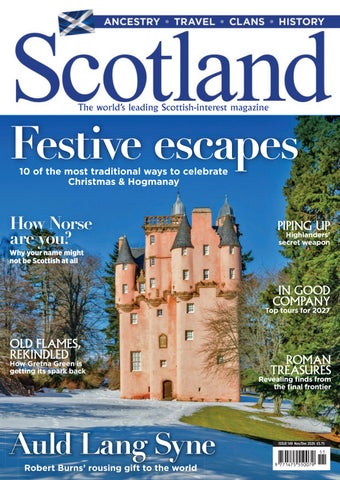
Festive escapes 10 of the most traditional ways to celebrate Christmas & Hogmanay
How Norse are you?
PIPING UP Highlanders’ secret weapon
Why your name might not be Scottish at all
IN GOOD COMPANY
Top tours for 2027
OLD FLAMES, REKINDLED
How Gretna Green is getting its spark back
Auld Lang Syne Robert Burns’ rousing gift to the world
ROMAN TREASURES
Revealing finds from the final frontier
ISSUE 149 Nov/Dec 2026 £5.75
travel
| Clan trails
A
fearsome FAMILY
Their prowess in war saw Clan Douglas grow from modest beginnings to challenge kings, leaving a powerful mark across southern Scotland Words by GRAEME JOHNCOCK
18 Scotland
Clan trails | travel
Scotland 19
history
| Exhibitions
44 Scotland
Exhibitions | history
ROMAN FRONTIER FINDS New discoveries reveal hidden truths about the Scotland the Romans tried to conquer Words by AILSA SHELDON
A
cricket pavilion is an unlikely place to find a doorway into the Roman Empire, but when one burned down near Musselburgh in 2010, archaeologists investigating the site made an extraordinary discovery. Beneath the pavilion were two Roman altars, buried face-down in a pit. Dating to around AD140, they once stood in a temple dedicated to Mithras, the mysterious god popular among Roman soldiers. Now, nearly 2,000 years later, they are going on display for the first time. The altars are the centrepieces of Roman Scotland: Life on the Edge of Empire, a new exhibition at the National Museum of Scotland that challenges the idea that Hadrian’s Wall marked the northern limit of the Roman world. In fact, Roman armies campaigned as far north as the Moray Firth, while Roman objects have been found from Galloway to Shetland. The exhibition is interested in more than just when and how far north the Romans got: it asks what happened when the empire came north and met and mixed with the people who already lived here.
LEFT: The Roman altars at the National Museums Collection Centre, Edinburgh
Even viewed under the strip lighting of the National Museums Collection Centre, the altars are immediately striking, almost formidable. More than 500 hours of conservation have gone into revealing their craftsmanship. One altar was broken in two, both suffered plough damage, and the sandstone layers had begun to split. The sun god Sol is depicted with pierced eyes and a solar crown. Above him, four female heads depict the seasons, with winter well wrapped up, perhaps against that cold Scottish east wind. The second altar depicts Mithras and is decorated with imagery associated with the Greek and Roman god Apollo, including a griffin, a lyre and ravens. Traces of red and blue paint suggest that both would have been brightly coloured. Worship of Mithras was a secretive male-only cult, popular among soldiers. Worshippers gathered in dark temples, or Mithraea, evoking the cave where Mithras
Scotland 45
© DUNCAN MCGLYNN/NATIONAL MUSEUMS SCOTLAND
SIGNIFICANT MUSSELBURGH FINDS
Piping up The author of a new book explains the significant role the Great Highland bagpipes have played in Scottish history Words by PATRICK KING
History | books
I
t seems almost perverse to think that music should be so closely associated with war, but the two are inseparable. Musicians have been part of the battlefield since ancient times when drums, horns and bugles were used to communicate orders and to inspire troops in the field. The Scots, however, had another weapon in their musical arsenal. It was said to be worth a hundred guns and its ammunition, a music so potent and sonorous it stirred men’s souls. Its power and influence in battle was unique and profound, the ancients called it ‘The Great War Pipe of the North’. The Great Highland bagpipes have taken soldiers to the heights of bravery and driven their enemies to the depths of despair. The history of this martial instrument is full of stirring tales of pipers inspiring troops in battle, even continuing to play after being wounded. Now that
we live in times of night-vision cameras, laser weaponry and sinister flying drones, it seems incredible, even absurd, to imagine a person going into battle armed with nothing more than a musical instrument. The Great Highland bagpipe had been developed as an instrument of warfare right from the earliest days when the piper’s duty was to gather the clan ready to march to battle with their chief. The clan piper himself was a man of war. He played before battle, then handed the pipes to his gillie for safe-keeping, drew his broadsword and plunged into the fight with the rest of his clansmen. Sir Walter Scott wrote of the Battle of the North Inch pipers in Perth in 1396: “At a certain stage of the fight the pipers, who had been stimulating the clans to feats of desperate valour, threw aside their instruments and rushed at one another with their daggers drawn.”
© THE HISTORY PRESS
The Great Highland bagpipes have taken soldiers to the heights of bravery
ABOVE, LEFT TO RIGHT: Massed pipers of the Scottish regiments being filmed for the documentary When the Pipers Play in Holyrood Park, Edinburgh, 1997; mercenary pipers: Irish, 13th century. Highland Scots, 17th century
Scotland 61
ancestry
| Names
Words by DR BRUCE DURIE
How Norse are you? Ever wondered if your surname has Scandinavian origins? Our expert explains why it may be the case...
S
it back for a moment and contemplate this: threequarters of all males of Scottish ancestry descend from one of four men who lived in the Bronze Age. Just four. And two of these resultant lineages are of Norse origin (see ‘Scottish Lineages’ info box overleaf). At the start of the Bronze Age (c. 2500BC until c. 800BC) Indo-European peoples migrated from Central Europe into Britain and Ireland. Within a few centuries (2400 to 2000BC), this and climate change prompted a population and genetic shift from Early European farmers to Western Steppe herders, changing about 90 per cent of Britain’s gene pool. One branch of these were what are loosely called Picts, or Caledonii. These pre-existing people, indigenous to Scotland, were later joined by related Brythonic (‘British’) peoples from Wales and Cumbria, whose settlements later became the Kingdom of Strathclyde (Alt Clut). Goidelics (Gaels, or Scotii) from the north of Ireland consolidated in the western Highlands and islands. In the 7th century, Bernician Angles from Northumbria moved into the Lothians and eastern Borders where they fought and eventually mingled with the Picts and Britons. The Norse, on the other hand, were rather late to the party. Their arrival from the 8th and 9th centuries forced the Gaelic and Brythonic tribes to band together under the Pict King Alpin and his son Kenneth MacAlpin. Northern Scandinavians reached Orkney, Shetland, the Western Highlands and islands, the Isle of Man and Scotland’s north coast, as well as establishing Dublin and Cork in Ireland. Southern Scandinavians – Danes,
66 Scotland
Norn was replaced in the west by Gaelic and by Scots in Orkney and Shetland
© KENNY LAM/VISITSCOTLAND
Names | ancestry
effectively – mostly harried the east coast of Scotland. Norse influence still runs deep through Scotland – especially in the West Highlands and Northern Islands. In Orkney and Shetland, the Hebrides and mainland Caithness, the language spoken was called Norn (now extinct), which was replaced in the west by Gaelic and by Scots in the Orkney and Shetland Islands when these were ceded to Scotland around 1470. But there are still remnants of the Norn language in some surnames and place names.
NORSE SURNAMES The use of fixed surnames came after the arrival of Gaelic and Scots, but in Scotland groups of people in the same place often self-identified with a name (which later may
ABOVE: Torchlight procession in Viking costume in Edinburgh
have become a clan) even if there was no genetic link. If your family is originally from Orkney, Shetland or the Western Highlands, there’s a good chance that some of your ancestors were Norse. The telltale surnames to look out for include (in alphabetical order): • Gunn (from gunnr, meaning ‘warrior’), found in Caithness and Sutherland where they settled and intermarried with local Picts • Manson (meaning simply ‘son of Magnus’) • MacAskill (from asketill, Norse for ‘God-kettle’), originally in Skye • MacAulay (Gaelic Mac Amhlaoibh for ‘son of Olaf’) in the Hebrides, especially Lewis; there is a separate MacAulay of Irish origin, also found in Dunbartonshire • MacCorquodale (Gaelicised ‘son of Thorketill’, from
Scotland 67
Cruises & Tours | travel
VENTURE FORTH Explore and experience the best that Scotland has to offer on one of these tours
© PETER SUMMERS/GETTY
Words by LAURA SUTHERLAND
Scotland 73