ANCESTRY • HISTORY • HERITAGE • TRAVEL
WIN
a stay in a fairytale castle
The world’s leading Scottish-interest magazine
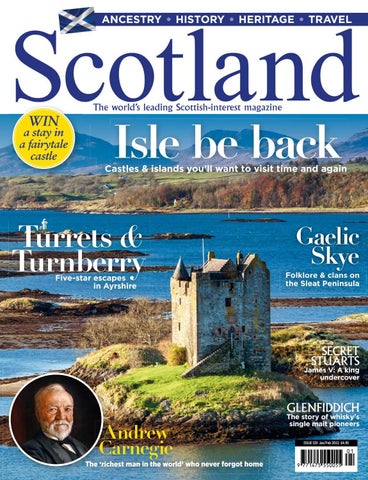
Isle be back
Castles & islands you’ll want to visit time and again
Turrets & Turnberry Five-star escapes in Ayrshire
Gaelic Skye
Folklore & clans on the Sleat Peninsula
SECRET STUARTS
James V: A king undercover
GLENFIDDICH
Andrew Carnegie
The ‘richest man in the world’ who never forgot home
The story of whisky’s single malt pioneers ISSUE 120 Jan/Feb 2022 £4.95
Seasons WINTER
Inspired by special memories as Sheila and her husband, Rick, walked through falling leaves on the paths of Inverewe’s tranquil gardens. Created in silver, with yellow and rose gold leaves, hand-enamelled in Winter hues. Also available in Spring, Summer and Autumn enamel colours.
Designer Rings A selection of stunning rings shown in silver, 18ct gold with enamel and 9ct yellow, white and rose gold, many hand-set with diamonds. Available to order in Scottish Gold.
ORKNEY | EDINBURGH | GLASGOW | ST ANDREWS
01856 861 203 | sheilafleet.com
2 Jubilee Place, London SW3 3TQ Tel: 020 7349 3700 Fax: 020 7349 3701 Email: editor@scotlandmag.com www.scotlandmag.com
EDITORIAL
ADVERTISING SALES
PUBLISHING
Editor Sally Coffey Production Editor Jenny Rowe Consultant Editor Roddy Martine Art Editor Clare White PR Requests pr@chelseamagazines.com
Contact Publicity Suite 4b, Platinum House Eagle Street, Glasgow Tel: 0141 204 2042 Fax: 0141 204 2043
Chairman Paul Dobson Managing Director James Dobson Publisher Simon Temlett Chief Financial Officer Vicki Gavin EA to Chairman Sarah Porter
Contact Stacy Knoud stacy@contactpublicity.co.uk
Printed in England by William Gibbons Ltd Production All Points Media
SUBSCRIPTIONS UK and Rest of World: www.scotlandmag.com/subscribe Tel: +44 (0) 1293 312 197 Email: scotland@subscription.co.uk SCOTLAND magazine, Intermedia, Unit 6 Enterprise Centre, Kelvin Lane, Manor Royal, Crawley, RH0 9PE, UK USA and Canada: www.britsubs.com/scotland Tel: 1-800-925-8215 (toll free) Email: SCOcustserv@cdsfulfillment.com Post: SCOTLAND, PO Box 37518, Boone, IA 50037-0518 (USA only); OR SCOTLAND, 1415 Janette Avenue, Windsor, Ontario, N8X 1Z1 (Canada only) Annual subscription rates (6 issues) UK – £23.95; USA and Canada – $39.95/$44.95 Rest of World – £39.95 New Zealand & Australia AUD $79.95 Did you know you can manage your subscription online? Oversee your print and digital subscriptions online today simply by signing up at https://www.subscription.co.uk/chelsea/Solo/. Stay up to date with the latest issues, update your personal details, and even renew your subscription with just a click of a button. Back Issues www.chelseamagazines.com/shop Distribution Scotland Magazine Issue #120, (ISSN 1475-5505) (USPS 020-429) is published six times a year (bi-monthly) by The Chelsea Magazine Company, Jubilee House, 2 Jubilee Place, London SW3 3TQ, UK. Distributed in the U.S. by NPS Media Group, 2 Enterprise Drive, Suite 420, Shelton, CT 06484. Periodicals Postage paid at Shelton, CT and additional mailing offices. POSTMASTER: Send address changes to Scotland magazine, PO Box 37518, Boone, IA 50037-0518. UK and Rest of World: Seymour, 2 East Poultry Avenue, London EC1A 9PT, UK Tel: +44 (0)20 7429 4000 SCOTLAND IS PROUD TO SUPPORT THE SCOTTISH HOTEL AWARDS
Simon Temlett, Awards Director simon.temlett@chelseamagazines.com
© CLICK ALPS/AWL IMAGES
© The Chelsea Magazine Company Ltd 2021/2022. All rights reserved. Text and pictures are copyright restricted and must not be reproduced without permission of the publishers. The information contained in Scotland magazine has been published in good faith and every effort has been made to ensure its accuracy. However, where appropriate, you are strongly advised to check prices, opening times, dates, etc, before making final arrangements. All liability for loss, disappointment, negligence or damage caused by reliance on the information contained within this publication is hereby excluded. The opinions expressed by contributors to Scotland magazine are not necessarily those of the publisher.
A sumptuous suite at Glenapp Castle, Ayrshire
Editor’s letter This issue we’ve gone a little castle crazy, because who doesn’t love a castle, particularly one you can cosy down in as the wind and snow battle each other outside? In Fairytale Fonab (p32) you can enter our competition for a chance of winning a stay in a romantic castle in the Perthshire countryside – an idyllic Highlands hideaway, we think you’ll agree. Meanwhile, in Turrets & tee time (p22), discover one of Scotland’s most picturesque castle hotels, Glenapp Castle, and one of its most luxurious golf hotels: Ayrshire’s tasteful Turnberry. At Armadale Castle on Skye’s Sleat Peninsula, which you can read all about in The beautiful south (p14), there’s no chance of getting snug, since the castle where Flora Macdonald wed in 1750 now stands in ruin. However, just a couple of miles up the road you’ll receive a warm Gaelic welcome at Hotel Eilean Iarmain. This issue, we also look back at the origins and evolution of one of Scotland’s most famous whisky brands, Glenfiddich, in Never sit still (p58), and we meet a new generation of knitters putting their own spin on things in Island inspiration (p68). History buffs are well catered for with a look at the motives behind King James V’s penchant for dressing up in The incognito king (p34), while we shed some light on a forgotten incident during the American Revolutionary War in Not on our watch (p64). And finally, if you are itching to get back to Scotland, then there can be few better ways of visiting our many isles than on a small ship cruise. We round up some of the best in Cruise into 2022 (p44). Enjoy.
ANCESTRY • HISTORY • HERITAGE • TRAVEL
WIN
a stay in a fairytale castle
The world’s leading Scottish-interest magazine
Isle be back
Castles & islands you’ll want to visit time and again
Turrets & Turnberry Five-star escapes in Ayrshire
Gaelic Skye
Folklore & clans on the Sleat Peninsula
SECRET STUARTS
James V: A king undercover
GLENFIDDICH
Andrew Carnegie
The story of whisky’s single malt pioneers ISSUE 120 Jan/Feb 2022 £4.95
The ‘richest man in the world’ who never forgot home 001_UK_COVER_SM120 v12SC.indd 2
08/12/2021 14:29
COVER IMAGE:
Castle Stalker near Appin, Argyll. © Tom Mackie/ AWL Images Inset: Andrew Carnegie. © Ian Dagnall/Alamy
SALLY COFFEY
Editor
editor@scotlandmag.com
@Scotland_Mag
facebook.com/ScotlandMagazine
@scotlandmagazine
Scotland 3
40 Westray p68
Barra p68 Glenfiddich p58
Armadale Castle p14
68
Fonab Castle p32
Arbroath p64 Perth p54
Carlowrie Castle p75
Turnberry p22 Glenapp Castle p22
CONTENTS ISSUE 120
03 Editor’s letter 06 The Clan Courier Local news and the latest travel tip-offs
09 Dates for your diary This season’s best events on both sides of the Atlantic
10 Notes from the isles Explore the Borders through a Highlands lens
12 We’ve got mail Your letters and stories of Scotland
14 The beautiful south Seek Skye’s lesser-known beauty spots and beat the crowds on Scotland’s favourite island
22 Turrets and tee time Get a taste for outrageous luxury travel in Ayrshire on visits to Turnberry, Glenapp Castle and Gailes
32 Fairytale Fonab Head to the heart of Highland Perthshire, where you could win a stay at this Disney-style castle hotel
34 James V: The incognito king Why did the monarch travel among his subjects in disguise? We consider the various theories
40 Dive right in Meet the man who catches many of the scallops that end up in some of the UK’s top restaurants
Win a stay at Fonab Castle
32 What better way to explore Scotland’s coastal scenery than on a comfortable, liveaboard boat?
44 44 Cruising into 2022
© JEREMY FLINT PHOTOGRAPHY/DEE KEARNEY. ILLUSTRATION © MICHAEL A HILL
Enjoy wildlife encounters and island hopping on Scotland’s best small ship cruises for 2022
52 Born and bred What does it feel like growing up in Scotland but having to constantly prove your Scottishness?
54 The happy city Welcome to Perth, ‘Scotland’s happiest city’ and now a city break destination in its own right
56 The boy done good Delve into the life and legacy of the Scottish American industrialist Andrew Carnegie
58 Never sit still How Glenfiddich rose from a small family operation to become the biggest single malt brand in the world
22 62 Easy on the palate Our Master of Malt reflects on the way Glenfiddich developed its booming export business
64 Not on our watch How the people of Arbroath protected their port from privateers during the American Revolutionary War
68 Island inspiration Discover a new generation of island makers who are continuing the knitwear tradition with a twist
75 Leading lady Read all about the Edinburgh explorer, Isobel Wylie Hutchison, who ventured to the Arctic in the 1920s
82 The story behind... How a cabinet of dusty photographs led one author on a fascinating journey into family history
Scotland 5
News & events
CLAN COURIER Islanders challenge the status quo, an epic hike, and emblematic earrings
[OBITUARY]
SCOTLAND’S OLDEST CLAN CHIEF DIES
THE ULTIMATE STYLE QUEEN In 2022 Her Majesty The Queen will celebrate her Platinum Jubilee, and like all the other royal palaces, the Palace of Holyroodhouse will be celebrating her remarkable reign. From July 2022 to September 2022, visitors to the palace will be able to view a display of outfits worn by Her Majesty on occasions to celebrate the Silver, Golden and Diamond Jubilees, included with the normal entry fee. One of the outfits on display is the dress, coat and stole Her Majesty wore to mark her Silver Jubilee in 1977 [pictured], designed by the royal courtier Sir Hardy Amies. Cut from pink silk crepe and chiffon and complemented with a matching hat designed by Simone Mirman, with flowerheads hanging from silk stems, it was quite the showpiece. Her Majesty wore this ensemble at the Service of Thanksgiving at St Paul’s Cathedral on 7 June 1977. rct.uk/visit/palace-of-holyroodhouse
Captain Alwyne Farquharson MC, 16th Laird of Invercauld and Chief of Clan Farquharson, has died at the age of 102. Alwyne, who died on 6 October 2021 at his home in Valley Farm, Norfolk, is believed to have been Scotland’s oldest and longest serving clan chief and was chieftain of the Ballater Highland Games on Deeside for 73 years. He served in the Second World War and was awarded the Military Cross for bravery during the Normandy Landings. As Clan Chief, Alwyne was always keen to meet clan members from across the world. A memorial will be held at Braemar Castle in Aberdeenshire during the Clan Farquharson Gathering in the second week of August 2022 and a stone will be laid at the Clan Cairn, Carn-na-Cuimhne, in his memory.
Scotland 7
© MIRRORPIX/GETTY/JONATHAN FINDLAY
[QUEEN’S JUBILEE]
[ ACCO M M O DAT I O N ]
ISLANDERS TAKE ON AIRBNB
A new holiday lettings site has launched that aims to rival tech giants like Airbnb and put more money back into islanders’ pockets. Like other bookings companies, IsleHoliday, will take a commission from holiday lets. However, instead of the money profiting large, faceless companies, all profits will be reinvested in the island communities, via the Isle Develop fund. As well as helping support local communities, booking through IsleHoliday will also give travellers access to genuine and invaluable local knowledge. Rhoda Meek, founder of Isle Develop CIC, said: “All of our Directors and staff are islanders – we know our Bernerays from our Burras! By working together with accommodation providers and local organisations, we can offer rich information about island life before visitors arrive.” isledevelop.com/isleholiday
[CHARITY]
AND I WOULD WALK 5,000 MILES… A Perthshire man is undertaking a huge coast-to-coast hike across Canada to raise awareness and money for rewilding projects in Scotland. Michael Yellowlees, a 32-year-old musician from Dunkeld in Perthshire, is following in the walking boots of the legendary Scots naturalist John Muir, who completed a similar feat in 1867…and then some. While Muir travelled 1,000 miles from Kentucky to the Gold Coast in the United States, Yellowlees is covering some 5,000 miles from Canada’s Pacific coastline to Newfoundland on the edge of the North Atlantic. Yellowlees is hiking with his faithful dog, Luna, and is raising funds for Highlands-based rewilding charity Trees for Life, supporting its work in restoring Scotland’s Caledonian Forest, at a time when the world is on high alert over climate chaos and biodiversity loss. You can support Michael and follow him on his journey at www.justgiving.com/fundraising/ michaelandlunarewild.
8 Scotland
News & events
[SHOPPING]
JACOBITE JEWELS The new Jacobite Rose Coin Collection, part of Orkney-based Aurora Jewellery’s official Outlander range, draws on one of the most rousing emblems of Scotland: the white rose. The white rose was a symbol of the Jacobites and was the likely source of the white cockade ribbon flower that Jacobites like Jamie Fraser used to identify themselves to each other. Among the pieces, which are all hand-finished in the firm’s workshop in Orkney, are this elegant Jacobite Rose Coin necklace with drop detail, plus pretty Jacobite Rose Coin stud earrings. Necklace £224; earrings £87.50. aurora-jewellery.com
[ C U LT U R E ]
© BEN SHAKESPEARE PHOTOGRAPHY
LEARN GAELIC FROM THE BEST A new learning platform has been launched that hopes to inspire a new wave of fluent Gaelic speakers. Whether you are a beginner or looking to refresh your language skills, SpeakGaelic (speakgaelic.scot) combines online or in-person Gaelic classes, with complementary learning materials across BBC ALBA, BBC Sounds and dedicated SpeakGaelic platforms. The free-to-use teaching materials are being supplied by Sabhal Mòr Ostaig, the National Centre for Gaelic Language and Culture, based on Skye’s Sleat Peninsula (see page 14). Marsaili MacLeod, SpeakGaelic Board Member and Director of Studies at Sabhal Mòr Ostaig, said: “Sabhal Mòr Ostaig is delighted to be providing the learning materials for such an accessible, multiplatform resource as SpeakGaelic, taking Gaelic learners on their own personal journey to becoming confident Gaelic speakers. Community learning is at the heart of our mission as a national centre, and we look forward to providing face-to-face SpeakGaelic classes, available via www.smo.uhi.ac.uk.”
DATES FOR YOUR DIARY With exhibitions and events slowly returning, you can celebrate Scotland wherever you are Follow the swirl of tartan and the sound of bagpipes through midtown Manhattan as the NYC Tartan Day Parade returns in person for the first time since 2019. nyctartanweek.org
SCOTLAND Until 27 March 2022 SCOTLAND’S CLIMATE CHALLENGE, EDINBURGH This National Museum exhibition considers how Scotland is tackling the climate crisis. nms.ac.uk Until 17 April 2022 THE TYPEWRITER REVOLUTION, EDINBURGH Another National Museum exhibition, which examines the social and technological impact of typewriters. nms.ac.uk 27 April to 2 May 2022 SPIRIT OF SPEYSIDE This year’s events programme, across 51 distilleries, will shortly be announced online. spiritofspeyside.com
annual Highland games back for the full weekend in 2022. blair-castle.co.uk
US & CANADA
4-6 March 2022 NORTH TEXAS IRISH FESTIVAL, TX This Irish and Celtic festival celebrates its 40th anniversary this year. ntif.org 5-6 March 2022 PHOENIX SCOTTISH GAMES, AZ A new venue of Gilbert Regional Park brings this games back for 2022. phoenixscottishgames.com 9 April 2022 NEW YORK CITY TARTAN DAY PARADE
9-10 April 2022 LOCH NORMAN HIGHLAND GAMES, NC A traditional games hosting diverse activities including heavy athletics, Highland dancing, Scottish country dancing and longbow and battle axe competitions. lochnorman.com 9-10 April 2022 LAS VEGAS HIGHLAND GAMES, NV Floyd Lamb Park hosts a traditional Highland games with all the trimmings. lasvegascelticsociety.org 7 May 2022 SAVANNAH SCOTTISH GAMES, GA The largest and fourth oldest games in the southeast returns for its 44th year at the historic Bethesda Academy. savannahscottish games.com
27 May to 4 June 2022 THE ISLAY FESTIVAL No longer a virtual event, visitors flock to the Whisky Isle to fill up on island life. feisile.co.uk 28-29 May 2022 ATHOLL HIGHLANDERS PARADE & GATHERING, PERTHSHIRE Blair Castle welcomes this
Scotland 9
JOURNAL
| Window into Scotland
Notes from the Isles
This issue, our friend in the north is reminded of the power of Gaelic song, and takes a holiday in the Borders Words by KATE FRANCIS
THIS PAGE: Kate and Cronie, her faithful Border Terrier OPPOSITE: Melrose Abbey in the Scottish Borders, where Robert the Bruce’s heart is buried
10 Scotland
N
ot so long ago, Gaelic was the first language in the Western Isles and was also understood and spoken by many mainland Highlanders. Today this is not the case with quite a few of the younger generation – indeed there are even some young islanders who can’t speak it at all. Certainly, it was the first language 50 years ago when we moved into our island home, and one of my greatest regrets is that I never managed to master it, though my oldest daughter Mary did – up to a point. We’ve hosted many happy cèilidhs and the songs are always in Gaelic, so we hum along and clap in unison. On one occasion we had Paul, a neighbour and acclaimed singer with us. He began a familiar song and Mary joined in, very quietly. Paul gradually lowered his voice until Mary, unaware, was singing solo: I was filled with pride – and envy. The Royal National Mòd was just a vague ‘thing’ in my mind until this year when the festival came to Inverness. Even then I may not have given it much thought until I heard that my neighbour John was performing at one of the concerts. I looked up the Mòd and discovered that it was founded in 1892 as an annual festival of Gaelic culture, including song, instrumental music, dancing, drama, sport, and literature. John is a musician and as he and Maggie have become extra children in my life, I booked a ticket.
The entire concert, including the announcements, was in Gaelic. The first act was three girls with lovely voices and a guitarist who kept going for an hour to rapturous applause. During the interval, I joined Maggie, who had been at work, for the second act. John and another man, both with guitars, accompanied by a percussionist, an accordionist, and a pianist, sang, solo and in chorus, for another hour and the combination of wonderful voices and melodies and the unique Gaelic language was something I shall never forget. I was completely transfixed. A recent visit to the Borders reminded me of many good stories I’d unearthed during a journalistic tour many years ago. Totally faithful as I am to the Highlands and the Hebrides, I can still appreciate that chequerboard of farmland, undulating hills, wooded river valleys, and the rocky coastline with cliff-walled fishing towns and villages. There are so many treasures, each with an important place in history – Robert the Bruce’s heart is buried in Melrose Abbey. Hoping to atone for his sins, Bruce had ordered Sir James Douglas to take his heart to Jerusalem on his death. When Bruce died in 1329, Douglas obeyed but was killed en route by the Moors, in Spain. The heart, in its casket, was retrieved and brought back to Melrose. During building work at the Abbey in the 20th century an embalmed heart was excavated – and hastily reburied. Another Borders’ treasure is Traquair House, visited by at least 27 monarchs including Mary, Queen of Scots with Darnley, and their baby son (King James VI of Scotland),
© KENNY LAM/VISIT SCOTLAND
Window into Scotland |
whose cradle is on view, together with Mary’s crucifix, rosary, and purse. Bonnie Prince Charlie was the last person to go through The Bear Gates at the entrance to the avenue on his fated march to Derby in 1745. The staunchly Jacobite Fifth Earl of Traquair clanged the gates shut and ordered that they must never be reopened until a Stuart ruled Scotland again. They remain shut. My reason for being in the Borders was to attend a houseparty of 12 geriatrics celebrating an important birthday. I didn’t revisit any of the old haunts because I was looking after a very dear, blind friend who wouldn’t have appreciated tours of stately homes, and having already written about most of them, I had no urge to go back. Instead, she and I had a peaceful time walking, talking and picnicking. We also visited a delightful woman whose mother had done all the flowers for my wedding, 62 years ago. The house we were staying in was a remote old fishing lodge, near the River Teviot. The plumbing and electricity were spasmodic and there were notices forbidding us to pull the curtains. Someone disobeyed this order on the first night and the entire curtain rod crashed off the wall. The lodge was a splendid relic of the olden days, its walls festooned with antlered skulls and sporting relics and there was one with its fur still intact that we decided was a bison or possibly a buffalo. There was also the skin of a zebra in a passage, which it pained me to walk on. My favourite of all the mementos was a life-sized china spaniel wearing a coloured bonnet, who sat at the foot of one of the staircases
journal
During building work at Melrose Abbey in the 20th century an embalmed heart was excavated – and hastily reburied and I couldn’t resist giving him a wee pat on the head every time I passed. The dining room table was 10-foot-square, with three places along each side leaving wide gaps between each. As there was a preponderance of defective hearing aids, mealtimes involved plenty of hand-cupped ears and shouts of “I’m sorry, I didn’t quite catch that, could you say it again...”. There were many reminiscences of when we’d all been a young gang learning to spread our wings. It was a happy couple of days but, as ever, I was very glad, nearly a thousand miles later, to drive up to my beloved old farmhouse on the Black Isle. We are making plans for Christmas in our island home, and it is going to be not just the 15 members of my family, but my brother-in-law and his 15, too. They won’t all fit in the house and it’s not an ideal time of year for camping, so they’ve rented two bothies nearby. I shall be interested to see if any of the cousins bring their bathing suits and join us in our annual Christmas Day swim in the Atlantic Ocean – wet suits verboten. Watch this space... S
Scotland 11
MAILBAG
| Your letters
WE’VE GOT MAIL A selection of messages from our readers across the globe
RAIL ADVENTURE
Your article ‘Making Tracks’ (Issue 118) is, in a word, fabulous! In 2019 I planned a trip beginning in Edinburgh, going west via train to Mallaig then by bus to Oban then by train to Glasgow. I spent several days in each with various side trips and can hardly wait for my return visit. Your article brought back so many wonderful memories and I am grateful. Sandra Bennett, Virginia
Another great issue. I was particularly struck by the article ‘MacRobert’s Reply’ (Issue 118). In 1944, Pipe Major Willie Ross (ex-Scots Guards and long-time director/instructor at the Army School of Piping at Edinburgh Castle) composed a slow march titled ‘Flight of the Eaglets’ and subtitled ‘MacRobert’s Lament’ in memory of Lady MacRobert’s three sons. The tune was published in Ross’s fourth book of tunes and in the first book of the Scots Guards Collection of bagpipe tunes. Paul Hinson, via email
The Editor, Scotland, 2 Jubilee Place, London, SW3 3TQ
12 Scotland
FLIGHTS OF IMAGINATION
STORIED SEAS
I’m what’s called a newbie to your amazing A transferee from Scottish Life, I found the magazine. I treated myself to it this weekend November 2021 issue (118) of Scotland in and have been not only totally absorbed, but the mail accumulated from my month in thrilled with it. My car has gone on the blink Scotland. Yes, you can go there now! and I can’t go adventuring at the moment, I appreciated ‘Under Attack’. I’ve visited so I’m travelling via your magazine. Orkney a couple of times and St I don’t think you can beat one’s own Magnus Cathedral to see the imagination to travel far and wide. memorial and I’ve seen the Can’t see yours or want I’m currently living in South book listing the crew who to read more Lanarkshire, which I love because perished in the submarine letters? Go to it’s so rural and full of cattle and attack on that fateful night. scotlandmag.com/ sheep. However, I’d dearly like to There’s also a submarine yourviews make it up to Inverness story in Dundee as well. I sometime, which is where discovered some years ago the my mother was born. My father little publicised Submarine Memorial was born in Edinburgh, which is at the harbour. It’s a memorial to the 296 much closer. I have very happy sailors and commandos lost on operations memories when, on the odd from the Dundee base during the Second occasion, my folks disagreed, my World War. mother would say to my father: The 9th Submarine Flotilla was a unique “You’re a mere lowlander!” international group that included crews from I’m a writer and an historian Poland, the Netherlands, France and Norway, and I know that your magazine in addition to Britain. is right up my street. Keep up the great work. Alex Macpherson, via email Don Ukens, Oklahoma
editor@scotlandmag.com facebook.com/ScotlandMagazine
@Scotland_Mag @scotlandmagazine
© ALAN COPSON/AWL IMAGES
MUSICAL MEMORIAL
The Jacobite Steam Train crosses the Glenfinnan Viaduct on the West Highland Line
H OTEL E ILEAN IARMAIN ISLE OF SKYE
E ILEAN IARMAIN .CO.UK
TUNNING LLOCATION OCATION R SSTUNNING RESTAURANT ESTAURANT & & PPUB UB O OUTDOOR UTDOOR AACTIVITIES CTIVITIES G IN D ISTILLERY W HISKY S HOP A RT G ALLERY GIN DISTILLERY WHISKY SHOP ART GALLERY
Harris Tweed Isle of Harris Caberfeidh, Tarbert, Isle of Harris HS3 3DJ www.harristweedisleofharris.co.uk
01859 502040 l 01859 502727 l 01859 502505
ISLE OF SKY KYE K YE
T HE - INN -A AT T -A AIRD AI R -A- BHASAI RD BHASAIR A
BRIDGE of ORCHY HOTEL
Rooms, Restaurant and Bar Experience Highland hospitality in a luxurious four-star setting Bridge of Orchy Hotel, Bridge of Orchy PA36 4AD Tel 01838 400 208 Email info@bridgeoforchy.co.uk Web www.bridgeoforchy.co.uk Scotland 13
TRAVEL
| Secret Skye
The
Beautiful south
From southern Skye’s tight-knit Gaelic community, to spotting winter wildlife and lesser-known beauty spots, here’s how to beat the crowds on Scotland’s favourite island Words by SALLY COFFEY
14 Scotland
Secret Skye |
travel
Scotland 15
travel
| Quiet Skye
PREVIOUS PAGE: The Point of Sleat, southeast Skye CLOCKWISE, FROM TOP: Armadale Castle is set within a 20,000-acre estate; the ruins of Armadale Castle; Torabhaig Distillery
16 Scotland
© MARCUS MCADAM/SIMON LARSON/PHOTONONSTOP/HEMIS/ALAMY ILLUSTRATION: © MICHAEL A HILL
T
here are two main routes onto the Isle of Skye – over the Skye Bridge from Kyle of Lochalsh (with most visitors stopping off at the photogenic Eilean Donan Castle en route) that brings you to near Kyleakin, or by ferry from Mallaig on the mainland to Armadale in south Skye. But though most visitors arrive in Skye’s stunning south, they very quickly tend to head north, to Portree (Skye’s main town) and the famous, eye-catching attractions of the Trotternish Peninsula. But what if, on your next trip, you didn’t head north and chose to base yourself on the south of Skye instead? Well, then you’d have time to explore one of Skye’s best-kept secrets: the Sleat Peninsula. Often referred to as the ‘Garden of Skye’ due to its abundance of greenery compared with the starker, rocky centre and north of the island, the name Sleat comes from the Gaelic ‘Slèite’, which means smooth or even. It’s true the fertile land is softer here, but by no means does that mean the scenery is ordinary. From the south side of the peninsula, there are views across the Sound of Sleat, the water that separates Skye from the mainland, to the knobbly hills of Knoydart, arguably Scotland’s most remote peninsula. Meanwhile, turn off the main road through Sleat towards Ord, on the north side of the peninsula, and follow the
Secret Skye |
travel
Scotland 17
travel
| Secret Skye
CLOCKWISE, FROM TOP LEFT: The Isle Ornsay Lighthouse, as seen from Eilean Iarmain; the Cuillin, viewed from the crofting village of Tarskavaig, near Ord; Hotel Eilean Iarmain
18 Scotland
coast road and you’ll be rewarded with some of the most incredible views of the mighty Cuillin mountain range on Skye. There is a quietness to the region too, that’s at odds with the stories of overtourism on Skye. Here, you can take walks along the rocky coastline, broken up by the occasional sandy beach, and come across just the occasional dog walker or local family out for a stroll. That’s not to say there aren’t attractions. Torabhaig Distillery is good for a rainy afternoon, and Armadale Castle is a beautiful ruined castle that stands on the shore of the Sound of Sleat amid wonderful gardens filled with exotic plantings. The castle’s gardens are just one section of a 20,000-acre estate that is home to crofts, natural woodland, and a farm. Sleat is Clan Donald land, once Scotland’s most powerful clan, which ruled the western seaboards of Scotland as the Lords of the Isles, and though today Armadale Castle is run by the charitable Clan Donald Lands Trust, it was once the seat of the Macdonalds of Sleat. As well as the romantic ruins of the castle itself, Armadale has a very good museum, which tells the story of the Highlands & Islands through the eyes of Clan Donald, with Viking, Jacobite and crofting artefacts to examine. In 2022, as part of the castle’s anniversary celebrations (to mark 50 years since it was preserved by the Clan Donald Lands Trust)
there will be an exhibition and events progamme, which will look at the past, present, and future of the castle, telling the stories of the people who worked here, from Victorian gardeners to the castle’s last housekeeper. The castle is also undertaking an ambitious Trees for the Future programme, protecting some endangered species on the estate, as well as planting a new generation of trees. Of course, it was at Armadale Castle that Flora Macdonald, the Jacobite heroine who helped Bonnie Prince Charlie escape government forces, was married in 1750. This, of course, was after she had been given up to the government and imprisoned in the Tower of London for leading the Jacobite prince to safety. It was from a small settlement, further along the Sleat Peninsula, known at Eilean Iarmain, that Flora was taken aboard HMS Unicorn to her prison cell (she was later released under a general amnesty in 1747). Visiting this tranquil place, where a small slipway still takes guests over the water to the nearby Isle Ornsay Lighthouse (where there’s a self-catering property next door), it’s hard to believe that this was once the main port on southern Skye. In the 19th century food and provisions for the island arrived here, while displaced people left for new lives on ships to Australia and the Americas. The village has a history reaching much further back still.
travel
Originally called Eilean Dhiarmaid (or Diarmid’s Isle), it was named after the hero from the Ossian stories and is a place steeped in legend: the mythical Irish warrior Cuchulain learned martial arts here and Ossian and the Fenians are also said to have landed here from Ireland. Today, this tradition of storytelling is upheld. At the Hotel Eilean Iarmain, the whitewashed building that forms the hub of a small complex of historic buildings, Gaelic culture in all its forms is celebrated: storytelling, language and music. Every Thursday night, the small bar attached to the hotel, Am Praban, is filled with students from the nearby Gaelic College Sabhal Mòr Ostaig, who come to listen to Gaelic music, performed by locals, and sometimes travelling musicians. On occasion, guests in the hotel are treated to cèilidhs in the cosy lounge, with spoken word, the pipes and singing, which all pull on the Gaelic culture of the area. Today, most people working in the hotel speak Gaelic (and English too) and are only too happy to explain the original names of local landmarks and the stories behind them. Gaelic whisky and crafted gin is available to try and buy in the little shop next door, and there is even a small gallery showing the works of local artists. Gaelic in the Sleat Peninsula has seen a resurgence since the 1970s when landowner Sir Ian Noble, a Scottish
Scotland 19
© RDONAR/ALAMY/DAVID C TOMLINSON/GETTY IMAGES
Quiet Skye |
travel
| Quiet Skye
entrepreneur and Gaelic language activist arrived, and set about creating opportunities for locals to progress in business and other ventures, while still holding onto their language and culture. Sir Ian Noble’s vision is continued to this day, supported not just by short courses at the college (where you can learn everything from Gaelic song to Gaelic language) but also by places like Armadale, which supports local musicians, and SEALL, a rural performing arts promoter that hosts concerts and other events. In his many years in Eilean Iarmain, Sir Ian also restored the ailing pier and the 19th-century buildings overlooking it, including the hotel, which had gradually fallen into disrepair following the demise of the herring industry, and the railway reaching Mallaig, which saw Armadale overtake Eilean Iarmain as Skye’s main port. Keen to keep the area’s architectural heritage, the buildings are in keeping with how they would have been in the 19th century, with a few embellishments. As well as bedrooms in the main hotel building (think huge beds you need a run-up to reach), the old stables were restored in 1991 to provide extra accommodation, and the lofts where the bedrooms in the suites are, was once a hay store. Sir Ian died in 2010 and his widow, Lady Lucilla Noble now runs the estate, which includes the buildings of Eilean Iarmain and the college.
20 Scotland
Guests can see more of the estate on a guided tour with Head Gamekeeper, Stuart Mackenzie, who also takes guests up into the hills to stalk deer (or shoot decoys if that’s more appealing). It’s an eye-opening experience, whether deer management is something you agree with or not. Stuart can also take you to view eagles and other wildlife that have made themselves at home in southern Skye. And who could blame them? S
TOP RIGHT: The hotel lounge TOP LEFT AND ABOVE: Head gamekeeper, Stuart, teaches guests about deer management
PLAN YOUR VISIT ARMADALE CASTLE
DUISDALE
Open from spring to autumn, Armadale Castle and its adjoining museum is a great place to visit to learn more about the might of the Macdonalds. armadalecastle.com
Just up the road from Eilean Iarmain, Dusidale is a cosy bolthole with an excellent restaurant, luxurious rooms and even a hot tub. skyehotel.co.uk/duisdale
HOTEL EILEAN IARMAIN
GETTING THERE
Guests will love the warm and inclusive welcome they receive, particularly in the wood-panelled bar, where you can try some of the Gaelic whisky sold in the shop next door. eileaniarmain.co.uk
Eilean Iarmain is less than a 20-minute drive from the Skye Bridge. However, most people arrive here by ferry from Mallaig into Armadale, which is just a short drive away. calmac.co.uk
THE TWO BYRES contemporary design and comfort with timeless views
Photo: ©Alistair Nicholls
Photo: ©Alistair Nicholls
Photo: ©Margaret Soraya
Photo: ©Margaret Soraya
Photo: ©Curtis Budden
Enjoy the wild beauty of the Isle of Skye from our 5i holiday home. “To achieve such levels of luxury whilst also adhering to the strictest sustainable practices is truly admirable… amongst the region’s leading lights.” Visit Scotland info@thetwobyres.co.uk
https://thetwobyres.co.uk
Sheepskin tanners and suppliers on the stunning Waternish peninsula on the isle of SKYE
Shop online or find out how to visit us at WWW.SKYESKYNS.CO.UK v
Scotland 21
22 Scotland
Luxury Ayrshire |
travel
TURRETS
& Tee Time Jenny Rowe and Sally Coffey bed-surf their way around southwest Scotland, home to some of the most outrageously luxurious hotels in the whole country, set amid some of its most underrated scenery
Scotland 23
travel
| Luxury Ayrshire
T
rue luxury hotels and accommodation effortlessly meet and surpass everyday needs, elevating the mundane events of sleeping and eating into once-in-alifetime experiences and offering excursions to fill those fleeting in-between hours with lifelong memories. Ayrshire, that easy-to-reach historic county southwest of Glasgow, is fast becoming a hotspot for holidaymakers seeking a hefty dose of this hedonism. Plus, stretching between Largs in the north and Ballantrae in the south, you won’t be short of things to do here. The region encompasses Alloway, the birthplace of national bard Robert Burns, and Ardrossan, from where you can set sail for the Isle of Arran, while to the east lies the allure of the UK’s first Dark Sky Park, Galloway Forest Park.
Jenny “Our Ayrshire adventure begins with a motorway closure and further diversions due to flooding, but stress levels drop as we meander through rolling farmland, crest a final hill and descend to sea level. Ayrshire borders the Firth of Clyde and Scots flock here in summer for its long sandy beaches (at Troon, Barassie, Ayr and Girvan) and atmospheric golf courses, including, among many others, three of the world’s finest links courses: Prestwick Golf Club, Royal Troon, and Turnberry. The latter boasts both a beautiful beach and links, and is our first stop. Scotland’s iconic Turnberry resort began as the Station Hotel in 1906, developed by the Glasgow and South Western Railway as a place for visitors to the golf course to stay. Over a century later and with a £200 million injection from new owners, the Trump Organisation, kilted porters greet us in the courtyard and ferry our bags to our room before our feet have crossed the threshold. The roaring fire in The Grand Tea Bar & Lounge stokes our anticipation. The afternoon brings better weather and from our Deluxe Ocean View room we watch the silhouette of Ailsa Craig, an iconic volcanic island 10 miles off the coast, disrobe from its cloak of cloud and bathe in a flood of amber light. Just in time for our ride. With 800 acres of Scottish countryside on hand, incorporating forest, field, sand and sea, horse-riding is just one of the many outdoor pursuits offered by the Turnberry Adventures Hub. Hotel guests and non-residents alike can book in for quad-biking, e-biking, paddleboarding, kayaking, archery, rifle target shooting and much more. Mountain bikes are also provided free of charge to resident guests. Our patient steeds Tilly and Louis are both Percherons, a French breed renowned for their agreeable nature. True to form, they are the gentlest of giants. All levels can be catered for at Turnberry, with trips ranging from short lead rein rides around the estate to a canter along Turnberry Beach. Afterwards, a visit to Turnberry’s newly refurbished spa is a must. A huge 18-month restoration project has elevated this already award-winning wellness haven into a palatial heaven-on-earth. The spa’s design cleverly takes advantage of its natural assets, most notably its enviable view: both the new 65-foot indoor pool and bio-sauna overlook Ailsa Craig and Arran (on a clear day). ESPA designs a full range of wellness experiences exclusively for Turnberry, from skin and beauty treatments to reflexology and aromatherapy. Guests can choose the
24 Scotland
© MATTHEW SHAW
PREVIOUS PAGE: Glenapp Castle, hidden in the trees on the southwest coast of Scotland LEFT: The Master Bedroom inside Turnberry’s exclusive Lighthouse Suite BELOW: Trump Turnberry, located between Girvan and Ayr on the southwest coast
essential oils for their treatment – I opt for ‘Restful’, a lavender-based blend – and the Balinese hot stone massage makes the most of its exquisite, soul-touching scent by beginning with an inhalation bowl. The evening continues in a similarly self-indulgent vein at 1906, Turnberry’s signature restaurant, where each night’s service begins at 19.06pm in acknowledgment of the year the hotel opened. Classic dishes such as prawn cocktail, lobster bisque and apple tarte tatin are all mouth-watering. Staffed by friendly, far-from-stuffy locals, legendary sommelier Sumith is particularly charming if you need any help choosing wines. A deep sleep is guaranteed in the hand-carved walnut burl mahogany bed, complemented by matching bedside tables, both of which are decorated in delicate gold leaf: just one example of Turnberry fulfilling the Trump Organisation’s mantra to ‘never settle’. Every single furnishing and fitting – from the chandelier to the thick tartan curtains and sparkling marble floors – is of the highest quality. The next morning, we give clay pigeon shooting a go. Our tutor, Norman, from nearby Girvan, has more than seven decades experience. “Everyone who comes here says I’m the best teacher around,” the 78-year-old comments with a twinkle in his eye. He’s not wrong. I’m far from au fait with guns, but by the end of the session, even I am hitting clays. Before you leave, be sure to visit the immaculately
Scotland 25
travel
| Luxury Aryshire
restored Stevenson-designed Turnberry Lighthouse at Turnberry Point, which was erected in 1873 on the site of the now destroyed Turnberry Castle, thought to be the birthplace of Robert the Bruce in 1274. Now the building contains a two-bedroom suite and is renowned as the best halfway house in the world, presiding over the two prestigious Martin Ebert-designed golf courses at Turnberry: The Ailsa and the newer King Robert the Bruce. Indeed, King Robert is not the only illustrious Scot of that name to have graced the region. Heading north from Turnberry takes you along the A77 to Alloway, Burns’ birthplace. But there are several reasons to stop en route. First up is AD Rattray’s Whisky Experience and Whisky Shop, located within the old school building in Kirkoswald. You will also pass the remarkably well-preserved ruins of Crossraguel Abbey, founded in 1244, and Maybole, a pretty little town where Robert Burns’ mother, Agnes Brown, grew up. Arrive in Alloway and visit the 18th-century childhood home of the national bard at the Robert Burns Birthplace Museum. You can celebrate his legacy by tucking into haggis, neeps and tatties in the museum cafe. A day of exploration under your belt, the family-owned Gailes Hotel & Spa is your next port of call for rest and recuperation. Sandwiched between two links courses, since Si! Spa opened here in August 2021 following a £2 million investment, Gailes has fully established itself on the map as a one-stop-shop for luxury wellness and leisure. We head directly for the Thermal Suite, with its dreamy vitality pool, sauna, steam room and rainforest shower. Knowledgeable therapists are available to guide you through the many diverse treatments on offer.
26 Scotland
Luxury Ayrshire |
travel
Si! Spa is partnered with ESPA, as well as Ishga, an awardwinning Hebridean skincare firm that Turnberry also champions. Ishga products contain the anti-ageing properties of the Scottish seaweed used to create them. After a full body massage, with the pressure and focus customised to my preferences, my skin – from toe to finger – feels silky soft for days. Afterwards, the Si! Spa lounge provides teas, cocktails, bubbles or even a bite to eat, allowing the opulence to continue for a few precious hours more. Take your drink outside to the deck area and hydro pool, a treat in all weathers with serene views over lush grounds. With 42 rooms, a coffee shop and a brilliant restaurant, Coast, where traditional dishes are served alongside crowd pleasers, The Gailes Hotel & Spa has everything you need for a sumptuous overnight stay. The following day, a Caledonian MacBrayne ferry crossing from Ardrossan (just 15 minutes from Gailes) to Brodick on Arran awaits. Ayrshire’s luxury lodgings couldn’t be better located for a tour of southwest Scotland. And when there are such treats in store at each stopover, why not go all in and make every moment one to cherish forever?”
© DENNIS HARDLEY PHOTOGRAPHY/DAVID CANNON
Sally “My journey to Ayrshire is a little less eventful than Jenny’s. After crossing the border into Scotland from England, we stop for tea and cake at the Old Toll Bar in Gretna Green, where eloping English couples arrived in the 18th century to marry under Scotland’s far more lenient laws. Having got married a couple of years previously, elopement is not on the agenda for my husband and I today. From Gretna Green, we spend a pleasant couple of hours driving along a series of A-roads towards our destination for the day and night: Glenapp Castle. Glenapp is one of those places I’ve often admired from afar – and by afar, I mean through a computer screen – an elegant Victorian castle in the Scottish Baronial style with sandstone battlements topped with turrets and towers, shrouded by woodland. It’s always looked like the embodiment of a romantic hideaway to me. A welcome committee greets us – throughout the duration of our stay, I notice this is something bestowed on all guests – and we are swiftly checked in and swept away to our suite. And what a suite it is: our grand Garden View room comes with a huge, plump, canopied bed, a dressing table overlooking the garden, an armchair by the window and a bathroom filled with robes, fluffy towels and deluxe Penhaligon’s toiletries. The height of elegance. Built in 1870 on land once owned by the Earl of Orkney, Glenapp was initially the lavish home of industrialist James Hunter, who went on to become the deputy Lord Lieutenant of Ayrshire. In 1917, however, the house came into the hands of James Lyle Mackay. Mackay later became the first Earl of Inchcape, CLOCKWISE, was Chairman of Peninsular and FROM TOP LEFT: Oriental Steam Navigation Co The King Robert (P&O) and played a significant role the Bruce Course in solving the Indian currency crisis and Turnberry Lighthouse; the of the early 20th century. Thermal Suite at It is the story of James’s daughter, Si! Spa; the Burns however, that really captures my Monument in Alloway imagination. Elsie Mackay’s story
Scotland 27
travel
| Luxury Ayrshire
is so extraordinary and encapsulates the glamour and pioneering spirit of 1920s high society so well that it feels as though she is a character from a Noël Coward play. Part-time actress, with the stage name Poppy Wyndham, Elsie was no stranger to scandal – having reportedly been disinherited by her father for a runaway marriage in 1917, which ended in annulment in 1922. By 1923 Elsie had gained her pilot’s licence and wanted to become the first woman to fly across the Atlantic Ocean. In 1928, she attempted this feat in a single-engined plane with Captain Walter George Raymond Hinchcliffe, setting off from Lincoln. Sadly, the pair never arrived in Long Island, as planned, and were never seen nor heard of again. Glenapp Castle was eventually sold by the family and after a period of neglect, it was bought in 1994 by a family of hoteliers and opened as a luxury hotel. In 2015 it was bought by current owners, Paul and Poppy Szkiler. Glenapp is a genteel type of place. It is part of the Relais & Château group – an exclusive collection of fine hotels and restaurants – and one of the Pride of Britain hotels, a group of unique but excellent hotels throughout Britain set in beautiful locations, which offer exceptional service. I saw this demonstrated time and time again. The lengths to which one staff member went to ensure a family of five could take a long bike ride in one direction and be collected at exactly the right time (with a contingency plan in case one of the kids got too tired en route), was seriously impressive. Glenapp’s interiors are also impressive. On the ground
PLAN YOUR VISIT ■ Trump Turnberry With the ‘All in at Turnberry’ offer, you can make the most of all the exciting opportunities available when you book a two, three, or five-night break. On arrival you will receive resort credits in accordance with the length of your stay (e.g. £650 of credit to be used over three nights) that can be used at the 1906 restaurant, spa, golf course or Adventures Hub. From £349 per night. trumphotels.com/turnberry ■ The Gailes Hotel & Spa A luxury spa break on the Ayrshire coast near Troon includes an hour in the Thermal Suite, an ESPA Awakening body experience with therapeutic scalp ritual (1 hour 25 minutes), a two-course spa lunch with glass of Prosecco, a two-course dinner at Coast and one overnight stay, with breakfast included. From £180 per night. gaileshotel.com ■ Glenapp Castle A genuine five-star hotel, with plenty of character, space to wander and a sense of seclusion, Glenapp also has a full programme of activities, from falconry to stargazing, tennis, and boules within the grounds, to sea safaris and off-site country sports. Garden View Suites start from £275 per night. glenappcastle.com
28 Scotland
CLOCKWISE, FROM LEFT: The grand facade of Glenapp Castle; treat yourself to a luxury afternoon tea at Glenapp; a Master Suite at Glenapp
| Luxury Ayrshire floor, there’s a light-filled lounge with sofas to sink into, with antique tables and cabinetry, books to peruse and views across to Ailsa Craig. This is where guests gather to have a drink before being taken through to the dining room. At the end of a hallway is the wood-panelled library, an intimate setting for after-dinner drinks – we met two couples there who regaled us with tales of some of the many activities they’d enjoyed on their week’s stay, including a trip out on the hotel boat, which comes with its own on-board chef and can take guests to some of the nearby islands. There’s even an option to take Ripley, the sea eagle, with you, who is trained to catch fish in local waters. The first thing to catch my eye as I looked down towards the library on arrival was the portrait of Winston Churchill. An unexpected sight in a Scottish castle, but I later discover that the British wartime Prime Minister is believed to have discussed D-Day here in 1944, alongside President Eisenhower and Lord Inchcape. For dinner, the sophisticated main restaurant is a must, with a selection of locally sourced dishes that include Ayrshire lamb and seafood, served with lots of homegrown vegetables. For a more casual lunch, the Azalea Glasshouse & Bothy Restaurant is lovely. Located in the Victorian walled garden, it’s a calming place, filled with the sound of running water and vines and fruit trees that quite literally grow around you, bringing the outside in. Despite the lush walkways and lochs of the Galloway Forest Park calling us, we find it hard to leave the castle come morning. Following a delicious breakfast in the dining room, we take a leisurely stroll through the gardens, hoping to see some deer, which roam the grounds. Arriving back outside the hotel, we can’t resist a game of croquet, with ice-cool glasses of lemonade to refresh us between play. I can’t remember who won (I can, but it wasn’t me), but it was a fitting LEFT: A portrait end to our luxury country-house of Churchill hangs stay. We only wish we could have on the wall of the library at Glenapp stayed longer.” S
STEPPING STONES TO THE OLYMPICS WORDS BY FIONA LAING One thing you can’t miss from the Ayrshire coast is the blunt island in the Clyde – Paddy’s Milestone, or more formally, Ailsa Craig. The 240-acre uninhabited granite island is home to thousands of seabirds, seals, rare plants, plus the rocks which, as shiny polished spheres, will star on the ice of the Winter Olympics in Beijing in February 2022. Curling is one of the 15 sports in the Winter Games and the competitors will be using stones that come from Ailsa Craig. The Olympic curling stones are made in Mauchline by Kays Curling, a small company founded in 1851 when curling was particularly popular in the west of Scotland. Ailsa Craig is home to two types of granite – Blue Hone and Common Green – which must be extracted before the craftsmen at Kays can create the stones.
30 Scotland
The last granite harvest was in November 2020. “On this particular occasion we only took the Blue Hone, which is used for the part of the stone which touches the ice,” explains Mark Callan, a director of Kays. It was a meticulously planned three-week operation, with two boats working out of Girvan. The weather didn’t help, but November was chosen to avoid bird breeding season. “We commissioned an environmental impact assessment which ran to a significant number of pages that looked at all the elements that could affect our operation,” says Callan. One of the key goals was to keep the island rat-free after it was cleared in 1991 to allow puffins to return. “We set up 50 traps round the working area. The boats were also carefully checked. And I’m pleased to report that there were no signs of rodent activity.”
Once the stones are complete, they are sent to the World Curling Federation’s base in Ayrshire. There, Rhona Martin, the federation’s equipment officer, tests them. “Eight stones are thrown at the same time by a machine and then by humans so that before we send them out to events, we know they are well matched,” explains Martin, whose all-Scottish team won Great Britain’s first Olympic gold medal in women’s curling in 2002. “I’m very lucky to be working in a sport I love,” says Martin, who will be commentating on the Beijing curling for the BBC. Each day, as she drives to work, she sees Ailsa Craig. “It’s quite ironic because as a family we used to have a holiday house outside Girvan and as a child every time we drove down, I saw Ailsa Craig. Then to play – and now work – with stones from such an iconic part of my childhood is a full circle.”
© STEPHEN BENNETT PHOTOGRAPHY
travel
Hand Crafted in Scotland
www.woodenbathsltd.com Scottish Heritage USA, Inc.
Putting pride in your heritage to work for you A Non-profit Organization providing student scholarships for highland dance and bagpiping and making charitable donations to the National Trust for Scotland and other non-profit organizations that promote Scottish tradition, history, crafts and culture here in the states and abroad Scottish Gaelic studies at UNC Chapel Hill was largely funded by Scottish Heritage USA for the academic years of 2018-20 and plans are currently in process to fund a Department of Gaelic Studies at UNC! WE ARE ALSO A PROUD SPONSOR OF THE GRANDFATHER MT. HIGHLAND GAMES CULTURAL VILLAGE!
ARE YOU PLANNING A TRIP TO SCOTLAND? Before you go check out the deals you get from membership in Scottish Heritage USA • • • • • •
Hill House - Scottish Heritage contributed funds to help preserve this iconic building
• •
Reciprocal membership to the National Trust for Scotland Foundation, USA Free Admission to all (over 70) National Trust for Scotland properties Free Admission to 27 National Trust for Historic Preservation (in the US) Annual subscription (six issues per year) to “Scotland” magazine Annual subscription to the National Trust’s magazine (3 times per year) INVITATION to members only reception following the GMH Games AND for all new members, the first time you attend the reception it is FREE! DISCOUNTS on all Scottish Heritage USA tartan merchandise Plus, Scottish Heritage’s Newsletter
Memberships range from $35 and up and are well worth the price! Call now or visit our website for more information
P.O. Box 457, Pinehurst, NC 28370-0457
♦
www.scottishheritageusa.org
Eisenhower Suite at Culzean Castle-Scottish Heritage funded the refurbishing and reconstruction of this guest suite
♦
910.295.4448 Scotland 31
hotels with history
| Fonab Castle
FAIRYTALE FONAB
In the heart of Highland Perthshire, overlooking Loch Faskally, this castle looks like something out of a Disney film
ABOVE: Fonab Castle is nestled in the Perthshire countryside OPPOSITE PAGE: Inside, the hotel’s interiors are surprisingly modern
32 Scotland
I
t’s hardly a secret that Scotland does castles very well. But while it may be enthralling to walk amid the ruins of a battle ravaged fortress and feel the history all around you, nothing can beat bedding down in a plush castle, designed to pamper rather than protect. Fonab Castle is far from one of the oldest of Scotland’s castles, but it is one of its more luxurious, thanks to a painstaking multi-million-pound restoration project. Built in 1892 for the Sandeman family, cotton traders and wealthy merchants of port and sherry, it is very of its time, with the red sandstone structure and Scottish Baronial style favoured by the Victorians, which includes a large corner tower and a sprinkling of crowstepped gables. Despite a brief spell as a British Red Cross auxiliary hospital in the First World War, the house remained in family ownership until 1946 when it became the headquarters of the North of Scotland Hydro-Electric Board – the famous Pitlochry Dam lies just beneath the hotel’s raised aspect. Eventually the house fell into disrepair and lay empty for many years before being bought
in 2002 by the Clarke family, who spent many years converting it into a luxury hotel, eventually opening it to the public in 2013. Inside, Fonab may not look how you imagine it to. Far from being a museum, the traditional exterior gives way to modern Scottish interiors, decorated in sumptuous materials and with luxury amenities that have earned it five-star status. The atmosphere is decidedly unstuffy too – I had to do a double-take when the receptionist told me I could cross the courtyard from my room in the main part of the castle to the Woodland Spa in my dressing gown, but it’s that kind of relaxed approach to things that makes guests feel right at home. Set just back from the main arterial A9 road near Pitlochry, you’ll soon forget the hum of the road traffic when you step inside. The rooms are large, with big comfy beds, and fluffy robes and slippers on hand. In the original castle building, you can stay in a room with turreted views, while in the contemporary wing, many rooms have direct access to a lochside terrace. The aforementioned spa is a nice addition, with the outdoor hot tubs particularly welcome after a day walking in the Perthshire hills. However, it is the public rooms that really give this castle
© JAMES MERRELL. ILLUSTRATION © MICHAEL A HILL
Words by SALLY COFFEY
Win a stay at Fonab Castle Scotland magazine is delighted to be able to offer one reader and their guest the chance to win an overnight stay with dinner and bed and breakfast at Fonab Castle. hotel the wow factor. The Sandemans fine-dining restaurant, with its dark green wood-panelled walls and deep-pile carpet, is a salubrious and intimate setting for sampling the sevencourse tasting menu. Meanwhile, the less formal Fonab Brasserie, with glass walls on two sides, has one of the best restaurant views in Scotland – I had to stop mid-course and run out to take some sunset photos. After dinner, guests tend to congregate in the upstairs lounge bar, where an outside terrace offers even better views across Loch Faskally towards the green, gold or red wooded shorelines (depending on the season) and the hulk of Ben Vrackie beyond. The nearby pretty town of Pitlochry is a bit of a tourist hub, at least by Highland standards. It’s just a short drive from the hotel or if you follow the path from the side of the hotel down through the trees, you can walk there via the famous Pitlochry Dam, where from April to August salmon can be seen leaping as they attempt to ‘climb’ up the ladder to reach upstream. On your visit, also make sure you book tickets for a show at the excellent Pitlochry Festival Theatre, one of the best theatres in Britain. S
For your chance to win, go to www.scotlandmag.com/ fonabcastlecomp or fill in and return the form below with your answer to the following question:
Question: In which year was Fonab Castle built? a) 1802 b) 1892 c) 1902 Closing date for entries is 6 May 2022. Winner and guest must both be over 18 years old. The trip must be taken by 6 May 2023. Travel is not included. There are no cash alternatives and date exclusions may apply. For full terms and conditions, visit www.scotlandmag.com/fonabcastlecomp
ENTRY FORM
SEND YOUR COUPON TO: US readers – Fonab Castle Competition, Scotland, PO Box 207, Des Moines, IA 50301, US UK and ROW – Fonab Castle Competition, Scotland, Jubilee House, 2 Jubilee Place, London, SW3 3TQ, UK My answer: Name: Address:
Luxurious double rooms at Fonab Castle Hotel & Spa start from £295 per night on a B&B basis. www.fonabcastlehotel.com
Postcode:
✁
Tel no:
Email:
I consent to receiving exclusive offers and promotions from Scotland Fonab Castle is committed to respecting and protecting your privacy. If you tick the box that you would like to receive e-mail special offers, your email address will be added to their database, and they will contact you with special offers. You may unsubscribe or change your email address at any time by following the instructions given within each email promotion. Please tick if you wish to receive further information from Fonab Castle
secret stuarts
34 Scotland
| History
History |
secret stuarts
JAMES V: THE INCOGNITO KING Why did the monarch travel among his subjects in disguise? We look at the various theories Words by KIRSTEN HENTON
© KENNY LAM/VISIT SCOTLAND/ NATIONAL GALLERIES OF SCOTLAND/ANTONIA REEVE
J
ames V’s short life was a kaleidoscope of pleasure and pain. His years were packed with personal trauma, passionate affairs and political feuds. Thrust onto the throne at just 17 months old, following the death of his father, King James IV, at the Battle of Flodden in 1513, he was placed in the care of a council of regents and soon became a pawn of rival pro-English and pro-French factions. As a boy, James ricocheted around ambitious figures such as his mother, Margaret Tudor, sister of England’s King Henry VIII, and her new husband, the ambitious 6th Earl of Angus. Then there was the half-French Duke of Albany, who was charged with the governorship of Scotland until James was able to rule; not to mention numerous archbishops who either championed Catholicism or saw a future allied more closely with England. The regency council was formed of people from both sides of the ideological divide and sporadic feuding was commonplace. James was shunted between the two opposed camps until, CLOCKWISE, in 1525, the Earl of Angus, who had by FROM FAR this time separated from James’s LEFT: King mother, refused to release James and James V, father of Mary, held the king captive. Queen of Scots; As Timothy Venning writes in his Stirling Castle; book, The Kings & Queens of Scotland, Linlithgow Angus dominated young James Palace
during this period and made him “a powerless puppet.” Eventually, however, the wily by-now-teenage king escaped, taking control of his government and outlawing Angus. In 1528, the reign of James V began in earnest.
JAMES THE RULER, JAMES THE MAN James’s tumultuous childhood led to a life-long distrust of the nobility. As Venning states, James became known for his “harshness towards certain noble offenders”, displayed through heavy taxation, swift execution, and everything in between, especially for those with pro-English leanings. John Knox, theologian, writer, and somewhat puritanical leader of the Scottish Reformation, wrote of James in 1566: “Hie was called of some, a good poore manis King: of otheris hie was termed a murtherare of the nobilitie, and one that had decreed thair hole destruction.” James was a shrewd leader, however. He was determined to centralise government authority in Scotland, an unenviable
task that had been attempted by his predecessors. He ruthlessly tackled the Border Reivers in the Debatable Lands and was quick to show strength in areas such as the Highlands and Hebrides, where he intervened in local matters. He also had a keen interest in centralising the justice system and, in 1532, established the Court of Sessions. James was a creative soul. He loved music and was said to be an enthusiastic lute player. He was also a fervent patron of poets and authors, and no stranger to the quill himself. He encouraged the further development of Scotland’s Renaissance court, employing craftsmen from across Europe to light up his palaces. Holyrood was even home to a lion, just one of the exotic creatures in James’s menagerie. His cultural side was tempered by his highly strung nature that was prone to bouts of tyranny against the nobility. What’s more, James railed against the early stages of the Scottish Reformation, burning vocal Protestants, proving he had no time for heretics, while showing his uncle, Henry VIII, that he had no intention of breaking Scotland from Rome in line with England. While some had hoped James would marry to strengthen ties with England, he turned to France. His first wife, Madeleine of France [more information about her portrait, pictured, can be found at weissgallery.com], died of tuberculosis within six months of their
James V ruthlessly tackled the Border Reivers in the Debatable Lands and was quick to show strength in the Highlands and Hebrides 36 Scotland
History |
secret stuarts
In contrast to his dislike of the nobility, James V was actively concerned with the wellbeing of his subjects marriage, and his second wife, Mary of Guise, confirmed his attachment to the continent.
© COURTESY OF THE WEISS GALLERY, LONDON/VISIT SCOTLAND/KENNY LAM/ FALKENSTEINFOTO/CHRONICLE/ALAMY
GUIDEMAN OF BALLENGEICH: FACT OR FICTION? In contrast to his dislike of the nobility, James V was actively concerned with the wellbeing of his subjects. Venning writes, that this can be seen in legislation he enacted, which dealt with “issues of concern for the less well-off, including excessive rents, arbitrary evictions and paying mortuary duties to the Church, and he created a special advocate for the poor.” While he points out that “‘social legislation’ was not an innovation”, these acts coupled with his contemporary nickname as ‘King of the Commons’ go a long way towards cementing James’s reputation as a man of the people, or the “poor man’s king”, another oft-used term. This image was only enhanced with tales of his incognito wanderings as the ‘Guideman of Ballengeich’, a name James is alleged to have given himself; ‘Guideman’ meaning a landowner or farmer, while ‘Ballangeich’ was the name of part of a path that passed by the walls of Stirling Castle, where James spent much of his time. The issue here is that references to the Guideman of Ballengeich first appeared some 300 years later, in the work of Sir Walter Scott. “It is not clear how authentic this nickname, first mentioned by Sir Walter Scott, is,” says Venning.
THE DILEMMA OF CRAMOND BRIG In Scott’s early 19th-century tome, Tales of a Grandfather, we encounter a benevolent James whose adventures should be draped in warning lights. The story goes that in 1532, King James V was travelling solo from Linlithgow to Edinburgh when he was attacked by thieves at the old Cramond Brig across the River Almond in northwest Edinburgh. A local labourer, Jock Howieson, came to his rescue and, unaware of who this stranger was, invited James to his home. James introduced himself as a courtier and wished to thank Jock for his help by taking him on a tour of the Palace of Holyroodhouse. Jock accepted and as instructed, duly appeared at the gates the following week asking for the Guideman of Ballengeich. After taking him into the palace, James V eventually revealed his identity and rewarded Jock with ownership of CLOCKWISE, FROM TOP the land he worked, Braehead Farm. LEFT: This heart-warming tale is impossible James V’s first to prove (or, for that matter, disprove) wife, Madeleine but much like the name Guideman of France; the Palace of of Ballengeich, there’s no reference to Holyroodhouse; it prior to the publication of Scott’s Margaret Tudor; work, which gives it a whiff of myth the 6th Earl and legend. of Angus
Scotland 37
| History
© NATIONAL TRUST FOR SCOTLAND/BRIDGEMAN IMAGES
secret stuarts
MAN OF THE PEOPLE OR TRAPPED ROYAL? Whether or not he called himself the Guideman of Ballengeich is, arguably, irrelevant. That he dressed down to mingle with the everyday folk is accepted; after all, he wouldn’t have been the first. His father, James IV had an alter ego he used for jousting. What’s intriguing is, why? Venning writes that “later stories [said] that he went among his people in disguise... to collect evidence of injustice and oppression which he then later acted upon.” Meanwhile, David Stevenson, in his journal article, The Guideman of Ballangeich: Rambles in the Afterlife of James V, suggests that James’s dalliances with disguise were perhaps an exercise in finding freedom. It was a way for the young man to experience a taste of normal life, far from the expectations of court and the need to behave like a king. Adding another layer to this is the implication that James donned his everyday persona to indulge in more carnal delights. He was said to have had a voracious sexual appetite
ABOVE: – his nine illegitimate children are King James evidence of this. Knox wrote that while V and Queen he was revered for his attempts to Mary of Guise, curtail oppression, others “dispraised British School, 16th century him for the defoulling of menis wyffes and virgines.” The beauty of these multiple motives is that they could all, to some extent, be true. From curiosity and the desire to defend the weak to seeking liberation and sexual freedom, James V could quite possibly have taken to the streets incognito to achieve each of these ends.
A KING FOR THE PEOPLE James’s time was brief and often tormented. In 1542, shortly after the disastrous Anglo-Scots Battle of Solway Moss, it’s said James V took to his bed at Linlithgow Palace in a deep depression and died suddenly, aged just 30, mere days after the birth of his daughter, Mary, Queen of Scots. Whether he’s remembered for his loyalist Catholic tendencies, harsh policies against the nobility – something that ultimately cost him influential support – or his general promiscuity, he should be acknowledged for his genuine desire to see right done by his people as the Guideman of Ballengeich, regardless of the authenticity of the name itself. S
Adding another layer to this is the implication that James donned his everyday persona to indulge in more carnal delights 38 Scotland
journeys
Durham to Edinburgh, Northern England and Scotland As the train pulls out of Durham you are treated to the first of many spectacular views: one of the most admired Norman cathedrals in the world, overlooking the city (see p14). It’s but a short journey to Newcastle-upon-Tyne, where you’ll cross the river, enjoying a fantastic view of the city’s industrial glory. The urban cityscape is soon left behind, replaced by rolling unspoilt Northumbrian countryside. The track hugs the coast north of Newcastle, taking in majestic, unforgettable views. The train passes close to Bamburgh Castle, one of the largest inhabited castles in Britain. With a history dating back 2,000 years, it sits dramatically on the shore. Passengers can later alight at Berwick and make the short journey back to the castle by car or bus to explore. A highlight is surely passing the Holy Island of Lindisfarne, founded by St Aidan in 635 AD. Marooned in the North Sea, it is accessed at low tide by a causeway known as the Pilgrims’ Way. Passing from England to Scotland through border country presents some of the wildest rural scenery you will find. Just before arriving at Berwick-upon-Tweed, the train crosses the Royal Border Bridge – a Grade I-listed railway viaduct opened by Queen Victoria in 1850. The 659m-long bridge doesn’t actually mark the border, though, as this is three miles further north. www.nationalrail.co.uk
PHOTOS: © IAN RUTHERFORD/MARK FERGUSON/ALAMY
Inverness to Thurso, Scottish Highlands This journey offers views of Britain’s least populous region as you travel to the northernmost point of mainland Scotland, discovering all its visual treasures. Your entire journey lasts just under four hours, and there’s never a dull moment. The line is single-track in many places, adding to the remoteness and isolation of the journey, and traces the eastern coastline so that it feels as though the train is running along the beach. The train crosses the ‘flow country’ of Caithness, and the virtually uninhabited landscape has a rare, bleak beauty. At the tiny station of Georgemas Junction the line splits into two branches – one to Wick and the other to Thurso. This last stretch to Thurso is particularly special, as passengers prepare to alight at the northernmost railway station in Britain and take in all that this little Highland town, overlooking the Orkneys, has to offer. www.scotrail.co.uk www.britain-magazine.com
BRITAIN
39
everyday everyday heroes heroes |
40 Scotland
|The TheScallop scallopDiver diver
The Scallop Diver |
everyday heroes
Words and photos JEREMY FLINT
DIVE RIGHT IN Meet the man who catches many of the scallops that end up in some of the UK’s top restaurants with his own hands
Scotland 41
42 Scotland
The scallop diver |
S
callops are one of the most highly prized types of shellfish in the world and commonly feature on fine-dining menus. However, they require a lot of effort to arrive on your plate and while most scallops are caught by boat today, a small percentage of scallops are collected from the seabed by hand. Alasdair Hughson has been hand-diving for scallops off the west coast of Scotland and the surrounding islands for the past 35 years, with his father teaching him the skills when Alasdair was just 12 years old. During the school holidays, Alasdair remembers being on a boat with his father. He knew he was destined to follow in the footsteps of his father, who had been diving for scallops since the 1970s, from a young age. “It was in my blood, and I have been diving off and on ever since, with a spell of 10 to 11 years in the police,” he says. Alasdair’s father co-operatively set up Keltic Seafare in the early 1990s to sell his scallops to the finest restaurants in London. Alasdair began helping his father and really enjoyed the father/son working relationship, which continued until his father was tragically killed in a road accident in 2003. Alasdair became heavily involved in keeping the business going and is now at the helm of the company, based in Dingwall, just north of Inverness, in Scotland. During this time, the business’s reputation has grown considerably, while additional scallop supplies have been sourced from other boats, and bigger boats and more divers have been employed to meet the increase in demand. From Dingwall, Alasdair and his team are well positioned to travel anywhere in Scotland to catch scallops for the local community and beyond. Alasdair is an incredible scallop diver with a wealth of experience and knowledge. He knows all the best places to pluck these pearls from the ocean and likes to fish along the shores, particularly around the Western Isles, including Skye, Mull, and Islay, off the coast of Northern Ireland and along the Firth of Clyde. He dives in all weathers, year-round and seeks sheltered waters if there is strong wind. “This usually happens around the spring and autumn equinoxes, particularly between Uig and Harris,” he says. Extremely passionate about his work, Alasdair loves the nomadic lifestyle that scallop diving brings. He can be away from his family extensively, working four long days at sea, from Monday to Thursday, with three nights on the boat, yielding the best chance to land the biggest catch. By this time, the available dive time is limited due to the potentially damaging effects of nitrogen in the blood stream. “There are always three men on a boat – a skipper, a diver and someone on standby, while four is more profitable, allowing for two divers,” Alasdair tells me. Each diver does three to four dives per day (three in winter and four in summer) for 45 minutes at a time. “We could stay longer depending on the depth, but with a set time we know when to expect a diver to surface and this prevents any problems occurring,” Alasdair says. To operate safely, diving equipment is backed up with a second cylinder for oxygen and the divers are equipped with electrical devices fitted with personal locator icons for when they are above and below the water. Fluorescent markers are also used for visibility when surfacing. Alasdair has learned that scallops come to shallower waters according to the light and tides, and dives at a depth of 30-35 metres. Diving for ALL IMAGES: Alasdair Hughson; his boat and two crew members; freshly caught hand-dived King Scallops; unloading the boat and packing the van; all captured at Uig on the Isle of Skye
everyday heroes
scallops at these depths and for this amount of time in British waters can get extremely cold, with temperatures varying from around five degrees in winter to 15 degrees in summer, so Alasdair and his divers wear Neoprene dry suits and layers underneath to keep warm year-round. There are perks to this extreme form of fishing in sea lochs and offshore seas, Alasdair reassures me. “Hand-diving for scallops does have its rewards, I enjoy seeing different places, the wildlife, the sunsets and generally roughing it,” he says (the crew share close sleeping quarters with minimum comforts while at sea). “The scenery above and below the water is spectacular and there is nothing more enjoyable than filling scallop bags.” The catch varies from several scallops to several hundred per dive and is essentially Alasdair’s livelihood. The beauty of diving to forage for scallops is that it is the most sustainable and low impact-form of fishing known to man. Limited only by depth, time and visibility, hand-diving for scallops plays an important part in protecting the marine environment. Alasdair says: “It can be done in an extremely environmentally-friendly way, we don’t disturb the seabed, it’s clean and doesn’t require heavy gear or fuel.” Scallop fishing regulations also protect the ecosystem as landed scallops must be a minimum size of 105mm to leave the ocean. Alasdair only picks scallops over 110mm, returning undersized scallops back to the ocean to continue to grow and spawn, practising responsible fishing, and ensuring there is no waste or by-catch. Alasdair’s aim with catching scallops is to make them available every day, ensure they remain fresh, and keep them alive until they reach the restaurants. Once the scallops are loaded from the boat to the van, they are driven to the factory in Dingwall to be graded, checked, and packed, ready to arrive with the customer in London the following morning between 4-5am. The scallops will stay alive for 24-48 hours out of the water and are delivered in carefully designed packaging to ensure they arrive fresh and in good condition for the customer. Alasdair’s hand-dived scallops are held in high esteem, and his clients include the Ritz Hotel, Gordon Ramsay’s restaurants, and Annabel’s and Scott’s restaurants, who pay a premium price because of the way they are harvested. One of Alasdair’s greatest memories was personally driving live shellfish to Le Manoir aux Quat’Saisons in Oxfordshire, England, for chef Raymond Blanc’s 70th birthday celebrations. Although the shellfish industry has faced challenges due to Covid and Brexit, Alasdair is optimistic about the future. He has invested in training a new diver and is renovating a larger boat that is more capable and comfortable to accommodate a larger crew. Scotland has become even busier, with the North Coast 500 route seeing an uptake in demand for scallops. “We are catering for an increased influx of visitors and are operating 12 months a year instead of only during peak season from May to September,” Alasdair says. His decision to diversify the business and supply a wider variety of shellfish has paid dividends. Keltic Seafare has become a specialist in sourcing the finest quality, freshly caught seafood. Besides supplying hand-dived scallops to the UK market, the company send creel-caught langoustine and lobster to France, and sometimes Spain and Italy. It’s nice to see all that hard work paying off. S
Alasdair knows all the best places to pluck these pearls from the ocean and likes to fish along the shores around the Western Isles
To find out more about Alasdair or to buy his scallops and seafood, go to kelticseafare.com
Scotland 43
travel
| Small ship cruising
Words by SALLY COFFEY
CRUISING INTO 2022 Wildlife encounters, island hopping, and expert guides, here’s why a small ship cruise is one of the top ways to see Scotland
S
cotland is home to thousands of miles of coastline that frame its myriad isles and skirt its sea lochs, so what better way to explore Scotland’s coastal scenery and experience its unique island cultures than on a comfortable,
44 Scotland
liveaboard boat? Forget huge cruise liners, with so much onboard entertainment that you could be anywhere. With small ship cruises you get a front-helm view, personable service, and a deeper understanding of the places you visit.
Small ship cruising |
travel
Make a beeline for The Majestic Line popular small ship cruise company, trips with The Majestic Line are fast running out for 2022 and even 2023, though there is some availability left: its six-night Coastlines & Castles of Argyll cruises, which depart from the company’s home base of Holy Loch in Dunoon, will run in April and October 2022, and still have space. A great way to get to know this vastly underrated part of Scotland, guests will visit famous castles such as Inveraray as well as get to see lesser-known fortresses, such as the ruins of Castle Stalker, Lamlash Castle and Tarbert Castle, before bedding down in their private cabin. Guests can enjoy gourmet meals in the saloon of the 1930s-style gentleman’s motor yacht Glen Shiel at anchor (pictured), with different views each evening, and look out for dolphins, which often swim in the wake of the boat, when the ship is underway. Price from £2,640pp themajesticline.co.uk
Scotland 45
© JONATHAN NEVILLE
A
travel
| Small ship cruising
Sail away with VentureSail
I
f an adventure aboard a classic ship appeals, then VentureSail is running its seven-day Tall Ship Sailing in the Hebrides cruise between 14-30 July 2022. Guests will board the three-masted tall ship Blue Clipper and set sail around the Outer Hebrides and Skye from Mallaig. Itineraries are at the mercy of the elements, but rest assured, your skipper will know the best anchorages and secret coves to hide away and will give you a real off-the-beaten track experience, while offering insight on how the sea has shaped the islands and their environment. All cabins are en-suite and guests are welcome to try their hand at sailing, or just sit back and let someone else do the hard work. Price Tall Ship Sailing in the Hebrides £1,530pp all-inclusive venturesailholidays.com
46 Scotland
Small ship cruising |
travel
Short-stay cruises with Hebridean Adventures f you’re looking for a short cruise, which you can tag on to other travels, then Hebridean Adventures has you covered. The company runs whale, dolphin, and wildlife cruises from April to September aboard its converted fishing boat MV Monadhliath, which take a maximum of eight guests, so you needn’t have to fight for space to see things. Running out of Stornoway on the Isle of Lewis, the cruises are informal and offer a good chance of wildlife sightings. If you want to learn how to turn your sightings into prose, then you might want to join the three-night Wildlife Watching and Nature Writing Cruise on 20 June 2022, during which you’ll be accompanied by author Karen Lloyd as you visit the seabird cities of the Shiant Isles and then motor on to the Summer Isles. Whale and dolphin cruises from £885pp for three nights; Wildlife Watching and Nature Writing Cruise £975pp hebrideanadventures.co.uk
Scotland 47
© PT CREATIVE/PAUL SHARMAN
I
travel
| Small ship cruising
Royally good with Hebridean Island Cruises
Y
ou may have heard of the Hebridean Princess, the ship Her Majesty the Queen twice chartered for family celebrations, but did you know that you too can cruise Scotland’s west coast on this ship fit for a queen (pictured above)? The five-night Summer Sampler cruise (from Oban to Oban) in late August is a great chance to appreciate the first golden and fiery signs of autumn in and around Skye, the Small Isles and the northwest Highlands. Meanwhile, on the seven-night Highland and Island Explorer cruise (also Oban to Oban) in late September, you’ll venture to less visited spots, such as the Ardnamurchan peninsula, home to the most westerly spot on the British mainland. Summer Sampler cruise from £3,810pp; Highland and Island Explorer cruise from £4,880pp. Both prices are based on two people sharing an inside twin/double cabin. hebridean.co.uk
48 Scotland
Small ship cruising |
O
travel
See the Small Isles with Red Moon
n these exclusive-use cruises, which all take place aboard the same boat, an old Admiralty fishing vessel named Red Moon, couple Mary and Scott will plan a bespoke (and flexible) itinerary to suit your requirements. Setting off from near Kyle of Lochalsh, by Skye, there are lots of cruising options, but Mary recommends a six-night cruise to the Small Isles (weather permitting you’d visit all four) with the couple telling you stories about the isles as you go that you won’t hear anywhere else. Mary cooks all the meals on board, while Scott is your captain (though Mary is also a qualified skipper), so you really will get the personal treatment. Price from £3,760 for a four-night cruise for two redmooncruises.co.uk
Scotland 49
travel
| Small ship cruising
Have a spiritual awakening with St Hilda Sea Adventures
W
ith three authentic, traditional vessels making up its fleet, St Hilda offers a range of cruises throughout the year. One of its most popular cruises is the six-night Mull Odyssey Cruise: Staffa, Iona and the Ross of Mull. As the name suggests, on this cruise, you’ll not only visit the beautiful Isle of Mull, but you can take a pilgrimage to the spiritual Isle of Iona, where many historic kings – including Macbeth – are buried, and visit the uninhabited Isle of Staffa, where you can see Fingal’s Cave (see below), plus (from May to August) the breeding puffin colony. Taking a maximum of 11 guests, the 82ft former Norwegian ferry Seahorse II is more than sturdy enough to keep you stable and comfortable on board, while it is also small enough to access shallow waters.
© GARY BARBER/ST HILDA SEA ADVENTURES
Price from £1,710pp sthildaseaadventures.co.uk
50 Scotland
Cruise the magical Scottish islands
Skye and the Isles Cruises
Our Vessel: "Fleur de Lys", is ideal for cruising these sheltered waters, with spacious accommodation, full of nautical character, for a comfortable life at sea. What a treat it is for our guests to travel to the remotest corners of the Hebrides and have their luxury holiday accommodation travel with them!
Couples, singles, families can cruise the breath-taking Hebridean islands, including St Kilda, aboard one of our authentic, traditional small cruise ships. Great range of activities, incredible scenery, rare wildlife, delicious local food with your dedicated chef and knowledgeable crew.
The Food: Our onboard chef is passionate about food and the fabulous local produce of the west coast of Scotland. Dinner is a highlight on our cruises; the Skipper dines with the guests, recounting the stories of the day, while discussing options for the following day's adventures.
Our Crew: Provide the warm, safe, stress-free and fun onboard atmosphere that our guests will never forget. The Wildlife: The clear waters of the west coast of Scotland
are home to many wonderful species. Of course, we cannot guarantee wildlife will put in an appearance near our vessel, which makes it extra special when it does.
The Beauty of the Landscape: The sea, coastline and islands that is the west Art, photography and wildlife specialists on some cruises at no extra cost!
To find out more or to request our latest brochure visit www.sthildaseaadventures.co.uk +44 (0) 7745 550988 or +44 (0) 1776 810802 info@sthildaseaadventures.co.uk
coast of Scotland is simply exceptionally beautiful. The best way to get around is by boat and to experience the scenery from the sea.
C.O. Mallaig Boatyard • Harbour Slipway • Mallaig PH41 4QS 07557 192 315 • info@skyeandtheislescruises.com
www.skyeandtheislescruises.com
Private chauffeured tours of the North Scottish Highlands Travel in style as you discover all the North Highlands and North Coast 500 has to offer. Whether you are treating yourself to a holiday of a lifetime or simply wish to learn more about the area, we would love to host you in our premium 4x4 with your own bespoke itinerary.
Join us and become a North Coast Explorer! T: +44 1847 851852 E: info@northcoast.scot W: www.northcoast.scot
Scotland 51
heritage
| Scottish identity
BORN AND BRED
What does it feel like growing up in Scotland but having to constantly prove your Scottishness? Vaishnavi Ramu tells of her experience
ABOVE: Vaishnavi and her brother, Kiran TOP RIGHT: Kiran on the beach on the Isle of Lewis
Due to this global connection, black people and people of colour have been coming to Scotland for hundreds of years 52 Scotland
Due to this global connection, black people and people of colour have been coming to Scotland for hundreds of years, shaping Scotland right up to the present day. Tom Jenkins, Britain’s first black schoolteacher, grew up in the Scottish Borders and taught in the Scottish village of Teviothead. Andrew Watson was a Scottish footballer and the first black footballer to play internationally. Saroj Lal was one of the first South Asian teachers in Scotland and spent her life fighting racial inequality. Yet I never learnt about any of these figures in school and finding out about them was not easy. Scotland thrives on its tourism industry, with its rich history attracting visitors from around the world all year round. So, it is time for people in Scotland, as well as for international tourists, to see Scotland for the multicultural society it is. Being Scottish and a person of colour should not be mutually exclusive, and if we begin to learn about the diversity that is interwoven into Scottish history, people of colour can finally cease to prove their ‘Scottishness’. S
© VAISHNAVI RAMU
D
uring our first summer travelling around Scotland, my father, brother, and I stayed in a lovely bed and breakfast in Stornoway on the Isle of Lewis. There were several things that stood out to me during those seven days of travelling, but one thing I’ll never forget was an exchange with one of the owners of the B&B. After telling her that I was from the Scottish Borders, she replied, “Yes, I could tell from your accent!” Up until that point, we had mixed reactions from fellow travellers and locals up north; and no one had ever been able to tell that I was from the Borders before then. Some people were extremely welcoming while we travelled, not at all second guessing my brother and I being from Scotland. Others, were not so kind. From disapproving stares to questions regarding whether my brother, Kiran, and I were “really Scottish”, we questioned how accepted we were as fellow Scots. Having been born and raised in Scotland, I was used to this kind of treatment. The sad part was, for a long time I simply accepted that I had no real historical connection to Scotland, even though I was proud to be Scottish. At school, we delved into Scottish history, but it was never the full picture. Stories from the Celts to the Jacobites were told time and time again; yet we only had a single lesson on Scotland’s participation in the British Empire. For this reason, I had no idea that people of colour played a significant part in Scottish history. Scottish history is intertwined with global history. Scotland played a huge part in the British Empire. Once Scotland became part of the Union with England in 1707, she profited hugely from the slave trade, though many Scots do not know this themselves. Scots from all class ranks could be found working in and benefiting from the slave economy. Scottish people also had a presence during the British Raj, many of them employed by the East India Company military.
GREAT SAVINGS WHEN YOU SUBSCRIBE
includes
FREE delivery to your hom e
Discover the rich history of Scotland and become a subscriber today UK & ROW go to www.chelseamagazines.com/CSCOJF22 Or phone +44 (0)1858 438 789 (quoting code CSCOJF22) USA & Canada go to www.chelseamagazines.com/SC-J212S1 Or phone 800-925-8215 (quoting code J212S1) Saving calculated off the shop price. If for any reason you’re not happy with your subscription, you may cancel within 14 days of placing your order
© SHUTTERSTOCK
Order an annual subscription to Scotland magazine for yourself or as a gift: UK £23.95 | Europe €41.95 | USA $39.95 | Canada $44.95 | Australia $79.95 | Rest of World £39.95
cities
| Perth
THE HAPPY CITY Recently named ‘Scotland’s happiest city’, the residents of Perth have plenty to smile about, says Robin McKelvie
54 Scotland
Perth |
1
4
Because it’s a city blessed with churches Perth sports myriad church spires. Chief among them is St John’s Kirk of Perth, whose spire has vaulted across the skyline for half a millennium. The quartet of neighbouring monasteries were razed by John Knox’s mobs during the Reformation in 1588 after his firebrand speech. It’s a miracle and a joy that the church that once gave the city its name – St John’s Town – survives to be appreciated today.
5
To piece together shards of history Scotland’s oldest regiment is immortalised at the award-winning Black Watch Museum. Its controversial historic
A highlight of the cultural year is the Perth Arts Festival, with the grandest events at the revamped Perth Concert Hall.
7
To drink in its ‘proper’ pubs Perth still sports real, independent pubs that offer fine ales to go with their great food. The family-run King James lays a fair claim to being the city’s most historic pub. It is built on the site of the ancient Blackfriars Friary, where King James I was stabbed to death in 1437. You can still see the foundation stones through the glass floor as you enjoy local ales, whiskies and a King James steak pie.
8
To visit Scotland’s pivotal palace There is no understating the importance of grand Scone Palace [pictured bottom left], which overlooks the Tay just northeast of Perth. This was where for centuries Scotland’s monarchs were crowned on the legendary Stone of Destiny. Plans are afoot to relocate the stone to the revamped Perth City Hall when it opens in 2024. Meanwhile, Scone Palace offers more than just this famous stone, with a lavish interior backed up by sweeping grounds that feature a maze and flying fox for kids.
To see the mighty Tay Scotland’s longest river is Perth’s lifeblood. This sweeping aquatic artery has buzzed over the centuries with everyone from the Vikings to traders from the Baltic nations, and on to merchants from as far away as Spain. During Perth’s golden age, the quayside you can still walk today was alive with whisky, beer and fish being spirited away, while Spanish silk and French claret poured into Perth. The Tay’s banks have been remodelled in recent years with parkland, benches and information boards.
2
To breathe in green Perth Perth is a city on a human scale, awash with green lungs. Local legend has it that King James VI became so frustrated by his men enjoying life in Perth that he banned golf in the city’s North and South Inch parks (which still neatly frame the centre today), as it was distracting from archery practice. Towering above it all is Kinnoull Hill, the city’s favourite weekend escape. The views out across a swathe of Perthshire – ‘Big Tree Country’ – are sublime.
3 © XXXXXXXXXXXXX XXXXXXX
ABOVE: Attendees at the clan’s 2019 gathering at the ruined Castle MacEwen, which overlooks Kilfinan Bay in Argyll
To meet the beavers Perth recently became the first UK city in over 400 years to welcome wild beavers. Colonies have thrived in other parts of the Tay for years, but it was only in 2021 that it was confirmed they had settled in Perth. If you want the chance to see them, head for the upper reaches of North Inch. Sunrise and sunset are the best times to spot our furry friends, and keep an eye out for their dam handiwork.
9
role within Scotland has come into focus in recent years, but here it’s more about celebrating its rich history at the major conflicts it has been involved in since the regiment was formed in 1739 during the ferment of the Jacobite rebellions. The museum offers a fascinating insight into Scottish, as well as military, history.
To savour foodie Perthshire It’s no surprise that foodie Perth was the first city in Scotland to get a farmer’s market, as the lush region of Perthshire overflows with world-class food and drink. Legendary local restaurant 63 Tay Street makes excellent use of Perthshire’s fine culinary larder, while at acclaimed newcomer North Port Restaurant, you can choose from the likes of Highland partridge and Black Isle beef steaks.
6
10
To enjoy the city’s arts Perth’s citizens enjoy a vibrant cultural life. The Fergusson Gallery is dramatically set in an old waterworks. It celebrates Scottish Colourist JD Fergusson, and houses too his pioneering modern dancer wife Margaret Morris’s archive. Perth Museum and Art Gallery is an unmissable joy too. Exhibits sweep from meteorites to in-gallery activities for families and on to a rich collage of art. Look out also for the ambitious new Mecanoo-designed museum being born in Perth City Hall.
To visit the Highlands Perth lives up to its ‘Gateway to the Highlands’ moniker, with superb access deep into the majesty of the Highlands via the A9 and Highland Line railway. But don’t forget it’s also a great base for exploring glorious Perthshire with its epic scenery, wealth of outdoor activities, swathe of historic sights and Scotland’s only two Michelin-starred restaurant at Gleneagles. The Heart 200 is a new driving route that opens up many of Perthshire’s highlights.
Scotland 55
© IAN DAGNALL/PAUL WOOD/ALAMY/VISIT SCOTLAND/KENNY LAM. ILLUSTRATION: © MICHAEL A HILL
K
nown as the ‘Fair City’, Perth, which stands on the banks of the mighty River Tay, certainly does seem to be having a run of good fortune. Among its many accolades, it’s been named ‘Scotland’s Food Town’, is Scotland’s first Cittaslow (a city committed to slowing down), its football team (St Johnstone) in 2021 miraculously won both Scottish cups, and in 2022 Perth celebrates a decade since it regained city status. Far more than just the ‘Gateway to the Highlands’, Perth is now a city break destination in its own right – here are 10 great reasons you should visit.
cities
HEROES OF SCOTLAND
| Andrew Carnegie
The boy done good A new book looks at the life and legacy of the Scottish American industrialist and philanthropist, Andrew Carnegie
A
ndrew Carnegie’s rise from humble beginnings in a weaver’s cottage in Scotland, to become a serial entrepreneur in America and the world’s richest man, is a compelling story. He was the archetypal ScotsAmerican. He became intensely loyal to his adopted home City of Pittsburgh. However, he loved his native country, especially its ancient capital and his birthplace, Dunfermline; its historic characters, notably Wallace and Robert the Bruce; and, not least, its bard, Rabbie Burns. How Carnegie’s eclectic interests led him to the world of steel and the Bessemer Process, his skill at vertically integrating his various companies, and his destiny as a great philanthropist, are all explained and illustrated in new book Carnegie Heritage, co-authored by Henry Steuart Fothringham, OBE, and Dr Charles Kinder Bradbury. The pair have previously written books on the Stewarts, the Incorporated Trades of Edinburgh, and the assayer, Alex Stewart. When their quest for a new project began in 2019, in Dunfermline, Fife, Andrew Carnegie’s name was in the news, it being the centenary of his birth in Dunfermline. Andrew Carnegie’s story, his ancestry and legacies, appeared to fit well into the format of the Heritage Series and access to the local Andrew Carnegie Birthplace Museum facilitated research. Henry’s interest was piqued by his distant relationship with the Carnegies. In 1848, aged 12, Andrew Carnegie emigrated from Dunfermline to the United States, along with his parents. It was in the US that Carnegie built up his hugely successful steel empire, famously being named ‘the richest man in the world’, but he didn’t forget his hometown, laying the first stone for his first public library in Dunfermline in 1881.
BUY THE BOOK Carnegie Heritage includes comprehensive entries for Andrew’s wife, Louise; their homes in Skibo, Dornoch, and in America; their daughter Margaret; and their many descendants. £38, Braykc Publishing. braykcpublishing.com
56 Scotland
a neGIe HeRITaGe
C R H
CHaRLeS KInDeR BRaDBURY enRY STeUaRT FOTHRInGHam
Andrew Carnegie sold his industrial empire to John Pierpont Morgan in 1901, receiving bonds in the US Steel Corporation. The bond interest generated enabled Carnegie to give full rein to his philanthropic initiatives. However, over the succeeding years it became clear that ‘Andra’ could not continue to give away his fortune faster than it was growing. This prompted the creation of the Carnegie Corporation of New York, still active today, to disburse his wealth to many foundations and trusts in America, Scotland and elsewhere. In modern times, the corporation created the renowned Carnegie Medal of Philanthropy. In today’s world of information technology, it is easy to overlook the wonderful legacy left by Andrew Carnegie, who wrote: “A library outranks any other one thing a community can do to benefit its people”. His love affair with books blossomed in Dunfermline, Scotland, and in Pittsburgh, America. During his lifetime, Carnegie helped to establish more than 2,500 libraries throughout the world. On the lintel above the entrance of almost every such building which he endowed is the motto ‘Let there be Light’.
© IAN DAGNALL/ALAMY/VISIT SCOTLAND/PAUL TOMKINS
Andrew Carnegie | In the realm of education, Carnegie poured money into universities, buildings and academic pensions. His support of the Universities of Scotland is particularly significant. His contribution to many branches of science, including medicine, astronomy and genetics, was achieved in great part by the founding of the Carnegie Institution of Washington, now known as the Carnegie Institution for Science. His foresight in allowing his trustees in this and other foundations to support projects of ever-changing nature is quite remarkable. The first Department of the Institution was that of Plant Biology and, in 1903, the Desert Laboratory was established in Tucson, Arizona. Shortly after the death of their benefactor, research scientists dedicated the locally-known cactus, saguaro, to “Andrew Carnegie, distinguished philanthropist and patron of science”, naming it Carnegiea Gigantea. One of the most interesting scientific projects championed by Andrew was in the field of Terrestrial Magnetism. In 1909, the yacht Carnegie was launched. This vessel, devoid of all traces of magnetic materials, enabled the identification of errors in the maritime charts of the day, notably those of
heroes of scotland
the British Admiralty, thus making navigation safer. The great philanthropist was proud to claim to reporters: “The Carnegie is going over all the seas year after year putting the world right”. The global magnetic study was almost complete in 1929, when the yacht was unfortunately completely destroyed by an explosion and fire when travelling in Western Samoa. Carnegie abhorred war and, during the last decades of his life, aimed his efforts on an international scale towards defusing tensions among nations. Among his outstanding legacies are the Carnegie Endowment for International Peace, and the Palace of Peace in The Hague in the Netherlands. His pacifist beliefs also led him to celebrate heroism in civilian life rather than in war. He did so by setting up Carnegie Hero Funds in the USA, the UK and in Europe. These funds continue to honour those who have saved lives, often at the cost of their own, and to support victims of disaster and their families. S
LEFT TO RIGHT: Portrait of Andrew Carnegie; The Andrew Carnegie Birthplace Museum in Dunfermline; a bronze medal awarded by the Carnegie Hero Fund for Norway
Scotland 57
made in scotland
| Glenfiddich
Words by SALLY COFFEY
NEVER SIT STILL
G ABOVE: Glenfiddich Distillery in Dufftown, the whisky capital of the world RIGHT: A 1960s advert promoting Glenfiddich whisky
58 Scotland
lenfiddich is to Scotch whisky what Walker’s is to shortbread. A brand so synonymous with its product, that it needs no qualifying description. Perhaps it’s a coincidence that both companies have origins in the Speyside region of Scotland, or maybe there’s something in the water. According to figures from The Spirits Business, Glenfiddich is the biggest-selling single malt whisky in the world (though its nearby neighbour of Glenlivet is hot on its heels). Sales figures may have taken a little dive recently, but a lot of this is
being attributed to US-imposed tariffs, which have now thankfully been lifted, so hopefully normal service will now resume. Glenfiddich has won more awards than any other whisky brand in the world and it regularly makes headlines when vintage bottles go on sale for tens of thousands of pounds. Never one to sit still, the distillery recently released a limited edition 26-year-old single malt to commemorate the COP26 conference and raise money for Stop Climate Chaos Scotland, and it has launched its ‘closed loop’ Fuelled by Glenfiddich initiative, in
© IAN DAGNALL/ALAMY
How Glenfiddich rose from a small family operation to become the biggest single malt brand in the world
Glenfiddich |
which production waste and residue is converted into Ultra-Clean Low Carbon fuel that the company is using to power its transport fleet. Perhaps most surprisingly, in October 2021 it released a 46-year-old single malt exclusively for sale through the non-fungible tokens (NFTs) luxury drinks marketplace BlockBar – the first of 15 bottles it plans to sell this way. So how did a whisky distillery that was built by the original owner and his family with their bare hands grow to become such an enormous worldwide brand, still in family ownership? Some shrewd business decisions and a radical marketing campaign, that’s how. In 1886, William Grant, a family man who had long held an ambition to open his own whisky distillery and create the ‘best dram in the valley’, got a chance to realise his dream. Buying a piece of land in Dufftown, Speyside,
By 1887 the distillery was ready, and it opened under the name Glenfiddich, meaning ‘valley of the deer’
made in scotland
and cobbling together what little equipment he could, Grant and his seven sons and two daughters set about building his distillery from the ground up, stone by stone. By 1887 the distillery was ready and the first drop of whisky fell from the stills on Christmas Day of that year. In 1892, William Grant opened his second distillery nearby, Balvenie, which is also still in operation today. In 1909, William Grant’s son-in-law, Charles Gordon, used his contacts to help pave the way for William Grant & Sons to become a global export business. By 1914, William Grant & Sons was a thriving business, but by 1917 it was forced to close for a couple of years as war took its toll. Just two years later, it was open for business again and when many whisky distilleries began to slow down, or even cease production during the Prohibition years of the 1920s, William Grant refused to buckle and the company held fast.
Scotland 59
made in scotland
CLOCKWISE, FROM TOP LEFT: The original Malt Barn; a 1986 advert depicting the brand’s iconic triangular bottle; racing driver Jackie Stewart, the ‘Flying Scot’, is featured on an Italian promotional advert
60 Scotland
| Glenfiddich
In 1923, on William Grant’s death, his grandson Grant Gordon made the bold decision to increase whisky production. The gamble paid off and by the end of the Prohibition era, William Grant & Sons was one of just six Scottish distilleries still in operation in Scotland. In 1959, an onsite cooperage was introduced and today it’s one of the few cooperages still in operation in a distillery. However, while a focus on innovative distilling methods and an importance placed on the use of casks in the
maturing process have helped make Glenfiddich, which means ‘valley of the deer’, a world-class whisky house, its success is also down to some clever marketing. In 1956, the legendary Hans Schleger designed the iconic triangular bottle, representing the three components of whisky: water, air and malted barley, which began being used for Glenfiddich in 1961. Today it is still instantly recognisable on the shelf. Also in the 1960s, Sandy Grant Gordon, began promoting the distillery’s single malt (or straight malt) whisky outside of Scotland – before then the world whisky market was the preserve of blended whiskies, and so the single malt boom began. Sandy and his brother Charles Grant Gordon also recognised the importance of highlighting the provenance of whisky, and in particular its water source. Under their management Glenfiddich began referencing the Robbie Dhu spring on its bottles and highlighting the age of its whiskies. In 1969, Glenfiddich opened its doors to the
Glenfiddich |
public and began inviting people in for tours of its distillery, and the brand has gone from strength to strength since. Glenfiddich’s distillery, on the fringes of the small town of Dufftown, is in good company. When William Grant first opened shop in 1887, he kickstarted a whisky boom in the area. The saying goes that Rome was built on seven hills and Dufftown was built on seven stills – and it is still considered by many to be the whisky capital of the world. Glenfiddich whisky tours include a self-guided walk through the history of the distillery, a visit to the still rooms and a look in the warehouses. At the end of the tour, guests are given a guided tasting of the Glenfiddich 12, 15 and 18 as well as the Glenfiddich Grand Cru, a 23-year-old whisky finished in rare French cuvee casks. Remarkably, over 130 years after William Grant
started producing whisky, the company is still in family ownership, and it is now run by the fifth generation of the Grant family from the same distillery that their ancestors built by hand. If only William Grant could see them now. S
made in scotland
CLOCKWISE, FROM BELOW: An advert in 1965, part of the campaign that took the distillery’s single malts global for the first time; Glenfiddich warehouse casks; the finished spirit; the distillery stills
William Grant’s great-grandson, Sandy Grant Gordon, began promoting the distillery’s single malt outside of Scotland Scotland 61
made in scotland
| Whisky
EASY ON THE PALATE Our Master of Malt reflects on the way Glenfiddich has developed its export business and still thinks outside the cask Words by JOHN LAMOND
I
ABOVE: Glenfiddich label from the 1990s
62 Scotland
t may seem strange that the first spirit flowed from Glenfiddich on 25 December 1887, but Christmas Day was not a public holiday in Scotland until 1958 following a kirk ban on ‘Yule vacations’ almost 300 years previously. The company originally bought its distilling equipment, including two stills, from Mrs Cumming’s distillery at Cardow and in January 1888, its output was 400 gallons (1,818 litres) a week and was fully contracted to an Aberdeen spirit merchant until 1890. Today, Glenfiddich has 43 stills, and the potential annual output is 28 million litres of alcohol, although it is currently running at considerably less than that. The parent company, William Grant & Co Ltd, introduced the now familiar triangular bottle for Grant’s Standfast Blended Whisky in 1957 and they adopted this packaging for Glenfiddich in 1961. In 1963, the company focused its marketing on American opinion formers, to bounce-start its world-wide export campaign, which became a phenomenal success. Until then, the company only exported 500 cases of Glenfiddich. By 1966, the export total was 8,000 cases. In 1974 Glenfiddich exported 119,500 cases, hitting 500,000 in 1986 and one million cases in 2018. The stag was first incorporated into the label in 1968 and for many years, it seemed that the brand’s presentation did not change. I was fortunate enough, in the early 90s, to be shown by their design team that a tweak was being made to the label every couple of years with seemingly very little change. The original looks very different from the modern iconic logo, but most people don’t realise. The company has been imaginative and innovative on many fronts over the years. Most recently, in the summer of 2021, Glenfiddich began converting its 20 delivery trucks to run on biogas made from the distillery’s own waste products. The waste draff from the mash tun and pot ale from the first distillation, which used to be sold off for high protein cattle feed, is converted through anaerobic digestion – where bacteria break down organic matter – into an ultra-low carbon fuel. This cuts the vehicles’ CO2 emissions by over 95 per cent compared with the normal diesel and other fossil fuels. As Glasgow has just hosted COP26, it is good news that each of these trucks will displace 250 tonnes of CO2 annually.
Glenfiddich’s PR team is currently working with cocktail bar staffs around the world to create cocktails featuring the malt. Many will say that this is profane – that a single malt should only be drunk neat or with a wee bit of water. However, by taking this route, the brand can engage with many new consumers. For the past 14 years, the brand has selected several annual Artists in Residence. These have come from all over the world. Artists in watercolour and oils, poets, sculptors, photographers, you name it, they have all been resident at Dufftown for a year to produce a considerable volume of artworks. Some of which even I like (I am fussy and fairly boring in my art choices). People think of Glenfiddich as a ‘starter’ malt, a simple whisky, one from which drinkers move on to more complex malts. This is far from the truth and the brand has been very daring in their bottlings, as this issue’s whiskies will show – and they also offer very good value. S A Master of Malt, John Lamond is one of the world’s leading authorities on whisky and author of The Malt Whisky File, The Whisky Connoisseur’s Companion and Le Snob: Whisky.
TASTING NOTES ■ The second release in Glenfiddich’s Experimental Series is its Project XX expression, which was created when 20 Malt Masters were invited to the distillery and allowed to pick any expression from the thousands of casks maturing in the warehouse. The 20 chosen casks were then married to create this bottling. There are a lot of active wood characters in the nose, showing vanilla toffee, ginger, and orange; with water, it leaps out of the glass, with notes of liquorice and old leather. The palate also has a lot of wood, is medium sweet, rich, and honeyed with cinnamon spice, vanilla, a touch of dark coffee and an edge of orange, finishing long and spicy with some chocolate. £48 (US$65) ■ One of my favourites from the distillery is Glenfiddich 15 Years Old. This is aged in a marriage of European oak sherry casks and new oak casks and finished in the distillery’s unique Solera Vat, a large oak tun inspired by the sherry bodegas of Spain. This tun is never emptied, remaining at least half full, allowing influence from the first whiskies that filled it in 1998. The nose is medium-bodied, sherried with sultanas, fudge and citrus; with water, the citrus is specifically orange with some newly sawn wood. The palate is rich and medium-sweet with fruitcake, finishing long with gentle spice, some softly chewy tannins and a stewed fruit note. £49 (US$68)
HOUSE | GARDENS | MAZE | SHOP & EAT | STAY
Escape
to Scotland
Escape the hustle and bustle to a world of sanctuary when you visit Scone Palace. If you really feel like getting away from it all, why not stay in our Balvaird Wing, the luxury self-catering apartment set within the Palace.
◆ The Crowning Place of Scottish Kings and the site of the Stone of Scone.
◆ Roam around the glorious and extensive grounds and gardens which feature the Murray star maze, Pinetum, playground and kitchen garden.
◆ Browse around our Food and Gift Shops,enjoy fresh, home-made refreshments in our Coffee Shop.
◆ Stay in our 5-star, luxury self-catering
apartment situated within the Palace.
Scone Palace, Perth, Scotland 01738 552300 | help@scone-palace.co.uk
www.scone-palace.co.uk
Scotland 63
HISTORY
| Bombardment of Arbroath
Words by ALLAN WEBSTER
WATCH
How the people of Arbroath protected the port from privateers during the American Revolutionary War
TOP LEFT: The cannon ball at the Old Brewhouse restaurant TOP RIGHT: Signal Tower Museum in Arbroath, a complex of buildings originally used as the shore station for the Bell Rock Lighthouse
64 Scotland
O
n the bar of the Old Brewhouse restaurant in Scotland’s scenic east coast town of Arbroath, there is an iron cannon ball mounted on a wooden plinth. Few customers can be aware that this is a relic of a minor incident of the American Revolutionary War. Minor, that is, for everyone except those living in Arbroath at the time. On 23 May 1781, an unfamiliar vessel appeared in the bay of Arbroath. It hoisted the white fleur-de-lis flag of France and proceeded to capture a merchant ship of Aberdeen in plain view of the inhabitants. The French ship then anchored off the harbour and two men were spotted rowing ashore. A crowd of townsfolk gathered at the harbour to watch but scattered when a cannon shot was fired over their heads.
The ball landed in a street called Lady Loan, narrowly missing a prominent merchant of the town, Mr William Fitchett. A partner in a leading firm of flax weavers and a member of the town council, Mr Fitchett was knocked to his knees by the wind of its passing. The boat’s crew were prisoners from the Aberdeen vessel, and they had a letter from the captain of the French ship to the “Mair and chiefs of the town,” demanding that, unless they made some agreement with him in less than a quarter of an hour, he would set fire to Arbroath. The ship was the Sans Peur, registered in the French port of Dunkirk, but better known by its English name of Fearnought. A cutter, armed with 18 four-pounder guns and a crew of 100, she was captained by a notorious English smuggler and pirate named
© VISITSCOTLAND/KENNY LAM/IAN DAGNALL COMPUTING/ALAMY/ALLAN WEBSTER
Not on our
Bombardment of Arbroath |
history
LEFT: Arbroath harbour, Angus ABOVE: A portrait of Scottish privateer Captain William Kidd (c. 1654-1701) by Sir James Thornhill
William Fall. Why was such a man commanding a French ship and engaging in acts of war against British subjects? With the 1778 intervention of France and Spain on the side of Britain’s rebellious American colonists, the Royal Navy was hard put to support a major land war in North America and to defend its own shores. Besides the threat from the powerful French and Spanish battle fleets, as well as the newly formed Continental Navy, fast commerce-raiding cruisers infested the North Atlantic and the seas around Britain, seizing merchant ships and imprisoning their crews. Most of these hostile raiders were privateers rather than official warships of the belligerent nations. Ever since the Middle Ages, privateering was a widely recognised means of waging war at sea. European governments regularly issued documents known as Letters of Marque and Reprisal to the owners of privately outfitted warships, authorising them to attack enemy vessels. The captains and crews of these fast and lightly armed ships were usually in it for the money, rather than reasons of patriotism.
The letter from the captain of the French ship demanded that, unless they made some agreement with him, he would set fire to Arbroath They were bound by a strict contract to attack only enemy vessels and to abstain from preying on neutrals, on pain of forfeiting a very large deposit. A system of Prize Courts ruled on the legality of each capture, then ship and cargo were auctioned, and the proceeds shared proportionately between the sponsoring state and the privateer’s owners, captain, and crew. However, many privateers were little better than pirates and behaved accordingly. During the 16th and 17th centuries, England was the major source of letters of marque, though all significant maritime powers made use of them. Some noted privateers
Scotland 65
history
| Bombardment of Arbroath
TOP TO BOTTOM: Cannon balls on display at the Signal Tower Museum; the Old Brewhouse restaurant exterior
were Britain’s Sir Francis Drake, Henry Morgan and William Kidd; France’s Jean Bart and Robert Surcouf; and the United States’ David Hawley, Jonathan Haraden and Noah Stoddard. On 23 March 1776, the Continental Congress passed an act to regulate the commissioning of privateers and establishing rules of conduct. With the drafting of the US Constitution in 1789, Article I, Section VIII, paragraph 11 permitted Congress “To declare War, grant Letters of Marque and Reprisal, and make Rules concerning Captures on Land and Water.” Privateering was a form of warfare that many found repugnant. The famous Boston minister Cotton Mather, who often preached at the trials and executions of pirates, expressed his reservations about privateering in a sermon published in 1704: “Yea, Since the Privateering Stroke, so easily degenerates into the Piratical; and the Privateering Trade, is usually carried on with so Unchristian a Temper, and proves an inlet unto so much Debauchery, and Iniquity, and Confusion, I believe, I shall have Good men Concur with me, in wishing, That Privateering may no more be practised, except there may appear more hopeful Circumstances to Encourage it.” Shortly before his death at the Battle of Trafalgar in 1805 British naval hero Admiral Lord Nelson, similarly wrote: “The conduct of all privateering is, as far as I have seen, so near piracy, that I only wonder why any civilised nation can allow them.”
Governments regularly issued letters of marque to the owners of privately outfitted warships, authorising them to attack enemy vessels 66 Scotland
During the American Revolutionary War, the Continental Congress issued about 1,700 Letters of Marque, on a per-voyage basis, to privateering captains. Nearly 800 vessels were commissioned as privateers, capturing, or destroying around 600 British ships. One such captain was William Fall, also known as John, or Daniel, or George Fall, who at various times had letters of marque from the American, French, and Dutch governments. Captain Fall is recorded as having captured numerous coasters, colliers and packet boats in the North Sea and Irish Sea, as well as mounting attacks on the ports of Lowestoft, Cromer, and Dunbar. He was seen, on occasion, to have hoisted a flag of 13 red and white stripes. In September 1778, a ship of Arbroath had been captured by a privateer while on a voyage home from Riga, and the crew suffered great hardships as prisoners in Verdun. The town council of Arbroath, already anxious about the threat to shipping, became concerned about the defenceless state of the town and petitioned the British government for six or eight large guns and 200 muskets, together with the requisite ammunition and equipment. However, no defensive battery had been constructed, nor had the guns arrived, when nearly three years later William Fall appeared off Arbroath, fired his warning shot that so alarmed Councillor William Fitchett, and made his ransom demands. On receipt of Fall’s letter, the provost of Arbroath, David Greig, hurriedly convened the town council. They found themselves in a perilous situation. A company of 60 militia had been billeted at Arbroath for some months, but half of them were away escorting some Spanish prisoners of war to the town of Perth, about 40 miles away. The magistrates played for time. They detained the two messengers until 7pm, then sent them back with a letter to the effect that Captain Fall had mentioned no terms. They would be glad to know his terms and would lay them before the inhabitants; once the opinions of the townspeople had been canvassed, they would give him an answer. Meanwhile, they would be obliged if he would refrain from damaging the town. Incensed by their prevarication, Fall sent a second message saying that as the magistrates had not come aboard to negotiate, he demanded a ransom of £30,000 and six of the chief men of the town to come aboard as hostages. He also warned that if his messengers were harmed, he would hang all the merchant seamen whom he already had as prisoners on board. Provost Greig wanted to try negotiating for a lesser amount, but the council’s resolve was stiffened by the Reverend Alexander Mackie and two local landowners, Mr Lindsay Carnegie of Kinblethmont and Mr Fraser of Hospitalfield, who urged resistance. A reply was conveyed to Captain Fall that, “he might fire on the town as much as he pleased,” and as to his setting fire to it, the inhabitants
© HISTORIC ILLUSTRATIONS/SIMON PRICE/ALAMY/VISITSCOTLAND/PAUL TOMKINS/ALLAN WEBSTER
Bombardment of Arbroath | “would endeavour to prevent that as much as was in their power.” While these negotiations were going on, one of the councillors, Alexander Ritchie, was riding posthaste to the town of Montrose, 13 miles up the coast, seeking help from the garrison there. Pending the troops’ arrival, the men of Arbroath were summoned to arms by the town crier with his drum, accompanied by the public cowherd with his horn. A few old muskets had been found, together with such rudimentary weapons as the inhabitants could lay their hands on. An old cart had its box removed and a wooden pump lashed over the axles to resemble a cannon. Two of Arbroath’s townsfolk, a disreputable citizen known as ‘Satan Barclay’, and another called ‘the simple tailor’ took cover behind a rock and began taking pot shots with muskets at the French ship. A cannon ball, fired close to them, persuaded them to desist and the Fearnought began a bombardment of the town that lasted for several hours. Several houses by the harbour, including the then 80-year-old brewhouse, had cannon shot fired through their roofs and windows, and various chimney pots were shot away. An enterprising local tried to secure one of these iron balls as a souvenir but burned his hands on it, becoming the only known casualty of the bombardment. Some of the other cannon balls fired that day can now be seen in Arbroath’s Signal Tower Museum. Built a generation later, in 1815, this gleaming white landmark was the shore facility for the Bell Rock Lighthouse, constructed between 1807-10 by the engineer Robert Stevenson (grandfather of writer Robert Louis Stevenson). That this cannonade did not do more serious damage to the town is surprising. One explanation credits a ruse by one of the prisoners on board the privateer. The skipper of an Arbroath sloop that had been captured earlier slyly remarked within hearing distance of one of the crew that the gunners were aiming too low. The man repeated this to his captain, who ordered the guns to be elevated. Most of the shots duly passed over the town, many embedding themselves in Cairnie Hill beyond. The Fearnought remained at anchor overnight and patrols of locals kept watch along the shoreline to prevent any surprise landing. At dawn, the bombardment of the town was resumed, some of the balls being heated red hot to cause fires. About nine o’clock in the morning, Fall sent a third letter to the council that was met with defiance because the soldiers from Montrose had arrived. The captain weighed anchor, sailed out to capture some unsuspecting vessels that had come in sight, then headed north. His ship next anchored off Montrose, where he aimed a shot at the steeple of Montrose Old Church. A local grocer, Mr George Watson, was leaning out of the upper half of his shop door at 166 High Street. The ball missed its target and lodged in the gable end of the old man’s property, bringing
history
While these negotiations were going on, one of the councillors was riding post-haste to Montrose, seeking help from the garrison there down a shower of lath and plaster around his ears. The terrified man retreated to the inner recesses of the building and the Fearnought left the scene before any ships of the Royal Navy could arrive. This cannon ball is now in Montrose Museum. After further depredations in the North Sea, Captain Fall headed for the Irish Sea and no more was heard from him on the east coast. Privateering mostly ended with the Paris Declaration Respecting Maritime Law in 1856, by which 55 nations renounced its use. The United States did not sign it but abided by the ban. However, the Confederacy briefly resorted to privateering during the Civil War. Privateering belongs in the past. Today, those cannon balls at the Old Brewhouse and the Signal Tower Museum are a reminder of a time when Arbroath’s picturesque harbour was a dangerous place for sightseeing. S
TOP TO BOTTOM: Montrose harbour, 13 miles north of Arbroath; ‘Ships Under Full Sail’ by Ludolf Backhuysen, 1701, which illustrates the chaos out at sea that would have ensued upon the Fearnought’s arrival
Scotland 67
meet the makers
68 Scotland
| Island knits
Island knits |
meet the makers
Words by MARK ROWE
Island inspiration How a new generation of makers from the Outer Hebrides to Orkney are continuing the knitwear tradition, while putting their own spin on things
© VISITSCOTLAND/VISITORKNEY/COLIN KELDIE
B
arra is a hauntingly peaceful place. The wind funnelling low over the flower-packed sea meadows known as machair; the sloshing of the ever-present sea: these are the sounds that pass for intrusive noise in the southern reaches of the Outer Hebrides. Listen carefully and you may, in the imagination at least, hear another sound. ‘Click, clack, clackety-click…’ Rather than a rare bird call, these are the reverberations of a tightknit community of knitters producing high-quality garments that epitomise the soul of the island. If you thought clothing in the Scottish islands was all about what to wear with your gun dog while stalking the moors and glens, prepare to have those preconceptions confounded. A revolution is taking place in design, with stylish patterns and eye-catching apparel being made by innovative local people who are keen to incorporate tradition and history into their work. Nowhere, perhaps, is this more the case than with the Herring Girl (herringgirlcollection.com), based in Barra. The ‘girl’ in question is Margaret Anne Elder, who oversees a collective of knitters creating shawls, jumpers, beanies, hand warmers, cowls and cushions – every item handmade with no machine in sight.
LEFT: Hume Sweet Hume knitwear, handmade on Westray, in the Orkney Islands
Scotland 69
| Island knits
“I’d always knitted, it was a passion, I learnt everything from my grandmother and auntie,” she says. “I was really just giving away my work, but people said I should be selling it.” ABOVE: Margaret Anne Elder, founder of the Herring Girl Collection, Barra OPPOSITE PAGE, CLOCKWISE FROM TOP: A Herring Girl shawl; inside the Hume Sweet Hume workshop on Westray; ‘S’taigh’ branded cushions by Herring Girl; Outer Hebridean island inspiration
70 Scotland
The ‘herring girl’ name refers to the history of girls from the islands who spent their summers elbow-deep in the pungent, exhausting work of gutting and curing fish, up and down the Outer Hebrides and beyond. The industry’s 19th-century heyday saw vast catches of herring landed on quaysides from Stornoway in Lewis, via Barra and Broadford in Skye, all the way south to Suffolk. In their time off, the girls would sing and knit, using patterns that reminded them of home, such as ships’ wheels, and cross-seams to represent marriage lines. At its peak, 600 Castlebay boats fished for herring; it’s said that you could walk across to neighbouring Vatersay without getting your feet wet, by hopping from boat to boat.
Today you can follow the Herring Walk, a small waymarked trail along the shoreline on Barra, that takes you past a series of herring barrels and information boards. Buy any item from the Herring Girl and you will find the designs pay homage to those early knitters, with all items discreetly incorporating the boat registration of one of the key ports, whether that be Barra (denoted by a CY, for Castlebay), SY (Stornoway) or BRD (Broadford), as well as anchors (which symbolised a safe homecoming), sails, ears of wheat, or stretched nets. Each garment also features a signature of the knitter who made it, but you’ll look in vain for initials; instead, each knitter uses a call sign, the distinctive name and registration number of a fishing boat linked to their community. If your hat or jumper has been knitted by Cy Grian nan Oir, you’ll know that it is the handiwork of Margaret. The wools come in four separate colours, themed as seas of green (a rich mix of the dark blue of sea blurring into seaweeds); oceans of blue (mixing the blues of sea, sky, and lighter tones of clouds); shades of the shore (the piebald mix of white bubbles and grey waters on dark days); and colours of the croft (the purples of heather and greens of grasses). Dour is not a word that springs to mind. These designs have expanded from clothing to household items, such as cushions and throws which are branded as ‘S’taigh’, a Gaelic phrase that roughly translates as ‘come on, come inside.’ Margaret has begun to put the history of the herring girls in Gaelic first on the clothing tags, with English underneath, and has recently introduced a babywear range, branded as ‘m’eudail’, which translates as ‘wee darling’ in Scots Gaelic. Margaret admits she stumbled into the business, and, like many people, the Covid-19 lockdowns provided an impetus to finally get round to a more substantial operation. “I’d always knitted, it was a passion, I learnt everything from my grandmother and auntie,” she says. “I was really just giving away my work, but people said I should be selling it.” But making money is not the focus of Margaret’s work. “If you have a market that wants to buy what you make, I want to be selling the story, the history. My family is from Barra, the men in the family were fishers. The herring girls were travelling the length of Britain, but their story is just not told. They were working so hard, but they were also formidable women, they were striking and pushing for equality before the Suffragettes.” Margaret oversees a team of 14 knitters on Barra. Garments are often passed from one knitter to another, though the patterns are determined in advance and Margaret provides the template and advice. The charm of this is that while a box of handmade cowls will be similar, no two will be identical. This process is time-consuming but worth the effort, Margaret believes. “Each one will take at least four hours to make by hand as opposed to a matter of minutes on a machine. But the final item will be unique to the buyer.” The echoes of knitting roll across the Minch and North Sea to Westray, one of Orkney’s north isles where the
© DEE KEARNEY
meet the makers
Island knits |
meet the makers
Scotland 71
meet the makers
| Island knits
“I’ve got a gravel path outside the store, the grass above the shore, the beach, the bay, clouds above and the island of Papa Westray on the horizon” TOP TO BOTTOM: Local landscapes are the inspiration behind Hume Sweet Hume’s designs; Lizza and Jenna Hume outside the Hume Sweet Hume shop on Westray
72 Scotland
stylish designs of two local sisters also draw heavily on the landscapes where they grew up. Hume Sweet Hume (humesweethume.co.uk) is based in Pierowall, the tiny ‘capital’ of Westray, and peering out of her shop on the waterfront, Lizza Hume remarks: “This view provides the physical and colour inspiration for so much of what we do. I’ve got a gravel path outside the store, the grass above the shore, the beach, the bay, clouds above and the island of Papa Westray on the horizon. I’m not looking for the detail of what I see, but for the colours.” Together with her sister Jenna, Lizza manages a small team of six knitters who produce highly innovative designs, including tight-fitting seamless jumpers and ripple jumpers, which can be worn inside out or upside down. “We try and design things we like to wear ourselves,” says Lizza. “I tend to like long throws and wraps and draping things, Jenna is more into the upside-down jumpers that look good with tight jeans.” Like Margaret (our Herring Girl) on Barra, Lizza is keen to be distinctive and true to her origins. After graduating from art school, both Lizza and Jenna made their way back to Westray independently and set up work, making cushions on the kitchen table using two knitting machines. “We both grew up on Westray, we both studied away from home, we had the chance to live down south, but something just drew us back. Maybe it’s a Nordic thing.” Visit Westray and you may see Lizza walking her dog, wandering one of its many gorgeous shell-sand beaches, collecting pebbles that are suitable for drilling and use as buttons. “I just wander around and there are so many natural colours, so many textures, the grainy feel of the sand will appear on our cushions, in our jumpers,” she says. Just as the landscape offers inspiration in a wide variety of forms, Lizza believes the same can be said for knitting, where lambswool and silk blends, along with mohair from Italy can replicate the endless shades of colour to be found on Westray. “Knitting used to be thought of as a thing for grannies. I don’t see why that’s a problem, but today knitting is seen as such a versatile way to be creative. It adds to that sense of my roots, of belonging, that goes into the garments.’ Back home, many miles from Westray or Barra, I open a drawer and pull out a Herring Girl cowl. I find the ‘CY’ lettering, and find myself drifting fondly back to my time on both islands. Thanks to such garments, it’s not only the knitters who can put down emotional roots in the Scottish islands. S
Promotion for North American readers
SCOTLAND MAGAZINE PRESENTS AN EXCLUSIVE READER TRAVEL OFFER
Journey to the Northern Isles Explore the islands of Orkney and Shetland in September 2022
Ring of Brodgar, Orkney
S�������� 1�� - 10�� 2022 Join Discover Europe on a small group adventure and explore the unique history and dramatic coastal landscape of the Orkney and Shetland Islands in Scotland. From the extraordinarily rich wildlife to the fascinating neolithic sites of Skara Brae and the Ring of Brodgar, this tour will show you the beauty and mystery of these two fascinating island groups. Staying in first-class hotels and travelling with up to 15 others, this is a tour that we are absolutely sure you won’t want to miss! To find out more, complete the coupon below and return it to receive a day-by-day itinerary and the latest edition of Discover Europe’s travel newsletter.
REQUEST MORE INFORMATION BY MAIL:
Scotland Magazine Travel Offers, c/o Discover Europe, Ltd., 122 Island Street, Keene, NH 03431, USA To learn more about Discover Europe, call their toll-free number or visit their website: (866) 563-7077 | www.discovereuropeltd.com
Please send me the itinerary for Journey to the Northern Isles and your free European Travel newsletter.
N���: A������: C���: S����: Z�� C���: P����: E����: □ C���� ���� �� B� A���� T� D������� E�����’� ����� ���������� ����. (Non US/Canadian residents can only receive the email newsletter)
Scotland magazine programs are designed and operated in conjunction with Discover Europe, Ltd., of Keene, New Hampshire and London, England.
Tailor Made Private Tours in Scotland
THE ROBERT BURNS SOCIETY OF CHARLESTON PRESENTS THE FOLLOWING
29 April 2022
The National Tartan Day Dinner
Bagpipes and Drums * Cocktails and Clarsach * � Haggis Ceremony * Plated Dinner� Charleston, SC� Black-Tie, Mess Dress, Highland Evening Dress: Miniatures
Sit back, relax and enjoy a private tour with the highly rated Glascotours in a luxury Mercedes Van. The owner driver and guide, Ian Smith, will design a unique tour around your requirements. Whether it’s a one day tour or your full vacation you will benefit from an unforgettable experience in Scotland conducted by Ian. All interests are catered for from Castles, Lochs, Food and Drink, Golf, Whisky and much more. The choice is yours. Find more at
www.glascotours.com | info@glascotours.com
30 April 2022 The Charleston Scottish Performing Arts Classic Internationally Acclaimed Performers * Clarsach * Fiddle * Pibroch� Saint James Anglican Church * James Island, SC
4 November 2022
The Charleston Tartan Ball
Bagpipes and Drums * Cocktails and Clarsach * Dance * � Haggis Ceremony * Plated Dinner� Charleston, SC� Black-Tie, Mess Dress, Highland Evening Dress: Miniatures
Tickets: www.burnscharleston.org
Charles Simpson
home&away February 2022
scottish-gallery.co.uk Charles Simpson.indd 1 74 Scotland
12/6/2021 1:15:24 PM
Isobel Wylie Hutchison |
great scots
Leading lady The story of the Edinburgh explorer, who travelled to the Arctic, making friends along the way Words by FIONA LAING
A
DID YOU KNOW?
1
Isobel became the first Scotswoman to set foot in Greenland when she landed at Angmagssalik (Ammassalik) in 1927.
2
Isobel slept in a snow house in the Arctic. In the winter of 1933, when she and her companion, Gus Masik were caught in a snowstorm, Gus built an igloo from blocks of snow.
© COURTESY OF ROYAL SCOTTISH GEOGRAPHICAL SOCIETY
s women in Scotland were enjoying the wider freedoms of the Roaring Twenties, their horizons were expanding. They had grown up as steam ships, airplanes, telephones, and movies were starting to shrink the world. For the most part, global exploration was a male domain, but a small number of women set off on their own ambitious journeys. One of the most intrepid Scottish female travellers was Isobel Wylie Hutchison. Born in 1889 near Edinburgh, Isobel spent the 1920s and 1930s exploring the Arctic, discovering people, places, and plants… all the while documenting her journeys. And Isobel’s words, paintings, photographs, and films were able, in part, to fund her grand but crumbling family home, Carlowrie Castle, where she lived until her death in 1982. To us, the list of places she explored – Iceland, Greenland, and Alaska – may not seem that ambitious, but when you hear that she travelled alone, and mostly by sea and over land to cold, remote places few Westerners had visited, and frequently altered her plans as circumstances changed, you start to grasp what a leap of faith she took in setting off from her sheltered Edinburgh life. Isobel was in her thirties, had travelled abroad – mainly in Europe – and was a relatively experienced walker when she left on her first northern adventure in 1925. Having “done” the sights of Iceland’s capital, Reykjavik,
ABOVE: Isobel in Eskimo dress during one of her explorations of the Arctic
3
A talented linguist, Isobel learned Scots, Gaelic, French, Norwegian, Danish, Greenlandic, Greek, Arabic and Hebrew.
4
Isobel loved going on long-distance walks, which she called ‘strolls’: She walked from Carlowrie to London, and from Carlowrie to John o’Groats. She also walked the length of the Western Isles.
she decided to hike cross-country to catch a boat scheduled to call 260 miles away, 14 days later. Often unannounced, Isobel was welcomed in the remotest of places and the spontaneity and resourcefulness she found in herself on this trip were to be valuable in the future. In Greenland – over two visits – she had to navigate the officialdom of the Danish colony, as well as its harsh
Scotland 75
great scots
| Isobel Wylie Hutchison
CLOCKWISE, FROM LEFT: Baychimo, the ‘ghost’ ship Isobel encountered on a trip around the coast of Alaska; Isobel and the crew of her umiak (a wooden boat) having lunch in Greenland, 1927; Carlowrie Castle, Isobel’s Scottish family home
climate. To gain permission to visit, she had applied as a botanist, and plant collecting became the framework for her travels. Her first visit in 1927 took her close to the Arctic Circle where she sketched, collected plants, and obtained a specially made pair of thigh-high sealskin boots. She was tasting raw Greenlandic life. Further south she also found herself on the dance floor for a Schottische. Scottish whalers had introduced Highland dancing in the previous century. It was a life as far removed from the Edinburgh countryside as you can imagine. This five-month adventure gave Isobel the taste for more and she quickly returned to spend a full year in Greenland. Her travels gave her plenty of material and she wrote articles, gave more than 60 talks on the country, and published a travel book, On Greenland’s Closed Shore. “She was the most remarkable woman,” reflects Jo Woolf, writer in residence for the Royal Scottish Geographical Society (RSGS), who has studied Isobel. “I was just enchanted by her story and what she did and the way she expressed herself, it’s just beautiful.” But Greenland was a mere stepping-stone for Isobel – her biggest adventures were in Alaska. In 1933, it took her five
At Martin Point in Alaska, Isobel tried to do some watercolour painting outdoors, but her paints froze 76 Scotland
Isobel Wylie Hutchison |
great scots
© COURTESY OF ROYAL SCOTTISH GEOGRAPHICAL SOCIETY
Isobel loved Scottish dancing. The Greenlanders often asked her to demonstrate the sword dance and then tried to copy her – with mixed results!
weeks to sail to Vancouver, from where she set off for the Arctic coast. The picture painted of Isobel in Edinburgh might have been of a quiet artistic lady of means, but on her travels, she seemed to cast off any shyness and even did things we, today, would say were reckless. The most telling example is that journey around the coast of Alaska. She sailed the 500 miles from Nome to Point Barrow in a cramped boat with a Russian trader Ira Rank, who she had just met. On the way they encountered and explored a famous ‘ghost’ ship trapped for years in the floating ice. Then, when she could go no further with Ira because of the ice, she travelled with another stranger, Gus Masik, even staying alone with him for seven weeks in his small hut before reaching Aklavik in Canada by dog sled. News of her exploits preceded her and she returned home something of a celebrity. The importance of her Arctic research was marked with the RSGS Mungo Park Medal in 1934 – the first time it was awarded to a woman. Isobel went once more to Alaska in 1936 and this time she explored the Aleutian Islands, the 1,000-mile chain in the northern Pacific Ocean. Her travel arrangements were again at times unconventional – hitching a three-week ride with a US Coast Guard cutter – but fruitful. She also returned to Nome to see friends she had made on her previous visit and then met her sister in Vancouver before they toured Japan and took the Trans-Siberian railway on their way home across Europe. What is notable about Isobel’s journeys is that along with the countless miles she covered and the wealth of botanical
samples she collected for prestigious institutions, she spent time with the people who inhabited these remote places, learning – with the help of her ear for languages – about their lives. Jo Woolf notes: “She looked at the people that she was visiting in a different way from the explorers of her generation. She didn’t see them as curiosities, she treated them as equals, and she was interested in them.” Across the northern lands, Isobel left in her wake a host of admirers – not just her scientific and exploration contemporaries, but also the native inuits, traders and officials she spent time with. Today, Isobel has quietly been gaining more recognition as her remarkable story is told and she takes her well-earned place in exploration history. S
ISOBEL’S HOME: CARLOWRIE CASTLE Carlowrie Castle was built for Isobel’s grandfather, Thomas, with his wealth from the wine trade. The Edinburgh architect, David Rhind created a glorious castle in the fashionable Scottish baronial style. Built to the highest specifications, it cost an eye-watering £33,000 and was ready for the family – just after Thomas died – in 1852. Conveniently situated on the outskirts of Edinburgh, the castle is approached by a tree-lined avenue, set amid paddocks, with lawns, walled garden, and glasshouses. Isobel grew up at Carlowrie where she enjoyed a close relationship with her father who sowed the seeds of her love of plants. He died when she was 10 and it was his trust fund legacy that allowed her to take leave from her life in Edinburgh. Today, Carlowrie is a glamorous wedding venue, but it also opens on occasion for free public events. And Isobel is not forgotten – in the turret below its distinctive candle snuffer roof, a beautiful space has been created in her honour by artist Kelly Stewart. Andrew Marshall, the present owner, is a big fan of Isobel and has commissioned a delightful range of Isobel-inspired merchandise from artists and he is currently working on a documentary about Isobel’s life. carlowriecastle.co.uk
Scotland 77
SCOTLAND | Scottish Societies
Forbes Clan-Forbes.org
SCOTTISH SOCIETIES
@ClanForbesSociety president@clan-forbes.org Sign up for a free e-newsletter!
If you are interested in joining any of these Scottish Societies, please contact them at the address shown and they will be happy to provide you with membership information.
THE THE CLAN FRASER SOCIETY CLAN FRASER SOCIETY OF OF SALTOUN SALTOUN
Armstrong Clan Society
Arms awarded by the Lord Lyon in 1985. We invite descendants of the Armstrongs, Crosiers, Fairburns, Groziers and Nixons thru their paternal or maternal lines to join this famous family. We are tax-exempt and publish the ARMSTRONG CHRONICLES quarterly for our worldwide membership.
Organized July 1975 The first worldwide Clan Graham Organization
Chris Armstrong, President Armstrong Clan Society P O Box 346 Flowery Branch, GA 30542
Clan Blair Society Membership cordially invited from Blair descendants, and other interested parties.
clanblair.org
Russell McCrary Email: clanmembership@clanblair.org
Clan Cumming Society USA Established 1997
Contact Information: G. Allen Cummings, Secretary 330 S Middleton Drive Unit 203
CLAN GRAHAM SOCIETY Ne Oublie • “Do Not Forget” to join us!
www.clangrahamsociety.org www.facebook.com/ClanGrahamSociety
Calabash, NC 28467
Website:
www.clancumming.us
Family of Bruce International, Inc., USA
www.clangregor.com
Family of Bruce International, Inc., USA, the only such organization recognized by the hereditary chief of the Name of Bruce, The Rt. Hon. Earl of Elgin and Kincardine, is a non-profit organization established to create kinship amongst its family members and promote interest in the Family of Bruce and its history. Membership is open to persons who qualify by surname, by descent, or by recognized septs: Carlisle, Carruthers, Crosby, Randolph and Stenhouse. Associate membership is also available.
For membership contact Keith MacGregor P.O Box 56, Redding Ridge, CT 06876 kmac1@optonline.net. Peter Lawrie, Secretary 6 The Esplanade, Broughty Ferry, Dundee DD5 2EL Scotland
Clan MacDougall Society of North America, Inc.
Clan MacDougall Society Clan MacDougall Society of North America, Inc. of North America, Inc.
Membership inquiries should be directed to: Donald E. Bruce, FSA Scot President 1051 Eagle Ridge Trail Stillwater, MN 55082 bruce1051@comcast.net
Polly A. (Bruce) Tilford, Secretary 5561 Earl Young Road Bloomington, IN 47408
www.familyofbruceinternational.org
HOUSE OF BURNETT, INC.
Sanctioned by James C.A. Burnett of Leys,
Chief of the Name, and Head of the House of Burnett
Contact: Jackelyn A Daugherty, Secretary PO Box 666 Topock, AZ 86436 (928) 788-9434 jdaugherty@1791.com
Celebrating 175 years of Home, Family and Love. 708-447-5092 | ChicagoScots.org 78 Scotland
LOVAT
w ww w..c sn a..c co m ww cffs na om
www.armstrong.org
Membership is open to those descended from Baird, Barde, Bard, Beard, Beaird, Byrd, Bayard, Bardt, Barth and Biard or varied spellings of the name of Scottish origin. In addition to the Society newsletter and the opportunity to associate with fellow clansmen, members may query the Society genealogist, whose database contains over 100,000 entries of Bairds and related names. For information write: Clan Baird Commander Richard Baird of Rickarton, Ury and Member of the Lochwood, President, Stonehaven, Scotland Scottish Clans and Dr. Debra Baird, Convenor Associations, Inc. www.clanbairdsociety.com
NORTH AMERICA AMERICA NORTH
LOVAT Operating under the authority of Operating under the authority of The RT. Hon. Lady Saltoun, The RT. Hon. Lady Saltoun, Chief of the name of Fraser Chief of the name of Fraser The RT. Hon. Lord Lovat, The RT. Hon. Lord Lovat, Of the Clan Fraser of Lovat Of the Clan Fraser of Lovat Registered members are invited to share in the bond Registered members are invited to share in the bond of this heritage and receive The Nessie newsletter. of this heritage and receive The Nessie newsletter. For membership and information please visit: For membership and information please visit:
Valerie McDougall VP Membership
Carol Morton-Bianchini, Secretary Clan Douglas Society of North America PO Box 6974, Portland, OR 97228 Phone: 971.300.8593 DouglasSecretary@comcast.net
CLAN ELLIOT SOCIETY, U.S.A. Clan President Jim Dougherty welcomes into membership all who are connected with this great border family. ThePlease Scottish Homeinquiries to: direct 2800 Des Plains Avenue Membership-Treasurer N. Riverside, IL 60546
Matt Elliot PO Box 75, Smithfield KY, 40068 https://elliotclan-usa.com
Valerie McDougall VP Membership
PO Box 338047 PO BoxMcDougall, 338047 Valerie VP Membership Greeley, CO. 80633 80633 MacDougall MacDowall MacDougall MacDowall POGreeley, BoxCO. 338047, Greeley, CO. 80633 Home Page:ww.macdougall.org Email:membership@macdougall.org HomeEmail:membership@macdougall.org Page:ww.macdougall.org • www.macdougall.org Email: membership@macdougall.org Facebook: www.facebook.com/clanmacdougall Facebook: www.facebook.com/clanmacdougall www.facebook.com/clanmacdougall Names with Clan MacDougall of Argyll Names Associated with Clan MacDougall of Argyll Names Associated withAssociated Clan MacDougall of Argyll and Clanof MacDowall of Galloway and Clan and MacDowall Galloway Clan of MacDowall Galloway
Macoual Coul MacCoul Coul MacoualMacCoul Coul MacCulloch Dulothe MacCowan MacConcher MacDugle Conacher MacConcher MacConacher Conacher MacConacher Conacher MacClintock MacDoual M’Gowall MacDowall Coyle MacCoyle Coyle MacDougall MacDill MacCoyle Coyle MacCowan MacLintock MacDill McDowell Dole MacDole McDoll Dole MacDole McDoll Dole MacHale Mcdougle MacLugash MacCullich Dowdle MacHowell MacDugal Macoual MacCullagh Dulothe MacDulothe Dowdle Dulothe Dowdle MacDulothe Doual MacKichan MacConcher McDougal McLintock MacDoual Doual MacDoual Doual MacDowal McDougal Dougal MacLinden Macdowell MacDill McCown MacDougall MacDougald Dougal MacDougallDougal MacDougald Dougle MacLucas McLullich McDoll Mactheul Dougle Mcdougle McDougald Dougle Mcdougle McDougald Dugal MacCoul McCulloch MacDulothe McCown MacDugal MacDugle Dugal MacDugal Dugal MacLintock MacDugle Dowall MacConacher McDougal MacNamell MacDowal Dowall MacDowal DowallMacowen MacDowall MacDowel MacCoyle MacDougald MacDowall MacClintock Lullich MacDole McHoul McDougald McDowell MacLuke Macdowell MacDowell MacdowellMacDowell McDowell Lullich McLullich MacCullich Lullich McLullich MacCullich Spelling Variations May Vary or Omit the Mac, Mc McCulloch MacCullagh MacCulloch McCulloch MacCullochMacCullagh MacLintock McLintock MacClintock MacLintockMacClintockMcLintock McCown MacCowan Macowen MacCowanMcCownMacowen Mactheul MacHale McHoul MacHale MactheulMcHoul McCown MacHowell MacCowanMacHowellMcCownMacCowan M’Gowall MacNamell MacKichan M’Gowall MacKichan MacNamell MacLintock MacClintock MacLinden MacLintockMacLinden MacClintock MacLuke MacLucas MacLugashMacLucas MacLukeMacLugash
Give your society the exposure it deserves, our 100,000 Scottish interest readers are keen to connect with their clans and associations. Spelling Spelling Variations May Vary or Omit the Variations Mac, Mc May Vary or Omit the Mac, Mc
To book your society in Scotland email: Sophie.Easton@chelseamagazines.com
Scottish Societies | SCOTLAND
ClanMacRae MacRaeSociety Society Clan ofofNorth NorthAmerica America
Clan MacKinnon Society
Granted GrantedArms Armsinin2008 2008
We invite MacRaes of all We invite MacRaes of all spelling variations and their spelling variations descendants to joinand ourtheir Clan descendants to join ouryour Clan MacRae Society. Learn MacRaeMacRae Society. history Learn your Scottish and family lineage! Scottish MacRae history and
Since 1891
Family | History | Philanthropy | Fun Septs: Love, MacKinney, MacKinning, MacKinven, MacMorran, Morren, Sherry
family lineage! www.macrae.org
www.TheMacKinnon.com ClanMacKinnonSociety@gmail.com / @The_MacKinnon @TheMacKinnon
Clan MacInnes
Int’l Assn. of Clan MacInnes (Aonghais)
Need more info? Contact: www.macrae.org Bruce McRae, President
303-670-9611 Need more info? Contact: brucewaynemcrae@gmail.com 1
Bruce McRae, President 303-670-9611 brucewaynemcrae@gmail.com
Worldwide, we welcome descendants of all spelling variations, including (Mc)Angus, (Mc)Canse, (Mc)Ginnis, (Mc)Guenis, (Mc)Inch, (Mc)Innes, (Mc)Innis, (Mc)Kinnis, (Mc)Masters, (Mc)Neish, (Mc)Ninch, and more. Scott Mcinnis, Member Services: scott@macinnes.org or visit: www.macinnes.org
Membership invited from all U.S. residents of or connected to the name in any of its recognized forms. INQUIRIES TO: Roger H. Johnston 107 Stellamar Drive Hutto, TX. 78634 texscott2020@gmail.com Visit the Clan Website: http://www.clanmacgillivray.net
Clan Hamilton Society
Hamiltons and those of Hamilton descent are cordially invited to join the Society. Visit our website: http://www.clanhamilton.org
Inquiries should be sent to: Sherri Lambert, Treasurer PO Box 5399 Vernon Hills, IL 60061
The Clan Hannay Society
For those with family names of Hannay, Hannah, Hanna and Hanney. Membership Sec: Mrs. Jacquie Hannay 5 Picket Cross, Bankend Road, Dumfries DG1 4AH SCOTLAND www.clanhannay.org
Clan Irwin Association Chief and Patron
Alexander H. Irvine, 27th Baron & Laird of Drum, Chief of the name Contact: Brian S. Ervin 1103 Highview Road Lapeer, MI 48446 248-854-0798 brian.ervin@clanirwin.org www.clanirwin.org www.facebook.com/groups/clanirwin * Twitt@Clan_Irwin IRWIN * IRVINE * IRVIN * IRVING * ERWIN And the many other spellings of the name
Clan MacLaren Society of North America
MACLAREN MACLAURIN LAWRENCE LAWSON LOW[E] LOW[E]RY LAW[E] PATTERSON MACPATRICK MACRORY
Clan Macnachtan Association Worldwide
Descendants of the CLAN MACNAUGHTON are invited to join our Worldwide Association to learn and share our MacNaughton and Scottish heritage. For more info go to: clanmacnaughton.net or contact Mary Nivison Burton, Membership Secretary at: membersec@clanmacnaughton.net New Second Edition!
A History of the Clan Macnachtan Paperback available through Amazon.com, Amazon.co.uk, Amazon.ca
Clan MacNicol of North America Chief John MacNeacail of MacNeacail and Scorrybreac Clan MacNicol, a small but vibrant Clan active in Australia, Canada, New Zealand, Scotland and the U.S.A. From the misty Isle of Skye, the Hebrides and the Northwest Highlands, the sons and daughters of MacNicol, Nicol, Nicolson (and of other spelling variations) have spread to six continents. Nearly two centuries ago, the Chiefly line emigrated to Australia where it thrives to this day. Membership open to all who acknowledge the Clan Chief as its leader and wish to join the Society. New members receive a copy of the book on Clan history and two Clan newsletters during the year. President and Deputy Membership Secretary Jeremy Nicholson Website www.clanmacnicol.org E-mail presidentna@clanmacnicol.org Postal Address P.O. Box 501166 Atlanta, GA 31150-1166, USA
Clan Maxwell SOCIETY
Adair Maxton Blackstock Mescall Dinwiddie Monreith Dinwoodie Moss Edgar Nithsdale Herries Paulk Kirk Peacock Kirkland Polk Latimer Pollo(c)k Latimore Sturgeon MacKittrick Wardlaw PO Box 3225, Staunton, VA 24401
Combie McColm McComas McComb(e) McCombie McComie McComish
SEPT NAMES
www.clanmacthomas.org
MacOmie MacOmish Tam Thom Thomas Thoms Thomson
Andrew MacThomas of Finegand, 19th Chief, welcomes members. Please direct inquiries to: Cathy McComb Ludemann North American Branch membership-na@clanmacthomas.com
Nesbitt Nisbet Society of North America Clan Nisbet, a Borders family, welcomes Nesbit/Nisbet and all various spellings worldwide. Share our history and learn about Alexander Nisbet, Scotland’s famous author of heraldry. For more information, visit www.ibydeit.org or contact Dave Nesbitt Harvey, President, at dharvey@ibydeit.org.
CLAN POLLOCK Among the Most Ancient Families of Scotland. If you are a descendant of Pollock, Pollok, Pook, Polk, Polke, Paulk, Poalk, Poalke, Poulk, Poolke, Pogue, you are cordially invited to contact: Archie D. Pollock, Jr. P. O. Box 404, Greenville, Ky 42345 (615) 456-1699 apollockis@comcast.net
Clan Ross America
Representing the great Highland Clan of Ross since 1976
www.clanmaxwellsociety.com
Recognized by the Chief of Clan MacLaren Mark McLaren, FSA Scot President greatscot@earthlink.net
Canadian Membership Secretary Jacques McNicoll Website www.clanmacnicol.org E-mail mcnicollclan@videotron.qc.ca Postal Address 202 rue Berlioz Apt. 203, Verdun, Québec H3E 1B8, Canada
The Clan MacThomas
Muirhead Clan Society www.clanmuirhead.com
Crest Badge Of Clan Member
Chev. Raymond L. Morehead, GOTJ, FSA Scot. President/Chief Elect 6522 194th Avenue E. Bonney Lake, WA 98391 1-253-219-8736 E-mail: raymond@clanmuirhead.com
Paul D Ross, President Virg Bumann, VP Membership 1015 Archer St. San Diego, CA 92109 membership@clanross.org info@clanross.org www.clanross.org
Scotland 79
SCOTLAND | Scottish Societies
Clan Uisdean, USA
Clan Sinclair Association, Inc. (U.S.A.) Do you know who came to North America almost 100 years before Columbus’ famous voyage? Prince Henry Sinclair in 1398
Founded
Dedicated to the preservation of the legacy of the families McCuistion, McCuiston, McQuiston, McQuistion, McQuesten, McChristian, McQuestion, McQueston and all variations thereof in the United States, who are descendants of Uisdean, son of Alexander McDonald, Lord of the Isles, Earl of Ross and Justiciar of the Highlands. Uisdean is also a descendant of Robert the Bruce, hero-king of Scotland. Contact: BJ McCuiston, Secretary, PO Box 2193 Gilroy, CA 95021-2193 or billiejo@garlic.com
Saint Andrew’s Society of the State of New York
Come join (and enjoy) your Sinclair family President Tom H. Robinson TomHRobinson@aol.com
Defenders of Freedom, Mindful of Knowledge & Labor
1756
150 East 55th Street - 3rd Floor New York, NY 10022 David M. Murphy, 103rd President Tel. 212/223–4248; Fax 212/223–0748 www.standrewsny.org
Membership Contact Keith A. Sinclair ClanSincMembership@gmail.com
For a list of spelling variations and septs Website: www.clansinclairusa.org
Clan Wallace Society
H E FI R S
REL I
T
D LL E
RE
WT
www.standrewssocietymilwaukee.org Contact: Tom Westgaard, FSA Scot Phone 414-421-1598 P.O. Box 210288 Milwaukee, WI 53221-8005
St. Andrew’s Society of Albany
NC Scottish Heritage Society
150 Washington Avenue Albany, New York 12210
Join us to learn more about your highland heritage and an opportunity to publish your own research
FOUNDED 1803
www.standrewssocietyalbany.org “Relieve the Distressed” “Faire Sans Dire”
80 Scotland
506 Shinnecock Court New Bern, NC 28562
www.theargyllcolonyplus.org Like Us On Facebook
CA
D LL E CA
REL I
EE
UK
ST A N
EE
UK
WT
D SSE
RE
D
A O F M I LW
ED E TH ISTRE EV
ST AN
TY
D SSE
CI
D
A O F M I LW
ED E TH ISTRE EV
ST AN
TY
EWS SOCIE DR
OF TY
THE
CI
THE
EWS SOCIE DR
OF TY
ST A N
St Andrews Society of the City of Milwaukee
H E FI R S
Celebrating over 50 years. For more information contact our membership chairman at membership @clanwallace.org.
T
Membership Chairman: Charles Wallace 4634 N. Beechwood Drive Macon, GA 31210-2304
website: http://clanwallace.org
n Young Cla
A charitable & social “We organization formed to promote fellowship among those surnamed Young, descendants of any Scotsman and anyone interested in all things Scottish.
Ride!”
For membership information, contact Linda Young-Sheiko Membership Secretary (616) 581-2229
clanyoungmembership@yahoo.com www.clanyoungsociety.com
Scottish Gourmet USA Scotch Whisky Treats
Rampant Lion Pewter Whisky Glass $34
Whisky Barrel Truffles $18
Edradour Whisky Cake $24
Glencairn Whisky Pipette $12.50
ORDER TODAY!
By Phone (877) 814-3663
On-line at scottishgourmetusa.com By Mail: Scottish Gourmet USA 1908 Fairfax Road, Suite B Greensboro, NC 27407
Single Malt Whisky Fudge Tins $16
Explore our website today for all your Scottish food & gift needs.
scottishgourmetusa.com
culture
| Real-life tales
THE STORY BEHIND… Family photos gathering dust tell the remarkable story of The Lindsays of Balcarres
L
LEFT TO RIGHT: Balcarres, the Lindsay family seat in the East Neuk of Fife; the 26th Earl of Crawford
82 Scotland
udovic Lindsay had always known about a cabinet filled with old photo albums and other boxes in his late grandfather’s home of Balcarres – the family seat in the East Neuk of Fife – but it was only on a wet afternoon about five years ago, that he thought, “right, I’m going to take a look inside”. What he found was a real treasure trove of photos, dating from the 1840s onwards – at the very beginning of photography – including three early daguerreotypes, which have since been verified as being some of the earliest of these types of photos in the world. Ludovic originally planned to create a coffee-table book for the family, but it soon became obvious that what he had stumbled upon was worthy of something far greater. Some of the photos and diaries Ludovic unearthed hadn’t been looked at for 70 or 80 years and, together with other items he sourced, from cousins scattered throughout the UK that he had never met before, he began to build a detailed picture of the family from the 1840s onwards. Ludovic says: “Basically you had this Scottish aristocratic family, who had sided with the Stuarts for too long and by the end of the 18th century, they were on their uppers. “Balcarres was just a run-down tower then, but one of the family married someone who was left land in Lancashire, which was over some of the richest coal seams in the country. “By borrowing money from here and there and a little bit of money from other endeavours, they invested, they bought up little pockets of land, joined it together and created one of the largest coal and iron companies in the country. In fact, it was the largest joint stock company in the country after the railways,” he says. Among the many ancestors whose stories interested Ludovic was the 26th Earl of
Crawford, who with his father built up the Bibliotheca Lindesiana, one of the greatest private libraries. The 26th Earl became president of the Royal Astronomical Society in 1878 and a decade later, he gifted many scientific books and astronomical instruments to help found the Royal Observatory, Edinburgh, which replaced the Edinburgh Royal Observatory. It’s this 26th Earl who features on the cover of Ludovic’s new book about the family, The Lindsays of Balcarres, wearing the robes in his role of Hereditary Standard Bearer, Great Steward and Premier Earl of Scotland. Many women also feature in the book, including Lady Margaret Majendie (née Lindsay), a great poet, who counted Queen Victoria among her fans, and Lady Cynthia Anne, who married an Italian called Fummi and had to escape the Nazis with her children. The story of Ludovic’s own great grandfather, David, 27th Earl of Crawford, could fill a book alone. He ran the Crawford Committee, which laid the groundwork for the BBC, and during the First World War he was the only cabinet peer who signed up. David only returned from the war because he was offered the role of Minister of Agriculture at a time when Britain risked starvation. S This pictorial book is crammed with chapters on themes as diverse as electricity and yachts, as well as profiles on dozens of Ludovic’s ancestors. £60, Pimpernel Press. pimpernelpress.com
SCOTLAND — 2022 Escorted Tours — British Isles
Scotland: Dumfries and Galloway England: Hadrian’s Wall, Lake District Wales: Snowdonia National Park, Welsh Castles Ireland: Dublin, the magnificent Neolithic site at Knowth in Bru Na Boinne, Belfast
May 5-19, 2022 • 14 Nights • $5,795
Special 19th Annual Outlander Tour®
Western & Northern Isles of Scotland
A combination tour of the popular Lords of the Isles and Viking Treasure. Skye, Lewis, Harris, Orkney, the Northwest and Northeast coasts, and the Highlands. Includes the Royal Edinburgh Military Tattoo.
August 11-27, 2022 • 16 Nights • $5,995
19th Annual Outlander Tour®
Based on the book series by Diana Gabaldon. An extended version of the 9-night Outlander Tour. The addition of the Isle of Lewis, the Calanais Stone Circle, and other archaeological wonders of the Outer Hebrides, makes this extended version a once-in-a-lifetime adventure!
Based on the book series by Diana Gabaldon. Time travel back to the 18th-century Highlands, where history and fantasy come face to face. See secret places and magical sites that are off the beaten path and that will paint a new portrait of Scotland for you.
June 23-July 4, 2022 • 11 Nights • $4,995
October 2-11, 2022 • 9 Nights • $4,195
Deluxe escorted tours 16-guest maximum
Contact Judy at judy@celticjourneys.us
Scotsmaster / Member of the Better Business Bureau / Licensed and Insured / Tourist Board Certification
www.CelticJourneys.us • (703) 941-6455
Discover new islands, get tips from locals and collect passport stamps! Download from your app store or head to our website:
www.islands.scot