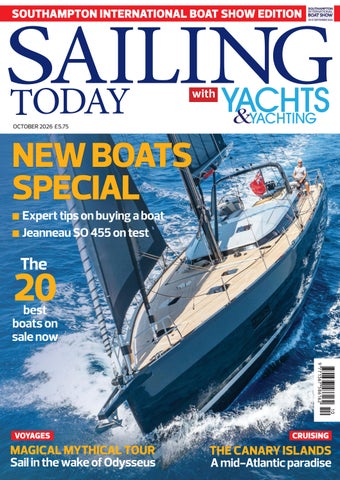
SOUTHAMPTON INTERNATIONAL BOAT SHOW EDITION OCTOBER 2026 £5.75
with YOUR COMPLETE GUIDE TO SAILING: SPORT. ADVENTURE. LIFESTYLE OCTOBER 2026 £5.75
NEW BOATS SPECIAL ■ Expert tips on buying a boat ■ Jeanneau SO 455 on test
The
20
best boats on sale now
VOYAGES
MAGICAL MYTHICAL TOUR Sail in the wake of Odysseus
CRUISING
THE CANARY ISLANDS A mid-Atlantic paradise
THE
RACE OF YOUR
LIFE 18-27 SEPT 2026 STAND H60 MARINA BERTH M852
RETIEF JORDAAN
39
Construction Manager Circumnavigator on board Dare to Lead
BECOME AN OCEAN RACER No experience required, full training provided SCAN HERE JOIN THE RACE
clipperroundtheworld.com
To download the information pack today.
REGULARS
10 News 32 Paul Heiney 34 Andy Rice 42 Tom Cunliffe 98 Jess Lloyd-Mostyn
70
UNDER SAIL
36 Canary Islands Exploring a stunning transatlantic stopover
54
46 Blue water prep Expert tips on prepping for a blue water passage
50 Women in sailing Georgie Corlett-Pitt discusses the issue of gender equality on the water
54 In the wake of Odysseus A mythical trip around Ithaca
60 El Nino Expert advice on how El Nino could affect your cruising plans
70 Caribbean Race Charter Options to consider
74 Gull’s Eye A look at Watchet Marina in Somerset
64 Buying a boat How to buy a boat
16
88
82 Southampton Boat Show A look forward to the 2026 edition
88 Clipper Race A look back at an epic round the world race
BOATS 16 New boats special Latest launches in the world of monohulls
36
36 Boat Test: Jeanneau SO 455 A comfy cruiser put through her paces
94 Three of the Best Three of the finest brokerage boats
GEAR 80 Launched Sailing kit reviewed and tested
Sailing Today with Yachts & Yachting OCTOBER 2026
3
More than a marina
A Yachting Community Experience boating with us in the finest locations
1
2
Our locations 2 Largs Yacht Haven BRITISH YACHTING AWARDS 2026 NOMINEE
5 Lymington Yacht Haven
6 Haven Quay – Dry Stack, Lymington
2 Troon Yacht Haven
7 Plymouth Yacht Haven
3 Neyland Yacht Haven
8 Yacht Haven Quay – Dry Stack, Plymouth
4 Fambridge Yacht Haven
9 Jachthaven Biesbosch, The Netherlands
yachthavens.com
9
3
87
4 65
Welcome
EDITORIAL EDITOR
Sam Jefferson 020 3943 9261 sam.jefferson@chelseamagazines.com
Skipper’s View
ART & PRODUCTION EDITOR Gareth Lloyd Jones WRITER AND SUB EDITOR Sue Pelling
AN OFTEN OVERLOOKED INGREDIENT THAT IS KEY TO A HAPPY VOYAGE
PUBLISHER Annabelle Lee annabelle.lee@chelseamagazines.com ADVERTISING ADVERTISEMENT MANAGER Mark Harrington 07715 631379 mark.harrington@chelseamagazines.com ADVERTISING EXECUTIVE George Wilson 07731 344261 george.wilson@chelseamagazines.com MARKETING HEAD OF MARKETING Seema Bilimoria MARKETING EXECUTIVE Loulou Easton ACTING DIRECTOR OF COMMERCIAL REVENUE Simon Temlett ADVERTISEMENT PRODUCTION Allpoints Media Ltd allpointsmedia.co.uk CHIEF FINANCIAL OFFICER Vicki Gavin MANAGING DIRECTOR Marie Davies Published by: The Chelsea Magazine Company Ltd CMC, 111 Buckingham Palace Road, London, SW1W 0SR © The Chelsea Magazine Company Ltd 2026, part of the Telegraph Media Group. All Rights Reserved. ISSN 1367-5869 (print) ISSN 2059-9285 (digital) No part of this magazine may be reproduced without permission in writing. Every care is taken to ensure the accuracy of information in Sailing Today, but no responsibility can be accepted for the consequences of actions based on the advice portrayed herein. The Chelsea Magazine Company Ltd makes every effort to ensure that the advertising contained in this magazine is delivered from responsible sources. We cannot, however, accept any responsibility for transactions between readers and advertisers. For the Chelsea Magazine Company Ltd full set of terms and conditions please go to chelseamagazines.com/terms-and-conditions
THIS MONTH WE turn our thoughts to the transatlantic run. This seems a bit counterintuitive given that summer is in full swing but that's really the point; if you're planning a transatlantic crossing, you need to think a long way in advance and, by now, most yachts planning to make the crossing will already be working their way south towards the Canary Islands for a crossing in November. One of the articles we are running this month is on prep for tihs passage and it's well worth a read, having been put together by Will Spencer who has devoted many years of his life to helping owners get over the start line at the Atlantic Rally for Cruisers (ARC). Given this base of knowledge, his insights are good and one that jumped out at me was the importance of ensuring your crew knows what they are doing and are happy. This human element can often get overlooked as you scramble to make sure our boat is ready - yet it's incredibly important. If you have a crew who get along, you're probably going to have a good trip. If not, a two week transatlantic crossing can sem like an eternity. Trust me, because I did it. Back in 2012 I signed on to an ARC boat making the crossing and in need of crew. The fact she was in Las Palmas searching for crew should have been a red flag as it meant her previous crew had scarpered . Unfortunately, in my haste to get a ride across, I ignored the warning signs and ploughed on. I think it would have been alright if I had been on my own but unfortunately I shipped with my then girlfriend who was hellbent on taking our skipper to task on everything. He was a bit of a Bligh to be fair but the pair were unbearable and I found myself in a situation that Kofi Annan at the height of his powers would have struggled to negotiate. Anyway, it's a shame because most years I attend the start of the Atlantic Rally for Cruisers and, amid all the drinks receptions and safety briefings, I sometimes get that thrill of heading off across the ocean into the unknown. Of course, everything is known these days. this is not the age of Columbus; yet somehow the thrill of a blue water voyage is still tangible. No amount of navigational aids or gizmos can make the ocean seem anthing other than what it is; an awe inspiring place to undertake an adventure.
facebook.com/ SailingToday
Subscriptions Tel: +44 (0) 1858 438769
editor@ sailingtoday.co.uk
twitter.com/ SailingTodayMag
CONTRIBUTORS
Annual subscription rates: 12 issues a year UK/ROW: £69, Europe: €81, US: $94 Email: sailingtoday@subscription.co.uk Online: sailingtoday.co.uk Post: Sailing Today, CDS Global, Tower House, Sovereign Park, Lathkill Street, Market Harborough, LE16 9EF Manage your subscription: account. chelseamagazines.com Back Issues: chelseamagazines. com/shop
JESS LLOYD MOSTYN is a writer and bluewater cruiser who is currently moored in Singapore
TOM CUNLIFFE is an author, journalist and TV presenter, and one of Britain's best-known cruising sailors
ANDY RICE is a journalist and veteran dinghy racer who has won championships at both ends of a skiff
Sailing Today with Yachts & Yachting OCTOBER 2026
5
Ciao Carlo This classic shot from La Maddalena bears all the hallmarks of the photographer Carlo Borlenghi, who passed away in August. Borlenghi was renowned for his uncanny ability to read the wind and anticipate tactical manoeuvres seconds before they unfolded, allowing him to position his camera exactly where water, light, and human effort collided Photo: Carlo Borlenghi
your journey starts here As an MDL berth holder, your home marina is just the beginning. Discover welcoming destinations, premium facilities and more ways to enjoy life on the water across the MDL network. With Otium Rewards membership included, the more you explore, the more you save, helping you get even more from every visit. Start your next adventure at mdlmarinas.co.uk/explore or call 0845 600 1813
cobb’s quay
torquay Queen Anne’s Battery brixham
Woolverstone
bray
windsor saxon wharf ––– shamrock quay ––– ocean village ––– hythe marina village ––– mercury yacht harbour ––– port hamble ––– hamble point
northney ––– sparkes
penton hook
Chatham Maritime
News
Ebb and flow EVENTS | NEWS | TALES FROM THE SAILING COMMUNITY
With the sudden passing of Carlo Borlenghi on 3 August, 2026, at his home on Lake Como at age 70, the sailing world has lost its most gifted visual narrator. To call Carlo a photographer is to understate his craft. For over four decades – from Italy’s ground breaking Azzurra campaign at Newport in 1983 through to the screaming, foiling beasts of modern America’s Cups – Borlenghi did not simply record yacht racing; he defined its poetry. Where lesser hands saw glassfibre, carbonfibre, and spray, Carlo saw light, drama, and raw human endurance. Fiercely intuitive, he could read a racecourse like a veteran tactician, anticipating a gybe or a sudden burst of pressure long before the helm put the tiller over. Ironically for a man who spent a career dangling from salt-crusted helicopters
10
OCTOBER 2026 Sailing Today with Yachts & Yachting
PHOTO: PAUL WYETH
Carlo Borlenghi (1956–2026) and bouncing off wave tops in press RIBs, Carlo famously could not swim. He often admitted that a healthy dread of the deep was precisely what gave his sea images their rare, reverent awe. Through his agency, Studio Borlenghi, he elevated maritime photography into fine art, capturing everything from the chaos of the Barcolana Race to the bone-chilling solitude of the Southern Ocean. Yet for all his international accolades, he remained the warmest presence on any media dock – generous, wry, and endlessly passionate. With his passing, the sea loses its finest chronicler. Fair winds, Carlo. Your lens taught the rest of us how to see the water.
Heroes’ welcome: Clipper fleet returns to Portsmouth after epic 40,000-mile race After a gruelling 11-month circumnavigation spanning over 40,000 nautical miles, the Clipper 2025-26 Round the World Yacht Race fleet arrived home at Gunwharf Quays in Portsmouth on 25 July to cheers from thousands of lined spectators. The final leg from Oban to Portsmouth is a relatively short sprint (around five to six days of sailing), but put tactics under the microscope as the teams faced strong tidal currents, busy shipping lanes and unpredictable coastal winds. This leg saw no conserving of energy, and the boats and crews were pushed to the absolute limit. While Team GOSH (Great Ormond Street Hospital) had already clinched the overall victory before departing Oban, the battle for the remaining podium spots fuelled a tense final sprint down the UK coastline.
Stage 13 delivered high drama across the waters. Qingdao delivered a masterclass in tactical sailing, crossing the finish line first to claim the final leg victory. Scotland crossed next in second place, earning crucial points to leapfrog into third place on the overall race podium. London Business School sailed in third for Stage 13, successfully locking in second place overall on the leaderboard. Although overall champion GOSH crossed sixth in the final leg, their dominant 153-point overall total capped an incredible campaign. As Champagne sprayed along the dockside, all crews celebrated an extraordinary ocean journey defined by resilience, endurance, and global seamanship.
Sailing Today with Yachts & Yachting OCTOBER 2026
11
Sacred Cowes marks 200th anniversary in style
PHOTO: PAUL WYETH
The historic 200th anniversary edition of North Sails Cowes Week concluded following a week of fierce competition on the Solent. Featuring over 600 boats and 5,000 sailors across 27 classes, the landmark regatta delivered world-class ocean racing and a shore-side festival that drew tens of thousands of spectators to the Isle of Wight. Tactical brilliance defined the seven days of racing. The coveted Queen Victoria Jubilee Cup for overall regatta champion was awarded to Lone Star, helmed by Phil Lawrence, Nick Froud, and David King, following a dominant performance in the competitive X One Design (XOD) class. In the Black Group,
Ben Rogers’ Contessa 32 Solan Goose clinched the King George V International Cup in a downto-the-wire finish. Meanwhile, Andy Maskell’s High Spirit took home the specially-commissioned Bicentenary Gold Cup. Marking two centuries since the regatta’s 1826 debut, the bicentenary featured an expanded field that paired modern carbonfibre yachts with classic wooden fleets, including the return of the Folkboat class for the first time in 50 years. Shore-side, the atmosphere was equally electric as pop-up venues, live music, and a commemorative aerial display transformed the historic town of Cowes into the global capital of sailing.
New show for Swanwick A collective of leading yacht sales and brokerage businesses based at Swanwick Marina has announced the launch of the Swanwick Yachting Showcase, an appointment-led yachting event taking place from the marina on the River Hamble, 19-27 September 2026. Designed specifically for serious buyers, whether entering the market for the first time or looking to upgrade. The showcase will feature the latest models from some of the industry’s most respected brands, including Beneteau, Lagoon, Dufour Yachts, Fountaine Pajot, Bavaria, Bali Catamarans, Excess, and Jeanneau alongside an extensive selection of approved pre-owned yachts available for immediate handover. For full information go to swanwickyachtingshowcase.co.uk
12
OCTOBER 2026 Sailing Today with Yachts & Yachting
SAIL
Refined sailing instruments for life at the helm.
© Garmin Ltd. or its subsidiaries. All rights reserved.
Next month in Sailing Today In the November edition of Sailing Today with Yachts & Yachting we turn our focus on the British Yachting Awards. Yes, it’s that time of year when the greatest yachts, events, equipment and human beings are celebrated. Who will be on the nominations list? Aside from that, we head to Scotland where Barry Pickthall and Sir Robin Knox-Johnston are on a voyage of discovery in search of the Clipper Round the World fleet. We also test the lightning quick Saffier SE 28 Leopard, and take a trip to the Bay of Roses on Spain’s Mediterranean coast.
Position: Bouncing back
Trampolines offer a good opportunity to strike a silly pose Trampolines have their roots in the Inuit communal blanket toss which uses tightly stretched walrus hides to launch hunters high into the air for spotting game across flat Arctic horizons. It’s doubtful that any inuit imagined that this same basic principle would be used on fast racing catamarans like this Sail GP racer and thereby allow crewmembers to strike silly poses which, in turn, would then be published in a sailing magazine.
...stretched walrus hides launch hunters high into the air... DIFFICULTY RATING: 3/5
Quote and buy online at www.noblemarine.co.uk or call us on 01636 707606 Authorised & regulated by the Financial Conduct Authority
14
OCTOBER 2026 Sailing Today with Yachts & Yachting
The BVI Sets the Standard So Should Your Yacht. When the boat is right, everything is right. From finding the perfect anchorage to connecting with those that matter, it all just works. Find us at the Southampton International Boat Show, 18–27 September, Stand H58, and speak with our experts to plan your next yacht charter.
VISIT MOORINGS.COM/UK 0333 060 8996 BAREBOAT • POWER • SKIPPERED • CREWED
BEST NEW BOATS FOR 16
2026
OCTOBER 2026 Sailing Today with Yachts & Yachting
CNB 62 Luxury yacht manufacturer CNB has been on a journey in recent years. The boatbuilder was originally part of the French Beneteau Group, focusing on bigger luxury yachts until the manufacturer sold the marque off a couple of years back. CNB was then acquired by Italian luxury boatbuilder Solaris and the new 62 is the first boat to be developed since the takeover by the Italians and the boat sits beneath 66 in the range and replaces the smaller CNB 60, being a refinement of that boat. As with previous recent models, the boat is designed by Philippe Briand and it is clear that the aim is to produce a luxurious cruiser with decent performance that could either be manned by a couple or with a professional skipper.
It has been a busy year for the boatbuilding industry. Sam Jefferson casts his eye over the latest launches in the last calendar year Sailing Today with Yachts & Yachting OCTOBER 2026
17
New boats ~ Cruising yachts
BENETEAU OCEANIS 42 Replacing the popular 40.1, the new Beneteau Oceanis 42 marks a major leap forward for the 40-foot cruising segment. Designed by Marc Lombard Yacht Design with exterior and interior styling by Nauta Design, it carries a wider beam (4.23 m) aft, expanding cockpit floor space by 12%. It features a taller rig for added power under sail, a modular cockpit with open or closed transom options, and five versatile layout options spanning two to four cabins. beneteau.com
JEANNEAU SUN ODYSSEY 455 Serving as the flagship of Jeanneau’s cruising range, the new Sun Odyssey 455 replaces the popular 440 and 490 models. Designed by Marc Lombard Yacht Design with interiors by Jean-Marc Piaton, this 14.28-meter cruiser maximizes interior volume and short-handed control. On deck, it features signature walk-around side decks and a dual-table cockpit that easily converts into sunbeds. Below deck, a convertible chart table, an expansive galley, and versatile 3-to-5-cabin layouts make it ideal for private cruising or charter fleet operations. Jeanneau.com
HANSE 461 he new Hanse 461 merges high-volume cruising with effortless shorthanded sailing. Designed alongside Berret-Racoupeau, it retains Hanse’s signature self-tacking jib while centralizing winches at the helm so a single watchkeeper can easily manage the rig. On deck, it introduces an expanded swim platform and cockpit barbecue lounge. Below deck, 26 ventilation points and eight customizable layout options allow owners to tailor the bright interior for private or charter voyages. Inspirationmarine.co.uk
DUFOUR 39 Slotting between the 37 and 41, the new Dufour 39 revitalizes the brand’s 11-meter cruising lineup. Designed by Umberto Felci and Luca Ardizio, it pairs a full-volume hull and voluminous bow with a single rudder for direct helm feedback. On deck, the modular “Skylounge Cockpit” features dual helms and an outdoor galley. Offered in Easy, Ocean, or Performance trim levels, the customizable interior accommodates 2 or 3 cabins with options for a home office, utility room, or second head. dufour-yachts.com
18
OCTOBER 2026 Sailing Today with Yachts & Yachting
LAUNCHING SEPTEMBER 2026
the ultimate sailing membership experience
All access 7-Day Access To Any Boat
£995/month
midweek Mon-Thurs Access To Any Boat
ONE MEMBERSHIP | ANY BOAT | TRULY UNLIMITED
£795/month
WHY SEA EQUITY?
book a private tour
UNLIMITED USE Reserve up to 7 days in advance, once a day is used, it can be rebooked. USE ANY BOAT Don’t settle for one boat, members have access to all our sailing yachts. SIMPLE MEMBERSHIP Aside from the fuel you use, everything else is included. PRIME LOCATION Our base at Hamble Point Marina gives you prime access to the Solent & beyond. DOG FRIENDLY Bring the whole family with you.
www.seaequity.uk
+44 (0)2381 112557
New boats ~ Day sailers/weekenders
J BOATS J/7 What seems like many centuries ago, J Boats built the first j/24 and, in doing so, the company hit the big time. Back then performance day sailers were big business. It’s not so much the case these days, with most boatbuilders shying away from building uncomplicated entry level yachts like this so hats off to J Boats for going back to their roots with the J/7. The boat is clearly going to be quite quick but is also easy to handle and features a big cockpit with a small enclosed ‘cabin’ forward which is exclusively for storage unless you are a true masochist. The boat has a generous sail area but a deep keel and decent beam suggest a stiff boat that is fun and easy to handle. Jboats.com
WOY 26 The Woy 26 is a lovely looking 26’ day sailer that clearly places performance as a key plank of the concept. Talking of planks, one of the most innovative features of this German built boat is that it is cold moulded in epoxy on a larchwood frame, making for a light and stiff yet sustainable boat. The Woy features a lifting keel and lifghtweight carbon rig, making the boat easy to slip and rig, making for a practical and elegant boat that will win the hearts o. woy-yachts.com
SAFFIER SE 28 LEOPARD Saffier Yachts are the past masters of producing fast, stylish daysailers and, after taking a hiatus to produce the bigger Saffier SL46, the company returns to familiar ground with the SE 28 Leopard, a boat that sits beneath the hugely popular SE33 in their range. The new 28 Leopard is suitably stylish, boasting a low freeboard and dramatic lines. These are definitely weekenders, but there is limited accommodation up at the bow and this is stylishly finished, making a night afloat perfectly possible. AS with previous SE models, the helms are set well forward compared to many rivals and this gives extra lounging space aft. This is a relatively light boat with a generous sail plan and the aim is for fast, effortless sailing. saffieryachts.com
POGO RC Yachts designed specifically to conform to a rating rule can be curiously deformed things. Who can forget some of the contorted designs of the 1980s bent into peculiar shapes to profit to the maximum from the IOR rule. Thankfully, the IRC rule tends to encourage more balanced designs and the Pogo RC is an interesting experiment, having been designed specifically to optimised for IRC racing. The result is a speedy yacht that boasts a full sectioned scow bow, married to a short (8.17m) waterline relative to her overall (10m25cm) length. This is a yacht designed for winning on the offshore racecourse. pogostructures.com
20
OCTOBER 2026 Sailing Today with Yachts & Yachting
New boats ~ Bluewater cruisers
KRAKEN 44 Kraken Yachts is the brainchild of businessman and sailor Dick Beaumont who, like so many before him, decided to build his dream boat and, off the back of that, launched a new sailing brand of blue water cruisers built to his own exacting vision of what a blue water cruiser should be. Unlike so many before him, Beaumont actually made it work and the result is a niche brand of highly innovative boats tailored for blue water cruising and designed by Kiwi Kevin Dibley. The 44 is the latest addition and the smallest boat in the range so far. She retains all the key features though including centre cockpit set up, skeg hung rudder and innovative Z Keel bolting system which is viewed as pretty bulletproof. If you’re after a serious blue water cruiser, this could be the boat for you. krakenyachts.com
PURE 42 If you thought that the French held the monopoly on rugged aluminium ‘go anywhere’ cruising yachts, think again. Move over Allures, Ovni, Boreal et al because there is a new kid in town and he has a German accent. The Pure 42 takes the much loved concept and gives it a Teutonic twist. The new boat places a greater emphasis on performance than many of its rivals, with a lifting torpedo keel that gives a max draft of 3m and minimum of 1.2m. in addition, there is the option of a carbon rig. Nevertheless, this 42 footer looks suitably rugged and packed with clever innovations. pure-yachts
STEM 50 Did I mention that the French were dominant in the sector of aluminium ‘go anywhere’ rugged blue water cruisers? Maybe so but lining up alongside the German Pure 42 is the somewhat curiously monikered Stem 50 which is an Italian built aluminium yacht that seems to be aimed even more squarely at the Allures and Ovnis of this world. The new boat takes a rutalist approach to design with its high freeboard and angular lines and looks like the sort of boat that could be employed as an icebreaker in the high latitudes. Unusually for this genre of yacht, the Stem comes with a fixed keel as opposed to the usually favoured swing keel. stem50.stemmarine.it
BOREAL 56 And here is exhibit A), a French, rugged, aluminium ‘go anywhere’ yacht from one of the stalwarts of the genre, Boreal. Based in Treguier in Brittany, Boreal has been producing unfussy and incredibly rugged yachts for many years now and the 56 is the sort of boat Bernard Moitessier might have favoured had he been a member of generation X. This is an incredibly tough boat with 12mm thick aluminium hull plating ensuring good protection against growlers in the high latitudes. Over the years, Boreal has become much less rudimentary in the way its boats are fitted out and the 56 is positively luxurious down below. boreal-yachts.com Sailing Today with Yachts & Yachting OCTOBER 2026
21
New boats ~ Performance cruisers
RM 980 RM Yachts is a French boatbuilder that produces fast cruisers which stand out from the crowd due to the fact that their yachts are built of epoxy/plywood- something that is almost unique in the world of production yachts due to the complexity of mass producing boats in this manner. It is, however, a construction method that lends itself to light, stiff yachts and the 980 looks to pick up where RM and go to designer Marc Lombard Design Group left off with their previous launch, the RM 1050. This is a 32’ fast cruiser that is available with single or twin keels – the twin keel option being ideal for sailors in tidal areas as you can easily dry out. RMs are noted for being very bright down below thanks to a huge windscreen on the coachroof combined with generous portlights. rm-yachts.com
JPK 48 FC French manufacturer JPK yachts has established an extremely strong reputation for building racing yachts with boats such as the JPK 1050 picking up many prizes. Yet the boatbuilder does also dabble in the world of fast cruising and the JPK 48FC is their latest launch aimed at those who like to go cruising at high speed. This is the successor to the 45FC and the boat has been tweaked somewhat, incorporating much of what they had learnt from the JPK 1050 in order to create a boat that will plane earlier with increased stability downwind and reduced pitching. Down below, the layout has been revised to improve ergonomics while on deck, the running rigging set up has been adjusted to ensure the boat is easily handled even if short handed. jpk.fr
BENETEAU FIRST 60 Beneteau’s First 60 and shares the same hull as the Oceanis Yacht 60. It is, in fact slightly heavier than that boat. It does, on the other hand, boast a rig that is almost 4m taller while the keel has been upgraded from an L-shaped iron one to a deeper (2.88m as standard) T-shaped keel with a lead bulb. No question, this will make the boat stiffer and faster. The interior is not wildly different from the Oceanis Yacht 60 with three cabins and an owner’s suite set forward with the double berth set against the aft bulkhead, opening up the entire space and giving more privacy. beneteau.com
POGO 50(2) French manufacturer Pogo is the past and present master of the exceedingly quick planing cruiser. Their boats have always been quite extreme while still catering for the cruising market. The 50 is at the top end of their current size bracket and replaces their current flagship – also confusingly named the Pogo 50. This Finot/Conq design clearly draws on the latest IMOCA designs to produce a hull with plenty of volume forward combined with broad aft sections and twin rudders for pace and control when planing off the wind. The 50 is designed as a liveaboard and despite its clear performance credentials, it has plenty of internal volume and a lifting keel which allows easy access to out of the way anchorages. pogostructures.com
22
OCTOBER 2026 Sailing Today with Yachts & Yachting
DS41 | DS48 | DS54
Luxury Decksaloon
Exceptional bluewater yachts. Explore the oceans in total comfort.
Inspiration Marine Group Ltd moody@inspirationmarine.co.uk 02380 457008
Discover the Moody DS41 and DS48 in the UK this Autumn www.moody-yachts.co.uk
Cruising – Canary Islands
The Canary Islands offer everything from lively tradewind sailing to sheltered anchorages. It’s a perfect proving ground before crossing to the Caribbean as Ingrid Schnabl relates
SHAKEDOWN IN PARADISE
T
wo days at sea, and the Atlantic cataracts us from the lush greenery of Madeira straight into the lunar landscapes of La Graciosa, the northernmost Canary Island. Her sun-bleached, barren hills – sculpted by centuries of wind and erosion – stand in breathtaking contrast to the deep blue of the ocean. For cruising sailors worldwide, this
24
OCTOBER 2026 Sailing Today with Yachts & Yachting
is a landfall of pure longing; for us, it marks a brand-new chapter aboard our Alubat Ovni 435, Stravanza. Dropping anchor at Playa de la Francesa instantly unlocks an old treasury of memories. Twenty-five years ago, our hook bit into this very seabed. Back then, as a young family fresh off our first multi-day Atlantic passage from Gibraltar, it was the
ABOVE The author looking down at the anchorage on Graciosa OPPOSITE PAGE A suitably dramatic anchorage off La Graciosa
opening salvo of a four-year circumnavigation aboard our previous boat, Idemo. It was right here that we first truly tasted the romance of life ‘on blue water’. Our daughter, Anna, barely four years old, was bursting with energy as she trudged up the island’s prominent hill beside us. Today, Robert and I climb that same peak, Montaña Amarilla, in quiet solitude, feeling a twinge of melancholy. Where
on earth has the time gone? The idyllic anchorage is only a short walk from the tiny hamlet of Caleta del Sebo, which offers a modestly stocked supermarket and a welcoming beach bar. Sitting down to tapas and ice-cold Estrella Galicia, our sentimental mood quickly dissolves. We resolved to take our time with the Canaries this time around – a stark contrast to our frantic preparations a
quarter-century ago, when we rushed through without a glance at the beauty of these islands. Yet, places like La Graciosa carry a distinct risk: you can easily end up lingering too long. Ultimately, empty vegetable lockers, a mounting pile of laundry, and the modern urge to get back online, nudge us onwards toward Lanzarote. In a flash, we are thrust back into the comforts of civilization. Sailing Today with Yachts & Yachting SEPTEMBER 2026
25
Cruising – Canary Islands
Lanzarote – a landscape forged by fire
Marina Lanzarote in Arrecife, on the island’s eastern coast, offers easy entry, is highly affordable, and ultra-modern. In fact, it is so modern that it has succumbed to total app-sanity. You now need a smartphone app for absolutely everything – from accessing the pontoons and unlocking the showers, to coaxing the washing machines into action. While the app is quick to install, the marina’s Wi-Fi thoughtfully decides not to reach most of these areas. This leaves you standing outside the laundry room, holding a bag full of dirty laundry, desperately chasing a single bar of signal just to start a cycle. I have to laugh, because this proves it yet again: doing laundry is the absolute bane of a cruiser’s life! Still, the marina being a stone’s throw from the town centre, it feels like pure luxury after days at sea and remote anchorages. We hire a car to explore Lanzarote’s bizarre landscapes. From the northern tip, we enjoy a spectacular view looking back across the water to our old anchorage at La Graciosa. Delving deeper, the island reveals a stark, dramatic canvas of dark charcoal and brown. Imposing volcanic cones dominate every horizon, punctuated by palm-fringed, fertile plains, charming villages, and flawlessly whitewashed houses. Kinetic wind sculptures by the famed local artist César Manrique spin lazily at roundabouts, adding a touch of whimsy to the stark terrain.
26
In the south-west, it feels as though we have genuinely landed on the moon – nothing but ancient lava fields and volcanic craters, sliced through by an arrow-straight road. Our road trip concludes in Lanzarote’s unique winegrowing region, La Geria, for a well-earned glass. The pitch-black volcanic hills of the high plateau are pitted with thousands of funnel-shaped hollows. At the bottom of each pit, up to three vines grow, sheltered from the relentless trade winds and nourished solely by the nocturnal moisture trapped in the porous lapilli. It is a spectacular vintage, literally clawed from a hostile environment by hand. Back at the marina, an elderly couple catches our attention. Edi and Almuth, 88 and 80 years young respectively, are absolute fixtures of the marina, known to everyone on the pontoons. They have been living aboard their ketch, Single Malt, for 35 years. Having already completed a circumnavigation, they are now content to cruise the Canaries to stay fit. Talk about keeping active: just a
OCTOBER 2026 Sailing Today with Yachts & Yachting
ABOVE LEFT The stark, dramatic, landscape of Lanzarote is unmistakeable ABOVE RIGHT A road trip through a moonscape on Lanzarote BELOW Marina Lanzarote in Arrecife
few days ago, Edi hauled Almuth up the mast because their wind transducer was jammed! She dismantled it at the masthead, brought it down for repair, and went right back up to reinstall it. Cruising as the ultimate fountain of youth – it gives one hope! Soon, though, we have our fill of sightseeing and marina life. The crew feels the pull of a quiet anchorage once more, finding the perfect spot at Playa de Papagayo on Lanzarote’s southeastern coast. We spend a few blissfully lazy days swinging gently over turquoise waters as the hours melt away.
La Gomera – valleys and echoes of the past
Our journey next takes us to La Gomera. Tying up at the marina in the capital, San Sebastián, we encounter a fierce crosscurrent running perpendicular to the pontoon. Fortunately, a deft marinero is on hand to salvage our somewhat botched berthing attempt. It is prime sundowner entertainment for the harbour, with Stravanza taking centre stage! Ever since, we’ve been the talk of the waterfront. Over a shared pontoon beer, Sandro the marinero officially christens us “Kapitana Kamikaze” and “Kapitano Furioso”. San Sebastián is a tiny place and quickly explored – small but beautiful. However, we are drawn outwards anyway, into the barrancos, as the deep ravines on La Gomera are called. There is one spot we are determined to see: the Valle Gran Rey, the
legendary hippie hotspot of the 1960s and ’70s. Chasing the ghosts of the 1960s hippie trail, we hike through the Valle Gran Rey. Well... the hippie spirit is technically still there, albeit mostly in the form of shops selling typical boho fashion and souvenirs from Bali. Otherwise, the Valle Gran Rey is a stunning, palm-fringed, green valley, and the town of Vueltas has become a tourist resort with a small beach, a tiny harbour and an attractive anchorage. It seems I am light years too late – for whatever it was my teenage self had imagined the Valle Gran Rey to be... From Garajonay National Park, we hike 1,000 metres straight down back to the coast, plunging into a fairy-tale canopy of prehistoric laurel trees. This dense woodland thrives on ‘horizontal rain’ – moisture from trade wind clouds that condenses directly onto the leaves, soaking the forest floor like a giant sponge. Normally, this path is shrouded in a ghostly mist, but the weather gods ‘punished’ us with flawless, radiant sunshine. We had secretly hoped for eerie fog to experience the forest’s mythical reputation, but even bathed in sunlight, it remains an utterly spectacular trek. Still, while it sounds like a breeze on paper, those 1,000 metres downhill are a painful wake-up call for unconditioned, vintage knee joints of a sailor! We keep our ears pricked during our sweaty hikes, hoping to catch a strain of El Silbo – the ancient and unique whistling language used by
locals to communicate across the vast valleys – but to no avail. Ironically, we finally hear it on the public bus on our way back to Stravanza; local passengers use a short, sharp whistle to signal the driver to stop at the next halt.
Tenerife – of ancient trees and Spain’s highest peak
At the base of Punta Roja, a striking red rock formation on Tenerife’s southern coast, lies an excellent anchorage. Stravanza sits perfectly still without a hint of swell, having been blown comfortably across from La Gomera by a moderate southeasterly. En route, a pod of pilot whales crosses our bow. We very nearly land a beautiful tuna, too, but the fish makes a clean break for freedom at the final moment, taking our lure and hook with him. After such a sublime day under canvas, we don’t grudge him his liberty. Naturally, Punta Roja has to be conquered on foot. With a low-pressure system moving through, we shift Stravanza into nearby Marina San Miguel for a few days, giving us the perfect excuse to head inland. The peak of Mount Teide
ABOVE LEFT The striking cliffs of Playa de Vueltas, La Gomera ABOVE RIGHT Exploring the barrancos - deep ravines - of La gomera BELOW The oldest Dragon tree in the world can be found on Tenerrife - El Drago Canario
calls us, and we are determined to answer. We hire a car, though our planned assault on the summit is admittedly a bit of a cheat; our strategy is to ride the cable car to the upper station and tackle only the final stretch to the peak on foot. Even so, the mountain’s 3,715 metre altitude commands our absolute respect. Having spent the last few months scuttling around at sea level, our hiking fitness is severely lacking. How will our bodies cope with the thin air? Would we even make it to the top? As it turned out, those anxieties were entirely in vain. Our bookings for the cable car and summit trail permit were cancelled not once, but twice in a row due to fierce gales on the ridges. While the refunds were processed without a hitch, the disappointment was bitter. Yet, even with the cable car grounded, we decide to drive up to the high plateau anyway. The moment we cross into the caldera, our disappointment vanishes, replaced by sheer awe. Away from the sprawling tourist resorts, Tenerife reveals itself as an incredibly diverse island of handsome mountain villages and coastal towns. One such hamlet is home to the oldest dragon tree in the world, El Drago Canario. Sacred to the indigenous Guanches, its bloodred sap was long rumoured to possess mystical healing powers. In the shadow of this mighty tree, we sample the Canaries’ famous coffee specialty: a barraquito. It is a deliciously sweet affair, meticulously layered
Sailing Today with Yachts & Yachting OCTOBER 2026
27
southamptonboatshow.com
Cruising – Canary Islands
with condensed milk, espresso, a generous splash of liqueur, and frothed milk, topped with a twist of lemon peel. It’s worth ordering for the visual artistry alone. Later, the well-appointed Marina in Santa Cruz de Tenerife offers superb shelter on the east coast. Its bustling central market is an absolute must-visit – the perfect opportunity to victual the boat with prime fresh fruit, vegetables, and seafood for the next leg.
La Palma: the charming beauty
With a fine north-easterly filling our sails, we round the northern cape of Tenerife, setting up a comfortable night passage to La Palma. Yet, just outside the harbour entrance of Santa Cruz de La Palma, the archipelago’s notorious ‘funnel effect’ strikes. The trade wind squeezes hard between Tenerife and La Palma, accelerating instantly from a pleasant breeze into high winds. Happily, the boundary of this acceleration zone is clearly visible from a distance; a sharp line where the water ahead suddenly turns white with spindrift. Every island here has its own acceleration zone, welldocumented in the pilots, and they must never be underestimated! Already heavily reefed, Stravanza charges into the white water. To enter the harbour at Santa Cruz de La Palma, we call up Port Control on the VHF for clearance. The response was immediate: we have to stand off to let an outbound fast ferry depart. His delay forces us into a
succession of high-power tacks and a sporty gybe right in the teeth of the strong breeze. Fortunately, there is minimal sea state, and the manoeuvres – which you rarely get to practice on a longdistance cruise – are exhilarating. Waiting on the pontoon is our radio friend, Federico. Back during our circumnavigation, we used to chat via amateur radio across the Pacific and Indian Oceans. Now, we are sitting in a marina bar, catching up face-to-face for the very first time. Federico, originally from Switzerland, has called La Palma home for 40 years. For decades, he devoted himself to running the Canary Islands’ legendary ‘Trans-Ocean’ cruising outpost, acting as a steadfast beacon and a welcoming haven for international bluewater sailors. However, his retirement was shattered in 2021 when the devastating eruption of the Cumbre Vieja volcano completely destroyed his beautiful home. Evacuated at the final moment, they escaped with nothing but the clothes on their backs. Yet, despite the tragedy, they refused to abandon the island. In their 80s,
ABOVE LEFT Hiking on Tenerife – the peak of Telde can be seen from anywhere ABOVE RIGHT Very clear signs of volcanic activity on Tenerife BELOW Negotiating the acceleration zone off La Palma
Federico and his wife started over from scratch, their zest for life undiminished. Federico’s voice trembles slightly as he speaks, but his eyes shine with resilience and enterprise. Our inland adventures peak with the legendary ‘Ruta de los Volcanes’, a gruelling yet spectacular 17km trek across the ridge of the Cumbre Vieja – the volcanic backbone of La Palma. The trail demands a punishing 700-metre ascent followed by a knee-shattering 1,400-metre descent through shifting volcanic ash and pine forests. Looking down from the high ridges across the plains of Los Llanos de Aridane, the sheer scale of nature’s power hits home. Where a massive, blackened tongue of cooled lava now stretches from the mountainside to the sea, there once stood 200 homes – including Federico’s. Cruising guides also advise giving the western coast of the island a wide berth due to ongoing submarine volcanic activity. La Palma quickly becomes our undisputed favourite. The relaxed capital, Santa Cruz de La Palma, is just a short stroll from the pontoons and charms visitors with its historic old town. The island is also a perfect staging post to prepare for an Atlantic crossing; from well-stocked chandlers and gas bottle refills to bunkering diesel, every box on the pre-departure checklist can be ticked here. Even the local supermarkets are fully geared up for bluewater
Sailing Today with Yachts & Yachting OCTOBER 2026
29
Cruising – Canary Islands
cruisers, offering the brilliant luxury of delivering your mega provisioning order directly to the pontoon free of charge. The marina provides excellent shelter and boasts a unique luxury – its own swimming pool! Life here moves at a wonderfully slow pace. In the local tavernas, we indulge in Canarian delicacies, with papas con mojo – small potatoes
wrinkled in a salt crust served with spicy sauces – becoming our definitive sundowner snack. It is incredibly easy to slip into the ‘island flow’ here. It takes a real effort of will to pull ourselves away and begin the serious logic of preparing for the Atlantic crossing. Time is flying, and our heading is locked: we intend to drop anchor in the
ABOVE LEFT Hiking the Ruta de los Volcanes, a gruelling, yet spectacular, 17km trek across the ridge of the Cumbre Vieja – the volcanic backbone of La Palma ABOVE RIGHT A picturesque street in Santa Cruz, La Palma
Caribbean well before Christmas! Looking back, it was wonderful to stretch our legs so thoroughly before the long ocean passage ahead. The Canary Islands are simply far too beautiful to be treated as a mere pit stop – and we are profoundly grateful that this time around, we finally took the time to truly see them.
Cruising information for the Canary Islands For charter sailors, the Canary Islands are an ideal cruising ground to experience bluewater sailing without having to cover long distances. With good planning, all islands can be reached within day sails. However, a night passage can often be the highlight of a successful Canary Islands cruise. Frequent identical place names like La Palma, Palma, Santa Cruz, etc, can be confusing and have previously led to a few mishaps. GETTING THERE Charter and scheduled flights from all major European cities. Ferry connections between the islands and from the Spanish mainland. WEATHER AND CLIMATE Wind: Prevailing winds blow from the north-east, but all other directions are possible. Season: The Canaries are a year-round cruising destination; peak season is from September to January. Air temperature: Pleasant air temperatures range between 20°C and 30°C year-round. Water Temperature: Depending on the season, water temperatures range between 19°C and 22°C. Weather reports: Available via VHF (UKW), Navtex, Windy, or various weather apps. Swell: It is essential to monitor swell forecasts. Navigation and tides Nautical charts: Navionics, O-Charts digital, and paper charts.
30
OCTOBER 2026 Sailing Today with Yachts & Yachting
Tenerife through reputable companies. One-way charters between the eastern and western islands are possible.
Tidal range: 1-2m. Crucial note: Pay close attention to the notorious cape and funnelling effects in the Acceleration Zones. Every island in the Canaries has ‘its own’ funnelling zone. These are discussed in detail in the nautical cruising guides for the Canary Islands and must not be underestimated! HARBOURS AND MARINAS Reservations: Booking ahead via phone or email is highly recommended for all marinas. Space is often limited; however, it is still common practice to successfully secure a berth even during the peak season (September to January) by reserving just the day before. Fees: Harbour fees for a 43ft yacht, for example, are approximately EUR 40 per night. Literature RCC Pilotage Foundation: Atlantic Islands. Charter options Available from Lanzarote, Gran Canaria, and
The crew Ingrid and Robert Schnabl have been passionate cruising sailors since the 1980s. On their first yacht, a Motiva 42 named Idemo, they circumnavigated the globe over four years with their young daughter. This was followed by numerous cruises in the Mediterranean and North Atlantic using charter boats or delivery transits. With their second vessel, an Alubat Ovni 435 named Stravanza, they have been sailing the Atlantic for several years, reaching destinations as far as Iceland. They are currently sailing in Nova Scotia and Newfoundland. You can follow their live travel blog at www.stravanza.at
An integrated VHF/DSC/AIS communication system. Engineered and built for marine life, packed with functionalities designed to make your boating safer and more convenient. Control VHF/DSC from your smartphone Integrated 5W AIS for full visibility and collision awareness Instant MOB & PLB alerts across all connected devices
em-trak.com/X100
CONNECT-X
Paul Heiney
H
A crew who can add an interesting flavour to a passage are the ones Paul would definitely consider inviting back for another voyage!
ow many kinds of crew are there? Let’s start with the no-hopers. Often pleasant enough, but useless. These are the ones who, after a full week’s sailing, still can’t get the rope the correct way round the winch and can’t fathom the intricate mechanism of a tin opener. I was once alongside an exasperated skipper who had such a passenger, which worried him because the bloke in question was a senior engineer at a nuclear installation. At the other end of the spectrum are those who know too much and turn up dressed for battle, latest sailing garments, tracker strapped to their wrist, emergency locator beacon in their pocket – you can never be too careful even if it’s only a jaunt the Isle of Wight. These are the ones who would feel safer if a rescue helicopter was shadowing them all the way into Newtown Creek. They tend not to add much to the sailing experience, other than tension. I have never had crew with strict ‘dietary requirements’, but I’ve had a few for whom the main requirement is to have as much of it as they can get, when they want it, which is usually now! They tend to come with a doctor’s note, warning that they are allergic to washing-up liquid, and possibly warm water, and so must be excused galley duties. You think I exaggerate? My problem is that having done so many miles single-handed, I have always considered my boat to be an extension on myself, and never considered crew to be strict necessity when it comes to getting from A to B. They are handy at times, it is true, when anchors must be lifted or lines taken ashore, or the waterline needs scrubbing, but you can usually manage. The crews I look out for are the ones who bring something new with them that adds to the experience, rather than dilutes it. I don’t care how good they are at knots, or are all that bothered about port or starboard. I want them to bring something else to the party. For example, I have mentioned before a crewman I took to Iceland, an artist who opened my eyes wider with his appreciation of the tumbling shapes of waves, the changing colours of the turbulent waters. As if that wasn’t enough, his finest moment was when we were moored in a crowd of towering, industrial-sized fishing
vessels. He had gone for a stroll and returned half and hour later with a broad grin on his face and in his clutches a silvery cod big enough alone to fuel an entire chip shop on a Saturday night. To see a cod fresh from the sea is to fully appreciate its true royalty. But what to do with it? Beyond my skills, but not his. He parked himself on the harbour wall, removing first the inwards and then skin, until he had enough sweet smelling, creamy white fillets to last us an entire week. I wouldn’t have swapped that filleting skill of his for all the Yachtmaster tickets in the world. That’s what I call a real crew. I once had an electronics genius as crew who could work magic with a screwdriver and soldering iron in the same way that my artist friend could wield a filleting knife to such a satisfying outcome. His Cambridge degree gave him an understanding of the intricate mathematics of GPS. He thought they were flawed and if you didn’t stop him in time he would explain why. It appears that those electronic navigators are not as clever as you think, or possibly not as clever as he thinks he is. He impressed me with a navigation app of his own design used by a doughnut business in mid America to facilitate deliveries. His phone would jangle at odd times of day and it would be entertaining to sit in the cockpit and listen to him giving fast-talking transatlantic computer talk to ensure the good people of Kansas City would not go without their Bacon Maple Donuts simply because the vans were turning left out of the factory instead of right. Rather more relaxed was the chap who worked the summer season in Namibia, in the desert, taking tourists on dazzling star-spotting trips made possible by the night skies there, which often have a crystal clarity. He knew the constellations, the stories behind them, although his first attempts were somewhat confounded by the fact that, him being used to the southern hemisphere and we were very much in the northern, all the stars appeared upside down. All these people, and more, have added greatly to my many miles under sail, opening doors to new worlds, and giving rise to new ideas. And not one of them ever talked much about sailing.
32
OCTOBER 2026 Sailing Today with Yachts & Yachting
HAVE YOUR SAY What blessings can you count these days? facebook.com/ sailingtoday @sailingtodaymag sailingtoday.co.uk
ILLUSTRATION CLAIRE WOOD
'They tend to come with a doctor’s note, warning that they are allergic to washing-up liquid'
DISCOVER THE NEW HANSE 461 IN THE UK THIS AUTUMN Contact us to learn more.
Inspiration Marine Group Ltd hanse@inspirationmarine.co.uk 02380 457008
315 360 410
461 510 590
new
BREAKING RULES . SETTING TRENDS
Andy Rice Will Andy’s XOD sailing experience at Cowes Week tempt him back for more? Plus why some classes continue to attract huge numbers at major events Tarantella, the original Swan 36 that started it all back in 1967. When Finnish entrepreneur Pekka Koskenkylä commissioned Sparkman & Stephens to design a radical new yacht, they built her not from timber, but from a new-fangled material called GRP (glass-reinforced plastic). Crucially, rather than giving her a traditional long keel with the rudder attached to the trailing edge, Tarantella featured a separate central fin keel and a standalone rudder hung on a skeg – a configuration we take completely for granted today. When Tarantella arrived at Cowes Week in the summer of 1967, she swept all before her, marking a vital milestone in establishing Nautor’s Swan as the powerhouse brand it has been for nearly six decades. Much like classic cars, if a boat possesses a genuine touch of classic heritage, it seems to be doing extremely well. This stands in stark contrast to several modern one-design classes, which seem to have burnt brightly before fading away, despite deserving much better. High-profile designs from the Farr stable come to mind: the Mumm 30 (later the Farr 30), the Farr 40, and the Corel 45 (Farr 45), all of them brilliant boats, yet all of them extinct. Which brings us to the present day: will the hypercompetitive Cape 31 prove to have enduring longevity, or will it eventually fall by the wayside like those fantastic Farrs of the past? Part of the challenge facing the Cape 31 lies in the sheer level of professionalism and relentless pre-event training currently required to campaign at the top end of the fleet. Speaking to a couple of keen amateur Cape 31 racers struggling to compete on the circuit whilst holding down proper jobs, they tell me it’s quite a challenge to commit to the demands of a full-on campaign, and they’re probably not going to carry on in the class. So, what if race training time were strictly capped? Would that change the mind of those keen amateurs? Imagine a rule where teams were permitted only a single practice day immediately prior to an event, rather than spending the preceding week out on the water. On the surface, placing limits on practice might sound a bit extreme, but it could actually protect participation numbers. After all, strictly limited sailing days are already standard practice in the high-stakes worlds of the America’s Cup and SailGP. Is the Cape 31 operating at quite that level? Perhaps not. But putting sensible restrictions on training time might make the class far more sustainable and attractive to passionate owners who aren’t quite cash – and time – rich enough to compete with the most professional campaigns. How do you police the training limit and ensure that teams are not training on the sly? With a transponder fitted to every boat. Probably a mad idea, but so is allowing this boom-and-bust cycle to continue. PHOTO: PAUL WYETH
W
hile some parts of our sport are currently struggling for numbers, others appear to be in remarkably rude health. Take Cowes Week, for example, with more than 5,000 sailors competing in 641 boats, or the Firefly Nationals, which recently racked up 116 entries. Meanwhile, the Rolex Swan Cup in Porto Cervo is gearing up for a maxed-out fleet of 170 boats. What do these seemingly disparate events have in common? Each of them boasts an element of the classic. I got to sail an X One Design for the first time at Cowes Week this year, finally giving in to the relentless demands of my old Laser-sailing friend from 30 years ago, Andy Oddie, to join him on Magic Dragon. Built in 1948, she is the very same boat that Andy used to sail with his father, David, some 30 years earlier. Together they won the Captain’s Cup, something we never threatened to do this year. Being a notoriously slow boat, the XOD had never particularly appealed to me. Yet I have to admit that the sheer closeness of the racing and the slow-motion drama of working the tides and wind shifts – trying to eke out the smallest fraction of an advantage on a silent racecourse – was a lot of the time frustrating, sometimes very rewarding, and ultimately good fun. With 60 boats on the Cowes start line, it is staggering not only how many people choose to race the XOD, but also the formidable quality of the sailors who line up on the grid. Whenever we found ourselves languishing in the middle or back of the fleet, my helm would point out the rockstars also suffering around us. Names that Andy was throwing around included Nigel Buckley, former 470 World Champion, double Olympian Stuart Childerley, and another Finn Olympian, David ‘Sid’ Howlett, coach to a few gold medal legends like Iain Percy and Ben Ainslie. Meanwhile, in dinghy land, the Firefly is so deeply ingrained in the British dinghy firmament – particularly as the team racer’s weapon of choice – that it is easy to forget it started life as an Olympic class. Designed for the 1948 London Olympic Games, it was in a Firefly that an 18-year-old Paul Elvstrøm won the very first of his four consecutive Olympic gold medals. Decades later, the Firefly endures, whereas the boat that I team raced at university, the Laser II, is scarcely seen at all. Over in Sardinia, the Rolex Swan Cup is building towards its biggest ever fleet, capping out at the 170-boat maximum that the Yacht Club Costa Smeralda is prepared to accommodate. The fleet ranges from traditional 36-footers right up to state-of-the-art, 128ft superyachts. Perhaps the most significant vessel of all is the smallest one in attendance:
“Imagine a rule where teams were permitted only a single practice day”
34
OCTOBER 2026 Sailing Today with Yachts & Yachting
ANDY RICE As a sailing journalist and TV commentator Andy has unparalleled knowledge of the performance racing scene, from grassroots to elite level
Freedom to Flex with Visicover Boat Insurance Adjust your boat insurance instantly as your needs change throughout the year. Sunny summer voyages, laying up over winter, that refit you’ve been planning – your boating needs change across the year. Your insurance should reflect this, so that you’re not paying for cover you don’t need, or relying on cover that no longer fits.
Traditional cover: expensive & ill-fitting Many boat owners only review their vessel’s insurance annually, largely due to inflexible policies, steep amendment fees, and the fact that changing simple details requires completing paper forms or hours on hold to the call centre. The result? Boat owners feel locked into policies that don’t accurately reflect their needs and pay more for unnecessary cover year-round.
Active management made easy Actively managing your boat insurance throughout the year ensures that you aren’t paying for unnecessary cover, that new additions to your vessel are adequately insured, and that you benefit from any reductions in premium as your circumstances change. Visicover’s award-winning online service puts you in control, allowing you to amend your cover instantly whenever you need to.
Why Visicover? No tedious paperwork. No hidden fees. Just tailored, affordable, and flexible cover that you can amend online in minutes, underwritten by one of the world’s largest insurers – with a 24-hour claims hotline and expert support whenever you need it.
The changes you can make with Visicover Adjust your cruising area whenever needed Taking a longer trip, or planning to stay local? Adjust your covered cruising area as and when you need it, rather than paying for a wider cruising area year round, ‘just in case’. Update your insurance when you update your vessel If you’re updating your vessel, whether you’re refitting the hull, replacing the engines, or installing new onboard equipment, make a quick change to your policy to ensure this investment is fully protected. Benefit from security upgrades and reduced risk Installing better security equipment or moving your vessel to a safer mooring decreases risk, and therefore insurance costs – but only if your insurer knows about it. Update your cover to reduce your premium. Switch between ‘in commission’ and ‘laid up’ cover Taking your boat out of the water for the winter? Switching to laid-up cover can significantly reduce your insurance costs over those winter months whilst keeping protection in place for key risks like fire and theft.
Looking for more flexibility in your boat insurance? Get a quote today at visicover.com
Boat test – Jeanneau Sun Odyssey 455
THE MYTHICAL SUN ODYSSEY Jeanneau’s Sun Odyssey range has been running for 36 years so they’ve had plenty of time to refine it;. Sam Jefferson test sails the new Sun Odyssey 455 to see how she performs
36
OCTOBER 2026 Sailing Today with Yachts & Yachting
Boat test – Jeanneau Sun Odyssey 455
B
eing a naval architect has always sounded to me like a good job. Being a naval architect who designs yachts sounds even better. In fact, I have a confession. When I was a child I wanted to be a yacht designer. I was very serious about it and spent a lot of time drawing up plans of yachts and shaping them carefully. I generally copied yachts designed to the IOR Rule and, for those of you who remember that far back, you may not be surprised that the resulting model yachts sailed appallingly. Ultimately it was this and my exceedingly poor grasp of physics and maths that persuaded me that I was not going to be a yacht designer but instead a sailing instructor who would head to the the Caribbean and go play with the dolphins. Not sure why I thought dolphins were important but there you go. After that, I figured I would become a journalist. The moral of the story; aim higher. Why in hell didn’t I plan to become a millionaire by the age of 25? Anyway, enough about me; naval architect – a nice job. Yet I must say I do feel a twing of empathy for them when they are commissioned to design a yacht such as the Jeanneau Sun Odyssey 455. Imagine the conversation: Yacht Designer: “What sort of boat are you after this time, then?” Jeanneau Big Cheese: “We want a comfortable, roomy cruising yacht that’s easy to handle but also fast.” Yacht designer: “Ok, that sounds a lot
38
like your existing Sun Odyssey 440 and 490. How do you want this new yacht to differ?” Jeanneau Big Cheese: “We want it to be the same, but better in every way.” Ah yes, this is modern life. We humans are consumers and we are constantly demanding something new, exciting, different. Which brings me to the Jeanneau Sun Odyssey 455. This boat replaces the successful Sun Odyssey 440 but also the Sun Odyssey 490. Both were roomy, easy to handle well performing, surprisingly fast yachts. The Marc Lombard design team are the naval architects tasked with creating a new yacht that does all these things but is somehow intrinsically better. One thing
OCTOBER 2026 Sailing Today with Yachts & Yachting
ABOVE LEFT The Sun Odyssey 455 features Jeanneau’s distinctive side decks which slope down aft to make a clear pathway into the cockpit ABOVE RIGHT The Marc Lombard lines are distinctive and angular BELOW The Sun Odyssey in her natural domain
that is notable is that this is the biggest Marc Lombard designed Jeanneau ever and she is going to be the biggest Sun Odyssey once the 490 is discontinued. The new boat is 46’ long and is, in actual fact, 1’2” longer on the waterline than the 490. She has identical beam 5” more drat and is a shade lighter than the 490. So taken all in all, there’s not a huge amount of difference between the pair size wise. In terms of the design of the new boat, she looks striking both on the water and at rest with her vertical bow and distinctive chine. The boat is clearly designed for comfortable cruising and ease of handling is a priority. This is a versatile yacht and is available with a range of layout options that run as follows: Three cabins, two heads – this is the classic owner’s version; three cabin plus workshop – this workshop is set aft and is ideal for those planning blue water voyages; four cabins, four heads – probably a choice for those thinking of chartering; five cabins – with an additional skippers berth in the bow. On the four and five cabin versions, the very roomy owner’s suite at the bow is split into two. As with all of Jeannneau’s recent Sun Odyssey designs, the 455 features their clever deck layout where the side decks slope down as you move aft meaning there is no step down into the main cockpit and the two areas blend seamlessly aft. Aside from that, this is a yacht that is intended to perform
reasonably well and to this end, the hull has relatively fine waterlines forward combined with a very distinctive chine and twin rudders. The keel is surprisingly deep in standard form, being 2.35m which could be a little restrictive in some anchorages but does help boost performance especially when married with the performance package available to sportier owners which features upgraded sails, a hydraulic backstay tensioner Dyneema running rigging and a flat deck furler for the headsail.
On deck
As you’d expect there is a good deal of beam aft and although the bathing platform is not full width it is plenty wide and encloses the cockpit nicely. The helm seats are to either side of the bathing platform and are L Shaped with a nice back rest integrated into the pushpit plus good lockers underneath for stowing fenders. There is plenty of space for the helmsman and the binnacles are uncluttered featuring integrated
chart plotters as you’d expect with the throttle on the starboard binnacle. Beneath the helmsman’s feet is a massive storage area with a gas bottle locker separate from this. Directly in front of the helm are two big winches with twin banks of jammers. These allow you to control the boat from the helm position with great ease. There are well placed bags for the winch handles but they seemed a bit small for all the ropes that are needed here and, at rest, these were coiled around the winches. Forward of the wheels was the main lounging area of the cockpit which had twin tables with a corridor down the middle allowing for easy access to the companionway. It’s a roomy space and you could seat eight Here with no fuss whatsoever. The tables can be dropped down to create a larger lounging space with infills. In the middle of the cockpit sole is a huge locker that could take a decent sized deflated dinghy. Forward of this is a separate locker for the liferaft. On the coachroof there are
ABOVE The Sun Odyssey 455 replaces two yachts in the Jeanneau range; the 440 and the 490 BELOW LEFT A sprit for your downwind sails with anchor roller Integrated into it is very much de rigeur these days BELOW RIGHT A very roomy cockpit with twin tables that can drop down to give you yet more lounging space
two big winches and twin banks of jammers for your running rigging. Here there are some decent zip up rope bags to keep things tidy. There are two banks of six jammers. One of the winches was powered on the test boat which kept things effort free. As mentioned, the side decks have that distinctive drop down slope running aft which only Jeanneau uses and keeps your feet well enclosed while providing an obvious channel for water to run down if the boat is heavily heeled over with large cockpit drains situated right by the helmsman’s feet ensuring the water drains away quickly. It makes for a really easy walkway forward helped by the fact that the lower shrouds are set inboard and the uppers outboard leaving a central walkway free. Aside from this the bow is, as with all modern boats somewhat foreshortened with the forward part of the coachroof offering further potential for lounging. At the bow there is a sprit with an integrated roller which is great for flying your Code sails of gennaker
Sailing Today with Yachts & Yachting OCTOBER 2026 39
Boat test – Jeanneau Sun Odyssey 455
and there is also a really generous lazarette for your sails plus a decent sized anchor locker. In terms of rig, you have a twin spreader set up with plenty of aft sweep to the spreaders and a split backstay which on the standard rig has no tensioner. The mainsheet is set on a bridle on the coachroof and the jib sheets are run through thimbles on the coachroof so no cars are required.
Down below
Step down via four steps and you find yourself in a roomy saloon which has twin skylights and decent sized portlights. The interior has been designed by Piaton, who work a lot with the Beneteau Group and the styling is quite distinctive with white units and dark wood that gave it quite a hard, modern look. The laminated wood is smart and can easily be maintained. The layout on the test boat featured twin double berths aft with heads to port and a workshop space to starboard. This is the blue water layout. On the starboard side you have the chart table ahead of this with a clever Lazy Boy folding seat which means you can actually lounge athwartships if you like. It also has plenty of storage underneath. The chart table itself is quite narrow but works quite well as a desk/office area. The large U shaped seating area is a decent size with stylish shelving/ lockers above. To port and at the aft end of the saloon is the day heads with separate shower. This is really extra large compared to your normal heads. The aft berths are roomy but unspectacular.
Ahead of this is the galley which is laid out fore and aft to starboard with two large fridge/freezer units set into the worktop plus extra storage space with a second access to the fridge from below which is a nice touch. The cooker is set forward of the fridges and the sink is set against the forward bulkhead running athwartships forward of this. There is a bit of a lack of a handhold on the deckhead although there is a sort of bracing point next to the cooker. Otherwise, the galley is well set up with good storage and a nice view if you are cooking. Forward of this is a really spacious double berth with the bed set facing aft. There’s loads of space here you can walk around the bed to either side. The heads with separate shower is set aft and to port and this is a big space too. It’s all very stylishly put together
40 OCTOBER 2026 Sailing Today with Yachts & Yachting
ABOVE LEFT A bright, roomy saloon with a plethora of stylish touches ABOVE RIGHT Th palatial owner’s suite set at the bow BELOW On a beam reach, we hit over 9kn as the wind piped up
and there is a lovely curve to the furniture as you enter the cabin that must have taken quite a lot of work to put together. There are other thoughtful touches too such as the recesses in the floorboards with lift out panels so you can sweep dust into them then lift them out and drop it overboard. It’s a small detail but a nice touch.
Under Sail
I test sailed the boat in the Baie des Anges off Cannes on a day that started with a modest 10kn but built to a more exciting 18kn. There was a shortish chop for most of the day. Hard on the wind we were initially doing 6.4kn in 10kn of breeze which was decent I felt and the helm had a very good feel. It was notable while underway that there was masses of space to move around the cockpit. There was a nice foot chock if standing up and the helmsman’s seat was super comfortable. There was also a repeater set below the binnacle which gave speed and wind even when you are sitting outboard. By the time the breeze was up to 17kn we were hitting 7.6kn hard on the wind which was not bad and the helm offered masses of control and grip while remaining light to the touch. The winches were very well placed for sail handling though there was a lot of rope in the middle of the cockpit. On a beam reach with the Code 0 up we did 9.2kn which was impressive. This may be a cruising boat but she has more than a hint of performance to her.
ALTERNATIVE BOATS
BENETEAU OCEANIS 47
Freshly launched by Beneteau last year, this is the natural competitor to the 455, replacing the widely popular Oceanis 46.1. The Oceanis places heavy emphasis on wide aft sections, generous interior volume, and relaxed deck lounge areas. beneteau.com
SAM’S VERDICT Marc Lombard, may he rest in peace, can continue to rest peacefully, his design house having provided Jeanneau with a new boat that does much the same as the boat it replaced, but better. The boat performs strongly,
THE SPEC Hull Type: Fin w/bulb twin rudders Rigging Type: Fractional Sloop LOA: 46’ 10” (14.28m) LOD: 45’ 1” (13.74m) LWL: 44’ 7” (13.58m) Sail area (reported): 1,108.68 ft² (103.00 m²)
provides masses of room and is easy to handle. Reservations would be around the draft if anything which, at 2.35m is a bit much for my tastes although there is always the option of a shallow draft 1.75m keel.
BAVARIA C46
The German beast designed by Italian Mauricio Cossutti and launched two years ago. Noticeably beamier than the 455 (4.70 m vs. 4.49 m), offering massive interior living space and deep cockpit layouts. It offers exceptional volume and solid upwind stability, appealing to cruisers looking for maximum saloon/cabin space. bavariayachts.com
Beam: 14’ 9” (4.49m) Displacement: 24,757.91 lb (11,230kg) Ballast: 5,932.64 lb (2,691kg) Max Draft: 7’ 9” (2.35m) Designer: Marc Lombard / Jean-Marc Piaton Price (exc VAT):353,200 (base) 435, 964 Euro fully equipped Contact: jeanneau.com
DUFOUR 48
French Rival Dufour teamed up with designer Umberto Felci to design a yacht with very wide beam and powerful hull lines. Dufour sets itself apart with exterior features like integrated cockpit plancha grills and sinks at the transom, appealing to sailors who prioritize outdoor entertaining. dufour-yachts.com Sailing Today with Yachts & Yachting SEPTEMBER 2026
41
Tom Cunliffe
Rules of the ‘road’ when sailing are fundamental but as Tom’s experience demonstrates, sound judgment remains the final line of defense against collisions
M
any years ago I was trying to sell my yacht. She was a little 22-footer and by today’s standards there wasn’t much money involved, but I was proud of her. The prospective buyer and I had been out for a trial sale which had gone without a hitch until the engine failed on the home run in the lower reaches of the Hamble river. With the wind on the nose this was a disappointment, but
42
we still had the main hoisted so we whipped up the jib and beat on towards our destination. All went well for a board or two until we met with a port-tack race boat, also beating up to his mooring. He seemed to be on an alarmingly steady bearing as we shaped up to cross tacks. ‘Starboard!’ I called. ‘Hold your course,’ he hailed back. Readers used to racing will appreciate that this call effectively exonerates the recipient from
OCTOBER 2026 Sailing Today with Yachts & Yachting
PODCAST Catch up with Tom’s columns now and in the future at sailingtoday.co.uk
blame, but I didn’t like the look of it. The man on the wheel was right aft, of course, and he was confident of missing me. He might have had a different perspective had he been sitting in the pulpit. Rule 17 of the Colregs requires that when we are stand-on vessel and the give-way vessel has failed to do the square thing, it’s up to us to avoid a collision if we can. I leaned on the tiller but it was too late. His spoon bow sliced neatly between me and my backstay and brought down my mast.
“He called round the next night with a bottle of Grant’s ‘Stand Fast’ whisky to show there were no hard feelings” We gave him what a more literary figure than me once described as a dose of the singeing curse of Cain, wrote down his insurance details on a cigarette packet, grappled the mortal remains of the rig on board, and tried our luck with the Stuart Turner. To my surprise, it opted to start and it got us home. Readers will be sad to learn that the thoroughly decent gentleman who was transformed from buyer into emergency crew felt
he couldn’t proceed with the sale. He called round the next night with a bottle of Grant’s ‘Stand Fast’ whisky to show there were no hard feelings. Nor were there. He bought himself an honest MacWester, and the Elephant yard did a fine job replacing my mast. I finally sold the boat to a man with one leg who I never saw again. So what about the port/ starboard incident? In my days as a Yachtmaster Examiner I don’t
ABOVE Overtaking or crossing? I’m closing with this yacht from just abaft her beam. Which is the stand-on vessel? BELOW Tack – The line bowsing down the windward clew of a close-hauled square-rigger’s foresail is the ‘tack’
recall anybody failing to spot the rights and wrongs of one of these. You don’t have to be a scholar to remember that if the boom’s on the port side you are on the starboard tack. You may not realise why this should be, you might even have wondered, but sometimes the easiest thing is just to accept what we’ve been told. Matters are not always so clear-cut when it comes to crossing situations under power. We all know in theory that we must give way to anything approaching on our starboard bow. It’s less obvious when the enemy is coming in 20º abaft the starboard beam. Is he an overtaking vessel, in which case avoidance is down to him and it’s happy days, or is he coming in at less than the designated ‘two points abaft the beam’? The cut-off angle is 22½º. If you’re thinking this is obscure and why on earth can’t it be a sensible whole number, the reason is historic but still perfectly sound. Before we had degrees to steer by, the compass card was divided into points, sub-points and sub-subpoints. There were 32 in all. Divide 32 into 360 and you get 11¼, hence ‘two points abaft the beam’. You won’t have missed the coincidence that the screening on any steaming light allows it
Sailing Today with Yachts & Yachting OCTOBER 2026
43
Tom Cunliffe
to shine out up to 22 ½ degrees abaft the beam. Herein lies the big secret about remembering the colregs under power. Stop trying to think in degrees and about whether the other vessel is on your right or your left. Even in broad daylight, just keep your running lights in mind whenever there’s a tricky situation. Anyone coming in on your starboard bow would be seeing your green light if it were lit. ‘Aha!’ he thinks. ‘Green for go. I’m the stand-on vessel. And, by the way, I’d be showing him my red light and we all know what that means. He’s give-way.’ That chap over your starboard quarter is either seeing your steaming light or he’s not. If he’s more than 22½º abaft the beam, the steaming light will be obscured. He sees only your stern light; he’s therefore an overtaking vessel and must keep clear. If he can see your steaming light, he can also see your green, so on he comes. When he’s closing from the port side, you’re showing him red all the way round until the steaming light disappears and he becomes an overtaking vessel, so anyone on that side of you is on a hiding to nothing. Now we’ve sorted out how to remember the rules under power, have you ever wondered why the starboard tack is so called? To us fore-and-aft sailors it seems completely illogical, but to the square-rigger it is straightforward. I recently had the pleasure of sailing aboard the first-class Swedish brig Tre Kronor. It was many years since I’d been
to sea under square yards and the opportunity came because my wife Ros had been posting daily reels about our modest adventures on Facebook and Instagram. These were picked up by an old shipmate from the time when I sailed up the English Channel on the British brig Maria Asumpta, subsequently lost near Doom Bar with three hands. Magnus invited us and I don’t need to tell you that we were up the gangway like the proverbial rats up drainpipes. I hadn’t been aboard for long before it all came flooding back. The technology of square sail and the nomenclature are so different from our own. Why are the ropes that pull our sails up called halyards? Because the yards from which the square topsails are spread don’t live permanently aloft in their sailing position as they do in a child’s pirate-ship drawing or on some modern square riggers.
ABOVE A glorious day spent aboard Tre Kronor BELOW Tack and gasket – Looking down on the closehauled foresail you can see the weather leech is tight to create a good aerofoil. The coil neatly made up on the yard is one of the gaskets that secure the furled sail
TOM CUNLIFFE Tom has been mate on a merchant ship, run yachts for gentlemen, operated charter boats, delivered, raced and taught. He writes the pilot for the English Channel, a complete set of cruising text books, and runs his own internet club for sailors worldwide at tomcunliffe.com
OCTOBER 2026 Sailing Today with Yachts & Yachting 4444OCTOBER 2026 Sailing Today with Yachts & Yachting
Traditionally, they are lowered to the yard beneath them when the sail is not required. To set the topsail, the gaskets (long sail ties) are cast off. The clewlines and buntlines which brail the sail up to the yard are let go and the sheets which secure the two lower corners (the clews) to the outboard end of the yard beneath are hove tight. The yard is then hoisted to its sailing position. It’s a hard pull to get it up, as the sail fills with wind, and the rope that does it is called a halyard. It’s not a big etymological jump from there to the ‘Haul-yard’ origin of the term. As for the tack, and which one we’re on, the upper sails are sheeted to the yards below, but the big bottom sail, the ‘course’ – the brig’s foresail – cannot be, for the simple reason that there’s no yard there. When the ship is running and the yards are square across the beam, one sheet can be taken aft from each clew and trimmed for the optimum shape. However, as anyone who has ever shipped out with a loosefooted sail understands, when you ease a sheet the clew will rise unless there is a downward component in its angle. When a square-rigger is closehauled with the yards braced as near foreand-aft as the standing rigging allows, the sail would become unmanageable without a second rope attached to the windward clew which pulls down and forward. This keeps the weather leech of the sail tight and enables it to operate as an aerofoil. Guess what that rope is called? The tack! When the starboard tack is hauled tight and inboard, the ship is said to be ‘on the starboard tack’, for what are now obvious reasons. The wind is coming over the starboard side and there are no doubts. All we have to do is imagine for a moment that we are beating round the Horn on a wild, freezing night, tailing on knee-deep in water with seven of our mates to haul the tack down and inboard as we press on to Valparaiso. We’ll never forget again.
One berth. A whole South Coast network.
Be part of the South Coast’s most extensive network of destinations. With 17 locations to explore, for truly unbeatable value from your berth, plus practical rewards, join our community today.
DA R T M O U T H
| DEA
S CON
NEW FO
Why berth anywhere else?
Upgrade
Visit: premiermarinas.com/upgrade or call 01489 884060
| PO
RTL
A
ND
6 2 0 R 2
| W
EY
U MO
TH
|
EA
ST
CO
W
ES
|
H
A
SL
A
R
Ocean crossing check list
PREP TALK
Sam Jefferson spoke to Will Spencer who offers some useful advice on how to ensure your bluewater dream doesn’t become a nightmare
S
elling up and sailing around the world requires planning. Here are some of the pitfalls to avoid in order to realise your bluewater dream. If you have ever walked the pontoons of Las Palmas in November as yachts prepare to cross the Atlantic you will see that they are an absolute hive of activity. This is because the actual logistics of planning an ocean voyage are actually rather more complicated than many anticipate. Aside from the basics of provisioning and making sure your boat is in good fettle, and you have enough water, there is a whole raft of planning work that goes in to preparing for a trip of this nature. And that planning can begin years before you make it to the start line. Few people have seen more ARC yachts at the point of departure than Will Spencer, founder of White Dot Sailing. After completing the World Cruising Club’s ARC rally himself in 2016, Will joined the World Cruising Club as an
46
ARC Safety Inspector, assessing yachts preparing to leave Las Palmas for the Caribbean. Having inspected more than 200 ARC yachts, he began to notice the same preparation mistakes appearing time and again. Those insights led him to develop White Dot Sailing’s Adventure Projects programme – a bespoke preparation service that looks beyond the boat itself to assess the entire project, including the yacht, crew and passage planning. Since then, White Dot Sailing has helped hundreds of sailors prepare for bluewater cruising with the confidence that nothing important has been overlooked.
OCTOBER 2026 Sailing Today with Yachts & Yachting
ABOVE LEFT Loading water – ensure you have enough for the entire passage ABOVE RIGHT Check everything is up-to-date in your flare barrel BELOW The aim is to set off on a voyage with total confidence in your yacht and crew
Over the years, Will has seen the same themes emerge time and again. While every yacht and crew are different, these are the 10 mistakes he believes cause the biggest problems before an ocean passage. 1: Not considering the end goal, onwards trip or ultimate destination The end goal should be the starting point of your plans. Think about where you will be spending most time, and the sort of air and water temperatures you will generally be sailing in, Biminis, air conditioning, extra anchor chain, solar, and tender size all start to become more important. Also consider the availability of spares and supplies where you are going to. Your style of sailing will also impact the systems you put onboard, crews that want to ‘race around’ may prioritise downwind sails, where as a short-handed crew should consider investing in a second self-steering system. Knowing your long term destination will also inform your assessment of all your systems aboard and the maintenance
cycle. If you know your end goal it will inform you of the spares to carry because you’ll be able to accurately calculate the wear and tear on items and keep check-lists for expected fatigue. 2: Assuming that coastal sailing translates into ocean crossing “This is all about not taking the steps to find out what you don’t know when it comes to long offshore passages,” Will explains: “You can be a great coastal sailor but this experience doesn’t always smoothly translate into ocean sailing. Often people find that out too late and try to learn on the go – which is costly and stressful.” What you can do: l Work out your own knowledge gaps and understanding of systems l Work on safety plans in advance. Think about longer term survival tactics. Run through your procedures with crew to make sure they actually work and are safe to conduct in an emergency; add gloves and safety goggles to your flare barrel to protect the crew, clear waypoints from your plotter so there is enough memory to activate an MOB waypoint, a 1kg fire extinguisher has up to 10 seconds of discharge time, how long can you fight a fire for? l Give some thought to managing yacht and crew over longer periods of time. Have all your crew sailed offshore for over three days? Do they suffer from any amount of seasickness? If your autopilot
were to fail, would you manage to steer for long periods? How would your watch pattern change if a crew member were sick? What are your daily checks at sea? If you ran out of gas, or a fridge compressor failed – how would you manage food onboard? 3: Starting planning too late It can be very difficult to recover if starting late – compromises end up being made that can put pressure on quality of installations and also mean that there is no time for a proper shakedown before boat and crew are put to the test on an ocean crossing. In these circumstances, budget tends to get pushed as you are often doing things last minute and contractors can get booked up quickly during peak periods. The logistics of getting spare parts to islands can be fraught, with longer time lines and customs delays. 4: Not thoroughly checking systems at start of project This can lead to wrong decisions on upgrades and can have really bad consequences. It
ABOVE Ensure any major jobs are completed at your home yard before you set off BELOW A happy, confident crew ready for departure
means you can be left with your budget stretched or time line disrupted at the last minute when a system that should have been checked before departure fails unexpectedly. Rather than simply servicing equipment, think about how every critical system will perform after weeks of continuous use. Servicing an engine before departure is a good idea, however, depending on its age, you should go further; inspect the heat exchanger for scale build up or debris, raw water pumps over five years old should have seals replaced and shaft wear checked, alternators can be bench tested (especially if a primary means of charging), turbos should be carefully inspected. Carefully decide on your sail set-up based on crew ability and numbers, buying a large downwind spinnaker may not be the best use of funds if it can’t be flown. It would be better to invest in a set-up like a whisker pole that can be used with minimum input. Check if a hull survey is required before your yard phase, then it can be combined in one lift. The same with a rig survey, the rig can be lifted prior to the boat and then reunited in one movement on launch day. If you are dropping your rudder for inspection (recommended), check the overall length and whether you can do this when on the hard. If not, a perfect time is whilst it’s in the hoist.
Sailing Today with Yachts & Yachting OCTOBER 2026
47
Ocean crossing check list
5: Not considering wear and tear from sailing 24/7 If you think about how often a boat leaves the marina when it is being sailed seasonally compared to a boat on an ocean passage, the amount of wear and tear is just exponentially higher. An ocean crossing provides the approximate equivalent of two season’s worth of normal use. What to look for: l Chafe – Halyard travel example (8km over 20 day crossing) l UV damage – look at lines, sails, covers l Salt damage – check furlers, clutches and winches in particular l Frequency of use – water pumps, heads etc – these are being used far more intensively than usual so will be more prone to wearing out 6: Not liaising with insurers at beginning of prep to know what they might require This is another classic trap where voyagers only find out they are not covered after they need to make a claim. Talk to your insurer before you start your preparations and establish when you will be covered and what you need to do to ensure that cover remains in place.” Questions to ask: l Standing rigging – do I need to change it or not? l Do I need a hull survey? If so, how often? l What are the correct areas of sailing for my cover? Some insurers will offer monthly variations for coastal or Atlantic sailing, or credit months not in Atlantic etc.
7: Not getting the crew together soon enough to allow time for training before departure A happy crew makes for a happy voyage and if everyone is up to speed and comfortable with their role, the more likely you are to avoid trouble. A little bit of pre planning and training prior to setting out can make a world of difference. I once had a crew member hallucinating mid ocean and wanting to “go for a walk on that pier over there” when we were 300 miles from land. Working out whether the open ocean is the right place for your crew is best done on the shakedown trips. Steps to take: l Determine how systems are set up and prioritised; make sure that everyone understands how it works and what their role is – the classic example is the spinnaker where crew coordination is vital l Allow time for training aboard. Ensure that the more experienced members of the crew are ready and willing to share their knowledge with less experienced sailors l Give the crew the chance to decide if they want to do long legs in the future 8: Not building in shake-down legs and not doing proper sea trials before departure A short trip or shakedown cruise is vital if you want the voyage to go well, but it’s surprisingly often overlooked. A shakedown cruise is a chance to test all of your
48 OCTOBER 2026 Sailing Today with Yachts & Yachting
ABOVE LEFT Crew working hard as a team to prepare their yacht for departure ABOVE RIGHT Always plenty of last minute jobs to attend to
equipment, test the compatibility of systems, train the crew, and work out suitable watch systems. 9: Not building in contingency time An inflexible sailing deadline is a sailor’s worst enemy. Yachts are complex and it’s very unlikely your boat will be perfect after an extended yard upgrade period. Try to factor in parts delays, contractor delays, remedial works; this is all work best done at your home port under warranty and with no time pressure, so you really want to get this sort of stuff done well in advance with major upgrades preferably carried out the season prior to sailing. 10: Not factoring in time for life-admin pre-departure Just remember, extracting yourself from life is tricky and that process of untying the lines of your previous life inevitably coincides with final works on the yacht and departure date. The rise of Starlink which allows us all to be connected to the internet even in mid ocean means that if you don’t successfully extract yourself from your previous life and particularly business affairs, the risk is you are as busy or busier than ever while trying to manage a yacht and enjoy yourself. Successful ocean passages are rarely the result of luck. They are usually the product of good decisions made months – or even years – before the lines are cast off. For more tips on how to plan your ocean voyage you can contact Will by going to: whitedotsailing.com
Enquire today +44 20 4577 2029 www.theglobesailor.com
YACHT CHARTER & CABIN CRUISES Get Your Special
€100 READER’S DISCOUNT with the code ST1026
1,500 verified professional partners
Personalised advice since 2008
Financial guarantees of a Travel Agency
More than 180 destinations
RELAX ON THE BEAULIEU RIVER beaulieuriver.co.uk Discover your perfect mooring today
Sailing Today with Yachts & Yachting OCTOBER 2026
49
BEYOND VISIBILITY When it comes to gender equity in sailing, progress is now visible – but gaps remain. As Georgie Corlett-Pitt reports, there is still work to do in securing our sport’s future…
E
and others, while also in recent months, female helms have claimed ground-breaking overall victories, such as Laura Grondin in the J/70 Open Worlds, Jiang Lin in the SydneyHobart Race, and Sharon Ferris-Choat in the Solo TransTasman Yacht Challenge. The impact is evident. Eightythree per cent of respondents to The Magenta Project survey believe female representation in sailing has improved over the last five years. That visibility matters. Sailing is now seeing heroines celebrated across the breadth of disciplines – foiling, offshore, Olympics... And everyone benefits from that transparency – boys as well as girls see that women belong at the pinnacle.
PHOTO: FRANCESCA CLAPCICH
arlier this year, a survey published by The Magenta Project, in partnership with World Sailing and 11th Hour Racing, showed just how far things have advanced for women in sailing since the first round of ground-breaking research was carried out in 2019. Since then, opportunities for women at the top of the sport have increased significantly. Crew mandates introduced by SailGP, the America’s Cup and The Ocean Race have enabled women to compete alongside their male counterparts, while the Olympic Games now requires an equal male:female athlete ratio across sailing events. Individual women also continue to blaze a trail. Alexia Barrier’s Jules Verne Trophy attempt saw her hand-picked multinational crew become the first ever allfemale team to sail around the world non-stop and unassisted, setting a benchmark. Recent successes in the IMOCA fleet include standout performances from Violette Dorange, Justine Mettraux, Francesca Clapcich
50
OCTOBER 2026 Sailing Today with Yachts & Yachting
ABOVE LEFT Events like SailGP have helped to create a new generation of role models, such as Hannah Mills (centre), now racing and celebrating alongside their male teammates ABOVE RIGHT Proving what’s possible – Alexia Barrier’s The Famous Project became the first allfemale team to complete the Jules Vernes circumnavigation course, non-stop and unassisted BELOW Francesca Clapcich is another of the new generation of heroines; having competed in the Olympics, Women’s America’s Cup and won The Ocean Race, she is now aiming for the Vendée Globe
It demonstrates what women can achieve, and importantly, it creates relevant role models; it is far easier to imagine yourself succeeding when the people you admire look like you do.
Visibility is not enough
But while the report acknowledges that representation and perception are important milestones, it also makes clear that more needs to happen. It is worth noting that 34 per cent of the survey’s 2,500 respondents, spanning 68 nations, were male – proof that this is not a conversation for women exclusively, nor is it a problem for women to tackle alone. The report concludes that “lasting change will not be achieved through visibility alone”, and therefore calls for broader cultural change and a collective commitment to creating a genuinely inclusive sport. That’s because elsewhere in the report, the statistics remain concerning: only 36 per cent could see increased opportunities for women and under-represented groups in recreational sailing.
PHOTO: ROBIN CHRISTOL
PHOTO: ANDREW BAKER/SAILGP
Women in Sailing
At the elite end of the sport, gender equity is – very visibly and commendably – building momentum. But effecting widespread change depends on more – it needs a groundswell of support from those already in the sport. Most participation in sailing doesn’t happen at the America’s Cup, SailGP or in IMOCAs, it happens at club level. This is where you find a huge majority of participants – experienced, knowledgeable sailors with a strong commitment to their sport. Yet, as the review highlights, clubs and events are also where many women still report feeling unwelcome. The encouraging news is that these same clubs, classes and organisations are also where meaningful change can happen fastest. Their members are central to our sport and have the potential to drive real transformation. Guidance and support are being put in place. World Sailing and national governing bodies such as the RYA and those in
ABOVE SailGP’s Women’s Pathway has accelerated inclusion at elite level by engineering opportunities for women to train and compete alongside their male teammates BELOW Violette Dorange showed millions of online followers what’s possible in the last Vendée Globe, and here, finishing third in the Vendée Arctique
Australia, New Zealand and Ireland, are leading the way with new initiatives that stem directly from recommendations made in the original 2019 report, increasingly focusing on creating longer-term pathways that ensure retention lasts way beyond taster days and intro courses. But gender equity in sailing is a hugely complex issue, and there is no one-size-fits-all solution. Every sailor’s experience is different, just as no single article can hope to provide all the answers. Sailing’s fragmented structure adds to the challenge, with clubs, classes and events often working in isolation. One of the sport’s greatest strengths – the networks that give it a unique camaraderie – can also create unintended barriers for those without existing connections. Breaking into those established networks isn’t always easy. The report therefore calls for active ‘allyship’ at every level of the sport, from club committees and race organisers to coaches, boat owners and male sailors themselves. Cultural change, it suggests, will only happen when responsibility is shared. Time then to ask some honest questions... How easy is it for a newcomer to find opportunities within your organisation? Does your marketing really reflect the people you want to attract? Are things communicated openly, or do they still rely on word of mouth? Are women visible in positions of trust and authority,
Sailing Today with Yachts & Yachting OCTOBER 2026
PHOTO: RICARDO PINTO/SAILGP
Driving real change
PHOTO: ELOI STICHELBAUT
Sixty-seven per cent continue to see gender imbalance as a significant issue. Sixty-five per cent report experiencing some form of discrimination. More than half of respondents believe sailing clubs are not inclusive, 43 per cent say they have felt out of place or unwelcome at events, and half of all women say they have adapted their behaviour to feel accepted. As a woman who has built much of my life and career around sailing and who is now introducing my own children to the sport, this data makes for exceptionally difficult reading. It tallies with what I have heard from women involved with sailing at every level, and confirms that the lived experience for many people in sailing remains very different from the positive image elite sailing increasingly projects. That should concern all of us, not simply because of the impact on individuals – unacceptable in itself, but because it also raises questions about the long-term health of sailing. Without becoming more inclusive, worryingly our sport risks limiting its own future. Creating a better experience for everyone is not about ticking a diversity box but about recognising that women make up half the population, and that sailing will only thrive if it becomes a sport where everyone feels they belong. Now the question is no longer over whether progress can be made – rather, what happens next to ensure change becomes the norm?
51
PHOTO: PAUL WYETH PWPICTURES.COM
Women in Sailing
from coaching teams to race committees and club boards, and are there pathways in place for those women wanting to be in those positions? Contemplating such questions can bring about small changes that, collectively, can shape whether someone feels they belong.
equal intake of young men and women, ensuring equality is inbuilt for the next generation, not added later. The double-handed event La Transat Paprec took a bold step in 2023, requiring each team to consist of one male and one female sailor. None of these individual initiatives have magically transformed the sport overnight – naturally, that takes time – but they are breaking down barriers. They provide examples that others can adopt, adapt, and build on. Above all, they show the potential: change the format and you change the opportunities.
New initiatives and their consequences
52
Facilitating access
The next consideration then comes in facilitating access to opportunities – whether that’s to access to boats, crews, coaching, or crucially, access to the networks where these opportunities are shared. PHOTO: JACKSON GREEN
The next step then is to maximise momentum, and here the report calls for greater collaboration. Rather than trying to solve challenges independently, it encourages organisations to share successful initiatives, learn from one another and build on what already works. There are already some impactful initiatives emerging. While crew mandates have doubtlessly proved controversial, there’s now evidence that they have transformed opportunities for women. SailGP, the America’s Cup and The Ocean Race have all introduced requirements that place women onboard alongside men in elite competition, generating experience and exposure in a way that simply did not exist previously. The impact is already visible in the calibre and depth of female sailors emerging at professional level. The same principle is filtering into other parts of the sport. The revived Admiral’s Cup, organised by RORC, required each boat to carry both a female sailor and a youth sailor, with next year’s edition expanding that requirement slightly. RORC’s Griffin Youth Programme meanwhile, has a near-
OCTOBER 2026 Sailing Today with Yachts & Yachting
ABOVE LEFT The J/70’s Mixed Plus format has attracted significant numbers of female and youth sailors into the class ABOVE RIGHT The Merlin Rocket class has created support and coaching structures to encourage female helms BELOW Former British Sailing Team Kitesurfer, Jemima Lines, makes history as the first British woman required to race onboard the five-person AC75 crew for the 2027 America’s Cup, pictured here with GB1 helm Dylan Fletcher
One example already in place is the Etchells Youth Academy. Class supporters have donated boats and funding, experienced sailors volunteer as coaches and mentors, and young crews are given access to racing opportunities that might otherwise remain out of reach. While this isn’t a female-exclusive initiative, it’s a great illustration of allyship in action and a class strengthening itself by proactively opening-up its established networks and resource. The Magenta Project’s mentoring scheme – its flagship programme running alongside dedicated work in offshore, foiling and leadership – also aims to open networks, connecting aspiring female pros with experienced sailors and practical support, providing mentees with a platform for progression. It’s interesting to note that 18 per cent of mentors on this programme are male, a recognition of the shared responsibility in achieving equity. Several high-profile events are founded on initiatives that directly enable access. At international level, this September’s inaugural New York Yacht Club Women’s Championship is giving female sailors access to world-class one-design racing in identical IC37s. Meanwhile, in the UK, the annual Women’s Open Keelboat Championship combines racing with coaching, mentoring and networking, while a partnership with the British Keelboat League has enabled a ‘rock up and race’ fleet using supplied boats, addressing the significant barrier of ownership and providing
Accelerating change
Across our sport, there are some excellent initiatives in place, encouraging participation and removing barriers, with allies working hard to facilitate this and brilliant women
ABOVE LEFT The Magenta Project’s team at this year’s Cowes Week, led by Olympic gold medallist Lijia Xu; its mentoring programme has supported over 400 women since 2018 ABOVE RIGHT Cowes Week reported 30 per cent female competitors this year, with over 100 helming on the designated Women’s Day; the challenge now is for mixed crews to become the norm, rather than the exception BELOW RORC’s Griffin Project has a roughly 50:50 male:female intake of young sailors, embedding equity within the next generation, so it shouldn’t need to be engineered in future
leading the way. But it’s important these concepts and achievements aren’t isolated. By sharing ideas and successes openly we can help inspire and accelerate change. Making this a part of the conversation is crucial in normalising change. That’s a big ask for a sport so rooted in tradition. And not every organisation can introduce crew mandates or launch national mentoring programmes. But every organisation can ask whether it feels genuinely welcoming and look at how its opportunities are shared; it can share initiatives with others, and implement guidance offered by governing bodies. Every boat owner can think about who gets invited to go sailing. Every committee can consider whether its leadership, coaches and officials represent and reflect a truly balanced, modern community. It’s these small actions, these shifts in mindset, taken across multiple organisations that have the potential to create real change. This isn’t about political correctness, nor is it about waving a flag for the sake of it. It is about ensuring that sailing remains as relevant and sustainable as possible. Visibility has shown what’s possible for women to achieve in sailing. Now we need to ensure all those who want to go sailing, feels genuinely welcome in doing so. It’s a responsibility that belongs to all of us.
Sailing Today with Yachts & Yachting OCTOBER 2026
PHOTO: PAUL WYETH PWPICTURES.COM
It helps that the one-design J/70 also lends itself well to mixed crews through its size, something newer designs such as the ClubSwan 28 has also embraced – indicating that modern design could ultimately have a part to play in broadening participation. Meanwhile in dinghies, the Merlin Rocket class has taken a similarly practical approach, offering coaching, crew matching and access to boats alongside its dedicated Women’s Championship. Despite the name, the event permits male crews. The class has reported an increase in women helms at other major events as a direct result of this open-minded initiative.
PHOTO: RICK TOMLINSON / RORC
a pathway to the international Women’s’ Sailing Champions League series. But for all the support offered by such events, surely there is also a question as to whether they should be the destination or the stepping stone? Women-only events undoubtedly have an important place within the sport. Events such as those above are clearly designed to provide support, experience and opportunity in a variety of ways, and I know for many women, that’s invaluable. They enable women to build their own networks, camaraderie, and confidence. For some, racing exclusively against other women is exactly what they want, and those events – and the classes and formats that enable that – deserve their place. But if the long-term ambition is genuine balance, shouldn’t the expectation be that mixed crews become the norm, rather than defaulting to segregation? Surely, the goal should be to evolve the sport to a point where opportunities no longer need to be engineered. It’s interesting then to look at the J/70 class. By actively incentivising mixed crews through its ‘Mixed Plus’ formats – limiting male adult sailors rather than stipulating female crews – the class is helping to normalise diverse teams rather than treating them as something exceptional; it runs both integrated formats and separate championships, with many sailors choosing to compete across both. The concept has proved extremely popular, attracting significant numbers of women and youth sailors into this fast-growing keelboat class.
53
Cruising – In the wake of Odysseus
The release of Christopher Nolan’s The Odyssey turns the spotlight back on mythical Ithaca. Sam Jefferson takes a tour of some of Odysseus’ haunts
I
n many respects Homer’s Odyssey set the stage for modern day chartering in Greece. Think about it; Odysseus’ little jaunt back from Troy has all the ingredients of a classic charter. The trip begins as a high spirited affair that soon gets derailed in part due to unforeseen consequences as a result of an impromptu barbecue. Meanwhile a visit to the hedonistic lotus eaters leads to heavy hangovers and a reluctance to continue at all. All the while, unfavourable breezes mean that Odysseus’ intended destination of Ithaca remains tantalisingly out of reach. Despite these trials, Odysseus eventually returns home content. Anyone who has chartered for any length of time can relate to this. Meanwhile, anyone who has sailed the Ionian can also truly understand Odysseus’ yearning to return to the
54
A MAGICAL
island of Ithaca because it is a truly lovely spot, its name utterly saturated in myth. To approach Ithaca from the sea is a real treat; steep hillsides occasionally scored white with goat paths, and frothy with dark green pines plunge
OCTOBER 2026 Sailing Today with Yachts & Yachting
ABOVE Dexia Bay, a beautiful starting spot to visit the Cave of Nymphs BELOW Odysseus’ statue in Vathi
down into that lambent blue water. Here and there along the coast a village or a lonely white church interrupt the solitude but, for the most part, you are looking at Greece uncontaminated; blinding bright, freshly minted and unassailably beautiful. Reverberating in the sunlight and just as it would have been when Odysseus returned, ragged and exhausted after 10 years of wandering, to reclaim his title as the king of Ithaca. Try to imagine how those inviting shores must have looked to Odysseus after a 20 year absence! Given that Odysseus eventually arrived in Ithaca from Corfu, then I guess the most authentic approach is from the north which is handy if you’re chartering, as most of the charter bases are on neighbouring Lefkas and, from there, it’s just a gentle cruise of
MYTHICAL TOUR about 15nm to Ithaca with the potential to stop off and admire the view of Ithaca from the lovely peaceful anchorage at Cliff Bay on the abandoned neighbouring island of Atokos. From here, it’s best to quote Odysseus (or at least Homer) himself:
My home is under the clear skies of Ithaca. Our landmark is Mount Neriton with its quivering leaves. Other islands are clustered round it but Ithaca, the farthest out to sea, lies slanting to the west…it is a rough land, but nurtures fine men Looking southeast from Atokos, it’s all there, with Mount Neriton dominating, reverberating in the bright sunlight. The beautiful island beckons you on. The northern end of the island offers a plethora of pleasing anchorages
in addition to the ports of Vathy, Frikes and Kioni. All are tempting but we are principally occupied here with mythical spots and how to get to them.
Dexia Bay and the Cave of the Nymphs (N38.371506 E 20.700609) The most obvious starting place is, of course, going to be where Odysseus first washed up after all those years away. After many years of bickering, the general – although of course not universal – consensus is that this was Dexia Bay, which in Homeric times was the port of Forkynas and is also known as Phorcy’s Bay (N38.22.2710 E20.42.2044). While this is no longer a port, it’s still an appealing anchorage. In the Odyssey it is described in the following manner:
When the brightest of the stars rose up, the one which always comes to herald light from early Dawn, the sea-faring ship sailed in close to Ithaca. Now, in that land, Phorcys, the Old Man of the Sea, has his harbour. Two jutting headlands at its mouth drop off on the seaward side, but on the other, slope down to the cove and keep the place protected from huge waves whipped up by stormy winds at sea. In there well-timbered ships can ride without being moored, once they reach that anchorage. An olive tree with long pointed leaves stands at the harbour head, and close beside it there’s a pleasant shadowy cave, sacred to the nymphs whom people call the Naiads Not much has changed since Homeric times and you approach as if in a dream, passing under
Sailing Today with Yachts & Yachting OCTOBER 2026
55
Cruising – In the wake of Odysseus
the shadow of Mount Neriton and its dark, pine-covered slopes. Simply follow the coast around until you pick up the distinctive egg shaped island of Kasturbo and then turn to starboard. In truth, although Dexia looks well protected as Homer suggests – lying as it does in the lee of Kasturbo – the afternoon breeze does have a nasty habit of funnelling in here and making life a bit uncomfortable. Nevertheless, in the glassy calm of an Ithacan morning, it’s a beautiful spot to drop the hook. There are just those clearly defined headlands, and then to shoreward, a white, pebbly beach with a single taverna. The approach is straightforward with no hazards to speak of and good depths that, if anything, will have your depth sounder struggling to find the bottom at all. The bottom is mud and weeds and you just need to pick your spot and anchor in between 5 and 15m. From here, the first of the big milestones of Odysseus’ return to Ithaca is within reach. This is the Cave of the Nymphs. After Odysseus landed, he promptly encountered the goddess Athene, who had always been rooting for him and was now on hand to help him out. After a quick chat about this and that, Athene told him to hide the gifts he had received from Alcinous in the Cave of the Nymphs (N38021.6650’, E020042.3964’). The cave is clearly marked and is just off the winding road that runs from Dexia Bay up into the hills. It’s a 2km climb rising up 188m from
56
sea level, so not particularly demanding unless you choose to do it in the midday heat. The cave itself is no great shakes, but there is a ladder that drops you down 10m or so and once inside, there is pleasant selection of stalactites and you have to admit it would be a good spot to hide any treasure you had. After doing just this, Odysseus covered the entrance with a stone and he and Athene once more took stock of the situation. It’s a good spot to take stock, having a lovely view back down the valley toward toward Dexia. The conversation
OCTOBER 2026 Sailing Today with Yachts & Yachting
ABOVE LEFT The rather tight entrance to the Cave of Nymphs ABOVE RIGHT Looking down onto the port of Vathi from Mount Neriton. Phorcy’s Bay is to the right of this with the distinctive rock, Kasturbo in front of it. Dexia Bay is just to the right of this, slightly out of shot
that followed between the goddess and Odysseus brings us to landmark number two on our list which is as follows: You must go first of all to see the swineherd, who tends your pigs. He’s well disposed to you and loves your son and wise Penelope. You’ll find him keeping his swine company where they feed by Corax Rock, near the spring of Arethusa, drinking its dark water and eating lots of acorns, which make pigs grow rich in fat. Stay there and sit with him. And ask him questions about everything.
ABOVE Ithaca’s mount Neriton in the background with the island of Arkoudi in the foreground BELOW LEFT Pera Pighadi beach is the best spot to sit in the spring of Arethusa
The spring of Arethusa (N38.339906, E20.741266) So that’s where we’re headed to next. The swineherd in question was Eumeus and the two landmarks are the Corax (or Korax) rock and the spring of Arethusa. Now, these have been identified and they are a good 6km from Dexia Bay and the good news is that by far the best way to approach it is by boat. Even better, the path up to the fountain of Arethusa can be accessed from the stunning beach of Pera Pighadi on the south eastern tip of Ithaca. This is a splendidly wild section of the
coast that is still only connected by rough, goat’s tracks. By boat, the approach is relatively simple and this is better sheltered from the prevailing winds than Dexia, making it a great overnight anchorage. There is a small island you can long line off on the west side, but you may prefer to anchor further south, in the bay away from the island. The holding and shelter are good, and you will struggle to find clearer or cleaner water! This anchorage coined the acronym ACS or Alarming Clarity Syndrome among the charter skippers as, when you pass through the 4m deep passage
between the small island and Ithaca, it looks unnervingly shallow despite the depth. You’ll find no tavernas here, but there is a lovely white pebbled beach, and magnificent views out across the Ionian. You’re beckoned ashore by the whispering of the pines, the sweet aroma of wild sage, and the hypnotic thrum of the cicada. The sleepy beauty of this place is seductive. For those not distracted by the prospect of swimming and sunbathing in this pristine spot, then the fountain of Arethusa awaits. It’s not hard to find either, as there is a path that leads up from the beach. After about 1,500m you find yourself in the steep ravine with the fountain located toward the top (N38019.4935’, E020044.6266’). This little spring must be over 3,000 years old and has survived earthquakes and landslides over the years. The water is crystal clear, ice cold and extremely drinkable after a trek up from the anchorage. Up above that is the Korax rock (N38019.3780’, E020044.6l80’), a great white lump of limestone. The climb up to this is precipitous and, although the path is well marked, it’s a touch challenging but once up, you’re on the Marathias Plateau where Eumeus kept his swine. Up here, the ground is rough and the land is as wild and untamed as it was in Odysseus’ time. The oak trees are gone sadly and so have the swine, but Eumeus’ Cave is still there, although it takes a bit of finding, as the signs and paths can be a bit confusing. Nevertheless, it’s a grand spot high up with
Sailing Today with Yachts & Yachting OCTOBER 2026
57
Cruising – In the wake of Odysseus
excellent views down to the shore and then away out to a sea that rolls out pristine blue against the dark shadows of the of the great mountains of the mainland. Odysseus’ palace (N38.438901 E20.639886) for anchorage The third major Ithacan landmark of the Odyssey is shrouded in mystery; this is the location of Odysseus’ palace itself. The fact is that Odysseus was not a fabulously wealthy ruler and the indications are that he would have had a relatively modest palace that would not survive over thousands of years. Arguments have raged over the possible location for years. Basically, Odysseus states that from his palace you can see three different seas, so it obviously had a fairly commanding position. As always, there has been a lot of argument about where it is, but perhaps the best candidate – particularly from our point of view as cruising sailors and Odyssey followers – is adjacent to the lovely village of Exoghi, high up in the north eastern corner of Ithaca. Now, I’m not going to lie, the best way to get here is to catch a taxi unless you fancy undertaking a somewhat Herculean task of taking a fairly precipitous walk in the heat of the day. The nearest and most convenient place to get a taxi from is the charming village of Stavros, and the nearest anchorage to this is just down the hill at Polis Bay. This is all good news as this is another gem of an anchorage, situated in the narrow channel that separates Ithaca from neighbouring Cephalonia. The approach is simple in daylight
58
with no outlying hazards and the bay is deep. You can long line on the north or south shore, or free swing in the middle. Mooring can be challenging as you will be anchoring in 10-20m and the bottom is quite weedy, so it may take a few tries before your anchor holds. It’s a little bit exposed and I’d only recommend a stay overnight here with a settled forecast, but when it is settled it’s certainly worth stopping. A five-minute walk up the hill takes you to Stavros and you really shouldn’t miss a meal at the aptly named Polyphemus restaurant. There is also a lovely museum and a very handy mock up of Odysseus’ palace which it is worth taking a look at before visiting the actual site itself. From here, you can order a taxi and a 10-minute drive and a five-minute hike will take you to the ruin of Odysseus’ palace which is signposted School of Homer. At the start of the hill, near the first diggings, you can see the Melanydros Spring, where, according to Homer, Penelope’s servants came to carry water. In the site there are ruins
OCTOBER 2026 Sailing Today with Yachts & Yachting
ABOVE LEFT Polis Bay – the best anchorage if you’re headed to Odysseus’ palace ABOVE RIGHT The view down to Phorcy’s Bay from Odysseus’ cave
of Mycenaean buildings as well as of the church of Agios Athanasios that was built on the ruins of the palace. The site is believed to be a large Mycenaean palatial building complex occupying two levels. A stairway cut into the solid bedrock of the hill provided easy access to the two levels. It’s an otherworldly place with commanding views across to Cephalonia. Standing here in this heavenly place, in the blinding Greek light you feel like you are on top of the world – or on the edge of a different, more divine one. No wonder Odysseus fought so hard to get home. Back to the boat in Polis Bay and all that remains is to settle in for the evening, admire the sunset and the shifting shadows on the Cephalonian hills while perhaps drinking an ice cold ouzo as a libation to Poseidon who, despite his best efforts, allowed Odysseus to return home to this heavenly spot. Excerpt taken from In the Wake of the Gods by, written by Sam Jefferson and published by Bloomsbury priced at £18.99. Go to Bloomsbury. com for more information.
Yacht insurance from specialists you can trust
15678
Salvage & wreck removal Marina scheme benefits No claims bonus
Scan the QR code to get a quote in minutes or visit gjwdirect.com/styy
or call 0151 473 8000
Proud Corporate Sponsor
Features are subject to exclusions and limitations. For more information about the features of the insurance, please refer to the relevant insurance booklet. GJW Direct® is a registered trademark and a trading name of Ripe Insurance Services Limited which is Authorised and Regulated by the Financial Conduct Authority, Firm Reference No. 313411. Registered office: One Stockport Exchange, Railway Road, Stockport, United Kingdom, SK1 3SW. Registered in England and Wales No. 04507332. Information correct February 2026.
CW_NV_VELA_Paysage_GB.pdf
2
10/07/2026
11:41
Sailing Today with Yachts & Yachting OCTOBER 2026
59
Cruising El Nino – Canary Islands
BOY OH BOY – EL NINO IS BACK
I
PredictWind meteorologist Arnaud Monges explains what a strengthening El Niño means for cruisers planning ocean crossings and Mediterranean passages over the next 12 to 18 months.
learned to read wind before I ever had a tool to help me. Growing up windsurfing in the South of France, before the internet existed, we’d call a hotline for a basic wind speed reading, then trust our instinct for the rest. Thirty years and a Master’s in Atmospheric Sciences later, I forecast professionally for one of the world’s leading marine weather forecasters, PredictWind. But this year, even with every model at my disposal, I keep coming back to the same three words: expect the unusual. That’s because El Niño is back, and it will likely disrupt the weather.
60
OCTOBER 2026 Sailing Today with Yachts & Yachting
What El Niño Actually Is
Strip away the news headlines and El Niño is simple – the Pacific Ocean gets warmer than usual, the trade winds that normally blow steadily from the Americas toward Asia weaken, and the warm water that’s usually pushed to the western Pacific slides back toward the centre and east instead. Think of the trade winds as a giant fan running 24 hours a day. An early sign that El Niño is on the way is when trade winds or the fan start to slow down.
ABOVE LEFT The author, Arnaud Monges, at the helm
Scientists track this with the Oceanic Niño Index (ONI) – a rolling three-month average of sea-surface temperature anomaly in a defined patch of the tropical Pacific. When the Oceanic Nino Index (ONI) increases and reaches +0.5°C, then it is the sign that El Niño has officially started. Above +2.0°C, we are looking at a “very strong El Niño”. At the end of May 2026, the index reached +0.5°+ and we entered El Nino. At the end of July 2026, the index reached +1.4° (April/May/ June average) which is double the previous month, showing El Nino is strengthening. Current
seasonal forecasts put a 63 per cent chance on this event crossing +2.0°C by December/January/ February, with the peak most likely landing around Christmas. Events like this typically run nine to eighteen months, so this isn’t a one-off spike – it’s the weather you’ll be sailing in for the best part of the next 12 months.
Tropical Pacific: Where It Bites Hardest If you’re planning a Pacific crossing – Panama to the Galápagos, on to French Polynesia, Fiji, or Australia – this is where El Niño has the most direct say. Think of El Niño like an earthquake with its epicenter in the central tropical Pacific – the closer you are, the more impact it will have, while the further away you are (like the Atlantic or the Mediterranean), the less you’ll feel it. Weaker trade winds mean slower passages on average, and those winds are also less consistent: some cruisers will see periods of reversal, particularly in the western Pacific. Convection shifts too, concentrating more thunderstorms and squalls around the mid-Pacific, French Polynesia and Hawaii especially, bringing
sudden wind shifts, gusts and reduced visibility. Hurricanes could be more likely in the Central Pacific during El Niño. None of this makes the passage impossible. Good weather windows still show up, they’re just shorter, and less forgiving of a “we’ll check the forecast once we’re out there” mindset. I have a colleague, Smiley, who sails from New Zealand to Fiji most years. He’s very familiar with the trade winds on that route, and even he checks the forecast more closely during an El Niño year, because the conditions he’d normally trust his own experience for become less predictable. PredictWind’s Departure Planning and Weather Routing tools are useful here – more on how those work below.
The Atlantic: A Quieter Crossing, With One Catch
Good news first. The Atlantic sits much further from the Pacific heat source, so the overall impact is more moderate. Trade winds may run slightly weaker and a touch more variable, and the Caribbean hurricane season tends to be less active during El Niño years – useful if you’re planning a Europe-to-
ABOVE LEFT The South Seas look set to be hit hardest by El Nino ABOVE RIGHT Although extreme weather is on the rise, the Atlantic and the Mediterranean will be less dramatically affected by El Nino. The big factor will be increased heat
Caribbean crossing this season. The catch is on the return leg. El Niño raises the odds of what’s called a negative North Atlantic Oscillation, or NAOnegative – essentially a weaker pressure difference between the Azores high and the Iceland low. That tends to push the winter storm track further south than usual, which stacks the odds toward more low-pressure systems on the mid-latitude route back from the US to Europe than you’d typically see.
The Mediterranean: A Weaker, SlowerBurning Signal
The Mediterranean barely registers on most El Niño maps. The Med is a closed sea and has local winds in different parts, those winds are impacted by the local geography (e.g., the Mistral) and those are not really impacted by El Niño. Where I’m from, the Mistral is squeezed into shape by the Alps on one side and the Rhône valley funnelling it through on the other, and it can turn a flat calm morning into a howling afternoon with barely any warning. That’s geography doing the work, not the Pacific Ocean. Heat is a different story. There’s Sailing Today with Yachts & Yachting OCTOBER 2026
61
El Nino
an indirect link there worth watching. El Niño redistributes heat globally, and regions that are already warm in summer, ours included, tend to get a little warmer still. If Mediterranean sea-surface temperatures climb further this summer, that’s more energy available for the kind of intense, short-lived storms we call Medicanes, which tend to arrive toward the end of the season. It’s a weak, indirect signal rather than a guarantee, but it’s one more reason to keep a closer eye on the forecast come August and September. El Niño redistributes heat globally, and it seems that some warm regions become even warmer during El Niño. El Niño can still make the Mediterranean warmer than average through atmospheric teleconnections and it could be potentially the case so look out at the end of this summer or the end of 2027 summer as strong storms like Medicane could be more likely to happen.
What This Means for Your Planning
Whichever ocean you’re on this year, the same advice remains. Check the forecast more often than you’re used to, and don’t rely purely on the wind you remember from previous seasons. Look at more or all weather variables, including wind gusts, which is often overlooked as people solely focus on the average wind speed. If you’re weighing up a passage of any length, PredictWind’s weather routing tool will calculate how comfortable and how safe a passage is by using all the forecasted weather (wind, gust, wave height, period, etc). Additionally, the PredictWind Departure Planning tool will help you find the best weather window for your passage , which is trickier (fewer, shorter) to find during El Niño.
62
Tools to Stay Ahead of the Unusual Weather Conditions El Niño Can Bring
None of this is complicated once you know where to look. Global models like GFS are a good starting point, especially for ocean crossings, but for anything coastal, it’s worth pairing them with a highresolution regional model – at 25km, GFS can’t resolve local effects like the Mistral being funnelled through the Rhône valley, or the squalls building over French Polynesia. PredictWind’s high-resolution PWG and PWE models run at 1km, and I’d check them at least once a day, or twice if you can, since El Niño makes yesterday’s forecast a weaker guide to today’s than usual. Once you’re looking at wind, don’t stop at the average, pull up the gust forecast too, since gusts are usually what actually causes damage or a bad moment on deck. Watch the rain forecast for organised bands as well, since a tight band of rain is often a sign the wind behind it means business. For the passage itself, Departure Planning helps you find the best weather window. Once you know that window,
OCTOBER 2026 Sailing Today with Yachts & Yachting
ABOVE AND BELOW A selection of PredictWind’s tools that can help you plan ahead S
Weather Routing takes over – it plots the optimal route across the ocean, whether you want to minimise time, maximise speed, or maximise comfort. With the wave routing option switched on, it also factors in your own boat’s hull shape to tell you not just whether a passage is doable, but whether it’ll be comfortable. Worth knowing when El Niño is shortening your good windows. The Observations page gives you live buoy and coastal readings rather than a forecast, the rain radar shows exactly where the bands are right now, and the combined satellite-and-rain hybrid map pulls it all into one view. Once you’re underway, the following live weather information PredictWind can help you stay aware of what’s actually happening around you: ● Live wind observations (buoy, land station) ● Rain radar ● Satellite imagery El Niño isn’t a reason to cancel your plans. It’s a reason to plan a little more carefully, check the forecast a little more often, and trust the data over the memory of last season. The ocean hasn’t changed its rules completely – it’s just changed a few of them for a while. Sail accordingly, and you’ll be fine. ABOUT THE AUTHOR:
Arnaud’s journey into meteorology began in the South of France, where, as a windsurfer before the internet era, he relied on his intuition to forecast the wind. His passion for the atmosphere led him to a Master’s in Atmospheric Sciences, conducting research on hurricanes and in the Amazon forest. He later became a Team Meteorologist for the America’s Cup before joining leading marine weather forecaster, PredictWind.
Premium Equipment for Sailors
Non Skid Decking
Automatic Feathering Propellers
Inflatable Textile Fenders
Exclusively Distributed by Seaview Progress
www.seaviewprogress.com - info@seaviewprogress.com
Luxury Yacht Charters in the Ionian
Bareboat Charter Skippered Charter
Visit us at stand H43
Crewed Charter Informal Flotilla RYA Training
info@sailionian.com | sailionian.com | 0800 321 3800 Sailing Today with Yachts & Yachting OCTOBER 2026
63
Buyer’s Guide – choosing a boat
TAKING THE PLUNGE
Whatever your budget, buying a boat is a huge decision. Fear not, Sam Fortescue is here to guide you away from the pitfalls and help you find your dream boat
I
t’s all very well lusting after a 60ft Solaris or a brand-new Oyster, but when it comes to buying a boat, you need to keep a cool head. Before picking a brand or a model, or even a size, the first step is to figure out your sailing projects. Luckily, the internet is awash with observations and advice about this, as will be the yacht club bar. Yacht brokers are another valuable resource, as Sophie Kemp of Berthon International says: “We try to make sure that people are looking at their criteria properly. If you are saying you want four cabins for when the grand kids come to visit, I would say why? Buy the boat for yourself, not for the off chance of someone coming to stay.” It’s not just a question of size, either, although you’ll want to make sure you fit into your berth or favourite anchorage. A coastal or inshore cruiser clearly doesn’t need to be as robust as an offshore passagemaker. And even within the bluewater realm, there are many different options. Spending your summers in the Mediterranean, you’ll want a large rig that can take advantage of low average winds, a well-ventilated interior and a spacious, comfortable cockpit. Crossing the Atlantic you might prefer higher topsides and coaming, and a better balance between ballast and
64
sail area. High latitudes, on the other hand, often lead buyers in the direction of an aluminium hull that stands up better to punishment from ice or submerged debris. Then there’s always the question of a performance keel or a system that allows the boat to dry out safely. If you’re buying new, you can go wild from the options list, but remember that the ‘base price’ of the
OCTOBER 2026 Sailing Today with Yachts & Yachting
ABOVE The Berthon Boat Company has a huge range of yachts for sale
boat may not even allow you to sail away. In boat tests, we regularly trial production boats with specs that add 20-40 per cent to the base price. When buying second-hand, decide what features are non-negotiable and what is a ‘nice-to-have’. Remember that specific equipment – a B&G plotter or an electric winch – can easily be added in a refit. You just need to take that cost into consideration when
with confidence, while also benefiting sellers through better-qualified enquiries and a smoother, often faster, sales process,” says Will Blair, group marketing director at Ancasta. “In an increasingly digital marketplace, the combination of strong visibility across Ancasta.com, leading portals, traditional and AI-driven search, together with expert guidance and personal service, remains the key to delivering the best possible outcomes for both buyers and sellers.” drawing up your budget. “The three biggest requests we get are good teak deck condition, recent standing rigging and a good sail wardrobe,” continues Kemp. “Some buyers want more and more mod-cons: washing machine, separate shower, big freezer. But there’s always going to be a compromise somewhere.” Being clear on how you plan to use the boat also enables the broker to get the VAT advice right up front, saving time and potentially large sums of money later (see box-out overleaf ).
Finding a boat
Boat brokerage has moved online in a big way. Websites such as yachtworld.co.uk, boats. com and theyachtmarket. com have global reach and list tens of thousands of boats for sale. Then there are smaller country-specific platforms, such as apolloduck.co.uk, annoncesdebateau.com in France, or cosasdebarcos.com in Spain. The Boats Group owns lots of these brands, and recently hiked prices for listing following its sale by UK private equity firm Permira. “A lot of small brokers no longer list on them,” says Kemp, “but we’ve stayed and that’s become one of our selling points. In terms of the way people search for boats, we find the majority still come through yachtworld.com.” But she says that buyers have become more savvy, setting price alerts on these websites
that are triggered when the asking price of a given boat drops below a certain threshold. “Everything has got to be realistically priced because we’re in a tough market that’s incredibly price sensitive,” says Kemp. “If it’s too expensive, you just don’t get enquiries. We’ve gone from people turning up at the door to ask what we’ve got, to people waiting online to see the price drop.” Occasionally, a time-pressed buyer will engage their own broker to find the perfect boat for them. It is a more common practice in the US, but it needn’t cost the buyer a penny. The buyer’s broker agrees to split the seller’s commission, in effect charging their services back to the vendor. For truly independent advice, however, the buyer would need to pay a set fee or an additional commission to their broker. Either way, traditional bricks-and-mortar brokers are still at the heart of buying all but the smallest boats. “This direct relationship helps buyers make informed decisions
ABOVE Ian Scott (left) from the east coast broker Clarke & Carter shakes hands on a deal
BELOW LEFT Sophie Kemp – Berthon International
Flying solo
If you do decide to deal directly with the vendor, then most of the points below around surveys and contracts still apply to you. You’d be wise to join the RYA and use their ‘Agreement for Sale and Purchase of a Second-hand Boat’ and template Bill of Sale to preserve your legal rights if something goes wrong. Otherwise, it’s a simple case of caveat emptor – buyer beware. You should be particularly clear on establishing the vendor’s actual title to the boat by asking for its full sales history and proof of VAT status. If in doubt, some brokers will undertake the ‘conveyancing’ for a set fee. Contacts include Grabau International and Scott Bailey.
Making an offer
Once you’ve found a boat you like the look of, get in touch with the vendor or broker to request more images and a full inventory. Bad photos or sloppy particulars will naturally give pause for thought, but the only real way to be certain whether a boat is a decent prospect is to see it yourself. Keenly priced boats can be snapped up quickly, especially sought-after brands or those with niche capabilities, so make an offer as soon as you can. If it has been on the market for some time, you may be able to negotiate a little harder, but don’t assume there is anything wrong with it. Sailing Today with Yachts & Yachting OCTOBER 2026
65
YACHT FRACTIONS
GLOBAL MARINE SURVEYORS OVIDING A FIRST CLASS SERVICE
Buy and sell shares with confidence from the no 1 UK yacht share brokerage, established 1991
ranty Surveys I Pre-purchase Surveys GLOBAL MARINE SURVEYORS Commercial Compliance I Sea Trials PROVIDING A FIRSTSURVEYORS CLASS GLOBAL SERVICE GLOBAL MARINE PROVIDING Build Surveys I Pre-delivery Inspections MARINE A FIRST CLASS SERVICE SURVEYORS
GLOBAL MARINE SURVEYORS Warranty I Pre-purchase Warranty Surveys I Surveys Pre-purchase SurveysSurveys PROVIDING PROVIDING A FIRST CLASS SERVICE Compliance I (0) Sea7795 Trials 4 (0)Commercial 2380 659350 M: +44 Commercial Compliance I Sea415465 Trials A FIRST CLASS New Build Surveys Inspections fo@sgsurvey.com W: www.sgsurvey.com New BuildI Pre-delivery Surveys I Pre-delivery Inspections
SERVICE Warranty Surveys I Pre-purchase Surveys
350 M: +44 (0) 7795 415465 E: info@sgsurvey.com W: www.sgsurvey.com Commercial Compliance I Sea Trials
Warranty Surveys I Pre-purchase Surveys New Build Surveys I Pre-delivery Inspections Compliance Sea415465 Trials T:Commercial +44 (0) 2380 659350 M: +44 (0)I7795 NewE:Build Surveys I Pre-delivery Inspections info@sgsurvey.com W: www.sgsurvey.com T: +44 (0) 2380 659350 M: +44 (0) 7795 415465
T: +44 (0) 2380 659350 M: (0) 7795 415465 E: info@sgsurvey.com W:+44 www.sgsurvey.com E: info@sgsurvey.com W: www.sgsurvey.com
www.yachtfractions.co.uk 07802 658463
VISIT US ON THE PROMENADE
80 YE ARS OF ENGINEERING E XCELLENCE
STAND W8
POWER. PRECISION. PROVEN. Premium winches. Engineered in Britain. Trusted worldwide.
ENGINEERED WITH EXCELLENCE Lewmar premium winches are expertly crafted in our UK factory and trusted by sailors around the world for their confidence, reliability and performance.
66
OCTOBER 2026 Sailing Today with Yachts & Yachting
LEWMAR.COM/DEALERS
Buyer’s Guide – choosing a boat Buyer’s Guide – Surveying
VAT rules post-Brexit When you buy a new boat from a UK dealer, you pay 20 per cent VAT. Second-hand boats in UK waters should already be VAT paid, but insist on full documentation to show the boat’s sales history to prove its VAT status. Broker Berthon says that boats with clear, transparent VAT histories are actually more attractive to buyers. It gets more complicated for UK residents looking to buy a second-hand boat in the EU. Since Brexit, you may have to pay UK VAT on the value of the boat when it comes into the country – even if it is already VAT-paid in the EU. If you’re buying an EU boat and keeping it in the EU, there should not be any VAT complications – as long as the EU VAT was properly paid in the first place. And if you want to sail a UK-based boat in European waters, you can do so for up to 18 months without paying VAT or customs duties using the Temporary Admission procedure. Ancasta has a handy online guide to the VAT question here: https://ancasta.com/features-and-articles/ boat-buying-and-vat/
“While the best-presented and realistically priced boats tend to attract attention quickly, boats that have been on the market a little longer can often represent excellent value,” says Ancasta sales director, Stuart Brotherton. “In these cases, sellers are typically more open to sensible offers, creating opportunities for buyers to secure the right yacht or motorboat at an attractive price.” Boats that need some work can prove an excellent deal, if you have the time. “If a buyer is willing to take on more of a project, it is likely they will get more boat for their money,” says Angus Rose, MD of Clarke & Carter. “Boats that require work done before sailing do not sell as quickly – as such, lower offers are often considered. But be warned: you’ll have some upfront bills to sort.” Your offer should always be made subject to survey and contract – and possibly a sea trial as well. Once the offer has been accepted, the buyer must put down a deposit –
usually equivalent to 10 per cent of the purchase price. The broker should keep this in a holding account, pending the outcome of the survey.
Pre-purchase survey
This is such a key document for both buyer and seller, so pick a surveyor who is accredited to a professional association such as the Yacht Designers and Surveyors Association (YDSA) or International Institute of Marine Surveying (IIMS). This ensures a level of peer review and experience which are not otherwise mandated by law – anyone is eligible to set up as marine surveyor. Expect to pay upwards of £500
BELOW Stuart Brotherton – sales director at Ancaster
for a survey of a decent cruising boat, with costs reaching well over £1,000 for a 60-footer. A rough yardstick is £20/ft (there’s no VAT to pay on a survey). Crucially, the buyer is also liable for the costs of hauling the boat out for inspection and launching her for a sea-trial (re-step the mast, put the sails on, and so on). The pre-purchase survey is the most comprehensive small craft survey available, and will evaluate the boat’s key functions and features. First and foremost, it reports on the condition of the hull, notably moisture levels and osmosis risk, but also general integrity. The surveyor will run an expert eye over the decking, rig, sails, engine, gas and electrical systems, and switching on equipment where possible. But there are clear limits. “Surveyors are trained to tell people what they’re not inspecting as much as what they are,” explains Mike Schwarz, CEO of IIMS. “A pre-purchase survey will not start lifting up floorboards – it’s just a snapshot. Also, a surveyor can
Sailing Today with Yachts & Yachting OCTOBER 2026
67
Buyer’s Guide – choosing a boat
only report on what they see on the day, and the weather conditions can be critical – when it’s raining, you might spot a leak, where there wasn’t one on a sunny day.” You will end up with a long report that lists any defects, identifying those that pose the gravest risk as well as those that are more cosmetic. “If the report identifies many faults, the buyer may wish to re-negotiate the price or not purchase the craft at all,” says surveyor Geoff Waddington. However, minor defects should not change the value of the boat. “In boat brokerage, the ‘five per cent rule’ typically refers to survey results, where
defects totalling five per cent or more of the purchase price allow a buyer to renegotiate or withdraw from the sale without losing their deposit.” This is broadly confirmed by Sophie Kemp at Berthon, who says that the survey should not be weaponised to secure small discounts. “We try to explain to people to treat the survey as your works list for your new boat,” she says. “It’s not there solely for the purposes of negotiation. It’s a boat, after all – there are always going to be jobs to do.”
ABOVE LEFT & RIGHT Getting a surveyor involved will help draw up a list of ‘things to do’ on your potential new boat
Final paperwork
Once the survey has been digested and the price adjusted as necessary, the purchase
process should complete fairly quickly. It is a question of collating ownership documents and submitting the bill of sale to the MCA for UK-registered boats. In other countries, the process may differ slightly, but the broker will handle all this. All told, it usually takes four to six weeks from the acceptance of an offer to completion, with funds transferred and title bestowed. If you are one of the five per cent who are buying with marine finance, the process may take a little longer and require a visit from the lender. Either way, you will need to have your own insurance cover and a berth in place from the date of formal transfer.
Finding your next boat ONLINE: yachtworld.co.uk boats.com boatshed.com theyachtmarket.com apolloduck.co.uk boat24.com boatbuyer.uk boat-bay.co.uk annoncesbateau.com
Sweden, Spain and the US. Specialises in bluewater and performance yachts of 40ft and up. berthoninternational.com
UK BROKERS: Ancasta, Offices across the south of England, France and Spain. Quality listings from Cornish Crabbers up to 100-footers. ancasta.com
networkyachtbrokers.com
Berthon International Headquartered in Lymington, with offices in
68
Network Yacht Brokers, Offices in marinas across the UK, Ireland and the Med
Clarke & Carter Long established with offices in Levington, Burnham-on-Crouch, Hamble and Grenada in the Caribbean. clarkeandcarter.co.uk Red Ensign Southwest broker with a
OCTOBER 2026 Sailing Today with Yachts & Yachting
presence in Falmouth and Plymouth. red-ensign.com Doug Edwards Yachts Selection of 20-35ft boats for sale from Beaumaris, Anglesey dougedwardsyachts. com Mark Cameron Yachts Based close to Inverness with listings in Scotland and all over Europe mcyachts.co.uk MGM Yachts Offices in Cork, Dublin and Carrickfergus to cover the Republic and Northern Ireland. mgmboats.com
UK DEALERS Hanse, Dehler, Moody: Inspiration Marine (Hamble Point, Kip), inspirationmarine.co.uk
Lagoon, Beneteau, Contest, McConaghy: Ancasta (England, Spain, France), ancasta.com
Bavaria, Bali catamarans, Nautitech catamarans: Clipper Marine (Swanwick, Palma), clippermarine.co.uk
Solaris, Pegasus: Berthon International (Lymington, Europe, US), berthoninternational.com
Jeanneau, Excess catamarans: Sea Ventures (Swanwick), sea-ventures.co.uk Dufour: Universal Yachting (Swanwick), universalyachting.com
J/Boats, Grand Soleil, Tofinou: Key Yachting (Hamble Point), keyyachting.com Hallberg-Rassy: Transworld Yachts (Hamble Point), transworldyachts.co.uk
Try 3 months’ access free
Explore the latest news and free-thinking views, from Westminster to Washington. Plus, explore practical advice for your health, wealth and travel plans.
Scan the QR code to subscribe or visit telegraph.co.uk/tmg-newsuk To scan the QR code, open your phone camera, point it at the code and tap the banner that appears on screen. On older phones, you may need to download a QR code reader first.
Caribbean Race Charter
As the countdown to the Caribbean race season begins, Sue Pelling highlights what’s in store and why it’s time to start planning your ultimate winter getaway
ROCK AND ROLL
A
Caribbean race charter combines steady trade winds and turquoise waters with a thriving local tradition. Here, regattas are vibrant cultural festivals celebrating sport, music, and food. Balancing thrill-packed racing with legendary rum punch– fuelled parties, these events deliver unforgettable memories and lifelong friendships. Running from January through late April, the main Caribbean race season
70
comfortably avoids hurricane season while offering overseas visitors plenty of time to make an Atlantic crossing worthwhile. Its reputation for high-octane, competitive racing has also resulted in the Caribbean being the ultimate proving ground for pro teams using the circuit as a warm up for the Northern Hemisphere season ahead. The Caribbean regatta calendar is packed, but thanks to smart scheduling by the Caribbean Sailing Association (CSA), dates rarely clash. Every event keeps
OCTOBER 2026 Sailing Today with Yachts & Yachting
ABOVE Idyllic regatta conditions at Antigua Sailing Week
its unique identity, making it entirely possible for teams to race the whole series. If holiday time is limited, returning to a favourite event might be your best bet. Top choices include the St Maarten Heineken Regatta, the BVI Spring Regatta & Sailing Festival, and Antigua Sailing Week. For an equally fun and highly competitive alternative, the St Thomas International Regatta (USVIs), or the North Sound Maxi Regatta (BVIs), and the St Barths Bucket, which are both favourite haunts for superyacht race teams, are worthwhile considerations.
PHOTO: TIM WRIGHT
PHOTO: PAUL WYETH
Given the demand, a strong line-up of race yacht charter companies operates across the Caribbean. Beyond main-stage regattas, operators cater for popular feeder races and ocean passages, such as the World Cruising Club’s ARC and ARC+ events departing Gran Canaria in late autumn. This offers ample opportunity to secure a berth either via private charter or through established operators
such as Adventure Sailing, LV Yachting, Go West Sailing, and Firstaway Yacht Charter. While many companies offer full-boat crewed, or bareboat options, individual berth charters at Caribbean regattas are rapidly growing in popularity. This setup gives solo sailors, couples, or small groups the opportunity to immerse themselves in the action without the cost or logistics of chartering an entire vessel.
ABOVE A classic day on the racecourse at Antigua Sailing Week BELOW A happy team at the BVI Spring Regatta
If you are looking for choice, LV Yachting is a good option because this company covers all the regattas in the Caribbean, from Barbados Sailing Week at the beginning of the season, to the BVI Spring Regatta in April and everything in between, including the Maxi and Superyacht regattas like the North Sound Maxi Regatta and the Antigua Superyacht Challenge. LV Yachting also tells us it is about to launch its new website with user-friendly navigation to make booking even easier. And, for the 2027 Caribbean season specifically, LV Yachting has some exciting yachts available, including Vantanera (a 30m Wally), Palanad 4 and Sophia (Orma 60). Abi Orton, Charter Manager at LV Yachting, says selecting the right yachts, and staff to ensure the ultimate experience, is what this company is known for: “A Caribbean charter lives
Sailing Today with Yachts & Yachting OCTOBER 2026
71
or dies in the details: race entry, berthing, crew logistics, flights, accommodation and contingency planning. Whether it’s a professional team chasing silverware, or friends enjoying a regatta in the sun, we bring the same standard, the right yacht, the right people, and are ready to handle as much of the logistics as needed through our regatta concierge. This means charterers arrive ready to race.” The Sail Racing Academy is also looking forward to another exciting Caribbean race season, with race charter opportunities available for several of the region’s premier sailing events including the RORC Caribbean 600, St Maarten Heineken Regatta, and Antigua Sailing Week. This company tells us that a key development for the upcoming season is the expansion of its Caribbean fleet, with three yachts now available. Whether guests are seeking a highperformance racing campaign,
a sociable race charter, or a comfortable platform to experience world-class regattas, the Sail Racing Academy fleet offers options to suit a variety of budgets, experience levels, and sailing ambitions. Commenting on its firm Caribbean racing roots, and why guest should consider this charter company for the forthcoming Caribbean race season, Germaine Williams, Sail Racing Academy’ Company Manager, said: “With years of racing experience in the Caribbean and close relationships with event organisers, we work collaboratively with charter teams throughout their campaign, sharing our knowledge, experience and support to help them get the most from their racing experience.” Yacht race charter agency Sail, Race, Crew has a selection of race-ready yachts for
PHOTO: ARTHUR DANIEL/RORC
PHOTO: SAIL RACING ACADEMY
Caribbean Race Charter
ABOVE LEFT Sail Racing Academy is a popular company for race charter ABOVE RIGHT Plenty of charter choice with Sail, Race, Crew including the Volvo 70 Ocean Breeze BELOW Startline action for Sunsail and Moorings charter yachts at the BVI Spring Regatta
charter for the ARC, and the Caribbean including Volvo 65 Sisi and 70 Ocean Breeze. Sytske du Crocq, Sail, Race, Crew owner and founder, says this company will ensure you have a ‘number one sailing experience’: “Our yachts are ready for both the ARC or the RORC Transatlantic, and we have availability for Caribbean races as a whole-boat charter or for individuals with a minimum of eight guests.” Finally, if you are looking for a race charter yacht for the popular BVI Spring Regatta, one charter company to consider is BVI Yacht Charters which, as well as bareboat, also offers all inclusive, fully crewed charters, and captain-only services. This privately-owned company which has been running successfully for 25 years, not only owns approximately one third of its yachts, but the others, which are privately owned, are all managed by BVI Yacht Charters.
Useful contacts sailracecrew.com lvyachting.com sailracingacademy.org monstermarine.co.uk seatoskysailing.com bviyachtcharters.com adventuresailing.com firstawayyachtcharters.co.uk horizonyachtcharters.com sunsail.co.uk moorings.com secondstarsailing.com classic-charters.com
72
OCTOBER 2026 Sailing Today with Yachts & Yachting
The UK’s leading yacht refit and repair facility Craftsmanship backed by 99 years of experience
An East Coast facility trusted worldwide for quality, service and exceptional value
All types of yacht refit and repair: Sprayshop & hull finishing Marine engineering & electronics Spars, rigging, ropes & splicing GRP repair & modifications Teak decks, joinery & classic restorations Stainless repair & fabrication Cruising & race preparation & support Fox’s Marina & Boatyard, Ipswich, Suffolk, IP2 8SA +44 (0) 1473 689111 foxs@foxsmarina.com
foxsmarina.com
+Take your sailing further Whether you're building confidence on the water, achieving your next RYA qualification, or working towards your RYA Yachtmaster, UKSA offers expert practical and shorebased training for every stage of your sailing journey. Train at our 4-acre waterfront campus in Cowes, Isle of Wight, with industry-experienced instructors and modern training yachts. Looking to go further? Our intensive Professional Yachtmaster Offshore programme provides a direct route into a career on the water. Why choose UKSA? Purpose-built centre with industry-experienced instructors Full range of RYA practical and shorebased courses Pathways into superyachts, flotillas, commercial vessels & more
Find Out More
careers@uksa.org +44(0)1983 203038 uksa.org
Sailing Today with Yachts & Yachting OCTOBER 2026
73
WATCHET MARINA
GULL’S EYE
W
N
S
E
OUTER HARBOUR TOWN CENTRE
SLIPWAY F
BAR
COFFEE SHOP
150 SAFE, SECURE BERTHS WITH PLENTY OF SCOPE FOR CRUISING MARINA OFFICE
74
MARINA FACILITIES & LAUNDRY
OCTOBER 2026 Sailing Today with Yachts & Yachting
MAIN ENTRANCE WALKWAY
Western Marinas’ Watchet Marina, set in the heart of a vibrant seaside town on the south shore of the Bristol Channel, offers a safe haven and easy access to prime west country cruising writes Sue Pelling 51.18216 N, 3.32739 W BRISTOL CHANNEL
C FUEL BERTH
B
A
PARKING & BOAT STORAGE
EAST QUAY ARTS CENTRE AND CAFE
Sailing Today with Yachts & Yachting OCTOBER 2026
75
Gull’s Eye – Watchet Marina
L
ocated on the south shore of the Bristol Channel in Somerset, Watchet Marina is one of Western Marinas’ carefully selected harbour locations on the west coast of the UK. This charming seaside town is steeped in maritime history which dates back to the Saxon times and beyond. In 871–901 AD Watchet was fortified by Alfred the Great as a key coastal port, and it even minted its own Royal coins! Now, Watchet is a vibrant holiday destination which makes this prime located marina, in the heart of town, an extremely attractive option if you are considering cruising the west coast or West Country as far as Devon, Cornwall or further afield. As with all marinas in Western Marinas’ portfolio, which includes Cardiff, and Aberystwyth, Watchet offers a fully functional, well maintained, safe haven in extremely friendly surroundings. Annual berth holders and short-term visitors can enjoy all the facilities, with
76
drinking water and electricity located at every berth. As well as the toilet/showers and washrooms, there are laundry facilities, secured access to the pontoons, and plenty of berthholder car parking, and boat storage space, plus diesel is available at a dedicated berth on Pontoon C. Given its central location you’ll find the town buzzing, with all its amenities close by with cafes, shops, bars and restaurants, just a few minutes’ stroll from the marina. There is no shortage of activities either because Watchet is not only home to a station on West Somerset Steam Railway, but also the East Quay Arts & Activity Centre. The town is also known for its huge range of annual events as well as a weekly summer fair on the waterfront. Because the marina is located within the inner dock where a minimum water level is retained, access is via a lock gate which is controlled by automatic traffic lights. There are a total of 150 berths which are spaced adequately and, when you contact the marina
OCTOBER 2026 Sailing Today with Yachts & Yachting
ABOVE LEFT The marina entrance ABOVE RIGHT Plenty of room for manoeuvre FACING PAGE LEFT The canal and Summerleaze Beach, Bude FACING PAGE RIGHT Clifton Suspension Bridge, River Avon BELOW LEFT Wide pontoon walkways BELOW CENTRE & RIGHT Watchet is noted for its social events and friendly atmosphere BELOW FAR RIGHT A clear view of the outer and inner harbours
51.18216 N, 3.32739 W
to book your berth, you can be sure of a warm welcome by the marina staff who will be on hand to assist you with berthing.
PASSAGE PLANNING
Watchet is fronted by a rocky foreshore which dries out for half a mile. The harbour is tidal and the outer harbour dries completely. It is advisable to approach Watchet Marina two hours either side of high water. Also, given the tide, and its north facing entrance, strong north or east winds, which can affect the approach to the marina, it pays to plan your trip accordingly. On the approach to the marina, keep an eye out for two lit radio masts (206m) bearing 208o/1.6M from the harbour entrance. Also, Hinkley Point nuclear power station – 7.3M to the east – is a good landmark to watch out for. On the final approach, you’ll see the entrance to the harbour (28m wide) between two breakwaters marked with a lighthouse and beacon. Once inside the Outer Harbour the marina entrance
Your needs . . . Seagoing
Saildrives
Inland Waterways
Marine Generating Sets
Spares & Support
39 years of customer centred focus, listening to needs and delivering long term value solutions. Specialists in customer advice and support at all points of a products voyage. Superb after-sales service via our national network of approved authorised dealers, spares stockists & international re-engine centres.
DIESEL
ELECTRIC
GENERATORS
10 to 98 HP heat exchange propulsion engines with mechanical or hydraulic gearboxes.
NEW E-Drive electric propulsion, 14kW & 21kW constant electrical propulsion power.
Heat exchange cooled generator sets 4 to 58 kVA with or without super silent acoustic housings.
14 to 56 HP heat exchange propulsion engines with 2 saildrive solutions, engine with new saildrive, engine with adaptor to suit existing saildrive.
Fully integratable with 48v battery management inverter charger systems.
30 to 98 HP heat exchange cooled diesel propulsion engines with single or twin 48v hybrid electric drive motor/generator(s).
Fully integratable with BetaGen/ BetaSet generators.
REDUCE CO2 BY UP TO 90%! Compatible for continuous use with HVO fuel.* 5 year combustion engine & 3 year E-Drive self-service warranty, recreational use only terms & conditions apply. * If other FAME bio fuels are used or mixed we strongly advise use of our alternative fuel kit option. Available for new or retro fit-able to existing engines.
. . . our tailored solutions delivering reliability and peace of mind
www.betamarine.co.uk Tel: +44 (0)1452 723492 Email: sales@betamarine.co.uk
SUMMER SALE 6 ISSUES FOR £10 Racing or cruising, preparation matters. Sailing Today with Yachts & Yachting delivers the testing, seamanship, and insight you need to sail through the summer with confidence.
SAVING *
71%
SUBSCRIBE NOW! ORDER ONLINE AT chelseamagazines.com/STCSS26 OR PHONE 01858 438 769‡ and quote CSS26 TERMS AND CONDITIONS: This offer is open to UK customers only when paying by Continuous Credit Card. Offer ends on 31st August 2026. *All savings are calculated as a percentage of the standard shop price. You will pay £10 for 6 issues, renewing at £27.99 every 6 issues thereafter. For overseas pricing, please visit: chelseamagazines.com. For our privacy policy, visit: chelseamagazines.com/privacy-notice. Lines open Weekdays 8am-9:30pm; Saturdays 8am-4pm. ‡ Calls are charged at your standard network rate.
FACTFILE
is immediately to port, and entrance is via a simple traffic light system. During the marina access period, the flow across the harbour entrance is predominantly westbound, so you need to be aware of that too. Finally, Western Marinas tell us that all visiting boats must report to the Marina Office on arrival ‘to complete a mooring contract’. Also note that boat owners need to show a copy of their fully comprehensive insurance documents.
CRUISING GROUNDS
Powerful tidal streams caused by the area’s massive tidal range demand thorough passage planning but it’s worthwhile because the marina’s location is an ideal base for unhurried cruising. If you continue up the Bristol Channel to the River Severn, cruising destinations are endless with places like Portishead (30nm away), Cardiff (18nm) and the City of Bristol (38nm) well worth
adventuring to. Across the Bristol Channel, the South Wales coastline offers another huge cruising area such as the Gower Peninsular with anchorages like Pwlldu, and Oxwich offering shelter behind headlands. Although cruising stop-offs on the North Devon/Cornish coast are limited you could try Bude, in Cornwall because it operates a lock into its inner canal basin for yachts up to 24m in its Inner Harbour. If you’re up for a challenge, plan a trip to Lundy Island, situated far out in the Bristol Channel approximately 45nm from Watchet. It’s remote and therefore an absolute paradise for bird watchers, but this island is heavily exposed, so it is best visited when weather conditions are stable. For a secure anchorage, target the southeastern coast – Lundy Roads in the Landing Bay – which provides the best refuge from the rolling westerly Atlantic swell. Also, Lundy is in a Marine Conservation Zone, so be aware of local zoning rules to avoid disturbing the wildlife and dropping anchor on delicate reef habitats.
Postcode: TA23 0AQ VHF: Ch80 Website: westernmarinas.co.uk/marinas/ watchet-marina Email: info@westernmarinas.co.uk Office: Tel: +44(0)1984 322230 Office open: 7 days a week (8am-4.30pm) Berthing fees: (Minimum 6m length chargeable for boats 5.9m and below) Annual: from £340 p/m 6 months: from £224 p/m 3 months: from £120 p/m Monthly (fully flexible): from £43 p/m Visitors: Weekly: from £24 p/m Day rate (24-hour): from £4.25 p/m Short stays up to 4 hours: £18 fixed Marina services Electricity: Pay per use Water: free of charge Wifi: Free of charge Fuel: diesel Places to eat and drink Watchet Harbour Marina: +44(0)1984 322230 The Marina Cafe (& Curiosity Shop): +44(0)1984 631264 East Quay Kitchen: +44(0)1984 263103 The Cat’s Whisker: +44(0)1984 633366 Pebbles Tavern: +44(0)1984 633215 The Spice Merchant: +44(0)1984 634500 The Corner House Cafe: +44(0)1984 636549 Nearest supermarkets Coop: TA23 0AE (0.2 miles) Morrisons: TA24 6DG (6 miles) Nearest mainline railway station Taunton (17 miles )
Sailing Today with Yachts & Yachting OCTOBER 2026
79
LAUNCHED
New kit for you and your boat
Hansen Women’s Quick-Dry (QD) Cargo Shorts
TRIED AND TESTED
The seemingly endless UK summer provided more opportunities to wear shorts on a daily basis than I can ever remember writes Sue Pelling. In fact, even as we head into late summer with air and sea temperatures still at a record high, I continue my long-term test on the Helly Hansen Women’s Quick-Dry (QD) Cargo Shorts. But what makes these shorts (available in men and women versions) so special? They offer a particularly well-cut stylish fit, and the Quick Dry feature is a real bonus when you want to step ashore after sailing, and not have to worry about changing. Given the lightweight, UPF 50+ two-way, ripstop fabric, they dried almost instantly in the hot, summer air, and the zip on the thigh pocket (women’s version only) was useful to ensure security of small items. Unlike some shorts, which tend to feel tight when you’re sitting out on the side deck, these HH Cargo shorts have been designed specifically for sailing or similar watersports with a built-in gusset in the crotch area. This attention to detail made them feel really comfortable and unrestricted even after a long day on the water. As a point of interest to help with fit, I am size 12 and the HH size 30 was perfect. Overall verdict: Versatile, hard wearing pair of stylish shorts that look as good onshore as they do on the water. When laundering however, read the instructions. Ideally hand wash in mild detergent, and avoid using any sort of softener because this can reduce the fabric’s UPF rating. Helly Hansen QD Cargo Shorts (Women) £65 (Men £80) hellyhansen.com/en_gb
NV Equipment Sun Shade I’m not sure if you’ve noticed but it has been quite warm at times this summer. Almost as hot as the summer of ’76 as the Telegraph might say writes Sam Jefferson. I live in the South of France and, as you can perhaps imagine, it has been quite warm there. So warm in fact that when you stop sailing you feel like you are about to expire. Anyway, dig out the world’s smallest violin. First world problems and all that. Nevertheless, it is a problem and that is why I decided to get hold of this sun shade from NV Equipment. I recently paid a visit to its factory in Les Sables d’Olonne which was fascinating as it is one of the only mass producers of Biminis, sprayhoods etc in the world. Its client list includes the Beneteau Group, Fountaine Pajot and a host of others. The biggies. And this company clearly knows what it’s doing. You could see that from walking around the factory. Anyway, it also supplied a sun shades which was a blessed relief. I was intrigued so see if it would work because my boat is so narrow that it makes things tricky. I also have lazyjacks that are fixed in place so I was worried that, given this wasn’t a custom bit of kit, it might be a disappointment. Thankfully, I was wrong. The concept is simple enough; it’s made from durable white PVC and is a pretty simple rectangle with eyelets for the guy ropes. The aft end of the cover has a double-ended zip which means you can run the cover behind the mainsheet tackle or topping lift, and it is also set up so you can run it above the boom or below, thanks to some webbing straps. It was simple to set up and, despite the narrowness of my boat, it works admirable and I must confess to being delighted with it. I can now lounge in the cockpit in comfort while at anchor or in the marina. The cover comes in three sizes; small, which is 2.6m × 2.4m, medium: 3.1 × 2.8m, or large, which is 3.6 × 3.45m. The price varies somewhat according to size. You can’t buy it direct through NV Equipment but if you go to the website, you’ll find a list of distributors. Contact: nvequipment.com Price: £260 for a small one
80
OCTOBER 2026 Sailing Today with Yachts & Yachting
TRIED AND TESTED
SAIL WITH SEAFARER PUTTING YOU AT THE HELM
FLOTILLA BEACH CLUB RYA TRAINING CABIN CHARTER WORLDWIDE BAREBOAT GREECE - CROATIA - TURKEY - THAILAND
Yachts & Yachting May 14.pdf
1
24/03/2014
12:55
Traction Made Beautiful... The high performance non-skid deck coating.
Made In New Zealand
Unit E4 Fort Wallington, Fareham, PO16 8TT. Tel 01329 232360 sales@vitessemarine.co.uk www.vitessemarine.co.uk/kiwigrip Sailing Today with Yachts & Yachting OCTOBER 2026
81
Southampton International Boat Show
YOUR NEXT SEASON STARTS HERE
Southampton International Boat Show is where plans for the season ahead begin, with new boats to explore, upgrades to consider and fresh inspiration for your next adventure
T
here comes a point the boat is working perfectly towards the end of well, but your ambitions every sailing season are beginning to change. when the to-do list starts writing itself. Perhaps the mainsail is becoming harder to manage than it ought to be. The instruments have grown into a collection of different generations that only occasionally agree with one another. The batteries no longer quite make it through a night at anchor. Or perhaps
82
OCTOBER 2026 Sailing Today with Yachts & Yachting
BELOW Try-a-Boat is always a popular attraction
September might mark the approach of shorter days, but for sailors it is also when next season starts to take shape - and Southampton International Boat Show offers an opportunity to explore the possibilities properly. From 18 to 27 September, the show will bring boats, equipment, technical expertise, training and sailing experience together in one place. This isn’t only a chance to see what’s new – it’s a chance to step aboard different boats within minutes of
one another, handle equipment before buying it and talk directly to the people who design, build, install and maintain it. Come with a problem and you may leave with a solution. Come with an idea and you may leave with the beginnings of a plan.
Start with how you want to sail
New boats are always a major part of Southampton, but the most useful way to explore the marina is not necessarily to start with a particular make or model. Start with the sailing you want to do. Do you want to cover serious distances with a small crew? Are you looking for something responsive enough to make an afternoon sail exciting? Would more space encourage family and friends to spend longer aboard? Or are you simply curious about how modern design might make sailing easier? This year’s sailing line-up provides plenty of contrasting answers.
The Hallberg-Rassy 370, making its UK debut with Transworld Yachts Sailing, showcases the qualities associated with a modern bluewater cruiser: confident handling, practical passage-making features and a layout designed for life under way. It is a good opportunity to see how cockpit ergonomics, sail controls and interior design come together to support comfortable, capable cruising. Presented by SE Yachts, the Najad 451 AC offers another distinctive take on long-distance sailing. Its aft cockpit, twin helms and push-button sail handling are designed to make life aboard feel refined and manageable, while its accommodation reflects the needs of sailors planning longer passages or extended time on board. The Saffier SE 28 Leopard demonstrates how a compact daysailer can combine responsiveness with comfort. Its cockpit layout, easy movement around the helm and flexible
ABOVE LEFT Saffier’s SE28 Leopard ABOVE RIGHT The Nautitech 41 Type S BELOW LEFT The Dragonfly 40 Carbon BELOW RIGHT The J/40 OPPOSITE The pontoons of the Southampton International Boat Show all set to welcome thousands of visitors
use of space make it well suited to both energetic sailing and more relaxed time afloat. For sailors looking for performance alongside cruising capability, the J/40 brings together speed, stability and a comfortable onboard environment. Stepping aboard gives visitors the chance to see how its hull design, rig, accommodation and handling systems have been developed as a complete package. Multihulls offer another range of possibilities. The worldpremiere Nautitech 41 Type S places sailing performance, adaptability and onboard living at the heart of its design, while the Dragonfly 40 Carbon combines impressive pace with the stability and lowheel sailing associated with a performance trimaran. Together, these boats show the breadth of modern sailing design and give visitors the chance to explore which features best suit their own ambitions on the water.
Sailing Today with Yachts & Yachting OCTOBER 2026
83
Southampton International Boat Show
What to look for aboard
Before the upholstery and polished joinery take over, spend a few minutes checking: l Can the helm reach the controls needed when sailing short-handed? l Is there somewhere secure to brace yourself below? l Can machinery, seacocks, filters and batteries be reached easily? l Is the cockpit comfortable at sea as well as in the marina? l Does the storage suit real cruising equipment? l How easy is it to move from cockpit to foredeck? l Which features are standard and which are cost options? The right boat isn’t simply the one that looks best alongside. It is the one that fits the way you will actually sail.
Your boat, better
Of course, not every visitor will be ordering a new yacht. For many, the real opportunity lies away from the marina: working out how to make the boat they already own safer, easier and more enjoyable.
Brands including Lewmar, Harken, Elvström Sails, Hyde Sails, Ullman Sails and Jeckells are among the sailing specialists represented at the show, while Jimmy Green Marine can offer advice on custom ropes and rigging. Bring photographs of the deck layout and be ready to explain how you normally sail. A solution designed for a fully crewed race boat may not be the right answer for a couple sailing short-handed. Ask whether the issue is the equipment, the setup or the technique - and whether a smaller change could deliver most of the benefit. Kit yourself out Not every upgrade needs to be fitted to the boat. The show’s onsite chandlers and clothing
Easier sail handling If hoisting, reefing or trimming is beginning to feel harder than it should, speak to sailmakers, riggers and deck-hardware specialists before assuming one piece of equipment will solve everything.
84
OCTOBER 2026 Sailing Today with Yachts & Yachting
ABOVE LEFT Nautitech’s 41 Type S ABOVE RIGHT The Najad 451 AC BELOW The show showcases a vast range of new yachts, both motor and sail
specialists offer the chance to compare foul-weather gear, boots, jackets, gloves and other sailing essentials side by side, try them on and find the right kit for the way you sail. Rooster, Dryrobe and Mustang Survival are among the clothing brands represented this year, with new products including Rooster’s Airflex Lite Spray Top and SB2 Trainers, and Mustang Survival’s TAKU waterproof jacket and bibs. It is worth allowing time for a proper browse too, as show offers and end-of-season bargains can make Southampton a good place to replace tired kit before next season. Sort out the electronics Marine electronics are often upgraded one item at a time, leaving owners with instruments, radios and displays from several different eras.
Icom UK will be showcasing new communications equipment, including its IC-M430E fixed VHF and MA-600TRBB Class B AIS transponder. Whether you are replacing a radio or considering a wider system update, ask how the new equipment will communicate with what is already aboard. Compatibility, installation and future support matter just as much as the features on the display model. Look below the waterline Some of the most worthwhile improvements are almost invisible once the boat is afloat. Bruntons Propellers will be available to discuss propulsion and products including Autoprop. Owners looking to improve motoring performance should arrive with information about their boat, engine, gearbox and
current propeller, as well as a clear account of the problem they want to address. Is the priority more control astern, better fuel efficiency, reduced drag under sail or improved performance into a head sea? The answer will shape the recommendation. Don’t forget the sensible bits Insurance might not always make the winter wish list, but changes to the boat, its value, cruising area or regular crew can all make an existing policy worth reviewing. Haven Knox-Johnston will be at the show speaking to owners about cover. Bring the questions that are easy to put off: does a planned upgrade need to be declared, are survey requirements approaching and does the policy still reflect how and where the boat is being used?
ABOVE Legendary sailor Sir Robin KnoxJohnston will be at the show giving a talk on his Clipper Round the World Yacht Race BELOW The Wooden Boat Stage offers a selection of superb presentations throughout the show
Ask about the complete cost Before agreeing to a show offer, check whether the price includes: l Removal of the existing equipment l Installation and additional wiring l New controls, sensors or network components l Calibration and commissioning Software, subscriptions or charts l Ongoing servicing l VAT and delivery
Learn something that changes your season
A conversation or well-chosen stage session may prove more valuable than anything you carry home in a bag. The show’s talks programme includes plenty of famous names and extraordinary stories, but it also offers practical sessions that can help sailors make more confident decisions. For those considering ownership or trying to keep costs under control, the Westerly Owners’ Association will discuss the route to boat ownership and sailing on a budget. Experienced owner associations can often provide the sort of realistic guidance that is missing from sales brochures, from common maintenance issues to what it genuinely costs to keep an older yacht sailing. The RNLI engineering team will give an insight into the new Atlantic 85 lifeboat, exploring the engineering and technology Sailing Today with Yachts & Yachting OCTOBER 2026
85
Southampton International Boat Show
developed to support crews operating in demanding conditions. The RNLI will also be the show’s Charity of the Year, with experts available to offer practical water-safety advice. Sailors with ambitions beyond familiar waters can hear from Sir Robin Knox-Johnston and the Clipper Race team, while the RYA will continue to provide guidance on training pathways from developing core skills through to Yachtmaster and offshore passage-making. Environmental sessions will include subjects such as antipollution responsibilities, the impact of human activity at sea and the implications of PFAS “forever chemicals” for the marine sector. These may not sound like immediate additions to the cruising plan, but changing rules and environmental expectations increasingly affect how boats are maintained and operated. The trick isn’t to spend the whole day moving between talks. Pick one or two sessions that answer a genuine question, then leave enough time to follow up with the relevant organisations afterwards.
Put the theory into practice
The show also offers opportunities to get afloat through Try-a-Boat, with participating organisations including FlexiSail, UKSA, Clipper, Wetwheels and Team Endeavour Racing. Scheduled craft include the Sun Odyssey 319, Hanse 360, Hanse 415, a UKSA J/80 and the new Clipper RX adventure
86
yacht on selected trips. Places are limited, so check the latest arrangements and book or register early on arrival. There will also be closequarters racing to watch on Saturday 26 September, when Key Yachting stages a mini J/70 regatta. Six identical boats, provided by the Royal Thames Yacht Club, will compete in a one-day knockout event for the Key Yachting J/70 Invitational Cup. Further details will be announced nearer the time.
Make the day work for you
A large show can easily turn into several enjoyable hours of wandering without resolving any of the questions you arrived with. A little structure makes a significant difference. Before you arrive l Choose one main purpose for the visit: l Compare possible next boats l Plan a winter refit l Solve a particular technical problem l Review safety equipment l Explore a different kind of sailing l Build skills or confidence You can still enjoy everything else, but having one priority will help you decide where to spend time. Start in the marina Use the marina to compare ideas, not just boats. Begin with the models closest to your own sailing plans, then look at one or two alternatives that take a different approach. Pay attention to the details that are hardest to judge online: sightlines from
OCTOBER 2026 Sailing Today with Yachts & Yachting
ABOVE LEFT Flags flying and sun shining, a perfect recipe for an enjoyable day at the show ABOVE RIGHT Join in the onthe-water fun
the helm, movement around the cockpit, storage and how the boat feels below when several people are aboard. A quick note after each visit will help, particularly once the layouts and specifications begin to blur. It’s also worth returning to a favourite later in the day, when the initial excitement has settled and the more practical questions tend to surface. Take your questions to the specialists Move on to the equipment and service exhibitors with photographs, measurements and model details ready. Ask what they would recommend but also ask why. Compare at least two approaches where possible and check installation, delivery and servicing before focusing on the headline price.
Choose talks selectively Use the programme to support the day’s objective. A session on budget ownership, safety, training or offshore sailing can help frame the questions you ask elsewhere at the show.
Leave time to enjoy it
Not every minute needs to be productive. Step aboard something entirely outside your plans, meet friends for a drink or watch the activity on the water. Some of the best ideas begin with a conversation you hadn’t intended to have. Southampton International Boat Show takes place at Mayflower Park from 18 to 27 September 2026. Sailing Today readers can book any-day tickets for £23 using the code STSIBS2026.
PHOTO: ANDREW BAKER/SAILGP
2025-26 Clipper Round the World Yacht Race
ROOKIE RACERS Fresh off the gruelling 40,000-nautical-mile Clipper Round the World Yacht Race, amateur crew members open up about the brutal demands of the 11-month journey and the strategies that carried them to the finish line writes Sue Pelling
S
panning 40,000 nautical miles over 11 gruelling months, the Clipper Round the World Yacht Race is an extraordinary test of human endurance. Founded in 1996 by Sir Robin Knox-Johnston – the first person to complete a solo, non-stop circumnavigation of the globe – it remains one of the ocean’s ultimate challenges. Among the reasons this biennial event remains extremely popular
88
OCTOBER 2026 Sailing Today with Yachts & Yachting
is the fact that it is a professionally-run race for amateur crew, on a pay-to-sail basis, and crew members can sign up for a single leg, several stages, or the entire global journey. With 40 per cent of the crew having never stepped foot on a yacht before and the remaining crew having varying degrees of amateur experience, ranging from casual weekend sailing to
ABOVE Team GOSH (Great Ormond Street Hospital) were the overall winners of the 2025-26 edition of the Clipper Round the World Yacht Race
experienced dinghy or coastal sailing, it makes it a truly unique, inclusive sporting event. Eleven months after setting sail, the 10 teams returned to their homecoming port of Portsmouth in late July, bringing the epic 2025-26 edition of the race to a close. As always with the Clipper Round the World Race, which is sailed by up to 22 crew members in identical Clipper 70 yachts, racing was extremely close throughout with some of the final standings going right down to the
wire. For one team however – GOSH (Great Ormond Street Hospital) – celebrations began early because they had sailed so impressively, they secured the overall win of the 2025-26 edition, a leg before the finish of the event in Portsmouth. Led by 26-year-old skipper Oli Irvine and 22-year-old first mate Otto Kurlow, the youngest professional duo in the fleet dominated the race with seven victories across 13 stages. They sealed overall victory upon arriving in Washington, DC – marking the first time in a decade the race winner was decided with a leg to spare. Speaking as he stepped ashore in Portsmouth, Irvine said: “We have been to incredible places, seen things on board I never thought I’d see. We pushed hard, set high standards and the crew lived up to them every single day. It was a privilege to lead a group of people who want to push hard.”
The final 920nm sprint from Oban, Scotland was a gripping affair with Team London Business School securing second place overall from third placed Team Scotland by just four points. Led by professional sailors Heather Thomas and Millie Apperley – Team Scotland made history as the first allfemale skipper and first mate pairing to secure an overall Clipper Race podium finish. One sentiment echoed across the fleet was the fact that the real triumph of the race lies in the fierce camaraderie and lifelong bonds built among the crew. Heather Thomas, chatting after the team’s final-stage battle highlighted this fact: “I went into this last race with a mindset of it’ll
ABOVE Heather Thomas and Millie Apperley – Team Scotland (third overall) – made history by becoming the event’s first ever all female skipper and first mate to make the overall podium BELOW Thomas Roy (19) chose the Clipper Round the World Yacht Race over a place at Oxford!
be what it’ll be. We did our best, the team worked so hard and did their absolute best and performed really well. But at the end of the day, in 10 years’ time nobody will be remembering who was in second or 10th place – we will remember the bonds we created, the teamwork, the resilience.” Because this unique type of event attracts crews from all walks of life, it was interesting to catch up with some with significant stories to tell about the coping mechanisms they learnt along the way that ultimately saw them through some of the biggest challenges of their lives. Thomas Roy (19) aboard Team Tongyeong which finished the event in fifth place overall, even turned down a place at Oxford to compete in the Clipper Round the World Yacht Race! Although it sounds drastic, Roy said the decision was clear: “I had signed up for the Clipper Race about six months before I even considered applying to Oxford, so doing the Clipper Race was always number one for me. Getting an offer for Oxford was a great feeling as I put in a lot of work for it, but when they didn’t let me defer it to do the race, I was never going to pull out of Clipper Racer so, in the end it was an easy decision – and one I have absolutely no regrets about!” Roy, from Hamble, Hampshire, although amateur, did have a certain amount of sailing experience, having raced dinghies and had done a bit of cruising, however, nothing prepared him
Sailing Today with Yachts & Yachting OCTOBER 2026
89
2025-26 Clipper Round the World Yacht Race
for the extreme lessons he learnt in the Clipper Race: “I think my biggest lessons were on leadership and people management. I was one of the two watch leaders on board from the very start all the way through the race, which was a big challenge but an extremely rewarding one. “With so many different personalities on board and frequently leading in high pressure situations, my people skills, communication and leadership has improved a lot. These weren’t skills I expected to improve on as much as I did going into the race but I’m super grateful that my skipper, Lou, gave me the opportunity as watch leader, and allowed me to be able to do this. It definitely has inspired me to pursue sailing further, and the next step now is to get my Yachtmaster done and then I’m thinking of applying as a first mate for the next edition of the Clipper Race.” In his closing comments, Roy said: “I would absolutely recommend people my age to get involved with Clipper Race, even if it’s only one leg. It’s such a unique experience to anything you’d find at uni and one where you learn so much in such a short space of time. The sailing side of things is only really a small bit of it, the social dynamic of the team is such a huge element too. It teaches you how to work with all sorts of different personalities in a high pressure environment, and how to get the best out of yourself and others in these situations, which I think are hard skills to learn elsewhere. You’ll also just have an absolutely amazing time, whether you have sailed in the past or not, you meet incredible people and, the feeling of working together as a team all pushing yourselves for a common goal, is an amazing one.” Kev Lynch (43) – manager for an IT training company, and Roy’s watch leader partner aboard Team Tongyeong – was a total beginner to sailing and confesses that he signed up for the race after spotting a post on social media!
90
As a super-fit ultra marathonrunner, who’s other challenges have included running through jungles in Borneo, hiking the three famous high mountain passes of the Everest region in Nepal, and completing the world’s largest cave trek – the Hang Son Doong Expedition in Vietnam – Lynch was hungry for another life challenge. “The Clipper Race looked like the perfect next challenge to push myself both physically and mentally. I also love to travel, and what better way to do so than to sail round the world!” He said.
OCTOBER 2026 Sailing Today with Yachts & Yachting
ABOVE The foredeck team on London Business School fight with the elements during a headsail change BELOW Action man Kev Lynch was a watch leader aboard Team Tongyeong
Commenting on the contrast between sailing and other sports, Lynch added: “Compared with other sports I’ve done, such as running, it was a completely different world. Sailing is far more dependent on teamwork, adapting to constantly changing conditions, and learning new technical skills. It challenged me in ways I had never experienced before, both physically and mentally. “As I was assigned the role of watch leader along with Thomas Roy, we had to make sure everyone was doing their duties, run evolutions, make sure everyone is getting involved
across the different aspects of the boat, helming, trimming sails etc. Sometimes people aren’t always cooperative, different personalities, being tired, cold, wet can get people down. A nice way of saying that dealing with the other crew was the biggest challenge. Learning how to adapt, and to different personalities. Physically, Thomas and I would get called up for sail drops or certain evolutions, during our off watches, meaning the lack of sleep would affect us. I’m so glad Thomas was there by my side. “The biggest lesson I learned from the race was the importance of preparation, adaptability, and
staying calm under pressure. No matter how well you plan, conditions can change quickly, so being able to make good decisions in the moment is just as important as technical skill. I also gained a deeper appreciation for teamwork, resilience, and the mental side of sailing – staying focused and positive even when things don’t go as planned.” Lynch says the experience has inspired him to continue sailing because he says it reinforced how rewarding and challenging the sport can be: “It’s motivated me to keep improving. My immediate plans are to build on what I’ve learned by taking part in more races, refining my skills, and gaining as much experience as possible. I’m looking forward to setting new goals and continuing to develop as a sailor.” Another interesting story comes from Gary Golder (62) a senior Aircraft Engineer for a
ABOVE Gary Golder aboard Team Qingdao was racing against his daughter on Team Warrant BELOW A familiar scene in the Clipper Round the World Race
major airline who took unpaid leave in order to participate in several legs of the race aboard 8th placed Team Qingdao. Significantly, he is father of Jade Golder, a previous Clipper Race competitor, and first mate aboard Team Warrant this time round. He says the main reason he signed up was his involvement in Jade’s previous race. “We combined holidays to link with the race stopovers and I got to connect with the rest of her crew and the Clipper Race. As we got to know everyone I realised they were involved in something new, an adventure and something to be involved in. At the race finish it was amazing how they all grew as a result of the race and I saw an opportunity for me to do the same. Jade was totally supportive and encouraged me.” Not surprisingly the two Golders engaged themselves in a bit of fun rivalry and, for Gary and his team on Qingdao, winning the final sprint from Oban was a real boost: “Jade even set up a ‘Golder Cup’. This was for the highest finish position in each race we shared. It was fitting that we were 3:3 in Oban, and with Qingdao’s win in Portsmouth it sealed my winning of the cup.” As someone with his RYA Day Skipper exam and whose sailing experience extended to charter and flotilla holidays as well as a couple of Round the Island races, he said nothing matched
Sailing Today with Yachts & Yachting OCTOBER 2026
91
PHOTO: SEAN RYAN
2025-26 Clipper Round the World Yacht Race
There were many other memorable moments and each leg had its own wonders including the Panama Canal, marine life, sunrise and sunsets, and the stars at night.” Joining the fleet as a ‘Legger’ after the crew had settled into a routine made Gary slightly nervous but he says as soon as he joined the boat he was immersed in jobs and tasks in boat preparation which meant there was no time for apprehension. “Along with the events arranged on shore in stopovers, you quickly get to know everyone. In addition you would have already met most of the crew in pre race team-building and during training. Another point is that you are not the only one joining for the first time as only a third of the crew are Circumnavigators. Everyone makes the effort to welcome new Leggers.” Finally, Gary shared some thoughts on how to make the race truly enjoyable. “What I did learn is the need to be tolerant of others to improve teamwork. As you
ABOVE Sixth place overall Team UNICEF strutting her stuff towards the finish line BELOW A truly joyous occasion as Team Great Ormond Street Hospital (GOSH) celebrate at the Portsmouth homecoming prizegiving
all have a common desire, you realise that you need to accept everyone for a better outcome. “You also learn very quickly how much time we waste when there is access to the internet. As it was very limited on the boat you saw amazing natural sights, the scenery, wildlife, spectacular sunrise and sunsets, and of course the marvel of the sky at night. “For me, personally, taking part in the race satisfied my longstanding desire to cross an Ocean and the Atlantic, so as far as what sailing I’ll do in the future, further long distance sailing is unlikely. Except maybe yacht deliveries. I will continue with charters and flotillas and, depending on what Jade does next, who knows!”
PHOTO: SEAN RYAN
the experience he gained from the Clipper Race. Chatting about his most a memorable occasion, Gary explained an incident that brought home the reality: “Early on, after leaving Queensland, we hit a major storm and, in the middle of the night while working on the headsail, there was so much water in deck that, although tethered on, we were being washed around the foredeck. It got to the point that my lifejacket AIS beacon went off. This created a few minutes of controlled panic where the crew needed to ensure there wasn’t a MOB. With this occurring so early in my race, it did make me apprehensive for a short while.” And the best memories? “There were lots of memorable days but being the only boat to cross the finish line in Portsmouth and win that race was fantastic and quite emotional (as the race was time limited, the Clipper Race Management Team called the finish earlier for the remaining nine boats).
Don’t miss Part II of our Clipper Round the World Yacht Race special in the November issue… Here we catch up with one of the oldest women to ever enter the race – a total non-sailor – as she compares her epic journey at sea to her previous, record-breaking Atlantic row.
Final Overall Standings 1st Place: Team Great Ormond Street Hospital – 153 points 2nd Place: Team London Business School – 100 points 3rd Place: Team Scotland – 96 points 4th Place: Team Power of Seattle Sports – 93 points 5th Place: Team Tongyeong – 87 points 6th Place: Team UNICEF – 83 points 7th Place: Team Yacht Club Punta del Este – 81 points 8th Place: Team Qingdao – 74 points 9th Place: Team Warrant – 58 points 10th Place: Team Washington, DC – 53 points
92
DECEMBER OCTOBER 2026 2025Sailing Sailing Today Today with with Yachts Yachts && Yachting Yachting
MYERCHIN KNIVES
HARD TO BEAT THE ORIGINAL
- Reliable - Efficient - Affordable - Dependable
EXPERIENCE THE DIFFERENCE • Lowest drag of all • For shaft & saildrive • Superior stopping power • With or without Overdrive
Lifetime Warranty
Genuine lifetime cover after registration
Legally Compliant 2-Factor Age Verificaton
Use Code ST2026
www.myerchin.co.uk
Enter the code on checkout for a free Myerchin gift
Call +44 (0)1305 302304 sales@myerchin.co.uk
facebook.com /Myerchinuk instagram.com /myerchinuk
WWW.GORI-PROPELLER.COM
Sillette Sonic Ltd.: sales@sillette.co.uk
Online Custom Build Splicing, Rigging and Sewing Service Custom Rigging, Mooring and Anchoring Solutions Produced to Order - Professional Finish
Visit us in the New Wave Hall
Stand H8
Order to Collect at Boat Show
JimmyGreen.COM
Email: sales@jimmygreen.co.uk
Your trusted partner on the water since 1981
Tel: +44 (0)1297 20744
Scan to Find out More
Sailing Today with Yachts & Yachting OCTOBER 2026
93
0 5 9 9, paid 3 £1 x Ta
Three of the best BROKERAGE | BOATS FOR SALE
£14 Tax 9,5 pa 00 i d
94
MASON 44 | LYRA MAY
X-YACHTS X-43 | SEANACHAIDH
The lines of a Mason 44 are classic and timeless, and the design's well documented, sea-kindly motion, offers effortless bluewater cruising. According to the broker, a total of 180 Mason 43 and 44 yachts were built, and the long keel with solid glassfibre hull construction makes a ‘bullet proof’, go anywhere sailing vessel. Lyra May was imported into the UK in 2013 with full UK VAT paid and CE certification in place. She underwent a major rebuild and the refit included new engine, new electrical wiring, heating, hull paint, teak rub rails, and refrigeration. More recent upgrades include a bow thruster, Raymarine, Force 10 cooker, and gas pipes. In 2019 she had new standing rigging, new boom to suit a conventional slab reef main, new sails (main, yankee and staysail – all in Hydranet). Also new batteries in 2023, and a recent (2025) copper coat add to the extensive list of upgrades. This head-turning bluewater sailing yacht, which is located in Portsmouth, is in 'ready to sail' condition.
The X-Yachts X-43 is a modern cruiser-racer from the design board of Niels Jeppesen, a designer with over two decades of experience producing robust, stylish and comfortable performance yachts. A well-proven design, with 169 hulls produced over a seven-year production run, the X-43 has proved immensely capable whether cruising or racing around the cans. Commissioned by her current owner, the X-43 Seanachaidh (meaning Story Teller in Gaelic) has cruised as far as the Spanish Mediterranean coast and is a familiar sight around the West Coast of Scotland. Specified to a high standard when new, she has benefited from continual maintenance, and boasts an extensive list of upgrades which includes her topsides finished with Awlgrip 2000 Flag Blue, applied professionally by Silvers Marine in 2019, and the addition of a Sports Keel – 300mm draft and larger bulb. She is currently lying in Badachro – the northwest Highlands of Scotland.
Year: 1988
Year: 2004
LOA: 13.39m (43.92')
LOA: 12.93m (42'0")
Beam: 3.73m (12.25’)
Beam: 3.97m (13'0")
Draft: 1.91m (6.25')
Draft (max): 2.5m (8'0")
Displacement: 12,428kg
Displacement: 8,600kg
Hull Construction: Glassfibre
Hull Construction: Glassfibre
Keel: Long
Keel: Full – Sports Keel
Engine: Yanmar 4JH5E – 55hp
Engine: Volvo Penta D2-55 55hp
Designer: Mason/Leishman
Designer: Niels Jeppesen
Accommodation: 4/6 in 2/3 cabins
Accommodation: 8 berths in 3 cabins
Location: Portsmouth, Hants
Location: Badachro, Scotland
Contact: red-ensign.com
Contact: grabauinternational.com
OCTOBER 2026 Sailing Today with Yachts & Yachting
£17 Tax 9,95 pa 0 id
HALLBERG-RASSY 37 | RASCAL This beautiful Hallberg-Rassy 37 has had two owners from new and has been lovingly maintained since launch. With her centre cockpit and conservative hull form, she has been designed as a true ocean-going cruising yacht and has a pedigree and build quality second to none. Superbly specified and equipped by her original owners, Rascal completed a two-year circumnavigation before returning to her home waters of the West Coast of Scotland. She was sold to her current owners in 2021 and has undergone extensive upgrades including new standing rigging, new canopy and cockpit tent, new Raymarine Axiom Pro Plotter and AIS system, new Raymarine Quantum Two radar, new 80m of chain and Rocna anchor and new batteries. Consequently, she is an ideal option if you are in the market for a serious bluewater cruising yacht. Year: 2005 LOA: 11.32m (37.14') Beam:3.55m (11.65') Draft: 1.90m (6.23') Displacement:7,500kg Hull Construction: Glassfibre Keel: Fin with lead bulb Engine: Yanmar 4JH4E inboard 54hp diesel Designer: Germán Frers Accommodation: 5/7 in 3/4 cabins Location: Inverkip, Scotland Contact: inspirationmarine.co.uk
Sailing Today with Yachts & Yachting OCTOBER 2026
95
ON THE WATER
To advertise call +44 (0) 7731 344 261 or email george.wilson@chelseamagazines.com
KEMP SAILS
TRAFFORDS INSURANCE
SEE US AT THE SOUTHAMPTON BOAT SHOW – STAND B032 At Kemp Sails, we take great pride in crafting sails that perform flawlessly. Our meticulous process includes taking precise measurements, selecting the ideal cloth and panel layout, and attending to every detail of design and construction. From the initial quote to the final product, we maintain a hands-on approach, working closely with you to understand your sailing needs and aspirations.
A family run Insurance Consultants. We offer competitive premiums for yacht, cruiser, dinghy and speedboat insurance. We can assist you whether you require comprehensive cover, third party cover, a cruising policy, laid up or a fitting out or under construction policy. We are entirely independent and are always willing to provide advice. Get in touch now via our details below to learn more about our available policies.
Tel: 01929 554308 (Wareham) info@kempsails.com | www.kempsails.com
Tel: 01525 717185 | info@traffords-insurance.co.uk www.traffords-insurance.co.uk
RAIN & SUN DINGHY COVERS
SAILING HOLIDAY IN TURKEY raina .co.ukndsun
Tel: 0
23 80
34 88
54
Rain and Sun Covers can be seen in just about every dinghy park in the country, and quite a few worldwide! Look out for the orange and blue logo. Most of our new orders come from people seeing our quality and long lasting covers, doing their job day in and day out for many years. We manufacture covers for just about every sailing dinghy, catamaran and even trimarans, we have an extensive range of premium long lasting fabrics to choose from for all budgets.
Tel: 023 8034 8854 | info@rainandsun.co.uk www.rainandsun.co.uk
Enjoy a weeks sailing holiday in Turkey, all inclusive half board (excluding flights). This includes sailing trips visiting beautiful parts of the Turkish coastline situated in a luxurious marina on the west coast of Turkey. Sailing yacht can accommodate up to 6 people two double cabins fully equipped kitchen, lounge, toilet and shower. This sailing holiday experience comes with a skipper on board. Flights via Eastjet/Pegasus nearest airports Bodrum/Izmir. Availability April-September 2026 Cost £500 per person per week.
Aldo – asbruno11@aol.com
CLYDE MARINE LEATHER
Makers of top quality suede yacht accessories. Run by brothers Paul and Richard Harris, Clyde Marine make their special marine suede at their tannery near Glasgow, a family business since the 1950s. The special high grade marine suede is totally colour fast and resistant to mould. It is luxurious to touch but extremely tough and is available in either silver or tan colours. Covers for all wheel sizes, leather spinnaker pole covers, handy pull tags to open shackles.
Tel: 01418 814981 | sales@clydemarineleather.co.uk www.clydemarineleather.co.uk
To advertise in the On the Water or Yachts for Sale features in Sailing Today with Yachts & Yachting magazine please call George on +44 (0) 7731 344 261 or email george.wilson@chelseamagazines.com
YACHTS FOR SALE
To advertise call +44 (0) 7731 344 261 or email george.wilson@chelseamagazines.com
BAVARIA 42 CRUISER
SAVING GRACE II
Bavaria 42 Cruiser commissioned for ARC in 2000, privately owned from new and never chartered, now available in idyllic berth near Split. UK-flagged and SSR Part 3 registered with EU VAT paid. Careful ownership, major recent upgrades, four-cabin layout. An ideal choice for family cruising, extended Mediterranean adventures, or buyers seeking a vessel with significant recent investment. £52,500 (CROATIA).
southerly 42RST - 2013 Immaculate condition. Blue water ready. Price reduction: £355,000 Now £329,000 UK vat paid
Tel: 07792 470667 | Email: alan.cameron@talktalk.net
Tel: Itchenor Brokerage on +44 7562 097230 Email: sales@itchenorbrokerage.com www.savinggrace2.com
KELT 707 - LIFT (SWING) KEEL SLOOP
BRUCE ROBERTS CLASSIC 45
Lovely boat. 5 berths in two cabins. Inboard diesel engine with folding prop. Main, genoa, self-tacking jib, spinnaker. Yard trailer. Much more. A ‘ready to sail’ family boat. £7500 (MORSTON)
Fully specced for crusing in well maintained trained condition. Your chance to buy in a great location before 2026 when it will be sailed back to UK. £65000 (VALENCIA, SPAIN)
Tel: 01263 741172
Tel: 07968 873099
ED DUBOIS MINI TONNER DESIGNED
COLVIC WATSON 29 MOTOR YACHT
ONLY ONE EVER BUILT. Selling our much loved racing yacht which is a one off design built by super yacht designer. She’s been varnished, antifouled and is ready for the season with the potential for mooring in Chichester. £5000 (CHICHESTER)
Recently reconditioned. 5 berths. BMC 48 hp Marine Diesel Engine. New carpets, cushions, headlinings. New comms radio/GPS. New Genoa. New Newmax batteries New Clipper Duet speed/depth log. Constructed 1979 with only 2 owners from new. Twin keels. £17500 (POOLE)
Tel: 07969 806405
Tel: 01494 673802 / 07925 287279
Jess Lloyd-Mostyn trolling down the dock with my morning coffee I love taking a peek at the huge variety of vessels berthed there. And, one of my guilty pleasures, is making a note of some of the unforgettable boat names that I spot. Having grown up with stories of the crews of Swallow and Amazon and learning of the inimitable Bootle Bumtrinket a few years later it has always struck me how personal and telling the names emblazoned on our bows and sterns truly are. And, I should point out, I’m highlighting some of my favourites and more interesting ones here. There are countless others that are far more pedestrian or repetitive. There are women’s names galore as a tribute to someone’s wife, mother, daughter or auntie. Several are punchy, one word affairs, Blaze, Escape, Valient, or Orion. And don’t even get me started on the font or typeface choice. There is nothing worse than a well-found bluewater boat, with nice clean lines, and some awful cartoony scrawl chosen for inscribing its name – ugh. Some names speak volumes about the particular and intimate journey the owners have embarked upon, in taking the plunge and buying a boat; typical titles in this category are Leap of faith, At Last!, Long Story and Bucketlist. There are also those which fly the flag of relentless optimism, such as No Worries and Smile. Both rather charming. However, a yacht’s handle is more than painted words and snazzy graphics. There are some very serious moments when this moniker needs to be announced clearly over the VHF radio, we hope never to be preceded by the words Mayday, mayday, mayday. In which case those last two would be rather confusing. Boaters seem to also have quite the penchant for pun names and none seem to feature more heavily in this grouping than the catamarans. Copy Cat, Nauti Kitty, Double Trouble and Alley Cat are just the few that I can glimpse from the end of our pontoon. Monohulls are not immune to a good play on words though and I’ve noticed several crafts entitled Second Wind and Sea You Soon. There are those that opt for slightly more lyrical styles, many that seem like an ode to their love of the ocean, such as Sea Dancer or the more tongue in cheek Salty Doodle.
Sometimes a name choice is dictated by the type of boat like, for example, a fishing boat called The Codfather. Or it can be a reference to how it looks, such as a smartly red-painted, two-masted boat christened Ketchup. A more subtle approach is a choice that takes inspiration from the current or past occupation of its crew, as we have known more than one yacht owned by retired doctors with the label Code Blue. Other names display a certain creativeness about the sailboat lifestyle itself. We have dear friends, a family where the mother was a teacher who raised and home-schooled their two children aboard Field Trip. And we’ve come across multiples of Honest Mistake and Best Revenge. Dinghies too can get in on the fun and have a name that is either neatly suited with their mothership or something more far out and bizarre. So it’s fitting that s/v Fluenta, the Latin for ‘flow’, has a dinghy called Trickle. The cheeky tender called Wiggle Biscuit most likely has a particular story or in-joke behind it, whereas the aptly named Row vs Wade is a more public gag. But, for those of us who liveaboard full-time, a boat name becomes as attached to her crew as they are to her. We are forever known as the Adamastors by people worldwide who haven’t a clue what our surname is. Come to think of it, there are many that wouldn’t even recall our first names. We know one sailing family who have had four different boats all named Bumfuzzle who our kids always affectionately refer to as the fuzzles. And, in toying with more boats ahead in our future, our children tend to start by batting around various name suggestions. Because the right name just has a certain je-ne-sais-quoi flair to it; we sailed to various islands in Indonesia alongside Zigzag; I spotted a Ninja Penguin in last year’s ARC fleet; our kids befriended the German family on Rainbow Safari; I’ve always loved the pythonesque lettering used on the boat Flying Circus. You can make it clever or deeply personal, cute or strong. But whatever it is, the name sticks to you and even colours your sailing experience, to an extent. And, even today, whilst sipping my coffee, glancing across the dock at Mystical Crumpet always makes me grin. ILLUSTRATION HOLLY ASTLE
S
Naming a boat requires careful thought; as Jess discovered, the name often defines not just the vessel, but the crew itself!
“Some names speak volumes about the particular and intimate journey the owners have embarked upon”
98
OCTOBER 2026 Sailing Today with Yachts & Yachting
JESS LLOYDMOSTYN Jess and James left the UK in 2011 in their Crossbow 42 and have sailed halfway round the world, growing their crew en route.
PROVEN RELIABILITY & PERFORMANCE Trusted by sailors worldwide Crusader’s Performance Hybrid range brings race-inspired shape to tough cruising sails — dependable handling, consistent performance, built to last.
CRUSADER SAILS
VISIT US AT
info@crusadersails.com +44 (0)1202 670580
The Sail Loft, Hatch Pond Road, Poole, BH17 0JZ, UK
18 - 27 SEPTEMBER 2026 NEW WAVE HALL • STAND H90
crusadersails.com
GEAR UP FOR SOUTHAMPTON BOAT SHOW
FREE GIFT WITH YOUR PURCHASE Join Mustang Survival at Southampton International Boat Show to explore our latest flotation, apparel and on-water gear, meet the team and get hands-on with products built for life beyond land.
SCAN FOR SHOW OFFERS, COMPETITIONS & ACTIVITIES
Plus, shop with us during the show — at Stand H70 or online — and receive a free gift with your purchase.
T&Cs apply
Visit us at Stand H70
#livebeyondland
mustang-survival.co.uk