Inside the world of modern motorsport technology
October 2026 / Vol 36 No 10 · UK £6.95 / US $16.25
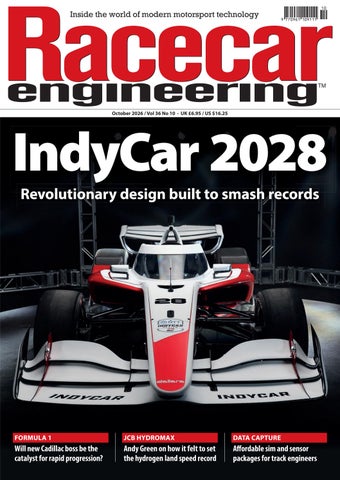
IndyCar 2028 Revolutionary design built to smash records
FORMULA 1
JCB HYDROMAX
DATA CAPTURE
Will new Cadillac boss be the catalyst for rapid progression?
Andy Green on how it felt to set the hydrogen land speed record
Affordable sim and sensor packages for track engineers
INDYCAR – IR-28 Álex Palou was one of the first drivers to test the new IR-28 package in August, and remarked that it felt noticeably different to the outgoing DW12 chassis
Bold new world
IndyCar has finally taken the wraps off the IR-28, its nextgeneration platform that will enter competition in 2028. Racecar investigates the design process By ANDREW COTTON
A
OCTOBER 2026 www.racecar-engineering.com 7
James Black
running joke in international motorsport is that the current spec IndyCar has, for some time now, been eligible for historic racing. Originally designed as the DW12 (so named following the untimely death of development driver and racer, Dan Wheldon) for the 2012 season, the car has undergone extensive iterations since, including safety revisions to the tub, the short-lived arrival of individual manufacturer body kits, the introduction of hybrid technology and the series-defining Aeroscreen to improve driver head protection. That development path is now due to end. After 15 years, the series has finally unveiled the DW12’s successor, the IR-28, which is a clean sheet of paper design that IndyCar says will be faster, safer and provide even better racing when it arrives in competition in 2028.
FORMULA 1 – CADILLAC MAC-26
Firstborn child Never before has GM launched a team to compete in a global series with a powerful single seater against teams comprising 1000 people. The launch car for the first new F1 team in a decade has certainly been an adventure By DANIEL LLOYD
I
Nick Chester, the former Renault and Lotus technical director, has been involved in the Cadillac F1 project since 2023, and has overseen its technical growth to be ready for racing 18 www.racecar-engineering.com OCTOBER 2026
t wasn’t a great surprise that Cadillac, Formula 1’s newest team, propped up the 2026 World Constructors’ Championship table at the halfway point of the season. Heading into the summer shutdown, it was the only outfit with zero points to its name. A blank scorecard was hardly unexpected, considering how tough it was for the US squad just to make the grid in the first place. Notwithstanding the arduous process of securing an entry, first driven by Andretti and then TWG Global (official confirmation only came in March 2025), a new grand prix team had to be built from the ground up. The last time that happened was a decade ago, when Haas entered the championship in 2016. Cadillac fully intends to eventually compete for titles, but this debut season has simply been about getting the ball rolling. Eventually, the team will field works cars carrying an American-made General Motors
The new Cadillac team’s MAC-26 is named after 1978 world champion, Mario Andretti, who was involved in the initial push to bring the American team to the grid
power unit, and have a greater operational presence in the US. But for now, it has been leaning on external suppliers to build key components, including the chassis, and running most of its activities from a site at Silverstone in the UK. For now, completing races with the Ferrari-powered MAC-26 has been the main priority. Although the car has faced its fair share of race-ending reliability dramas, it would be unfair to describe the scoreless first half of the season as a disaster. The team has brought both cars to the finish in a few races and, while its learning curve has been steep, it has encountered less severe issues than the more experienced Aston Martin squad. As Cadillac’s chief technology officer, Nick Chester, relates in an exclusive interview with Racecar Engineering, the team has shown signs of progress, even if points remain elusive.
‘We can race some cars at the back of the midfield, but we need to find a bit more pace to get properly into that fight’ Nick Chester, chief technology officer at Cadillac F1 Team
‘We had to push all the way up to the last minute of getting ready for four-wheel dynos and testing,’ he says. ‘It was a massive effort, particularly while the team was still growing, but I think we’re reasonably pleased with what we’ve delivered. We started out in Melbourne about four per cent off quickest, and now we’re about two per cent off quickest in qualifying. We’ve improved massively throughout the first half of the year,
though there is still, obviously, a lot more to do. We can race some cars at the back of the midfield, but we need to find a bit more pace to get properly into that fight.’
Design deadlines Cadillac couldn’t afford to take risks with the MAC-26’s initial design. Though no modern F1 car can reasonably be described as basic, the priority was to have something that could be built upon with updates, rather than a car that wowed straight out of the box. ‘We couldn’t be too ambitious,’ confirms Chester. ‘We couldn’t do a lot of iteration because we had to hit design deadlines to build the car. The real goal of last winter was to make sure we had a car and could get on track. After that, it’s how you develop it. ‘It was, in many ways, a really big push just to get the team built and the car on track to start with.’ OCTOBER 2026 www.racecar-engineering.com 19
TOURING CARS – ITC CLASS 1
‘There were so many tools, it was a race engineer’s playground’ Edward Turner, former race engineer at Team Joest
Brief encounter Despite lasting only two years, the Class 1 tin tops contesting the International Touring Car Championship in the mid-’90s made a profound impression By JAMES NEWBOLD
B
link and you missed it. The adage applies both to the speed of the highly advanced Class 1 machinery that formed the basis of the DTM’s shift into the International Touring Car Championship, but also their fleeting competition history. Thirty years ago, the inevitable decision was taken to call time on the ITC before it could establish itself as a truly global series. The decision followed the simultaneous withdrawal of Alfa Romeo and Opel in September 1996, which consigned to
36 www.racecar-engineering.com OCTOBER 2026
history a breed of touring car we are unlikely ever to see again, barely more than a year after the class was created in 1995. That these 2.5-litre, seemingly production-based machines, were enjoyed for so brief a period by audiences outside Germany is a travesty, given their state-ofthe-art composition. In some respects, they were more like prototypes than conventional tin-top racecars, packed from nose to tail with technology that would be envied by many championships today, let alone its contemporary peers.
‘It was a free, continuous development,’ remembers Stefano Fini, race engineer to ITC rookie, Jason Watt, at the new-for-1996 JAS Motorsport Alfa team. The team started with year-old machinery but gradually received in-season updates. ‘After every race we had two days of testing. The budget was huge in those days.’
Pay to play It can be argued that this was to the ITC’s detriment. The eye-watering financial commitment undermined efforts to attract
Opel / Stellantis
Mercedes-AMG
Significant development of its Calibra 4x4 turned Opel into a regular winner in 1996, securing the final ITC title with Joest driver Manuel Reuter ADAC
Mercedes and Alfa Romeo went wheel to wheel on Helsinki’s streets with advanced Class 1 racers, which were consigned to history at the end of 1996 Alfa Romeo won the DTM title on its first attempt in 1993, and continued to evolve its Class 1 155 V6 TI over the next four seasons
new manufacturers, and was ultimately deemed unsustainable by the suits at General Motors and Fiat. But while it lasted, the ITC made an indelible mark on those who worked in the series. ‘There were so many tools, it was a race engineer’s playground,’ reflects Edward Turner, who ran Manuel Reuter’s Team Joest Opel Calibra V6 4x4 to the 1996 title. His view is echoed by Owen Hayes, who engineered Jan Magnussen’s AMG Mercedes C-Class V6 in the same season. To Hayes, the opportunity to work on Class 1 machinery made him feel ‘like a child in a toy store,’ as he put it at the time. ‘The ITC was mind blowing as regards the amount of stuff on the cars,’ he says. ‘Everything was constantly moving or resetting. I can’t be any more grateful for having that opportunity when I did.’
Alfa Romeo introduced the original Class 1 car for its arrival to the DTM in 1993. The 155 V6 TI duly blitzed the opposition, before Mercedes responded with its new C-Class in 1994. Klaus Ludwig then claimed the title that year before defecting to Opel for 1995, allowing Bernd Schneider to become Mercedes’ leading light. He claimed both the DTM and ITC titles (the latter comprised only races held outside Germany in 1995). Until Hockenheim’s final round of 1995, Opel’s wins had been limited to a single victory at a non-championship DTM race held at Donington in 1994, but the team and the Calibra came good in 1996. Reuter beat Schneider to the drivers’ title, while Zakspeed’s defection from Mercedes bolstered Opel numbers and helped deny Alfa Romeo the final manufacturers’ crown.
Eliminating the transmission woes that blighted 1995 was a major focus for Opel and, by ’96, Turner says the car was ‘very reliable.’ Input from Williams in developing control systems for Opel’s sequential gearbox, which utilised Xtrac components, also bore fruit.
Reading the rulebook The transmission was initially operated as a semi-automatic, with driver-operated paddles for shifts (each taking 40ms), before going fully auto with ECU control, initiated by the driver pressing a button. Turner credits Alfa with being the first to spot the alternate interpretation afforded by the rulebook. Refreshed aerodynamics, aided by Joest leveraging its strong relationship with Porsche to access its boundary layer suction wind tunnel at Weissach, together with an OCTOBER 2026 www.racecar-engineering.com 37
TECHNOLOGY TRANSFER – FERRARI HYPERSAIL
Sea Horse Ferrari is taking to the water with its Hypersail project, bringing road car technology and a Hypercar approach to the open sea By ANDREW COTTON
T
he crossover between track and sea is nothing new. America’s Cup teams have been leaning on Formula 1 computing technology for quite a while now, while the list of teams and engineers dipping into each other’s field of competition is increasingly long. However, rather than step into the America’s Cup world with the Italian national team, Ferrari has instead targeted trans-oceanic speed records with its new Hypersail project, which is set to hit the water later early in 2027 for testing. While the Hypersail might look similar to the America’s Cup AC75, a standard racing boat design that ‘foils’ (rises up on wing-like fins at speed so the hull is out of the water to reduce drag), it has been built to a completely different rule set, and for a very different purpose. For where the AC75s compete on a set course in a (relatively) controlled environment, the Hypersail will take to the open seas, alone, for weeks at a time. The purpose is to chase long distance sailing records, pursuing prizes such as the Jules Verne Trophy, for the fastest non-stop, unassisted circumnavigation of the world by boat. The record, set this year by the Sodebo Ultim 3 trimaran skippered by Frenchman Thomas Coville, currently stands at 40 days, 10 hours, 45 minutes and 50 seconds. That’s quite a bit longer than the races Ferrari is used to.
Production relevance
Ferrari has designed and developed the foils, working with new and experimental materials that may become relevant to motor racing and production cars in the future. There is crossover between the new electric Ferrari Luce and the Hypersail in terms of energy management and vehicle control, while the active suspension from the company’s Purosangue SUV also makes an appearance on the yacht. As well as going fast, there is also a further environmental factor the technical team, which works in collaboration with French America’s Cup yacht designer, Guillaume Verdier, has to contend with. That is managing the energy generated by more than 100m2 of solar panels fitted to the upper portion of the hull. With so many appliances on board that draw 52 www.racecar-engineering.com OCTOBER 2026
energy, the Hypersail has to generate and store sizeable amounts of it, all while meeting the safety and regulatory requirements of the competition. Leading the project is Enrico Voltolini, with Matteo Lanzavecchia, who has led development of Ferrari supercars since 2004, including that of the new, and controversial, all-electric Luce, heading up the technical team. Lanzavecchia was appointed chief technology officer of Ferrari Hypersail and vehicle engineering of sportscars in 2022, and is tasked with finding the technology crossovers that can help advance both programmes.
Fossil fuel zero
The rules of trans-oceanic racing state that the vessel cannot have any combustion engine power, other than a generator to power hydraulic controls, electronics and canting keels. Adding to the challenge, Ferrari imposed upon itself a strict zero fossil fuel rule.
While there are similarities to the advanced yachts used in the America’s Cup, the Hypersail is a one-off, built to contest trans-oceanic speed records
There is crossover between the new electric Ferrari Luce and the Hypersail in terms of energy management and vehicle control, while the active suspension from the company’s Purosangue SUV also makes an appearance
OCTOBER 2026 www.racecar-engineering.com 53
TECH UPDATE – HYPERCAR
Contenders, ready New and updated Hypercar machinery took to the track in August in preparation for next year’s WEC campaign By ANDREW COTTON
T
he starting pistol has been fired for the 2027 FIA World Endurance Championship, as new and updated cars hit the track in August. Ford finally got its real-world validation under way, while fellow newcomer, McLaren, continued its preparations with a 30-hour session and further running with a three-day test at Silverstone. Among the continuing brands, Ferrari tried out an update kit for the 499P, with a view to introducing it next season. Also at Silverstone was Aston Martin, with the updated version of its non-hybrid Valkyrie. Each new or updated Hypercar will go through the FIA and ACO’s procedure at the end of this year before being locked in ready for competition. The process includes wind tunnel testing at Windshear in the US. Therefore, at time of writing, the cars are going through validation tests with a view to finalising any changes ahead of that homologation. Once homologated, the cars’ specifications will be fixed, save for updates that have to be requested through the FIA and ACO. For McLaren and Ford, who are developing LMDh cars, this is initial testing ahead of their first homologation. That
Ford is the fourth brand to call upon ORECA to be its LMDh chassis constructor. Initial testing took place at Paul Ricard, close to ORECA’s factory in southern France
76 www.racecar-engineering.com OCTOBER 2026
involves troubleshooting the inevitable mechanical and electrical teething issues one might expect, as well as rehearsing the operations of a new race team.
Finally Ford Ford’s Hypercar programme is considerably behind that of McLaren, having only completed its first test at Paul Ricard in August. McLaren, meanwhile, had been on track since late May. Ford drivers Matt Campbell, Mike Rockenfeller and Tom Blomqvist were all on hand to start getting to grips with their new car, which features a 5.4-litre, Coyote-based V8 engine, linked to
Once homologated, the cars’ specifications will be fixed, save for updates that have to be requested through the FIA and ACO
the spec LMDh hybrid and gearbox systems, and set in an ORECA-built chassis. The same spine was used by the Acura, Alpine and Genesis LMDh cars. Initial testing focused on control and systems settings to ensure the Ford would run cleanly before ramping up the programme ahead of homologation. ‘The team methodically followed a comprehensive programme to activate and verify every control system; these are now all fully operational and ready for the first track tests,’ said the team in a statement. Meanwhile, the engine has been undergoing extensive dyno testing at Ford’s Dearborn plant in Michigan. The car development team still needs to complete performance and endurance testing, and will use data gathered from that, and the tyres, to make final tweaks ahead of its homologation.
McLaren ahead McLaren has also picked the LMDh platform, but chose to go with the Dallara chassis. Development of the MCL-HY is ahead of Ford in its programme as it has already completed its first endurance test, so the team is focusing more on performance. The car has now