Inside the world of modern motorsport technology
November 2026 / Vol 36 No 11 · UK £6.95 / US $16.25
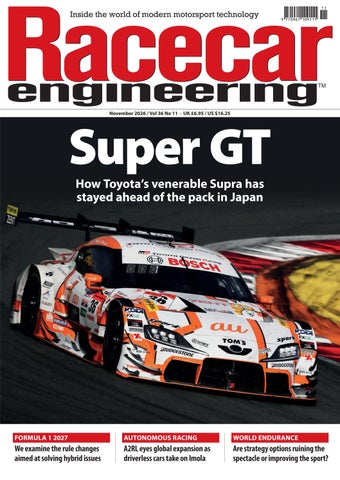
Super GT How Toyota’s venerable Supra has stayed ahead of the pack in Japan
FORMULA 1 2027
AUTONOMOUS RACING
WORLD ENDURANCE
We examine the rule changes aimed at solving hybrid issues
A2RL eyes global expansion as driverless cars take on Imola
Are strategy options ruining the spectacle or improving the sport?
FORMULA 1 – 2027 REGULATIONS
Step changes T
he now infamous conversation with Star Wars creator George Lucas was an eye opener for Formula 1 boss Stefano Domenicali. ‘He gave me an incredible insight into how new fans are watching F1,’ revealed the Italian, ‘and it gave us a brilliant perspective on how we can simplify things, because new fans don’t understand the reality; what goes on behind the scenes. They’re just fascinated by the fact that there’s so much action.’ Yet the fans who are interested in what happens between the two axles of the car, or in what goes on at the software level between the combustion engine and the electric motor, haven’t disappeared. These are often
6 www.racecar-engineering.com NOVEMBER 2026
fans who have been following Formula 1 for decades. Many readers of Racecar Engineering will undoubtedly fall into this category. Even if the current iteration of F1 has lost some of its appeal for petrolheads, from a technical perspective it still offers plenty of material for analysis. That is why this publication has already run a number of articles on the 2026 regulation changes. This piece will certainly not be the last, either, for the current energy-starved racing means the technical rules are more dynamic than ever. To be clear, we’re not only referring to the reactive rule change made for Miami, after just three races of the 2026 season. From next year, as announced in June, there will be
further adjustments aimed at mitigating the undesirable effects of extreme hybridisation.
Quick fix With the Miami quick fix, the options were limited because hardware changes were out of the question. Things look somewhat different for 2027, though, even if a major paradigm shift is not on the cards. That would require a completely new engine regulation, which would require broad consensus and much longer lead times for the power unit manufacturers. It is not until 2031 that the FIA can decide unilaterally and fulfil its president’s wish for the return of V8 engines. Until then, the aim is to secure majorities.
In June, F1 announced a phased rebalancing of the current power units, from a near equal split between electrical and combustion power to 60 / 40 in favour of the latter in 2028
As Formula 1 continues to grapple with its energy dilemma, we look into the rule changes coming for 2027 and beyond By CHRISTIAN MENATH
This is precisely why efforts to open the fuel tap further in 2027 failed. The root of all F1’s problems is the limited fuel flow. This keeps the internal combustion engine’s output low, which is why the electric motor now accounts for almost 50 per cent of total power output. In fact, the ICE’s share of the overall system’s power output varies from manufacturer to manufacturer. But unlike the electric motor, the ICE has no power limit; it is constrained by the limited fuel energy flow. So, whoever builds a more efficient engine has more power. It is therefore not possible to speak of a blanket 50 / 50 split, however tempting that might be. A realistic figure at present is an ICE share of
53 per cent. Such precision regarding percentage figures is important, as the scale of the increase for 2027 is only feasible up to a certain point. Next season, the maximum fuel energy flow rate will increase by a meagre five per cent, from 3000MJ/h to 3150MJ/h.
Because the power from the MGU-K is simultaneously reduced from 350 to 300kW (by about 14.3 per cent), overall system power will decrease, but the internal combustion engine’s share will rise to around 58 per cent.
Power ratios
Next season, the maximum fuel energy flow rate will increase by a meagre five per cent, from 3000MJ/h to 3150MJ/h
We will have to wait until 2028 for the bigger change, which many had been hoping for as early as next season, to come into effect. The fuel energy flow will then increase by a total of 13 per cent compared with today. The MGU-K will continue to have a maximum output of 300kW, resulting in the much-cited 60 / 40 internal combustion engine to electric power ratio. NOVEMBER 2026 www.racecar-engineering.com 7
SUPER GT – GT500
Stick, or twist?
Honda and Nissan both introduced new Super GT cars during the series’ current Class One era, but Toyota stuck with its original model. Who made the right decision? By JAMIE KLEIN
S
Opportunity knocks Since the introduction of the Class One rules, there have been only two opportunities for a major reset. The first was in 2024, after an initial homologation cycle elongated by a year due to the Covid pandemic. That was when Honda switched from the NSX-GT to the Civic Type R-GT, and Nissan from its classic Z to the slightly sportier-looking Z Nismo. The second was at the start of this year, when the radical but unsuccessful Civic made way for the more conventional Prelude-GT, while Nissan continued with its Z Nismo. 24 www.racecar-engineering.com NOVEMBER 2026
Toyota could have replaced the GR Supra as its base model at either juncture – and there was some speculation of a new car coming for 2026 as the roadgoing version went out of production in March – but the car’s lifespan was stretched into a seventh year, with an eighth now looking a possibility. It was in 2024 that the GR Supra went from being on par with its rivals, albeit with different strengths and weaknesses, to all conquering. In 2023, TOM’S Toyota drivers Sho Tsuboi and Ritomo Miyata won a close-fought title battle against Nissan in a year where none of the brand’s other Bridgestone-shod cars won a race. Since then, Tsuboi and Miyata’s successor, Kenta Yamashita, have taken two titles at a canter, and held a strong lead at the halfway point of the 2026 season.
High-rake theory So, what explains this leap forward? Yu Iketani, general manager of the Motorsport Development Division at Toyota Gazoo Racing Development (TGR-D), explains that changes made to the GR Supra’s original set-up philosophy led the team down pathways that couldn’t be fully fixed until the regulations allowed for a bigger revamp. ‘When Super GT adopted Class One regulations, with more standard suspension parts and fewer areas open for aero development, our assessment was that the 2020 cars would produce less downforce than the 2019 cars,’ explains Iketani. ‘In anticipation of the loss of downforce, we adopted a high-rake configuration, aiming to maximise front-end downforce. However, one challenge we then faced was rear-end instability, particularly compared to the NSX; we struggled at circuits like Motegi. ‘So, for 2021 and ’22, we aimed to improve overall aero efficiency so we didn’t have to rely on a high-rake philosophy. But this only
Super GT
uper GT’s current GT500 regulations, based on the ‘Class One’ framework that the Japanese series devised together with the DTM, are now in their seventh season, having been introduced in 2020. Since then, Honda and Nissan have both replaced the base models upon which their challengers are based. Toyota, on the other hand, has stuck with the trusty GR Supra since the inception of the rules. The GR Supra was brought in to replace the Lexus LC500 as Toyota’s GT500 weapon of choice for the start of the Class One era, and its winning record already makes it one of the all-time great Super GT machines. It has won four of a possible six titles, and looks to be well on its way to a seventh this year. Since it was given a significant refresh in 2024, it has been dominant, claiming exactly two thirds of all wins (14 out of 21) since then, leaving rivals Honda and Nissan to feed on scraps. What makes Toyota’s success with the GR Supra all the more impressive is the fact that the GT500 rules have become increasingly restrictive in terms of what can be changed year on year. As is now the way across much of motorsport, longer homologation cycles and development freezes have become the order of the day in Super GT to reduce costs.
Toyota has stayed true to the GR Supra since the current GT500 regulations were introduced in 2020, while its two rival manufacturers have made significant changes to their car models
Toyota took the opportunity in 2024 to redesign its engine, increasing mid-range torque and reducing weight, in conjunction with chassis changes
‘As we had this golden chance with the homologation coming to an end [in 2023], we decided to develop the engine and chassis in tandem and do things that we couldn’t have done if we developed them in isolation’ Yu Iketani, general manager of the motorsport development division at Toyota Gazoo Racing Development
introduced new problems like porpoising, and an inability to use the aero consistently. ‘In 2022, Nissan introduced the Z [to replace the GT-R] and it felt like our rivals were levelling up. We couldn’t undertake major development in 2023 and, even though we won the championship with the no.36 [TOM’S] car, you can see in the footage that it bounces under braking. We won that year’s title thanks to the drivers’ skill in managing that, and extracting speed even with those challenges.
‘That was the Supra’s fourth year and it felt like the car was approaching its limits, but the car’s homologation was reset in 2024, which gave us the chance to fundamentally rethink the entire philosophy.’
Golden chance While the aero package was the most obvious change made to the GR Supra, particularly a more complex treatment of the side skirts below the so-called ‘design line’, which dictates the areas open for development, Iketani says the changes were wider ranging. In particular, the chance to give the engine a more thorough redesign than would normally be possible was vital in the 2024 leap forward. ‘As we had this golden chance with the homologation coming to an end, we decided to develop the engine and chassis in tandem and do things that we couldn’t have done if we developed them in isolation. Things like the structural configuration and airflow management, and the centre of gravity,’ highlights Iketani. ‘We focused on centralising mass, moving heavier components away from the extremities towards the centre. ‘This wasn’t limited only to the chassis, as new engine hardware was also developed at the same time. We collaborated closely with NOVEMBER 2026 www.racecar-engineering.com 25
WEC – STRATEGY With the WEC a BoP formula, strategy has taken on an increasing level of importance, made all the more so by the cars’ inability to perform at their best in a pack
T Clearing
the air
Strategy in endurance racing has become increasingly complicated as teams seek to run their cars in clear air. We spoke to a top race engineer to understand what’s going on By ANDREW COTTON 30 www.racecar-engineering.com NOVEMBER 2026
he basic rules of a normal motor race are that you have either a time or a distance limit. Your job as a team is therefore to complete the race as fast as possible, or cover the greatest distance in the allocated time. How you do that is based on speed, but in the FIA World Endurance Championship (WEC), there are now so many strategy options available that races have become almost impossible to read. Only the cars at the front of the field can make a traditional race strategy work. Those chasing, for various reasons, need to use their strategic choices to make up ground and the WEC has plenty of scope to play. Some work, others don’t, and some that should work don’t work due to circumstances beyond a team’s control, such as a race neutralisation. Consequently, establishing a race narrative has become tricky as teams create ever more inventive ways of trying to make up ground.
BMW Press Club
Tyre strategy is one of the main tools that teams can use to make up ground. Teams may not refuel and change tyres at the same time, and only two tyre guns may be used per car. Time lost changing tyres can be made up if the car is fast
Cars weigh around 1060kg dependant upon Balance of Performance, and are equalised on power, weight and energy per stint. That leaves very little room for manoeuvre in terms of development, and ability to race in a pack
Currently, the WEC has eight manufacturer teams, each fielding two cars in the top Hypercar class. More are coming in 2027, in the shape of Ford and McLaren. While the newcomers are currently working on hardware reliability, those already racing homologated cars are focusing on software, and establishing yet more race strategies. The championship runs to a Balance of Performance (BoP) formula that is now closed to public scrutiny. The teams themselves are banned from speaking of it, and the tabulated numbers behind it are not published. Under the BoP criteria, energy per lap and per stint is limited. Car weight, power and energy are then adjusted on a race-by-race basis to give all cars the chance to win. But only if the team, car and driver perform at their optimum level. Homologation parameters give the WEC’s governing bodies, the FIA and ACO, clear view of how each car behaves in test conditions.
race lengths have been used, but the Car weight, power and energy Other Qatar 1812km (roughly 10 hours) and the are all then adjusted on a 8 Hours of Bahrain were both removed from the 2026 schedule due to the ongoing race-by-race basis to give all conflict in the Middle East. cars the chance to win. But Rubber trouble only if the team, car and driver Three compounds of Michelin tyre are perform at their optimum level available at Le Mans, and two of those are
Cars are measured aerodynamically in the Windshear wind tunnel in North Carolina, and are aerodynamically adjusted to fit into a prescribed area on the lift / drag graph. This means all competing cars should be of equal aero efficiency, and through power, weight and energy have an equal chance to win. WEC races are timed to six hours, except for the 24 Hours of Le Mans centrepiece.
available at every race. The French tyre supplier decides which compounds are taken to each race, though the medium is the most popular,. Each car is allowed 18 tyres to complete a six-hour race. When it comes to pit stops, tyre changes and refuelling may not occur simultaneously, but any number of tyres can be changed at a stop, and any of the available compounds used. They can also be mixed, so one corner could run a hard compound and three corners the medium, for example.
NOVEMBER 2026 www.racecar-engineering.com 31
PIKES PEAK – FORD SUPER MUSTANG MACH-E Ford Racing
Return of the Mach Ford’s third electric racecar at Pikes Peak proved to be its fastest yet By DANIEL LLOYD
Ford first set its Super Mustang Mach-E on the mountain at Pikes Peak in 2025, but poor weather truncated the track and prevented it from realising its potential. So the team went back to base and further refined the car for another try in 2026
36 www.racecar-engineering.com NOVEMBER 2026
Although Ford’s two previous Pikes Peak contenders had competed on a ‘one and done’ basis, the 2025 outcome left the team with a sense of unfinished business for the third
W
e’d love to have some of what Ford is smoking. In recent years, the American manufacturer has been putting out extreme one-off racecars left, right and centre, providing a fresh alternative to the highly regulated world of manufacturer racing. Most of Ford’s latest efforts have concentrated on the Pikes Peak International Hill Climb, where it has made use of the event’s relatively open rulebook to deploy three different electric cars on the twisty Colorado mountain course since 2023. Table 1 shows the first was the Transitbased SuperVan 4.2, which finished runner-up that year. In 2024, it was replaced by the F-150 Lightning SuperTruck, which invoked Ford’s popular production pick-up and delivered overall victory in the hands of two-time 24 Hours of Le Mans winner, Romain Dumas. Ford’s latest effort is the sportier Super Mustang Mach-E, made to showcase electric powertrain technology off the back of the production Mach-E’s release in 2021. The car made its Pikes Peak debut last year, but its potential went unrealised as the full 19.99km, 156-turn course couldn’t be used due to high winds on the mountain’s upper reaches. On the shortest course in the event’s 104-year history, the Mach-E was defeated by Simone Faggioli’s Nova Proto NP01 Bardahl. Although Ford’s two previous Pikes Peak contenders had competed on a ‘one and done’ basis, the 2025 outcome left the team with a sense of unfinished business for the third. Especially considering the course truncation meant it missed out on the tight switchbacks towards the top of the climb, where a four-wheel drive electric racecar is most likely to excel.
‘Not letting this car get its chance at the mountain really did drive us to go back and spend that extra time,’ says Nick Kuhajda, demonstrators programme supervisor at Ford Racing. ‘With these programmes, year over year bringing new vehicles, this was a good opportunity for us to really spend time with the car, taking it through a lot of the processes we have at Ford.’
Back to base Armed with real-world data from the previous year, Ford undertook extensive homework for its 2026 return to Pikes Peak. ‘Even with the shortened course in ’25, we had a lot of good takeaways,’ says Kuhajda, ‘specifically around suspension, which is one of the biggest challenges when getting a vehicle up that mountain. Because it’s a public road, it degrades. You have transitions between old pavement and new pavement, and frost heaves. So one of the big focuses for us was refining our suspension tuning. That allowed us to bring a package that was much more tuneable for the conditions of the mountain, which this year had degraded more than we had expected, especially in the top section.’ Ford’s engineers started by re-scanning the Super Mustang Mach-E and making comparisons with the original CAD files. The car was put on seven and eight-post rigs to understand more about how to set up its five-way adjustable KW dampers. It also went into the company’s 200mph (322km/h) rolling road wind tunnel, which opened in 2022. According to Ford, these processes helped inform ways of improving the car’s steering precision, roll stiffness, suspension geometry and system friction.
Table 1: Ford’s recent Pikes Peak missions Year 2023 2024 2025 2026
Car SuperVan 4.2 F-150 Lightning Super Truck Super Mustang Mach-E Super Mustang Mach-E
Time 8m 47.682s 8m 53.553s 3m 42.252s 8m 18.202s
Position 2nd 1st 2nd 1st
NOVEMBER 2026 www.racecar-engineering.com 37
RACECAR INSIGHT – CUNNINGHAM BU-MERC
Mix and match Watching his friends race on America’s best European-type roads, Briggs Cunningham II thought they deserved an American-built racer. Meet the immortal Bu-Merc By KARL LUDVIGSEN
Under the eyes of visitors to the 1939 / ’40 World’s Fair, Miles Collier made a good fist of chasing the leader in a hastily organised endurance race. Here he is visibly in the Bu-Merc’s second gear
B
By the time he reached Yale, as pictured, Briggs Swift Cunningham II was already car crazy. He followed his passion and became an icon of American motorsport 50 www.racecar-engineering.com NOVEMBER 2026
riggs Swift Cunningham II was a man of enthusiasms, exercised by virtue of his immense wealth. Born in 1907, he was only five when his father died, leaving Briggs junior with an inheritance said to be ‘secure enough to live a privileged lifestyle.’ And some. Briggs II shared his good fortune with his wife, Lucie, an oil heiress whose own financial endowment led the press to call them ‘the richest couple in history.’ Their dwelling was Connecticut’s Greens Farms manor house, facing Long Island Sound. Soon enough, Cunningham’s passion for cars began filling their capacious garage on the other side of the access road. Cars had always appealed to the young Cunningham, whose parents bought a new automobile every year. Dr Ashton Heyl, an uncle, beguiled him with a Dodge sedan powered by a war surplus HispanoSuiza V8. Its output of some 160bhp made for exciting motoring in the 1920s. From its launch in 1929, the couple’s extended honeymoon in Europe included attendance at the 1930 Monaco Grand Prix, where Type 35 Bugattis swept the top three.
While in London in October 1929, Cunningham called on the Mercedes-Benz Ltd stand at the Olympia motor show to order a suitable car to continue their European tour. The model, a yellow 710 SS touring by Sindelfingen was driven to Paris for delivery there on 3 December. Its designated driver was race-winning Rudolf Caracciola. Also supplied by the works was a riding mechanic who accompanied the Cunninghams on their extensive tour. This included a stop off at a concours d’elégance at Cannes, where the car, and Lucie, won an award. The ultimate fate of their handsome SS is unknown, although it was shipped back to Greens Farms after its European service. His experience of Mercedes-Benz ownership surely left a mark with Briggs Cunningham, for he could not otherwise have specified the shape of a Mercedes when it came time to create a suitable racecar for his own purposes.
Racing for America In the early 1930s, Cunningham competed in some of the road racing events organised by the newly established Automobile Racing Club of America. A friend remembered how