Inside the world of modern motorsport technology
January 2027 / Vol 37 No 1 · UK £6.95 / US $16.25
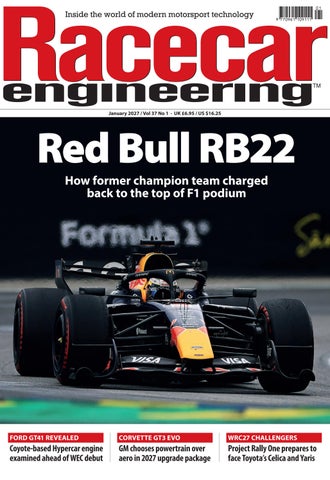
Red Bull RB22 How former champion team charged back to the top of F1 podium
FORD GT41 REVEALED
CORVETTE GT3 EVO
WRC27 CHALLENGERS
Coyote-based Hypercar engine examined ahead of WEC debut
GM chooses powertrain over aero in 2027 upgrade package
Project Rally One prepares to face Toyota’s Celica and Yaris
FORMULA 1 – RED BULL RB22
Upward trajectory Red Bull found itself trailing at the start of the new era, but the RB22 became perhaps the best car on the grid. Here’s how it happened By CHRISTIAN MENATH
The RB22 is the first to use a works Red Bull Ford Powertrains unit, but that doesn’t appear to have been the cause of the team’s early-season running issues
6 www.racecar-engineering.com JANUARY 2027
F
or Red Bull, 2026 marked the beginning of a new era in two ways. On the one hand, there was the technical overhaul of the regulations, perhaps the biggest in F1 history, which involved major changes to the chassis and power unit. On the other, for the first time since it arrived on the grid in 2005, Red Bull raced as a true works team, manufacturing both engine and chassis. Despite a close working relationship with Honda from 2019 to 2025, those engines were developed 10,000km away in Japan. Starting in 2026, Red Bull developed its chassis and engine under one roof, although to be entirely accurate, there are now many individual buildings on the factory grounds in Milton Keynes. The important bit is that Red Bull Racing and its power unit company, Red Bull Ford Powertrains (RBFP), are located on a shared campus.
‘That’s quite a big difference,’ admits Red Bull Racing technical director, Pierre Waché, in an interview with Racecar Engineering. ‘We used to be dealing with a different company. It’s not a question of good or bad work, it was simply a different company, although with the same goal. [We] all have the desire to win. ‘[Honda] did a fantastic job, and we achieved massive success with them, but when you are under the same roof it’s quite a different dynamic. ‘First of all, we see each other more often compared to meetings we had with Japan. Plus, I think we are more aware of the engine side, and they are more aware of what we are trying to do, and try to find the best compromise.’ Nevertheless, building the first in-house engine in Red Bull’s history from scratch also had its drawbacks, at least initially. ‘In the
first year, the difficulty was to make sure the engine went of the manufacturing [facility] and performed well,’ said Waché. ‘The challenge was a little bit different. The constraints between both parties were as minimal as possible.’
Extraordinary job
Red Bull isn’t known to shy away from risk, but in 2026 the team had to allow a bit of margin for error. Yet Ben Hodgkinson’s team at RBFP did an extraordinary job. Its first power unit, the DM01, even attracted praise from the FIA. Measurements showed that the V6 from Milton Keynes was the most powerful internal combustion engine on the grid, by some margin. This praise came with the caveat that RBFP was the only manufacturer not to be granted any additional development and upgrade opportunities (ADUO).
For the first time since it arrived on the grid in 2005, Red Bull raced as a true works team
WEC – FORD GT41 COYOTE ENGINE
Wiley Coyote Ford has lifted the lid on the 5.4-litre, normally aspirated engine that will power the new GT41 Hypercar in the WEC and at Le Mans. Racecar investigates By ANDREW COTTON
F
ord has officially unveiled its GT41, the car that it hopes will carry the Blue Oval to victory in the FIA World Endurance Championship and the 24 Hours of Le Mans in 2027. The car is built on an ORECA chassis, similar to that used by Genesis and formerly by Acura. The hybrid system, as with all LMDh cars, is standard, along with the Xtrac gearbox, MGU from Bosch and battery from Fortescue Zero. The aero was styled at Ford’s headquarters in the United States, but the performance function of the bodywork came from ORECA in Signes, France. At the heart of the GT41 is a 5.4-litre, normally aspirated V8, based on that used in the Mustang production car. The engine has already been developed into a GT3 version, but has undergone a major transformation to hit the expected load requirement of a Hypercar power unit, which must also have the durability to last for more than 30 hours.
In-house engine Compared to the GT3 engine, the Hypercar version is lighter, more powerful, and upgraded to better cope with the characteristics of the TotalEnergies fuel that must be used in the WEC. It was designed, developed and built at Ford’s main engineering facilities in Dearborn, Michigan as part of a wider programme to bring race engine building back in-house. The dyno centre itself is not new. The race-winning engine from the GT40 of the 1960s was built and developed in a room within the current building, although it has now changed purpose. However, for many years, the facility has focused exclusively on production engines, while development for racing applications was outsourced to extremely capable external companies, such as Roush Yates. Recently, though, Ford decided to bring race engine development back under its control, and brought dyno cell 17G into play, its most capable speed and load dyno for engine development. 26 www.racecar-engineering.com JANUARY 2027
Ford Racing unveiled its new LMDh car at its Michigan base in late November. It will make its race debut in Qatar in March 2027
Adam Schultz
‘You put port flow coefficients in there, friction models, all aspects of performance into a one-dimensional model and from that you can predict performance… without actually producing any hardware’ Christian Hertrich, powertrain chief engineer at Ford Racing Christian Hertrich heads up the new race engine facility at Dearborn, Michigan, a decade into his tenure at Ford
The first engines brought back in-house under this new mission were the current S650-based (Ford nomenclature for the seventh-generation Mustang road car) power units, and the company now has around 50 of those in circulation. The GT3 engine was next up on the dyno. These were designed, tested and developed at Dearborn, but are built and serviced at M-Sport in England. The Hypercar engine is therefore only the third major racing engine programme of this era. The complexities of developing an entire power unit, including a hybrid system, required a different approach, and the plan from the start was to test the full powertrain in the spin torsional cell. This is what was used in November as part of the GT41’s 30-hour endurance test. Head of the facility is Christian Hertrich, powertrain chief engineer at Ford Racing. Hertrich joined Ford in 2016 and initially worked on the GTE programme, but now spreads his time around the GT engines, and working with Red Bull Ford Powertrains on its Formula 1 programme. In 2025, he was also tasked with leading the production powertrain programme or Ford Racing.
Hypercar concept The concept for the Hypercar engine was already in mind when Ford was developing the GT3 unit. The manufacturer announced in January 2025 that it would be returning to the top flight of endurance racing for the first time since the original GT40 programme of the ’60s, and was eyeing its Coyote engine as the potential power source. ‘We had built the GT3 engine, and it was capable of producing horsepower in the mid-600s,’ says Hertrich. ‘We asked ourselves what we needed to do to get power to the mid-700s to do the Hypercar engine. So, we figured out what we would need from a performance aspect: speed; valvetrain in terms of valve lift; cam drive; things like that. We always had that in our back pocket and, as the programme was coming together, we already knew what we wanted to do.’ The process started with a onedimensional schematic of the engine, which allowed the design team to work out the fundamentals. Notably, Ford does not do single-cylinder testing at Dearborn, confident in its 1D process. ‘We have our own code called MANDY, and you basically analytically build the engine,’ explained Hertrich at the launch of the car in Michigan. ‘You put port flow coefficients in there, friction models, all aspects of performance into a onedimensional model and from that you can predict performance. Then you can do cam sweeps, fuel injection sweeps, and analyse it all without actually producing any hardware.’ JANUARY 2027 www.racecar-engineering.com 27
WEC – FORD GT41 TEAM BUILDING
Background noise Ford Racing’s entry into the WEC Hypercar class in 2027 offers Racecar a rare opportunity to watch an endurance operation being built from scratch By JAHEE CAMPBELL-BRENNAN
S
ixteen hours into an endurance race, a car leaves the circuit and slows to the pit lane speed limit. The crew step out of the garage and take their positions. As the car comes to a stop, there’s a flurry of activity: fuel goes in, followed by new tyres and a fresh driver, before the car drops back onto its wheels, the lollipop lifts and it accelerates toward pit exit. On the broadcast, the whole episode lasts just a few seconds. A stationary time flashes up on screen, and the commentary moves on to the next battle. For the viewer, a pit stop is one of the few moments when the people behind a racecar become visible. Spectators see overtakes, lap times tumbling through practice and the occasional glimpse of an engineer’s screen on the pit wall, while the dedicated fans can follow timing, tyre compounds and stint
32 www.racecar-engineering.com JANUARY 2027
lengths on the WEC+ app. Almost everything that made those few seconds possible, however, happened out of shot, much of it weeks before the car even reached the circuit. Consider for a moment what sits behind that one stop. The tyre compound going onto the car may have been chosen three months earlier, when the team had to give Michelin its compound allocation before the consignment was loaded onto a cargo ship. Pit strategy, and the decision to use a sided tyre on this occasion, was discussed back at base, using data and simulation to weigh up stop time against race time. The fuel rig was set up by the same person who prepares it at every event. The crew rehearsed their stops until the routine was second nature, so that hours into a race there are no silly mistakes made, like crossing the white line too early. And somebody made
sure they had all eaten a proper healthy meal, at the appropriate time of day. A successful race weekend, especially in endurance racing, is the product of hundreds of activities like these, and of how well they all interconnect: the people, the preparation, and the processes that protect and make use of every lap.
Hidden edge That hidden work matters more than ever these days. With BoP regulating weight, power, aerodynamic performance and hybrid deployment, there is far less room to find an advantage through the car alone. Much of the competitive edge now lies in the quality of the operation around it. Ford Racing’s inaugural entry into the FIA World Endurance Championship (WEC) Hypercar class in 2027 with its new LMDh car,
A successful race weekend… is the product of hundreds of activities… and how well they all interconnect: the people, the preparation, and the processes that protect and make use of every lap
the GT41, gives us a rare chance to watch that operation being built from scratch. In this article, the programme’s management, chief engineer and chief mechanic explain how they are turning a group of experienced specialists into a high-functioning race team, and where they believe performance today is really to be found. The team’s chief mechanic, Jon Caller, sets the pace: ‘What people see from the outside is that the car goes out on time, goes around the circuit, and comes back into the garage. It’s the work in between sessions, going on constantly, that feeds that calm exterior you see on circuit.’ Factory programmes competing at the top level of world championship racing, such as Ford Racing, carry substantial head counts. The cars are highly complex, with hybrid systems to configure, monitor and extract performance from. The engineering crew consists of a chief engineer, and one each of a race, performance and systems engineer, while on the technician side, there’s a chief mechanic, number one, front-ender, rear-ender, a floater who also covers the
Ford unleashed a new, lightweight spec of engine in time for a 30-hour test at MotorLand Aragon, Spain. Preparations are ongoing and fast-paced as the team ramps up both mileage and experience
cockpit (a very busy place to be), bodywork technicians, and sub-assembly technicians covering dampers, pedal boxes, gearbox and differential, plus one or two tyre technicians. Compare this with smaller, privateer operations such as those found in GT World Challenge, or even European Le Mans Series
teams. There, each car may be run by a race engineer, a data or performance engineer, one number one and two number two mechanics, and a ‘truckie’ or tyre technician, with a team manager and coordinator overseeing the whole operation. It is a skeleton crew by comparison. JANUARY 2027 www.racecar-engineering.com 33
FORMULA E – SPARK RACING TECHNOLOGY Simon Galloway / LAT
Spark and ride A constant in Formula E since its inception, we look at what Spark does to keep the electric world championship ticking By DANIEL LLOYD
Spark has been the Formula E chassis supplier through all four car generations so far, but its remit has evolved consderably during that time
60 www.racecar-engineering.com JANUARY 2027
Spark
Spark has various design and engineering departments, although manufacturing is outsourced. One of its most notable partners is Dallara, which provides the carbon monocoque for the Formula E racer
A
lot has changed in Formula E since the first season in 2014 / ’15. The cars have become more powerful and can recover more energy. Only two drivers from the inaugural campaign, António Félix da Costa and Jean-Éric Vergne, are still on the grid. Many of the original teams have either disappeared or been subsumed with the coming and going of different manufacturers. One constant through all that evolution, however, is Spark Racing Technology. The French engineering firm has been the designated supplier of the spec Formula E chassis through each of the car generations so far, including the new Gen4 that will debut at the Mexico City E-Prix in January 2027. Spark has played an important role in the championship for more than a decade now, yet those who don’t follow Formula E closely are likely unfamiliar with what the company does. That is the desired effect, to a degree. Spark needs to be very well known by the championship’s stakeholders, especially the FIA, the powertrain manufacturers and the teams running the cars. Addressing the public is not part of its job description.
Spark has been there at every step of Formula E’s growth to date That said, Spark has been there at every step of Formula E’s growth to date. As the championship enters a new technical era, one that could change general perceptions towards electric racing, there is reason to consider Spark’s past and present contributions. After all, every Formula E car to date has been assembled at its headquarters south east of Paris.
Forward vision Fred Vasseur founded Spark Racing Technology in 2012, to coincide with then-FIA president, Jean Todt, and Formula E architect, Alejandro Agag’s, plans for an all-electric race series. Vasseur, best known today as Ferrari’s Formula 1 team principal, had previously co-founded ART Grand Prix, a prominent single-seater outfit. ART once operated an electric prototype called the Formulec EF01, developed by Segula Technologies, with help from the Mercedes F1 team. So Vasseur had already seen the direction motorsport powertrain technology was heading in, and decided to do something about it. JANUARY 2027 www.racecar-engineering.com 61