Inside the world of modern motorsport technology
February 2026 / Vol 36 No 2 · UK £6.95 / US $16.25
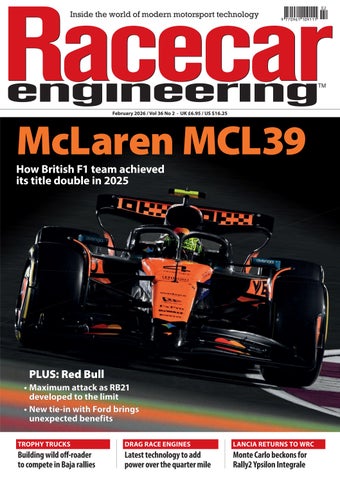
McLaren MCL39
How British F1 team achieved its title double in 2025
PLUS: Red Bull • Maximum attack as RB21 developed to the limit • New tie-in with Ford brings unexpected benefits TROPHY TRUCKS
DRAG RACE ENGINES
LANCIA RETURNS TO WRC
Building wild off-roader to compete in Baja rallies
Latest technology to add power over the quarter mile
Monte Carlo beckons for Rally2 Ypsilon Integrale
FORMULA 1 – MCLAREN MCL39
Crowning achievement How McLaren achieved a title double in the final year of Formula 1’s ground effect regulations By DANIEL LLOYD
Rob Marshall started with McLaren after the MCL38 design had been signed off, so the MCL39 was the first car to be developed under his watch
‘I think there were a few elements that needed improving, but clearly not many because the MCL38 was a pretty damn good car’ Rob Marshall, chief designer at McLaren Formula 1 Team
M
cLaren’s surpassing of Red Bull to win the 2024 Formula 1 World Constructors’ Championship, its first in 26 years, was a huge achievement. Especially considering how far behind the Woking-based team was at the start of the same rules cycle. But no sooner had the papaya confetti settled on the Yas Marina pit lane floor than the question became, could McLaren defend its title in the year ahead? The answer soon became apparent, as the team maintained its momentum into 2025, winning 14 grands prix and wrapping up the World Constructors’ Championship with six rounds to spare. The MCL39 proved to be a great racecar, especially on Sundays, when at times it displayed crushing dominance with a clear tyre management advantage. Even at tracks where it wasn’t top dog, it could
still reach the podium. That consistency and ability to ride out less favourable circuits enabled it to draw clear of its rivals, into a lead it would not relinquish. The situation was much closer in the Drivers’ Championship, though, as Max Verstappen in the Red Bull RB21 dramatically chased down McLaren’s Oscar Piastri and Lando Norris. Although Verstappen won the showdown race in Abu Dhabi, it was Norris who became champion for the first time by finishing third.
Internal affairs
The 2024 championship-winning MCL38 was the first product of an internal transition at Woking to return McLaren to winning ways. It was the first car created under the technical management structure that McLaren Racing CEO, Zak Brown, and F1 team principal, Andrea Stella, established in early 2023.
The system utilises three technical directors, rather than one, to lead the departments for aerodynamics, engineering and performance respectively. That was supplemented in early 2024 by the arrival of chief designer, Rob Marshall, after 17 years at Red Bull. While Marshall joined after the MCL38’s design had been finalised, he was on hand to give and receive suggestions throughout the 2024 season, observing ways in which the concept could be further refined. The MCL39 was then McLaren’s first F1 car to be designed with Marshall’s input from the start. ‘There were a few elements that needed improving, but clearly not many because the MCL38 was a pretty damn good car,’ recalls Marshall. ‘There were some elements of internal packaging that needed to be improved, and I think we did that successfully. There were some suspension kinematic elements we could
Lando Norris earned his first World Drivers’ Championship driving the McLaren MCL39, which also won the 2025 Constructors’ title
FEBRUARY 2026 www.racecar-engineering.com 7
RALLYING – LANCIA YPSILON RALLY2 HF INTEGRALE
Return of the Integrale Lancia is returning to the World Rally Championship in 2026, with a Rally2 contender built on the Ypsilon platform By ANDREW COTTON
T
he name Lancia has been associated with the FIA World Rally Championship (WRC) since the series was first formed in 1972. Through models such as Stratos, 037 and Delta, Lancia became an iconic name in off-road racing. Now, under the umbrella of parent company Stellantis, it’s back on stage. There are, however, a few significant differences for the manufacturer’s 2026 entry. Far from the Delta Integrale and Group B 037 that made heroes of the likes of Miki Biasion and Markku Alén, the new car is based on the Ypsilon platform, the smallest car in the Lancia range, and the least likely to make it as a poster pinned to a bedroom wall. Nevertheless, this latest offering to the gravel gods carries the fabled Integrale badge. Unlike the standard road car it’s based on, it is four-wheel drive, and powered by a 1.6-litre, 287bhp engine, housed in a car that, by regulation, weighs 1390kg with crew onboard. It is built to Rally2 regulations and Lancia will support private drivers and customer teams across the world championship’s WRC2 class, as well as the FIA European Rally Championship and national series in Italy, France, Spain and Belgium. The plan is to sell almost double the number of cars that sister Stellantis brand, Citroën, managed with its C3 Rally2, which has been available since 2018. The Stellantis racing department has scaled up to be able to sell around 60 cars per year. At time of writing, the order book has some 140 entries, before the new Lancia has even been homologated.
Safe option Stellantis doesn’t have a Rally1 car, so the Ypsilon occupies the highest rung on its rallying ladder. In terms of safeguarding for the future, is the safest option, at least as far as the parent company is concerned. 24 www.racecar-engineering.com FEBRUARY 2026
With all the doubt, delay and reworking of the WRC27 regulations, and with uncertainty over how many manufacturers will be able to produce a car in time for their arrival, entering Rally2 with the Ypsilon is a logical move. Stellantis believes the future will see a combination of WRC27 cars built to the new regulations, and Rally2 performance balanced up to speed, to ensure strong participation in the top class. It means the Ypsilon will carry the group’s colours in the WRC’s second tier for now. Stellantis’ lack of a Rally1 car means the uncertainty surrounding the new regulations hasn’t affected its Rally2 order books as much as it may have done for other manufacturers. By focusing on Rally2, the François Wales, head of Stellantis Motorsport customer racing
company believes it has a solid business case going forward before even making representation to the board to step up. Taking a two-wheel drive city car and creating a rallying version worthy of Lancia’s high-performance Integrale moniker has required a major feat of engineering and design, particularly as the car starts life on the standard production line. To achieve this, Lancia has taken learnings from the Citroën C3 Rally2 and Peugeot 9X8 Hypercar to create the new racer. Although Lancia is of Italian origin, the rally programme is based at Satory in France, the headquarters of Stellantis Motorsport. The Ypsilon competition ladder comprises the company’s first all-electric performance road car, featuring a 280bhp power unit. Alongside that sits the Ypsilon HF Racing, an entry-level training car that complies to FIA Rally6 regulations. Above that comes the Ypsilon Rally4 HF – said to be inspired by the popular Fulvia model of the 1970s – and then at the top of the pile sits this Rally2 version.
Production base
Creating a rallying version worthy of Lancia’s highperformance Integrale moniker has required a major feat of engineering and design
It seems an odd decision, taking a city car and turning that into a competition vehicle powered by a combustion engine, but François Wales, head of Stellantis Motorsport customer racing, says it is not such a big leap: ‘The regulation has been designed for that,’ says the Frenchman. ‘The WRC regulation dates back to 1997 and allows you to transform a base car, usually a front-wheel drive B or C segment car.’ For each of the rally cars, Stellantis takes a bare bodyshell from the production line and prepares it for competition. The work involved to turn it into the Rally2 car includes cutting a tunnel into the floorpan to accommodate the four-wheel-drive system.
‘A lot of learnings were kept from the [Peugeot] 9X8 and we transferred this into the strategies for our 1.6-litre engine in the Lancia’ François Wales, head of Stellantis Motorsport customer racing
The name Integrale evokes memories of Lancia’s past glories in rallying, though the car that previously bore it was a far cry from the Ypsilon city car the new Rally2 version is based upon FEBRUARY 2026 www.racecar-engineering.com 25
OFF ROAD – TROPHY TRUCKS
The all-wheel advantage How Mason Motorsports has harnessed existing technology to bring a gamechanging package to Baja racing By DON TAYLOR
36 www.racecar-engineering.com FEBRUARY 2026
T Neal Mason, the engineering and design visionary half of the Mason Motorsports brothers
he last time we looked in on American Baja Trophy Trucks (RE V24N9) their design had fallen into a rut, and innovation was spinning its wheels. We concluded; ‘there are many risks associated with trying something completely new, but as long as the Trophy Truck rules remain unlimited, someone will be tempted to break through and think outside the box.’ That has proven to be the case. Recall that Trophy Truck is the class where virtually anything goes regarding powertrain, chassis or electronics. Any engine can be used, any fuel system; while suspension and weight are free. A breath of fresh air in this era of spec racecar restrictions.
The long-held belief in Baja Trophy Truck (TT) rule making has been that the tough Mexican desert is the great equaliser, and that it will balance out different technologies. Anything you may add to go faster, like turbos, or all-wheel drive (AWD) will be offset by their complexity and reliability issues.
Meet the Masons We went back, just before this year’s Baja 1000 to off-road racing’s so-called ‘motorsports valley’ – an area roughly covering Los Angeles down to San Diego – to visit Mason Motorsports, whose innovative ideas have been shaking things up with the trucks coming out of its facility.
FEBRUARY 2026 www.racecar-engineering.com 37
INSIGHT – STUDENT MOTORSPORT Cars run by Student Motorsport teams race in a sub class in the popular and hard fought CityCar Cup championship, at times chalking up overall wins
Bernice Bradley
Accelerated learning How the Student Motorsport initiative is giving college goers real-world experience of working in a race team and engineering a car By MIKE BRESLIN
T
hree months after the Formula 1 teams occupied the pit garages at Silverstone for the British Grand Prix, the same floor space in two of those garages was being used by a number of teams running much slower machinery; cars about as far from F1 as it’s possible to be in motorsport. Yet the people tending those racecars in October were, at a basic level at least, doing the same work as those in the F1 teams in July. The difference being they were at the very start of their motorsport careers. These were the team members in the Student Motorsport competition, which is run as a class in the British Racing and Sports Car
46 www.racecar-engineering.com FEBRUARY 2026
Club’s (BRSCC) CityCar Cup. This initiative offers an environment in which college goers can immerse themselves in real-world motorsport. It has been around since 2022 and is the brainchild of John Paul Latham – JP, as he’s widely known – an ebullient former motorsport engineering tutor and experienced race engineer, who is both the founder and director of Student Motorsport. ‘I thought, let’s start a motor racing series for education,’ says JP of his original idea. ‘It’s never been done before. It’s seven weekends, 18 rounds, day and night, hot and cold, eating a sandwich in one hand with a spanner in the other. It’s proper motorsport.
‘We have 16 racecars on track [in 2025], racing in a club-level programme. It doesn’t just focus on racing drivers, but on the intricacies of motorsport, from a technical standpoint all the way through to media, hospitality… you name it.’
Class acts At time of writing, JP tells us that as many as 21 higher education institutions in the UK could be a part of Student Motorsport in 2026, and among these will be Boston College Racing (BCR), which has been involved for the past two seasons and won the competition in 2025.
Bresmedia
‘It gives them lots of handson experience, and teaches them a bit of ownership… Then there’s the competition side of things. It’s good to have a bit of competition in life; it builds resilience’ Leon Wilde, team principal and head of engineering at City College Norwich
The students’ work is overseen by qualified technicians at 2025 championship-winning outfit Boston College Racing (BCR), where the team principal is a former FIA World Rally Championship engineer Bernice Bradley
Under the Student Motorsport programme, college goers have the chance to learn their craft in an actual race team operating in a proper UK championship. The aim is to make them work-ready when they start their careers Bernice Bradley
‘When I first heard about Student Motorsport, I thought it was a great idea; bringing learners into a real racing environment, and for them to be able to use their skills and knowledge at a competition level,’ says Lee Crisp, team principal at BCR and senior learning lead for motorsport and automotive at Boston College. ‘Work experience is a big part of FE [further education]. It’s part of the study programmes, and this is a great way to get it,’ adds Crisp, who himself has wide ranging experience of working in motorsport series, including the FIA World Rally Championship. BCR usurped Team Northbrook Racing, which won the competition in 2022, 2023 and 2024, to be top of the pile in 2025. Its team principal, Emma Norton, also course leader for HE Motorsport at Northbrook College, says of the initiative: ‘We’re literally using motorsport as a vehicle to teach engineering. So you have something the students are passionate about, and they’re learning maths, science and engineering skills [in their courses] that back that up. They’re not actually assessed on this, but this is what gels them together as a group, and it’s what makes them passionate about what they do.’
Building blocks
The traditional end-of-season photograph. Student Motorsport worked out of the same pit garages used earlier in the year by F1 teams when it raced on the Silverstone International layout at the close of last year’s competition
Leon Wilde, team principal at the City College Norwich team and head of engineering at the institution, is similarly positive about the worth of its Student Motorsport programme. ‘It gives them lots of hands-on experience and teaches them a bit of ownership,’ he says. ‘They have to turn up, have to plan before the actual race event; some of them even come in on their days off to make sure the car is ready. Then there’s the competition side of things. It’s good to have a bit of competition in life; it builds resilience within our students.’ There is also the learning, of course. ‘They do learn a lot,’ Wilde says. ‘The hand skills, especially, greatly improve. They start to build confidence, and that gets them ready for work. Work ready is what we’re always aiming for.’ FEBRUARY 2026 www.racecar-engineering.com 47
Saturday practice before the start of the Italian Grand Prix at Imola on 14 September 1980 was the first public appearance of a turbocharged V6 Formula 1 Ferrari
‘We tested both the American Garrett and German KKK turbos and opted for the European version [but] our relations with KKK were those of ‘normal customers’’ Mauro Forghieri
the hot and cold sides of the turbochargers aimed to keep the cool side cool. Congested as it was in the central vee, with individual pipes from the three exhaust ports to their blowers, each cylinder head’s exhausts served the turbine on the opposite side. Short exhausts from the turbines then flowed straight back in gently expanding megaphones. Not handed, the turbos delivered boost to the tops of air-to-air intercoolers with cores facing forward within the shrouding at both sides. From the intercooler bottom, it was a short duct to the manifold serving the inlet ports, twin injectors and throttles, in that order. ‘We tested both the American Garrett and German KKK turbos and opted for the European version,’ Forghieri related. ‘Our relations with KKK were those of ‘normal customers’, without any technical support.’ This turned out to be a problem when the German constructors’ turbo engines arrived in F1 with BMW and Porsche, who enjoyed very different relationships with their supplier.
Technical strength
Adopting the 120-degree vee layout that had worked well in 1961, Ferrari placed the two small-diameter turbochargers in the central vee of the V6 power unit, next to the relocated exhaust ports, and from there delivered boost air to its outboard inlet ports
By the end of 1979, Ferrari was already testing its turbocharged engine, with the usual initial difficulty. Enzo had strengthened his racing technical team by the late ’79 hiring of Nicola Materazzi, who had been with Lancia for a decade on a variety of racing jobs, including the turbocharging of a Group 5 Stratos. He had been at Maranello for just three days when Enzo sought him out for urgent help. There was a problem with the new F1 engine, the turbocharged V6 for the 126C. ‘An issue caused the sealing rings in the heads to fail,’ recalled Materazzi. ‘I had already fixed this when working on the Ferrari V6 for the Lancia Stratos project. When those test engines were melting pistons, I discovered FEBRUARY 2026 www.racecar-engineering.com 53