Inside the world of modern motorsport technology
December 2026 / Vol 36 No 12 · UK £6.95 / US $16.25
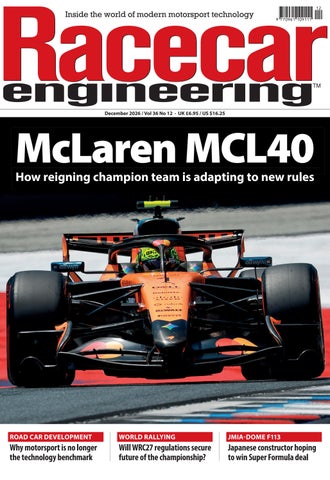
McLaren MCL40 How reigning champion team is adapting to new rules
ROAD CAR DEVELOPMENT
WORLD RALLYING
JMIA-DOME F113
Why motorsport is no longer the technology benchmark
Will WRC27 regulations secure future of the championship?
Japanese constructor hoping to win Super Formula deal
FORMULA 1 – MCLAREN MCL40
Rules reset After winning back-to-back titles, McLaren found itself looking up at its rivals again following F1’s big rule change By DANIEL LLOYD
‘You think there’s a lot of freedom but… when you actually look at it, you’ve probably only got 150 to 300mm of the car length that you can really control’ Rob Marshall, chief designer and chief technical officer at McLaren F1
Instead of fighting for a third consecutive World Constructors’ Championship, McLaren has been trying to hold off a resurgent Red Bull for third place in the standings
O
n the one hand, McLaren is set to relinquish its World Constructors’ Championship crown at the end of the 2026 Formula 1 season. On the other, it has experienced a better start to a new set of technical regulations than it did the previous time. The Wokingbased team has been one of the ‘big four’ front runners this year, although if viewed through the lens of thrash metal, it would be more of an Anthrax than a Metallica. Yes, there have been a couple of smash hits, but otherwise its campaign has not been as consistently fruitful as the industry leader – in this case, Mercedes. The Mercedes-powered 2026 McLaren won its first grand prix at round 11 in Hungary, and repeated the feat one race later in the Netherlands, both courtesy of reigning drivers’ champion, Lando Norris. The MCL40 was impressive at some events, but lacked
podium pace at others. On balance, then, it has been a decent campaign, with clear room for improvement. Considering McLaren’s well-documented struggles at the start of the previous rule cycle in 2022, this has been a more stable start.
Key players Rob Marshall continued as chief designer and chief technical officer, having been a key part of the team’s turnaround in the second half of the previous rule set. The senior team overseeing the MCL40 also included technical directors Mark Temple (performance), Peter Prodromou (aerodynamics) and Neil Houldey (engineering). Whereas Marshall came on board part-way through the previous rule cycle, the former Red Bull designer had the chance to set McLaren’s direction from the outset this time.
DECEMBER 2026 www.racecar-engineering.com 7
SPORTSCARS – GT3
Saving graces Not only does the GT3 world have different cars, but it has different styles of racing, which require series-specific homologation. Racecar investigates By ANDREW COTTON
G
T3 is one of the most prolific racing categories in the world. It started out from humble beginnings, bringing together the racers from single-make series, and allowing them to run together, along with other cars specifically designed for the class. It meant the Porsche 997 GT3 Cup could compete against the Ferrari 430 GT3 Challenge, Maserati Gransport Light and Aston Martin DBRS9, while Lamborghini pitted its Gallardo against the Corvette C6. Since then, the category has become the premier class in customer GT racing. It is prolific, with some estimates of 3000 homologated cars racing around the world. At the centre of it all is the SRO Motorsports Group, which handles the promotion of the GT World Challenge across America, Europe, Asia and Australia, the Intercontinental GT
22 www.racecar-engineering.com DECEMBER 2026
Challenge, and the French and British GT championships, among its many other activities which also include a partnership with the ACO in Asian Le Mans. The technical director in charge of Balance of Performance at the SRO is Claude Surmont, who oversees the process for GT3, GT4 and GT2 cars. Surmont has worked in prototype racing and, as such, has a good idea of how to make a car fast, and what to look for as a technical director aiming for perfect balance.
BoP challenge Under Surmont’s BoP system, the SRO series have grown in stature and in depth, with new and old manufacturers racing to his formula, but it has been no easy task. Not only has he had to balance the cars (and work around the engineers employed by manufacturers to beat his system), but he has also worked with
some of the manufacturers who needed help to bring their cars into the performance window necessary to compete. With SRO, he has also undertaken the performance balancing role for the DTM, ADAC GT Masters, Italian GT and the GT300 class in Super GT. He was also due to join IMSA for its BoP test at Daytona in December, before that was cancelled in late October. The GT3 rules have always been the property of the FIA, which homologates the cars and now balances performance in the GT World Cup at Macau and the WEC. The homologation file documents the finer details of the car to ensure each example is the same. There is no variation allowed from this base document, which removes the desire to develop the car, and also allows Surmont to be able to balance them, safe in the knowledge that he knows each model well.
Part of that homologation document is the basis for the performance balancing, including weight of the car, power levels and aerodynamic properties that are established after a full tunnel test at Windshear in North Carolina. However, the document cannot cover everything, and each series has had to develop its own supplementary homologation document to accommodate the different flavours of racing. The GT World Challenge Europe Sprint Cup, for example, comprises two one-hour races per weekend. Each race features one compulsory pit stop between 25-35 minutes, and the fastest wheel change the team can manage. The Endurance Cup, on the other hand, requires a set minimum pit stop time to allow for refuelling, driver change and tyre change in the safest possible manner.
Series specific Even small items such as wheel nut rotation differ from category to category, while for others, the nature of the circuits can lead to the need for technical changes, such as increased brake cooling, engine cooling or acceleration curves.
The homologation document cannot cater in entirety to all these needs. Therefore, supplementary documents are produced that cover the nuances of each series Some of the series that run GT3 cars, such as the DTM, permit sensors that are not allowed in other series. Laser ride height sensors that are used to set the optimum ride height are one such example. Similarly, torque sensors mounted on the driveshaft that provide data on the power output of the cars. The FIA World Endurance Championship also uses driveshaft-mounted torque sensors as part of its BoP system. In the GT World Challenge, power is currently controlled via air restrictors, but Surmont is working with various companies around Europe to try to establish a more cost-effective torque sensor package for the series. With more than 43 cars starting the last
round of the Sprint Cup, and 61 cars in the last round of Endurance, any such solution has to come without a heavy financial burden. Clearly, the requirements for the cars in the various series are very different, and a single homologation document cannot cater in its entirety to all these needs. Therefore, supplementary documents are produced that cover the nuances of each scenario. These papers force the teams to prepare their cars differently and spend extra money on series-specific parts; sensors being just one example. There are steps that are likely to be taken to reduce the costs in the near future, but for now the supplementary documents are vital to each series, if complicated.
Game changer The arrival of Ford’s Mustang in 2025 changed the game. The car is a very different animal to the Ferraris and Mercedes, with a high c of g and very different aerodynamic properties. There was an expectation that the car would only work on a limited number of circuits and it needed a lot of development work to come up to speed. For that, Surmont had to work outside the FIA homologation boundaries. SRO JEP
DECEMBER 2026 www.racecar-engineering.com 23
MODSPORTS – LOTUS ESPRIT CHEVROLET V8
Grand design With a 5.5-litre V8 from a Grand-Am Daytona Prototype, Simon Allaway’s Lotus Esprit is one of the most interesting, and fastest, racecars on the UK club motorsport scene By MIKE BRESLIN
T
he best club-level racecars are never truly finished. Even when they have won multiple races and championships over a number of years, there’s always a hunger to develop and take them to the next level. Simon Allaway’s Lotus Esprit V8 is a very good example of this. It is also a very good example of a UK silhouette racer. Which means it’s not really a Lotus Esprit at all, but rather a unique spaceframe creation with an unusual engine, some brightly coloured carbon bodywork, and a colourful back story. Allaway races this distinctive car in the popular and very competitive BARC Sports / Saloon Car Championship, which he has won twice, most recently in 2025. He also regularly competes in CSCC Special Saloons and
34 www.racecar-engineering.com DECEMBER 2026
Modsports, as well as in the Bernie’s V8s and Historic Outlaws series. His relationship with Esprit-based racecars goes back to 1990, when he bought a silhouette Esprit rolling chassis that had been developed for hillclimbs. He fitted a 3.5-litre Rover V8 engine and went on to race it with a series of other Rover V8s over the years, including a Wildcat-developed, 5.0-litre unit and a monster 6.0-litre example. Then, in 2009, he fitted the 5.5-litre, Chevrolet LS6 V8 that now sits in this, his current Esprit racecar.
Cracks in the machine Allaway had great success with that first Esprit, but in 2014 made a discovery that led to its demise: ‘The roof on the old car was
glass fibre, and it was heavy, so I decided I wanted to make a carbon roof. But when I was pulling the roof off, I discovered a crack in the spaceframe,’ recalls the now-retired aircraft structures engineer. ‘Once I’d found that crack, I then found more cracks, and more cracks, and soon it didn’t make any sense whatsoever to repair the old car.’ In a sense, this was serendipitous, as it gave Allaway the excuse to start all over again, building a brand new Esprit. ‘The second car was very much built around the experience I had with the first car,’ he says. ‘I knew everything that I didn’t like about the first car, such as the seating position; my head was almost touching the roof. Also, torsionally it wasn’t very good. And geometry-wise, the suspension, I couldn’t get
Simon Allaway’s Lotus Esprit is a frontrunner in the UK’s very popular Sports / Saloon Car Championship, which is for highly modified sports and saloon racers
TECH SPEC: Lotus Esprit Chevrolet CHASSIS
Tubular steel spaceframe, owner designed on TurboCAD BODYWORK
GRP and carbon; latter made with a mix of liquid resin infusion and wet lay-up ENGINE
Chevrolet LS6 Daytona Prototype (for spec see p38) AERODYNAMICS
Bresmedia
TRANSMISSION
Hewland DG300 five-speed gearbox; H-pattern shift; Salisbury LSD SUSPENSION
Double wishbone; pushrod-actuated rocker arm system with rising rate; three-way adjustable Penske 8760 dampers; blade-type anti-roll bars; Lola T88/00 IndyCar magnesium uprights and hubs ELECTRONICS
S80 Pro ECU; AiM MXS dash and datalogger; bespoke engine monitoring system WHEELS AND TYRES
Lola T88/00 magnesium wheels (15 x 11in front, 15 x 14.75 rear); Avon slicks and wets BRAKES
Brembo, from Lola T88/00 DIMENSIONS
The steel spaceframe chassis beneath the Lotus Esprit-inspired bodywork was designed by Allaway on TurboCAD after cracks were found in the chassis tubes of his original Esprit racer. In true silhouette racer style, there’s nothing Lotus about this car at all
Length
4190mm
Width
1850mm
Height
1110mm
Wheelbase
2491mm
WEIGHT
850kg (56 per cent towards rear) DECEMBER 2026 www.racecar-engineering.com 35
PS Images
Twin-element sports prototype carbon rear wing; aluminium ramped floor; carbon rear diffuser; Dibond front splitter; front venturis; dive planes
TECHNOLOGY – ROAD AND RACE
Streets ahead How motorsport is being outpaced by production car technology, which is free from the confines of regulations and rule makers By LAWRENCE BUTCHER
I
n 1986, one of the most powerful road cars on sale in Europe was the Porsche 959. Its turbocharged, flat-six, boxer engine pushed out just shy of 440bhp. With electronically-controlled dampers and a sophisticated four-wheel drive system, Weissach’s flagship model was said to be a technological marvel. However, put next to the cutting edge racecar technology of the day, it looked a little bit weedy. F1’s turbo era was in full swing at the time, the diminutive, 1.5-litre BMW engines were kicking out unholy amounts of power in qualifying trim; well north of 1200bhp. Even when turned down for race distances, they were knocking on the door of 1000bhp. This was also the period when teams began to properly investigate active suspension, while ‘digitisation’ was starting to arrive, with complex ECUs looking after fuel injection systems, and data logging coming of age. Throw in carbon fibre tubs and brakes, and racing machinery was truly another world to just about anything found on the road. Fast forward to 2026 and the gulf, at least on paper, is not nearly so wide. In fact, in many areas there is an argument to be made
that road cars are the ones pushing the boundaries. Racing, of course, will always optimise to a far higher degree, but does the relentless tightening of technical regulations, tying almost every element of a car’s design into ever tighter boxes, mean racecars are no longer the last word in technical marvel? To be clear, this is not to say that the engineers designing and building racecars are any less innovative than they were in the past, it’s just that – with a few notable exceptions (‘Macarena’ wings, we’re looking at you) – those innovations are far less ‘in your face.’
Power games Let’s start in the obvious place: power. Or, more accurately, powertrains. Here, our points of reference when it comes to ICE and hybrids are F1 and the 24 Hours of Le Mans. This might be controversial, but the apogee of ICE development in racing may have passed. It peaked in the 2014 onwards rule sets for LMP1 and F1. Regulations were still a constraint but, for LMP1 in particular, the limits on what you could (or couldn’t) do were loose enough to encourage variation and, importantly, chase performance.
Recognising combustion engines are not going away, Changan Automobile has developed its Blue Core Super Engine, an ultra-efficient ICE with a thermal efficiency of 45 per cent that offers around 2.98l/100km (79mpg) fuel economy 58 www.racecar-engineering.com DECEMBER 2026
In August 2025, the Yangwang U9 Extreme became the first electric production car to lap the Nordschleife in under seven minutes (6m 59.157s)
The U9 Extreme, one of just 30 production models to be built by the BYD subsidiary, also now holds the fastest production car in the world title, at 496.22km/h (308.4mph)
Does the relentless tightening of technical regulations… mean racecars are no longer the last word in technical marvel?
DECEMBER 2026 www.racecar-engineering.com 59