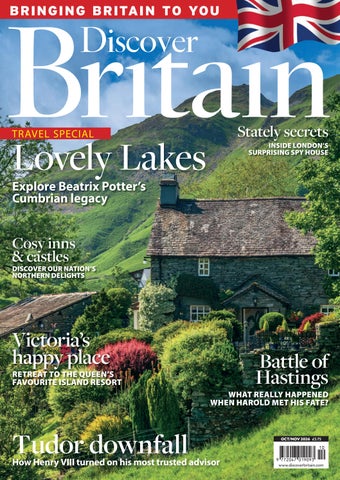
B RINGIN G B RITAIN TO YOU
Stately secrets
TRAVEL SPECIAL
Lovely Lakes
INSIDE LONDON’S SURPRISING SPY HOUSE
Explore Beatrix Potter’s Cumbrian legacy
Cosy inns & castles
DISCOVER OUR NATION’S NORTHERN DELIGHTS
Victoria’s happy place
Battle of Hastings
RETREAT TO THE QUEEN’S FAVOURITE ISLAND RESORT
WHAT REALLY HAPPENED WHEN HAROLD MET HIS FATE?
Tudor downfall
How Henry VIII turned on his most trusted advisor
OCT/NOV 2026 £5.75
www.discoverbritain.com
BRIT EDIT
STATELY HOME
Tudor tapestry returns This autumn, visitors to Oxburgh Hall, Norfolk, can see a 16th-century tapestry hanging back in the historic home for the first time in more than a century. Having been sold by the Bedingfeld family in 1924 to help fund the running of their Oxburgh Estate, the whereabouts of the tapestry, which tells the story of Jewish orphan, Queen Esther, and her husband King Ahasuerus of Persia, was unknown until recently. Then in 2025 an eagle-eyed National Trust researcher spotted it for sale at an art fair and the process of acquiring it for the National Trust’s collection began. Claire Golbourn, of the National Trust Textile
6 discoverbritain.com
Conservation studio, who helped authenticate the tapestry and reunite it with Oxburgh, said: “While it has benefited from minimal previous conservation and past reweaving, nothing can take away the splendour of this tapestry. The intricate detail of Esther’s cloak and canopy, together with the remarkably realistic tassels, speaks to the extraordinary craftsmanship and artistry of the piece.” The tapestry is on display in an open frame at Oxburgh Hall until December, though the location of the six other tapestries that once hung with it remains a mystery. nationaltrust.org.uk/visit/norfolk/oxburgh-estate
BRIT EDIT
Brit Edit
© NT IMAGES/MIKE HODGSON
Your curated guide to Britain this season
discoverbritain.com 7
HISTORY
Right, from top: Norman depictions of Harold: a scene from the Bayeux Tapestry depicting Harold with an arrow in his eye; 13th-century manuscript shows Harold Godwinson crowning himself Left: A 14thcentury manuscript image of Harold
Rewriting history
S
ince Victorian times, Harold has been known as the king who rushed from one end of England to the other, fighting off invaders, only to die at the Battle of Hastings from an arrow in the eye. Admirers have painted him as steadfast and dutiful, a warrior and even the model Englishman, who gave his life for his country. Critics have cast him as a perjurer who bit off more than he could chew by seizing the throne, losing England to William as a result. Historians have also often regarded Harold and his clan, the Godwines, as the power behind Edward the Confessor’s throne, keeping alive the myth that, in all but name, Harold was ruling
48 discoverbritain.com
England at least a decade before the Norman Conquest. The outlines of Harold’s portrait were first sketched shortly after his lifetime, before being reinscribed centuries later by the Victorians. Rarely have they been amended, an exception being the story of the arrow in the eye, which is now regarded as late and unreliable (it was stitched into the Bayeux Tapestry by 19th-century restorers). In Edward the Confessor: Last of the Royal Blood (my biography of Harold’s predecessor), I also challenged the idea that Harold was the power behind Edward’s throne. I was then commissioned to write Harold’s biography for the same
series (Yale English Monarchs), being funded by a Leverhulme Major Research Fellowship as well as a Fellowship at my old college, Magdalene, Cambridge. Returning to the original sources in Latin and Old English, I began reconstructing Harold’s life with reference to what other scholars had written, asking whether their interpretations checked out, or whether the evidence could be read in different ways. Harold began emerging as a warrior by vocation and training. He learned by observing rivals and enemies in the field, even engaging in foreign espionage to gather strategic intelligence, and ➤ adapting his tactics accordingly.
© NIDAY PICTURE LIBRARY/MICHELLE BRIDGES/THE HISTORY COLLECTION/ALAMY
In his new book Harold: Warrior King, historian Tom Licence reveals what really happened at the Battle of Hastings
Prepare for Battle As the Bayeux Tapestry goes on display in London, Jeremy Flint travels to the Battle of Hastings site for a history lesson to remember
Left to right: The Battle of Hastings annual re-enactment takes place close to the battle’s anniversary; authentic weapons and period dress help bring the event to life
52 discoverbritain.com
ALL PHOTOS © JEREMY FLINT
HERITAGE
I
t’s a crisp autumn morning, silence fills the air at the top of Senlac Hill near the town of Battle in East Sussex. Suddenly, a storm of arrows whooshes overhead. Below, Norman banners flutter in the breeze. Then comes the sound of pounding hooves, echoed by the roar of raging voices. The ground beneath trembles, as waves of cavalry wielding weapons charge uphill towards a defensive shield of Anglo-Saxon forces. Flashes of colour and silver uniforms fly by in the blink of an eye before spears splinter and swords engage in a barbaric fight to the death. This was the scene I was met with at last year’s annual re-enactment of the Battle of Hastings, a dramatic event that will take place again this October to commemorate the 960th anniversary of the historic conflict that shaped English history. During England’s most famous battle, Duke William of Normandy and his large contingent of archers, infantry and horsemen – dressed in heavy chain mail and conical helmets – finally broke through the heavily fortified Saxon wall after hours of stalemate, culminating in the death of King Harold Godwinson. William’s feigned retreats broke the English wall, as English soldiers broke rank, exposing Harold to the attacking forces. Prior to the real-life event, a series of spectacular incidents unfolded. When the childless King Edward the Confessor died in 1066 without a successor, ➤ Harold Godwinson seized the English throne and discoverbritain.com 53
Opposite: Portrait of Thomas Cromwell by Hans Holbein the Younger
Cromwell’s
DOWNFALL Jo Romero looks at where it all went wrong for Henry VIII’s powerful advisor
© ARTEFACT/ALAMY
I
n the dangerous world of Tudor politics, it was a deadly combination of success, jealousy and paranoia that led Thomas Cromwell to the axe. The son of a blacksmith and tavern owner from Putney, Cromwell rose through the ranks of Henry VIII’s court to become one of the most influential figures of the Tudor age. A royal servant, diplomat and member of the royal council, he was awarded an impressive list of titles during his career, among them Lord Privy Seal, Great Lord Chamberlain and Master of the Jewel House. At the height of his power, he took responsibility for the political, foreign and religious affairs of the kingdom. We all know how his career ended. Seized by his fellow council members, he was imprisoned in the Tower of London and charged with heresy and treason. Despite insisting he had always been loyal to the king, and pleading for “mercy, mercy, mercy”, he was swiftly executed on Tower Hill on 28 July, 1540. Just three months earlier, he had been celebrated for his loyal service to the king, who granted him an earldom. So, what went wrong? From around 1530 Thomas Cromwell had been 72 discoverbritain.com
Henry’s ultimate ‘fix-it man’, annulling his legally watertight 24-year marriage to Catherine of Aragon, and paving the way for his marriage to Anne Boleyn. Later, he would engineer Anne’s own downfall in May 1536. But it wasn’t just in dabbling with the king’s love life that Cromwell proved himself. According to John Foxe in his 1559 Acts and Monuments, Cromwell and Henry hit it off after he promised the king “great riches”, something Henry liked the sound of “right well”. Over the following years Henry’s Principal Secretary filled the royal coffers with jewels, coins and property deeds gleaned from the Dissolution of the Monasteries, which was carried out with astonishing pace. Historians estimate that over 800 religious establishments in England, Wales and Ireland were closed between 1536 and 1540, forever changing the religious, social and material landscape of the realm. Naturally, this sudden, radical change had consequences. People murmured as ancient abbeys were sold to aristocrats, who converted them into private stately homes. A Welshman named Lewes ➤ reacted to Cromwell’s English translation of the
HISTORY
discoverbritain.com 73
LONDON
London
SPOTLIGHT
This issue, our Londonphile (and our editor) are up early exploring the cafés and restaurants serving the capital’s best breakfasts and brunches
Pavyllon At Four Seasons Park Lane, Mayfair While not technically a ‘fry-up’– there’s not a banger (sausage) in sight – this is possibly the grandest breakfast you’ll ever eat in your life. Head Chef Yannick Alléno has been awarded a Michelin star for his Pavyllon restaurant, set within one of London’s most luxurious hotels, The Four Seasons on Park Lane, and while you can also enjoy lunch and dinner in this elegant dining room, it’s the five-course breakfast menu that currently has the longest waiting list. On my visit, I sat at the counter facing the immaculate kitchen, watching the chefs work their magic. First came an ‘amuse juice’, accompanied by a plate of finest viennoiserie. Then a decadent lobster flatbread, followed by an exotic chia pudding and, finally, the chef’s weekly special. In this case, the most perfect Eggs Royale I’d ever tasted, made with a ‘Mayfair Muffin’ and topped with caviar. fourseasons.com/london 78 discoverbritain.com