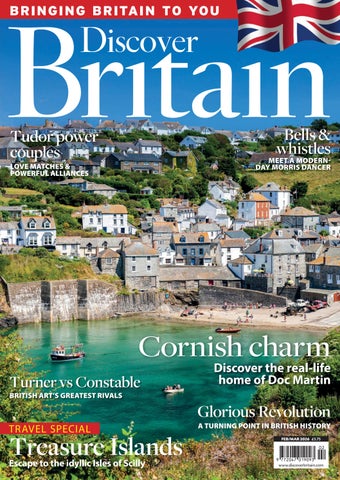
B RINGIN G B RITAIN TO YOU
Bells & whistles
Tudor power couples
MEET A MODERN DAY MORRIS DANCER
LOVE MATCHES & POWERFUL ALLIANCES
Cornish charm Turner vs Constable
Discover the real-life home of Doc Martin
BRITISH ART’S GREATEST RIVALS
Glorious Revolution TRAVEL SPECIAL
Treasure Islands
Escape to the idyllic Isles of Scilly
A TURNING POINT IN BRITISH HISTORY FEB/MAR 2026 £5.75
www.discoverbritain.com
BRIT EDIT
Brit Edit Your curated guide to Britain this season
6 discoverbritain.com
BRIT EDIT
TRAVEL
Ticket to ride
© ROBERT SHERWOOD/STEPHEN HAYWARD
If seeing more of Britain is one of your new year’s resolutions, then check out the calendar of day trips on offer from Steam Dreams Rail Co. in 2026. Taking in many of the UK’s most beloved destinations, these steam train journeys are a great way of combining city escapes and visits to charming coastal towns and villages with comfortable onboard travel. Guests can choose from a luxurious fine-dining experience offered in the Pullman Dining carriages or opt for the refined comfort of First Class without catering. Journeys set off from lots of stations in England’s southeast with destinations including Bath, Cambridge and Kingswear in Devon. Juliet Soley at Steam Dreams Rail Co. said: “Each journey has been thoughtfully curated to offer passengers an itinerary that captures the elegance, nostalgia and timeless allure of a bygone era.” steamdreams.co.uk
discoverbritain.com 7
Scilly SEASON
ALL PHOTOS © JEREMY FLINT
Jeremy Flint joins a train and boat tour of the Isles of Scilly to discover these idyllic isles in good company
14 discoverbritain.com
5. Kensington Palace, London William and Mary commissioned Sir Christopher Wren to transform the modest mansion of Nottingham House into the opulent private country retreat of Kensington Palace. Tales of their personal lives still linger here: of extravagant balls and visits from foreign princes, but also simple fish-andbeer meals together in Queen Mary’s Dining Room. William would play games of soldiers in the King’s Gallery with his little nephew, the Duke of Gloucester, who, in accordance with the Bill of Rights, stood in line as his heir after a childless Mary died of smallpox in 1694, aged 32. When Gloucester, the only surviving son of Mary’s sister, Anne, died at just 11 years old in 1700, a succession crisis loomed, prompting parliament to pass the Act of Settlement 1701 to ensure continuing Protestant rule in years to come. William died the following year at Kensington Palace, shortly after a riding accident at Hampton Court. hrp.org.uk/kensington-palace
HISTORY
© ADAM GRAY/SWNS GROUP/KENNY LAM/VISITSCOTLAND
6. Culloden, Inverness
Queen Anne, who succeeded William, died childless in 1714, so, in line with the Act of Settlement, the Crown passed to the closest eligible Protestant relative, George of Hanover. Ousted James II had died in 1701 but with his son and grandson still alive in exile, Jacobites mounted rebellions in 1715 and 1745, aiming to restore the exiled Stuart monarchy. The ’45 came to a head at the Battle of Culloden, near Inverness, where James’s grandson ‘Bonnie Prince Charlie’ faced government troops under the Duke of Cumberland – today’s visitor centre vividly recreates what happened in the 360-degree battle immersion theatre. The last pitched battle on British soil saw the Jacobites fall – you can view poignant graves of the fallen and a memorial cairn. Bonnie Prince Charlie escaped into legend, while ‘Butcher’ Cumberland oversaw the vicious dismantling of Highland culture. It was the end of Jacobitism as a significant political movement, the Glorious Revolution had held, and the direct descendants of George I rule to this day. n nts.org.uk/visit/places/culloden discoverbritain.com 61
LONDON
London
SPOTLIGHT This issue, our Londonphile casts an appreciative eye over some of the buildings designed by Britain’s greatest architects
W
e shape our buildings; thereafter they shape us.” So proclaimed Prime Minister Winston Churchill in October 1943, while addressing the House of Commons about the rebuilding of its Chamber, which had been destroyed by German bombs dropped during the Blitz. Britain’s architects have certainly helped to shape our nation, and especially our capital. The buildings they have designed over the centuries are an integral part of the image that Britain presents to the world.
“
From medieval royal palaces, such as the Tower of London (whose central White Tower was designed by Bishop Gundulf of Rochester, a skilled architect and master builder as well as a monk), to the trailblazing, ultra-modern shaped glass and steel edifices of The City. Many of these historic buildings are open to the public for exploration and enjoyment. Join me for a tour of some of the most fascinating and historic examples in London today linked to some of our most revered and talented architects.
Russell Higham is a freelance journalist who writes on arts, culture, history, travel, and British heritage
Christopher Wren
© JAMES NEWTON
A true polymath, Sir Christopher Wren (1632–1732) was an astronomer, mathematician and physicist, as well as being the architect of some of Britain’s most famous landmarks. Combining two of his talents, he designed the original Royal Observatory building in Greenwich; this after having been appointed ‘Surveyor of the Royal Works’ in 1669, essentially giving him control over every royal and government building in the country. Strongly influenced by French and Italian baroque styles, Wren designed 51 of the capital’s churches following the Great Fire of London of 1666. His crowning glory is widely considered to be St. Paul’s Cathedral (pictured), with its triple-shelled domes, which is open for public visits as well as guided tours. In the crypt, look for his tomb which bears a Latin inscription; translated, it reads: “If you seek his memorial – look around you”. stpauls.co.uk 78 discoverbritain.com
➤
LONDON
Gilbert Scott A prolific exponent of Gothic Revivalism in the Victorian age, Sir George Gilbert Scott (1811–1878) designed, restored or influenced over 850 buildings. He designed the striking red-brick facade to St Pancras Station, which is considered one of the world’s most beautiful examples of transport architecture. However, his masterpiece is widely considered to be the Albert Memorial in Kensington Gardens (pictured), directly opposite the Royal Albert Hall. Unveiled in 1872 after taking 10 years to complete, this exquisitely ornate structure – built in the form of a ciborium (a canopy over a church altar) – commemorates the death of Prince Albert, Queen Victoria’s beloved husband, who died at the age of 42. At its base, the Frieze of Parnassus contains 169 life-sized sculptures of historical figures, including the architects Pugin, Barry and Wren next to Scott himself. The Royal Parks, which manages the memorial, offers guided tours that delve behind the scenes of one of London’s most intriguing landmarks. ➤ royalparks.org.uk
discoverbritain.com 79
CROSSWORD & QUIZ
Crossword no 250
Solutions in next issue
Teatime
QUIZ
Test your knowledge of Britain – answers below! 1. Which UK city has a Jewellery Quarter? a) Leeds b) Glasgow c) Birmingham
2. How many isles make up the Isles of Scilly? a) 200 b) 150 c) 100 3. What type of mythical creature appears on the Wyvern of Wessex flag? a) Dragon b) Unicorn c) Sea monster
82 discoverbritain.com
Down 1 ___ Hotspur, English football club (9) 2 ____ Castle, seat of the Duke of Norfolk (7) 3 Nancy ____, the first woman to sit in Parliament (5) 4 Early ____ is a wildflower unique to the UK (7) 5 ____ Square is a popular green space in Bloomsbury (7) 6 ____ Warrior goddess who personifies Britain (9) 7 Shakespearean tragedy set in Venice and Cyprus (7) 8 The ____ , a long-running children’s comic (5) 15 Film starring Roger Moore as James Bond (9) 17 City on the Tyne, known for Geordie culture (9) 19 21 across is closely associated with Art ____ (7) 20 Nickname for British military police (7) 21 Scottish valley, scene of a historic massacre (7) 22 National Trust steam yacht on Coniston Water (7) 23 ‘Bless your cotton ____’, a fond British saying (5) 25 ____ Martin, village on the North Devon coast (5)
4. Into which port did William of Orange sail? a) Portsmouth b) Weymouth c) Brixham 5. At which Scottish castle hotel will you find a newly opened restaurant called The Azalea? a) Aldourie Castle b) Glenapp Castle c) Inverlochy Castle 6. Which UK police force issued the first speeding ticket in 1895? a) Birmingham b) Manchester c) Hampshire 7. The Tudor Heart necklace was a gift from which king to his queen? a) Henry VII to Elizabeth of York b) Henry VIII to Katherine of Aragon c) William III to Mary II Solutions to crossword 249 Across: 1 Cambridge 6 Banff 9 Arsenic 10 Portree 11 Swans 12 Man 13 Slim 15 Oldfield 17 Fisher 18 Temple 20 Peter Pan 24 Clun 25 Awe 26 Motte 28 Chester 29 Art Deco 30 Ronan 31 Waddesdon Down: 1 Chatsworth 2 Mustard 3 Rings 4 Decimal 5 Epping 6 Berkshire 7 Norwich 8 Fred 14 Princetown 16 Islington 19 Malvern 21 Emerald 22 Pithead 23 Harrow 26 Mitre 27 Acer Teatime quiz answers: 1, C. 2, A. 3, A. 4, C. 5, B. 6, C. 7, B
Across 1 London square named for a famous naval victory (9) 6 ‘Captain ____’ tried to steal the Crown Jewels in 1671 (5) 9 County town of Somerset (7) 10 Anglo-Saxon saint associated with rain (7) 11 Small native tree steeped in lore and mysticism (5) 12 ____ houses kept food and drink cool before fridges (3) 13 Narrow passageway between buildings (5) 14 Area of London linked to the legal profession (7) 16 Historic cathedral city in eastern England (7) 18 Important church, typically a cathedral (7) 21 Largest city in Scotland by population (7) 23 Part of the wicket in cricket (5) 24 River that flows through Chester (3) 25 Small island in Inner Hebrides (5) 26 Made in ____, popular reality TV show (7) 27 Cold ____ Farm, comic novel by Stella Gibbons (7) 28 A ____ in Scarlet, the first Sherlock Holmes story (5) 29 UK’s first designated New Town (9)