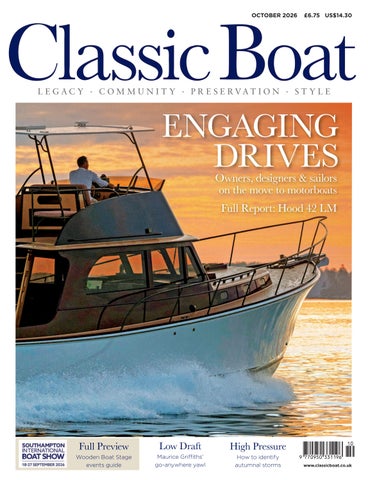
OCTOBER 2026
£6.75 US$14.30
L E G AC Y · C O M M U N I T Y · P R E S E RVAT I O N · S T Y L E
ENGAGING DRIVES Owners, designers & sailors on the move to motorboats
Full Report: Hood 42 LM
Full Preview
Low Draft
High Pressure
Wooden Boat Stage events guide
Maurice Griffiths’ go-anywhere yawl
How to identify autumnal storms
www.classicboat.co.uk
IRINA VII
6
CLASSIC BOAT OCTOBER 2026
DIRECTOR’S CUTTER Maurice Griffiths’ 1933 gaff ketch Nyala is notable for a rare combination of shallow draught and good manners in an awkward sea state. Now she’s been beautifully restored by a French film director WORDS NIGEL SHARP PHOTOS NIGEL SHARP AND LOÏC LE MARCHAND
CLASSIC BOAT OCTOBER 2026
7
IRINA VII HOOD 42 LM
CLASS, BRASS & WARM WOOD
24
CLASSIC BOAT OCTOBER 2026
This astonishingly detailed full custom project by CW Hood and Lyman Morse is the very essence of classic New England motor yacht design WORDS CARL RICHARDSON PHOTOS CORY SILKEN, ALISON LANGLEY
CLASSIC BOAT OCTOBER 2026
25
MOTORBOAT OWNERSHIP
POWER MOVE Throttle back and enjoy a wave of classic motorboat design and ownership discussion WORDS BY CARL RICHARDSON
34
CLASSIC BOAT OCTOBER 2026
T
he reassuring throb of engines, the feeling of control, the comparative ease, a bit of elbowroom and berths you can potentially sleep in. These are all motorboat traits bound to entice. But then add the style, pedigree and respect of your fellow owner, sail or power, that a classic boat can convey and it’s a glorious mix. Many an ex-sailor has moved to motor, and a lucky few have the means to do both. We will hear from the owners, designers and clubs connected to classic motorboats of the planing or semi-displacement kind. What advice would they give to someone buying their first motorboat? What are the pros and cons of deep Vee and semidisplacement design? We must even confront the unavoidable fact that old wooden powerboats can be just as challenging as even older wooden sailing boats.
TRUE CLASSIC
The motorboat story stretches back to the turn of the century, with displacement hulls, steadying sails, paraffin engines and handsome lines, often created by the same designers and yards responsible for building beautiful sailing boats. But the planing hull classics born out of racing, fishing and pilot boats are a parallel story. At the risk of missing several key moments and details, their lineage dates back to the frankly crazy low deadrise powerboats of 1920s and the far more sensible aspirations of round-bilge displacement boats simply trying to go a bit faster.
TURN OF SPEED
Planing and semi-displacement – skeg to our American readers – hulls came to some prominence in the ‘30s and ‘40s. Motor Torpedo Boats or fast attack craft are a key moment, the British opting for those flatter powerboat aft sections for speed, the Germans using what we would consider a round-bilge semi-displacement design. Next came fast express cruisers, many out of ‘50s America. Low
Deep Vee vs Semi-Displacement Explainer The vee hull is intended to run fast, creating more lift, to plane over the waves, reducing the wetted area and allowing greater speed, in excess of 30 knots. The higher the deadrise – the sharper the angle of the Vee - the better the quality of high-speed ride, but equally it will require more horsepower to create the lift. A lower deadrise will require less power but its flatter sections are more liable to slam. The classic Hunt, Levy, Burnard hull has a high deadrise of around 20 degrees across the transom, more than many modern yachts amidships. A semi-displacement hull is designed to run more efficiently and handle better than the planing hull at slower displacement speeds, and to push on to low planing speeds of between 20 and 28 knots. It takes the fine, fluid entry of a displacement hull and combines it with flatter and deeper aft sections to create lift. This, again, requires more horsepower. Usually including a keel, these hulls retain a larger wetted area, with more hull in the water, even at speed.
deadrise, often round bilge, designs. The ‘60s saw the arrival of the modern vee, with Ray Hunt, Dick Bertram, Sonny Levi and, later, Alan Burnard and his Faireys all part of a story that connected offshore racing with leisure cruising and often mixed the two. On a slightly different heading, the ‘50s also saw the wooden, hard-chine, fine entry trawlers, skeg boats and the so-called builtdown, garboard and keel boats of the American North East begin their journey towards the trawler yachts and Downeasters we see today. Finally, we must acknowledge the slim, round-bilge, fine entry pilotboat of Britain, which would hail the Nelson yacht era. Broadly, pretty much every classic built since the 1960s can trace its lineage to these few groups. But there is a final piece of the puzzle, the thing that allowed fast cruising boats to prevail and, indeed, modern boat production to happen: the availability of lighter, more powerful diesel engines.
THE MARKET
With these foundations set, the market today for an antique or modern classic will showcase a fine selection of deep-Vee and semi-displacement yachts. So, which is the right one for you? Well, spoiler alert, it’s probably a semi-displacement. There are more of them, new and old, which tells its own story. They can offer good onboard space, the hulls have a fine entry to slice through chop and are designed to run efficiently in the 12-20 knot range that reflects normal, sensible, day-to-day use. Of course, sense is only a small part of any boat-buying story, so we must acknowledge the thrill of a deep Vee, the arcing, intuitive turns, the roar of twin diesels, the aggressive intent of a spray-rail and the finer line of a yacht with less height above the waterline. A few also offer the comfort and privacy of an aft cabin – a feature that most modern boat builders avoid due to the added production cost and the more recent move to stern or pod drives, filling the aft sections up with engines.
Andrew Wolstenholme designs: Vee (top) and semi-displacement
HERITAGE
OLD WOUNDS From admirals to able seamen, many thousands of severely disabled sailors were the living legacy of 18th and 19th century naval warfare WORDS KATHERINE GAZZARD IMAGES ROYAL MUSEUMS GREENWICH
Katherine Gazzard is Curator of Art at Royal Museums Greenwich and author of The Art Of Naval Portraiture
A
t 1:15pm on 21 October 1805, a French musket ball struck Vice-Admiral Lord Nelson in the shoulder, passing through his lung and severing his spine. The bullet hole is clearly visible in the fabric of his uniform coat, now displayed at the National Maritime Museum in Greenwich. Nelson collapsed on the quarterdeck of his flagship, HMS Victory, knowing instantly that the wound was fatal. “Hardy,” he gasped to his flag captain, “I do
46
CLASSIC BOAT OCTOBER 2026
believe they have done it at last.” He was carried to the ship’s cockpit, where he passed away a little over three hours later. This famous moment occurred during the Battle of Trafalgar, a brutal naval encounter which resulted in victory for the British and defeat for their French and Spanish opponents. The list of causalities from the battle included almost 500 dead and more than 1,000 wounded in the British fleet. The figures for the French and Spanish fleets were even
Above left: The first portrait of Horatio Nelson after the loss of his arm, painted by Lemuel Francis Abbott Above centre: JMW Turner’s The Battle of Trafalgar, painted in 1824
higher. These numbers are a sobering reminder of the dangers that faced those involved in naval warfare during the age of sail. Nelson’s comment that the French had “done it at last” alluded to the fact that he had come close to death before. On several previous occasions he had survived serious and lifechanging injuries, including damage to his eye, the amputation of his arm and a severe head wound. In the centuries since his death, the battered state of Nelson’s body
has become central to his legend, although the details of his wounds are often misremembered. For example, in the sport of cricket, “Nelson” is slang for a score of 111 runs, supposedly because Nelson had “one arm, one eye and one leg”. This explanation is factually incorrect: he lost neither a leg nor an eye, though his sight was impaired. The image of Nelson as a wounded hero is so familiar that it obscures the reality of his injuries and what they meant for his day-to-day life, afloat and ashore. It also gives the misleading impression that he was unique. In fact, many naval officers and sailors lived with disabilities and long-term physical and mental health conditions.
AN INJURED EYE
Nelson experienced health issues throughout his life. Born at Burnham Thorpe in Norfolk on 29 September 1758, he was a sickly child. When he joined the Royal Navy aged twelve in 1771, he discovered that he was prone to seasickness. He endured scurvy and malaria during his early career and contracted a typhoid-like
illness while serving in the Caribbean in 1780. His first major battle injury occurred on 12 July 1794. Nelson was part of a British naval squadron sent to reinforce Corsican rebels fighting against the French garrison on the island. Guns were brought ashore and arranged around the town of Calvi. Nelson was overseeing one of the batteries when French fire hit a nearby sandbag. Sand and stone fragments flew into his face, striking the area around his right eye. His wounds were quickly bandaged and he returned to action, but he reported diminished vision in the affected eye, noting that he could only “distinguish light from dark”. There is no outward sign of injury in a miniature portrait that he commissioned from an Italian artist as a gift for his wife, Fanny, a few months later. However, his vision remained limited for the rest of his life. Nelson maintained a sense of humour about his condition. At the Battle of Copenhagen on 2 April 1801, he supposedly used his
Above right: The fatal bullet hole in Nelson’s uniform from the Battle of Trafalgar Below: A miniature portrait of Nelson, painted shortly after his eye injury
one-eyed status as an excuse to ignore the orders of his commanding officer, Admiral Sir Hyde Parker. When Parker signalled his ships to break off their attack on the Danish fleet, Nelson is reported to have placed his telescope to his damaged eye and joked to his officers “I really do not see the signal!” He continued with the assault and secured a decisive victory. Thanks in part to this incident, Nelson’s visual loss in his right eye remains well-known today. Often forgotten is the fact that he also experienced impaired sight in his left eye. Some medical historians have theorised that his symptoms were the result of sympathetic opthalmia, an autoimmune condition in which injury to one eye triggers inflammation in the other. Another possibility is that he was suffering ill effects from long-term UV exposure. The glare of the sun was and remains an occupational hazard for seafarers. Nelson’s doctors advised that he should use a green fabric visor to protect his failing vision when on deck. This CLASSIC BOAT OCTOBER 2026 CLASSIC BOAT APRIL 2026
47
Craftsmanship Yard News
Email the team: editorial@classicboat.co.uk
NORTHWEST
David Moss on Severn We spoke to David Moss last month about his restoration of Arnside Sailing Club’s 114-year-old gaff Severn. David sent in so many images
A pressure washer had torn away at the softer hull sections, but,
and gave us so much background on the project that we felt duty
somehow, David and the team managed to save most of the pitch pine
bound to continue the story.
planks. The counter, as reported last month, was replaced, as were the
David started his Thornton yard in 1974, becoming well-known for his 15ft and 21ft Sea Otter canoe yawls. In 2018, he won a Classic Boat award for Polly, a 31ft pilot cutter.
70
to try and shore things up.
garboard and beam shelves and the stem, all in Iroko. The original build had used lots of odd pieces to build around the hull shape, the reverse sections being particularly poor. The keel and
When Severn arrived, David knew she was in a bad way. Her working
keelson barely connected in places. With new oak laminate frames,
boat roots and years of make-do maintenance had left the hull dotted
locally sourced and sawn, and bronze fasteners, Severn is now solid
with screw holes, her frames split, doubled and in some cases trippled
and in the best condition of her long life.
CLASSIC BOAT OCTOBER 2026