FEBRUARY 2024
£4.95 US$11.99
T H E W O R L D’ S M O S T B E A U T I F U L B O A T S
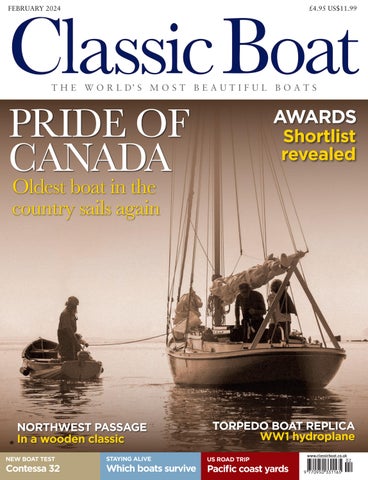
PRIDE OF CANADA
AWARDS Shortlist revealed
Oldest boat in the country sails again
NORTHWEST PASSAGE In a wooden classic NEW BOAT TEST
Contessa 32
STAYING ALIVE
Which boats survive
TORPEDO BOAT REPLICA WW1 hydroplane US ROAD TRIP
Pacific coast yards
www.classicboat.co.uk
MA Lic. #155
THE W I N TE R
Marine Sale
F E B R UA RY 2 7 - 2 8 , 2 0 2 4
John Stobart (English/American, 1929-2023) “Victoria, View from Songhee Point, 1891” showing the famed clipper Thermopylae in Victoria, B.C. Oil on canvas, 9.75” x 14.25”. Framed.
FEATURING THE PROPERTY OF A GENTLEMAN including important ship models, Sheffield exhibition knives and an authenticated Admiral Lord Nelson letter
NEW ENGLAND + BEYOND I +1.508.385.3116 I VIEW ALL LOTS + BID AT ELDREDS.COM
STEFFAN MEYRIC HUGHES, EDITOR
The shortlist has landed
Every year I use the quantum of freedom afforded by this space to beseech you to vote in our annual awards, and this year is no different. Actually, it is a bit different. The tide of motorboats new and restored has given some ground to what looks like a resurgence in sailing yacht restoration. This year, we’ve seen more of them than in any other when it comes to creating our awards shortlist. There are the super restorations, like Baruna and Princess Svavevit, then the smaller jobs, where typically a hull is fortified, the odd rotten plank replaced and a new rig put on. Phrased like that, it sounds a bit like redoing the kitchen cabinets, but anyone who’s rolled up their sleeves (fiscal or real) will know that’s not the case. There is a nice selection of spirit-of-tradition yachts this year too. They seemed thin on the ground for a while, but perhaps we’re going to see a few more in the years to come? And, to keep things moving along a bit, we’ve put some of the nicest big powered vessels in their own category. So we’ve done our bit – it’s time for you to choose your favourites. Cover photo of Dorothy c/o Friends of Dorothy
CONTENTS 4 ISSUE No 428
classicboat.co.uk Telegraph Media Group, 111, Buckingham Palace Road, London, SW1W 0SR
DOROTHY
COVER STORY
EDITORIAL Editor Steffan Meyric Hughes steffan@classicboat.co.uk Art Editor Gareth Lloyd Jones Sub Editor Sue Pelling Publisher Simon Temlett ADVERTISING Hugo Segrave +44 (0)7707 167729 hugo.segrave@chelseamagazines.com Advertisement Production Allpointsmedia +44 (0)1202 472781 allpointsmedia.co.uk Published monthly ISSN: 0950 3315 USA US$12.50 Canada C$11.95 Australia A$11.95 PUBLISHING Director of Media James Dobson Chief Financial Officer Vicki Gavin Group Sales Director Catherine Chapman Head of Sales Operations Jodie Green Publishing Consultant Martin Nott
Subscription and back issues
Tel: +44 (0)1858 438 442 Annual subscription rates: UK £75 ROW £87 Email: classicboat@subscription.co.uk
Online: www.subscription.co.uk/chelsea/help Post: Classic Boat, Subscriptions Department, Tower House, Sovereign Park, Lathkill Street, Market Harborough LE16 9EF Back Issues: chelseamagazines.com/shop/
The Chelsea Magazine Company Ltd Telegraph Media Group, 111, Buckingham Palace Road, London, SW1W 0SR chelseamagazines.com ©Copyright The Chelsea Magazine Company
Follow the Classic Boat team on Twitter and Facebook THE
CHELSEA
MAGAZINE
COMPANY
LTD
Classic Boat is part of the Chelsea Marine Magazines family, along with our other monthly titles
4 . CANADA’S OLDEST BOAT She’s probably Canada’s oldest, possibly her favourite and definitely sailing again 16 . FUN IN WASHINGTON Out and about at the Port Townsend Wooden Boat Festival 18 . BOAT TEST – CONTESSA 32 Contessa 32 owner Nigel Sharp tests a brand new version of the same legend 64 . US ROAD TRIP PART TWO Our intrepid traveller reaches the west 24 . DAZZLE PATTERN Warship models under the hammer COVER STORY
32 . CLASSIC BOAT AWARDS It’s make-your-mind-up time; 31 boats in six categories await
18
42
CONTESSA 32
WW1 HYDROPLANE
COVER STORY
42 . WORLD WAR ONE HYDROPLANE Replica of a WW1 racing hydroplane altered to carry a torpedo 48 . SURVIVAL OF THE... FITTEST? A historical perspective on why some yachts survive and others don’t
48
SURVIVAL OF THE FITTEST
54
NORTH WEST PASSAGE
COVER STORY
54 . THE NORTH WEST PASSAGE Threading the needle on a classic wooden yacht 64 . US ROAD TRIP PART TWO Our intrepid traveller reaches the west coast to visit three more boatyards
WIN AN E-PROPULSION ELECTRIC OUTBOARD WORTH OVER £1,800
with JANUARY 2024 £4.95
INTO THE WILD
BOAT TEST
ITALIA 11.98
REGULARS
Lightning fast, razor sharp, silky smooth
Icebound in Scoresby Sound
STYY Cover January -final.indd 1
01
● The future of electric motors ● Investigating green boatbuilding ● Windelo’s basalt catamaran on test
IN SEARCH OF GLORY
The path from amateur to pro racer
9 771367 586148
JERVIS INLET The world’s most beautiful dead end BLUE WATER CRUISING GOES GREEN
22/11/2023 11:52
For cruising and racing sailors
To subscribe, chelseamagazines.com/marine
14 24 26 28
. TELL TALES . SALEROOM . OBJECTS OF DESIRE . ADRIAN MORGAN
62 . GETTING AFLOAT 78 . LETTERS 80 . NEXT MONTH 82 . STERNPOST
CRAFTSMANSHIP
64 . US BOATYARDS 72 . YARD NEWS 76 . BOATBUILDER’S NOTES
Tom Cunliffe
Sailor king
PAGE 6 0
CLASSIC BOAT FEBRUARY 2024
3
CANADA’S DAUGHTER
She was designed for the Thames but built in Canada. After 127 years, she’s possibly the nation’s oldest boat and her recent refit sees her ready for another century WORDS JAN HEIN PHOTOS JAN HEIN AND FRIENDS OF DOROTHY
4
CLASSIC BOAT FEBRUARY 2024
CLASSIC BOAT FEBRUARY 2024
5
DOROTHY
I
n the spring of 2023, a buoyant crowd gathered on the east coast of Canada’s Vancouver Island for the relaunch of a small but very significant boat. The 30ft (9.1m) sloop Dorothy, built in 1897, was about to return to the sea after years of neglect and a prolonged rebuild. Like most launchings, the vessel was dressed in flags and flowers, with a bottle of champagne readied to burst across the bow. But this ceremony was far ordinary. Dorothy is thought to be the oldest vessel on the west coast of Canada; possibly the oldest one in the country still sailing. She has endured 126 years and nearly a dozen owners, yet her story is as clear as calm water, thanks to the man who commissioned her. W H Langley was a young barrister in Victoria, Canada, who spent his leisure time in the 1890s racing and cruising the waters around Vancouver Island aboard his 18ft (5.5m) sloop Viola. Competition at the newly formed Victoria Yacht Club prompted his desire for a faster vessel, and a search began. Within the pages of the 1895 edition of Dixon Kemp’s Manual of Yacht and Boat Sailing, Langley found plans for a 30ft (9.1m) boat that would suit his needs. Naval architect Linton Hope designed the sloop as a singlehanded cruiser for the Thames estuary. The first one was built in 1894 in Hope’s yard, the Thames Yacht Building Company, and has since vanished from history. A slightly larger version, also christened Dorothy, is 129 years old and still turning heads, a testament to Hope’s talent and skill. A year of correspondence between Langley and Hope began in earnest in 1896 with questions about materials, costs, and modifications. Those papers, yellowed by time, are remarkably still intact. One letter details Hope’s offer to create a Dorothy in his UK yard. He wrote, “We could build one of improved design of teak, metal fittings, high-class workmanship, finish price at our yard, two hundred and fifty pounds. If coppered, two hundred and sixty-five pounds. We can build a cheaper style of boat, same design, two hundred and twenty pounds.” Those prices didn’t include another 100 pounds to ship it to Canada via sea and rail. Despite the fact that Victoria’s boatbuilders specialised in workboats, Langley opted to build locally. He convinced JJ Robinson to take on the project of building a yacht in his James Bay Boatyard. A price of $500 Canadian dollars was quoted, with the agreement that Langley would supply all the fittings, sails, and rigging. From 1896 to 1897, Robinson constructed the sloop using local materials; Garry oak for frames and backbone; red cedar planking; and Douglas fir tongue-and-groove decking, cabin top, and vertical cabin staving. She was copper riveted and the backbone fastened with galvanized iron. The boat was built strong, using high-quality commercial boat construction. Mast fittings, port lights, sails, capstan, and miscellaneous bits came from England. The centreboard was built in San Francisco and shipped to Victoria. By the time Dorothy was launched on 26 June, 1897 and fitted out, the build cost was around $1,800 Canadian, far more than Robinson’s quoted price. Historians know every minute detail that went into the making of Dorothy
6
CLASSIC BOAT FEBRUARY 2024
Previous Page: Dorothy sets off across Ladysmith Harbour on her first sail in 23 years
Below: Thames Yacht-Building Company note
because of Langley’s propensity to save copious receipts, quotes, letters, and shipping bills. He stored the documentation for the 47 years he owned the boat. Some was passed through a string of owners after him, but much of it was preserved by the Langley family. At the recent relaunch, his great great granddaughter was asked why that old paperwork hadn’t been tossed out. Her quick response, “Not Dorothy! We couldn’t get rid of any of her!” captures the appeal that the dainty sloop has on nearly everyone who sees her. Among boxes of Dorothy’s history are several of Langley’s detailed logs written during cruises to the Canadian Gulf and San Juan Islands, often in company with his wife and daughter. In them he detailed races and regattas throughout the area, some stories accompanied with sketches of favourite destinations. The logs tell the story of the 1903 alterations, including a full ballast keel that replaced the centreboard shortly after launching, a wise choice for the Salish Sea. In the early 1900s, a bowsprit was added and later made longer. By the 1920s, the boat sported a 3hp Kermath engine. Langley cherished his sloop well into his 70s, but once it was sold, it would be another 20 years before she would receive his level of upkeep and care. While under the command of the next four owners, a fire-damaged the cabin, cockpit and engine, and shoddy repair and maintenance left her with little curb appeal. Dorothy’s innate beauty, however, was in the eye of her next beholders, Chuck and Pam Charlesworth. During their nine-year stewardship, multiple planks were replaced, and rot and fire damage was repaired. Between haul-outs, they discovered the remarkable speed that prompted her creation. Charlesworth was so taken by the boat’s ability and history that he wrote the unpublished book, Dorothy I – A Sailor’s Legacy. Dorothy’s next owner, Angus Matthews, would become a true friend. Though his ownership only lasted from 1973 to 1984, nine years of races and wins, he was instrumental in saving the sloop and her ultimate relaunch in 2023. The transfer of ownership continued until 1995 when Dorothy was donated to the Maritime Museum of British Columbia (MMBC), located in Victoria. Volunteers were in charge of keeping the boat afloat but lacking shipwright skills, deterioration continued until the boat was placed in storage.
FRIENDS OF DOROTHY TO THE RESCUE The sloop’s demise was imminent until shipwright Tony Grove was summoned. While working for the Museum on John Guzzwell’s infamous Trekka (1954), he was asked to look at Dorothy and weigh in on her fate after a previous survey condemned her. Grove concurred that there were obvious issues but he deemed her salvageable. That opinion would alter the boat’s fate and Grove’s life for the next 10 years. Saving the boat became a community cause, thanks to a group named Friends of Dorothy. A fund-raising campaign was established with the lofty goal of returning the boat to her original glory. In the summer of 2012, Dorothy travelled by truck and ferry to Grove’s property on Gabriola Island where he
Clockwise from top left: Dorothy was a standout in 1897; WH Langley’s cruise to Nanoose Bay in September, 1902; Easy to manoeuvre in tight spots; Tiny but efficient cruiser; Part of the small Victoria BC fleet of raceboats; Linton Hope’s design was well suited for Canada’s West Coast; Towing Dorothy out for the first sail of her new life; Evidence of the original Turner reefing gear
CLASSIC BOAT FEBRUARY 2024
DOROTHY
discovered, among other things, that the keelbolts were mere rusty remnants. “If they’d attempted to sail her from Victoria,” he said, “It would have sunk for sure.” As winter approached, the boat was moved into Grove’s shop for a thorough inspection. He found an odd mix of original wood and fittings, along with some from subsequent repairs. Garboards forward needed replacing; rot was located, and a list of repairs grew. Word of the country’s oldest sailing vessel spread and she began to receive visitors. Dorothy’s story was featured in magazines, on local news, and film makers Tobi Elliott and Kate Bradford began work on Between Wood and Water, a documentary offering an intimate look at the boat and the importance of early boatbuilders.
ARCHAEOLOGICAL STUDIES Though funding for the restoration and the film project hastened progress, Grove continued with what he called “his archaeological studies.” Hull paint was removed, revealing planking scarphed over frames, poorly planned repairs and a questionable variety of caulking and paying material. “As I got into it,” Grove said, “Robinson’s construction methods were like a window into boatbuilding of the 1800s.” Working toward the goal of making Dorothy seaworthy again, Grove replaced several keelbolts, sister frames, and splined damaged seams. He caulked her with cotton and oakum, payed with putty. Old-growth cedar was used for new garboards and a Douglas fir rub rail was installed. The
8
CLASSIC BOAT FEBRUARY 2024
Clockwise from top left: Garboards removed; Paint was stripped to assess the boat’s issues; Red lead primer for floor timbers and sintered frames; Dorothy inside the shop on Gabriola Island; Caulking the seams
1897 forged-iron chainplates were refitted, a Sampson post put in, the back boom rebooted, and he built a new bowsprit. Sole boards and a spartan interior went in, then everything got a fresh coat of paint and varnish. She was sound and ready for the next team of specialists who would refine her historical detail. Another land journey carried Dorothy to the Ladysmith Maritime Society (LMS) on Vancouver Island. Working with MMBC, a fine crew of volunteers, all mid-70s and older, the restoration continued under the direction of shipwright Robert Lawson. Using early photos, he found the exacting details needed to return the boat to her beginning. Dorothy’s jib initially had a furling system with a drum on a wooden roller. In the 1980s, a Wykeham Martinstyle furling gear was installed but later removed. The LMS team installed a new Wykeham Martin No3 roller furling at the end of the bowsprit. Bi-fold cabin doors were replaced with double doors, and the cockpit redone in vertical planking. Mainsheet blocks are lignum vitae, and 20 clamshell Herreshoff blocks were made by J Reinecke and Sons (RI). Lawson researched every detail including the boat’s original colour. “Langley bought a gallon of paint called Salmon,” he said. “The 1928 maintenance log noted paint by Lagoline No7, but no colour reference.” More inquiries led to the discovery that Lagoline was the British division of Paint International. More emails unearthed a 1928 paint chart that included Lagoline No7, Light Buff, the colour she now sports. Lawson left no stone unturned.
Clockwise from top left: Dorothy slipped from the trailer with grace in May, 2023; Robert Lawson and Tony Grove guide the boat to her relaunch celebration; Newly-fitted cockpit cushions; The beauty of old school gear; Interior cushions made to match the Linton Hope plans; A companionway built with historic detail
CLASSIC BOAT OCTOBER 2023
9
DOROTHY
DOROTHY DESIGN
Linton Hope
BUILD
JJ Robinson, 1897
LOA
30ft (9.1m)
LWL
24ft 4in (7.4m)
BEAM
8ft (2.6m)
DRAUGHT
3ft 6in (1.1m)
DISPLACEMENT 5 tonnes
DOROTHY GETS HER WINGS BACK A year after arriving in Ladysmith, Dorothy was ready to end her two decades ashore. At the launching, MMBC President Jaime Webb rededicated the boat before a crowd of volunteers, former owners, and Dorothy’s many friends. Some were dressed in period costumes; one came to donate a silver trophy, won by the boat in 1899. Holding the christening bottle was builder J J Robinson’s great, great granddaughter, Carol Bertram. More Robinsons and five generations of Langleys came to celebrate the legend of their ancestry. Dorothy slipped from the trailer with grace, her fantail stern finding deep water. Tony Grove and Robert Lawson took their place in the cockpit to guide her to the Ladysmith Marina for a proper reception. Drinks were dispensed and toasts made. Jaime Webb presented plaques to Dorothy’s finest friends. “Tony Grove worked on Dot like an orthopaedics surgeon,” he said. “Tony, you set Dorothy up for the next century.” Handing a plaque to Robert Lawson he acknowledged: “You were the driving force to getting Dot in the water today, in historically accurate condition.” At the dock beside the crowd, bobbed the agile centenarian, with all her memories intact. Through the next few months, the mast was stepped and rigged so that the only hardware visible is brass, bronze, or
10
CLASSIC BOAT FEBRUARY 2024
Above: Finally sailing again Below: Companionway threshold
painted galvanised iron. Rope is three-strand vintage Dacron properly spliced and whipped to give the quality of her original yacht hemp. A new mainsail arrived from Lee Sails. On 26 August, she was towed into Ladysmith Harbour. Sails were hoisted, and for the first time in 23 years, she caught a light summer wind and set off. Angus Mathews aptly noted: “Dorothy got her wings back.” In the cockpit and aboard the escort boats were Dorothy’s proud saviours. Their long standing vision was finally in full focus. When the sailing season ends, work on the interior will begin using cues from Kemp’s book. Curved panels will be installed made of walnut and stained Sapelle that can be taken apart in order to work on the boat. Ultimately, Dorothy will sail to Victoria and serve as a working girl at the Maritime Museum when they procure a new facility. Until then, she will be well loved in Ladysmith. Despite innumerable obstacles and formidable odds, this 126 year-old boat was saved. Some would say it happened because of Hope’s alluring lines. Others believe it’s because of her intensely rich history. But for those who believe as I do, that wooden boats have soul, Dorothy sails again because of all who believed in her value… and more importantly, because she’s a boat with true friends.
THE FUSION OF HERITAGE AND INNOVATION
CLASSIC YACHT RESTORATIONS, REFITS AND SERVICE AT LYMAN-MORSE Restoring a classic involves responsibility: Honor the design and craftsmanship that passed the test of time, but respect the performance and comfort that modern equipment can deliver. At Lyman-Morse, our team excels at using high-tech innovations and software to make classic yachts as relevant today as they were when first launched. Contact us today to see how we can bring out the best in your classic.
BOATBUILDING | SERVICE | BROKERAGE | MARINA | FABRICATION | TECHNOLOGIES Thomaston, Camden, Northeast Harbor, Maine U.S.A. +1 207.354.6904 | www.lymanmorse.com | info@lymanmorse.com
1
PORT TOWNSEND WOODEN BOAT FESTIVAL
A gathering of wooden wonders WORDS AND PHOTOS JAN HEIN The Wooden Boat Festival in Port Townsend, Washington (PTWBF) is a well-oiled machine. Since 1975, the extraordinary event annually gathers fans and fanatics of watercraft that showcase the versatility and beauty of wood. The venue, which sprawls from the Northwest Maritime Center, through Point Hudson Marina is jam-packed with boats ranging in size from jumbo schooners to prams. Three packed days of demos and speakers highlight every aspect of
2
design, construction, repair and adventuring with wood on water. Owing to the event’s longevity, there are favorites who take part each year. Designer Sam Devlin, a pioneer of modern ‘stitch and glue’ building
3
methods offers workshops and boat tours. Bill Harpster is a regular on the dock aboard his 55ft (16.8m) Spray, Joshua. The 81ft (24.7m) gaff-rigged schooner, Alcyone is the sweetheart of the NW Schooner Cup. Presentations by systems guru Nigel Calder, Pete Langley of Pt Townsend Foundry, and staff from the Brion Toss Rigging Shop are always standing-room-only. Each year there’s a crop of newbies to balance out festival veterans. Showstoppers this year included the 40ft (12.2m) schooner Fame, built in 1910; Thunderbird Hull No1, built of plywood in 1958; Otak, built in 2023 at the Northwest School of Wooden Boatbuilding; and the 34ft 8in (11.6m) Murray Peterson design, Bish. Kids were busy in the paddleboard pool, boatbuilding, and partaking in the Pirate Parade, while the older crowd tried their hands at wood-shaving with a draw-knife, making a dovetail, applying epoxy, and creating a rope grommet. The Festival offers something for everyone, but nothing beats walking the docks, hearing stories of boats saved, built, and voyaged to far-off lands. It’s there that dreams are made and everyone marks their calendar for PTWBF 2024.
4
5 6
12
CLASSIC BOAT FEBRUARY 2024
13
9
8
11
7
12
1 The Schooner Race with a few spectators 2 Life aboard Sam Devlin’s vessel 3 Early morning maintenance 4 Four T-birds in a chorus line of under 30ft boats 5 Family resemblance 6 Spiffing up the Folkboat Lorraine for the Small Boat Race 7 Silva Bans enjoying the view 8 Curious crew in the dinghy parade 9 Ziska and Silva Bans crossing paths 10 Starlight, recently rebuilt and shipshape 11 Jam-packed docks 12 T-bird alley 13 Checking out the entire boat
CLASSIC BOAT FEBRUARY 2024
10
13
Tell Tales Follow the Classic Boat team on Twitter and Facebook
AIVE launches new classic regatta series In addition to announcing its 2024 calendar, The Associazione Italiana Vele d’Epoca (AIVE) announced two new classic regatta series at its annual meeting reports Noel Gazzano. Firstly, the Naples, Capri, Ischia and Gaeta yacht clubs have coordinated to organise an attractive 12-day programme: at the end of Argentario Sailing Week, on 17 June, participating boats will sail in company from Santo Stefano to Capri, arriving on 19 June for a cocktail party. As AIVE President Giancarlo Lodigiani points out: “We will be a majestic sight! Imagine the fleet of vintage and classic boats sailing south… a pleasure for the eye! We will sail, dive, eat, celebrate.” It takes 20-24 hours from Argentario to Ponza (120 miles) and another 60 miles from Ponza to Capri. On 21 June, there will be a race from Capri to Naples, arriving to a welcome by YC Savoia, one of the oldest yacht clubs in Italy. On 24 June, the fleet will sail from Naples to Ischia, with a race around the island the following day, then a sail in company to Gaeta for three days of racing (28-30 June). The other big news involves Venice: the race organised by YC Venezia and sponsored PHOTO: MATTEO BERTOLIN
by the Principality of Monaco (29-30 June) will be preceded by another vintage boat event organised by Compagnia della Vela, Venice’s oldest yacht club, which is offering free berthing to boats participating in both events (Premio Città di Venezia, Trofeo Artù Chiggiato, 21-23 June). The AIVE season comprises 18 events on sea and lakes, in May, June, September and October.
Tally Ho project looks after its own You’re probably used to seeing news of Tally Ho in the Yard News pages at the back of this magazine quite regularly. Young British boatbuilder Leo Goolden bought the 48ft (14.7m) Albert Strange cutter, built in 1910 and famous for her victory in the windy 1927 Fastnet, for a Dollar six years ago when she was facing demolition. Her total rebuild, which is nearing completion in Port Townsend, Washington, has been watched by millions on Youtube in that time, but for the first four years, Leo and his growing team were lent land and a large outbuilding belonging to Raul and Darlene Marmol in nearby Sequim. Darlene was a high school special education needs teacher, much loved by her students. It was thanks to her and Raul’s generosity that the Tally Ho project was able to get started. When Darlene became ill with cancer, and Raul suffered a severe spine injury around the same time, followers of the Tally Ho project repaid that generosity by raising an amazing $108,555 to help them cover medical costs. In a video of thanks recorded shortly before her death, Darlene said: “It’s amazing what a boat can do,” in terms of its ability to bring people together. Darlene leaves husband Raul and a daughter, Mackenzie.
14
CLASSIC BOAT FEBRUARY 2024
PHOTO: HARRY DWYER
SS Robin comes home The London River bore witness to a rare sight on 10 December, as the
of Urban Space Management that manages Trinity Buoy Wharf said:
143ft (44m) SS Robin, moved from the Royal Docks to Trinity Buoy
“The SS Robin is an outstanding ship which epitomises the
Wharf, a move that took the ship back home to the Orchard Yard on the
important history of the East End. I am looking forward to the new
River Lea where she was built by Mackenzie, MacAlpine & Co in 1890.
future for the Robin.”
She has joined the rest of the collection of Heritage Vessels at Trinity
SS Robin is the last surviving British-built steam coaster, of the sort
Buoy Wharf, which together make up a free-to-visit, open-air
immortalised by John Masefield in his poem Cargoes (“Dirthy British
museum of the maritime history of London’s trading River Thames.
coaster…”). National Historic Ships goes further, stating that “no other
SS Robin now sits 10ft (3m) above the River Lea on its purpose-
British cargo steamer of considerably larger proportions, whether
built pontoon, safely protected for the long future. Over the next
Cardiff tramp or Liverpool cargo liner has survived, and so, with her
few months practical access to the ship will be created, so that SS
riveted hull and triple expansion steam propulsion, she is the sole
Robin can be toured, and the archive material examined. Eric
remaining representative of all those cargo steamers that made up the
Reynolds, the Chairman of the SS Robin Trust and founding director
vast bulk of the British merchant fleet at its apogee.”
West Country Classic Series prizegiving At the beginning of December the West Country Classic Series prizegiving – sponsored by Hattiers Rum – was held at Saltash Sailing Club, reports Nigel Sharp. Boats of 18ft (5.5m) or longer which had competed in two of the three classic regattas held in 2023 in Falmouth, Fowey and Dartmouth were eligible. Pennants were awarded to a dozen prize winners with the top four also receiving engraved glassware and a bottle of Hattiers rum. They were the Nicholson 43 Sarabande of Dart in first place, followed by the Swan 55 Lulotte, the Van de Stadt Pioneer 10 Maija, and the Ed Burnett-designed Foxhound.
Left to right in picture: Bruce Thorogood, chairman of West Country Classic Series; John Milsom (Sarabande); Ben Morris (Lulotte); Chris Olsen (Maija); Philip Everett-Lyons (Hattiers Rum); and James Mills (Saltash SC commodore) CLASSIC CLASSIC BOAT BOAT FEBRUARY JANUARY 2024
15
TELL TALES
Cape Horn Hall of Fame grows Nominations have opened for six more famous Cape Horners to be
partnership with Les Sables d’Olonne, public nominations for next
inducted into the International Association of Cape Horners (IACH)
year’s intake closes on 30 April, 2024. Anyone can nominate a Cape
Cape Horn Hall of Fame. This follows the inclusion of Dame Ellen
Horner of note simply by completing the nomination form on the
MacArthur (UK) Grant Dalton (NZ), Skip Novak (USA) and Jeanne
Cape Horners web site: capehorners.org. The IACH chairman
Socrates (UK), together with Franck Cammas and Michel Desjoyeaux
explained the voting process: “Anyone can nominate a verified Cape
from France. Their names were added to the Honours Board in
Horner. The names go before an independent panel of judges chaired
September during the opening of a new clubhouse (Le Carre) in Les
by Sir Robin Knox-Johnston and 10-time circumnavigator Jean-Luc
Sables d’Olonne dedicated to the history of this most famous of all
van den Heede, who select the top 20 names to be voted on by the
Capes and the sailors who have rounded it. Organised by the IACH in
entire IACH membership to select the top 6 inductees each year.”
British National Yachting Archive After 10 years of operating on a voluntary
focussed on developing the underlying
basis, the British National Yachting Archive
database and tools to manage what is
(BNYA) now needs to build its capacity in
potentially a huge data set and to
order to move forward. Mindful that there are
populate it with information that can be
several important collections waiting to be
readily researched in order to test
deposited, BNYA needs a permanent home,
everything. The database now includes
and resources for volunteers to work
some 45,000 boats, 5,000
cataloguing, digitising and indexing the
organisations, 30,000 references,
material. This move has been postponed long
250,000 images, archived web material,
enough and BNYA needs the support of the
as well as extensive classification data
sailing community to preserve our sailing
and cross-indexing and this provides the
history. The organisation is looking for funds,
structure for moving forward - several terabytes of data. While nominally a
equipment and volunteer archivists. The original driver for establishing BNYA
“British” archive, Britain has operated
was the recognition that material is being lost - it can be disposed of by
world-wide - designed and built boats, organised and participated in
family, landlords, etc once there is no-one to take responsibility for it - and
events, set the rules, etc. - so the archive reflects that scope and is quite
much is still at risk. There are also limited places to deposit material. The
encyclopaedic in its nature.
aim is to gather all possible material relating to the history of sailing and make it digitally accessible. Whilst BNYA has been operating now for several years, its work has
See bnya.org.uk to learn more, and justgiving.com/campaign/bnyacapacity.
Linton Hope's Grisette Grisette was designed by Linton Hope and built in Southwick by Courtney & Birkett in 1904 when she was described by The Yachtsman as “an admirable specimen of the modern fast cruiser, of fine model, and bids fair to prove herself a fine sea boat.” Her last entry in Lloyd’s Register of Yachts was in 1962. The Association of Yachting Historians has digitised 92 volumes of The Yachtsman (1891-1940) and the complete Lloyd’s Registers of Yachts (1878-1980) and these can be purchased on memory sticks. www.yachtinghistorians.org
16
CLASSIC BOAT FEBRUARY 2024
GONCA - Early 1900s, UK Edwardian style yacht shrouded in mystery Rebuilt in 1993 and restored in 2023 by RMK Marine
Gallery of masterpieces. Proudly restored at RMK Marine
LADY EDITH - 1925 William Fife III Fife & Sons, Fairlie Restored in 2003
CASSIOPEIA - 1937 Bertil Bothen Sverre Varvet, Göteborg Restored in 2016
ROMOLA - 1903 Charles E. Nicholson Camper & Nicholsons, Gosport Restored in 2013
MAID OF HONOUR - 1927 Royal Navy Picket Boat J. Samuel White, Cowes Restored in 2017
Since 1978 we bring back to life the old ladies of the sea. If a restoration or a new build is on your agenda, contact us. www.rmkmarine.com.tr restorations@rmkmarine.com.tr
TIMELESS
The Contessa 32 is one of the most wanted glass classics, which is why Jeremy Rogers recently built a new one for a trip to Cape Horn. And now they’re building another WORDS NIGEL SHARP PHOTOS NIGEL SHARP AND JEREMY ROGERS LTD
18
CLASSIC BOAT FEBRUARY 2024
T
he opportunity to sail on and write about a brand-new Contessa 32 was too good to miss. After my keelboat ownership began with a timber Nordic Folkboat in 1998, it was probably at the back of my mind for most of the next 20 years that I might have a Contessa 32 one day. Sure enough, when it came to it I didn’t consider anything else and I went to look at six of them. The most expensive of these was the 1990 Dart Dash which initially I told myself not to view as the asking price was above the budget I had set. As soon as I saw her, however, I knew she was the one so I bought her and renamed her Songbird. I haven’t had a moment’s regret since. It was in 1971 that Jeremy Rogers started building the Contessa 32 which he had designed in collaboration with David Sadler. It proved so popular that at one stage the company was employing about 200 people and was producing two boats every week in five different factories in the Lymington area. But in the early ’80s, the company found itself the casualty of a recession and went into receivership. That was when Mike Slack acquired the moulds and, over the next few years built about 25 of the boats in Lowestoft, including Dart Dash. In 1996, Jeremy Rogers bought back the moulds and went back into production, but this time on a more modest scale. When he retired in 2012, his son Kit took over as managing director and began to run the company with his wife Jessie. The company has now built a total of about 650 Contessa 32s, and nowadays typically produces just one a year, each of them effectively custom built. Kit and Jessie also have a Contessa 32 of their own, the 1972 Assent which was owned for many years by Willie Ker who took her on some extraordinarily adventurous voyages, and which was the only finisher in her class in the notorious 1979 Fastnet Race. While Assent is now often used for cruising, she also regularly races in the Solent area including Cowes Week (where the class has its own start), the Round the Island Race (which normally attracts more than 30 32s) CLASSIC BOAT FEBRUARY 2024
19
CONTESSA 32
and, in 2023, the inaugural all-Contessa regatta for Contessas of all sizes. Furthermore, in 2019 she completed the Fastnet Race again, this time with Kit, his brother Simon and their two eldest children on board.
GLORIOUS DAY FOR A SAIL It was Kit and Jessie who took me sailing one glorious day in August on Gina, a red-topsides 32 completed just a few weeks earlier. Gina was built for a highly experienced 80-year-old owner who was planning to sail singlehanded to Ushuaia, the world’s southernmost city. There he will meet up with his son and the two of them will sail west through the Beagle Channel, then around Cape Horn, from and to 52 degrees latitude, a distance of more than 3,000 miles, so they can qualify for membership of the International Association of Cape Horners – see Tell Tales in this issue. We met We met at Gosport’s Royal Clarence Marina where Gina was moored. One of the first
things we discussed was timber, specifically in the light of the extreme difficulties in acquiring teak these days. Myanmar (formerly Burma) has traditionally been the source of the best quality teak, but it is now illegal for it to be imported into Europe, although some less reputable companies are finding dubious ways around that. “You have got to be careful,” said Jessie, “but finding a good alternative is not easy and is an ongoing project for us.” So whereas the capping rails and cockpit seats on Songbird (and, presumably, the vast majority of her sisterships) are teak, Gina’s are made from thermally treated maple. It is much harder than teak but doesn’t bend particularly well so, having tried unsuccessfully to steam the capping rails to cope with the transverse bend, they were laminated. Left scrubbed the appearance is similar to that of teak which has been exposed to UV light for a while, and Kit told me that if it is varnished it appears “slightly darker than teak, more like mahogany”. The company has 20
CLASSIC BOAT FEBRUARY 2024
Previous spread: Kit and Jessie Rogers on board Gina Below: Looking back from the bows at the Contessa 32
previously tried Kebony, another maple but differently modified and now no longer available; plantation teak, such as Java teak supplied by Sykes Timber, which is not as hard as Myanmar teak and only available in shorter lengths; and plastic, such as Flexiteek, which works well in some cases like decking, but is not so good for capping rails and larger sections. Kit started the engine – a three-cylinder Beta 25HP diesel driving a three-bladed Darglow Featherstream propellor – and we set off from the marina and motored out through the entrance to Portsmouth Harbour, hoisting the mainsail along the way. When we were lining up with the Swashway we turned to starboard, unfurled the headsail, turned the engine off and began sailing out into the Solent in a gentle south-easterly breeze. Soon after I bought Songbird, someone said to me: “they are rather wet boats, aren’t they?” To which I replied: “I dare say, but unlike the very wet boat I have had for 20 years, she has a sprayhood.” I mention that to Kit and Jessie and they expressed frustration that the 32s seem to have such a reputation, and I agreed wholeheartedly. I always leave Songbird’s sprayhood up when she is on her mooring to prevent rain water collecting in its folds, but I always put it down before casting off, mostly for better visibility when manoeuvring through the crowded Percuil River where I keep her. But the number of times that I have really found it necessary to put it up again when under way is probably still in single figures. And then I have found the tiller position so far forward in the cockpit to be a great advantage as it is possible to steer while sheltering under the sprayhood. Kit then talked about racing Assent two-handed with his brother Simon. “He is very competitive, and the first time he insisted that everything unnecessary, including the sprayhood, should be taken off the boat. We then had a very wet upwind leg when we both got very cold and miserable, and since then has has insisted that the sprayhood is left on!” For many years Sanders Sails of Lymington has been the Contessa sailmaker of choice. “We wouldn’t want to use anyone else,” said Kit. I was keen to benefit from that invaluable knowledge when I ordered a new headsail a couple of years ago. Songbird came with two Sanders headsails, both very tired, one that seemed too big (and with a low clew which gave poor visibility) and one too small. The new one is an excellent compromise which, as it happens, is pretty much exactly the same as Gina’s. Although we didn’t have time to try it, Gina also has an asymmetric spinnaker set on a top-down furler, a considerable improvement, by all accounts, on an old fashioned snuffer, which is what Songbird has. Gina’s deck and rig gear includes Selden aluminium spars, Harken blocks, Spinlock clutches (halyards and reef lines are led back to the cockpit) and Andersen self-tailing winches which are gratifyingly more powerful than Songbird’s smaller Lewmars. She also has a Quick electric windlass, of interest to me as I plan to fit one, or similar, this winter (geometrically it doesn’t look as difficult as I had imagined).
Clockwise from top left: Gina and the team who built her; Gina emerging from the build shed; Laying up a moulding for a headlining; Engine installation; Galley, chart table and saloon; Gina’s gelcoat applied on the two halves of the hull mould
CLASSIC BOAT DECEMBER CLASSIC BOAT OCTOBER2023 2023
CONTESSA 32
CONTESSA 32 DESIGN
David Sadler/Jeremy Rogers
BUILD
Jeremy Rogers, 2023
LOA
32ft (9.8m)
LWL
24ft (7.3m)
BEAM
9ft 6in (2.9m)
DRAUGHT
5ft 6in (1.7m)
SAIL AREA
562sqft (52.2m2)
DISPLACEMENT 4.3 tonnes
It was no surprise to find that Gina’s performance under sail is every bit as delightful as Songbird’s, the only real difference being that sitting on Gina’s coaming between the primary and secondary winches is a lot more comfortable in the absence of Songbird’s redundant cleats which I have so far failed to remove!
INTERIOR IMPROVEMENTS Below decks, Gina’s layout is almost identical to Songbird’s and every other 32, but I did notice some improvements in detail. In Songbird’s heads there is a GRP moulding that incorporates a small basin that I find almost unusable, whereas Gina has a more practical basin which slides inboard from its stowed position below an outboard cupboard. Other improvements include more accessible heads and engine inlet seacocks, a clever bottle storage in the saloon table (designed by Jeremy himself), and a rounded chart table corner for easier access to the quarter berth. Rogers’ Contessas have always had stainless steel fuel tanks which were originally about 35 litres (about the size of Songbird’s plastic tank) and while the standard tank is now 55 litres, Gina’s is 85 litres. Until about 25 years ago water tanks were GRP and built into the keel; they are now SS. Back in the day the favoured timber species for the interiors of Contessas was teak. But here the current supply difficulties aren’t really an issue as durability is not as important and there are plenty of other species which more than suffice. While other recent Contessas have been fitted out with American walnut, maple and painted white joinery, Gina’s is cherry; the traditional teak and holly cabin sole has been superseded by maple, 22
CLASSIC BOAT FEBRUARY 2024
Above: One they made earlier... a Contessa 32 sails past Hurst Castle on the Isle of Wight
with the dark planks treated and the white stripes untreated; and the Corian galley worktop makes Songbird’s Formica seem somewhat dated. In the early days of GRP boatbuilding, caution and lack of knowledge led most boatbuilding companies to produce lay-ups much thicker than necessary, but that was not so much the case with Contessas, not least because Jeremy was a highly competitive racing sailor. “There was a proper laminating schedule which was thoroughly thought through,” said Kit, “and it’s the same one we use today which means that vintage Contessa 32s can still race competitively and fairly with new builds.” In 2009, the company moved from a land-locked site in Milford-on-Sea to Lymington Yacht Haven. Up until then, small refit work was out of the question as the cost of moving boats from the sea to the factory was proportionally too high. But now the convenience of the Haven’s 60 tonne travelift is proving invaluable, and allows refits of any magnitude to be undertaken. Although the company is happy to refit other types of boats, major restorations on Contessas (including 26s, of which about 400 were built between the mid-’60s and the mid-’70s) are providing regular bread-andbutter work. The company typically carries out two or three of these each year, with Contessa 32 owners spending anything between £100,000 and £250,000. “The jobs lists tend to get longer when owners come into the yard and see what we are doing to other boats, and decide they should have that too,” said Kit. “And when they are finished, people often think they are new boats. But if anything they are better than new as the Awlgrip paint systems we use for the hull and deck have much better depth than gel coat.” But what of a new boat? The base price for a ‘standard’ sail-away boat but with no electronics is £350,000 plus VAT and Kit told me that typically customers spend anything from £40,000 to £80,000 on extras. “We know it is a huge amount of money for a 32ft (9.8m) boat,” said Kit, “but it is a huge amount of work and we have to stay in business.” There are, of course, plenty of 32ft (9.8m) boats with much more internal room than the Contessa, but it has to be said that they don’t look as good or sail as well. For those discerning owners who are happy with such a compromise, there is clearly still a demand. And just to prove that, the company is just in the process of starting to build yet another.
ALEXA OF LONDON
€2,950,000 VAT PAID Offers Welcomed
Alexa has been meticulously maintained by her long standing crew. Without doubt she is the ‘belle’ of any anchorage and is much admired wherever she sails. She has four guest cabins (sleeping 8) and a particularly large deck space for dining or lounging out on. Alexa is a very popular charter yacht, achieving 8 weeks per Med season. She is the ideal ocean going cruising yacht to take off around the world on! Keen seller, offers encouraged.
Model: 123ft (37.5m) Steel Gaff cutter & commercially registered Guest cabins: 8 guests in four cabins Built: 1992 Lying: Palma, Mallorca Spain
SAVANNAH
€2,950,000 VAT PAID
SAVANNAH’s all carbon kevlar construction ensures thrilling performance & impeccable balance thanks to her deep fin keel. In truth this Modern Classic Legend has never really been matched since her launch in 1997. Achieving a particularly good rating, it is no wonder SAVANNAH continues to turn heads on the racecourse where she has achieved podium results in Antigua, Newport RI, St Tropez and Cowes.
Model: 90ft (27.43m) Fast Carbon composite sloop Guest cabins: Sleeps 4 guests in two cabins Built: 1997 Lying: St. Tropez, France Built by Concordia Custom Yachts, Massachusetts USA
I T ’ S P E R S O N A L . E X C L U S I V E , TA R G E T E D M A R K E T I N G , F O R T H E F I N E S T YA C H T S . +44 (0)7476 888639
|
brokerage@carrswoodyachts.com
|
www.carrswoodyachts.com
BY DAVE SELBY
CHARLES MILLER LTD
Picasso’s dazzling deception
CHARLES MILLER LTD
Saleroom
Art-loving Classic Boat readers need not fear that Damien Hirst has
By the end of the war more than 4,000 British naval and merchant
grown out of his dot-painting phase and migrated to colouring in model
vessels had been given the dazzle treatment. Proportionately there was
ships with crayons. Nevertheless the “dazzle-pattern” camouflage that
little difference in the torpedo hits on dazzle and plain grey vessels,
emerged in WW1, and seen here (above) on the Olympic, sister ship to
though fewer dazzle ships were hit amidships, and fewer sank,
the Titanic, was credited to an artist… and even claimed by Picasso.
suggesting u-boat commanders had more difficulty in assessing range,
Dazzle pattern was first proposed in 1914 by zoologist John Graham
speed and heading.
Kerr, who argued for a “disruptive camouflage” that aimed to confuse,
After the war, credit went to Wilkinson, who was awarded £2,000
like that of zebras and giraffes. Winston Churchill, then First Lord of the
by the Admiralty, whereas the more diffident Kerr, rather than
Admiralty, was receptive but on his departure from the Admiralty Kerr
suggesting his idea was stolen, merely said the “principle was, of
was sidelined.
course, invented by nature.” And a few years later a Spanish chancer
The Admiralty was more attentive to well-connected marine artist
muscled in, asserting: “It was we who made it… that is cubism.” Not
and Royal Navy Volunteer Reserve officer Norman Wilkinson, even
sure that claim holds water, as the £3,220 this model made would be
though his case was based on artistic perception rather than science.
quite cheap for a Picasso. (Top) Dazzle model of Olympic, which safely transported 201,000 troops over 184,000 miles and even sank a u-boat by ramming; (Far left) “Old Reliable,” as she became nicknamed, captured on canvas in 1919; (Left) photo of US merchant ship certainly plays tricks on the eye
ONSLOWS
Train sailing
BONHAMS
Cold Snapper
Maurice Griffiths, small yacht designer and author of creek-
penguin it’s fair to assume he’d
crawler bible, The Magic of the
probably never yet eaten one.
Swatchways, was also a rail
That dubious delight came in 1916
enthusiast who sailed as much on
when he and others were left
train time tables as tide tables,
behind on Elephant Island as Sir
commuting from his London
Ernest Shackleton set off in the
office to the coast and back
James Caird lifeboat and returned four months later to rescue every last man of the expedition.
during his 40-year tenure of Yachting Monthly to 1967. Pretty much wherever you sail in UK
Hurley’s photo of Shackleton’s
Punk penguin with hair gel,
waters there’s a rail poster
departure is a defining image of
one of a group of Antarctic
evoking these simpler, halcyon
Antarctic exploration and survival,
wildlife photos from 1911-14
times of carefree coastal calamity
yet by then the pioneering Australian
Australian expedition that
and curly buffet-car sandwiches.
photographer was already a polar
made £2,004. Hurley also
veteran, who’d taken part in the
produced a remarkable
The east coast was Maurice Griffiths’
documentary from moving
favourite cruising ground: (Top right)
Expedition on which he captured
images of the expedition
This very collectible c1930 Clacton-
this “Precocious Victoria Penguin.” I
and went on to become a
on-Sea rail poster made £2,322;
war photographer.
(Bottom right) 1953 British Rail Isle
1911-14 Australasian Antarctic
do hope he didn’t eat it.
of Man poster just £245
24
CLASSIC BOAT FEBRUARY 2024
ONSLOWS
BONHAMS
When Frank Hurley snapped this
SALE, CHARTER & MANAGEMENT
Yacht Brokerage
Also specialises in Transoceanic Charter 2010. Replica of the legendary ATLANTIC, launched in 1903 and commissioned by the New York Yacht Club member Wilson Marshall. After owning, restoring, rebuilding and recreating a number of famous yachts, her owner built her with his vast experience, and has once again constructed a yacht that no-one thought would ever sail again. Her original lines were honoured to the finest detail, and her sail plan is identical to that of her victorious 1905 Transatlantic Race. Above all, she is again breathtakingly beautiful, turning heads wherever the wind takes her. Her dimensions are simply incredible. Thanks to her spars, which support a staggering area of 1,750 m² of sail, she performs at unmatched speeds under sail.
212ft New Classic Schooner
ATLANTIC
90ft New Classic Hoek Design ATALANTE
84ft Oceangoing Steel Ketch WINDWEAVER of PENINGTON
80ft Long Range Gentleman’s Yacht THEMARA
Classic 20 DOLCE VITA
65ft Gentleman Yacht KITIKAE
52ft New Classic Sloop LAZY DAYS
2009. Refit 2023. Built by Holland Jachtbouw, ATALANTE has proven to be an excellent family cruising yacht in all destinations, combining a spacious interior and exterior layout with performance. Participating in various regattas, she was winner of the Hoek Design Cup in 2012 & 2013. She also achieved second place overall in the Palma Superyacht Cup in 2013. The interiors are extensive with alfresco living areas, with the central cockpit serving as a social centre for guests and the aft cockpit for sailing functions.
1962. Refit 2022. Designed by the Scottish naval architects G.L. Watson & Co. and built along traditional lines to Lloyds class by Ailsa Shipbuilding, Scotland. She has a top speed of 11 knots and boasts a maximum range of 4,000 NM, thanks to her twin Gardner engines. She has cruised extensively in all latitudes including a circumnavigation. She was also a support vessel for the filming of Luc Besson’s Atlantis. Her interior has been rebuilt using varnished mahogany, in a timeless style, with modern details for comfort.
1924. KITIKAE is equipped with 2 legendary 72 HP Gardner diesel engines. With a cruising speed of 8 knots and a low RPM, she has a large range of over 2000 NM. She can accommodate up to 6 guests in a lovely and cozy interior with one saloon and two cabins (one Master & one with 2 upper and lower beds).
FRANCE: Montpellier (Head Office) - Paris - La Ciotat - Antibes Palma, Majorca • Monaco • Hong Kong • California
1998. WINDWEAVER OF PENNINGTON is a solid, seaworthy, go-anywhere sailing yacht. She has a huge range including under engine with 2,500 NM to go at 8 knots cruising. Inside, she has a lovely cosy interior which allows her to face all sort of weathers and climates. She is well kept thanks to her owner, who has always highly invested in her maintenance, and to her captain, who has been onboard for 7 years.
2004. Refit 2022. The hull and superstructure are made of wood, mixing traditional construction and design with the latest techniques. She truly resembles the timeless elegance of more traditional classic yachts. DOLCE VITA has been designed with enjoying comfortable holidays in mind, sailing peacefully, easily and safely. Her fuel range stretches to further extended coastal trips.
2004. From a Joubert Nivelt Design, LAZY DAYS is a new classic jewel, of which only 5 units sail across the oceans. She is spacious, comfortable and luxurious with a special character. The interior is built around a spacious saloon with beautiful dark woodwork and a galley to starboard. She offers 4 double cabins and two shower rooms, both with electric toilets.
Bernard Gallay Yacht Brokerage
1 rue Barthez - 34000 Montpellier - France +33 467 66 39 93 - info@bernard-gallay.com www.bernard-gallay.com
Objects of desire
PHOTOGRAPHIC HOUSEWARE Here are three attractive, but handy items with a strong nautical theme from Rhode Island-based photographer Onne van der Wal, who has been shooting now for three decades. He is having something of a sale at the moment, with 20 per cent off all gift vouchers, and it seems that money goes quite a long way: these are refreshingly good value. The 14in by 14in (35cm by 35cm) wooden serving trays in two different themes are down $10 to $54.40 each, while the 12in laptop sleeve in neoprene is half price at just $14.
See these and more at vanderwal.co.uk
HENRI LLOYD QUILTED JACKET
WARDROBE HOOK
This padded wax jacket from Henri Lloyd is part of the offshore couturier’s heritage collection
Sometimes it’s the little things. This
celebrating the brand’s 60th anniversary. Made
wardrobe hook from Davey and Co
with British Millerain Bonneville waxed cotton
comes in polished or chromed
and using (a more up to date) Comfortemp
brass and will grace the back of
lightweight thermal insulation material, with
any door or wardrobe, at home or
corduroy standup collar and detailing, the jacket
on board the boat.
comes in dark blue or mustard yellow. A raglan
£8.55 arthurbeale.com
sleeve and no-nonsense YKK zip with a chunky puller complete the look.
£250 www.henrilloyd.com
SMARTWATCH FOR SAILORS
Garmin’s Quatix 7 Pro Marine might only have a battery life of 16 days but the list of its features explain why… It is packed with pre-loaded apps and supports more, giving you charts, GPS, wind speed, notifications, weather, tide, anchor-drag, race-timer, trolling motor control and even a fish forecast as well as being a flashlight. With solar power boosting and more than 30 activity profiles and fitness features, the watch promises ruggedness with a sapphire touchscreen lens, hard carbon coating and titanium bezel.
£869.99 garmin.com/marine 26
CLASSIC BOAT FEBRUARY 2024
2 Southford Road, Dartmouth, South Devon TQ6 9QS Tel/Fax: (01803) 833899 – info@woodenships.co.uk – www.woodenships.co.uk
38’ Kim Holman Landfall Ketch, the first of this design built from which the class took its name. Built in 1958 by Whisstocks for the owner of the yard. Just returned home after 15 years of cruising. 6 berths including a double forward. 6’ headroom throughout. November 2023 survey available. A fine pedigree yacht proven as a blue water cruising live aboard home. Devon £29,500
33’ J. Pain Clark gaff cutter built by Harry King and Sons in 1911. Competed in the Fastnet in the 1950’s. 2010-2013 refit included complete new rig, new teak deck and major hull repairs. Beta 20hp engine. Very attractive and well mannered yacht well suited to classic regatta racing. Easily handled by 2 people, raced successfully with 3. Suffolk £29,500
38’ Bristol Channel Pilot Cutter built in Porthleven 40’ McGruer Bermudan Yawl launched in 1962. in 1909. Worked as a pilot boat for many years before Elegant and fast cruising yacht with an easily handled going into private ownership. Current owner has sailed split rig and typical McGruer lines. New teak deck 2010. 40,000Nm in Arctic waters. Solid capable boat with a New main mast and rigging 2022. Well maintained and formidable cruising history. 6 berths with 6’+ headroom. well presented yacht with original features and interior An exploration cruising yacht from yesteryear, the next joinery. Superb classic yacht offered at sensible money. owner has big boots to fill. Gloucester £97,000 Scotland £55,000
22’ Iain Oughtred Grey Seal professionally built in 1997. Clinker planked in larch on oak frames with lead keel and a centreboard. Deck stepped mast in a tabernacle which can be stepped without a crane. Comes with a recently serviced road trailer. Said to be the most capable of Oughtreds designs, perhaps the perfect pocket cruising boat. Scotland £7,000
20’ Nick Smith Motor Launch, clinker planked 33’ Miller Fifer Motor Sailer built by Millers of 58’ Danish Haikutter Gaff Ketch built in Denmark mahogany on oak frames built in 2004. Yanmar 2YM St Monance in 1962. New Holland 85hp diesel in 1924. Oak planking on oak hull, new stem and 15hp diesel new in 2008. Complete with all over cover gives a comfortable 7 knots. 5 berths including a much new planking 2018. Converted to the current and road trailer. Exceptionally pretty boat based on double. Recent sails, new standing rigging and all configuration in 1990. Gaff ketch rig, new main mast the traditional open fishing boats of Salcombe, well new navigation systems. An easily handled, safe and 2010, some recent sails. Cummins 380hp diesel. 12 maintained by the builder and in regular use. Very comfortable motor sailer in great condition and fully berths in 3 cabins. Very elegant vessel well known in equipped. 2022 survey available. attractive and practical launch. southern Baltic regattas. Devon £49,950 Devon £22,500 Germany €85,000 Another fascinating selection of traditional and classic yachts only from Wooden Ships. Call for true descriptions, genuine honest values and a service from people who know their boats.
CHARLOTTE WATTERS
Adrian Morgan
Salty Cravings
The motivation was as old as Ishmael’s, the itchy-footed narrator of Herman Melville’s Moby Dick which, incidentally, I had enough off-watch time to read on the 14-day passage, along with Erskine Childer’s spy thriller Riddle of the Sands, an antidote to the whale oil, blubber and disaster. In both books the main characters were motivated by a desire to get away to sea; Ahab’s obsession with finding the white whale, however, contrasts with Ishmael’s simple desire to escape the surly bonds of land, while for civil servant Carruthers, the Riddle’s reluctant at first addition to Davies’ crew on the Dulcibella, it was a chance to flee the ennui of a stiflingly hot London during the height of the Edwardian “Season”. Both must have wondered, as I did at times, whether trading boredom for adventure, in my case at the wheel of a magnificent old steel trawler, plugging very slowly into a series of gales, in leaky oilskins, had been a wise decision. Carruthers learned to cope, and Ishmael survived, thanks to Queequeg’s coffin, as did I, without recourse to coffin – albeit nursing a hernia from an abrupt change of diet and much straining on strange ropes. Alas poor Ahab whose obsession had no happy ending. And he didn’t even get the satisfaction of killing his bête blanc! This is as much to say that anyone with a love of the sea can find adventure, without shame, suited to their taste closer to home. There is no need to spend two weeks in the North Atlantic to scratch an itch. Anyone can be cold, wet and miserable on a boat; it takes only an ability to endure the tedium of long watches, and the promise of good hot food and a warm bunk when the long trick is over. Does it build character? Possibly in the admirable youngsters who crew aboard these Tall Ships, and who know no better; not for those whose characters are formed, and who may well have faced greater hardships, but of a different calibre: bereavement, close encounters with death or debilitating illness, and already possess the stoicism needed to plug on regardless. By all means tap into your inner Ishmael, when life becomes a chore, if your chums are all having fun and you’re stuck in the office, just take a moment to reflect. “Anyone with To adapt the old saying: be careful what you hanker for. a love of the Is it really a life on the ocean wave you crave? Or the sea can find end of a trapeze on a fast dinghy off a beach in the Caribbean, washed down by a rum punch, to the sound adventure, of a steel band and sparkling table talk? Have the sirens without of the deep stuffed your head with fantasy, or is it all about the promise of penguins? shame”
The many ways to feed your desire to go to sea
C
all yourself Ishmael, if you really must go down to the sea again... it’s a common theme in literature; a romantic appeal that strikes us all from time to time, but is it realistic? Should we feel guilty if the last thing we crave is a long, wet, windy sea voyage rather than a flotilla holiday in Greece to restore the balance of life? Or better still, a deckchair under a parasol on a beach in Thailand, for that matter. Of course not. A crash diet of Eric Newby, Shackleton or Alan Villiers and a dozen Mariner’s Library books should be enough to cure many of those with salt in their veins of a misplaced longing for the North Atlantic or Southern Ocean, and yet the appetite for cold latitude adventure increases exponentially by the year. Arctic, North West Passage, Antarctic… icebergs, polar bears and penguins. This I know, having returned in mid November from a delivery trip from Ullapool in the wintery far north to Tenerife in the balmy south, via the North Atlantic and Biscay at its grumpiest. I should have known better but the old Ishmael in me was whispering in my ear, a wild call that I could not deny, but perhaps should have (peer pressure and the promise of warm seas and sunny skies also had a lot to do with my decision at the last minute to ship aboard a 1915 Dutch ketch for an 1,800nm trip on the cusp of winter).
28
CLASSIC BOAT FEBRUARY 2024
GREAT SAVINGS WHEN YOU SUBSCRIBE SAVE UP TO 47% OFF THE SHOP PRICE $10.99
£4.95 US
2 ARY 202
WOR
THE
L D’ S
MOS
A T BE
Sco song swan IC CLASS BOAT DS AWAR ats Best boyear of the
H 2022
WOR
THE
MOS
L D’ S
A T BE
UTIF
T H E W O R L D’ S M O S T B E A U T I F U L B O A T S
UL B
BUT SMALLCT PERFE rker Fred Pa stored re p sloo
CB404
2
RY 202
JANUA
L WOR THE
February
OS D’ S M
Cover
options.indd
A T BE
UTIF
OA UL B
STER ER, FA R, HIGHas king w FURTHE VESSEL speed RKING IC WO When HISTOR trawler
S
YEAR
30 SPIRIT World ive exclus st te t firs
RATOR G ILLUST SAILIN
r to wate Drawn CB405
March
Cover
2023
Awards
CLUB YACHoT album URGH ALDEB 0-year phot The 12
OKERS is AY HO GALW esign analys D k icboat.co.u www.class
ER NG POW HOLDI
l vice Vertica
05/01/2022
15:26
CB AWARDS Shortlist revealed
Racing in 50 knots of wind
Expert advice
TS
PPEAL OW A ch SHALLmotor laun raught Low-d PAINT k icboat.co.u www.class
CES IN ADVAN
E MARIN
ish The fin
line
01/02/2022
10:43
Brixham
dd 1
optionsv2.in
R
TO X FACow ners
Why assics love cl
BORRNACE TO kes on st maxi ta ain Fir astnet ag the F RED IN RESTO
GER G LUG PLANIN
eed on at sp Traditi CB403
January
Cover
options.indd
Stunning traditional yachts,showcased through beautiful photography and expert editorial coverage
1
t ic Boa Class RATES CELEB
35
THE BIG CLASS
S OAT
da .99 Sextant £4.95 US$10
42 test Hardy
Beautiful boats
$10.99
AGE ast N PASSto East Co AUTUM untry gaffer West Contury-old OWN UNKN ATION on a ce DESTIN ys POWER HYBRID
TS
£4.95 US
ST THE LDA R rvel WO e best ca Th er? build ev
BOA
UL UTIF
AST THE L UERr’s MCttGisR h builde MARC
£4.95 US$10.99
FEBRUARY 2023
FEBRU
BUL ISTAN
er bilt tend Vander
CLUB YACHoT album URGH ALDEB 0-year phot EXCLUSIVE The 12
ALFRED MYLNE Life and designs of a Clyde master
L H STEE... BRITIS s on 50 year k icboat.co.u www.class
GER OUT AU ALL AB
BITS
down Drilling
30/11/2021
ON LAND AND SEA Car collector and his 1930s motor yacht
15:06
PAUL GARTSIDE DESIGN
New 30ft gaffer
2
CB416 Coversv2.indd 1
1 YEAR (12 ISSUES) SUBSCRIPTION TO CLASSIC BOAT £34.95 Europe €64.95 | USA $69.95 Australia $89.95 | Rest of World £59.95
RIDDLE OF THE SANDS
In Childers’ wake
BIG MASTS AND SPARS
www.classicboat.co.uk
Boom times
22/12/2022 14:08
SAVINGS
+deliFvReEryE
In-depth examination at a practical level with credible advice above deck and below
Stunning features
Featuring classics of all types, from J-Class yachts to traditional work boats and everything in between
Order your subscription today Subscribe online www.chelseamagazines.com/CCB24 or call +44 (0) 1858 438 442 (quoting code CCB24) *Prices and discounts based on our annual UK shop price of £66 **Free postage UK only. If for any reason you’re not happy with your subscription, you may cancel within 14 days of placing your order.
BARRY PICKTHALL
Memory man For more than half a century, Barry Pickthall has covered every major event in yachting, from the 1979 Fastnet to the America’s Cup WORDS STEFFAN MEYRIC HUGHES
30
CLASSIC BOAT FEBRUARY 2024
B
arry Pickthall has been covering the world of yachting back, then for the water to settle. After a brief stint at the for so long (over half a century), that many historical Matchbox toy car factory staffed by 4,000 (mainly) women in topics are, for him, memories. He is, for instance, the Hackney, Barry set up as a boatbuilder, building 10ft and 12ft only journalist who has covered every Whitbread clinker-effect GRP dinghies by a railway line in West Sussex. Then Race, beginning with the first one in 1973 (article in last he was sales manager at Chippendale Boats, in those days a prolific month’s issue), and every time you mention a legend like builder of fine racing dinghies. Designer Peter Milne, the man Robin Knox-Johnston or Chay Blyth or Eric Tabarly, it will behind the Fireball and more, was working there at the same time turn out that Barry has known them for decades. and got Barry the job of technical assistant at Yachts and Yachting. Raised in landlocked Cheam (Surrey) Barry, the eldest of four And so Barry found himself in the metier he’d spend the rest of his brothers, got into sailing accidentally as a child. His father, out life in. “We were doing layouts by sticking letters on with cow gum with the family on a Sunday drive (in the Morris Oxford estate) back then. I did the photos, the writing, the subbing, everything.” spotted two boats on the forecourt of a petrol station and In 1973, Barry, aged just 24, left to go freelance in 1973 and fell performed the only random act of his life and bought one. “It straight into covering the first Whitbread race. Of early influences, was a 12ft Carry Boat, vee-bottomed, with a direct-drive Acto Jack Knight stands out: “He was the best of that era. I learned to be outboard. It was absolute rubbish!” remembers Barry with glee. controversial like him. One of Barry’s columns of the time, in He was 12 or 13 at this time, and there followed a series of ‘Yachting and Blotting’ (Yachting and Boating Weekly) proved trailer-sailing day trips to the upper Thames and the Wey. This particularly successful. It covered goings on in Cowes – “the centre was followed by the family joining of the world then – it isn’t now” – and 30 Century SC near Chertsey (now a magazines around the world published it marina) and trading up for a Comet every month. These days were the peak of dinghy – “halfway between a Heron print readership, and a freelance could do and a GP14.” At the age of 14, well for himself. although he makes light of it today, Barry covered the 1973 Whitbread, the life came to a crashing halt for Barry, first crewed round-the-world yacht race, when he caught a viral infection that then the 1977/8 Whitbread provided a confined him to his bed for two years, breakthrough when he came to know and missing school. “A vicar would Dutch sailor Cornelis van Rietschoten (“the come to see me every week, so the Chichester of Holland”). Cornelis won the Flyer, winner of the 1977 only O’ Level I ended up with was race on Flyer and asked Barry to write the RE!” As soon as he was out, Barry, by book, Flyer Flies Faster, which sold 14,500 and 1981 Whitbread yacht then hooked on sailing, apprenticed copies in its first run. Cornelis flew Barry races. Photo by Barry himself to W Bates and Son of and family to the Algarve for two weeks to Starcraft fame, the modernist cruisers write it, then gave Barry the royalties. Barry Pickthall/PPL Media cold-moulded in teak. Part of the would go on to write another 31 books apprenticeship was to spend a day a – “one each winter!” The friendship with week at Brooklands College in Weybridge, where one of the Cornelis was lifelong, with Barry acting as his shore manager and teachers, Mr Pickering, took Barry under his wing and persuaded PA on future Whitbreads, as well as for Eric Tabarly. him to study full-time and put him through the rest of his O’ The 1979 Fastnet was one of Barry’s first jobs for The Times, Levels. This was followed by a job as assistant scientific officer at and produced reams of articles and photos, and it was soon after the National Physical Laboratory, ship division, tank-testing at that that Barry started his photographic library - PPL Media. the old tanks at Teddington. By 1983, Barry was in Rhode Island, covering the America’s This was where Barnes Wallace fired off golf balls to come up Cup, famously won by Australia II and leaving American hands for with the famous bouncing bomb of the Second World War; and the first time. “The Australians in town partied all night, then most the great man was a patron of the college. “Barnes’s lectures of them missed their flights home!” The Australian win, dictated were amazing” said Barry, remembering how he crystallised the down the phone by Barry to The Times, made the front page the feeling of the day with his hatred of politicians and bureaucracy. next day. The 1987 America’s Cup in Fremantle produced a “His lectures were so popular that arts students with no interest hilarious disaster. “I was writing it up for Sail,” remembers Barry. in ship design would come just to hear Wallace stick it to the “The French boat was called French Kiss and the tender was called man.” The place and era, the late 60s, were a crucible of Kiss Me Tender. I extended joke to call its helicopter Kiss Me advanced post-war engineering, much of it in pursuit of speed. Chopper, thinking they’d sub it out, but it slipped through. I was At lunchtimes, Barry and his fellow students would sit on the fired by telex!” Another American magazine, Yachting, saw the disused Brooklands race track watching the BAC111s take off joke, and started employing Barry on the strength of it. and land from BAC just down the road. There were no jokes at the 1990 One Ton Cup, where Barry All this gave Barry an understanding of design, which was wrote the story of the crew of IPunkt (German yacht) in a cheating useful for doing boat tests later on. For now it was time for a scandal involving full bottles of water on the windward side bunk. new job, this time at Vosper Thornycroft, tank testing the Brave That story produced great acrimony and rumbled on for two years. Class 70ft MTBs, powered by four jet engines at up to 70 knots. It was not until 2008 that Barry was awarded the Whyte and The tank was half a mile long, meaning they had to account for Mackay Journalist of the Year award, and that was for a story on the curvature of the earth in their slide rule calculations, but it disabled sailing. He continues to write articles and supply photos to was getting dull; it took five months to test one wax ship model the yachting press of the world, announcing recently that he was and after every run they had to wait for the boat to be towed retiring... not that anyone believe him.
CLASSIC BOAT FEBRUARY 2024
31
2024
Awards IN ASSOCIATION WITH
17TH CLASSIC BOAT AWARDS
THE NOMINEES Our shortlist of the year’s best restorations, new vessels and more – which gets your vote?
Welcome once again to the annual Classic Boat Awards in association with Classic Marine, where we celebrate the best in the sometimes unsung world of classic and traditional boatbuilding and restoration. The pages that follow feature everything from antique restored sailing yachts of all sizes to new, cutting-edge, spirit-oftradition yachts and just about everything else you could imagine in between. Here, too, are new and restored powered vessels, and a few contenders for centenarians still sailing today, in partnership with Gstaad Yacht Club. Some have been complete rebuilds, others partial, and yet more, of course, brand new. Sailing yacht restorations seem to have made a big comeback in 2023. There were easily more than
we have ever seen before in these awards, and it was easy to list eight in each size category. There were many others that could not, for one reason or another make the cut. To vote, please visit awards.classicboat.co.uk, a dedicated Awards page that makes it easy to cast your votes. Just tick your winner in as many or as few categories as you like. Anyone may vote; about 5,000 people do so most years, casting up to 20,000 votes across the categories. The awards can only happen with the support of our sponsors: Classic Marine, Simon Winter Marine, Gstaad Yacht Club and Davey & Co. Finally, we must thank the owners, boatbuilders, volunteers and associated industries for keeping this most elegant global fleet of vessels afloat and looking forward to bright futures.
AWARDS SPONSORS
VOTE ONLINE awards.classicboat.co.uk 32
CLASSIC BOAT FEBRUARY 2024
2024
Awards NOMINATED
2024
C/O ASH FAIRE-RING
C/O FRIENDS OF DOROTHY
Awards
THE NOMINEES RESTORED SAILING VESSEL UNDER 40FT (12.2M)
DOROTHY
GROWLER
Tony Grove and Robert Lawson completely, and with great historical
The resurrection of this half-sized barge yacht from bare hull was carried
accuracy, restored what could be Canada’s oldest boat. Story on page 4.
out over four years by Ash Faire-Ring, who started aged just 17.
JO
MARTLET
The 6-M Jo won gold at the 1920 Olympics. By the time Demon Yachts
A total rebuild costs more than building anew, but Ashley Butler did just
started, she was sat in a field, both ends cut off. Now she’s racing again.
that for owner Anne Roe, who has strong childhood memories of Martlet.
PETER DUCK
CLAN GORDON
Two years of major maintenance work at Woodbridge Boatyard mean that
This Loch Fyne skiff was rebuilt from almost complete wreck by Isle Ewe
Arthur Ransome’s “marine bath chair” will no be safe for decades.
boats, to an original, engineless state, alongisde St Vicent (facing page)
WAVE
YVONNE
Charlie Couture bought Wave for £5 and started a near-complete rebuild
One of the Melbourne Tumlares, Yvonne was rescued by Tumlare sailors
in 2017. She won all four of her races on her first outing in summer 2023.
Roger Dundas, Ferdi Darley and syndicate. All but the hull was gone.
Designed/built Whites of Conyer Creek, 1922, gaff ketch, 34ft (10.4m)
Desiogned and built GA Feltham, c1948, 15ft (4.6m), gunter sloop
NIC COMPTON
C/O ALASDAIR GRANT
Designed J Anker, Built Anker and Jensen, 1920, 34ft (11m), berm sloop
Designed and built A Munro, 1911, 38ft (11.6m), standing lug
NIGEL SHARP
NIGEL SHARP
Designed JL Giles, Built 1946 Harry King, 28ft, berm ketch
Designed and built PM Coode 1930 (TBC), 30ft (9.1m), gaff sloop
34
NIC COMPTON
C/O DEMON YACHTS
Designed Linton Hope, Built JJ Robinson, 1897, 30ft (9.1m), gaff sloop
CLASSIC BOAT FEBRUARY 2024
Des Knud Reimers, Built Charlie Peel, 1938, 27ft 3in (8.3m), berm sloop
THE NOMINEES RESTORED SAILING VESSEL OVER 40FT (12.2M)
C/O STATR YACHTS
JAMES ROBINSON TAYLOR
2024 Awards
BARUNA
FALCON
This big S&S yawl has been put through a restoration of such quality by
This Q-Class flyer was restored and optimised for CIM racing on a tight
Robbe and Berking and VMG that it might just represent a new standard.
schedule for a new owner by Absolute Projects in Lisbon.
KALEA
LUTINE
Kalea has seen a deep refurbishment for new owners Tim and Jo
The famous Lutine went through a series of imrovements under her
Blackman over the last four years, at Lallows and elsewhere.
owners, which culminated in a minor rebuild at Elephant Boatyard.
PEREGRINE
PRINCESS SVANEVIT
Marine artist Martyn Mackrill and his wife Bryony have spent 18 months
She’s the longest 12-M of them all and Sweden’s favourite yacht. Her
briging Peregrine back to life, including reinstating the original rig.
restoration at Stockholms Båtsnickeri AB left no stone unturned.
NIC COMPTON
Designed Frank C Paine, Built Lawley & Son, 1930, 52ft (15.8m)
BEN WOOD
Designed S&S, Built Quincy Adams, 1938, 72ft (22m), berm yawl
Designed Laurent Giles, built C&N, 58ft 6in (17.8m), berm yawl
BEN WOOD
CB ARCHIVES
Designed B Veronese, Built Cantieri di Pisa 1964, 69ft (21m), berm ketch
Design G Estlander, Built Stockholm Batsbygerri 1930, 72ft, berm sloop
C/O LYMAN MORSE
C/O JONSON AND LOFTUS
Designed OM Watts, Built Fife, 1936, 45ft (13.7m), berm cutter
SAINT VINCENT
ZEMPHIRA
Designed and built W&G Stephen, 1910, 50ft (15.1m), lug ketch
Designed and built Brooklin/Rockport, 2005, 76ft (23m)
Johnson and Loftus’s restoration of the fishing boat St VIcent was as pure
What started out as a small refit for this much-loved wood and composite
and complete as Clan Gordon (facing page). Both are for the same owner.
flyer ended up as a three-year job for Lyman Morse and Stephens Waring. CLASSIC BOAT FEBRUARY 2024
35
C/O BROOKLIN
Awards
THE NOMINEES SPIRIT OF TRADITION
C/O ROCKPORT
2024
EGGEMOGGIN 47
LW38
(14.5m), Rig bermudan sloop
38ft 9in (11.8m), Rig bermudan sloop
The latest E47, Harper, is at the faster end of things for a spirit-of-tradition
The LW38 is a modern interpretation of a shoal-draught New England
yacht, with a carbon/cedar sandwich hull weighing just 5.2 tonnes and an
yacht with a centreboard and large cockpit for island-hopping. She’s cold-
SA/displacement ratio of 29, all aided by a modern underwater form.
moulded in timber and this one, Mar Amore, is the latest off the line.
C/O SPIRIT YACHTS
Designed by Sam Chamberlin, Built by Rockport Marine, 2023, LOA
C/O RUSTLER
Designed by Will Sturdy, Built by Brooklin Boatyard, LOA 47ft 6in
RUSTLER 57
SPIRIT C72
(17.4m), Rig bermudan cutter
bermudan sloop (or yawl option)
The latest in a long line of collaborations between designer and builder,
The C72, formerly known as the 72DH (deckhouse) is primarily a cruiser,
the Rustler 57 is not overtly ‘classic’, but with solid build (GRP), aft cockpit,
but capable of regatta sailing too. Like all Spirits, the C72 is cold-moulded
sheerline and transom, she’s a no-nonsense, world-girdling, traditional yacht.
in timber. This first one has a large, open galley in the deckhouse.
Designed by Stephen Jones, Built by Rustler Yachts, 2023, LOA 57ft
VOTE ONLINE awards.classicboat.co.uk 36
CLASSIC BOAT FEBRUARY 2024
Designed and built by Spirit Yachts, 2023, LOA 72ft 4in (21.1m), RIg
15 - 18 FEBRUARY | NEC BIRMINGHAM
BUY YOUR TICKETS NOW! OVER 100 BOATS, LIVE STAGE GUESTS, FAMILY ACTIVITIES, ACCESSORIES, EQUIPMENT & MORE.. boatlifetickets.com
boatlifeevents.com
@boatlifeevents
2024
NIC COMPTON
C/O DENNETTS
Awards
THE NOMINEES POWERED VESSEL UNDER 100FT (30.5M)
BIBBIDY
BREDA
16hp inboard Vetus diesel
twin Ford Sabre 135hp diesels
Builder John McShea was runner up in our 2022 awards for his open clinker
This Dunkirk little ship was rescued from oblivion by Dennett Boatbuilders
launch Tenacity. Bibbidy is a development of that ideal, which combines
on the Thames, over four years. The boat was initially in the worst possible
the modest elegance of a working launch with great finish and shape.
condition, but is now elegant inside and out, with a new art deco interior.
Designed and built by JW Brooke, 1931, LOA 52ft 7in (16m), Power:
MARTIN KELLY
C/O BROOKLIN BOAT YARD
Designed and built by John McShea, 2022, LOA 18ft (5.5m), Power:
CMB4R
COME FROM AWAY
Trust Volunteers, 2023, LOA 40ft (12.2m), Power: 430hp diesel
(5.5m), Power: original inline six-cylinder Chrysler Crown
For years, a World War One ‘coastal motor boat’ (torpedo-carrying fast
After resting under a tarp for 25 years, this Utility model Shepherd runabout
launch) has hung from the ceiling of the working museum Boathouse 4.
was advertised with nearly all her original parts, for free. She was taken by
Now they have a rip-snorting 35-knot replica. See our story in this issue.
Bruce Bennett, who restored her alongside a team at Brooklin Boat Yard.
R37
THE ONE AND ONLY
(11.3m), Power: 550hp diesel
twin 250hp diesels
She’s a lobster boat, built with the traditional ‘down east’ look from cold-
Absolute Projects in Lisbon carried out a complete restoration of this rare
moulded timber (four layers of it), but this time with an open transom for
Double Stateroom Chris-Craft cruiser. The original hardware has been
easy tender access, swimming and fishing.
restored and retained, including her original Chris Craft pennant.
Designed by Henry Shepherd, Built by Shepherd Boats, 1956, 18ft
PIM VAN HEMMEN
C/O ABSOLUTE PROJECTS
Designed John Thornycroft, Built by Portsmouth Naval Base Property
Designed by Sam Chamberlin, Built by Rockport Marine, LOA 37ft
VOTE ONLINE awards.classicboat.co.uk 38
CLASSIC BOAT FEBRUARY 2024
Designed and built by Chris-Craft, 1948, LOA 35ft 9in (10.9m), Power:
THE NOMINEES POWERED VESSEL OVER 100FT (30.5M)
C/O HUISFIT
C/O NIGEL SHARP
2024 Awards
ATLANTIDE
MARALA
(37.3m), Power: twin Gardner diesels
Power twin 750hp MAN diesels
She’s one of the world’s most instantly recognisable classics and surely the
Marala has had more than a few illustrious owners over the years,
pinnacle of the motor sailer type. The steel yacht went to Royal Huisman
including aviation pioneer Richard Fairey. Her structural restoration took
for a cosmetic job and came out after a two-year rebuild.
two years at Melita Marine, then it was over to Pendennis for the rest.
Designed and built by Camper & Nicholsons, 1931, LOA 193ft (59m),
C/O RMK
Designed by Alfred Mylne, Built by Philip and Sons, 1930, LOA 122ft
GONCA
Designer, builder and year of build unknown, LOA 108ft (33m), Power: 550hp triple-expansion steam engine Not much is known about the origins of Gonca. The most that can be reasonably assumed is that she was built in Britain in the early years of the 20th century. She was bought by Turkish boat collector Rahmi M Koç, known for his eponymous maritime museum in Istanbul. Her latest restoration, although relatively modest in stature, comes a quarter of a century after a complete rebuild in the same place for the same owner.
VOTE ONLINE awards.classicboat.co.uk CLASSIC BOAT FEBRUARY 2024
39
2024
Awards
THE NOMINEES GSTAAD YACHT CLUB CENTENARIAN OF THE YEAR
Our Centenarian of the Year category, run in partnership with the Gstaad Yacht Club, is open for public vote. An international panel of judges has chosen the shortlist you see below – now we invite you to vote for the winner. The judges started with a long list of centenarians in many different countries, ranging from yachts to workboats, and whittled it down to these six, based on authenticity and recent achievements of significance, or on a wider story that deserves praise. The winning boat’s name will be engraved onto the Centenarian of the Year trophy, which was made for the purpose by Robbe & Berking silversmiths and is displayed in the Yachting Heritage Centre in Flensburg, Germany. The winning owner is given a solid silver Robbe & Berking goblet, presented at the Classic Boat
BOB BATEMAN
JAMES ROBINSON TAYLOR
RICHARD JOHNSTONE-BRYDEN
Awards ceremony in spring.
BOOTLEGGER, 1922
REAPER, 1902
The 49ft 6in (15.1m) Camper & Nicholsons
The ‘lifting lid’ hire yachts of England’s Broads
The 70ft (21.4m) ‘Fifie’ sailing herring drifter
yawl Barbara has become a well-known sight
are among the most loved of all little classic
Reaper was the star of the show at the 2023
on the classic Med circuit, particularly in her
yachts, not least because they have afforded
Portsoy festival, emerging there after a six-year
last nine years of ownership under Roberto
pleasure to so many hirers over the years. The
restoration led by A and R Way Boatbuilding.
Olivieri, who discovered her after 20 years
30ft (9.1m) Bootlegger, designed and built by
She was built by J&G Forbes in Fraserburgh,
mothballed and had her restored. He’s smitten
Walter Woods, is no exception, and after a big
among the last of a fleet that remain among
by the yacht, as is captain Vincenzo Baccagni.
restoration a few years ago, she’s back at work.
the fastest working sail vessels ever conceived.
VIC LOVE
NIGEL SHARP
GIANFRANCO FORZA
BARBARA, 1923
MARISHKA, 1895
SHENANDOAH, 1902
WHITE CLOUD, 1912
By any standards, 27 years is a long time to
The vision of Shenandoah of Sark heeling over
It’s not just the boat – although the 25ft
restore a yacht, although it was actually an
in a gust on the cover of our February issue
(7.7m) Falmouth quay punt yacht White
intermittent odyssey for owner and restorer
elicited a few gasps. The 137ft (41.5m) three-
Cloud, built by Gann and Palmer is a delight
Dave Reay. Marishka was originally built as a
masted topsail schooner built by Townsend
– it’s the use they are put to. Paul Stevens
yacht, albeit with a heavy whiff of Loch Fyne
and Downey of New York, and whose saloon
bought her in 2019 on a whim, then after
cutter, by Morris and Lorrimer to a design by
houses a grand piano, isn’t an obvious choice
a few modifications, sailed her solo across
David Fyfe. Today, that double-ended hull
to race around the cans in a gale, but she did
Biscay in winter, to Porto. He’s been going
form looks as svelte as it ever did.
just that at Cannes and Saint-Tropez in 2022.
ever since, and still is now.
Gstaad YC was formed in 1998 by a group of sailors with the vision to “create a unique global yacht club away from water, instead of another local club by the water”. Based in the Swiss mountains, it was initially met with surprise, but the GYC has developed into a club with 400 members from more than 35 countries. The GYC supports sailing projects at all levels from juniors to professional and has become a solid force on the Swiss sailing scene, especially in Olympic sailing and classic yachts.
VOTE ONLINE awards.classicboat.co.uk 40
CLASSIC BOAT FEBRUARY 2024
Your needs . . . Seagoing
Saildrives
Inland Waterways
Marine Generating Sets
Spares & Support
• Optional secondary domestic 12V alternator or 3.5/5.0 kVA travel power.
• 36 years of customer centred focus, listening to needs & delivering long term value solutions. • Specialists in customer advice & support at all points of a products voyage.
• A range of 14 to 56 HP heat exchange propulsion engines with 2 saildrive solution options.
• Superb after-sales service via our approved national & international re-engine centres and authorised dealer network.
• Heat exchange Generating Sets 4 to 58 kVA with or without super silent acoustic housings.
• Extensive range of 10 to 98 HP heat exchange propulsion engines with mechanical or hydraulic gearboxes.
• 5 year self-service warranty*.
. . . our tailored solutions *Recreational use, terms & conditions apply.
delivering reliability and peace of mind
www.betamarine.co.uk Tel: +44 (0)1452 723492 Email: sales@betamarine.co.uk
BATTLE SHIP A replica World War One wooden warship, with a pedigree in racing motor boat history, wowed visitors at last year’s Southampton Boat Show WORD AND PHOTOS MARTIN KELLY
42
CLASSIC BOAT FEBRUARY 2024
T
he cavernous Boathouse 4, in Portsmouth Historic Dockyard, is alive daily with the bustle, noise, smell and dirt of classic naval boats under repair and renovation: everything from small rowing gigs to admiral’s barges. In the quieter mezzanine above the workshop floor hangs a boat of great historical importance while, underneath her, a fully operational replica of her has just been completed. The hanging vessel is Coastal Motor Boat 4 in which, in 1919, Lieutenant Augustus Agar earned the Victoria Cross (VC). She has been much restored over the past 100 years and is now only a bare hull stripped of her engine and most of her equipment. The replica that has just been completed below CMB4 is a near-copy 40ft (12.2m) Coastal Motor Boat (CMB) launched in the summer of 2023. Gleaming in her white paintwork, she has undergone sea trials and a formal commissioning ceremony and is proving fully able to emulate the record-breaking speeds once achieved by her elder sister in 1916. These torpedo-carrying hydroplanes were designed by the famous shipbuilder John I Thornycroft Ltd in 1915 with the aim of skimming at great speed over minefields and carrying out torpedo attacks on the German High Seas Fleet at its anchorage. The name adopted for them by the Royal Navy was a cover to preserve secrecy: to call it a Torpedo Hydroplane would have revealed far too much; they were usually referred to by their designers, builders and operators as “skimmers”. But the CMB sprung from a pure pedigree: they were a direct development from the cutting-edge sporting boats designed, and raced, by the Thornycroft family during the 10 years prior to the war.
A SPORTING LEGACY The Thornycroft family, under the inspiration of the patriarch, John Isaac Thornycroft, played a major role in the new sport of motorboat racing when it developed at the turn of the 20th century. Not only did the family race boats, they also invested much effort into their design and development and, particularly, with their ground-breaking use of model tank testing. John I Thornycroft Ltd was a very successful shipbuilding and engineering company, founded in Chiswick in the 1860s and subsequently moved to the famous Woolston Yard in 1905. John Isaac (the Isaac is used to distinguish him from his son, John Edward, who also had a significant role in the company) had been instrumental, along with his rival and friend Alfred Yarrow, in developing fast, steam powered, torpedo boats during the 1870s and subsequently torpedo boat destroyers in the 1890s. Ironically, Thornycroft’s first involvement in marine petrol engines comes out of the company’s production of steam road vehicles as a natural extension of their maritime steam plants; this led to motor car production, and then to the first Thornycroft racing boat, Scolopendra, being powered by a 22 hp Thornycroft car engine. She was 30ft (9.1m) LOA and capable of 16 knots and took part in the inaugural Harmsworth Trophy event in Cork in 1903. CLASSIC BOAT FEBRUARY 2024
43
HISTORIC WARSHIP
OLYMPIC SUCCESS The next significant Thornycroft racing boat, based very largely on Scolopendra’s hull, was Gyrinus, built to compete in the 1908 London Olympics (the only Games to feature motorboat racing). Because of boat and skipper’s ability to survive in some pretty rough conditions during the races, Tom Thornycroft (John Isaac’s son) won two of the three gold medals on offer. Despite this triumph, Gyrinus (a semi-displacement hull) was beaten in the same year in a private race at Cowes by a French designed hydroplane: Ricochet. Ricochet’s shortcoming was that she was only able to operate in the most benign conditions. Stung by this defeat, Tom, his father and, importantly, his sister Blanche, threw themselves into developing a seaworthy competitive hydroplane. They were aided by the model-testing tank that John Isaac had built in the garden of his house at Steyne near Bembridge on the Isle of wight. It was an open-air tank with a dry well at either end which allowed weights to drop and pull models through the water; primitive by today’s standards and it was, being uncovered, also subject to the influence of wind, and was cold and wet to use during the winter. Nevertheless, with much trial and error, but also using the lessons learnt from Gyrinus together with John Isaac’s previous theoretical work on planing hulls, the company launched, in 1909, Miranda III. She planed on a wide stern and a prominent, although vulnerable, bow foil. She was very successful racing but still not as good a seaworthy hydroplane as John Isaac felt he could produce. More testing followed during the next winter, and , Miranda IV emerged in 1910. She had a fine bow leading aft to a single step of a curved section that optimised the lifting effect and provided great stability on the plane, she was 26ft long and, fitted with a 110hp Thornycroft engine, was capable of 36kts; she was a winner. Boats based on what the company referred to as the “Miranda System” dominated racing up until 1914 (although competition with the Saunders/Fauber boats was very close). John I Thornycroft was an unashamed salesman and he recorded in , Miranda IV’s log book of 1910 that he took her for several runs on the Thames past the Houses of Parliament, and even embarked several senior naval officers for demonstrations. Despite this, and regular promotion in the national and yachting press, The Royal Navy seemed blind to the opportunities that hydroplanes offered.
THE NEED FOR SPEED That situation changed, albeit slowly, when war was declared in 1914. Although several influential people made proposals about the naval potential of hydroplanes, it was the impetus from three lieutenants serving in the Harwich Force in the summer of 1915, and the passion of their senior officer, Commodore Reginald Tyrwhitt, that got the idea noticed. Their thinking was that 44
CLASSIC BOAT FEBRUARY 2024
Previous spread: The replica Coastal Motor Boat on sea trials Above: CMB1 on first trials on the Thames on 25 April, 1916. Now declassified Below: An original 40ft boat showing the stern-launched torpedo
a planing hull would have a shallow enough draught to allow the boats to penetrate the German fleet anchorage at Schillig Roads, skimming over the mine fields and the many sand banks that provided protection. The Royal Navy’s requirement was demanding: a hydroplane weighing not more than 4.5 tonnes so it could be carried at the davit head of a light cruiser, capable of a speed in excess of 30kts, but still carry three-quarter ton of torpedo and fuel for a 100-mile round trip. As a result of much original thinking by John Isaac, including a lot more tank testing by Blanche and Tom, the Coastal Motor Boat was born and the first of 12 hulls was launched on 6 April 1916. (John Isaac had by this stage built himself an impressive indoor model testing tank which still survives). Based on the , Miranda IV hull scaled up to 40ft (12.2m) in length, but with a broader stern section to carry the torpedo, the CMB’s 250hp engine gave a top speed of 34kts with the torpedo loaded; they were exciting craft for their crew of two young officers and a motor mechanic. They were armed with a single 18in (45cm) torpedo ejected by an explosive ram, tail first, over the stern of the boat. However, after all this development and preparation including training and attempted reconnaissance operations, the boats were, surprisingly, not used for their original purpose. The reason the Schillig Roads stunt was abandoned remains a matter for some debate and ongoing research, instead the secret was revealed to the Germans when a CMB sunk a destroyer off Zeebrugge in 1917; perhaps small return for a lot of investment.
BALTIC ADVENTURE In due course a 55ft (16.8m) version was designed and altogether over 100 boats were built of both types, but they delivered little operationally until 1919. After the Armistice the Royal Navy was fighting a legacy war against the Bolshevik Forces; Coastal Motor Boats were deployed on three fronts: the Caspian Sea, Archangel, and the Baltic. It was in this last theatre that two boats, under the command of Lieutenant Augustus Agar, were being employed running secret service agents into and out of St Petersburg from a small bay in Finland close to the Russian border. Agar suggested to the local RN Flag Officer, Walter Cowan, that his boats
Clockwise from top left: A nice retro touch with the wheel; The Simulated torpedo in the replica; Elegant bow fitting; Similar rib construction to the original, but in 1916 they had no pump!; The white hull copying the paint work when CMB 4 and 7 were deployed to the Baltic in 1919; The modern 430HP diesel engine, smaller, quieter and more reliable than the Thornycroft petrol original
CLASSIC BOAT DECEMBER CLASSIC BOAT OCTOBER2023 2023
HISTORIC WARSHIP
CMB4R DESIGN
John Isaac Thornycroft
BUILD
PNBPT volunteers, 2023
LOA
40ft (12.2m)
BEAM
8ft 6in (2.6m)
POWER
Cummins QSB 430hp diesel
SPEED
c35 knots
DISPLACEMENT c4.5 tonnes ARMAMENT
could be used to attack the Bolshevik warships threatening the Estonian coast. His idea was accepted and, on the night of 17/18 June 1919, Agar was successful in sinking the 7,000-tonne cruiser Oleg using a torpedo fired from Coastal Motor Boat 4. It was a great achievement, especially as Agar had to pause the attack for 15 minutes, within range of the guns of the cruiser and her destroyers, while a problem on the torpedo launch system was corrected. Having seen what the boats were capable of, Cowan asked for more CMBs to be sent from Britain and, on 18 August 1919, in a significant raid, seven 55ft (16.8m) boats entered the Bolshevik naval harbour on Kronstadt Island and sunk three major warships; Agar also took part in CMB7. Three boats were lost and eight RN officers and men killed in the raid. The Coastal Motor Boat capability was dropped by the Royal Navy soon afterwards, as torpedo-carrying aircraft took over the role. Subsequently, the use of small Coastal Forces craft re-emerged in the 1930s in the face of the threat from German and Italian small craft and several Thornycroft Coastal Motor Boats took part in the Second World War but that is a further story.
A FITTING REPLICA The replica idea sprang from a proposal several years ago by Commander Rodney Agar (nephew of Augustus) to preserve the memory of the original boat’s achievements.
46
CLASSIC BOAT FEBRUARY 2024
Above: The replica at speed in the Solent
Single (dummy) torpedo
It has been built largely by volunteers at the Portsmouth Naval Base Property Trust to complement their existing fleet of important Royal Navy boats, many of which remain fully seaworthy. The original Thornycroft drawings, held by the National Maritime Museum, have been used for the build, although some allowances have had to be made for both modern methods and materials, and sustainability. The engine, a 430hp diesel, should provide more power and certainly greater reliability than the original Thornycroft V 12 250hp petrol engines. The new boat has a glassfibre sheath to protect the hull and extend its life; the first boats were regarded as almost written off after two years running – albeit in wartime. It is also painted a striking white: this is a nod to the two boats that Agar took to the Baltic which he painted white in order to disguise them as fast pleasure boats (with his team playing the part of salesmen!) to deter the inquisitive. The new boat will provide a fantastic opportunity to test some of the factors about the performance of the boat that at present are only known from the written accounts such as its turning circle when carrying out attacks, and the sort of sea conditions in which it could operate. Above all, it will recreate in some measure the excitement that must have been felt by the very young Naval officers who were prepared to volunteer to use these small craft.
We are a fully equipped, family-run boat yard specialising in all aspects of wooden and grp yacht refurbishment and repair, as well as building new Contessa 32s. Our highly skilled team of shipwrights have the vision and experience to make your project a pleasure, be it a complete rebuild or a simple repair. Come and talk to our friendly and expert team about your next project jeremyrogers.co.uk Call us: +44(0)1590 646780 Email us: production@jeremyrogers.co.uk
www.workingsail.co.uk CLASSIC BOAT FEBRUARY 2024
47
HISTORIC BOATS
SURVIVAL OF THE… FITTEST? Why do some boats live forever, while others are left to die? And what you can do to help build a case when it comes to deciding
I
n 1906 word went round the yachting community on the Clyde that the 20-Rater, Molly, a familiar sight in their handicap races, was not fitting out for the season. She had been sent to the “breakers”. I’m sure there was sadness, for sailors knew of her valiant, if not exactly successful, efforts at the Scottish regattas, and she was a Fife III design, built in 1891 at Fairlie. In 1907, there was an identical story about Bloodhound, another Fife, this time designed and built by the father, not the son. Bloodhound was the older (1874) and larger of the two, a “40-tonner, commissioned from Fife Senior by the famous Marquess of Ailsa. By ’78, new developments in racing yacht design had left her “rather old-fashioned and outclassed”, so she was sold on, but had still held her own, especially for her last owner, Sir Thomas Dunlop, competing under handicap. She, Molly and local spectators had enjoyed many a tussle out on the cold waters of the Clyde. The Marquess was very distressed when he heard of Bloodhound’s fate, and stepped in to save her. She was
48
CLASSIC BOAT FEBRUARY 2024
WORDS CLARE MCCOMB bought back, overhauled and refitted, before being dispatched to race down south, where she achieved astonishing success. This was not the end of the story because in 1908 she sank while racing at Cowes, but, once again, the Marquess stood by her, had her raised, repaired and re-launched to beat the opposition once again. It is said that he made a bet when she was still submerged that she would be victorious, the following year, in the race she had just lost. He won his bet. Having done Bloodhound proud, she did him proud in return.
WHEN PEDIGREE AND SIZE DON’T MATTER
Above: The Marquess of Ailsa Below: Bloodhound sunk at Cowes, 1908
My question is: what made one boat survive over the other? Molly was beautiful, she had the Fife pedigree, and she was newer than Bloodhound. There is a whole range of reasons, some of which were summed up at the time in the press: “Whether the Bloodhound races or not, or, if she races, whether she wins or not, she will always be an imposing figure in any company, by reason of her age (as yachts go) and brilliant record, as well as being a memorable example of a sailor’s love for his old ship.” Of course the Marquess had the finances to engage expert shipwrights to tune her up into optimum racing condition. Size doesn’t matter where “love for an old ship” is concerned. Take the case of the Palmer family. John Palmer was given an old sailing dinghy, Nomad, for his 18th birthday before World War II. Post war, he married Mary Ellyatt from Shaldon, in Devon, and eventually came to live there, bringing his precious Nomad with him. One day Frank Morgan Giles came walking by, as he often did, and stood looking at Nomad, on the beach. There was a long silence, during which John wondered what was wrong. Then the old designer said: “I built that boat in Hammersmith in 1908. She should not have a deck.” The family had had no idea that she was one of his. She was used and loved by them all until, in the early 1970s, when it was felt the elderly lady might be vulnerable, knocking about with the plastic boats pulled up on Shaldon beach.
Inset above: Molly This image: Bloodhound
CLASSIC BOAT FEBRUARY 2024
49
HISTORIC BOATS
Ultimately she was accepted by the National Maritime Museum, and is currently in Falmouth’s store. Later John’s son, David remembers his father buying the family a new boat. They were taken upstairs into what the Morgan Giles workforce called the “toy shop” where, hanging from the rafters, was a rowing dinghy which was to become one of the most famous little boats on the Teign, competing in almost every race she was eligible for, at Shaldon regattas, where she won spectacularly, for being so light. She was lent out, on request, when the family were not competing. Eventually she was given to the local museum and stored, emerging briefly into the public gaze, as part of the Wetherpoons’ Jolie Brise pub décor, once again suspended from the ceiling. Eventually she was returned, and the museum, which no longer had storage space, needed to find her a new home. When David heard, like the Marquess of old, he sprang into action. Part of the gifting arrangement in the first place had been an undertaking that, in this exact circumstance, the family would get first refusal. He was able to produce the letter to prove it. A new shed was erected in the garden and Anitra returned home. Today she is rubbed down and varnished, wrapped in sea-soaked towels (Morgan Giles’s advice being that wood needs salt water to avoid rot) and carefully launched for one week a year, when many of the family come to use her, and swap memories. Originally she was built as one of three such dinghies, but is now the only survivor. Yet David is under no illusion that Anitra’s story is complete and she is safe. So often our boats outlive us; who is going to take her on next? It will have to be someone who understands wooden craft: even drying out those few years at Wetherspoons left their mark. Originally she never shipped a drop. His worry is that her new guardian might not give time for her to take up after launching, after which she is almost entirely dry. In his mind’s eye he can see a well-meaning owner
50
CLASSIC BOAT FEBRUARY 2024
forcing silicone into any gaps, resulting in pressure damage when the planks finally swell. These things keep him awake at night.
GOOD BONES
Above left: Nomad after restoration by the National Maritime Museum Above right: Anitra rowing dinghy on Shaldon beach Below left: Morgan Giles’ yard in 1907. Dinghy quarter view showing the frames and some some strakes of planking fitted Below right: Dolly Varden from Uffa’s Book Thoughts on Yachts and Yachting
Anitra ticks many of the survival criteria boxes – age, history, sentiment. We can add more to the list: it helps if the boat is in reasonable condition. In 1907 Bloodhound was declared “sound as a bell”, which may have influenced the Marquess’s decision. Morgan Giles dinghies were beautifully constructed, and, if treated right, will endure; indeed, those Edwardian standards of build, at the Morgan Giles Hammersmith yard, or Mylne’s Bute Slip Dock have helped their boats to survive the almost inevitable periods of neglect and ill treatment which follow when human owners get sick, age, lose their money or die. With a real classic, when museums are asked to step in, underlying condition has a vital influence on any decision to accept. Although the answer is very often no, an iconic boat does not have to end up as a perfectly restored item on display. The Classic Boat Museum at Cowes has a history of safeguarding iconic craft, to protect them from being destroyed or dispersed in the first instance, but always with an eye to the future. They hold the great Dolly Varden, famously raced and lived on by Tom Ratsey, the godfather of sailmakers, who used her to test out his new designs. She is quintessentially important historically, far beyond the shores of the Isle of Wight. The Museum also holds early examples of Uffa Fox’s Flying 15, Flying 12 (of which only a very few were ever built) and Flying 10, the latter two rescued from the auction of EISCA small boats – rare as anything, and the key to Uffa Fox heritage in time to come.
THE VALUE OF MOTHBALLING Restoration back to sailing condition requires cold hard cash and is not always practical, but saving an icon from destruction, by providing safe shelter and preserving them in their current condition, is one of the
PHOTO: DJANE SHADDICK
museum’s lesser-known achievements. Clearly space is always at a premium and funds are limited; bequests and donations are needed just to maintain the status quo; however, the aim is there, and without that vision the Dolly Varden, Uffa Fox’s Flying dinghies and International 14 No 1, Hope, could have been lost irretrievably. Rarity is another element in survivability, at least as far as museums are concerned. Sometimes the history of an individual vessel transforms to heritage, often in a local context, as with Brixham’s sailing trawlers and Anitra in Shaldon. People feel a heritage boat’s story belongs to them. An example of national heritage is the ‘little ship’, Lady Cable, built to carry tourists around Torbay, but saviour of over 600 lives from the Dunkirk beaches. There have been different attempts to restore her; the latest, involving a survey and costings, sounds hopeful once again. There is talk of crowd funding, because so many people still respect what those small craft did to turn the tide of the war. Hopefully she will prove eligible for National Lottery support and finally be set to rights.
Above left: Lady Cable 1925 Above right: Lady Cable, Dunkirk plaque 2020 Below left (top): Crew aboard Peter Bonham Christie’s Solent One Design Eilun Below left (bottom): Eilun in in 1898 Below right: Eilun races regulalry
THE SMALLEST TICKET TO THE BIGGEST PARTY I was fortunate enough to have a recent conversation with Peter Bonham Christie, owner of the 1896 Solent (not South Coast) One Design Eilun. He calls her “the smallest ticket to the biggest party”, one of the smallest and among the oldest on the Solent where he races her. What he loves is that she was designed for speed, unabashed by choppy seas where she is in her element, in every sense of the word. We talked about the issues behind actually racing a classic, the strain on a Victorian vessel taking part in serious competition; but then she is not a cruising yacht, she was designed to compete, a purpose which she is fulfilling. Peter tells me that whatever work is done to enable Eilun to race, is designed to be reversible; any material removed is stored, with careful records kept. If she ever becomes a museum piece, she can be returned to her highest possible percentage of original fabric. We discussed the rebuilding of Mylne’s last great “Twelve”,
CLASSIC BOAT FEBRUARY 2024
51
HISTORIC BOATS
Jenetta, from the keel up. He stressed the importance of researching a boat’s story, during the long snowy evenings when sailing is impossible. I cannot agree more. Without those stories, the images, the letters, bills of sale and faded newspaper clippings, a wooden vessel is just a structure of planking with fixtures and fittings. Getting everything collected into a file, whether paper or electronic, which can go with your classic boat when and if she has to leave you, or you leave her, is the most crucial thing you can do to give the highest chance for survivability in the future. What is not written down and collated, can be lost. After learning about David Palmer’s Nomad a search was made in Morgan Giles’s personal diaries and it transpired she was a “clench built” Norfolk dinghy, since when huge interest has been shown from East Anglian small boat enthusiasts. To conclude, these are some of the survivability indicators for a classic boat: is she old? Is she rare? Did she have a famous designer? How original is she? Is she a good example of a class or type, or the only one to survive? Is she known and cherished by more than your family by people who might help to keep her going – within your area? Nationally? Internationally? Is she an icon (think Jolie Brise which represents the founding of
52
CLASSIC BOAT FEBRUARY 2024
Above left: Jenetta 12-Metre with Sir William Burton at the wheel. Picture from Yachting Monthly July 1939 Above right: Solent One Designs racing in 1901 Below left: South Coast One Design – Kelpie’s sisters racing at Southsea on the year of launch, 1903 Below right: Brixham trawlers racing 1931
the sport of British Ocean Racing)? Is she in good condition? Has she been involved in well-known historical events? Had a famous owner? Been involved in renowned voyages or races? If a top-class racer, is she large and thus expensive to crew and maintain (a downside)? Importantly, how much of her history has been put together into a coherent pack or file, including those obscure black and white photos from the 1920s? What thought has been put into whoever takes her story forward after you relinquish the helm? If appropriate, has contact been made with Heritage organisations and relevant museums? Is there a plan B? And then of course there is luck. Lucky Kelpie is the sole sailing survivor of the original eight South Coast One Designs built. Many have fallen for her at first sight and she haunts their dreams. Perhaps there are occasions when a great designer hits a ‘sweet spot’ where the mathematics and the aesthetics interconnect, with a result so beautiful people ensure the boat survives. As for Bloodhound, her luck ran out in 1922 when she was destroyed by a fire, far from her Scottish home. On that final occasion, she lost all her remaining lives. Nothing on earth could raise her from the ashes. Except that over in America, they built a replica, from her original plans – but that is another story…
VENTIS T h e C l a s s i c Ya c h t S h i p y a r d info@ventis.nl +31 228 312 542 Vlakwater 7, 1601 EV Enkhuizen, The Netherlands
RESTORATION Adv.Ventis_2020november.indd 1
NEW-BUILD
WOODEN SPARS 28/09/2020 13:55:16
CLASSIC BOAT FEBRUARY 2024
53
54
CLASSIC BOAT FEBRUARY 2024
THE FROZEN GAUNTLET Integrity is no steel-hulled ice-crusher, but she’s proved herself in icy seas over the years. Now it was time for her builder and crew to sail the North West Passage WORD AND PHOTOS WILL STIRLING
I
ntegrity had been designed and built at our small Plymouth shipyard in 2012. Seasoned English Oak, copper and bronze with a heavy dose of lead underneath. Five years of use in all seasons within hailing distance of the shipyard had allowed us to test and improve the boat, but also to teach ourselves how to sail her. Following the extended Plymouth based sea trials, Integrity spent five years in Iceland with a number of summer voyages to Jan Mayen and East Greenland. By this stage the North West Passage expedition was set for 2023. These years based in northern Iceland brought a different type of boat preparation and training to build on the foundations laid in Plymouth. Each successful voyage cultivated a deepening assurance in the qualities of the boat and the crews. Crucially, there was also developing experience of navigation in ice. We also learnt about ourselves; having to deal with the boat and manage our own behaviour when tired, cold, hungry and, at times, frightened. Facing these problems is to gain experience. After each voyage, spares and repairs were considered in two categories: the immediate in order to make the boat safe after an incident and; the onward in order to have the ability to continue a journey. We had to be sure we had a comprehensive response in terms of our own ability to service, maintain and repair the boat and also the appropriate tools and spares on board in order to effect that maintenance and repair. Spending time in Iceland before and after each excursion also brought a key element of great value:
friendships with those familiar with the Arctic and the benefit of their advice. Having departed from Iceland for one final sojourn in East Greenland, we sailed on south from Cape Farewell, reaching Lunenburg, Nova Scotia late in the season. This was a journey in the wrong direction but had been felt worthwhile because we wanted the boat to be in an area of infrastructure and expertise for a thorough winter inspection and refit. The aim of the work was to remove any element of doubt as to the structural condition of the boat where things could not be immediately seen for survey. It was with the boat in this strategic position that the final stages of planning for an attempt to sail through the North West Passage the following year could be set in motion.
THE LABRADOR COAST In early June, all sail set and with a farewell committee on the quayside, we moved a little too quickly across Codroy Harbour and came to rest firmly on a mud bank inside and adjacent to the harbour entrance. The previous autumn Integrity had sheltered in the little harbour from a hurricane, billed as the deepest low recorded, to make landfall. We had been most fortunate to be in the right place at the wrong time; with the wind howling down off the Wreckhouse Mountains, Integrity had been secured to the quay by mast and rudder stock, in confidence that those members could not be pulled out of the boat. CLASSIC BOAT FEBRUARY 2024
55
INTEGRITY
One winter had passed and in trying to give our friends a departing display, there could be little disagreement but that we were now firmly in the wrong place. At the time we ran aground, the harbour was being surveyed. We were able contribute by confirming depths at our location. By mid-June first ice was encountered in the Strait of Belle Ilse, at a parallel latitude with Cornwall and in short order the southern edge of the Labrador pack ice hove into view. Further progress north along the Labrador coast was forestalled by the pack. Preparations were put in hand for the 700nm passage across the Davis Strait to Greenland. Leaving Labrador at first light gave us the longest period of daylight to sail clear of the ice. During the first day of the passage, we encountered the southern tip of the pack ice significantly south of its plotted position and skirted around it. Ice lights were rigged before darkness fell to pick up any potential stragglers from the pack. As the days passed and we rotated watches on the tiller, the miles accumulated on the log. Having turned off the GPS before departure, navigation was by dead reckoning supported by sextant sights when the sun was visible. Venus and the Moon also helped but as we proceeded north, night faded into twilight and then we entered the land of midnight sun. At times Integrity was accompanied by pilot whales and later larger unidentified whales. After six days at sea the fog peeled back to reveal the snowy mountains of Greenland. With no darkness, sleep patterns became erratic. We might walk ashore at midnight and take breakfast at 1600. Working north along the coast we reached Disko Bay where ice concentration increased. With some nudging and wiggling we made it in time and on time for the first crew change in Illulisat.
CANADA BOUND Approaching the North Water, we waited for the pack ice in Melville Bay to dissipate. With some poor weather approaching and plenty of ice offshore, we spent almost a week near a landmark called The Devil’s Thumb where Kev led a number of mountaineering shore excursions. The sea water was cold and, despite the 24 hour sunlight, in one bay the surface had settled into pancake ice by early morning. A reasonable opportunity in terms of weather and pack ice distribution arose for an attempt to cross over to the beginning of the North West Passage. Our route across the North Water to Canada was rather meandering in order to have least exposure to the pack ice. Three days is quite a long time to spend in persistently thick fog with blue sky above the mast head and, for those who may doubt, fogbows do exist! Magnetic variation increased to almost 40 degrees with one chart noting ‘magnetic compass useless in this area’. We followed the retreating pack ice edge west along Lancaster Sound, taking shelter from stronger winds in Erebus and Terror Bay beside Beechey Island, Franklin’s winter quarters in 1845. With the wind blowing off the ice to the north, it was cold. Having climbed up to 56
CLASSIC BOAT FEBRUARY 2024
Previous spread: Integrity encounters first ice in the Strait of Belle Isle
Franklin’s cairn to gain height we were able to survey the ice conditions to the west and choose a route through to Resolute. Within six hours of anchoring in Resolute Bay the wind had changed and the ice sailed in, surrounding the boat and dragging her towards the shore. The outcome of our predicament was uncertain for a moment. Having extricated ourselves from the icy grip we chose an equally unsuitable anchoring spot when, most fortunately a local hunter guided us to a partially sheltered cove, where we were able to pole the more threatening ice away from the boat. Options for shelter were limited with ice around and variable wind conditions. We sought and heeded more local advice, moving to a secluded bay nearby from where the Resolute RCMP detachment kindly facilitated the final crew change.
THROUGH THE NORTH WEST PASSAGE We remained cornered near Resolute for 12 days, initially by ice and then by a storm. For five days we were confined on board, unable to leave the boat because of the sea state. Luckily we had forewarning and had chosen our anchorage carefully both in respect of wind and ice. With 36 hours of moderate weather between the next low pressure system and the ice having finally been dispersed by the wind, we agreed to take the rough with the smooth and get into Peel Sound. Sailing down Peel Sound is a crucial milestone because it is an ice choke point in the North West Passage. The later it opens, the later in the season we would emerge in Alaska, and the greater probability of autumn trouble in the Bering Sea. Down Peel Sound, across the St Roch Basin and through Rae Strait led us on to Gjoa Haven, ‘The most perfect little harbour in the world’, which Amundsen found in 1903 and where he overwintered for two years. It was rather special to anchor a traditional boat in Gjoa Haven. Sailing from Gjoa Haven, we negotiated Simpson Strait, the narrowest part of the North West Passage and the site of the Franklin Expedition’s last stand in the sombrely named Starvation Cove. Darkness at night started to set in which was cold … and dark. Both of which were compensated by the Northern Lights. Integrity had a good run with the square sail out of Dolphin and Union Strait. This was the final narrow passage between mainland North America and the Arctic Islands, leading into the Beaufort Sea. With boisterous weather building up again, we careered into a lovely bay giving protection from all directions of wind – fortunate as over the subsequent six days a gale blew from the northwest and then southeast. On a day when we could get ashore by dinghy, we walked seven miles to a river to catch a fish. We didn’t catch a fish. Nonetheless, it was good to be out in the countryside – a low lying desert of brown gravel as far as the eye can see. With reduced visual inputs, one became sensitive to nuance; the changing light on the land could be captivating.
Clockwise from above: Navigating through glacier ice; Integrity’s forepeak; Squaresail in Greenland; Lost!; Moving quickly in Newfoundland
CLASSIC BOAT DECEMBER CLASSIC BOAT OCTOBER2023 2023
INTEGIRY INTEGRITY
INTEGRITY DESIGNED AND BUILT Will Stirling, 2012 LOD 43ft (13.1m) BEAM 11ft (3.5m) DRAUGHT 7ft 6in (2.1m) SAIL AREA 2,000sqft (186m2) DISPLACEMENT 23 tonnes
Chukchi Sea and through the Bering Strait. Onwards we sailed south past Icy Cape, past Point Hope, with square sail set across the Arctic circle, through the gap beside the Diomede Islands (where Russia and the USA are just two nautical miles apart) and into the safety of Nome harbour, the gold panning town where Integrity is overwintering.
DESTINATION REACHED At this stage, due to unseasonably strong weather, we had done 1/3 of the distance of the third leg in 2/3 of the allocated time. Patience is said to be an essential trait of the Arctic traveller; with 1,500nm still to go, we kept busy while waiting for the opportunity to press on. The gales finally abated to allow us to sail 750nm to Point Barrow, the northwest point of mainland North America. It was a helter skelter journey in order to make the most of the reasonable weather. There were only two brief stops during this period of pressing on: One at Tuktoyukyak, the northern end of the ice road, where we saw the tug and barge trains which service the settlements in the summer. And one at Herschel Island where the Inuviak rangers were packing up after the summer. They were most hospitable and their hut very warm. The Beaufort Sea is shallow and we became used to approaching land in 4m of water. One has to take care as the Canadian charts are in feet; the USA charts in fathoms and the digital charts in metres! The compass became more useful as we moved west past the longitude of the magnetic North Pole. The magnetic variation changed to east and reduced to a mere nine degrees. On leaving Canada we entered United States territorial waters. We attempted to stop at the settlement of Kaktovik for shelter from weather but on approach it was too shallow. It was windy and there was evidence of a sand bar with breaking waves. While we hauled our wind and dealt with the sails for onward travel, two polar bears were playing in the water nearby. So it was fresh water rationing and straight on for Point Barrow. Wind, fog, a Northern Lights display, delicious cooking and never enough sleep! There was some brave action from the crew at Barrow, where we took on fuel and water. It involved landing on an open beach and twice the dinghy was swamped in the surf while trying to relaunch. The stakes are a bit higher when the water is 1.5 degrees. The final leg of 550nm remained across the 58
CLASSIC BOAT FEBRUARY 2024
Above: Integrity sailing in Labrador Below: Line drawings of Integrity
There is an Inuit saying: “It is never wise to get too confident in the Arctic.” In respect of this, heartfelt thanks go to the sailing team: Tim Marchant, Luke Browne, Martyn Oates, Kev Oliver, Hugh Coulson, Sara Stirling, Owen Nye, Dan Curgenven, Arthur Hamel and Alasdair Flint for putting up with everything expected and unexpected in such an affable manner. Thank you also to all those many people who welcomed us and helped us during the voyage. We are keenly aware that the transitory traveller gives little in return, yet the unsolicited kindness we repeatedly met during our tour around the top of a continent, made a lasting impression. Will Stirling offers inspiring motivational presentations: email will@stirlingandson.co.uk for more information
OPEN DAY 3RD FEBRUARY 2024 100% EMPLOYMENT RATE FOR 2021 & 2022 GRADUATES
ER N IN W ! DON’T JUST LEARN TO BUILD A BOAT. LEARN TO BE A BOATBUILDER. BURSARIES FOR 2024 NOW AVAILABLE! Proud agents for the PTS range of contemporary classics, 24, 26 and 33 with a choice of diesel or electric propulsion. Build slots for 2024 Q3 still available.
www.ibtc.co.uk
GANNON & BENJAMIN VINEYARD HAVEN
Marine Railway MASSACHUSETTS
Design No. 100 Launched 2023 & Available for Purchase
• courses@ibtc.co.uk • 01502 569 663
IBTC_Quarter_Size_CB_v2_Jun_23.indd 6
19/12/2023 12:4
CLEAR PENETRATING EPOXY SEALER THE WORLD’S FINEST WOOD PRIMER Makes varnish or paint last Glues the top coat to the wood Glues wood fibres back together
26 ft. GAFF SLOOP with electric auxiliary motor
Waterproof but breathable Made largely of wood resins Penetrates deeply Stops tannin bleed
Christian Carleton used Epifanes varnish over CPES on Taurus (pictured right) in 1991. He writes: “You are welcome to use my name, my experience, and any photos of the boat in your testimonials. I am a true believer in your CPES product. I have been using it since 1991 on every piece of wood I put into a boat.”
www.makewoodgood.co.uk
WWW.GANNONANDBENJAMIN.COM
Support and advice on: +44 (0)1732 824 700 CLASSIC BOAT FEBRUARY 2024
59
Tom Cunliffe The sailor king Getting lost in a book on a rainy day
I
can’t help feeling sorry for golfers, tennis players and the rest. For quality and quantity, marine literature stands alone, particularly with books from ‘the golden age’. Last Sunday the rain was making a fair imitation of Noah’s flood, so I stayed in and read the paper. After 10 minutes I’d lost the will to live, consigned the newsprint to fire-lighting duties and sidled over to the bookshelves. There, flanked by Claud Worth and Eric Hiscock, was a battered 1921 first edition of All Hands on the Mainsheet by B Heckstall-Smith. By today’s standards, the publication is a rough job and the pages have shabby edges, suggesting they have been cut with a paper knife. No copperplate inscription graces the flyleaf, so we don’t know who the original reader may have been, but since the author describes the work as ‘a book for yachtsmen and sportsmen’, he or she was surely our sort of sailor. The contents are a mixed bag of lively race reports and well-informed comments on the rules of the day. The designs these were producing are scrutinised and, of course, being penned in 1920, the sentences are beautifully constructed. My favourite parts are the on-board descriptions of sailing and of HeckstallSmith’s shipmates, including Charles Nicholson, Dixon Kemp and King George V. When I found myself racing on Britannia in a gale with the King, Sir Philip Hunloke and Queen Mary, I knew I had struck solid gold. Unlike most big yachts of her day, Britannia was at this time helmed not by a professional skipper from Essex or Itchen Ferry Southampton, but by Major Hunloke, a yachtsman of unique talent. The chapter describes how Britannia, by then almost 30 years old and theoretically outclassed by the modern 23-M yachts, was able to eat the wind out of them all close-hauled in a hard breeze. The descriptions of hammering along at 11 knots with the bulwarks underwater and three feet of the lee shrouds submerged are thrilling entertainment, while the loss of their topsail in a squall is socially revealing as well. Have you ever wondered whether a jib-headed topsail sets better to windward or to leeward of the peak halyards? I’ve come to the conclusion that, on the wind at least, it’s better set to weather of the clutter aloft. This helps keep the sail flat, more than making up for any loss in pure aerodynamics. What’s beyond discussion is that setting and dropping it is easier with it to windward, so that it goes up or down lying, tamed, against the mainsail. This was in Major Hunloke’s mind on that windy day, but all does not go as he’d have liked… “Halfway through the second round the sky was so black to windward that Major Hunloke gave the order to take down the jib-headed topsail. This seemed an easy enough job, because the yacht was close-hauled on
60
CLASSIC BOAT FEBRUARY 2024
the starboard tack, with the topsail on the weather side of the main halliards. The lazy tack broke as the men started to get the sail down; this allowed the sail to flap violently. The crew next lost the tack altogether, so that the topsail blew away aloft, held only by the halliard and the sheet. The tack of the sail was adrift, so the sail was now threshing in mid-air like a gigantic flag.” I could not for the life of me imagine what a lazy tack was, so I called my old pal Captain Jim Thom, late of the 19-M Mariquita and the schooner Atlantic. Jim scratched his head too, before concluding that it wasn’t a rope at all, but an old name for the shackle or grommet attached to the tack of the sail that slides up the leader or halyard, keeping the lower part of the topsail tight to the mast. That made sense. I’ve done the same myself. Back aboard Britannia, things now go from bad to worse: “His Majesty said, ‘cut the halliard adrift and with luck the sheet might also run out from the gaff-end and the sail blow clear away into the sea and we can get rid of it.’ The halliard ran out beautifully through the top-mast sheave. No such luck with the sheet; this ran a long way, but finally took a turn at the gaff-end. The topsail was now sixty yards away in mid-air, held only by the tail end of the sheet with its wire halliard careering about between wind and water like an enormous snake. In this manner we raced on, and as we neared the Mountstuart mark-boat I could see the men in it crouching down and wondering if the wire was going to knock out their brains.” The next leg was a run. Desperate to lose the topsail, Hunloke gybed several times and finally, after damaging the main boom, the hands snagged the sheet around the stern of the yacht. Back we go to Heckstall-Smith: “Now, of course, the topsail sheet being round the taffrail, we could tail onto it till we hauled the water-logged sail out of the sea over the lee quarter. I must say every man jack on board had worked splendidly, the King hauling throughout along with two admirals, the cook, the steward and such of the crew as could be spared from other jobs.” So we see King George sweating alongside the humblest of his subjects, doing what he loved most, his wife and daughter there on deck with him. Not for them the shelter of the deckhouse as the grand old yacht raced on through the spume. The Sailor King. Makes you proud to be British doesn’t it. And even if you aren’t, you’ll join in the cry, “Those were the days!”
Johnson & Loftus Boatbuilders ESTD 1790
2024 Awards NOMINATED
“ T H E R E I S O N LY O N E S TA N D A R D I N T H I S LO F T A N D T H AT I S T H E V E R Y B E S T ” T R AT S E Y 1 8 3 3 Visit our newly expanded loft in Cowes to discuss your requirements whether it’s winning races, creating the most authentic looking sail or patching-up your old favourite. Whilst embracing the latest technology, the team at Ratsey and Lapthorn are still working to Tom Ratsey’s principle; one standard, the very best.
Traditional boats built and restored from selected trees. Sawmilling, foundry, forge & engineering
SUSANNA II 07795 118651
www.johnsonandloftus.co.uk
C O N TA C T T H E T E A M E : H E L L O @ R AT S E Y A N D L A P T H O R N O R T : 0 1 9 8 3 2 9 4 0 5 1
Three-time winner of Giraglia 1964- 65 - 66
W W W. R AT S E Y A N D L A P T H O R N . C O M
Bermudian yawl
1971 L.Giles edoardonapodano.it Cadamà 72‘ Beconcini ketch The fiinfo@edoardonapodano.it rst barrier-free classic boat
POA
lovers Year:for classic boat 1964 Laurent Giles Designer: Sangermani Built by: 63’6” Loa: 14’6” Beam:
... all a sailor’s heart can wish for. equipment for traditional ships, classic yachts, boatbuilders and shipyards
edoardonapodano.it • napodanoedoardo@gmail.com +393356073541
TOPLICHT GmbH Notkestraße 97, 22607 Hamburg, Germany +49 40 88 90 100
toplicht@toplicht.de
CLASSIC BOAT FEBRUARY 2024
61
Getting afloat
Two yachts at €3 million from Carrswood
ALEXA OF LONDON
Alastair Shove has been in yacht
Round the world
brokerage all his adult life. He spent
Alexa of London is a large gaff cutter, inspired by Britannia but built in steel
16 years at Ancaster, then started
in Poland in 1992. She’s of ‘superyacht’ standard and accordingly is a very
getting more involved with
popular charter yacht, easily bringing in eight weeks of charter a year, at
superyachts after the credit crunch of
€50,000. She has a great dollop of charm for a yacht this size (123ft/37.5m)
2008 drove up sales. He set up
and the centreboard configuration gives her a draught that ranges from an
Carrswood Yachts, his own brokerage,
impressive 22ft (6.9m) to a relatively beach-friendly 10ft 8in (3.3m). With
in 2015, and these days, he lives in the
that sort of draught, not to mention 120 tonnes of steel under your feet, this
Hamble area with his family, but still
is a yacht that can look after her crew of five, and her guests (nine, in four
manages to travel a lot to see yachts.
air-conditioned, en-suite cabins), in comfort. She’s in “mint” condition and in
He currently has two interesting modern classics on his books,
class, home-ported in the yachting hotspot of Palma, Mallorca, which is also
both priced to sell at €3 million, and from opposite ends of the
where the English captain Ross and the crew live. “Whether it be a global
spectrum. See carrswoodyachts.com for more.
circumnavigation or a trip to the Caribbean for the winter months, this yacht is in her element,” says Alastair.
SAVANNAH
Round the cans If Alexa was inspired by Britannia, then there are no prizes for guessing what the design cues are for Savannah. The low freeboard, uncluttered deck, overhangs and big bermudan sloop rig are pure J-Class, but unlike a J, this yacht, built in carbon Kevlar in 1997 (by Concordia Yachts) can be easily handled by two to three people. “She’s really a 90ft (27.4m) dinghy – a day sailer and very fast,” says Alastair. This is a statement borne out by her numerous podium finishes at regattas in Antigua, Newport, Cowes and her home port of Saint-Tropez, thanks to a good rating and that speed. Despite her dinghy-like performance, Savannah actually has a lovely interior that sleeps four guests in two en-suite cabins, with crew accommodation for two. This is a boat that would be at home cruising coastlines like New England or the Med, or island-hopping in the Caribbean, perhaps taking in regattas on the way.
To see more boats for sale go to classicboat.co.uk 62
CLASSIC BOAT FEBRUARY 2024
2024 Awards
NOMINATED Steve wanted a 21ft, go-anywhere traditionally built fishing boat.
What would you like?
Phone: +44 0 7892 889 191 Email: alasdairgrant@hotmail.co.uk Facebook: @isle ewe boats www.isleeweboats.co.uk 3a Isle of Ewe Aultbea, Achnasheen IV22 2JW, Scotland
Loch Fyne Skiff Clan Gordon restored 2023
ISLE EWE BOATS Phone: +44 0 7892 889 191 Email: alasdairgrant@hotmail.co.uk Facebook: @isle ewe boats www.isleeweboats.co.uk
3a Isle of Ewe Aultbea, Achnasheen IV22 2JW, Scotland
CLASSIC BOAT FEBRUARY 2024
63
US ROAD TRIP – WEST COAST PORT TOWNSEND FOUNDRY
POURING HISTORY EVERY DAY Bruno Cianci continues his American odyssey on the west coast, starting with a visit to a marine foundry
T
here are approximately 40 foundries operating in the state of Washington. One of them, particularly active in the nautical sector, has deserved success more than any other, to the
point of becoming a reference for classic boat enthusiasts, always looking for well-made hardware, and a brand at the forefront of ‘Made in the USA’. It is located in the outskirts of Port Townsend, WA – a charming town of 10,000 inhabitants, famous for its Victorian style buildings. This company is run by Peter R Langley (known to all as Pete), born in Oregon in 1958 and the deus ex machina of Port Townsend Foundry LLC, established in 1983. At that time Pete, who had been doing metal work since the fourth grade, and who did his first casting in junior high school, was already an expert and enterprising foundry man: enough so to want to revitalise an ancient brand whose origins dated back to 1883. A descendant of Samuel P Langley (an aviation pioneer
also known for his studies in the field of electromagnetics
certainly belong to this category (Patrick, Pete’s brother, Above: The
sailed with Dennis Conner for decades), and the classic
crucible in action
boats waiting to be restored in the sheds adjacent to the foundry are the clearest proof of this.
and for being secretary of the Smithsonian Institution between 1887 and 1906), Pete is a man accustomed to hard
Below: Pete
work. Assisted by his wife Cathy and a variable number of
Langley
people, from 7 to 15 depending on availability and demand,
another one, a 5.5-M yacht designed by Britton Chance.
he does a job which, as one of his slogans tellingly declares,
And then there is Indian Scout, a 6-M yacht built at Luders
allows him to pour ‘a little history every day’. For the most
yard in Connecticut, designed by Herman Whiton, which
general purposes Pete says: “We use silicon bronze, and for
will probably be the first of these boats to be restored, as
highly loaded pieces we use 95500 or 95800 nickel
Pete explains: “The only plan as of today is to start on the
aluminium bronze. But we pour a wide range of copper
6-M, which we hope to later this year. I am in the process of
alloys. Marine hardware is our core activity, but we also
relocating her, so that she can receive the right attention in
have our toes in architectural, restorations, and industrial components for things that fly, like carbon fibre hinges.” On the occasion of our visit Pete and his
64
Pacific Trader, built in Port Townsend in 1976, and designed by Bill Garden, is one of these; Composition is
a more equipped shipyard.” An unmissable part of the Port Townsend Foundry is the so called ‘mould library’, crammed full with over 30,000 items, among which not only
staff honoured us with a specially organised
moulds intended for the creation of cleats,
casting of an alloy 87300, Everdure silicon
eyebolts, turnbuckles and snap hooks are to be
bronze. Witnessing the pouring ritual,
found, but also more romantic (and bulky!)
obviously keeping a safe distance, and
accessories, such as steering wheels, davits,
personally checking the result after more
anchors, spreaders, mast and spars’ heads and the
than an hour (the materials must cool
like. And then there are the plaques, plates and so
naturally and not by immersion in water)
on. In fact, there is enough material to fill an
conveys strong emotions, even more so if
extraordinary museum. A museum, if you will,
one is a boating enthusiast. The Langleys
within a museum.
CLASSIC BOAT FEBRUARY 2024
CRAFTSMANSHIP
Clockwise from top left: Hardware on show; The ‘mould library’ counts over 30,000 pieces; A gaff saddle; Digging into the sand well after casting; A mast’s head; Mould of the steering wheel of Columbia, the fishing schooner built in 1923 and restored in 2014
CLASSIC BOAT FEBRUARY 2021
65
CRAFTSMANSHIP
Clockwise from top left: An Arctic Tern, built in 1987, gets a new paint job; Model of a native canoe with a tug model behind; More artwork on the drafting board; Tugzilla, one of Sam’s most iconic creatures; Building a model
66
CLASSIC BOAT FEBRUARY 2024
for his grandson
CRAFTSMANSHIP
US ROAD TRIP
DEVLIN DESIGNING BOAT BUILDERS
STITCH AND GLUE Sticking to a construction method that is accessible to amateurs has meant Sam Devlin has got a lot of people afloat
T
here is a sign on the veranda of the Devlin house, 20 kilometres northwest of Olympia, that says a lot about its owner, his entrepreneurial intuition and ultimate success, as well as about his
stunning estate by a water pond and sieged by conifers: ‘The house that boats built’. Born in Eugene (Oregon) in 1954, Sam Devlin is a man self-made through hard work. His greatest merit? Allowing hundreds of enthusiasts to build their own boat without requiring any particular experience. This was made possible by his specialisation: a construction technique known as stitch-and-glue, which is relatively easy to achieve. The diffusion of the plans he created, combined with the technique and methods he promoted, allowed him to prosper and attain success. First of all, however, comes the passion: for the nautical world in the broadest sense of the term, but also for that hearth where the construction activities, the long design sessions, even the creation of scale models of boats for his grandson are
Above and below:
Judging from such a list of commitments it seems
being carried out.
‘The house that
premature to think of succession, yet Sam is preparing for
boats built’
that. Mackenzie, his son, seems determined to follow in his
Building and other works are always underway: “Currently,” says Sam, “we are finishing a rebuild on one
old man’s footsteps: “Mackenzie has worked with me for
of my Arctic Tern gaff sloops built in 1984. She was in for
over 18 years off and on, and when the shop was running
some deck repairs and a complete repaint job. We’ve just
busily he was our lead painter and finisher, so he’s got
finished annual haul-outs on three Devlin-designed
plenty of experience.”
boats, with bottom paint and new zincs applied. We are
Sam is now trying to slow things down a bit, trying to
also installing a bow thruster on
have just Mackenzie and
one of my Red Salmon 33 vessels
himself doing the main
built in 2014.”
boat-shop work, with
There are even two new
only occasional help on
builds on the horizon: “The first is
larger projects. It
a build of my Candlefish 18
remains to be seen if the
powerboat design for a customer
pair can manage to
in Rhode Island, and shortly after
‘keep the beast of
that a Surf Scoter 24 for a
Devlin Designing Boat
customer in California.” Devlin
Builders caged up’ like
projects also follow one another
that, but for now that’s
seamlessly: “I am very, very busy
the goal: “I am
with design work – he confirms – with at least nine
restricting myself to festivals and fun boat shows,” says Sam,
projects on the drafting table, not to mention the writing
“passing over the major glass fibre shows we have exhibited
and editing of the latest edition of my design catalogue,
at in past years, and truly trying to see if the momentum
which was extremely time-consuming.” The new vessels in
that has been generated from 45 years of designing and
question are four powerboats (24ft, 3ft, 37t, 39ft), a
building will persist and keep us fed and watered. My plan is
runabout (19ft), a Shanty/solar electric houseboat (22ft), a
for Devlin Designing Boat Builders to still be thriving,
solar electric catamaran (30ft), a sailing boat (20ft) and,
designing and building boats. I would like to remain
last but not least, a canoe design for a local Indian tribe
inventive and build my own creations. No plan sits around,
on Puget Sound (26ft).
but I hope to be active and vital in spirit and shape.” CLASSIC BOAT FEBRUARY 2024
67
BOATSWAYNE SHIPYARD
HOLDING OUT IN LOS ANGELES The only boatyard involved in maritime preservation in the Port of LA is threatened by an industrial development project
T
hey call it ‘progress’, yet when it
S&S-designed yawl Chubasco and the
comes to preserving an ancient
Alden-designed schooner Mayan. The
profession and classic boats, this
Maritime Preservation Trust, of which I
concept gives one cause to
volunteer as president, is a group of
disagree. The Port of Los Angeles,
preservationists dedicated to
unfortunately, seems party to such cynical
perpetuating our maritime heritage and
logic. The only shipyard in the area that
the skills it has taken to build it over the
carries out restorations of classic boats, in
years. The purpose of the foundation is
fact, was ‘invited’ to find another location.
to provide an avenue through which
Wayne Ettel, founder of the historic
willing professionals in the maritime
Boatswayne Shipyard (1975) and president
industries can pass their craft and
of the Maritime Preservation Trust (MPT),
knowledge on to future generations. We
explains the story.
achieve this by restoring, maintaining
Born in San Diego in 1954, the son of
and campaigning for vintage and
a man of firm principles and Austrian
historically significant watercraft of all
ancestry (he was, in Wayne’s words,
types. The work is done by volunteers
“humble, helpful, resilient… a friend, a
and apprentices sent to us from the
mentor and an inspiration to everyone who
various youth programmes in the area.
knew him”), Ettel is a quiet and gentle man
They are coached and instructed by
who reminds one a bit of Ronald Reagan,
volunteers and professionals that have
especially the wrinkles that mark his face,
the skills, experience and
and his sly smile. Unlike the former US
knowledge gained from working in the
president, however, Wayne smiles rather
various maritime professions.”
rarely: when he does, however, he conveys calm, confidence
Above: Wayne
and experience. These days you can read the uncertainty
Ettel in front of a
jetties and shops of Boatswayne, all admirably restored
Many are the boats that have passed through the
regarding the future in his face, which his words confirm
portrait of his late
and well preserved. Some, as Wayne explained, belong to
unequivocally: “We are currently under threat from the Port
father
the MPT: “The Trust’s own boats are afforded by donors
of Los Angeles; Boatswayne has been given notice to
and sponsors. These, theoretically, can be sold: the money
terminate operations here. The port wants to put a slag-
stays in the trust to afford the restoration of other vessels
processing cement plant at this location and they say they
so that we can continue with our training programmes.”
have no other place for us. The powers that be in the Port of
The boats in question are Athena, the MPT’s flagship, a
Los Angeles are completely insensitive about how important
commuter built in Stockton, CA in 1929 and donated in
it is to pass on the skills necessary to repair and maintain
2009; two other motor boats named Conquest and Black
our water craft.” A nonsense, boating enthusiasts may call it.
Douglas, both as old as the former; and then the sailing
The symbiosis between the threatened shipyard and
yachts Rose of Sharon, a schooner designed by W Starling
the MPT is absolute, since it is precisely through the
Burgess (1930), and Laila, a Norwegian ‘pearl’ by Anker &
restorations conducted by Boatswayne that youngsters are
Jensen, built in 1928. There could be no better witnesses
trained to become skilled craftsmen and shipwrights: “Under
than these to the seriousness and love for boatbuilding and
the Boatswayne name my crews and I have for over four
classic yachts of those who fight to preserve the maritime
decades undertaken major restorations, repairs and
culture for posterity in the Los Angeles area.
upgrades to hundreds of classic watercrafts, both pleasure and commercial. Probably the most notable are the
68
CLASSIC BOAT FEBRUARY 2024
maritimept.org
CRAFTSMANSHIP
Clockwise from top left: A docked tug serves as a floating workshop; One of the workshops; A young craftsman; Athena, flagship of the Maritime Preservation Trust, under way; Boats in the port of Los Angeles
CLASSIC BOAT FEBRUARY 2021
69
BOATS FOR SALE
Boats for sale Looking to sell your boat? Reach over 50,000 readers each month
To advertise call Hugo Segrave +44 (0)7707167729 or email hugo.segrave@chelseamagazines.com 12TON DEEP KEEL NICHOLSON
All teak built by AH Moody, 5 ton lead keel. 38’; D-7’; W-9’. Perkins 4.108, rebuilt gear box, flexi-drive, 3 blade offset bronze prop. Wheel strg sep cockpit. Requires re-commissioning. Superb ocean going vessel, very dry. Heavy canvas, light ghoster. Welded alloy tapered mast. 3 jib. Boom roller. Doing 7knts at that time taken from pal o mine vessel. See on-line advert also. Contact: david thomson dgbtomo72@icloud.com
TEAK ON OAK 16 FOOT LAUNCH
Built as a ferry in 1945 capable of carrying up to 12 Passengers. Powered by 10 hp Single Cylinder Yanmar Diesel. Professionally maintained and recently “ wested”. In very good condition £15,000. For viewing in Isle of Wight please contact: jimbeaux2@gmail.com
1963 MORGAN GILES MONACO 38
Rare twin-engine classic motor yacht. No expense spared bow-to-stern refit. 7 berth. 2 heads. Teak deck. 6.5ft headroom in saloon and wheelhouse. New bow-thruster, navigation, webasto heating, remodelled master cabin and rear canopy. Perfect combination of old and new. Lying Poole Harbour. Price £89,000 ONO Contact: captainmonaco38@outlook.com
SPRITE
Classic 1920s gaff sloop, wood hull. 17 ft on deck, with bowsprit 20 ft. Full restoration 2002-06. 5 HP outboard. At Brough, Yorkshire. £6750 Contact: nicholas.arthurd.hall@gmail.com; 0044 7900 650077
KIM HOLMAN 35’ ‘RUMMER YAWL’ 1962 9’7” beam, 5’ draft. Mahogany on oak carvel planked, teak coach work. Fastidiously maintained, modern wiring and electronics. A beautiful head turner and marvellous sailer Based Yarmouth IOW £35,000. For further details please contact russhattuk@gmail.com
MY SANTA CECILIA
SHE 27 FIRECRACKER IV
Good home wanted for S&S classic She 27. In need of use. £11000 refit 2021. Lying North Shields. Full details on-line. £7,500. Contact timbowles51@gmail.com; 07896276999.
35 Fots Motorkryssare, built in Sweden in 1938. Designed by Knud H Reimers. Perfect condition, freshly overhauled from top to bottom. Location: North Germany. €259.000 For details visit: https://www.lodsman.com/en-gb/yacht-verkauf Mobile: 0049 174 6903445
Looking to sell your boat? Reach over 50,000 readers each month plus 30k web visitors There are two styles of Boats for Sales adverts to choose from and with our special offer, if you buy two months, your third month will be FREE. Pick the style which suits your requirements and email: hugo.segrave@chelseamagazines.com with your text and image or call +44 (0)207 349 3718 70
CLASSIC BOAT FEBRUARY 2024
Brokerage listing
C L AS S I C A N D V I N TAG E YAC H T S
We hope that you enjoy our selection of vintage and classic sailing yachts. Please do not hesitate to contact us if you require any further information on any of the yachts featured here. TOUGH BROTHERS 85FT TWIN SCREW MOTOR VESSEL
1956/2018
SPARKMAN & STEPHENS/ SANGERMANI 71FT YAWL
1963
Notwithstanding her moment of worldwide fame - the vessel that carried Sir Winston Churchill up the Thames towards his final resting place in January 1965 - HAVENGORE has always been interesting in her own right. Commissioned by the Port of London Authority as their survey vessel and flagship, beautifully built to Admiralty construction scantlings with double diagonal teak planking. Since retirement in 1995, HAVENGORE has continued to work for her living as a day charter vessel, MCA licenced for 40 passengers and 10 crew, but always with the potential to operate as a private yacht. Recent major structural refits at a good UK yard have been an excellent investment in the future of this national treasure.
In our quest for the most interesting classic and vintage yachts, every now and then we are offered the chance to market a boat that has quietly existed away from the limelight, in the same ownership, almost unaltered since new. ROSALÙ is one. Her Sparkman & Stephens/Cantieri Sangermani pedigree, performance, quality of build, and finish are assured; also that aura of a yacht still happy being what she was supposed to be. You enter her world, and just know she will never disappoint. ROSALÙ has always been enjoyed by summer, and been well cared for by winter, including occasionally necessary, more extensive refits and upgrades to her equipment. Her La Spezia berth is available by separate negotiation.
£POA GBP
€880,000 EUR
CHARLES E NICHOLSON 55FT GAFF YAWL
Lying UK
1920/2011
Even in 2005 it was becoming almost impossible to find an unrestored but in commission, high pedigree early 20th Century classic cruiser-racer of 50 feet and over. PATNA was one of those rarities, and in Greg Powlesland (MARIGOLD, COLLINETTE) and Katie Fontana she found exactly the right owners to take her forward with full reverence for impeccable Camper & Nicholsons provenance and authenticity. Few and careful owners over almost a century had ensured that so much of PATNA could be preserved, but no shortcuts were taken during a fiveyear restoration, so that PATNA in her second century is a thoroughly practical classic yacht capable of taking her owners for long periods of voyaging in great comfort and style. £750,000 GBP Lying UK
For further information please contact: +44 (0)1202 330077 info@sandemanyachtcompany.co.uk
Lying Italy
LAURENT GILES/ BELTRAMI 60FT BERMUDAN CUTTER
1956
Laurent Giles identified PAZIENZA as a ‘good example of a comfortable shorthanded cruising boat with a first class performance under power yet able to take part successfully in ocean races.’ Yachting World in 1957 described her as ‘a large cutter into which a great deal of thought has been given to comfort and convenience.’ Giles achieved a seamless transition between traditional and modern styling, creating his own unique blend. PAZIENZA is blessed with these understated English good looks and handsome sheer. The current owning family has successfully cruised and raced in Europe and the Caribbean and PAZIENZA is just one of those boats that once viewed – she will always stay with you! £425,000 GBP
Our classic and vintage yachts & motor yachts are available to view at: – www.sandemanyachtcompany.co.uk –
Lying UK
22 Market Street, Poole, Dorset BH15 1NF, UK MEMBER OF ABYA
Craftsmanship Yard News
SECTION HEAD SUB SECTION
Edited by Steffan Meyric Hughes Email steffan@classicboat.co.uk
PORT TOWNSEND, WASHINGTON
Way out west
A quick update from Port Townsend Shipwrights about two boats they
boat is a 42ft (12.8m), 1969 Chris Craft, that the yard has gutted, prior
are working on at the moment. One is the 115ft (35m) Pacific Grace, a
to the installation of a sea-keeper, new engines, all new systems and
sail-training vessel out of Victoria BC, Canada. The yard is currently
interior. She is expected to be back on the water in the spring or
working on the transom and some new planking in the stern. The power
summer of 2024.
WOODBRIDGE, SUFFOLK
Ceres rebuilt Ceres 30ft (9.1m), 42ft (12.8m) LOS, built in 1960 as Glee came back to Woodbridge in late 2019 as Rosanna. She was in a poor state as her previous owner had suffered with his health. Larkman’s Boatyard had had a recent cancellation and were able to take her on. James, the shipwright and team at Landmark have performed a thorough restoration to bring Ceres back to life. Unfortunately her present owner now has health issues too, so the 2024 season will be her first proper return to the water.
72 72
CLASSIC BOAT NOVEMBER 2023 FEBRUARY 2024
BEN WOOD
ANNAPOLIS, MARYLAND, USA
Phillip Rhodes yawl finished The big restoration of the Phillip Rhodes-designed yawl Rendezvous II
contemporary style, a complete new heads, mostly new galley, interior
(ex Noelani) that we reported on in Yard News March 2023 has reached
cabinetry, and a new look below decks in white paint and stained red
completion. She was built over seven years (1960-7) in glass fibre and
mahogany. M Yacht Services & Rigging in Annapolis restored the rigging
rigged over a few more, by a Hungarian aeronautical engineer awaiting
by refurbishing the masts, new spreaders, wiring, and traditional bronze
asylum after fleeing to Annapolis, Maryland, after the Hungarian
fittings. After a year of work, the masts were set on 11 August, 2023. The
Revolution of 1956. At 43ft (10.1m) on deck, 12ft (3.6m) beam, the
rig now closely follows Rhodes’ original plan, suitable for ocean racing,
centreboarder is thought to be unique, and Rhodes’s largest glass fibre
which includes the mizzen staysail, spinnaker and double forestay, plus
yacht. After half a century with her second owner, Berry Gruber, the
the three working sails (working jib, main, and mizzen).
current owner, Bjorn Arp, bought her in 2019. By this point, the boat
Meanwhile, the hull was at Tiffany Yachts in Burgess, Virginia, being
needed much work. Problems included soft decks, a rotten toe-rail,
faired to the designed shape: the hull originally had noticeable
rusted fuel tanks, messy and unfinished electrical wiring, and insufficient
irregularities as a result of having been laid up in glass fibre without an
and leaky plumbing. The original rig was not to Rhodes’ original design,
industrial mould. About 70 per cent of the dilapidated deck was
and tired to the point of being dangerous. Below decks, Rendezvous II
replaced, and the boat received a new toe-rail in glass fibre and cap rail
was unfinished or furnished with a provisional, makeshift interior and
in iroko. Finally, the hull was painted in an Awlgrip colour created by the
insufficient or non-existent galley, tankage, and so on.
owner to give the boat a clear colour that reflects the water and the
Bjorn took on some work himself, like various interior renovations, and trusted the rest to the experts. The boat received new deckware in
heat of Chesapeake Bay’s summers. Bjorn and his wife have been sailing the yacht out of Annapolis.
PORTSMOUTH, RHODE ISLAND
CORNWALL
Grey Fox
Change of helm at Cockwells
We normally associate the name of S&S with the famous line of racing yawls that started with Dorade, and of which Baruna,
Cockwells has made
in our most recent issue, is a brilliant
major changes to its
example. There is a very different S&S
senior management
nearing the end of a serious restoration at
structure, after
the Loughborough Marine Interests yard
exceptional growth in
(LMI) at the moment. Grey Fox is an S&S
recent years. Founder
sword-fishing boat of 43ft (13.1m), built in
Dave Cockwell will take
1960 by Knutson. “About 18 months ago,
up the dual roles of
her handsome looks appealed to me,” said
executive chairman and
LMI’s Joe Loughborough. “Despite being a
sales and technical
sword-fisher, the boat was fitted out yacht
director, while Dean
quality, with a timber build of double-
Short takes the role of
planking (cedar and mahogany) on oak
managing director. After six years as director of
frames, teak deck, classy mahogany/white interior, all Monel tanks etc.” Her refit has
operations at Princess Yachts, Dean Short is “ideally
included many new frames, chine gussets and a new double-planked and single-plank
placed to take up the operational reins of Cockwells,
sipo-and-spline combination to feather the sound, old material with the new. “I knew from
which will enable Dave Cockwell to focus on
the start that 60 per cent of the inner cedar was shredded wheat, so we dived in put a
developing new products, increasing sales and
new bottom on her – the proper fix,” says Joe. The plan is to have her ready for spring.
driving technological innovation.” CLASSIC BOAT FEBRUARY 2024
73
MARINE DIRECTORY
To advertise call Hugo Segrave +44 (0)7707167729or email hugo.segrave@chelseamagazines.com
Marine Directory BOATBUILDERS
DAVID MOSS BOATBUILDERS Quality boatbuilding in wood 8’-50’, clinker, carvel or strip-plank, spar-making, painting , welding, lay-up facilities
Repairs - Restorations
31ft gaff cutter Polly
15ft Sea Otter
Photo: Keith Allso
BOATBUILDERS
Boatbuilders Wanted AT T H E C H E S A P E A K E B AY M A R I T I M E M U S E U M
EXPERIENCE Photo: Peter Chesworth
Skippool Creek, Wyre Road, Thornton-Cleveleys, Lancs FY5 5LF Telephone: 07572 926460 Email: davidmossboatbuilders@gmail.com
www.davidmossboatbuilders.co.uk
Yacht Restorers
» 7+ years’ experience in wooden boat construction » Demonstrated proficiency and exceptional craftmanship C H E S Aworking P E A K E on B AY M A R Iof T Iprojects M E M Uincluding SEUM » Comfortability a variety 1 3 N . TA L Bnew O T builds S T R E Eand T, S T. M I C H A E L S , M D boat2restorations, rebuilds
Must be authorized to work in the U.S.
WHAT TO EXPECT » Relocation Assistance » 4 Weeks Paid Time Off » 11 Holidays » Retirement Plan » Medical, Dental, Vision, Disability
SCAN HERE
& Life Insurance
CBMM.ORG/CAREERS to see career opportunities
www.harbourmarine.co.uk
Harbour Marine
Marcus Lewis
Wooden Boatbuilder
Rowing Boats, Sailing Dinghies, Motor Launches Mayflower Dinghies, New Builds, Repairs, Restorations Fowey, Cornwall Tel: 07973 420568 • www.woodenboatbuilder.co.uk
ALAN S.R. STALEY
• Shipwright • Boat Building • Spar Maker • Repair & Restoration of wooden boats • Surveys of wooden ships
Tel: 01795 530668
www.alanstaleyboatbuilders.co.uk
visit www.classicboat.co.uk 74
CLASSIC BOAT FEBRUARY 2024
The Directory listings page for all your classic boat needs, this is a chance to be able to reach an audience that you can take control of really promoting who you are. You can update this as many times as you like throughout the year to stay up to date with what you’re doing and any promotions you have. For more information contact: Hugo Segrave +44 (0)7707167729 or email hugo.segrave@ chelseamagazines.com
Traditional and Modern Boat Services The Boat Bosun provides a high quality, shipwright, marine engineering, painting and coating services to traditional and modern boat owners of wooden and GRP, yachts and powerboats.
visit www.classicboat.co.uk
/08
MARINE DIRECTORY DESIGN
EQUIPMENT
Combwich Marine Enterprises A Division of Anglia Stainless Ltd
Specialist Suppliers of Silicon Bronze Fastenings SELWAY FISHER DESIGN Visit our web site at
www.selway-fisher.com
to see our full range of 440 yacht and boat designs, plus boat building manuals and DVD’s.
Paul Fisher BSc. MRINA 24 Lancaster Drive, Lydney, GL15 5SL Tel. 07887 495847 enquires@selway-fisher.com
08:25
For the latest photos of SFDesign boats go to
Pageour1Fb page and the Blog page on our web site
To advertise in the Marine Directory call Hugo Segrave +44 (0)7707167729 or email hugo.segrave@ chelseamagazines.com
��������� ������������� �����������������
Woodscrews • Bolts Nuts • Washers Machine Screws • Coach Screws • Coach Bolts Fin Bolts • Studding • Plain Rod Copper Boat Nails & Roves Delivery Worldwide Major Credit Cards Accepted
Tel: 01359 251414
www.angliastainless.co.uk
Unit 3–4, Parkway, Elm Farm Park, Thurston, Suffolk, IP31 3TB
TRADITIONAL BOAT SUPPLIES LTD
���������� ������� �����������������
Winter Marine ��������������Simon ���� Yacht Insurance
INSURANCE
Yacht Insurance Yacht Insurance
Classic yacht & pleasure craft insurance
+44 (0)1173 305950 • www.traditionalboatsupplies.com
OWNERSHIP
Simon WinterMarine Marine Simon Winter Classic yacht & pleasure craft insurance Classic yacht & pleasure craft insurance
For a quotation please call
0344 545 6132
www.simonwintermarine.co.uk
For a quotation please call
0344 545 6132
Simon Winter Marine Limited is an Appointed Representative of Winter & Co (Marine) Ltd Winter & Co (Marine) Ltd is authorised and regulated by The Financial Conduct Authority
www.simonwintermarine.co.uk
SHOULD I? or, SHOULDN’T I? You should, for, HERE IS A TRULY WONDERFUL OPPORTUNITY! Bring colour and reward to your life and join me in owning this Olympic Gold winning yacht ANCORA. About to be restored, I am seeking fellow enthusiasts to form a team that will spread costs, and share ownership, sailing and maintaining her. She is part of our heritage, making this treasured yacht worth every penny needed to revive her to her former glory and save her for future generations!
Find out more at “ancoraheritage.com” and give me a call: Stephen on 07990 581887
1937 Tore Holm - Insurances by Simon Winter Marine
Ancora off the south coast - in her former glory - now located up north
Simon Winter Marine Limited is an Appointed Representative of Winter & Co (Marine) Ltd Winter & Co (Marine) Ltd is authorised and regulated by The Financial Conduct Authority
MASTER CRAFTSMAN
Traditionally carved decorative work for all craft Interior decoration - Sculptures - Gilding - Restoration Trailboards - Sternboards - Billetheads Tafferels to Figureheads tel. +44 (0)7836 32 34 31
TIMBER
Importers and Machinists Since 1881 Marine Grade Timber, Plywood and Finishes www.robbins.co.uk CLASSIC BOAT FEBRUARY 2024
75
CRAFTSMANSHIP
Boatbuilder’s Notes 1
By Robin Gates
2
Cutting curved edges Having marked a curved edge,
rumpus of machinery, the job may
1 Cutting a curve
arm (1) whose natural articulations
perhaps following the radius rod or
be done using a coping saw.
with the coping saw
are well adapted to the task.
curved batten techniques described
Patience is key to success, keeping
recently (CB426) the next step is
an eye on where the blade is going
2 Smoothing a pair
pieces with identical curvature may
cutting out. Where time is money
as much as where it is at present
of hand-sawn curves
be ganged up for smoothing with
this is normally the work of the
– being ‘ahead of the curve’ so to
the spokeshave (2) so long as their
bandsaw but if peaceful exercise
speak – while maintaining the
combined thickness does not
seems preferable to the dust and
steady back-and-forth of the human
exceed the width of the blade.
The sawn edges of two or more
1
2
Gently does it A rubber mallet is invaluable for aligning wooden parts, assembling new joints or gently dismantling old ones during restoration. It delivers a softer blow than a wooden mallet, which is better suited to driving chisels, and is more convenient than interposing some other material between the work and a steel hammer which is better employed for driving nails.
Scrap iron scraper
Prices vary according to weight and make but a rubber mallet is an inexpensive tool. Some have glued and pinned heads, glass fibre or
A useful companion to the file
degrees, hardened and honed to a
1 Fingers curling
steel handles. This 400g example
reforged as a scraper for removing
30 degree bevel. Drawn backwards
beneath the sole keeps
keeps it simple with a self-locking
stubborn paint (CB424) is this
under finger pressure alone its wide
the try-plane on track
head and well-shaped hickory handle.
scrap plane iron repurposed for
2in (50mm) edge works like a
finishing a surface before painting.
cabinet scraper or indeed the more
2 Trying an edge with
Its first working life had worn the
sophisticated cabinetmaker’s
a 19th Century
edge to within a sliver of
scraping plane, leaving a glass-
try-square
exhaustion but, like the file, it has
smooth surface in the wake of
mallet with
been annealed, turned through 90
fluffy shavings.
self-locking
400g rubber
head and
76
CLASSIC BOAT FEBRUARY 2024
hickory handle
SECTION HEAD SUB SECTION
Traditional Tool By Robin Gates
1
GOUGES
Straight-edged chisels carefully
brass ferrule. This is probably what
1 Gouging a finger
the blade so that, driven by a steady
chosen for length, width and thickness
John Leather had in mind for the
recess
hand, the cutting edge may be rocked
are essential for square joinery but
‘half-round, 5/8in’ gouge in his list of
rounded work calls for the chisel’s
essential tools given in Clinker
2 The bevel
tool to enter and exit the wood with a
rounded cousin, the gouge. Unlike a
Boatbuilding (Adlard Coles Nautical).
enables a
continuous scooping action. This is
round-soled plane or even a
But I suspect the ‘flat curve, 1¼in’
scooping action
further eased by the corners of the
spokeshave a gouge asks for very little
gouge he mentioned was a carving
working space. It is but a blade with
gouge with shallow sweep, perhaps a 5
3 Paring a
and not digging in as would be the case
an inline handle able to access the
or even 3 as might be used for paring a
rounded corner
with a straight-edged chisel. While
tightest spots, meanwhile allowing the
recess to a smooth finish or rounding a
paring, however, an out-cannel gouge is
worker to see exactly what it’s doing;
potentially shin-cracking corner.
used flat to the work with its bevel
the cutting edge isn’t masked by the
Carving gouges are mostly worked by
facing outwards so as to make a clean
bulk of a supporting body or jig. The
the feeling push of the hand alone and
straight cut without scooping at all.
ability to shape a neat depression for
have lighter more elegant handles.
accommodating a cable or corner of
These are out-cannel gouges with
some belatedly remembered piece of
their bevel ground on the outside of
controllably on the bevel enabling the
edge remaining outside of the wood
NEXT MONTH: Compass rabbet plane
kit may save the day while fitting out. The most basic is the firmer gouge which typically has a bold arc or ‘sweep’ to the cutting edge and is counterpart to the sturdy firmer chisel. One use for it is removing the bulk of the waste while roughing out a hollow, perhaps using a wooden mallet to drive it. Anticipating rough usage, the tool maker will have forged its neck with a broad bolster to spread the impact of the mallet and avoid splitting the wooden handle. The join may be further reinforced by a shock-absorbing leather washer and
2
3
CLASSIC BOAT FEBRUARY 2024
77
Letters LETTER OF THE MONTH SUPPORTED BY OLD PULTENEY WHISKY
Stuart Turners… and oars! I was delighted to see the Stuart Turner engine in the clinker launch in Saleroom (January 2024). I once owned a 20ft white clinker cabin cruiser powered by a one-pot Stuart Turner, which, as Dave Selby provocatively reminds us
failed. The Stuart even outlasted
(at least some of us
Morgan, who ended his days
old-timers), did keep me
(yes it was a he) in a Hull
pretty well occupied. But I
boatyard, too hogged to revive.
got used to changing the
But here’s the thing: I now
plug, sandpapering the
have a bigger boat (Morgana)
points (remember those?)
with a much more powerful and
and even blowing through
most of the English and Welsh canal and
a hankie down the filler pipe to get things
river system for nearly 30 years!
moving. And yes, I did carry some oars. Yet
I remember firing her up with the starting
efficient Yanmar engine; yet it turns out that the electrics and the dreaded diesel bug have given me much more grief
it turned out that she motored my little boat
handle first time after each of the 27 locks
than my old puttering Stuart ever did.
Morgan (named after the cult film Morgan
through and after the Caen Flight on the
Tortoises and hares come to mind…
– A Suitable Case for Treatment) around
K&A west of Devizes, the Dynastart having
Trevor Cherrett, Devizes, Wiltshire
More Fairey tales On P51 of the September 2023 copy of omits the 26ft Atalanta in his list of Uffa Fox designs. The Atalanta he mentions is the Atalanta 31, the largest of Uffa’s tumblehome cruising yachts, but by far the more popular was the original 26-footer, of which 186 were built. Richard James
Onward owners reconnected It was lovely to see on page 13 of the
Perhaps you would be able to share this email
December issue that Onward of Ito is going
with him and if he would like them, he could
strong as she nears 100. I’m a previous owner
get in contact?
of Ito and still have some papers and images
James Vaughan
from the time we owned her, which the current owner, Martin Goodrich might like?
78
CLASSIC BOAT FEBRUARY 2024
Done! – ed
PHOTO: CHARLES CURREY ARCHIVE/PPL
your excellent magazine, Nic Compton
BEN HARRIS & CO Wooden boat building in Cornwall Newbuild, Restoration, Repair
www.benharrisboats.co.uk info@benharrisboats.co.uk tel: 07570 780 864
Bristol Classic Boat Company
Tel: 01173305950 • Email: roltsboatyard@gmail.com
www.roltsboatyard.com CLASSIC BOAT FEBRUARY 2024
79
Next month THE CUTAWAY GUY Dutch illustrator Robbert Das, who turns 95 this year, is known for his many great cutaway drawings of yachts and other vessels
SAILING TODAY WITH YACHTS & YACHTING CELEBRATING 50 YEARS OF SAILING HOLIDAYS
with THE BRITISH
FEBRUARY 20 2024 £4.95
YACHTINGSponsored by AWARDS 2023
ALL THE WINNERS REVEALED
NO SLEEP 'TIL MARTINIQUE What's it like to race the Transat Jacques Vabre?
ATLANTIC EXPLOITS Tales from the ARC
ORC 57 ON TEST Turbocharged cruising ULTIM CHALLENGE The fastest ever race around the world? RIVER NITH Exploring a forgotten estuary
NORTH WEST PASSAGE A classic adventure story
STYY coverv4-sj_SP.indd 1
15/12/2023 17:08
IN THE FEBRUARY ISSUE Through the north west passage – classic adventure under sail Pond yachting – adventures from the ARC
STEINBECK’S BOAT The restoration of the big MFV Western Flyer won our 2023 award. Her survival is largely due to a famous voyage of discovery under the novelist John Steinbeck
British Yachting Awards 2023 – winners revealed Boat test: Orc 57 – turbocharged cruising No sleep ‘til Martinique – racing the Jacques Vabre
PLUS… Schooner Orianda restored in lockdown; a century of
FIRST PLYWOOD CRUISING YACHT?
Sunbeams; paint guide; latest books; yard visit to a
Morgan Giles’s Matawa, 1947, could be Europe’s first plywood cruising yacht, a
MARCH 2024 ISSUE ON SALE
‘missing link’ vessel built in plywood planks,
09 Feb, 2024
and recently restored
Or why not subscribe?
Dunkirk little ships yard; and more
30 YEARS AGO FEBRUARY 1994, CB68
What an interesting editorial we carried in this issue. The editor at the time, Robin Gates, who still writes for us monthly (Boatbuilder’s Notes), bemoans the lack of diversity in modern rig, to wit, everything is lost to the ‘bermuda triangle’. Reading back over this came at a telling moment, after going for a run along the towpaths of west London. I’m often challenged by fellow runners and cyclists, but this time, my challenger was an open dayboat of about 16ft with a lug rig. There was little tide and our route put us at every angle to the wind. My recording shows that I averaged 8.1 mph over 9 miles, but somehow, the little lug-rigged dinghy kept up. Just one little classic quietly out for a sail on a sunny, breezy winter’s day, through the eye of one of the busiest cities in the world. It really puts Robin’s comments into perspective. The bermudan rig is driven by simplicity and efficiency, which it manages well. After all, as Robin points out, a scientific observer might defend it by saying something like: “A pretty rig is all very well, but does it work?” Which is a bit like asking what the point of an esoteric rig like lug is. Well firstly, performance under some older rigs can be comparable, even better in some respects. But secondly, you have to ask what the point of sailing is in the first place, when utility will suggest the ferry or the aeroplane as a method of transport. The point is only to give pleasure, and the two people sailing the London river on 17 December certainly looked happy. And if it was you, and you saw me (black t-shirt and black shorts), drop me a line!
80
CLASSIC BOAT FEBRUARY 2024
Available online or order now post-free from chelseamagazines.com/shop
Sternpost To brown seas and beyond The problem with sailing destinations is they’re surrounded by water, says Dave Selby
T
he main obstacle to my life’s dream of sailing in Ireland is that until now there’s been no way of getting there, as it’s entirely surrounded by water. But at last my hopes of wafting down the Shannon in my tralier-sailer may one day be realised. Historians among you may recall that Boris Johnson was once Prime Minister, and that he once proposed an undersea tunnel to Ireland. By the time you read this he may well be again, and if that happens I’ll be heading for Ireland, tunnel or not. He’s that inspirational. Not that I’m a stranger to ‘going foreign’, as some years ago I cruised my 18ft (5.5m) trailer-sailer to Norway, a quite extraordinary feat considering there’s no tunnel, which meant I had to go over the water rather than under it. The conventional term for this type of activity is ‘sailing’, though in an 18ft soap dish there’s barely any distinction between being on the water and under it. This adventure in my semi-submersible made me the most celebrated sailor in my patch of the East End of London, where RYA missionaries have historically encountered stout resistance, though a few locals did once cross the Thames on the Woolwich Ferry. Unfortunately, this just upset people in south London, but the Krays were eventually brought to justice for travelling without proper documentation. The scandal of this little known episode is that the twins didn’t know XL bully dogs needed passports. And they call that justice! As for my Norway episode, it was the fault of my friend Karen, who thinks she’s a single mum. I should explain. She knows she’s single, but was not sure whether she was still a mum, as she hadn’t seen her son Reece for years, although most of the food she left outside his bedroom had disappeared. And one evening as I told Karen how sailing had transformed my life she looked at me oddly for a bit, then suggested I take Reece sailing for his 15th birthday. As we left the boundaries of the M25 and drove into the Essex countryside, Reece looked up anxiously from his phone and asked suspiciously: “What are those?” “Trees,” I replied. “What are they for?” “Nature,” I explained. “Woteva,” he said, as he squinted at the outside world through his fingers and flipped the sun visor down. I was puzzled by this as it was one of those dull grey days when you seem to have your own personal cloud tracking you. Next thing he’s pulled out an aerosol from his personal grooming trunk and is spraying it on all his exposed body parts and vigorously rubbing it in. “What’s that?” I said, opening the window. “It’s called Nature, by Lynx.” “That’s ironic,” I said, holding my nose. “No I’m not, I’m telling my mum,” he countered. Turns out it was more ironic than I thought because Nature by Lynx includes factor 200 sunblock to protect delicate teenage skin from the harmful UV rays of the moon.
82
CLASSIC BOAT FEBRUARY 2024
As you know, getting teenagers on to a boat is no easy matter, particularly in Reece’s case, as he was wearing skinny jeans that were highly fashionable but endowed him with the agility of a penguin in bondage gear. It may also explain his difficulty in leaving the bedroom. When I got the sails up Reece said: “I’m stressed,” which was a fair point, because so was I. And as I did sailor stuff, like needlessly adjusting things to impress him and criticising him in the proper nautical manner, I handed him the helm and we started to get along and even talk the same language. In fact we invented our own. When I said “ready about” he responded as instructed with “woteva.” And when I said “stand by to gybe,” he correctly replied “loser.” Something the RYA might want to take on board if they seriously want to engage the youth sector the way I do. When eventually we anchored off a shingle shore and Reece asked if we could go ashore for a paddle, I regretfully had to explain: “Love to, mate, but that’s Norway and we haven’t got our passports.” On the drive home Reece excitedly phoned his mum to tell her all about sailing to Norway and she still tells everyone in east London about it to this day. Reece, meanwhile, is a fine young man who works as a construction engineer on the London Cross Rail tunnel. Ironic that. Sailing with me really has transformed his life, and mine too. I’ve struggled with the celebrity surrounding my voyage to Norway and left London in case anyone found out Osea Island on the river Blackwater in Essex is not in Norway. The truth of the matter is that I only told Reece it was Norway because I couldn’t be bothered to blow up my tender. If he reads this I hope he doesn’t feel too deflated.
Make your guests f e e l co m f o rta b l e on board
+49 (0) 4 61 / 31 80 30 60 . CL ASSICS@ROBBEBER K ING.DE . W W W.CL ASSIC-YACHTS.COM