£4.95 US$10.99
JULY 2022
T H E W O R L D’ S M O S T B E A U T I F U L B O A T S
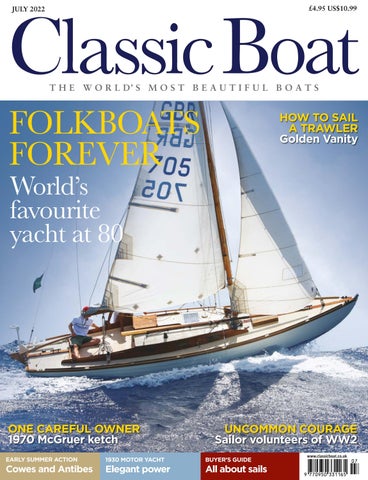
FOLKBOATS FOREVER
HOW TO SAIL A TRAWLER Golden Vanity
World’s favourite yacht at 80
ONE CAREFUL OWNER 1970 McGruer ketch EARLY SUMMER ACTION
Cowes and Antibes
1930 MOTOR YACHT
Elegant power
UNCOMMON COURAGE Sailor volunteers of WW2 BUYER’S GUIDE
All about sails
www.classicboat.co.uk
I NTERNATIONAL B OATBUILDING T RAINING C OLLEGE LOWESTOFT
EST 1975
TRAINING BOATBUILDERS FOR FIVE DECADES ...AND STILL GOING STRONG www.ibtc.co.uk
courses@ibtc.co.uk
01502 569 663
STEFFAN MEYRIC HUGHES, EDITOR
PLOT NUMBER EIGHT: ETERNITY
PAGE 23 FOLKBOATS FOREVER PAGE 24
According to the 2004 book by Christopher Booker, The Seven Basic Plots: Why we Tell Stories, there are only seven plots. God knows how many caveats the author drowned in, or if he came to blows with those who quite fervently maintain that there are 3, 26 or 36 plots. It’s a matter of sensitivity in the end, how much detail you tune out in order to broaden genres. If, however, we take it as playful sophistry, these seven plots relate perfectly to classic boat ownership. The seven plots are these: Overcoming the Monster; Rags to Riches; The Quest; Voyage and Return; Comedy; Tragedy; Rebirth. We’ve had ‘em all in these pages over the years, altered respectively to Overcoming the Keelbolt; Riches to Rags; The Quest (wooden boat ownership); Voyage and Return (of course); Comedy (see Keelbolt); Tragedy (See Riches to Rags). As for Rebirth, it’s our stock-in-trade, as in all magazines like this, from classic cars to house renovation. But both our lead boats in this issue – Cuilaun and the Folkboat – represent a new, eighth plot. I’m calling it Eternity… So Far.
COVER PHOTO: SANDEMAN
ISSUE No 409
CONTENTS
classicboat.co.uk Jubilee House, 2 Jubilee Place, London, SW3 3TQ
COVER STORY
EDITORIAL Editor Steffan Meyric Hughes +44 (0)203 943 9256 steffan@classicboat.co.uk Art Editor Gareth Lloyd Jones Group Editor Rob Peake Publisher Simon Temlett Publishing Consultant Martin Nott ADVERTISING Andrew Mackenzie +44 (0)207 349 3779 andrew.mackenzie@chelseamagazines.com Advertisement Production Allpointsmedia +44 (0)1202 472781 allpointsmedia.co.uk Published monthly ISSN: 0950 3315 USA US$12.50 Canada C$11.95 Australia A$11.95 PUBLISHING Managing Director Paul Dobson Director of Media James Dobson Chief Financial Officer Vicki Gavin Group Sales Director Catherine Chapman Head of Sales Operations Jodie Green Publishing Consultant Martin Nott
Subscription and back issues
Tel: +44 (0)1858 438 442 Annual subscription rates: UK £75 ROW £87 Email: classicboat@subscription.co.uk
Online: www.subscription.co.uk/chelsea/help Post: Classic Boat, Subscriptions Department, Tower House, Sovereign Park, Lathkill Street, Market Harborough LE16 9EF Back Issues: chelseamagazines.com/shop/
The Chelsea Magazine Company Ltd Jubilee House, 2 Jubilee Place, London SW3 3TQ +44 (0)207 349 3700 chelseamagazines.com ©Copyright The Chelsea Magazine Company 2020 all rights reserved ISSN 0950-3315
Follow the Classic Boat team on Twitter and Facebook THE
CHELSEA
MAGAZINE
COMPANY
LTD
Classic Boat is part of the Chelsea Marine Magazines family, along with our other monthly titles
4 . ONE CAREFUL OWNER The ketch Cuilaun, built in the sunset of wooden yacht building and immaculate today 12 . VOILES D’ANTIBES The season in the Med is open 14 . COWES SPRING CLASSICS Back where it belongs, in spring COVER STORY
24 . FOLKBOATS FOREVER The world’s most popular and influential cabin yacht is 80 this year 38 . DEBBIE PURSER A life in charter and sailing – and now boatbuilding too 40 . BOOKS ROUND-UP The latest releases in marine publishing
For cruising and racing sailors
42
DEBBIE PURSER
UNCOMMON COURAGE
COVER STORY
42 . UNCOMMON COURAGE The yachtsmen who helped Britain win the war at sea COVER STORY
48 . HOW TO SAIL A GAFFER It’s back to basics aboard the powerful Brixham trawler Golden Vanity 54 . AMERICAN BEAUTY The 1930 motor yacht Cielito 60 . GUIDE TO SAILS Not sure where to start? Read this 66 . TOM CUNLIFFE The power of luck REGULARS
To subscribe, chelseamagazines.com/marine
4 38
CUILAUN
16 32 34 36
. . . .
TELL TALES SALEROOM OBJECTS OF DESIRE ADRIAN MORGAN
48
HOW TO SAIL A GAFFER
38 . CLOSE QUARTERS 66 . TOM CUNLIFFE 78 . LETTERS 82 . STERNPOST
54
CRAFTSMANSHIP
70 . YARD NEWS 74 . YARD VISIT 76 . BOATBUILDER’S NOTES
CIELITO
Tom Cunliffe
Jonah’s luck PAGE 6 6
CLASSIC BOAT JULY 2022
3
TIMEWARP KETCH The McGruer yacht Cuilaun has only had one set of owners since she was built over 50 years ago WORDS STEFFAN MEYRIC HUGHES
CUILAUN
F
PHOTOS ON THIS PAGE: C/O SANDEMAN YACHT COMPANY
rom time to time on British roads – more so in summer – you see a recent classic, like an Austin Allegro or Ford Cortina doing precisely 70mph in the middle lane. Piloting it will usually be a youngish man for whom the car is a modest entry to the world of classics, but just occasionally, the driver will be older and you know without having to ask that he bought the car new in the 1970s or 80s owns every receipt ever spent on it. Even in the automotive world it’s rare. In the world of sailing yachts, it’s unheard of. A few months ago, we ran the story of the 47ft (14.3m) ketch Rinamara, the last yacht designed by James McGruer of the prolific Scottish family yard that designed and built so many yachts, but who became best known for racer/cruisers, including the ‘cruiser eights’. Rinamara’s launch in 1968 was perilously close to the end of the wooden boatbuilding era, but there was about to be a postscript. By 1969, man had landed on the Moon and Robin Knox-Johnston had sailed his ketch Suhaili non-stop and solo around the world, claiming ocean sailing’s last great exploratory prize. The glassfibre Westerly Centaur had just launched at the London Boat Show; change was in the air. Nonetheless, James McGruer’s son George had taken over the family firm that year, with its proud and long history of wooden boatbuilding, when Irish sailor Michael O’Flaherty ordered a 55ft ketch. Michael and partner Brian Smullen had started with a Folkboat before graduating to Namhara, one of James McGruer’s popular 8-M cruiser/racers – the so-called ‘cruiser eights’ – so they were already familiar with James and George McGruer. In the autumn of
6
CLASSIC BOAT JULY 2022
Above: Launch day in 1970, with builder and owners Below: Under power soon after her launch and a view of the saloon as it was in 1970, complete with brown glass ashtray
1969, the build of Cuilaun of Kinsale – today just Cuilaun – began. “First I saw of her was when they dropped seven tonnes of lead into a hole in the floor!” remembers Brian today, who is now sole owner of the boat, after the death of Michael in 2018. “I remember the drawing was lofted out in chalk on the black floor, and George would roam around it at night, chalk in hand, altering it here and there. It was his first boat. Next morning, the foreman would come in and shout “that bloody George has been at it again!”” Nine months later, Cuilaun was finished, built in teak planking on frames of afromorsia, silicone bronze fastened, and finished to the highest standard. “It was a dream commission for George,” says his wife Dorothy today. “Cuilaun was the best of everything. George even went over to Ireland for a week to discuss the build with Michael beforehand.” She was launched in 1970, an era that must have felt like a new world, but carvel planked, continuing the tradition of ship and boatbuilding that began millennia before. About the only concession to modernity in her fundamental make-up were the frames, which were laminated rather than grown – that and the angularity of the windows in the cabin trunk. Two near-sisterships followed over the next three years: Talisker Mhor (originally Ceresio) and Border Legend (originally Glory B IV). All three are still sailing today as, of course, is dad James McGruer’s last yacht – Rinamara. Today, at least one commentator has called this trio, perhaps the last traditional yachts built in Britain until the classic boat revival a couple of decades later, “among the finest yachts ever built at this
PHOTOS ON THIS PAGE AND OPENING SPREAD: TIM WRIGHT, PHOTO ACTION
This page: Racing in the blue swells of Antigua. Note the mizzen staysail. This and the spinnaker are in green, orange and white, after the Irish flag
CLASSIC BOAT JULY 2022
7
CUILAUN
size”. Iain McAllister, Scottish yachting historian and these days broker, has a good familiarity with the McGruer yard and notes that the McGruers had responded to the desire for yachtsmen after the war admirably: “Through the 1950s and 60s, British yacht designers found various solutions in appeasing their clients’ post-war demands for greater comforts and space by increasing hull volume while trying to keep an eye on looks. Arguably it was James McGruer who achieved the greatest aesthetic harmony in this task by gaining volume via the American norm of increased beam. When James’s son George stepped up to the drawing board, he inherited a wonderful provenance of well-proven excellence for inspiration.”
ALL PHOTOS ON THIS SPREAD: C/O SANDEMAN YACHT COMPANY
A TRUE CRUISER RACER
8
What followed for Cuilaun was a half-century of very enthusiastic ownership that saw the boat cruise to the Med and back and forth across the Atlantic so many times that Brian has lost count. “Fourteen… maybe sixteen” is as close as he gets. Some of these transats were double-handed by the two owners, although most were with friends crewing or, on the odd occasion, “a hired deckie”. The ability to double-hand a yacht this size when needed was the main consideration behind the ketch rig, a set-up that divides sail area into more manageable sections. In the case of Cuilaun, that figure is usually four: main and mizzen, mizzen staysail that gives another half knot in the right conditions, and a choice of various headsails from jib all the way to spinnaker. Originally these were hanked on, but the boat’s steady modernisation over the years has included
CLASSIC BOAT JULY 2022
This page: The interior, modernised but with original furniture. Note the mahogany battens running inside the hull. These were a McGruer feature, that allows air circulation and a view of the frames, but with more comfort than leaving the inside of the hull completely bare
a powered furler on the forestay – what Brian calls a ‘geriatric jib’. Another advantage of the ketch rig is its ability to steer a yacht, something that has not only negated the need for a windvane, but saved boat and crew from disaster once, 300 miles west of Portugal when the rudder broke. “So long as the wind blew, we were able to steer her,” remembers Brian. “And the wind did blow, so we made it home on the mizzen.” As befits Cuilaun’s cruiser/racer pedigree, the boat has won her fair share of races as well as proving to be a comfortable, reliable cruising yacht. These have included a win in Class 3 in the 1979 transatlantic race from Marblehead to Cork, another class win at Antigua Classic in 2005 and the overall win at Panerai Classics Week on the Solent in 2017, a year after competing with success in the RORC Caribbean 600. It was in Antigua, in fact, that Brian remembers an encounter with Elizabeth Meyer, the American sailor who rescued Endeavour and reignited the J Class. She was chatting to Michael, Brian and the Irish crew while various of her entourage were tugging metaphorically at her sleeve to draw her away to dinner somewhere. She finally exploded “Oh fuck off! I want to stay with the Micks!” Then there was the Retired Skippers’ Race in Castine, Maine in the 1990s. “It was a pursuit race – great fun,” says Brian. Here Brian and Michael met Olin Stephens – “a helluva nice fellow”, sailing Dorade. “It blew like old boots and we beat him!” After countless sea miles and 52 years of ownership, it is the moments cruising that are most vivid in Brian’s memory. Most were joyful, some tinged with fear. There was a time on the Chesapeake Delaware Canal when
LAK II
Clockwise from top left: The large windows let a lot of light in; Deep, wellequipped cockpit for globetrotting; The mizzen sail is sheeted to the aft deck; Clock and barometer; Portlights in the hull are, like everything on Cuilaun, kept in tip-top condition; The deck is swept timber on a plywood subdeck
CLASSIC BOAT JULY 2022
9
CUILAUN Brian stepped ashore, left the boat, looked back and saw she was a full 4in (10cm) down on her waterline. “I rushed back in a panic, and tore the sole boards up. I was terrified. But there was no leak. The canal water was too fresh to float her to her lines.” There was not one, but two near misses with boatyard fires. And Michael and Brian didn’t limit their cruising to warm climes like the Med and Caribbean. Brian recalls a time when they were in the tender, chipping ice of a huge Newfoundland iceberg for the evening G&Ts. They rowed away, and just moments later saw the whole iceberg capsize. It was in these cold, northern latitudes that they visited the town of Seldom-Come-By Tickle (‘tickle’ means short, narrow strait). “They had not seen a visitor in years! The party went on three days.”
KEEPING CUILAUN PRISTINE It’s not just sailing that has been done to the fullest over the last 52 years. Cuilaun has never been restored in that time, and that’s due to a constant, steady programme of maintenance and gradual modernisation. For example, in 2020, the cockpit sole and bearers were replaced, the navigation and electrics were seen to, some standing rigging was replaced, all portlights and through-hulls removed, serviced and refitted or replaced, some painting here and there and a complete rebuild of the engine, a Yanmar 4JH4THE. The year before that, it was a re-caulk of the hull and two new floors. 2018 saw an overhaul of electrics, propellor and chart table. In 2017 it was batteries, worktops, heads and sinks. The year before that, a deck re-caulk and coachroof redeck. 2015 was a repainted mizzen and complete strip back and revarnish. The year before saw all standing rigging replaced. You get the idea. Then there’s the bright finish, one of the most noticeable things about Cuilaun (her nickname in Maine, such is the time she has spent there, is “the varnished two-sticker”). This alone is the product of about 10 days’ work annually by a top yacht varnisher based in Antigua who visits Cuilaun wherever she is in the world, for a revarnish. Every decade or so, he strips all the varnish back to bare and builds it up again from scratch. Keeping Cuilaun looking as she does is not an easy – or cheap – task. Brian is not prone to dewy eyes when he talks about his life with Cuilaun, but the idea of passing her on must tug at the heartstrings nonetheless. The boat is now for sale through Sandeman Yacht Company – though not particularly urgently. “I’m still torn” says Brian. It would be lovely to think her next owner – whenever that may be – might keep for another half century.
10
CLASSIC BOAT JULY 2022
CUILAUN DESIGNED: George
McGruer BUILT: McGruer & Co, 1970, Clynder, Scotland LOA: 55ft (16.8m) LWL: 35ft (10.7m)
BEAM: 12ft
(3.7m) DRAUGHT: 8ft (2.4m) DISPLACEMENT: 20 tonnes SAIL AREA: 1,172 sqft (109m2)
Building the future classics
“
As proud Dutch yacht builders with a passion for perfection, we realize dreams that enter the history books.
Truly Classic 78 “Bontekoning” by Hoek Design, refit by VMG Yachtbuilders
“It’s in our DNA. We wake up in the morning, knowing it’s going to be another day of creating history. To us that is essentially different from building a boat. Our yachts not rarely outlive both their owners and their builders…” Tim van Daal, CEO at VMG Yachtbuilders
Grand Estime 62 “Misha” by Olivier van Meer Design, refit by VMG Yachtbuilders
www.vmgyachtbuilders.nl
info@vmgyachtbuilders.nl
(+31)228 322 352 part of
Logbook VOILES D’ANTIBES
Normal service resumes PHOTOGRAPHS JAMES ROBINSON TAYLOR After two covid years of being deferred until late summer (much like Cowes Spring Classics, overleaf), Les Voiles d’Antibes, first held in 1996, was back in its proper place as the starting gun of the Mediterranean classic yacht racing season. From 2-5 June, a fleet of 54 that included some of the world’s most famous classics gathered and, in mostly light winds, raced under thin, rustling billowing headsails, blue skies and sun. Establishment grandees like Cambria and Stormy Weather rubbed shoulders with newcomers like the 1929 12-M schooner Viveka, newly restored and winner of our award for best restored large sailing yacht this year – not to mention her class at Antibes. On the quayside and in the winding streets of old Antibes, there was a feeling of cautious cheer that the world might... just... be turning again. Winners in their classes were: Outsider, Viveka, Matrero, One Wave, Tigris, Arcadia III, Comet, Sagittarius and Scud.
2
1
4 5
3
12
CLASSIC BOAT JULY 2022
10
11
6
7
8
9
1 The bermudan class was a tight game 2 Torben Grael on the Bar Harbor 31 Scud 3 The ‘Fighting 40’ Chinook 4 Comedian Griff Rhys Jones of S&S yawl Argyll with crew from another S&S yawl, Manitou 5 S&S yawl Comet chases down the Nicholas Potter N-class yacht Serenade, built for violinist Jascha Heifetz 6 Viveka, bound for glory 7 The crew of Serenade 8 There were some windy moments, like this one, with Scud punching upwind 9 Racing in the P Class was close – sometimes alarmingly so! 10 Cambria with Antibe’s ramparts and old town in the background. 11 Voiles d’Antibes, est 1996 CLASSIC BOAT JULY 2022
13
Logbook
1
COWES SPRING CLASSICS
Spring in the step PHOTOGRAPHS CHRIS BROWN The fifth edition of Cowes Spring Classics held over the weekend of 20-22 May was back to its traditional spring date after two years of calendar hopping in the pandemic. The regatta, based at Shepards Marina in Cowes, started with the Mermaid Gin Welcome Drinks and Crew BBQ on Friday evening followed by two days of racing. Perfect conditions defied a forecast of low winds and the crews in bermudan and gaffrigged classes enjoyed four races over the two days in glorious Solent sunshine. The Saturday night dinner in the Sugar Store was enjoyed by nearly 100 owners and crew,
2
many of whom dressed to suit the age of their yacht. The overall winner was Whooper, Giovanni Belgrano’s 1939 Laurent Giles sloop, a popular result with four class wins. She was also the winner of the first Cowes Spring Classics in 2018. The Fife yacht Mikado won Class 2 (smaller bermudan yachts) and Step Back in Time won Class 3 (gaff). Best effort by a family-crewed yacht went to Sea Filly, while the Spirit of the Regatta trophy went to Sheba. 3
4
6 7
5
14
CLASSIC BOAT JULY 2022
8
14
9
10
12
11
1 Close action with Fife Mikado leading West Solent OD Suvretta 2 and 3 Whooper, overall regatta winner for the first time since 2018 4 Crew of gaffer Sea Filly celebrate 5 Glorious weather on both days 6 Bermudan cutter Maresta 7 Cowes Spring Classics welcomes classic yachts of all types and sizes 8 S&S Swan Scherzo leads My Dream 9 Ed Burnett-designed gaff cutter Ivy Green 10 Close-up action aboard Suvretta 11 Crew dressed to suit the age of their yachts for Sunday evening’s dinner 12 and 13 Whooper 14 Step Back in Time, winner in the gaff class CLASSIC BOAT JU.LY 2022
13
15
Tell Tales
Classic Boat’s address: Jubilee House, 2 Jubilee Place, London, SW3 3TQ cb@classicboat.co.uk Follow the Classic Boat team on Twitter and Facebook
SOLENT
Royal Lymington to host Folkboats The Nordic Folkboat nationals will be held in September at the Royal
dedicated team are putting together a fantastic week of social events
Lymington Yacht Club, which is celebrating its centenary this year, as
and activities to accompany the racing and a number of our Nordic
the Folkboat design itself turns 80.
fleet and club members have offered to host visiting international
Entry is open and registrations have been flooding in for the event, which comprises both the nationals and the 2022 Sessan Cup. Five days of racing are planned in Christchurch Bay from 17-22 September, amid a week of celebrations and social events ashore. Commodore of Royal Lymington YC, Phil Lawrence, said: “Our
Folkboat sailors during the regatta.” The event is sponsored by Spencers of the New Forest and supported by Yacht Havens, Walcon Marine, SoResource Management, Folkboats UK and the UK Folkboat Association. See rlymyc.org.uk/ folkboat-nationals-sessan and pages 24-30 in this issue.
Silhouette, 1910 SILHOUETTE 1910
Here’s a wonderful Fife yacht that is less known in northern European waters but is well raced in the Mediterranean circuit. Silhouette is a gaff-rigged 8-Metre gaff cutter designed by William Fife III and built in mahogany planks on oak frames in 1910 by Abeking & Rasmussen in Germany. Her first owner – she was launched as Woge IV – was Consul Otto C Ernst. Today she is a regular participant in the Gstaad Yacht Club’s annual Centenarians' Trophy, where she is helmed by the race organiser and Silhouette’s owner Daniel Heine. Daniel had the rig rebuilt according to the original plans, which were retrieved by
COPYRIGHT : ©JUERGKAUFMANN.COM
Duncan Walker, at the time of Fairlie Yachts.
16
The mast is Sitka spruce provided by John Lammerts van Bueren’s Touchwood company. She is on the list to attend Voiles d'Antibes this June, but not the Fife Regatta, which runs very soon after.
CLASSIC BOAT JULY 2022
TELL TALES
Tasmania ready for the big one The Australian Wooden Boat Festival will be held again after a
water. With the ongoing support of the state government, Events
two-year break, from 10-13 February 2023, on Hobart’s waterfront,
Tasmania and TasPorts, the festival has become “one of Tasmania’s
and registrations are now open.
greatest free events”. The organisers invite “wooden boats of all
The waterfront festival is held biennially over four days on the
shapes and sizes” to enter. Boat manager Roscoe Barnett has
Hobart Regatta long-weekend, with tens of thousands of visitors
already confirmed the attendance of 10 tall ships from Tasmania
and around 450 wooden vessels normally attending on land and
alone, with eight months still to go.
Young sailor bursary Young sailor Alanna Cameron has become the first recipient of a nautical bursary with its roots in the 1800s. The Nottage Maritime Institute in Wivenhoe was founded in 1896 with a bequest from Captain Charles Nottage, a successful racing yacht owner who employed
Uffa regatta all set
crews from the fishing and yachting communities alongside
The regatta celebrating the life and work of Uffa Fox, UF50, is ready to go ahead
improve themselves in navigation primarily, or make up
from 18-21 August in Cowes.
their deficient skills generally”.
Hosted by the Royal London Yacht Club, the sailing regatta will take place on
the river Colne in Essex. He wanted to create an institute “where yachtsmen and sailors could, if they desired,
The institute has newly created an annual Young Sailor’s
Friday 19 August and Saturday 20 August, and is open to all Uffa Fox-related
Bursary in the form of 50 per cent off any course within its
designs of dinghies, keelboats and yachts.
curriculum. “We’ve been teaching courses in many marine
These include but are not limited to Firefly, National 12, International 14,
subjects to thousands of people who sail the seas
Redwing dinghy, Pegasus, Albacore, Jollyboat, National 18, Flying 10, Flying
professionally or for pleasure for over 125 years,” said
Fifteen, Foxcub 18, Harrier 20 , Flying Fox, Foxterrier 22, Foxhound 24 and
Nottage Chairman, Richard Barnard.
Atalanta. The wider event will encompass a variety of activities, centred around Cowes
Alanna, became interested in professional sailing on the ketch Maybe before joining the Pioneer Sailing Trust in
Parade, which will host a static display of Fox-designed boats, and will also be
Brightlingsea, Essex. She plans to further her career in
the starting point of the Uffa Fox trail around Cowes and East Cowes, where
sail-training and has taken the RYA Yachtmaster course at
examples of his history and heritage can be seen.
the Nottage.
Fox lived from 1898 to 1972, a highly regarded naval architect as well as a
To apply for the bursary the applicant must be aged less
great sailor and character. The UF50 celebration was conceived by the Atalanta
than 26, and be working, or planning to work, in a marine
Owners Association, one of his designs.
environment.
See UF50.org
nottage.org.uk CLASSIC BOAT JULY 2022
17
TELL TALES
ITALY
Italian series under way The Italian classic boat racing series is underway after officials and participants gathered in Rome for the official conference and launch. The series is run by AIVE, the Italian Vintage Boat Association, which presented the 2022 regatta calendar at the event in Rome, comprising more than 15 regattas over the summer in the Tyrrhenian and Adriatic seas. Four seasonal trophies are up for grabs. Guests were welcomed by Giancarlo Lodigiani, the new president of AIVE and owner of Voscià, the 1959 Sparkman & Stephens yacht. The culmination of the season is the Viareggio Historic Sails Meeting in JAMES R. TAYLOR / PAOLO MACCIONE
October. “Finally a long season of regattas awaits us, which first of all has the aim of spreading the culture of yachting, a theme that has always been dear to AIVE”, declared Lodigiani, “and inaugurating it as new president on the 40th anniversary of its foundation is a great honour”. Participating boats are divided into three categories: Yachts Epoca (launched before 1950), Classic Yachts (launched between 1950 and 1975) and Spirit of Tradition.
See Britannia II up close The Classic Boat Museum in Cowes now has the boat that Sir Ben Ainslie and team raced in the last America’s Cup on show. Britannia II is the AC75 that Ben raced as INEOS Team UK (which has become INEOS Britannia for the next Cup in Barcelona in 2024). The British-led team took Britannia II – which drews gasps from onlookers when she was unveiled in Auckland in early 2021 for her radical styling, even among the other AC75s – to the final races of the Prada Cup, where they were beaten by the Italian team. The 75ft (22.9m) boat has top speed of over 50 knots and it will join the museum's eclectic mix of 89 boats that also includes the original BAR T1 (Ben Ainslie Racing) America’s Cup foiling catamaran, used as a test bed for the 2017 Americas Cup in Bermuda, again given by Sir Ben and team to the museum in 2018. Mark Mc Neil, Chairman of the Classic Boat Museum said: "Britannia
INEOS Britannia for this amazing donation.” Sir Ben Ainslie said: “Showcasing the historical legacy of the
II joins our wide range of historical breakthrough yachting exhibits and
America’s Cup is one of the goals of the Classic Boat Museum and we
will be a significant addition to the Boat Shed, allowing the museum
are delighted to again support them by donating Britannia II, helping
to showcase the history of the exciting development of foiling boats
bring the America’s Cup story to life and leaving a legacy for the
and the British America’s Cup story. I would like to thank the team at
generations to come.”
Photo winner Sailing photographer Robert Wilson bagged a national prize with this shot taken in the Royal Imperial Dry Dock Shipyard in Edinburgh. Robert won the the ‘still life and object’ category in the Association of Photographer’s prestigious Photography Awards. The judges said: “Robert’s photograph provides a very rare insight into the underside of the ship. In addition, the viewpoint the photograph was taken from showcases the structure and scale of the vessel as the measurement is literally painted on the stern. In addition, the colours contrast with the handwritten numbers used to identify areas for repair.”
18
CLASSIC BOAT JULY 2022
Collectors Sale
OTHER UFFA FOX CRAFT THYME Int 14 K523. The last traditionally built 14 made for Captain Porteous, Commodore of Tamesis Club in 1948, pictured sailing 1970. Newly varnished, nearly new mast and sails, plus spinnaker and spare suit. Still very fast inland. £3,000 ONO
The Uffa Fox Collection - Remember the Uffa Fox Regatta, Cowes 19-21 August HUFF OF ARKLOW - Flying 30 45ft overall. Planing Ocean Racer Newly Restored. 2 suits sails, spinnaker and genniker. Lying Portishead Marina. £75,000 ONO
Mid 30’s Int 14 Hull only by Uffa Fox in reasonable condition. POA 12ft Frostbite dinghy, either Runt or Squall as featured in Uffa’s books. Hull requires repair. Complete but no sails. POA
For restoration by Coastal Marine Holdings Ltd CARITANA One Design 22 square metre no 131. Newly restored with new trailer. Nearly new mast and sails. Excellent day boat. Accommodation for 2. Fast boat for classic regatta. £17,500 ono Edwardian 12 ft rowing dinghy. Newly restored and varnished. Rows like a dream. £5,000 ono
CHADRAK 22 square metre K3. Fast boat, new mast, good sails. Needs refastening and painting. £3,000 ono
We have a revolving collection of old sailing dinghies available fully restored or for restoration.
Call 01173 634 410 or 07402 095 236
Email andrew.thornhillqc@exchequerchambers.com
TELL TALES
Tollesbury small boats in the sunshine Tollesbury Sailing Club on the Essex coast
Mersea lugger Woodcock (joint second overall)
provided glorious sunshine and light winds for the
the show was stolen by Steve Johnson in his
Old Gaffers' Association's (OGA) first east coast
grandfather’s 1946 winklebrig Native WM1. She
event of the year. In addition to the delightful
was away like a shot at the starts and that was
flotilla of smack's boats that traditionally
the last seen of her in both races.
challenge the club’s small boats, newcomer
overall (5th and 4th) in the Brian Kennell-built
Wolstenholme-designed Gaffling 4.1 dinghies, also
Willow and honourable mentions also went to
joined the fleet this year. Helmed by Richard Ham,
Yvonne Mitchell in her scow Ermintrude (6th &
she was joint second overall after the two races,
5th) and Pete and Clare Thomas in their new,
which augurs well.
home-built smack's boat Eureka. The stunning
Despite the best efforts of trophy holder and
20
Eloisa Rule was the fastest smack's boat
Suffling, one of the OGA’s new Andrew
duo of smack's boats Pudding Faces and Ettie,
Tollesbury SC commodore Bing Weedon and
sailed by Ian Clark and father and son Wildridge
daughter Zoe in his Mersea winklebrig Fidget
respectively, ensured no one was lost at the
(honourable mention) and Phil Plumtree in his
back. Words and photos: Sandy Miller
CLASSIC BOAT JULY 2022
Your needs . . . Seagoing
Saildrives
Inland Waterways
Marine Generating Sets
Spares & Support
• Optional secondary domestic 12V alternator or 3.5/5.0 kVA travel power.
• 34 years of customer centred focus, listening to needs & delivering long term value solutions. • Specialists in customer advice & support at all points of a products voyage.
• A range of 14 to 56 HP heat exchange propulsion engines with 2 saildrive solution options.
• Superb after-sales service via our approved national & international re-engine centres and authorised dealer network.
• Heat exchange Generating Sets 4 to 58 kVA with or without super silent acoustic housings.
• Extensive range of 10 to 98 HP heat exchange propulsion engines with mechanical or hydraulic gearboxes.
• 5 year self-service warranty*.
. . . our tailored solutions *Recreational use, terms & conditions apply.
delivering reliability and peace of mind
www.betamarine.co.uk Tel: +44 (0)1452 723492 Email: sales@betamarine.co.uk
CORNWALL
Wharram Hui this summer The 'hui' (gathering) to celebrate the lives of James and Ruth Wharram will be held over the weekend of 23-24 July (with some leeway in case of bad weather). There will be a parade of sail out of Falmouth, following the catamaran Mana, which be moored at Customhouse Quay. All admirers of Wharram, who died in December last year, are invited to join the parade of sail, including monohulls and other multihulls. The ashes of James and Ruth will be scattered out at sea on the outgoing tide, remembering their first voyage out of Falmouth on Tangaroa in 1955, the pioneering voyage that started the global Wharram movement that still thrives today. The event follows the traditional boat festivals in Brest and Douarnenez earlier in July. Anyone attending Douarnenez ‘Temps Fête’ (14-17 July) will have a week to sail across to Cornwall to attend the Hui, weather permitting.
Lifeboat named after 1960s model The widower of 1960s actress and model Julie Alexander has named an RNLI lifeboat in her honour. Robert Breckman fully funded the £285,000 lifeboat in honour of his late wife, who was known for playing glamorous roles including Rosalie Dawn in The Pure Hell of St Trinian’s (1960), and other credits include Hello London (1958), Operation Bullshine (1959), Dentist in the Chair (1960), The Terror of the Tongs (1961) and A Matter of WHO (1961). The boat is stationed at Tower Lifeboat Station in London – the busiest of the RNLI’s 238 stations. The inshore Atlantic 85 RIB was christened Julie Poolie, Robert’s pet name for his wife. Julie and Robert were married in 1979 and she died in 2003. During the naming ceremony, some of Julie’s ashes – along with those of the couple’s beloved pet pug, Brian – were scattered by Robert into the River Thames, accompanied by several red roses cast by friends and family. Robert said: “This lifeboat is the best of its kind, I am assured of that, and the crews who will use it deserve nothing less. I’m happy that it will be joining the RNLI fleet and helping the RNLI’s crews keep the waters around NIALL DAWS
the UK and Ireland safe.” RNLI Deputy Chair Janet Cooper OBE said: “We are very grateful to Robert who, by funding this lifeboat, is allowing us to continue our vital lifesaving work – we owe a great debt of gratitude.”
Cowes Week advice for older boats Owners of elderly yachts intending to enter Cowes Week, which takes place from 30 July to 5 August, might be interested in a new video offering advice to regatta first-timers, as well as more experienced participants. The UK’s biggest regatta runs fleets for classic classes as well as cutting-edge IRC raceboats. The video has been put together by the Cruising Association, which sponsors one of the ‘cruising’ classes in the event, with Cowes Week. You can view it on the regatta website front page – web address below. Lucy Gray, Cruising Association General Manager, said: “We consulted with our members and lined up a pile of questions that are likely to crop up for new competitors.” In 2021, the Club Cruiser Class featured a broad range of designs including Folkboats, XODs, Flying Fifteens, Redwings, Solent Sunbeams (pictured) and others. cowesweek.co.uk
22 22
CLASSIC BOAT JULY 2022
SPECIAL SAVINGS WHEN YOU SUBSCRIBE SAVE OVER £25 OFF THE FULL PRICE $10.99
£4.95 US
2 ARY 202
FEBRU
£4.95 US$10.99
APRIL 2022
S OAT UL B UTIF BEA OST D’ S M L R WO THE
AST THE L UERr’s MCttGisR h builde Sco song swan
Beautiful boats
THE PRESENT
IC CLASS BOAT DS AWAR ats Best boyear of the
H 2022
MARC
TS BOA IFUL AUT T BE MOS L D’ S R O W THE
ST THE LDA R rvel WO e best ca
E
k icboat.co.u www.class
ER NG POW HOLDI
OWN UNKN ATION DESTIN
days .99 Sextant £4.95 US$10
42 test Hardy
BUT SMALLCT PERFE rker Fred Pa stored re p sloo
CB404
2
RY 202
JANUA
February
Cover
options.indd
“More fun than diamonds”
CLUB YACHoT album URGH ALDEB 0-year phot The 12
OKERS is AY HO GALW esign analys D
AG ast N PASS East Co AUTUM Th es ?atceContunurtry-yoltod gaffer Wr e v e d on il bu POWER HYBRID
Stunning traditional yachts,showcased through beautiful photography and expert editorial coverage
T H E W O R L D’ S M O S T B E A U T I F U L B O A T S $10.99
£4.95 US
l vice Vertica
05/01/2022
15:26
1
Expert advice
TS BOA IFUL AUT T BE MOS L D’ S R O W THE
t ic Boa Class RATES CELEB
35
STER ER, FA R, HIGHas king w FURTHE VESSEL speed RKING IC WO When HISTOR trawler
S
YEAR
30 SPIRIT World ive exclus st te t firs
RATOR G ILLUST SAILIN
r to wate Drawn CB405
March
Cover
PPEAL OW A ch SHALLmotor laun raught Low-d PAINT k icboat.co.u www.class
CES IN ADVAN
E MARIN
ish The fin
line
01/02/2022
10:43
Brixham
dd 1
optionsv2.in
R
TO X FACow ners
Why assics love cl
BORRNACE TO kes on st maxi ta ain Fir astnet ag the F RED IN RESTO
GER G LUG PLANIN
eed on at sp Traditi CB403
January
Cover
options.indd
BUL ISTAN
er bilt tend Vander
LEGENDARY S&S Running Tide returns
CLUB YACHoT album URGH ALDEB 0-year phot The 12
k icboat.co.u www.class
down Drilling
ALL
30/11/2021
UTILITY CHIC Do-it-all dinghy
THE FROZEN SOUTH Painting in Antarctica
L H STEE... BRITIS s on 50 year BITS T AUGER ABOU
15:06
2
LIVING ARCHAEOLOGY
Sutton Hoo ship CB406 APRIL Cover - final.indd 1
1 YEAR (12 ISSUES) SUBSCRIPTION TO CLASSIC BOAT £44.95 (USUALLY £70) Europe €79.95 | USA $99.95 Australia $149.95 | Rest of World £74.95
BIG
YACHTING PHOTOGRAPHER
Kos Evans
MIRROR FINISH
www.classicboat.co.uk
Varnishing tips
01/03/2022 11:19
SAVINGS
+deliFvReEryE
In-depth examination at a practical level with credible advice above deck and below
Stunning features
Featuring classics of all types, from J-Class yachts to traditional work boats and everything in between
Order your subscription today Subscribe online www.chelseamagazines.com/CCBO0722 or call +44 (0) 1858 438 442 (quoting code CCBO0722) Prices and discounts based on the regular subscription price of £70. If for any reason you’re not happy with your subscription, you may cancel within 14 days of placing your order.
Around the island or around the world… The Folkboat’s versatility over its first 80 years has made it the most popular and influential cabin yacht in the world
TIM WRIGHT/PHOTO ACTION
FOLKBOATS FOREVER
FOLKBOATS
T
he Folkboat is often referred to as the nautical equivalent of a ‘Volkswagen’– more specifically the Beetle of 1938 and its replacement in 1974, the Golf. Volkswagen means, of course, ‘people’s car’, a rallying cry for the democracy of mobilisation, which is why people liken the car to the boat, but it’s borne out in numbers too: the Beetle and Golf combined have outsold every other car in history, and similarly the Folkboat, whose story began in the fire of war just one year after the Beetle, has become the most popular cabin yacht of all time, and arguably the most influential too. The reason for the boat’s success is simple: versatility. The original brief for the Folkboat stems from the Royal Gothenburg Yacht Club who, in 1939, were looking for a new one-design class that would offer more room and beam than a Dragon, and offer cruising accommodation – of sorts – to a family. The boat had to be cheap and easy to build in large numbers, with the building materials specified as Nordic timber, with iron for the keel, in order to keep costs down. A month later, the Swedish Sailing Association (SSA), urged by shipyard owner and 6-M sailor Sven Sahlen, joined the initiative and announced a design competition that attracted 58 entries. None quite pleased the jurors, but the six entries that showed the most promise were awarded prize money, and the Swedish yacht designer Tord Sunden was brought in to collate the top four entries into one. The final plans for the Nordic Folkboat were published by the SSA in summer 1941 and build soon started in earnest, thanks to an order for 60 boats by Sahlen, to kickstart the class. On 23 April, 1942, the ice had melted from Gothenburg Harbour and the first Folkboat slipped from its builder, Arendal Shipbuilding, into the sea.
FROM PLEBIAN TO MASTERPIECE What had been created was a simple bermudan sloop of 25ft 10in with a decent cockpit and tiny cabin. Many traditionalists turned their noses up at it – one Norwegian commentator at the time called it something like ‘plebian’ – for its simple raked transom and bermudan rig; but enthusiasm soon built around its seaworthiness and cruising ability. These days of course, with 5,000 or so afloat, the Folkboat has cemented its place at the high table of yachting history. It was a (British) Folkboat owner – Colonel Blondie Hasler – who founded singlehanded ocean racing in 1960, with the first OSTAR. He raced across the Atlantic solo aboard his Folkboat Jester, modified for junk rig. Later Folkboats have sailed around the world, first under Ann Gash, from 1975-7. As for transats, there are too many to list, and in terms of sailing around the cans, they have had more success than history can record. Back in our October 2015 issue, our late technical editor Theo Rye called it a “masterpiece”. “Designing a small yacht, especially one with pretensions to cruise as well as race, is probably one of the hardest commissions for any designer,” he wrote. “To make it habitable, safe, reasonably fast, well-mannered and elegant (even 26
CLASSIC BOAT JULY 2022
Previous spread: Nordic Folkboat Norema sailiing at Antigua Classics in 2015 Above: Construction, aerial and sail plans of the original Nordic Folkboat Below: The very first Nordic Folkboat, seen here saling in the Baltic in the early 1940s Facing page: A Nordic Folkboat in its natural habitat, cruising the Stockholm archipelago Inset: Interior of a British Folkboat
pretty), but only 25ft (7.6m) long, is the work of genius.” Those who remember Theo’s columns will know he was not generally given to superlative talk. “The hull design,” he continues, “approaches perfection. The sections show a flare to the topsides for their whole length; a difficult trick to marry to a nice sheer, but achieved here. The freeboard looks perilously low, especially on the Nordic version, but the boat is remarkably dry, even when pushed hard. The flare in the sections means the waterline beam when upright is modest enough for decent light-airs speed, but as the hull heels it rapidly gains stability, aided by a very healthy ballast ratio (well over 50 per cent in most versions). She is also tolerant of added weight; a good attribute in a pocket cruiser, especially one capable of crossing the Atlantic or more, so even quite reasonably equipped boats look and sail perfectly well. The firm tuck of the bilges leading into nice, slim keel sections
LAK II NORDIC FOLKBOAT DESIGNED
Tord Sunden, 1941 LOA
25ft 1in (7.6m) BEAM
7ft 2in (2.2m) DRAUGHT
3ft 11in (1.2m) SAIL AREA
258sqft (24m2)
CLASSIC BOAT JULY 2022
27
help generate good lift (in relative terms) from the long keel, which is a key to good sailing performance. The shape owes precious little to rating rules, only hydrodynamics; you pay for that bold forward overhang in accommodation or waterline length, maybe, but driving into any sort of sea you’ll be glad of that bargain.” That bargain applies to beauty too: eight decades after the yacht was considered plain and utilitarian, the Nordic Folkboat was voted by our panel of experts as one of the most beautiful yachts of all time in our
TIM WRIGHT/PHOTO ACTION
FOLKBOATS
Above left to right: Tord Sunden; Nordic Folkboat Norema at Antigua in 2015
400th issue. But you pay for that beauty in the cabin, which sports a vee-berth forward, with a bucket and chuck-it between the bunks, a small chest of drawers, and not an awful lot else besides. Not everyone was glad of that bargain, as it turned out, and in Britain, boatbuilders started to offer their own versions from the 1950s onwards. The ‘British Folkboat’ as it became known, was a carvel-hulled boat built on the same lines, with better cabin accommodation, but it was at the expense of the fabulously svelte look of the Nordic.
Folkboats round the island If you want to win the historic Round the Island Race, you need the right boat. History relates that the overall winner will generally come from IRC Division 3D or IRC Division 0. If you have a spare £200,000, you might buy a used TP52 and race in Division 0, but less than a tenth of that will get you a Folkboat to race in Division 3D with at least as good a chance of success. After 80 years in existence, the Nordic Folkboat stands as the most successful design in the history of the Round the Island Race (RTI). As Nordic Folkboats across the Solent and around the world gear up for the 2022 Sessan Cup and UK Nationals, both at the Royal Lymington YC in September, all eyes will be on Folkboat performance at this
at Woodnut’s in Bembridge in 1947, with a different rig
year’s RTI on 25 June.
that technically made her a British Folkboat. She still sails
The first Round The Island Race, organised by the Island Above:
had 25 entries and the winner was one of the smallest
Crackerjack (left)
boats in the fleet; a 22ft Cornish fishing boat named Merry
and Maedlaine,
1950s. Cyra, owned by the Lloyds yacht surveyor Jim
Conceit. This result clearly set a precedent for smaller
respectively the
Saunders, who went on to become the first UK class
boats to take prevail in the race.
outstanding
chairman, won the Gold Roman Bowl (the prize for overall
boats in the
winner of the RTI) in 1958 and again in 1963. Fenya, a
resumed in 1946, the Folkboat had risen from the ashes of
Folkboat and IRC
Nordic, won in 1962.
war, ready to take on the world in the… relatively… peaceful
classes in the
pursuit of yacht racing.
history of the
him post-war on a ration book in the Hamble, won the
Round the Island
Gold Roman bowl in 1994, skippered by his son Malcolm
Race
Donald and again in 1999 skippered by his grandson Ed
By 1939, the RTI fleet had grown to 80. When racing
In 1948, the first British Folkboat emerged victorious in the RTI. Katrina was a clinker-hulled Nordic Folkboat built
28
in Weymouth under an IRC handicap and is as competitive
Sailing Club, was run on 11 July 1931. This inaugural race
CLASSIC BOAT JULY 2022
today as she was over 70 years ago. The first carvel-hulled British Folkboats were built in the
Ted Donald’s British Folkboat Celia Mary (FB39), built by
EMILY HARRIS
LAK II
These days, the racing and cruising fraternities are largely separate and the fleet is growing, in terms of numbers in use if not significantly in overall numbers. The scene is expanding in Estonia and Finland and still very strong in its most popular nation, Germany, which can boast 455 boats in 13 fleets; in fact, 113 of these can be found on a single lake in Berlin. Sweden’s Folkboat fleet is in a decline caused by the country’s adherence to wood, as Simon Osgood, secretary and treasurer of Nordic Folkboat International Association puts it. Denmark is still strong. “They are cracking the
Tord Sunden, frustrated by his lack of accreditation for the Folkboat’s design (he died in 1999 after a lifetime of unsuccessful legal challenges), came up with the carvel-effect GRP International Folkboat in 1966 and, a decade later, the Marieholm 26 and other derivatives. The Stella and Contessa 26 are other well-known boats based on the hull. The Folkboat itself hadn’t thrown in the towel though – far from it. In 1976, the class allowed a clinker GRP variant, far ahead of most other classes, many of which are suffering those growing pains now; and in 2000, aluminium masts were introduced.
Above right:
Donald. The Donald family have won the Gold Roman Bowl
Above left to
four times in two different Folkboats, compared to the
right: A fleet of
undoubtedly been GBR 707 Madelaine, sailed by Ed
oft-quoted record holder ex-PM Ted Heath, credited with
Nordic Folkboats
Donald. Remarkably, Madelaine has won the RTI twice in
four wins in three different Morning Clouds. In fact, Ted
racing in the UK
the last 16 years (2007, 2014) and finished second on five
Heath did not sail in the first two. The most frequent
Nationals
occasions. Madelaine has been in the top five finishers in 10
Viking Bird is one of the most attractive of the British Folkboats, adding accommodation while preserving great looks with a stepped coachroof
The most outstanding Nordic Folkboat under IRC has
winner is the Rogers family’s Contessa 26 Rosina of
of the past 16 years. Unfortunately, in 2016 she lost her
Beaulieu which has won three times (2002, 2003 and
mast off St Catherine’s point, while under spinnaker, and in
2006). The Contessa 26 is a development of the Folkboat.
2020 there was no RTI due to covid.
Periwinkle became the first pure Nordic Folkboat to take
Within the Folkboat Class, the outstanding boat is
the Gold Roman Bowl in 1991 when Peter Bainbridge took
GBR718 Crackerjack, followed closely by GBR652
first place in a fleet of 1,300 boats on Channel Handicap
Stralende.
System. Eight years after that, the RTI adopted the IRC (International Racing Certificate) handicapping system. Folkboats can also enter in their own class but are not eligible for the overall prizes. To enter the RTI under IRC, it is necessary to conform to Category 4 safety requirements. This involves the fitting of stanchions and lifelines, which puts off many Nordic owners who are loath to drill holes in their decks. Most Nordics therefore enter in the Folkboat Class, racing as a one-design rather than under IRC. Under the IRC handicap Div 3D, the Nordic Folkboat has been an outstanding competitor in the RTI. In the past 16 years, Nordic Folkboats have won the RTI outright on four occasions. They have been second seven times. The Contessa 26 comes a close second and the International Folkboat has also performed well. Both designs are derived from the original Nordic Folkboat. CLASSIC BOAT JULY 2022
29
FOLKBOATS
generational thing,” Simon says. “Everyone in Scandinavia has known a Folkboat. The grandparents or parents had one, and now the third generation is coming in. In Denmark, there are at least 10 boats now owned by the 26-32 age group.” The San Francisco bay area, home to a fleet of woodies, is “holding its own” and the small Dutch scene of around 22 boats is recently reinvigorated and growing fast. There are around 90 in the British Isles, but introduction of the British Folkboat has prevented the true Nordic boat from becoming as popular as it might have been. You can still buy a new Folkboat in GRP. The builder today is Haubold Yachting in Berlin. They build one every six months or so, which is a trickle in the waterfall of Folkboats worldwide, but this is mainly because the used market is so well developed that there’s little reason to pay the ‘sticker’ price on one. A good, wooden Folkboat might cost £5,000-£10,000
Above: Three Nordic Folkboats cruising the Stockholm archipelago in company Below: British Folkboat Viking Bird
and a GRP from £14,000-£35,000. The wooden Nordic will always be the epitome of the class, but the upkeep is a serious undertaking – “people tend to enjoy them for five or six years, then sell them – or they become family heirlooms, depending on how the owner takes to that” says Simon. And while the British variants have been derided for their dumpy cabin trunks, some versions are much more elegant than others – and that accommodation is a serious boon to comfort while cruising. Wichever variant, when you set the cost against the versatility of the boat, it’s quite probable that the fleet will continue to grow for the next 80 years. After all, there’s almost nothing you can’t do in a Folkboat– apart from put your trousers on maybe. The author would like to thank Simon Osgood, the Royal Lymington Yacht Club and the late Theo Rye for their research and insight into Folkboats.
International Folkboat Regatta 2022 The 2022 UK Folkboat Association International Regatta at the Royal Lymington YC will include the UK Nordic Nationals and Walcon Cup from 17-18 September and the Sessan Cup from 20-22 September. Five days of racing are planned in Christchurch Bay during the regatta week, along with a week of social events to celebrate 80 years of the Nordic Folkboat and the centenary of Royal Lymington YC. This is the first time the UK has hosted an international Folkboat event. Meanwhile, the Gold Cup – unofficially the world championship – will take place at Germany’s famous Kiel Week. Enter online: rlymyc.org.uk/folkboat-nationals-sessan. EMILY HARRIS
30
CLASSIC BOAT JULY 2022
2 Southford Road, Dartmouth, South Devon TQ6 9QS Tel/Fax: (01803) 833899 – info@woodenships.co.uk – www.woodenships.co.uk
84’ West Country Trading ketch built in 1904. Currently run as a very successful charter vessel under UK flag. Licenced under MCA to Cat 0 for 12 passengers, Class VI passenger licence and 50 ton cargo licence. Maintained to a very high level with fully up to date systems, a very rare opportunity to obtain a top class traditional charter vessel in ready to go condition. UK £599,000
44’ Max Oertx Bermudan cutter built in Germany in 1925. Pitch pine hull with new teak on ply deck in 2019. New bottom planking, ballast keel and keel bolts in 2013. New Lombardini 60hp diesel in 2007. Smart interior with 7 berths in 3 sleeping cabins. An eye catching yacht with an excellent classic regatta record, fast, elegant and extremely smart. Netherlands €175,000
52’ Philips of Dartmouth Motor Yacht designed and built by Philips and Son of Dartmouth in 1963. Lovely classic motor yacht built to Lloyds 100A1 and professionally maintained in present ownership with major 2019/2020 refit. Twin Perkins 6354 diesels. 8 berths in 3 sleeping cabins including with 2 ensuite heads. Very attractive and capable motor yacht in full sea going condition. Devon £190,000
62’ motor yacht designed by Archibald MacMillan and built by the Fairlie Yacht Slip Ltd in 1968. An elegant yacht built for a wealthy Scottish couple. Mahogany hull with solid teak decks. Aluminium superstructure. 4 sleeping cabins with 10 berths and 7’ headroom. Twin Gardner 6LX diesels with new 2021 generator. An excellent yacht with plenty of pedigree and class. Turkey
25’ Laurent Giles Vertue V40 built in 1951 for the Festival of Britain as an example of British boat building. Honduras mahogany hull. Yanmar 1GM diesel. 2 berths with heads and galley. Very smart yacht in excellent condition with a full inventory including a new all over winter cover. A lovely example of this timeless classic design. Devon £25,000
25’ Laurent Giles Vertue II built in 1979, the first example of this classic design built in GRP. Probably the best Vertue II, fitted out in teak joinery with a lovely finish. 2022 refit and upgrades to prepare her for extended cruising. November 2021 survey available. Surely one of the most capable and reliable blue water cruising boats afloat. Sweden £20,000
31’ Buchanan Viking sloop built by the present shipwright owner and launched in 1983. Larch on oak hull with sheathed decks. 2005 Beta 28hp diesel. 5 berths with good headroom throughout. The Viking is a relatively fast boat with shallow draft and comfortable internal space, an excellent cruising boat for coastal waters or further afield. Bristol £25,000
41’ Buchanan Cruiser Racer sloop built by Priors of Burnham in 1959 to Lloyds 100A1. In need of a refit, detailed September 2021 survey available with prices for the work required. Teak hull with lead keel and bronze bolts. 2018 Beta Marine 38hp diesel. 6 berths with 6’6” headroom. A very attractive yacht well suited to family cruising or classic regatta racing. Wales £19,750
Another fascinating selection of traditional and classic yachts only from Wooden Ships. Call for true descriptions, genuine honest values and a service from people who know their boats.
By Dave Selby
BONHAMS/CHARLES MILLER LTD
Saleroom
BONHAMS/CHARLES MILLER LTD
Nelson’s hair looms large As one of the first modern celebrities, Nelson would have been far
to confirm authenticity. Even on the day of his death, 21 October,
better off if he had had a commercial rights department to monetise
1805, his hair was shorn before his body was placed in a cask of
his image, for through his life and in the century after, the hero of
brandy to preserve it; and on the 200th anniversary of his death the
Trafalgar spawned a souvenir trade from which he and his
underwear he was pickled in was offered for auction with an
dependents reaped little reward. Though frequently beset by money
estimate of £300,000-500,000, but failed to find a buyer with
troubles, caused in part by the lavish lifestyle he maintained with
suitably ghoulish tastes.
Emma Hamilton, it’s quite possible his barber died a very rich man. Trinkets ranged from the tacky to tasteful and sometimes
Above Left to Right Tasteful: Wedgewood plaque made in Nelson’s
poignant and macabre, for to this day there is a roaring trade in
life time and after fetched £471. Poignant and macabre: extremely
tresses of his wispy hair, with enough on the market to stuff a
rare 1805 official memorial ring with hair insert made £31,800. Tacky:
Chesterfield settee; some has even been subjected to DNA testing
Mid-19th century Staffordshire death tableau made £1402
CHARLES MILLER LTD
RM SOTHEBY’S
Join the Jet-Zet Though jetskis are more politely known as “personal watercraft,” many CB readers will have coined fruitier euphemisms, among which “landfill” is one of the few that can be repeated here. When a Finnish woodworker got hold
CHARLES MILLER LTD
Race to the bottom While pond yachts often signposted the future – with fin-and-bulb keels long before they appeared on full-sized yachts and self-steering gear of the kind later used by Blondie Hasler’s Jester and Sir Francis Chichester’s Gypsy Moth IV – they also navigated down a nautical cul-de-sac with designs that were more extreme than anything produced in full size. One such is this c1895 pond yacht that took the briefly
of a 1980s Kawasaki jetski, he quite rightly scrapped the body, but upcycled the 50hp drive-train and turned a pest into a pert, wooden runabout with the panache of a mini retro classic. The delightful 12-footer (3.7m) was formed on a plywood hull with mahogany veneers on the topsides and deck of inlaid pine and contrasting mahogany planking. Such was the effort and attention to detail that on completion in 1995, builder Hannu Viren vowed: “I will not make another one. I don’t repeat it.” Weighing just 250kg, the one-off Jet-Zet is reputedly capable of 35 knots and Hannu was rewarded for his efforts when the mini jet boat sold, complete with trailer, for €31,200 at a Monaco auction.
voguish “plank-on-edge” craze for racing yachts of absurdly narrow girth, extravagant draught and barely feasible overhangs to new lengths. If this 5ft (1.5m) pond yacht were scaled up to the 144ft (43.9m) length on-deck of Nat Herreshoff’s radical 1903 America’s Cup victor Reliance, her draft would have been around 30ft compared to Reliance’s that while plank-on-edge designs were fast, they were equally adept at sinking. The advantage of this model, which sold for £434, is that you could recover it in a pair of chest waders.
32
CLASSIC BOAT JULY 2022
RM SOTHEBY’S
20ft and beam 3ft slimmer at a mere 23ft. The problem was
Yacht Restorers
© Emily Harris Photography 2021
Harbour Marine
Telephone +44 (0)1502 724721 Email info@harbourmarine.co.uk www.harbourmarine.co.uk HMS_DAVEY_CBNov21.indd 1
DAVEY & Co
16/09/2021 15:37
LO NDO N L I M I T E D ˚ E s t . 1 8 8 5
TRADITIONAL BOATBUILDING FITTINGS, TOOLS & MATERIALS T R AD E
M AR K
Telephone +44 (0)1206 500945 ˚ Email info@davey.co.uk ˚ www.davey.co.uk HMS_DAVEY_CBNov21.indd 2
16/09/2021 15:37
CLASSIC BOAT JULY 2022
33
Objects of desire DECK STEP This foldable teak dock step is made by East Passage Boatwrights in Bristol, RI, recent winners in the Classic Boat Awards. When collapsed it can be stowed in the tightest quarters on board. Watch a video of it in action on the East Passage Boatwrights website.
epbws.com
ANTIQUE TELESCOPE
No self-respecting yacht or dinghy should be without one. An antique ship’s telescope from the mid-19th century made by JP Cutts, measuring 8 inches closed, extending to 23 inches, with a 40mm objective lens giving 15x magnification. £240
scientificcollectables.com
DAVEY MASTLIGHT Davey and Co was founded in 1885, before anyone considered wiring a boat up for
Automatic by Spinnaker
the company’s classic mastlight now has a
Watches is as desirable as the
shore power 110/220v option. (12v and 24v
brand’s other models, this one
versions are still available too.) It is cast in
offering an impressive 300m of
bronze with a choice of finishes, or in
water resistance and a dual
anodised aluminium. The base is angled up
time bezel adding a different
10 degrees to aid the throw of light.
dimension of utility.
From £177
£265
captainwatts.co.uk
Spinnaker-watches.co.uk
To celebrate being the official timekeeper for the Round the Island Race, the family-owned Marathon Watch Company launched a limited edition Round the Island Race Marathon Stopwatch, shockproof, waterproof, nautical and able to deliver “precision timing to help competitors get across the start line in perfect time and reach the finish line ahead of the rest”. It has a unique design inspired by the race logo and can be ordered in time for the race on 25 June, via UKsales@marathonwatch.com £550
uk.marathonwatch.com/collections/round-the-island
CLASSIC BOAT JULY2022
The new Cahill 300
mains electricity, but this new version of
MARATHON STOPWATCH
34
SPINNAKER WATCH
This is a private collection being offered for sale. The boats shown here have all been professionally refurbished/restored and are now offered to the market to make way for the next project.
Delphi o.i.r.o £42,000 (No VAT payable) • 1960 30ft Starcraft. • Complete restoration 2020/21. • BSS expiry date April 2025. • Last surveyed May 2021.
Sambucca o.i.r.o £37,500 • 1957 craft which underwent an extensive refurbishment in 2017/18. • The original engine and gearbox were overhauled and tuned. • The electrics were completely rewired to modern standards. • Three new covers-forward,aft and overall. • Two new batteries installed. • laying in its own boatshed on the Norfolk Broads.
Skiffs o.i.r.o £8,000 • Undergoing major restoration with the replacement of a good deal of her hull, keel and transom. • Her age and builder we do not know. • 22ft double camping skiff (think Jerome K. Jerome and Three Men In A Boat) with two pairs of oars. • Cover mounted on the original hoops. • Revarnished and anti-fouled. • Lying ashore on the Norfolk Broads.
taylorsboats.godaddysites.com • lanceotaylor@hotmail.com
ARTISAN BOATWORKS CUSTOM YACHT BUILDERS
CLASSIC BOAT JULY 2022
35
CHARLOTTE WATTERS
Adrian Morgan
Putting a bung in it
one, although the idea of making a hole in your hull is quite alarming. Just be sure the bung is the kind of which they make stopwaters, tapered and driven in from the outside. Sally’s tender – a smaller, 7ft version of the Tippy, designed by John Westell for this magazine, that can be hoisted on the foredeck – has not so much a bung hole as a large screw hatch, like the flap on a planing dinghy, the logic being that when towed, if swamped, the water will drain rapidly out of the transom. And it works, as we found out off Ile de Batz in the days when Sally was based on the Hamble and summer cruises took us down Channel. The only other bungs I have come across were the ones you find close by sea cocks, of which Sally has a selection. Chandlers sell them in all sizes (at exorbitant prices), the idea being that should your bronze Stuart seacock shear, you can swiftly plug the hole with the appropriate sized wooden bung although chances are, Sod’s Law, the one you need is up forward by the Baby Blake. They used to be required on board yachts in RORC offshore races. Has anyone ever used a bung in extremis? And so back to my Dad in his Corribee Damnsel off Old Harry. Clinker dinghies could be hired by the hour in those days – it would have been the late ‘60s – no questions asked. Lifejackets? But almost certainly cumbersome, kapok and deeply un-cool. Dinghy certificate? Pah! Everyone knew about clinker boats from lazy afternoons on the Serpentine or municipal boating lake. No need to ask. Which would have been a good idea of the family of four, mother stolid in the stern sheets in summer frock and sunhat, father in shirt sleeves, kids up front just about balancing their ma in the back, and all now slowly sinking out there in Swanage Bay, water swilling around their ankles. It was early season and No 12 would still have been taking up a little as the boatman shoves them off the rickety pontoon by the Pier Head Cafe (demolished for holiday flats and a restaurant). “You might need to bale out,” he shouts. Which was what they were about to do when my father sees them waving. Turns out they had determined (with unerring reasoning) that by unscrewing the bung the water would flow out. As this had not happened and the water was in fact rising, they had agreed that before too long they would indeed all have to bale out, as advised...
The simplest device of all plays the most important role
O
h, the humble, classic wooden bung, that tapered bit of timber, rough-shaped cork or fancy bronze screw that stops water getting into a boat, and once removed, lets it out when it does get in: unless the logic gets muddled as my father discovered off Old Harry Rocks in Dorset, of which more later. We all have bung stories, as daft as his, or not. Mine was of a race at a regional dinghy championships, in Swanage Bay where I cut my sailing teeth, that I was miraculously leading at the first mark. Until Fesquie that is, when my yellow Laser began to slow – imperceptibly at first – before becoming more and more sluggish as water entered the bungless hole in the transom. I never again got so close to winning a major race; the disappointment has stayed with me ever since. Cleaning out the club dinghies the other day, we discovered a colony of mussels had taken over the aft buoyancy tank. I imagine they started as spat, and grew to a size that made it impossible to escape. Mussels surely need flowing water, so the bung must have been left open at some stage. Whatever, winkling them out involved micro surgery with a long screwdriver. Sally has a bung, but it’s only popped when she’s on the hard. Every wooden boat should have one, albeit hidden under layers of antifoul and Danboline. When the time comes to flush out the bilges you’ll find a bunghole a godsend, and if you don’t have one, bore
36
CLASSIC BOAT JULY 2022
“Every boat should have one, albeit hidden under layers of paint”
Barge Yacht JUNO - FOR SALE LOA: 17.83 m
LOD: 13.72 m
Beam: 3.96m
Draught: 0.81 m
Professionally built in 2000 and now for sale in superb condition with an impressive inventory of equipment.
For full details please visit: www.sailingbargejuno.com
Cleaners & Protectors Ask for AquaMarine at your local chandlery
www.aquamarineint.com AQM_Classic Boat_HalfPage_Advert.indd 1
31/05/2022 16:16
CLASSIC BOAT JULY 2022
37
DEBBIE PURSER
Downsizing
After years of big-boat charter and running a charter firm, it was time for Debbie Purser to discover the joys of dinghy cruising and boatbuilding WORDS AND PHOTOGRAPHY NIGEL SHARP
38
CLASSIC BOAT JULY 2022
I
t was in 1997 that Debbie Purser and her husband Adam Boat Building Academy in Lyme Regis which she had “wanted to first started doing charter work on board Eve of St Mawes, do for decades”. Whatever the situation regarding her own boat the first pilot cutter built by Luke Powell. For 20 seasons ownership in the future, this would at least allow her to do the they took turns (with each other and with other experienced maintenance herself but, as it happened, it also allowed her to sailors) to skipper Eve, taking charter guests on adventure sailing acquire another small boat. Although all the BBA students work holidays and running RYA courses. Soon after they started, their on all of the boats under construction, each boat is company Classic Sailing branched out by arranging sailing “commissioned” by one of the students who pays for its materials holidays on traditional vessels owned by others. But in 2016, by and then owns it afterwards. Debbie decided to become a which time they were working with 23 other boats, they decided commissioning student for another spritsail yawl based on a it was time to sell Eve. “We had done traditional Gorran Haven boat with the every sort of theme of voyage under the intention of running the two yawls sun and had had a really good innings,” together, with her and a couple of guests said Debbie. “And we thought it was on one, and more experienced guests time to just concentrate on selling sailing without an instructor on the sailing adventures for this amazing fleet other. The newer yawl was built of larch offering voyages to incredible places.” on oak and named Wild Boy. It wasn’t long, however, before The course fees and cost of materials Debbie realised that, after 25 years for Wild Boy more or less took care of mostly working outdoors, she was all the money Debbie had previously finding it hard sitting in front of a planned to put towards a bigger boat. computer all the time and she was However, part way through the course missing the sailing. So when she had the her father died and, with the inevitable opportunity to acquire a spritsail yawl sadness that came with that, so did a – built by Peter Williams in 2012 as a modest inheritance which allowed her replica of an 1882 Gorran Haven to think again. fishing boat – she jumped at the chance, As a result of this, she bought with the initial intention just to sail in Tallulah, another Luke Powell pilot her leisure time. cutter which he built in 2008. Once the When Covid arrived, vessels offering BBA course finished, in October 2021, overnight accommodation were badly Debbie had a very busy winter ahead of hit by the restrictions, but Debbie saw her, mainly in getting Tallulah ready for an opportunity to legitimately get over charter before the spring of 2022, but the rules and take people – just one at a also carrying out some much-needed time, or two if a couple – on wild maintenance to Outdoor Girl and “I did quite bit of camping expeditions. She wrote a Number 8, and putting the finishing recce-ing on a standcomprehensive protocol to allow her to touches to Wild Boy. up paddleboard” do so safely and legally, which basically With a hull length of 44ft, Tallulah is involved staying two metres apart at all a fair bit bigger than the 38ft Eve and Debbie Purser times while afloat and sleeping in has “a lot more headroom and masses separate tents at night. To do this she more space above and below decks.” had two small boats at her disposal – the yawl, now named But she was built for a couple and so Debbie has had to do some Outdoor Girl to reflect her new role; and a 15ft clinker punt conversion work to make her more suitable for chartering, called Number 8, also built by Peter Williams, which had been including fitting two extra berths in what was a large sail locker Eve’s tender and which Debbie and Adam had kept – and she forward and a new mate’s berth aft. formed a new company called Sail Row Explore. With four wooden boats on her hands, Debbie realises that she “In planning this venture I did quite a bit of recce-ing using a is “probably spreading myself too thin, but at least I’ve got the stand-up paddleboard to look for interesting, shallow places I flexibility whatever might happen with Covid or anything else.” could take the boats,” she said, “not only using charts and a In Tallulah’s first charter season, Debbie will concentrate on compass but also Google satellite images which identified charter work on Tallulah but plans to use one of the yawls to give possible camp sites, gaps in rock plateaus and littoral features small boat experience to any of the guests who are interested, but not included on charts. Part of the unique selling point was that in subsequent years she hopes to be able to employ a skipper for the trips were low-carbon adventures under oar and sail with no Tallulah so that she can also focus on taking people wild camping engine. By the end of summer in 2020 I was fully booked. on the small boats, all based in St Mawes. Everyone who came was just desperate to be outside.” Meanwhile charter bookings for Tallulah are coming in nicely. Throughout this period she had been trying to save money It is no coincidence that all but one of the nine pilot cutters built with a view to buying a bigger boat to replace Eve. But after by Luke Powell are being, or have been, used for charter work. realising that this was unrealistic, she decided that she would be “They are still great charter boats,” said Debbie. better off focusing on small boats. She then enrolled on the 40-week Boat Building, Maintenance and Support course at the See classic-sailing.com for more
CLASSIC BOAT JULY 2022
39
A round-up 0f the latest
BOOKS The latest releases in the world of nautical publishing are as eclectic as ever, from the memoirs of a marine engineer to art, travel, history – even some sailing! REVIEWS BY STEFFAN MEYRIC HUGHES
JAMES DODDS, THE BLUE BOAT BY IAN COLLINS Earlier this spring, we received this very lush hardback from Jardine Press, the name of artists James Dodd’s publishing arm. It starts in similar vein to River, Coats and Creek (left) – “Essex may be the most misunderstood of any English county; it is certainly the most maligned.” This time the subject of the book is James Dodds, who has carved his own niche through his portrayals of harbours and boats – the latter usually of the working sort and often in build. The book takes its title from one of James Dodds’ best-known works – a huge 2001 oil-on-linen
RIVER, COAST AND CREEK BY JUDITH ELLIS
painting of a clinker dinghy, the paining measuring 122 by 244cm. James, who was a boatbuilder before a painter, said: “It was just the sort of boat I had helped to build as a shipwright. Now I physically built it on the canvas.” It is typical of Dodds’ work in the sense that it is realistic, bright and bold,
Countless writers have
filled, as one commentator put it with the ‘luminous optimism’ that is his
been enchanted by the
trademark. The book itself, a large hardback of 171 pages, is gorgeously
Thames Estuary and the
produced, with the art that has made Dodds famous beautifully reproduced
Essex coast over the
over full pages and double-page spreads, while the text forms a thorough
centuries, so much so that
appraisal of both the artist and his work. It’s also very well priced for a book
barely a decade goes by
of this quality.
without a new chronicler
Pub Jardine Press, £35
attesting to its everchanging faces. The best
Conrad, and in more
THE DINGHY CRUISING COMPANION (2ND ED) BY ROGER BARNES
sailorly circles, Maurice
When the first Dinghy Cruising Companion
Griffiths is the best-known
came out in 2014, it was clearly an immediate
of the 20th-century
classic. Architect Roger Barnes is to dinghy
known of these have included Dickens and
40
laureates of the mud. Caroline Crampton’s recent story of
sailing what the apostles were to Jesus – all
the London River’s final reaches – The Way to the Sea
12 of them. His prime motivation in writing
– was a great addition to the canon in 2020, and now we
these books is to convince others of the joys
have this, which is specific to the Essex coast, as evidenced
of cruising in small, open boats, rather than
by its subtitle – An Exploration of Maritime Essex. It’s a
larger yachts, and the prose hums with that
personal history based on experience; the author first
restrained zeal. So, interwoven with the book’s
arrived on the Essex cast 30 years ago, in proper style on a
main preoccupation – the practicalities of
Thames sailing barge from Pin Mill. The history, which
dinghy cruising – are tales of the author’s own
starts when the Thames was part of the Rhine and the
experiences, mostly on the seas and rivers of northern France. Seemingly
footsteps found below low-water are 900,000 years old
everything is covered: choice of boat, fitting out, trailing, launching, sailing,
and predate homo sapiens, is the main focus, but the
engines, oars, navigation, overnighting, cooking afloat, safety and clothing.
author’s emotional involvement – as well as her attractive,
The book benefits from the author’s architectural flair, so alongside the
hand-drawn maps – make the book really readable. Here is
photos are hand-drawn diagrams to clarify many of the technical aspects
someone who is able to put her enchantment of this most
covered. The end product is a treatise on dinghy cruising, and a paean to its
mysterious, shifting landscape into lovely, flowing prose,
many virtues. If you cruise dinghies, you’ll want this book. If you don’t, but
and that makes River, Coast and Creek far more enjoyable
are considering it, then you need this book. This new edition contains
than many other local histories which in the past have too
updated information on electronic equipment and boats available to buy, as
often been dry, poorly-presented efforts.
well as new sections on capsizing and sailing in heavy weather.
Pub Red Heering, £16.99
Pub Adlard Coles, £16.99
CLASSIC BOAT JULY 2022
IN THE WAKE OF THE GODS BY SAM JEFFERSON
ADDICTED TO MORE ADVENTURE: RISK IS GOOD, ENJOY IT BY BOB SHEPTON
Our colleague Sam,
the islands and coast of Scotland, then from
editor of Sailing
England to the Canaries via Biscay and Madeira,
Today, and who often
and then make yet another cruise of Scotland in the
writes book reviews on
cold and gales of autumn? The Reverend Bob
these very pages, has
Shepton, an ordained minister in the Church of
been quiet about this one, no doubt typing away in the
England, has been traversing the high seas and making first ascents of
cockpit of his Morecambe Bay prawner yacht as he sails the
formidable walls and peaks for more than 35 years. He was a climber first,
Greek islands, while the rest of us lead more ordinary lives
and when he began sailing he combined the two, just like the renowned Bill
among hedges and roads. He’s been so quiet, in fact, that this
Tilman, the sailing and mountaineering legend of the early 20th century.
book only came to light just before we went to press. Of
Indeed, Bob has been awarded the Royal Cruising Club’s Tilman Medal
course, being biased, I’ll say it’s bound to be an excellent
twice. He has also been honoured with the Ocean Cruising Club’s Barton
book – Sam is everyone’s idea of the soulful sailor, in both
Cup (twice), and with climbing’s highest accolade, the Piolet d’Or. He was
appearance and demeanour, and he’s also the author of a
YJA Yachtsman of the Year in 2013. In 1995 Bob received the Cruising Club
number of previous titles, including Clipper Ships and the
of America’s highest award, the Blue Water Medal, for his circumnavigation
Golden Age of Sail; Gordon Bennett and Sea Fever, all
of the globe via Antarctica and Cape Horn aboard his 33ft (10m) fibreglass
histories. In this book, Sam follows the trails of Odysseus,
Westerly sloop Dodo’s Delight. But his high-latitude circumnavigation was
Hercules, and Jason and the Argonauts, retelling the classic
in some ways only the beginning of many years of adventuresome
stories from the well-known to the less familiar. The book is
voyaging. Most sailors know Bob today for his many sailing-to-climb
filled with photography and useful and practical pointers for
expeditions to the most isolated regions of the Arctic, often with the “Wild
pilotage and passage-planning, including prevailing winds
Bunch”, a group of first-class climbers and all-around intrepid people. In
and anchorages, so you too can voyage through the world of
2014, Bob wrote an absorbing book recounting many of these endeavours.
monsters and heroes.
Addicted to Adventure: Between Rocks and Cold Places, but he left many
How many people in their 86th year sail throughout
You must buy this book – and I must email the boss, so he
stories untold. Happily, this second volume fills the gaps, starting with
can alert his sleeper in Athens to either liquidate Sam, or at
Bob’s youth in North Africa in 1954 with the Royal Marines. Whether he’s
least bring him back to HQ in London, so I can ask him where
describing the frequent gales he and his young crew encountered on the
my favourite stapler went when he blew town.
long passage from Antarctica to Easter Island or the difficulties of landing
Published Adlard Coles, £20
climbers onto big walls from the deck of Dodo’s Delight in Greenland, Bob
DIESELS AFLOAT (2ND EDITION) BY CALLUM SMEDLEY AND PAT MANLEY
does so with humour, lightness, and understatement. Ellen Massey Leonard Independently Published, £15
curse them for their smell and noise, but nearly all sailing
IN THE TREACLE MINE – THE LIFE OF A MARINE ENGINEER BY JW RICHARDSON
vessels above a certain size have one, so you’d better know
John Richardson served as an engineer in the
something about them. Diesels Afloat, first published in 2007,
unbearable heat of ship’s engine rooms, as part of his
must have helped a lot of sailors get to grips with that
service in the Merchant Navy, starting in 1964 as an
terrifying thing under the companionway.
engineer cadet with Esso Tankers and retiring as chief
A diesel engine might not have the same allure as a big, backlit mainsail pulling hard off the wind, and many sailors
This second edition is just as clear,
engineer on the cross-Channel ferries in 1993. It will
starting with a brief history of the
delight petrol – and diesel – heads, from the very
diesel at sea, before going into
start, where the author tells us his car history while
different installations and their pros
studying dry subjects like ship stability and heat
and cons, then a guide to
engines in east London in the 60s under a series of
maintenance and troubleshooting
irascible or eccentric teachers. We quickly move to
that’s clear and well-illustrated, such
the first trip to sea, with its new challenges, including
that if you don’t do your homework
working and sleeping to a watch system, close calls in
in time, you might reach for this
the engine rooms, then the pleasures of foreign travel and adventure on the
book when it’s all going wrong at
blue oceans of the world. Steam heads, too, will enjoy the book, as steam
sea. It’s considerably more useful
was still common in the 1960s, before inevitably giving way to the diesel
than that other famous engine
onslaught in the 70s and on. The author’s recall is quite amazing, given the
guide – Zen and the Art of
vintage of the memories described here. And who hasn’t ever wondered in
Motorcycle Maintenance. Maintenance
awe at the magnitude of big ship engines?
Pub Fernhurst Books, £18.99
Pub Whittles Publishing, £16.99 CLASSIC BOAT JULY 2022
41
WINSTON MEGORAN
STEWART PLATT
UNCOMMON COURAGE
A cast of sailors and adventurers, from Dick Bogarde to Maurice Griffiths, played a vital role as volunteers in Britain’s war effort WORDS JULIA JONES
I
t was six years ago that I discovered the suitcase of my father George Jones’s papers which set me to researching his membership of the RNVSR (Royal Naval Volunteer Supplementary Reserve), also known as the Yachtsmen’s Reserve. I read about his prewar reconnaissance cruise to the Baltic aboard the Higley Halliday-designed motor yacht Naromis and I learned as much as I could about his wartime service. I published a small book, The Cruise of Naromis; August in the Baltic 1939 but I couldn’t stop. I seem to have been researching the RNVSR almost ever since. When Dad was finally demobbed in 1946 he returned to Waldringfield on the River Deben to join his older brother Jack. Dad set up the East Coast Yacht Agency (the Easy Cosy) which later became Interyacht. I was born in 1954 and by the mid-1960s we’d moved to the family farm in Essex. It’s only recently that I’ve come to realise how many of the figures from those early childhood years had also been members of the RNVSR. Many people say that their older relatives who served in the war didn’t want to talk about it. That was only partially true of my uncle Jack. He was Jack Francis Jones, naval architect; we learned never to refer to him as
a ‘yacht designer’ [feature in CB407]. He hadn’t been one of the first to rush into uniform. In September 1939 he was aged 24, newly qualified and working in Birmingham. He was also getting his first designs published and was absorbed in esoteric controversies over the metacentric shelf. His job in Birmingham was a protected occupation so he didn’t have to join the forces.
JULIA JONES
42
CLASSIC BOAT JULY 2022
DAVID COBB
Instead, he took over a column in Yachting Monthly, vacated when RNVSR members Maurice Griffiths and Norman Clackson were called up. There, he voiced contentious opinions under a pseudonym, then answered himself on the letters page. Jack could keep an argument running for months. “What a publicity hound I was in those days,” he wrote later. It couldn’t last. As Britain’s position, worsened many people, previously unconvinced, changed their minds and joined up. Jack was commissioned into the RNVR in January 1941 and was posted to a mine-laying group. For a while he continued writing letters to Yachting Monthly as he “bobbed about” Nore Command. In fact, this was dangerous work. In October 1941 he was injured in an explosion and spent three months in hospital. On recovery he was sent north to Fort William for training in motor launches (ML) at HMS St Christopher. Many of his companions were former yachtsmen who had joined the RNVSR in the pre-war years, offering their services “in case of emergency”. When the emergency had arrived on 3 September 1939, the Admiralty had seemed uncertain how to make best use of these volunteers. The motor launches and coastal motorboats that had proved so useful at the end of World War One had been disposed of and not replaced. Initially, most RNVSR yachtsmen had been sent to minesweepers and patrol vessels but there were men among them with additional experience as polar explorers, Olympic athletes and racing drivers. Jack’s name is often to be found in the same lists as the pre-war racing driver Peter MitchellThomson (Lord Selsdon), who had joined the RNVSR after the Munich Crisis. Cornish solicitor Robert Hichens, future star of Coastal Forces, also had pre-war experience as a racing driver as well as a dinghy sailor and RORC member. Once there were sufficient MGBs (motor gun boats), MTBs (motor torpedo boats) and MLs available for direct aggression against E-boats or clandestine missions to occupied Europe, these former yachtsmen, explorers and sportsmen were natural choices for command.
Above, left to right: Armed trawler in the war; Mark IV tanklanding craft off the Normandy coast on 6 June, 1944 (D Day); Fleet of MTBs Below: Annotated account of the Dieppe Raid by J Francis Jones Opposite: The Old Maltings, home to Francis Jones’ design studio and East Coast Yacht Agency, 1947
In March 1942, RNVR officers from HMS St Christopher had responsibility for most of the MLs which crept stealthily up the Loire to attack the Normandie Dock at St Nazaire. The loss rate among these wooden-hulled, petrol-engined vessels was horrific – only 3 of the 15 MLs survived – but the dock was put out of action and the operation counted a success. In August a much larger cross-channel raid, Operation Jubilee, was mounted against Dieppe. Jack was commanding RML513, a newly commissioned Fairmile B rescue motor launch, tasked with rescuing downed airmen. The operation was a disaster. As well as the 3,623 of the 6,086 men who were killed, wounded or captured on landing, the RAF lost 106 planes. RML513 helped rescue 47 RAF personnel and returned home riddled with bullet holes. A piece of shrapnel had passed through Jack’s neck, severing half his cranial nerves. The late Rev John Waller, rector of Waldringfield, used to claim that Jack had himself lashed himself to RML 513’s wheel to get her safely home. Whether or not that was so, this was a serious wound and left him in pain for the rest of his life.
CLASSIC BOAT JULY 2022
43
UNCOMMON COURAGE
Command of RML513 was taken over temporarily by the seafarer Alan Villiers while Jack spent another two months in hospital. Later in life he never hesitated to voice his criticism of the almost criminally inept planning for the raid. I inherited a copy of a history book heavily annotated with his condemnation of Lord Mountbatten, disappointment in General Montgomery and anger at the “callous attitude” of the Royal Navy. Jack remained in Newhaven, East Sussex, with Coastal Forces until summer 1943 when he returned to Scotland, this time for Combined Operations training in preparation for D-day. This was the period that he met 2nd Lieutenant Derek van den Bogaerde, posted there for a signals course. It was a significant relationship for them both, resulting in a lifelong friendship, though their lives diverged when Derek became film star Dirk Bogarde, and Jack returned to Suffolk and to yacht design. It was another of Jack’s post-war grudges that the state, which had been so ready to accept the possible sacrifice of his life in war, should threaten prosecution for people like him for their sexuality in time of peace. He made it through D-day unscathed, though his landing craft hit a mine on the run in to Gold Beach. The troops landed safely but two members of Jack’s crew were killed as they remained stranded on the beach trying to repair and refloat their craft. It was some days before they succeeded. Jack sent Yachting Monthly a somewhat incoherent account of events but never talked about it later. As a child I was an obsessive reader of Maurice Griffiths’ Ten Small Yachts. I was constantly horrified by his lack of loyalty to his boats so, on the rare occasions that I met him, it was particularly difficult to know what to say. I don’t imagine that he noticed. Griffiths had been called up early for service in HMS Vernon, the Navy’s torpedo school. Now that I’ve had the chance to research his duties there, I am amazed at his sang-froid in one of the most terrifying wartime arenas. Although Griffiths’ pre-war writing is atmospheric and emotive, The Hidden Menace, his account of his war service, is almost dull, though very technical. Perhaps being technical was the most effective way to cope. Griffiths writes, for instance, about his quest to select wooden-hulled drifters that would be sound enough to tow the heavy gear needed to attempt to trawl up magnetic mines for investigation, yet sufficiently old for it not to matter that they were being used for “expendable duties”, meaning in this case highly likely to be blown up, as had very recently happened with 44
CLASSIC BOAT JULY 2022
an HMS Vernon minesweeping trawler sunk and six men killed. One part of Griffiths’ war service that he never talked about (according to Dick Durham, his biographer) was the period of the Blitz during which he was involved in defusing unexploded mines dropped on the London docks. In The Hidden Menace he describes the groups of people with drawn faces lining the pavements and the way they raised a cheer when they saw the dark blue Navy van hurrying through. He mentions casualties among the HMS Vernon teams and admits he was glad to be sent back to his Mine Recovery Flotilla in Lowestoft, Suffolk, where he could “take his little trawlers to sea off his familiar East Coast and deal with mines that were under water.” He doesn’t say he was awarded the George Medal for his bravery. Maurice Griffiths wasn’t the only figure from my childhood who I’ve needed to reassess in the light of my recent research. I remember Norman Clackson, a very tall, very genial figure who I always felt rather glad to see as I reached up from my nine-year-old height to offer him a plate of Ritz crackers at an Easy Cosy office party. Imagine my surprise when I was reading His Honour Judge Ewen Montagu’s account of being a World War Two Intelligence Chief and discovered genial Norman Clackson had been helping him run a team of double agents. Ewen ‘The Man Who Never Was’ Montagu was an RNVSR member (as was Clackson). He was a KC, son of a Baron, a 1939 Fastnet race competitor in Latifa and winner of that year’s La Rochelle race in his own John Dory. Today he’s the man best known for Operation Mincemeat – all those things that would put him beyond my ken and make it perfectly credible that he should be managing double agents. But that my father’s friend Norman Clackson should have been aiding and abetting… if anyone reading this article knows more detail, please get in touch, I remain agog! A much closer family friend was Stewart Platt who many people will remember as president of the Cruising Association. (I hope they’ll also remember his beautiful gaff ketch Celandine, designed by Uncle Jack). Stewart was born in 1923 so was still at school in 1939. He was a keen young Sea Scout and dinghy sailor and by 1941 had found his way into the Royal Naval Patrol Service helped by a convenient error in his age. He was sent on anti-submarine warfare
C O R N WA L L DEVON I S L E S O F S C I L LY HEBRIDES & ST KILDA SCOTLAND
A DV E N T U R E sailing HOLIDAYS No sailing experience needed!
V E N T U R E SAI L Over 200 skippered voyages to choose from on a variety of unique boats available for solo travellers and private charters.
v e n t u re s a ilh o lid a y s . c o m WB_Display_Ad_6-21.indd 1
6/16/21 10:55 PM
CLASSIC BOAT JULY 2022
45
UNCOMMON COURAGE
STEWART PLATT, C/O VICKY PLATT
training with the tough Glaswegian crew of HMS Tuscarora, a Victorian steam yacht of a type often requisitioned for naval service. This was a culture shock for the 17-year-old from Leigh-on-Sea, Essex, but he survived and progressed first to HMS Ganges in nearby Shotley, then to HMS King Alfred for RNVR officer training. After this experience he was glad to be sent back to Lochailort in Scotland for Combined Operations training. He wrote later “the course was tough and included running up a mountainside before breakfast, as well as assault courses tacked onto more general boat-handling, navigation and types of landing craft. One was taught fighting at close quarters – how to creep up behind a sentry and cut his throat silently
Above: The late Victorian steam yacht Tuscarora Below: Christmas 1958. From left to right: Author’s mother June, brother Nick, the author, grandmother Edith and ‘Uncle Jack’ (Francis Jones)
and other such delights I am happy to say I never had to put into practice.” I remember Stewart as a mainstay of the local church and village community, a businessman, my best friend’s father, someone who I assumed had always lived a quiet, reliable life – how ignorant can one be? Aged 20 he had got his wish and was given command of a 186ft (56.7m) steel LCT (tank landing craft) with twin 500hp Perkins diesels heading for Gold Beach on D-day. It was blowing hard and vessels were being pushed to leeward. By the time LCT 879 reached Normandy, there was a clutter of drowned vehicles, Atlantic Wall obstructions and very little beach remaining. Platt didn’t hesitate; he let out his kedge anchor and ran in hard for the last scrap of beach. He describes the “almighty explosion” as he, like Jack Jones, hit a mine, blowing a large hole in the bottom of their ship. Undaunted Platt and his crew landed their invasion cargo and set about repairs. They then ran steadily backwards and forwards ferrying supplies across the Channel until the war’s end. I wish I’d known these things years ago, when my father and his friends were alive to be admired and thanked. But then again I assume that the purpose of their wartime effort was so that small girls like me could grow up thinking that the height of excitement was meeting the Platt family for a weekend in the Walton Backwaters and playing Monopoly with Uncle Jack at Christmas carried the authentic spice of danger. Julia Jones’s book, Uncommon Courage, is out now
JULIA JONES
46
CLASSIC BOAT JULY 2022
-
Brown Owl • £155,000 Dunkirk Little Ship ‘Brown Owl’ is a 42ft John Bain design, built in 1928 by J A Silver of Rosneath. She has been maintained to a high standard and has attended the ‘Dunkirk Returns’ since 1980. Brown Owl can sleep up to six and benefits from a warm air heating system throughout. She is equipped with full navigation equipment and her sale includes her flags issued during WW2. Available for viewing Teddington.
For further information visit: www.cymltd.co.uk Email: captainhook@cymltd.co.uk • Tel: 07966 578825
BOATBUILDERS
OF
BOATBUILDERS
THE THAMES ESTD
OVER
300 YEARS
. RESTORERS . BROKERS
TELEPHONE: 01628 824382 WWW.PETERFREEBODY.COM THAMES BOATHOUSES, MILL LANE, HURLEY, BERKSHIRE, SL6 5ND
CLASSIC BOAT JULY 2022
47
SAILING GOLDEN VANITY Fifty years ago she took on the OSTAR under Peter Crowther. Now, Golden Vanity is for all to sail. Modern yacht sailing instructor Clive Loughlin went to find out how she works WORDS CLIVE LOUGHLIN PHOTOS THE AUTHOR AND FIRST CLASS SAILING
GOLDEN VANITY CLASS
Mumble Bee class Brixham sailing trawler BUILDER
Sanders & Co, Galmpton, 1908 LOA
38ft 8in (11.8m) LOS
53ft (16.2m) BEAM
12ft 9in (3.9m) DISPLACEMENT
23 tonnes (gross) DRAFT
7ft (2.1m) HEIGHT
51ft 2in (15.6m) RIG
Gaff Cutter MAST
Douglas fir, hollow using bird mouth construction method BALLAST
:
Concrete, lead and pig iron HULL
Carvel Oregon pine planking over sawn oak frames with double futtocks
GOLDEN VANITY
D
espite having over 40 years sailing under my keel, and been a long-term subscriber to Classic Boat, I have never previously sailed a gaffer. All my time has been spent in dinghies and modern cruising yachts. It was not until I was offered the chance of a day’s sailing on Golden Vanity that I realised just how much I didn’t know. This article recalls my experiences on the day and I hope it will encourage others to grab the ratlines and step aboard.
WHAT’S THE DIFFERENCE? Most sailors will be familiar with modern sailing boats and how they are operated. This article aims to highlight the main differences that I found between a modern sloop and Golden Vanity – a 100+ year-old, gaff-rigged Brixham trawler. The first obvious difference is the rather bewildering array of lines that are used and the absence of winches, apart from a single winch at the mast.
BLOCKS AND TACKLES Blocks and tackles are used to provide purchase ratios that make the tasks manageable. This is just as well as everything is very solidly built! The blocks and tackles were a bit of a revelation to me, with many providing two and sometimes three different purchase ratios (3, 4 or 5 to 1). This includes lines without ‘gearing’ that are used to quickly haul in the slack, before a block and tackle applies necessary tension. Although the number of lines is great and the processes involved initially rather intimidating – everything has a reason and purpose and soon begins to make sense.
MASTS Modern sloops have a single mast that is held up by a forestay, port and starboard shrouds, and a single or split backstay. Golden Vanity essentially has two masts with the topmast fixed to the top of the mainmast. 50
CLASSIC BOAT JULY 2022
Left: Gaff and gaff saddle Centre: Raising the mainsail Right: Mainsail raised
MAINMAST The mainmast is supported by a forestay and port and starboard shrouds (three on either side), but does not have a backstay. The main mast is a very substantial hollow timber construction that passes through the deck and slots in to the keel (keel stepped).
TOPMAST The topmast is of much lighter construction and can be raised into position from the deck – although in practice it is left aloft and only lowered for maintenance. It is secured to the top section of the main mast and is supported by shrouds that lead to a spreader at the top of the mainmast, a forestay that runs to the forward end of the bowsprit, and running backstays that are only used when the topsail or flying jib are deployed.
SAILPLAN The basic sailplan comprises four sails. The simplest configuration is with just the mainsail and staysail and with the bowsprit retracted; but I am told she is never sailed like this unless perhaps in extremely windy conditions. A well balanced plan usually consists of the mainsail, staysail and working jib.
MAINSAIL The gaff in a gaff-rigged boat refers to the spar that supports the top of the mainsail. The mainsail provides a very large area of canvas that is especially effective when sailing downwind. The gaff increases the surface area of the sail higher up where wind speed is generally greater, but prevents the main adopting the aerofoil shape that is found on modern bermudan-rigged vessels. This limits the vessel’s ability to point close to the wind. The gaff is raised up the main mast and this pulls up the head (upper edge) of the mainsail. The front of the gaff has a U-shaped saddle that straddles the main mast. The luff (forward edge) of the mainsail is held to the mast sometimes by hoops and sometimes, as with Golden Vanity, by a line that is round around the mast and through eyes in the luff.
The foot (lower edge) of the mainsail is ‘loosefooted’ and the clew (aft lower corner) is held to the boom by the clew outhaul.
REEFING THE MAINSAIL The mainsail has three reefs and the clews for these reefs are pulled down to the boom by two separate outhauls. There are also rows of reefing lines in the mainsail that allow the loose section of the sail below the reef to be bundled up. These reefing lines gather up the loose-footed main and are NOT secured around the boom.
Left: Bowsprit deployed Centre: Jib and staysail working together Right: Running backstay secured at the shrouds when not in use
JIB The jib provides a lot of forward drive and works with the staysail to create airflow over the mainsail.
BOWSPRIT The jib is set on the bowsprit which is first hauled out and the aft end secured in place by a bolt through the bitts and a fid, and by port and starboard whisker shrouds that keep it straight, and a bobstay that holds it down.
RAISING THE JIB
The gaff is raised up the mast by hauling on two lines. These allow the angle of the gaff to the mast to be controlled, with the aim of raising the gaff horizontally, so that friction between the jaws and the mast is reduced. Once the luff is tight, the aft end of the gaff is raised to set the mainsail. Of all the activities of the day, I noticed that raising and reefing the mainsail required all hands to be involved, hauling on lines under the watchful eye of the first mate. I doff my sou’wester to Peter Crowther who sailed her across the Atlantic single-handed in the 1972 OSTAR – albeit taking 88 days to do so!
Once the bowsprit is set, the tack (forward corner) of the jib is attached to a ‘traveller ring’ and hauled out to the end of the bowsprit with the jib outhaul and the head (top corner) of the jib hauled up by the jib halyard. Port and starboard jib sheets control the clew (aft lower corner) of the jib and are led around outside of the forestay. Often the jib is raised ‘in stops’. The sail is rolled up into a sausage with woollen stops tied along it every couple of feet. This allows for the sail to be fully hoisted without having to fight with a sail full of wind. This same technique is still often used with modern racing yachts when raising a spinnaker. When ready the sheet can be heaved on to pop the stops and the sail bursts open.
LOWERING THE MAINSAIL
TOPSAIL
Lowering the mainsail is the reverse of raising, however the aft end of the gaff is kept above the horizontal as the gaff is lowered so that its weight pushes down on the saddle.
The topsail is raised with the halyard from deck level to the top of the topmast and then the clew of the topsail is hauled out to the aft end of the gaff. A ‘leader’ line is permanently secured to the topmast and this passes through an eye on the luff to keep the topsail close to the topmast. A downhaul is then heaved on from deck to give tension to the luff.
RAISE THE MAINSAIL
STAYSAIL The staysail is hanked onto the forestay and raised using the staysail halyard and controlled with port and starboard sheets just like a modern jib. The staysail can often be used to advantage for turning the boat, as its small size and accessibility mean that it can be quickly deployed and doused and is readily back-winded to assist in ‘tight’ turns and for sailing off anchor, or when arriving at or departing a berth.
RUNNING BACKSTAYS When a topsail or flying jib is raised the pressure on the sail needs to be countered by rigging a backstay for the topmast. If a single centred backstay was rigged for the top mast then it would obstruct both the boom and the gaff. To get around this problem, running backstays are used that are led to either the CLASSIC BOAT JULY 2022
51
GOLDEN VANITY
port or starboard quarter depending on which tack the boat is on. Only one backstay is rigged at a time. If the boat is on starboard tack with wind coming from starboard, then the starboard running backstay is rigged. When not in use the lines for the running backstays are taken down by the shrouds ready for rapid deployment as the boat tacks or gybes. While I found that most activities on Golden Vanity could happen at a leisurely pace, tacking and gybing called for prompt coordinated actions between the port and starboard crews. As the boom and gaff come across, so the previously active backstay needs to be released and stowed to the shrouds while the previously lazy backstay gets swiftly brought into service and the tackle hauled tight.
FLYING JIB Golden Vanity has a third headsail. A flying jib or jib topsail. It sets aloft of the working jib and staysail and is only flown in light airs due to its power and the strain it places on the topmast. The head of the sail is pulled aloft via a halyard all the way to the top of the topmast. The downhaul is then pulled tight towards the end of the bowsprit to give the luff tension.
MAKING FAST The lines on Golden Vanity are mostly made fast around belaying pins. A line goes around the bottom of a pin and then three figure-of-eights are made on the pin. The friction caused in these three knots is enough to secure the line. The rest of the line is coiled up and looped onto the pin to give a neat stow. I had always assumed that belaying pins were designed so that they could be pulled out of their socket in the pinrail to quickly release a line – but apparently this is never done. The odd line is made fast to a cleat. In the case of the working and flying jib sheets these should be taken around the back of the cleat first so that the line does not jam on itself, before figure-of-eights are made.
STEERING The tiller is around 5ft (1.5m) long. Sometimes, to help maintain course, the helm’s task can be made easier using a line taken from the relevant quarter and wrapped 52
CLASSIC BOAT JULY 2022
Left: Shrouds and belaying pins Centre:Securing the staysail halyard around a belaying pin at the foot of the main mast Right: Tailing a line
around the tiller, with the helm controlling the free end. On modern yachts of 36ft (12m) or less I prefer a tiller to a wheel because you always know exactly how the rudder is angled. However, on larger boats I do appreciate the reduced effort required to hold a wheel and the space it frees up in the cockpit. I must say that I really enjoyed helming Golden Vanity – there is nothing quite like the sensation of having your arm pulled out of its socket to make you appreciate the forces that are acting on the rudder below your feet.
ENGINE PROPULSION Golden Vanity has a 75hp Beta diesel engine driving a shaft that is offset to port and angled away from the centreline. The thrust from the propeller does not flow over the rudder and so steerage is only obtained when the boat is moving through the water.
MANOEUVRING UNDER ENGINE While Golden Vanity is in her element in big seas and strong winds, manoeuvrability under engine is severely limited. Even on modern yachts with bow thrusters, I always try to use what nature provides rather than reaching for a button. Golden Vanity has no such frivolous luxuries and has the added challenge that prop walk while going astern is nothing if not unpredictable. I rather like the idea that the modern addition of an engine, while certainly having its place, also creates ‘distortions’ in the boat’s handling. I was therefore delighted when we back-winded the staysail to initiate a turn as we left our hammerhead berth; and on our return, ferry glided gently alongside. These are all skills that are still available to us today; but sadly often forgotten.
ANCHORING The anchor chain is deployed over a bow roller just as it is on a modern yacht, however the anchor is lowered over the port bow with a tricing line secured to the crown of the anchor so that the anchor is lowered over the gunwale about 3m (10ft) aft of the bow. Once the anchor is below water level the tricing line is released so the anchor hangs free from the bow roller. When the anchor is recovered the tricing line (which has its other end shackled to the anchor chain) is
retrieved and used to raise the crown of the anchor well aft of the bow, and then up and over the gunwale. The anchor chain is let out and recovered manually.
BELOW DECKS AND INSTRUMENTS Golden Vanity has modern galley facilities such as a fridge and gas cooker sited to starboard within the original traditional layout. The skipper’s berth and navigation table are in the port quarter, with the first mate’s berth in the starboard quarter on the side of the engine compartment. Going forward there is the crews’ quarters in the bow with six single berths and a large heads/shower/wet locker to port. Modern instruments are used including a paddle wheel log, chart plotter, radar and AIS.
Left: Tiller and mainsheet Centre: Mainsheet tidied
STEPPING ABOARD Thanks to the huge efforts of paid helpers and volunteers, and partially supported by crowd funding, Golden Vanity is now returned to excellent health and ready for many more years on the water.
away Right: Deploying the anchor using the tricing line
Clive Loughlin teaches for First Class Sailing in the Solent area and is a regular contributor to CB’s sister title Sailing Today. First Class Sailing offers a variety of ways for people to sail on Golden Vanity (with a Skipper and First Mate) from private chartering to gaff rigged sailing weekends , 7-day West Country cruises, and RYA Competent Crew and Day Skipper courses.
Golden Vanity: history and restoration Golden Vanity is a traditional wooden gaff cutter and Mumble Bee
piece was chopped in. Then fresh paint applied. The shoe on her keel
class Brixham sailing trawler. She is a ‘fishing smack’ – although she
was needle gunned back to shiny bare metal before a galvanizing zinc
was built, in 1908, as a yacht for the renowned marine artist Arthur
paint was applied.
Briscoe, who regularly sailed on board with
Lots of areas of the deck were recaulked, the
his close friends and spy novelist Erskine
spars stripped back to bare wood and coated
Childers, who wrote Riddle of the Sands.
with Deks Olje D1 and D2 finishing oil. Her
She is very strong and seaworthy with a
capping rail got sanded back and D1 applied.
deep displacement keel.
The shrouds were replaced.
As with many boats of her class and age
A new mainmast was made out of close-
Golden Vanity has led a challenging life with
grained, kiln dried, Canadian Douglas fir. Apart
various phases of restoration and use,
from a few feet at each end, the mast is hollow
including with the Golden Vanity Trust
and was made from an assembly of eight
where she was sailed by hundreds of young
sections in bird’s mouth construction, and then
people from various backgrounds and
painstakingly planed and sanded to a circular
varying abilities. In 1999 she passed to the
form, before receiving 12 coats of varnish. It is
Trinity Sailing Foundation and it was here
approximately 56ft (17m) long and 23cm (9in)
that Charlie Tulloch, Principal of First Class
diameter at the gooseneck.
Sailing first sailed on her.
All four tonnes of her moveable ballast where
In 2019 funding difficulties forced Trinity
heaved out by hand and replaced with 22kg
Sailing Foundation to cease operating and
lead prisms.
she was acquired by First Class Sailing and
The engine was hoisted out to the bottom of
housed under a lean-to at the Hamblebased Elephant Boatyard, where a team led
the companionway stairs which allowed the Golden Vanity – shipshape and looking gorgeous
by Paul Pilsworth of paid helpers, volunteers,
engine itself to be worked on – de-rusted, painted, new alternator arm welded on, while
a couple of specialist engineers and a boatbuilder from the yard,
also allowing people to get into the engine bay to replace the drip
stripped her hull, topsides and bulwarks of years of layers of paint
tray, fit sound/fire insulation, change seacocks and fuel piping, paint
back to bare wood. A few areas were recaulked and the odd graving
and generally make it 100 per cent better than it was. CLASSIC BOAT JULY 2022
53
CIELITO
DIPPED IN SUNSHINE
54
CLASSIC BOAT JULY 2022
Cielito was built in Hollywood’s 1930s heyday but these days lives in Florida WORDS BRUNO CIANCI PHOTOS TOM SERIO
T
here are those who, as the saying goes, have a girl in every port and those, like Rahmi M Koç CBE, who have a boat in every city they live in. The honourary chairman of Koç Holding has dozens of yachts and many mansions, mostly built on the water or at least very near the sea. Although he’s originally from Turkey’s landlocked capital Ankara, he feels much more at ease when he is near what he calls “the most beautiful among the elements”. Istanbul is his home, but every year he spends a few weeks in Miami, London, Lesbos, Provence and on a tiny island off the coast of Tuzla (Istanbul), the city that is home to his own RMK Marine shipyard, where the restorations of most of his floating jewels are carried out. Classic Boat has recently devoted articles to two boats that belong to the Turkish magnate: Lady Edith, a 1925 William Fife III 12-M yacht, and T/T Vedette, a tender that belonged to the Vanderbilt family. The latter is one of the 16,000 items on display at the Istanbul museum founded by Mr Koç and named after him. In addition to the one in Tuzla, ‘Rahmi Bey,’ as people refer to him in Turkey, also owns the Merrill Stevens shipyard in Miami, which he took over in 2013 and renamed RMK MerrillStevens. “I spend at least three weeks in Miami every autumn, to swim, play golf and fish,” says
Above left to right: Builder’s plate; Just before being launched in 1930 Below left: Raised, flush foreeck with anchor windlass Below right: The aft cockpit
Koç. “Sailing along Miami’s channels, especially in the afternoons, is great fun. After seeing several classic boats there that I liked a lot, I resolved to acquire one for myself. And after conducting much research we sourced a beautiful gentlemen’s cruiser named Cielito in Seattle; we agreed to buy her and brought her over to Miami. She underwent a thorough overhaul at my shipyard, RMK Merrill Stevens. Sadly, due to a trivial miscalculation, Cielito cannot sail under a bridge and therefore can’t be moored outside my house; instead, we use the quay opposite, the one used during the Miami Boat Show, and we drive to the boat.”
A HOLLYWOOD START Cielito is a 42ft (13m) triple-cabin, raised-deck wooden motor yacht built in 1930 by Stephens Bros of Stockton, California, a very well known builder in the USA founded in 1902. At the time Cielito was launched (with hull number 526), the yard was specialised in workboats and custom craft, and was soon to become known among sailors in the San Francisco Bay Area for its Farallone Clippers, with 19 examples built. Cielito’s deck layout consists of an aft cockpit, flush side decks, and a raised flush foredeck, which is equipped with an anchor windlass. The foredeck and cabin tops are constructed with a plywood substrate installed over the original deck planking. The side decks
CIELITO BUILT
Stephens Bros, California), 1930 LOA
42ft 9in (13m) BEAM
10ft 6in (3.2m) DRAUGHT
3ft 4in (1m) DISPLACEMENT
10 tonnes POWER
2 x 85hp @2,500 rpm
CLASSIC BOAT JULY 2022
55
CIELITO
have a solid teak plank overlay. The hull is planked with Port Orford cedar, bronze-fastened on steam-bent oak timbers. For internal reinforcement, the vessel relies upon plywood bulkheads. The decks, bridge cabin, and boat deck are teak throughout. The interior accommodation is laid out in three cabins. The forward cabin has pilot berths to port and starboard and a private head forward; the pilothouse contains the helm station and side doors port and starboard. The aft cabin is home to a galley to port and a private head to starboard. The first owners of Cielito were the Hollywood director William A Seiter (1890-1964) and his wife, the silent movie star Laura La Plante (1904-96), who bought the yacht for $12,420 and stationed her in Los Angeles. Before the couple divorced in 1934, the yacht was sold to Wesley D Smith, owner of Sea-Dog Hardware, who subsequently ordered a 55ft (16.8m) Stephens, which he named Sea Dog. Cielito had several owners who sailed her mostly in southern California. Eventually the name was changed to Tara and the craft had new engines installed in 1952: two Chrysler six-cylinder petrol engines. Some 30 years later, after more than half a century in the south, Tara returned to the north of the Golden State and was bought by two staunch cruising enthusiasts, Mont and Cynthia
56
CLASSIC BOAT JULY 2022
Above and below: Some of the periodcorrect details that have helped Cielito win concours awards
McMillen, who restored the original Cielito name and re-engined the boat in 1989 with the engines she still has today. These are two in-line, four-cylinder 4-236M Perkins diesels, providing 85hp each at 2,500 rpm. They were securely installed on wooden stringers, with the use of steel brackets, through-bolted to the stringers. In 1997 the McMillens took Cielito to the Pacific Northwest and cruised the Inland Passage for three months. There’s no doubt that the yacht was looked after beautifully in the McMillens’ hands: Cielito won the “Best Overall Power” award the same year at the renowned Victoria Classic Yacht Festival, held annually on Vancouver Island every weekend before Labor Day. In 1999, Cielito was loaded onto a lorry and taken to Lake Michigan for a one-year circumnavigation of the eastern USA via the so-called ‘Great Loop’. The trip took the yacht across Lake Michigan, then the Georgian Bay and Trent Severn Waterway. In August, Cielito was again acknowledged for her beauty and excellent state of conservation: she was awarded ‘Best Power Boat’ at the Antique & Classic Boat Society (ACBS) Clayton Boat Show in New York, before continuing her voyage along the St Lawrence River, down the Chambly Canal to Lake Chaplain and thence the Hudson River and the Inter Coastal Waterway to Florida, the state that would
HAVENGORE: The Boat That Carried Sir Winston Churchill ‘And so Havengore sails into history ... not even the Golden Hind had borne so great a man’
Havengore was commissioned by the Port of London Authority in 1954 to replace its former survey vessel the Shorne Meade. Built by Tough Brothers of Teddington, she is of double diagonal construction in teak over a framework of English oak. Since 2006 she has undergone three successive phases of restoration and is now licenced by the MCA to carry 40 passengers and 10 crew. Havengore carried Sir Winston Churchill in 1965 at the culmination of his state funeral, watched by a global audience of 350 million people, one in ten of the then world population. Beautifully restored, Havengore is located on the Thames and has been used in many national events including the Queens Diamond Jubilee in 2012, the Olympic Games and the Paralympics, plus countless Private and Charitable events. This is a once in a lifetime opportunity to own part of the Nation’s history, to ensure its future is secure for generations to come. Length: 25.81 m (84.7 ft) • Beam: 4.95 m (16.2 ft) Draft:1.90 m (6.2 ft) • Speed:12.29 knots Installed power: Twin Gardner 8L3 Diesels delivering 304 h.p. at 900 r.p.m.
Contact Mike@vofd.co.uk to discuss further
for classic boat lovers
2 2 ’ R AC I N G C AT B OAT
... all a sailor’s heart can wish for. equipment for traditional ships, classic yachts, boatbuilders and shipyards
See our newest design at the WoodenBoat show in Mystic, CT.
AreysPondBoatYard.com
TOPLICHT GmbH Notkestraße 97, 22607 Hamburg, Germany +49 40 88 90 100
toplicht@toplicht.de
CLASSIC BOAT JULY 2022
57
CIELITO
become home. She wintered there before motoring around Florida’s west coast and up the canals and rivers to Lake Michigan again. Other than the trip to the eastern states with the McMillens, Cielito continued to ply California’s San Francisco Bay and the Sacramento River delta.
Above: Cielito in her home waters
BACK IN FLORIDA A 2012 condition and value survey of the craft stated: “Overall, Cielito has been well maintained and is in excellent condition for her age. Her current owner (Mont McMillen) is conscientious and very knowledgeable of the vessel’s systems and operation.”
Cielito’s condition was still good in 2016, when Koç commissioned a pre-purchase survey; the renovation by RMK Merrill-Stevens was to better fulfill the new owner’s needs. This included structural repairs, transom replacement, drive refurbishment, engine maintenance, electrical and electronics upgrades, generator replacement, the installation of air-conditioning and various interior and exterior refinishing jobs. The overhaul duly won the shipyard the Vintage Weekend 2018 award for ‘Best Restoration’, which is hardly newsworthy, because for this owner, perfection is a lifelong habit.
Merrill Stevens: a story of resilience After losing a fortune in the American Civil War, Captain James G
depression of 1929, staff at the company decreased quickly from 150
Merrill moved to Jacksonville, Florida in 1866, where he established a
to 15, and work was hard to come by. Then, thanks to the dredging of
marine blacksmith and ironwork shop, the foundation of the Merrill-
the Miami River, completed in 1933, the business managed to recover
Stevens shipyard, which started to grow during the American-Spanish
once again. Larger yachts and commercial vessels now visited Miami
war in Cuba (1898). In the Great Jacksonville Fire of 1901, the
through the inland waters, providing Merrill-Stevens with new work.
Merrill-Stevens wharf was completely consumed by flames, but the owners quickly built a new facility and began to focus on shipbuilding. During World War One,
conversion of recreational yachts into
Merrill-Stevens Co was bought by the
naval support vessels. The post-war
Emergency Fleet Corporation, created by
history of the yard is little known, but it is
the Shipping Board to bolster the American
certain that, over the years, it has
Merchant Marine. In 1921, the company was
gradually lost allure, prestige and, most
sold back and two years later a facility in
importantly, profitability. All these
Miami, the Pilkington Boatyard on the north
caused the yard to fall victim to an
bank of the Miami River, was acquired. Miami
unstoppable decline, with the last
was undergoing one of the greatest real
wooden craft built in 1974.
estate booms in history, making the
When Rahmi M Koç acquired the
boatyard a prime opportunity for someone with experience and
shipyard in 2013, he vowed to restore the company to its former glory
knowledge in the marine industry to turn the business around. The
and to make Miami once again a great destination for yachts and
company achieved early success thanks to the prohibition.
superyachts from around the world. RMK Merrill-Stevens is composed
Although business was booming, disaster struck Merrill-Stevens.
58
During World War Two, 3,500 military-related projects were completed at the Merrill-Stevens facilities. Among these was the
of two yards straddling the Miami River, and are now known as the
In 1926, the plant was devastated by the ‘Great Hurricane’ that hit
North Yard and the South Yard. An investment of over $23 million
Florida in September. As the yard was in full readiness for a flood of
was made into the complete renovation of both. Each yard provides
business, hard times struck once again. Leading up to the great
refit, maintenance and repair to vessels of up to 230ft (70m).
CLASSIC BOAT JULY 2022
1983/2008 Victory 83 – 12 Metre Victory 83 needs very little introduction, having been campaigned as a 12 Metre her whole life. In the current ownership of 15 years she has raced at nearly all the 12 Metre regattas and has numerous World championship titles under her name. A fine example of a modern 12 Metre that has been upgraded and fine tuned into a World Champion. Price: POA Location: Newport, Rhode Island
+44 (0)777 1606 747
themetreyard.co.uk
T D 117 7 9 09 0 E S ETSD
© Yoichi Yabe Photography • yyyoyabe@gmail.com • yoyabe@solid.ocn.ne.jp
All enquiries welcome Email: hello@ratseyandlapthorn.com or Tel: 01983 294051
www.ratseyandlapthorn.com CLASSIC BOAT JULY 2022
59
A GUIDE TO SAILS Today’s traditionalists can have it all – the look of old with the technology of the new WORDS NIGEL SHARP AND CB PHOTOS THE AUTHOR
SAILS
NEW SAILS On any yacht, sails represent around 90 per cent of the visible surface, so it’s an important thing to get right. Thankfully, these days, classic boat owners have a number of options when it comes to sails, from the ultra-traditional – cotton – to high-tech membrane sails made of exotic materials for racing (although not in the Med, where the CIM rating system in use penalises anything less than authentic – and that includes sails). For the great majority, sails made from woven polyester prove to be the most sensible compromise. Their fortes include cost, longevity, and the ability to closely mimic the boat’s original appearance.
WOVEN POLYESTER: DACRON AND TERYLENE Woven polyester sail cloth first became available in the 1950s. Is was then generally known as Terylene, which was British company ICI’s trade name, while nowadays it is commonly referred to as Dacron, which is the equivalent product of American company du Pont. Most sailmakers buy their cloth from four major suppliers: Contender, headquartered Holland, Challenge in the USA, Bainbridge International in the UK and Germany’s Dimension Polyant. Between them, they manufacture around 40 woven polyester cloths, almost all in different weights, some in different colours and finished in various resins. Other makes of polyester cloth often used in sail making for classic boats include Clipper Canvas, Oceanus and Duradon.
HARD OR SOFT? Boat owners may sometimes find the availability of such a range of sailcloths somewhat bewildering. A sail made from hard, tempered cloth with a higher resin content might give a better performance in the short term, but might not last as long as a cloth with less resin: it will also be more difficult to handle and stow. “Classic boats tend to have heavy keels which allow them to hang on to full sail for longer than a modern boat,” said Jerry White 62
CLASSIC BOAT JULY 2022
Above left: The yacht Marigold with the ultimate in authenticity – cotton sails Above right: Close-up of Marigold’s real cotton sails Below: Modernday woven polyster sailcloth
of Elvstrom Sails. “That means it is more important for them to have sails made from higher-quality cloth.”
PANEL LAYOUTS Over the years, sails have been made with various panel layouts: vertical cut, with the panels and their seams parallel to the leach; cross cut, with the panels perpendicular to the leech; and, in the case of topsails and headsails, mitre cut, with a mitre between the clew and the luff. On most mitre-cut sails, at least these days, the panels are perpendicular to the foot and to the leach, but occasionally you will see another type of mitred headsail, with the panels parallel to the foot and leach. This layout is known as Scotch cut, perhaps because it was developed by a Greenock man in the 1830s. A much more recent development is the radial sail, whereby long, thin triangular panels radiate from one or more corners of the sail. In the early part of the 19th century, mainsails were always vertically cut. This was for ease of construction, but also because if a seam started to fail when at sea, the boom and gaff would still be connected and the vessel had a chance of getting home. But then, in 1851, schooner America came over and beat 15 British boats in a race around the Isle of Wight. “America had cross-cut sails,” said Mark Butler of James Lawrence Sailmakers, “and that started a slow process of change in the UK. By the early part of the 20th century, most British boats had followed suit.” Woven polyester sailcloth is constructed of ‘warp’ yarns running the length of the roll, and ‘fill’ or ‘weft’ yarns running across the roll. In the majority of modern sail cloths, the fill yarns run straight and there are more of them, while the warp yarns run over and under the fill yarns. With this construction there is less stretch (or creep) across the roll than along it and so it lends itself to the manufacture of cross-cut sails, in which the fill yarns can cope with
the highly loaded leach. In the case of a conventional mitre-cut headsail or topsail, this cloth can take the loads along the foot as well as the leach.
REPLICATING THE PAST However, there is still a significant desire to replicate the look of the past with vertically cut sails; happily there are a number of warp-oriented cloths available with the more numerous warp yarns running straight and the fill yarns running over and under the warp yarns. These have been developed more for the benefit of radial sails, but they are equally suitable for vertically cut sails and even Scotch-cut headsails. Clipper Canvas was used for the sails on recently launched Falmouth pilot cutter Pellew, which has a vertically cut mainsail and staysail, and a Scotch cut jib, all made by Steve Hall of North Sea Sails, where “vertically cut sails are run of the mill”. Clipper Canvas is made by Heathcoat Fabrics in Devon and its construction is balanced in terms of the warp and the fill, and so it is equally suitable for panels laid in any direction. Clipper Canvas has a particularly soft feel and so is very popular among cruising sailors. It is also available in a cream and tan colour (or indeed other colours, including white, if ordering more than 500 metres), while the main cloth suppliers also sell various coloured cloths. “There are four or five different creams available to replicate the traditional cotton look,” said Butler, “some being quite peachy, while others are more of an olive colour.” There is still an overwhelming preference for vertically cut sails on luggers, but they are a rarity on bermudan mainsails, perhaps because the bermudan rig was originally developed at around the time that vertically cut sails were losing favour, so there is no tradition to follow. However, about 15 years ago, Falmouth company Sailtech made a vertically cut bermudan mizzen for Falmouth quay punt Curlew (CB385), but it was as much to aesthetically match the gaff mainsail as anything.
Above left: Pellew’s vertical cut (with narrow panels) main and staysail; and mitre cut jib – all narrow panels Above right: Barnabas with vertical cut sails Below: The sailmaker’s tools
Sanders Sails regularly makes sails for Irish Galway Hookers, which until recently had a class rule stipulating vertically cut sails. “But a tan Dacron with good warp strength is not available in all weights,” said Peter Sanders, “so they have agreed to allow some cross-cut layouts.”
CLEW ANGLE With headsails and topsails, most sailmakers seem to agree that the angle of the clew is the determining factor when choosing between mitre cut on the one hand, and cross-cut or vertical cut on the other. “If the angle is more than 90 degrees, I would normally recommend mitre cut as there is more load along the foot,” said Pete Crockford of Sailtech. Hence mitre-cut high-clewed jibs and cross- or vertical-cut deck-sweeping staysails is a common combination on cutters. The terminology when describing panel layouts on topsails can be confusing. Panels parallel to the leach are generally described as vertically cut – hardly vertical, admittedly, but think of them as a logical continuation of the panels on a vertically cut mainsail. Panels perpendicular to the leach are, therefore, cross-cut. Since the 19-M Marquita’s restoration was completed in 2004, she has had mitre-cut jackyard and working topsails (with the mitre intersecting the clews) and a vertically cut jackyard topsail. “But then they found an old photo showing that she once had a topsail with a mitre running from the bottom of the jackyard into the mast at a slightly downward angle,” said Butler. “The panels above the mitre ran parallel to the gaff, and the ones below were at right angles to the gaff. So, they asked us to make one of those.” Cross-cut topsails now seem to be a rarity, with most boats opting for mitre cut or vertically cut. An example of aesthetics perhaps taking priority over efficient sail shape can be seen on the Falmouth Working Boats, a fundamental characteristic of which is the uniquely coloured topsail set by each boat. CLASSIC BOAT JULY 2022
63
SAILS
NARROW PANELS Another traditional look is the oft-replicated narrowpanelled sails. These originated simply because cloth was available only in narrow rolls, typically around 18in (0.46m), sometimes as narrow as 12in (0.3m). “But the numerous seams helped with the stretching and made them more stable,” said Andy Cassell of Ratsey and Lapthorn. Even when wider cloth became available, a false seam of triple thickness was sometimes created by
Above Left: Rawhiti (left) with cross-cut main and Thelma with vertical cut main Above right: West Solent OD – tri radial main and jib with cross-cut mid section
folding and stitching the cloth along the middle of the roll for extra strength and stability. To create narrow panels nowadays, the wider cloth is just cut down the middle with a hot knife or laser cutter and then stitched together, “with as many as four rows of stitching on boats as big as 150ft (45.7m),” according to Cassell. With many sails now being designed on computers, which then tell the cutters exactly what panels to cut out, the cloth splitting can even be done as part of that process.
GOING GREEN RECYCLABLE SAILS The issue that has faced the recycling of sails has been one of performance. Polyester, nylon and carbon sailcloth are vastly compromised by recycling,” according to Alastair Shires of sailcloth manufacturer Contender UK. There has been progress though. For instance, One Sails has developed a product range called 4T Forte which can be recycled. A top-spec 4T Forte sail is a one-piece threedimensional sail made entirely of polyethylene, and is “essentially melted into one piece and then vacuumed to squeeze it as it’s heated, and it then melts into one Above: 4T Forte
replace heavy wooden boards while racing. These recycled
sails use a high-modulus polyethylene fibre called STR, and
sails on the new
boards are 20mm thick with the recycled carbon forming
its membrane is completely recyclable in a standard waste
Spirit 30
the skins sandwiching a foam core. Primrose is now
separation process. In the less expensive version that uses
developing the process to allow such recycled materials to
an aramid instead of the STR, about 80 per cent of the sail
be incorporated into aeroplane seats, with a view to then
mass can be recycled. Over the last five years, 4T Forte
also making seats for high-speed ferries. “It would be quite
sails have become One Sails’ main product line and they
nice to take something from the marine world and put it
have made “several thousand” of them. The first batch of
back into the marine world,” he said, “but my ultimate goal
post-consumer used sails is just completing its recycling
is to be able to make new sails from recycled sails.”
path, testing the validity of the recycling route. The company doesn’t expect to be able to make new sails from
IDENTIFYING MATERIALS
the recycled old sails – although, they have, to date, made
The issue of not knowing exactly how a sail is constructed
new plastic headboards.
has the potential to be a frequently serious problem if and
TAKING TO THE SKIES
64
Cento Magic Carpet into lightweight cain sole boards to
homogeneous entity,” explains One Sail’s Peter Kay. The
when, in the future, recycling sails becomes more commonplace. But if each new sail was issued with some
Light Black Design’s Dan Primrose has been developing a
sort of certificate, or at least a serial number linking it back
process for recycling North carbon 3Di sails. This started
to detailed records at the original sailmaker, that would go
when he was given some redundant sails from the Wally
a long way to solving that problem.
CLASSIC BOAT JULY 2022
Most sailcloth comes in widths of 54in (1.37m) so that tends to be cut into two to give panels something under 27in (0.69m) (allowing for the overlap for stitching), or into three for something under 18in, normally depending on the size of the boat. For instance James Lawrence made sails for Herreshoff schooner Mariette by splitting the rolls into two, and for the 40ft (12.2m) LOD Ayesha (CB383) by splitting them into three. Pellew’s mainsail came from 24in
Above Left: Boats in the Fowey River Boat class have uniquely coloured sails Above right: Curlew – vertical cut main and mizzen
(0.61m) cloth which was spilt into two to give 10in (0.25m) panels. Not only do extra seams still contribute to the strength and stability of a sail as much as they did a century ago, these days a narrow panel sail might have a better shape. “When we design our sails on the computer, we lay every panel over a virtual mould,” explained Sanders. “The mould is duplicated everywhere there is a seam, so the more seams there are, the fairer the sail will be.”
SAILS FROM OLD PLASTIC
Occasionally one of those might be what they call an “end
There have also been recent developments in making sails
of life” sail, one that is in too poor condition or too dirty to
out of recycled plastic bottles and other plastics. Last year
be made into a sellable product, but they have resolved
sailcloth manufacturer Challenge Sailcloth started a new
this by making buckets which they have donated to the
subsidiary company called Challenge Outdoor to produce
environmental organisation 2-Minute Beach Clean. Sanders
a range of 100 per cent recycled polyester materials called
Sails frequently find that customers leave them their old
Ecopak from which products such as rucksacks can be made.
sails but in almost every case they are passed on to other
Hand in hand with that, and in partnership with Elvstrom
companies or individuals who convert them into products
Sails, Challenge has developed a new sailcloth called XRP
as diverse as dog beds, garden shades, gym bags and
Cruise Recycled, made from 100 per cent recycled plastics.
garden waste collectors. An important consideration when
Elvstrom will have the exclusive rights to this material for
reusing old sails in this way is that they all have “impurities”
a year before it is made available to other sailmakers. Sails
– ie parts made of materials other than the basic sailcloth,
made from this material have been “tested to oblivion in
mostly around the edges. But these too, are often used in
Denmark,” according to Elvstrom Sails UK’s Jeremy White
imaginative ways. Hyde Sails, for instance, “have
but the product has only recently been launched in the UK.
participated in deconstructing a container load of old
Although it is primarily for the cruising market in which the
Clipper Venture sails into cool accessories with a nautical
all-polyester yarns can cope with the loads, there is also a
twist,” said Nigel Grogan “and using things like big stainless
product called XRP Race – a laminate sail where the film as
rings and clips into things like – believe it or not – dog
well as the fibre is recycled – for racing boats up to about
leads!” But it isn’t just used sailcloth that can be used in
30ft (9.1m). Larger race boats are more likely to need sails with
such ways – according to Hermione Barfield of sailcloth
high-tech yarns not from 100 per cent recycled material.
manufacturer Bainbridge International, “we look to make
SAILS TO BAGS
sure that any cloth that does not pass our rigorous quality control process is not simply disposed of but used for
There are of course many examples of companies reusing,
other things such as sail bags, jackets and accessories that
rather than recycling, sailcloth to make products like bags
are taken up by our trade and retail customers.”
and clothing. One such company is Sails and Canvas at
Attitudes towards sails sustainability is clearly changing
Topsham in Devon who make a large variety of bags as well
but it seems to be a recent development. Nearly all sailmakers
as deck chairs, windbreaks, cushions; even a backgammon
now report a great surge in customer demand for recyclable
set. These are mostly made from old polyester sails but
sails. One sailmaker told us that he thinks 95 per cent of old
some nylon is used and the company is looking into the
sails still go to landfill: “Some sails may first spend some
possibility of making products from laminate sails. They
time in a garage but that only postpones the landfill,” he
typically take delivery of around eight sails each week.
said – so there is still a long way to go. CLASSIC BOAT JULY 2022
65
TOM CUNLIFFE
BEWARE THE JONAHS WHO BRING BAD LUCK Some shipmates are just dogged by ill fortune ILLUSTRATION CLAUDIA MYATT
I
t seems to me that two sorts of Jonah are still abroad in the watery world. The first lot are traditional, bringing ill fortune to whatever ship counts one on the crew list. The others don’t do much damage to the ship, but they don’t have a lot of luck themselves. In my time, I’ve shipped out with both. Readers of a certain age will recall the Jonah character who first appeared in the hallowed pages of The Beano in 1958. So infamous around the seven seas was this hapless, buck-toothed mariner, that whenever he was first noticed on board, he was greeted with the catch-phrase, ‘Aggggh! It’s ‘im!’ by the mate or the bosun. Everyone understood that Jonah meant the Deep Six for them. And so, week after hilarious week, it proved to be. Only one Jonah of this first category has ever crossed my rail. I’d known the lady – for such she was – fairly loosely for a while and was aware that things had inexplicably never gone well for her partner’s boats. A series of apparently unconnected incidents had decided him that his yacht was unlucky, so he sold her and bought a bigger one. Good man, you’ll be thinking, and so did I, but his fortunes didn’t change. He hadn’t had the new boat a month before he was anchored one sunny, breezy day in an open roadstead. He was sitting with the lady in the cockpit enjoying a nice cup of tea from his fine new galley when out of nowhere a large steel wave-cruncher arrived closehauled and teeboned him comprehensively at 6 knots. His yacht didn’t sink. Not quite, but the damage was so heavy that she was never the same again. This, then, was the lady who pitched up by chance on a 35-ton gaff cutter in my charge while I was dried out on the tide. The boat was stable, lying in at just the desired angle, plenty of chain cable along the inboard side deck and the throat halyard led ashore to a big-ship mooring ring. So stable was she that, with work on the rig pending, I decided it would be safe to bring in the halyard and make a start on de-rigging the boat. As before, the lady was taking tea – this time with my wife – when the impossible happened. I’d stowed the halyard and was walking round to the shrouds away from the wall when the boat fell over. From below came crashing, screaming and the sound of breaking crockery. As for me, I hung onto the mast in total confusion. This could not have happened. But it had.
66
CLASSIC BOAT JULY 2022
Still clinging on, I took stock. Unbelievably, things could have been worse. The women were clambering from the companionway, white as a pair of ghosts but unharmed and the boat had not gone right down and stove in her bilge. She was rigged with four seriously stout shorelines secured to some grand old cavils in the bulwarks. She’d fallen to, perhaps, 50 degrees before these had miraculously saved her from going any further. There, for a few minutes, the matter rested. The next event was the inevitable arrival of rent-a-crowd who always seem to show up when events are not proceeding as you’d have liked. For once, I was glad of them. I made up a heaving line and tossed it across. One was sailor enough to grab it. I attached the lower throat halyard block and overhauled what felt like half a mile of slack. The man ashore got the message. He pulled the block across and hooked it back onto its ring. When I tossed him the fall, he knew what to do with it. This excellent fellow marshalled the dockside loafers into a team and took up the slack. At the cry of ‘Two-six, heave!’ they lay to with a will. The creaking was awful and for a few grunts I feared something would carry away or that morale ashore would collapse. But not a bit of it. Slowly, at the standard throat halyard velocity ratio of 5 : 1 rove to disadvantage, the boat came back up again. We cleared away, made sure all was stable, then spliced the main brace. The loafers thought it was Christmas. They hadn’t had so much fun in years. As my wife poured the second round I looked for the other lady. She’d gone and taken her luck with her. I’ve dried out a lot of boats and I stand here to tell you there was no reason for what happened on that day, but pondering on her man and his misfortunes, you have to start wondering, don’t you… Once, I shipped out with a spectacular Jonah of the other less dangerous variety. His name was Hughie. He turned up from a crewing agency with his mate, Ron, to help me deliver a classic 50ft motor-fishing vessel to the French riviera. The first night out, one of the two engines blew up during his watch after he mistook the warning whistle for the kettle boiling. Hard luck, you might say, and at the time I did. We limped into Guernsey, had the diesel rebuilt, then pressed on. Hughie’s next mishap came in Lisbon. In a moment of drinkinduced enthusiasm, he fell off the sea defence wall at midnight.
Away he went down-tide along the stonework and since neither of us fancied jumping in to save him, Ron legged it back to the ship for a line while he clung to a strand of seaweed. We hauled him out, rubbed him down and he swore to lay off the booze in future. But they all say that, don’t they? On the final leg of the trip, we ran into a full-blown mistral. We were taking big seas on the beam and an awkward breaker arrived half-way through Hughie’s afternoon watch. It threw us flat down into the trough, leaving Ron and me buried under a heap of debris down below. When the boat shook herself back up again, we went out to look for Hughie but the wheelhouse was empty. Hoping he’d wandered on deck for a smoke, we pushed open the door, but there was no sign of him out in the storm. Ron throttled back while I peered frantically across the grey wastes of the Gulf of Lyons. Suddenly, I heard a feeble voice calling my name. It seemed to come from the clouds and for a second I feared he was already an angel, until I glanced up and saw his round face silhouetted against the sky above the wheelhouse. “I’m up here, boys…” Hughie had been washed clean overboard, fag and all, as the boat was knocked down. He’d spent a few seconds in the sea considering his mortality until, like his biblical forebear, the ocean
spat him out. With the boat still on her side, a second sea had tossed him against the lid of the house. He’d grabbed the radar scanner for a free ride while she righted, and hung on, dazed, while we imagined he’d opted for early pay-off. Ron set the autopilot to head slowly into the waves while we sorted Hughie out yet again. The change in motion was downright impressive. Gone were the violent lurches of a small craft in a dangerous beam sea. Instead, the MFV stayed on her feet, nodding as she soared up the steep faces of the breaking waves, breasted the peaks and nudged down their windward sides. We hoisted a reefed mizzen, sheeted it board flat to steady her and steered just far enough off the wind to fill it most of the time. The boat made virtually no headway but maintained enough steerage to keep her bow up to the crests, steering manually to dodge any breakers until conditions eased off. A week later I was safe in St Jean with the hands paid off. I’ve often wondered what became of Hughie, but there was no doubt that, once he stepped ashore, the disasters backed right off. The technique Ron and I stumbled across is well known by fishermen as ‘dodging’. In these days of reliable auxiliary power, it can work for smaller craft as well. Just make sure you’ve no Jonah aboard before you try it. CLASSIC BOAT JULY 2022
67
BOATS FOR SALE
Boats for sale Looking to sell your boat? Reach over 50,000 readers each month
To advertise call Andrew Mackenzie +44 (0)207 349 3718 or email andrew.mackenzie@chelseamagazines.com
PLUS For more boats to buy go to
classicboat.co.uk/buy-a-classic-boat
SIBYL OF CUMAE
For sale Sibyl of Cumae, a 51 ft. William Fife from 1902. She is a very beautiful and fast boat. She sleeps 5. Sibyl has always been maintained to a high standard. Recently all the electricity and navigation instruments have been renewed and updated. She is double planked mahogany and ceder under the waterline, oak frames and a lead balast keel. She will be ready to sail in the Fife Regatta in Scotland in the Spring of 2022. Laying in S.W. England. Asking price £235.000. For more information, please contact Cornelius van Rijckevorsel on 0044 (0)7816932312 or email at: corneliusvanrijckevorsel@ googlemail.com
43’ HANNA MARIA
RAFAELLE, 43’ MASTHEAD SLOOP
Built in 1995. Strip planking covered with five layers of GRP. Laminated oak frames and floors. Selden white varnished aluminium mast and boom from 2008. New 45 hp Yanmar 4 cyl engine, electronic fuel injection installed 2021. Extensive equipment. Lying Gothenburg, see www.hannamaria.se for more information and photos. Contact: Price: £70,000. Contact email: peter@hannamaria.se
Robert Clark design, Berthon built in 1962. 10’1” beam. Beautiful lines and fast. Teak topsides, pitch pine below waterline, swept teak decks. Major, keel up re-fit in 2015 so in excellent condition. Rebuilt engine with modern injection system. Immaculate internally with new cooker and modern electrics/hot water. Runner up in 2015 Classic Boats ‘Restoration of the Year’ awards. Lying: Beaulieu river. Price £87,500 Contact: stephen_bisset@yahoo.co.uk Tel: 07725 983300
WINDCHASER
Cuckoo is for sale after 22yrs. 25ft + 5ft Sprit, lifting feel, well serviced Yanmar engine. All new sea cocks, boat safety certificate, comfortable, spritely, safe in a seaway. Extras include recent Webasco, cockpit Tent. Lying Norfolk Broads. So pretty, my heart breaks a little every time I leave her. Price £45,000 (a snip). Contact Harry: 01692 678644\ 07856 801652.
A baby Jongert Yawl designed by S Van Der Meer built in Holland in 1967. Steel hull with teak on steel deck and GRP coach roof and Dog house. Teak deck needs some TLC. Alloy main mast with steps. Wheel steering. Easily sailed single handed with sea kindly motion. £16,000 Contact: peterwilson1938@hotmail.com, 01903 755765.
Looking to sell your boat? Reach over 50,000 readers each month plus 30k web visitors There are two styles of Boats for Sales adverts to choose from and with our special offer, if you buy two months, your third month will be FREE. Pick the style which suits your requirements and email: andrew.mackenzie@chelseamagazines.com with your text and image or call +44 (0)207 349 3718 68
CLASSIC BOAT JULY 2022
NORFOLK SMUGGLER
1947 37FT PARKER ONE DESIGN
Mahogany on oak. Built in Poole Boatyard in Dorset. Lead keel. Mast and boom hanging in shed. Galvanised standing rigging. Cooker, VHF, portlights, rudder has to be remade. Pushpit and pulpit. Opening portlights have to be rechromed. New cockpit floor. New unfinished teak decks. Built to Lloyds spec. €6,800 ono Contact: 0035 3862 549 416
SINOE /ARSINOE
A 3 berth, cold moulded 21ft Masthead Sloop to a PAUL GARTSIDE design calling for “a strong, tight, easily handled, no-nonsense boat.” Built new 2003, now with a new BETA 16hp engine and GARMIN electronics fitted in a major 2014 upgrade. Her unique history file has Paul’s plans, a full build record, magazine articles, receipts, manuals + photos from her launch to present. Excellent condition ready to go. Yard bogey inc.. Offers over £24,000. Enquiries to: rb@blackhornet.co.uk
GRIMA. 1972 EX SCOTTISH CAR FERRY.
Built to Lloyds A1 spec. High quality steel displacement hull with retro fitted bilge keels. Completely overhauled. Excellent condition. 12 Berth. 2 x English Electric Kelvin TA6 engines driving twin Ulstein gearboxes with VPP. £170,000.00 as seen. NO TAXES. River Severn, Gloucester. Email: Ken.Lovegrove@outlook.com
LE TEMPS PERDU
French gaff cutter, LOA 12,60m, length on deck 9,60m, Beam 3,30m, Draft 1,80m, engine Volvo Penta. Built in Granville, Normandy 1964. Hull iroko on oak frames, coachroof mahagony, teak deck. Successes in several Classic Boat regattas. Well maintained with boatsmancare and in first class condition. Owner selling now for reasons of age. Location Andratx, Majorca. GBP £49.900. Contact: canvey@hagengrote.de Phone: 0034 606379226
Brokerage listing
C L A S S I C A N D V I N TAG E YAC H T S We hope that you enjoy our selection of vintage and classic sailing yachts. Please do not hesitate to contact us if you require any further information on any of the yachts featured here.
54ft Ed Burnett Bermudan Cutter
2018
58ft Alfred Mylne Bermudan Cutter
1931/2003
59ft Starling Burgess Staysail Schooner
2004
From renowned designer Ed Burnett’s drawing board, HELENA was launched in the summer of 2018, her every detail fashioned by a small team of British craftsmen with a proud heritage of wooden boatbuilding led by shipwright Mike Ludgrove over a period spanning more than a decade. With lines echoing from the 1930’s, she is every inch a classic inspiration from the Golden Age of yachting, yet combines all the advantages of watertight and modern construction and new and efficient systems. When we visited HELENA immediately after her return from the Mediterranean it was almost impossible to believe this was a boat that had sailed 9000 miles in one summer. She is capable and beautiful - what more can we say!
Unhindered by the mathematics of any rating rule when tasked by her first owner to design a fast, spacious and of course very beautiful family yacht, Alfred Mylne’s answer was this gorgeous ‘fast cruiser’ with no vices. EILIDH has charmed only four owners in ninety years, in Scottish and northern European waters, and for the past almost twenty years in the Mediterranean where she has become something of a star. EILIDH owes this extended longevity to two passionate French owners and a necessary 2002-2003 restoration at the skilled hands of Gilbert Pasqui’s Villefranche yard, followed by ongoing upgrades and maintenance – and the fact that Alfred Mylne designed such an attractive cruising boat that she simply deserves - and gives - love.
NIÑITA is a striking, strong and well proven blue water cruiser with an amazing pedigree: a hull lines and rig replica of the Starling Burgess-designed schooner NIÑA, once described by Olin Stephens as, “the only boat he knew of that looked good from any angle”. Built of strip plank Douglas fir epoxy by one of the great schooner builders of the modern age, since launching in 2004 NIÑITA has been in almost constant commission as a very able eastern north Atlantic cruiser and exceptionally comfortable floating home, with a Baltic cruise north of the Arctic Circle and many classic rallies and regatta wins - all just two-up – also included in her impressive sailing programme.
£695,000
Lying UK
€480,000
£450,000
52ft William Fife Bermudan Cutter
1940/2013
46ft Charles Sibbick Bermudan Cutter
Lying France 1901
36ft GL Watson Gaff Cutter
Lying France 1894/2005
The last yacht launched by the famous Fairlie yard in Fife’s lifetime, SOLWAY MAID only had two owners, and it shows in her remarkable authenticity. Conceived and built speculatively, thereby incorporating everything Fife thought best in such a yacht, she was advertised just before the Second World War as a “Fast cruiser suitable for ocean racing”; it’s hard to think of a better description. A Mediterranean-based regatta winner since the mid-1990s, she offers the unique opportunity to become only the 3rd owner of The Last Fife; of an absolute gem; of a yacht that will always look after you; that’s fast enough to win prizes, and extremely cool enough for strong envy
NEDDA is a magnificent reminder that Cowes designer-builder Charles Sibbick produced a line of elegant and fast cruiser racers alongside his famous fin and bulb keel race-winners like BONA FIDE, 1900 Olympic Gold Medal winner and recent scourge of Mediterranean classic regattas. Along with her alive-and-well cousins SAUNTERER and THALASSA, NEDDA was stoutly built from the finest of materials. Restored and maintained (most recently at La Rochelle by Bruno Barbara) over the past 30 years by two loving owners, NEDDA is a truly authentic, easy to sail Victorian family cruiser-racer with spacious decks, authentic and comfortable accommodation, nicely simple systems - and superb provenance.
PEGGY BAWN’s authentic restoration is recognised in her CIM rating’s almost unrivalled coefficient of authenticity. Noted for perfect balance and good manners, in 20 knots under fingertip control her toe rail kisses the water; up to 17 knots a jackyard topsail flutter marks optimum groove. Easily rigged and sailed by two, this perfect Victorian cruiser/racer offers the chance to step back in time into the shoes of her illustrious designer, then at peak career. PEGGY BAWN comes with a custom road trailer by Harbeck.
£395,000
€310,000
€300,000
Lying Malta
For further information please contact: +44 (0)1202 330077 info@sandemanyachtcompany.co.uk
Lying France
Lying UK
Our classic and vintage yachts & motor yachts are available to view at:
22 Market Street, Poole, Dorset BH15 1NF, UK
– www.sandemanyachtcompany.co.uk –
MEMBER OF ABYA
Craftsmanship
Edited by Steffan Meyric Hughes: +44 (0)207 349 3758 Email: steffan@classicboat.co.uk
EUROPA COMPOSITES
Yard News
SECTION HEAD SUB SECTION
LYMINGTON, HAMPSHIRE
Europa Composites – where Folkboats roost Folkboat fanatic Simon Osgood took a different tack during the
from the McAdams and keep them alive for another generation. Nordic
pandemic, taking early retirement from a life in finance to open a new
GRP Folkboat Cidron II (featured in one of the first issues of this
boatyard at the old Green Marine site. His motivation was partly to
magazine) is looking like new, following a complete restoration from a
prevent the lifelong experience and skill of Scottish boatbuilding
back garden rescue. She’s been done for the son of the original owner.
brothers Dan and Rob McAdam from slipping away. The other half was
Wombat (GRP Nordic) is at the beginning of a similar journey. The
the desire to boost the Folkboat fleet by bringing them back to perfect
gorgeous wooden Nordic Ysa (‘fish’ in Danish) was built in 1998 by John
condition and making the class more attractive again to people today.
Perry, and Simon thinks it might be the world’s best Folkboat. The
On a quick tour of the yard, there are six Folkboats in various states of
details are exquisite. Another GRP Nordic – Woodpecker – has nearly
metamorphosis, a tiny Yarmouth Scow, Simon’s own Fairey Huntsman 31
ended her journey from decrepitude to concours. Jack the apprentice
and, outside, the British Folkboat belonging to apprentice and IBTC
shows us his 1960, Parnhams-built British FB Aries, which he is restoring
Portsmouth graduate Jack Orpin, chosen by Simon to learn the skills
with his father, and hopes to have sailing this summer – or maybe next.
ISLE OF EWE, SCOTLAND
Scottish businessman brings classic yacht back to Scotland A 110-year-old yacht has arrived home in Scotland after more than 50 years abroad. The 50ft (15.1m) Gannet was built in 1910 by the shipyard of William Fife and Sons to a design by the Norwegian naval architect Christian Dekee. She arrived in Aultbea on Scotland’s west coast, after an 886-mile journey from her previous home in Brest on France’s Atlantic coast, via Portsmouth, from where the boat was taken by road. Although the yacht retains almost all its original features, an 18-month restoration programme by boatbuilder Alasdair Grant on the C/O THE OWNER
Isle of Ewe will return her former glory. Once the restoration is complete, she will be chartered to holiday makers from around the world who want to enjoy the stunning Scottish coastline. An outreach project will also provide local youngsters with the opportunity to learn sailing skills.
70
Owner Sam McAdam, a businessman who lives and works in
region. “I’ve spent the last two years searching for the right yacht to
Aberdeen, hopes the return of Gannet to Scotland will help to develop
buy and restore so that we can create a unique yachting experience off
the north west of Scotland into a yachting destination and plans to
the west coast of Scotland,” said Sam. “When I came across Gannet, I
establish a yachting business in the area, creating jobs for people in the
knew she would be perfect.”
CLASSIC BOAT JULY 2022
BEMBRIDGE, ISLE OF WIGHT
New project for CB artist Martyn Mackrill Last autumn, marine artist Martyn Mackrill, who illustrates our regular
weatherly and able to carry her way in the short steps sea, she must have
‘Bosun’s Bage’ pages in this magazine, bought the OM Watts-designed,
good accommodation. She must be a good-looking vessel for as an Irish
Fife-built yacht Peregrine last autumn through Sandeman Yacht Company
yachtsman once remarked, ‘An ugly yacht is no more attractive than a
in Poole. The bermudan cutter of 39ft (12m) was built in 1936 of teak
ugly woman however fast she may be!’”
planking on oak and elm frames. Martyn and his wife Bryony sailed
“Peregrine fulfils all the above criteria exactly,” continue Martyn and
Peregrine from Gosport across to Bembridge to the yard of H Attrill &
Bryony. “This is what we wanted; the quality of her construction, built at
Sons in early November, where a big refit is taking place now. Martyn and
the Fairlie yard by William Fife & Sons, and the perfect size. capable of
Bryony are doing all the work themselves and hope to have Peregrine
being handled by a crew of two – and a good offshore cruiser. The
back in the water in the spring of 2023. “We have been looking for a
tragedy is that she is in an incredibly run-down state, having swung
suitable boat for extended offshore cruising in comfort for some time” the
around on her mooring abandoned for some years. She was about to fall
couple wrote, going on to quote Claud Worth’s chapter on Tern III, from
off the cliff and needed to be saved…
his book Yacht Cruising: “Some years ago I began trying to plan a cruising
The couple were previously behind the 15-year restoration of Nightfall,
yacht which should combine all the good points of all the vessels I knew
the 31ft (9.4m) shoal-draught gaff cutter designed by Harold Lidstone,
and should be equally suited for home cruising or for an ocean voyage –
built in 1910 by F Miller and Co, and owned for some years by Maurice
have an easy motion, able to lie to safely in bad weather, she must be
Griffiths, and aboard which he wrote his seminal Magic of the Swatchways.
NEYLAND, WALES
It’s all in the details In common with other magazines, we have not always focused enough on the minutiae of boatbuilding. This oak instrument console with carbon fibre elements for the latest Dale Classic 37 motor yacht is coming together only after weeks of discussion and designs between yar and owner. The challenge was to come up with an ergonomic, attractive console in solid wood that could accommodate a large set of screens, combined with oldfashioned analogue dials, a magnetic compass – and even a timber cup-holder. The console has to work in all weathers, and when standing at the wheel or sitting in the helm seat. Even the height of the owner’s fingertips above wheelhouse sole is taken into consideration so that we ensure he can comfortably reach and operate the instruments and engine controls – and all this while ensuring that the console design does not impinge on maintaining full visibility. The design process was carried out with the aid of 3-D modelling and these CAD files were then used to CNC-cut the oak panels. The CNC cutting machine also cut out the apertures including predrilling of any fastening holes. After being built by the furniture-making department, the console will receive 12 coats of varnish. CLASSIC BOAT JULY 2022
71
MARINE DIRECTORY
To advertise call Andrew Mackenzie +44 (0)207 349 3718 or email andrew.mackenzie@chelseamagazines.com
Marine Directory
BOATBUILDERS
Seahopper . . . easy on the earth Beautiful folding wooden boats for this generation and the next
BOATBUILDERS
DAVID MOSS BOATBUILDERS Quality boatbuilding in wood 8’-50’, clinker, carvel or strip-plank, spar-making, painting , welding, lay-up facilities
Repairs - Restorations
Photo: Keith Allso
Photo: www.luckybeanz.com
31ft gaff cutter Polly
15ft Sea Otter
Unit 4 Dainton Manor Estate Ipplepen Devon TQ12 5TZ
Call: 07860 488544 Email: info@seahopperfoldingboats.com
Visit: www.seahopperfoldingboats.com
Photo: Peter Chesworth
Skippool Creek, Wyre Road, Thornton-Cleveleys, Lancs FY5 5LF Telephone: 01253 893830 Email: davidmossboatbuilders@gmail.com
www.davidmossboatbuilders.co.uk
Premier Boatbuilders at the Southern Gateway to the Broads
Oulton Broad, Suffolk NR32 3LQ 01502 507435 info@oultonmarine.co.uk oultonmarine.co.uk
Woodford’s
ALAN S.R. STALEY
Yacht Restorations, Repairs &Refits
Craftsmen in timber and Grp Traditional shipwright service Teak decks, Painting & Varnishing
• Shipwright • Boat Building • Spar Maker • Repair & Restoration of wooden boats • Surveys of wooden ships
Tel: 01795 530668 www.alanstaleyboatbuilders.co.uk
07754 490672 • 01202 939844 www.woodfordyachtrestorations.co.uk visit www.classicboat.co.uk ! "#$ Unit 12 Cobbs Quay Marina, Poole BH15 4EL & % ' ()! *+(!'(
Hayling Yacht Hayling Yacht
visit www.classicboat.co.uk
DESIGN SELWAY FISHER DESIGN
COMPANY COMPANY
Established as wooden boat builders in 1935, and trusted to refurbish and repair yachts such as Lively Lady and Robertsons Golly, we are a family run business that takes pride in refurbishing new and old boats - from simple re-caulking to full refurbishment and teak decking.
Hayling Yacht Co
Hayling Yacht Co
Call 02392 463592 for a chat with friendly, experienced staff. www.haylingyacht.co.uk
72
CLASSIC BOAT JULY 2022
Visit our web site at
www.selway-fisher.com
to see our full range of 440 yacht and boat designs, plus boat building manuals and DVD’s.
Paul Fisher BSc. MRINA 24 Lancaster Drive, Lydney, GL15 5SL Tel. 07887 495847 enquires@selway-fisher.com
For the latest photos of SFDesign boats go to our Fb page and the Blog page on our web site
The Directory listings page for all your classic boat needs, this is a chance to be able to reach an audience that you can take control of really promoting who you are. You can update this as many times as you like throughout the year to stay up to date with what you’re doing and any promotions you have. For more information contact: Andrew Mackenzie +44 (0)207 349 3718 or email andrew.mackenzie@chelseamagazines.com
MARINE DIRECTORY EQUIPMENT
DESIGN
��������� ������������� ����������������� ���������� ������� �����������������
�������������� ���� EQUIPMENT
Yacht Insurance
Simon Winter Marine Classic yacht & pleasure craft insurance
INSURANCE
Yacht Insurance Yacht Insurance
Winter Marine SimonSimon Winter Marine Classic yacht & pleasure craft insurance Classic yacht & pleasure craft insurance
For a quotation please call
0344 545 6132
www.simonwintermarine.co.uk
Photo: ©Nic Compton
For a quotation please call
0344 545 6132
Simon Winter Marine Limited is an Appointed Representative of Winter & Co (Marine) Ltd Winter & Co (Marine) Ltd is authorised and regulated by The Financial Conduct Authority
www.simonwintermarine.co.uk
Heron II – 1936 Fred Shepherd classic yacht – currently for sale – www.heron2.com Simon Winter Marine Limited is an Appointed Representative of Winter & Co (Marine) Ltd
Winter & Co (Marine) Ltd is authorised and regulated by The Financial Conduct Authority 99 x 62.5 JOB VACANCY.qxp_Layout 1 16/12/2021 11:49 Page 1
SITUATIONS VACANT
Delivery Worldwide
JOB VACANCY
www.angliastainless.co.uk
Boatbuilder required to join small team at our Boathouse in Stratford-upon-Avon.
Tel: 01359 01359 251414 251414 Tel: Sales@anglia-stainless.co.uk Fax: 01359 250103 Units Sales@anglia-stainless.co.uk 3 – 4, Parkway, Elm Farm Park, Great Green,
Working in repair, restoration and operation of our heritage fleet of wooden passenger vessels and small boats. Contact Nick Birch for information: nick.b@avon-boating.co.uk | www.avon-boating.co.uk
Thurston, Bury Grove St Edmunds, Suffolk IP31 3TB Shepherds Ind Estate, Stanton, Bury St Edmunds, Suffolk IP31 2AR
TRADITIONAL BOAT SUPPLIES LTD
+44 (0)1173 305950 • www.traditionalboatsupplies.com
TIMBER ROBBINS ELITE MARINE PLYWOODS MARINE TIMBERS ACCOYA® & TRICOYA® CEDAR STRIP CLASSIC TEAK DECKING MACHINING SPECIALISTS MARINE FASTENINGS CAULKING & EPOXY
Robbins Timber, 8-18 Brookgate, Bristol BS3 2UN Tel: +44 (0)117 963 3136
Email: timber@robbins.co.uk
www.robbins.co.uk
CLASSIC BOAT JULY 2022
73
CRAFTSMANSHIP
METRE YARD VISIT
DOWN ON THE FARM Newly founded in a pandemic, the yard that’s already going places WORDS STEFFAN MEYRIC HUGHES PHOTOGRAPHY THE AUTHOR AND METRE YARD
I
t was a chance encounter with Carl Whitewood at the
Right: Tschüss
Classic Boat awards party that led me to Hampshire,
emerges from the
at the western end of the South Downs National Park,
shed ready for a
in late April. Carl, all of 30 years old, and brought up
summer of sailing
in Yarmouth on the Isle of Wight, has started a boatyard restoring classics, seemingly out of nowhere, although as
Bottom left: 14ft
we talk, it becomes apparent that Carl has had a lot of
Bemister-built
experience in his three decades on earth, starting out in
dayboat Aries,
an Optimist, then doing work to various of neighbour and
rebuilt at the
local sailor John Caulcutt’s boats as a teen, then
yard. They are
launching a brokerage for classics in 2020. The boatyard
keen for another!
side of things didn’t begin until 2021, during the latter stages of lockdown. With admirable pluck, he and lead
Bottom right: The
shipwright Sam Fletcher (who is also here to show me
yard builds these
around the yard), drove around knocking on farmhouse
lovely cradles for
doors to see if any farmers had disused buildings to let. It
its boats
didn’t take long to find the current site, a large, modern
The really huge job here is a 1912 McGruer-built teak motor launch that was built for a client, but bought back just five years later, from which point she served as the
agricultural building set in lovely countryside. Sam,
Facing page,
yard’s work launch until the 1980s. The planks are good,
although only 38, has a reassuring died-in-the-wool air
clockwise from
thinks Sam – and they sound good to the tap – but
about him, having started off the old-fashioned way with
top left: Carl’s
everything else is wrong, including many if not all of the
a long apprenticeship (at the Maritime Workshop) before
Dragon Tschüss
steamed timbers. Eventually, she will be a smart, perhaps
becoming a boatbuilder. It is clear, and perhaps goes
(left) and the
electric, launch of nearly 30ft (9.1m) but right now she’s a
without saying, that there is probably no line of work that
McGruer launch;
wreck. This job is for a client.
Sam or Carl would rather be in. Joining them – although
interior of the
not here on my visit – are apprentices Will (26) and Chris
1947 Uffa Fox Int
bought off 6-M aficionado Tim Street just before the
(41), fellow boatbuilder James (38), and a small, revolving
14 Zeus; Topside
pandemic, which was around the same time he met
cast of part-timers, although the yard is also looking for a
repairs to the
boatbuilder Sam and set up the brokerage. She’s just had a
painter and varnisher, a role currently fulfilled by Carl, but
Herreshoff 6-M;
final fit out and strengthening of the deck. Carl’s favourite
not feasible with the a boatyard and brokerage to run.
Detail from Aries;
thing about the boat is the full-length mahogany planking
Relatively speaking, this is a very young crowd.
Twinkle 12 being
– there are no scarphs at all!
In the shed on my visit was a 1921 Herreshoff-designed 6-M yacht. She’s been in for chainplate reinforcement,
74
stripped, and is in the process of fairing and repainting.
refinished; Sam (left) and Carl
Next to her is Tschüss – Carl’s own boat, a 1971 Dragon he
One of Carl’s other loves is of small, generic clinker dinghies in the 12-14ft range. The Twinkle 12 in the yard is
which was done by inserting a section of cold-moulding
probably a late 50s/early 60s boat and in for a client, who is
each side to take the plates. This has been cleverly
having the whole thing stripped and refinished, a huge job
matched on the inside and outside to the traditional
on a boat like this, which is all lands and ribs inside, and of a
single-carvel planking of the yacht, with an invisible,
size whereby only one person can work at once, but it
diagonal layer on the inside. Other than that, she’s been
makes a nice break from the bigger jobs.
CLASSIC BOAT JULY 2022
CRAFTSMANSHIP
CLASSIC BOAT MAY 2022
75
CRAFTSMANSHIP
Boatbuilder’s Notes
By Robin Gates
Block plane holster Recent iterations of the once reliable Stanley block plane have
£45. While the portability and precision of a block plane recommend
suffered from quality control issues. Current Stanley Sweetheart
it for countless boatbuilding tasks, there may be nowhere to rest the
models (evoking high-quality tools of the pre-WW2 era marked with
tool safely. Pocket-sized it may be but a block plane is an awkward
the sweetheart symbol) have suffered from poor machining, while
lump to stow in trousers, jacket or apron. Also, once the tool is
the sliding toe of my 1990s Stanley 91/2 fell off when it hit a wooden
well-honed and adjusted you don’t want to risk a damaging knock or
bench stop, breaking the inadequate weld of its adjusting screw. If
fall. The holster ’s Velcro-fastened loop enables easy attachment to
you find a vintage Stanley entirely made in Sheffield you should be
your belt, a stringer down below or even a G-cramp, keeping the
on firmer ground; the low-angle 601/2, for example, is a robust and
plane conveniently to hand, meanwhile making a protective cocoon
well-proven tool.
for it inside the toolbox while travelling. Neither vintage nor the
One redeeming feature of my defunct plane is its black and yellow holster – supplied ‘free’ when new, although retrospectively costing
latest Sweetheart planes come with a holster, so if you see one going cheap, grab it!
3
2
1
1 Conveniently carried on the trouser belt 2 Impromptu attachment to a G-cramp 3 Vintage Stanley 60 1/2
The lighter and thinner bevel-edged chisel initially found favour for
A hundred years ago (a reliable reference point for sound hand-
paring surfaces flat, and trimming fibres in the corners of joints and
tool practice) the frugal shipwright would modify a firmer by grinding
recesses. But the extra grinding required for bevelled edges made this
edges for just the first inch of the blade to make a ‘fifty-fifty’ chisel,
a more expensive tool, so the heavier and thicker square-edged firmer
thereby adding the slender cutting advantages of bevelled edges
chisel long remained the popular choice. Today the bevel-edged chisel
without sacrificing comfort and sturdiness. Using a powered grinder
is the more common type among joiners, while the thicker square-
the job would be done in a trice (although beware of overheating and
edged firmer – although better suited to heavier work like mortising
spoiling the steel’s temper) but in the spirit of the age it’s perfectly
– is seen less often. Even when used for paring, the bevel-edged chisel
feasible using a hand-powered grinder. Cranking the grinder while
isn’t perfect because its thin edges gripped by fingers necessarily
maintaining a steady angle of tilt on the blade as you also feed it back
wrapped around the blade soon lead to discomfort, as is also the case
and forth on the wheel is an effective antidote to hands falling
when using the chisel for scribing across the grain – marking tenon
obsolete under the relentless advance of technology.
shoulders, for example. 1
2
3
1 Fifty-fifty chisel with bevel-edged (front) and firmer (rear) chisels 2 Tilting the firmer chisel blade on the grinding wheel 3 Vertical paring in a recess with the fifty-fifty chisel
76
CLASSIC BOAT JULY 2022
ALL PHOTOGRAPHS ON THIS AND FACING PAGE: ROBIN GATES
Fifty-fifty chisel
SECTION HEAD SUB SECTION
Traditional Tool By Robin Gates
1
SAW RASP While not laying claim to the
(teeth per inch) for coarse work, the
1 Squared timber
impossible to clog’ must be taken
generations of use typical of many
other with 25tpi leaving a smoother
is rounded
with a pinch of salt if you’re working
hand tools used in traditional boat
finish. Multiply those figures by 10 for
rapidly by the
with softwoods – fibres lodge in
building, the Shinto saw rasp is a firm
an approximate total of the teeth in
coa rse teeth
those acutely angled junctions of
favourite among workers concerned
action per inch of tool.
with removing waste wood quickly
Despite its resemblance to old bed
zig-zag blades like blackberry pips in hollow molars.
2 Through-
– and there’s a lot of that in shaping
springs, the saw rasp handles well,
riveted zig-zag
a boat.
cutting obliquely to the grain much
blades
It may seem unlikely that
The tool used to be supplied with a wooden handle but regrettably the
faster than its file-like ancestors, fully
factory has gone over to plastic. Had
hybridisation of a saw and a rasp
justifying the purchase price (from
3 Rubber ferrule
Shinto wanted to make an
could produce viable hand-tool
around £26 depending on size and
on the nose
improvement they might have added
offspring, yet both parents are
retailer), but that isn’t to say it does
protects fingers
a small handle at the tip where, if not
essentially cutting tools albeit with
everything. Side two of the old-
tamed, those shark-like teeth soon
differently shaped teeth; teeth cut
school rasp is typically convex for
aggravate bare fingertips. But that’s
into the edge of a saw’s steel plate
working in hollows, while for
easily sorted using the rubber ferrule
have sloping edges and flat sides,
enlarging a small aperture you’ll still
of a walking stick – one of 16mm
while the teeth of a conventional
need a rat-tailed rasp. An oft-
internal diameter makes a secure
rasp ‘stitched’ by hammering a
repeated claim that it’s ‘almost
push-fit.
punch into the face of solid bar resemble tiny trekking tents. The hybrid tool has the saw’s tooth and the rasp’s bar-like outward form, with two linear blades framing eight zig-zag blades, all cutting on the push stroke. Under attack of so many teeth angled left, right and pointing straight ahead even the most ROBIN GATES
contrarily grained timber submits to shaping. And it’s effectively two tools in one, with blades toothed on both edges, one edge with 10tpi
2
3
CLASSIC BOAT JULY 2022
77
Letters LETTER OF THE MONTH SUPPORTED BY OLD PULTENEY WHISKY
Pilot cutter model I saw the letter from Ian Nash with his photo of Herga II asking for any information about the original vessel. As a retired naval architect, I recognised the vessel as a Bristol Channel pilot cutter and so looked it up in the authoritative book The Sailing Pilots of the Bristol Channel by the late Peter J Stuckey. While there is little information about Herga, I have drawn together some facts that Ian Nash might find helpful and these are attached, but regrettably there are no photos. Martyn Hart Precis was forwarded to Ian Nash. Whisky for good homework – Ed
Vega of Garth
Ireland, north Wales and England. She proved
I was delighted to read your recent article on
the worst of what the Irish Sea could throw at
Vega and your trip to Scotland [May]. It brought
you and comfortable progress could be made
With reference to Robert Henry
back many memories from the time when I
in heavy weather with the engine ticking over
de Haer’s letter in your June
owned your lovely vessel. I bought Vega in
and a reduced rig to steady her.
edition, there is a colour
1995/6 when I found her virtually abandoned
In 2003 we took Vega south and east to
photograph of Baranquila in
in a Dover lorry park. Her hull was sound but
Dover where we left for a few years cruising
Beauty of Sail by Frank & Keith
rainwater ingress over many years had ruined
the French Inland Waterways, something for
Beken (first published by George
her deck and coachroofs and her wheelhouse
which Vega was ideal, if a little deep-
G Harrap & Co in 1964). The
had disintegrated. She was not fit for a sea
draughted at times.
photograph shows her running
journey to Milford Haven where we were to
under a spinnaker with the vivid
keep her, so she
had bought into
image of a bull’s head and there
went by lorry.
my next
12-M yacht Baranquila
is some accompanying
We sold her reluctantly in 2007 as by then I
On arrival she
restoration project
information. At that time she
was put into the
– the restoration
was used mainly for cruising.
caring hands of
of the 1937
She was built in 1930 and
master
Berthon built
designed by “the master” GA
shipwright Bob
Gauntlet, Mitten,
Estlander. The dimensions of the
Palmer who was
whch was lying
yacht are given together with
then working out
abandoned in
the comment that not one line of
of Lawrenny on
Dover Marina very
her hull is less than
the Cleddau
close to where
perfection, and that she is a
Estuary, where at
Vega was moored.
classic case of “age does not
that time we had
weary nor the years condemn”.
a house. Bob did a huge amount of work on
that Vega has found her way into your
Her name is spelt as
the boat, including a re-engine, new systems,
capable hands and from the wonderful
“Barranquila”. The legend went
new deck, coachroofs and more. Bob refused
photographs in the article she looks very
that she had been found by the
to let me paint her in her original dark blue
much as she was when we parted with her. I
owner and his wife “in the
(all the seams will open up, he said) and I
hope you will enjoy your time with this fine
harbour of a Mediterranean
painted her a pale blue. The attached photo from
vessel which we remember fondly and it is
island and (they) bought her
2001 shows her in her prime, on completion of
gratifying to see how well she has been
well and brought her back to a
the work. (I painted her dark blue a few years
looked after since we parted with her. Please
famous English yard for a
later when the seams had settled down).
keep in touch and l look forward to reading of
‘slap-up’ refit”. I hope this helps. Adrian Clemens, Truro, Cornwall
78
to be a wonderful sea boat able to cope with
CLASSIC BOAT JULY 2022
From 1998 to 2003 we sailed, motored and motor-sailed Vega all over the Irish Sea to
I am delighted
your further adventures. Nicholas Gray, Sandwich, Kent
Working Sail Ltd.
Traditional Shipwrights Newbuilds, Restoration & Repairs
With 30 yearsheritage of experience specialising in traditional Exceptional classics from Henley Salesand and electric boats we will do our best to find the ideal craft to Charter celebrating 30 ayears infor 2022. suit your individual needs — for day or a lifetime.
www.workingsail.co.uk 07949 805274 . 07790638084
With 30 years of experience specialising in traditional and Forwill more electric boats we doinformation our best to contact find the ideal craft to suit your individual needs — for a day or for a lifetime.
HENLEY SALES
AND
CHARTER LTD
For more information contact
+44 (0) 1491 578870 | sales@hscboats.co.uk www.hscboats.co.uk HENLEY S ALES AND CHARTER LTD SMITHS CPES AND FILL-IT PERMANENT REPAIRS TO ROTTEN WOOD Clear Penetrating Epoxy Sealer Penetrates deeply - finds all rot Restores strength Flexes with wood Epoxy strength & durability Made largely of wood resins Stabilises rotten wood
Fill-it Flexes with wood Totally waterproof No sag lightweight filler High strength epoxy filler Keith Jones wrote May 2016:
“Amazing product. I purchased the small repair kit to restore the base of a load bearing strut which supports a small gable window that had partially rotted. Customer support is second to none, even on a Sunday. Repair is as good as the original and the product is well worth the money as the only alternative was to remove the base & splice in a new piece which would have been difficult and expensive.”
www.makewoodgood.com www.makewoodgood.co.uk
Support and advice on: +44 (0)1732 824 700 CLASSIC BOAT JULY 2022
79
Next month SAILING TODAY WITH YACHTS & YACHTING
RESTORATION OF THE YEAR After her epic rebuild,
ROUND THE ISLAND RACE: WHAT'S NEW THIS YEAR
subsequent win in our 2022 Awards (Restored Sailing
with
Vessel over 40ft), and at the
JULY 2022 £4.95
SAIL TO THE SUN
recent Voiles d’Antibes, we get to know the 1929
Fit out to live aboard
schooner-rigged 12-M yacht
MID-TIDE SOLENT WEEKEND: Practical advice
SKILLS: Solo marina entry Pre-race nav prep Passing on the reach GOING FOR THE VENDÉE
AROUND BRITAIN With friends in a 25-footer
STRANGE SEAS ! "Our wrong-way transat"
9 771367 586148
Sailing’s brightest new star
BOAT TEST
MINI-SUPERYACHT Push-button luxury goes mainstream 07
Viveka.
Cover - July v3.indd 1
12/05/2022 08:46
IN THE JULY ISSUE Strange seas: doing the transat the wrong way Around Britain in a 25-footer with friends
MESSING ABOUT IN BOATS THE WORLD OF POWER Irish yachtsman Hal Sisk had a double
The world of traditional motorboats has been
win in our Awards: man of the year, and
on the up for years. We take a look at the last
new sailing vessel for the Dublin Bay
few decades, and present an overview of
21 boats. We find out why he loves his
what’s out there and what sort of motorboat
little punt as much a as anything!
might be best for you.
PLUS…
AUGUST 2022
First of a two-parter on the life and designs of Alfred Mylne;
On sale Friday 15 July
the genius of Uffa; Folkoat, the next chapter – we sail the
Or why not subscribe?
timeless Stella
30 YEARS AGO July 1992, CB47
The cover boat on this issue was the three-masted gaff schooner Adix, designed by Arthur Holgate and launched (as Jessica) in 1983. In our July issue, Robin Gates reports on recent work that saw the schooner re-rigged and lengthened by 10ft to 184ft (56m) on deck with a much more graceful transom and different keel and stem. She had, in Robin’s words, “blossomed” from a boat that might initially have been compared to Schubert’s eight symphony – an unfinished masterpiece in other words. We went on board Adix some years later, in 2008, as she lay in Valencia, Spain, still under the same captain – Paul Goss. She was, and is to this day, one of the great sights in the world of big classics. Also in this issue, we reported – with some prescience as it turns out – that the first Brest Festival will be the festival to attend. The quadrennial giant is by some margin, the largest traditional sailing festival in the world, drawing crowds that number over a million when it rolls into town. Towards the end of the magazine, the most notable thing is how many nice, fishing boat-style motor-sailers are for sale, new (from Fisher) and used. Those who own motor-sailers love them – but these days they seem to occupy a tiny niche in the world of yachting in general. 80
CLASSIC BOAT JULY 2022
Sailing skills: entering marinas alone, pre-race navigation prep and how to overtake while reaching Boat test: a mini super yacht? Fit out to live aboard and sail away to the sun Available online or order now post-free from chelseamagazines.com/shop
Considering an Electric Outboard? “Using a well-engineered electric outboard has been a revelation.’’ TOM CUNLIFFE Classic Boat
Quiet, Convenient, Reliable and Easy-to-Use In the popular 2-4hp category, the latest electric outboards – with their integral and rechargeable lithium batteries – have transformed the market, rendering petrol motors all-but obsolete. Advantages include: From £1650 Epropulsion Spirit PLUS 1276Wh battery Faster to charge Battery floats if dropped Foldable tiller means only one cable to connect › Three shaft length options › Direct drive (no gearbox) › › › ›
› Ease of Use Switch on, twist the tiller handles, go. Almost anybody can do it; no experience, strength or mechanical knowledge is needed. › Ease of Handling The batteries are removable, and the “pass up and down” weight (the shaft/motor assembly) is then 10kg or less. › Ease of Storage These electric motors divide into components, don’t leak oil or petrol, and don’t mind which way up they’re stored. › Quietness & Smoothness Electric motors are a delight to use.
From £1750 Torqeedo 1103 › 916Wh battery › GPS data on tiller gives speed & range indication › Removable tiller (more compact for storage) › Near‐silent direct drive › Much more robust than the previous model (Torqeedo 1003)
› Power Forget slow speed “trolling motors”, these 1kW electrics have huge torque (more like a 3hp petrol). › Range There are many variables, but most users achieve at least 9 to 10 nautical miles per charge, at 4 to 5 knots (2.5m inflatable dinghy). Much more if you slow down a little. › Reliability Many outboard motors don’t get used very often, and small petrol motors hate this. Electric outboards have fewer parts in general, and in particular there’s no carburettor to “gum up”.
Of course, it’s not all perfect. The range may still not be enough for some users. And they’re undeniably More Expensive than petrol outboards, mostly because lithium batteries are expensive. But that extra upfront cost is largely offset by their Lower Lifetime Running Costs, including (almost) No Servicing.
NESTAWAY BOATS is the UK’s number one retailer for both Torqeedo AND Epropulsion. You can find out more on our website, and we are always happy to discuss further – and offer advice – by email or phone. If you’d like to see them before making a purchase, we are based in Christchurch, Dorset (UK).
www.nestawayboats.com mail@nestawayboats.com Tel 0800 999 2535
Sternpost The joys of discomfort food Boat food is not ready to eat until its sell-by date predates colour televsion, says Dave Selby
T
here’s a sure sign the my boat with the exact sailing season’s same stuff I’ve already winding down. got on board. In certain Marlin lets me know. All segments – tinned season, she has been so mandarins for example frolicsome and kittenish, but – I’ve cornered a now she’s lumbering along, considerable portion of wallowing low on her the world market. marks. That’s because As I’ve got a Sailfish there’s more food on my 18, people feel sorry for boat than in my house. me and are forever And that means it’s time inviting me on board to call it a day. It’s a time of their boats for some quiet reflection – and “proper food.” The dread, cos I’ll have to thought strikes me with spend the next three months horror because boats eating ‘boat food’. I never touch the stuff when I’m afloat, but I turn ordinary decent cooks – and men in particular – into can’t help buying it. There’s something about sailing that changes experimental nouvelle nutters. Last season I was ambling past a your appetite. It’s like when you’re in bed with flu and craving Hallberg Rassy when I heard a hideous retching followed by the comfort food. The boat equivalent is discomfort food. whirr of the electric heads and a chap cheerily calling below: For some reason I buy stuff I’d never have in my cupboards at “Darling, don’t you think the pineapple chunks and onion mince home, except that they’re now full of it. There are weird-shaped work rather well together?” tins with missing keys from Argentina, flat round pie tins bought The invention of these galley gourmets knows no bounds. The simply because they don’t roll around, and a lot of rust-streaked ones you really have to watch are those who invite you to some ones without labels that sound strangely alive when you shake them. “humble fare”. Ask what it is and they’ll glint, ever so casually... We sailors like a bargain, so most of it comes from pound-shop “Oh, nothing special, just a lil’ something I’ve rustled up.” Such bargain bins (where everything’s still a pound but feels even cheaper) false modesty masks the mad ambition of a Michelin-star-crazed or from dusty, mildewed corner shops that smell like a wet locker maniac. Be very aware, cos I can’t tell you how many times I’ve so are completely irresistible to your average cruising type. The been proffered diesel-basted bladder of faggot, Swarfega-glazed shop’s been closing down ever since the by-pass didn’t come to possum, compote of spleen, malaise of pork, fatigue of lamb or town in 1972, and on the shelf, just to tempt you, is a lone desolation of sole - followed by lemon surprise, which – as orphan tin with a compressed stalagmite stack of price stickers always – turned out to be tripe and pickle sorbet. How predictable. on top. It’s not just what you eat, it’s the age. If only chandlers sold Peeling them back takes you on a nostalgic journey back to the date-expired food the way they do with flares and anti-fouling, age of black-and-white TV. The bottom price label could well be they’d clean up. It would be, in effect, a nautical convenience pre-decimal; if the print is too indistinct, carbon-dating will food because it would save sailors the trouble of maturing it in reveal its age. Strictly speaking, explosives should be handed the bilges for several years until the use-by date is safely past. over to the coastguard, but to cordon-bleu cruisers they are Sailors are a superstitious bunch and it’s generally thought prized delicacies, trophy foods that are almost too unlucky to have on board any items that are in-date. good to eat. My old pal Julian is one such. Once when I was “There’s a tin Every time I go to my boat there’s a nautical groping around in his bilges I came across a bulging squirrel-like hoarding impulse that makes me stock tin of something that was actually throbbing in my kitchen up – on everything. It’s just common sense really, cupboard that I slightly. As I went to throw it out he shouted: because as the science of navigation is only in its “Don’t, it’s my friend. We’ve been to the Arctic dare not tackle. together.” In fact he’s got vintage Claret younger infancy you never know how long you’re going to It’s a longbe out there. If you set off for Brightlingsea (a voyage than most of his beloved tins, although it’s difficult of 13 miles from Stone) and it all goes pear-shaped to tell their precise age as the Roman numerals of the expired can you could end up spending weeks at sea and make sell-by-dates have all but faded away. of Alphabetti landfall somewhere truly primitive like BurnhamIf you dare mention the rust, he’ll just blurt: Spaghetti – it on-Crouch, where they eat people. And that’s why “Don’t be foolish, iron’s good for you.” But there’s could spell it’s always best to have a few extra ship’s stores. one tin of boat food in my kitchen cupboard that I And I’ve got a lot. Because I don’t make lists – dare not tackle. It’s a long-expired can of Alphabetti disaster” they’re for old people – I spend all season loading Spaghetti – that could spell disaster!
82
CLASSIC BOAT JULY 2022
FOR THE
OCEAN VOYAGERS SET YOUR COURSE FOR A LIFE LESS ORDINARY
B O O K YO U R S U M M E R 2 02 2 B E RT H TO DAY
PO R TOM ONT E NEGRO.COM
Derigging RRS Discovery in Dundee for complete rig refurbishment. www.tnielsen.co.uk
Discover more at www.tnielsen.co.uk +44 (0)1452 301117