BRITAIN THE OFFICIAL MAGAZINE THE OFFICIAL MAGAZINE
HISTORY HERITAGE TRAVEL CULTURE HISTORY HERITAGE TRAVEL CULTURE
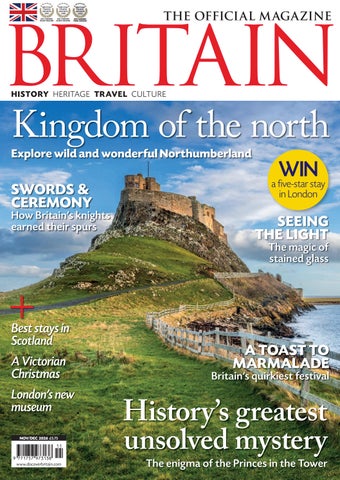
Kingdom of the north Explore wild and wonderful Northumberland
SWORDS & CEREMONY
How Britain's knights earned their spurs
WIN a five-star stay in London
SEEING THE LIGHT
The magic of stained glass
Best stays in Scotland A Victorian Christmas London's new museum NOV/DEC 2026 £5.75
www.discoverbritain.com
A TOAST TO MARMALADE
Britain's quirkiest festival
History’s greatest unsolved mystery
The enigma of the Princes in the Tower
WALES STATELY HOMES
BREAK for the
BORDER
Nestled against the border with England, Montgomeryshire is a place rich in history and beautiful landscapes – but is blissfully overlooked by most visitors WORDS EMMA GIBBS
14 BRITAIN
www.discoverbritain.com
WALES
www.discoverbritain.com
BRITAIN 15
history
22 BRITAIN
www.discoverbritain.com
history
A Knight’s
TALE Every year, the King knights some of the nation's most deserving citizens. But how did this centuries-old honour evolve from the age of medieval chivalry? WORDS FELICITY DAY
PHOTO: © MUSÉE CONDÉ, CHANTILLY/BRIDGEMAN IMAGES
A
www.discoverbritain.com
t the end of every year, about 1,100 people in Britain receive an extra-special Christmas present: an honour, announced in the New Year Honours List. Like those who receive honours in June, to mark the King’s official birthday, the majority of them receive MBEs or OBEs. Just a small proportion are given one of the highest civilian honours: a knighthood, or its equivalent for women, a damehood. Neither one confers any particular privileges, other than the right to use the title ‘Sir’ or ‘Dame’ for life. There is no entitlement to sit in the House of Lords, and no financial benefit. Yet a knighthood, one of the most visible of British titles, possessed by prime ministers, ageing rockers and racing drivers alike, carries undeniable prestige and remains highly coveted. Rumour has it that former footballer David Beckham mounted a years-long campaign for the knighthood he was awarded in 2025. Much of its allure lies in its long history. The oldest of all honours conferred, knighthoods probably have their origins in the rituals used to initiate warriors in the Empire of Charlemagne, or possibly the Roman military. As heavily armoured cavalry soldiers, knights were a feature of life in England by the late 11th century, a time of insurgent uprising, violent reprisals and shifting borders, with their name thought to BRITAIN 23
daughter Beatrice, a gifted artist and the Director of the Marmalade Awards. That fi rst year, they attracted 60 entries. For 2027 they expect See our website discoverbritain.com more than 3,000. “It’s just grown completely for more on British organically.” stately homes With presentations, talks, tastings, stalls, and patron Paddington Bear on hand (or paw) to meet and greet, the festival not only makes a great family day out but has inspired sister festivals in Australia and Japan. Over the years there have been entries from Swaziland and South Korea, Hong Kong, Thailand, Canada, Cameroon, Brazil, Argentina and Afghanistan; from women’s cooperatives across Senegal, from a Taiwanese orphanage, from children in a remote mountain village in the Czech Republic, from an Edinburgh Men’s Shed group, and inmates of Styal women’s prison. “In Taiwan there’s a couple who always compete against each other, and there’s a group of ladies in Hiroshima who compete together”, says Beatrice, noting that the popular ‘Man Made’ category is one of the most fiercely competitive. “From January, about a hundred jars a day will arrive. We have helpers who unwrap and log them. The volunteers are one of the elements that make it so special. The Girl Guides have been involved from the very start.” There are two competitions, one for the home amateur, the other for small artisan makers. And, in the UK, if you don’t want to post your precious pot of gold, you can take it to a collection point. One of these is Fortnum & Mason, the iconic grocery store on London’s Piccadilly, proud bearer of Royal Warrants. “About four hundred people come and deliver jars to Fortnum’s, and they’re given a jar in exchange, so they’re never without marmalade.” Most Brits with a glancing knowledge of marmalade tend to think of it as quintessentially British, but we did not so much invent it as appropriate it, adapt it, and make it our own. The earliest-known written reference to orange marmalade in Great Britain is a recipe for ‘marmalet of oranges’, in a book by Eliza Clockwise from top Cholmondeley from around 1677. A full century left: Atsuko Hayashi, Double later, on 24 April 1777, James Boswell, diarist, Gold International lawyer and biographer, wrote to the great Artisan winner lexicographer Samuel Johnson, “My wife has 2026; artisan made marmalade of oranges for you.” marmalade from “Tell Mrs Boswell,” replied Dr Johnson, “that I Taiwan; orange sheep marking the shall taste her marmalade cautiously at fi rst … But festival's 21st when I fi nd it does me no harm, I shall receive it anniversary; an and be thankful for it…” Marmalade as we entrant in the understand it was not, then, a known quantity, and Savoury Johnson, a martyr to ill health and with curious Marmalade category, 2026; notions about food (meat every other day, peas on marmalade tasting; Mondays and Wednesdays), was clearly distrustful. Yasuko Tanaka's The word ‘marmalade’ derives from the prize-winning Portuguese marmelada, referring to a preserve seawater lemon made from quince. In his 1755 dictionary Dr variety, 2026
30 BRITAIN
PHOTO: © MALCOLM FAIRMAN/ALAMY
PHOTOS: © HERMIONE MCCOSH PHOTOGRAPHY/BEATRICE MCCOSH/MARY-LEE WINKLER
heritage
www.discoverbritain.com
heritage
www.discoverbritain.com
BRITAIN 31
traditions
From left: Frontispiece of Cassell's Household Guide (c 1860); Christmas decorations in the Music Room at Erddig Hall, Wales
Wrapped in
TRADITION From Christmas cards to crackers, our best-loved festive traditions date back to Victorian times WORDS FELICITY DAY
34 BRITAIN
PHOTOS: © MARY EVANS PICTURE LIBRARY/NATIONAL TRUST IMAGES/PAUL HARRIS
L
ike Santa’s partiality for mince pies, it’s a well-known fact that most of Britain’s festive traditions were a gift from the Victorians. Parcelling up in shiny new wrapping all sorts of customs from centuries past, they also delivered brand-new innovations that became some of the best-loved bits of our modernday Christmas. Thanks to his bestselling novella A Christmas Carol, which bestowed a fuzzy family feeling and a tradition of charitable giving on the season, Charles Dickens gets a lot of the credit. As do Queen Victoria and Prince Albert, whose enthusiasm for the twinkling fir trees first introduced to Britain by their Hanoverian predecessors helped make them an indispensable part of the festivities. But a lesser-known cast of characters played a part in our Christmas story, too. The very same week that Dickens’ nostalgic story went on sale in December 1843, so did a herald of Christmases yet to come: ‘A Christmas Congratulation Card…to Perpetuate kind recollections between Dear Friends’, as the advertisement described it. It was the world’s first-ever Christmas card, the idea of Henry Cole.
www.discoverbritain.com
PHOTOS: © MAURITIUS IMAGES GMBH/ALAMY/NATIONAL TRUST IMAGES/CHRIS DAVIES
traditions
www.discoverbritain.com
BRITAIN 35
heritage
Seeing the light Stained glass has been brightening Britain’s buildings for centuries. From medieval masterpieces to modern designs, discover the stories behind the glass WORDS NEIL JONES
www.discoverbritain.com
BRITAIN 43