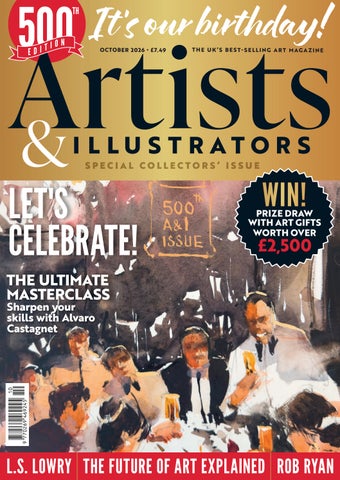
500
TH
It 's our birthday! OCTOBER 2026 • £7.49
T H E U K ’ S B E S T - S E L L I N G A R T M AG A Z I N E
SPECIAL COLLECTORS’ ISSUE
LET'S CELEBRATE!
WIN!
PRIZE DRAW WITH ART GIFTS WORTH OVER
£2,500
THE ULTIMATE MASTERCLASS Sharpen your skills with Alvaro Castagnet
L.S. LOWRY THE FUTURE OF ART EXPLAINED ROB RYAN
Tom Mead
H O W I WORK IN TH E STUDI O
This figurative and portrait artist captures the personalities of his subjects through unusual, fragmented compositions. He tells Sarah Edghill how he creates his striking work ▸ Playing House, acrylic on canvas, 61x61cm
18 ARTISTS & ILLUSTRATORS
Do Finger Prints Grow Back? acrylic on canvas, 76x61cm ARTISTS & ILLUSTRATORS 19
H O W I WORK HOW I P A I N T Michael and Sally, oil, 60x60cm
26 ARTISTS & ILLUSTRATORS
H O W I W O R K H O W I PA I NT
Oliver Winconek This artist shunned the world of a traditional art education and went it alone. It was a bold – and rewarding – decision, finds Niki Browes
W
ithin three months of starting his college foundation course, Oliver Winconek walked out, never to return, after being told by one of his tutors that traditional painting was ‘old hat’ and no longer relevant. An odd piece of advice, I think we can all agree. Conceptual art was encouraged; not painting. That’s all Oliver needed to hear to know it wasn’t for him. Since then, he has forged a successful career as an oil portrait artist and describes himself as a self-taught one with no formal training. A great example of following your instinct – and going for it. oliver-winconek.co.uk For me, portrait art is about spending time with people and actively listening. It’s about finding out what makes them unique, their achievements and the things that interest them. I often like to include items, belongings or places in portraits that resonate with the sitter or give an insight into who they are. A painting has to have soul and feel real to the viewer; by getting to know their true character, you’re then able to portray them in a way that feels instantly familiar to them and their loved ones. Typically, I am in the studio five days a week. I tend to keep fairly regular office hours
now, and this allows me to be as focused as possible while still maintaining a fairly healthy work-life balance; it’s all too easy for the creep of work to eat into your downtime, and before you know it you run the risk of being burnt out and not producing your best work. I like to work hard during the week, knowing that I often have time at the weekend to rest, ready to go again the following week. I have had some incredible experiences that would never have happened in a regular day job. My studio is in a building that used to be an old Ordnance Survey site. It has so much history, and I am surrounded by a great variety of other businesses. I have a huge arched Crittall window that overlooks a canal, but often this is covered with blackout curtains as I prefer the consistency of professionalquality daylight bulbs. I’m a big fan of Michael Harding oils; it gives me great confidence to know that I can rely on my materials and have consistency of colour and quality. I am also consistently impressed by Jackson’s professional oil paint which offers a lower cost but still high quality alternative. I love music. Silence is the enemy of creativity when I’m in the studio. Music either charges me up or calms me down. It’s a constant companion when working that allows me to focus without getting distracted. ▸ ARTISTS & ILLUSTRATORS 27
A Landmark, 1936, oil on canvas
40 ARTISTS & ILLUSTRATORS
E X HI B I T I O N
L.S. Lowry The Theatre of Lıfe
A new exhibition marks the 50th death anniversary of the artist whose body of work extends far beyond the industrial landscapes for which he’s best known. Sarah Edghill examines the myths behind the man
THE LOWRY COLLECTION, SALFORD © THE LOWRY COLLECTION, SALFORD
W
hen you think of L.S. Lowry, you might picture stark industrial landscapes, with figures trudging head down against the elements; stray dogs, bleak factories, smoke billowing from chimneys. But, as a new exhibition shows, Lowry’s work was much broader than the matchstick men paintings for which he is best known. Lawrence Stephen Lowry was born in Manchester in 1887, an only son who later talked of his unhappy and repressive childhood. Although he showed a talent for art, his parents showed little interest in it and were unsupportive. So, after leaving school, he went to work for the Pall Mall Company as a rent collector, studying art at evening classes at the Manchester Municipal College of Art and later at Salford School of Art. He would continue to do this job for 40 years, and it brought him into daily contact with the people who lived and worked in the industrial streetscapes for which he later became so famous. L.S. Lowry: The Theatre of Life brings together more than 140 of his paintings and drawings and includes rare loans from The Lowry, the Tate, the Royal Academy of Arts and private collections. The exhibition marks the 50th anniversary of the artist’s death and is the first time his work has been shown outside of The Lowry in Salford since 2013. While Lowry is known for his ‘matchstick ▸ A R T I S T S & I L L U S T R A T O R S 41
50 ARTISTS & ILLUSTRATORS
STEP-BY-STEP
Bursting with colour JULIA RIGBY uses acrylic paints and inks to recreate
I
this striking autumnal Lakeland scene
took the reference photograph for this painting on a beautiful September day in the Lake District. I love visiting the UK’s national parks, discovering new walks and returning to old favourites. When I’m out, I’m constantly looking for interesting compositions, but also spend time observing the colours around me. I study the plants, rocks and lichens, noticing details such as the delicate pink of a foxglove or the impossible green of a moss. Although I work from photographs, I rely just as much on my memory to bring these colours to life and add atmosphere to the finished painting. This scene appealed to me because of the dramatic light. The sunken track leads your eye towards the white cottages on the hillside, while the raised pathway creates a natural route through the composition. Large areas of deep shade contrast beautifully with bright sunshine, and the puddle reflecting the clear blue sky provides the perfect finishing touch. Although I often combine acrylics with collage, this painting uses acrylic paints and acrylic inks. juliarigby.uk ▸
JULIA’S MATERIALS Hahnemühle Acrylic Painting paper, 360gsm Paints Winsor & Newton Galleria acrylics: Green Gold, Cerulean Blue, Ultramarine, Cobalt Blue, Cadmium Yellow Deep Hue, Cadmium Orange Hue, Hookers Green, Phthalo Green, Opera Rose Winsor & Newton Professional acrylics: Quinacridone Violet Daler-Rowney System 3 Acrylic Inks: Titanium White, Cadmium Yellow Deep Hue, Cadmium Orange, Sap Green, Paynes Grey Brushes Flat brushes, small, medium and large Fan brush Round brush A natural sponge
ARTISTS & ILLUSTRATORS 51