for the HUMANITIES
SPRING 2022
IN THIS ISSUE 3
Letter from the Gaines Director
5
The Gaines Feast in the Mountains
12
Mountain Moonshine
14
The 2022 Breathitt Lecture
16
Celebrating our Seniors
30
The 2022 Gray Art Experience!
46
Alumni Spotlight: Dr. Mark Wurth (2000)
50
Save the Date: 2022 Bale Boone Symposium
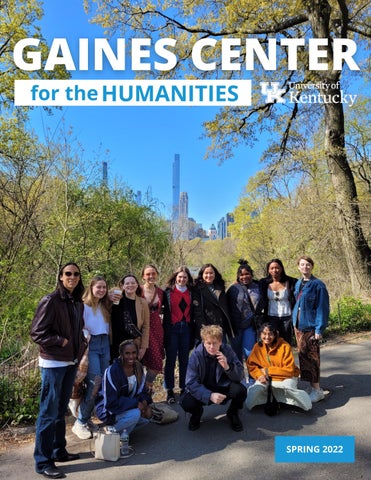
Gaines fellows excited for a Broadway performance of "Funny Girl"
Letter from the
GAINES DIRECTOR When the decision was made to return to fully in-person instruction in the fall, I must admit I was a skeptic. The hardships of the quarantine period were great, but I still felt unsure about leaving the bubble of safety I had created for my family and my colleagues. In truth it was not a complete exit. We returned to the classrooms and conference rooms and auditoriums which we truthfully had missed, but somehow zoom is still with us. Some of the things we worried about happened, but many did not. At the end of a long year, we are all ok. This year the UK Gaines Center for the Humanities have focused on Mountains, both Appalachia and beyond. It has been a great year for the Fellows who, as part of the seminar, hiked in Red River Gorge, read about the mountaineering imaginations of Germans in the period between the First and Second World War, and compared the food ways of mountain communities of Indonesia to those in the U.S. In the early days of the semester, I joined the juniors in the UK Food Connection kitchens, where Chef Tanya Whitehouse taught them to make cornbread in cast iron skillets and cook soup beans while teaching them about the three sisters—corn, squash, and beans—in Appalachian cuisine. The joy and the struggle in the kitchen that day did a lot of work to allay my doubts about returning. There is a particular magic that happens in the Gaines Seminar where great students open themselves to the possibility that learning can happen in a multitude of ways, and we make sure they are offered as many opportunities as possible. The culmination of turns and leaps of the junior seminar is the senior thesis. The senior Fellows wrote a play and a book of poetry. They mapped the writings of local luminaries and explored the history of conflict in Eastern Europe that is now more present than ever in our lives. My interactions with the Fellows is the best part of my job at Gaines and those interactions are best when we are together face-to-face. I say it was an incomplete exit from the Covid quarantining because we thought it important not to leave behind the beneficial lessons learned in doing the work of the Center remotely. The Gaines Center staff and I made a commitment to continue to hold each event virtually and inperson to include as many in our community as possible. This was not always smooth, but we did it. Many of you logged in and donned masks for the beautiful conversation and performance of Rhiannon Giddens. Matthew Kluemper took those of us in the audience and many friends online through the sites of Kentucky’s most legendary urban myths with his photographic and research project select for the Breathitt Lecture. We laughed in our seats and in our homes as a local distiller and the director of the UK Jim Beam
3
Institute taught us the history of moonshine. We thank so many of you for joining us in the ways that you were able. This will now be the practice of the Gaines Center as we continue in our mission to amplify the humanities on campus and in communities in the Commonwealth and beyond. Some things, however, can only be done face-to face. This was true with the successful return of the Gaines Feast at Holly Hill Inn with Gaines alum and Chef Ouita Michael. It seemed like a big undertaking, but Ouita shewed me and the other Gaines Center staff away to make it a moment for herself and the students to work together and be creative. The foraged and met with farmers. They cooked a beautiful meal inspired by all that they had learned in their experience in Gaines. There was beautiful music and even a little moonshine. The joy of sitting around a table together eating food prepared by students for their community is one of the most common memories our Gaines alum share with us. We hope the Feast will return as a regular part of our schedule and in time, some of you will join us. Lastly, The Gaines Center continues to be a leader in supporting the Humanities on campus. We again offered the Gaines Center Mini-Grant, which supported humanities programming on campus. We awarded grants to usual humanities partners like the departments of History and English and the College of Fine Arts. Our most exciting grant was to the Math Department who offered a program on the links between Music and Mathematics. In the spirit of John Gaines who wanted to reach students around the campus, we know that our outreach to students is benefited by our contact with and support of faculty. I and Dr. Brislin have served on the search committees for the new Dean of the College of Arts & Science and the Director of the Chellgren Center for Undergraduate Excellence respectively. We also continue—thanks to your generosity—to continue to lead in the #OneDay4UK fundraising effort. Next year, the Gaines Center is on the move. We will continue to occupy our physical space on the line between the university and the city, but with a focus on Movements, which will be our theme for the 2022-2023 academic year. It will be a year with a lot of discussion about social movements and how people have made large and small steps to change the world, and in between—there will be dancing. There will be more details to come, so be sure to check your email. Summer is always quieter at the Gaines Center, but it is a time where we are in steady preparation for the work ahead. We wish you all a bit of quiet in this period, so you are ready to join us in the fall.
THE FEAST
Photo by Tejaswini Sudhakar
The GAINES
FEAST in the MOUNTAINS
a Haute Cuisine Hootenanny
Delicate white flowers, one of the earliest heralds of spring, pushed their way through the thickening grass, spreading a veritable welcome mat for Holly Hill Inn's guests on this perfect March evening. The lilting strains of bluegrass music drifted from the open doors, rising just above the excited chatter of the small crowd gathering inside. This evening had been a long time in coming and anticipation ran high. This evening was the return of the Gaines Feast. For the previous two months, our Gaines Fellows had collaborated with James Beard nominated chef (and Gaines alumna) Ouita Michel to create a culinary evening honoring and celebrating Kentucky foodways-and oh boy, did they do us proud! "Chef Ouita encouraged us to let our imaginations run riot," said Lexi Gauger, senior Gaines Fellow and an integral part of the close-knit team of Fellows working on the Feast with Chef Ouita at the renowned Midway restaurant. The menu, beautifully designed by Lexi with copies laid out at every place setting, reflected the excitement and creativity of our Fellows. From the decadent grazing boards (and we'd be remiss here if we did not recognize Lexi's father who made the stunning wooden boards) through to the blissful dessert, every mouthful was intentionally curated to delight the palate and highlight the beauty and heritage of Kentucky food. Packed with a smorgasbord of bite-sized nibbles, the grazing boards were both delicious and educational. Alex Davis, senior Fellow, reflected on making the beaten biscuits-an almost violent process necessary to induce the dough (which is devoid of all raising agents) to rise. The biscuits were accompanied by a tasty selection of cheeses, hams, and spreads, olives, roasted garlic cloves and a small glass dish filled with pickled watermelon. That watermelon was one of the surprise highlights of the evening, but it was certainly not the only one. After grazing contentedly, the guests found their places at the exquisitely decorated tables, and dinner commenced. First, a light acorn squash bisque with cornbread, followed by a salad of foraged greens. And remember those delicate white flowers from the lawns of Holly Hill Inn? Some of those flowers made it onto the salad! During the meal, guests sipped on either a refreshing lavender lemon verbena tonic created by junior Fellow Larah Ballard or, if age-appropriate, a tasty bourbon cocktail. After the first two courses, guests were treated to an amuse-bouche trio, designed and cooked by Lexi Gauger as part of her work toward her Gaines senior thesis. The trio was inspired by characters from Lexi's reading and research, and she thoughtfully provided guests with a brief, yet fascinating, narrative of each small bite, explaining the origins of her recipes and the significance of the ingredients.
Photo by Tejaswini Sudhakar
9
Lexi has kindly shared one of her recipes-for a beet and ginger hummus-with us, and it is well worth making! Next up was the entree, and guests enjoyed a choice of dishes--either a Stonecross pork loin chop glazed with a bourbon hickory nut gastrique or a new-fangled tomato dumpling filled with creamy ricotta. Both were served with an exceptional chiffonade of collard greens and a Kentucky pecan crumble. Of course, no feast is complete without a dessert, and our Fellows created an absolute treat to round off the evening: a light vanilla Bavarian cream with a sorghum cookie crust and a rhubarb compote; what a perfect way to round off the meal!
LEXI GAUGER'S BEET & GINGER HUMMUS inspired by the Podoll family from "Deeply Rooted" by Lisa Hamilton method: peel beets; toss with salt and oil; roast in 400 degree oven until very soft. peel garlic; place in oven-safe dish covered in olive oil; roast until cloves are soft but not burnt. cut beets into large chunks and place in food processor; drain and rinse chickpeas and add to food processor; add garlic cloves and the oil they were roasted in to the food processor. add 1 tablespoon powdered ginger, 1 teaspoon white pepper, and half a teaspoon of salt to food processor. process until desired texture is reached; add seasoning or additional olive oil as needed. serve with ancient grain crackers.
ingredients: 2 beets 3 garlic cloves olive oil 1 can chickpeas powdered ginger white pepper salt
The impressive food wasn't all the evening had to offer, though. Throughout the evening guests delighted in the amazing music of three of the Reel World String Band: Karen Jones, Sue Massek, and Beverly Futrell. The trio performed songs reflecting environmental justice, feminism, and labor as well as bringing a joyous celebration of Appalachian culture. Two of our Fellows, Braden Kirkpatrick (senior) and Larah Ballard (junior) are accomplished musicians in their own rights and, as the meal ended, our talented Fellows joined Karen, Sue, and Beverly to bring their own voices to the evening. It's fair to say that everyone attending had a wonderful experience. As the evening turned to night, our guests bid farewell with full bellies, warm hearts, and memories that will last a lifetime. Our immense gratitude goes to everyone who made this evening such a triumph.
11
n i a t n u o M shine LAFAYETTE 2022
n o o M
by CHRIS LUCAS '23 GAINES FELLOW
Economics & Finance Major
Three things captured my imagination when I realized I was going to the University of Kentucky: bourbon, horses, and basketball. In my time here, basketball has been disappointing. Horses, while exciting, come and go during Keeneland. But Bourbon...? Bourbon and my love for its history and taste, and the bourbon industry in Kentucky have made this place feel like home. My fascination with alcohol, in an academic sense, of course, was what excited me so much about this year's Lafayette Seminar on the history of moonshine.
We hosted two speakers for the Mountain Moonshine Lafayette Seminar: Dr. Jarrad Gollihue and Dr. Pat Heist. Dr. Gollihue, the technical director for the James B Beam Institute at Kentucky, dazzled all of us listening with his ability to synthesize and explain the science behind distilling. In particular, he talked about the technology and tools moonshiners used and how those affected the flavor and safety of their products. He also explained why it would not taste good to try to drink the alcoholic sanitizer pumps around campus! Talk about making science cool again. Dr. Pat Heist is the co-founder of Wilderness Trail Distillery and a UK alum. Dr. Pat (as he is often known) discussed the history and business of moonshine. He explained the deep relationship between the development of NASCAR and the moonshine industry: "moonshine runners" would often have to haul huge loads of liquor on tough roads, which pushed innovation in building fast cars. And, of course, these fast cars needed fast drivers! Today, Dr. Pat said, the best place to get moonshine (besides walking around Kentucky for 20 minutes) is at a NASCAR race. Dr. Pat had lots of tips on how to navigate the NASCAR moonshine scene. I could tell that he and I shared a common academic interest in alcohol. This seminar really encapsulated what Gaines has given me throughout my first year as a Fellow. The fellowship, in part due to my Gaines seminar being about mountains,, fostered knowledge and appreciation for Kentucky and its people. Why does Kentucky have such a strong heritage in distillation? Because the Scots-Irish who resided in Appalachia came from a history of distillation in Europe and carried on that tradition. What’s the connection between moonshine to bourbon? Well, Appalachians were really good at making moonshine and the skills transferred over. Thanks to the seminar, where our cooking unit with Chef Whitehouse empowered the fellows to learn the history of and practice making Appalachian food, I now have a better understanding of Appalachian culture and heritage. My academic and extracurricular experiences this year have illuminated a part of this country that I previously knew little about. So as I consider what I will remember about Kentucky when I leave, I will of course think of the bourbon I enjoyed, the horses I bet on, and hopefully, I will enjoy a March of basketball victories. But, I will also remember all that I learned about Appalachia: the history of the people, the food and drinks, and, most importantly, the friends I made. Watch the Lafayette Seminar on our YouTube channel by clicking here
13
The Gaines Center hosted its annual Edward T. Breathitt Undergraduate Lecture in the Humanities on the evening of April 7th to a packed house of both inperson and virtual attendees. This year's lecturer was Matthew Kluemper, a digital media and design student in the School of Art and Visual Studies. Kluemper presented a fascinating lecture: "Photographic Retellings of Kentucky Urban Legends" in which he unpacked a trio of well-known urban legends, sharing his methodology for the creation of his images. Established to honor former Kentucky governor (1963-1967) Edward T. Breathitt, an outstanding University of Kentucky alumnus and lover of the humanities, the lectureship is awarded to an undergraduate whose qualities of mind and spirit have been expressed eloquently on humanistic concerns. Kluemper was chosen from a highly competitive and accomplished pool of applicants--in fact, the highest ever number of applicants in the lectureship's history. "I explore the relationship between urban legends and the spaces and cultures in which they originate," explained Kluemper. "The tradition of sharing urban legends spans generations, but I use photographic storytelling to offer a new perspective on this practice." During the creation of his work, Klumeper took photographs of the locations
connected with urban legends, then physically projected imagery of the legends on top of the photographs. His final collection comprised of a gallery installation, a short film, and a photo book/portfolio box. "I invite audiences to take part in a more active role as they learn about each tale," he said. "Rather than simply hearing one person's retelling of a story that's already been retold many times before, the individuals who view my photos will see these locations as they stand today juxtaposed against surreal imagery of the legends that made each location famous. The process of telling stories through photos is certainly not a new practice, however introducing a more permanent form of storytelling into the tradition of folklore might offer new opportunities for audiences to engage with each tale."
Watch the Breathitt Lecture on our YouTube channel by clicking here
15
OUR SENIOR FELLOWS
SENIORS celebrating our
Ben Cortas
Physics Louisville, KY
Thesis Title
Best Gaines Memory
"An Ode to the Revolution: The Humanities and their Liberation of Eastern European Communism"
"The 2020 Bale Boone Symposium with Nikky Finney. It was COVID, so I was watching the symposium on zoom, but I was deeply moved by her poetry reading."
17
Alex Davis
Animal Sciences Keller, TX
Thesis Title
Best Gaines Memory
"The Black Experience: Jockeys in America and Europe: An Evaluation of the Lives of Enslaved Horsemen, Isaac Murphy & Jimmy Winkfield"
"The Feast! It was so nice having everyone together in one room. And Shaker Villagegetting to see some of the cohort in person for the first time!"
Lexi Gauger
Entomology Lexington, KY
Thesis Title
Best Gaines Memory
"The Fruits of the Spirit: Ethical Imaginaries of Sustainable Agriculture"
"Collaborating with Ouita Michel, the Holly Hill Inn staff, and other Gaines fellows to produce the Feast."
19
Eva Grossi
Arts Administration Shelbyville, KY
Thesis Title
Best Gaines Memory
"Duck & Cover: A Play on Women’s Self Defense"
"Seeing the unique perspectives and hidden talents of each member of my cohort everyone is so creative and gifted."
Natalie Harrington
Secondary Education Franklin, TN
Thesis Title
Best Gaines Memory
"Hallmark Christmas Movies: A Very Merry Analysis of a Popular Literature"
"The Bale Boone Symposium was a remarkable touchstone in my college career — true to the nature of her music, Giddens united our cohorts."
21
Ellie Kinnicutt
Communication Lexington, KY
Thesis Title
Best Gaines Memory
"Before and After: An Analysis of Women's Collegiate Sports in Relation to Title IX"
"Seeing all the art museums in NYC! I loved learning about the different pieces, artists, and exploring all the museums had to offer!"
Braden Kirkpatrick
International Studies Franklin, TN
Thesis Title
Best Gaines Memory
"Music and Medicine: Perceptions of Community, Personhood, and Identity in a Shipibo-Conibo World"
"Definitely my cohort! My cohort inspires me with their distinct identities, intelligence, and their commitment to justice."
23
Shelby McCubbin
Neuroscience, Gender & Women's Studies Lexington, KY
Thesis Title
Best Gaines Memory
"Medical Memoirs as a Teaching Tool within Narrative Medicine"
"The creation of a space where I can combine my interest in the humanities with my passion for medicine."
Olivia Morris-Bush
Political Science, Geography Midway, KY
Thesis Title
Best Gaines Memory
"Written Landscapes: an Exploration of Walter Tevis’ Literature and Films"
"Shaker Village! It was a wonderful time to bond before starting our seminar classes and thesis!"
25
Mary Sherman
Political Science, Spanish Peoria, IL
Thesis Title
Best Gaines Memory
"Dorothy Day: Reimagining the Catholic Harlot Narrative for the 21st Century"
"Shaker Village - my favorite break from the rush of school!"
Teja Sudhakar
Psychology, Gender & Women's Studies, Creative Writing Lexington, KY
Thesis Title
Best Gaines Memory
"Looking for Smoke"
"Especially on trips like Shaker Village, I am reminded how amazing the students in Gaines are and how much I cherish spending time with them."
27
Iyahna Wilson
Agriculture Lexington, KY
Thesis Title
Best Gaines Memory
"How Can an Agricultural Guide Assist in Educating Youth About the History of Agriculture?
"I have enjoyed attending events that are musically empowered because my deepest love is how music can move through your spirit."
Even as we say goodbye to our seniors, we look forward to welcoming our new Gaines Fellows for Fall 2022. Here's just a little bit about them...
12 40
FELLOWS SELECTED
FROM
6
COLLEGES
3.93
APPLICATIONS
REPRESENTED
AVERAGE GPA
29
GRAY ART EXPERIENCE
Photo by Ben Cortas
31
33
35
37
39
art OBJECTS
41
43
If you would like to support the Gaines Center and humanities programming at UK, you may donate year-round by searching for "Gaines Center" at uky.networkforgood.com
We are keen to establish mentorships for our Fellows. Gaines alum, if you are interested in being a mentor, please complete the Google Form linked below. Gaines Mentorship Form
Senior Fellows, Gaines alumni and UK alumni enjoyed an evening of catching up at the always-fun Jack Demsey's in NYC!
2022 ALUMNI REUNION
ALUMNI SPOTLIGHT
For this issue's alumni spotlight Gaines Fellow Riley Droppleman chatted with Gaines alum Dr. Mark Wurth (class of 2000) about fiddles, ambition, and how many gallons of water a lecture theater can hold... Riley: Since graduating from UK, what has your life path been like? Mark: So, I took one year off to do some academic and research stuff, and then I joined, I went and did a combined MD/PhD at UK. So, I did graduate and medical school. At the completion of that, which was in 2008, I did a combined internal medicine and pediatrics residency, and then did a peds chief residency year and went to Vanderbilt to do a combined allergy, immunology, and pediatric pulmonology fellowship. And then landed back here as junior faculty. Riley: So, what does your day-to-day look like now? Mark: (prolonged laughter) Lots of putting out fires! So, I was the only pediatric allergist when I joined the practice here, so I started the pediatric allergy and immunology program. I am nominally 50% clinical, I do about 15-20% research, and the rest is teaching academic stuff. I cover the pulmonary consult service on the inpatient side for peds about 1 week out of the month, I am in clinic 2-3 half-days a week, and then one of the things I did was rebuilt the immunology curriculum for the first-year medical students, so I do a fair amount of curriculum development. I am teaching probably about 30+ classroom hours a year now plus all the administrative things that come along with the College of Medicine, so I do a good amount of large format teaching, teaching in the residency, which is nice, small group stuff, and then resident education as they rotate through pulmonary and allergy. Riley: What is your research on right now? Mark: Oh… (laughter) that shifted a lot! So, I came in really interested in fungal allergy and the development of severe asthma in the setting of
folks who are allergic to mold, and then COVID happened, so I’m doing some CF (cystic fibrosis) research now. We’re doing some stuff with mental health and looking at how outcomes with all of the stressors that have been going on, looking at pulmonary outcomes and health outcomes in patients living with cystic fibrosis. What else am I doing? I’m involved in some clinical trials, so as one of the people that was involved in the pediatric COVID vaccine trial through UK. That was kind of a big lift…learning a lot of new skills in that clinical trial domain, which I had not done a lot of…doing some cystic fibrosis clinical trials and practice quality improvement research, so how do we take the tools we have, and make sure that we’re standardizing processes and making sure that everyone’s getting good care, and monitoring for episodes where things are maybe not going as well as they could and how do we fix that to make sure outcomes are good for those patients. In the last year or so, I have taken on the role as a site PI, or principal investigator. The CF Foundation supports something called the therapeutics development network, which is basically a bunch of clinical trials sites to try to improve and develop new drugs for folks living with CF, so I’m running the clinical trial arm of that at UK. So, depends on the day! Riley: When you look back on your Gaines experience, what memories come to mind? Mark: I would spend a lot of time upstairs at the Bingham Davis house just in conversation with my co-fellows, like there was a computer lab up there and we tended to hang out there a lot as a group and just kind of talk about anything. What I really loved about Gaines was that we all came from very different academic backgrounds, so there’s a huge diversity and I think just the day-to-day conversation in that space was really remarkable. I still keep in touch with a lot of the folks from that time, and even the folks I don’t talk to as regularly, I know where they are. We kind of keep up with each other. I think I learned a lot about respect for differing perspectives and I think some of the stuff we had learned surrounding narrative was really important, particularly now as a physician. One of the guys who’s a big name in physical diagnosis is named Ossler, who is sort of the person who started the idea of “let’s have residencies as a thing” at Hopkins; I’m butchering his quote but he said basically “listen to the patient long enough; they’ll tell you what their diagnosis is”, and it just means that you kind of have to approach that from a place of naivety and openness to what their experience and understanding of their disease state is, and I learned a lot, I didn’t realize it at the time when I was Gaines, about how to be open to other people’s stories in a way that’s been really valuable to me as a physician. Again, because sometimes the medicine isn’t the biggest piece of what we do as doctors. Riley: You kind of already answered this, but my question was going to be: As a medical doctor and a scientist, how do you see the impacts of the humanities even in the world of STEM?
47
Mark: It’s all interconnected, right? We had a poetry section of our junior seminar, and I remember talking about how there’s not much difference between mathematics and poetry. They’re both structures for describing the world and experiences around you, and the tools are different, but the goals are very similar and the aesthetics and the beauty. You think you’re opposing forces, but you’re doing the same thing but with different symbols. I think some of that intellectual diversity that we experience really helps while confronting some really problematic topics, because I think there’s stuff we talk about in the seminar that has no easy answer, right? You’re forced to confront the models that are maybe not equipped to completely describe something or, how do you deal with morality in the setting of more relativism or respect for differing cultures, and autonomy for person. I think those conversations were really important to me and helped me figure out how you navigate those more difficult situations. Another thing that came out of Gaines that was really important for me is people are people everywhere, you know, sometimes they’re disappointing, but none of us are very different from one another at the end of the day. Our experiences shape us, but people are people. Riley: Are you able to have time to interact with the humanities on your own? Are you able to incorporate it into your life in your free time if you have any? (laughs) Mark: Work-life balance is a new focus for me this year. I’m still struggling with it. I have one of the…he’s actually one of the faculty, he’s now retired, who taught in Gaines. When I was a fellow, it turns out my grandfather’s fiddle had been sitting in an attic not used forever, and Ron Pen was a musicologist in the school of music. He used to have this thing where once a semester, he would let any student in his class ask any question they wanted, and he would do his best to find the answer for them. So, in exchange for answering how many gallons of water the large lecture hall in the Fine Arts building would hold, I paid for my first fiddle lesson with my grandfather’s fiddle. I’ve played a little bit with metalworking, but I don’t have a great space for that since moving back to Lexington. I think some of that artistic, creative expression is important, and I get to do
some of that in my work; I do that in my writing and that kind of stuff, but that descriptive, creative piece I think is something I’m working for. I think it’s nice to have something that not language based, because I spend my whole day talking and writing, so to have something that’s like music or form, shapes, sculpture, that kind of stuff is nice. Riley: In what ways has the Gaines Fellowship impacted your life? Mark: Being invited into that community was incredibly valuable for me. I came from an area in rural Kentucky, I’m a first-generation college graduate, so before my older siblings, no one in my family had gone through college. I think being put in that environment and seeing I was intellectually able to run with some of the best students at UK gave me a lot of confidence just because this was not something that was routine, rote, or expected from me from my family or where I grew up. Certainly, nobody had ever had a single doctoral degree, there’s not college professors, no academic pathway. It was really important for me to open some of those doors and see what that would look like. I’ve built a lot of lifelong friends, a lot of folks who I can have conversations with about challenges in life and how we navigate. It’s been fascinating to see how people’s trajectories have been since being out of Gaines. Riley: Do you have any advice for any current or upcoming Gaines Fellows? Mark: Be ambitious. This is one of those great opportunities to go out and do something that you may never have the opportunity to do regularly, and I think you want to be successful, you want to finish your thesis, but really just find something crazy that you’ll never have the opportunity to do again. You’re gonna be supported, you’re gonna have resources surrounding you. You may figure some things out along the way, and if the things you figure out are like “this is not what I want to do”, that is valuable experience. Take care of the people around you, because those people are gonna be important for you moving forward. The kind of playground you guys get in Gaines to just explore and share ideas and perspectives and make yourselves better as a group is hard to find later in life. You just don’t get that same space. Enjoy those things while they’re there, take time to breath; you don’t get one of those fellowship spots without being overworked and a little “overachieve-y” so, make space for yourself, especially now, because that’s part of being successful, too. Find time and space to decompress at times. Do what’s interesting.
49
ANNOUNCING THE 2022 bale boone symposium
october 13, 2022 FEATURING
bill T. jones
@ukygainescenter | uky.edu/gainescenter