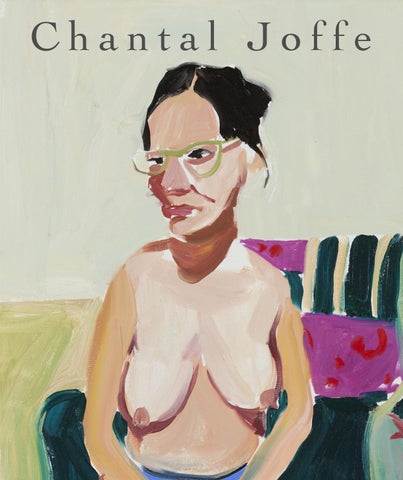
Chantal Joffe
Chantal Joffe
Night Self-Portraits Te x t b y L o u i s e Ye l i n Cheim & Read 2015
Chantal Joffe: The Work of Self-Fashioning in the Age of the Selfie Louise Yelin Chantal Joffe has been making self-portraits all her life. Taken together, her self-portraits, like those of Lucian Freud and David Hockney, among other artists who paint themselves over the span of their careers, can be seen as a kind of serial autobiography. Painted documents that “report back,” as Joffe puts it, on a succession of disparate, discontinuous moments, her self-portraits register the changes that have punctuated her life and the various ways she has experienced herself in different times and places. Earlier paintings in the ongoing series, some lost, portray the artist as twins, as Sylvia Plath, as a porn star or porn victim, as a mother with her now ten-year-old daughter Esme as an infant, a toddler, a young girl. The paintings, which refract the different angles of vision afforded by mirrors and photographs, include head shots and head-and-body shots, the figure sometimes nude, sometimes clothed, set in and against backgrounds sometimes fully rendered but more often barely sketched. The scale of the paintings, very large or rather small, demands that viewers take notice that we are looking at a constructed image of the self. The paintings in Night Self-Portraits are the latest installment in the series. Made over the course of a year or so, they record a set of moments in Joffe’s life, moments of heightened insight and intense self-awareness that the artist translates into paint. One could say of the selfie, the Oxford Dictionaries Word of the Year in 2013, that this digital genre does the same thing. While the selfie and the painted self-portrait both offer performances of self, the apparently instantaneous capturing of the evanescent now in which the selfie traffics is quite different from what Joffe’s self-portraits so powerfully convey, the work of self-fashioning, of putting together and taking apart the ensemble of elements that compose the artist’s versions of herself as an embodied subject.
Night Self-Portrait in a Red Dress (Small Version) 2014 oil on canvas 25 5/8 x 21 1/4 in 65.1 x 54 cm
This essay draws on an interview I conducted with Joffe in her London studio in January and by telephone in March. I was struck, when I reviewed the recordings and the transcripts made from them, by the parallels between the artist’s rhetorical style, which is tentative and self-qualifying, yet also assertive, and the style of her paintings, which are at once improvisational and bold. In an essay accompanying Joffe’s 2005 exhibition at the Victoria Miro Gallery, Neal Brown notes that the paintings create “unlikely combinations of luxury impastos, anarchised scumbling, and areas of austere thinness—a deliberately disintegrating painting style” that governs the artist’s “fluent command of the appearance of socialised emotions.” 1 Like the works that Brown describes, the paintings in Night Self-Portraits set before the viewer the brilliantly realized appearance of the “socialized emotions” of the artist-sitter herself. WORK Writing about Gustave Courbet’s self-portraits, Michael Fried notes Courbet’s “drive to reconstitute in paint his conviction of his own bodily being.” 2 A similar drive propels Joffe to imagine and re-imagine and to project in oil on board or canvas her sense of her own embodiment. Joffe’s characteristic mark-making is the visual sign of the work that produces her self-portraits: Big swathes of paint so thickly applied that it appears to be wet, little dribbles that run down the surface and disrupt the illusion that what we are looking at is a copy of something real, and colors that exaggerate the contrast between light and shadow call attention to themselves and to the work—the process as well as the product—of painting. Work is also reflected in the way that the group of self-portraits trace changes in the artist’s self-image, a term customarily used as a metaphor but meant literally here, over the course of several months. Take, for example, the three paintings in which Joffe presents herself wearing a red dress. Like variations on a theme, these self-portraits assemble and reassemble the same few elements (dress, hands, posture, background, color, light, and shadow), position and reposition the figure of the artist in the frame. In two of these paintings, Night Self-Portrait in a Red Dress and Night Self-Portrait in a Red Dress (Small Version), the artist’s seated posture and the black shadows falling on the red dress make her appear
particularly short-waisted. Her large hands, painter’s hands as she describes them, rest uneasily on her lap. She looks aslant away from the viewer, her gaze alternately knowing (large version) and wary (small). The small version isn’t a sketch for the larger one, but rather, as Joffe explains, a kind of reprise, a re-visioning that foregrounds the slight alteration of mood that distinguishes one moment, one state of being, from another. Joffe describes Self-Portrait in a Red Dress and Orange Cardigan, in which she sets herself against a black background, as “overheated” and “laden with angst.” She suggests that it marked the end of the group of paintings—all the paintings, not just the three in which she is wearing a red dress—that make up the Night Self-Portraits. In contrast, she says, the placement of the figure and especially the fact that the disproportionately large head presses against the top of the picture in Night Self-Portrait in a Red Dress better contain and transmit to viewers the emotion that she was experiencing at the time. A set of selfies might similarly dramatize performances of self and shifts of mood, but without the evidence, so palpable in these self-portraits, taken singly or together, of self-reflection, self-consciousness, work. SELF A self-portrait, like an autobiography, asks “Who am I?” and in doing so, puts into question the key term self. But unlike an autobiography, which records an arc traversed by the author-subject, a self-portrait focuses on a small segment, a discrete moment, in a larger trajectory. A more pertinent question, then, would be “Who am I now?” Joffe describes the paintings in Night Self-Portraits as “leavings,” traces that stand (in) for the artistsitter. Rehearsing some of the guises in which she appears to herself and presents herself to the viewer, Joffe’s leavings leave behind the notion of a self distinct from its painted avatars. As Sacha Craddock remarks in a reflection on sitting for Joffe, “a completed painting becomes independent of both painter and subject; it is not the representation of something or someone so much as something else altogether.” 3 Joffe refers to the figure in her self-portraits sometimes as “she,” sometimes as “I” and to herself as artist-maker sometimes as “I,” sometimes as “you”: The shifting pronouns reflect the way that the self-portraits seek to fix in place the variations in her sense of herself.
Self-Portrait with Hand on Hip is the first of what only later became a group of self-portraits. Joffe says of this painting that she “dug all the sweetness out.” She made it while looking in a mirror in the dwindling light of nighttime. She was, she explains, “literally in shadow.” The self here is solitary, her isolation intensified by the fact that the setting isn’t specified. The truncated nude figure, rendered in colors at once stark and dull, strains against the edges of the painting, the head cut off just above the eyes, the left hand that gives the painting its title exaggerated, the lower right arm disappearing altogether. Looking at her reflection, the artist directs her gaze not head-on but slightly to the right of the viewer who occupies the same position as the mirror, yet she also solicits the viewer’s gaze, turning the viewer into a secret-sharer by enlisting the viewer in her own self-scrutiny. Not always solitary, Joffe also portrays herself as a mother, as she has been doing since the birth of her daughter in 2004. Naked Self-Portrait with Esme with her Arm Raised and Naked Self-Portrait with Esme in a Pink Nightshirt present two versions of the mother-daughter dyad at a moment when the daughter is poised just on the verge of adolescence and the mother, entering middle age, is anticipating (although, like many other mothers, perhaps not quite ready for) a new phase in their relationship. Self-Portrait with Esme in a Pink Nightshirt is tender, the tenderness underscored by the Renoirish pinks of Esme’s face and her nightshirt. Joffe says that the positioning of the two figures in Pink Nightshirt—at once close together, almost touching each other, yet separate—resembles “fruit in a bowl. I’m like the old banana. I’m still curving towards her to protect her, but she looks at me as if to say ‘I’m me.’” With Arm Raised gives a different picture of the mother-daughter couple. Instead of the soft, bright colors of Pink Nightshirt, Joffe uses a slightly dimmer palette. Here, the two figures are separated by empty space, the distance between them emphasized by the parallel lines made by the residues of the paint that dripped down the surface of the painting. Esme looks at the viewer and away from her mother; Joffe takes in Esme with her gaze but also seems to be looking away or looking inward. Both Pink Nightshirt and Raised Arm constitute a departure from earlier paintings that depict Joffe standing close to or holding Esme, Esme clinging to her mother, Joffe bending over Esme in a way that almost cancels the distance
between them, and Esme attempting to wriggle out of her mother’s grasp. Yet the placement of the mother alongside the daughter in these two recent paintings and the connection between them, however tenuous, distinguish the figure of the artist in these works from the solitary occupant of the painted spaces in the other self-portraits in the group. FASHIONING There are relatively few things in Joffe’s self-portraits and even fewer of the things that traditionally accompany the artist and define the genre of the artist’s self-portrait: No paintbrushes, palettes or easels like those in the self-portraits of Artemisia Gentileschi and Judith Leyster that point to the vocation of the artist-sitter—widely acknowledged as a consummate painter—or situate her in a space readily identified as a studio; no markers of status, like the insignia of craft or guild in some of Rembrandt’s self-portraits or Degas’s top hat and Vigée-Lebrun’s feathered bonnet, that indicate the artist-sitter’s place in society, although Joffe herself observes that having a child is in a way “the ultimate status.” There are no items that purport to give viewers special access to the artist’s inner thoughts and feelings, evoke her political beliefs and values, or place her in national or transnational histories like the icons of empire in the work of Sonia Boyce and Hew Locke, to take just two examples. Rather, the things in these recent self-portraits, as in most of the selfportraits that Joffe has made over many years, are everyday objects: blue knickers, green glasses, red dress, orange cardigan, and a new chair. “Not a Biedermeier chair,” Joffe remarks, the chair in which she is sitting is an ordinary chair upholstered in a patchwork of stripes and florals and as variable in appearance from one painting to the next as is the appearance of the artist herself. These objects set the artist in an unspecified hereand-now, against a black background or in a room with light-colored walls, some embellished by the ghosts of straight lines and right angles that suggest molding, empty picture frames, or windows and doors that don’t lead anywhere. The relative lack of specificity in the backgrounds of Joffe’s self-portraits is a constant throughout her career. In the recent self-portraits, the almost featureless place in which the artist sets herself is an arena for a mode of self-fashioning that begins with and thrives on the particular and eschews
Self-Portrait with Esme 2009 oil on linen 84 x 60 in 213.4 x 152.4 cm
the metonymic or metaphorical. Joffe says that she used to start with a “big fancy idea and paint backwards from the idea,” but later discovered that “you have to start with a tiny block, like blue underpants.” The green glasses are perhaps the closest Joffe gets in these works to presenting objects as symbols since they might be regarded as a sign of middle age, a period of life identified with the inexorable presence of glasses needed for reading or other close work. Red dress, orange cardigan, blue knickers, and even the green glasses tell us no more—and no less—about the artist than the appearance of her body in the works in which she paints herself unclothed. That Joffe’s self-portraits are figurative paintings might seem to set her work apart from that of artists such as Cindy Sherman, Yinka Shonibare, Tracey Emin, John Kirby, and Mark Wallinger, to name just a few, who present the self as a collection of body parts or as someone else, perhaps a character in a masquerade, or who multiply themselves or disappear themselves altogether. Yet Joffe also participates in the interrogation of identity that defines self-portraiture in a digital age. Rejecting the apparatus of traditional self-portraiture, she also refuses the instant gratification or instant recall afforded by the image of the self in a selfie. Emphasizing in her mark-making the materiality of the paint that makes the picture, she also implies that a self-portrait is not a window on the artist’s interior being. Joffe’s self-portraits address the question “Who am I?” not by proposing a transcendental subject but by treating the figure in the painting as a “leaving” that testifies to where she has been and insisting that the painting, like the painted self it presents, stands on its own.
Notes 1 Neal Brown. Chantal Joffe: New Paintings. London: Victoria Miro, 2005. 2 Michael Fried. Courbet’s Realism. Chicago: University of Chicago Press, 1990, p. 78. 3 Sacha Craddock. “Modelling for Chantal Joffe.” Chantal Joffe. London: Victoria Miro, 2008.
Chantal Joffe: Excerpts from Interview with Louise Yelin, January 2015 Everyone’s aim is to make the painting you would make as if it’s your last day because there’s no point in painting at all otherwise, if you don’t paint like that, if you’re painting as if on your way somewhere.
When I make a new group of work, I sit down to work, I sit down and write, to ask myself: What do I want to paint? And I wanted to paint where I am, however hard that place is, and being middle-aged, your child growing up, my body has changed, not in a way I particularly like but it’s quite fascinating visually for me in an almost Egon Schiele-ish way. So I thought okay I want to paint those things, those are new things I can paint, and if I paint them, I’ll own them, and I’ll be them, and that will make it okay? Whether it did or it didn’t that’s almost irrelevant in a way, because the sheer excitement of painting them was transformational.
I’ve got a short body, but I made it that much shorter. Everything’s wrong, I’ve got really long arms and big ugly hands. Don’t get me wrong, I don’t find myself ugly, I find myself pretty compelling to look at, like everybody finds themselves if they’re honest, because we only have ourselves so we’re of course riveted.
I’m looking in a mirror at night… It’s cold, and the light is terrible, because the light is terrible here [in the studio], so I could hardly see my own face, it was so in shadow, I couldn’t see color… because the light was so bad, that was so great.
I’ve always thought this, that life is about everything you see and experience, like Diane Arbus, the more you see and experience the better your work will be. But that’s quite hard, it’s trying to keep a balance between experience and painting, trying to hold it together enough to do the one. It’s funny, I also think your life shouldn’t be hard. In one way it’s a really
easy life or should be in theory. I walk from my house, drop my daughter at school, come here, it’s a beautiful place and it should be easy, but of course nothing ever is easy. It’s between what you live and what you report back on in your work. Because for me art is exactly about… I can’t bear made-up art, I have no imagination whatsoever, I have to paint what there is.
Why get rid of the pretty? Because honesty seems to me the only quality worth having.
Painting makes me feel in the present, which is already important, you’re in that moment, you’re not planning ahead, you’re just there, which is really great. That’s the greatest thing, you’re just right there in that… I don’t know if it makes me feel safe, but that’s irrelevant when I’m painting. I forget, bad stuff or good stuff. There is no value, you stop judging or evaluating.
I don’t have any sense of my work as a whole. I like the idea of being in the present. I don’t like to look back or forward. I like to think, wow, this is what I’m doing now… I don’t like to look at the work historically. Some plan, have a sense of themselves in history, as history. I can honestly say I don’t have that sense. I like to begin each day as a new day. That’s for me the best, the ultimate thing: make a mark, a mark you never made before, paint something you never painted before.
Naked Self-Portrait with Esme in a Pink Nightshirt 2014 oil on canvas 96 1/8 x 72 1/4 in 244.2 x 183.5 cm
Self-Portrait in a Bra and Blue Knickers (Second Version) 2014 oil on canvas 25 5/8 x 21 1/4 in 65.1 x 54 cm
Night Self-Portrait in a Red Dress 2014 oil on board 83 7/8 x 60 1/4 in 213 x 153 cm
Topless Self-Portrait in Blue Knickers 2014 oil on canvas 20 1/8 x 15 3/4 in 51.1 x 40 cm
Naked Self-Portrait with Esme with Her Arm Raised 2014 oil on board 96 1/8 x 72 1/8 in 244.2 x 183.2 cm
Esme Reclining 2015 oil on canvas 16 x 12 in 40.5 x 30.5 cm
Topless Self-Portrait in Reading Glasses (Small Version) 2014 oil on canvas 16 x 12 1/8 in 40.6 x 30.8 cm
Self-Portrait in Striped Trousers 2015 oil on canvas 84 x 60 in 213.5 x 152.5 cm
Self-Portrait in a Red Dress and Orange Cardigan 2014 oil on board 83 7/8 x 60 1/4 in 213 x 153 cm
Self-Portrait (Weeping Woman) 2015 oil on canvas 16 x 12 in 40.6 x 30.5 cm
Naked Self-Portrait Turned Away 2014 oil on canvas 24 1/8 x 19 3/4 in 61.3 x 50.2 cm
Topless Self-Portrait in Reading Glasses 2014 oil on canvas 72 1/8 x 48 1/4 in 183.2 x 122.6 cm
Self-Portrait with Hand on Hip 2014 oil on canvas 72 x 48 1/4 in 183 x 122.5 cm
BIOGRAPHY 1969
Born in St. Albans, Vermont Lives and works in London
EDUCATION 1987–88 1988–91 1992–94
Foundation Course, Camberwell School of Arts and Crafts B.A. (Hons) Fine Art, Glasgow School of Art M.A. Fine Art, Royal College of Art, London
SOLO EXHIBITIONS 2015
Chantal Joffe: Night Self-Portraits, Cheim & Read, New York Chantal Joffe: Beside the Seaside, Jerwood Gallery, East Sussex, England Using Walls, Floors, and Ceilings: Chantal Joffe, curated by Jens Hoffmann and Kelly Taxter, the Jewish Museum, New York
2013 Chantal Joffe: The Hard Winter, Galerie Forsblom, Helsinki 2012 Chantal Joffe, Cheim & Read, New York 2011 Il Capricorno, Venice 2009 Chantal Joffe, Cheim & Read, New York Galleria Monica de Cardenas, Milan 2008 Victoria Miro Gallery, London 2007 Galleria Monica de Cardenas, Zuoz, Switzerland Studio d’Arte Raffaelli, Trento, Italy 2005 Victoria Miro Gallery, London Galleria Monica de Cardenas, Milan 2004 Il Capricorno, Venice
2003 Women, Victoria Miro Gallery, London 2001 Galerie Jennifer Flay, Paris Galleria Monica de Cardenas, Milan 2000 Victoria Miro Gallery, London Il Capricorno, Venice 1999 Feigen Contemporary, New York Galeria Marabini, Bologna, Italy Il Capricorno, Venice
GROUP EXHIBITIONS 2014 Alessandra Ariatti, Chantal Joffe: Ritratto di Donne, Collezione Maramotti, Reggio Emilia, Italy 2013
With Torch and Spear: Constructing Collage, curated by Ian Dawson, Winchester School of Art Gallery, Winchester, England Cinematic Visions: Painting at the Edge of Reality, curated by James Franco, Isaac Julien and Glenn Scott Wright, Victoria Miro, London
2011 The Women in Our Life: A Fifteen Year Anniversary Exhibition, Cheim & Read, New York 2010 In the Company of Alice, Victoria Miro Gallery, London 2009
A Room of Her Own, McClain Gallery, Houston, Texas British Subjects: Identity and Self-Fashioning 1965-2009, curated by Louise Yelin Neuberger Museum, Purchase, New York On Paper, Galleria Monica De Cardenas, Zuoz, Switzerland The Female Gaze: Women Look at Women, Cheim & Read, New York
2008
Her House, Her House Gallery, London I Won’t Grow Up, Cheim & Read, New York Monument to Transformation 7, Monument to Transformation, Prague ...same as it ever was; Painting at Chelsea 1990-2007, University of the Arts, London
2007
Portrait: a fictional narrative?, Clifford Chance, London DRAW, Middlesbrough Institute of Modern Art, Middlesbrough, England Very Abstract and Hyper Figurative, Thomas Dane Gallery, London Inaugural Show, ALP / Peter Bergman, Stockholm
2006
My World in Your Eyes, Gallery Hyundai, Seoul The Wonderful Fund—Collecting Art for the New Millenium, Pallant House Gallery, Chichester, England Stilelibero, Cannaviello, Milan Sweets & Beauties, Fredericks & Freiser, New York The Royal Academy Summer Exhibition, Royal Academy of Arts, London
2005 London Calling, Galleri KB, Oslo The Wonderful Fund on Tour, Le Musée de Marrakech, Marrakech, Morocco 2004 Plan B—Drawing Show, STUDIO 1.1, London Chantal Joffe — Kenny Macleod, Bloomberg Space, London Ancoats Hospital — Out Patients Hall, The Nunnery, London 2002
John Moores 22, Walker Art Gallery, Liverpool, England The Galleries Show — Contemporary Art in London, Royal Academy of Arts, London Art + Mountains: Conquistadors of the Useless, The Alpine Club, London Nel Bosco/The Forest, Galleria Monica de Cardenas, Milan The Bold & the Beautiful, Mile End Park, London
2001
Works on Paper: from Acconci to Zittel, Victoria Miro Gallery, London The Way I See It, Galerie Jennifer Flay, Paris Figuarcoes, Galeria Mario Sequeira, Braga, Portugal Chantal Joffe and Steven Gontarski, One in the Other, London Gardino, Bergamot Museum, Studio d’Arte Raffaelli, Trento and Comune de Sassuolo, Modena, Italy
2000
Palace, The Lock Up, London A very nice film club, Vilma Gold, London SEXY, Houldsworth Fine Art, London Girl, The New Art Gallery, Walshall, England Raw, Victoria Miro Gallery, London Shadow of Glamour, One in the Other, London The Practices of Perception, Galeria Civica, Trento, Italy
My Love Painting, Kunsthalle Exnergasse, Vienna Joffe/Flannigan, Gallerie Akinci, Amsterdam
1999
British Portrait 1, Studio d’Arte Raffaelli, Trento, Italy 6 min, 3 sec, Tullkammern/Galleri Brage, Sweden Equlibri Precari, The British School at Rome, Italy Temples of Diana, curated by Neal Brown, Blue Gallery, London
1998
Saks Project Art, Saks Fifth Avenue, New York The Painter’s Progress, The Royal College of Art Collection, Pallant House Gallery, Chichester, England Whitechapel Open, Whitechapel Art Gallery, London Facts & Fictions, Galleria IN ARCO, Turin, Italy
1997 Chantal Joffe and Dawn Mellor, Victoria Miro Gallery, London 1996 SAD, Gasworks, London Glass Shelf, ICA, London New Contemporaries, Tate Gallery, London 1995 Delfina Studio Trust Summer Show, Delfina Studios, London 1994 Into the 90’s, Mall Galleries, London 1993 Withworth Young Contemporaries, Withworth Gallery, Manchester, England
PUBLIC COLLECTIONS Arts Council of England, London Fonds National d’Art Contemporain, France Government Art Collection, United Kingdom Metropolitan Museum of Art, New York Mount Holyoke College Art Museum, South Hadley, Massachusetts Musée des Beaux-Arts de Nantes, Nantes, France Museum of Fine Arts, Boston, Massachusetts Royal College of Art, London Saatchi Collection, London Scottish National Gallery of Modern Art, Edinburgh, Scotland Sintra Museu de Arte Moderna, Sintra, Portugal
Chantal Joffe Night Self-Portraits
Published on the occasion of the 2015 Cheim & Read exhibition. Design John Cheim. Essay Louise Yelin. Editor Ellen Robinson. Photography Stephen White. Special thanks to Adam Sheffer. Printed in the United States by GHP Media. ISBN 978–0–9914681–7–1.
Cheim & Read