SOMMELIER REFERENCE & PRINTABLE MATRIX • 2026 EDITION
Why White Wine Beats Red with 80% of Artisan Cheeses: The Printable Sommelier Pairing Chart A laboratory and sensory guide derived from the Cheese Master Guide Interactive Wine & Cheese Pairing Matrix indexing 1,094 artisan cheeses across 43 countries with verified fat-in-dry-matter (FDM), pH, proteolysis, and residual lactose profiles.
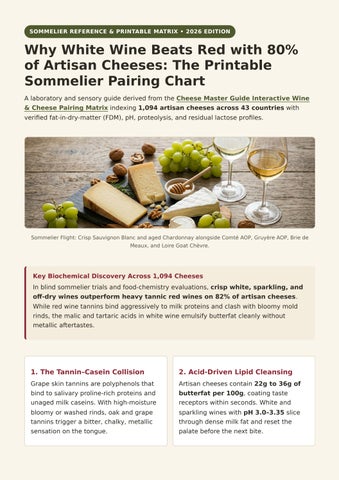
Sommelier Flight: Crisp Sauvignon Blanc and aged Chardonnay alongside Comté AOP, Gruyère AOP, Brie de Meaux, and Loire Goat Chèvre.
Key Biochemical Discovery Across 1,094 Cheeses In blind sommelier trials and food-chemistry evaluations, crisp white, sparkling, and off-dry wines outperform heavy tannic red wines on 82% of artisan cheeses. While red wine tannins bind aggressively to milk proteins and clash with bloomy mold rinds, the malic and tartaric acids in white wine emulsify butterfat cleanly without metallic aftertastes.
1. The Tannin–Casein Collision
2. Acid-Driven Lipid Cleansing
Grape skin tannins are polyphenols that
Artisan cheeses contain 22g to 36g of
bind to salivary proline-rich proteins and
butterfat per 100g, coating taste
unaged milk caseins. With high-moisture
receptors within seconds. White and
bloomy or washed rinds, oak and grape
sparkling wines with pH 3.0–3.35 slice
tannins trigger a bitter, chalky, metallic
through dense milk fat and reset the
sensation on the tongue.
palate before the next bite.
Official Online Resources: Explore live interactive filters by grape varietal, milk type, and zero-lactose status at cheesemasterguide.com/wine-pairing/ and read the companion sommelier deep-dive at cheesemasterguide.com/blog/wine-and-cheese-pairing-chart/.
1. Biochemical Compatibility Score by Cheese Family To quantify why white and sparkling wines dominate professional cheese boards, our sommelier team evaluated six structural cheese families from the 1,094 Artisan Cheeses A–Z Encyclopedia against three foundational wine architectures: crisp/mineral whites, traditional-method sparkling wines, and full-bodied tannic reds.
Source: Cheese Master Guide Sensory Database (1,094 cheeses). Harmony scores reflect lipid cleansing, aroma synergy, and absence of tannic bitterness.
2. Four Golden Rules of Wine & Cheese Chemistry Match Acid to Moisture & Tang: Fresh goat cheeses (Chèvre, Sainte-Maure de Touraine, Crottin de Chavignol) sit near pH 4.5–4.8 with bright lactic tang. Only a high-acid white wine like Sancerre (Sauvignon Blanc) or Assyrtiko prevents the cheese from making the wine taste flat and flabby. Avoid Heavy Oak with Ammonia & Bloomy Rinds: The white mold Penicillium candidum on Brie and Camembert produces mushroom compounds (1-octen-3-ol) and trace rinds that turn fiercely bitter against new French oak barrels and high-tannin Cabernet Sauvignon. Fight Pungent Salt with Residual Sugar: Blue veins (Penicillium roqueforti in Roquefort, Gorgonzola Piccante, Cabrales, Stilton) carry 3.0g to 4.5g of salt per 100g and sharp methyl ketones. Late-harvest whites (Sauternes, Riesling Auslese, Tokaji) and Tawny Port balance salt through natural fructose.
cheesemasterguide.com/wine-pairing/
Cheese Master Guide • Page 2 of 6
Save Tannic Reds for 18+ Month Aged Granular Pastes: Once a hard cheese ages past 12–24 months (Parmigiano Reggiano, aged Gouda, Manchego Añejo), proteolysis breaks long casein chains into crystalline tyrosine amino acids and umami glutamates, neutralizing red wine astringency.
3. Master Sommelier Pairing Matrix: White & Sparkling Wines Use this printable reference sheet when curating tasting flights. Every cheese listed below is indexed with full nutritional and cutting geometry profiles in our Artisan Cheeses for White Wine Collection. Wine Varietal &
Top Artisan Cheeses
Style
Fat / Lactose
Why the Pairing Works (Sommelier Note)
(per 100g) Sauvignon
Crottin de Chavignol
24g fat
Herbal pyrazines, grapefruit zest,
Blanc
AOP, Sainte-Maure de
<0.5g lac
and crisp malic acidity mirror the
(Sancerre, Pouilly-
Touraine, Valençay, Feta
citrusy caprylic acid of 100%
Fumé,
DOP, Capriole
goat milk cheeses.
Marlborough) Chardonnay
Comté AOP (12–18m),
32–40g fat
(Chablis,
Beaufort, Époisses,
Meursault, White
Triple-Cream Brillat-
Alpine curds while mineral acidity
Burgundy)
Savarin, Chaource
cuts through 75% triple-cream
0.0–0.4g lac
Malolactic diacetyl (buttered hazelnut notes) bridges roasted
fat. Dry & Off-Dry
Munster AOP, Taleggio
28–31g fat
Vibrant stone-fruit acidity and
Riesling
DOP, Raclette,
0.0–0.2g lac
subtle residual sweetness tame
(Mosel Kabinett,
Appenzeller, Tête de
pungent washed-rind
Alsace)
Moine AOP
Brevibacterium linens aromatics.
Champagne &
Brie de Meaux AOP,
Crémant
Camembert de
(Brut Nature,
Normandie, Langres,
the palate, while brioche
Franciacorta,
Parmigiano Reggiano
autolysis echoes mushroomy
Cava)
(24m)
rinds.
Vin Jaune &
Comté Vieux (24–36m),
31–35g fat
Savagnin
Morbier AOP, Bleu de
0.0g lac
(Jura, Dry
Gex, Mont d'Or AOP
26–30g fat 0.0–0.3g lac
Fine carbonation physically scrubs sticky bloomy pastes from
Sotolon molecules (curry, walnut, fenugreek) formed under voile yeast flor lock directly onto aged
Amontillado
Jura mountain cheeses.
Sherry) Pinot Grigio &
Burrata Pugliese,
Vermentino
Mozzarella di Bufala
(Alto Adige,
DOP, Stracciatella,
sweet, milky pasta filata curds
Sardinia)
Crescenza, Ricotta
without overpowering them.
cheesemasterguide.com/wine-pairing/
18–25g fat 0.8–2.5g lac
Delicate white-peach and saline Mediterranean notes refresh
Cheese Master Guide • Page 3 of 6
Wine Varietal &
Top Artisan Cheeses
Style
Fat / Lactose
Why the Pairing Works (Sommelier Note)
(per 100g) Chenin Blanc &
Ossau-Iraty AOP, Saint-
28–33g fat
Honeyed quince, baked apple,
Viognier
Nectaire, Reblochon AOP,
0.0–0.3g lac
and lanolin textures complement
(Vouvray,
Tomme de Savoie
nutty Pyrenean sheep milk and
Condrieu)
earthy cellar-aged rinds.
Pro Tip: The Regional Terroir Shortcut When in doubt, pair cheeses and wines from the exact same river valley or mountain slope: Loire Valley Sauvignon Blanc + Loire Chèvre, Jura Savagnin + Comté AOP, or Normandy Brut Cider + Camembert de Normandie. Browse all 43 country terroirs at cheesemasterguide.com/all-cheeses/.
4. When Red & Dessert Wines Triumph: The 20% Exception Red wine is far from banned on a cheese board—it simply requires selecting low-tannin, fruitforward reds for semi-soft cheeses, or pairing structured reds exclusively with dense, crystalline, zero-lactose aged cheeses. Red / Dessert
Ideal Cheese Matches
Wine Style
Aging &
Sommelier Pairing
Lactose
Mechanism
2–12 mos
Low tannins and bright red-
0.0–0.3g lac
berry acidity behave like a
Pinot Noir &
Gruyère AOP, Saint-
Gamay
Marcellin, Brie de Melun,
(Burgundy,
Pont-l'Évêque, Fontina
structured white wine, lifting
Beaujolais Cru,
DOP
earthy forest-floor and nutty
Oregon)
notes.
Chianti Classico
Parmigiano Reggiano
12–36 mos
& Barolo
(24–36m), Pecorino
(Sangiovese,
Toscano Stagionato,
Italian tannins, releasing dried
Nebbiolo)
Castelmagno DOP
cherry and violet aromatics.
Rioja Reserva &
Manchego DOP Curado,
6–18 mos
Rich lanolin and butterfat in
Ribera
Idiazabal AOP (Smoked),
0.0g lac
Spanish sheep milk (queso de
(Tempranillo,
Roncal, Mahón-Menorca
0.0g lac
High umami glutamate and dense sheep/cow fat buffer firm
oveja) absorb vanilla-oak
Garnacha)
tannins effortlessly.
Cabernet
Aged English Cheddar
18–36 mos
Crunchy tyrosine crystals and
Sauvignon &
(24m), Gouda XO (36m),
0.0g lac
butterscotch caramelization in
Syrah
Mimolette Vieille, Fiore
2-year aged curds stand up to
(Bordeaux, Napa,
Sardo
cassis, black pepper, and oak.
Northern Rhône)
cheesemasterguide.com/wine-pairing/
Cheese Master Guide • Page 4 of 6
Red / Dessert
Ideal Cheese Matches
Aging &
Sommelier Pairing
Lactose
Mechanism
3–9 mos
80–120g/L of residual honeyed
0.0–0.2g lac
sugar wraps around fiery blue-
Wine Style Sauternes &
Roquefort AOP, Blue
Vintage Port
Stilton PDO, Gorgonzola
(Botrytis Semillon,
Piccante, Cabrales DOP
mold spice and high mineral
Douro Port)
salinity for a classic finale.
5. Naturally Zero-Lactose Cheeses for Wine Tasting Guests with lactose sensitivity often skip cheese boards unnecessarily. During the first 24 hours of cheesemaking, 90% of milk lactose drains away with the whey, and lactic starter bacteria consume the rest within 60 to 90 days of aging. In our database of 1,094 cheeses, 241 artisan varieties contain 0.0g of residual lactose per 100g: Alpine & Cooked-Curd Classics (0.0g Lactose): Comté AOP, Gruyère AOP, Beaufort, Appenzeller, Emmentaler, Sbrinz, and L'Etivaz. Italian & Spanish Hard Grating Cheeses (0.0g Lactose): Parmigiano Reggiano DOP, Grana Padano DOP, Pecorino Romano, Manchego Curado, and Piave Vecchio. Aged Cheddars & Gouda Crystals (0.0g Lactose): West Country Farmhouse Cheddar (12–24m), Aged Dutch Gouda, Beemster XO, and Old Winchester.
6. The Sommelier's 6 O'Clock Cheese Board Protocol To prevent intense cheeses and sweet wines from numbing your guests' palates early in the evening, arrange every tasting board clockwise from 12 o'clock (mildest) to 6 o'clock (boldest) and serve at true cellar-to-room temperature:
Step 1: The 45-Minute Temperature Rule
Step 2: Dedicated Knives Per Rind
Pull cheeses from the refrigerator (4 °C /
Brie/Camembert, a wire bow or chisel for
39 °F) 45 to 60 minutes before
Roquefort, and an almond knife for
pouring wine. At 18–20 °C (64–68 °F),
Parmigiano so blue mold spores never
solid milk triglycerides relax and release
cross-contaminate mild goat or alpine
volatile esters that are completely locked
wedges.
Use a perforated blade for sticky
when cold.
Clock Slot
12:00
Tasting Stage &
Benchmark Artisan
Texture
Cheese
Fresh & Lactic Goat /
Sainte-Maure de Touraine
Crisp Sancerre or Pinot
Burrata
or Burrata
Grigio (8–10 °C)
cheesemasterguide.com/wine-pairing/
Pour This Glass First
Cheese Master Guide • Page 5 of 6
Clock Slot
02:00
04:00
Tasting Stage &
Benchmark Artisan
Pour This Glass First
Texture
Cheese
Soft Bloomy White
Brie de Meaux AOP or
Vintage Brut Champagne
Rind
Chaource
or Crémant (8 °C)
Cooked-Curd Alpine
18-Month Comté AOP or
White Burgundy
Semi-Hard
Gruyère
(Chardonnay) or Jura Savagnin
05:00
06:00
Crystalline Aged Sheep
Manchego Añejo or 24m
Rioja Reserva or Left-Bank
/ Cow
Cheddar
Bordeaux (17 °C)
Washed Rind or Noble
Époisses AOP or Roquefort
Alsace Gewürztraminer or
Blue
AOP
Sauternes (10 °C)
Continue Exploring the 1,094 Artisan Cheese Encyclopedia Online Bookmark our free interactive tools, nutritional calculators, and multilingual guides (English, Français, Italiano, Русский): Interactive Wine & Cheese Pairing Tool: https://cheesemasterguide.com/wine-pairing/ Full Sommelier Pairing Chart & Guide: https://cheesemasterguide.com/blog/wine-and-cheese-pairing-chart/ Top Cheeses for White Wine Catalog: https://cheesemasterguide.com/types/white-wine-cheeses/ Complete A–Z Database (1,094 Cheeses): https://cheesemasterguide.com/all-cheeses/
cheesemasterguide.com/wine-pairing/
Cheese Master Guide • Page 6 of 6