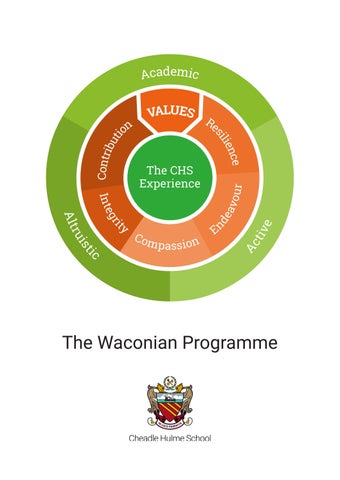
The Waconian Programme
The Waconian Programme
The Waconian Programme is an integral part of Cheadle Hulme School’s pastoral care programme and fits under the Inspire and Sustain pillars of the CHS2030 Strategy. It covers all the statutory guidance relating to RHSE (relationships, health and sex education), whilst ensuring that pupils are educated about the world around them and about how to be able to be successful in the future and reach their full potential. There are five main strands to the programme:
Future Self
Health
Citizenship
Study Skills
Relationships
The Waconian Programme is delivered through: Waconian Programme lessons, Waconian mornings, form periods, assemblies, guest speaker visits, Beyond CHS lessons, Future Self Breakfasts, Future Self Conventions and Enrichment Week (Years 10 & 12), Let’s CHat evenings. The Waconian Diploma in the Lower School supports this and embeds the core values from the start of Year 7. The School also holds a number of parental forums and workshops over the course of the year and also hosts guest speaker events for parents/carers. The Junior Waconian Programme gives children from EYFS to Year 6 the opportunity to develop important life skills and extend their understanding of the world in a way that celebrates their interests and achievements beyond the curriculum and outside the classroom. Based on the core values of Compassion, Contribution, Endeavour, Resilience and Integrity, our children are supported into taking control of their learning, discovering new passions and exploring unknowns - displaying Integrity throughout to become curious and independent learners, armed with secure practical skills and the confidence to collaborate by communicating effectively.
2
Parents/carers receive a full overview of the material covered in The Waconian Programme lessons and are asked to complete a Google Form for feedback.
The broader impact and suitability of the programme are measured through regular pupil consultations and internal surveys as well as collaborations with organisations such as Beewell and Digital Awareness. The School recognizes that the needs of its young people are in a constant state of change. Therefore, we review the data from these sources and, where deemed appropriate, adjust the suitability of our provision to better meet the needs of the pupils.
Contents
The programme covers a new topic every lesson. Baseline assessments like mind maps, Google documents, or graffiti walls are used, and at the end of the lesson, pupils revisit the initial assessment to add what they have learned. Teachers comment on these assessments and use them for future lesson planning.
Future Self 5-9
Mental Well-being Pre School, Infant & Junior School Senior School
10-11 11-13
Physical Well-being Pre School, Infant & Junior School Senior School
14 15-17
Personal Development Pre School, Infant & Junior School Senior School
18-19 19-21
3
Your Waconian Programme Path Graduate from CHS!
Stay connected to School using CHS Community
Sit A Level Examiantions
Practice interview technique
Make positive lifelong memories of CHS Develop skills to prepare for adult life
Sixth Form
Explore the variety of apprenticeships
Join the Peer Mentoring Programme
Complete a week of work experience Find out more about Find out more about health promotion and safe and healthy self examination lifestyle choices
Learn and understand how to manage grief and loss Explore respect for different cultures
Sign up for Duke of Edinburgh
Research Higher Education options
Get volunteer experience during Summer Holidays
Attend a Future Self Breakfast
Chat with the Future Self Team if you need guidance Year 11 Graduation
Prepare for work experience Attend a Let’s CHat Careers Evening
Sit GCSE Examinations
Take part in the Waconian Walk
Start a CV
Develop essential planning skills Start a personal review
Understand money management and cybercrime
Discuss sexual orientation and gender identity
Senior School Investigate career aspirations Discuss puberty and managing body changes
Junior School
Listen to the Ed. Podcast to explore different corners of CHS
Identify and challenge bullying Learn about consent and respectful relationships Gain an understanding of employability skills
Stay supported using CHS’s health and wellbeing resources
Have fun! Explore discussion around drugs, alcohol and tobacco
4
Recognise and celebrate successes
Align actions with goals
Develop goal-setting and analytical skills
Enter House competitions
Apply for university through UCAS
Year 13 last day
Apply for School Council
Obtain healthy coping strategies
Become informed on managing relationships
Develop wellbeing techniques before the examination period
Utilise CHS’s Green Path for mental well-being Support House charities
Learn about online safety and communiation
Take part in co-curricular clubs
Develop organisational skills
Develop First Aid skills
Learn revision techniques
Make and maintain forever friendships
Learn to regulate emotions
Join CHS
The School aims to enable each pupil at CHS to achieve successful progression through the different aspects of the Future Self provision. All pupils in the Senior School The School provides access to a wide range of online and paper resources, which is continually being updated and developed.
Future Self
Cheadle Hulme School is committed to providing our pupils with a programme of Future Self Information (Careers Education, Information and Guidance) in Years 7‐13 which aims to help prepare them for life beyond CHS. The School has a planned, progressive programme of activities and opportunities that supports the pupils in making informed decisions about their career pathways.
Throughout the year guest speakers talk about their careers during sessions open to all year groups.
5
Future Self
Years 7 - 11 In Waconian Programme lessons, pupils gain an understanding of employability skills, personal finance and the skills that are required in enterprises or to be an entrepreneur. Year 9 Within Form periods pupils start a personal review and a planning process, identifying their strengths, interests, qualities and ambitions and making the links between these and employability. Pupils also investigate the nature of careers and develop aspirations for future career choice, understanding the range of post-16 options in order to inform Key Stage 4 choices. Year 10 During Enrichment Week pupils undertake a week of Future Self activities that include completing the Unifrog online assessments, and take part in workshops that simulate assessment centre activities Year 11 All pupils have an interview with a member of the Future Self team; the purpose of the interview is to give the pupils advice about how post-16 qualifications fit together, other educational institutions and also any future plans that they may have. In addition, pupils are offered the opportunity to speak to an Independent Careers Advisor should they wish to. Years 12 & 13 All pupils have an interview with a member of the Future Self team; the purpose of the interview is to give advice about courses, gap year information, International University events and apprenticeships to encourage pupils to go to Open Days. All Year 12 students complete a work experience week in the final week of the year. Form tutors and subject specialists support students with their applications for university and employment.
6
The Gatsby Benchmarks are: • A stable careers programme • Learning from career and labour market information • Adressing the needs of each pupils and their different career guidance needs at different stages • Linking curriculum learning to careers • Encounters with employers and employees • Experiences of workplaces • Encounters with Further and Higher Education • Personal guidance
Future Self
The Gatsby Benchmarks Although, as an independent school, Cheadle Hulme School is not required to measure its careers’ provision against the Gatsby Benchmarks, it is felt that this is a useful exercise in order to ensure that the provision is as full as possible for all the pupils in the School.
Example list of Future Self breakfasts • The World of Marketing • What is PR and why is it different from Marketing and Advertising? • The Field of Medicine • Inside Knowledge on Interior Design • Banking and Business • Quality Assurance and Manufacturing • Finance, Portfolio Management and Hedge Funds • IT Consultancy • Project and Change Management • Everything you need to know about Architechture • What you need to know about Dentistry and Orthodontics • Being a Technical Manager within the North Wales Fire and Rescue Service • Life as a Dentist • Strategy and Operations at BP • Being part of the Police Force and becoming a Detective Chief Inspector • Being a Barrister • Bridging Finance • Working and Living Abroad
7
Artwork by Freya Thompson, Upper Sixth
8
Artwork by Hayden Smith, Upper Sixth
9
Mental Well-being
Mental well-being at CHS means equipping Waconians with the
knowledge and skills to understand and deal with the feelings and emotions which everyone experiences. In the Senior School, this translates into giving pupils the ability to share how they are feeling in an articulate manner and encourging them to behave in an appropriate way. Children in the Junior School are taught who they should share these feelings with and how they can seek support.
Pre School and Reception
Developing an awareness of others’ expectations and of how it feels to endeavour to make their best effort: • Follow our rules, making friends and the importance of friendship • My family • What makes me happy? What’s important to me? • Dealing with unkindness • People who help us
Years 1 & 2
Developing a deeper understanding of self, beginning to think about others and resilience to explore challenges: • Understanding a wider range of feelings • How our behaviour affects others • Understanding right and wrong • Differences and similarities • Healthy choices and hygiene
Years 3 & 4
Developing the skills and confidence to make positive and compassionate choices: • Anti-bullying • Understanding healthy and unhealthy relationships • Online relationships • Awareness of different family relationships
Year 5
10
Developing an awareness of upcoming changes and beginning to make positive choices with integrity: • Changing adolescent body • Recognising different relationships • Personal boundaries • Online behaviour • Rights to privacy
Developing agency, strategies to support future decisions and making positive contributions to the wider community: • Understanding and copying with change, loss and separation • Harmful substances and drugs • Online behaviour and safety • Personal safety • Understanding strategies to support mental well-being
Year 7
Developing self-confidence and self-worth: • Puberty and managing change • Body satisfaction and self concept Developing agency, strategies to manage influence and decision making: • Regulating emotions • Diet and exercise • Hygiene and dental health • Sleep
Mental Well-being
Year 6
Year 8
Developing empathy, compassion and strategies to access support: • Mental health • Change, loss and bereavement • Healthy coping strategies Developing agency and strategies to manage influence and access support: • Drugs and alcohol • Introduction to contraception • Resisting peer influence • Online choices and influences
Year 9
Developing empathy, compassion and strategies to access support: • Mental health • Change, loss and bereavement • Healthy coping strategies
11
Mental Well-being
Developing assertive communication, clarifying values and strategies to manage influence: • Healthy / unhealthy relationships • Consent • Relationships and sex in the media
Year 10
Developing empathy and compassion strategies to manage influence and assertive communication: • Relationship expectations • Impact of pornography Developing respect for diversity, risk management and support-seeking skills: • Nature of committed relationships • Diversity and discrimination • Managing relationship challenges and endings
Year 11
Developing communication and negotiation skills, risk management and support-seeking skills: • Relationship values • Maintaining sexual health • Sexual health services • Managing relationship challenges and endings Developing empathy and compassion, clarifying values and support-seeking skills: • Families and parenting • Fertility, adoption, abortion • Pregnancy and miscarriage • Managing grief and loss
Sixth Form
12
• Choosing universities • International universities • Apprenticeships and careers • Virtual Open Days at universities • UCAS • Interview skills • Leadership/branding
• Sexual health at university • First Aid • Mindfulness/coping strategies • Personal safety • Consent • Domestic violence • Breast/cervical screening
• Kooth - An Introduction to Online Mental Health Support (Year 7) • It Happens - RSE Education • GMP - Staying Safe Online (Year 8) • Kooth - Exam Stress (Sixth Form) • RAP Project - Consent (Sixth Form) • Phil Holmes - The Importance of Eating Well & Nutrition (Whole School) • Rangan Chatterjee - The Importance of Sleep (Whole School)
Mental Well-being
Example Previous Guest Speakers
13
Physical PhysicalWell-being Wellbeing
Physical well-being at CHS means helping Waconians to develop an understanding of what characteristics make up good physical health, and how to implement them. This includes guidance surrounding diet, physical activity, lifestyle choices and risks, sleep, self-care techniques and prevention of health and well-being issues. Pupils also learn skills and strategies to seek support and manage influence and peer pressure.
Pre School and Reception • • • • •
I can use my senses to explore Active and outdoor play Fine and gross motor skill development Being healthy and making good choices Regular fitness and exercise
Years 1 & 2 • • • •
Outdoor learning Sun safety Good hygiene Regular fitness and exercise
Years 3 & 4 • • • • •
Outdoor learning and nature studies Gardening to eat sustainably Local environment awareness Regular fitness and exercise Mindfulness
Year 5 • • • • •
Identifying risks, dangers and hazards Changing adolescent body Outdoor learning Regular fitness and exercise Yoga and mindfulness
Year 6 • • • • •
14
Outdoor learning and environment projects Drugs, alcohol and tobacco Food - healthy eating and making healthy choices Regular fitness and exercise Yoga and mindfulness
Developing agency, strategies to manage influence and decision making: • Regulating emotions • Diet and exercise • Hygiene and dental health • Sleep
Year 8
Developing agency, strategies to manage influence and access support: • Maintaining positive mental health • Importance of physical activity • Drugs and alcohol • Introduction to contraception • Resisting peer influence • Online choices and influences
Year 9
Developing decision-making, risk management and support seeking skills: • Contraception • Cancer awareness • First Aid awareness
Physical Well-being Wellbeing
Year 7
Year 10
Developing agency and decision-making, strategies to manage influence and access support: • Personal safety • Online relationships • Online presence and reputation • First Aid Training
15
Physical Well-being 16
Year 11
Developing confidence, agency and support-seeking skills: • Making safe and healthy lifestyle choices • Health promotion and self examination • Blood, organ and stem cell donation Developing empathy and compassion, clarifying values and support-seeking skills: • Families and parenting • Fertility, adoption and abortion • Pregnancy and miscarriage • Managing grief and loss Developing communication and negotiation skills, risk management and support-seeking skills: • Relationship values • Maintaining sexual health • Sexual health services • Managing relationship challenges and endings
Sixth Form • • • • • • •
Body image Disordered eating Shopping on a budget and having a balanced diet Self care Sexual health Pornography Personal safety
Physical Wellbeing “Our aim at CHS is to provide every pupil with the opportunity to be physically active through curriculum time, and through our co-curricular programme. There is a huge amount of variety in order to ensure that pupils can find something that they enjoy, whether this be through a performance or participation pathway. The importance of being physically active and the positive impact this has on both physical and mental health cannot be overstated; as a department we want to ensure that every member of the CHS community understands that importance and has the opportunity to be active throughout their time at the School and beyond.” Mr Giles Heagerty (CHS Co-Director of Sport)
17
Personal Development
At Cheadle Hulme School, pupils develop skills which ensure great communication and interactions with fellow classmates and those around them. These skills assist pupils with decision-making both during their time at CHS and beyond.
Pre School and Reception
Developing self awareness, an understanding of others’ expectations and resilience: • Creating games and rules • Understanding right from wrong • Self regulation • Being responsible and taking responsibility • Road safety
Years 1 & 2
Developing an identity, displaying endeavour and making more conscious choices: • Understanding and coping with change • Behaviour and consequences of actions • Staying healthy and safe • Introduction to British and Waconian values • What to do in an emergency • Resilience, independence and confidence following residential trip
Years 3 & 4
Developing organisation skills and making decisions around support required with integrity: • Environment safety - understanding water and fire • Basic emergency First Aid • Internet safety and staying safe • Organisation - begin learning in specialist rooms with specialist teachers • Resilience, independence and confidence following residential trip
18
Developing respect for diversity, support-seeking skills and making greater contributions to the School community: • Metacognition and the ability to evaluate • Basic emergency First Aid • Current affairs reflection and discussion • Understanding internet and device safety • Resilience, independence and confidence following residential trip
Year 6
Developing compassion, leadership and presentation skills: • Finance and understanding money • Community School Project • Presentation skills • Emergency First Aid • Resilience, independence and confidence following residential trip
Year 7
Developing goal setting, organisation skills and self awareness: • Personal identity and values • Learning skills and teamwork • Respect in School
Personal Development
Year 5
Developing assertive communication, risk management and support-seeking skills: • Rights in the community • Relationship boundaries • Unwanted contact • Basic First Aid Developing empathy, compassion and communication: • Making and maintaining friendships • Identifying and challenging bullying • Communicating online • ‘Sexting’
19
Personal Development
Developing risk management skills, analytical skills and strategies to identify bias: • Managing online presence • Digital and media literacy Developing respect for beliefs, values and opinions and advocacy skills: • Stereotypes, prejudice and discrimination • Promoting diversity and equality • LGBTQ+ inclusivity
Year 9
Personal Development
Year 8
Developing goal-setting, analytical skills and decision making: • GCSE options • Sources of careers advice • Employability
Year 10
Developing goal-setting, leadership and presentation skills: • Skills for employment • Applying for employment Developing respect for diversity, risk management and support-seeking skills: • Nature of committed relationships • Forced marriage • Diversity and discrimination • Extremism • First Aid Training
Year 11
Developing motivation, organisation, leadership and presentation skills: • Prepare for and reflection on work experience Developing confidence, self-worth, adaptability and decision making skills: • Recognising and celebrating successes • Transition and new opportunities • Aligning actions with goals
20
• • • • • • • • • •
Unifrog Driver safety awareness CV writings Interview skills Leadership Body language Student finance & personal finance Revision Guided meditation Guest speakers
Previous Guest Speakers
• Sheffield University - Post 16 Options (Year 11) • Matt Leigh - Apprenticeships (Sixth Form) • Hannah Hull - International University Applications (Sixth Form) • University Guys - International University Roadshow (Sixth Form) • University of Sheffield - Post 18 Options (Sixth Form)
Personal Development
Sixth Form
21
THE WACONIAN
Artwork by Scarlett Stanbra, Year 11
Relationships, Sex and Health Educatio Relationships and Sex Education
Safeguarding
Health and Wellbe
Year 7
Year 8
Year 9
Year 10
Introduction: Staying Safe
Staying Safe in Everyday Life
Truth or Trick? Navigating Fake News
Media, Influence an Online Risk
Mental Wellbeing: Emotions & Lifestyle
Understanding Mental Health
Respect, Boundaries & Real Relationships
Exploitation, Gangs & County Lines
Respect, Equality and British Values
British Values & Our School Community
Power, Politics and Voice
Power, Influence & Sexual Ethics
Online Safety & Digital Awareness
Digital Wellbeing Project
Digital Lives: Staying Safe & Smart Online
Online Project
Flexible Week (or week 15 content)
Flexible Week
Flexible Week
First Aid
Introduction to Relationships: Families & Respect
Student-Led Safeguarding
Your Voice, Your Safety
Substance Use, Dep & Informed Choice
Personal Safety & Growing Independence
Personal Safety & Risk Awareness
Recognising Harm & Making Safe Choices
Navigating Healthc & Accessing Suppo
The Teenage Brain & Decision-Making
The Teenage Brain & Online Wellbeing
Informed Choices: Relationships & Reproductive Health
Recognising and Preventing Discrim
Careers & Future Pathways
Careers Project
Future Pathways: Careers & Ambitions
Careers Project
Flexible Week (or week 15 content)
Flexible Week
Flexible Week
Risk, Relationships & Informed Choices
Healthy Living: Fitness & Nutrition
Healthy Lifestyle Choices
Risk, Reward & Reality
LGBTQ+ Rights
Boundaries and Consent
Respectful & Intimate Relationships
Substances, Choices & Consequences
Student Led
Personal Hygiene & Self-Care
Building Positive Relationships
Challenging Hate: Building Respectful Communities
Flexible Week
Flexible week / Student Led
Flexible Week
Flexible Week
Flexible Week
Summer Safety & Independence
Summer Safety & Independence
Summer Safety & Independence
Summer Safety & Independence
N PROGRAMME
on (RSHE) | Weekly Overview Years 7–13
eing
nd
s
pendency
care ort
mination
s s
Online Safety
Social, Economic
Careers
Flexible Week
Year 11
Year 12
Year 13
Raising Families
Life Admin
Life After School
FGM
The Comparison Gap
UCAS Stress & Managing Pressure
Who Influences You?
Parties, Alcohol and Drugs
Gym Culture & Body Pressure
Consent & Communication
Consent, Pressure and Grey Areas
Phone Addiction
First Aid Training
STDs & Sexual Health
What’s Happening in the World?
How to Use AI
Staying safe: Conflict, Nights Out & Personal Safety
Who Are You Without School?
Public Sexual Harassment
Real Life Finances - Student Loans & Budgeting
Harmful Sexual Behaviour
Moving Out Survival Guide
Gambling Awareness
Travel & Summer Safety
Wellbeing Online
Online Project Health Prevention and Knowledge Current Affairs Exam Prep and Mental Health Sexism and Society
Careers Project Pornography: Risks and Realities Student Led
Managing Stress, Exams & Mental Health Driving, Risk & Road Safety
Drink Spiking Festival Safety Drugs and Substances Awareness Summer Safety (Festivals)
Head · Mr Lee Richardson Claremont Road · Cheadle Hulme · Cheadle · Cheshire · SK8 6EF Tel 0161 488 330 · Email admissions@chschool.co.uk cheadlehulmeschool.co.uk Registered Company Number 3823129 Registered Charity Number 1077017