JOURNAL OF THE CATHOLIC HEALTH ASSOCIATION OF THE UNITED STATES
HEALTH PROGRESS FALL 2026
Understanding Catholic Healthcare
www.chausa.org
Season Seven: Health Reimagined THE OFFICIAL PODCAST OF THE CATHOLIC HEALTH ASSOCIATION
Subscribe to chausa.org/podcast
HEALTH PROGRESS
®
FALL 2026
FEATURES
UNDERSTANDING CATHOLIC HEALTHCARE
35 THE CHALLENGE OF WELFARE: DECIDING WHO IS DESERVING OF OUR HELP Fr. Michael Rozier, SJ, PhD 41 ACCOMPANYING THE DYING: A CATHOLIC RESPONSE TO ASSISTED DEATH Brian M. Kane, PhD
DEPARTMENTS 2 EDITOR’S NOTE BETSY TAYLOR 47 AGING Home and Community-Based Services Provide a Lifeline for Older Adults, Caregivers and Health Systems INDU SPUGNARDI 51 FORMATION Facilitation Inspired by Jazz Improvisation DARREN M. HENSON, PhD, STL 54 MISSION Well-Being: So That All May Flourish DENNIS GONZALES, PhD, and DR. HERBERT SCHUMM, MD, MBA 58 COMMUNITY BENEFIT From Strategy to Measurement: Why Alignment Matters in Community Health ALEXANDER GARZA, MD, MPH 61 THINKING GLOBALLY Catholic Healthcare at a Global Inflection Point BRUCE COMPTON
Illustrations by Jianan Liu 4 TO HEAL AS JESUS HEALS: CATHOLIC SERVICE TO THE POOR AND VULNERABLE Bishop James T. Ruggieri, MDiv
23 FINDING GOD IN DAILY LIFE 64 PRAYER SERVICE
11 HOW DO CHARISMS ANIMATE OUR WORK? NEW TIMES NEED NEW NARRATIVES Sr. Patricia Murray, CJ 16 SPONSORS AS CO-LABORERS: RELATIONSHIP AT THE HEART OF MEANINGFUL SPONSORSHIP John Hardt, PhD 24 BUILDING TRUST, SHAPING CULTURE — THE PRAXIS OF THE ETHICIST IN CATHOLIC HEALTHCARE Mary E. Homan, DrPH, MA, MSHCE, and Giovanni Tafuri, PhD(c) 30 DISRUPTIVE CHANGE: LEADERSHIP LESSONS ALONG THE ROAD TO EMMAUS Michael Cox, PhD
HEALTH PROGRESS
IN YOUR NEXT ISSUE
MENTAL HEALTH
www.chausa.org
FALL 2026
1
EDITOR’S NOTE
I
t’s not unlikely that the millions of people who receive care in a Catholic hospital, clinic or care facility annually in the United States don’t know the finer points of charism, sponsorship or community benefit.
But for those working in these settings, charged with continuing Jesus’ mission of love and healing in the world, having an understanding, or a better understanding, of foundational theology, structures and concepts is key. Not everyone needs BETSY to know everything at the same TAYLOR level, depending on their discipline and role. Yet, orientation and continued growth in understanding how Catholic healthcare is shaped and continues to evolve provide learnings that form the individual and influence how they deliberate, make decisions and respond to patients. Understanding Catholic Healthcare is the focus of this issue of Health Progress. It is meant as a way to discuss and deepen knowledge related to aspects of Catholic healthcare. It is written both for those new to the ministry and those with years of experience, who may find something educational or inspirational as they revisit concepts that already feel familiar to them. Consider, for example, the cover art for this Fall
2
FALL 2026
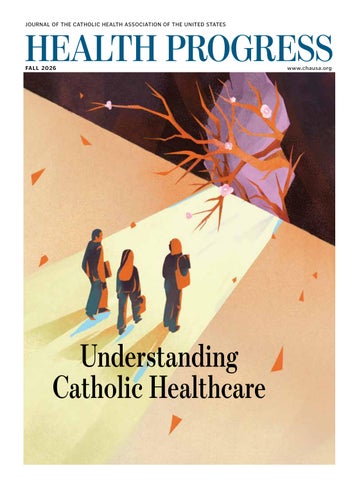
issue. Three contemporary figures walk a path, heading toward an opening filled with mostly bare branches and blossoms. To my mind, illustrator Jianan Liu likely was motivated by author Michael Cox’s reflection on the biblical Road to Emmaus story in his article about leading with head, heart and presence when decisions may be disruptive for staff and patients. Walking to Emmaus, two of Jesus’ disciples initally don’t recognize the risen Christ. It is as he accompanies them, teaches them and breaks bread with them that they realize who he is. While the passage can be parsed more deeply on a theological level, this speaks to the importance of relationship and fellowship to understanding. That’s true in our workplaces and our lives, I think. Also, as a reminder, CHA has a wealth of resources, and so if readers don’t see a topic represented here in a way that seems robust, it may be because we’ve taken it up in another recent issue. The editor in me also believes a writer shouldn’t introduce a topic without explaining it, so if you read the first line here and are still scratching your head about charism, sponsorship or community benefit, read on.
www.chausa.org
HEALTH PROGRESS
®
VICE PRESIDENT, COMMUNICATIONS AND MARKETING BRIAN P. REARDON
EDITORIAL ADVISORY COUNCIL Trevor Bonat, MA, MS, vice president, mission integration, Ascension, St. Louis Sr. Rosemary Donley, SC, PhD, APRN-BC, professor of nursing, Duquesne University, Pittsburgh
EDITOR BETSY TAYLOR btaylor@chausa.org
Sr. Jayne Helmlinger, CSJ, MS, MA, formation director, Sisters of St. Joseph of Orange, and Center for Spiritual Development staff member, Orange, California
MANAGING EDITOR CHARLOTTE KELLEY ckelley@chausa.org
Seth Lovell, RN, MBA, system vice president of clinical transformation and innovation, SSM Health, St. Louis
GRAPHIC DESIGNER NORMA KLINGSICK
Jennifer Stanley, MD, physician formation leader and regional medical director, Ascension St. Vincent, North Vernon, Indiana
ADVERTISING 4455 Woodson Rd., St. Louis, MO 63134-3797, 314-253-3447; fax 314-427-0029; email ads@chausa.org. SUBSCRIPTIONS/CIRCULATION Address all subscription orders, inquiries, address changes, etc., to Service Center, 4455 Woodson Rd., St. Louis, MO 63134-3797; phone 800-230-7823; email servicecenter@chausa.org. Annual subscription rates are: complimentary for those who work for CHA members in the United States; $29 for nonmembers (domestic and foreign). ARTICLES AND BACK ISSUES Health Progress articles are available in their entirety in PDF format on the internet at www.chausa.org. Photocopies may be ordered through Copyright Clearance Center, Inc., 222 Rosewood Dr., Danvers, MA 01923. For back issues of the magazine, please contact the CHA Service Center at servicecenter@chausa.org or 800-230-7823. REPRODUCTION No part of this publication may be reproduced or transmitted in any form or by any means, electronic or mechanical, including photocopying, recording or any information storage and retrieval system, without permission from CHA. For information, please contact copyright@chausa.org. OPINIONS expressed by authors published in Health Progress do not necessarily reflect those of CHA. CHA assumes no responsibility for opinions or statements expressed by contributors to Health Progress. 2026 AWARDS FOR 2025 COVERAGE Catholic Media Awards: Magazine of the Year — Professional and Special-Interest Magazines, First Place; Best Layout of Article or Column, Third Place; Best Special Section, First Place; Best Special Issue, Third Place; Best Coverage — Political Issues, Third Place; Best Essay, First Place; Best Reporting on Special Age Group — Senior Citizens, First Place; Best Reporting on Special Age Group — Children and Teens Younger Than 18, First Place; Hot Topic — Pope Francis, Third Place; Best Writing — In-Depth, Third Place. American Society of Business Publication Editors Awards: Print — Special Section, National Silver Award and Regional Gold Award; All Content — Enterprise News Story, Regional Gold Award.
Produced in USA. Health Progress ISSN 0882-1577. Fall 2026 (Vol. 107, No. 4). Copyright © by The Catholic Health Association of the United States. Published quarterly by The Catholic Health Association of the United States, 4455 Woodson Road, St. Louis, MO 63134-3797. Periodicals postage paid at St. Louis, MO, and additional mailing offices. Subscription prices per year: CHA members, free; nonmembers, $29 (domestic and foreign); single copies, $10. POSTMASTER: Send address changes to Health Progress, The Catholic Health Association of the United States, 4455 Woodson Road, St. Louis, MO 63134-3797.
Rachelle Reyes Wenger, MPA, system vice president, public policy and advocacy engagement, CommonSpirit Health, Los Angeles Nathan Ziegler, PhD, system vice president, diversity, leadership and performance excellence, CommonSpirit Health, Chicago
CHA EDITORIAL CONTRIBUTORS ADVOCACY AND PUBLIC POLICY: Lucas Swanepoel, JD; Kathleen A. Curran, JD, MA; Paulo G. Pontemayor, MPH COMMUNITY BENEFIT: Nancy Zuech Lim, RN, MPH CONTINUUM OF CARE AND AGING SERVICES: Indu Spugnardi ETHICS: Nathaniel Blanton Hibner, PhD; Brian M. Kane, PhD FINANCE: Brian Stremlau, CMA, MBA GLOBAL HEALTH: Bruce Compton LEADERSHIP AND MINISTRY DEVELOPMENT: Diarmuid Rooney, MSPsych, MTS, DSocAdmin LEGAL, GOVERNANCE AND COMPLIANCE: Catherine A. Hurley, JD MINISTRY FORMATION: Darren Henson, PhD, STL MISSION INTEGRATION: Dennis Gonzales, PhD; Jill Fisk, MATM PRAYERS: Karla Keppel, MA; Lori Ashmore-Ruppel THEOLOGY AND SPONSORSHIP: Sr. Teresa Maya, PhD, CCVI
Follow CHA:
chausa.org/social
HEALTH PROGRESS
www.chausa.org
FALL 2026
3
U N D E R S T A N D I N G C A T H O L I C H E A LT H C A R E
To Heal as Jesus Heals
Catholic Service to the Poor and Vulnerable BISHOP JAMES T. RUGGIERI, MDiv Bishop of Catholic Diocese of Portland, Maine
T
he theme of Catholic service to the poor and vulnerable is familiar to us, perhaps so familiar that we can pass over it too quickly. We speak often about service, mission, compassion, dignity, access and care for those most in need. These words rightly belong to Catholic healthcare and to the wider mission of the Church. Yet familiar words need to be renewed by returning to their source. For Christians, that source is not first a policy, a program or an institutional structure. It is Jesus Christ. Catholic service to the poor and vulnerable nity, brought the isolated back into communion, begins with the way Jesus sees the human person. and revealed the mercy of the Father. In this sense, It begins with the way he encounters the sick, the Catholic service to the poor and vulnerable can suffering, the forgotten and the excluded. It begins never be reduced merely to the delivery of care. It is always an encounter with with the way he reveals, in word someone loved by God. and deed, that every person is I would like to reflect on two loved by the Father and called Bishop James T. Ruggieri Gospel encounters that can help to fullness of life. The Church’s delivered an address for us understand this more deeply. ministry of healing, including the Covenant Health 2026 The first is the woman who sufthe ministry carried out through Governance Institute fered from hemorrhages and Catholic healthcare, is therefore earlier this year. His reached out to touch the cloak of not simply the provision of serremarks about Catholic Jesus (Mark 5:25-34). The second vices under Catholic sponsorhealthcare resonated with is blind Bartimaeus, who cried ship. It is a participation in the those in attendance and an out for mercy and heard Jesus ask healing mission of Christ. excerpt is shared here with him, “What do you want me to do The Ethical and Religious his permission. Covenant for you?” (Mark 10:46-52). These Directives for Catholic Health Health is a regional two encounters illuminate two Care Services place Catholic healthcare delivery network principles essential to Catholic healthcare within the Church’s covering New England and social teaching and Catholic serbroader mission. They remind part of Pennsylvania. vice: human dignity and subsidus that Catholic healthcare iarity. The woman who touches continues Christ’s healing ministry, a ministry concerned not only with physi- Jesus’ cloak teaches us that the vulnerable person cal affliction but with the whole person. Christ must be seen, acknowledged and restored to dighealed bodies, but he also restored relationships. nity. Bartimaeus teaches us that the vulnerable He forgave sins, reconciled people to the commu- person must be heard, respected and engaged as
HEALTH PROGRESS
www.chausa.org
FALL 2026
5
etly. Sometimes they come with distrust because they have already been disappointed. Sometimes they come ashamed of their need. Sometimes they come convinced that no one really wants to see them. The woman reaches out and touches the cloak of Jesus. Immediately, she is healed. Yet Jesus does not allow the encounter to end there. He stops, even though the crowd is pressing upon him and even though another urgent situation is unfolding. Jairus has already come to ask Jesus to heal his daughter, who is near death. Jesus is on the THE WOMAN IN THE CROWD: way to another crisis, and yet he stops for this hidHUMAN DIGNITY RESTORED In the Gospel according to Mark, we meet a den woman. Then Jesus asks, “Who has touched my woman who had been suffering from hemorrhages for 12 years. Twelve years is a long time clothes?” The disciples are confused. How can he to suffer. It is a long time to seek help, to live with ask who touched him when the crowd is pressuncertainty, to endure disappointment, to carry ing on every side? But Jesus knows that somefatigue, and to wonder whether healing will ever thing more than physical contact has taken place. come. The Gospel tells us that she suffered greatly He knows that healing power has gone forth from at the hands of many doctors and had spent all him, and he also knows that this woman, who has that she had. Instead of improving, she had grown been hidden in suffering, must not remain hidden worse. By the time she comes to Jesus, she is not in healing. So she comes forward. The Gospel says she only physically ill. She is financially exhausted, socially isolated, religiously burdened and emo- comes in fear and trembling. She falls down before him and tells him the whole truth. Then Jesus says tionally worn down. to her, “Daughter, your faith has saved you. Go in peace The poor and vulnerable do not always and be cured of your affliccome with confidence. Sometimes they tion.” That word “daughter” is central to the whole come quietly. Sometimes they come with encounter. Jesus does not identify her by her condidistrust because they have already been tion, her interruption of his disappointed. Sometimes they come journey or the burden of her need. He calls her daughter, ashamed of their need. and in doing so, he restores not only her body but her She comes to Jesus in the crowd, but she does place within relationship and community. Her physical healing is real, but Jesus gives her not approach him openly. She comes from behind. She says to herself, “If I but touch his clothes, I more than physical healing. He restores her to visshall be cured.” There is something profoundly ibility. He restores her to dignity. He allows her to speak the whole truth in a place where she had human in that gesture. She reaches out quietly, almost secretly, hop- previously remained hidden. This is the first great ing that contact with Jesus will be enough. In a lesson for Catholic service to the poor and the vulsense, she is hidden in plain sight. That is often nerable: The person must be seen as a person, not the condition of the poor and vulnerable. They merely as a need to be addressed. may be present, but unseen: part of the crowd, but not truly recognized. Their suffering may be real, HUMAN DIGNITY: but hidden beneath shame, fear, social stigma or SEEING THE PERSON BENEATH THE CIRCUMSTANCE the exhaustion of having asked for help too many Human dignity is not simply a beautiful phrase in times. The poor and vulnerable do not always Catholic social teaching. It is the truth that each come with confidence. Sometimes they come qui- person before us has a sacred worth that does someone with a voice, a desire and a role in his own healing. Together, these two Gospel stories offer a way to understand what Catholic service must always be. It is not service from above or service at a distance. It is not assistance that reduces people to needs, categories, costs or outcomes. It is service as encounter, service as accompaniment, and service as a manifestation of Christ’s own compassion.
6
FALL 2026
www.chausa.org
HEALTH PROGRESS
U N D E R S T A N D I N G C A T H O L I C H E A LT H C A R E
not depend on health, usefulness, productivity, responsible systems, reliable processes and carewealth, social status, age, ability, autonomy or the ful measurement are not opposed to mission. But the Gospel always recalls us to the percapacity to repay. Human dignity is not granted by the market, assigned by the state, or measured son. A chart can describe a condition, but it canby efficiency. It is not lost through illness, dimin- not exhaust the mystery of a person. A diagnosis ished by poverty, or erased by addiction, disabil- can name an illness, but it cannot name a human ity, mental illness, dependence or old age. It is being. A financial report can identify a challenge, but it cannot measure the worth of someone who given by God. Every human person is created in the image is poor. A strategic plan can establish priorities, and likeness of God (Genesis 1:26-27). Every per- but it cannot replace the act of recognizing the son son is loved into existence by God. Every person or daughter before us. is someone for whom Christ died. Every person is called Catholic service begins when we learn to to communion with God. This is why Catholic service see the person beneath the circumstance. can never treat the poor and This is not always easy, especially in large vulnerable as a secondary concern. They are not an institutions. optional addition to the mission. They are not simply The woman with the hemorrhage teaches us recipients of institutional charity. They are perthat healing must include acknowledgment. It sons in whom Christ himself comes to meet us. Catholic tradition speaks often of a preferen- is possible to treat someone and still leave that tial love for the poor. This does not mean that God person unseen. It is possible to provide a service loves some people and not others. It means that and still fail to restore dignity. It is possible to help God has a special tenderness for those most eas- someone and still make that person feel small. ily forgotten, wounded, excluded or cast aside. It Jesus does not do that. He allows her to be healed, means that when we draw near to the poor and but he also allows her to be known. He receives vulnerable, we are not moving away from the cen- her truth and sends her in peace. That is the first movement of Catholic service: to restore dignity ter of the Gospel. We are moving toward it. The woman in the Gospel shows us that vul- through encounter. nerability is not always obvious. The crowd saw a woman among many others. Jesus perceived faith, BARTIMAEUS: THE DIGNITY OF BEING ASKED suffering and a hidden cry for healing. The crowd Now let us turn to Bartimaeus. The Gospel tells almost swallowed her anonymity. Jesus restored us that Bartimaeus was sitting by the roadside her name, her voice and her dignity. This is an outside Jericho. He was blind and he was begging. important lesson for every work of healing and When he hears that Jesus of Nazareth is passing, service, because vulnerability takes many forms. he begins to cry out, “Jesus, son of David, have It can be illness, poverty, loneliness, old age, dis- pity on me.” The crowd tries to silence him. Barability, mental illness, addiction, trauma, the fear timaeus is not only blind; he is treated as a disof being a burden, the confusion of a family fac- turbance. He is not only poor; he is inconvenient. ing difficult medical choices, the isolation of The vulnerable are often silenced, sometimes the immigrant, the anxiety of the uninsured, the directly, sometimes indirectly. They may be exhaustion of the caregiver or the hidden suffer- silenced because their suffering is uncomfortable, ing of someone who outwardly appears strong. because systems are too complicated for them Catholic service begins when we learn to see to navigate, or because they are not included in the person beneath the circumstance. This is the conversations in which decisions are made. not always easy, especially in large institutions. Sometimes their lives are discussed, interpreted, Healthcare systems necessarily use forms, charts, planned and managed by others without anydiagnoses, billing codes, policies, procedures and one stopping to ask what they themselves are metrics. Good order matters. Professional com- experiencing. petence matters. Accountability matters. Indeed, Bartimaeus, however, cries out all the more: those entrusted with governance know well that “Son of David, have pity on me.” And once again,
HEALTH PROGRESS
www.chausa.org
FALL 2026
7
Jesus stops. Just as he stopped for the woman in the crowd, he stops for the man by the roadside. Then Jesus says, “Call him.” The same crowd that had tried to silence him now says, “Take courage; get up, he is calling you.” Bartimaeus comes to Jesus. Then Jesus asks him a question that is both simple and profound: “What do you want me to do for you?” At first, the question may seem unnecessary. Bartimaeus is blind. He is begging. His need appears obvious. But Jesus does not presume to speak for him. He asks. That question reveals deep respect. Jesus does not reduce Bartimaeus to his blindness or define him only by his need. He allows Bartimaeus to speak, to name his desire and to participate in the encounter. Bartimaeus replies, “Master, I want to see.” Jesus heals him, and the Gospel tells us that Bartimaeus follows him on the way. This encounter helps us understand the Catholic social principle of subsidiarity. Subsidiarity means that persons, families and local communities have a dignity and responsibility that should not be ignored or replaced by larger structures. Higher levels of organization and authority should support what is closest to the person, not absorb it, silence it or unnecessarily control it.
SOLIDARITY AND SUBSIDIARITY: COMPASSION THAT RESPECTS AGENCY
It is important to place subsidiarity alongside solidarity. Solidarity teaches us that we belong to one another. It moves us toward those who suffer and reminds us that the burdens of the poor and vulnerable are not someone else’s concern. Their suffering has a claim on us because of our shared human dignity and our communion in the human family. In the light of faith, solidarity is deepened even further because in the suffering person we encounter Christ himself (Matthew 25:35-40). Solidarity without subsidiarity can become a form of well-intended paternalism. It may rush to help, but without listening. It may provide, but without empowering. It may assume that those with resources, authority or expertise already know what is best. Subsidiarity without solidarity also can become neglect. It may speak of local responsibility while leaving persons and communities without the support they need. Catholic social teaching refuses both errors. It calls us to a form of service that is compassionate enough to draw near and humble enough to listen. In the Gospel, Jesus gives us a living image of
8
FALL 2026
this union. He knows what Bartimaeus needs. Yet he asks him, “What do you want me to do for you?” That question does not weaken Jesus’ compassion. It reveals its depth. Jesus draws near in solidarity, but he acts in a way that honors the voice and agency of the person before him. This is essential for service to the poor and vulnerable. There is a kind of service that provides but does not empower. There is a kind of service that assumes it knows what others need without asking them. There is even a form of compassion that can become paternalistic when it forgets that the person in need remains a person with gifts, wisdom, desires, relationships, responsibilities and a voice. Jesus shows us a better way. He calls Bartimaeus forward, asks him what he desires, receives his answer and restores him not only to sight but to movement, freedom and discipleship. Catholic service should always seek that kind of restoration. It is not simply to address immediate need, but to honor the deeper vocation of the person. It is not simply to manage vulnerability, but to accompany persons toward fuller life.
GOVERNANCE AS STEWARDSHIP OF MISSION
This has direct implications for those who lead and govern ministries of care. Governance, especially in large institutions, can easily become distant from the immediate experience of those being served. I say this with appreciation for the difficulty of this work. Governance often requires decisions that are not simple and sometimes are painful. Leaders must weigh real needs, limited resources and obligations that cannot be ignored. They are asked to think not only about today’s needs but also about whether the ministry will remain strong enough to serve tomorrow’s needs. This is not a small responsibility. Precisely because it is so serious, it must be continually grounded in mission. Governance in a Catholic setting is not only fiduciary responsibility. It is stewardship of mission. It requires financial seriousness, strategic clarity, ethical integrity and operational competence. But it also requires moral imagination. It requires leaders to ask who is not being heard, who is closest to the suffering, whose dignity is at stake, and whose voice should inform the decisions being made. This is why human dignity, solidarity and subsidiarity belong together. Human dignity tells us who the person is: someone sacred, someone
www.chausa.org
HEALTH PROGRESS
U N D E R S T A N D I N G C A T H O L I C H E A LT H C A R E
loved by God, someone of incomparable worth. Solidarity tells us that we must draw near to that person and share responsibility for his or her good. Subsidiarity tells us that we must do so in a way that respects agency, strengthens local relationships and supports rather than replaces the persons and communities closest to the need. Together, these principles form a Catholic pattern of service rooted in the way of Christ.
THE CONTEMPORARY NEED FOR A CATHOLIC PATTERN OF SERVICE
This pattern is deeply needed today. We live in a time of remarkable medical capability and deep social fragmentation. We have extraordinary technology, but many people are lonely. We have complex systems, but many people do not know how to enter them. We have increasing awareness of social needs, but many communities remain isolated, poor and wounded. Catholic service must offer something different. It must witness that the human person is never a burden to be discarded, a problem to be managed, a cost to be minimized, or a life to be judged unworthy of care. At the same time, Catholic service must witness that vulnerable persons are not merely passive recipients of charity. They are persons with voices, agency, gifts and wisdom. They are persons who can reveal Christ to us. The poor are not only people we serve; they are people from whom we learn. They teach us
This is where advocacy becomes part of service. The ministry of healing does not end with the direct encounter. It also asks how communities, institutions and public policies can better protect life, strengthen families, support the elderly, care for those with disabilities, respond to mental illness, accompany those suffering from addiction, serve immigrants and refugees, protect the unborn and ensure that the poor are not excluded from necessary care. Catholic service is personal, but not private. It is institutional, but not bureaucratic. It is spiritual, but not detached from the body. It is rooted in Christ, and therefore it must touch the real wounds of the world.
CATHOLIC HEALTHCARE AND THE WHOLE PERSON
Catholic identity is not simply a label attached to an institution or a legacy inherited from the past. It is a living responsibility. Those who serve in governance help make that identity concrete. Through the questions they ask, the priorities they set, the leaders they appoint, the partnerships they discern, and the resources they steward, they help determine whether Catholic identity remains a living mission or becomes merely a historical description. In Catholic ministries, governance must ask questions that are both practical and evangelical. Financial sustainability is a necessary concern, but sustainability must always be ordered to mission. Strategic positioning matters, but Catholic leaders must also ask whom the strategy positions the ministry to serve. Risk management is necessary, but so Catholic identity is not simply a label is the courage to remain faithful to Christ and to the vulnerattached to an institution or a legacy able even when fidelity carries inherited from the past. It is a living a cost. Outcomes must be measured, but Catholic ministries responsibility. must also ask whether they are measuring what truly matters. where our systems are too complicated, where Care must be provided, but the deeper question our assumptions are incomplete, where our com- is whether dignity is being restored. These questions are not opposed to good govpassion has become abstract, and where our mission must become more concrete. This is part of ernance. They are part of good Catholic goverthe genius of Catholic social teaching. It does not nance. The Church does not ask Catholic instiallow us to choose between charity and justice, tutions to be less competent because they are between personal encounter and social responsi- Catholic. She asks them to be more deeply human bility, or between the dignity of the individual and because they are Catholic. She asks them to unite professional excellence with moral clarity, finanthe common good. It holds these together. Catholic service must respond to the person cial stewardship with mercy, institutional strength before us while also asking about the conditions with humility, and service with the encounter of Christ. that leave so many people unseen and unheard.
HEALTH PROGRESS
www.chausa.org
FALL 2026
9
RETURNING TO CHRIST IN THE MIDST OF COMPLEXITY
The Gospel gives us a way to remain centered. When the pressures become great, we return to Christ and to his way of seeing. We return to the woman in the crowd and to Bartimaeus by the roadside. We ask who is hidden, who is being silenced, who is reaching out quietly, who is crying out, who needs to be called forward, and who needs to be asked rather than presumed upon. The Gospel says that the woman told Jesus the whole truth. How many people served by our ministries are carrying a truth they have never been invited to speak: a truth about pain, fear, poverty, shame, grief, addiction, loneliness, family burdens, spiritual distress or the feeling of being forgotten? Bartimaeus tells Jesus his desire: “Master, I want to see.” How many people in vulnerable situations have desires that are deeper than the immediate service they seek? They may want stability. They may want reconciliation. They may want to be treated with respect. They may want to go home. They may want to understand. They may want someone to tell them the truth. They may want to be forgiven. They may want to begin again. They may want hope. Not every caregiver can do everything, and not every institution can provide every form of heal-
ing. But every Catholic ministry can cultivate a culture in which persons are not reduced to transactions. Every Catholic ministry can ask whether its practices communicate dignity or indifference and whether it listens to those closest to suffering. Every Catholic ministry can form leaders who understand that mission is not an ornament but the soul of the work. Ultimately, governance in Catholic ministries is about fidelity: fidelity to Christ, the Church, the human person, the poor and vulnerable, and the healing ministry entrusted to us. Catholic service to the poor and vulnerable is the continuation of that healing mission. It is the conviction that no person is invisible to God, that no suffering person is merely an interruption, and that no human being loses dignity because of poverty, illness, disability, age, dependence, addiction or fear. It is the conviction that authentic help must respect the voice and agency of the person being helped. It is the conviction that the work of healing belongs to Christ before it belongs to us. And it is the conviction that when we serve the poor and vulnerable with love, we do not simply bring Christ to them. We meet Christ in them. BISHOP JAMES T. RUGGIERI leads the diocese of Portland, which covers the entire state of Maine.
A CHA ADVENT RESOURCE
BUILDING A KINGDOM OF PEACE ADVENT 2026
The Catholic Health Association invites you to experience Building a Kingdom of Peace — a beautifully curated daily Advent resource designed to inspire prayer, reflection and connection through this sacred season. Available digitally and as a self-standing coil-bound calendar with accompanying poster set for display in your ministry.
chausa.org/advent
10
FALL 2026
www.chausa.org
HEALTH PROGRESS
U N D E R S T A N D I N G C A T H O L I C H E A LT H C A R E
How Do Charisms Animate Our Work? New Times Need New Narratives SR. PATRICIA MURRAY, CJ Chair of The Anna Trust
I
recently visited Nano Nagle Place in Cork, Ireland, a heritage and community center that tells the story of Irish Catholic educator and social reformer Nano Nagle and the origins of the Presentation Sisters, the congregation she founded in 1775. During her lifetime, Nagle, called the “Lady of the Lantern,” made nightly visits with her lantern to poor families in Cork and championed education as a path out of poverty. Although she spent most of her life serving as a layperson, she later founded a religious order with an active ministry in education and social reform. This visit prompted me to reflect on the evolution of women’s religious congregations since the 17th century. From their initial foundations in Ireland and across Europe, Catholic sisters carried their ministries around the world and gave birth to many new communities and institutions. Inspired by the Gospel, which was reflected in the charism of their congregations, they saw the need for healthcare, education and social services in far-flung places. They were pioneers and adventurers for Christ. I remember reading the daily diary of a group of sisters from my own congregation, the Congregation of Jesus, who traveled by boat from Ireland to Australia in the 1880s, knowing that they would never see their homeland again.1 In South Sudan, I have visited the graves of Comboni Missionary Sisters from Italy, who died of malaria within months of arriving in Africa. In Indonesia, the Sisters of Jesus, Mary and Joseph, who arrived from the Netherlands, are remembered with gratitude for their healthcare ministry, which changed the lives of so many, especially women and children. When visiting Cooktown in Australia, I saw pho-
HEALTH PROGRESS
tos of Mercy Sisters, newly arrived from Waterford, Ireland, wearing black serge habits in the searing heat of Queensland. These examples are repeated throughout the world. Across the U.S., the history of these courageous pioneering women can be traced in convent graveyards, congregational archives and exhibitions, local museums, heritage centers, biographies and chronicles. These women left their homelands during times of war and conflict, famine and misfortune, religious persecution and social deprivation. They inspired other women to join them. Their legacy and heritage are to be found today in health and educational systems, social services networks, community development initiatives, social justice movements and advocacy on behalf of those who are marginalized and forgotten. The members of these congregations saw the needs in remote places and reached out over the centuries to provide schools, hospitals, clinics and many social services not provided by the government. As the number of sisters diminishes, how then do we carry on the founding vision and charism
www.chausa.org
FALL 2026
11
U N D E R S T A N D I N G C A T H O L I C H E A LT H C A R E
of these different congregations? We know that the charism of a religious congregation is the special spiritual gift given by the Holy Spirit to its founder. It defines the congregation’s unique identity, its core mission and its specific way of living out the Gospel. What, then, should happen when institutions founded by different congregations come together, bringing their distinct charisms to continue the provision of healthcare? When laypeople take up leadership and management positions, are they being called to preserve the charismatic identity of the hospital, or of the hospital system that they lead and manage, which is often a collective of congregations? These are not easy questions to answer, but I offer a few of my reflections on these topics.
RECLAIMING OUR ROOTS
laypeople. Since Vatican II, processes of renewal and adaptation have led many religious congregations to revisit their origins and rediscover the important role of the laity in their early history, development and expansion. Now it is almost as if the Holy Spirit has brought the life cycle of congregations full circle in parts of the world. As more laypeople, who are not vowed religious, take responsibility for congregational institutions, the mission, ministry, founding vision and charism of these congregations are being nurtured, interpreted and integrated into the life of the Church by laypeople. Members of the congregations, religious sisters and brothers who are present in smaller numbers, are now being called to play a new role. They are offering a new type of presence and are scattered like mustard seeds within the whole enterprise; they help to nurture future growth, which is being led by the laity. Their roles are now more varied — accompanying and mentoring lay leaders, participating on boards, being a pastoral presence, or providing spiritual and theological formation.
Firstly, I believe that it is important to remember and to reclaim the lay roots of religious congregations. Many founders, like Nagle, were laywomen or laymen who never set out to establish religious congregations. However, to receive official recognition and approval from the Catholic Church to As more laypeople, who are not vowed carry out their different religious, take responsibility for apostolates, establishing a congregation as a congregational institutions, the mission, religious order or under a bishop was the only ministry, founding vision and charism of canonical option available these congregations are being nurtured, at the time. In addition, this recognition ensured interpreted and integrated into the life of the Catholic identity the Church by laypeople. and the continuity of the established ministries. Religious and laity are being called by the However, as religious congregations initially grew and spread worldwide, a wider local Church Church to intertwine their vocations, charisms network of laypeople, made up of family, friends and ministries and to “live the communion that and parish members, supported the sisters’ mis- saves by walking in a synodal way … by going forth sion and ministry. As the number of sisters to meet everyone in order to bring the joy of the increased over time and congregations and their Gospel.”2 As religious introduce laypeople to the institutions expanded, the local links and bonds charism, history and spirituality of their congrebetween the religious and their local lay support- gations, they pass on a living tradition that will ers tended to remain geographically confined. As continue to have influence in ways discerned by congregations grew nationally and internation- lay leaders. ally, they relied more on their institutional structures and less on these local networks, which RESPONDING COURAGEOUSLY, PROPHETICALLY gradually weakened over time. Secondly, moving into the future, fidelity to the Members of religious congregations occupy a founding charism is not about responding as the unique consecrated state that sets them apart from sisters, past or present, would have responded.
HEALTH PROGRESS
www.chausa.org
FALL 2026
13
The charism, as already noted, is a living heri- in the journey of our communities and allowing tage that has to be continually explored, reinter- ourselves to be guided towards the next steps.” preted and contextualized. It is about continuing It means “recognizing God’s action in history in to nurture and develop the Catholic identity of order to discern the present and open ourselves the ministry in fidelity to the Gospel, Catholic to the future.”4 social teaching and the Church’s synodal way of This is the challenge facing lay leadership. proceeding. This is what It is not about preserving what has been the founders did. Like them, today’s lay entrusted to them but about doing what the leaders must respond to contemporary contexts founders did: bringing the richness of their in courageous and provocation and personal gifts to the needs and phetic ways. It is about venturing forth into new challenges that lie ahead. and uncharted territories, knowing that the founding charisms offer Gospel values and spiritual tradiAt this point in history, it is good to look back tions to sustain the ministry. However, at the heart and see God’s action in and through the founders of each charism is the Catholic identity, which was and the members of the various congregations, central to the founder’s graced beginnings. recognizing that a new phase of that story has It can be a particularly helpful exercise to already begun. Visiting sites associated with the explore the writings or sayings of the founders founders or reading their biographies or congreand see how they echo important passages of gation’s history offers precious time to give thanks Scripture and different contemporary challenges for the journey undertaken so far. Then it calls for found in Catholic social teaching. The charisms evaluation and discernment to identify the prohave to be contextualized in the current reality of cesses of change and transformation that lie ahead. the Church and society. Some years ago, reflecting on my congrega- CARRYING THE MISSION FORWARD tion’s educational work in his diocese, the bishop A Catholic healthcare system, like a local church, of Darjeeling, India, remarked, “You came to Dar- is being invited by the synodal process to examine jeeling in the 1850s and you laid a golden egg, and its relationships, ecclesial processes and bonds in then you sat on it. Now is the time to get off the egg order “to bring to life an exchange of gifts at the and go to new places and meet new needs in new service of the common mission.”5 The exchange ways.” This is the challenge facing lay leadership. of gifts across different institutions, involving difIt is not about preserving what has been entrusted ferent individuals and teams, enriches the health to them but about doing what the founders did: ministry in many ways. bringing the richness of their vocation and perEach institution and healthcare system is a sonal gifts to the needs and challenges that lie microcosm of the wider world with a highly comahead. plex community, striving to meet the needs of peoThe Church’s synodal journey is offering the ple in a fast-changing environment. The Church same kind of challenge. It is a reminder that every today seeks to foster communion, participation baptized person is called to participate in and be and mission by engaging in listening, dialogue and part of God’s mission in the world. The recently discernment. There will be many different levels published document, “Recollecting: Accom- of engagement, ranging from full participation to panying the Preparation of the Local Church’s skepticism, lack of interest and involvement, and Evaluation Assembly,” has some helpful pointers even opposition. about how to bring together the past, present and However, like the early founders of congregafuture.3 It says that recollecting means remem- tions and the generations of members who folbering, which in Scripture actually means “rec- lowed them, the challenge is to continue creating ognizing what the Lord has brought to maturity welcoming spaces where people committed to
14
FALL 2026
www.chausa.org
HEALTH PROGRESS
meeting the needs of the day can come together. Some will engage because of their faith commitment, others because of their bonds with the institution or congregation, and others for personal reasons. But in the words of the late Pope Francis, “There is space in the Church for everyone.”6 We believe all are welcome, and indeed, all are needed. In conclusion, I want to return to Nagle’s legacy in Cork. She represents all those extraordinary women and men who, initially as laypeople in their times and contexts, responded to health, education and social needs. The Holy Spirit led each of them and their followers along a particular charismatic path and vocation to ensure the continuity of the mission and to meet the needs of the times. That mission is now increasingly being entrusted to the laity to carry it into the future. Let us remember that: “In the face of fear, they chose to be daring, In the face of anxiety, they chose to trust, In the face of impossibility, they chose to begin.”7 What will you (we) choose to do? SR. PATRICIA MURRAY, CJ, is chair of The Anna Trust: Catholic Sisters’ Elder Care Fund, based in Rome. She is a consultor at the Dicastery for Institutes of Consecrated Life and Societies of Apostolic Life. She served as the executive secretary for the International Union of Superiors General from 2014 to 2025.
NOTES 1. The Congregation of Jesus (CJ) has historically been known by different names, including the English Ladies (Englische Fräulein) in German-speaking Europe, the Loreto Sisters in Ireland and worldwide, and Las Irlandesas in Spain. 2. XVI Ordinary General Assembly of the Synod of Bishops, “For a Synodal Church: Communion, Participation, Mission,” The Synod, October 26, 2024, section 154, https://www.synod.va/content/dam/synod/ news/2024-10-26_final-document/ENG--Documento-finale.pdf. 3. “Recollecting: Accompanying the Preparation of the Local Church’s Evaluation Assembly: Notes for Bishops and Synodal Teams,” The Synod, July 27, 2026, https://www. synod.va/content/dam/synod/process/ implementation/recollecting/260065_1_ ENG_RECOLLECTING.pdf. 4. “Towards the 2027 Assemblies of the Local Churches: ‘Recollecting’ Resource Published,” The Synod, July 27, 2026, https://www.synod.va/en/news/towardsthe-2027-assemblies-of-the-local-churchesrecollecting-r.html. 5. “For a Synodal Church: Communion, Participation, Mission,” section 65. 6. Andrea Tornielli, “For Everyone,” Vatican News, August 4, 2023, https://www.vaticannews.va/en/vatican-city/news/2023-08/ pope-francis-tornielli-editorial-wyd-lisbonwelcoming-ceremony.html. 7. This quote is an adaptation. The original 1977 poem uses the language “she” rather than “they” and is by Sr. Raphael Consedine, PBVM, “Profile: Nano Nagle” in Songs of the Journey (Presentation Sisters Victoria, 2001).
GET IT DELIVERED Health Progress and Catholic Health World CONTACT THE SERVICE CENTER AT SERVICECENTER@ CHAUSA.ORG
Issues are complimentary for those who work for CHA members in the United States.
HEALTH PROGRESS
www.chausa.org
FALL 2026
15
U N D E R S T A N D I N G C A T H O L I C H E A LT H C A R E
Sponsors as Co-Laborers:
Relationship at the Heart of Meaningful Sponsorship JOHN HARDT, PhD Vice Dean for Professional Formation at Loyola University Chicago Stritch School of Medicine, Sponsor and Board of Directors member for SSM Health
M
any rich metaphors have been offered to describe the role of sponsors in Catholic healthcare, and I want to propose three descriptions, not as replacements for others, but as complementary to them. Viewing the sponsor’s role as vessel, witness and covenant partner allows us to highlight the relational nature of sponsorship roles and the importance of engaged collaboration among sponsors, governing board members and executive teams. These metaphors seek to locate the sponsor’s work within — not above or outside — the life of the ministry and illuminate the strengths and potential challenges inherent in various sponsorship structures. Before exploring these three images, it is worth pausing to say something about what sponsorship is and how its structures have changed: Sponsorship of a healthcare ministry is a structured relationship through which the sponsor, in the name of the Church, directs and influences a ministry that meets an apostolic need and furthers the mission of Jesus. Sponsor members of Catholic healthcare act publicly on behalf of the Catholic Church, promoting and assuring Jesus’ healing mission by guiding and overseeing a specific institutional ministry in a formal and public way.1 For much of the history of Catholic healthcare in the United States, this accountability was exercised directly by religious congregations — primarily women religious — who founded, staffed and led the institutions. The sponsor was, in those circumstances, a present community formed by
HEALTH PROGRESS
religious vows and lives of prayer whose charism permeated the culture of the ministry from within. A charism in Catholic healthcare is the grace-given, distinctive way of perceiving and responding to Christ in the suffering caused by illness and injury. A charism enlivens and shapes a ministry’s memory, identity, discernment and practices of healing. The model of congregation as sponsor has undergone a significant transformation. As religious congregations have diminished in number and their members have aged, the sisters have partnered with committed laity in sponsorship models. These models are facilitated by the establishment of the ministerial juridic person (MJP). A juridic person is a canonical entity created under Church law to hold the sponsoring function previously exercised by a congregation. This has become the dominant model of sponsorship for Catholic healthcare systems in the U.S.2 Once an MJP is formed, the key structural question pertains to how the sponsor body and the governing board relate to each other. The MJP generally takes one of three configurations in our current moment to establish this relationship: A sponsor body can be “distinct” from the governing board;
www.chausa.org
FALL 2026
17
a sponsor body can “mirror” the governing board such that the sponsoring body and governing board are composed of one and the same members; or a sponsor body can function in a “hybrid” configuration in which the sponsor body is a subset of members drawn from the governing board. A consistent challenge persists across these configurations: There is no simple or best way to exercise the overlapping accountabilities of sponsor, board and management. I would suggest that this is because the meaningful work of sponsorship reaches beyond the contour of its structure and into the art of human relationship. It is in the relational quality of these various configurations that the preservation and strengthening of the healthcare ministry’s mission is facilitated. It is precisely this challenge — how sponsors inhabit their role in relationship with other key bodies — that the images of vessel, witness and covenant partner are meant to address.
TRUE COLLABORATION NECESSITATES ENGAGED RELATIONSHIP
The Ethical and Religious Directives for Catholic Health Care Services, addressing the role of laity in the leadership of Catholic healthcare, observes that: While many religious communities continue their commitment to the health care ministry, lay Catholics increasingly have stepped forward to collaborate in this ministry. … Their participation and leadership in the health care ministry, through new forms of sponsorship and governance of institutional Catholic health care, are essential for the Church to continue her ministry of healing and compassion.3 The verb “collaborate” speaks to a central component of the sponsor’s role, namely, to work, or co-labor, in relationship with the governing board and the executive team to preserve, expand and strengthen Catholic healthcare’s mission. Collaborate, meaning “to work together,” communicates a relationship characterized by mutuality and engagement. I’d like to suggest that this language highlights sponsors as engaged in the reality of the ministry’s life on the ground, rather than working at a level that can seem distant from or above the ministry and its constituents. Collaboration also resists an understanding of the sponsor as somehow in possession of something others don’t have. Instead, it creates
18
FALL 2026
a context for mutual accountability among key constituents in the preservation, expansion and strengthening of Catholic healthcare’s mission lived out in its ministries.
SPONSOR AS VESSEL
To speak about a sponsor as a vessel is to emphasize function rather than status. Sponsors carry a charism and mission without owning it. Their position is not privileged as singular possessors of the mission and charism. Sponsors serve as vessels insofar as they carry the charism of a system’s founding congregation(s) and the mission of the ministry on behalf of the Church. This role requires formation, fidelity and humility. For some sponsors, the gift of translating the meaning of the Catholic tradition, the charism of the ministry, and its mission and values can be a particular kind of service to the wider ministry. Here, the charism and mission that move through the sponsor as a vessel are renewed as they are received, interpreted and embodied in new circumstances. This possibility calls for theological and teaching competence to be represented in the sponsoring entity. A vessel seems like an apt image because it carries something while not being the thing itself. Instead, it moves through them and is meant to be shared and poured out. Vessels are also open, that is, they are meant to be filled. To think of a sponsor as a vessel emphasizes a disposition of receptivity. An engaged sponsor not only gives but also receives, shaped by the input of the governing board, the executive team, the local ordinary, the current moment and its challenges, and the Spirit. The sponsor is formed by the sponsor’s engagement with leadership, clinical staff, community events, ceremonial events within the ministry, and the life of the Church. A sponsor’s willingness to be “filled,” to be receptive to the current moment, its challenges and opportunities, is necessary for sponsors to remain engaged in the lived reality of their healthcare ministry. In this way, while sponsors play a central role in conveying the mission, wisdom and insight of the charism and mission, they are also there to receive. This willingness to be formed into a disposition of receptivity is particularly important given the role of discernment in the life of the sponsor and the broader ministry. Discernment requires a quiet and open receptivity to the life of the Spirit. A sponsor must be humble enough to hold the various streams of information about the healthcare
www.chausa.org
HEALTH PROGRESS
U N D E R S T A N D I N G C A T H O L I C H E A LT H C A R E
To think of a sponsor as a vessel emphasizes a disposition of receptivity. An engaged sponsor not only gives but also receives, shaped by the input of the governing board, the executive team, the local ordinary, the current moment and its challenges, and the Spirit. ministry’s life that make authentic discernment possible. A vessel is an apt metaphor for both the sponsor’s work and disposition.
SPONSOR AS WITNESS
The Archbishop of Paris, Cardinal Emmanuel Célestin Suhard (1874–1949), observed that “[t]o be a witness does not consist in engaging in propaganda, nor even in stirring people up, but in being a living mystery. It means to live in such a way that one’s life would not make sense if God did not exist.”4 Cardinal Suhard’s insight about the nature of witness speaks beautifully to the importance of being, rather than just saying, in the life of a sponsor. The descriptor of witness can serve as the counterweight to the notion of vessel, which describes a more active and communicative capacity for the sponsor in carrying and sharing the mission. Where the sponsor as vessel does, the sponsor as witness is. The sponsor who embodies the identity of being a witness models a life ordered around mission values. In this way, sponsors serve as a formative influence through their very presence in serving the healthcare ministry. Sponsors, then, strive to embody the mission of their healthcare ministry in their own lives. The values that adhere to our common mission of Catholic healthcare — a preferential option for the poor and marginalized, a concern for human dignity, humility, faithfulness, and a commitment to compassion and justice — can become fragile amid market pressures and performance metrics. Sponsors serve as embodied witnesses to the enduring quality of those values even through hard times. The sponsor as witness forms and shows the way through the quiet teaching of presence within the ministry’s work.
SPONSOR AS COVENANT PARTNER
To speak of a sponsor as a covenant partner highlights the difference between a contract and a covenant. Building upon the biblical model of
HEALTH PROGRESS
covenant established in the Hebrew scriptures, the language of covenant signals mutual fidelity shaped by relationship rather than transactional exchange. A covenant is binding, ongoing and requires fidelity through thick and thin. To imagine the sponsor as a covenant partner is to call attention to shared accountability. All persons in this covenantal relationship — sponsor, governing board and executive team — are interconnected in their common responsibility to sustain the health system’s identity as a ministry, not just a business. The language of the covenant partner encourages governing boards and executive teams to allow for sponsor engagement amid the system’s work. It resists the sponsor being perceived narrowly as either an approval body for business acquisitions or partnerships that meet Catholic “standards” or a distant overseer of missionrelated matters. A covenantal relationship fosters the ability for sponsors and leadership to ask and consider deeper questions to ensure faithfulness to Catholic identity and mission. It is crucial that honest and direct dialogue not be perceived as a breach of trust or misalignment but rather the dynamic collaboration of these various entities at the service of the preservation and growth of the ministry. Similarly, the covenantal relationship requires the sponsor to be similarly accountable to the on-the-ground realities facing the board and executive team. In a covenantal relationship, accountability runs in all directions.
PROPHETIC VOICE
Yet the image of covenant partner, precisely because it is rooted in fidelity rather than mere consensus, carries with it a dimension that collaboration alone cannot fully account for: the obligation to speak truthfully, even when truth is challenging or perceived as a speed bump or stumbling block to the speed and efficiency that characterizes contemporary healthcare management. This is the prophetic dimension
www.chausa.org
FALL 2026
19
of the sponsor’s covenantal role, and it deserves explicit attention. The prophetic tradition of the Hebrew scriptures is a tradition of honest speech in the service of fidelity. The prophet speaks not from above the community but from within it — bound to it, invested in it, and therefore willing to name what others may be reluctant to say. The sponsoring congregations that gave rise to Catholic healthcare institutions carried a prophetic impulse with them into the ministries they built. Sponsors now inherit that dimension whether they received it from a founding congregation or through formation as a juridic person. It is not incidental to the role; it is constitutive of it. In practical terms, prophetic witness in the sponsor’s covenantal role means the willingness to say what needs to be said. For a sponsor, this could pertain to raising the possibility of mission drift when it is occurring or to questioning strategic decisions that may be financially sound but not sufficiently mission-aligned. The prophetic voice of the sponsor has an obligation to stand for the poor and marginalized when market pressures could press them to the margins of the ministry’s concern. Partly because sponsors are not caught up in day-to-day management and governance, they have an obligation to name hard realities that those absorbed in operations may overlook. This prophetic capacity should not be used for adversarial posturing — how things are communicated is almost as important as their being communicated. At its best, prophetic communication arises from abiding, transparent relationships, fidelity to the mission, and the presumption of good intention that enables hard conversations without damaging trust.
THE BOUNDARY OF ENGAGED COLLABORATION
This prophetic dimension of covenant also clarifies where collaboration ends and where the sponsor’s irreducible responsibility begins. The language of collaboration, for all its importance, should not obscure a genuine asymmetry in the sponsor’s role. The sponsor is not simply one stakeholder among equals at the table. The sponsor holds canonical and ecclesial accountability for the ministry’s Catholic identity — distinct from that of the governing board or executive team. As CHA has articulated, while sponsors bear the ultimate responsibility for maintaining Cath-
20
FALL 2026
olic identity and addressing community needs, they work in partnership with the Church, the diocesan bishop, and the health system’s governance and mission functions. That ultimate responsibility creates an asymmetry that covenantal language must hold honestly. In structural terms, this asymmetry is expressed through reserved powers, the canonical and civil instruments by which the sponsor retains final authority over certain decisions. While reserve powers can vary by system, they typically include amendments to the mission statement, major transactions that affect Catholic identity, and the appointment or removal of the board and chief executive. This is the final line of accountability for the ministry’s mission. As previous Health Progress authors William J. Cox and John O. Mudd have observed, the exercise of reserved powers over major decisions can come at a steep cost to relationships and to the ministry itself. Reserved powers are best understood as rarely used instruments whose availability signals the seriousness of the sponsor’s covenantal accountability, not as routine tools for oversight and governance.5 The boundary between collaboration and sponsorial authority is a threshold. On one side lies the wide and generative space of covenantal engagement: dialogue, discernment, mutual formation, honest questioning and shared accountability for the mission. On the other side lies the sponsor’s nondelegable, ultimate responsibility to the Church for the Catholic identity of the ministry entrusted to its care. Healthy sponsorship only rarely crosses that threshold because the relationships cultivated in the collaborative space make it generally unnecessary. Strong engagement and trusting relationships between a ministry and its sponsor diminish the possibility that reserved powers will be exercised to alter the course of decision-making. But the threshold is real, and sponsors who are genuinely covenant partners — invested in the mission and willing to speak prophetically — will not pretend otherwise. Fostering such relationships among sponsors, boards and executive teams yields honest, generative conversations that produce more durable outcomes.
ENGAGED COLLABORATION ACROSS MODELS
These images are not intended to be exhaustive of the meaning of sponsorship or to replace those suggested by Cox and Mudd or others. Instead,
www.chausa.org
HEALTH PROGRESS
U N D E R S T A N D I N G C A T H O L I C H E A LT H C A R E
thinking of the sponsor as a vessel, witness and sponsor members also serve as governing memcovenant partner seeks to highlight the mutual, bers constituting a portion of the governing board. relational and collaborative nature of good spon- The governing board consists of the sponsor body sorship. They describe what sponsors do in rela- and additional members who serve solely on the tionship with key constituencies and locate the governing board. In this way, the “hybrid” consponsor’s function within, not above or outside, figuration of sponsorship serves as a middle path between the “distinct” and “mirror” configurathe life of the ministry. As one considers the sponsor’s work as ves- tions. The hybrid model allows the sponsors, like sel, witness and covenant partner in each struc- their colleagues in a “mirror” configuration, to be ture, important nuances of the sponsor begin to fully present and engaged at the governance level. emerge. In the “distinct” configuration of spon- At its best, the governing board benefits from the sorship, role differentiation among the spon- sponsor members’ perspective and insight withsor, governing board and executive team is most out collapsing roles and risking some dilution of clearly defined. With no functional overlap the sponsor’s distinctiveness. But like the mirror configuration, confusion between the governing board and sponsor body, role demarcation is clear. However, in this model, about which “hat” sponsor members are wearing the sponsor as vessel, witness and covenant at any given moment can arise. The intermingling partner may have to do their heaviest lifting, while the Locating the “best” sponsorship structure itself elevates the risk that the sponsor will act configuration remains elusive, with and be perceived as removed each variant offering strengths and from or above the ministry. The temptation toward a weaknesses. But what remains clear is distance that strains the possibility of engaged colthe opportunity to overcome inherent laboration is greatest in this weaknesses in any configuration through configuration. In the “mirror” configuraengaged collaboration. tion, the sponsor’s invitation to engaged collaboration is evident, given their involvement in all governance of two distinct bodies within the governing board decisions arising from their collective responsi- risks creating “camps,” with the sponsor body perbilities as governing board members. Similarly, ceived as representing a particular perspective. Locating the “best” sponsorship configurathe “mirror” sponsor model could be seen as functioning more efficiently, given the dual, shared tion remains elusive, with each variant offering roles of its members as both sponsor and govern- strengths and weaknesses. But what remains clear is the opportunity to overcome inherent weaking board member. The inherent challenge of this model may be nesses in any configuration through engaged colits capacity to exercise its prophetic function. laboration. Regardless of structure, an engaged, Significant vetting of sponsor/board candidates trusting, transparent and collaborative relationcould help ensure the recruitment of individu- ship among sponsor, governing board and execuals with discerning dispositions, capable of see- tive team mitigates shortcomings while highlighting beyond the health system’s operations to ing strengths. perceive the potentially latent mission-central questions. The distance between a structure A SHARED MISSION that accounts for both sponsor and governing Regardless of sponsor configuration, responsibilboard roles and its successful practice requires ity for attending to the mission must be undercareful recruitment and formation, emphasiz- stood and felt as shared by the sponsor, governing ing prayerful persons of faith with a discerning board and executive team. The distinctive miscapacity and a commitment to regular critical sion of Catholic health ministries and what they self-assessment. call us to learn, attend to, implement and discern In the “hybrid” configuration of sponsorship, cannot be left to the sponsor alone. In the same
HEALTH PROGRESS
www.chausa.org
FALL 2026
21
way, mission accountability ought not to be considered a sponsor’s possession. Our shared mission is just that — shared. The maintenance and growth of our mission and the exploration of our identity as a ministry of the Church are far too important, complex and multifaceted for a single entity to carry them alone. While the sponsor’s role is distinct and unique in the context of mission, it is not exclusionary. Because the challenges ahead are significant and the work of Catholic healthcare is consequential, the metaphors offered here seek to situate the sponsor’s role within genuine relationship — as co-laborers — with governing boards and executive teams. JOHN HARDT is an associate professor of bioethics and vice dean for professional formation at Loyola University Chicago Stritch School of Medicine. He serves as a sponsor and member of the board of directors for SSM Health in St. Louis.
NOTES 1. “Sponsorship,” Catholic Health Association, https://www.chausa.org/focus-areas/sponsorship. 2. Julie Minda, “Updated Guide Illuminates Relationship Between Bishops and Health Care Ministries,” Catholic Health World, February 9, 2021, https://www.chausa. org/news-and-publications/publications/catholichealth-world/archives/february-15-2021/updatedguide-illuminates-relationship-between-bishops-andhealth-care-ministries. 3. Ethical and Religious Directives for Catholic Health Care Services: Seventh Edition (Washington, DC: United States Conference of Catholic Bishops, 2025), 6-7. 4. Madeleine L’Engle, Walking on Water: Reflections on Faith and Art (Convergent Books, 2016), 22. 5. William J. Cox and John O. Mudd, “Effective Catholic Health Care Sponsors Are Elders, Guides and Guardians,” Health Progress 105, no. 3 (Summer 2024): https://www.chausa.org/news-and-publications/ publications/health-progress/archives/summer-2024/ effective-catholic-health-care-sponsors-are-eldersguides-and-guardians.
QUESTIONS FOR DISCUSSION This article uses several metaphors and images to explore the relationship between sponsors and others involved in Catholic healthcare, imagining a sponsor as a vessel, witness and covenant partner. Catholic healthcare sponsors are leaders who act publicly on behalf of the Catholic Church to ensure and guide Jesus’ healing mission within a ministry. With reflection, visuals like these can help people make connections and better understand the role of a sponsor or allow sponsors to think more deeply about their calling. 1. After reading this article, did one of these concepts hold particular relevance for you, or do you think it’s important to consider them all together? 2. The article also talks about sponsors as co-laborers, whose work is within the ministry, not above or outside it. How have you lived that as a sponsor, or as someone who is guided by sponsors? 3. What skills or gifts have you found most valuable in sponsors? How can systems ensure that sponsors have the relationships and information they need to make challenging decisions and lead an organization forward effectively? 4. The sponsor’s responsibility to serve as a prophetic voice comes with the obligation to speak truthfully, even when the truth is challenging. When and how have you seen this responsibility exercised in your ministry?
22
FALL 2026
www.chausa.org
HEALTH PROGRESS
Finding God in Daily Life
The future of the Church’s mission in healthcare in the United States of America also depends upon your union with Christ and with one another. As long as you remain united to him, sharing in his life and motivated by the love in his heart, there is no doubt that you can continue to bear abundant fruit through caring for the sick and suffering. — Pope Leo XIV’s message on May 18, 2026, to Catholic Health Assembly attendees
Photos by Jerry Naunheim Jr./©CHA
U N D E R S T A N D I N G C A T H O L I C H E A LT H C A R E
Building Trust, Shaping Culture
The Praxis of the Ethicist in Catholic Healthcare MARY E. HOMAN, DrPH, MA, MSHCE Mountain Region Vice President of Theology and Ethics, CommonSpirit Health GIOVANNI TAFURI, PhD(c) Greater Denver Market Clinical Ethicist, CommonSpirit Health
A
s two ethicists with CommonSpirit Health, we wanted to share how we foster relationships in our respective roles as a vice president, primarily focused on organizational ethics, and a clinical ethicist, working alongside front-line caregivers. Through these relationships, we seek to overcome challenges in clinical ethics at the bedside while working toward organizational changes that benefit patients. We also provide examples of collaboration that we hope will be useful to other leaders interested in bringing on clinical ethicists.
MARY’S TAKE:
‘PARTNERSHIP OVER DIRECTION’
I was fortunate to begin my first full-time clinical ethicist role in a Catholic healthcare system that valued mission and ethics in distinct ways and placed ethics directors at its major hospitals. I had a supportive direct-line leader who would jokingly call himself my “work dad” even after I moved on to my next role, and a dotted-line leader who constantly challenged me to improve my craft. I also had my own dad, an exceptional mentor and colleague in Catholic healthcare ethics, who coached me and helped me understand what academics call the “hidden curriculum,” the unspoken rules and expectations that shape professional success. So many of us began in the field without strong mentors or a standardized process for going about our daily work. We are now the ones hiring and training the next generation of clinical ethicists, and we have seen significant changes to the role and expectations of clinical ethics over the last 10 to 15 years. We are held to the same quality and efficiency standards as other front-line caregivers,1 yet many ethics colleagues have never taken
HEALTH PROGRESS
a finance course or learned to read a control chart (a tool used to track process stability and quality over time).2 While we may effectively support clinicians experiencing moral distress or help families navigate complex care decisions, we often fall short of fully articulating our impact. Mark Repenshek, vice president of ethics and church relations at Ascension, Becket Gremmels, system vice president of theology and ethics at CommonSpirit Health, and I meet regularly to develop tools and strategies to share with other Catholic healthcare ethics leaders so they, too, can show return on investment for clinical ethicists. In our most recent workshop, held last fall at the annual Catholic Healthcare Innovation in Ethics Forum (CHIEF), we helped participants build leadership pitch decks, visual presentations using their own data to demonstrate both the need for clinical ethicists and the expected operational value of these roles. Following that workshop, a core group continues to meet to create a toolbox, including a guide to cultivating key relationships across clinical and operational teams. We discuss subjects including finance, care coordination, informatics and more.
www.chausa.org
FALL 2026
25
LISTENING RATHER THAN DIRECTING
Early in my career, I came across a piece from the members of the American Society for Bioethics and Humanities Clinical Ethics Consultation Affairs Standing Committee, “HCEC Pearls and Pitfalls: Suggested Do’s and Don’ts for Healthcare Ethics Consultants.”3 While this document remains helpful for early-career ethicists conducting consults, it doesn’t go far enough in explaining how to be effective in your ethics role when you’re first beginning in the clinical arena. For that, we ought to take a page out of community-based participatory research. Community-based participatory research stems from academic-community partnerships, particularly in public health. For too long, academics studied, commented on and analyzed the health (or lack thereof) of communities without actively engaging the people who lived in them; something was being done to “them” without “their” permission. Community-based participatory research changes the power dynamic from “them” to “us” and recognizes that collaboration is essential to creating and sustaining change. This can only happen when mutual trust and respect underpin the arrangement, but such a dynamic does not occur overnight. In my many years working with local health departments, community organizations and research teams, I found that ego often replaced expertise and power undermined successful relationships. Fostering collaborative leadership,4 which emphasizes partnership over direction, brought greater success and shared responsibility. The same type of dynamic should be explored
in the relationship between the clinical ethicist and their supervisor, as well as between the clinical ethicist and those they work with every day. Recognizing the need to quickly onboard and integrate new clinical ethicists who wouldn’t have the luxury of previously knowing their clinical teams, CommonSpirit Health’s National Theology and Ethics team set out to develop an onboarding protocol and a variety of tools to help our new ethicists in their early weeks. Some items were as simple as ensuring appropriate access to the electronic medical record, while others detailed how to get connected with complex case discussions and multidisciplinary rounds. We also developed a list of questions and conversation starters for use while rounding on clinical units to discuss and identify ethical issues (see sidebar below).
TRUST, PRESENCE AND PARTNERSHIP
Because ethics leaders and other executive leaders might not witness or lead routine clinical ethics consultations or ethicists might not be present in leadership meetings, laying the groundwork for how the ethicist functions for both clinical staff and executive leadership is critical to a successful ethics consultation service. This is especially important if an ethicist’s title doesn’t align with those of other operational leaders, as they may be unintentionally excluded from distribution lists and miss key announcements or daily metrics. Similarly, ethicists may be called upon only to arbitrate or mediate conflicts. Although ethicists often say, “We recommend,” it can be interpreted as permission, especially in Catholic healthcare. The ethicist becomes the “sage on the stage” or the
Conversation Starters for Identifying Ethical Issues Recognizing that ethical issues often emerge through conversation and relationship-building, CommonSpirit Health’s National Theology and Ethics team developed a set of questions and conversation starters for clinical ethicists to use with caregivers when rounding in patient care areas, including: Where do you see yourself challenged to do what you think is the right thing? Did you ever feel like you knew the right thing to do, but you weren’t able to do it? Maybe something beyond your control prevented you from doing it? Have you encountered any gray areas lately? Maybe a time when you weren’t sure about the right thing to do? Are there any patients right now for whom you feel like you’re no longer doing anything for them, but instead doing things to them?
26
FALL 2026
www.chausa.org
HEALTH PROGRESS
U N D E R S T A N D I N G C A T H O L I C H E A LT H C A R E
Health team, rely on the experience of a trusted mentor and utilize standardized processes as I grow in my role. As a full-time clinical ethicist, my primary focus is addressing the ethical dilemmas that arise in caring for our patients. All providers and staff have my pager number handy and know they can reach me with concerns ranging from professionalism to shared decision-making from beginning-of-life and end-of-life care. I work closely with them to resolve issues promptly and am available in person at any of our six healthcare ministries in the Denver market. No two locations are exactly alike, from smaller medical centers nestled in the mountains to Level I trauma teaching hospitals just on the outskirts of the city, and As with community-based participatory none previously had an in-house, full-time cliniresearch, trust is integral to the success cal ethicist. It has been a of a clinical ethicist. That trust also means privilege to be immersed in each hospital’s culture being transparent about metrics, key and take on the challenge of integrating ethics into performance indicators and unwritten each organization. expectations. Being in person has allowed me to attend and boils down to a lack of trust on both sides, a dis- participate in patient safety huddles, intensive cordance that can simmer when ethicists remain care unit (ICU) rounds, complex case discusat arm’s length rather than embedded in the work. sions and goals-of-care meetings. I document My best advice to an ethics leader is to help your these interactions in a rounding tool created by ethicist get engaged in the work of care teams at the national team, not for micromanagement, but the bedside to better serve patients and advocate to identify trends and opportunities for integration. I have found these tools hold me accountable for them and their role to improve patient care. and provide valuable metrics for optimizing my in-person presence. GIOVANNI’S TAKE: Unit-based rounds conducted in community, ‘NO ONE DISCIPLINE IS THE LEADER’ Like Mary, I was fortunate to begin my first full- rather than traditional ethics committee meettime clinical ethicist role in a Catholic healthcare ings focused on retrospective case reviews, prosystem with a National Theology and Ethics team vide just-in-time, patient-forward gatherings for diverse in areas of expertise, deeply committed teams to proactively address ethical concerns, to mission and supportive of one another’s work. especially for vulnerable patients such as those Unlike Mary, however, I do not have years of expe- without permanent housing or family support. rience under my belt. Although I am completing These same meetings help me demonstrate my my doctoral degree and have prior clinical expe- commitment to the interdisciplinary team, even rience as an EMT, along with ethics internships when there is yet to be an ethics question, and and volunteer roles in healthcare systems on the open the door for ethics education and policy East Coast and abroad (at the Ospedale Pediatrico development. For example, by attending ICU Bambino Gesù through the Pontifical Academy rounds and interacting with critical care physifor Life), I am only a few months into my role as cians and nurses, I identified opportunities to a clinical ethicist. Because of that, I greatly value improve our statewide advance directive policy the support and guidance of our CommonSpirit and created a set of “know-do-share” documents “squeaky wheel of morality” when what we really want is for ethics consultants to be smoothly integrated into the transdisciplinary team. As with community-based participatory research, trust is integral to the success of a clinical ethicist. That trust also means being transparent about metrics, key performance indicators and unwritten expectations (for example, how to demonstrate commitment to Catholic identity in interactions with others in addition to adherence to established protocols). Ethicists don’t want to walk the halls wearing something like an “Ethicist Deputy” badge, yet many take it personally when someone questions a decision as being too Catholic or too narrow in its interpretation. Often, this
HEALTH PROGRESS
www.chausa.org
FALL 2026
27
that codified practices to make the process easier for care teams and patients’ loved ones.
MENTORSHIP MATTERS
My growth as a clinical ethicist owes much to my mentor and to our standardized protocols and practices. A few months back, I found myself moving across the country, stepping into my first clinical ethicist role in a state where I was unfamiliar with the regulations that would affect the recommendations I was tasked with making. Having a leader in Mary, one who has been in my shoes before and understands the terrain that comes with the role — the work, stress and expectations — has been essential to settling in quickly. There is also something to be said about a mentor who wants their mentee to succeed and the impact of their trust. As Mary stated, trust is an
me to take the ethics lead. Though I did not have experience in this type of work, the group welcomed me because Mary’s trust in me helped earn their confidence. I am excited that, rather than merely establishing boundaries and rules during an already stressful time in the ICU, we are developing tools that support clinicians and surrogate decision-makers in making informed and proportionate decisions. Our hope is to mitigate instances of conflict-based ethics consults and move toward early identification of ethics issues.
COLLABORATION ROOTED IN TRUST
As Mary explained earlier, our recommendations are not simply a form of permission; the clinical ethicist does not unilaterally decide what to do and what not to do, as we are not the “ethics police.” An example of this is our approach to ethics conI am excited that, rather than merely sults about restraints. We establishing boundaries and rules during want to keep patients and caregivers safe, and we need an already stressful time in the ICU, to be attentive to the dignity of all parties involved. we are developing tools that support As such, a question such as clinicians and surrogate decision-makers “Should we restrain a nondecisional patient?” may be in making informed and proportionate answered differently by nursing, patient safety, risk mandecisions. agement and ethics. By leanintegral component of collaborative leadership; ing into the collaborative leadership process, no it is essential to my effectiveness, and a mentor’s one discipline is the leader (or ultimate decisiontrust can help build the credibility needed to gain maker). Rather, we all have to buy into a process others’ trust and smooth the path of a new role. that might be more time-consuming than simply Though I am not the “sage on the stage,” having a checking Centers for Medicare & Medicaid Serleader who serves as a backstage manager of sorts vices regulations and asking whether restraints would be ethically justifiable. has truly helped in my role. Again, with access to a variety of ethicists in As I have made efforts of my own to form relationships with those I work with and take on new our system working on practical issues, I spoke projects that align with my responsibilities, Mary with Laura Webster, our Northwest Region vice has made it a point to introduce me to hospital and president of ethics, who is testing a set of guidesystem-level leadership. In one instance, I stood lines and a framework for assessing the ethical use in her stead at the opening of a new cancer cen- of restraints. By using a tool like this to guide the ter, where I had the opportunity to meet a variety ethics discussion in real time, the clinical team of leaders and even identified some collaboration decides collectively and quickly what the decision will be. opportunities. This collaboration requires trust. For providAnother example was when Mary introduced me to an already formed work group around prog- ers, trust in the clinical ethicist is necessary for nostic discordance, where differences in expec- an ethics consultation to be requested and for the tation between providers and surrogate decision- ethicist’s guidance to be incorporated into clinical makers of a patient’s recovery exist, and asked decision-making, as some physicians still ques-
28
FALL 2026
www.chausa.org
HEALTH PROGRESS
tion the effectiveness of ethics consultations.5 Similarly, the clinical ethicist needs to trust the provider to share all the information necessary to develop their ethical guidance. Building strong relationships and trust goes beyond scheduled meeting times. By taking the time to visit clinical units and engage in conversations with staff about the problems they are experiencing or have experienced, the relationship and trust between the clinical ethicist and providers are developed and strengthened. The resulting trust in the clinical ethicist is also contagious; when others notice the trust placed in the clinical ethicist, they, too, will request an ethics consult to address the dilemmas they are facing. We do not engage in these conversations with only a “gain” in mind; we do so because we care about those with whom we work and about the patients we collectively serve as a ministry. MARY E. HOMAN is Mountain Region vice president of theology and ethics at CommonSpirit Health. GIOVANNI TAFURI is a Greater Denver Market clinical ethicist at CommonSpirit Health.
NOTES 1. Mary Homan and Becket Gremmels, “The Clinical Ethics Consultation Benchmarking Collaborative Initial Findings,” Health Care Ethics USA, Spring 2024, https:// www.chausa.org/news-and-publications/ publications/health-care-ethics-usa/archives/ spring-2024/the-clinical-ethics-consultationbenchmarking-collaborative-initial-findings. 2. “Run Chart Tool,” Institute for Healthcare Improvement, https://www.ihi.org/library/tools/run-chart-tool. 3. Joseph A. Carrese et al., “HCEC Pearls and Pitfalls: Suggested Do’s and Don’ts for Healthcare Ethics Consultants,” The Journal of Clinical Ethics 23, no. 3 (2012): https://pubmed.ncbi.nlm.nih.gov/23256404/. 4. “Section 11. Collaborative Leadership,” Community Tool Box, https://ctb.ku.edu/en/table-of-contents/ leadership/leadership-ideas/collaborative-leadership/ main. 5. Lynette Cederquist et al., “Identifying Disincentives to Ethics Consultation Requests Among Physicians, Advance Practice Providers, and Nurses: A Quality Improvement All Staff Survey at a Tertiary Academic Medical Center,” BMC Medical Ethics 22, no. 44 (2021): https://doi.org/10.1186/s12910-021-00613-7.
The Catholic Health Association is excited to offer resources related to the Ethical and Religious Directives for Catholic Health Care Services, Seventh Edition, in coordination with the United States Conference of Catholic Bishops. Often called the ERDs or the Directives, the document offers moral guidance drawn from the Catholic Church’s theological and moral teachings on various aspects of healthcare delivery. chausa.org/focus-areas/ethics
HEALTH PROGRESS
www.chausa.org
FALL 2026
29
U N D E R S T A N D I N G C A T H O L I C H E A LT H C A R E
Disruptive Change:
Leadership Lessons Along the Road to Emmaus MICHAEL COX, PhD Chief Mission Officer, Northwest Region, CommonSpirit Health
T
he Catholic health ministry in the United States, and perhaps all modern healthcare organizations today, exist within a liminal space. We know change is both required and inevitable, yet we are not completely sure what the Catholic health ministry will look like in the future. We also operate in an ever-fluctuating environment, where the lexicon of change — Medicaid cuts, reimbursement and revenue-cycle challenges, mergers, affiliations, consolidations, rationalizations, service line growth, reductions in force, and new and innovative operating models — is often disruptive. It is essential, however, to distinguish between external disruptions that affect the ministry without our consent and those that we, as leaders, intentionally initiate as we seek to move out of this stage of liminality. Intentionally initiating change may rightly be the gold standard of ministry leadership. Identifying opportunities to grow the ministry, better meet community needs, and respond to “the signs of the times” has required intentional change throughout our history. Change is at the core of our ministry’s collective DNA. And yes, the saying is true: Change is constant. Yet today’s environment feels different. The pace and disruptive nature of the changes we initiate can create a profound moral tension felt and experienced by those ministering at the bedside, in the boardroom and everywhere in between. At the same time, some change may be readily embraced when it enables teams and communities to flourish. However, for changes that can cause our teams distress, we are the architects of the upheaval when we consciously choose to disrupt our own organizations through closing or consolidating
HEALTH PROGRESS
service lines, shifting care sites, or pivoting to a new clinical or operating model. We know that these changes, often strategically necessary for organizational sustainability, can feel foreign, unwelcome and genuinely harmful to everyone affected: clinicians, staff, patients and families, as well as the leaders called upon to implement them. Left unaddressed and unmitigated, this moral tension has the potential to disrupt and irrevocably alter our ministry’s identity.1 How, then, do we remain true to our Catholic identity while leading through the complexities of change we ourselves have set in motion? The biblical story of the Road to Emmaus offers a narrative of hope during profound change and, more importantly, a road map for ministry leadership that leans into the moral tension embodied in our ministry today.
NAVIGATING THE ROAD TO EMMAUS
In the aftermath of the crucifixion, two disciples are walking away from Jerusalem. Their world has been shattered. Everything they hoped for in the promise of Jesus’ mission and life had been violently ripped away. They experienced
www.chausa.org
FALL 2026
31
disillusionment, grief and fear of what may come next. In a sense, walking to Emmaus is walking away from the center of their mission. In many ways, this is how staff feels when we announce intentional and disruptive change. They feel that the “Jerusalem” of their daily work — the relationships, the known routines, the stability — has been crucified. They worry about the identity of the ministry to which they have entrusted their vocation, and they feel the weight of a future that seems to have vanished.
ment where critical decisions may often be made by leaders who are “invisible” to those affected by them. These operating structures pose a significant risk to those “visible” leaders who, while not necessarily involved in making the decision, are often held accountable for successfully implementing it or potentially disruptive change. For significant decisions, sponsors and senior executives might consider how to better include the “visible” leaders in the decision-making process and offer them supportive accompaniment through the change. Failing to do so risks eroding leadAs leaders, our first moral obligation ers’ identities and prevents in the face of disruptive change is the practice of authentic subsidiarity, defined by Pope accompaniment. When we intentionally Leo XIV in his first encyclical, Magnifica Humanitas, create disruption, we cannot remain as a principle where “decidistant or remote. Rather, we should claim sions are made at the closest level possible to the persons the ability to be visible, proximate and near involved, thereby fostering those affected by the change we initiate. community life and avoiding people being presented When Jesus joins the disciples on the road, he with decisions that have already been taken.”2 does not immediately correct their theology. He Applying subsidiarity to the disruptive nature does not tell them to “move on” or “focus on the of the digital revolution, not unlike the disruptive strategy.” Instead, he asks, “What are you discuss- change leaders can initiate, Pope Leo also asks ing as you walk along?” First, he listens. He lets that those in power direct their efforts “toward the them articulate their pain, their confusion and common good with transparency, accountability their sense of loss (Luke 24:13-35). and meaningful forms of participation.”3 His inviAs leaders, our first moral obligation in the tation to a deeper sense of community and leaderface of disruptive change is accompaniment. ship is critically important for the Catholic health When we intentionally create disruption, we can- ministry’s identity. Moreover, it is prudentially not remain distant or remote. Rather, we should wise as we seek to retain the talented, courageous claim the ability to be visible, proximate and near and compassionate leaders who have chosen to those affected by the change we initiate. We must accompany those they serve. Our Catholic health walk the road with those who are grieving the loss ministry might otherwise lose talented leaders to of what was. We must listen to the hurt our deci- other organizations and industries. sions have caused. We often justify disruption by referencing If we are the authors of the disruption, we bear the common good, arguing that these disruptive the primary responsibility to sit with those who changes are required to ensure the ministry’s suffer because of it. Accompaniment in these situ- sustainability. We must be cautious and listen to ations requires leaders to have tremendous cour- Catholic social teaching, which warns us against age, compassion and comfort in being vulnerable a utilitarian interpretation of the common good in new ways. Doing so humanizes the leader as as merely “the greatest good for the greatest numsomeone willing to enter into the suffering caused ber.” Instead, it is a commitment that everyone, by disruptive change. especially the most vulnerable, has what they need to participate fully and to flourish. Our ministry’s diverse practices of facilitated valuesTHE MORAL BURDEN OF ‘CHOSEN’ DISRUPTION Many organizations within the Catholic health based discernment can be helpful in navigating ministry operate in a complex matrixed environ- these tensions, so long as discernment does not
32
FALL 2026
www.chausa.org
HEALTH PROGRESS
U N D E R S T A N D I N G C A T H O L I C H E A LT H C A R E
become a single “box” to check. When we intentionally create disruption that harms our teams or communities, we should also acknowledge that harm openly and honestly. We cannot label our strategic decisions as “the mission” if we ignore the human cost. True and meaningful moral leadership demands that we avoid marginalizing our own team members by reducing their identities to lines on a spreadsheet. Recognizing their inherent dignity as members of our human family and as active participants in our ministry of loving compassion and kindness should make disruptive decisions more challenging for Catholic health ministry leaders. If disrupting people’s lives comes too easily to leaders, what does this say about the distinctive nature of our Catholic ministry’s identity? Our ministries’ leadership teams, board members and sponsors may wish to explore how our Catholic identity calls us to live within this moral tension and how our decisions and lived experiences shape our ministry’s future. At the same time, leadership formation can more deeply consider the challenges that leaders may encounter in Catholic healthcare today. The “breaking of the bread” in the Emmaus story is the moment the disciples finally recognize Jesus. It is a moment of shared, embodied vulnerability. For leaders, this means moving beyond the transactional. We must be transparent about why we choose to disrupt, but more importantly, we must be vulnerable about the difficulty of that choice. We must invite our teams into the “why” so that they are not just victims of the change, but participants in the new reality.
LEADING TOGETHER TOWARD A NEW JERUSALEM
The end of the Emmaus story is not the end of the walk; it is the return. Once their eyes are opened, the disciples immediately turn back to Jerusalem to continue the mission. They do not stay in Emmaus; they return to the very place that caused them pain, equipped with a new understanding of their purpose. While disruptive change is inherently distressing and often painful, those leading it should ensure there is a clear and defined purpose to such disruption and that this purpose is effectively communicated. If we are to intentionally disrupt our organizations, we must do so with the prophetic clarity that this change is not for the sake of the institution, but for the sake of the
HEALTH PROGRESS
healing ministry, not at the expense of our healing ministry’s identity. We must transition from “deliberative” language, which focuses on directives, policy and natural law, to a “persuasive or synodal” style that centers on relationship and shared values. We need to remind our teams that while the structures of our work may change, our mission to respond with loving compassion, humble excellence and fiercely proximate accompaniment of all who are vulnerable remains unchanged.
A MORAL FRAMEWORK FOR CHANGE
As we navigate these disruptive times, we can apply the Emmaus framework to our leadership: 1. Acknowledge the trauma. When we initiate
disruptive change, we must acknowledge the human impact and grief it causes. Do not minimize the pain of staff who are losing relationships and roles. Seek to understand the emotional toll that implementing hard and disruptive decisions places on leaders. Create space for them to speak their truth. 2. Accompany. Do not lead from afar. Be proximate and visible. During times of disruption, leadership’s presence where the change occurs is most important. Ensure that leadership is present in the clinics, offices and care sites where the disruption is most felt. 3. Align formation efforts with change management. Help teams, both those initiating change
and those directly affected by it, to encounter values more deeply, personally and formationally. It is not enough to be formed in the founding heritage narratives of our ministries and our current moral and ethical commitments. Our approaches and practices of change can themselves be formative. Connect the uncomfortable “what” with the essential “why.” 4. Break bread. Embracing synodality can foster environments of genuine human connection. Recognize that trust is built in the moments where we share the burden and joy of our shared mission. Many years ago, the late spiritual writer Henri Nouwen gave us The Wounded Healer. I believe each of us carries our own wounds, and more importantly, these experiences have helped to form us into who we are today. Perhaps, by creating moments of encounter that deepen our appreciation of others’ perspectives, we can help cultivate
www.chausa.org
FALL 2026
33
a community of wounded leaders better able to guide our Catholic health ministry toward a future we cannot yet see but believe must continue to reflect our Gospel values. Building such a healing community, rooted in subsidiarity and reflective of synodality, should be one of our most paramount priorities. 5. Practice authentic discernment. Discernment can be a wonderful method to navigate the moral tensions and value conflicts that arise when considering disruptive change. Ensuring that discernment is not simply a box to check, but a formative experience that can foster subsidiarity, should be a critical priority. Part of the discernment process should include developing a communications plan that recognizes the suffering of those adversely impacted. The path forward will remain disruptive. As healthcare leaders, we will continue to face the need to make hard, intentional choices that will affect those in our care and those we serve with. But if we can lead like Jesus on the road to Emmaus, by listening, accompanying, reinterpreting and breaking bread, we can lead our teams deeper into the heart of our shared ministry, where God’s divine presence becomes more clear amid chaos. We are then better able to return to our “Jerusalem” not because we have all the answers, but because we are committed to the healing ministry together.
MICHAEL COX is chief mission officer of the Northwest Region at CommonSpirit Health. NOTES 1. The author’s doctoral dissertation, published earlier in 2026, “The Moral Weight of Organizational Change: Hospital Presidents’ Lived Experiences of Suffering and Discernment in Catholic Health Ministry,” highlights six essential themes gathered through qualitative interviews with Catholic healthcare leaders: 1) the tension between mission and margin is creating an ontological crisis; 2) leaders often feel the weight of decisions they have limited or no moral agency in making, and they’re often held primarily accountable for such decisions; 3) discernment can become a transformative practice when used authentically; 4) leaders struggle holistically (physically, emotionally and spiritually) when making or implementing decisions that harm their teams; 5) the matrixed nature of complex organizational structures is marginalizing local leaders’ moral agency; and 6) leaders lean into their own authentic alignment of personal and organizational values as a method to cope with change. 2. Pope Leo XIV, “Magnifica Humanitas: On Safeguarding the Human Person in the Time of Artificial Intelligence,” The Holy See, section 70, May 15, 2026, https://www.vatican.va/content/leo-xiv/en/ encyclicals/documents/20260515-magnificahumanitas.html. 3. Pope Leo XIV, “Magnifica Humanitas,” section 71.
QUESTIONS FOR DISCUSSION Michael Cox’s article reminds us that some of the most challenging moments of leadership arise when making decisions that lead to disruptive change. 1. The author offers several ways that leaders can respond well when change is imminent in a healthcare ministry. What do you think of his calls for visible leadership in tough times, clear communication, acknowledgment of the toll the change may have on those in the workplace, accompaniment and vulnerability? How could those be integrated into formation and change management at your organization? 2. Do you have examples of when your workplace responded well to change or did not? What lessons did you learn that you can apply moving forward? 3. What process does your ministry have in place to ensure an “authentic discernment” of potentially disruptive or painful change that is not just “a box to check”? 4. What can you do in your role to transition from a “deliberative” or directive approach to a more “persuasive or synodal” style when discerning and communicating disruptive change?
34
FALL 2026
www.chausa.org
HEALTH PROGRESS
The Challenge of Welfare:
Deciding Who Is Deserving of Our Help FR. MICHAEL ROZIER, SJ, PhD Vice Provost for Strategic Initiatives, Loyola University Chicago Excerpt from his Growing Our Moral Imagination book
From that place he went off to the district of Tyre. He entered a house and wanted no one to know about it, but he could not escape notice. Soon a woman whose daughter had an unclean spirit heard about him. She came and fell at his feet. The woman was a Greek, a Syrophoenician by birth, and she begged him to drive the demon out of her daughter. He said to her, “Let the children be fed first. For it is not right to take the food of the children and throw it to the dogs.” She replied and said to him, “Lord, even the dogs under the table eat the children’s scraps.” Then he said to her, “For saying this, you may go. The demon has gone out of your daughter.” When the woman went home, she found the child lying in bed and the demon gone. (Mark 7:24–30)
A CONTEMPORARY PARALLEL rom there Jesus set out for the city. He entered a church to pray by himself and did not want anyone to know he was there. Yet he could not escape notice. Several parents, both mothers and fathers, whose children were sick and often hungry, saw him and approached him. Now one of the fathers had been unemployed for years. He begged Jesus to assist his children by helping find a doctor to visit and find food to eat. Another said to the man, “Our programs already do too much. It is not fair to ask that society care for those who should be able to care for themselves. I will not take away what some have earned and give it to others.” But the man answered, “Society helps everyone, just in different ways. Why should I have to beg just because our help is more obvious?” Then Jesus said to the father, “You are right. I will do all I can to ensure your children have what they need.” So the father and other parents went home, filled with hope for their children.
F
SOCIAL SAFETY NETS
During my theology studies in Boston, I worked with an organization that was responsible for resettling refugees and asylum seekers who had gained legal status in the United States while they awaited further processing of their claims. A central part of my assignment was finding a place for these families to stay. While they were awaiting
HEALTH PROGRESS
more permanent legal status, they weren’t allowed to work, so they were instead given a voucher from the government for housing assistance. From the families themselves, there was always a deep sense of appreciation for such care, but I quickly found myself moving from gratitude to frustration as I spent weeks trying to find them a place to rent. The challenges felt insurmountable. Most
www.chausa.org
FALL 2026
35
landlords expect the first and last month’s rent, as well as a security deposit, but the federal housing support gives families only one month’s rent at a time. Also, government assistance doesn’t often respond to market rates, so at a time when rentals were going for a premium, the assistance program stayed constant. In addition, every family needed public transportation because they obviously couldn’t afford a car, but most apartments that were anywhere near buses and the T (Boston’s light rail) cost much more than other apartments. Others in the Boston metro area wanted access to public transit and could afford to pay that premium. On top of everything else, I regularly faced the realities of discrimination in that landlords were happy to talk about renting an apartment to a well-spoken white professional, but when I indicated I was looking on behalf of a refugee family, I often encountered a sudden coldness and distance. Securing housing for these families ultimately came down to raising outside funds and finding landlords who were sympathetic and would cut us deals. For those unfamiliar with the context of the original Scripture passage, Jesus can appear quite harsh when interacting with the woman. He seems, like many of us, to want to avoid getting dragged into a never-ending series of requests for help. At the same time, I would note two important dimensions of this passage. First, up until this point Jesus’ ministry is focused on Israelites. His response to the woman is rooted in his sense that he should not yet expand his ministry beyond that group. However, Jesus’ interaction with this woman is similar to his interaction with Mary, his mother, at the wedding feast of Cana. He is open to being changed by those who express a desire and need for what he has to offer. His reaction to both women reveals his knowledge that there is enough to go around, even if he didn’t originally feel like it was time to begin or expand his ministry. If only we all exhibited the kind of openness to changing our minds as Jesus shows in this parable. In the United States, one of the policy debates that we can’t seem to dislodge from constant disagreement concerns social safety nets. Included in this broad category is health insurance, nutritional assistance, housing assistance, unemployment insurance and parental leave. I focus here primarily on health insurance, although it is obvious that other safety net programs have major connections to health and well-being. Nutritional
HEALTH PROGRESS
status is a fundamental criterion for health and a number of other aspects of well-being. Unemployment assistance ensures that people are able to pay for housing, food, educational expenses and more, all of which impact health. And parental leave improves the short-term and long-term health outcomes for parents and children. At an earlier point in human history, social needs could largely be taken care of through charity given by one person to another. Although personal charity should still play a major role in addressing people’s unmet needs, the structure of society itself means that we must also construct ways to care for those in need in a manner that is consistent with how we live today. In many situations, that means help is best delivered through formal, often government-run, social safety nets. Even if we could get people to somehow agree on the need for social safety nets in general, there would still be significant disagreements on how they should be structured. The disagreements that appear in public are often about who is eligible, how generous the programs are, or how long someone can be on them. We are relatively open and honest about our differences of opinion on these aspects of safety net programs. Some believe that broad eligibility with generous benefits for extended periods of time is the best way to ensure that those with basic needs have them met and that this assurance is a primary duty of society. Others believe that this assurance is part of the problem and suggest that narrower eligibility and minimal benefits for a short period of time are necessary to ensure that people are motivated to find other ways of meeting their basic needs. As important as they are, this is not the place to adjudicate these disagreements about which people are fairly open. Instead, I would like to highlight a dimension of social assistance programs that rarely gets brought to light: the inclusion of administrative burdens in the program design. Administrative burdens subtly prevent people from accessing an assistance program that should theoretically be available to them. These burdens come in many forms and are generally categorized into learning costs, compliance costs and psychological costs. A compliance cost, for example, might be paperwork that is so confusing or so difficult to access that people abandon hope before actually enrolling in a program. Sometimes these administrative costs are unintentional, but sometimes they are
www.chausa.org
FALL 2026
37
Bureaucracies cannot be swayed in the manner that Jesus was swayed. He heard the plea of someone in need and responded, but computer systems and telephone hotlines, while often necessary for efficiency, lend themselves to impersonal decisions that are deaf to the cry of those who are burdened by the system that is supposed to provide care. very much designed to keep people from accessing assistance that they genuinely need. Not all of us have the staying power of the Syrophoenician woman, who was not going to let up until she was given what she came for. Or perhaps more to the point, bureaucracies cannot be swayed in the manner that Jesus was swayed. He heard the plea of someone in need and responded, but computer systems and telephone hotlines, while often necessary for efficiency, lend themselves to impersonal decisions that are deaf to the cry of those who are burdened by the system that is supposed to provide care.
THE DESERVING POOR
The point of the exchange between the woman and Jesus might not be immediately obvious to those unfamiliar with this section of Mark’s Gospel. The presumption in the original Gospel story is that Jesus had come for the Children of Israel, the Hebrew people, and that for him to spend his time with others would be a waste. Up until this point, all of his public ministry had been directed toward Israelites, so it can be assumed that Jesus himself also had this understanding. It should not be underestimated what a significant move the Syrophoenician woman (or the Canaanite woman if you are reading the Gospel of Matthew) was begging Jesus to make. It shifted the whole emphasis of his ministry. It was not just a matter of healing this one woman’s daughter, as important as that was; it was expanding Jesus’ ministry from a small tribe nestled between the Jordan River and the Mediterranean Sea to the entire world. The contemporary passage echoes a similar narrowness in the way we can think about the world. Jesus isn’t arguing that welfare programs aren’t needed, but his initial response is that they
38
FALL 2026
are already sufficient. I suspect that is how many of us feel at one point or another. Moreover, his initial response implies that support should not go to those who should be caring for themselves. This sentiment is also deeply held by many. There is a sense that the poor come into two distinct categories: the deserving poor and the undeserving poor. If this distinction between these two groups is the way that we view the world, then we must make sure that the undeserving poor don’t take advantage of us. The question of deservedness is tucked into the reimagined story. We hear that the father who speaks “had been unemployed for years.” Given this information about the man, many of us probably agreed, consciously or not, with Jesus’ initial response. This man has surely received enough help by now, hasn’t he? After several years, shouldn’t he have figured out how to provide for his family? We know that there are limited resources for public assistance, and we have to determine who should receive it and who should not. So we look to make distinctions between people, which doesn’t always serve us well. Lives are complicated, and broad-based public policy isn’t always able to account for the nuances that characterize our experiences. Nevertheless, we must design policy so it is as applicable as possible, but we guard against the temptation to believe that any policy perfectly accounts for the reality of people’s lives. In some ways, the reimagined moment avoids one of the more inflammatory issues related to deservedness. We hear parents begging for food and healthcare for their children, which is a group of people who receive the least amount of resistance to assistance. There is a reason why Medicaid (the health insurance program primarily for
www.chausa.org
HEALTH PROGRESS
those who are poor or disabled) is much easier to enroll in if you are pregnant with a child and why we have a separate program (CHIP, or the Children’s Health Insurance Program) that ensures children who don’t qualify for Medicaid still have access to health insurance. There’s also a reason why the WIC program, providing nutritional assistance to women, infants and children, is easier to enroll in than other programs. In general, we don’t believe that children ever deserve to be poor. We know poor children aren’t poor because of decisions they have made, and so we are more inclined to ensure they have the social support that they need. This disposition does not extend into adulthood. Nevertheless, Jesus himself wipes away the distinctions of deservingness, even for adults, in the parable of the workers in the vineyard (Matthew 20:1–16). In this parable, those who work all day are paid the same amount as those who work for just one hour. How could that possibly be fair? Doesn’t that discourage people from working hard all day? With this parable, we see that Jesus’ chief concern is not our human notion of fairness or our human concern about motivation; instead his chief concern is ensuring that those who are in need are taken care of. In fact, as far as I can tell, there isn’t a single moment in the Gospels where Jesus attempts to determine the deservingness of someone who needs help. And when he does hesitate, as he does with the Syrophoenician woman, he quickly reverses course when the need is made manifest.
HEALTHCARE AS A SOCIAL GOOD
Despite our country’s massive investment in healthcare, the United States is the only industrialized economy that does not have universal health insurance. While the majority of people in the United States receive health insurance through their employer, programs that step into the gaps and provide health insurance to certain
groups of people are also needed. Medicare covers those over 65 and with certain chronic conditions. Medicaid was originally designed primarily to cover pregnant women, children and those with disabilities. With the Affordable Care Act, Medicaid expansion ensured that the insurance was also available for the working poor. The Children’s Health Insurance Program covers kids who are not eligible for other programs. The Indian Health Service provides care for Native American communities on their tribal lands. Veterans Affairs and the Department of Defense provide care to veterans and active-duty military, respectively. The most confusing of these programs is Medicaid. Since Medicaid is jointly administered by the federal and state governments, every state’s program is run in a different manner. The state of Texas is the most extreme example in terms of qualifying. In 2025, a single parent with two kids is considered too rich for Medicaid if he or she earns more than $3,700 in an entire year. Moreover, there is no level of poverty that would allow an adult without children to qualify for Medicaid in Texas, which is also the case in 10 other states. The challenge with making it so difficult for people to access health insurance is that receiving care does not just benefit the person who is insured. If it has taught us nothing else, the COVID-19 pandemic has shown us that our health is not simply our own. This was true before COVID, but there’s nothing like a novel virus spread through respiration to drive the point home. I would hope that most people would want their neighbors to be healthy regardless of the benefit to themselves. But even if we only approach this out of self-interest, we can see that our lives are better when those around us are healthier. Healthcare, therefore, is one of the chief social goods in society. Alongside education, it is constitutive of a well-formed citizenry and wellfunctioning society. Moreover, the complexity
Our values do not arise out of thin air; they are shaped over time by the environments in which we live. Public policy is yet another example of something that shapes our environment and therefore shapes each of us. HEALTH PROGRESS
www.chausa.org
FALL 2026
39
and expense of healthcare is such that people cannot receive the healthcare they need without some level of social cooperation.
SOCIAL VIRTUES
We have made a major mistake by thinking about social safety nets only through the lens of the people they are meant to care for. Of course, there is no doubt that social assistance is primarily for those the programs support. However, there is another part of the social safety net that we, as a public, underestimate at our own peril. We must also consider the way that social assistance programs — in fact, the way that all public policy — subtly influence the character of the societies that enact them. Our values do not arise out of thin air; they are shaped over time by the environments in which we live. Public policy is yet another example of something that shapes our environment and therefore shapes each of us. Social safety nets can have a major, if more subtle, impact even on those who do not receive direct benefits such as food, healthcare or housing. Good public policy cannot and should not substitute for personal charity. Public policy must be in addition to the personal engagement we have with others and with the virtues we seek in our lives. In other words, we cannot count on the government to take care of everyone who is in need. Individuals must play their part, as well. Our public debates on these topics too often frame things as either/or, but our moral tradition should instead make us very comfortable with both/
and. Moreover, if we are going to err, which we certainly will, would we rather err by being too generous or by being too stingy? I hope it is the former. The original Gospel story, for me, is one of the most fascinating moments we hear about in the life of Jesus. What is remarkable is that Jesus’ first response changes due to his engagement with the Syrophoenician woman. It echoes the way God the Father had his mind changed by Abraham as Abraham pleaded for Sodom’s future (Genesis 18:16–33) or when Moses walked God back from consuming the Hebrew people after they constructed a golden calf to worship (Exodus 32:4–14). These moments in Scripture are reminders to us all that we should be open to the possibility of being changed by those around us. Such is the life of faith. It is one of constant conversion. The day we begin to believe that we are no longer in need of genuine conversion is the day we believe we are no longer in need of God’s grace. That is not a day I want for myself or for anyone else. FR. MICHAEL ROZIER, SJ, is an associate professor of health management and policy and vice provost for strategic initiatives at Loyola University Chicago. This is an excerpt from Chapter 7 of his book: Growing Our Moral Imagination: Approaching Health Care with a New Faith-Based Vision (Johns Hopkins University Press, 2026), 97-110.
Upcoming Events from The Catholic Health Association
Community Benefit 101: Planning and Reporting Nonprofit Hospital Community Benefit
Oct. 20 – Oct. 22 | 2 – 5 p.m. ET each day
Deans of Catholic Schools of Nursing Networking Call Oct. 27 | 1 – 2 p.m. ET
Global Health Networking Call
Nov. 4 | 11 a.m. – 12:30 p.m. ET
Essentials for Leading Mission
Eight monthly sessions starting Nov. 10 | 11:30 a.m. – 1 p.m. ET
We Are Called Networking Call
Nov. 12 | 1 – 2 p.m. ET
Faith Community Nurses Networking Call Nov. 19 | 1 – 2 p.m. ET
NOTE: Full references and notes are in the book; they are not included in this excerpt.
chausa.org/events
40
FALL 2026
www.chausa.org
HEALTH PROGRESS
Accompanying the Dying:
A Catholic Response to Assisted Death BRIAN M. KANE, PhD Senior Director of Ethics, Catholic Health Association
S
hould we choose the means of our own death? We all know, with certainty, that we will die. The immediate question at hand for many is whether we should bring our own lives to an end because of a terminal or painful illness. With a grim prognosis, is it more human to choose to end our lives or to continue to live through the process of dying? These questions arise because of legal changes to assisted dying, both in the United States and internationally. Yet these questions are not the most significant ones, although at first glance they appear to be. They have assumptions about individual autonomy, community, dignity and our responsibility to care for the dying. The questions that those assumptions raise must be addressed first to answer the question of whether we should choose the means of our own death. Medically assisted dying, variously termed medical aid in dying (MAID), physician-assisted suicide, voluntary assisted dying or euthanasia, has become one of the most contested bioethical and legal debates of the late 20th and early 21st centuries. To try and describe the choice as neutrally as possible, the term assisted dying will be used throughout this article. Between 1999 and 2023, nearly 185,000 people chose to end their lives through assisted dying across 20 jurisdictions where it was legal, accounting for approximately 1.4% of all deaths in those areas.1 While it remains an ethical issue for Catholic healthcare and beyond, assisted dying does not currently constitute a public health crisis. In
HEALTH PROGRESS
short, most people who die do not choose assisted dying. Assisted death is controversial because of competing worldviews, but it remains a rare choice despite publicity that suggests it is more common. The laws permitting such deaths now exist in France, Belgium, the Netherlands, Luxembourg, Switzerland, Canada, New Zealand, several Australian states and a growing number of U.S. states. In 2025, the U.K. declined to legalize the practice, although the same legislation has been reintroduced this year. Yet the numbers are rising each year. Behind the policy debates and legal frameworks lie deeply personal stories: individuals confronting terminal illness, loss of independence, and the erosion of the lives they once knew. The conflicts between those who advocate for and against assisted dying do not lie in disagreements about hospice and palliative care, but rather in differences about the place of autonomy in healthcare decision-making. Advocates for assisted dying believe in an absolute value of individual choice. Those who advocate for limits on
www.chausa.org
FALL 2026
41
assisted dying believe in a choice that is grounded in a community that assists in the final moments of dying. The primary reasons people seek assisted dying, as reflected in empirical data and patient testimony, stand in sharp contrast with Catholic ethical and theological teaching, which holds such acts are gravely contrary to human dignity and God’s sovereignty over human life.
MOTIVATIONS FOR ASSISTED DYING
Before examining the reasons behind requests for assisted dying, it is instructive to understand who makes them. Data consistently show that the practice is not evenly distributed across the population. Terminal cancer accounts for the majority of qualifying diagnoses — approximately 68% in the U.S. — with neurodegenerative diseases such as ALS or Huntington’s disease making up the second-largest group at around 11%.2 Those who request assisted dying tend to be older, predominantly white and relatively well-educated. The Oregon Death with Dignity Act, enacted in 1997, mandated annual reports documenting patient motivations; these represent some of the most reliable longitudinal data available. These Oregon reports indicate that most patients are 65 and over, and there are concerns about racial disparities in access, with people of color consistently underrepresented in the data.3 These are not people in the early stages of illness seeking a quick escape. The majority face prognoses of six months or less to live and most are already hospice patients. Individuals have often lived full lives and arrived at the decision after sustained reflection, often informed by witnessing the deaths of others and by having formed strong convictions about how they wished their own deaths to proceed. Contrary to popular assumptions, the desire to avoid physical pain is not the primary driver of assisted death requests, so strong palliative care programs will not diminish these requests. While pain is a factor for some patients, the most consistently reported reasons relate to existential and psychological concerns about the quality and meaning of life in its final stages. The single most consistently cited reason across decades of Oregon data is the loss of autonomy. In the “2023 Oregon Death with Dignity Annual Report,” 92% of patients listed loss of autonomy as an end-of-life concern contributing
42
FALL 2026
to their decision.4 In earlier consolidated studies covering both Oregon and Washington state, loss of autonomy was reported by approximately 87% of patients.5 For many individuals, particularly those who have exercised significant agency throughout their lives, the progressive loss of control over bodily functions — being unable to dress oneself, to move freely, or to make independent decisions about daily life — represents a profound and unbearable diminishment. Early research from Oregon noted that patients’ decisions were “more associated with attitudes about autonomy and dying, and less with fears about intractable pain or financial loss,” reflecting a philosophy about controlling the manner of one’s death that many patients described as a long-standing personal value.6 Closely related to autonomy is dignity. In the 2023 Oregon report, nearly 64% of patients cited loss of dignity as a significant factor.7 Patients frequently describe their concern not merely about physical indignity — incontinence or dependence on others for intimate care — but about the erosion of their sense of self. The fear is becoming, in their own perception, a diminished or unrecognizable version of themselves: present in body but absent as the person they have been throughout their lives. For many, assisted dying represents not an act of despair but the final assertion of a self-defined identity. The 2023 Oregon report also found that 88% of patients cited a decreasing ability to participate in activities that made life enjoyable as a significant factor in their decision. Terminal illness often involves a progressive narrowing of the world: first the abandonment of hobbies and social activities, then of work, then of mobility and then of basic functions. For individuals whose sense of self is bound up with activity — gardening, sports, music, intellectual engagement, time with grandchildren — this progressive withdrawal can render life, in their own estimation, no longer worth living on terms they can accept. Physicians who have worked with assisted dying patients describe this frequently: A patient who defined themself through a love of activity cannot reconcile themself to a bedridden death. Physical pain and suffering remain significant factors only for a minority. Studies from Oregon report inadequate pain control as a reason in roughly 25% of cases.8 Fatigue was cited in 31%
www.chausa.org
HEALTH PROGRESS
and difficulty breathing in 27% of cases in a New England Journal of Medicine study of physicians’ experiences with assisted dying requests.9 For patients with conditions that are particularly difficult to palliate — advanced cancer, ALS or severe heart failure — the anticipation of future suffering can be as motivating as present pain. The prospect of a slow, painful, dying process drives many patients to seek a degree of control over both the timing and manner of death. A further and troubling motivation is the fear of becoming a financial or emotional burden to family members and caregivers. While financial concerns are cited in only a small percentage of cases — approximately 11% in early Oregon data10 — critics have noted a broader cultural anxiety about dependency. Critics of assisted dying laws point to the fact that, over time, the profile of Oregon patients has shifted, with nearly 80% now relying on governmentfunded healthcare, raising questions about whether systemic inequities in palliative care access may be subtly coercing vulnerable people toward assisted death rather than enabling a genuinely free choice.11 Underpinning all these motivations is a common thread: the desire for control or autonomy. Studies from The New England Journal of Medicine found that a desire to control the circumstances of death was cited by 53% of patients.12 Proponents often frame access to assisted dying as an extension of the broader right to self-determination in medical decision-making. If patients may refuse treatment, decline resuscitation or choose palliative sedation, advocates argue it is inconsistent to deny them the right to determine the moment and manner of their deaths. For many patients, obtaining the prescription itself — even if never used — provides psychological relief, a sense of having an “exit available” should suffering become intolerable.
involved. This teaching is grounded in several interlocking theological and philosophical convictions concerning the nature of human life, the meaning of suffering, the limits of personal autonomy and the sovereignty of God. The differences between Catholic teaching and the proponents of medically assisted death reflect long-standing philosophical differences about autonomy, dignity and how to approach suffering. At the foundation of Catholic opposition to assisted dying is the conviction that human life is not a possession, but a gift entrusted to each person by God. As the Catechism of the Catholic Church states, “We are stewards, not owners, of the life God has entrusted to us. It is not ours to
The differences between Catholic teaching and the proponents of medically assisted death reflect long-standing philosophical differences about autonomy, dignity and how to approach suffering.
AUTONOMY, DIGNITY AND SUFFERING: THE CATHOLIC RESPONSE
The Catholic Church’s position on assisted dying is absolute and unequivocal: It is morally wrong, regardless of the circumstances or motivations
HEALTH PROGRESS
dispose of.”13 This means that neither the desire to avoid suffering nor the exercise of personal autonomy can justify deliberately ending a human life. It also explicitly states: “Whatever its motives and means, direct euthanasia consists in putting an end to the lives of handicapped, sick or dying persons. It is morally unacceptable.”14 Pope John Paul II’s encyclical Evangelium Vitae (The Gospel of Life) represents the most comprehensive magisterial statement on these questions. He declared euthanasia a “grave violation of the law of God, since it is the deliberate and morally unacceptable killing of a human person.”15 Crucially, the encyclical engages directly with the compassionate framing often used to justify assisted dying. Pope John Paul II coined the phrase “false mercy” to describe the idea that killing a suffering person represents an act of compassion. As he stated, “True ‘compassion’ leads to sharing another’s pain; it does not kill the person whose suffering we cannot bear.”16 In the encyclical’s framework, assisted dying does not resolve the problem of suffering; it
www.chausa.org
FALL 2026
43
eliminates the sufferer, a fundamentally different and morally impermissible act. The pope also situates this debate within a broader “culture of death,” by which he means a cultural and ideological tendency to see human life as valuable only conditionally, when it meets certain standards of productivity, independence or quality. Catholic anthropology differs sharply from views that regard suffering as merely a problem to be eliminated. Rooted in the passion and death of Jesus Christ, it holds that suffering can be redemptive. In Spe Salvi, Pope Benedict XVI developed this theme, emphasizing Christian hope for eternal life and the need to accompany the sick with love rather than to hasten their deaths.17 To be clear, this does not mean Catholics are required to seek or prolong suffering. The Church explicitly supports the use of palliative care, including pain management, and permits the withholding of treatments that offer little or no benefit, in proportion to the burden of the treatment. What it opposes is the direct and intentional ending of life as a means of diminishing suffering. In September 2020, the Congregation for the Doctrine of the Faith, with the approbation of Pope Francis, issued “Samaritanus Bonus: On the Care of Persons in the Critical and Terminal Phases of Life.” This document was explicitly prompted by the global expansion of assisted dying laws and represents the Church’s most detailed recent engagement with end-of-life questions.18 The document makes several significant arguments. First, it addresses the autonomy argument directly, drawing an analogy: “Just as we cannot make another person our slave, even if they ask to be, so we cannot directly choose to take the life of another, even if they request it.” The limits of personal autonomy are thus understood not as arbitrary impositions but as reflections of the inherent dignity that makes people more than instruments of their own or others’ preferences.
Second, Samaritanus Bonus challenges the premise that requests for assisted dying represent settled, autonomous decisions, noting that “the request for death is in many cases itself a symptom of disease, aggravated by isolation and discomfort.” The document argues that with adequate palliative care and human accompaniment, requests for assisted dying are “considerably” reduced. This is not merely a theological assertion: Research on patients in palliative care settings consistently finds that depression, social isolation and undertreated pain are significant drivers of assisted dying requests, and that many patients change their minds when these conditions are properly addressed.19 Third, the letter emphasizes that palliative care is not a consolation prize but “an authentic expression of the human and Christian activity of providing care, the tangible symbol of the compassionate ‘remaining’ at the side of the suffering person.” The Catholic vision does not leave the dying person alone with their suffering; it accompanies them through it, addressing physical, emotional and spiritual dimensions of their experience. One of the sharpest points of tension between Catholic teaching and the arguments in favor of assisted dying concerns the concept of dignity. Advocates of assisted dying frequently cite dignity as a justification, arguing that individuals should be able to die with dignity, on their own terms. Catholic teaching does not deny the importance of dignity but contests its meaning. In the Church’s understanding, human dignity is not contingent on independence, cognitive capacity or freedom from suffering; it is inherent to being made in the image of God (imago Dei). A person in the final stages of terminal illness, wholly dependent on others for basic care, retains every part of their dignity as a human being. To suggest otherwise is, in the Church’s view, to embrace a dangerously conditional view of human worth.
Advocates of assisted dying frequently cite dignity as a justification, arguing that individuals should be able to die with dignity, on their own terms. Catholic teaching does not deny the importance of dignity but contests its meaning. 44
FALL 2026
www.chausa.org
HEALTH PROGRESS
The tension between the reasons people give for seeking assisted dying and the Catholic Church’s response reveals not a simple conflict between compassion and dogma, but a deep disagreement about fundamental philosophical and theological questions: the nature of the self, the meaning of suffering, the source of human dignity and the limits of personal freedom. Those who seek assisted dying predominantly frame their choice in terms of self-determination and the integrity of a life lived on one’s own terms. For them, the capacity to choose the moment and manner of death is the final expression of the autonomy they have exercised throughout life. To be compelled to endure a dying process experienced as degrading or contrary to one’s values is, in this view, an injustice imposed by the state and by social norms. The Catholic Church, by contrast, sees this view as a misunderstanding of the nature of personhood. The self is not sovereign over life itself, and the meaning of one’s life is not simply what one makes of it, but is constituted by one’s relationship with God, with others and with the created order. As we share our lives with others, so, too, we share our deaths. The disagreement on suffering is equally fundamental. Secular proponents of assisted dying view suffering as a pathology to be managed or, where it cannot be managed, eliminated. The Church sees it as a dimension of human existence that can be transformative when accompanied rather than fled. While Samaritanus Bonus calls for greater investment in palliative care,20 it insists that eliminating the sufferer is not the same as relieving suffering, and that the impulse to do so reflects a failure of moral imagination.
progressive illness with deeply held values about autonomy, dignity and the kind of life one wishes to live. Empirical data consistently show that the primary drivers are existential — loss of independence, loss of dignity and diminishing engagement with what makes life meaningful — rather than purely the desire to escape physical pain. These motivations deserve to be taken seriously and understood with empathy, regardless of one’s ultimate ethical position. The Catholic Church’s response to these motivations is not a refusal to engage but a sustained theological and philosophical challenge to their premises. In documents from Evangelium Vitae to Samaritanus Bonus, the Church argues that human dignity is not dependent on independence or capacity, that suffering can be endured and accompanied rather than escaped by death, and that the sovereignty of God over human life imposes limits on individual autonomy that no civil law or personal desire can override. True compassion, in this view, walks with the dying person rather than hastening their departure. These two frameworks — the autonomy-centered case for assisted dying and the Catholic vision of accompanied dying — represent profoundly different accounts of what it means to be human, to suffer and to die well. As assisted dying laws expand worldwide and usage rises, the conversation between these traditions will become increasingly urgent, not merely for legislators and clinicians, but for all who must eventually confront their own deaths. I choose the Catholic path of accompaniment until natural death.
DIVERSE TRADITIONS, SHARED QUESTIONS
NOTES 1. Brandon Heidenger et al., “International Comparison of Underlying Disease Among Recipients of Medical Assistance in Dying,” JAMA Internal Medicine 185, no. 2 (2025): https://doi.org/10.1001/ jamainternmed.2024.6643. 2. “Medical Aid-in-Dying Utilization Report, 2026,” Compassion & Choices, https://compassionandchoices. org/wp-content/uploads/2024/02/final_utilizationreport-3.31.26.pdf. 3. “Oregon Death with Dignity Act: 2023 Data Summary,” Oregon Health Authority, https://www.oregon. gov/oha/ph/providerpartnerresources/evaluation research/deathwithdignityact/Documents/year26.pdf.
There are, nonetheless, areas of genuine convergence. Both Catholic teaching and the empirical research on assisted dying agree that inadequate palliative care is a significant driver of requests for assisted dying, and that improved access to holistic end-of-life care would reduce such requests. Both traditions insist that the dying deserve accompaniment rather than abandonment. And both grapple seriously with how societies should respond to people facing unrelievable suffering at the end of life. The decision to seek medically assisted dying is rarely simple. It emerges from the collision of
HEALTH PROGRESS
BRIAN M. KANE is senior director, ethics, for the Catholic Health Association, St. Louis.
www.chausa.org
FALL 2026
45
4. “Oregon Death with Dignity Act: 2023 Data Summary.” 5. Luai Al Rabadi et al., “Trends in Medical Aid in Dying in Oregon and Washington,” JAMA Network Open 2, no. 8 (2019): https://doi.org/10.1001/ jamanetworkopen.2019.8648. 6. Dr. Arthur Chin et al., “Oregon’s Death with Dignity Act: The First Year’s Experience,” Oregon Health Authority, February 18, 1999, https://www.oregon.gov/ oha/PH/PROVIDERPARTNERRESOURCES/EVALUATION RESEARCH/DEATHWITHDIGNITYACT/Documents/ year1.pdf. 7. “Oregon Death with Dignity Act: 2023 Data Summary.” 8. Dr. Charles Blanke et al., “Characterizing 18 Years of the Death with Dignity Act in Oregon,” JAMA Oncology 3, no. 10 (2017): https://doi.org/10.1001/ jamaoncol.2017.0243. 9. Dr. Linda Ganzini et al., “Physicians’ Experiences with the Oregon Death with Dignity Act,” The New England Journal of Medicine 342, no. 8 (2000): 557–563, https://doi.org/10.1056/NEJM200002243420806. 10. Ganzini et al., “Physicians’ Experiences with the Oregon Death with Dignity Act.” 11. “A Troubling Moment for Oregon’s ‘Death with Dignity’ — 2024 Report Raises Hard Questions,” NH Coalition for Suicide Prevention, https:// zerosuicidesnh.org/blog/a-troubling-moment-fororegons-death-with-dignity-2024-report-raiseshard-questions. 12. Ganzini et al., “Physicians’ Experiences with the Oregon Death with Dignity Act.” 13. Catechism of the Catholic Church, Second Edition
46
FALL 2026
(Libreria Editrice Vaticana, 1997), section 2280. 14. Catechism of the Catholic Church, Second Edition, section 2277. 15. Pope John Paul II, Evangelium Vitae, section 65, https://www.vatican.va/content/john-paul-ii/en/ encyclicals/documents/hf_jp-ii_enc_25031995_ evangelium-vitae.html. 16. Pope John Paul II, Evangelium Vitae, section 66. 17. Pope Benedict XVI, Spe Salvi, section 38, https:// www.vatican.va/content/benedict-xvi/en/encyclicals/ documents/hf_ben-xvi_enc_20071130_spe-salvi.html. 18. Vatican Congregation for the Doctrine of the Faith, “Samaritanus Bonus: On the Care of Persons in the Critical and Terminal Phases of Life,” The Holy See, 2020, https://www.vatican.va/roman_curia/congregations/ cfaith/documents/rc_con_cfaith_doc_20200714_ samaritanus-bonus_en.html. 19. Ganzini et al., “Physicians’ Experiences with the Oregon Death with Dignity Act.” 20. “Magisterial Teaching on End-of-Life Issues,” Texas Catholic Conference of Bishops, https:// txcatholic.org/magisterial-teaching-on-end-of-lifeissues/; “Samaritanus Bonus Defends the Value of Life and Dignity for the Chronically and Terminally Ill,” California Catholic Conference, December 3, 2020, https://cacatholic.org/news/samaritanus-bonusdefends-value-life-and-dignity-chronically-andterminally-ill-urging-true/; Aaron Lambert, “‘Samaritanus Bonus’ and the Hope of ‘Remaining,’” Denver Catholic, February 9, 2025, https://www.denvercatholic. org/em-samaritanus-bonus-em-and-the-hope-ofremaining.
www.chausa.org
HEALTH PROGRESS
AGING
HOME AND COMMUNITY-BASED SERVICES PROVIDE A LIFELINE FOR OLDER ADULTS, CAREGIVERS AND HEALTH SYSTEMS INDU SPUGNARDI
A
s a fan of the popular TV show The Pitt, I’ve eagerly tuned in each season to see what crisis the emergency department of the fictional Pittsburgh Trauma Medical Center will face next. While the show is known for its realistic depiction of emergency medicine and cutting-edge medical technology, it also weaves in the big issues facing healthcare and society. Through the eyes of Dr. “Robby” Robinavitch and his team, we see how healthcare providers grapple with burnout, care for the uninsured, navigate immigration enforcement at the bedside and support patients and families at the end of life. I’ve been particularly struck by the stories of older adults and their families. These storylines focus on the struggles of caregiving and honoring older patients’ wishes for how and where they receive care. Often, the crisis that brings an older adult to the emergency room isn’t primarily a medical issue, but the result of unmet personal care, social supports and caregiving needs. This can present itself in many ways in the ER, from an older adult who falls at home because an overwhelmed family caregiver lacks adequate support, to an older couple injured while trying to manage daily activities they can no longer perform safely on their own, refusing a family caregiver’s efforts to secure additional help or a higher level of care in order to remain at home. For older patients, their families and the broader healthcare delivery system, addressing these unmet needs is as critical as treating medical trauma. What’s the answer? In the aging column from the Summer 2026 edition of Health Progress, “The Future of Older Adult Services in a Time of Disruption,” author Howard Gleckman asks us to “reimagine how medicine, social supports, housing and family finances can be brought together to maximize the well-being of older adults.”1 A critical part of this reimagining is making home and community-based services (HCBS) widely available and accessible to all who need them.
HEALTH PROGRESS
These services help older adults age in place and recover safely at home, which most older adults prefer.2 Research also shows that HCBS can improve health outcomes and, in many settings, save the healthcare delivery system money through reduced institutional placements, avoidable emergency department visits and hospitalizations.3 Home and community-based services are long-term services and supports (LTSS) delivered in a person’s home or community rather than in institutional settings. They include a broad range of services such as home healthcare, personal care, caregiver support, transportation, nutrition services, adult day programs, home modifications and case management. But too often, as The Pitt makes clear, older adults and their families aren’t aware of how to access these services until a medical crisis occurs. By that point, caregivers are often overwhelmed, and options can be limited. Also, families often don’t understand how these services will be paid for, and many mistakenly believe Medicare will cover them.4 Medicare generally does not cover ongoing long-term supports and services such as bathing, dressing, meal preparation and household chores.5 Accessing HCBS can also be complicated. Medicaid is the nation’s largest payer of HCBS,
www.chausa.org
FALL 2026
47
but benefits are limited to those who meet strict support or assistance with personal care. Given their financial and operational strucincome and eligibility requirements, and eligibility and enrollment processes can be complex. tures, it often does not make sense for health sysHCBS offered by Area Agencies on Aging (AAAs) tems to directly offer HCBS, but there are ways and funded by the Older Americans Act are often they can raise awareness of the services and build easier to access. But because funding has not kept community capacity to provide them. up with demand, these services prioritize those with the greatest economic and social needs, ofEstablish or strengthen hospital caregiver ten resulting in waitlists. support programs. In the Winter 2026 edition Private pay options are available but must be of Health Progress, Nicole Duritz and Rhonda coordinated by the family and can be too expen- Richards of AARP shared how health systems sive to provide for an extended period. All these can integrate caregivers into the care team.7 As options face the common challenges of workforce hospital stays become shorter, family caregivers shortages and a fragmented delivery system, might need to provide complex clinical care for which adds to the difficulty of accessing services. loved ones as they recover at home. If the famPublic awareness is another challenge. When ily member is not trained or supported, this can most people think about long-term care, they cause significant distress and impact patient think about care delivered in rehabilitation fa- health outcomes. cilities or nursing homes. The media and popular Assessing family caregiver needs and providculture reinforce this perception. Even The Pitt, ing critical support, training and connections to while highlighting caregiving challenges, Too often, as The Pitt makes clear, older remains focused on adults and their families aren’t aware of how acute care. Public policy has to access these services until a medical crisis historically reinforced the bias for instituoccurs. By that point, caregivers are often tional care. Under overwhelmed, and options can be limited. Medicaid law, nursing facility care is a mandatory Medicaid benefit, while most home and community resources are increasingly considcommunity-based services are optional benefits.6 ered key elements of quality and financial manSince most HCBS under Medicaid are optional, agement strategies. Federal policymakers also eligibility rules and access vary across states, recognize the benefits of integrating caregivers which can make HCBS less well understood and into care delivery. In 2024 and 2025, the Centers more difficult to access than nursing home cover- for Medicare & Medicaid Services finalized codes age. This lack of awareness and institutional bias for caregiver training services, allowing clinicians creates barriers not only for older adults and care- to bill for training family caregivers and other ungivers but also for health systems when develop- paid caregivers to carry out care plans.8 ing strategies to reduce ER use and readmissions.
WHAT CAN HEALTH SYSTEMS DO?
Partner with organizations that provide HCBS. Value-based care is creating incentives for
The benefits of home and community-based services for older adults and their caregivers translate into benefits for the healthcare delivery system. HCBS help older adults stay healthy and safe at home, reducing avoidable ER visits and hospitalizations. This means more hospital beds are available for other patients who need acute care. Clinician stress may be reduced because they won’t have to manage crises that ultimately require nonmedical interventions such as caregiver
48
FALL 2026
health systems to invest in services that keep covered populations healthy. For aging populations, this includes home and community-based services. Health systems are partnering with AAAs, the Program of All-Inclusive Care for the Elderly (PACE) and other community-based groups that have the expertise and relationships to deliver high-quality HCBS. For example, Kaiser Permanente announced a joint venture called Habitat Health, a PACE pro-
www.chausa.org
HEALTH PROGRESS
gram that will enroll participants and provide healthcare services. Habitat Health plans to offer this partnership model to other health systems nationally.9 Trinity Health and Ascension10 are also shifting
cess to HCBS reflects a commitment to Catholic social teaching. We respect the dignity of older adults when we listen to their desire to remain in their homes as they age. We respect the dignity of the caregiver when we acknowledge their contributions and struggles to care for their loved HCBS help older adults to remain connected ones. We acknowlin a way where others can experience edge that people are social beings and realtheir gifts and wisdom and support family ize their full potential when living in comcaregivers so that they may participate in munity, and HCBS are family, social and economic life. vital to maintaining older adults’ commutoward outpatient, virtual and home-based care, nity connections. Advocating for high-quality, accessible HCBS including PACE programs. Trinity Health President and CEO Mike Slubowski believes PACE is reflects a commitment to the common good. critical to caring for an aging population: “With HCBS help older adults to remain connected in the challenges in the nursing home industry and a way where others can experience their gifts and everything else that we’re facing, we’ve got to wisdom and support family caregivers so that have options for people to live their whole life and they may participate in family, social and economic life. do it within a cost-effective way.”11 Health systems are also working with AAAs How do we start? The Pitt shows us that the first to connect patients to HCBS. More than half of hospitals partner with local AAAs to address so- step is listening to older adults, family caregivers cial needs, according to the most recent American and staff who care for them. In one episode, when caring for an older, frail couple whose unmet soHospital Association Annual Survey.12 cial needs lead to an ER visit, doctors on the show Advocate. As states grapple with how to re- use compassion, attentive listening and home and spond to reduced Medicaid funding and how to community-based resources to help the couple honor older adults’ wishes to age independently recover at home. The husband, who has struggled in their homes and communities, it has never been to ensure everyone understands his wishes, exmore important for aging advocates and health- presses his deep appreciation: “You know, every care leaders to educate policymakers about the old person knows what it is to be young, but no vital role of HCBS. In his previously mentioned young person can know what it is to be old. Thank column, Gleckman lays out transformational you for listening.” policy options, including making LTSS and HCBS services mandatory benefits under Medicare or INDU SPUGNARDI is senior director, community Medicaid and establishing a publicly financed, health and eldercare, for the Catholic Health Association, Washington, D.C. federal long-term care insurance program. But health systems should also continue to work with partners, particularly HCBS providers NOTES and advocates for older adults and caregivers, on 1. Howard Gleckman, “The Future of Older Adult Services short-term goals to ensure that all who need them in a Time of Disruption,” Health Progress 107, no. 3 have access to these services provided through (Summer 2026): https://www.chausa.org/news-andMedicaid and the Older Americans Act. This in- publications/publications/health-progress/archives/ cludes advocating for adequate funding of HCBS, summer-2026/aging---the-future-of-older-adultstrengthening the direct care workforce, expand- services-in-a-time-of-disruption. ing caregiver support and enhancing the applica- 2. Suzette Lohmeyer, “Older Adults Want to Age-intion and enrollment process.13 Place, But Many Don’t Expect They’ll Be Able To,” AARP, For Catholic healthcare, working to expand ac- December 10, 2024, https://www.aarp.org/home-living/
HEALTH PROGRESS
www.chausa.org
FALL 2026
49
home-community-preferences-survey-2024/. 3. Joe Caldwell et al., “Home and Community-Based Services Improve Outcomes While Reducing Costs,” Brandeis University, April 2026, https://heller.brandeis. edu/community-living-policy/research-policy/ publications/pdfs/briefs/hcbs-improve-outcomes-andreduce-costs.pdf. 4. “Many Americans Are Counting on the Wrong Safety Net for Long-Term Care,” Nationwide, June 16, 2025, https://news.nationwide.com/many-americans-arecounting-on-the-wrong-safety-net-for-long-term-care/. 5. Jisoo Choi, “Understanding Medicare Home Health Care,” Medicare Rights Center, January 28, 2026, https://www.medicarerights.org/medicare-answers /2026/01/28/understanding-medicare-home-healthcare. 6. Brendan Flinn and Tobey Oliver, “Medicaid and Its Role for Older Adults: A Fact Sheet,” AARP Public Policy Institute, March 4, 2025, https://doi.org/10.26419/ ppi.00360.001. 7. Nicole Duritz and Rhonda Richards, “Health Systems Can Take Action Today to Support Family Caregivers. Here’s How.,” Health Progress 107, no. 1 (Winter 2026): https://www.chausa.org/news-and-publications/ publications/health-progress/archives/winter-2026/ health-systems-can-take-action-today-to-supportfamily-caregivers-heres-how. 8. Duritz and Richards, “Health Systems Can Take Action
OR-PROFIT
IVEN NOT-F
MISSION-DR
:
HOSPITALS
lations vulnerable popu holders first, especially unity, not share and community ess of the comm fitable Put patients health and welln need even if unpro s funds into the se of community fees services becau Reinvest surplu tial other taxes and essen as e to provid e taxes, as well hospitals have Are more likely other business incom that ated nts unrel , taxes ty requireme by the IRS Pay payroll parency and quali transparency requirements trans the all forgone ct to additional Comply with federal revenue and are subje d the value of from HHS/CMS, benefits far excee ts in community status Investmen rofit tax-exempt from their nonp
ING SELECTED HOSPITALS OFFER ICES* SERV PERCENT OF U.S. H AND SPECIALTY higher PUBLIC HEALT provide a
tals often and specialty Catholic hospi These of public health percentage care providers. other health good the common services than dedication to ionally organizations’ these tradit them to offer leads often services. “unprofitable” Profit)
Catholic Healthcare munities Commitment to Our Com A Mission to Care
A
Catholic
State/Local
Youth Wellness
Govt
Investor Owned
(For
Programs Child Age)
(Teen & ic mission to Benefit t hospitals’ histor Only) abilities and are other not-for-profi to Community Programs (Teen Youth Wellness Commitment t is an extension of Catholic andthose who experience poverty, vulner Community benefi their communities, especially Trauma Care of meet the needs underserved. ent or promote th Services men courageously treatm e Teleheal ents provid religious women and fit Requirem efined set of activities that empt hospitals are required and congregations of same call to provide a well-d . Tax-ex Community Bene civic leaders ), beginning, nt to serve. Today, that t programs are very sment (CHNA community theneeds Treatme called s. were they ce Use Disorder Community benefi as a response to identified From unity health needs asses ofandthe nities ses Substan commu nity benefit program expen g a comm ded to the needsms e ways through commu health and healin to (1) conductresponcomm unity benefit progra regardinged in unique and creativ communities ements on their their Work Services answer requir with report Social being IRS is (3) work to meet plan H, (4) hope health and Schedule and implementation 990health s funds into the (2) create an ble IRS Form reinvest surplu publicly availa Psychiatric Services tions and (5) through their THAN billing and collec MORE ance, assist financial H community. 647 cy Services Psychiatric Emergen wellness of the e with these ital complianc CATHOLIC n Centers How is hosp monitored? Patient Educatio ALS er way to FAQs HOSPIT requirements benefit anoth . The Affordable Is community es compliance es The IRS ensur care? in Community Benefit say charity n 9007(c), requir assistance Palliative Care cial Sectio , “finan (ACA) d (calle community Care Act No. Charity care is only one of the eight each hospital’s s IRS) the IRS to review $3.0 billion every three ment Program at cost” by the t that hospitals Pain Manage y at least once at cost s about benefit activit community benefi review Financial assistance IRS 990 the categories of , on the IRS Form years. Accordingly empt hospitals annually. (charity care) Obstetrics provide and report categories of community tax-ex all tax l of ird federa eight one-th and wellresult in loss of Schedule H. All ement to the health mpliance can requir tant s $7.3 billion Nonco CHNA impor Program a are Nutrition to meet benefit unities. exemption. Failure 00 excise tax for each rsed Medicaid and costs Unreimbu unity being of our comm comm $50,0 a able programs can result in IRS also has the of other means-tested nizes eight report Neonatal ICU mpliance. The the The IRS recog year of nonco net income of ries: ty care) e taxes on all benefit catego $2.2 billion option to impos of compliance. ance at cost (chari Clinics out · Financial assist Medicaid Indigent Care ent, subsidized of hospital that is Community health improvem and in-kind · Unpaid costs other means-tested of Hospice health services and cash · Unpaid costs ms ty benefit show progra ts communi for es ment ons repor t servic contributi govern studies and health improvementions Why do some unity benefit numbers · Community HIV-AIDS Services benefit opera and community differing comm s? $1.7 billion n sions education ntage profes perce educatio ns and · Health that Health professio Services services GeriatricN er of data sets 1 MILLIO ers · Subsidized health memb or There are a numb s organization for AIDServices · Research MEDICDental $100 million researchers, other contributions a story about can use to tell · Cash and in-kind t Health research often of the media DISCHARGES community benefi t. However, they community benefi a couple of aspects YEAR h Services PER unity one or Community Outreac repor t any comm only focus on g to a narrow Can hospitals as community benefit? benefit, leadin of g ity of community the full scope of Cancer Screenin e an service activ Breast ss pictur 100% addre 80% best way to 60% or incomplete 40% an activity must 20% t t activities. The 0% benefi benefi t No. To qualify, need, unity r-profi comm a not-fo Y unity health ANNUAL SURVE full picture of identified comm hospital (i.e., AL ASSOCIATION understand the its community more than the CAN HOSPIT UNITED STATES t is to look at *2024 AMERI the community and advance ATION OF THE hospital’s impac and see its IRS Form 990 eferral-driven) IC HEALTH ASSOCI † t THE CATHOL in Other Investments not marketing/r unity health objective, needs assessmen on community programs. at least one comm access to care; enhancing nity Health H report ions ule Commu in admiss Sched ving 4.5 million such as: impro alizable health visits advancing gener burden to Employees 99 million outpatient public health; $7.6 billion ing government room visits 480,747 Full-time knowledge; reduc rseds cost of Medicare 19 million emergency ent to Community Unreimbu . communitie Part-time improve health
S IN TOTAL INVESTMENT
COMMUNITY HEALTH
$ 14.3 billion
$ 7.9 billion
211,227
mitm needs of their Care A Com the unique able purpose . A Mission to care organizations respond tothrough their primary charit tments in health this r-profit health all. They do ties and inves Community building activities other not-fo well-being for as other activi Catholic and health and ams, as well improve the efit benefit progr and work to community /communityben healthcare, at chausa.org more of providing financial assistance Learn Bad debt attributable to
$71 million
$200 million
more and access Visit chausa.org to learn to assess, plan and resources and tools community benefit report nonprofit hospital requirements. and comply with federal
50
Today to Support Family Caregivers. Here’s How.” 9. Diane Eastabrook, “Kaiser Launches National PACE Joint Venture,” Modern Healthcare, March 27, 2024, https://www.modernhealthcare.com/providers/ kaiser-permanente-pace-habitat-health/. 10. Emily Nevarez, “New Expansions of PACE Aim to Transform Elderly Care with Integrated Healthcare Services,” Chartis, May 24, 2024, https://www.chartis. com/insights/new-expansions-pace-aim-transformelderly-care-integrated-healthcare-services. 11. Alan Condon, “Trinity Health CEO’s Plan to Drive 75% of Revenue from Community-Based Care,” Becker’s Hospital Review, April 30, 2026, https:// www.beckershospitalreview.com/finance/ trinity-health-ceos-plan-to-drive-75-of-revenue-fromcommunity-based-care/. 12. Andrew Jager, “Hospitals and Area Agencies on Aging Work Together to Advance Social Connection,” American Hospital Association, February 19, 2026, https:// www.aha.org/news/blog/2026-02-19-hospitals-andarea-agencies-aging-work-together-advance-socialconnection. 13. ATI Advisory, LeadingAge LTSS Center @UMass Boston, and The SCAN Foundation, “Policy and Program Opportunities to Address Medicaid HCBS Complexities,” LeadingAge LTSS Center @UMass Boston, MEMBER ONLY June 2025, https://www.ltsscenter.org/wp-content/ uploads/2025/08/Medicaid-HCBS-Brief.pdf.
FALL 2026
data from 370 TY23 IRS Based on an analysis of available representing approximately Form 990 Schedule H filings 634 Catholic hospitals.
MEMBER EXCLUSIVE
New Community Benefit Toolkit CHA has created resources that can be used in meetings with lawmakers and policymakers and shared on social media. These materials are designed to help amplify the story of Catholic healthcare’s long-standing commitment to improve the health and wellness of the patients and communities we serve.
chausa.org/communitybenefit
www.chausa.org
HEALTH PROGRESS
FORMATION
FACILITATION INSPIRED BY JAZZ IMPROVISATION
W
hat, exactly, is being facilitated in a formation experience? Those of us leading formation experiences refer to what we do as facilitation. We avoid describing our role as teaching. The latter largely entails brainpower, whereas formation involves something more. It involves joining head and heart to connect with the organization’s purpose or mission.
DARREN M. HENSON
Facilitation also differs from giving a presentation or lecture. Formation does involve delivering content, but it goes further with the sails of skilled facilitation. The point is more than semantics, as it gets to the heart of formation to ensure the flourishing of the people and the ministry itself, now and into the future.
GUIDING EXPLORATION
To better amplify the significance of facilitation in a formation experience, consider a musical analogy. Teaching or delivering a presentation involves following a lesson or text, much the way a musician follows a score. A symphony orchestra follows the notes on the page. Classical composers occasionally include a cadenza midway into a concerto. Here, the soloist enjoys the freedom to explore the composition’s themes independently, without the constraints of the conductor and the orchestral musicians. In jazz, the written score is held loosely by the musicians. They routinely give one another a solo spotlight, during which a player improvises, sometimes in a lengthy exploration on the chord structure and themes, varying and embellishing them. The soloist also enjoys the support of the other musicians, who vamp, providing a short sequence of chords as background. The soloist concludes the improvisational exploration, returning to the music’s structural flow with the other ensemble members. Facilitation is like jazz. A skilled facilitator must embrace improvisation. That means the leader loosely holds the materials or the content
HEALTH PROGRESS
for the formation session. In doing so, the facilitator empowers participants and the whole group to explore many dimensions of the topic. Often, the group exploration goes in directions that could only have been vaguely anticipated by the program leader. And this may be exactly what the group needs. The facilitator creates the space and freedom for these skilled healthcare experts to explore the foundational elements of the organization’s Catholic identity, to understand them, and to consider how they relate to their role. The individuals themselves need to first come to a sense of the foundational theme. Then, hearing their peers discuss it in their own context and leadership style, an individual can begin to realize how the topic intersects with their own work and leadership.1 Talking about the topic together (rather than being talked at) enables participants to play around with the foundational topic. They can try it on, turn it around, pull it inside out and adjust it upside down. Eventually, they come to see how it fits within the organization’s purpose, the ministry that continues Jesus’ healing mission. This is how leaders discover what they need to do with it in their own leadership, among their teams and in their strategies.
CREATING CONNECTIONS
As the group dialogue unfolds, the formation facilitator creates the conditions for connection and discovery to emerge within the individual participants and among the group. Connections occur at multiple levels. Here are five to consider: First, the facilitator strives to foster connections among the participants themselves. As CHA’s definition of ministry formation explains, it “creates experiences ... to discover connections
www.chausa.org
FALL 2026
51
between personal meaning and organizational purpose,” and allows participants to “articulate, integrate and implement the foundational elements of Catholic health ministry so that it flourishes now and into the future.” The first connection is within the persons themselves. They explore how and where their own values and purpose align with the organization’s mission, vision and values. Those connections fuel their leadership and energize their teams. Second, the facilitator gives attention to the connections between the participants. High-quality facilitation ensures that small- and full-group dialogues flow with ease, enabling a variety of voices, including counterpoints or “yes, but” perspectives, to enter the conversation. When group energy is lacking or dialogue is sparse, the facilitator reorients and considers offering a different prompt and a new way of approaching the topic. Then, there is what we call weaving. Two key areas that are important for weaving are making connections to the ministry’s operations and to other foundational elements in the formation program. When the group may be narrowly focused on a particular point or one dimension of a foundational element, a skilled facilitator weaves in a practical application to operations, patient care, strategic planning, etc. A fourth connection occurs when the facilitator weaves the current experience to other formation experiences. This is particularly effective in a formation program with an established curriculum. In early sessions, the facilitator can foreshadow other foundational elements that will be addressed. Conversely, in later sessions, the facilitator reconnects to previous topics. Even better is when the facilitator recalls specific points or examples given by group participants and offers it back to them in a way that creates a layering effect. Lastly, and arguably most importantly, the facilitator seeks to draw an awareness of the presence of God among the group. The facilitator accomplishes this by observing what lies beyond the people, the group and the conversation — naming the transcendence in the moment. This may occur as a closing ritual when participants reflect on the experience they just had, the moments, people and conversations that touched them. Often, they become aware of something beautiful, a transformative movement or a sense of awe.
THE ART OF FACILITATING
Facilitating these connections is an art. Mission
52
FALL 2026
leaders and any facilitator enter into a formation experience with a heightened awareness to look for these connections. This is why CHA offers its “Levels of Awareness for Facilitating Formation” resource.2 Facilitators attend to multiple layers of connection as the experience unfolds. An awareness of five distinct levels is a hefty task, especially for one person. Many longer formation programs benefit from two facilitators, who support each other and the full group in making multiple connections and weaving content and experiences together. Creating the conditions for connections can involve a number of techniques. Here are three: First, facilitators practice the art of the response. The facilitator plays an outsized role in how they respond to participants in a group discussion. A skilled facilitator listens beyond and beneath the particular words to draw forth the group’s wisdom. The facilitator then tests themes that seem to emerge by offering them back to the group, checking for validation or alternative perspectives. In other words, the goal is not to focus on the facilitator, but rather to discover the group’s emerging wisdom. Responding with “thank you” is woefully insufficient, as it neither advances the conversation nor fosters connection, both of which are needed for formation. Second, surfacing alternative perspectives is important. Facilitators become accustomed to inviting counterpoints. The facilitator develops flexibility to navigate topics or situations that others may initially find uncomfortable. This, coupled with the skill of weaving, can make the conversation relevant and applicable, so that participants see and value the connections. Lastly, the skilled facilitator uses silence to help the group become comfortable with it. Less experienced facilitators tend to rush in to fill the void. They may respond with words and explanations like a reaction. A more experienced facilitator may simply respond with “Hmm.” Intentional silence may be exactly what participants need to discover the connections before them.
EASING THE WAY FOR DEEPER CONNECTIONS
Formation facilitation involves the dynamic exploration between the participants, the culture and the Catholic tradition.3 Since formation is not explicitly in the business of educating, but rather accompanying, encountering and uncovering, the formation facilitator weaves connections among the elements of the formation triangle.
www.chausa.org
HEALTH PROGRESS
U.S. Postal Service
STATEMENT OF OWNERSHIP, MANAGEMENT AND CIRCULATION (Required by 39 U.S.C. 3685)
The word “facilitation” derives from the Latin word facilis, meaning “to make easy.” The mission leader’s role, then, is to ease the way for participants to connect deeply with themselves, with one another, with the ministry’s mission and, quite possibly, with God. This column drew from conversations with Laura Rakestraw, director of mission at Mercy. She led a series of conversations on facilitation with other mission leaders. They shared learnings from their practices using CHA’s Levels of Awareness for Facilitating Formation resource. DARREN M. HENSON, PhD, STL, is senior director of ministry formation at the Catholic Health Association, St. Louis. NOTES 1. “Framework for Ministry Formation,” Catholic Health Association, 2020, https://www.chausa.org/docs/defaultsource/formation-resources/frameworkfor-ministry-formation_v11.pdf. 2. “Levels of Awareness for Facilitating Formation,” Catholic Health Association, 2025, https://www.chausa.org/docs/defaultsource/member-only/focus-areas/ministryformation/levels-of-awareness-forfacilitating-formation.pdf. For an understanding of the distinction between a formation program and experience or reflection, see page 7 in the following: “Ministry Formation for All Workers,” Catholic Health Association, March 2025, https://www. chausa.org/docs/default-source/ministryformation/formation-for-all-workers.pdf. 3. Darren M. Henson, “How Experience, Culture and Tradition Shape Catholic Healthcare: The Formation Triangle,” Health Progress 107, no. 3 (Summer 2026): https:// www.chausa.org/news-and-publications/ publications/health-progress/archives/ summer-2026/formation---howexperience--culture-and-traditionshape-catholic-healthcare--the-formationtriangle.
1. Title of publication: Health Progress 2. Publication number: 0882-1577 3. Date of filing: September 2, 2026 4. Issue frequency: Quarterly 5. No. of issues published annually: 4 6. Annual subscription price: free to members, $29 for nonmembers 7. Location of known office of publication: 4455 Woodson Rd., St. Louis, MO 63134-3797 8. Location of headquarters of general business offices of the publisher: 4455 Woodson Rd., St. Louis, MO 63134-3797 9. Names and complete addresses of publisher, editor and managing editor: Catholic Health Association, Publisher; Betsy Taylor, Editor; Charlotte Kelley, Managing Editor; 4455 Woodson Rd., St. Louis, MO 63134-3797 10. Owner: Catholic Health Association of the United States, 4455 Woodson Rd., St. Louis, MO 63134-3797 11. Known bondholders, mortgagees and other security holders: None 12. The purpose, function and nonprofit status of this organization and the exempt status for federal income tax purposes has not changed during the preceding 12 months. 13. Publication name: Health Progress 14. Issue date for circulation data below: Summer 2026
Average No. Copies Each Issue During Preceding 12 Months
Actual No. Copies of Single Issue Published Nearest to Filing Date
13,053
13,225
11,619
11,782
395 50
420 54
0
0
12,064
12,256
741
729
21 0
23 0
0
0
762
752
12,826 227 13,053 94.06%
13,008 217 13,225 94.22%
15. Extent and nature of circulation: a. Total no. copies (net press run) b. Paid and/or requested circulation (1) Paid/requested outside-county mail subscriptions stated on Form 3541 (2) Paid in-county subscriptions (3) Sales through dealers and carriers, street vendors, counter sales and other USPS paid distribution (4) Other classes mailed through the USPS c. Total paid and/or requested circulation [sum of 15b (1), (2), (3) and (4)] d. Free distribution by mail (samples, complimentary and other free) (1) Outside-county as stated on Form 3541 (2) In-county as stated on Form 3541 (3) Other classes mailed through the USPS (4) Free distribution outside the mail (Carriers or other means) e. Total free distribution [sum of 15d (1), (2), (3), (4)] f. Total distribution (sum of 15c and 15e) g. Copies not distributed h. Total (sum of 15f and g) i. Percent paid and/or requested circulation (15c divided by 15f times 100) 16. This statement of ownership will be printed in the Fall 2026 issue of this publication.
I certify that the statements made by me above are correct and complete. Betsy Taylor, Editor
HEALTH PROGRESS
www.chausa.org
FALL 2026
53
MISSION
WELL-BEING: SO THAT ALL MAY FLOURISH DENNIS GONZALES, PhD, and HERBERT SCHUMM, MD, MBA
A
s leaders in well-being, the Catholic health ministry is called to foster an environment of healing where patients, co-workers and local communities may flourish. Together, we represent a community of nearly 700,000 associates, united by the healing ministry of Jesus and the enduring vision of our foundresses, dedicated to advancing human flourishing. Today, the well-being of healthcare teams remains a pressing challenge amid what Erik Wexler, president and CEO of Providence St. Joseph Health, calls the ongoing “polycrisis” environment.1 Burnout rates among nurses and physicians are estimated at about 48% for physicians and 35% for nurses, while rates among healthcare executives may reach as high as 75%.2 The consequences extend beyond the workforce itself, affecting organizational effectiveness, quality outcomes, patient safety and mission fulfillment. Although many healthcare organizations have implemented programs and services to support workforce well-being, comprehensive frameworks remain limited. Most notably, many initiatives overlook a critical dimension of well-being: spirituality. Research from Columbia University has demonstrated that spirituality serves as a protective factor against depression, anxiety and substance use,3 yet it is frequently absent from organizational well-being strategies. Fortunately, this is an area where we in Catholic healthcare are well-equipped and experienced. Spirituality has always been at the heart of our ministry and central to what it means to receive whole-person care.
A ROAD MAP FOR CAREGIVER WELL-BEING
To address this gap in spiritual care, the Coalition for Physician & APP Well-Being developed Medicus Integra about a decade ago, a recognition program that assesses organizations against established criteria. It is designed to help healthcare organizations evaluate, strengthen and measure
54
FALL 2026
their well-being initiatives. The coalition’s origins are deeply connected to faith-based healthcare and its long-standing commitment to wholeperson care. (Both authors of this column serve on the coalition’s board.) Medicus Integra is built upon four foundational pillars: operations, ethics, learning and resilience. Spirituality is recognized as an essential component of the resilience pillar. The program’s criteria offer healthcare organizations a practical, no-cost road map for assessing current efforts and advancing a more integrated approach to wellbeing. Medicus Integra aligns existing organizational resources — including employee assistance programs, ethics and mission services, and benefits offerings — within a broader strategic framework that also encompasses electronic medical records, quality and safety initiatives, peer review, teamwork and professional learning. The framework is applicable across health systems, hospitals and medical groups. In recent years, Mercy Health Physicians, the physician group of Cincinnatibased Mercy Health (prior to merging with Bon Secours) received Medicus Integra recognition in 2019, and then Bon Secours Mercy Health engaged in the program and received its Medicus Integra recognition in 2022. This past July, at the coalition’s Joy & Wholeness Summit in Memphis, Tennessee, CHRISTUS Trinity Clinic received the Medicus Integra Award. The multispecialty medical group that is part of CHRISTUS Health includes over 1,500 clinicians across more than 400 locations in
www.chausa.org
HEALTH PROGRESS
OPERATIONS
CULTURE
ELECTRONIC MEDICAL RECORD
MEDICAL ETHICS
RETENTION
COLLEGIALITY
COMMUNICATION
PHYSICIAN & APP VOICE
THE FOUR PILLARS OF MEDICUS INTEGRA
SPIRITUALITY
PEER REVIEW
SUPPORT
WELLNESS LEARNING
WELL-BEING COMMITTEE
LEADERSHIP DEVELOPMENT
RESILIENCE
LEARNING Source: The Coalition for Physician & APP Well-Being
Texas, Louisiana, Arkansas and New Mexico. Dr. Marisa Emmons serves as CHRISTUS Trinity Clinic’s chief clinician wellness officer. “We have been doing well-being initiatives for 10 years and were ready to take our program to the next level. Medicus Integra gave us that opportunity,” said Emmons. The medical group’s well-being program, called the HoneyComb Project, began with the idea that the organization could improve processes and teamwork such that both clinicians and staff could better enjoy where they work. That joy would be visible to patients, who would then want to receive care in the medical group’s facilities. Since the program’s inception, Emmons and the team have partnered with legal, human resources and mission leaders to improve communications, share resources and work in alignment on bigger projects. “Having legal support was critical when starting our peer support program to ensure confidentiality, and the team has been an ongoing partner in identifying clinicians facing board complaints and other similar stressors so we can proactively reach out,” Emmons said.
HEALTH PROGRESS
Human resources members have been another area of partnership, including support for engagement and burnout surveys, recognition of service anniversaries, awarding of “CHRISTUS Kudos!” points for various well-being activities that can be redeemed for gift cards or prizes, and in-person explanation of benefits for new clinicians at orientation.
SHARED OWNERSHIP, LASTING IMPACT
When the HoneyComb Project was started by Emmons and Dr. Linda Ray, an internal medicine physician with CHRISTUS Trinity Clinic, they knew they needed to include others for the program to be sustainable. Physicians and advanced practice clinician leaders are involved in various activities, including planning and executing the annual Clinician Excellence Awards, held in each geographic area. When clinicians bring ideas to Emmons, she encourages them to participate and provides support as needed, whether in ways big or small. For example, a group of clinicians wanted to participate in a local 5K that was sponsored by
www.chausa.org
FALL 2026
55
and other well-being recognition programs lies in its focus on spirituality. Mission leaders have been part of the CHRISTUS program from early on and have been key partners in supporting the clinician as a whole person. The first presentation at new clinician orientation covers mission and history, which flows into subsequent discussions of collegiality, culture and well-being. “We also realized there was a gap between mission, pastoral care “I’m happy to consider any activity or and our ambulatory facilities. We are currently running a pilot solution to an issue that my colleagues in which the chaplain is roundmay have. If it’s not feasible, I’ll work ing in our clinics. The focus is with them to find a compromise that is.” on building relationships with our clinicians, though we expect — DR. MARISA EMMONS there to be spillover to the rest of our employees in those locaing on the drivers of burnout, tools for mitigation, tions,” Emmons explained. The inclusion of advanced practice providand how to share that knowledge with colleagues. Nominations for the scholars come from physi- ers in the Medicus Integra criteria also aligned cian leaders, operational leaders and winners of with the vision of CHRISTUS Trinity Clinic’s work. Emmons explained: “Physicians and adthe internal Rising Star Excellence Award. The key difference between Medicus Integra vanced practice providers work together to lead CHRISTUS, so Emmons provided the team with T-shirts to wear. “I’m happy to consider any activity or solution to an issue that my colleagues may have,” said Emmons. “If it’s not feasible, I’ll work with them to find a compromise that is.” To build future wellness leaders, Emmons partnered with the talent development team to build their own Scholars of Wellness program, focus-
Dr. Marisa Emmons, center, represents CHRISTUS Trinity Clinic to accept the Medicus Integra Award this past July at the Coalition for Physician & APP Well-Being’s Joy & Wholeness Summit in Memphis, Tennessee. She is joined by Dr. Herbert Schumm, left, a well-being consultant, and Dennis Gonzales, CHA’s senior director of mission innovation and integration, who both serve on the coalition’s board.
56
FALL 2026
www.chausa.org
HEALTH PROGRESS
the healthcare team, though we also recognize that they bring different skills to the team. Several years ago, we learned that our APPs did not feel heard. Since then, CHRISTUS Trinity Clinic has identified an APP leader who has developed a council with regional representatives. I meet with her regularly to collaborate and partner. We recently revised our annual clinician evaluations, creating separate ones for physicians and APPs. They are very similar yet still address the items unique to each professional.” Subsequent surveys show APP engagement has improved, and turnover has decreased. Where differences exist between physicians and APPs, such as with delegation of prescriptive authority in nonindependent practice states, Emmons works with recruiting, operations, APPs and physicians to streamline processes and provide education on the requirements. “While we focus our activities on our clinicians, we are cautious about negative downstream effects to other members of the team,” Emmons said. One example is the collaboration with the quality team to create standing orders that allow team members to work efficiently at the top of their licenses. These standing orders reduce work for clinicians, allow staff to care for patients more easily, and improve patient satisfaction.
MORE THAN A ‘NICE-TO-HAVE’ OPTION
Emmons shared that the overall goal of their wellbeing work is to reduce the “noise” of healthcare so clinicians can do what they are trained to do: take excellent care of patients. She and her team strive to reduce work-related frustrations and give clinicians time to refuel away from work. “We recognize that caring for patients is sacred work. We do our best work when we can be fully present in body, mind and spirit. Supporting our clinicians as whole people allows them to be more present.”
HEALTH PROGRESS
The Medicus Integra recognition also highlighted areas for further growth and connected the medical group’s team with other leaders doing similar work. Emmons noted that applying for Medicus Integra would not have been possible without the support of her leadership, who have always valued well-being work at CHRISTUS. This work is not simply a “nice-to-have” option at the mercy of the ministry’s financial performance. The well-being of staff is and always has been central to the mission of Catholic healthcare. DENNIS GONZALES is senior director of mission at the Catholic Health Association, St. Louis. DR. HERBERT SCHUMM is the founder of Schumm Associates, a coaching and consulting firm focused on health and ministry professional wellness and leadership. He is also a member of CHA’s Well-Being Advisory Council. NOTES 1. Erik Wexler, “Healthcare’s Polycrisis: It’s Time for a New Path Forward,” Modern Healthcare, June 17, 2025, https://www.modernhealthcare.com/opinion/ mh-healthcare-crisis-providence-erik-wexler/. 2. Kriti Prasad et al., “Prevalence and Correlates of Stress and Burnout Among U.S. Healthcare Workers During the COVID-19 Pandemic: A National Cross-Sectional Survey Study,” eClinicalMedicine 35 (2021): https://doi. org/10.1016/j.eclinm.2021.100879; Richard A. Smiley et al., “The 2024 National Nursing Workforce Survey,” Journal of Nursing Regulation 16, no. 1 (2025): https:// doi.org/10.1016/S2155-8256(25)00047-X; “WittKieffer Issues Report and Call to Action on Healthcare Executive Burnout,” WittKieffer, December 5, 2022, https://wittkieffer.com/news/wittkieffer-issues-report-and-call-toaction-on-healthcare-executive-burnout. 3. Lisa Miller, The Awakened Brain: The New Science of Spirituality and Our Quest for an Inspired Life (Random House, 2021).
www.chausa.org
FALL 2026
57
COMMUNITY BENEFIT
FROM STRATEGY TO MEASUREMENT:
WHY ALIGNMENT MATTERS IN COMMUNITY HEALTH ALEXANDER GARZA, MD, MPH
“Survey the path for your feet, and all your ways will be sure.” (Proverbs 4:26)
A
t healthcare executive meetings, leaders routinely review infection rates, readmissions, net patient service revenue and case mix index. Some are routine operational measures; others function as key performance indicators (KPIs), a term healthcare adopted from the business world. KPIs help translate strategy into measurable goals and connect our Gospel commitments, mission, vision and values to day-to-day work. Business-derived models such as SMART goals, leading versus lagging indicators, along with healthcare quality frameworks such as Total Quality Control and Donabedian’s structure-processoutcome model, can help organize that work. Yet many of these models assume significant control over inputs and processes, making them easier to apply in manufacturing and some healthcare operations than in community health.1 Similar to manufacturing or other service industries, healthcare does have inputs, processes and outputs. However, quality and processes in the majority of industries are fundamentally different from improving health across people with varied diagnoses, social circumstances, access barriers and comorbidities. Biology, behavior, environment, economics and policy shape outputs in ways healthcare organizations cannot fully control, making these models challenging, particularly in community health. Because community health focuses on factors that shape individual and community well-being, many of which lie outside healthcare delivery, it creates a central dilemma for executives, boards, the public and policymakers: How should community health or community impact be measured, and what does success look like?
58
FALL 2026
Effective measurement in community health should separate what health systems control, what they influence and what broader community outcomes they support through strategy, partnerships and disciplined execution. Though it is morally powerful to say healthcare should solve issues such as food insecurity, housing or gun violence, these are not common operational tasks suited to traditional quality improvement; they are “wicked” problems shaped over generations by policy, economics, geography and social conditions. No single program, organization or industry can solve them alone. That reality does not absolve healthcare organizations of responsibility; it defines the boundaries of their impact.2 Community health, therefore, needs metrics that distinguish healthcare delivery from broader health outcomes while keeping them aligned. Quality management principles remain useful, but they must be adapted to a community health paradigm, making measurement frameworks complementary rather than competing.
BUILDING MEANINGFUL MEASURES
A practical measurement approach should answer three questions: What is within the organization’s control? What outcomes are influenced but not owned? And how do program outputs connect to long-term community health goals identified
www.chausa.org
HEALTH PROGRESS
through strategy and other foundational documents, such as the community health needs assessment (CHNA) and linked to the community health improvement plan (often known as CHIP or implementation strategy)? Logic models are planning tools well-suited for community health, articulating what a program does and what it hopes to accomplish using “if– then” logic.3 This model provides a practical way to answer questions about accountability, influence and impact by connecting program design, implementation and outcomes without overstating what the organization owns and linking program activity to longer-horizon outcomes. Like Donabedian, it distinguishes inputs (structure), activities (process) and outputs (outcomes), but it also adds short-, intermediate- and long-term outcomes, and importantly, assumptions and contextual factors. The inputs, process and outputs sections of the logic model lend themselves to tools such as SMART goals to measure KPIs within their span of control. While the outputs contribute to broader outcomes, healthcare organizations should avoid claiming ownership of those results driven more by context than by their own programs. For example, a community health KPI should not be “eliminating food insecurity in the community,” which is a strategic aspiration. Instead, it should focus on a feasible operational measure, such as the number of patients screened for food insecurity and verified as connected with a food bank. That KPI reflects the inputs required to build a screening program and train staff, the activity of screening patients, and the output of connecting patients with food insecurities to resources. It measures how well the organization performs the work it can control and improve.
PRIORITIZING WHAT HEALTH SYSTEMS CAN INFLUENCE
Once leaders distinguish control from influence, the next question is what to prioritize. An impactversus-feasibility exercise helps translate mission, vision, values and strategy into practical and motivating KPIs. Impact is the why: the scale of positive change and value a project could create. Feasibility is the how: the capability, effort and time required to accomplish it.
HEALTH PROGRESS
High-impact, high-feasibility work is lowhanging fruit that can quickly improve efficiency and effectiveness. High-impact, low-feasibility work represents strategic initiatives that require time and resources but offer substantial benefits. Low-impact, high-feasibility programs may be tempting because they are easy to start, but they offer limited payoffs. Low-impact, low-feasibility work should generally be avoided because it requires significant investment with little return, and programs with low impact, in general, should not become KPIs because of their limitations toward reaching strategic outcomes. Plotting options on a 2x2 impact-feasibility matrix makes these distinctions easier to see and discuss.4 Because no organization can address all social determinants of health at once, the CHNA helps teams narrow their focus to shared priorities through the CHIP. Those priorities can anchor the logic model, guiding inputs and processes that produce outputs in support of CHNA/CHIP-aligned outcomes.
MEASURING WHAT WE CAN INFLUENCE
This same distinction between aspiration, influence and control is important in community benefit reporting. Politicians, think tanks and media often focus on the value of nonprofit healthcare using IRS community benefit reporting. However, this is a blunt tool for showing community value. The same KPI discipline should apply here, with measurement focusing on what the organization can intentionally influence. Uncompensated care, charity care and unreimbursed Medicaid are important. Yet, healthcare systems have limited influence over these categories, mostly through financial assistance policies and location of services. Healthcare systems do not control Medicaid eligibility, insurance markets, coverage affordability or employment-based insurance, all of which are significant policy factors that drive these categories. By contrast, community benefit activities and community-building investments create stronger opportunities for an intentional community health strategy. A community benefit program itself has inputs, processes and outputs that can be defined in a logic model to track larger outcomes, such as the number of programs or the amount of dollars.
www.chausa.org
FALL 2026
59
Healthcare should not claim sole responsibility for societal conditions it did not create and cannot solve alone, but it should be accountable for the work it can lead, the partnerships it can strengthen, and the arguments it can help shape. WHAT DOES SUCCESS LOOK LIKE?
The practical challenge, then, is turning measurement discipline into governance discipline. For the C-suite, success should mean disciplined alignment with, rather than ownership of, community-level outcomes. The question is not whether one organization can solve a generational social problem alone, but whether its strategy, investments, partnerships and KPIs align with the role it can credibly play. A strong community health KPI shows that the organization is doing the right work, at the right level of influence, and consistently enough to learn and improve.
ALIGNMENT: THE MEASURE OF DISCIPLINE
Community health sits at the intersection of healthcare delivery, social care, policy, economics and community infrastructure. Its challenges are complex and resistant to simple intervention. That complexity should not lead to vague measurement or inflated claims; it should lead to greater discipline. The central task is alignment: strategy with community needs, activity with organizational roles, investment with spheres of influence, and KPIs with levels of organizational control. Healthcare should not claim sole responsibility for societal conditions it did not create and cannot solve alone, but it should be accountable for the work it can lead, the partnerships it can strengthen, and the arguments it can help shape. In community health, success is not measured by aspiration alone. The real test is whether the work is aligned, measurable and accountable.
60
FALL 2026
By considering the path to better community health and establishing the conditions that lead to impact, healthcare can play its role in building a community where everyone has a fair and just opportunity to live a healthy life and flourish. DR. ALEXANDER GARZA is chief community health officer for St. Louis-based SSM Health. Garza is the winner of CHA’s 2022 Sister Carol Keehan Award. NOTES 1. SMART goals relate to specific, measurable, achievable, relevant and time-bound goals. Total Quality Control is a management system that aims to integrate quality improvement into every aspect of an organization. Also of interest may be: Avedis Donabedian, “Evaluating the Quality of Medical Care,” Milbank Quarterly 83, no. 4 (2005): 691-729, originally published in Milbank Memorial Fund Quarterly 44, no. 3, pt. 2 (1966): 166-203, https://doi.org/10.1111/j.1468-0009. 2005.00397.x. 2. Horst W. J. Rittel and Melvin M. Webber, “Dilemmas in a General Theory of Planning,” Policy Sciences 4, no. 2 (1973): 155-69, https://doi.org/10.1007/BF01405730. 3. “Evaluation Guide: Developing and Using a Logic Model,” U.S. Centers for Disease Control and Prevention, https://www.cdc.gov/library/media/pdfs/2024/10/ logic_model.pdf. 4. Victoria Thompson and Tucker O’Donnell, “Using the Feasibility and Impact Matrix for Policy Prioritization,” NACCHO, October 17, 2025, https://www.naccho.org/ blog/articles/using-the-feasibility-and-impact-matrixfor-policy-prioritization.
www.chausa.org
HEALTH PROGRESS
T H I N K I N G G L O B A L LY
CATHOLIC HEALTHCARE AT A GLOBAL INFLECTION POINT “The pain that moves us to compassion is not the pain of a stranger; it is the pain of a member of our own body ... .” 1 — POPE LEO XIV, MESSAGE FOR THE 34TH WORLD DAY OF THE SICK, JANUARY 2026
I
n the United States, conversations about Catholic healthcare understandably focus on access, financing, workforce shortages and a rapidly evolving policy environment. These are urgent concerns. Yet to fully understand Catholic healthcare today, we must widen our lens. The global reality is not peripheral to the story of Catholic healthcare in the U.S. It is part of what makes us Catholic, and it always has been. The roots of many U.S. Catholic health ministries can be traced to missionary movements and religious BRUCE congregations that crossed COMPTON borders to serve communities in need. Today, many Catholic health systems operate internationally, engage in global partnerships, and depend on an increasingly interconnected workforce, supply chain and healthcare ecosystem.2 This perspective is reinforced by a recent evaluation, “Global Health Landscape Analysis,” commissioned by CHA’s Global Health Advisory Council. Drawing on interviews with global health leaders, practitioner surveys and published research, the study found that global health is not experiencing a temporary disruption but a profound structural transformation. Longstanding assumptions about funding, leadership, governance and partnership are being reshaped as countries pursue greater ownership of their health systems and organizations adapt to a rapidly changing environment.3 Pope Leo XIV’s reflection on compassion, shared in his 34th World Day of the Sick message, offers more than spiritual encouragement. It provides a framework for understanding Catholic healthcare itself. If we are truly one body, then the global and the local cannot be separated. Through our shared humanity and common calling, the
HEALTH PROGRESS
health of communities in Nairobi, Accra, Mumbai, Lima and Dar es Salaam is connected to the mission of Catholic healthcare in St. Louis, Baltimore, San Francisco and every community we serve.
STRUCTURAL TRANSFORMATION, NOT TEMPORARY DISRUPTION
One of the most significant findings of the landscape analysis is that global health has entered a period of fundamental change.4 Recent contractions in international health financing exposed vulnerabilities in systems that often depended heavily on external funding and priorities set far from the communities they serve. As explained by Fr. Paul Steve Chobo, director of social services and head of the health department for the Tanzania Episcopal Conference, “We have suffered greatly. Programs that were once fully funded by USAID are completely gone; the cost will be very great.” While the immediate consequences have included staffing reductions, medication shortages, weakened surveillance systems and disruptions in care delivery, many leaders interviewed during the study also described this moment as an opportunity to build stronger, more sustainable and locally led health systems.5 The most important question is no longer how to restore previous funding models. Instead, it is how countries, health providers, faith-based organizations and international partners can create systems that are more resilient, accountable and sustainable over the long term. For Catholic healthcare, this shift aligns closely with our tradition. Catholic social teaching has
www.chausa.org
FALL 2026
61
long emphasized subsidiarity, the principle that decisions should be made as close as possible to the communities affected by them. What many now call localization or health sovereignty reflects values that have always been central to the Church’s understanding of human dignity and participation.6
WHY GLOBAL HEALTH MATTERS AT HOME
Some may ask why these developments should concern Catholic healthcare leaders in the United States. The answer is simple: Global health challenges are no longer distant realities. The COVID-19 pandemic demonstrated how quickly local events can become global crises. Health security, workforce shortages, migration, climaterelated health impacts, supply chain disruptions and emerging technologies increasingly transcend national boundaries. What happens elsewhere affects communities here.7 The landscape analysis identified workforce capacity as one of the most significant vulnerabilities facing healthcare systems worldwide. Many countries, including the U.S., continue to experience shortages of trained clinicians, challenges in retaining health professionals and limitations in educational infrastructure. At the same time, healthcare systems in higher-income nations increasingly rely on internationally educated health professionals to fill workforce gaps. These realities are connected and call for solutions rooted in solidarity and mutual benefit rather than extraction.8 Likewise, the study identified pandemic preparedness, digital health, artificial intelligence, climate change and noncommunicable diseases among the forces that will shape global health for decades to come.9 Catholic healthcare has an important opportunity to ensure that innovation remains centered on human dignity and that vulnerable populations are not left behind.
TRUST: CATHOLIC HEALTH’S DISTINCTIVE ASSET
At a time when many institutions struggle with declining public trust, the study found that faithbased healthcare providers remain among the most trusted actors in many communities worldwide. This trust is not the result of branding or public relations. It has been earned through decades, and often centuries, of consistent presence, service and commitment to human dignity. Participants in the study repeatedly empha-
62
FALL 2026
sized that faith-based organizations are trusted because they remain present in communities where others often do not go, particularly in rural and underserved areas. They are valued not only for the care they provide but also for how they provide it, with respect for the whole person and a commitment to the common good. For Catholic healthcare, this trust is more than an asset. It is a responsibility. Trust can be strengthened through quality, transparency, humility and accountability, but it can also be diminished if these commitments are neglected. Maintaining that trust requires an ongoing fidelity to mission and to the people we serve. As Dr. Shailey Prasad, executive director and Carlson Chair of the Center for Global Health and Social Responsibility at the University of Minnesota, explained, “Trust is like a clay pot that takes months to form, but can be shattered in a moment by a stick.”
ACCOMPANIMENT AS THE PATH FORWARD
Perhaps the most important lesson from the landscape analysis is that partnership itself must evolve. The future of global health will not be built through transactional relationships or externally designed solutions. As Christian Acemah, executive secretary of the Uganda National Academy of Sciences, noted, “[If ] it’s only good while things are going well, that’s not a partnership … It’s a transactional affair. Period.” The leaders consulted throughout the study consistently pointed toward a different model: one based on listening, shared decision-making, local leadership, mutual accountability and long-term commitment. Accompaniment means walking with communities rather than directing them. It means supporting local leadership rather than replacing it. It means recognizing that sustainable change emerges from within communities themselves, not from outside them.10 Far from being a new concept, accompaniment reflects the foundations of Catholic ministry and the values that shaped Catholic healthcare from its earliest days. The opportunities identified in the landscape analysis, including workforce development, leadership formation, technology partnerships, pandemic preparedness, collaborative learning and stronger advocacy, share a common theme: strengthening local capacity so that health systems can thrive long after external support ends.
www.chausa.org
HEALTH PROGRESS
A CALL TO LEADERSHIP
The question before Catholic healthcare is not whether we are connected to global health realities. As already stated, we are connected through our workforce, supply chains, technology, partnerships and the Church’s universal mission. The real question is how we will respond. We can cling to models rooted in dependency, or we can help build models rooted in dignity, trust, sustainability and shared responsibility. We can choose to measure success only in margins, or we can measure it in stronger communities, healthier populations and more resilient health systems. Catholic healthcare has always been strongest when mission and strategy are aligned. Today, as global health enters a new era marked by greater local ownership and shared accountability, we are called to lead in ways that reflect both our deepest values and our greatest strengths. If, as Pope Leo suggested in his World Day of the Sick message, the pain of another is truly the pain of a member of our own body, then solidarity is not optional. It is both a theological imperative and a practical necessity. By accompanying our brothers and sisters around the world as they build stronger and more sustainable health systems, Catholic healthcare does more than respond to a changing landscape. We fulfill the purpose of our ministry: advancing human dignity, promoting the common good and bearing witness to hope in a world that needs it more than ever.11 BRUCE COMPTON is senior director, global health, for the Catholic Health Association, St. Louis. NOTES 1. Pope Leo XIV, “Message for the 34th World Day of the Sick,” The Holy See, January 20, 2026, https:// press.vatican.va/content/salastampa/en/bollettino/ pubblico/2026/01/20/260120d.html. 2. CHA’s Global Health Advisory Council, “Global Health
HEALTH PROGRESS
Landscape Analysis (2025-2026),” July 2026. 3. “Health Workforce,” World Health Organization, https://www.who.int/health-topics/health-workforce. 4. “Health Workforce.” 5. “Health Workforce.” 6. “Global Strategy on Human Resources for Health: Workforce 2030,” World Health Organization, July 7, 2020, https://www.who.int/publications/i/ item/9789241511131; Mathieu Boniol et al., “The Global Health Workforce Stock and Distribution in 2020 and 2030: A Threat to Equity and ‘Universal’ Health Coverage?,” BMJ Global Health 7, no. 6 (2022): https://doi.org/ 10.1136/bmjgh-2022-009316. Both references identify workforce shortages, migration pressures and persistent inequities in workforce distribution. 7. CHA’s Global Health Advisory Council, “Global Health Landscape Analysis (2025-2026).” 8. “Subsidiarity,” United States Conference of Catholic Bishops, 2023, https://www.usccb.org/resources/ Subsidiarity.pdf. 9. “Accelerating Action on the Global Health and Care Workforce by 2030,” World Health Organization, May 27, 2025, https://apps.who.int/gb/ebwha/pdf_files/ WHA78/A78_R16-en.pdf. 10. Yin Zou, “The Pandemic Exposed Fragile Supply Chains: Here Are 3 Ways to Strengthen Them and Build on Global Trade,” World Economic Forum, January 2, 2024, https://www.weforum.org/stories/2024/01/ supply-chains-global-trade/; Ukamaka Gladys Okafor et al., “Global Impact of COVID-19 Pandemic on Public Health Supply Chains,” IntechOpen (2021): https:// doi.org/10.5772/intechopen.97454. These analyses document how the pandemic exposed the interconnectedness of health security and global supply chains. 11. Pope Leo XIV, “Message for the 34th World Day of the Sick”; Pope Francis, “Fratelli Tutti,” The Holy See, sections 63-86, https://www.vatican.va/content/francesco/en/encyclicals/documents/papafrancesco_20201003_enciclica-fratelli-tutti.html. Both messages emphasize accompaniment, solidarity, encounter, and a model of care rooted in proximity and relationship rather than transactional engagement.
www.chausa.org
FALL 2026
63
P R AY E R
SERVICE
A Litany for Patients Waiting PATTY BREEN McNEIL, MA, MISSION LEADER, TRINITY HEALTH, MUSKEGON, GRAND HAVEN AND SHELBY, MICHIGAN
“Then he told them a parable about the necessity for them to pray always without becoming weary.” (Luke 18:1) “Rejoice in hope, endure in affliction, persevere in prayer.” (Romans 12:12) INTRODUCTION A litany is an ancient form of prayer that contains a series of petitions or invocations said by a leader and answered by a repeated response from those gathered, such as “Lord, have mercy” or “Pray for us.” Common Catholic litanies include “The Litany of the Saints,” “The Litany of the Sacred Heart of Jesus” and “The Litany of St. Joseph.” Waiting is a shared human experience. Each of us has waited — or is waiting — for something throughout life. As leaders, caregivers and individuals called to work in Catholic healthcare, waiting is an experience that can feel endless for our patients. This litany is an opportunity to pray in solidarity with all who wait, mindful that the God of all Love and Compassion also waits with them. PRAYER
mercy on them.
O Jesus.
For those anxiously waiting for test results, be with them, O Jesus.
For the people standing in line at registration, to check in, sign insurance paperwork or pay copays, be with them, O Jesus.
For the scared patient endlessly waiting in the emergency department for care, be with them, O Jesus. For those staring at ceiling tiles waiting for lab results, X-rays or the physician to return with a diagnosis, be with them, O Jesus. For the mother in labor, waiting to deliver her child, be with her, O Jesus. For the parents waiting to deliver a stillborn or miscarried baby, be with them, O Jesus. For the patient waiting for an inpatient bed to be opened so they can feel settled, be with them, O Jesus. For the patient in pre-op under a warm blanket, listening to clinical chatter, while counting down the minutes until anesthesia, be with them, O Jesus.
For the family members waiting with a loved one in the final days of their life, be with them, O Jesus. For those waiting to die who are alone and have no one with them, be with them, O Jesus. For the patients waiting outside the MRI or CT scan suite, often while fasting and hungry, be with them, O Jesus. For those waiting for a number to be called for routine or urgent blood draws, be with them, O Jesus. For the family members waiting for a priest to arrive to administer last rites, be with them, O Jesus.
For the women waiting for mammogram test results and those awaiting a life-changing diagnosis, be with them, O Jesus.
For the patients waiting for a psychiatric evaluation or for a dedicated behavioral health bed to open, be with them, O Jesus.
For the families waiting in the intensive care unit, anxious for an update on the status of their loved one, be with them, O Jesus.
For those waiting for a biopsy result to confirm whether a tumor is benign or malignant, be with them, O Jesus.
For all the patients who are entrusted to our care, we offer them to You, O God. In all the heavy situations of their waiting, be with them and near them. Fill them with your lasting peace, O Jesus, remembering that you are always with them and they are never alone.
For those waking up from anesthesia, waiting for the fog to clear and their pain medication to take effect, be with them, O Jesus.
The response after each prayer is:
For those who are waiting to be discharged home, be with them,
Lord, have mercy on them. Christ, have
For the sick waiting for chemotherapy or antibiotic bags to finish dripping into an IV line, be with them, O Jesus.
For those waiting for their call lights to be answered, to use the bathroom or change positions, be with them, O Jesus.
Loving Jesus, you suffer with all those who suffer in their waiting, be with them, O Jesus. Loving Jesus, you came to heal sickness and restore hearts back to the Father, be with them, O Jesus. Loving Jesus, may those who wait feel your presence accompanying them through whatever they face, be with them, O Jesus. Amen.
“Prayer Service,” a regular department in Health Progress, may be copied without prior permission.
64
FALL 2026
www.chausa.org
HEALTH PROGRESS
Earn your advanced degree in
Healthcare Ethics Duquesne University offers an exciting graduate program in Healthcare Ethics to engage today’s complex issues.
Courses are taught face-to-face on campus or through online learning for busy professionals.
MA in Healthcare Ethics (Tuition award of 25%) This program requires 30 credits (10 courses). These credits may roll over into the Doctoral Degree that requires another 18 credits (6 courses) plus the dissertation.
The curriculum provides expertise in clinical ethics, organizational ethics, public health ethics and research ethics, with clinical rotations in ethics consultation. Doctoral students research pivotal topics in healthcare ethics and are mentored toward academic publishing and conference presentation.
Doctor of Philosophy (PhD) and Doctor of Healthcare Ethics (DHCE) These research (PhD) and professional (DHCE) degrees prepare students for leadership roles in academia and clinical ethics. MA Entrance – 12 courses BA Entrance – 16 courses Graduate Certificate in Healthcare Ethics This flexible program requires 15 credits (5 courses). All courses may be taken from a distance. The credits may roll over into the MA or Doctoral Degree (PhD or DHCE).
Questions? 412.396.4504 or chce@duq.edu
duq.edu/globalhealthethics
COMMUNITY BENEFIT 101
Planning and Reporting Nonprofit Hospital Community Benefit OCTOBER 20–22, 2026
Learn the essentials of community benefit planning and reporting at CHA’s highly regarded program. Led by experienced community benefit leaders, this live virtual program grounds participants in shared standards, real-world application and current public policy context, providing foundational knowledge and practical tools to meet established expectations. Attendees will receive a copy of CHA’s A Guide for Planning and Reporting Community Benefit and 24/7 access to recorded sessions, tools and resources. To register, visit chausa.org/CB101 or scan the QR code. The American Hospital Association is a sponsor of CB 101, and AHA members can receive a discount on registration fees.