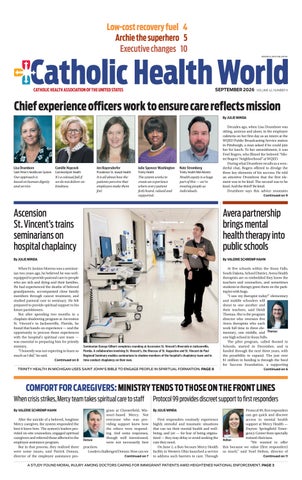
Low-cost recovery fuel 4 Archie the superhero 5 Executive changes 10 PERIODICAL RATE PUBLICATION
SEPTEMBER 2026 VOLUME 42, NUMBER 9
Chief experience officers work to ensure care reflects mission By JULIE MINDA
Lisa Drumbore
Camille Haycock
Jen Bayersdorfer
Julie Spencer Washington
Nate Stromberg
Our approach is based on human dignity and service.
It’s a colossal fail if we do not deliver on kindness.
It is all about how the patients perceive that employees make them feel.
The system works to create an experience where every patient feels heard, valued and supported.
Health equity is a huge part of this — we’re treating people as individuals.
Saint Peter’s Healthcare System
CommonSpirit Health
Providence St. Joseph Health
Trinity Health
Trinity Health Mid-Atlantic
Decades ago, when Lisa Drumbore was sitting, anxious and alone, in the employee cafeteria on her first day as an intern at the WQED Public Broadcasting Service station in Pittsburgh, a man asked if he could join her for lunch. To her astonishment, it was Fred Rogers, who filmed the beloved “Mister Rogers’ Neighborhood” at WQED. During what Drumbore recalls as a wonderful chat, Rogers offered to divulge the three key elements of his success. He told an attentive Drumbore that the first element was to be kind. The second was to be kind. And the third? Be kind. Drumbore says this advice resonates Continued on 9
Ascension St. Vincent’s trains seminarians on hospital chaplaincy
Avera partnership brings mental health therapy into public schools
By JULIE MINDA
By VALERIE SCHREMP HAHN
When Fr. Justino Moreno was a seminarian two years ago, he believed he was wellequipped to provide pastoral care to people who are sick and dying and their families. He had experienced the deaths of beloved grandparents, accompanied close family members through cancer treatment, and studied pastoral care in seminary. He felt prepared to provide spiritual support to his future parishioners. But after spending two months in a chaplain shadowing program at Ascension St. Vincent’s in Jacksonville, Florida, he found that hands-on experience — and the opportunity to process those experiences with the hospital’s spiritual care team — was essential to preparing him for priestly ministry. “I honestly was not expecting to learn so much as I did,” he said.
At five schools within the Sioux Falls, South Dakota, School District, Avera Health therapists are so embedded they know the teachers and counselors, and sometimes students in therapy greet them on the parking lot with hugs. “I saw my therapist today!” elementary and middle schoolers will shout to one another and their teachers, said Heidi Thomas. She is the program director who oversees five Avera therapists who each work full time in three elementary, one middle, and Thomas one high school in Sioux Falls. The pilot program, called Rooted in Schools, started in December, and is funded through the next three years, with the possibility to expand. The just over $1 million in funding is through the Seed for Success Foundation, a supporting
Continued on 8
Seminarian George Gilbert completes rounding at Ascension St. Vincent’s Riverside in Jacksonville, Florida. A collaboration involving St. Vincent’s, the Diocese of St. Augustine and St. Vincent de Paul Regional Seminary enables seminarians to shadow members of the hospital’s chaplaincy team and in time conduct chaplaincy on their own.
TRINITY HEALTH IN MICHIGAN USES SAINT JOHN'S BIBLE TO ENGAGE PEOPLE IN SPIRITUAL FORMATION. PAGE 8
Continued on 6
COMFORT FOR CAREGIVERS: MINISTRY TENDS TO THOSE ON THE FRONT LINES When crisis strikes, Mercy team takes spiritual care to staff
Protocol 99 provides discreet support to first responders
By VALERIE SCHREMP HAHN
By JULIE MINDA
After the suicide of a beloved, longtime Mercy caregiver, the system responded the best it knew how. The system’s leaders provided on-site counselors, engaged spiritual caregivers and referred those affected to the employee assistance program. But in that process, they realized there were some issues, said Patrick Dotson, director of the employee assistance pro-
Dotson
gram at Chesterfield, Missouri-based Mercy. Not everyone who was providing support knew how the others were responding. And some responses, though well intentioned, were not necessarily best
practices. Leaders challenged Dotson: How can we Continued on 7
First responders routinely experience highly stressful and traumatic situations that can tax their mental health and wellbeing, and yet — for fear of being stigmatized — they may delay or avoid seeking the care they need. On June 1, a Bon Secours Mercy Health facility in Western Ohio launched a service to address such barriers to care. Through
Protocol 99, first responders can get quick and discreet access to mental health support at Mercy Health — Dayton Springfield Emergency Center from specially trained clinicians. Helton “We wanted to offer this because we value (first responders) so much,” said Noel Helton, director of Continued on 11
A STUDY FOUND MORAL INJURY AMONG DOCTORS CARING FOR IMMIGRANT PATIENTS AMID HEIGHTENED NATIONAL ENFORCEMENT. PAGE 3
2 CATHOLIC HEALTH WORLD September 2026
FIND MORE CONTENT ONLINE chausa.org/chw
Upcoming Events Critical care for children
New women’s hospital in Austin
Senior living complex
Through a partnership with the nonprofit Gift of Life, St. Francis Hospital & Heart Center in New York offers lifesaving care to children from low-resourced parts of the globe.
The 178-bed Ascension Seton Women's Hospital opens on the Ascension Seton Medical Center Austin campus. It offers advanced maternal and fetal care and 24-hour emergency services.
Construction is expected to start next year on a senior living community in Wisconsin that will be built on land the Congregation of Sisters of St. Agnes gifted to SSM Health.
from The Catholic Health Association Community Benefit Networking Call
Sept. 17 | 1 – 2:15 p.m. ET
Hope in a box
Faithful Accompaniment: Supporting Those Working in Migration Ministry
Ascension Via Christi offers tangible support to patients in mental health crisis
Oct. 9 | 1 – 2 p.m. ET
Community Benefit 101: Planning and Reporting Nonprofit Hospital Community Benefit Oct. 20 – Oct. 22 | 2 – 5 p.m. ET each day
By VALERIE SCHREMP HAHN
Getting a gift can make a person feel seen, heard and loved. And what could be better than a gift that is helpful, even potentially lifesaving? That’s the thinking behind Hope Kits and Care Kits given to patients getting trauma or psychiatric care at Ascension Via Christi St. Francis and Ascension Via Christi St. Joseph hospitals in Wichita, Kansas. The kits, created by Wichita State University and handed out by hospitals and other community partners, are more than a gift. They’re an evidence-based intervention that provides ready access to emotional regulation and resilience skill-building tools for times of distress. The Hope Kits feature items and resources to support mental health, such as a journal, a magazine with stories of hope, a coloring book and crayons, and a gun lock. They are meant to serve as “emotional first aid kits.” The Care Kits feature many of the same items plus some specific to addressing substance use disorders, such as fentanyl test strips and the opioid-reversing drug naloxone. The kits come in cardboard boxes about the size of a large shoebox. Recipients are encouraged to customize them such as with photos of loved ones. “This is something that we can give them, I think, to let them know that there’s somebody here that wants Nold to help,” said Dr. Joseph Nold, the medical director of the trauma center at Ascension Via Christi St. Francis. Ascension Via Christi hospitals started giving out the kits last year, and Nold already knows of a family who used the naloxone in a kit to save a family member from overdosing. As of the end of July, the university had
Deans of Catholic Schools of Nursing Networking Call Oct. 27 | 1 – 2 p.m. ET
Global Health Networking Call Wichita State University students Ervis Oake, left, and Matt Dixon assemble Hope Kits that will be distributed to Ascension Via Christi hospitals and about two dozen local organizations. The kits contain items and resources to address mental health.
sent about 180 Hope and Care kits to Ascension Via Christi. “This is for those people who fall through the cracks a lot, and they need some help, but they don’t need to be in the hospital,” Nold said.
duce and each Care Kit about $60, higher mostly because of the naloxone and fentanyl test strips and the portable pouch that comes with them.
An extra resource The kits are meant to be visible. If someDeveloping a gift one has a kit sitting on a table at home, that The kits are part of Wichita State’s promotes conversation or keeps the topic Suspenders4Hope program, which pro- of mental health or substance use top of vides training, crisis resources and online mind, Provines and Young said. Ascension mental health screenings and promotes Via Christi associates who take online menawareness. tal wellness and suicide prevention trainMarci Young, a clinical psychologist ing are allowed to wear Suspenders4Hope and the director of Health, OutT-shirts with their scrubs or unireach, Prevention, and Education forms, another visible symbol of (HOPE) Services at Wichita State, allyship. created Suspenders4Hope with “We’re bringing this issue that Jessica Provines, also a clinical psyhas been historically very stigmachologist and the school’s assistant tized and misunderstood — and Scan to read vice president for wellness. a lot of faith communities and the an extended Provines got the idea for the kits Catholic Church are not immune version of after her daughter was diagnosed from that — out of the darkness this story. with Type 1 diabetes. She rememand into the light,” Provines said. bers leaving the hospital with her arms full Nold said his colleagues at Ascension of supportive materials: a teddy bear for Via Christi St. Francis appreciate having the her daughter to use to practice injections, kits as an extra resource to help patients. books, a T-shirt that said “Type ONEderful.” Nold said the kits evoke Jesus’ teaching Provines said that made her wonder: of “what you do for the least of others you do “Why do people go to the hospital for a sui- for me.” cidal emergency or a substance use over“That’s very little work on our part to dose and not get the same kind of love and make a huge difference in their life,” he said. care?” Each Hope Kit costs about $35 to pro- vhahn@chausa.org
CHRISTUS Health clinic provides care and support for violence survivors CHRISTUS Health opened a clinic in Southeast Texas in late July dedicated to supporting survivors of violence. The 50:20 Clinic in Beaumont is inspired by Genesis 50:20, a Bible verse that reflects the belief that “healing, hope and restoration can emerge from even life’s most difficult experiences,” according to a press release from the health system. The verse says, “You intended to harm me, but God intended it for good to accomplish what is now being done, the saving of many lives.” The clinic provides trauma-informed care for survivors of sexual assault, domestic violence, human trafficking, elder abuse, child abuse and other forms of interper-
sonal violence. Services include medical evaluations, forensic care coordination, counseling referrals, safety planning and connections to community support resources. The CHRISTUS Southeast Texas Foundation has committed $1.5 million to help fund clinic construction and support ongoing patient care. The sexual assault nurse examiner services provided by the clinic are not typically reimbursed by insurance, so philanthropic support plays a critical role in sustaining these specialized programs. Physicians, emergency departments, public health agencies, law enforcement, victim advocacy groups and other commu-
nity partners will refer patients. The clinic is in a discreet setting to protect patient privacy. More than one in three women and one in six men experience sexual violence, physical violence or stalking by an intimate partner during their lifetime, according to the Centers for Disease Control and Prevention. “The 50:20 Clinic gives us the opportunity to walk alongside patients throughout their healing journey, providing accessible, reliable care and helping them access the resources they need every step of the way,” Rachel Thomas, a nurse practitioner with the CHRISTUS Southeast Texas Health System, said in the release.
Nov. 4 | 11 a.m. – 12:30 p.m. ET
Essentials for Leading Mission Eight monthly sessions starting Nov. 10 | 11:30 a.m. – 1 p.m. ET
chausa.org/events
Catholic Health World (ISSN 87564068) is published monthly and copyrighted © by the Catholic Health Association of the United States. POSTMASTER: Address all subscription orders, inquiries, address changes, etc., to CHA Service Center, 4455 Woodson Road, St. Louis, MO 63134-3797; phone: 800-230-7823; email: servicecenter@ chausa.org. Periodicals postage rate is paid at St. Louis and additional mailing offices. Annual subscription rates: CHA members free, others $29 and foreign $29. Opinions, quotes and views appearing in Catholic Health World do not necessarily reflect those of CHA and do not represent an endorsement by CHA. Acceptance of advertising for publication does not constitute approval or endorse ment by the publication or CHA. All advertising is subject to review before acceptance. Vice President Communications and Marketing Brian P. Reardon
Associate Editor Valerie Schremp Hahn vhahn@chausa.org 314-253-3410
Editor Lisa Eisenhauer leisenhauer@chausa.org 314-253-3437
Graphic Design Norma Klingsick
Associate Editor Julie Minda jminda@chausa.org 314-253-3412
Advertising ads@chausa.org 314-253-3477
© Catholic Health Association of the United States, September 2026
September 2026 CATHOLIC HEALTH WORLD 3
Study finds immigration crackdown causes moral injury for doctors A study published this summer in the journal JAMA Internal Medicine found that physicians caring for immigrant patients are enduring moral injury resulting from how anti-immigrant policies are affecting patients under the Trump administration. Since January 2025, U.S. Immigration and Customs Enforcement, part of the Department of Homeland Security, has been heavily enforcing immigration laws, including through targeted roundups on some cities and by detaining people with pending asylum cases. The study, “Moral Injury Among Physicians Caring for Immigrant Patients Amid Anti-Immigrant Policies,” was published July 20 and is based on interviews with 38 doctors. It defines moral injury as the distress clinicians experience when providing care that conflicts with deeply held ethical values. The study found that moral injury “was exacerbated by the adverse effects of the policies on the health of immigrant and U.S. citizen patients, and by healthcare systems that limited immigrant patient support or remained silent.” It also found that the distress was mitigated by supportive healthcare system responses and physician advocacy. Dr. Marlene Martin, the lead author of the study, spoke with Catholic Health World. Martin holds several posts, including physician chief of care experience at Martin San Francisco General Hospital and professor of clinical medicine at the University of California, San Francisco. Martin is Catholic and the daughter of Mexican immigrants. Her responses have been edited for length and clarity. Why did you and your co-authors undertake this study? I wanted to examine what physicians caring for immigrant patients were experiencing given the changes patients made in their healthcare decisions due to fear of deportation. Even without ICE presence here locally (in San Francisco), we were seeing that patients who never miss appointments were missing their appointments. Does moral injury among physicians have implications beyond just those individual physicians themselves? There are so many implications for health systems and policymakers because moral injury can lead to physicians leaving, and replacing physicians and other health-
J.W. Hendricks/NurPhoto via Associated Press
By LISA EISENHAUER
Protesters rally outside a California hospital where an immigrant was getting care and contractors for U.S. Immigration and Customs Enforcement reportedly were waiting to detain her in July 2025. Physicians say the immigration enforcement crackdown is causing moral distress.
care workers is expensive and time intensive. We also have this happening on top of healthcare workforce shortages, H.R. 1 (the federal legislation also known as the One Big Beautiful Bill that shrinks funding for Medicaid and other safety net programs), and other crises that healthcare is facing. The compounding effects of these have deep implications for health systems. Some of the physicians who took part in the study indicated they are immigrants, or they have relatives who are. Did the study’s findings show an even higher level of strain among those practitioners? Definitely. We found that physicians who described themselves as having immigrant identities had increased moral injury. They were worried about the implications of these policies on themselves, but they still had to go to work and provide care. They also faced moral injury by seeing what was happening to their patients and by healthcare systems that remained silent or restricted their support of immigrants. One physician described how she was the only immigrant in her health system and everyone turned to her for answers, and the burden of that also led to increased strain. What do you see as the major findings of your study? Patients (not only immigrant patients)
being deeply affected by anti-immigrant policies which are harming their physical and mental health. For example, patients are avoiding going to the emergency room, delaying procedures or referrals, or having to change their medications to minimize going to clinic. We also found that some healthcare systems reacted in support of patients and healthcare workers and others remained silent or prohibited support of immigrant patients around this topic. Taken together, physicians are feeling the impacts of anti-immigrant policies as they care for patients and see how their healthcare system responds — and this is leading to moral injury. An important finding were the factors that mitigated moral injury, such as supportive healthcare systems and physician action such as advocacy and collective organizing. Can you comment more on the study’s findings related to healthcare systems and actionable strategies that they could adopt? Healthcare systems can listen to their staff. For example, a hospital could create a task force to develop a policy in case ICE is on campus or if a patient is under ICE detainment. We heard from healthcare systems
that partnered with local communitybased organizations to support immigrant patients. So action doesn’t have to rely on individual physicians or the healthcare system alone, but the partners in that area who are often already doing the work of providing resources to patients in their communities. What changes or response would you like to see based on the findings of the study? I would like to see healthcare systems taking actions to support the healthcare workforce and immigrant care. Our study focused on physicians, but we heard that many of the same feelings existed among staff, and they may have less power than physicians and also need support. I would also like to see policymakers support healthcare systems to continue to provide care for immigrant patients. One concrete example is ensuring that healthcare systems can bill for telehealth, so that we can continue to provide care virtually to immigrant patients afraid of coming in. And then the last piece that I would say here is that healthcare systems and their leaders should really listen and support their workforce, to say: We see you. We are here with you. We’re going to do this together. leisenhauer@chausa.org
Catholic groups appeal for compassion in implementing Medicaid work rules By LISA EISENHAUER
CHA has joined the United States Conference of Catholic Bishops and Catholic Charities USA in expressing “serious concern” about rules the federal government has released for implementing new Medicaid work requirements. The three organizations made their views known in a letter sent July 31 to Dr. Mehmet Oz, the administrator of the Centers for Medicare & Medicaid Services. They said interim final rules released by CMS in June appear to conflict with Congress’ intent to make the changes easy to navigate “so eligible people can get and stay covered.” The work requirements were added to Medicaid as part of H.R. 1, also known as the One Big Beautiful Bill Act. Congress passed and President Donald Trump signed that legislation last year. It enacts sweeping federal budget cuts. For Medicaid, the safety net health insurance program for lowincome Americans, the measure is pro-
jected to reduce funding by $1 trillion over the next decade. Starting next year, the legislation requires that most adult Medicaid recipients ages 19-64 must work at least 80 hours per month. The Congressional Budget Office projected that the requirement would affect about 18.5 million Americans and that more than 5 million of them would lose coverage for failure to comply.
An exhortation from the pope CHA and its co-signers cited Pope Leo XIV’s apostolic exhortation Dilexi Te in their letter. In that missive, the pope says society is judged by how it treats the poor and vulnerable. He calls on Catholic ministries to accompany those who often have little voice within complex systems and institutions. “Consistent with the principles articulated in Dilexi Te, we support implementation approaches that emphasize compassion, simplicity, and access to care and that safeguard eligible individuals from losing coverage due to administrative burdens
rather than true ineligibility,” the letter to Oz says. One of the specific concerns the letter cites relates to the definition of “medical frailty.” Currently, if someone has a condition that qualifies them as medically frail, such as blindness or a disabling mental disorder, they qualify for Medicaid coverage. Under the final interim rule, the determination of medical frailty will include that the condition significantly impairs an individual’s ability to comply with the work requirements. “This policy will create significant operational and administrative challenges for states, providers, and patients, increasing the risk that eligible individuals lose coverage because of administrative barriers,” the letter to Oz says. In asking that the definition remain as is, CHA and its co-signers also say that the planned change would shift responsibility for establishing medical frailty for a patient from state Medicaid agencies to hospitals, doctors and patients. “As a result, hospi-
tals and clinicians will need to assume significant new, unreimbursed administrative responsibilities to support implementation of the medical frailty exclusion, diverting clinical time and resources away from direct patient care,” the letter says.
More time to prepare for changes Another recommendation in the letter is that CMS delay implementation of the work requirements, set to take effect Jan. 1, for at least six months. The letter says states need the extra time to develop, test and validate their systems for putting the rules in place. “Ensuring eligible patients can obtain and maintain Medicaid coverage and continue to access needed care should remain the central objective as states implement the work and community engagement requirements,” CHA and its co-signers say. “Achieving that goal requires states to have operational systems that are fully prepared before implementation begins and that patients understand what is expected of them to maintain coverage.”
4 CATHOLIC HEALTH WORLD September 2026
Fueling recovery
Low-cost nutrition program dramatically improves surgical outcomes in rural West Virginia By VALERIE SCHREMP HAHN
A vanilla-flavored nutritional drink that, according to what Kathy Shumate hears from patients, tastes pretty good poured over frozen berries or stirred up with a bit of peanut butter powder is helping to drastically improve outcomes among surgical patients in West Virginia, especially those who are malnourished. A seven-year study showed patients who underwent nutritional optimization before and after surgery at WVU Medicine Wheeling Hospital experienced a 43% decrease in time spent in the hospital, a nearly 17% decrease in readmissions, and a more than 69% decrease in complications, such as surgical site infections. Patients get the drinks for free. The cost to the hospital is $52 per patient. “I have an administrative team here who knows that little $52 per patient is absolutely nothing compared to a surgical site infection that’s going to cost you on average $24,000,” says Shumate, the perioperative registered nurse program coordinator at WVU Medicine Wheeling, who came up with the idea for Shumate the program. The administrators are supportive of any initiative that will improve patient outcomes, she says. The hospital, founded in 1850, is one of the oldest in the country. It is the only Catholic hospital within the West Virginia University Medicine Health System.
Challenges of rural care The system's 25 hospitals are in Ohio, Pennsylvania, Maryland and West Virginia, all part of the Appalachian region, where the poverty level of 23.9% exceeds
WVU Medicine Wheeling Hospital’s seven-year Strong for Surgery analysis
Ensure- and Juven-branded immunonutritional and carbohydrate-loading drinks and shakes. Getting patients to consume the drinks has been surprisingly successful, with 95% of patients reporting they drank all the products before surgery and 92% saying they consumed the drinks after. Each hospital provides the drinks and information sheets at preoperative checkups.
Complication rate decreased
69.39%
Postoperative length of stay decreased
43.65%
Leveling the field Shumate says clinicians offer all pre-op patients in the program the drinks regardless of whether they are malnourished. The hospital can’t screen everyone for nutrition, and appearance or weight alone wouldn’t tell clinicians whether someone eats a healthy diet or not, she says. “Just get everybody on the playing field, just get everybody treated the same,” she says. That’s health equity, she points out. Patients who are malnourished also get a nutritional consult about their eating habits or to connect them to food resources, she says. Part of being a Catholic hospital means treating the whole person and their family, and getting them in the best physical, mental and spiritual state to face their surgery, Shumate says. Shumate learned that only 30%-40% of hospitals have a formal perioperative nutrition program, and she advises those who want one to start small and figure out the population they want to assist. For example, the Wheeling hospital wanted to inform surgeons whether patients were too frail to undergo elective surgery and reduce the complication rate. “This truly did start as a performance improvement project in the basement of the hospital,” she says. The program has spread throughout the WVU Medicine system, with different hospitals adding it for different populations having various surgeries. Shumate wants to add nutritional drink programs for patients undergoing nonelective surgeries. Last fall, the system started one for patients with hip fractures who need to undergo surgery quickly. Clinicians already see good results in those patients who get nutritional drinks after the surgery as they heal. Every health system can help put patients on a level playing field, Shumate points out. “Of all the things that we can do for patients, when it comes to the things that we can change and not change, nutrition is it,” she says.
Postoperative readmission rate decreased
16.87% the national level of 11.5%, according to Worldmetrics. In West Virginia, about two-thirds of the population lives in rural areas, and more than 90% live in medically underserved counties, according to the West Virginia Health Care Authority. The state is ranked the 46th least healthy and has the nation’s fourth-highest poverty rate, according to the World Population Review. Many rural patients are self-reliant and distrustful of health professionals, Shumate points out. Some are malnourished because it’s difficult to access fresh healthy food. If they delay needed medical care, they may find it difficult to eat or may not have an appetite by the time they see a doctor, she says. Malnourished patients are three times more likely to have a complication and five times more likely to die after surgery, Shumate says. Shumate has spoken at international and national conferences about her work with Enhanced Recovery After Surgery, or ERAS, an evidence-based approach to care pre- and post-surgery shown to improve outcomes.
How it started Shumate has been a nurse for 42 years, most of that time in Wheeling and mostly in perioperative services. “When you get to be a nurse with that many years, you kind of get a feeling about patients who come in for surgery. Who’s going to do well and who’s not going to do well? You just get this intuition, and it’s hard to explain that feeling to surgeons,” she explains. While the concepts for ERAS were first published about 30 years ago, the program at WVU Medicine Wheeling began in 2018. That year, several patients who came in for elective surgery gave Shumate pause. The hospital ethics committee gathered to help
St. Mary’s Health System in Maine provides wearable security devices to its 1,220 employees
determine whether these patients were healthy enough to have their surgeries. That prompted Shumate to develop a twominute frailty scoring system, assessing things like ambulation and nutrition. Many patients scored poorly. In an effort to fix the problem and get patients strong enough for surgery, an anesthesiologist colleague, Dr. Kenneth Nanners, introduced Shumate to the American College of Surgeons’ Strong for Surgery initiative, which clinicians implemented at the Wheeling hospital. The initiative helps clinicians evaluate surgery readiness by looking at things like a patient’s glycemic control for diabetes, whether the patient smokes, their home medications, and nutritional habits. “The one thing that we determined that we can change is their nutritional status,” Shumate says. The hospital started with a small group of patients over age 65 who were getting elective intermediate or high-risk surgeries, such as a gallbladder removal or a colorectal surgery. The patients got nutritional drinks for about a week before and after surgery. “We immediately noticed these improved outcomes, especially with surgical site infections and wound healing,” Shumate says. “This went on for a couple years. We just kept noticing results were just improving, improving, improving.”
Expanding and adapting During the pandemic, when nutritional drinks were in short supply, nurses noticed infection and complication rates started rising as patients stopped getting the drinks. In 2023, the hospital expanded the program to patients 18 and older. The system has changed drinks several times. Shumate has found that arginine, an amino acid that depletes when people’s bodies are under stress, is a key nutrient. Now, the system uses special blends of
LS:
HOSPITA OR-PROFIT
IVEN NOT-F
MISSION-DR
vhahn@chausa.org
lations vulnerable popu holders first, especially unity, not share and community ess of the comm fitable Put patients health and welln need even if unpro s funds into the se of community and fees services becau Reinvest surplu well as other taxes provide essential as , to taxes likely e hospitals have ess incom Are more nts that other , unrelated busin reme IRS taxes ll requi the ty by payro Pay cy and quali requirements the transparen transparency all ne ional with forgo ly ue addit to ct Comp federal reven and are subje d the value of from HHS/CMS, benefits far excee ts in community status Investmen rofit tax-exempt from their nonp n to
ING SELECTED HOSPITALS OFFER ICES* SERV PERCENT OF U.S. H AND SPECIALTY higher PUBLIC HEALT provide a
tals often and specialty Catholic hospi These of public health percentage care providers. other health good the common services than dedication to ionally organizations’ these tradit them to offer often leads es. servic “unprofitable” Profit)
Catholic Healthcare
A Mission to Care
Catholic
State/Local
Govt
Investor Owned
(For
A Commitment to Our Com
TOTAL INVESTMENTS IN
St. Mary’s Health System of Lewiston, Maine, has provided wearable duress buttons to all 1,220 of its staff. The health system, part of Covenant Health, has locations spanning the greater Lewiston-Auburn region of Maine. The locations include a 220-bed acute care community hospital, a network of primary care and specialty providers, urgent care, an emergency department, behavioral and mental health services, outpatient specialty practices and eldercare facilities. The employees at all these locations received their duress buttons Aug. 19. Two other Covenant Health hospitals already have deployed similar technology. They are St. Joseph Healthcare in Bangor, Maine, and St. Joseph Hospital in Nashua, New Hampshire. Covenant Health is at least the second CHA member to outfit staff with distress buttons. Bon Secours Mercy Health deployed similar technology last year. St. Mary’s leadership gave the devices to staff in response to expressed concerns about workplace violence, according to a
release. Employees can use the buttons not just within facility walls but also in parking areas. When they press the button, designated nearby colleagues receive an alert, as does St. Mary’s security team. The alerted colleagues and officers respond to the employee to help assess and address the potential security threat. The security team and switchboard team have received in-depth training on protocols for responding to the alerts. Jill Rollins, St. Mary’s chief nursing officer and chief operating officer, said in the release that “listening to our staff and investing in technology that makes their work safer is part of how we continue to evolve.” St. Mary’s said workplace violence is one of healthcare’s most pressing challenges. Most tools available to healthcare facilities — including policies, training and response protocols — focus on the moment violence occurs or the aftermath. The wearable duress buttons are for the “critical window before that point,” according to the release.
munities
Programs Youth Wellness Age) (Teen & Child
ic missio Benefit t hospitals’ histor Only) abilities and are other not-for-profi to Community Programs (Teen Youth Wellness Commitment t is an extension of Catholic andthose who experience poverty, vulner Community benefi their communities, especially Trauma Care of meet the needs . underserved ent or promote Telehealth Services provide treatm From the irements ed that very ies requir Requ beginning, civic leaders are fit activit tals set of and congregations of religious a well-defined . Tax-exempt hospi Community Bene ), responded toTreatme women and men courage t programs are thent needs of the commun community needs needs assessment (CHNA Disorder ously Community benefi as a response to identified ities they were called to ses Substance Use health health g ms and expen a community serve. Today, that same and hope is being answere health and healin to (1) conduct ing call to provide unity benefit progra d in unique and creative communities ements regard on their comm ways through community Social Work Services to work with their mentation plan (3) report meet IRS requir (4) and H, benefit programs. ule health imple Form 990 Sched s funds into the (2) create an available IRS reinvest surplu ly (5) Services ric public and their Psychiat collections through ance, billing and financial assist community. cy Services H Psychiatric Emergen wellness of the 647 e with these MORE THAN ital complianc CATHOLIC How is hosp monitored? n Centers Patient Educatio er way to FAQs requirements HOSPITALS benefit anoth . The Affordable Is community es compliance es The IRS ensur care? ance say charity n 9007(c), requir Palliative Care d “financial assist unity Act (ACA), Sectio (calle comm Care care tal’s y eight of the No. Charit each hospi in Community Benefit s IRS) is only one the IRS to review every three ment Program at cost” by the t that hospitals Pain Manage y at least once s about benefit activit community benefi 990 categories of , the IRS review on the IRS Form $3.0 billion years. Accordingly empt hospitals annually. Obstetrics provide and report categories of community tax-ex Financial assistance at cost of federal tax eight one-third of all and wellSchedule H. All can result in loss t tant to the health s (charity care) Noncompliance to meet a CHNA requiremen Nutrition Program benefit are impor unities. Failure exemption. tax for each being of our comm community a $50,000 excise also has the in able $7.3 result report billion can IRS nizes eight Neonatal ICU mpliance. The the The IRS recog Unreimbursed Medicaid year of nonco net income of ries: and costs ty care) e taxes on all benefit catego of other means-tested programs option to impos of compliance. ance at cost (chari Clinics out · Financial assist Medicaid Indigent Care is that hospital d costs of
COMMUNITY HEALTH
$14.3 billion
· Unpai -tested of other means · Unpaid costs ms government progra improvement services health tions · Community benefit opera and community sions education · Health profes es servic · Subsidized health for · Research contributions · Cash and in-kind t community benefi
Hospice
repor ts show studies and Why do some unity benefit numbers HIV-AIDS Services differing comm s? and percentage that Geriatric Services er of data sets 1 MILLION There are a numb s or members ization organ about researchers, other MEDICAID Dental Services use to tell a story can media often of the DISCHARGES However, they ts unity benefit. aspec comm of e h Services unity one or a coupl Community Outreac PER YEAR repor t any comm only focus on leading to a narrow t, Can hospitals as community benefit? benefi ity of community full scope of Screening service activ Breast Cancer picture of the 100% address an 80% best way to 60% or incomplete 40% an activity must 20% t activities. The 0% benefit No. To qualify, community benefi picture of a not-for-profit Y unity health need, tal (i.e., ANNUAL SURVE full identified comm hospi AL ASSOCIATION understand the its community more than the CAN HOSPIT UNITED STATES t is to look at *2024 AMERI the community and advance ATION OF THE hospital’s impac and see its IRS Form 990 eferral-driven) IC HEALTH ASSOCI † THE CATHOL not marketing/r unity health objective, ms. assessment progra needs Employees on community at least one comm access to care; enhancing 4.5 million admissions Schedule H report ving 480,747 Full-time such as: impro alizable health 99 million outpatient visits advancing gener burden to public health; 211,227 Part-time ing government 19 million ity emergency room knowledge; reduc visits s . ent to Commun of their communitie improve health A Commitm purpose unique needs
Care A Mission to
to the charitable . ns respond their primary tments in health care organizatio They do this through r-profit health all. ties and inves other not-fo well-being for as other activi Catholic and health and ams, as well improve the efit benefit progr and work to community /communityben healthcare, at chausa.org of providing Learn more
Visit chausa.org to learn more and access resources and tools to assess, plan and report nonprofit hospital community benefit and comply with federal requirements.
$2.2 billion
Community health improveme nt, subsidized health services and cash and in-kind contributions for community benefit
$1.7 billion
Health professions education
$100 million Health research
$7.9 billion in Other Investments in Community Health $7.6 billion
Unreimbursed cost of Medicare
$71 million
Community building activities
$200 million
Bad debt attributable to financial
assistance
Based on an analysis of available data from 370 TY23 IRS Form 990 Schedule H filings representing approximately 634 Catholic hospitals.
MEMBER EXCLUSIVE
New Community Benefit Toolkit CHA has created resources that can be used in meetings with lawmakers and policymakers and shared on social media. These materials are designed to help amplify the story of Catholic healthcare’s long-standing commitment to improve the health and wellness of the patients and communities we serve.
chausa.org/communitybenefit
September 2026 CATHOLIC HEALTH WORLD 5
CHRISTUS staffer finds a superhero in son born with cleft lip and palate By NANCY FOWLER
Gloria Madera was just 20 weeks into her pregnancy when she learned her son would be born with cleft lip and possibly cleft palate. “I was in total shock,” Madera recalls. “I was devastated, to be totally transparent.” Madera, now a public relations manager for CHRISTUS Health who lives and works in San Antonio, knew nothing about the conditions, which result when a baby’s upper lip and/or roof of the mouth don’t properly fuse together. She worried it was her fault. “I’m kind of going through my day-today life, like ‘Was it the hair spray I used — or something else I did or didn’t do?’” Madera says. During the second half of her pregnancy, she scoured the internet, learning the exact cause is often unknown. She also made connections with mothers of other affected children, finding hope in before-and-after surgery pictures and stories of their happy lives. In November 2020, Madera and her husband, Chance, welcomed their son, Archie, basking in what she calls the “golden moment” of holding her new baby. Nearly six years later — and after four surgeries and many visits with specialists at the CHRISTUS Children’s Pediatric Craniofacial & Cleft Palate Clinic in San Antonio — Archie is a rough-and-tumble kid, who’s mastering Brazilian jujitsu and loves to play with cars, trucks and dinosaurs. He started kindergarten in August. “He was ready to go — very excited about it,” Madera says. Inspired by her son, she wrote a children’s book that turns his challenges into super heroics. At the urging of her husband and friends, she published it.
‘Exactly what I needed’ One in every 700 infants is born with orofacial clefts. Archie has unilateral cleft lip and palate, meaning both are present on one side of his face. Shortly after Archie’s birth, a therapist came to the hospital room to help Madera and her husband feed their newborn. Because of the COVID-19 pandemic, the therapist wore a mask. “And then she pulled her mask down and showed us the scar above her lip,” Madera says. “And said, ‘You’re going to be fine’— exactly what I needed in that moment.”
At left, Gloria and Chance Madera hold Archie shortly after his birth in November 2020. Center, Archie awaits surgery to repair the cleft in his lip. Right, Archie celebrates his fifth birthday last year. In August, he started kindergarten.
Madera learned how to tape Archie’s lip to help it begin to grow together and to insert a custom plastic plate to reshape Archie’s gums, lip and nostrils before surgery. During frequent visits throughout Archie’s infancy, Madera, her husband and Archie became well-acquainted with the CHRISTUS Children’s Pediatric Craniofacial & Cleft Palate Clinic. At six months, surgeons repaired the cleft in Archie’s lip. Four months later they connected his palate. Archie later underwent two tympanostomies, the insertion of ear drainage tubes, related to his cleft palate.
Dignified and compassionate care Each time her firstborn was anesthetized, Madera, who’s never experienced surgery herself, worried. But the CHRISTUS team — which includes specialists in surgical reconstruction, speech therapy, hearing, dental/orthodontics and psychology — eased her mind. “They know how to talk to children, and they know how to talk to parents to help them digest all the information,” Madera says. “They treated me, my husband and my son with dignity and compassion the entire time.” While surgical excellence is imperative, ensuring that patients and families feel cared for is Garcia de Mitchell also essential, says Dr. Alejandra Garcia de Mitchell, clinic medical director.
Include your organization’s Christmas message in the December issue of
Catholic Health World invites you to extend a seasonal greeting to your employees and to colleagues in the Catholic health ministry.
SHARE THE
JOY
Visit chausa.org/ Christmas for more details. Send an email to ads@chausa.org to reserve your ad space. Ads due by Nov. 17
“We want them to be comfortable in all aspects of their care, to be involved in the decisions, and understand what is being proposed and what the options may be,” Garcia de Mitchell says.
Revolutionary approach The clinic houses its array of specialists together, providing convenience for parents already overwhelmed with the typical demands of a newborn or young child on top of the specific needs of a cleft-affected child. While cleft repair hasn’t changed drastically since 1955, when a U.S. surgeon pioneered the rotation-advancement flap technique that remains a standard procedure worldwide, a nationally connected team concept has revolutionized treatment, Garcia de Mitchell says. Centers around the country communicate with each other, sharing information about procedures and outcomes. If a family moves to a new city, their child’s treatment can continue seamlessly. Garcia de Mitchell enjoys keeping up with patients and their progress through planned community activities for patients and families. “It warms my heart,” Garcia de Mitchell says. “That’s why I do this.” ‘I hope he dreams big’ Not long after Archie made Madera a mother, he also inadvertently nudged her into several other new roles. For one thing, she changed careers. Until Archie was 1, she worked as a TV news reporter. The morning shift that required her to wake up at 2 a.m. became more difficult after having a child. In early 2022, Madera joined CHRISTUS as a public relations specialist. “Stepping into this role felt like a nobrainer because it was a place where I felt
safe with my child, and I wanted to help other parents through an uncertain time,” Madera says. “I’m not a healthcare provider but storytelling really has a role in advocating for a place of healing and hope.” Madera also is now an author. When Archie was a toddler, she wrote and published an illustrated children’s book called Archie the Cleftie: A Tale of Strength, Resilience, and Courage. Madera originally intended the book just for Archie after he came home from daycare saying another child said his nose looked “funny.” She realized the comments would multiply and become harsher as her son got older. The book details Archie’s conditions and surgeries. Each time he undergoes a surgery, he emerges with a new superpower. “Strength and bravery and resilience and courage,” Madera says. Madera’s husband and some friends encouraged her to publish the book, which is now available on Amazon. “People who are not even cleft-affected have purchased the book just from the strength and resilience message,” she says. “You can apply it to any kid who’s going through anything.” Three years ago, Archie became a big brother when Madera had her second child, Penelope. Around the time Penelope starts kindergarten, Archie will undergo a bone graft surgery to fully close his palate. As Madera looks ahead, she envisions her son growing into an admirable young man. “I hope he accomplishes anything he wants to. I hope he dreams big. I hope that he is a kind person,” Madera says. “And I hope he does not let any of his differences dictate who he is or what he’s capable of. I want him to know that a cleft is a part of his story, but that it is not his entire story.”
PeaceHealth Springfield Rehabilitation Hospital is first inpatient facility of its kind in Oregon PeaceHealth is opening the doors to a new rehabilitation hospital in Springfield, Oregon. The hospital will open this month, following a ribbon-cutting ceremony on Aug. 20. The $76 million, 67,000-squarefoot PeaceHealth Springfield Rehabilitation Hospital “was designed with a patient-centered focus and incorporates numerous details and technologies to help them recover from a range of injuries,” according to a press release. It is the first freestanding inpatient rehabilitation unit in Oregon and includes the region’s first dedicated traumatic brain injury unit. The hospital will serve 42 patients to start and eventually up to 60. The hospital includes a simulated apart-
ment to help patients with their transition out of the facility, a mock-up of a car so patients can practice how to get in and out of a vehicle, a 3,000-square-foot gym, and areas for outdoor activities. The new hospital will begin admitting patients as operations are gradually wound down in the current unit at PeaceHealth Sacred Heart Medical Center at RiverBend, also in Springfield. The move will free up space at RiverBend for general medical use and will help increase overall patient capacity. The rehabilitation hospital is jointly owned and operated by PeaceHealth and Lifepoint Rehabilitation, a division of Lifepoint Health.
6 CATHOLIC HEALTH WORLD September 2026
Spiritual care teams can play strategic role in addressing ministry challenges By JULIE MINDA
Healthcare systems and facilities are facing intractable challenges, and spiritual care teams can play a pivotal role in addressing those concerns. That was a central theme of a July CHA webinar entitled “Healthcare with Soul: Spiritual Care as a Catalyst for Innovation,” featuring spiritual care experts Kelsey White and Jason Lesandrini. The two said that when spiritual care teams are intentional in integrating cohesively White into their facilities, understanding leaders’ priorities and helping to find innovative solutions to challenges, they can become ever more straLesandrini tegically valuable to their facilities — and to staff and patients. White is a chaplain, author and researcher as well as an associate professor of patient counseling at Virginia Commonwealth University and Lesandrini is an assistant vice president for Georgia’s Wellstar Health System and an advocate of spiritual care. “The executive team is hyper-focused on a strategic plan that has certain key performance indicators in it. Your work directly connects to that,” Lesandrini said, addressing chaplains in the webinar’s audience.
A transition in spiritual care Lesandrini said spiritual care departments that are not integrally connected to their facilities’ leadership, purpose and strategic plan are missing key opportunities to be a more vital resource.
Survey elucidates concerns of ministry spiritual care teams Spiritual care leaders in the ministry are asking tough questions, such as: How can we gain more buy-in from leadership? How can we take on critical staffing and financial issues? Results from a CHA and National Association of Catholic Chaplains survey are pointing to answers. Read more at chausa.org/chw
White said spiritual care departments have been evolving. Traditionally, these departments have been staffed by some spiritual care staff who lacked full credentials, reliant on volunteers, disconnected from their facilities’ higher purpose and not fully involved in supporting clinician well-being. The evolution is toward greater professionalism, with more board-certified chaplains on the team, less reliance on volunteers and students, high integration in the organization, and a high level of connection with clinicians. White added that along with the increased professionalism, there’s a shift toward better-resourced spiritual care teams that can provide impactful support to staff and patients. For instance, these teams
may have more resources to integrate into health system operations in ways that benefit clinician well-being. White and Lesandrini referenced research they’ve conducted. White was among the authors of this year’s “Conceptualizing spiritual care in the U.S. through chaplain activities in research: a scoping review sub-analysis” in the Journal of Health Care Chaplaincy, and White and Lesandrini were among the researchers who published this year’s “Wicked problems need spiritual remedies: addressing top issues facing healthcare executives,” in the Journal of Health Care Management.
They also provided examples on the higher end of resource-intensity for spiritual care, a level of investment that provides more resources to chaplains so they can attend more thoroughly to clinicians’ well-being. Examples from the webinar included chaplains serving as communication coordinators with patients’ families, supporting families when their loved one is an organ donor, and providing patient navigation help in the intensive care unit. At one healthcare facility, chaplains have recorded patients briefly talking about who they are and their background. This recording goes into the patients’ medical records for clinicians to access to learn about Scan to read Speak up the patients. an extended Lesandrini said spiritual care Lesandrini spoke of Wellstar’s version of teams’ engagement and integraaround-the-clock hotline for its this story. tion can take various forms, but employees. Chaplains do the inithe teams’ leadership needs to be joining tial intake, respond to the scene to provide committees and councils throughout their on-the-ground resources, and then when facilities, listening to what is important to necessary, refer the employees to other decision-makers, and getting on the calen- mental health resources. dars of top leaders and then speaking up to Lesandrini emphasized that spiritual explain how the spiritual care department care departments must be smart about can help solve challenges and advance demonstrating their impact. “We have to goals. get clear as chaplains and chaplain leaders White and Lesandrini shared examples and mission departments about how the from their own organizations and exam- work that we do ties directly into (the straples from research of innovations that have tegic work of the broader organization),” come when spiritual care departments he said, “and then starting to measure that have taken this approach. For organizations work via key performance indicators to devoting a lower intensity of resources to connect back, and sort of impact what the spiritual care, examples included chaplains leaders are working on day in and day out.” teaching colleagues about wellness, conHe said, “You can see demonstrable ducting “compassion rounds” to debrief effects pretty quickly, I would argue, and … with colleagues and discuss emotionally you’re showing the value ultimately at the challenging experiences or ethical dilem- end of the day of spiritual care, and that has mas, and inviting clinicians to shadow them to be sold on an ongoing basis.” to understand their role. jminda@chausa.org
Avera partnership
stigma among all students about mental health, Thomas said. “It’s just a normal part of the school culture, and it’s exciting to think about, 20 years from now, the positive impact this may have,” she said.
From page 1
organization of the Sioux Falls Area Community Foundation. One priority of Seed for Success is youth and adolescent mental and behavioral health.
Part of the culture The Sioux Falls Area Community Foundation hired an expert to research models around the country and identified a program in the Twin Cities metro area in Minnesota that embeds therapists in schools, getting good results. The Sioux Falls partners modeled the program after that one. “In broad strokes, the idea was to root a therapist in a school, so essentially they would become part of that school’s culture, if you will,” said Thomas Otten, Avera vice president of behavioral health. “When they have staff meetings, they go to those staff meetings.” He added that the therapists don’t act as guidance counselors, who might provide short-term social support, but rather they focus on mental health issues and on students who need therapy. Early data is already showing results: School attendance has risen and disruptive behavior has decreased among the students who have undergone therapy. Nearly half of those students had never seen a therapist before. At the three elementary schools, the number of incidents of students threatening their own lives or those of others went from 15 to eight. “That’s seven lives that would be different in the second semester,” Otten said. Kim Sharping, the school district’s coordinator of student support services, said those from Avera she has worked with on this pilot and other programs are “true professionals.” She said Thomas has worked hard to understand the needs and culture of each school, and ensures there are weekly meetings between school administration, counselors and Avera therapists.
Sarah Bauer, an Avera Health therapist who is part of Rooted in Schools, meets with students during the school day at Washington High School in Sioux Falls, South Dakota.
“They’re constantly in communication,” Sharping said. “So we, from the district standpoint, have been nothing but pleased and impressed with what we’ve experienced with Avera.” Kersten Dobberpuhl, the principal of Terry Redlin Elementary School, said having a Rooted in Schools therapist at the school full time has been “amazing.” The therapist has worked to build trust with students and even worked with families and met with students over the summer. “Parents just want to know that their kid is being loved and trusted, and she can meet with them any time throughout the day to do an intake or just help problem solve some issues that might arise at home,” she said. “It’s just been a really strong partnership, and we’ve seen tremendous growth through this.”
Adding support Therapists see about 25 students a week at each of the five schools — Washington High School, Whittier Middle School and Cleveland, Terry Redlin and Rosa Parks elementary schools. The schools serve higherneed and diverse student populations.
The students referred by staff to the Avera therapists are struggling in the classroom, Thomas said. Maybe they have lost a parent or other family member, they have anxiety or depression, or they have neurodivergent needs and would benefit from mental health support. If needed, the Avera therapists have access to a psychiatrist, who can fast-track a medication consultation within two weeks. Additionally, students receive a “warm handoff” to inpatient services when they require a higher level of care, Thomas said. “The beauty of being part of a larger medical system is the access to so many more resources for these children,” she said. The program reduces transportation and schedule barriers for families who otherwise might have to work in an appointment after school. Parents can ask for the services for their children, and there are waiting lists at some schools. The students who receive therapy have an average of four adverse childhood experiences, such as losing a parent to divorce or death or being subjected to unwanted sexual contact. Having therapists in schools reduces
Partners for healthy communities Mary Kolsrud, chief philanthropy officer of the Sioux Falls Area Community Foundation, said her organization and the Seed for Success Foundation are happy to work with Avera. Kolsrud said Avera “cares about the community and wants to be at the table when we have discussions around collaboration and being a great partner.” She added: “Part of the beauty of philanthropy is that giving begets giving, and hopefully others want to step up and do something similar.” This isn’t Avera’s only program in Sioux Falls schools. Avera athletic trainers work with students at one of the high schools, and Avera clinicians provide training and continuing education on mental health topics for school personnel. In addition, the Avera Family Wellness Program sends a team of therapists several times a week to Sioux Falls elementary and one middle school that serve largely low-income populations, and the program offers family therapy clinics after school hours. That model has been successful for many years. Rooted in Schools takes the program a step further to reduce those barriers, putting therapists in the schools daily. The donation from the Seed for Success Foundation mostly covers the cost of therapist salaries, and the work can be billed through insurance and Medicaid. The program is the only one in Sioux Falls that will provide therapy for clients who don’t have Social Security numbers, Thomas said. Otten said this program wouldn’t be possible without the generous donor funding. “We’re a positive impact organization,” Otten said, “and we look at this as one of those things that definitely makes a positive impact on our community.”
September 2026 CATHOLIC HEALTH WORLD 7
Caregiver support
SPIRITUAL CARE
gram, who then helps organize a meeting across local and ministry-wide teams: employee assistance, spiritual care, behavioral health, peer support, human resources, mission, and whoever else might be pertinent, such as security. The call will prompt a CIRT response plan meeting, usually a 30-minute Teams call. “The idea is: Let’s get everyone on a call and talk about what happened, talk about where is the team emotionally right now, how they are affected, who’s most impacted, and then talk about how can we best support this team?”
HUMAN RESOURCES
Customizing response What works well for one team may not work well for another, Dotson pointed out: Some might want to share emotions with a counselor as a group, others may want to do so individually, some might want to talk to a chaplain. “It really varies, so we are matching the level of support as a ministry with the exact needs of that team,” he said. “I think that’s the recipe for ensuring our caregivers truly receive and feel that support and care.”
EMPLOYEE ASSISTANCE PROGRAM
From page 1
take this type of response to the next level and ensure that Mercy has true wraparound support for caregivers facing a crisis? That was the push behind the Caregiver Incident Response Team, or CIRT, which launched in October. The team responds to disruptive events impacting healthcare across the Mercy ministry, such as workplace violence and threats, a caregiver death or suicide, an unexpected patient death, patient trauma and suicide, storm and weather impacts, grief and loss, caregiver doxxing and online harassment, protests, and restructuring or reductions in force. Mercy leaders had already put a suicide response plan into place and already had a plan for mass casualty incidents, Dotson said. “But the challenge was, well, what about all of these other disruptive events that fall in between?” he said. “How can we better serve our caregivers who are emotionally rocked by disruptive events that happen at the workplace?” Mercy has 55 hospitals and 1,400 clinic practices, outpatient facilities and outreach ministries in eight states. The ministry employs about 52,000 caregivers.
Building the structure Dotson, who presented on the CIRT team at the CHA Assembly in June, said the hospitals already have Behavior Incident
BEHAVIORAL HEALTH
CAREGIVER INCIDENT RESPONSE TEAM Access to care One phone number for leaders across the ministry to call when their team needs support.
Coordinated response Centralized communications and disruptive event response using local resources.
Collaboration Partner with leaders and support partners to ensure response is a best fit for the team culture and needs.
Missional
PEER SUPPORT
Incorporate Mercy traditions and values into all phases of response. Source: Mercy
MISSION
Response Teams, or BIRTs, that respond when a patient is acting aggressively. Leaders figured the CIRT acronym would be familiar to caregivers. “The C stands for caregiver, so that helps the caregivers know this is for us,” he said. “This is a support for us.”
One priority in creating the CIRT is that it gives leaders across the ministry one phone number to call following a disruptive event in their workplace that deeply impacts a team. The CIRT phone number reaches a member of the employee assistance pro-
COMMUNITY BENEFIT 101
Planning and Reporting Nonprofit Hospital Community Benefit OCTOBER 20–22, 2026
Learn the essentials of community benefit planning and reporting at CHA’s highly regarded program. Led by experienced community benefit leaders, this live virtual program grounds participants in shared standards, real-world application, and current public policy context, providing foundational knowledge and practical tools to meet established expectations. Attendees will receive a copy of CHA’s A Guide for Planning and Reporting Community Benefit and 24/7 access to recorded sessions, tools and resources. To register, visit chausa.org/CB101 or scan the QR code. The American Hospital Association is a sponsor of CB 101, and AHA members can receive a discount on registration fees.
“
The C stands for caregiver, so that helps the caregivers know this is for us. This is a support for us.” — Patrick Dotson
At one Mercy clinic, several caregivers had lost loved ones over the holidays and were dealing with sadness and grief. There was a pall over the clinic. A leader called the CIRT line for support. At the response plan meeting of involved leaders, they talked about having a memorial service, and the leader of the caregivers mentioned that her co-worker had gifted her a vial of holy water from the Vatican. She had been looking for an occasion to use the water, and it was later incorporated into a blessing ceremony for the team and clinic. “The creativity of all those gathered together leads the care and support into unique directions,” Dotson said. As of the end of July, the CIRT team had responded to nearly 40 requests in 15 Mercy communities. Workplace violence has been the main reason leaders call, followed by caregiver death, and then unexpected patient deaths, Dotson said.
‘We are never alone’ Mercy caregivers have noticed the extra response. Leaders appreciate the chance to talk to one another to see how they can provide support, Dotson said. “I tell people all the time, as an EAP leader, the Mercy mission is to extend compassionate care and exceptional service, just as the Sisters of Mercy before us,” he said. “This ministry of Christ has been entrusted to us, and when someone reaches out to us, I say you are allowing us to fulfill our mission.” After a caregiver at one clinic unexpectedly died, the news hit her co-workers hard. CIRT leaders and senior leaders reached out within 30 minutes of the initial call to learn how they could help. A spiritual care team member arrived at the clinic that day, and more members and a counselor arrived the next day and followed up with a care plan for anyone in need of more support. “The experience reminded me that even in the hardest moments, we are never alone,” the leader who made the call wrote. “We have each other, and we have resources that bring comfort and hope when we need it most. These sacred moments are not just about loss, they are about love, community and the strength we find together.” vhahn@chausa.org
8 CATHOLIC HEALTH WORLD September 2026
At Trinity Health in Western Michigan, Saint John’s Bible inspires faith By JULIE MINDA
When Michigan’s Trinity Health Muskegon hospital hosts its ceremony every two weeks to mark the turning of a page of the Saint John’s Bible, spiritual care team members witness attendees’ astonishment at the beauty of the rare book’s illuminations and calligraphy. Allison Fisher Mannies, Trinity Health Muskegon, Shelby and Grand Haven spiritual care manager, often leads these ceremonies. She hears “wows” and “ohs” from the small crowd of staff, visitors and patients Fisher Mannies who assemble. She says it speaks to “the power art can have and the way that it has provoked wonder and awe in people.” Trinity Health is one of several hundred owners worldwide of a set of Saint John’s Bible replicas, and its facilities have been taking turns displaying the famed, illuminated books. Trinity Health hospitals in Western Michigan, which are hosting the Bible this year from June through October, are using it to engage community members in spiritually formative experiences. Gary Allore, Trinity Health Muskegon, Shelby and Grand Haven president, says the Bible has a calming effect. “I think when people walk in, they see the stained-glass windows on our chapel, and then they kind of walk through the lobby and see Allore the Saint John’s Bible, and I just think it’s just another symbol that we’re connected to a faith-based organization,” he says. “And I think that gives people comfort when they
Seminarians From page 1
Fr. Moreno, at the time a Diocese of St. Augustine seminarian studying at St. Vincent de Paul Regional Seminary, participated in the shadowing program at the 528-bed Ascension St. Vincent’s Riverside. In the program, seminarians become oriented to the hospital setting and accompany chaplains who work there. The seminarians gradually take a more active role in that work. They then perform the chaplaincy functions on their own, including visiting patients, family members and staff and assisting with sacramental ministry throughout the hospital. Now an ordained priest serving as parochial vicar at Holy Faith Parish and assisting at St. Augustine Church, both in Gainesville, Fr. Moreno said he continually draws on what he learned at Ascension St. Vincent’s. For example, he recently made a pastoral visit to a hospitalized parishioner and the parishioner’s family. He said the patient was very relieved to have a priest who was comfortable and confident providing spiritual support. Fr. Moreno said the two months at Ascension St. Vincent’s “served me so much, so I could do this type of ministry when I’m called to do it.”
An evolving collaboration The St. Augustine diocese currently has 31 seminarians. Deacon Stephen Arnold, an Ascension St. Vincent’s chaplain specialist, said seminarians nearing ordination complete a pastoral care practicum, such as in a jail, a prison or a social outreach ministry. Frank Wyler, Ascension St. Vincent’s spiritual care manager, said the diocese had difficulty finding opportunities for seminarians to complete in-person practicums at the outset of the COVID-19 pandemic. So
the Muskegon hospital is hosting the Bible. Many of the parishes have publicized this information to their parishioners. McNeil says leadership wants Trinity Health facilities from throughout the area — not just the Muskegon hospital — to have access to the Bible. Fisher Mannies often takes the book on “field trips,” including to other Trinity Health hospitals and facilities. She says she had a particularly engaging visit when she brought the Bible to an inpatient behavioral health unit, where she spent about two hours displaying pages for patients and discussing the patients’ perspectives with them.
Between 2000 and 2015, a team of artists, calligraphers, academics and others created 12 original sets of the Saint John’s Bible. There are 299 replica sets and Trinity Health owns one.
walk into the facility.”
Revived art form Beginning in 2000, Welsh calligrapher Donald Jackson led a team of artists, calligraphers, scholars, faculty, theologians and others on a 15-year project to use ancient techniques and tools and modern knowledge to create 12 original sets of the Bible by hand and then 299 replica sets. Trinity Health purchased a sevenvolume replica set and has been circulating the volumes throughout its facilities. Trinity Health has 91 hospitals, 101 continuing care locations and a network of other facilities across 23 states. Trinity Health’s Western Region has been hosting the volume of the set that contains the Gospels and the Acts of the
the diocese approached Ascension St. Vincent’s about hosting the seminarians. “We just said, ‘Yeah, we’d love to do that because we’re all about building that relationship with the diocese,’” Wyler recalled. Through collaboration, the hospital, the diocese and the seminary determined the format of the shadowing, and beginning in 2024 the seminary offered it as a practicum option. Three seminarians participated in the shadowing program in 2024, none did in 2025, and two did this year. Arnold noted that the program is evolving. This fall, the hospital will begin welcoming men training to be permanent deacons to complete a shadowing practicum at Ascension St. Vincent’s. In the future, the hospital will invite new seminarians for a short stint to get initial exposure to the hospital and its chaplaincy department, with the expectation that many will return for the two-month program later in their studies.
Four areas of formation Ascension St. Vincent’s Jacksonville includes four hospitals. Its spiritual care team includes 11 chaplains, two full-time priests, two priests who serve on an asneeded basis and a manager. These team members perform a variety of roles, including providing emergency and crisis care to patients and families, responding to referral requests and sacramental needs of patients and families, and offering education and spiritual support to staff. Arnold said the camaraderie among team members, along with intentional supports within the department have been key to the team’s effectiveness. Team members support one another in the often-difficult work of spiritual caregiving, through debriefings, ongoing discussions and ideasharing and stepping in for colleagues who need a break. It is typical for team members to participate together in on-campus Masses then have lunch together to fortify their bonds. The team also frequently com-
Apostles. For most of the time, that region has displayed the Bible in a glass case in the lobby of its flagship facility, Trinity Health Muskegon hospital. During the biweekly page turnings, a spiritual care team member — often Fisher Mannies — reveals a new spread in the Bible and poses questions to people who attend. She’ll ask: What stands out to them? How do the images make them feel? What ideas do the images spark? She also can answer McNeil questions about the Bible. Patty McNeil, Trinity Health Muskegon, Shelby and Grand Haven mission leader, and her team have shared with deaneries within the Diocese of Grand Rapids that
pletes “verbatims,” in which they process difficult situations they’re working through, preserving patient anonymity. They also frequently discuss materials, such as articles on how to understand patient needs. Fr. Moreno said that being immersed in this department and all these activities enabled him to deepen his own priestly formation, which the seminary teaches is focused on four realms: human, intellectual, pastoral and spiritual. “This experience really helped me in all of them,” he said.
Part of a family Seminarians Jacob Crowell and George Gilbert completed their shadowing this summer. Crowell said while he is still discerning his path, he likely will become a parish priest. He said an unexpected godsend that came from the Ascension St. Vincent’s practicum was Crowell working with people from many faiths, “and being able to learn how to best work with them and pray with them as well. You know, these are our fellow brothers and sisters in Christ … and to be able to work together for the common mission of Jesus — Jesus Christ’s mission here on earth — has been a true blessing.” Gilbert said healthcare chaplaincy had not been on his radar screen until Bishop Erik Pohlmeier of the Diocese of St. Augustine saw qualities in him that the bishop thought would be great for chaplaincy and suggested he complete his practicum at Ascension St. Vincent’s. Gilbert underwent surgery as a child to address severe seizures associated with Rasmussen syndrome, a neurological condition. The procedure cured his seizures but resulted in a loss of motor skills on his right side. Despite all the time he has spent in medical settings because of his condition, at the outset of the practicum, he wasn’t
Taking a pause McNeil says engaging people with the Saint John’s Bible has been a type of formation. She notes that while some people may think of formation as a formal process, “formation can be about anything in the world around us. It can be about art. It can be about a painting. It can be about a beautiful story, sacred text, anything really.” She adds that in this case, formation is about “giving folks who work in healthcare, our colleagues, patients, patients’ family members, an experience where they can go a little deeper, maybe take a moment, find time for a sacred pause. I think it is just a different way of offering formation, talking about it, presenting it.” McNeil notes that this type of formation is not just for Catholics, it is for anyone. She and Fisher Mannies enjoy being part of the discussions about the book and seeing its impact on people — the imagery and text spark all different responses and touch people’s spirit in many ways. “One of the beautiful things with art is, art is so subjective and it is so personal that I love the freedom,” Fisher Mannies says. jminda@chausa.org
entirely at home in the hospital. “With anything new, there’s always a little element of kind of uncomfortability, and also at times that you feel like you’re over your head,” he explained, “but (with) more and more exposure to it, I’ve noticed that there is more of growing confidence, and also a great growing joy to just bring comfort if need be, and also just to be present to the patient.” He said over the course of the shadowing, he has been “falling in love with the ministry” of healthcare chaplaincy and feeling “like I’m one more associate in a big family.”
Win-win-win Arnold said having the seminarians as part of the spiritual care team has been a “win-win-win,” with the seminarians preparing well to help people spiritually, the diocese gaining a beneficial practicum site and the hospital expanding its team’s reach. He added that the hospital’s chaplains learn more about themselves and their own ministry as they guide the seminarians. They also like seeing the vibrancy of newcomers to the priesthood. And, they’re enjoying the relationships they’re building with the seminarians. Wyler added that the Catholic health ministry generally has been concerned about a chaplain shortage, and particularly a shortage of priest chaplains. Similar collaborations between additional Catholic health systems and dioceses could help to address that, he said. For Fr. Moreno, shadowing helped him better grasp how he can extend the ministry of Jesus Christ through pastoral care. He said of the patients and families he visited: “They know that there’s somebody that I believe in that’s encouraging me to visit them; and, you know, nobody does that for fun, right? “And so we do it because we care about them.” jminda@chausa.org
September 2026 CATHOLIC HEALTH WORLD 9
SYSTEMS AND FACILITIES USE VARIED APPROACHES TO BUILD CONNECTION AND TRUST Chief patient experience officers and their colleagues across the ministry are putting in place many types of programming to improve how they address patients’ needs. The programming is enabling the systems and their facilities to better understand patient perceptions and needs, convey that information to employees, teach employees how to best meet the needs, measure the results of these efforts, and make improvements. Here are some of the tactics several ministry organizations are using:
CommonSpirit Health Is looking at how best to measure kindness, since everyone has their own understanding and definition of it. CommonSpirit uses data to measure elements that are related to kindness, such as patients’ perception of the trustworthiness of care providers. Now that all CommonSpirit facilities are on the same electronic health record, the health system uses that record to gather the data and then analyze it and act on it. Provides “kindness training” to help employees understand how best to convey respect when interacting and engaging with patients and their families. This includes training on hospitality standards, eye contact, listening and conversing in a way that honors the patient and family and conveys kindness. Carries out much of its patient experience work through patient and family councils. Uses intentional rounding to quickly identify and resolve issues that can
detract from patients’ experience.
Saint Peter’s Healthcare System Engages its leaders on a regular cadence in studying patient experience data and in reading all patient and family comments. The leaders create a 90-day action plan each cycle to address concerns. Empowers its 3,000 employees to serve as informal patient advocates who are responsible for making sure patients and their families have the best possible experience. Saint Peter’s makes it clear to employees that they are accountable for upholding service standards. Provides service excellence training to employees. Executives act out scenarios using cues such as eye contact and body language that show respect to others. Rewards employees who excel at practicing the service standards. This includes featuring videos of employees who carry out the standards well.
A clinical team at Marian Regional Medical Center in Santa Maria, California — from left, Tanya Torres Portillo, cardiovascular sonographer, and nurses Nathan Betts and Joesef Batista — prepares to care for a patient in the cardiac cath lab. The hospital is part of CommonSpirit Health.
Providence St. Joseph Health Has been developing a “listening system” to perfect how each facility gathers and understands patient feedback. Working with vendor partners, Providence is seeking to get that feedback quickly and in a tailored way. The system and its vendors are rolling out a survey platform that can stratify patients for a better understanding of particular population groups’ perspectives. Providence sites can use that platform to invite specific patient populations to be in focus groups or studies. Relies on patient and family councils and advisory groups to give feedback. Uses patient rounding intentionally to connect with
patients and to take a justin-time approach to resolving their concerns. Providence is continually honing associates’ rounding routines, including by providing a framework that addresses key quality and experience points. Those doing the rounding are empowered to quickly resolve any patient experience issues that surface. Leadership in Providence facilities also round in patient rooms, with an eye toward quick resolution of issues. Teaches employees to use common bedside tools to quickly identify and resolve concerns that can mar a patient’s experience. Visual boards documenting daily patient care plan goals are an example.
Trinity Health Grounds its patient experience work in listening to patients with the support of data from patient and family member surveys. The system is working with its vendors to become ever better at gathering feedback, especially from patient populations that have been difficult to reach. For instance, knowing that younger generations may not respond as well to the traditional mailed surveys, Trinity Health is looking to text, email and phone surveying to remain attuned to a broader swath of patients and family members. Is exploring how best to “close the loop” with people who provide feedback and input. Trinity Health facilities are acknowledging
issues that patients report, addressing and resolving them quickly, then reporting back to the patients how the problem was fixed. Trains on the ICARE protocol, in which employees Introduce themselves to patients, Connect with them, Ask for permission before starting a care procedure, Reduce their anxiety and Exit their presence with reverence. The protocol creates a consistent experience for all patients and colleagues. ICARE is a common healthcare framework that Trinity Health has adapted to align with the central focus of its culture, emphasizing the importance of having continual, meaningful touchpoints with patients so that they feel seen and understood. Ensures leadership is discussing service protocols that improve patient experience at employee orientation. Then leadership builds upon this introduction during workshops and through other educational programming. Trinity Health also reinforces it by recognizing employees who are doing it well. Makes sure patient experience leaders keep a continual in-person presence at the system’s facilities so they know how well protocols are taking shape. — JULIE MINDA
of ensuring employees are convey- space for sacred encounters, particularly nity and service,” Drumbore says. Chief experience officers science ing to patients and their loved ones that between employees and patients. From page 1
now more than ever in her role as chief patient experience officer at Saint Peter’s Healthcare System in New Brunswick, New Jersey. She feels that “kindness and empathy and meeting people where they are” are essential to delivering mission-based care to patients. Drumbore, who also is vice president of marketing and communications, is one of the patient experience experts at ministry facilities who take on the formidable challenge of ensuring that the employees are providing care that fully reflects the organizations’ mission, vision and values. These experts say for patient experience to live up to what the organizations are promising, associates must be well-equipped to deliver on those promises. “What we are doing at Saint Peter’s is highly complex, and very strategic, but at the core is the element of humble service to our fellow humans, and a focus on human dignity at all stages of life,” Drumbore says. “How we ensure that happens — that’s the magic that is so simple but yet so complex in healthcare.”
Striking a balance At CommonSpirit Health, which has over 160,000 employees working at more than 2,300 care sites in 24 states, the mission is to “make the healing presence of God known in our world by improving the health of the people we serve, especially those who are vulnerable, while we advance social justice for all,” says Camille Haycock, CommonSpirit Health senior vice president, patient experience. CommonSpirit is striking a continual balance between a focus on the hard science of measuring and improving patient experience and the soft
they and their experiences matter. For the hard science aspect of the work, CommonSpirit has been perfecting how it measures patient experience through surveys and related composite scores. The system has been standardizing how its team leaders train, mentor and coach all employees to implement the soft science of showing kindness and respect. Haycock says this patient experience work is embedded into all of CommonSpirit’s operations and into the balanced scorecards that every facility uses to guide decision-making. She says it all maps back to the system’s mission, vision and values. “It’s a colossal fail if we do not deliver on kindness,” she says.
Sacred encounter Jen Bayersdorfer, Providence St. Joseph Health chief quality officer, says at her system, which has about 119,000 employees working in more than 1,000 facilities across seven states, patient experience work is directly connected with the goal of creating
“
What we are doing at Saint Peter’s is highly complex, and very strategic, but at the core is the element of humble service to our fellow humans, and a focus on human dignity at all stages of life.” — Lisa Drumbore
That system has concentrated on fostering a culture in which associates are equipped with the tools required to immediately address patient wants and needs. Providence has worked with its vendor partners that secure patient feedback to ensure the health system and its facilities get that feedback in a quick, actionable way. Multidisciplinary teams at both the system and facility levels use the findings as well as anecdotal feedback to continually improve how everyone engages with patients. It is all about how the patients perceive that employees make them feel, says Bayersdorfer.
Accountability to mission Saint Peter’s is a standalone, diocesesponsored system in New Jersey that includes the 478-bed Saint Peter’s University Hospital, a children’s hospital, a joint venture surgery center and a network of outpatient sites. Drumbore says people generally have felt there has been a “dehumanization” in society, especially since the pandemic. A goal of Saint Peter’s has been to make sure every associate is accountable for Saint Peter’s mission, vision and values that focus on humanizing healthcare. She says senior leaders and the system’s diocesan sponsor are closely involved in making this happen. Drumbore notes that some of the survey scores that the system watches closely have to do with being the provider and employer of choice. Saint Peter’s healthcare facilities are among the top three in the state on the Hospital Consumer Assessment of Healthcare Providers and Systems, or HCAHPS, survey from the Centers for Medicare and Medicaid Services. “Our approach is based on human dig-
Delighting patients Julie Spencer Washington is executive vice president, chief marketing, communications and customer experience officer at Trinity Health. She joined the system from the consumer retail sector where “the consumer is boss,” and she says that credo speaks to the importance of listening to and understanding patients and their loved ones and being sure to meet them where they are. At Trinity Health, which has 133,000 colleagues and 38,900-plus physicians and clinicians across 23 states, patient experience leaders work closely with interdisciplinary teams across the system to better understand and act on patient feedback and experience data. Washington says relational care is at the heart of Trinity Health’s approach and “reflects its mission as a healing ministry, helping build trust through deeper connections based on each person’s needs.” Washington says by listening, meeting people where they are and taking a whole-person perspective, “the system works to create an experience where every patient feels heard, valued and supported throughout their care journey.” Nate Stromberg, regional director of patient experience, Trinity Health MidAtlantic, says that relationship-building among colleagues and between colleagues and patients is a key part of this process. “Health equity is a huge part of this — we’re treating people as individuals,” he says. “It’s about how we’re listening to the voices” of patients. Stromberg adds that, in a way, he’s trying to engage all associates in his region in becoming patient experience experts. “This is part of the mission,” he says. “We’re all serving together in the spirit of the gospel.”
10 CATHOLIC HEALTH WORLD September 2026
CHA relaunches program to develop new and future mission leaders
KEEPING UP PRESIDENTS/CEOS Kristy Carrington to chief executive for the North Division of Providence St. Joseph Health, from chief executive for Providence Swedish in North Puget Sound in Washington state. She succeeds Kevin Brooks, who is transitioning to chief executive of Providence Clinical Shared Services. Providence North Division includes facilities throughout Western Washington and Alaska. Scott Peek to president of Intermountain Health’s Peaks region, overseeing business and clinical operations across Intermountain markets in Colorado, Montana, Eastern Wyoming and New Mexico. He was operational lead for the region as well as the market president for the Colorado Front Range. Linsey Coster to president of Ascension Via Christi St. Peter in Derby, Kansas, effective Sept. 13. She was chief operating officer of Via Christi St. Joseph. Ascension Via Christi acquired the shuttered Rock Regional Hospital earlier this year, renamed it, and plans to reopen it next year. Robin Luxon to president of the University of Maryland St. Joseph Medical Center in Towson, Maryland, part of the University of Maryland Medical System. Prior to holding the interim president role, Luxon was senior vice president of strategy and clinical integration at the medical center. Jake McCarty to president of CHI Health Creighton University Medical Center– Bergan Mercy in Omaha, Nebraska, from chief operating officer of Kaiser Permanente’s San Leandro Medical Center in California. McCarty will join CHI Health on Sept. 8. The hospital is part of CommonSpirit Health.
ADMINISTRATIVE CHANGES Dr. Holly Beeman to chief clinical officer of PeaceHealth of Vancouver, Washington,
By VALERIE SCHREMP HAHN
Peek
Coster
McCarty
Beeman
Clark
DeRossi
Hensel
Nimatallah
Maez
effective Sept. 8. Joe Clark to chief technology officer of Hospital Sisters Health System of Springfield, Illinois, effective Sept. 14. Dia Williams Adams to chief development officer of Trinity Health Mid-Atlantic region, based in Newtown Square, Pennsylvania. That region includes six hospitals and a network of other facilities in three states. St. Mary’s Healthcare of Amsterdam, New York, has made these changes: Gina DeRossi to director of mission advancement and community outreach, and Patti Hensel to director of patient access. CHA has made these changes: Leila Nimatallah to director of government relations and Jennifer Maez to associate director of advocacy and engagement. Both work in CHA’s Washington office.
We are all a spark of the divine. While change is constant, PeaceHealth remains committed to serve those in need with dignity and respect.
peacehealth.org
CHA is offering a program for new and emerging leaders in Catholic healthcare as well as others who are discerning a call to mission leadership. Essentials for Leading Mission is a virtual program of eight monthly sessions. It will begin in November and last through June, and sessions will be offered from 11:30 a.m. to 1 p.m. ET. This is an evolution of a program that CHA offered in-person for many years, and then online during the COVID-19 pandemic. That program ended as needs and capacity shifted, and when Dennis Gonzales, CHA’s senior director of mission innovation and integration, asked chief mission leaders what they wanted from CHA, they asked for such a program to return. Karla Keppel, CHA’s associate director of mission services, said there may be many people in Catholic healthcare who have an interest in mission leadership or who have been identified as good mission leader candidates. “So let’s give them the skills they need, especially when it comes to things like the Catholic social teaching, theological grounding, ethics grounding, to support them in that discernment,” Keppel said. Mentors will accompany each participant throughout the program, meeting in between each session. “During that time, they’ll be working with their mentor to discuss the content from the sessions, and also to talk about their own professional development as new, newer or potential mission leaders,” Gonzales said. The program is based on the Mission Leader Competency Model and was developed with significant input from CHA’s Mission Leader Advisory Council and Mission
Formation Advisory Council. The program aligns with the mission leader competencies, including operations, strategy, and advocacy, which have a heightened importance in the current Mission Leader Competency Model, Gonzales pointed out. New to the program is a healthcare finance component, he said. Gonzales said he hopes the program will address the generational gap that exists not just in mission leadership, but also with other aspects of Catholic healthcare leadership. Baby boomers are retiring, Generation X is smaller, and the Millennial generation will have to quickly move into leadership roles, he said. “The runway that traditionally existed to learn and train and get experience is much shorter,” he said. Most of Catholic healthcare’s original mission leaders were the founding sisters, and as that population has shrunk much of their work is now focused on governance and sponsorship, he said. Laypeople in mission leadership, Gonzales said, have the main responsibility “to do whatever they can to ensure that the ministries stay true to the mission, the core values and the charism and Catholic social teaching, to ensure that they continue as ministries of the church.” Keppel said that the ministry needs mission leaders to help empower and invite others to live those values, even if it’s just with their presence. “More importantly, it’s in the way that mission leaders invite folks to build relationships and engage in relationship in such a way that those values are ingrained,” she said. “Mission leaders, to my mind, invite and empower (Catholic healthcare providers), along with their formation counterparts, to live those out in their day-to-day caregiving.”
September 2026 CATHOLIC HEALTH WORLD 11
Protocol 99 From page 1
emergency services and the observation unit for Mercy Health — Springfield market in Ohio. “We want to ensure they have somewhere to go at all hours and to feel supported.” The Springfield market includes two hospitals in the Springfield-Urbana area as well as the freestanding emergency center in the Dayton-Fairborn area. That freestanding center offers Protocol 99. Trenton Brown, chief of police at Mercy Health — Springfield Regional Medical Center, leads a police force that is embedded at the freestanding emergency center. “The nature of emergency response work exposes personnel to repeated trauma, high-stress decision-making and emotionally charged incidents that accumulate over time,” Brown said. “Yet, many hesitate to seek help because they worry about being labeled as unstable or unfit for duty.”
Peer support Kevin Sanders, a recently retired firefighter and paramedic and firefighter union representative, spurred the idea for Protocol 99. Nearly a decade ago, while working for Springfield Fire Rescue, he trained to become a peer support team member. He helps team members cope with personal and on-the-job stressors by listening, providing resources and pointing them toward mental health care. In his peer support role, he saw that fear of stigmatization prevented many first responders from seeking help when they were in crisis. “Best case, that would lead to
The group that created the Protocol 99 program, which supports first responders in a mental health crisis, created this fact sheet.
continued struggling and suffering. Worst case could be self-harm or even suicide,” he said. Sanders added, “Discrete access to the emergency room and the protection of the first responder’s professional reputation are key to breaking through and getting help.” Familiar with partnerships to address such concerns in other communities, Sanders approached Helton and some of her colleagues with the idea. He said they “quickly endorsed the program.” The Mercy Health team joined Sanders and others in the first responder community to develop the service.
Private entrance The group that developed Protocol 99 chose that name for the “Code 10-99” that many first responder organizations use when communicating that there is distress or heightened emergency. Helton said the Mercy Health team was
able to establish new programming at no cost. The program is available at any time to any first responder — active, retired, fulltime, part-time, or volunteer, at any local fire, police, ambulance or healthcare facility. Under Protocol 99, when peer supporters see that a colleague is in crisis, they can accompany them to the Dayton Springfield Emergency Center, or the distressed person can go on their own. Once there, they can say “Protocol 99” to staff and bypass the waiting room to be seen quickly in a private treatment room. Alternatively, they can enter the freestanding emergency center through a back door that is away from public view. Once screened by security, the patient goes to a private treatment room. Only clinicians trained in the new programming interact with the first responders who enter. These clinicians have learned to provide trauma-informed care and crisis intervention in a confidential way. Only
authorized staff can access the medical records of the Protocol 99 patients. The clinicians treat the patients’ identity protection as a clinical priority. After assessing the patients, the clinicians determine which treatment, services or resources could help them most. The clinicians then support them in accessing that care. Helton said this can include a transfer or referral to inpatient, outpatient and/ or virtual behavioral health care. The team also can refer the patients to substance misuse services. The emergency center team also connects the patients with follow-up services tailored to first responders to support their long-term recovery.
Gold standard Sanders said he wanted Protocol 99 to be the gold standard for care, and he is “incredibly proud and thankful that this service is available.” He has been meeting with first responders to build their awareness of the program. He said he’s hearing from them that “they appreciate that someone has preplanned for their worst day. “Knowing that there is a plan and they will be protected is very powerful,” he said. Brown, the police chief, said, “By ensuring anonymity and discretion, Protocol 99 removes … barriers and reinforces the message that mental health care is not a weakness but an essential component of operational readiness.” He added, “Programs like this strengthen the entire public safety system by promoting early intervention, reducing burnout and preserving the long-term resilience of the people communities rely on most.” jminda@chausa.org
Providence institute studies factors that promote best outcomes for certain cancers By JULIE MINDA
ESSENTIALS FOR LEADING MISSION EIGHT MONTHLY SESSIONS FROM NOVEMBER 2026 TO JUNE 2027 11:30 A.M. TO 1 P.M. ET Designed for new, emerging and discerning mission leaders, this multi-month cohort experience combines learning, reflection, mentorship and peer engagement to help participants grow in mission leadership and build meaningful connections across Catholic healthcare. Space is limited. Register today at chausa.org/events and strengthen the competencies needed to lead mission effectively.
Under that traditional approach, there has been no meaningful improvement in overall survival rates for almost four decades, and about half of all patients die within two years of treatment, according to the release. Providence Cancer Institute has undertaken a series of clinical trials since 2018 on alternative treatment approaches. This includes a combination of preoperative, or neoadjuvant, immunotherapy plus three doses of radiation. Bell says the studies indicate that preoperative treatment with focused radiation modulates the immune system and tumor cells. The researchers believe this modulation may make the patients’ immune system and tumor cells more responsive to immunotherapy.
A study of new treatments for head and neck cancers at a Providence St. Joseph Health cancer institute is showing promise for reversing what has long been a grim prognosis for patients. Dr. Bryan Bell, director of the Earle A. Chiles Research Institute, says a new phase of research on the treatment of these cancers “supports a potential revolutionary Bell approach to radiation in the immunotherapy era.” The research institute is using a $3.4 million, five-year grant from the National Institutes of Health’s National Cancer Institute to learn why certain treatment pathways have better results than others. The research arm Promising results is part of the Providence Cancer Institute. Bell says initial studies show better Bell says initial studies showed sig- results from the new approaches. The studnificantly better survival rates for certain ies indicate that 83% of patients using the treatment protocols, and the new research new approaches avoided postoperative should help institute scientists chemoradiation. Additionally, the understand the reason for the new approaches enable less invaimprovements. He says while the sive surgical approaches, promote findings are preliminary, “they better tumor control, and reduce suggest the potential for a substanthe toxicity of the treatments. The tial improvement in outcomes with new approaches also spare lymph Scan to read these investigational approaches.” nodes, which are key to healing. an extended Bell says in a press release on Additionally, Bell says, with the version of the study that the improvements in traditional approaches, the twothis story. approaches represent “a paradigm year, event-free survival rate for shift” in head and neck cancer treatment. head and neck cancers unrelated to human papillomavirus was about 45%. That rate Treatment advancements is nearing 85% for the new treatment The Providence press release on the protocols. new research explains that the most comBell adds that a key objective of the new mon treatment protocols for head and neck approach is not just to make the existing cancers currently involve radical surgery protocols more effective. “We anticipate the and broad-field radiation with chemother- potential for fewer long-term side effects, apy. Patients receiving this treatment can though this will be rigorously evaluated in experience side effects such as changes in the clinical trials,” he says. their speech, swallowing, taste and appearBell says the institute’s work “may funance. The treatments also can suppress the damentally change how radiation is intepatients’ immune system when they need it grated with immunotherapy for patients most, the release says. with head and neck cancers.”
12 CATHOLIC HEALTH WORLD September 2026
Providence Alaska applies creativity and resourcefulness to environmental stewardship By JULIE MINDA
By tapping into their creativity and resourcefulness, environmental stewardship leaders and associates across Providence St. Joseph Health have built momentum in achieving large-scale stewardship gains. The health system’s Alaska region has had to be especially inventive in this work, in large part because the state’s remoteness makes waste reduction efforts extra challenging. Darcy Moxon, sustainability manager of Providence Alaska, says creativity, communication and a “community mindset” have been key to her approach. Moxon The goal is to do all she can to discover ways to reuse all types of materials. She continually communicates with employees throughout Providence Alaska, asking them what reusable items they are struggling to find a home for. She then reaches out to people and organizations locally to see who can use these materials.
‘Trashion Show’ In her four years in her role — she is the inaugural sustainability manager for Providence in Alaska — she has helped to find many solutions. She spearheaded the creation of the region’s “reuse room” at a Providence Anchorage facility and has evolved it into a self-serve resource where employees
in a runway show at the museum June 11. The designers “blew everyone away,” Moxon says. Some of the outfits were for shock value, she laughs, but some were beautifully designed art pieces. “We received nothing but great feedback,” Moxon says, “and it was so impressive to see such talent and creativity on display.” After the show, the museum displayed selected outfits in an on-site gallery. Providence is to display them later this month.
Alaska peculiarities Moxon notes that in general her role and efforts around waste reduction are similar to what her sustainability colleagues throughout Providence do. However, she Providence St. Joseph Health’s Alaska region partnered with the Anchorage Museum to hold workshops noted that Alaska has special challenges. where community members could repurpose surplus hospital supplies and other goods into wearable art. For one, the Alaska region is too far from The outfits were showcased in a “Trashion Show” at the museum. the other markets to share its reusable items with other Providence facilities. can find everything from office supplies, to in repurposing unneeded supplies into Additionally, recycling is expensive in chairs, to file cabinets, to scrubs. clothing. Alaska because of a lack of recyShe’s helped arrange for usable but Moxon asked the Anchorage cling facilities; and very limited unneeded medical supplies to go to a Provi- Museum whether it would want types of items can be recycled in dence education and training institute as to partner, given its similar envithe facilities that do exist. well as to an Anchorage university. And ronmental stewardship focus and Moxon says prior to joinScan to read she’s sent clean hospital laundry that can- goals. Museum staff signed on. ing Providence, she didn’t realan extended not be returned to circulation to local aniThe two organizations hosted ize a large organization could version of mal shelters to use as bedding. designer workshops, inviting combe authentic in its sustainability this story. Moxon helped develop a particularly munity members once a month efforts. But, in her role she has seen creative way to reuse no-longer-needed for about a year to take what they the health system’s commitment material through Anchorage’s first-ever wanted from a collection of Providence dis- up close. “Our CEO at the time I started (Dr. “Trashion Show.” cards. Moxon facilitated the sessions. Rod Hochman, now retired) said things A couple years ago, Moxon came up with Providence and the museum then needed to change … and I said to myself, I the idea of engaging community members invited the designers to display their pieces must be a part of this.”
Season of Creation
Season of Creation, an annual ecumenical celebration of prayer and action to protect our common home, is from Sept. 1, the World Day of Prayer for the Care of Creation, to Oct. 4, the Feast of St. Francis of Assisi. The theme for the 2026 Season of Creation is “Living Water” to call attention to the essential role water plays in sustaining all life and the growing reality that access to clean, safe water remains unequal across communities. CHA has related resources on its website, chausa.org.