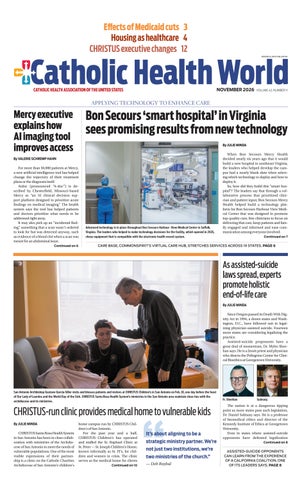
Effects of Medicaid cuts 3 Housing as healthcare 4 CHRISTUS executive changes 12 PERIODICAL RATE PUBLICATION
NOVEMBER 2026 VOLUME 42, NUMBER 11
APPLYING TECHNOLOGY TO ENHANCE CARE
Bon Secours ‘smart hospital’ in Virginia sees promising results from new technology
Mercy executive explains how AI imaging tool improves access
By JULIE MINDA
By VALERIE SCHREMP HAHN
For more than 50,000 patients at Mercy, a new artificial intelligence tool has helped change the trajectory of their treatment plans or the diagnosis itself. Aidoc (pronounced “A-doc”) is described by Chesterfield, Missouri-based Mercy as “an AI clinical decision support platform designed to prioritize acute findings on medical imaging.” The health system says the tool has helped patients and doctors prioritize what needs to be addressed right away. It may also pick up an “incidental finding,” something that a scan wasn’t ordered to look for but was detected anyway, such as evidence of a blood clot when a scan was meant for an abdominal issue. Continued on 6
Advanced technology is in place throughout Bon Secours Harbour View Medical Center in Suffolk, Virginia. The leaders who helped to make technology decisions for the facility, which opened in 2025, chose equipment that is compatible with the electronic health record system.
When Bon Secours Mercy Health decided nearly six years ago that it would build a new hospital in southeast Virginia, the leaders who helped develop the campus had a nearly blank slate when selecting which technology to deploy and how to deploy it. So, how did they build this “smart hospital”? The leaders say that through a collaborative process that prioritized clinician and patient input, Bon Secours Mercy Health helped build a technology platform for Bon Secours Harbour View Medical Center that was designed to promote top-quality care, free clinicians to focus on delivering that care, keep patients and family engaged and informed and ease communication among everyone involved. Continued on 7
CARE BASE, COMMONSPIRIT’S VIRTUAL CARE HUB, STRETCHES SERVICES ACROSS 19 STATES. PAGE 6
As assisted-suicide laws spread, experts promote holistic end-of-life care By JULIE MINDA
Since Oregon passed its Death With Dignity Act in 1994, a dozen states and Washington, D.C., have followed suit in legalizing physician-assisted suicide. Fourteen more states are considering legalizing the practice. Assisted-suicide proponents have a great deal of momentum, Dr. Myles Sheehan says. He is a Jesuit priest and physician who directs the Pellegrino Center for Clinical Bioethics at Georgetown University.
San Antonio Archbishop Gustavo García-Siller visits and blesses patients and visitors at CHRISTUS Children’s in San Antonio on Feb. 10, one day before the feast of Our Lady of Lourdes and the World Day of the Sick. CHRISTUS Santa Rosa Health System’s ministries in the San Antonio area maintain close ties with the archdiocese and its ministries.
CHRISTUS-run clinic provides medical home to vulnerable kids By JULIE MINDA
CHRISTUS Santa Rosa Health System in San Antonio has been in close collaboration with ministries of the Archdiocese of San Antonio to meet the needs of vulnerable populations. One of the most visible expressions of their partnership is a clinic on the Catholic Charities Archdiocese of San Antonio’s children’s
home campus run by CHRISTUS Children’s of San Antonio. For the past year and a half, CHRISTUS Children’s has operated and staffed the St. Raphael Clinic at St. Peter — St. Joseph Children’s Home, known informally as St. PJ’s, for children and women in crisis. The clinic serves as the medical home for clients Continued on 10
“
It’s about aligning to be a strategic ministry partner. We’re not just two institutions, we’re two ministries of the church.” — Deb Roybal
Fr. Sheehan
Sulmasy
The nation is at a dangerous tipping point as more states pass such legislation, Dr. Daniel Sulmasy says. He is a professor of biomedical ethics and director of the Kennedy Institute of Ethics at Georgetown University. Even in states where assisted-suicide opponents have defeated legalization Continued on 8
ASSISTED-SUICIDE OPPONENTS CAN LEARN FROM THE EXPERIENCE OF A CALIFORNIA COALITION, ONE OF ITS LEADERS SAYS. PAGE 8
2 CATHOLIC HEALTH WORLD November 2026
FIND MORE CONTENT ONLINE chausa.org/chw
Loyola outpatient center
Addressing workforce needs
Health system merger
Loyola Medicine, part of Trinity Health, is planning a $120 million ambulatory care center in Chicago’s growing western suburbs. The building will offer more than 30 specialties.
Mercy Health Sciences University in Des Moines, Iowa, is seeing record enrollment numbers. The boost comes as the university builds a new home for its nursing school.
Citing financial headwinds and growing care needs, Essentia Health and HealthPartners plan a 2027 merger. The 22-hospital system will serve patients across three states.
Nov. 19 | 1 – 2 p.m. ET
Mission in Long-Term Care Networking Call Dec. 3 | Noon – 1 p.m. ET
Advocacy Fly-In Dec. 8 – 9
United Against Human Trafficking Networking Call Jan. 14 | 1 – 2 p.m. ET
Foundations LIVE
By VALERIE SCHREMP HAHN
Moving cardboard walls At the cardboard city at St. Anthony, doctors, nurses, technologists and other clinicians walked through the space, going through workflows and play-acting emergency situations. Including a second phase, the project will cover about 23,400 square feet. Jeevanantham “We are building something with everybody’s input, which reflects SSM Health culture because we all participate and we want to create the space for patient care ... and make sure they have the best experience,” said Dr. Vinodh Jeevanantham, who is overseeing the proj-
from The Catholic Health Association Faith Community Nurses Networking Call
Using cardboard, SSM Health caregivers help design future cardiac care space If you were lucky enough as a child to build a house or fort out of an oversized cardboard box, you remember how it sparked your ideas and imagination. SSM Health and an Oklahoma City architecture firm are taking that approach as they figure out the layout and design of an expanded cardiology floor at SSM Health St. Anthony Hospital. A local company, Lingo Construction Services, built a “cardboard city” based on the architect’s layout of walls, tables, doorways, windows, countertops and other elements within a 16,000-square-foot space, even incorporating real equipment. The life-size cardboard model is just one element of an approach to construction called integrated facility design. The approach involves looking at how care actually should be delivered. The method has been used in planning SSM Health facilities in Wisconsin and will be for others in the future, explained Erin Daniels. Daniels is the interim regional vice president of ambulatory care in Wisconsin and previously Daniels served as regional vice president of continuous improvement for mid-Missouri, Wisconsin and Oklahoma. “Instead of beginning with the square footage, the number of rooms, the floor plans, what we do is bring team members who are part of that patient experience together,” she said, “and we talk about: How does this flow today? How does a patient move through our system? How does a team member do their job in our work environment? Where were we creating unnecessary movement, handoffs, waiting, complexity for both our patients and our caregivers? And what do we need care to look like in the future? Because that’s ever evolving and changing.”
Upcoming Events
Jan. 28 to March 18 | Thursdays, 1 – 3:30 p.m. ET
Deans of Catholic Schools of Nursing Networking Call Feb. 4 | 1 – 2 p.m. ET
Faith Community Nurses Networking Call Feb. 18 | 1 – 2 p.m. ET
chausa.org/events Scott Parker, left, of Miller Architects, walks through a “cardboard city” at SSM Health St. Anthony Hospital in Oklahoma City with Dr. Vinodh Jeevanantham, chair of cardiology. Clinicians and planners used the cardboard city to plan an expanded cardiology floor and cath lab.
ect as the hospital’s chair of cardiology. He said that another goal of the project is to integrate service lines, to make sure that patients aren’t treated in silos of cardiology, vascular surgery or interventional care. “We want them to feel like we work as a team, and it should be a seamless workflow,” he said. “It’s easier to move cardboard walls than concrete walls.” The redesign moves the catheterization lab and interventional radiology from separate floors to one floor. Design documents are still being finalized, with construction of the project expected to begin in spring.
Building the city The cardboard in the model is 1 inch thick and comes in 4-by-8foot sheets. Installers cut and tape the pieces together to make the walls and shapes they need. Scott Parker is the director of operations for Miller Parker Architects, which has worked with SSM Health on several projects. Most of the time, the firm presents plans digitally online or in boardrooms. “It’s one thing to be able to look through it on the screen and say, ‘Here’s how it will function,’” Parker said. Being able to walk through the cardboard city can spark more ideas, he said. The space to be used in the expanded cath lab had more than 60 concrete columns to work around. Lingo Construction tore out the interior of the existing space and spent three days building the first version of the cardboard city within the space. “We’ve got limited constraints, but within those constraints, and with regular
feedback from SSM Health, we’ve been able to squeeze out a few feet here and there, to add somewhere around 150 square feet or more to each of the cath labs to just try to maximize them to their potential,” Parker said. There are four cath lab procedure rooms, and two of them are hybrid spaces that can be used for other procedures as well. Because of what the team learned from the mockup, they enlarged 35 patient rooms to make room for all the clinicians needed at a patient’s bedside for a procedure. Some doorways were realigned by several inches so beds could be moved through the space more freely, without awkward turns. Along with this, some support spaces and operating room equipment rooms were relocated to make better use of space, Parker said.
Building for tomorrow Daniels noted that integrated facility design aligns with the Catholic social teachings of stewardship and subsidiarity. “With these resources that are being entrusted to us, we have an obligation to make sure that not only are we building something beautiful, but we also need to create the environments that really support our patients and our caregivers and the communities that we serve,” she said. Jeevanantham is excited to take part in the process, and so were the clinicians who walked through the cardboard city to help plan the new space. He said it gave them a sense of belonging to the work and space. “We’re not building it for today,” he said. “We’re building it for our future needs. We’re building it for tomorrow.” vhahn@chausa.org
Catholic Health World (ISSN 87564068) is published monthly and copyrighted © by the Catholic Health Association of the United States. POSTMASTER: Address all subscription orders, inquiries, address changes, etc., to CHA Service Center, 4455 Woodson Road, St. Louis, MO 63134-3797; phone: 800-230-7823; email: servicecenter@ chausa.org. Periodicals postage rate is paid at St. Louis and additional mailing offices. Annual subscription rates: CHA members free, others $29 and foreign $29. Opinions, quotes and views appearing in Catholic Health World do not necessarily reflect those of CHA and do not represent an endorsement by CHA. Acceptance of advertising for publication does not constitute approval or endorse ment by the publication or CHA. All advertising is subject to review before acceptance. Vice President Communications and Marketing Brian P. Reardon
Associate Editor Valerie Schremp Hahn vhahn@chausa.org 314-253-3410
Editor Lisa Eisenhauer leisenhauer@chausa.org 314-253-3437
Graphic Design Norma Klingsick
Associate Editor Julie Minda jminda@chausa.org 314-253-3412
Advertising ads@chausa.org 314-253-3458
© Catholic Health Association of the United States, November 2026
November 2026 CATHOLIC HEALTH WORLD 3
Catholic healthcare providers: Medicaid changes already taking toll By LISA EISENHAUER
Cuts to healthcare funding and revised rules around eligibility for Medicaid are just beginning to take effect, but Catholic healthcare leaders say the changes are already causing pain and much worse is ahead. Sr. Mary Haddad, RSM, president and CEO of CHA, says the changes threaten access to healthcare for millions of Americans and the viability of some Catholic healthcare providers, who are pledged to care for all. “We believe that every person is made in the image and likeness of God, and they have inherent dignity,” Sr. Mary says. “And because of that, we also believe that healthcare is a basic human right, and that all people deserve to live to their fullest potential. In order to do that, they must have access to quality healthcare. Period.”
Loss of enhanced premiums One change in place since the start of the year is the loss of the enhanced premium subsidies for low-income Americans who buy coverage through the Health Insurance Marketplace. The subsidies started during the COVID pandemic. The health policy research organization KFF projected in February that for the average enrollee who had gotten the assistance, the cost of premiums would double. Ryan Cross, chief government relations officer at FMOL Health, suspects that spike in premiums accounts in part for a spike in uninsured patients. At the system’s flagship hospital, FMOL Health — Our Lady of the Lake Regional Medical Center in Baton Rouge, Louisiana, the share of uninsured services rose from 2.8% in July 2025 to 5.6% in July 2026. In the first six months of this year, uninsured behavioral health admissions more than doubled compared to the same period in 2025. While uncompensated care affects FMOL Health’s bottom line, Cross says lowincome patients are most affected. They face tough choices like forgoing care, paying out of pocket, going into debt or seeking charitable assistance. “This is a policy problem with very human consequences,” Cross says.
Sr. Mary Haddad, RSM
Ryan Cross
Ali Santore
Damond Boatwright
President and CEO of CHA
Chief government relations officer at FMOL Health
Chief communication and external affairs officer at Providence St. Joseph Health
President and CEO at Hospital Sisters Health System
“It’s unrealistic to think that we can take a trillion dollars out of the healthcare safety net and not have it impact access to care.”
“We are going to face some very difficult decisions just maintaining our viability with this kind of reduction.”
“... all people deserve to live to their fullest potential. In order to do that, they must have access to quality healthcare. Period.”
“This is a policy problem with very human consequences.”
The funding will require the entire healthcare sector to make difficult choices, Santore says. Providence is already evaluating ways to strengthen and adapt its operations in response to the changing funding landscape without compromising its Catholic mission to serve everyone in its communities, especially those who are poor and vulnerable. “It’s unrealistic to think that we can take a trillion dollars out of the healthcare safety net and not have it impact access to care,” Santore says. “So we, like our foundresses before us, anticipate that we’re going to have to make some courageous decisions around where and how we can maintain access for those vulnerable populations.”
operating margins.” Boatwright projects that upcoming cuts will mean a 20-30% loss in Medicaid revenue for HSHS. But the loss won’t be across the board for the system because Medicaid accounts for more patients at some locations and in some service lines. At HSHS St. John’s Children’s Hospital in Springfield, Illinois, the payer mix is about 24% Medicaid, he points out, but in its neonatal intensive care unit, about 40% of patients rely on the safety net program. “We are going to face some very difficult decisions just maintaining our viability with this kind of reduction,” he says. “I mean things like reductions of staff, behavioral health, rural ambulance services, and cuts to access.”
Uninsured patients, unpaid care President and CEO Damond Boatwright says Hospital Sisters Health System is seeing significant increases in uninsured patients, uncompensated care, and uncovered debt this year. Boatwright says those challenges are surfacing at the same time as others unrelated to Medicaid. For example, as the nation’s population ages, more patients are moving off private insurance and onto Medicare, which typically has lower reimbursement rates. The changes, he says, are “exacerbating a reduction in our
Changes in eligibility rules Three Medicaid rule changes that raise particular concerns affect many of the about 20 million adults in the so-called expansion population. This population gained Medicaid coverage under the Affordable Care Act, but only if their states opted in. One of the new rules requires that these enrollees prove their eligibility for coverage every six months rather than every year. Another requires that they show proof that they are either working, in school or doing PROTECT WHAT’S PRECIOUS.
‘Courageous decisions’ to be made At Providence St. Joseph Health, Ali Santore, chief communication and external affairs officer, says the system is bracing for cuts to Medicaid funding that are set to begin next year. The Congressional Budget Office has projected that the cuts will total $1 trillion over 10 years. The office predicts the cuts and other changes to Medicaid will increase the number of people who are uninsured by 10 million. Santore says about 25% of Providence’s patients rely on Medicaid programs for coverage, although in some of its service areas that number is as high as 40%. Providence expects the funding cuts to mean a loss of about $800 million from 2027-2030.
CHANGES TO MEDICAID ARE COMING. SEE IF THE NEW RULES AFFECT YOU. SECURE YOUR MEDICAID COVERAGE TODAY.
CHANGES TO ARE SE AVECINAN MEDICAID CAMBIOS EN COMING. MEDICAID. PROTEJA LO QUE ES VALIOSO.
Qué hacer ahora:
What to do Now: VISIT OR SCAN
Visit medicaid.gov/ renew-info or scan the QR code to find your state Medicaid agency and update your contact information.
VISITE O ESCANEE
Visite medicaid.gov/ renew-info o escanee el código QR para encontrar la agencia de Medicaid de su estado y actualizar su información de contacto.
SEE IF THE NEW RULES AFFECT YOU. SECURE YOUR MEDICAID COVERAGE TODAY.
CONSULTE SI LAS NUEVAS NORMAS LE AFECTAN. ASEGURE SU COBERTURA DE MEDICAID HOY MISMO.
Then Stay Alert: Watch your mail, email and texts for any messages from Medicaid.
Y manténgase atento: Revise su correo postal, correo electrónico y mensajes de texto para ver si hay comunicaciones de Medicaid.
Two Things You Can Do Right Now: Update your contact information with Medicaid. Visit medicaid.gov/renew-info to learn more and get started Or scan the QR code to find your state Medicaid Agency
Find out whether the new work requirements apply to you.
Then Stay Alert: Watch your mail, email and texts for any messages from Medicaid. You’ll only have 30 Days to respond if you’re contacted.
PROTECT WHAT’S PRECIOUS.
DOWNLOAD NOW AT CHAUSA.ORG/MEDICAID CHA has developed a Protect What’s Precious Toolkit with informational and social media resources, available in English and Spanish, related to the Medicaid changes.
A CHA ADVENT CALENDAR
BUILDING A KINGDOM OF PEACE ADVENT 2026
CHA invites you to experience Building a Kingdom of Peace — a beautifully curated daily Advent resource designed to inspire prayer, reflection and connection through this sacred season. Available digitally and as a self-standing coil-bound calendar with accompanying poster set for display in your ministry.
chausa.org/advent
“community engagement” work for at least 80 hours a month. Another requires that those who have a condition that makes them medically frail also prove that their condition prevents them from working. Catholic healthcare leaders point out that all those changes will mean more paperwork for proof of eligibility. The burden of submitting and processing that paperwork will fall on patients, providers and the state agencies that oversee Medicaid programs. Sr. Mary points out that the medical frailty determination creates a new and generally unwelcome responsibility for physicians, who will have to make the call on whether a patient’s condition prevents them from holding a job. “I think this really skews the patientphysician relationship,” she says. “We think that’s a very sacred trust, and it has potential of being violated because of this added burden put upon the physician.”
Partnership, advocacy, resources CHA is working to maintain Medicaid coverage for as many people as possible through several initiatives. One is by being a founding member of The Partnership for Medicaid, a coalition of organizations representing clinicians, healthcare providers, safety-net health plans and counties. The partnership creates resources, issue briefs and other advocacy materials to sustain the safety net insurance program. To help its members prepare patients for the changes in Medicaid, CHA created the Protect What’s Precious Toolkit. The collection of resources includes downloadable posters and information cards for patients and a list of talking points for frontline employees. Meanwhile, CHA’s Washington-based advocacy team continues to urge members of Congress to rethink the funding cuts and changes because of the potentially drastic impact on healthcare nationwide. Healthcare system leaders say they are relying on CHA’s resources or are creating similar ones to educate patients on the changes. They also are staying in contact with the policymakers who voted for the changes in hopes of a reversal and with the state officials implementing the new rules in hopes of removing as many burdens as possible. Santore says Providence isn’t giving up the fight to convince lawmakers to rethink the Medicaid cuts. “It’s our hope that Congress will act in the next four years — hopefully next year — to mitigate the impact of these cuts on some of our most vulnerable populations,” she says. One point the system makes with lawmakers is that in many communities, Providence facilities are among the leading employers. If those facilities close or end services, it could mean a significant economic blow. Cross worries that the Medicaid cuts will prove “unsurvivable for many small rural hospitals across states like Louisiana and Mississippi.” He says even FMOL Health will be challenged, despite being on solid financial footing and led by a team that has proven resourceful at weathering tough times, as it did during the pandemic. “But as a Catholic healthcare institution, we are unwavering in our commitment to be there for those patients that need us most, regardless of their ability to pay, and we’re never going to back away from that,” Cross says. Boatwright says the projected losses in Medicaid funds will require HSHS to assess what is viable and sustainable in its care delivery. “We’re going to remain committed to providing high-quality services and care,” he says. “We just may have to do it with less of a footprint than we have right now.” leisenhauer@chausa.org
4 CATHOLIC HEALTH WORLD November 2026
Catholic Charities, health systems show power of housing as healthcare By VALERIE SCHREMP HAHN
Catholic Charities USA staffers know stable housing is crucial to healthy living. But they were pleasantly surprised when a study of their Healthy Housing Initiative showed that partnerships with Catholic health systems brought results that exceeded expectations. They hope that the findings will spur further collaboration. The five-year pilot program developed affordable housing in Detroit; Las Vegas; Portland, Oregon; Spokane, Washington; and St. Louis in collaborations with Ascension, CommonSpirit Health, Mercy, Providence St. Joseph Health and SSM Health. The goal of the initiative was to house at least 20% of people experiencing chronic homelessness in the five cities, decrease emergency room visits and hospital stays among the newly housed by at least 25%, and connect 35% of the residents to primary care and behavioral health services. The study, covering 2020-2024 and released Sept. 18, showed: 792 people found permanent housing, which was 113% of the original goal. Two of the five cities participating in the initiative exceeded their goal of reducing chronic homelessness by 20%. After being housed, 86% of residents had a primary care provider and 37% had a behavioral health provider. Emergency room visits decreased by 46% and hospital stays by 60% among residents after they were housed for six months. Reduced emergency room visits and hospital stays during the first six months of housing for 402 surveyed clients meant an estimated $4.91 million in community health savings. Even though the pilot phase of the program ended in 2024, the initiative’s partners continue to add housing. They have developed or are building 970 more units, which include permanent supportive housing and other affordable units. “With both Catholic Charities and Catholic Johnson healthcare being anchor institutions, the power of convening cannot be overstated,” said Curtis Johnson, vice president of housing strategy at Catholic Charities USA.
Creative approaches to housing Each city included in the study faces unique issues surrounding homelessness and has approached the situation in different ways, depending on goals and resources. For example, in St. Louis a major challenge is the high number of vacant and abandoned homes. A Catholic Charities of St. Louis caseworker is embedded with SSM Health to help clients find housing. In Detroit, the relationship started between Catholic Charities of Southeast Michigan and Ascension St. John Hospital. It continued after the system turned over the hospital to Henry Ford Health in 2024. Developers transformed a vacant Catholic school into 46 units of mixed affordable housing, The Residences at St. Matthew. The development is an example of how the growing inventory of surplus Catholic Church properties can be turned into housing, Catholic Charities representatives said. In Las Vegas, where homelessness is complicated by the high cost of living and limited affordable housing options, Catholic Charities of Southern Nevada rehabilitated and created several service-enriched units in its St. Vincent Apartments for formerly chronically homeless people. CommonSpirit has funded two case managers to address the needs Wortham of residents. Hospitals and health systems are crucial to this work, said Ben Wortham, who
This apartment at The Residences at St. Matthew is just one of the 46 units of mixed affordable housing built inside a former Catholic school in Detroit. The collaborative effort involved Catholic Charities of Southeast Michigan and Ascension Michigan.
served as Catholic Charities vice president of behavioral health integration before becoming a regional coordinator last year. “The hospitals and each Catholic health system supported Healthy Housing in their own unique way, and we saw the benefits of that,” he said.
Promising results Researchers with Delaware State University prepared the report. They evaluated surveys of 402 clients served in the five cities. Of those, 53% reported their physical and mental health was fair or poor at the beginning of the study and 56% were on medication for a chronic illness. A year after their enrollment in the Healthy Housing Initiative, a follow-up of 93 clients showed that 46% reported fair or poor mental health and 49% reported fair or poor physical health, and 90% were on medication for a chronic illness. In the first survey, 53% of clients reported at least one emergency room visit in the six months prior to being housed, and in the follow-up, the number dropped to 32%. “These promising findings demonstrate the critical connection between housing and a person’s health and well-being,” Kerry Alys Robinson, president and CEO of Catholic Charities USA, said in a statement. “When people have stable housing and supportive services, they are better able to access healthcare, build relationships and pursue opportunities that allow them to flourish. Addressing the root causes of homelessness requires us to see the whole person and work together across sectors to uphold human dignity.” As one client commented for the study: “When you’re homeless, you don’t go to the doctor and you can’t take care of yourself ... so a lot of them are just afraid to know how bad a shape they are, and they’ve been traumatized by medical people.” The study notes that systemic challenges remain. “There’s kind of long wait times in healthcare,” one caseworker reported. “Mental health (providers are) honestly very difficult to find at this point. Even for me working as a mental health service provider, we haven’t accepted new clients for intake since 2023. The system is backed up and there is a shortage of providers.” Partnership potential Johnson and Wortham said Catholic Charities USA, founded in 1910, has always worked closely with Catholic hospitals and health systems. But they said the collaborations have been one-offs and they are only aware of about 40 of them. There are 170 Catholic Charities agencies throughout the United States, with 3,900 service sites assisting 15 million people. The agencies offer ample opportunities for partnerships with the nearly 700 hospitals and more than 1,500 continuing
care facilities served by CHA, Johnson and Wortham said. Other partnerships exist with safety net hospitals, some of which are not Catholic, they pointed out. At the very least, a Catholic Charities CEO and a Catholic hospital CEO should meet and establish a relationship, Wortham said. “What we’re hoping is that at a very min-
imum, that our Catholic Charities agencies are able to leverage this report as an example, a very tangible first step,” Wortham said. If food and nutrition is a particular need in one area, Johnson said Catholic Charities can help connect hospitals to its food and nutrition specialists. “But these collaborations tend to lead to other joint opportunities,” Johnson said. A food partnership might lead to a housing initiative, and that might lead to funding for case manager positions to help people who are chronically homeless find housing and avoid the ER, he said. “Now, we’re working upstream,” Johnson said. “That’s the ultimate goal.” Partnerships don’t always have to be financial or involve building something from the ground up, Johnson and Wortham pointed out. Catholic Charities Eastern Washington in Spokane is particularly good at building housing, Wortham said, but in some cities that’s not always practical. “The way the health system supported those efforts in every city was just incredible and similar, but also different in the exact support,” he said. “So you could have med students coming over from the hospital to do wellness checks. You could have grant funding support, nurse practitioners coming to the building for primary care. ... Some of the biggest breakthroughs were the time and attention from the Catholic hospitals.” vhahn@chausa.org
SHARE THE
JOY
Catholic Health World invites you to extend a seasonal greeting to your employees and to colleagues in the Catholic health ministry. Visit chausa.org/Christmas for more details. Send an email to ads@chausa.org to reserve your ad space. ADS DUE BY NOV. 17 Include your organization’s Christmas message in the December issue of
November 2026 CATHOLIC HEALTH WORLD 5
Pathologist’s $3 million gift secures future of PeaceHealth mentorship program By VALERIE SCHREMP HAHN
Dr. Richard Nau, a longtime and nowretired pathologist who worked for PeaceHealth, knows the value of working hard and having a network of support to succeed. He recalls a program on PBS in which President George W. Bush defined success by his ability to do things for others. “And I thought, well, that’s kind of a good definition for success,” Nau said. The 86-year-old recently committed $3 million to set up the PeaceHealth St. John Mentorship Program Endowment in Longview, Washington. The contribution creates permanent funding for a program that has helped high school students discover careers in healthcare for nearly 30 years. Nau has lived in Longview, in the southwestern corner of Washington state, since the early 1970s. He grew up in Johnstown, Pennsylvania. His father worked for a steel mill and his mother died when he was 2. Nau and his father lived with relatives. After excelling during his first year in college, Nau earned a $1,000 scholarship to Penn State. That amount nearly paid for tuition, he said. He worked throughout college and medical school. He also served in the Army during and after medical school.
Dr. Richard Nau, second from right, stands with some of the high school students participating in the PeaceHealth St. John Mentorship Program in Longview, Washington. Nau, a retired pathologist who worked for PeaceHealth, recently donated $3 million to the program.
“I had as a good goal to do to others in a way as had been done to me,” he said. His gift to St. John is just one of his charitable endeavors. In 2023, he donated $1 million to a hospice facility in Longview, now called the PeaceHealth Richard Nau Hospice House. He has set up a scholarship at Penn State. He also supports the Salvation Army, Scouting America, and Lower Columbia College in Longview. Nau said he isn’t particularly religious, but is interested in learning about different religions, and recalls reading a book on the seven major religions of the world.
“What impressed me was that they all had the Golden Rule, or the universal ethic,” he said. “I thought when you boil down Christ’s teachings, the main teaching was the Golden Rule.”
Advancing generations Sr. Rose Nigro, CSJP, founded the PeaceHealth St. John Mentorship Program. At its start, the program served the first generation of the family who was literate, said Amy Leggio, executive director of the PeaceHealth St. John Foundation. The program now serves students who are likely to be the
first generation in their family to graduate from high school or college. “Philanthropists like Dr. Nau allow us to continue and maintain programs for the benefit of the community for decades into the future,” Leggio said. Students work up to 10 hours per week during their junior and senior years and up to 40 hours on school breaks in various departments of the hospital. They also work with hospital mentors. A third of each student’s earnings is set aside in a savings account for their future academic pursuits. When students complete the program and graduate from high school, they receive these funds with interest and many continue working at St. John while attending college. The program had relied on annual funding. Nau’s gift creates long-term stability. It will help the program return to a balanced cohort of six juniors and six seniors in high school, with the seniors learning leadership skills as they mentor the juniors. Participants in the program have achieved a 99% high school graduation rate compared to the county’s overall rate of about 80%. Mentorship program alumni also complete bachelor’s degrees at high rates, with many pursuing master’s degrees. vhahn@chausa.org
Mercy and partner reveal new details on large-scale, healthcare build-out in Arkansas
Season Seven: Health Reimagined THE OFFICIAL PODCAST OF CHA
Subscribe to chausa.org/podcast
Mercy health system, based in suburban St. Louis, and a foundation funded by a philanthropist have provided new details on a large-scale build-out of healthcare services in Northwest Arkansas. The philanthropist is Walmart heir Alice L. Walton, a businesswoman who has founded five nonprofits, including the one funding this healthcare access expansion. The plans include a Scan to read hospital, a specialty care an extended center and an oncolversion of this ogy facility on a holisstory. tic health campus in Bentonville, Arkansas. The partners also will expand healthcare services available on a Mercy campus in nearby Rogers, Arkansas. The work is part of an estimated 30-year project to improve care access in the region. Mercy, the Alice L. Walton Foundation and other partners announced the effort about two years ago. Alice L. Walton is the daughter of Walmart founder Sam Walton. Mercy; the foundation; the Alice Walton School of Medicine, or AWSOM; the Heartland Whole Health Institute; the Cleveland Clinic and other partners plan to create a “transformative destination for health and well-being in Northwest Arkansas,” according to a press release. The goal is to improve access to cancer care, heart care, orthopedics, gastroenterology, neurology and other specialties; advance whole-person healthcare; foster innovation in healthcare delivery; and create a hub for extending more healthcare services to rural populations. Earlier this fall, partners broke ground on the AWSOM Whole Health Campus. The 120-plus-acre site 2 miles east of downtown Bentonville will be a locus of the activity. The first building, the Center for Advanced Specialty Care, is set to open in 2029. The release says the group is developing the AWSOM Whole Health Campus in alignment with Mercy Hospital Northwest Arkansas. That hospital is based in Rogers, about 10 miles from Bentonville.
6 CATHOLIC HEALTH WORLD November 2026
APPLYING TECHNOLOGY TO ENHANCE CARE
Care Base, CommonSpirit’s virtual care hub, stretches services across 19 states By LISA EISENHAUER
During the COVID-19 pandemic, CommonSpirit Health started using “virtual sitters” to remotely monitor patients at a few hospitals. That successful program has evolved into a service line that today supports care and logistics at 452 CommonSpirit Health sites. Gail Daly, system senior vice president of clinical operations, integration and optimization, conceived and launched the program known as Care Base. Since its start in 2021, Care Base has evolved into what she calls a “virtual hospital.” Daly “I like to look at it as a state-of-the art healing facility where we’re supporting and facilitating innovation while providing really great care remotely, and that care is going across the care continuum,” says Daly, who was a bedside nurse before moving into an executive role. Daly was honored this year by Modern Healthcare magazine with an Innovator Award for leading the development of Care Base. The program’s mission, as stated on CommonSpirit’s website, is to ensure patients “get the right care, in the right place, at the right time — whether in the hospital, a postacute setting, or at home.” Daly credits Care Base for “improving the patient outcome, decreasing mortality and morbidity, and decreasing clinical variation, and all while doing it with evidencebased practice.”
A hub that reaches 19 states From a hub housed in the top floor of a building next to Dignity Health St. Joseph’s Hospital and Medical Center in Phoenix, the Care Base staff of about 700 augments hospitals, clinics and home health providers across 19 states. Dignity Health merged with Catholic Health Initiatives in 2019 to form CommonSpirit. The system encompasses 158 hospitals and 2,300 care sites in
AI imaging tool From page 1
In a white paper recently released by Mercy, researchers outlined more than 50,000 incidental findings in just five months, from January through May. Mercy began a phased rollout of Aidoc in January 2025, and it’s now in use throughout the system. Mercy is the only Catholic health system out of 12 that have formed the Diagnostic AI Consortium with Aidoc. The systems plan to work together to share lessons they’ve learned in using diagnostic AI. Dr. John Mohart, Mercy executive vice president and chief operating officer, spoke with Catholic Health Mohart World about the Aidoc platform and how it is changing how Mercy caregivers work. His answers have been edited for length and clarity. What is Aidoc and what does it do? Aidoc is an AI solution that interprets imaging studies. It looks at CT scans and X-rays and instantaneously comes up with an AI-generated read, and then it surfaces it to the radiologists, and it prioritizes those reads. So it not only evaluates the images, but if it’s something bad, it elevates it to the top of the list, which is also really important — taking care of patients. But it’s more than that. We’re developing a foundational model where it can search the electronic record as well, and find out what patients are at risk for, and help it even
a program that monitors expectant mothers and postnatal women with hypertension. The program reaches people in geographical areas where such care can be challenging to access in person.
A staff member keeps an eye on several monitors at the Care Base hub in Phoenix. Care Base is a service line of CommonSpirit Health that offers virtual assistance in care and logistics.
24 states. Daly says it was in the early days of the merger that a “visionary group” of about 40 leaders from both legacy systems began to lay the foundation for the combined system’s virtual services. After the successful deployment of virtual sitters during the pandemic, the system had its proof of concept. In one of its first expansions beyond virtual sitters, the service line took over dispatching duties for five hospitals in the Sacramento, California, region, deploying emergency response and other teams as needed. That service now covers 46 locations. Today, Care Base services include monitoring patients remotely both in hospitals and in their homes; handling patient discharges; coordinating patient movement among departments within a hospital; arranging transfers between CommonSpirit sites; and generating referrals to hospitals outside the system.
‘Rinse and repeat model’ There have been some key factors in cre-
get smarter for follow-up and for diagnoses. It’s fantastic that you get all these results. But there are challenges that come with that, too. How do you pick and choose what you’re going to deal with, and do you have the people, time and resources to do that? That’s exactly the challenge. Finding something is only valuable if you act on it. We made a deliberate decision not just to implement the technology, but also to build the infrastructure around it. We have teams and processes in place to make sure patients get the right follow-up, are connected to the appropriate specialist or primary care provider and don’t fall through the cracks. If I came in as a patient, I’d want to know about every significant issue that can be identified, not just the reason I came in for the scan. If someone comes in with shortness of breath and the scan rules out a blood clot, that’s good news. But if the same scan also shows a suspicious lung nodule that could become cancer, we have a responsibility to catch it and act on it. One example is heart disease. We found that about 6% of patients getting CT scans for reasons unrelated to their heart had evidence of significant coronary artery disease and didn’t know it. Those are opportunities to intervene earlier, often before a serious event occurs. That’s why we manage this centrally rather than leaving every individual provider to navigate it on their own. It creates a more consistent, reliable process and helps ensure patients get the care they need. Continued on page 7
ating what Daly terms the “rinse and repeat model” of Care Base, meaning that it replicates its services with the same standards wherever they are provided. One factor was to ensure that appropriate technology was in place and that the technology had redundancies so the services could roll over to other servers if needed. Another was to standardize the codes across CommonSpirit, so that, for example, a code blue at one hospital wouldn’t have a different meaning at another. Daly says Care Base meets needs the system has struggled to address, such as giving patients access to nurses and other clinicians even as the healthcare sector copes with a workforce shortage. She says the program isn’t displacing workers or replacing local services but rather supporting staff and bridging gaps. “I would say we have been closing the gap in the resource needs because those resources aren’t there,” Daly says. In fact, she says, Care Base has helped CommonSpirit address inequities in access to care by offering services that might otherwise be unavailable. One example of that is
Lighter loads, greater efficiencies In addition to filling gaps, Daly says, Care Base lightens the load on bedside caregivers by taking on some administrative tasks, such as preparing patients for discharge. The remote caregivers, who speak with patients via cameras, can give the patients and their family members as much time as needed to explain post-discharge care because they aren’t tending to multiple patients. Taking on responsibilities like this, Daly says, allows hospital staff more time to focus on direct patient care. She also cites the service line’s efficiencies, such as cutting the length of hospital stays for many patients by allowing them to recover at home with virtual monitoring. The service line’s overall efficiencies have meant a financial boost for CommonSpirit, which for fiscal year 2026 estimated the savings from Care Base at $95 million. CommonSpirit also credits the service line for heading off adverse events, such as hospital readmissions from postnatal preeclampsia. In the last fiscal year, the system says Care Base’s virtual companion service that supports 82 hospitals and monitors about 25,000 patients prevented 187,900 adverse events. In the year ahead, Care Base is set to expand to up to 60 more sites. Daly says she and the others leading Care Base continually look for service gaps that can be remotely filled and ways to better tap technology, including the ongoing advances in artificial intelligence, for care and logistics. Daly sees growing Care Base as an extension of her love for puzzles. “Anything that I see that’s a puzzle and I can put together, I’m really interested in figuring out how to make it better,” she says. leisenhauer@chausa.org
November 2026 CATHOLIC HEALTH WORLD 7
APPLYING TECHNOLOGY TO ENHANCE CARE
Smart hospital About a year and a half out from the Suffolk hospital’s opening, the leaders involved in the rollout say the technology — including electronic whiteboards, artificial intelligence tools, smart communication technology, advanced safety features and more — is exceeding expectations. Kelly Stuart, vice president of ethics at Bon Secours Mercy Health, says, “Building a hospital from the ground up with techStuart nology and patient care in mind and determining how technology can enhance our work helps to ultimately improve our relationship with patients, families, and each other. I think that is exciting!” Dr. Mark Townsend, Bon Secours Mercy Health chief clinical digital ventures officer, says, “Adoption is a way to measure success … So, if you’ve been admitted to Harbour View, and the connectivity with your family was such Townsend an important part of your admission, and you can’t imagine going to a hospital that doesn’t have that technology, then that’s our definition of success.” Harbour View Vice President of Nursing Kristen McSorley says outcomes look promising so far. “Our patient experience results have been one important way we’ve measured the overall impact of the Har- McSorley bour View experience,” McSorley says. “We’ve consistently remained in the 90th percentile for patient experience, and strong communication and alignment between our care teams and patients has been a consistent theme.”
Response to increased demand In a press release, Suffolk Mayor Michael Duman says the community needed this new facility because the city has been growing, and people wanted access to highquality care close to home. The U.S. Census Bureau estimates Suffolk has grown by about 10% since 2020. Opened in May 2025, Harbour View is a $85 million, 100,000-square-foot hospital built on a campus where Bon Secours Mercy Health already had an outpatient medical center. The hospital has 18 inpatient beds and four operating rooms and
AI imaging tool from page 6
What surprised you about this tool? Two things: the accuracy and the speed. The tool doesn’t just tell a radiologist there’s something concerning. It points directly to the exact area of the scan that needs attention. That saves valuable time and helps clinicians focus immediately on what matters. The prioritization has been just as impressive. If a patient in the emergency department has a life-threatening condition such as a brain bleed, that scan can be pushed to the top of the reading queue. We’ve seen situations where patients were diagnosed and treated sooner because of that capability. What’s also remarkable is how quickly the technology continues to improve. The more it learns, the more precise it becomes. That’s exciting because every improvement creates another opportunity to help patients get answers faster. How does this address workforce issues? You may not need as many humans to look at these at first anymore, but you may need more to address the
Photo courtesy of Wes Battoclette
From page 1
Much of the smart technology featured in the patient rooms at Bon Secours Harbour View Medical Center was chosen for its effectiveness in easing communications with patients. For instance, the monitor near the foot of the patient bed can be used to have a telehealth visit and to speak with providers.
offers emergency care, imaging, primary care and specialty care. Specialty services include orthopedic care, cancer radiation therapy, bariatrics, and robotic surgery. Bon Secours Mercy Health began planning the technology components of the new hospital in earnest around 2024, with a central technology planning team that included McSorley, Townsend, Stuart and many others. That team engaged workgroups to take on specific aspects and use cases of various technologies. The team included experts in a range of disciplines at the system level as well as at Bon Secours Mercy Health facilities. The system has 47 hospitals in Kentucky, Ohio, South Carolina and Virginia, as well as some international enterprises.
Technology for a purpose Townsend says numerous associates and vendors were involved in building out the technology, including nurses, physician leaders and other clinicians; information technology experts; engineers; architects; designers; and compliance experts. They thought through different ways technology would likely be used, anticipated issues and problem-solved solutions. They spoke with patients. To test it all out, they set up a simulated hospital environment outfitted with the technologies they were considering. McSorley says throughout the technology planning process, “a major focus was making sure we were not adding technology simply for the sake of having it. Every solution needed to serve a purpose and address a real need for patients or clinicians.” She adds that the planning team incorporated the patient voice throughout the process. Townsend notes a challenge was that “as you build hospitals, technology is continually evolving as well.” Early in the process of designing the technology platform, “AI (was) upon us, and then that really opens up … the realm of possibilities specific to
issues you’re finding. The reality is that we’re facing a significant shortage of radiologists, while imaging volumes continue to grow. What we’ve found is that AI doesn’t replace radiologists. It helps them do their jobs more effectively. The radiologist is still the expert and still makes the final decision. The technology helps identify urgent findings faster and reduces some of the burden of sorting through an ever-growing volume of studies. In many ways, it allows radiologists to focus more of their time and expertise on the patients who need them most. At the same time, you’re right that finding more important conditions creates additional follow-up work. We’ve invested in patient navigators, nurses and support teams who help make sure patients understand the findings, get connected to care and stay on the right path. Discovering a problem is only the first step. Helping patients address it is where the real value comes from. I know we’re talking about proper, ethical uses of AI in healthcare. Is this use a
how you can integrate these technologies into health systems. So then, as Harbour View opened last year, it had been built as our first smart facility through design and construction.”
Smart technology There are almost countless advanced technologies used throughout the Harbour View campus. A digital whiteboard, telehealth cameras, and digital room signs together make up the facility’s smart hospital room. Some of this technology allows for telehealth calls with clinicians and video visits with loved ones. The digital whiteboards are in all inpatient rooms. These screens are integrated with the hospital’s Epic electronic health record. The screens display important information about the patient’s care team and care plan. Patients also can control many of their environment settings from this system, including room lighting, blinds and temperature. The black box multimedia system uses cameras, microphones and sensors to monitor patient safety. Artificial intelligence, for instance, helps to determine whether a patient is likely to fall. At Harbour View, ambient technology, which is used increasingly in healthcare nationwide, uses digital tools to listen to, document and analyze clinical discussions happening in select care areas in order to use the information to improve patient care. Supporting, not replacing, caregivers McSorley says throughout the technology planning, leadership has been very intentional that the tools support the human side of care, not replace it. She says, “Technology is at its best when it helps us better live our mission and strengthen the human connections at the heart of healthcare.” Results are showing that the technology is accomplishing that goal by enhancing
clear slam dunk, or do you still have to be careful? We should always be careful with AI in healthcare. Any tool that affects patient care deserves rigorous evaluation and ongoing oversight. That said, this is one of the clearest examples I’ve seen of technology helping us deliver better care. It helps identify serious conditions sooner, improves efficiency, supports clinicians and creates opportunities to achieve better outcomes for patients. We don’t simply turn a tool on and trust it. Every solution goes through a structured review process, and clinicians remain responsible for medical decisions. In this case, we felt confident moving forward because the technology has been extensively validated and approved for clinical use. Ultimately, if we have a tool that can help us diagnose patients earlier, improve safety and potentially save lives, I believe we have a responsibility to use it thoughtfully. Did it take a lot of lead-up work to get this going? One of Mercy’s strengths is harnessing technology to improve outcomes.
what clinicians are doing, McSorley says. “Communication is better, information is easier to access and our teams can stay focused on the patient.” Stuart says the patients and families also are pleased. The whiteboard system enables them to see which clinicians and other staff have worked with the patient, which Stuart says enhances staff credibility and accountability with patients. McSorley adds, “Patients and families really value having information readily available and feeling connected to their care team. … patients increasingly expect healthcare to be easier to navigate, more connected and more responsive to their needs.” She says, “The technology at Harbour View Medical Center helps us meet people where they are and create a more convenient, informed and personalized experience.”
‘That escalated quickly’ Deylon Quarles says he and his family benefited from the technology when he was hospitalized at Harbour View shortly after the hospital opened. Quarles, who is in his late 20s, had spent Easter weekend in 2025 extremely ill. Never eager to go to the doctor, he argued with his mother about going to the hospital but finally relented after several days in pain. Expecting a quick, perfunctory stop in the emergency department, Quarles initially laughed and joked with hospital Quarles staff, despite his pain. The next thing he knew, a surgeon told him he had an advanced case of colon cancer and would need surgery right away. Quarles remembers thinking, “Well, that escalated quickly.” Within 24 hours, he underwent surgery. Post-procedure, he required physical therapy to regain his motor skills. After his spring discharge, he underwent chemotherapy until he received the all-clear just before Christmas last year. Quarles says the smart technology at Harbour View was key to his successful treatment. He says, “It’s like a beautiful combo of things — you have the technology element, and then you have the people working hand in hand to make everything work. You need both.” Quarles says, “It’s crazy to think, but I don’t know where I would be and what kind of condition that I would truly be in if it wasn’t for (the staff at Harbour View). And I’m absolutely grateful to each and every person that invested their time and showed up and cared about me.” jminda@chausa.org
It absolutely required preparation. For years, Mercy has invested in technology, clinical integration and operational capabilities needed to make innovations like this work across a large health system. Having a unified electronic health record across our footprint gives us the ability to deploy tools consistently and at scale. But the technology itself isn’t the most important part. Our mission is to get healthcare right for every patient we serve. That means reducing missed diagnoses, improving access and helping people get the right care at the right time. One of the things I’m most passionate about is making high-quality care available regardless of where someone lives. If you’re in a small rural community, you deserve the same expertise as someone receiving care at one of our largest medical centers. Tools like this help extend that expertise beyond the walls of any one hospital. In many ways, that reflects the spirit of the Sisters of Mercy. They went to where people needed care. Today, technology allows us to do something similar by bringing expertise to patients wherever they are. vhahn@chausa.org
8 CATHOLIC HEALTH WORLD November 2026
Assisted-suicide opponents can learn from a California Catholic alliance By JULIE MINDA
Having worked in Catholic healthcare in California for more than four decades, Lori Dangberg has had a front-row vantage point of the state’s turbulent history when it comes to assisted suicide. Since 2000, she has been executive vice president of the Alliance of Catholic Health Care in Sacramento, which Dangberg helped lead the opposition to legalization. The alliance convenes and represents the leadership of California’s Catholic healthcare systems and facilities. Despite the alliance’s efforts in opposition, the California State Legislature passed the End of Life Option Act during a special session in 2015. The state enacted the law a year later. California now is one of 13 states that have so-called Death With Dignity laws. With more than a dozen states considering such laws in the near term and many more poised to take up such legislation, Dangberg says Catholic healthcare providers nationwide could learn from the experience of those in states where the laws have passed. She advises ministry organizations to build and strengthen coalitions of likeminded partners, to warn of and anticipate erosion of safeguards in laws, and, perhaps most importantly, to promote wholeperson care. She says some primary concerns should remain: “How do we support those at the end of life? How do we provide a loving alternative to physician-assisted suicide for patients and their families? And how do we create a loving community to surround them?”
Advocating for protections Through the Alliance of Catholic Health Care, leaders of CommonSpirit Health, Providence St. Joseph Health, and Scripps Mercy hospitals collaborate on advocacy, ministry leadership formation, church relations and other activities. The coalition’s top focus areas include serving vulnerable people, advocating for expanded health insurance coverage and access, strengthening Medicare and MediCal, providing leadership around public policies promoting community health and well-being, promoting not-for-profit
Assisted suicide
had promised both. “We want consistent data reported across the state. The full impact of this law is unknown at this time because of the lack of reporting of key data that is collected, but that the state has chosen not to report,” she says. “We don’t know what is truly happening at the bedside.”
Rebecca Freeman talks about providing holistic care at a senior forum at St. Joseph Catholic Church in Placentia, California. Freeman is a diocese coordinator of Caring for the Whole Person, an initiative from the California Catholic Conference and Alliance of Catholic Health Care.
healthcare generally and protecting religious freedom. When it comes to religious freedom, the alliance focuses on preserving “the ability of Catholic and other religious organizations to deliver healthcare consistent with their religious beliefs and values.” Alliance President and CEO William Cox and Dangberg are retiring at the end of this year. The member health systems have decided to dissolve the alliance on Jan. 31 and transition responsibility for its projects, partnerships and relationships to those health systems.
Decades-long push Dangberg says the nonprofit Compassion & Choices — formerly the Hemlock Society — and various partners have conducted a well-organized campaign for decades to legalize assisted suicide in every state. In roles with various organizations, Dangberg tried to defeat these attempts in California since the early 1990s. She says most of her involvement has been through her role with the Alliance of Catholic Health Care. She says a key strategy of the alliance from the start has been to help build a diverse coalition of like-minded organizations. Together, they fought the legislative onslaught by proponents. She notes that such coalitions can be fragile precisely because of their diversity. The California coalition, which, in addition to the alliance, included civil rights groups and advocates of people with disabilities, hired a consultant to manage the group and keep members united.
efforts, proponents remain relentless, continuously returning to push legislation, says Indu Spugnardi, CHA senior director of community health and eldercare. Experts with a range of vantage points on the topic say Catholic healthcare providers can and should Spugnardi respond in states where assisted-suicide laws have passed and in states with pending legislation.
Kathy Curran, CHA senior director of public policy. Within the last year, three states — Delaware, Illinois and New York — have legalized assisted suicide. This summer, five Catholic organizations sued New York, Curran saying its law would force the organizations’ care facilities to assist with suicides in violation of their beliefs. Those litigants are the Dominican Sisters of Hawthorne, the Carmelite Sisters for the Aged and Infirm, the Little Sisters of the Poor, the Diocese of Rockville Centre and Catholic Health.
Persistent push Sulmasy says much of the energy behind the push for physician-assisted suicide has come from the nonprofit Compassion & Choices. Its predecessor, the Hemlock Society, dates to 1980. The organization advocates for the legalization of assisted suicide, educates people on its supposed benefits, and helps people navigate end-of-life decisions. It is a well-funded lobbying group that has organized people to “infiltrate” state medical associations and to influence other organizations that are pivotal to gaining support for assisted suicide, Sulmasy says. Alongside its legislative efforts, Compassion & Choices has been working to normalize assisted suicide among Americans and the practice is gaining acceptance, says
CHA as a resource The Ethical and Religious Directives for Catholic Health Care Services say “Catholic health care institutions may never condone or participate in euthanasia or assisted suicide in any way. Dying patients who request euthanasia should instead be given loving care, psychological and spiritual support, and appropriate remedies for pain and other symptoms so that they can live with dignity until the time of natural death.” Pope Leo XIV recently spoke of the Catholic Church’s perspective on the sick and dying. During a trip to France in September, the pontiff reaffirmed that people’s human frailty does not diminish their dignity. He spoke at a shrine in Lourdes where the sick come for healing.
From page 1
Prior to the 2015 passage of the legislation in California, the alliance had noted three changes in state dynamics. First was a shift in key social and moral attitudes, including on same-sex marriage and the use of stem cells. Second was a change in “the face” of euthanasia. Previously, it was associated with older white men like Jack Kevorkian, one of its high-profile proponents. In 2014, that changed when 29-year-old Brittany Maynard, a patient with terminal cancer, chose assisted suicide. Her decision, promoted by Compassion & Choices, gained national attention. And third was the California Medical Association’s change in position on assisted suicide — from opposed to neutral. “The momentum changed,” Dangberg says, noting that shortly thereafter the law passed in California.
Rollbacks Dangberg says with assisted suicide legal for a decade, the Alliance of Catholic Health Care and its partners have been working to help ward off continual efforts to roll back the legislation’s safeguards. One safeguard that was rolled back was a clause to sunset the law in 2031 if not renewed. The alliance and other opponents of the law have successfully fought attempts to make more people eligible for aid in dying and to relax the requirement that aid-in-dying medications be self-administered by the patient. Dangberg says a paramount concern is that there has been no full public reporting and no public auditing of the impact of the law, though assisted-suicide proponents
His visit comes in the wake of the French National Assembly’s approval in July of an assisted-suicide law. The French Bishops’ Conference had spoken out against the law, according to Catholic News Service, which noted that Pope Leo has decried the passage of such a law in his native Illinois.
Holistic care To counter the use and spread of assisted suicide, those who spoke to Catholic Health World say there is much that Catholic health systems and facilities can do. Curran says a key step Catholic health systems and facilities can take is to build awareness that high-quality palliative care is an alternative to physician-assisted suicide. She says they can “continue to provide palliative care in their hospitals, and they can continue to advocate for it … so that it becomes more common and better understood.” Foremost, the experts say, ministry facilities must recognize that making highquality palliative care available addresses many of the very real concerns that drive people to consider seeking medical aid in dying. Spugnardi says that vulnerable people who are suffering and afraid need accompaniment, including through palliative care, not abandonment. Ensuring the delivery of optimal care at the end of life includes adhering to the top standards of care, educating and training staff to provide the best possible care, and promoting a culture in which staff value the
‘Pivotal and profound moment’ Dangberg says a “pivotal and profound moment” in the California battles over assisted suicide came shortly after the law’s passage. The alliance had gathered leadership and sponsors of its member Catholic healthcare systems as well as multiple California bishops. During a presentation, Dr. Ira Byock, a palliative care physician and founder of Providence’s Institute for Human Caring, delivered what Dangberg recalls as a simple but insightful reflection. She remembers Byock said, “we’ve been opposed to physician-assisted suicide for a long time. The American public knows what we are against. But they could be forgiven if they don’t know what we’re for.” The moment spurred a more proactive stance for the alliance and the bishops. They united behind a vision — that people in church ministries could help those who are suffering to feel loved, and wanted and worthy, and to help those people to prepare for serious illness. The resulting Caring for the Whole Person Initiative from the alliance and the California Catholic Conference brings programming, education and training to parishes throughout the state. CHA has supported the initiative. The goal of the effort is to equip people to support fellow parishioners who are suffering and need holistic care. In a CHA Health Calls podcast episode earlier this year, Dangberg described how some of this work has played out. Dangberg says she’s had some similar takeaways from the initiative’s success as from the alliance’s work opposing assisted suicide. Namely, that the needs of the suffering should remain the ultimate focus of those opposing assisted suicide. “We have to balance our opposition to assisted suicide with also saying what we can offer,” she says. “We can understand people’s needs and determine how to address the needs of patients and families. We can offer hope that we can address their issues.”
dignity of all patients, even the most difficult ones, Sulmasy says. Catholic healthcare facilities should be highly proficient in pain control as well as in delivering the spiritual and mental health care that address nonmedical needs, he says. Curran says ministry systems and facilities also should advocate for government support and investment in palliative care.
Disciplined messaging Sulmasy and others say ministry systems and facilities also should build ongoing awareness of the availability of palliative care. They say societal buy-in for assisted suicide has happened in part because people don’t know about the highly effective medical and nonmedical treatments for pain and suffering. Sulmasy says “letting people know what the alternatives are” is vital to halting the spread of assisted suicide. Lori Dangberg, executive vice president of the Alliance of Catholic Health Care, says as people are dying, Catholic healthcare can help them “understand what can be brought to the journey.” Curran says telling the stories of people who have benefited from palliative care is one way to do this. Spugnardi says Catholic healthcare “can’t just be about opposing physicianassisted suicide. We need a hopeful message about palliative care, and about how we accompany people and not abandon them. It’s about holistic care.”
November 2026 CATHOLIC HEALTH WORLD 9
Ascension Sacred Heart staff gave terminally ill mom precious time with newborn daughter By JULIE MINDA
Patsy Brown Photography
Madison Marie Henderson is remembered in her obituary as someone who “treasured every moment spent with the people she loved and created countless memories that will forever be held close in the hearts of her family and friends.” So it is only fitting that some of the last acts of kindness that Madison’s care team at Ascension Sacred Heart Pensacola in Florida showered on the 22-year-old and her family were meant to help her spend her remaining precious days making — and preserving — memories with her newborn daughter and the many family and friends who visited her. As Madison moved among Ascension Sacred Heart’s perinatal specialty care, labor and delivery and neonatal intensive care units and into hospice over a threemonth span this summer, her care team did all they could to help her achieve her main goals: to keep her daughter, Marie Sterling Ann Martin, healthy and to spend as much time as she could with her. Julie Adams, patient care Adams manager for the Level III NICU at Ascension Sacred Heart’s Studer Family Children’s Hospital, was among the hospital staff who helped to ease the way for Madison to stay in a hospital bed in her daughter’s NICU room when Madison was healthy enough to do so, and to view the newborn by webcam when she was not. Adams and team also arranged a photo shoot for Madison and her daughter and created keepsakes for the family to treasure. Madison’s mother, Robin Henderson, says the staff created deeply meaning-
she’ll stand up for what she believes in and what’s right, and all those things, and make sure she goes to church,’” Robin recalls.
Madison Marie Henderson cradles her newborn, Marie Sterling Ann Martin, at Ascension Sacred Heart Pensacola, Florida. Hospital staff arranged a professional photo shoot that included this image.
ful “gifts and crafts and the photo shoot so Marie can see what kind of person Maddy was and that she loved her.” Robin says of the staff: “They were phenomenal.”
A lifesaving choice Madison was born in 2003 in Columbia, Missouri, the seventh of eight children. She moved with her family from Boonville, Missouri, to Pace, Florida, and graduated from Pace High School in 2022. She enrolled in classes at Pensacola State College with the plan to become a nurse, and she took a job as a home care aide, assisting disabled veterans. In April 2024, clinicians diagnosed Madison with chondroblastic osteosarcoma, an aggressive and fatal bone cancer. She endured 15 weeks of chemotherapy and a Madison’s parents, James and Robin Henderson, join her and her baby at the hospital. Robin says she is grateful for how staff cared for the whole family.
Foundations
of Catholic Healthcare Leadership JANUARY 28 — MARCH 18, 2027
Foundations Live is an interactive eight-week engaging virtual program with sessions each Thursday from 1–3:30 p.m. ET. AN ESSENTIAL PRIMER FOR NEW AND CURRENT LEADERS
Deepens understanding of the pivotal role leaders play in carrying out the healing mission of Catholic healthcare.
Register at chausa.org/foundationslive
14-hour pelvic surgery followed by another 12 weeks of cleanup chemotherapy. The cancer went into remission. But last December, Madison learned the cancer had returned in her tailbone, and that it was inoperable. During the diagnostic process, an MRI revealed that Madison was pregnant. Robin recalls when she learned Madison was pregnant, “I was terrified, and shocked, and I cried. I was upset.” During the prior treatment, Robin says, clinicians had warned that the treatments might upend Madison’s dreams of being a mom and of having a big family. So the pregnancy astonished Madison and Robin alike. Being pregnant with aggressive cancer forced an unthinkable choice on Madison: to pursue potentially effective cancer treatment, she would need to terminate her pregnancy. She chose to forego the aggressive treatment and prioritize her baby’s life. The family traveled to Germany for experimental treatment that would not affect the pregnancy.
Stuffed animals and favorite books Robin says family surrounded Madison throughout her ordeal with cancer — two of her brothers even moved to Florida to be near her. Loved ones threw her a shower, Robin says, overwhelming her with so many gifts that she no longer worried that the baby would go without the things she needed. During her pregnancy, Madison chose nursery decorations, stuffed animals and a rocking chair for Marie. Robin says she picked out “tons of books” for her daughter and even recorded herself reading one for Marie to listen to someday. Madison talked to Robin about her hopes for her baby. “She hoped Marie would definitely live life to the fullest. She was like, ‘You’ve gotta make sure that she doesn’t follow into these little cliques and groups, that she’ll be her own self and that
‘Weighed heavy on my heart’ Madison was admitted to Ascension Sacred Heart’s perinatal specialty unit for women with high-risk births, where clinicians helped her manage her pregnancy. She gave birth on June 8, when Marie was at 30 weeks’ gestation, or about 10 weeks premature. Initially, Madison stayed in the perinatal specialty unit while Marie stayed in an incubator in the NICU. While Madison was able to view Marie on a webcam from her hospital bed, what she really wanted was to be in the NICU with her newborn. NICU nurses shared with Adams that Madison was in too much pain to walk or to use a wheelchair to spend time in the NICU, but that Marie was too fragile to be discharged from the NICU into Madison’s care. “When the nurses shared the situation,” Adams recalls, “it prompted me to get involved because Madison and Marie’s situation weighed heavy on my heart.” Adams met with Madison and her family and with the care teams and the group came up with the solution of bringing a bed into Marie’s NICU room to allow Madison to lie down, hold her baby comfortably and sleep when she needed to. This gave mother and baby precious bonding time. Robin says before Madison died she wrote a letter advocating that hospitals create rooms to accommodate moms like her. Family keepsakes Since family was a top priority for Madison, the care teams made a special accommodation to allow for those visitors. Also, when Marie’s father, Jayden Martin, had a diabetic episode while visiting the NICU, the medical team helped stabilize him, and Adams ensured that he’d have the foods and drinks needed to manage his blood sugars safely thereafter. Adams helped arrange a professional photography shoot that preserved special moments between Madison and Marie. Staff also created handprints and footprints of Marie and cast a mold of Madison, Marie, and Jayden’s hands clasped together. They also recorded Madison’s heartbeat and the recording is now in a stuffed bunny toy that Marie can squeeze to hear that heartbeat. The NICU team saved Marie’s safety wristbands for the family. When Madison was discharged to inpatient hospice and Marie was discharged from the NICU into Madison’s care, the hospice team enveloped the duo and the family, Robin says. A particularly special memory for Robin is a party they threw for Madison and Marie with gifts. Madison was discharged to home hospice Aug. 15 and died Sept. 19. Since Madison’s death, the family has been caught up in a dispute with her baby’s father over access to the child. Heart and soul Adams says that serving people as the Ascension Sacred Heart team does, helps to reveal who God is. She says Madison’s care team “poured their heart and soul out to this family and met them in the thick of it.” And, she says the way Madison put Marie above herself is “beautiful symbolism” of the sacrificial love that God shows people. Robin recalls that Madison worried Marie wouldn’t know how much she loved her because she couldn’t do all the things other mothers did. Robin assured Madison that Marie could feel that love. Robin told her, “She knows you are her mom — that you are her person.” Robin says she knows Madison will be remembered. “She was fearless and loving and selfless,” she says. “And she loved with all of her soul.” jminda@chausa.org
10 CATHOLIC HEALTH WORLD November 2026
Clinic partnership From page 1
of the facility. For the clinicians who staff the clinic, the focus is “no child left behind,” Eva Aly DavilaAlcala said. She is administrative director of nursing ambulatory care and director of operations for pediatric primary care for Davila-Alcala CHRISTUS Santa Rosa, a San Antonio-area subsystem of CHRISTUS Health. Deb Roybal, vice president of mission integration for CHRISTUS Santa Rosa, said the clinic is just one way the health system and other Catholic Church ministries collaborate. “It’s about aligning to be a strategic ministry partner,” she added. “We’re not Roybal just two institutions, we’re two ministries of the church.”
Shared legacy CHRISTUS Santa Rosa and St. PJ’s Children’s Home share a common founder: More than 150 years ago the Sisters of Charity of the Incarnate Word opened the San Antonio hospital that would be the flagship of the CHRISTUS Santa Rosa ministry. More than 125 years ago, the sisters opened the orphanage that would evolve into the Catholic Charities emergency shelter it is today. Currently, St. PJ’s provides residential care for kids without a stable, permanent home; those transitioning into foster care; and migrant children. Also on the campus is Seton Home for women escaping domestic violence, most of whom are pregnant. Davila-Alcala said St. PJ’s migrant youth population count varies greatly because migration patterns change as political winds shift. She noted that several years ago, migrant children arrived by the busload, and now the flow is down to a trickle. Davila-Alcala said St. PJ’s staff shows the home’s clients much love. They take them on shopping trips so they’ll have the same types of clothes as other children in the public school they attend. They take them on field trips and support them in school athletics. Sustainable medical services Prior to 2025, a pediatrician provided healthcare at St. PJ’s, but there were not enough resources to meet all the needs. So, Catholic Charities partnered with CHRISTUS Santa Rosa for CHRISTUS Children’s to run the clinic on the campus. The St. Raphael Clinic is open Monday through Friday. Two licensed practical nurses and a medical assistant staff it. A CHRISTUS Children’s division chief and a rotation of residents visit periodically. The clinic provides pediatric wellness checks, such as those that the foster care system requires before children can be placed in a home as well as the required health
The children's home serves various populations of displaced children, including ones who are migrants and ones who are in the foster care system.
checks for newly arrived immigrant children. The clinic can diagnose and in most cases treat numerous symptoms including fever, vomiting and diarrhea. It can provide vaccinations. It also can provide basic primary care to the women’s home residents. Patients can go to CHRISTUS Children’s or other local facilities if they have a more critical health need than the clinic can handle. The clinic sees about 40 to 50 patients per week. Davila-Alcala said while government programs like Medicaid reimburse for much of the patients’ care, the reimbursement is low. CHRISTUS Santa Rosa uses community benefit dollars to supplement the cost of running the clinic. Davila-Alcala said providing a medical home to these vulnerable children and women furthers CHRISTUS Santa Rosa’s mission to take care of the underserved. She said it’s a continuation of the mission the sisters started more than a century and a half ago.
Getting upstream Roybal said the partnership at St. PJ’s is part of broader efforts to align CHRISTUS Santa Rosa’s work with that of ministries of the archdiocese. She said that knowing the importance of getting upstream of socioeconomic concerns, CHRISTUS Santa Rosa is deepening its partnerships with other ministries within the Archdiocese of San Antonio — especially Catholic Charities — to address community needs. CHRISTUS Santa Rosa recognizes that partnership with Catholic Charities “helps us understand health as a church — we see that it’s not just about the absence of illness but about human flourishing,” Roybal said. She noted that CHRISTUS Santa Rosa community health needs assessments have surfaced multiple areas of socioeconomic disparity, which the health system and the archdiocesan ministries can address together. These include concerns related
to mental and behavioral health; perinatal and maternal mortality; food, transportation and other social determinants of health; chronic disease; and community safety and childhood safety.
Increasing intentionality CHRISTUS Santa Rosa includes four hospitals in San Antonio and surrounding areas and the children’s hospital downtown. Roybal said throughout its history, the health system has maintained close ties with the San Antonio archdiocese as well as with Catholic Charities and that agency’s food pantry and homes for children and for abused women. For instance, she says, the health system and these social service ministries long have served on one another’s boards, referred their patients and clients to one another, and supported one another’s
programming. But Roybal said that because of the need to stretch limited dollars and other resources for maximum impact, CHRISTUS Santa Rosa and Catholic Charities have been working to deepen their connection and to be more intentional about their partnership. She said Catholic Charities and its ministries encounter vulnerable populations earlier in the progression of conditions than CHRISTUS Santa Rosa facilities do — and at a time when intervention can have a significant impact. For instance, Catholic Charities may encounter hungry families before malnutrition becomes a pressing health concern. “We as a healthcare system are not equipped to address those social needs alone,” but Catholic Charities has the infrastructure and capacity to address them, she said. Roybal has been in her role just over a year, and Catholic Charities of San Antonio’s director is new to that role. The two are building up their relationship. They’re assessing areas of top need for the community and aligning their response. They’re determining how CHRISTUS Santa Rosa can strategically direct community benefit and other dollars, as well as volunteer efforts and other support, to Catholic Charities and its ministries. As an example of an early effort of the revitalized partnership, CHRISTUS Santa Rosa organized a large food collection for the archdiocese’s food pantry during Lent. The health system is looking at how to enable its community health workers to work more closely with Catholic Charities ministries and how to extend its infant car seat safety check program to the social service agency’s clients. “We are looking to create the conditions in which people can flourish,” Roybal said. “It’s about serving the community — healthier people, healthier communities, healthier families.” jminda@chausa.org
Can We Strengthen Spiritual Care in Catholic Healthcare? New CHA white paper examines the present challenges and opportunities in providing spiritual care, an essential component of our Catholic identity. Scan to download the white paper or view it at chausa.org/ spiritualcare
One collaboration between CHRISTUS Health and the Archdiocese of San Antonio involves CHRISTUS providing healthcare services to children at St. PJ’s Children’s Home in San Antonio.
November 2026 CATHOLIC HEALTH WORLD 11
PeaceHealth partners with tiny home village to provide respite housing By JULIE MINDA
Until last year, there were just over two dozen respite beds available in all of Lane County, Oregon, for homeless people discharged from the hospital. With about 3,500 people homeless countywide — and many of them in poor health — the lack of respite space was a critical concern for PeaceHealth Sacred Heart Medical Center RiverBend in Springfield, Oregon. To help address the gap, PeaceHealth partnered with a tiny home community that a local pastor opened in 2022 to provide transitional housing. PeaceHealth invested $250,000 in Everyone Village in 2025 to build tiny homes that offer respite space and some wraparound support for patients discharged from PeaceHealth Sacred Heart. Analysis of the first year shows that the program provides much-needed stability and has a positive impact on patients’ health outcomes. “PeaceHealth was the first major player to show up and see that we have something very special happening here and say, ‘We must be a part of this,’” says Pastor Gabe Piechowicz, founder and executive director of Everyone Village in Eugene, Oregon. “This is a true community healthcare model.” Piechowicz says restoring health and well-being for people experiencing homelessness is essential to their longer-term stability. “Health is the base building block for life,” he says. “You need body care, then mind care, then soul care. This is paramount.”
A time of great need Lane County in Western Oregon has a population of about 380,000. Michelle Saunders, community health director for PeaceHealth’s Oregon network, says housing affordability is a key concern in the region. That, along with an escalation in the cost of living, has exacerbated homelessness, she says. Saunders Lane County data shows that the homeless count in 2025 was about 24% higher than the 2023 tally. Piechowicz says about five years ago, as a recently retired logger, he decided to immerse himself in Eugene’s homeless community to better understand their needs. He learned that it is very difficult for people to escape that life because the system is not designed to help them. For instance, those who need social services must travel — sometimes relying on public transportation — to multiple agencies to seek support. They also are at risk of having their property stolen while they are out
Everyone Village client Sam Jones operates a forklift as staff member Amiel Farfan hangs a sign for Everyone Village on the front of the welcome center. The village provides tiny homes, community gathering spaces and wraparound services for people who are homeless. PeaceHealth has partnered to offer respite at Everyone Village for people discharged from the hospital with no place to safely recover.
obtaining services. Piechowicz notes that many people who are unhoused also have healthcare needs and are trying to heal from trauma. But they face significant barriers to accessing healthcare. Dr. Duc Vo is medical director for a Volunteers In Medicine Clinic in Lane County, and he frequently visits Everyone Village. He says while most unhoused people are insured through Medicaid, many of them do not Vo regularly access the healthcare system because they have a poor relationship with that system and distrust clinicians. Amy Wilson, administrator and program director for Everyone Village, says it is hard for discharged patients to heal on the streets. Their health deteriorates because they can’t get the recuperative care they need. Saunders says without Wilson a stable place to recover, people who have been discharged from the hospital often will cycle back to the emergency department repeatedly. With few local homeless shelters equipped to care for people with pressing health concerns, Lane County was in a “great time of need,” prior to 2025, Wilson says.
Clearing the runway Piechowicz says he founded Everyone Village after learning that few organizations involved homeless people in designing solutions. To help people rebuild their lives, he says organizations need to draw upon homeless people’s skills, wisdom and resources. “The best way to move a life forward is for the community to say, ‘We need you,’” he explains. “And that is what we’re doing, (saying) ‘You’re part of the team, and we need you.’” When he had the idea for a transitional living community, Piechowicz says God “cleared the runway for a landing.” Property owners donated about 4 acres of land and a warehouse to him and other groups erected 70 tiny homes, funded in part by the county. The village includes a welcome center, communal gathering spaces, bathrooms, showers, a laundry area as well as a workshop and recycling center where residents build skills. PeaceHealth’s contributions enabled the addition of 10 tiny homes for patients recovering after hospital discharge. The dollars also fund care management and meals for respite patients, as well as related operating costs. Everyone Village also has a clinic staffed by Vo and other clinicians. Vo says he and the others serve as a “bridge,” helping villagers learn to trust clinicians. Vo enjoys meeting the clients and hearing their stories. “I mean that’s one of the reasons why you go into medicine is to develop these relation-
ships, and it’s really rewarding to me to be able to do this for them,” he says. He adds that “it’s an honor to treat patients, and I think for the most part they feel that too — that they can trust me.”
Making a difference There is a continual waitlist to live at Everyone Village. Village staff includes caseworkers, recovery mentors, peer supporters, and housing coordinators. PeaceHealth funds some of the staffers who tend to those on respite stays. Piechowicz notes that residents also serve as caregivers and as a supportive presence for those in the respite homes. Everyone Village staff and residents and the clinicians from Volunteers In Medicine all form a community that helps residents transition to more stable housing, such as affordable residences or long-term care. “We are doing all we can in the limited amount of time they are here to help them flourish, to help them get housing and overcome their barriers,” Wilson says. “It is hard being out on the street, it’s hard to take a breath and make a plan to move forward. But here, people care, and we help them, and it makes all the difference in the world.” Demonstrating what’s possible Saunders says a PeaceHealth analysis of the first year of the partnership with Everyone Village “really demonstrates what’s possible when we can come together as a community around a shared goal.” The analysis found that 128 people stayed in the respite homes at Everyone Village, with an average length of stay of 14.4 days. Of them, 54% transitioned to housing, shelter, family or community placements or care settings afterward. This exceeded benchmarks that the program partners had established. The report says the most significant impacts of the program were the consistent reduction in inpatient admissions, improvements in health stability and avoidance of high-cost acute care services among those who stayed at the village. PeaceHealth estimates that the patients’ hospital use decreased up to 27%, driven largely by a reduction in inpatient admissions of up to 51%. The report summarized that the “results demonstrate meaningful community impact and support continued investment in innovative approaches that address both housing instability and health outcomes.” “Everyone deserves a place to heal and rest and recuperate,” Wilson says, “and we love that PeaceHealth partnered with us on this to help our unhoused neighbors.” jminda@chausa.org
KEEPING UP Texas. She also helped expand health insurance coverage for children and establish clear eligibility pathways for Medicaid and the Children’s Health Insurance Program across Texas.
Towner
Wall
Little
PRESIDENTS/CEOS Chad W. Towner to president and CEO of Mercy of Cedar Rapids, Iowa, from CEO of Lutheran Kosciusko Hospital in Warsaw, Indiana. He succeeds interim President and CEO Greg DeWolf. Heather Wall to chief executive of the PeaceHealth Oregon region, from interim chief executive.
ADMINISTRATIVE CHANGES Justin Montoya to chief real estate officer for Providence St. Joseph Health, a role he’s held on an interim basis since April.
Hall
Beard
Hospital Sisters Health System of Springfield, Illinois, and a subsystem have made these changes: Jeremy Little to HSHS system director of nursing operations and Stephanie Hall to chief administrative officer of HSHS St. Francis Hospital in Litchfield, Illinois. An Ascension subsystem has made these changes: Dr. Sheryl Beard to chief medical officer and clinical dyad leader for Ascension Medical Group Via Christi in Wichita, Kansas. Dr. Anita Toussi to chief medical officer at Ascension Via Christi St. Francis in Wichita, effective Nov. 9. She succeeds Dr. Beard.
Toussi
Wilke
Jonathan Wilke to chief operating officer of Ascension Via Christi St. Joseph of Wichita.
ANNIVERSARIES Covenant Health, Andover, Massachusetts, 30 years. St. Francis Regional Medical Center, Shakopee, Minnesota, 30 years.
OBITUARIES Sr. Helen Brewer, DC, died Sept. 24. As a member of the leadership team of Ascension Seton, she helped to expand healthcare services throughout Central
Sr. Monica Heeran, CSJP, died Oct. 9 in Bellevue, Washington, at age 95. Born in Ireland, she immigrated to the U.S. at age 15 to join the Sisters of St. Joseph of Peace. Having studied nursing and hospital administration throughout her career, Sr. Heeran was administrator of multiple hospitals run by the Sr. Heeran congregation and she helped to establish multiple facilities. She was president of PeaceHealth from 1988 to 1997and founded the Volunteers In Medicine Clinic. In 2008, she received CHA’s Lifetime Achievement Award.
12 CATHOLIC HEALTH WORLD November 2026
CHRISTUS Health realigns the roles and titles of more than a dozen top system executives By JULIE MINDA
CHRISTUS Health of Irving, Texas, has reorganized its executive leadership ranks, effective Nov. 1, realigning the roles and titles of more than a dozen of the system’s top executives. According to an announcement, the system made the changes to “strengthen the organization’s ability to fulfill its mission of extending the healing ministry of Jesus Christ, advance strategic priorities and position the minScan to read an extended istry for continued service version of and growth across the this story with United States and Latin a full list of America.” promotions. In the announcement, CHRISTUS Health said the realignment reflects the system’s “commitment to thoughtful succession planning, developing leaders from within and positioning the ministry to meet the evolving needs of the communities it serves.” Ernie Sadau, CHRISTUS Health president and CEO, said in a press release, “as CHRISTUS continues to grow and respond
Generale
Margetts
Bagchi
to the changing needs of our patients, families and communities, thoughtful succession planning and leadership alignment remain critical to our long-term resilience and sustainability.” He said three leaders — Paul Generale, Marty Margetts and Dr. Sam Bagchi — will lead the transition. Sadau said these team members’ “experience, leadership and commitment to our mission will help drive our strategic priorities and continue the healing ministry of Jesus Christ into the future.”
CEO cabinet Much of the change relates to an eightmember CEO cabinet that supports Sadau. The cabinet includes: Generale, who now is president of operations; he was executive vice president, chief strategy officer. In his expanded role, he will advance CHRISTUS Health
Beal
Saenz
King Webb
priorities, strengthen alignment across the ministry and improve the system’s ability to deliver high-quality, mission-driven care. Margetts, who now is senior executive vice president, chief administrative officer; she was executive vice president, chief administrative officer. She will oversee enterprise strategy, communications, marketing, enterprise risk, transformation and asset management. Bagchi, who now is senior executive vice president and chief clinical officer; he was executive vice president, chief clinical officer. He will lead information systems, clinical excellence, integration and innovation efforts across CHRISTUS. Jennifer Beal, who is now executive vice president and chief ambulatory officer; she was senior vice president, chief administrative officer. She will oversee ambulatory
operations, CHRISTUS Trinity Clinic practices, health plans and networks. Beal is the sole new addition to the CEO cabinet. Her addition to the cabinet is part of CHRISTUS Health's broader leadership succession plan. Chief Operating Officer Jeff Puckett, will retire Jan. 1. He was on the cabinet. Gabriela Saenz, who now is executive vice president and chief of staff; she was senior vice president, corporate services. She will oversee congregations, sponsors, governance, advocacy, compliance, philanthropy, dignity and community impact. Kimberly King Webb, who now is executive vice president, chief human resources officer; she was senior vice president, chief human resources officer. She will lead human resources operations, talent and recruitment, change management and legal services, supporting leadership development, workforce engagement and organizational capabilities. Two CEO cabinet members remain on the cabinet, retaining their prior titles: Randy Safady, executive vice president and chief financial officer, and Steve Kazanjian, executive vice president and chief mission integration officer.
CHRISTUS brings mobile sports medicine units to Northeast Texas sidelines By VALERIE SCHREMP HAHN
This time of year in Northeast Texas, high school football reigns supreme among sports. And in addition to the two teams playing on the field, another team often waits on the sidelines, ready to assist. They’re athletic trainers, doctors and radiation technicians from CHRISTUS Health Northeast Texas. And chances are, they are parked on the sidelines with their MATR — pronounced MAY-ter, like the tow truck character in the cartoon franchise Cars. MATR stands for mobile athletic training room. CHRISTUS recently rolled out its fourth MATR. The unit, and the CHRISTUS team staffing it, stands ready to assist players, marching band members, spectators, and anyone else at the game who might need a place to stretch, recover from the heat or get an X-ray after an injury, stitches for a cut or tape for sore muscles.
Community visibility The trailers and the trucks towing them are wrapped in colorful graphics: “Getting you back in the game,” says the side of one unit. Some units include golf carts for easier access at the venue. In addition to being on the sidelines of many high school football games in the fall, the mobile units go to other sports games and tournaments throughout the year, such as volleyball, baseball and track, as well as community events, such as 5Ks and rodeos. Jim Rapp is the director of sports medicine for CHRISTUS Trinity Mother Frances Health System. The system’s athletic trainer outreach program started in 1996. Ray Thompson, the system’s chief operating officer at the time, was a big sports fan and realized that in Northeast Texas, schools didn’t have trained medical professionals at games, and that system trainers could help, Rapp explained. “Our mission has always been: If we can put resources out in the schools and create a safer, healthier environment for athletes, you have a ton of health benefits, both community benefits and health benefits,” Rapp said. Studies show, he said, that kids who participate in athletics are more likely to graduate from high school, pursue further education, and just be healthier overall. “The idea is that kids who stay in school tend to have higher levels of selfesteem, higher levels of motivation, self-
CHRISTUS Health Northeast Texas has four mobile athletic training rooms, or MATRs, that go to high school football games and other sports and community events to help athletes, spectators and anyone else who may need medical aid.
motivation,” Rapp said. “They have healthier lifestyle habits. They’re more likely to succeed and surpass their parents’ socioeconomic status, which is extremely important for a healthy community.”
Rolling out the mobile units The first unit rolled out in 2017 in Tyler. The second one arrived in 2021 in Sulphur Springs. In 2022, one rolled out in Longview, and the fourth unit, put into service this year, also serves Tyler because CHRISTUS Health’s ministry there is so large. “We have 46 athletic trainers here in Tyler that are employed by just the system here, so we needed two units,” Rapp said. “So any given Friday, we can be in two different locations.” One recent week, Rapp himself worked on a unit that went to football games Thursday and Friday nights, a 5K Saturday morning, and another football game Saturday. And yes, there are personal alliances and school rivalries. “The biggest question I get asked is, how do we decide where it goes?” Rapp said. The CHRISTUS athletic trainers meet with sports medicine physicians once a month to map out where the units need to go. In the Tyler area alone, they service more than 20 school football programs and only have five active sports medicine physicians, he said. “We can’t be everywhere,” he said.
Some schools have a dedicated team doctor and may not need as much help, and some games might draw larger crowds because of rivalries, so they might need more help, he said. In addition to the action on the field, the units can be kept busy by the Texas heat. The air-conditioned units serve overheated spectators, players and marching band and flag team members. Some nights, the unit’s staff might X-ray three or four athletes, Rapp said. The X-ray machines in the units came after he halfjoked with a radiology leader about getting one for a new unit in 2017. “We took possession of the trailer in July,” he said. “He and I had a meeting with his leadership team about two days later, and two weeks later we had a license, we had an X-ray machine, and we had a plan for delivering that care out into the field.” Rapp had made the comment partly because of his diverse career in professional and college athletics, including as an athletic trainer for the Cleveland Browns and The University of Tennessee at Martin. He figured college stadiums had X-ray machines, so why couldn’t high school players have access? Thinking outside the box and having colleagues willing to help has paid dividends, he said. “It’s a huge team effort,” he said. “It’s not just athletic training. It’s not just a trailer.”
Establishing a relationship The care given is at no cost to patients, and units not only provide care but also reassurance. The X-ray capacity gives a patient and their parent relief to know one of two things: The bone isn’t broken and the player can get safely back into the game, or the bone is broken and there’s a plan to care for it. And the blue lighting available inside can be soothing to players who come in with concussions. There is no obligation to follow up with a CHRISTUS provider, but often the patients do. Rapp said getting initial care in the mobile unit can speed up the process and improve communication between providers and parents. Players also can follow up during CHRISTUS Saturday injury clinics for athletes, which are also free and held in the fall. The latest MATR cost about $100,000 to furnish and equip, not counting the X-ray unit and the truck to pull it. Each unit has been paid for by the hospital foundations and is supported by community benefit dollars. While the flashy mobile units turn heads, parents are simply relieved that CHRISTUS caregivers can be there, especially for their children, Rapp said. Often, a parent’s first contact with a healthcare system is through their children, he said, and it makes sense to be ready to help during a high-stress situation if their child gets injured. “We’re there to keep them calm, reassure them that their kid’s OK, provide that medical care that gives them confidence in what we’re doing,” he said. “You can really establish a very positive patient relationship right from the beginning.” Positive outcomes One recent evening, a football player collapsed at a local high school practice, Rapp said. Two athletic trainers were there: one from CHRISTUS and the other from the Tyler school district. The trainers provided CPR and used a portable defibrillator, and they transferred the boy to an ambulance within 10 minutes. “He was responding and had a positive outcome,” Rapp said. CHRISTUS is happy to be on the sidelines, ready to help, Rapp said. “I think we’re doing more than just marketing,” he said. “I think we’re teeing up positive outcomes.” vhahn@chausa.org