Display to 31 December 2026 HK$40
Issue No. 84
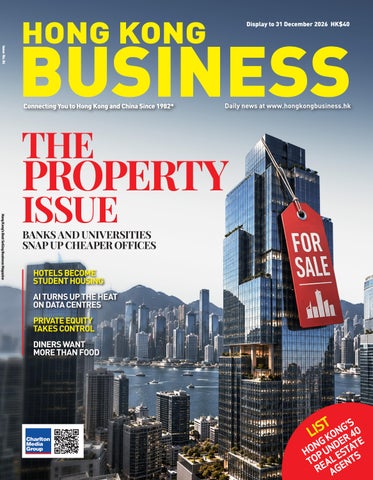
THE
PROPERTY
Hong Kong’s Best Selling Business Magazine
ISSUE
BANKS AND UNIVERSITIES SNAP UP CHEAPER OFFICES HOTELS BECOME STUDENT HOUSING AI TURNS UP THE HEAT ON DATA CENTRES PRIVATE EQUITY TAKES CONTROL DINERS WANT MORE THAN FOOD
T NG’S S I L KO R 40
NG NDE TATE O H P U ES S TO EAL ENT R AG
C2
HONG KONG BUSINESS | Q4 2026
HONG KONG
BUSINESS
FROM THE EDITOR
Established 1982 Editorial Enquiries: Charlton Media Group Hong Kong Ltd Room 1006, 10th Floor, 299 QRC, 287-299 Queen’s Road Central, Hong Kong | +852 3972 7166
B
anks, mainland companies, and universities are buying offices instead of leasing them as lower prices and borrowing costs change the economics of ownership. Our cover story on page 28 looks at how that shift is bringing owner-occupiers back into the market, even as the wider recovery remains uneven.
PUBLISHER & EDITOR-IN-CHIEF Tim Charlton ASSOCIATE PUBLISHER Louis Shek EDITORIAL MANAGER Tessa Distor PRINT PRODUCTION EDITOR Vienna Verzo LEAD JOURNALIST Gwyneth Marie Bejer PRODUCTION TEAM Frances Gagua Alec Maquiling-Cruz Jaleen Ramos Olivia Tirona Sam Bernardo EDITORIAL RESEARCHER Shiena Viene Sur GRAPHIC ARTIST Cathlyn De Raya EDITORIAL ASSISTANT Dylan Afuang COMMERCIAL MEDIA TEAM Jenelle Samantila Dana Cruz Danielle Goh ADVERTISING CONTACTS Louis Shek +852 6099 9768 louis@hongkongbusiness.hk Shairah Lambat shairah@charltonmediamail.com AWARDS Julie Anne Nuñez-Difuntorum awards@charltonmediamail.com ADMINISTRATION Eucel Balala accounts@charltonmediamail.com EDITORIAL editorial@hongkongbusiness.hk
SINGAPORE Charlton Media Group 101 Cecil St. #17-09 Tong Eng Building Singapore 069533 +65 3158 1386 HONG KONG Room 1006, 10th Floor, 299 QRC, 287-299 Queen’s Road Central, Sheung Wan, Hong Kong +852 3972 7166 MIDDLE EAST FDRK4467, Compass Building, Al Shohada Road, AL Hamra Industrial Zone-FZ, Ras Al Khaimah, United Arab Emirates
Read more on page 36.
Elsewhere, investors are finding another use for existing property. Hotels and older commercial buildings are being converted into student accommodation as demand for beds outpaces supply.
The same pressure to rethink familiar models runs beyond property. On page 6, data-centre operators are having to manage higher power and cooling demands as artificial intelligence drives denser computing. Restaurants face a different challenge on page 20, where diners are becoming more selective and full-service operators need stronger reasons for customers to visit. UOB, meanwhile, sees companies moving beyond “China+1” towards “Growth+1”, with Southeast Asia becoming a source of customers and innovation as well as diversification. Turn to page 38 for our interview with CEO George Tung. Behind many of these decisions are the people shaping where capital goes next. On pages 32 to 34, we profile 15 of Hong Kong’s most notable real estate agents under 40. Read on and enjoy!
Tim Charlton
Hong Kong Business is a proud media partner and host of the following events and expos:
www.charltonmedia.com PRINTED BY Gear Printing Limited Flat A, 15/F Sing Teck Fty. Bldg., 44 Wong Chuk Hang Road, Aberdeen, Hong Kong
Can we help? Editorial Enquiries: If you have a story idea or press release, please email our news editor at editorial@hongkongbusiness.hk. To send a personal message to the editor, include the word “Tim” in the subject line. Media Partnerships: Please email editorial@hongkongbusiness.hk with “Partnership” in the subject line. Subscriptions: Please email subscriptions@charltonmedia.com. Hong Kong Business is published by Charlton Media Group. All editorial is copyright and may not be reproduced without consent. Contributions are invited but copies of all work should be kept as Hong Kong Business can accept no responsibility for loss. We will, however, take the gains.
Hong Kong Business is available at the airport lounges or onboard the following airlines:
Sold on newsstands in Hong Kong, Macau, Singapore, London, and New York. *If you’re reading the small print, you may be missing the big picture
HONG KONG BUSINESS | Q4 2026
1
CONTENTS
REAL ESTATE LUMINARIES
MOST NOTABLE REAL ESTATE 32 HK’S AGENTS UNDER 40
CEO INTERVIEW
STORY FIRMS BUY OFFICES AFTER PRICE SLUMP 28 COVER
FIRST 06 AI raises heat on data centres 07 Hong Kong, Singapore take rival paths to bag global gold trade 08 Tech park growth outpaces border rules 09 Startup funding drops 88% to $24.2m in Q3
STARTUP 10 AAL Innovation helps property firms put AI to work
SPACE WATCH 12 Robot takes over safe deposit access
PROPERTY WATCH 14 JW Marriott trims waste across hotel ops
UOB SEES FIRMS SHIFT FROM 38 CHINA+1 TO GROWTH+1
INDUSTRY INSIGHT 16 Guangdong driving scheme faces spending test 18 Opaque rules cloud HKIC property push 20 Restaurants fight for diners beyond the plate 24 Pet-friendly dining may lift core district mall traffic 26 Fraud costs expose insurers’ payments lag
FINANCIAL INSIGHT 22 Private equity firms seek control deals
REAL ESTATE OUTLOOK 36 Investors turn hotels into student housing
Published by CHARLTON MEDIA GROUP PTE LTD SINGAPORE HONG KONG Charlton Media Group Room 1006, 10th Floor, 101 Cecil St. #17-09 299 QRC, 287-299 Tong Eng Building Queen’s Road Central, Singapore Sheung Wan, 2 HONG 2 SINGAPORE KONG BUSINESS BUSINESS | Q4 REVIEW 2026 | MARCH 2018 069533 Hong Kong
MIDDLE EAST FDRK4467, Compass Building, Al Shohada Road, AL Hamra Industrial Zone-FZ, Ras Al Khaimah, United Arab Emirates
INTERVIEW 40 Langham balances brand rules with local fit
ANALYSIS 42 Hong Kong’s clean-power push needs certification
LEGAL BRIEFING 44 China rules tighten outbound deal checks
HR BRIEFING 46 Six-week hiring rule strains Hong Kong restaurants
COMMENTARY 48 Hong Kong hospitality: Momentum and the new lifestyle era
For the latest business news from Asia, visit the website
hongkongbusiness.hk
New for the Most Privilege Categories Offered^ by number of investment product types#
Scan for details
Hang Seng Prestige Remarks: ^According to a survey conducted by Cimigo Limited between 28th May 2026 and 4th June 2026, based on the official websites of the 24 licensed banks incorporated in Hong Kong (excluding digital banks) listed on the Hong Kong Monetary Authority website, Hang Seng Bank Limited ranked No.1 for the Most Privilege Categories Offered among local retail banks in terms of the number of promotion and complementary product/service privilege categories offered. "Privilege categories" refer to the number of non-banking promotion and complementary product/service privilege categories offered to customers with a Total Relationship Balance exceeding HKD 1 million or HKD 8 million. #According to a survey conducted by Cimigo Limited between 19th November 2025 and 9th December 2025, among the 24 licensed banks incorporated in Hong Kong (excluding digital banks) with reference to the list of licensed banks incorporated in Hong Kong published on the official website of the Hong Kong Monetary Authority, Hang Seng Bank Limited offered the No. 1 investment product categories among HONG KONG BUSINESS | Q4 2026 3 local retail banks.
News from hongkongbusiness.hk Daily news from Hong Kong MOST READ
BUILDING & ENGINEERING
AECOM opens Asia headquarters in Cheung Sha Wan AECOM has launched its new Hong Kong office and Asia headquarters at 83 King Lam Street in Cheung Sha Wan. The office, which occupies approximately 126,000 gross square feet across four floors, features an internet-of-things dashboard to provide real-time data on energy consumption and indoor air quality.
FINANCIAL SERVICES
4
HR & EDUCATION
Workers see stricter office norms and weaker pay gains About 60% of Hong Kong employees work five days per week in the office, compared with the global average of 17%, suggesting that the city's workplace environment continues to place a stronger emphasis on in-person attendance. The findings point to a gap between employee expectations and workplace realities.
HOTELS & TOURISM
INSURANCE
Hong Kong insurance premiums jump 32.3% to $291.6b in Q1 2026 The insurance market recorded strong growth in the first quarter of 2026, with total gross premiums rising 32.3% year-on-year (YoY) to $291.6b. The increase was driven mainly by long-term insurance business, where new office premiums, excluding Retirement Scheme business, climbed 51.1% YoY to $141.1b.
HR & EDUCATION
Hang Seng Bank unveils Prestige Club programme
The Landmark reopens with wine, wellness, and wider appeal
Hong Kong hiring shifts to judgement as AI levels applications
Hang Seng Bank is launching “Prestige Club,” a new premium membership programme. Prior Prestige and Prestige Private customers will be automatically enrolled as Prestige Club members. Members are offered privileges and discounts in a range of brands that include Hainan Airlines and China Mobile Hong Kong.
Mandarin Oriental The Landmark, Hong Kong has reopened with refreshed dining, wellness, and social spaces as the luxury hotel targets corporate, leisure and local guests. Michael Groll, general manager at the hotel, said the redesign centres on creating social experiences around coffee, wine, and champagne.
Employers are relying more heavily on interviews and professional judgement as AI makes graduate applications increasingly polished and closely matched to job requirements. Employers are putting greater weight on communication and practical skills as AI makes applications harder to distinguish.
HONG KONG BUSINESS | Q4 2026
HONG KONG BUSINESS | Q4 2026
5
FIRST space for batteries, electrical equipment, and transformers because of their higher power requirements, he said. The concentration of several facilities in one area could add to local heat loads, according to Shipeng Yan, assistant professor of management and strategy at The University of Hong Kong. The government broke ground in March on the Sandy Ridge Data Facility Cluster in the Northern Metropolis. The cluster could consume about 1.75 billion kilowatt-hours of electricity a year, according to a March estimate by The Green Earth Ltd. “Data centre design should also consider physical climate risks,” Yan said. Companies are already preparing for the higher power and cooling demands. For Sandy Ridge, CLP Power Hong Kong Ltd. (CLP Power) has formed a dedicated task force to plan and deliver the electricity infrastructure needed for the cluster, working with data centre operators on their expected power requirements. Data centres already account for more than 7% of CLP Power’s electricity sales, with sales to the sector rising 11.8% yearon-year in the first half of the year.
The Sandy Ridge cluster could consume 1.75 billion kWh a year
AI raises heat on data centres INFORMATION TECHNOLOGY
D
ata centre operators may need to go beyond mandatory energy efficiency requirements as artificial intelligence (AI) increases power consumption and heat in a city warming more than twice as fast as before, analysts said. “The government or data centre owners may consider setting absolute energy, water, and carbon targets, in addition to those for efficiency,” Harry Lai, executive director of the Hong Kong Green Building Council, said. The government extended mandatory energy efficiency requirements to data centres on 20 September, requiring energy audits at least once every five years and disclosure of technical information. Operators will not be required to implement measures identified by those audits, and the government has not set a limit on how efficiently data centres use power. Efficiency measures alone may not show whether facilities are consuming more resources as they expand, Lai said. Hong Kong’s rising temperatures add to the cooling challenge. The city warmed by 0.35°C per decade from 1996 to 2025, more 6
HONG KONG BUSINESS | Q4 2026
than twice the rate recorded over the longer period from 1885 to 2025, according to the Hong Kong Observatory. The first half was also unusually warm, with the average low of 21.5°C the highest recorded for the period and the average high of 26°C the second highest. Traditional air cooling is becoming less suitable for AI systems, which can use up to eight times as much power per server rack as older equipment, said Chris Howard, head of account management for data centres at Jones Lang LaSalle Ltd. (JLL) in the Asia-Pacific region. Operators are shifting to liquid cooling, which removes heat closer to processors, Howard said. Backup systems are needed because temperatures can rise quickly if liquid flow stops, he pointed out. AI systems might also require more floor
Other considerations Ka Wing Tang, director at Equinix Hong Kong Ltd., said its HK6 data centre adjusts cooling automatically based on temperature and computing demand. HK6 also separates hot exhaust air from cooled air and supports direct-to-chip liquid cooling for high-density AI deployments, Tang said in an exclusive interview. More efficient cooling might not offset higher electricity consumption from AI equipment, said Tsang Hon-ki, dean of the Faculty of Engineering at The Chinese University of Hong Kong. “Other considerations could be the carbon footprint for measuring the environmental impact of data centres,” he said. Edwin Lau, founder of The Green Earth, said data centre electricity use rose 75.5% from 2018 to 2023, whilst related carbon emissions increased 35.6% to 922,000 tonnes. Lau said operators should disclose total electricity and water use, emissions, and actual efficiency levels to show whether efficiency gains are keeping pace with expansion. “Transparent data would also open access to green finance for retrofits and enable corporate customers to select higherperforming facilities,” he added.
Transparent data would also open access to green finance for retrofits and enable corporate customers to select higher-performing facilities
FIRST The regulations are almost the same; it’s more about the nature of the market and the perception of risk
Hong Kong’s advantage lies in its connection with China’s bullion market
Hong Kong, Singapore take rival paths to bag global gold trade
H
MARKETS & INVESTING
ong Kong and Singapore are pursuing different strategies to bolster their positions as precious metals hubs, with Singapore expanding clearing and vaulting services for international investors and Hong Kong building on its ties to mainland China’s bullion market. Singapore is viewed as a neutral jurisdiction with established storage facilities and a strong wealth management sector, Dick Poon, general manager at Heraeus Precious Metals Hong Kong, said in an exclusive interview. The general manager said Hong Kong’s advantage lies in its connection with mainland China’s bullion market through its integration with the Shanghai Gold Exchange.
Singapore’s strategy gathered pace in June when Deputy Prime Minister and Monetary Authority of Singapore Chairman Gan Kim Yong announced at the Asia-Pacific Precious Metals Conference that Singapore Exchange Ltd. would launch an over-the-counter clearing system for Loco Singapore gold by the end of 2026. The system will clear physical gold stored and settled in Singapore and will be backed by DBS Bank Ltd., Deutsche Bank AG, ICBC Standard Bank Plc, JPMorgan Chase & Co., Oversea-Chinese Banking Corp. Ltd., and United Overseas Bank Ltd. Gan also said the Monetary Authority of Singapore would begin offering gold vaulting services to foreign central banks and sovereign
Joshua Rotbart
entities from October 2026. Singapore will remove the 5% cap on physical investment precious metals under selected tax incentive schemes for eligible funds and single-family offices, whilst Singapore Exchange is studying a physically deliverable gold futures contract. Joshua Rotbart, founder of J. Rotbart & Co., said regulations are no longer the main factor separating Singapore and Hong Kong. “The regulations are almost the same,” he told Hong Kong Business in an interview. “It’s more about the nature of the market and the perception of risk.” He said investors typically choose Singapore for long-term gold storage and wealth preservation, whilst Hong Kong has developed into a trading centre serving mainland China. Singapore’s latest measures build on work launched in March, when the Monetary Authority of Singapore and the Singapore Bullion Market Association formed the Gold Market Development Working Group to review clearing, settlement, storage, logistics, custody, and investment products. Hong Kong has also stepped up efforts this year, but with a stronger focus on the mainland. The Financial Services and the Treasury Bureau (FSTB) signed a cooperation agreement with the Shanghai Gold Exchange in January to develop a gold central clearing system and deepen cooperation between the two markets.
THE CHARTIST: BRANDS FACE TRUST CRISIS AS 61% OF CONSUMERS WALK AWAY
C
onsumers are quick to drop brands and organisations they no longer believe in, with 61% saying they stopped engaging with or purchasing from a brand in the past year due to a lack of belief in its claims, according to a study by Ogilvy and YouGov. The study found that 94% of respondents take punitive action once they doubt a brand or organisation, slightly below the Asia-Pacific average of 96%. Silent disengagement emerged as the biggest commercial risk. About 89% of Hong Kong consumers said they would quietly walk away from a brand, including 46% who would stop purchasing altogether and 32% who would switch to a competitor. Consumers cited poor delivery and ethics as the top reasons for losing belief. About 34% said they disengaged because products or
services failed to deliver what was promised, whilst 29% cited poor handling of issues or mistakes. Another 27% pointed to poor business ethics. Communication missteps also affected trust, with 25% saying exaggerated or misleading communications caused them to disengage, whilst 24% said they walked away when a brand was unresponsive to concerns. The study found that credibility matters more than polished content in shaping belief. Around 76% said they rely on credibility-related influences such as trusted or multiple sources, whilst 62% rely on whether information aligns with their own knowledge or experience. Mainstream media and official brand channels remained the strongest trust-building channels. About 58% of Hong Kong respondents said mainstream media increases their belief in brands, whilst 50% said the same for official brand
Top believability attribute in APAC
Source: Ogilvy Believability Index 2026: The Power of Proof
HONG KONG BUSINESS | Q4 2026
7
FIRST GOV’T TOLD TO BUILD NIGHT-TIME ATTRACTIONS LEISURE & ENTERTAINMENT
T
he redeveloped Huanggang Port will make it easier for Shenzhen residents to come south at night, but also for local consumers to head north for shopping and dining. That could force businesses to build a stronger “night brand” around food, entertainment, and mega-events to keep more spending on this side of the border. “Organisers of major exhibitions, concerts, and cultural events are positioned to capture Shenzhen’s vast consumer base,” Chi Sum Li, head of government and public sector in Hong Kong at KPMG China, said in an exclusive interview. Higher visitor traffic could support catering, local transport, event production, and logistics, Li said. Hong Kong should use its food, entertainment, and event offerings to attract more Shenzhen residents travelling through the crossing, the KPMG leader added. The redeveloped Huanggang Port in Shenzhen’s Futian district is expected to handle about 200,000 passenger trips daily when it opens. Hong Kong and Shenzhen conducted large-scale stress tests in August ahead of the launch. The Hong Kong government said daily passenger trips could rise to about 300,000 after the Northern Link Spur Line is commissioned. Stronger competition Retailers could face stronger competition as Shenzhen’s shopping and dining options become easier for Hong Kong residents to access, Hong Kong General Chamber of Commerce CEO Patrick Yeung told Hong Kong Business. “The opening of the redeveloped port should be viewed through the lens of market expansion, not simply competition,” Yeung said. Businesses should adopt cross-border payment tools, improve customer platforms, and explore partnerships and customer segments in Shenzhen and the wider Greater Bay Area, he said. 8
HONG KONG BUSINESS | Q4 2026
Over 90 tech firms have agreed to establish a presence at the park
Tech park growth outpaces border rules COMMERCIAL PROPERTY
T
he Hong Kong-Shenzhen Innovation and Technology Park is moving towards full operations, but the cross-border rules needed to move researchers, equipment, data, and biological samples are still being finalised. Clear rules for data transfers, visas, and the movement of biological samples are needed to make crossborder research work smoothly, Wilson Chow, global technology, media, and telecommunications industry leader and China AI leader at PwC China, told Hong Kong Business. Higher rents and salaries in Hong Kong than in Shenzhen and other Greater Bay Area cities could also deter early-stage startups and companies from setting up in the park, he said. The park opened in December 2025 as Hong Kong’s part of a joint development with Shenzhen designed to support research, testing, and pilot production before largerscale manufacturing elsewhere in the Greater Bay Area. Two laboratories for life and health technology research and a 100-unit residence are in use, whilst five more
Vincent Ma
Wilson Chow
buildings are due for completion this year, said Vincent Ma, CEO at Hong Kong-Shenzhen Innovation and Technology Park Ltd. Ma said Hong Kong and mainland authorities are working to preapprove eligible technology workers and speed clearance for research materials and equipment. “Measures under discussion include green-lane arrangements, participatingenterprise whitelists, dedicated lists, and end-to-end monitoring,” he said. The Western Cross-River Link Bridge, which will connect the Hong Kong and Shenzhen sections, began construction in December and is expected to be completed before mid2027, Ma told the magazine. Kenny Shui, vice-president at Our Hong Kong Foundation, said the park’s progress depends on how quickly these arrangements are put in place. Detailed mechanisms for moving data and biological samples across the border are still being finalised, he added. The five remaining buildings are expected to shift the park’s focus in 2027 towards tenant move-ins and full operations, Ma said. Outlook More than 90 technology companies have agreed to establish a presence at the park. About half are from mainland China, one-third from Hong Kong and 15% from overseas markets. About 70% are startups, whilst nearly half are entering Hong Kong for the first time. Rosanna Tang, deputy managing director and head of research for Hong Kong at Cushman & Wakefield Plc, said the park would need to connect with the wider Northern Metropolis and use Hong Kong’s strengths in intellectualproperty protection, capital and data flows, and international connections. She said life sciences, artificial intelligence, and data science are likely to drive near-term demand, but occupancy should not be the only measure of the park’s performance. Longer-term measures should include talent and investment attracted, cross-border research, and economic value generated for Hong Kong and the Greater Bay Area. Ma said patents, licensing, corporate research spending, customer acquisition, and expansion into overseas markets would also show whether companies are gaining commercial value from the park.
FIRST NUMBERS
STARTUP FUNDING DROPS 88% TO $24.2M IN Q3
Note: 1. All currencies are in USD 2. We have only considered equity rounds and tech companies. 3. Q3-2026 is considered from 01-Jul-2026 to 26-Aug-2026
Source: Tracxn
HONG KONG BUSINESS | Q4 2026
9
STARTUP AAL INNOVATION HELPS PROPERTY FIRMS PUT AI TO WORK BUILDING & ENGINEERING
RedotPay puts stablecoins on payment cards
A
FINANCIAL SERVICES
Adeline Chan, CEO and co-founder at AAL Innovation
P
roperty firms are rushing to adopt artificial intelligence (AI), but many still do not know which parts of their business are ready for it or where the technology can actually improve daily work. AAL Innovation Ltd. is targeting that gap by assessing companies’ AI readiness and matching them with existing tools or building customised applications and workflows when off-the-shelf products fall short. The startup draws on a database of about 200 industry use cases and available AI solutions to identify where the technology can be applied. “If a property developer wants to use AI for masterplan feasibility studies, we can provide an AI design service or build an in-house platform, CEO and co-founder Adeline Chan told Hong Kong Business. Meanwhile, the firm can guide clients towards existing solutions and connect them with the relevant providers. AAL also trains employees to use AI in their daily workflows. It launched a monthly webinar series on 30 June covering AI, policy, and technology developments affecting the real estate and construction sectors. The company also provides AI-assisted architectural and property marketing services, including visualisations, renderings, and walkthrough videos. Expansion plans Chan said AAL plans to document more client cases over the next five years whilst exploring areas such as robotics. The startup also plans to expand across Southeast Asia, targeting Singapore, the Philippines, and Malaysia. Hong Kong’s proximity to Shenzhen and the Greater Bay Area gives the startup access to AI technologies developed in mainland China, she added. AAL is already pursuing business outside the region, with Africa amongst its target markets. Chan said European investor groups have also expressed interest in the company. The startup signed a memorandum of understanding with the Kenya Institute for Public Policy Research and Analysis in March to support AI policy, government training, and AI applications in public infrastructure and urban planning. Chan declined to disclose funding figures but said AAL remains fully bootstrapped despite receiving investment offers. “At this moment, we do not need any external investment,” she told the magazine. AAL would consider outside funding if it identifies a specific problem that could not be addressed by existing off-the-shelf tools and could be developed into a scalable product, she continued. 10
HONG KONG BUSINESS | Q4 2026
stablecoin balance on RedotPay can be spent through a payment card at more than 130 million merchants globally, giving Taylor Bossung, head of users a way to use digital assets for corporate affairs at RedotPay everyday transactions rather than simply hold them. Red Dot Technology Ltd. (RedotPay) balance almost instantly, Bossung said. is using that network to expand crossRedotPay Connect, launched in June border payments and remittances 2026, also allows businesses to accept across more than 100 markets, stablecoin payments and receive funds in targeting users with limited access to either local currency or digital assets. international payment services. Founded in 2023, RedotPay is Traditional remittance channels continuing to develop its card products in Asia-Pacific cost 5% to 15% of the and licensing operations as it expands amount sent in the first quarter of 2025 internationally. and could take several days to process, The startup has raised about $1.5b according to the Asian Development (US$194m) across multiple funding Bank. Digital remittances cost about rounds, including $314m (US$40m) 3.6% and are processed in real time. in Series A funding and $840m “The founders saw that crypto had (US$107m) in Series B funding in matured as an asset class, but everyday 2025. It earns revenue from transaction usability, especially for payments and fees, card-related revenue, as well as remittances, lagged,” Taylor Bossung, value-added services. head of corporate affairs at RedotPay, Its cards are accepted in markets told Hong Kong Business. including Brazil, Mexico, Argentina, Users can deposit stablecoins and and Colombia. RedotPay also secured other digital assets into the RedotPay app, a money service business registration link them to a virtual or physical card, in Canada in March to support localand spend or send money from their currency payments and e-wallet services.
AcousPrint pinpoints pipe leaks via sound BUILDING & ENGINEERING
A
cousPrint Technologies Ltd. is developing a portable ultrasonic tool to pinpoint leaks in ageing water pipes, targeting housing estates, utilities, and other network operators. “Hong Kong’s water loss rate is quite high, with about 30% of supply unaccounted for,” Kin Lau, CTO at AcousPrint, told Hong Kong Business. The startup’s prototype detects brief sound patterns produced by leaking pipes and uses them to locate the damaged section, Lau said. Each sound pattern lasts about 0.001 second. The tool can find leaks from about two or three metres away, Lau said. “We try to help the Water Supplies Department and housing estates locate leaks in their utility services,” he said. “Even from a distance of about two or three metres away, we are still able to locate it.” Hong Kong’s government said in May that the water pipe network’s leakage rate
fell to about 12.8% in 2025 from 13.4% in 2024. The government aims to reduce the rate below 10% by 2030. AcousPrint, established in 2024, plans to turn the prototype into a commercial product within two years. Engineers and maintenance teams will be able to operate the tool without specialist assistance, Lau said. The platform is being used in residential estate projects in Hong Kong, whilst the startup has received enquiries from overseas markets, particularly Singapore. “It is still at quite an initial phase,” Lau told the magazine.
HONG KONG BUSINESS | Q4 2026
11
SPACE WATCH
Robot takes over safe deposit access It serves more than 1,600 boxes at Kennedy Town branch. FINANCIAL SERVICES
S
hanghai Commercial Bank Ltd.’s West Point Branch in Kennedy Town combines automated safe deposit box retrieval, private wealth facilities, and sustainability-focused interiors across more than 7,000 square feet of usable floor area. Located on Catchick Street, the branch houses more than 1,600 safe deposit boxes of different sizes. A robotic system retrieves boxes from the vault and delivers them directly to a private customer room. After identity verification at the service counter, customers receive a one-time QR code to enter the room. A robotic arm then retrieves the assigned box, including heavier units stored on higher levels, without
requiring customers to enter the vault or carry the boxes themselves. The first floor houses a Wealth Management Centre designed around private meeting rooms rather than open banking counters. Dedicated relationship managers operate from the space, whilst a separate VIP area and consultation rooms provide additional privacy for wealth management discussions. The branch interior uses recycled terrazzo, certified quartz flooring, wood veneers, and recyclable vinyl flooring. Carpet materials installed during the refurbishment were equivalent to diverting 168,050 plastic bottles from landfill. Other sustainability features
The branch has more than 7,000 sq. ft. of usable floor area
Tony Wan
It has over 1,600 safe deposit boxes of different sizes
The West Point Branch uses recycled terrazzo, certified quartz flooring, wood veneers, and recyclable vinyl flooring
12
HONG KONG BUSINESS | Q4 2026
include intelligent temperature controls and energy-saving LED lighting, whilst the branch is pursuing LEED Gold certification. Tony Wan, managing director and head of segments and retail, told Hong Kong Business that similar environmental upgrades could be considered for other branches. The automated safe deposit box system remains relatively new in Hong Kong. Wan said its higher upfront cost and longer payback period could limit wider adoption in the near term. Shanghai Commercial Bank did not disclose the renovation cost or a financial return target.
HONG KONG BUSINESS | Q4 2026
13
PROPERTY WATCH
JW Marriott trims waste across hotel ops Energy-efficient lighting, water-saving landscaping, and paperless services cut resource use.
J
HOTELS & TOURISM
W Marriott Hotel Hong Kong in Admiralty is expanding sustainability measures across its leisure, dining, guestrooms, and event spaces, including energy-efficient lighting, water-saving landscaping, and paperless guest services. The hotel’s Level 7 leisure and social spaces use energyefficient lighting and native, drought-resistant plants to reduce watering needs, General Manager GP Yeow told Hong Kong Business in an interview. The floor includes a heated outdoor pool, landscaped wellness areas, an herb
GP Yeow
garden, Fish Bar seafood restaurant, and indoor and open-air event spaces overlooking Victoria Harbour. Guests can join weekend yoga sessions or use a meditation space, whilst the landscaping is designed to reduce water consumption, Yeow said. Fish Bar also uses responsibly sourced timber for its furniture and serves an upcycled dish called Fish Bone Fettuccine. The hotel received Leadership in Energy and Environmental Design (LEED) Gold certification for operations and maintenance in June.
2
1
Marriott Hotel 1 JW Hong Kong earned LEED Gold certification for operations and maintenance in June.
guestrooms 2 Its feature wraparound windows that provide natural light and views of Victoria Harbour.
4
3
hotel uses 3 The digital signage, QR code menus, and other paper-saving measures for events.
4 Filtered-water dispensers in public areas help reduce the hotel’s reliance on single-use plastic bottles.
5
6
hotel features 5 The an herb garden and plants that can survive with little to no water.
6 Level 7 includes a
heated outdoor pool alongside landscaped wellness and social spaces.
14
HONG KONG BUSINESS | Q4 2026
HONG KONG BUSINESS | Q4 2026
15
INDUSTRY INSIGHT: TRANSPORT & LOGISTICS
About 8,400 applications for urban-area entry had been approved as of the end of May
Guangdong driving scheme faces spending test
Economists say longer stays matter more than higher arrival numbers. TRANSPORT & LOGISTICS
M
ore Guangdong motorists will soon be able to drive directly into the city, but easier access will matter only if it turns day trips into longer stays and higher spending, according to economists. “It is supportive, but it’s not necessarily a game-changer in really reversing all the pressure that we see right now,” Gary Ng, a senior economist for Asia-Pacific at Natixis CIB, told Hong Kong Business. The expanded Southbound Travel for Guangdong Vehicles Scheme allows eligible private vehicles registered in Guangdong to enter Hong Kong under a quota system. The latest expansion adds Shenzhen, Foshan, Dongguan, Huizhou, and Zhaoqing to the existing coverage of Guangzhou, Zhuhai, Zhongshan, as well as Jiangmen, bringing the scheme to all nine mainland cities in the Greater Bay Area. 16
HONG KONG BUSINESS | Q4 2026
Gary Ng
Simon Lee Siu-po
About 8,400 applications for urbanarea entry had been approved as of the end of May, with about 6,700 travel bookings recorded, Hong Kong’s Transport and Logistics Bureau said in an exclusive interview. Applications rose to 15,000 in July, exceeding the available quota, after bookings during the Labour Day Golden Week holiday were oversubscribed by two to three times. From 25 July, the daily quota for vehicles entering Hong Kong’s urban areas will double to 200. Eligible vehicles from the five newly added cities can also enter via the Hong Kong-Zhuhai-Macao Bridge. Meanwhile, the Transport Department in August announced plans to use artificial intelligence to process applications under the scheme by year-end, targeting automatic approval of more than half of crossboundary driving permit applications. In addition to these measures, the
authorities will introduce a “Park & Visit” service allowing approved Guangdong vehicles to remain in Hong Kong for as long as three days. The bureau said the programme gives mainland residents a more convenient option to visit Hong Kong for tourism, business, exhibitions, concerts, and airport transfers. It also wants hotels, retailers, and tourism operators to offer accommodation, shopping, and parking packages to attract more overnight visitors. Ng said Hong Kong’s retail sector remains under pressure as more residents travel overseas and to mainland China for shopping, whilst mainland visitors are also spending less than before the pandemic. “They are not spending as much as before,” he told the magazine. Simon Lee Siu-po, an economist and part-time senior lecturer at the Chinese University of Hong Kong’s Shenzhen Finance Institute, said the expansion could increase same-day visitor numbers by 5% to 10%. But any increase in overall spending would likely come from higher visitor volumes rather than increased spending per traveller, he pointed out. Policy’s success Lee said average visitor spending has declined since the pandemic because more mainland tourists are making day trips instead of staying overnight. As a result, overnight stays and average spending per visitor are better measures of the scheme’s success than arrival numbers, he added. Meanwhile, Ng told the magazine that the policy’s success should be measured by whether visitors stay longer rather than simply make more cross-border trips. According to Lee, financial services, including cross-border wealth management, investment, and insurance, as well as transportation, could benefit from stronger cross-border travel. Ng added that visitors arriving by private vehicle might also explore attractions beyond Hong Kong’s traditional shopping districts, helping broaden tourism spending. Hong Kong and Guangdong authorities plan to extend the programme to all 21 Guangdong cities by the first quarter of 2027.
HONG KONG BUSINESS | Q4 2026
17
INDUSTRY INSIGHT: COMMERCIAL PROPERTY
Opaque rules cloud HKIC property push Core office vacancy could fall below 6% by 2030.
T
COMMERCIAL PROPERTY
he government’s plan to channel global private capital into commercial property through the Hong Kong Investment Corporation (HKIC) is drawing concern over transparency, with analysts warning that unclear project selection rules could weaken investor confidence. “We are not really seeing any comparable transparency, and if you have to compare this model with the traditional land tender process, the latter is basically more open,” Jack Tong, director of research and consultancy at Savills Hong Kong, told Hong Kong Business. The director said HKIC operates under a discretionary disclosure model, announcing partnerships only when projects reach a certain stage of maturity. “The HKIC will collaborate with regional and international long-term capital to channel funds into quality commercial property projects that align with Hong Kong’s industrial positioning and match them with enterprises from target industries,” the company said. It declined to answer further questions. Falling vacancy The concern comes as Hong Kong’s office market shows signs of tightening after years of oversupply. Tong said Grade A vacancy in core districts is already falling, with Central rents rising more than 5% in the first quarter. He expects the overall vacancy to drop below 6% in three to four years. HKIC evaluates projects based on industrial alignment, partner track record, and expected returns, but the specific standards behind those assessments have not been disclosed, Tong told the magazine. He said some developments could later be framed as aligned with industrial policy based mainly on tenant mix rather than a clear planning strategy. HKIC’s portfolio includes more than 109 companies across sectors, including hard technology, life sciences, and green technology, with 10 already listed in Hong Kong. 18
HONG KONG BUSINESS | Q4 2026
City University bought the entire Festival Walk office tower for $1.9b in late 2025
If the government is still only seeing selective recovery, then we may very well see a supply crunch in the next three to four years
Hannah Jeong
Tong said the corporation might identify properties with suitable tenants already in place before positioning them as aligned with government priorities. “They would just go out and find a partner and invest in those properties,” he said. Hannah Jeong, head of valuation and advisory services at CBRE Hong Kong, said the government has yet to publish a detailed execution plan following the February budget announcement. “The Development Bureau’s master planning role remained broadly defined and the overall approach highly conceptual,” she said. Both analysts said uncertainty over what qualifies as an industry-aligned project adds to governance concerns. According to Jeong, likely targets include industrial parks in the Northern Metropolis focused on biotech and fintech. Tong said HKIC is unlikely to develop projects directly and would instead partner with developers to secure anchor tenants for commercial projects in the Northern Metropolis. He added that universities could become key partners, citing the University of Hong Kong’s acquisition of an office tower in
Tseung Kwan O for more than $4b, and City University’s purchase of the entire Festival Walk office tower for $1.9b late last year. Tong warned that institutional investors accustomed to stricter governance frameworks might view the process as too opaque. Jeong added that Hong Kong also faces stronger regional competition for long-term capital, with rival jurisdictions offering tax breaks, housing support, and relocation incentives alongside property opportunities. “That cannot simply rely on land prices anymore,” she said. Both analysts said the next budget cycle would be critical for the commercial property market. Tong said lifting the moratorium on commercial land sales too late could trigger a supply shortage within several years if demand continues to recover. “If the government is still only seeing selective recovery—same time next year maybe in one or two districts, but still with an overall vacancy rate of around 12% to 15%—and decides against lifting the moratorium, then we may very well see a supply crunch in the next three to four years,” he added.
MEMBER OF NASDAQ LISTED COMPANY: AXG
Leading Stablecoin Issuance and Infrastructure Provider for MEA AX Coin Bahrain BSC Closed is licensed by the Central Bank of Bahrain as a Stablecoin Issuer
(Scan for More) HONG KONG BUSINESS | Q4 2026
19
INDUSTRY INSIGHT: FOOD & BEVERAGE
Restaurants fight for diners beyond the plate They want a story on the plate, not just protein and starch.
D
FOOD & BEVERAGE
iners in Hong Kong are becoming more selective about where they spend, putting pressure on restaurants that offer neither low-cost convenience nor a distinctive experience. Whilst 39% of consumers plan to increase dining spending over the next two years, 26% expect to cut back on full-service restaurants, meaning operators need a stronger reason to draw diners in for less frequent but higher-value visits. Nearly 70% ranked dining out amongst their top spending categories. “The greatest pressure will be on operators caught in the undifferentiated middle — those that offer neither genuine price accessibility nor meaningful experiential depth,” Hugo Texier, a partner at Roland Berger Southeast Asia, told Hong Kong Business. At Indian restaurant Leela, diners ask about the origins of spices and the inspiration behind Hong Konginfluenced dishes such as tandoori eel and lamb keema ham sui gok. Owner Manav Tuli said Leela
Manav Tuli
Malcolm Wood
June Lau
builds on that curiosity through tableside finishing, chef storytelling and smaller tasting menus. “Diners are no longer just hungry,” Tuli said in an interview. “They want a story on the plate, not just protein and starch.” According to Texier, quality drives 58% of food purchase decisions. Restaurants therefore require a clear identity, a credible food offering, and a compelling reason to visit before investing heavily in design or technology. Maximal Concepts Ltd. cofounder Malcolm Wood said many restaurants mistake gimmicks for memorable experiences. “Putting a DJ in the corner doesn’t make you experiential; it just makes you louder,” he said. “Being truly experience-led means every touchpoint—the greeting, pacing, plate, lighting, and exit—is designed.” June Lau, a senior analyst at Euromonitor International Ltd., said ambience and the overall dining environment increasingly influence spending decisions.
Nearly 70% of Hong Kong consumers ranked dining out amongst their top spending categories
20
HONG KONG BUSINESS | Q4 2026
“In many cases, the emotional experience and social returns such as enjoyment, relaxation, or shareability are just as important as the food itself,” she told Hong Kong Business. Lau said growth is likely to split between affordable, convenienceled formats and higher-value experiential dining. Euromonitor found that 61% of Hong Kong consumers order food for delivery or takeaway weekly, up from 58% in 2025. Another 24% expect to cut back on cafés. “It reflects a shift towards more intentional consumption, where consumers are choosing to engage with these formats less frequently, but with higher expectations,” Lau said. Individuality over standardisation Lau pointed to guest-chef collaborations, tasting sessions, and community events as ways to encourage repeat visits. And instead of spending heavily on décor, Tuli said restaurants should make food preparation more visible through open kitchens and chef counters. Texier also recommended dedicated collection areas, noting that 72% of consumers value spaces that let them enter and leave quickly. Large chains also need to adapt, he pointed out, adding that they should use their scale to deliver consistent quality whilst making experiences more relevant to local consumers. Texier said about 44% of diners favour individuality over standardisation, although 41% remain open to trusted brands when quality credentials are clear. “Their traditional strengths — scale, reliability, and consistency — remain useful, but are no longer sufficient on their own in a market where consumers increasingly value individuality and experience,” he said. Gerald Li, co-founder of Leading Nation HK Ltd., said mid-sized operators should focus on what differentiates them rather than copying larger competitors. “You should define, not replicate,” he said in a WhatsApp call. Li cited The Diplomat, part of the group’s portfolio, as an example, noting that it has kept the same burger recipe for more than six years. “Success does not come from chasing trends,” he said. “It comes from consistency.”
怎樣令幸福 可以不斷延續?
我們全面的健康保障, 讓你與摯愛創造更多幸福時光, 更好是用陪伴不斷延續愛。 了解更多
HONG KONG BUSINESS | Q4 2026
21
FINANCIAL INSIGHT: PRIVATE EQUITY
Private equity firms seek control deals Buyout transactions hit $165.4b this year, double the value of growth investments.
H
MARKETS & INVESTING
ong Kong private equity firms are pursuing more buyouts and controlling stakes as pressure grows to return cash to fund investors after several years of slower exits across Asian private markets. Managers are increasingly looking for businesses they can improve rather than relying on higher valuations to generate returns, Yuki Ishida, director and group CEO at YCP Holdings (Global) Ltd., said in an exclusive interview. Hong Kong-based private equity funds have raised $135.6b (US$17.3b) across three buyout funds in 2026, with EQT AB’s BPEA Private Equity Fund IX accounting for $122.3b (US$15.6b), Melanie Tng, an analyst for Asia-Pacific private capital at PitchBook Data, Inc., told the magazine. Private equity investors have participated in $165.5b (US$21.1b) of buyout transactions this year, compared with $80.8b (US$10.3b) of growth investments, she said. Firms are focusing more on acquiring controlling stakes in mid-sized companies and expanding them through acquisitions, according to Ishida. Recent deals reflect the trend. Funds managed by Boyu Capital Investment Management Co. Ltd. acquired a 60% stake in Starbucks Corporation’s China retail business in April in a deal that valued the business at about $31.4b (US$4b). Templewater Hong Kong Ltd. has also expanded its healthcare platform through acquisitions, including The Women’s Clinic Group Ltd. and Ascensus Health Group Pte. Ltd. Investors are placing greater emphasis on receiving cash distributions after a prolonged slowdown in exits across the region, Tng said. Business-to-business companies have attracted $90.2b (US$11.5b) from private equity investors this year, whilst information technology companies drew $76b
The transactions point to selective investor confidence
DEAL #1: FUNDS MANAGED BY BOYU CAPITAL INVESTMENT MANAGEMENT ACQUIRED A 60% STAKE IN STARBUCKS CORPORATION’S RETAIL BUSINESS, VALUING THE BUSINESS AT ABOUT $31.4B
22
HONG KONG BUSINESS | Q4 2026
(US$9.7b), the analyst added. Ishida said data centres and semiconductor companies remain attractive as artificial intelligence (AI) drives demand for computing power. Henry Chui, head of private wealth for Asia-Pacific at Partners Group Holding AG, said the firm has become more cautious on data centres as valuations rise. “Instead, we focus on adjacent areas of infrastructure,” he said in a separate interview, citing power generation and storage. “Power usage in the US is expected to increase significantly compared with the last 20 years as the data centre build-out continues.” ‘Selective investor confidence’ Private equity firms are also participating in later-stage funding rounds for tech companies that have already attracted customers, particularly in financial services and AI, Neha Singh, chairperson and managing director at Tracxn Technologies Ltd., told Hong Kong Business. She cited August Robotics Ltd.’s $235.3m (US$30m) Series B funding round for construction robotics used in datacentre development and Grace Investment Machine Ltd.’s $156.8m (US$20m) Series A funding round for software used in investment and capital markets. Investors remain selective, however. PitchBook recorded 14 private equity deals in Hong Kong in the first half, unchanged from a year earlier, whilst estimated deal value fell to about $18b (US$2.3b) from $22.7b (US$2.9b), Tng said. “The largest transactions in the first half ranged from minority growth investment to a corporate divestiture and an add-on acquisition,” she said. “The transactions point to selective investor confidence.”
DEAL #2: TEMPLEWATER HONG KONG HAS ALSO EXPANDED ITS HEALTHCARE PLATFORM THROUGH ACQUISITIONS INCLUDING THE WOMEN’S CLINIC GROUP
Now Health International (Asia Pcific) Limited, Unit 3301A, 33/F, AIA Tower, 183 Electric Road, North Point, Hong Kong.
HONG KONG BUSINESS | Q4 2026
23
INDUSTRY INSIGHT: RETAIL
The government accepted applications in May to let up to 1,000 venues admit dogs
Pet-friendly dining may lift core district mall traffic Weekend spending is seen to benefit central districts over suburban malls.
C RETAIL
ore district malls are more likely to see a boost in weekend footfall than suburban centres as the city relaxes rules on pet-friendly dining. “Overall, we think it will have a very positive impact on footfall,” Philip Lam, director of retail at Savills (Hong Kong) Ltd., told Hong Kong Business. The government began accepting applications on 18 May for licences letting restaurants admit dogs under a programme covering as many as 1,000 venues, with initial approvals rolled out in July. Lam said the policy could help retain weekend spending that has been flowing to mainland China, particularly Shenzhen, as Hong Kong residents increasingly travel north on weekends. He added that core district malls, rather than suburban lifestyle centres, are better placed to benefit because of their existing food and beverage density and infrastructure. Kathy Lee, head of research 24
HONG KONG BUSINESS | Q4 2026
Kathy Lee
Philip Lam
and retail consultancy at Colliers International (Hong Kong) Ltd., told the magazine that pet ownership has expanded across demographic groups, supporting demand for malls that cater to pet owners. “The pet owner population in Hong Kong has been growing,” she said in a separate interview, adding that many pet owners now visit malls weekly. She said dining with pets has become an important part of lifestyle consumption, alongside broader leisure and retail experiences. Pet owners are frequent mall visitors in Hong Kong, with 64% visiting at least once a week during weekends, according to a June 2026 YouGov report. Hong Kong has an estimated 1.2 million pets, with 47% of residents identified as pet owners. On weekdays, 56% of pet owners visit malls at least once a week. Spending is also significant, with 80% spending at least $200 (US$25.50) per mall visit. Some 45% spend $200 to $699 (US$89.10),
whilst 14% spend $700 (US$89.25) to $999 (US$127.37). Pet owners also spend time in malls, with 33% staying for one to two hours and 29% for two to three hours. Another 8% stay for more than three hours. Restaurants and food courts are the top destination, cited by 34% of pet owners during mall visits. However, both retail consultants said allowing pets into restaurants alone would not be enough to drive long-term differentiation. According to Lee, successful malls need outdoor spaces and supporting services such as pet retail zones, activity areas, and photo-friendly installations. Lam said casual dining formats such as cafés and bakeries are likely to benefit most, whilst barbecue and hotpot operators may be less willing to participate due to hygiene constraints. The director of retail also cited structural constraints in dense urban areas, including transport and parking access for pet owners. Developers, he added, are already adjusting projects with larger terraces, balconies, and outdoor communal spaces to capture the trend. Experiential retail Still, operational challenges remain, particularly around hygiene management and balancing customers with and without pets. Lee said malls might need separate zones or clearer segmentation to manage differing customer preferences. Meanwhile, Lam said operators need stricter cleaning protocols and clearer rules to avoid friction between customer groups. “With letting pets inside restaurants, especially for shopping malls, they would increase their dwell time within the development,” he said. “And when you spend more time, the likelihood of you spending on other things will be higher.” Despite the constraints, he said the policy supports broader shifts towards experiential retail and longer dwell times in malls. “Letting pets inside restaurants… would increase [customer] dwell time,” Lam said, adding that longer stays tend to support higher spending. Lee added that operators should consider a broader range of pets beyond dogs given the growing diversity of pet ownership in Hong Kong, including cats.
HONG KONG BUSINESS | Q4 2026
25
INDUSTRY INSIGHT: INSURANCE
Fraud costs expose insurers’ payments lag Cheques and manual work persist as fraud costs reach up to 5% of revenue.
I
INSURANCE
nsurers risk losing customers to digital-first rivals unless they modernise ageing technology that slows service, weakens fraud detection, and limits automation. “Progress has been good, but it’s been uneven amongst the different insurers,” Todd McGregor, market lead for Asia-Pacific and India, the Middle East, and Africa at Celent LLC, told Hong Kong Business. “The leading insurers, their onboarding process, their servicing and claims experiences have been markedly improving... but many of them are still falling short in terms of customer expectations for real-time interactions,” he said. Adyen N.V. in a report said 41% of Hong Kong consumers prioritise customer experience when dealing with insurers, comparing them not only with other insurers but also with digital services. According to Kai Tang, head of Adyen Hong Kong, Gen Z customers expect insurers to deliver the same mobile experience as e-commerce and ride-hailing apps. “They expect the same across different industries,” he said in a separate interview. “It’s no longer just a case of the product they’re selling, but it’s really about the experience.” Core systems Fraud is also becoming more costly. Adyen found 74% of Hong Kong insurers estimate fraud costs them as much as 5% of annual revenue, whilst 55% said outdated payment systems limit their ability to detect fraud effectively. More than half still dedicate resources to manual processing, and 96% continue to use cheques for certain payments. Half of insurers surveyed identified growing consumer demand for instant and seamless experiences as a key competitive challenge over the next five years. McGregor said many insurers are trying to improve digital services without replacing their ageing core systems. He said organisations are increasingly choosing to keep their core systems and add an 26
HONG KONG BUSINESS | Q4 2026
Nine in 10 millennials would accept two-factor authentication if it resulted in a faster experience
If you’re sitting on a 10-year-old core system, then anything you try and do of a sophisticated nature digitally is just difficult
Kai Tang
Todd McGregor
orchestration layer that links them together instead of undertaking large-scale system replacements. He added that core systems remain the biggest obstacle because they support underwriting, claims, policy administration, distribution, and customer service. “If you’re sitting on a 10-year-old core system, then anything you try and do of a sophisticated nature digitally is just difficult,” McGregor told the magazine. The industry’s priorities align with findings from Deloitte LLP’s 2026 Global Insurance Outlook, which identified core system upgrades and artificial intelligence (AI) adoption as leading investment areas to improve efficiency and growth. McGregor said insurers have historically invested less than banks in customer-facing technology, but that is beginning to change. “The best insurers have spent time, effort, and money on digitising the onboarding and servicing journeys,” he said, citing self-service tools, mobile services, AI-assisted support, and simpler claims processing. According to Tang, automation could also reduce fraud and speed up claim reviews. Adyen found 92% of millennials
would accept two-factor authentication if it resulted in a faster experience, whilst 54% of insurers expect to introduce tools that track customer interactions across the entire insurance process and application programming interface integrations by 2030. McGregor believes insurance will become more deeply integrated into broader financial ecosystems, enabled by AI-powered personal agents capable of managing financial relationships on behalf of consumers. Tang told Hong Kong Business that successful insurers over the next five years will be those that unify payments, data, fraud prevention, and customer engagement into a single operating environment. “Data drives everything in terms of how you’re reaching out to your consumers, how you’re engaging with them, how you’re communicating with them,” he said. “When you really can unify all of that under one roof, then definitely a lot of operational overheads can be saved.” Both executives said insurers that combine payments, fraud prevention, customer data, and customer engagement into a single platform would be better placed to compete as digital expectations continue to rise.
HONG KONG BUSINESS | Q4 2026
27
COVER STORY
Firms buy offices after price slump Grade A office prices remained 49% below their 2018 peak in Q2.
Big nonresidential transactions rose 84% year-on-year to $23.2b in the first half
F
alling office prices and lower borrowing costs are prompting banks, mainland companies, and universities to buy offices in Hong Kong instead of leasing them. “Prime assets with strong fundamentals, conversion potential, or owner-occupier demand should outperform over the next 12 months,” Jack Tong, director of research and consultancy at Savills (Hong Kong) Ltd., said in an interview. Grade A office prices were about 49% below their 2018 peak in the second quarter, whilst investment activity improved as prices became more realistic, Savills said in a report. Office transactions accounted for the biggest share of Hong Kong’s commercial property deals as buyers became more confident that prices had adjusted enough to support a recovery, said Rosanna Tang, deputy managing director and head of research for Hong Kong at Cushman & Wakefield Ltd. Hong Kong’s big nonresidential transactions rose 84% year-on-year to $23.2b in the first half, according to Cushman & Wakefield. Rental conditions are also improving in core office districts. 28
HONG KONG BUSINESS | Q4 2026
Hong Kong is growing nonlocal student numbers faster than the universities can build beds
Greater Central office rents rose 9.7% during the period, outperforming non-core locations, Tang said. She added that the availability of distressed office assets is declining, which could give end-users less choice as the market recovers. Tong cited DBS Bank (Hong Kong) Ltd.’s acquisition of six floors at The Center for about $2.5b as an example of well-capitalised occupiers buying prime offices after the price correction. He said Central and Admiralty offer some of the strongest opportunities for buyers because of their accessibility, efficient layouts, and prices below replacement cost. Sheung Wan and Wan Chai also offer opportunities for investors that can upgrade buildings or reposition their leasing strategies, Tong told the magazine, whilst Island South remains more dependent on buyers finding assets priced to reflect higher vacancy and leasing risks. Meanwhile, he said Kowloon City, Yau Tsim Mong, Central & Western, and Wan Chai are amongst the strongest districts for hotel-tostudent-housing, serviced-apartment and alternative-living conversions. “Their proximity to universities,
transport infrastructure and established residential amenities makes them particularly attractive,” Tong continued. Educational institutions are also becoming more active buyers, said Reeves Yan, head of capital markets at CBRE Advisory Hong Kong Ltd. The University of Hong Kong acquired 92–103A Connaught Road West for nearly $4b, one of the largest recent transactions. “We are also seeing increased investor interest in repositioning opportunities, distressed assets, and receiver sales,” Yan said in a separate interview with Hong Kong Business. Value discovery However, Yan pointed out that transaction growth has been driven more by mid-sized deals and owneroccupier acquisitions, whilst large institutional transactions remain relatively limited. “The market is increasingly driven by value discovery rather than speculative momentum, which should contribute to a healthier investment environment over the longer term,” Yan added. Owner-occupiers are becoming more active in strata offices in Admiralty, Sheung Wan, and the Central fringe, said Oscar Chan, head of capital markets at Jones Lang LaSalle Ltd. “What changed is the cost of money,” he said, noting that the Hong Kong Interbank Offered Rate had fallen to about 2% to 3%. For several years, owners paid more in interest than they earned in rent. That gap has now closed for well-let secondary assets, Chan said. Still, the recovery is uneven. Chan said secondary and decentralised offices, including older Grade B stock, continue to face high vacancies and weak rents, whilst industrial and logistics properties are also attracting less interest because of supply and leasing concerns. Investors are also targeting hotels, en-bloc residential properties, and Grade B commercial buildings that can be converted into student accommodation. Chan cited Wee Hur Holdings
COVER STORY Ltd.’s $748.8m purchase of One Bedford Place in Tai Kok Tsui for student housing. Savills also noted that Centaline Strategic Investments Ltd. bought Regal Oriental Hotel for the same purpose. “The demand is structural, not cyclical,” he said. “Hong Kong is growing non-local student numbers faster than the universities can build beds.” The economics of these conversions are being supported by the government’s Hostels in the City Scheme, he noted, which offers land-premium waivers, floor-area concessions and faster approvals. The scheme, launched in July 2025, allows eligible student hostel projects on most commercial sites to proceed without rezoning. It was expanded in September that year to cover the redevelopment of existing commercial buildings into new student hostels, further increasing accommodation supply. “Hotels are the prize—the rooms, risers and fire services already exist, so you refurbish rather than rebuild,” Chan told the magazine. Other property segments are attracting selective interest. Data-centre leasing demand is rising on artificial intelligencerelated requirements. Emerging investors Southeast Asian investors are becoming a bigger source of capital. Singaporean buyers accounted for more than 60% of inbound international investment in the second quarter, according to Thomas Chak, head of capital markets and investment services at Colliers International (Hong Kong) Ltd. “We expect capital from family offices, private wealth investors, and institutional funds seeking countercyclical opportunities to become increasingly active,” Chak said. Chan cited the roughly $305m purchase of 41 Chung Hom Kok Road by Singapore-based SC Capital Partners, which he said reflected demand for properties offering rental income and redevelopment potential. Tong said ASEAN investors also benefit from competitive funding costs and stronger regional currencies, whilst some can deploy capital without relying on Hong Kong-dollar financing.
Which districts, property types, or redevelopment opportunities offer the strongest potential for investors over the next 1-2 years? EXPERT OPINION
ROSANNA TANG Deputy Managing Director, Head of Research, Hong Kong, Cushman & Wakefield As the supply of suitable hotel conversion opportunities becomes increasingly limited, investors are turning their attention to Grade B/C office buildings, as well as older commercial properties that can be repositioned into student accommodation, co-living, or rental housing, amidst favourable demographic trends and sustained growth in non-local student enrolment.
THOMAS CHAK Head of Capital Markets & Investment Services, Colliers The Central and Admiralty office markets are leading Hong Kong's recovery, underpinned by limited future supply and improving leasing fundamentals. We forecast rents in these core Central Business District (CBD) locations to rise by 5% to 8% in 2026, reinforcing prime office assets as an attractive defensive investment play.
JACK TONG Director of Research & Consultancy, Savills Sheung Wan and Wan Chai offer attractive value-add opportunities, particularly where investors can undertake ESG upgrades, amenity improvements or leasing repositioning strategies. Entry prices remain meaningfully below Central whilst benefiting from improving CBD spillover demand.
REEVES YAN Head of Capital Markets, CBRE Hong Kong For office investments, we continue to see interest in core business districts such as Central and Admiralty. Owner-occupiers are taking advantage of lower acquisition costs. Decentralised office is still facing a very challenging time, whilst vacancy is high and take-up demand is relatively weak. In the retail sector, major tourism and lifestyle districts such as Tsim Sha Tsui, Causeway Bay, and Mong Kok remain attractive due to strong pedestrian traffic and improving tenant demand.
OSCAR CHAN Head of Capital Markets at JLL in Hong Kong Hotels and en-bloc buildings for student accommodation conversion. The demand is structural, not cyclical — Hong Kong is growing non-local student numbers faster than the universities can build beds. You buy at hotel or office pricing and exit at accommodation pricing, with the government subsidising the change of use.
KOH KENG-SHING CEO and founder of Landscope Realty Limited Hong Kong Island remains the most popular location for value appreciation and resilience during market downturns. At the luxury end, redevelopment opportunities on the island are extremely limited as most areas are already fully developed. Development sites rarely come to market, and those that do attract strong competition.
HONG KONG BUSINESS | Q4 2026
29
GENERALI HONG KONG
GENERALI HONG KONG WINS MARKETING CAMPAIGN OF THE YEAR
I
n a bustling, fast-paced financial hub like Hong Kong, consumers encounter countless commercial messages every day. Amidst such a saturated and highly competitive environment, visibility alone is no longer enough. Customers increasingly expect brands to demonstrate relevance, accessibility, and purpose throughout their daily lives. Recognising this shift in consumer behaviour, Generali Hong Kong launched one of its most ambitious integrated marketing initiatives to date. The result was a city-wide campaign designed to strengthen visibility, increase relevance and bring the brand closer to customers through their everyday journeys. The campaign has now earned Generali Hong Kong the title of Marketing Campaign of the Year at the Hong Kong Business High Flyers Awards 2026. The recognition celebrates an initiative that brought together strategic media planning, customer insight, creativity, and seamless omnichannel execution. Beyond generating market exposure, the campaign supported the company’s broader business objectives by strengthening brand familiarity, encouraging engagement, and reinforcing Generali’s commitment to being a true Lifetime Partner to customers, distributors, and the wider community. Building on momentum: From ‘Here. Now.’ to Generali is Everywhere in Hong Kong For Generali Hong Kong, this recognition reflects a sustained journey of strategic brand building. Anchored in Generali’s global “Here. Now.” platform, Generali Hong Kong builds on this momentum by translating its emotional connection into a highly visible local campaign, 30
HONG KONG BUSINESS | Q4 2026
demonstrating that Generali is close to customers across Hong Kong and wherever life takes them. Backing the local business is a global legacy spanning 195 years. Generali is the No. 1 insurance group in Italy and one of the world’s leading international insurers. This heritage provides a strong foundation of experience and trust. In Hong Kong, the opportunity was to connect that international strength with local relevance, ensuring that existing customers and new audiences experienced Generali not simply as a longestablished global insurer, but as an accessible partner embedded in the rhythms of Hong Kong’s everyday city life. Turning everyday journeys into brand experiences Rather than confining communication to individual media channels, Generali Hong Kong created an integrated ecosystem spanning both physical and digital environments. The campaign appeared across transport routes, business districts, shopping destinations, and lifestyle hotspots, supported by online advertising, social media, content, public relations, partnerships, and influencer engagement. From taxis travelling throughout Hong Kong and signature trams on Hong Kong Island to boundary buses, open-top sightseeing buses, digital panels at bus shelters, and prominent shopping mall displays, each placement was carefully selected to make Generali visible in the flow of everyday life — whether people were commuting to work, travelling across the city, visiting local hotspots, or making important financial decisions. Together, these touchpoints helped customers encounter Generali naturally across the city.
MARKETING CAMPAIGN OF THE YEAR PHILOSOPHY
FAST FACTS
We are living in an era of transformation. Insurance industry is continuously evolving, as well as our customers’ needs and dreams.
•
•
With a combination of local knowledge and Generali Group’s global expertise, Generali Hong Kong develops unique and innovative life insurance, general insurance, speciality insurance and employee benefit solutions to meet the needs of our customers. Generali is one of the world’s largest insurance companies with a successful history of 195 years.
This page: Raey Choi, Head of Marketing and Communications at Generali Hong Kong; Generali advertisements on an open-top bus and umbrellas Opposite page: Generali Tram
Every channel reinforced a consistent message and visual identity, ensuring that visibility translated into a coherent and recognisable brand presence. Creativity with a clear business purpose Creativity helped bring the campaign to life, turning everyday commuting, shopping, and digital experiences into opportunities for meaningful brand engagement. The work was designed to be noticeable without feeling disconnected from its surroundings, using Generali’s recognisable brand assets and straightforward messaging to communicate global strength, local relevance, and a broad portfolio of quality insurance solutions in a way that was easy to understand and remember. At the heart of the strategy was a deliberate move away from overly product-heavy communication. Instead, the campaign focused on the role of insurance in supporting people, families, and businesses through different stages of life. By connecting protection with confidence, progress, and everyday possibility, Generali made its proposition more relatable whilst reinforcing its position as a Lifetime Partner. Inviting customers and the public to take part Beyond media visibility, the campaign encouraged customers and members of the public to participate through social media engagement initiatives and interactive activities. By inviting audiences to share experiences and engage with the brand directly, Generali Hong Kong created opportunities for two-way conversations that extended the campaign beyond traditional advertising. Social media played an important role in amplifying the campaign, encouraging people to share, interact and become part of the brand story. User-generated content brought a more personal dimension to the campaign, whilst organic sharing helped the message travel beyond the company’s own channels and paid placements. Internally, employees, distributors, and business partners were also encouraged to take part by spotting the campaign across Hong Kong and sharing campaign moments, helping extend the campaign’s reach in a natural and authentic way. Supporting business through integrated marketing The award reflects Generali Hong Kong’s belief that marketing should support business, not simply communication. By bringing together visibility, relevance, participation, and stakeholder alignment, the
campaign strengthened the conditions for deeper customer relationships and sustainable growth. The campaign helped make Generali’s global credentials more tangible in the local market whilst supporting conversations across customer and distributor channels. It also provided a consistent platform through which the company could communicate its heritage, capabilities, and commitment to Hong Kong. Amidst changing media habits and evolving expectations, this disciplined integration enabled Generali to remain present across both highreach and high-engagement environments. A recognition of collective effort Raey Choi, Head of Marketing and Communications at Generali Hong Kong, said: “Winning Marketing Campaign of the Year is particularly meaningful because it recognises the impact that integrated marketing can have when customer insight, creativity, and business objectives come together. “Following the strong foundation laid by our Here. Now. platform, our ambition was to bring the Generali brand even closer to customers through this campaign. As an organisation backed by 195 years of heritage, we wanted to show that whilst our strength is global, our commitment to Hong Kong is deeply local. “By bringing together city-wide visibility, digital engagement and opportunities for public participation, we created a campaign that people could encounter throughout their daily lives. This recognition belongs to our colleagues, business partners and everyone who helped bring the campaign to life.” Looking ahead Winning Marketing Campaign of the Year reaffirms Generali Hong Kong’s conviction that effective marketing is not simply about maximising impressions. It is about building genuine, lasting connections, earning trust, and remaining relevant amidst changing customer expectations. Through the campaign, Generali Hong Kong has demonstrated how heritage and innovation can work together: combining the strength of a 195year global insurer with the creativity, local insight, and agility required to engage today’s Hong Kong audiences. The company will continue to develop meaningful experiences that support customers, strengthen partnerships, and create sustainable value for the wider community. HONG KONG BUSINESS | Q4 2026
31
REAL ESTATE LUMINARIES: HONG KONG
HK’s most notable real estate agents under 40
I
n search of the most notable agents under 40, Hong Kong Business reached out to more than 19 property firms in the city. After rigorously reviewing submissions from the firms, two women and 13 men made it to the final cut. Agents on this year’s list come from CBRE, Savills (Hong Kong), Colliers, Cushman & Wakefield, and JLL. Leading the pack are CBRE and Savills, tied with four representatives each. The youngest on the list is from CBRE. Notable transactions by this year’s honourees include the $7.2b acquisition of One Causeway Bay. Here are this year’s honourees, arranged from youngest to oldest. 1
Churchill Keung 27, CBRE
Known for his collaborative mindset and analytical approach, Churchill has built a strong start to his career in CBRE’s Capital Markets team. In four years, he has advised on investment sales exceeding $2b across industrial, retail, and office assets. His recent work includes the $500m acquisition of an enbloc industrial building in Tai Wai and the sale of COS Centre in Kwun Tong, which closed within four months of CBRE’s appointment. Churchill combines market insight, relationship-building, and hands-on execution across complex assignments and major deals.
4
Douglas Ng 29, Savills
Douglas has built a strong reputation in investment sales, advising on more than $2.6b of transactions since 2023. His work includes the $431m sale of 60 West in Sheung Wan, where he helped position the property for potential student accommodation, and the $430m receivership sale of a redevelopment site in Kowloon Tong. He also led the $272m sale of The Nate in Tsim Sha Tsui. A Chartered Valuation Surveyor, Douglas combines commercial acumen with strong technical grounding across complex property deals and investment challenges for diverse clients. 32
HONG KONG BUSINESS | Q4 2026
2
Jonathan Yip 29, CBRE
Jonathan has quickly made his mark in Hong Kong’s industrial and logistics market, transacting more than 700,000 sq. ft. since beginning his real estate career in 2021. His recent assignments include a 150,000 sq. ft. lease at Cainiao Smart Gateway for a logistics provider and a 50,000 sq. ft. facility in Shatin for a semiconductor client. He also helped a technology occupier secure improved terms on a 100,000 sq. ft. workshop. Known for his practical solutions, Jonathan’s track record spans leasing, investment sales, and strategic advisory.
5
Kwan Chit Chiu 31, Savills
Chit is a high-performing office leasing specialist, known for strategic thinking and a solutions-driven approach to complex occupier needs. His work includes a 72,000 sq. ft. lease renewal for YF Life at China Evergrande Centre, where the team secured favourable terms, signage, and building naming rights. He also worked on UOB’s Hong Kong portfolio and major office requirements at 28 Stanley Street, Gloucester Tower, and AIRSIDE. Chit combines market knowledge with strong client relationship management on demanding assignments across the city for major occupiers.
3
Ray Chan 29, CBRE
Ray has emerged as one of CBRE Hong Kong’s rising investment specialists, completing over 30 transactions worth over $8b in five years. A standout achievement was the more than $1.9b sale of No. 1 North Point Terrace to Chinachem Group, described by CBRE as Hong Kong’s largest private residential redevelopment-site sale of 2026 to date. He also secured a whole-building student accommodation operator for a Wan Chai hotel within two weeks. Beyond transactions, Ray, a Chartered Surveyor accredited by RICS and HKIS, mentors graduate trainees.
6
Russell Tang 31, Savills
Russell has carved out a distinctive niche in real estate through his focus on heritage buildings, tong lau (tenement buildings), and redevelopment opportunities. His recent work includes the $38m sale of 13 Moon Street in Wan Chai and the acquisition of the Grade 2 historic building at 99F Wellington Street for a charitable art foundation. He also handled the $180m sale of a redevelopment site in Kowloon Tong. A Chartered Surveyor and Certified ESG Analyst, Russell blends investment expertise with an appreciation for conservation and longterm urban value.
REAL ESTATE LUMINARIES: HONG KONG 7
Chris Hui 31, Colliers
Chris has built a growing reputation in the office leasing market through his clientfocused approach. Some of his recent work includes Mizuho Bank’s approximately 135,000 sq. ft. lease renewal at K11 Atelier Victoria Dockside, secured significantly below market rents, and Estée Lauder’s approximately 68,000 sq. ft. lease extension at The Gateway. Advising clients across financial services, beauty, retail, insurance and healthcare, Chris is known for professionalism, market awareness, and practical occupier strategies across complex, high-profile leasing mandates for multinational clients in Hong Kong.
10 Vincent Law
32, Cushman & Wakefield
Vincent has built his career by embracing change, moving from office leasing into Capital Markets and completing transactions exceeding $8b. He has worked on several major deals since joining Cushman & Wakefield Hong Kong as a graduate trainee in 2017, including the $7.2b acquisition of the high zone of One Causeway Bay, where he led a four-person team acting for the buyers. Vincent was also sole agent on the $1.2b disposal of a 50% stake in Millennium City 2 and advised on the $275m acquisition of The Unit Davis. His proactive mindset keeps him open to new challenges and opportunities.
8
Ken Hung 31, Savills
Ken is establishing himself as a nextgeneration adviser in the luxury residential market, specialising in prime houses and trophy homes. With over $2b in completed transactions, he has developed a reputation for discretion, relationship management, and off-market dealmaking. His work includes the $1b sale of a residence at 1 Gough Hill Road on The Peak and the $354.9m sale of a high-floor unit at The Legacy. Ken combines market insight with a personalised approach to clients and complex negotiations in prime residential property. His trust-based approach has also helped him build connections with prominent families and long-term clients.
11 Daniel Yip
34, CBRE
Daniel has built a reputation for taking on leasing assignments that go beyond a straightforward retail deal. With more than 12 years in the market, he specialises in landlord representation, retail strategy and non-traditional uses. His recent work includes a 36,385 sq. ft. lease at China Life Centre to a British international school and the takeover of a live performance venue at The Centrium. Known for his proactive, solution-oriented style, Daniel is particularly effective when transactions involve unusual occupier needs, multiple stakeholders, and operational complexity in Hong Kong.
9
Michael Liu 31, Cushman & Wakefield
Michael has established himself as a trusted adviser to major office occupiers in Hong Kong, combining market knowledge with a practical understanding of business needs. His recent work includes a 125,000 sq. ft. lease restructuring at One Pacific Place and a 21,000 sq. ft. lease at One Causeway Bay. With nine years of specialist experience, he serves a diverse portfolio of multinational, PRC, and local clients. Michael’s ability to navigate changing circumstances whilst being client-centred has supported lasting relationships across the city’s commercial property landscape.
12 Wong Tin Ngai (David Wong)
36, Jones Lang LaSalle
David brings 17 years of real estate experience spanning residential, retail, commercial, and industrial properties. With sharp negotiation skills and deep expertise across multiple property sectors, he has completed over 100 deals and acts as exclusive agent to McDonald’s in Hong Kong, having handled more than 10 property disposals for the company across 2025 and 2026, with a combined value of nearly $1b. His other work includes the $650m sale of the One Kai Tak I and II commercial podium, and an industrial site acquisition in Tsing Yi. David’s clients also include the URA, HKHS, and OCBC Bank. HONG KONG BUSINESS | Q4 2026
33
REAL ESTATE LUMINARIES: HONG KONG 13 Jackie Wong
37, Colliers
Jackie brings over 14 years of experience helping brands and occupiers find the right space to grow in Hong Kong, drawing on a background across hospitality and real estate. At Colliers, she leads the firm’s retail leasing and consultancy platform, covering market-entry strategy, site selection, lease structuring, and portfolio optimisation across banking, F&B, and retail sectors. Recent assignments include securing approximately 15,000 sq. ft. for a major banking tenant and 6,000 sq. ft. for a Chinese F&B concept. Jackie combines market insight with practical, brand-focused strategies for both occupiers and landlords.
34
HONG KONG BUSINESS | Q4 2026
14 Matthew Cheng
37, Colliers
Matthew has spent more than 15 years helping investors navigate the property market, bringing a client-first mindset and strong market insight to Colliers’ Capital Markets & Investment Services team. His recent work includes the $176m acquisition of 108 Wellington Street in Central and the $313m disposal of the retail podium at Bell House on Nathan Road. Known for his practical approach, Matthew combines market insight, negotiation and tailored investment strategies to help institutional and private investors navigate changing conditions and unlock value across core and value-add opportunities.
15 Michelle Chiu
38, Jones Lang LaSalle
With over 16 years of experience helping shape the city’s retail and food & beverage landscape, Michelle has advised more than 100 operators on market entry, site selection and expansion. Some of her notable deals include a 20,300 sq. ft. flagship at Sino Plaza for a Beijing restaurant, Bruno Steakhouse’s debut at Printing House and Manteigaria’s first Hong Kong location. Michelle combines local market knowledge with a strong understanding of how location, brand identity, and customer experience can support long-term growth and lasting success in a competitive market.
Driving decarbonization and digitalization. Together. Semiconductors are crucial to solve the energy challenges of our time and shape the digital transformation. This is why Infineon is committed to actively driving decarbonization and digitalization. As a global semiconductor leader in power systems and IoT, we enable
game-changing solutions for green and as well as smart and secure IoT. We make life easier, safer, and greener. Together with our customers and partners. For a better tomorrow.
www.infineon.cn HONG KONG BUSINESS | Q4 2026
35
REAL ESTATE OUTLOOK
Investors turn hotels into student housing
Office deals also rise as companies seek larger spaces for their own use.
H
RESIDENTIAL PROPERTY
ong Kong property investors are targeting hotels and office buildings for conversion into student housing as the city’s accommodation shortage is set to nearly double within four years. The shortage is projected to reach 147,200 beds by the 2029-2030 academic year from 76,300 in 20252026, according to a June report by Jones Lang LaSalle Ltd. (JLL). About 16,300 beds were in the pipeline as of the end of April. Tom Ko, executive director and head of capital markets for Hong Kong at Cushman & Wakefield (HK) Ltd (C&W), said buyers are focusing on quality and strategic value, whilst end-users favour premium, well-located assets. “The accommodation sector is a key growth area,” he said in an exclusive interview, citing government “academic town” initiatives and demand for living space. China Resources Longdation Company Ltd. bought Hotel COZi Oasis in Kwai Chung for $953m in March to convert the 583-room property into student housing with about 900 beds. Large nonresidential property transactions worth more than $100m reached $23.2b in the first half, up 84% from a year earlier, C&W data showed. The increase reflected more companies buying premises for their own use and investors seeking properties they can repurpose. Bigger, higher-quality spaces Office transactions are also expected to remain active as companies buy premises for their own use, said Antonio Wu, head of capital markets for Greater China at Knight Frank Hong Kong Ltd. Lower property values are allowing owner-occupiers, mainland companies, and institutions to secure bigger, higher-quality spaces, Wu said. Buyers are placing greater emphasis on whether a property suits its intended use and can remain competitive over the longer term, he added. 36
HONG KONG BUSINESS | Q4 2026
Tom Ko
Antonio Wu
Office transactions rose to 297 in the second quarter from 271 in the first, although their total value fell to $4.16b from $4.86b, according to Rating and Valuation Department data cited by Knight Frank. The University of Hong Kong bought an entire office building on Connaught Road West for $4b, whilst DBS Bank (Hong Kong) Ltd. acquired six full floors at The Center in Central for $2.62b. “The wider implication is a selective recovery of well-located assets with scale, strong specifications, or strategic relevance,” Wu said. The recovery remains concentrated in Central and other established business districts, supported by demand from initial public offerings, wealth management, and financial services. Occupiers in nonfinancial industries are expected to remain cautious, he added. Residential buyers are also placing greater weight on efficient layouts, building management, and long-term liveability, said Letizia Casalino, executive director at Okay
Property Agency Ltd. “It’s shifted from ‘How much will this appreciate?’ to ‘How well does this actually serve my life today?’” she said in a separate interview. “At the top end, privacy and exclusivity remain paramount.” She expects the mass- to midmarket homes to drive residential activity, helped by the higher threshold for the $100 flat stamp duty, which was raised to properties worth as much as $4m from $3m in February 2025. The higher stamp duty on properties worth more than $100m is unlikely to deter luxury buyers, said Koh Keng-Shing, CEO and founder of Landscope Realty Ltd. “What matters more is whether the property is the right product for them,” Koh told Hong Kong Business. Chinese buyers make up most of the luxury segment, whilst more than 60% of buyers he encounters work in financial services, he said. Interest rates remain the biggest risk for luxury property transactions, according to Koh, whilst the segment also depends on whether Hong Kong’s economic growth broadens beyond financial services. “If only one or two industries perform well, this could affect people’s confidence, which would, in turn, affect the property market,” he added.
The shortage is projected to reach 147,200 beds by the 2029-2030 academic year from 76,300 in 2025-2026
HONG KONG BUSINESS | Q4 2026
37
CEO INTERVIEW
UOB sees firms shift from China+1 to Growth+1 The bank is gearing up for stronger private banking growth by 2030.
C
FINANCIAL SERVICES
ompanies are moving beyond a “China+1” strategy focused on supply-chain diversification towards what UOB calls “Growth+1,” where businesses use Southeast Asia as a source of new customers and innovation. “They are maintaining an important presence in China whilst expanding into ASEAN to diversify operations, serve new customers and build more resilient regional models,” UOB Hong Kong Chief Executive Officer George Tung told Hong Kong Business. Tung, who took the role in July, said his priority is to boost connections between Hong Kong, mainland China, and Southeast Asia. The bank plans to help companies establish operations in Southeast Asia, including finding local partners and navigating tax and tariff issues, alongside financing. UOB is tying its wholesale, private banking, treasury, investment banking, and advisory services together around that expansion. Beyond financing, companies increasingly need advice on government incentives, local partners, lawyers, accountants, taxes, and tariffs, Tung said. UOB’s Foreign Direct Investment Advisory Unit has supported more than 3,000 Chinese companies since it was established in 2011. Over the past three years, the number of Hong Kong companies it helped establish operations in Southeast Asia rose 50% to 253 last year. Beyond financing, companies increasingly need advice on government incentives, local partners, lawyers, accountants, taxes, and tariffs, Tung said. Broader regional push The broader regional push builds on an existing investment pipeline. The bank has supported about 5,000 companies to expand into Southeast Asia and facilitated more than $190b of direct investment from Chinese enterprises into the region since 2020. Those investment flows supported more than 140,000 jobs, whilst more than 90% of Chinese enterprises assisted by the bank chose the region as their destination. A UOB business outlook study released in July found that nearly 80% of Hong Kong companies plan to expand overseas, with Southeast Asia and mainland China amongst their preferred destinations. Demand is strongest in Singapore, Vietnam, Thailand, Malaysia, and Indonesia. Tung said Singapore remains a preferred base for regional headquarters, treasury, financing and research and development. “Vietnam is attracting strong interest as both a growth market and a manufacturing or sourcing base,” he added. Meanwhile, Malaysia and Thailand are benefiting from supply-chain diversification, manufacturing investment and sales growth, whilst Indonesia is attracting businesses seeking access to its large domestic market and rising consumption. The bank expects greater demand for regional liquidity management, centralised treasury, foreign exchange risk management, capital markets, and structured solutions as firms spread operations across more markets and currencies. “Clients want practical advice on how to enter markets, structure capital, manage risk and execute with confidence across ASEAN,” Tung said. 38
HONG KONG BUSINESS | Q4 2026
Above all, we must grow in a disciplined way. Private banking is built on trust, consistency and longterm reputation
Technology and artificial intelligence (AI) are another priority. The bank uses AI and advanced data analysis in more than 300 areas across the group and operates more than 30 AI-powered chatbots. “Our technology and AI investments should translate into faster service, sharper insights, and more time for our bankers to focus on higher-value advisory conversations,” Tung said. UOB Hong Kong is also expanding its private banking business, targeting a threefold increase in client advisers and fivefold growth in assets and revenue by 2030. The private banking push is also tied to UOB’s corporate relationships. More than 70% of its private clients are business owners, allowing the bank to address operating companies, investment needs, succession planning, and family wealth through the same relationship. Citing Boston Consulting Group data, Tung said wealth inflows from mainland China and Hong Kong into Southeast Asia are expected to rise 9% annually through 2029 to nearly $784.4b (US$100b). The CEO pointed out that capturing that growth will require stronger investment advisory, faster onboarding, and greater use of data and AI to support advisers. “Above all, we must grow in a disciplined way. Private banking is built on trust, consistency, and long-term reputation,” he added. “The right milestone is not just asset or revenue growth, but sustainable growth that strengthens client relationships and reinforces UOB’s position as a trusted wealth partner between China and ASEAN,” he added. The bank plans to deepen sector expertise in technology, AI infrastructure, advanced manufacturing, electric vehicles, renewable energy, real estate, and infrastructure.
George Tung, CEO at UOB Hong Kong
ADVISING
ENERGY STAKEHOLDERS IN ASIA PACIFIC on their most important decisions At The Lantau Group – a consulting firm – we help our global clients navigate the complexities and opportunities of the energy transition in APAC through robust market analysis and advisory; deep regulatory, competition, and policy expertise; and through effective strategies, and roadmaps. We work with leading energy stakeholders around the world who are increasingly focused on the dynamic APAC region.
Quarterly Market Intelligence Services Our quarterly market services combine market description, market development tracking, market analytics, and market forecasts. We cover China/Taiwan, India, all major ASEAN countries, and Korea: • Overall background, context, and market developments of interest • Actual outcomes and associated explanation and analysis • Wholesale and retail market dynamics • Solar and wind profile value capture rates • Fuel contracting and cost implications • Demand and supply drivers • Green markets and REC value tracking And more, using models and methods developed right here in Hong Kong.
www.lantaugroup.com HONG KONG BUSINESS | Q4 2026
39
INTERVIEW
Langham balances brand rules with local fit More than 20 properties are planned through 2028 with local flexibility.
L
HOTELS & TOURISM
angham Hospitality Group Ltd. plans to open over 20 properties through 2028, using common training and brand standards whilst leaving room for hotel teams to adapt to local markets and use their own judgement. “For new hotels, that kind of shared leadership language is extremely valuable because it creates consistency without taking away personality or local judgement,” Chief Operating Officer Nils-Arne Schroeder told Hong Kong Business. Schroeder, who took the role in June, said his first-year priorities include hotel performance, guest experience, leadership appointments, staff training, and understanding local market expectations. Langham Hospitality Group plans to open The Langham, Custom House, Bangkok in December, its first hotel in Thailand, followed by properties in Italy and Malaysia in 2027 and Saudi Arabia in 2028. The company will use its LEAD The Langham Way programme to prepare managers and hotel teams before the openings. Owners and hotel teams will also agree on commercial plans, service culture, and the guest experience before operations begin. “The most complex projects are those that take us into a country or region for the first time, particularly when rooted in places of architectural or cultural significance,” he said. “For new hotels, that kind of shared leadership language is extremely valuable because it creates consistency without taking away personality or local judgement,” he added. Priorities and expansion The Bangkok hotel incorporates a heritage building along the Chao Phraya River, whilst the Venice property on Murano Island will occupy a former glassmaking factory. The group said in August that the Custom House in Bangkok is undergoing restoration. The 75-key property will feature 60 guestrooms and 15 suites. The Venice property will have 133 rooms, including 30 suites, and will restore a 16th-century casino whilst redeveloping former glass factory buildings on the island, known for its centuries-old glassmaking tradition. The Langham, Diriyah, its first hotel in Saudi Arabia and the Middle East, will require preparation because of its proximity to the birthplace of the Kingdom, he added. Schroeder said the projects require the group to adapt its brand standards to different settings. “Done well, the result is a hotel that feels true to its brand, its location, and the guests it’s designed to serve,” he said. Schroeder cited The Langham, Jakarta, which opened in 2021 as the group’s first hotel in Southeast Asia, as an example of how a team-focused approach can work. “It all starts with appointing the right leaders and hiring for attitude as much as experience, then giving colleagues the 40
HONG KONG BUSINESS | Q4 2026
Nils-Arne Schroeder, chief operating officer at Langham Hospitality Group Ltd.
A successful launch depends on the culture of the team as much as the quality of the product
confidence to use their own judgement rather than follow a script,” he added. Technology will also support that training. The group’s Knowledge Agent gives employees faster access to brand standards, operating guidance, and practical training materials. The aim is to make integration more consistent so new properties are well supported and commercially disciplined, Schroeder added. Schroeder held senior roles with Raffles and Fairmont Hotels & Resorts. He is also responsible for Langham’s portfolio of more than 30 hotels and residences, as well as group operations, quality, and sustainability. He has more than 30 years of experience in hospitality across the Asia Pacific, the Middle East, Europe, and Africa. Investment in existing properties will remain a priority alongside expansion, he said. For existing hotels, Schroeder cited The Langham, Pasadena, in the US, which is going through a multi-stage renovation. Work has covered guestrooms, pools, and food and beverage, whilst private cottages and gardens are still to come. “Keeping trophy properties at their best has an impact beyond a single hotel,” Schroeder pointed out. Langham also plans to expand sustainability measures across its portfolio—improving food tracking, purchasing, and preparation to reduce waste, alongside launching a more sustainable in-room amenity programme. Schroeder said 19 properties are currently EarthCheckcertified. He added that the group plans to extend that discipline across more of its portfolio over time.
Driving the Mobility Transition hitachirail.com
Whether it’s delivering a full turnkey metro system, or increasing the capacity of an existing network, Hitachi Rail works as a trusted partner to help its customers to improve the safety, availability and reliability of new and existing urban railways – improving passenger experience and helping operators to optimise costs. HONG KONG BUSINESS | Q4 2026
41
ANALYSIS sciences, advanced manufacturing, and financial services as the Northern Metropolis develops. “I think Hong Kong can become a very clean and low-carbon data centre cluster in Asia,” he said, citing the city's international connectivity and links with mainland China. Yuan Xu, associate professor at the Chinese University of Hong Kong, said that data centres would be amongst the industries most affected by electricity policy, although for different reasons. “For companies in Central, electricity is only a very small part of their costs,” Xu said. “But for data centres, electricity is one of the major operating costs.” He said electricity prices could influence whether future AI and data centre investments choose Hong Kong over nearby cities such as Shenzhen. The government aims to raise zero-carbon electricity from about 25% of the fuel mix to as much as 70% by 2035
Hong Kong’s clean-power push needs certification Certification and grid investment could create business opportunities.
H
ENERGY & OFFSHORE
ong Kong can put more zero-carbon electricity on the grid, but companies still need a credible way to verify that the power they buy is actually clean. As the city targets up to 70% zerocarbon power by 2035, certification, reliability and market rules will determine whether businesses can turn that supply into measurable emissions cuts. Christine Loh, chief development strategist at the Institute for the Environment at the Hong Kong University of Science and Technology, said the government and power companies could introduce a certification system that lets businesses buy verified zero-carbon electricity, similar to programmes already available in China. Loh noted that around onequarter of the electricity supplied through CLP Power’s network already comes from nuclear energy, although companies currently have limited ways to certify and claim that electricity as zero-carbon. 42
HONG KONG BUSINESS | Q4 2026
Christine Loh
Lawrence Iu
Yuan Xu
Loh said many international companies already have decarbonisation targets and timelines. "With zero-carbon electricity, this helps them to decarbonise," she said. The issue is becoming more important as companies face tighter disclosure requirements for emissions linked to the electricity they consume. “More companies are now required to disclose emissions linked to the electricity they use, making access to cleaner power increasingly important,” Lawrence Iu, executive director at Civic Exchange, told Hong Kong Business. Secretary for Environment and Ecology Tse Chin-wan told the Legislative Council in July that Hong Kong plans to raise zero-carbon electricity from about 25% of the fuel mix to as much as 70% by 2035, mainly through additional cleanenergy imports from mainland China. Iu said the shift could be particularly relevant for electricity-intensive industries including artificial intelligence (AI), data centres, life
Reforming the electricity market However, Xu cautioned against viewing zero-carbon electricity as a standalone advantage. “You cannot separate carbon emissions from affordability, reliability, and energy security,” he said. “If everything else stays the same, zero-carbon electricity is great. The problem is that when you move towards zero carbon, the other aspects also change.” Hong Kong has already reduced emissions by replacing coal-fired power plants with natural gas facilities, Xu said. The bigger challenge will come after 2035, when the city needs to further reduce emissions by importing more nuclear and renewable electricity from mainland China. Beyond clean electricity supplies, Xu said Hong Kong’s electricity market will also need to evolve. According to Xu, the city’s two vertically integrated utility companies have delivered reliable electricity for decades, but reforms will be needed to support carbon neutrality whilst maintaining affordability and system reliability. “The key issue is how to reform the electricity market to make sure it is fit for a future electricity system that includes carbon neutrality,” Xu said. Whether cleaner supply becomes a competitive advantage will depend on its reliability, affordability, and the market framework around it.
AINET
REDEFINING NETWORKS IN THE ERA OF INTELLIGENCE
Discover the next-generation intelligent network architecture that transforms connectivity. AINET integrates computing power and networking to deliver solutions tailored for AI models and intelligent computing centers. With AINET, explore a world where networks connect everything, and computing power is everywhere you need it.
HONG KONG BUSINESS | Q4 2026
43
LEGAL BRIEFING
China rules tighten outbound deal checks Law adds national security reviews for technology-heavy transactions.
C
MARKETS & INVESTING
hina’s outbound investment rules are reducing Hong Kong’s appeal as a route for moving mainland capital, technology, and data overseas by subjecting more transactions to security reviews and disclosure requirements, lawyers said. The regulations weaken Hong Kong’s role in structures used to move private wealth and corporate assets offshore with less scrutiny, Joanne Du, a partner at Mayer Brown LLP, told Hong Kong Business. “The specific ‘white glove’ advantage it offered for less transparent structures is being materially undermined under the new security review regime,” she said in an emailed reply to questions. China’s Regulations on Outbound Investment, which took effect on 1 July, establish approval and filing requirements for mainland Chinese residents making outbound investments and introduce a national security review system. The rules also increase scrutiny of technologyintensive transactions. Preferred route Du said the regime targets layered structures involving individual investors that previously made Hong Kong attractive as a lower-scrutiny route for moving assets offshore. “The new regulation closes a prior gap on the outbound flight of sensitive tech, data, [and] assets,” she said. Du said the rules target so-called “offshore washing” arrangements, in which mainland Chinese technology, intellectual property, or data is transferred into holding companies incorporated in jurisdictions such as the Cayman Islands or Singapore before being sold through offshore transactions. The regulations track where technology was developed and transferred regardless of where a holding company is incorporated, she said. They also tighten scrutiny of indirect transfers through overseas personnel deployment and training arrangements. Despite the changes, lawyers said Hong Kong is likely to remain the main gateway for mainland Chinese 44
HONG KONG BUSINESS | Q4 2026
Some deals are also being restructured, particularly those involving semiconductors, AI, and advanced materials
companies pursuing overseas deals. Shi Chuan, a corporate and commercial partner and co-head of the China Practice Group at Tanner De Witt Ltd., said the rules prevent offshore structures from being used to bypass export-control, data-security, and technology-transfer requirements.
Joanne Du
Shi Chuan
Jay Ze
‘Flying blind’ Like Du, Shi said Hong Kong would remain the preferred route for mainland Chinese companies and investors accessing overseas markets. However, deals will need to be assessed against mainland Chinese regulatory requirements earlier in the transaction process, he added. Shi said investors now need to assess whether proposed transactions involve sensitive technologies, data, personnel, financing arrangements, assets, or national security issues. Lawyers reported limited disruption since the rules took effect, although uncertainty over the scope of several provisions is affecting deal planning. Jay Ze, a partner and head of international strategy for Greater China at Stephenson Harwood LLP, said some transactions nearing signing accelerated before the regulations took effect.
Some deals are also being restructured, particularly those involving semiconductors, artificial intelligence, advanced materials, biotechnology, and large datasets, he told the magazine. Companies are testing whether investments could be structured as minority stakes rather than acquisitions, or as licensing arrangements instead of purchases, the partner added. “The dominant client concern is unpredictability,” Ze said. “The sensitive-sectors list is drawn in policy language rather than statutory precision, and clients do not yet have a bank of published decisions to calibrate against.” Neither Shi nor Du said they had seen transactions paused because of the rules. Shi said parties involved in transactions already under negotiation are reviewing deal structures, regulatory conditions, completion timelines, and representations to ensure compliance. Clients are also assessing whether the framework would lengthen transaction timelines or trigger more approval and filing requirements, he said. Several key terms remain undefined, lawyers said.
HONG KONG BUSINESS | Q4 2026
45
HR BRIEFING
Six-week hiring rule strains Hong Kong restaurants
Longer recruitment may leave operators short-staffed and force changes HR & EDUCATION
R
estaurants may need to raise pay, improve work schedules, and offer clearer career paths to retain local kitchen and front-of-house staff as tighter rules on imported workers increase their reliance on local hires. The government in June raised the required ratio for selected food and beverage roles under Tier 2 from two local full-time workers for every imported worker to three. The change covers cooks, drink makers, waiters, receptionists, and cashiers. Long hours, split shifts, and limited rest days make such roles less attractive to local workers, said Lancy Chui, senior vice-president at ManpowerGroup Greater China Ltd. Employers may need to offer more competitive salaries, clearer overtime arrangements, stronger workplace safety measures, and better training and career paths, she said in an exclusive interview. Chui said the tighter rules reflect government concerns over protecting local job opportunities, ensuring imported workers supplement rather than replace local employees. “At the same time, the government
The hiring cost is not just about money; there is also the time cost
is responding to structural issues such as an ageing workforce and skill mismatches,” she said. The rules also extend the local recruitment period for affected roles to six weeks. Employers must attend a Labour Department job fair once every two weeks during that period. The longer recruitment process could leave restaurants short-staffed and disrupt operations even when they offer higher pay and benefits, said Suki Yuen, director of corporate team at PERSOL Hong Kong Ltd. “The hiring cost is not just about money; there is also the time cost,” she told Hong Kong Business. Restaurants may need to adjust opening hours or staffing arrangements during the six-week recruitment period, she said. Some businesses have already reduced operating hours because of staff shortages. The longer process creates costs beyond salaries, Chui said, with restaurants operating below planned staffing levels exposed to weaker productivity, higher overtime expenses, longer advertising periods, and additional management time
Long hours, split shifts, and limited rest days make restaurant roles less attractive to local workers
46
HONG KONG BUSINESS | Q4 2026
spent on recruitment. She said restaurants may also find it harder to add shifts or increase capacity because each imported hire now requires a larger local workforce. “Some will respond by re‑designing workflows, simplifying menus, adopting more technology, or adjusting opening hours so that service levels remain consistent even when recruitment takes longer,” Chui told the magazine. Bill Lee, managing director for Hong Kong at JobsDB Hong Kong, said restaurants should recruit earlier and plan for staff exits rather than wait until vacancies become urgent. Food and beverage employers are competing with retail, hospitality, and other frontline industries for the same workers, he pointed out. “To remain attractive, employers may wish to benchmark their pay and benefits against comparable roles in the market,” he told Hong Kong Business in a separate interview. Redesigning workflows Yet, salary alone may not be enough, Lee noted, with jobseekers also weighing working hours, workplace culture, and career prospects when considering frontline roles. He said employers could use flexible staffing arrangements to manage short-term changes in demand. Restaurants could also redesign workflows to operate with fewer workers. Chui said digital ordering is one way to maintain service levels whilst reducing staffing needs. Employers should assess which roles face the greatest pressure under the revised ratio and adjust hiring plans accordingly, she said. Yuen said businesses should assess whether existing staff can cover shortages and how operating hours or staffing arrangements may need to change whilst recruitment is ongoing. “During this period, they may be posting advertisements and attending job fairs,” she said. “But if they manage to hire someone who eventually leaves, what will they do?” According to Lee, restaurants should keep records of job advertisements, applications, interviews, and hiring outcomes. Yuen said employers should complete required advertisements and Labour Department job fairs and check government guidelines to avoid application problems.
Smarter AI fuels transformation with AI solutions tailored to your enterprise Lenovo AI Solutions and Services www.lenovo.com/hk/en/solutions/ai HONG KONG BUSINESS | Q4 2026
47
OPINION
Hong Kong hospitality: Momentum and the new lifestyle era
T
he city’s hotel market enters the second half (H2) of 2026 backed by record visitor volumes and a shrinking transient supply, a compelling story for investors and operators who can read the structural signals. Inbound tourism rebounded to 50 million visitor arrivals in 2025, followed by 23 million logged in the first five months of 2026 alone. Yet beneath the headline volumes, structural shifts are reshaping the investment and operational landscape in ways that demand a more sophisticated playbook. Structural supply dynamics As of the first quarter (Q1) 2026, Hong Kong’s hospitality market comprises 333 licensed hotels providing approximately 93,500 operational room keys. These figures suggest structural stability with highly limited new development in the pipeline — but the more important story lies beneath: With highly limited new development in the pipeline, the effective supply available to transient travellers is compressing significantly. Cyclical renovations are further restricting active inventory near-term. Mandarin Oriental The Landmark completed a multimonth overhaul and reopened in June 2026. The flagship Mandarin Oriental Hong Kong is undergoing phased renovation, and The Peninsula Hong Kong is preparing for structural enhancement ahead of its 100th anniversary in 2028, temporarily removing further room stock from the transient market. In tandem with the limited supply growth, the effective supply available to transient short-stay travellers indicates even further compression in recent years, as asset owners and operators shift existing keys into hybrid models, including long-term stays, serviced apartments, co-living, student housing, and youth hostels. CBRE interprets roughly 18% of the total licensed hotel base now is dedicated for these other hybrid uses. This operational shift provides distinct advantages. Hybrid operation allows properties to tap into secular local student and professional residential leasing demand whilst retaining hotel licences to maintain daily operational flexibility. Hotel operation enables remaining traditional hotels to capture fluid overnight tourist demand with significantly reduced competition. This indirect impact has been and will continue to help topline ADR/occupancy performance boost. Market sentiment improved substantially since the second half of 2025. The Iran conflict driving global oil prices and commercial airfares upward has introduced headwinds entering the second quarter of 2026. Growth is expected to moderate through the third quarter before a recovery toward year-end, provided geopolitical tensions ease. Currency valuation had been a key driver altering Hong Kong’s inbound tourism demographics. Comparing 2018 to 2025, Hong Kong dollar (HKD) appreciated significantly against major regional currencies, with Japanese yen (JPY) and HKD and South Korean won (KRW)/HKD exchange rates rising by 36% and 29%, respectively. This directly correlates with a sharp contraction of 42% and 32% in 48
HONG KONG BUSINESS | Q4 2026
HARRY HA Senior Manager, Valuation & Advisory Services CBRE Hong Kong
visitor arrivals from two markets, a more severe drop than 15% decline in all inbound arrivals excluding mainland China during the same period. Nonetheless, in 2025, visitor arrivals from Japan and South Korea rebounded 32% and 13% year-on-year (YoY), respectively, when exchange rate was relatively flattening. Looking at clear recovery in baseline tourism demands despite lingering exchange rate drag in recent two years, macroeconomic factors would play a broader role than currency impact on improving recovery sentiment, despite the strong HKD in the near term. On the logistical side, Hong Kong’s long-term inbound capacity is receiving substantial structural support. The full operation of the Three-Runway System (3RS) since 2024 has increased hourly flight capacities up to 120 million passengers annually. And Terminal 2 (T2) recently opened for departures operation, which helps ease overall airport congestion. When T2 arrivals functions commence in 2027, the full hospitality dividend of these infrastructure developments will become more visible next year. Providing authentic experiences Data from H1 2026 confirms Hong Kong's push toward an eventdriven economy is successfully capturing high-value visitor volumes. The Hong Kong Sevens at Kai Tak Stadium brought in 113,000 attendees (including 40,000 overseas visitors), supported by LIV Golf’s 14,000 international spectators. Art Basel drew 91,500 global visitors to the city and BLACKPINK’s three-day concert series generated room compression at par with the New Year holidays. Whilst high-profile events serve as the primary catalysts drawing large volumes of mass travellers to Hong Kong, their on-theground behaviour reflects a distinct shift toward experience-driven itineraries. To maximise asset yields under this paradigm, forwardthinking hotels are introducing targeted experiential packages tied to major city events, collaborating on local tour curation, and creating social-media-friendly space activations. This resonates with the expansion of Hong Kong’s lifestyle hospitality sector and highlights a structural shift in how asset value is generated. Modern travellers — particularly younger cohorts — prioritise localised authenticity, distinct design, and digital connectivity over conventional luxury amenities. Lifestyle brands optimise revenue efficiency by converting underutilised public spaces into high-margin social hubs, insulating properties from raw room-rate competition and capturing a higher share of non-room ancillary spend. This trend is reshaping Hong Kong's hospitality landscape through tactical asset repositioning and premium brand introductions. Hilton chose Hong Kong for the Asia-Pacific test bed of its Motto brand and plans to build on this momentum by adding its Curio Collection to the local inventory. This follows the recent launch of IHG’s Kimpton Tsim Sha Tsui, which serves as a global flagship for the brand. By delivering robust brand differentiation, Hong Kong’s lifestyle segment is well-positioned to achieve superior pricing power and faster Revenue per Available Room (RevPAR) growth compared to traditional midscale and select-service properties.
HONG KONG BUSINESS | Q4 2026
3
4
HONG KONG BUSINESS | Q4 2026