FROM THE EDITOR
W
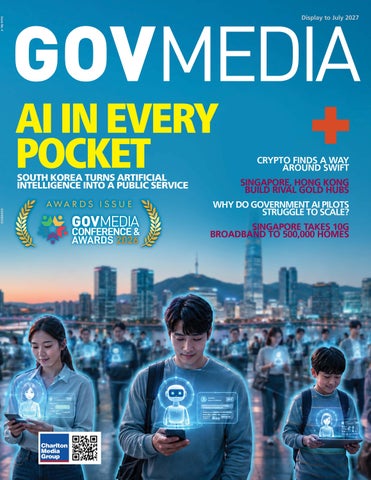
hen AI moves from something governments regulate to something they are expected to provide, South Korea is finding out what that really means. It wants every citizen to have access to a sovereign AI agent, partly to stop access to AI from becoming another economic divide. That story is on page 7.
About Us
GovMedia is the premier source of news and information dedicated to governance and leadership across the globe. It is part of ‘Charlton Media Group,’ a leading B2B publication and events company in Asia, with titles such as Singapore Business Review, Hong Kong Business, Asian Banking & Finance, Insurance Asia, and Healthcare Asia. PUBLISHER & EDITOR-IN-CHIEF
Tim Charlton
EDITORIAL MANAGER
Tessa Distor
PRINT PRODUCTION EDITOR
Vienna Verzo
PRODUCTION TEAM
GRAPHIC ARTIST EDITORIAL ASSISTANT COMMERCIAL MEDIA TEAM
Vincent Mariel Galang Ibnu Prabowo Joanne Christine Ramos Anlene Rosales Olivia Tirona Sam Bernardo Clare Garaña Simon Engracial Dylan Afuang Jenelle Samantila Dana Cruz Danielle Goh
ADVERTISING
Shairah Lambat shairah@charltonmediamail.com +65 3105 1200 ext. 402
AWARDS
Julie Anne Nuñez-Difuntorum awards@charltonmediamail.com
ADMINISTRATION EDITORIAL
Eucel Balala accounts@charltonmediamail.com editor@govmedia.com
SINGAPORE 101 Cecil St., #17-09 Tong Eng Building, Singapore 069533 +65 3158 1386 HONG KONG Room 1006, 10th Floor, 299 QRC, 287-299 Queen’s Road Central, Sheung Wan, Hong Kong +852 3972 7166 MIDDLE EAST FDRK4467, Compass Building, Al Shohada Road, AL Hamra Industrial Zone-FZ, Ras Al Khaimah, United Arab Emirates PRINTED BY Midas Asiapac Pte Ltd 10 Admiralty Street, #06-22 North Link Building, Singapore 757695 +65 6383 5290
Can we help?
Editorial Enquiries: If you have a story idea or press release, please email our news editor at editor@govmedia.com. To send a personal message to the editor, include the word “Tim” in the subject line. Media Partnerships: Please email editor@govmedia.com with “Partnership” in the subject line. For subscriptions, please email: subscriptions@charltonmedia.com
Then there is the problem of what happens when technology moves faster than enforcement. Crypto inflows to sanctioned entities jumped 694% in 2025, forcing regulators to rethink how sanctions work when money can move outside traditional banking rails. Read more on page 6. Hong Kong has a different numbers problem. Healthcare spending is rising, so the government is putting more money into prevention, screening and chronic-disease management in the hope that keeping people healthy costs less than treating them later. See page 8. On page 10, Singapore and Hong Kong are chasing the same prize in very different ways, with one leaning on bank-backed market infrastructure and the other on a more state-led model to build its gold hub. And in Quezon City, Mayor Joy Belmonte explains how a city keeps public services running when normal operations come under pressure. Turn to page 14. We also celebrate the people putting these ideas into practice. This year’s GovMedia Conference & Awards recognise leaders across government and industry using digital transformation to make public services work better for the people who rely on them. Meet the winners on pages 20 to 23. Read on and enjoy!
Tim Charlton
GovMedia is a proud media partner and host of the following events and expos:
GOVMEDIA
CONFERENCE & AWARDS
GovMedia is published by Charlton Media Group. All editorial is copyright and may not be reproduced without consent. Contributions are invited but copies of all work should be kept as GovMedia can accept no responsibility for loss. We will however take the gains. Also out on https://govmedia.com/ **If you’re reading the small print, you may be missing the big picture
caveat
emptor
GOVMEDIA
1
CONTENTS
AWARD COVERAGE
SECTOR INNOVATORS TAKE CENTRE STAGE 20 PUBLIC AT GOVMEDIA CONFERENCE AND AWARDS 2026
FIRST
10
POLICY REPORT HK GOVERNMENT SHIFTS HEALTHCARE SPEND TO PREVENTION
14
INTERVIEW HOW CAN CITIES KEEP SERVICES GOING IN CRISES?
EVENT NEWS
06 Why do government AI pilots struggle to scale? 06 Sanctioned states turn crypto into financial lifeline 07 S. Korea targets one AI agent per citizen
POLICY REPORT
18 Singapore strengthens digital infra with 10Gbps rollout
COMMENTARY
08 SG, HK take rival paths to capture global gold trade 12 Tourism authority backs wellness
40 Building Bangkok’s urban resilience through integrated governance
INTERVIEW 16 Philippines moves tax compliance beyond tax offices
Published Annually by Charlton Media Group
HONG KONG: Room 1006, 10th Floor 299 QRC, 287-299 Queen's SINGAPORE: Road Central, Sheung Wan, 101 Cecil St. #17-09 Tong Eng Building Hong Kong 2 GOVMEDIA RETAIL ASIABUSINESS REVIEW | MARCH 2018 SINGAPORE Singapore 069533 +852 3972 7166
MIDDLE EAST: FDRK4467, Compass Building, Al Shohada Road, AL Hamra Industrial ZoneFZ, Ras Al Khaimah, United Arab Emirates
For the latest news on governance and leadership, visit the website
www.govmedia.com
Growing Together for Sustainability
STEPS TOWARD ENDLESS POSSIBILITIES
GOVMEDIA
3
News from govmedia.com Daily news from Asia MOST READ
ADMINISTRATION
What leadership looks like in the public sector Public sector leaders operate under intense external scrutiny and face significant limits on their ability to influence resources, according to a McKinsey report. High-profile failures can have lasting personal consequences, whilst even successful, efficient programmes often trigger budget cuts rather than recognition.
PUBLIC CONSULTATION
4
SPACE & TECHNOLOGY
Governments risk missing out on $944b space boom Governments that delay investment in space risk losing their share of a market forecast to grow from $596b to $944b by 2033, according to a Boston Consulting Group and Novaspace report. The global space market was worth $224b in 2024, dominated by satellite communications at $159b, followed by earth observation at $21b.
ECONOMY
ADMINISTRATION
How to cut red tape before it delays vital projects Reducing red tape is key for agencies to deliver services more efficiently, responsively, and effectively, Deloitte said. Excessive bureaucracy can undermine mission outcomes, delay project execution, and erode public trust, the report said. However, key challenges remain, hindering initiatives to streamline bureaucracy.
POLICIES
Rising shareholder activism acts as ‘feedback loop’ for governments
Vietnam plans $90b trade finance registry
Government shortfalls stall Philippine startup growth
Regulatory changes in Asia-Pacific are making activism more attractive to investors, according to the “Shareholder Activism in Asia 2025” report published by Diligent Market Intelligence. The report said Asia remains a “growing hotbed for activism,” with over 200 firms in the region targeted with demands yearly.
UK’s fintechs will help Vietnam plug a $90b trade finance gap through a national trade finance registry, which could improve credit access amongst SMEs. The registry could increase transparency, improve data flows, provide better risk management, and reduce the documentation required for small importers and exporters.
Despite the passage of the Innovative Startup Act in 2019, Philippine startups still struggle with funding gaps, skill shortages, and weak infrastructure beyond Metro Manila. Subho Pati Sanyal, COO of the Nistula Group of Companies, said the country’s startup ecosystem is rich with potential but blocked by execution gaps.
GOVMEDIA
Board of Grievances
Board of Grievances
Kingdom of Saudi Arabia The Board of Grievances is an independent administrative judicial body in the Kingdom of Saudi Arabia, delivering administrative justice through an advanced, efficient, and digitally enabled judiciary.
Vision Leadership that drives administrative justice toward a more efficient and sustainable future, delivering distinguished institutional impact.
International Recognition At the GovMedia Awards 2026, the Board of Grievances was recognized with two awards for its excellence in Digital Initiative and Digital transformation.
Digital Initiative of the year Award – 2026 Mushir – A smart platform for
managing
judicial
research
Digital Transformation of the year Award – 2026 Smart Court System
and
An integrated digital judicial environment for
knowledge, enhancing the classification
efficiently and reliably managing court hearings
and publication of administrative rulings.
and judicial proceedings.
GOVMEDIA
5
FIRST SANCTIONED STATES TURN CRYPTO INTO FINANCIAL LIFELINE REGULATION
C
ryptocurrency is giving sanctioned states another route to move money when conventional banking channels are closed to them. Inflows to sanctioned entities jumped 694% in 2025 as countries including Russia and Iran increasingly used digital assets for trade settlement, procurement and other cross-border transactions, according to Chainalysis and Moody’s. Kaitlin Martin, senior intelligence analyst at Chainalysis, said the rise signals a structural change in usage. “Nation states like Iran and Russia are using crypto at scale for trade settlement, reserve diversification, procurement of dual-use goods and financial innovation,” she told the magazine, adding that crypto is “no longer just a sanctions workaround, but it’s a significant part of parallel financial systems.” The increase is tied to concentrated activity. Martin cited “high volume activity for Russia’s ruble-backed A7A5 token,” alongside newly sanctioned wallets linked to Iranian actors and proxies. “The Houthi wallets… had transacted nearly a billion dollars,” she said, highlighting the scale of flows. Choon Hong Chua of Moody’s said crypto is replacing traditional evasion channels. “They are using crypto as a sort of parallel railway to the correspondent banking system that’s outside of SWIFT,” he said, allowing cross-border transactions without relying on regulated banking networks. Stablecoins have become central to these operations. Martin said sanctioned actors are “acquiring stablecoins to conduct transactions that would otherwise be difficult through traditional financial institutions,” enabling settlement in currency-linked assets without direct exposure to the US financial system. 6
GOVMEDIA
Many public-sector AI projects remain stuck at the pilot stage
Why do government AI pilots struggle to scale? ADMINISTRATION
G
overnments have been quick to adopt artificial intelligence (AI) strategies, but many public-sector projects are still struggling to move beyond the pilot stage. Globally, 95 countries now have national data and AI strategies, compared with fewer than 20 in 2020, according to a McKinsey report. Yet the public sector received an AI maturity score of 28 out of 100, below the global cross-sector average of 33. It ranked lowest amongst the sectors assessed, behind consumer and packaged goods and life sciences, which each scored 29. Technology recorded the highest score at 44. McKinsey said many public-sector AI projects remain stuck at the pilot stage because of fragmented data, workflow integration issues, model risks, and high operating costs. Government agencies also face rigid procurement and budgeting rules, data-sharing restrictions, slow workforce redesign, and stricter requirements for explainability and human oversight. Programmes that redesign an entire service or operational domain are more likely to progress. About 70% of domain-based
Agencies should define which decisions require human sign-off based on the consequence of the decision rather than the category of process
programmes reach production, compared with 30% of projects focused on individual use cases. Agencies are already applying this approach. A professional licensing department that deployed agentic AI to redesign its physician licensing process reduced potential send-backs by 40% to 45%, halved the number of review rounds, and cut review timelines in half, to 12 days. Separately, a national customerservice agency that took a domain-led rather than pilot-based approach improved developer productivity by about 30% and identified more than $1b in inaccurate or fraudulent payments within two years. The report identified four measures for scaling public-sector AI: setting strategies around mission and resident outcomes, redesigning workflows from end to end, building organisational capabilities around the technology, and retaining human oversight for consequential decisions. McKinsey estimated that approximately 60% of AI’s value comes from workflow redesign rather than adding the technology to existing processes. Human review Workforce confidence is another challenge. Only one in five public-sector employees expects AI to significantly affect their daily work, whilst 31% trust their employer to develop the technology safely. This compares with 71% across industries. The report said agencies should invest in training, adoption and capabilitybuilding alongside technology. McKinsey’s research suggests that every $1 spent on technology may require $5 in change-management investment. On oversight, McKinsey said agencies should define which decisions require human sign-off based on the consequence of the decision rather than the category of process. Human review should remain in place for decisions such as benefit denials, licence revocations and public-safety dispatches. Lower-risk administrative processes could have higher levels of automation. McKinsey said agencies should measure AI performance using resident-facing outcomes, including shorter waiting times, fewer errors and faster responses, rather than the number of pilots introduced.
FIRST of the population had used AI services. “There are also concerns that, since the free versions of current foreign AI platforms have usage limits, they may become vulnerable to future policy changes by global big-tech companies, such as subscription fee hikes or service discontinuation.”
Korea will provide 512 advanced GPUs to firms to support the early launch of AI services in 2026
S. Korea targets one AI agent per citizen TECHNOLOGY
E
very South Korean could eventually have an artificial intelligence (AI) agent of their own. The government is working towards that goal with a free chatbot that will not impose the usage limits common on commercial platforms. The service is part of its “AI for All” strategy, which aims to prevent access to artificial intelligence from becoming another source of social and economic inequality.
According to the country’s Ministry of Science and ICT (MSIT), the goal is to ensure that all South Koreans can access AI services via a sovereign foundation model. “As one’s ability to use AI increasingly determines individual competitiveness, ensuring that the AI divide does not lead to social and economic divides has become an urgent task of our time,” said MSIT, which found in 2025 that approximately two-thirds
AI-based assistance Under the initiative, a public AI agent will also be introduced, providing AI-based assistance whilst the country works towards an “AI Universal Basic Society” for South Koreans. Interested companies had until 11 August 2026 to submit proposals for the project. Two to three firms will be selected as service providers. Prior to a full rollout, the South Korean government will run a beta service at the end of September. Referring to graphics processing units, MSIT noted: “This year, the government will provide 512 advanced GPUs to companies to support the early launch of AI services.” In line with the government’s plan, AI utilisation education will be strengthened through AI education opportunities. Deputy Prime Minister and MSIT Minister Bae Kyung-hoon, meanwhile, asked for everyone’s support so that South Korea could “actively use and improve” its own AI.
NOW IS #1
With three world No. 1 rankings* — in FinTech, IPOs and innovation cluster — Hong Kong is a global force in innovation. As the city’s largest I&T ecosystem, we orchestrate an ever-growing community of 5,000+ virtual members worldwide, expanding our global footprint and exploring new frontiers. Innovation. Next by Nature.
Sources: * Global Financial Centres Index 38 (Sep 2025); HKEX Insight - Q1 2026 Hong Kong Market Update; World Intellectual Property Organization - Global Innovation Index 2025
GOVMEDIA
7
POLICY REPORT: ASIA government plans to grow the territory’s gold storage to more than 2,000 tonnes within three years. In June, the Shanghai Gold Exchange opened its first International Board-certified offshore gold delivery vault in Hong Kong, allowing international investors to take delivery of eligible contracts outside the mainland.
Singapore will remove the 5% cap on physical investment precious metals under selected tax incentive schemes
SG, HK take rival paths to capture global gold trade One builds MAS-backed vaulting for central banks, the other opens to China. SINGAPORE
S
ingapore is preparing to vault gold for foreign central banks, whilst Hong Kong is building a state-owned clearing system linked more closely to mainland China. Both want a bigger role in the global gold trade, but they are taking different routes to get there. Singapore’s approach centres on fiscal incentives and bank-backed market infrastructure. The city-state will remove the 5% cap on physical investment precious metals under selected tax incentive schemes for eligible funds and single-family offices, a move aimed at deepening institutional participation in its bullion market. The Monetary Authority of Singapore (MAS) will also begin offering gold vaulting services to foreign central banks and sovereign entities from October 2026—a sovereign-to-sovereign offering that extends Singapore’s role beyond private wealth management into official-sector reserves management. On the clearing side, Singapore Exchange Ltd. (SGX) will launch an 8
GOVMEDIA
The regulations are almost the same. It’s more about the nature of the market and the perception of risk
Joshua Rotbart
over-the-counter clearing system for Loco Singapore gold by end-2026. This is backed by a consortium of six banks: DBS Bank, Deutsche Bank, ICBC Standard Bank, JPMorgan Chase, Oversea-Chinese Banking Corp., and United Overseas Bank. SGX is also studying a physically deliverable gold futures contract. Hong Kong, by contrast, has opted for state-led infrastructure and deeper integration with mainland China’s bullion market. The Financial Services and the Treasury Bureau signed a cooperation agreement with the Shanghai Gold Exchange in January to develop a joint gold central clearing system. That clearing function sits with a new state-owned entity, Hong Kong Precious Metals Central Clearing Company Ltd., which held its first board meeting in April; trial operations are scheduled to begin this year, according to Financial Services and Treasury Secretary Christopher Hui. Hong Kong has also moved to expand physical capacity, with
Models of market infrastructure The contrast amounts to two distinct governance choices: Singapore’s exchange-led, bankconsortium model versus Hong Kong’s state-owned clearing company. Market participants frame this as a difference in positioning rather than regulation. “The regulations are almost the same,” Joshua Rotbart, founder of J. Rotbart & Co, told GovMedia. “It’s more about the nature of the market and the perception of risk.” Investors typically use Singapore for long-term storage and wealth preservation, he said, whilst Hong Kong has developed as a trading centre serving mainland China. Dick Poon, general manager at Heraeus Precious Metals Hong Kong, offered a similar reading of comparative advantage: Singapore’s neutrality, established storage, and wealth management sector versus Hong Kong’s integration with the Shanghai Gold Exchange and mainland bullion flows. Both sets of measures build on institutional groundwork laid earlier this year. In Singapore, MAS and the Singapore Bullion Market Association formed the Gold Market Development Working Group in March to review clearing, settlement, storage, logistics, custody, and investment products. This is an effort Singapore Bullion Market Association CEO Albert Cheng linked to Project Lion 2, which aims to strengthen clearing, custody, vaulting, and product development. “By strengthening clearing, custody, vaulting, and product development, we can complement existing centres and deepen institutional participation,” he said.
Ministry of Energy and Environmental Sustainability Sarawak wins at GovMedia Conference & Awards 2026
SARAWAK SUSTAINABILITY BLUEPRINT 2030 The Sarawak Sustainability Blueprint establishes a strategic framework for a green economy across the state. Ministry of Energy and Environmental Sustainability Sarawak won Malaysia Sustainability Initiative of the Year - Environment in the GovMedia Conference & Awards 2026. The organization secured the accolade for its Sarawak Sustainability Blueprint, which serves as a comprehensive roadmap for a green economy. Launched in May 2025, the blueprint integrates multiple strategic thrusts, strategies, and action plans across the energy, environment, industrial, and social sectors. The initiative focuses on accelerating renewable energy, advancing carbon capture and storage, conserving forests, and promoting circular economy practices whilst building a future-ready workforce. The development of this masterplan stemmed from a commitment to lead climate action and build upon existing clean energy advantages. Abundant hydropower resources previously lowered power sector emissions significantly. To expand on this success, leaders engaged government agencies, industry stakeholders, and local communities to develop a unifying vision for society. The blueprint introduces innovative frameworks, including a domestic carbon trading system and a renewable hydrogen economy. These plans encompass hydrogen certification and dedicated export hubs to link clean energy directly with industrial growth. Early outcomes demonstrate steady progress toward the established targets. Renewable energy deployment exceeded expectations, with solar and wind projects complementing existing hydro dams. This clean grid infrastructure helped drive major reductions in grid emissions. Furthermore, a comprehensive greenhouse gas inventory mandated by 2027 will benchmark future emissions against a strict carbon budget to ensure transparent monitoring. The state also decarbonises transport systems and plans carbon pricing mechanisms to secure long-term objectives. The initiative actively reshapes local policy and industrial standards through new legislation. The Sustainable Resources & Wastes Management Bill 2025 established a state waste authority to enforce circular economy practices. Additionally, the Environment Ordinance requires industries to report emissions, embedding the agenda into institutional governance. GOVMEDIA
9
POLICY REPORT: HONG KONG
HK government shifts healthcare spend to prevention Preventive care is being used to keep health costs from outpacing GDP. HONG KONG
K
eeping people out of hospitals may become as important to Hong Kong’s healthcare finances as treating them once they fall ill. With healthcare demand and spending rising, the government is putting more emphasis on disease prevention, screening and chronicdisease management in an effort to slow the growth of the system’s costs. “The only way for Hong Kong to bend the cost curve so it doesn’t grow faster than the gross domestic product is primary prevention of disease,” David Bishai, clinical professor at the School of Public Health at the University of Hong Kong, told GovMedia. He said public health programmes deliver stronger long-term returns than treatment-focused care and should play a bigger role in controlling healthcare costs. Healthcare, social welfare, and education are expected to account for about 60% of Hong Kong’s $107.7b (HK$843.4b) budget for 2026-2027. Healthcare expenditure alone is estimated at $19.5b (HK$153.1b) or
David Bishai
Anna Cheung
Patricia Davidson
Health expenditure is estimated at $19.5b or about 18.2% of total spending
10
GOVMEDIA
about 18.2% of total spending. The government is expanding primary healthcare through a cocare network that will extend disease screening, boost chronic disease management, and improve access to diagnostic services. The programme targets about 700,000 participants in the first five years. Authorities have also extended an elderly healthcare voucher reward scheme through 2028 to encourage greater use of preventive services. “Spending money on primary prevention of the behaviours and risks for health pays dividends for the Hong Kong health system,” Bishai said. He said diet is an area where Hong Kong has substantial room for improvement despite relatively strong performance in reducing smoking, limiting alcohol consumption, and encouraging physical activity. “We are now at a point where less than 5% of Hong Kong people are getting five fresh fruits and vegetables a day,” he said. “One of the best investments for preventing diabetes and hypertension, heart
disease, and atherosclerosis and cancer is improving diet.” Alongside prevention efforts, the Hong Kong government is using regulatory reform to strengthen its healthcare and life sciences sectors. Anna Cheung, assistant executive director at the Hong Kong Trade Development Council (HKTDC), said the government’s “OnePlus” mechanism for faster drug registration has approved 19 drugs since February. Authorities are also planning a Centre for Medical Products Regulation, which Cheung said would function similarly to the US Food and Drug Administration by streamlining approvals and supporting the development of the city’s pharmaceutical sector. Rising investor interest Hong Kong is also deepening integration with mainland China through the Greater Bay Area Medicine and Equipment Connect scheme, which allows drugs and medical devices registered in Hong Kong and used in public hospitals to be used in designated healthcare institutions across the region, giving companies a pathway into the mainland market. “Many are looking for silver health or silver-related knowledge, especially related to Alzheimer’s,” Cheung said. “We see a lot of interest from investors for artificial intelligencerelated technology.” HKTDC arranged more than 400 business-matching meetings over two days at The Asia Summit on Global Health in May and hosted about 180 exhibitors, reflecting investor interest in health technology and ageing-related solutions. Workforce shortages remain another challenge for the healthcare system. “Hiring from abroad is not a sustainable model,” Patricia Davidson, co-director at the International Centre for Future Health Systems at the University of New South Wales, told GovMedia in an interview. She said healthcare employers need better working conditions and retention as rigid work structures and limited support drive workers out of the sector. The co-director added that planning should reflect workforce constraints and shifting system demands.
Recognised for Driving Community Impact
United Arab Emirates Outreach Project of the Year – Community We are proud to have received the United Arab Emirates Outreach Project of the Year – Community award at the GovMedia Awards 2026 for
our Our Sustainable Farms campaign. The initiative engaged farming communities across Abu Dhabi, Al Ain and Al Dhafra promoting
responsible waste management practices, reducing greenwaste burning, and encouraging more sustainable environmental behaviours. This recognition reflects our continued commitment to supporting Abu Dhabi’s vision for a circular economy, and our goal of diverting %80 of waste from landfill by 2031. Our Impact • 6,342 farm workers engaged • 2,173 farms and barns reached • Reached three regions across
the Emirate of Abu Dhabi • Supporting Abu Dhabi’s 2031 waste diversion target. Together, we are turning awareness into action and waste into value.
Turning Waste into Value
Shaping the future of cities Born from the world’s largest gathering of mayors and city leaders, this special report distils shared priorities and practical pathways for collaboration, connecting cities, industry and institutions to turn ambition into partnerships and outcomes.
Contributions from 169 mayors Lessons from more than 1,000 cities Global insights and trends driving the future of cities www.expocitydubai.com
DOWNLOAD SPECIAL REPORT GOVMEDIA
11
POLICY REPORT: THAILAND
Tourism authority backs wellness Today’s tourism has become a restorative space that resets the body and renews the mind. THAILAND
A
traveller who comes to Thailand for a holiday could also pay for a health screening, preventive treatment or structured wellness programme during the same trip. For Thailand, those additional services could mean longer stays and more spending without having to rely solely on bringing in more tourists. The Tourism Authority of Thailand is building closer links between tourism and healthcare as part of a push to develop wellness tourism into a higher-value segment of the industry. The policy aims to deepen links between tourism and healthcare services, as officials seek to reduce reliance on mass-market travel and raise overall visitor yield. Chuwit Sirivajjakul, deputy governor for policy and planning at the tourism agency, said the initiative seeks to boost Thailand’s competitiveness as global travel patterns evolve. “We see wellness tourism as a key lever to enhance Thailand’s position in the global tourism market whilst strengthening economic resilience beyond traditional travel segments,” he said in an exclusive interview. Thailand has long marketed its traditional massage, herbal treatments and hospitality culture. The latest push aims to formalise those offerings within a broader ecosystem that includes preventive healthcare, diagnostics and internationally accredited hospitals. Increased demand Industry players said wellness tourism has expanded beyond spabased services to include medical screening, lifestyle management and structured health programmes. Tanupol Virunhagarun, CEO at BDMS Wellness Clinic, said demand is increasingly tied to preventive care rather than short-term leisure. “Today’s tourism is not merely about rest or escape from fatigue, but has become a restorative space that resets the body, revitalises the mind, and creates holistic balance,” he told GovMedia in a separate interview. 12
GOVMEDIA
Wellness tourism has expanded beyond spa-based services to include medical screening
Chuwit Sirivajjakul
Tanupol Virunhagarun
Thailand’s wellness economy expanded 28.4% between 2022 and 2023, the fastest growth rate recorded globally, according to Global Wellness Institute data cited by BDMS Wellness Clinic. Within that broader sector, wellness tourism specifically ranked third worldwide for growth from 2023 to 2024, expanding 36.4% and trailing only the United Arab Emirates and India, the figures showed. Tanupol linked that growth to structural health pressures rather than short-term travel trends. He said ageing populations, chronic diseases, urban stress, sleep problems, and burnout are driving demand for preventive healthcare, making wellness a bigger part of travel rather than an optional add-on. The initiative, branded Wellness Hub Thailand, groups more than a dozen public and private organisations into three functional layers: travel and privilege enablers such as the tourism authority and Bangkok Airways, hospitality operators including several resort
brands, and healthcare providers anchored by BDMS Wellness Clinic. N Health, a BDMS-affiliated laboratory operator, supports the initiative with biomarker testing spanning hormonal panels, genetic screening and inflammation markers, processing more than 30 million tests annually under ISO 15189 and CAPaccredited standards. Universities including Mahidol University and King Mongkut’s Institute of Technology Ladkrabang have also been drawn into the initiative, developing curricula in preventive medicine and wellnessrelated fields to build a specialised workforce as the sector scales, according to organisers. Thailand is one of Southeast Asia’s largest tourism markets, and policymakers are seeking to reduce reliance on visitor numbers by attracting higher-spending travellers. Wellness tourism, which typically commands premium pricing and longer stays, is seen as a way to raise overall visitor yield without relying solely on rising arrival numbers.
JABATAN PENGAIRAN DAN SALIRAN MALAYSIA
GOVMEDIA
13
INTERVIEW
How can cities keep services going in crises? Digital access and financial buffers are being tested against shocks to daily operations. PHILIPPINES
O
uezon City had already moved many government services online before disruption tested whether that investment could keep the city running. Residents were able to continue dealing with the government without relying entirely on physical offices, whilst contingency funding kept around 100 free buses operating despite higher fuel costs. For Mayor Ma. Josefina “Joy” G. Belmonte, the lesson is simple: resilience depends on having different safeguards for different kinds of disruption. Speaking at the GovMedia Summit 2026, Belmonte said a future-ready government must be “prepared for any eventuality” and be “very resilient and sustainable.” The mayor pointed to disruption caused by the war in the Middle East as an example of how external events can affect governments and businesses, including changes to working arrangements and pressures that can interrupt operations. Quezon City’s earlier decision to move government services online provided one layer of protection. “Because we actually had the foresight to put everything online, our citizens were not greatly affected,” Belmonte said. Digital access allowed residents to continue dealing with the government without relying entirely on physical offices. For the city, this turned digitalisation from an administrative upgrade into a practical way to maintain service continuity when circumstances changed. Quezon City also used financial buffers to protect services that could not move online. Anticipating higher fuel costs, the city allocated contingency funding to maintain gasoline supplies for its free transport programme. Around 100 buses continued operating across the city despite higher fuel prices, allowing the service to remain available. The measure showed how the city combined digital systems with funding mechanisms for physical operations that still depended on fuel, vehicles, and staff. Investing in people Preparedness, however, represents only part of the city’s strategy. Belmonte said the biggest opportunity for the government to create public value comes from investing in people, with technology ultimately judged by whether it improves services and residents’ lives. She identified healthcare, education, and housing as essential to giving people the opportunity to maximise their potential. Residents who can do so, she said, are better placed to contribute to the city’s progress and development. That focus is being supported by investment in physical infrastructure. Quezon City is prioritising telecommunications, roads and drainage, which Belmonte said can make daily life easier whilst helping businesses move more efficiently and making traffic more manageable. Telecommunications plays a particularly important role because connectivity supports the city’s online services. Digital government therefore depends not only on putting transactions online but also on maintaining the infrastructure that allows residents to access them reliably. Belmonte also highlighted social infrastructure, arguing
14
GOVMEDIA
Quezon City Mayor Ma. Josefina “Joy” G. Belmonte
We need to be more mature as an electorate and choose leaders that have actual platforms of governance
that investment in physical systems must be accompanied by measures that strengthen people’s ability to participate in economic and civic life. The approach links resilience with the city’s wider development priorities. Roads and telecommunications affect how quickly businesses and residents can move and transact, whilst drainage and other essential systems help maintain normal activity when conditions become difficult. For businesses operating in the city, that approach also means reducing friction in everyday transactions and movement while keeping public systems functioning when external pressures would otherwise disrupt commercial activity and access locally. At the national level, Belmonte said competitiveness will also require changes beyond infrastructure. “We need to be more mature as an electorate and choose leaders that have actual platforms of governance,” she told GovMedia, pointing to leadership quality as an important factor in long-term development. For local governments, however, resilience can be addressed through more immediate operational decisions. Quezon City’s combination of online services, contingency funding and infrastructure investment provides different safeguards depending on the type of disruption. Digital channels can preserve access when physical transactions become difficult, whilst financial buffers can maintain services dependent on fuel and other resources. Roads, drainage, and telecommunications provide the
Bringing in Revenues for Nation Building
july
BAGONG PILIPINAS
9
Bureau of internal revenue
2026
recognized as
REMINDERS
PHILIPPINES DIGITAL INITIATIVE OF THE YEAR - FINANCE AWARD
GUIDES
for its
SCAN THE QR CODE BELOW
2026
FORMS LINKS YOUR GUIDE TO TAX COMPLIANC
E
INTERACTIVE DIGITAL TAX CALENDAR
Tax Compliance Made Easy! (02) 8538-3200
www.bir.gov.ph
birgovph
birgovphl
i-DECLARE A New Way of Digital Governance
Leading digital integrity through transparent compliance and good governance.
Secure Digital Asset & Benefits Declaration
Automated Governance Workflow
Comprehensive Audit Trail
Real-Time Compliance Dashboard
ISO 3700 & ISO/IEC 27001Aligned
Confidentiality by Design
Pengurusan Aset Air Berhad was established in May 2006 through Water Services Industry Act 2006, to assist Federal Government in realising the National Water Services Industry Restructuring Plan. GOVMEDIA
15
INTERVIEW
Philippines moves tax compliance beyond tax offices Mobile-first services aim to improve compliance and efficiency. PHILIPPINES
R
egistering for a tax identification number once meant going to a government office. The Bureau of Internal Revenue is increasingly moving that process online, alongside tax filing, payments, and taxpayer assistance. The shift is part of an effort to make tax compliance easier for younger and more mobile taxpayers whilst reducing the need for face-to-face transactions. Ma. Rosario Charo Enriquez-Curiba, deputy commissioner of the Bureau of Internal Revenue (BIR), said in an interview during the GovMedia Summit 2026 that the agency has expanded online registration, allowing taxpayers to apply for a tax identification number “wherever they are and anytime, anywhere.” It is also improving electronic filing and providing additional digital payment options, with payment channels linked to accredited agents to ensure transactions are properly accounted for. The BIR has also expanded its digital communication channels. Its website provides information materials and downloadable resources, while its contact centre includes a chatbot that can answer taxpayer questions. More difficult queries can be escalated to a live agent, giving taxpayers another way to seek assistance without immediately having to visit a BIR office. Accessibility and compliance For Enriquez-Curiba, accessibility is closely linked to compliance. She said taxpayers first need to understand their obligations before they can be expected to comply, making information dissemination and communication an important part of the agency’s approach. “Using this technology to reach out to them would really give value,” Enriquez-Curiba said, noting that better access to information can help taxpayers avoid penalties and reduce the need for enforcement action. The shift towards digital services also reflects the BIR’s effort to make communication with taxpayers more direct. Rather than relying on physical visits to obtain information, taxpayers can use the agency’s online channels to access materials related to their obligations. For the BIR, this is intended to create a healthier relationship between taxpayers and the agency. Enriquez-Curiba said informing taxpayers about their obligations can reduce pressure in the relationship and encourage voluntary compliance. The next challenge lies beyond the BIR itself. Enriquez-Curiba said the agency’s ability to deliver its mandate depends partly on support and integration from other government agencies. “If other agencies will not support us, we won’t be 16
GOVMEDIA
If other agencies will not support us, we won’t be as effective as having unified support from the other government agencies
as effective as having unified support from the other government agencies,” she said. She identified whole-of-government integration as an important part of keeping the Philippines competitive. While the BIR is mandated to collect taxes, she said other agencies need to support this work for government systems to operate more effectively. Digitalisation therefore extends beyond improving individual taxpayer services. For the BIR, connecting government agencies can help support the wider objective of raising revenue for government projects. Enriquez-Curiba said digitalisation and integration should work towards a particular objective: ensuring that revenue can be collected effectively to support government programmes and projects. The agency’s approach places taxpayer experience alongside revenue collection. Online registration, electronic filing, digital payment options, and accessible information channels are intended to make it easier for taxpayers to meet their obligations, while communication can help them understand what is required. This also changes the role of enforcement. By providing information before problems arise, the BIR aims to encourage compliance rather than rely solely on enforcement after obligations have been missed. As the BIR continues to develop systems for younger and increasingly mobile taxpayers, the agency’s focus is on making tax services more accessible while strengthening communication and coordination across government. For Enriquez-Curiba, digitalisation and government integration are closely linked to the country’s ability to collect revenue and support its wider development objectives.
Ma. Rosario Charo Enriquez-Curiba, deputy commissioner of the Bureau of Internal Revenue
WHEN PEOPLE ARE EQUIPPED TO
INNOVATE, ORGANISATIONS TRANSFORM Our people drove ground-up innovations, saving 28,000+ hours through AI adoption and continuous improvement. Partner NYP to build what's next.
Singapore Human Resource Development of the Year Higher Education Nanyang Polytechnic
nyp.edu.sg
linkedin.com/school/nanyang-polytechnic
DEPARTMENT OF MIGRANT WORKERS
GOVMEDIA
17
EVENT NEWS: ASIAN TELECOM SUMMIT 2026
Singapore strengthens digital infra with 10Gbps rollout The city-state is taking its digital lead to the next level, targeting 500,000 homes for 10Gbps broadband by 2028. SINGAPORE
A
n electronic invoice sent by a Singapore business can be processed across borders without requiring both sides to use the same system. A robot can also connect with surrounding infrastructure instead of operating on its own. Singapore is building more of these shared digital systems alongside faster networks and data centres, aiming to make transactions and automated services easier to connect, secure and scale. Speaking at the Asian Telecom Summit 2026 held in Singapore, Loh Woon Sien, senior director for Infrastructure Planning and Market Development at the Infocomm Media Development Authority (IMDA), outlined how Singapore’s Digital Utility Stack and National Quantum Safe Network Plus (NQSN+) initiatives are part of a
By driving adoption of this digital utility, we drive efficiency and reduce costs for businesses across their payment processes
Singapore has over 30 subsea cable landings, up from 10 in 2007
18
GOVMEDIA
layered approach to future-ready infrastructure. According to Loh, this soft infrastructure “provides the foundation for key digital transactions” and sits at the top of Singapore’s full-stack approach. At the Digital Utility Stack, she said, the focus is “to drive adoption, trust, interoperability, and global linkages,” supporting seamless operations across the digital economy. A prime example of this approach is InvoiceNow, Singapore’s nationwide e-invoicing network. Loh said the system “operates on the open standard Peppol framework, allowing for global interoperability and scale.” She added that “by driving adoption of this digital utility, we drive efficiency and reduce costs for businesses across their payment processes.” The middle layer of Singapore’s
digital infrastructure integrates physical and digital assets to improve connectivity, reliability, and interoperability for more autonomous and intelligent systems. For example, Loh highlighted the Autonomous Mobile Robots initiative, which helps enterprises integrate robots with surrounding infrastructure to overcome manpower constraints. Loh also described the hard infrastructure layer, which includes subsea cables, fibre networks, data centres, and mobile networks. She noted that Singapore currently has over 30 subsea cable landings, up from 10 in 2007, and plans to double subsea cable capacity in the next decade to meet future demand. On the domestic connectivity front, she said that one-fifth of households are already on Singapore’s 10G broadband network, and the country is targeting 500,000 homes by 2028 for speeds up to 10 gigabits per second. The city-state was also amongst the first to deploy nationwide 5G standalone networks, now covering 95% of outdoor areas. Reshaping capabilities Emerging technologies are also reshaping the landscape. Quantum, in particular, is an area where Singapore is “investing ahead to prepare for the emerging risks” to cryptography. The NQSN+ initiative, launched in 2023, aims to help the city-state achieve a quantum-safe environment within the next decade, providing businesses with access to Quantum Key Distribution (QKD) and Post-Quantum Cryptography (PQC) solutions. Loh noted that developments in AI, cloud, and quantum are reshaping telecom capabilities, “requiring networks not just to be faster, but also smarter.” She also stressed the importance of sustainability, highlighting the Singapore Green Data Centre Roadmap and Tropical Data Centre Standards, which aim to improve energy efficiency and enable data centres to operate at higher temperatures using green energy sources. These layers and initiatives ensure that Singapore’s digital infrastructure is robust, interoperable, and capable of supporting businesses and society.
GOVMEDIA
19
EVENT: GOVMEDIA AWARDS
Public sector innovators take centre stage at GovMedia Conference and Awards 2026
T
he GovMedia Conference and Awards 2026 convened government leaders, policymakers, and industry stakeholders in Singapore on 9 July 2026. The conference featured thought-provoking discussions on the future of governance, beginning with “When Government Gets Digital Right: Building Citizen-Centric Services That Deliver Results,” where panellists explored how digital transformation can improve service delivery, accessibility, and citizen experiences. “Bridging Science and Society: Making Research Work in the Real World,” examined how governments and research institutions can translate innovation into practical solutions that deliver impact. Meanwhile, “The Human Investment: Building Capability, Standards, and Opportunity at Scale” focused on workforce development, capability building, and creating opportunities that drive transformation. Attendees also gained valuable insights from three case study
presentations. Thailand Post shared its presentation highlighting the organisation’s evolution to meet changing digital behaviours and customer expectations. Airport Authority Hong Kong showcased its Park & Fly / Park & Visit project. Meanwhile, Kulai Municipal Council presented the Kulai Fast Lane (KFL) initiative. The event concluded with the GovMedia Awards, recognising government agencies, departments, and public and private sector organisations that have demonstrated excellence in governance, digital transformation, innovation, sustainability, and citizen-centric service delivery. The judges who assessed the entries based on innovation and impact were Guillaume Sachet, Partner, Advisory, KPMG and Shuchi Mehta, Business Application Consulting, Salesforce Consulting Generalist, Partner, PwC Consulting. Congratulations to all the winners!
GovMedia Awards 2026 Winners:
Department of Migrant Workers - Philippines • Philippines Public Facility of the Year - Social Services
Academic Service Affairs and International Education Faculty of Medicine, Chulalongkorn University • Thailand Digital Transformation of the Year - Education
Department of Migrant Workers – Migrant Workers Protection Bureau • Philippines Campaign of the Year - Regulatory
AGENSI KAUNSELING DAN PENGURUSAN KREDIT (AKPK) • Malaysia Sustainability Initiative of the Year - Finance Airport Authority Hong Kong • Hong Kong Smart City Initiative of the Year - Aviation Ajman Chamber • United Arab Emirates E-Governance Project of the Year - Smart Government Australian Department of Defence • Australia Digital Transformation of the Year - Smart Government
Department of Skill Development • Thailand Public-Private Partnership of the Year - Labor DEPARTMENT OF VETERINARY SERVICES SARAWAK • Malaysia Digital Initiative of the Year - Health Digital Policy Office, HKSAR Government • Hong Kong E-Governance Project of the Year - Smart Government dtcpay • Singapore Digital Initiative of the Year - Finance
Bahrain Airport Company • Bahrain Process Optimization of the Year - Aviation
Dubai Culture & Arts Authority • United Arab Emirates Cybersecurity Initiative of the Year - Culture and the Arts • United Arab Emirates Smart City Initiative of the Year - Culture and the Arts
Bank of China (Hong Kong) Limited • Hong Kong Sustainability Initiative of the Year - Finance
Dubai Media • United Arab Emirates Digital Initiative of the Year - Media
Board of Grievances • Saudi Arabia Digital Initiative of the Year - Justice • Saudi Arabia Digital Transformation of the Year - Justice
Dubai Municipality • United Arab Emirates Public-Private Partnership of the Year - Local Government
Bureau of Internal Revenue (BIR) • Philippines Digital Initiative of the Year - Finance City University of Hong Kong • Hong Kong Digital Initiative of the Year - Education Defence Technology Institute, Thailand • Thailand Research & Development of the Year - Science and Technology • Thailand Training Program of the Year - Science and Technology Department of Human Settlements and Urban Development Environment, Land Use, and Urban Planning and Development Bureau • Philippines Governance Project of the Year - Land • Philippines Research & Development of the Year - Land
Dubai Municipality Media Communication and Publishing Section • United Arab Emirates Crisis Management of the Year - Media Electrical and Mechanical Services Department, HKSAR Government, China • Hong Kong Outreach Project of the Year - Youth Expo City Dubai • United Arab Emirates Outreach Project of the Year - Urban Development FORESTRY DEPARTMENT OF PENINSULAR MALAYSIA • Malaysia Infrastructure Project of the Year - Forestry Goods and Services Tax Network • India E-Governance Project of the Year - Finance
Department of Information and Communications Technology Region X Government Housing Bank • Philippines Cybersecurity Initiative of the Year - Youth • Thailand Social Equity and Inclusion Initiative of the Year - Finance • Philippines E-Governance Project of the Year - Local Government • Philippines Social Equity and Inclusion Initiative of the Year - Education Grab & Kementerian UMKM Republik Indonesia • Indonesia Digital Transformation of the Year - Commerce
20
GOVMEDIA
Hail Region Municipality • Saudi Arabia Smart City Initiative of the Year - Local Government • Saudi Arabia Sustainability Initiative of the Year - Local Government Hong Kong Science and Technology Parks Corporation • Hong Kong Smart City Initiative of the Year - Community Intangible Cultural Heritage Office, Leisure and Cultural Services Department • Hong Kong Campaign of the Year - Culture and the Arts IPB Institut Pertanian Bogor • Indonesia Research & Development of the Year - Climate Change JABATAN PENDIDIKAN POLITEKNIK DAN KOLEJ KOMUNITI • Malaysia Public-Private Partnership of the Year - Education JABATAN PENGANGKUTAN JALAN MALAYSIA • Malaysia Digital Transformation of the Year - Transportation Krungthai Bank PCL • Thailand E-Governance Project of the Year - Finance • Thailand Stakeholder Engagement of the Year - Finance KULAI MUNICIPAL COUNCIL • Malaysia Public Sector Initiative of the Year - Regulatory Leisure and Cultural Services Department • Hong Kong Public Facility of the Year - Culture and the Arts Lembaga Pengelola Dana Pendidikan (LPDP)/ Indonesia Endowment Fund for Education Agency • Indonesia Campaign of the Year - Finance LEMBAGA PERTUBUHAN PELADANG • Malaysia Public Sector Initiative of the Year - Agriculture Lenovo PCCW Solutions (LPS) • Hong Kong Public-Private Partnership of the Year - Aviation MALAYSIA MARINE DEPARTMENT • Malaysia Governance Project of the Year - Maritime & Ports • Malaysian Communications and Multimedia Commission (MCMC) • Malaysia Public-Private Partnership of the Year - Regulatory Malaysian Qualifications Agency • Malaysia Governance Project of the Year - Higher Education. Malaysian Rubber Board • Malaysia Campaign of the Year - Agriculture Marikina Polytechnic College • Philippines Training Program of the Year - Higher Education MedAsian Health Technology Co. Ltd • China Public-Private Partnership of the Year - Health Ministry of Communications and Digital Affairs • Indonesia E-Governance Project of the Year - Smart Government
Ministry of Manpower • Singapore Stakeholder Engagement of the Year - Local Government Ministry of Transportation Republic of Indonesia • Indonesia Public Sector Initiative of the Year - Transportation Nakhon Ratchasima Zoo • Thailand Sustainability Initiative of the Year - Tourism Nanyang Polytechnic • Singapore Human Resource Development of the Year - Higher Education National Entrepreneurship Institute (INSKEN) • Malaysia Digital Initiative of the Year - Training • Malaysia Training Program of the Year - Training National Heritage Board/ National Museum of Singapore • Singapore Digital Initiative of the Year - Culture and the Arts National Institute of Electronics and Information Technology • India Cybersecurity Initiative of the Year - Science and Technology National Science Museum, Thailand • Thailand Outreach Project of the Year - Science and Technology • Thailand Public-Private Partnership of the Year - Science and Technology Natural Resources and Environment Board Sarawak • Malaysia Stakeholder Engagement of the Year - Education Novartis/ Novartis Gulf • United Arab Emirates Research & Development of the Year - Medical Office of Student Affairs, University of Science and Technology of Southern Philippines, Cagayan de Oro • Philippines Social Equity and Inclusion Initiative of the Year - Higher Education Office of the Privacy Commissioner for Personal Data, Hong Kong, China • Hong Kong Governance Project of the Year - Regulatory • Hong Kong Outreach Project of the Year - Regulatory Pengurusan Aset Air Berhad • Malaysia E-Governance Project of the Year - Utilities Philippine Statistical Research and Training Institute (PSRTI) • Philippines Process Optimization of the Year - Training Philippine Trade Training Center • Philippines Sustainability Initiative of the Year - Trade and Industry Princess of Naradhiwas University • Thailand Social Equity and Inclusion Initiative of the Year - Social Services Projects Tenders and Local Content Authority • Oman Outreach Project of the Year - Local Government Provincial Local Government of Zamboanga del Norte - Office of the Provincial Agriculturist • Philippines Governance Project of the Year - Local Government
Ministry of Energy and Environmental Sustainability Sarawak • Malaysia Sustainability Initiative of the Year - Environment
PT Bank Negara Indonesia (Persero), Tbk. • Indonesia Process Optimization of the Year - Finance • Indonesia Public Sector Initiative of the Year - Finance
MINISTRY OF ENERGY TRANSITION AND WATER TRANSFORMATION (PETRA) • Malaysia Outreach Project of the Year - Communications
PT Bank Negara Indonesia (Persero) Tbk (BNI) • Indonesia Digital Initiative of the Year - Finance
Ministry of Health • Bahrain Social Equity and Inclusion Initiative of the Year - Health • Bahrain Governance Project of the Year - Health • Bahrain Training Program of the Year - Health • Bahrain Process Optimization of the Year - Health
PT Pertamina Hulu Energi • Indonesia Stakeholder Engagement of the Year - Energy
Ministry of Health of Saudi Arabia • Saudi Arabia Campaign of the Year - Health
PT Pegadaian • Indonesia Digital Transformation of the Year - Finance
PTT Oil and Retail Business PCL • Thailand Digital Transformation of the Year - Energy
GOVMEDIA
21
EVENT: GOVMEDIA AWARDS Public-Private Partnership Center of the Philippines (PPP Center) • Philippines Public-Private Partnership of the Year - Aviation
Suntory Pepsi Vietnam Beverage • Vietnam Social Equity and Inclusion Initiative of the Year - Trade and Industry
Qatar General Electricity and Water Corporation (KAHRAMAA) • Qatar Public Sector Initiative of the Year - Utilities • Qatar Smart City Initiative of the Year - Utilities
Tadweer Group • United Arab Emirates Outreach Project of the Year - Community
Ras Al Khaimah Department of Economic Development • United Arab Emirates Campaign of the Year - Media Sarawak Civil Service Digitalisation Unit, Department of the Premier of Sarawak • Malaysia Social Equity and Inclusion Initiative of the Year - Community Singapore Management University • Singapore Digital Transformation of the Year - Education Singapore University of Social Sciences • Singapore Social Equity and Inclusion Initiative of the Year - Higher Education Standards Bureau of the Department of Social Welfare and Development • Philippines Digital Transformation of the Year - Regulatory
Airport Authority Hong Kong
Bureau of Internal Revenue (BIR)
22
GOVMEDIA
Ajman Chamber
City University of Hong Kong
Thailand Institute of Scientific and Technological Research • Thailand Sustainability Initiative of the Year - Agriculture Thailand Post Co., Ltd. • Thailand E-Governance Project of the Year - Smart Government The General Administration of Customs – Abu Dhabi • United Arab Emirates Governance Project of the Year - Customs • United Arab Emirates Modernization Initiative of the Year - Customs The Hong Kong Association of Banks • Hong Kong Social Equity and Inclusion Initiative of the Year - Statutory Board The Revenue Department of Thailand • Thailand Public Sector Initiative of the Year - Smart Government University of Phayao • Thailand Disaster Management of the Year - Education
Australian Department of Defence & Goods and Services Tax Network
Defence Technology Institute
Board of Grievances
Department of Migrant Workers - Philippines
DEPARTMENT OF VETERINARY SERVICES SARAWAK
Government Housing Bank
Digital Policy Office, HKSAR Government
Grab and Kementerian UMKM Republik Indonesia
Malaysian Qualifications Agency
PT Bank Negara Indonesia (Persero) Tbk (BNI)
Sarawak Civil Service Digitalisation Unit, Department of the Premier of Sarawak
Ministry of Transportation Republic of Indonesia
National Science Museum, Thailand
PT Bank Negara Indonesia (Persero) Tbk
Singapore Management University
Thailand Institute of Scientific and Technological Research
Expo City Dubai
Hong Kong Science and Technology Parks Corporation
Thailand Post Co., Ltd
KULAI MUNICIPAL COUNCIL (MAJLIS)
MINISTRY OF ENERGY TRANSITION AND WATER TRANSFORMATION (PETRA)
Ministry of Energy and Environmental Sustainability Sarawak
Ministry of Manpower
National Heritage Board National Museum of Singapore
Electrical and Mechanical Services Department
Nanyang Polytechnic
National Entrepreneurship Institute (INSKEN)
Natural Resources and Environment Board Sarawak
PT Pertamina Hulu Energi
Suntory Pepsi Vietnam Beverage
The Hong Kong Association of Banks
Pengurusan Aset Air Berhad
PTT Oil and Retail Business PCL
Tadweer Group
The Revenue Department of Thailand
GOVMEDIA
23
INDONESIA DIGITAL INITIATIVE OF THE YEAR - FINANCE
BNI Empowering national development through trusted digital financial ecosystems The bank has been partnering Indonesia’s growth since 1946.
F
or eight decades, PT Bank Negara Indonesia (Persero) Tbk (BNI) has been an integral part of Indonesia’s growth story. Established in 1946 as the country’s first state-owned commercial bank, BNI has evolved alongside the nation, supporting economic progress through every stage of Indonesia’s development. Today, BNI serves millions of customers through an extensive domestic network and international presence, connecting Indonesia with global opportunities whilst creating long-term value for customers, businesses, and society. BNI continues to redefine the role of a modern financial institution. Beyond providing banking services, the bank empowers businesses, strengthens institutions, and supports national priorities through innovation. This commitment reflects BNI’s vision of delivering financial solutions whilst contributing to sustainable development and greater public value. Innovation with purpose At BNI, innovation is guided by purpose. Technology is not viewed as an end in itself, but to create a measurable impact. This philosophy is reflected in the development of the Integrated Financial Portal for the School Revitalization Program, which delivers value across multiple dimensions: Improved public governance by strengthening transparency, oversight, and accountability in national education funding through centralised monitoring. Data-driven decision making by providing real-time analytics that enable faster, informed policy decisions. Educational equity by supporting efficient distribution to fund school infrastructure in underserved and remote areas. Local economic empowerment by creating financing opportunities for MSMEs participating in revitalisation projects. Economic multiplier effect by encouraging local procurement and employment, generating sustainable economic benefits for surrounding communities. Through close collaboration with government institutions and ecosystem partners, BNI continues to develop integrated digital financial solutions that not only enhance operational efficiency but also deliver long-term economic and social value for Indonesia. 24
GOVMEDIA
PT Bank Negara Indonesia at the GovMedia Conference & Awards 2026
Building stronger partnerships for national development As one of Indonesia’s leading financial institutions, BNI has long supported government initiatives that contribute to national development. By strengthening public financial management and expanding access to essential services, the bank leverages its financial expertise and digital capabilities to help government institutions deliver programmes more effectively. BNI believes successful public programmes require more than efficient financial transactions. They require trusted partnerships, strong governance, and integrated digital ecosystems that promote transparency, accountability, and collaboration. This approach enables solutions that improve fund distribution, strengthen oversight, and generate broader
At BNI, innovation is guided by purpose economic impact. By integrating financial services with digital innovation, BNI supports Indonesia’s digital transformation whilst advancing the government’s vision of more transparent, efficient, and inclusive public services. Turning vision into impact One example of this commitment is BNI’s collaboration with the Ministry of Primary and Secondary Education to support Indonesia’s
School Revitalization Program. To strengthen governance, BNI developed the Integrated Financial Portal, a centralised GovTech platform that enhances transparency, accountability, and real-time monitoring. Supporting the distribution and monitoring of an IDR18t budget for more than 16,000 schools, the platform provides greater visibility into fund utilisation whilst enabling secure financial management under the Swakelola (community-led management) model. Beyond governance, the initiative creates financing opportunities for local suppliers and MSMEs by helping them build verified financial records. Through this ecosystem, BNI demonstrates how digital financial innovation strengthens institutions, empowers local economies, and supports sustainable development. Recognition on the global stage BNI’s commitment to creating meaningful impact through innovation earned international recognition at the GovMedia Conference & Awards 2026, where the Integrated Financial Portal School Revitalization received the Indonesia Digital Initiative of the Year - Finance award for advancing digital governance in Indonesia’s public sector. For BNI, this achievement represents more than technological excellence. It reflects the bank’s belief that impactful innovations address real challenges, strengthen collaboration, and create lasting value for society whilst reinforcing its commitment to supporting Indonesia’s development through financial expertise and digital innovation. Looking ahead As Indonesia’s digital economy evolves, BNI remains committed to building financial ecosystems that support the country’s growth. By investing in technology, strengthening strategic partnerships, and developing innovative solutions, the bank aims to make financial services an even stronger catalyst for national progress. Guided by its purpose of creating sustainable value, BNI will continue working alongside customers, institutions, businesses, and communities to deliver innovations that empower people, strengthen governance, and contribute to a more connected and inclusive Indonesia.
Tahun
GOVMEDIA
25
26
GOVMEDIA
GOVMEDIA
27
Sarawak Civil Service Digitalisation Unit wins at GovMedia Conference & Awards 2026 Counters, kiosks, a mobile application, and a digital portal were integrated as a one-stop service delivery platform for Service Sarawak.
Service Sarawak counter
S
arawak Civil Service Digitalisation Unit, Department of the Premier of Sarawak won the Malaysia Social Equity and Inclusion Initiative of the Year - Community category at the GovMedia Conference & Awards 2026 for Service Sarawak: One Government at Your Service - Bridging Communities through Inclusive Digital Transformation. The initiative brought multiple government services into one access point for citizens across Sarawak through physical, digital, and mobile channels. The unit developed Service Sarawak under the Sarawak Civil Service Digital
Transformation Journey to address access issues in a large and diverse state. Citizens in rural and remote areas had faced long travel times, separate service points, and limited digital infrastructure when dealing with government agencies. Service Sarawak responded to these issues by consolidating public services into a single gateway that could be used across different channels, depending on a citizen’s preference, location and level of digital access. Service Sarawak combined counters, mobile applications, kiosks, and a digital portal under SarawakPass, a secure single
sign-on system. Through this setup, citizens could complete transactions, make payments, and track applications without going to different offices for separate services. The platform also supported English and Malay, helping make services more accessible to Sarawak’s population. The initiative improved service access for both rural and urban communities. Rural citizens who previously needed to travel to major towns for government transactions could use the multi-service channels instead, reducing travel time and related costs. Urban citizens also
The initiative brought multiple government services into one access point for citizens across Sarawak through physical, digital, and mobile channels 28
GOVMEDIA
MALAYSIA SOCIAL EQUITY AND INCLUSION INITIATIVE OF THE YEAR - COMMUNITY
Service Sarawak digital portal
benefited from more direct processes through connected digital and physical channels. Service counters followed a client charter that shortened waiting periods, with overall service time reduced by up to 75%, whilst digital use continued to grow as more citizens used Service Sarawak platforms. To date, Service Sarawak has served over 3.4 million customers and facilitated more than 5.5 million transactions, with total collections reaching RM6.1b across all channels. Customer satisfaction has consistently remained above 97% over the past three years, reflecting strong service delivery
performance. Service Sarawak has expanded access through centres and kiosks across the state, including Kuching, Serian, Sri Aman, Betong, Sarikei, Sibu, Miri, and Lawas as of May 2026. Further work includes additional services and centres, improved kiosk interfaces and mobile applications, customer satisfaction management, and broader service coverage in ensuring “no one is left behind”. The initiative supported Sarawak’s Post COVID-19 Development Strategy 2030 pillar on social inclusivity and Sustainable Development Goal 10 on reduced inequalities.
Datu Grace Huong Siew Hung, Director of Sarawak Civil Service Digitalisation Unit
Service Sarawak kiosk
Service Sarawak mobile application
GOVMEDIA
29
30
GOVMEDIA
GOVMEDIA
31
HONG KONG DIGITAL INITIATIVE OF THE YEAR - EDUCATION
CityUHK’s innovative interactive Tunnel connects campus and community Tunnel of Future Innovations, a first-of-its-kind in Hong Kong, transforms a pedestrian passage into an immersive space.
C
ity University of Hong Kong (CityUHK) won the prestigious Hong Kong Digital Initiative of the Year Education in the GovMedia Conference & Awards 2026 for its groundbreaking Tunnel of Future Innovations. This fifty‑metre immersive corridor is the first of its kind in Hong Kong, transforming a pedestrian passage into a dynamic cultural landmark that bridges academia, culture, and society in bold new ways. Launched in May 2025, the Tunnel links the CityUHK campus with the neighbouring shopping mall. It features LED screens on both sides and an overhead glass ceiling that incorporates the university logo, whilst a 4K touchscreen wall at the entrance provides campus navigation and visitor engagement. Tailored lighting and audio settings complement specific exhibitions and live broadcasts, creating a multi‑sensory environment that invites the public to experience the university’s creativity and innovation. The Tunnel has already become a multi-functional platform for exhibitions, performances, educational tours, and large-scale public communication. At its launch, it hosted Hong Kong’s first-ever tunnel-based fashion show, Thread of Creativity, attracting community partners and representatives from the cultural and creative industries. With the support of the Hong Kong Tourism Board, CityUHK presented digital storytelling projects highlighting local cultural heritage through artificial intelligence and visual art, positing the Tunnel as a new cultural and tourism landmark. Student creativity has flourished in the Tunnel, with exhibitions ranging from photography to digital animation showcases. These programmes celebrate the talent and imagination of CityUHK students, offering the public a window into the next generation of creative thinkers. Alongside student-led showcases, the Tunnel also hosts initiatives that highlight how CityUHK serves the wider community and advances its mission in education. Dedicated exhibitions and interactive displays communicate the University’s vision for future-ready learning and its 32
GOVMEDIA
Tunnel of Future Innovations
commitment to a sustainable future, showcasing pioneering research and campus initiatives. By integrating art, technology, and social responsibility, the Tunnel has become a vibrant platform
The Tunnel has already become a multi-functional platform
where the public can experience CityUHK’s dedication to innovation, cultural exchange, and global citizenship. The platform also functions as a strategic communication channel for institutional milestones. It promoted the Digital Health Asia 2025 conference, the CityUHK × University of Cambridge Scholarship, and various research achievements. Through these diverse programmes, the project received wide media coverage and earned accolades.
CityUHK won at the GovMedia Conference & Awards 2026 for Tunnel of Future Innovations
GOVMEDIA
33
SINGAPORE DIGITAL TRANSFORMATION OF THE YEAR - EDUCATION
Singapore Management University wins Digital Transformation of the Year - Education SMU’s AI assistant suite transforms student services, administration, and campus operations.
Singapore Management University (SMU)
S
ingapore Management University (SMU) has been awarded the Singapore Digital Transformation of the Year - Education accolade at the GovMedia Conference & Awards 2026. The award recognises SMU’s application of artificial intelligence (AI) to improve campus services, enhance user experience, and streamline operational processes across the university. The initiative, known as the AI-Powered Campus Assistant Suite, comprises three digital assistants designed to address common administrative and service needs. Mr Goh Wee Sen, SMU Deputy Director, Automation, Web Experience and AI from the Integrated Information Technology Services, said regarding their win, “This award recognises a collective effort to reimagine how we serve our students and staff through digital transformation. By deploying a unified ecosystem of AI-powered assistants across student services, administration and campus operations, we have reduced thousands of hours of manual work, improved service responsiveness, and enabled our people to focus on higher-value engagement.” The suite supports staff, students, and campus security through a combination of automation and self-service tools that improve speed, consistency, and access. A modular approach to digital services SMU adopted a modular design, developing separate assistants for distinct use cases rather than a single integrated system. The suite includes Ask:Smoo, a 24/7 virtual assistant for HR, IT, and campus service queries; Student Chatbot, which supports academic and administrative enquiries; and Lost & Found Assistant, which digitises item reporting, logging, and matching processes. All three AI-enabled assistants are built on Microsoft Copilot, Azure AI, and Power Platform, enabling integration, continuous improvement, and efficient deployment of new capabilities. 34
GOVMEDIA
Addressing operational challenges Over the past few years, SMU has faced increasing volumes of repetitive enquiries and manual workflows. University staff have relied on policy searches and email correspondence to respond to routine queries, whilst some processes, such as lost and found, remained paper-based and time-consuming. The AI-Powered Campus Assistant Suite initiative was guided by three objectives: improve response speed and accuracy for routine enquiries; enable self-service for students and staff; and digitise manual workflows to improve efficiency and tracking. The implementation has delivered measurable improvements across multiple areas. Ask:Smoo (named after the SMU mascot) achieved approximately 90% accuracy across over 1,000 FAQs, handled 5,795 queries within 174 days, reduced response time from 7.5 minutes to 6.5 seconds, and generated an estimated staff time savings of approximately 931 hours. The Student Chatbot supported more than 12,000 students, resolved approximately 82% of queries at first contact, reduced routine undergraduate enquiries from 47.5% (2020) to 1.2% (2024), and enabled academic advisors to focus on more complex cases and student support. Meanwhile, the Lost & Found Assistant achieved approximately 95% accuracy in item identification and categorisation, reduced logging time to under 60 seconds, lowered manual matching effort by approximately 75%, and logged over 3,800 items, with around 1,000 successfully returned. User feedback indicates improved consistency in responses, shorter waiting times, and better visibility of processes across functions.
SMU students discussing in-campus
SMU students posing outdoors at the campus
Key benefits The initiative has provided numerous operational advantages that enhance overall efficiency and effectiveness. As the chatbots are accessible 24/7, users can expect faster and more consistent responses. Additionally, the administrative workload for staff has been significantly reduced, allowing them to focus on higher-priority tasks. The improved user experience is facilitated through convenient self-service options, whilst digitised and auditable workflows enhance accountability and transparency. Furthermore, the modular architecture supports future expansion, along with built-in governance, privacy, and audit controls, to ensure robust compliance and security. The use of the three chatbots has enabled staff to focus on higher-value work whilst maintaining service quality at scale. Ongoing development and outlook SMU will continue to refine the assistant suite through user feedback and data analysis. The modular design allows updates to be made to each chatbot without affecting other components, ensuring continuity and ease of enhancement. Planned developments include AI-enabled support for HR onboarding, expanded tools for teaching and academic support, and real-time campus safety communications. The shared platform also supports integration with additional services as needs evolve. “We are heartened that the GovMedia Conference & Awards recognises our initiatives to use technology to improve workflows and enhance operational performance. This win reflects SMU’s commitment to improve our service quality to staff and students as the technology evolves,” said Mr Goh.
‘We are focused on delivering scalable, user-centred solutions that boost both operational effectiveness and the overall campus experience’
BUILDING MALAYSIA’S
NEXT GENERATION OF DIGITAL LEADERS
A flagship initiative by MCMC and Huawei Technologies (Malaysia), empowering leaders to drive Malaysia’s digital transformation.
FUTURE TECHNOLOGIES
MULTI-SECTOR LEADERS
GLOBAL INDUSTRY IMMERSION
REAL-WORLD IMPACT
(Through Capstone Projects)
dlexcellence.my
2
1
3
4
GOVMEDIA
35
The Office of the Privacy Commissioner for Personal Data, Hong Kong, China (PCPD) hosted the 65th Asia Pacific Privacy Authorities (APPA) Forum in Hong Kong from 16 to 17 June 2026. The Forum, which formed part of the commemorative events marking the 30th anniversary of the establishment of the PCPD, attracted more than 100 representatives from privacy or data protection authorities across the Asia-Pacific region. The Forum served as a valuable platform for regulators and data privacy professionals in the Asia-Pacific region to exchange insights on topical privacy issues, share recent regulatory developments and enforcement challenges, and explore best practices in the protection of personal data privacy. Major themes discussed included legislative developments, enforcement challenges, data breaches, children privacy, and the governance of artificial intelligence (AI), including agentic AI, and other emerging technologies.
latest RECOGNITIONS:
2 AWARDS
GOVMEDIA CONFERENCE & AWARDS 2026
FROM ENTREPRENEURSHIP INTERVENTION TO
MALAYSIA TRAINING PROGRAMME OF THE YEAR - TRAINING INSKEN Bumiputera Business Coaching (IBBC) 2025
MALAYSIA DIGITAL INITIATIVE OF THE YEAR - TRAINING INSKEN Mini Coaching (Marketing) 2025
NATIONAL IMPACT
OTHER RECOGNITIONS: World Economic Forum 2026 Public Social Innovator of the Year
Building entrepneurship. Strengthening ecosystems. Driving sustainable growth.
Entrepreneurship Development & Economic Empowerment Award (BUILDERS) 2026
National Entrepreneurship Institute (INSKEN) is Malaysia's national entrepreneurship development institute under the Ministry of Entrepreneur Development and Cooperatives (KUSKOP), advancing entrepreneurship through capacity building, ecosystem collaboration, market activation, policy advocacy, inclusive innovation and digital transformation. Building on expanding international collaborations and recognition within global platforms, including the World Economic Forum ecosystem, INSKEN continues to strengthen businesses, institutions and communities towards sustainable economic growth.
Malaysia Book of Records
Largest Student Participation In An Entrepreneurship Seminar
Social Impact Award
Tatler Asia Front & Female Awards 2026
OUR INTERVENTIONS: Stronger Businesses Capacity Building
Ecosystem Collaboration
Market Access
Policy Advocacy
Strengthing capability and resilience
Uniting partners to build a stronger entrepreneurial ecosystem
Expanding opportunities and market linkages
Shaping an enabling environment for entrepreneurs
160,000++
Entrepreneurs Trained & Coached
working with: 36 together GOVMEDIA
4,000++ Programmes Delivered
RM 22.4 Million
Entrepreneurs’ Sales Increase After Programme in 2025
Government
Financial Institutions
NGOs
Communities
Corporates
Universities
Industry
Media
Inclusive Innovation & Digitalisation Driving innovation and digital adoption for the future
710
Job Created After Programme in 2025
Resilient Communities
Enabling Institutions NATIONAL IMPACT
LET’S BUILD A STRONGER ENTREPRENEURSHIP ECOSYSTEM FOR A GREATER MALAYSIA. www.insken.gov.my
Pertamina Hulu Energi is committed to
becoming a leading oil & gas company that prioritizes energy resilience, availability, and sustainability. www.phe.pertamina.com
follow us on social media @phe.pertamina GOVMEDIA
37
EEC
2026 Environmental Education Conference 2026
Organised by 38
GOVMEDIA
Empowering Future Generations Through Environmental Literacy 27 - 28 October 2026 Imperial Hotel Kuching, Sarawak
Supported by
ENVIRONMENTAL EDUCATION CONFERENCE (EEC) 2026 SCAN HERE FOR MORE INFO
state’s
Sarawak’s Sarawak’s
GOVMEDIA
39
OPINION
Building Bangkok’s urban resilience through integrated governance FELIX TAN CEO Nuvola Media
W
hen city management transitions from isolated reactions to coordinated planning, efficiency extends to the business community and public welfare. Each year, the more than 11 million residents of Bangkok experience the tangible strains of rapid urbanisation during the monsoon season. Infrastructure is pushed to its limits: Localised drainage bottlenecks impact commuting times, traffic congestion peaks, and daily commercial activities face operational delays. Behind the scenes, resource demands fluctuate sharply as commercial and residential buildings adapt to these disruptions. Whilst traditionally managed by separate departments, these events are interconnected operational challenges within a single, shared urban ecosystem. The core challenge facing modern metropolises is rarely a lack of civic investment or long-term vision. On the contrary, forward-looking frameworks such as Thailand’s Smart City Master Plan 2024-2037 have successfully equipped cities like Bangkok with robust physical infrastructure. Instead, the primary bottleneck is institutional and data fragmentation. Separate agencies naturally operate within their own distinct mandates, utilising isolated data pools. Drainage teams monitor baseline water levels, transport authorities manage vehicular flow, and utility providers forecast localised energy loads. However, without a unified governance framework, optimising these systems simultaneously in real time remains a structural hurdle. This fragmentation often results in a reactive operational model. When localised infrastructure capacity is reached, responses are frequently initiated only after the disruption has begun to affect the community. When transport networks experience delays, rerouting strategies face lag times. Furthermore, isolated capital investments—from canal enhancements to major drainage tunnels—can struggle to deliver maximum return on investment if they are not synchronised with the broader urban grid. In recent years, data visualisation and digital modelling have become standard practices for modern urban planning. By utilising digital twins and spatial mapping, city administrators can better visualise infrastructure performance and simulate growth scenarios. However, static visibility alone does not automatically translate into cross-agency coordination. For a city to achieve true operational resilience, it requires an integrated governance layer that connects insights directly to collaborative action. Modern urban resilience relies on shifting from purely observational data to integrated cross-functional coordination. This approach aggregates existing inputs—from localised environmental sensors and infrastructure metrics to traffic management data—into a shared operational view. Rather than introducing entirely new commercial software systems, the focus is on breaking down organisational siloes so that existing public datasets can interact, revealing operational patterns, and
40
GOVMEDIA
enabling synchronised responses across different public sectors. When city management transitions from isolated reactions to coordinated, data-informed planning, the efficiency gains extend directly to the broader business community and public welfare. Optimising operations across interconnected sectors Consider the management of seasonal stormwater, a persistent operational focus for Bangkok’s low-lying topography. Under traditional frameworks, mitigation efforts are often localised and sequential: Pumps are deployed and traffic is managed independently as situations arise. An integrated approach shifts the focus towards predictive resource allocation. By cross-referencing topographic models, real-time drainage data, and predictive transit patterns, administrative bodies can better anticipate how water movement impacts specific commercial districts. This allows for the proactive deployment of mobile drainage resources and early transit adjustments, minimising business downtime and keeping logistics corridors open. The same principles apply directly to urban mobility and logistical efficiency. Bangkok’s transit networks directly influence corporate productivity and supply chain reliability. When traffic signals, public transit volumes, and weather variables are evaluated as a single, interconnected system, transport management can move away from rigid, static schedules. Instead, systems can be optimised dynamically to maintain economic flow across the city’s primary commercial arteries. Commercial energy systems similarly benefit from crossfunctional data integration. As urban energy demands fluctuate alongside weather variations and transit shifts, maintaining grid stability becomes an increasingly complex balancing act. Integrated data strategies allow utility planners to better anticipate localised demand spikes linked to transit congestion or sudden weather changes. This structural efficiency not only stabilises corporate operational costs but also directly supports Thailand’s national carbon-reduction goals by optimising resource distribution. Thailand has already established a strong foundation for this structural evolution. Agencies like the Digital Economy Promotion Agency (DEPA) and the Ministry of Digital Economy and Society (MDES) are actively guiding a national strategy to foster over 100 smart cities across the country. The overarching goal is to build urban centres that are economically competitive, sustainable, and resilient to operational shocks. To translate these high-level policy goals into consistent daily outcomes, the focus must now turn to practical execution frameworks. Bridging the gap between national strategy and local operations requires a shared commitment to data interoperability. By focusing on open data standards and cross-agency communication, municipal governments can create the organisational connective tissue required to turn policy ambitions into measurable civic and economic resilience.