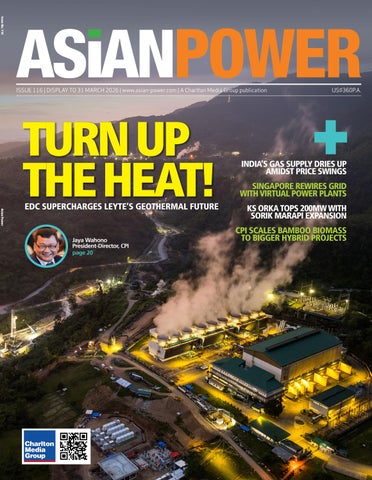
Issue No. 116
ISSUE 116 | DISPLAY TO 31 MARCH 2026 | www.asian-power.com | A Charlton Media Group publication
TURN UP THE HEAT! Asian Power
EDC SUPERCHARGES LEYTE’S GEOTHERMAL FUTURE
Jaya Wahono President-Director, CPI page 20
US$360P.A.
INDIA’S GAS SUPPLY DRIES UP AMIDST PRICE SWINGS SINGAPORE REWIRES GRID WITH VIRTUAL POWER PLANTS KS ORKA TOPS 200MW WITH SORIK MARAPI EXPANSION CPI SCALES BAMBOO BIOMASS TO BIGGER HYBRID PROJECTS
Forever power. Forever decarbonization. Forever excellence. We move big things to zero with future-fuel engines. Our experts design and engineer efficient electricity generators running on synthetic natural gas (SNG), biogas and biofuels. Our gas engines already operate with up to 25% hydrogen. Full hydrogen combustion is coming soon. We’re also scaling up green hydrogen production. Together, we can create clean energy. everllence.com
FROM THE EDITOR PUBLISHER & EDITOR-IN-CHIEF Tim Charlton EDITORIAL MANAGER Tessa Distor PRINT PRODUCTION EDITOR Eleennae Ayson LEAD JOURNALIST Vincent Mariel Galang JOURNALISTS Alec Maquiling Ibnu Prabowo GRAPHIC ARTIST Cathlyn De Raya EDITORIAL ASSISTANT Vienna Verzo COMMERCIAL MEDIA TEAM Jenelle Samantila Dana Cruz Danielle Goh
ADMINISTRATION Eucel Balala accounts@charltonmediamail.com ADVERTISING CONTACTS Shairah Lambat shairah@charltonmediamail.com +65 3105 1200 ext. 402 ADVERTISING advertising@charltonmediamail.com AWARDS Julie Anne Nuñez-Difuntorum awards@charltonmediamail.com EDITORIAL ap@charltonmediamail.com
SINGAPORE Charlton Media Group 101 Cecil St. #17-09 Tong Eng Building Singapore 069533 +65 3158 1386 HONG KONG Room 1006, 10th Floor, 299QRC, 287-299 Queen’s Road Central, Sheung Wan, Hong Kong +852 3972 7166 MIDDLE EAST FDRK4467,Compass Building,Al Shohada Road, AL Hamra Industrial Zone-FZ,Ras Al Khaimah, United Arab Emirates www.charltonmedia.com
Can we help?
Editorial Enquiries: If you have a story idea or press release, please email our news editor at ap@charltonmedia.com. To send a personal message to the editor, include the word “Tim” in the subject line. Media Partnerships: Please email ap@charltonmedia.com with “Partnership” in the subject line.
A
cross Asia, the energy transition is taking many forms—some projects extend old assets, others test new models, and some transform how power is shared. In the Philippines, Energy Development Corporation is giving its Leyte geothermal site a second life. New steam systems, automated controls, and cooling towers that can withstand typhoons are being deployed to keep the Tongonan complex running through 2046. It’s a rare instance of an operator not just maintaining a legacy asset but future-proofing it. On page 10, explore the facilities that will help keep the Tongonan site operational until 2046. Meanwhile, Singapore is testing whether a power plant can exist without a plant at all. Its Energy Market Authority is trialling virtual power plants that knit together solar, batteries, and hydrogen-ready turbines. If successful, the model could help deliver 40% renewable power by 2035 and provide a regulatory template for others. Turn to page 6 for a look inside this experiment. Indonesia’s energy story is taking a more community-driven turn. Clean Power Indonesia is scaling bamboo biomass from its Mentawai pilot to hybrid grids in Atambua and Nusa Penida, aiming for 100% renewables on the island by 2030. The approach ties energy directly to livelihoods, as locals supply the feedstock and buy the power. On page 20, President-Director Jaya Wahono explains how this model works at scale. India, by contrast, is seeing its gas plants fade. Once 13% of the mix, gas-fired power is now down to 2%, squeezed by volatile LNG prices and stranded assets. Yet LNG infrastructure is still expanding, with policymakers betting demand will return. Head to page 14 to see why the economics are proving stubborn. Finally, the regional picture: ASEAN’s goal of an interconnected grid is at risk. Nearly $700b in investment is needed, but without coherent cross-border rules, the projects may stall. On page 18, new ACE chief Dato’ Ir. Ts. Abdul Razib Dawood outlines what must change for the vision to advance.
Tim Charlton Asian Power is a proud media partner and host of the following events and expos:
For subscriptions, please email: subscriptions@charltonmedia.com Asian Power is published by Charlton Media Group. All editorial is copyright and may not be reproduced without consent. Contributions are invited but copies of all work should be kept as Insurance Asia can accept no responsibility for loss. We will however take the gains. Sold on newstands in Singapore, Malaysia, Hong Kong, London, and New York. **If you’re reading the small print you may be missing the big picture
ASIAN POWER 1
CONTENTS
WATCH 10 PLANT EDC TO UPGRADE LEYTE GEOTHERMAL PLANTS
26
INTERVIEW KS ORKA TOPS 200 MW WITH SORIK MARAPI EXPANSION
ANALYSIS
FIRST 06 Singapore rewires grid with virtual plant tech 07 Japan risks delays in clean energy supply chain
VOXPOP 08 Can China make green hydrogen competitive?
COUNTRY REPORT 14 India’s gas supply dries up amidst price swings
REGION REPORT 16 Double-sided panels could lift Hong Kong’s solar output
Published by CHARLTON MEDIA GROUP Singapore Hong Kong Charlton Media Group Room 1006, 10th Floor, 101 Cecil St. #17-09 299QRC,287-299 Queen’s Tong Eng Building Road Central, Singapore Sheung Wan, 2 ASIAN SINGAPORE POWERBUSINESS Hong REVIEW | MARCH 2018 069533 Kong
20
CEO INTERVIEW CPI SCALES BAMBOO BIOMASS TO BIGGER HYBRID PROJECTS
Middle East FDRK4467, Compass Building, Al Shohada Road, AL Hamra Industrial Zone-FZ, Ras Al Khaimah, United Arab Emirates
18 ASEAN risks $700b loss from political risk
INTERVIEW 22 Vanda RE seeks SG buyers for solar storage 24 APAC should align energy, data centre plans 28 Digital tools underused in Asia-Pacific energy transition
COMMENTARY 30 Reframing ASEAN policies to boost energy transition readiness 32 Coal power generation market: A realm of innumerable opportunities
For the latest news on Asian power and energy, visit the website
asian-power.com
to innovate since 1871
Pioneering the Future of Energy with 150 Years of Expertise For over a century and a half, MWM has been at the forefront of energy innovation, beginning with the invention of the gas engine. Today, we continue to drive progress, maximizing plant efficiency and empowering our customers to build a better and more sustainable world. Hydrogen Ready
Hydrogen Retrofit Kits
Digital Power Plant Control
mwm.net ASIAN POWER 3
News from asian-power.com Daily news from Asia
ENVIRONMENT
PROJECT
ENVIRONMENT
Blue Mackerel offshore wind taps GHD for environmental impact study
NTPC Green unit inks deal for renewable projects in Goa
No major shift seen for global coal demand in 2025-2026
The Blue Mackerel offshore wind project has appointed GHD to lead its environmental impact assessment and approvals process. This is a flagship project in Australia’s first designated offshore wind zone, located off the coast of Gippsland in Victoria. The project will benefit over half a million homes.
NTPC Green Energy Limited said its wholly owned subsidiary has signed an agreement for the development of 300 megawatts or more of renewable power in the state of Goa. In a bourse filing, the company said the memorandum of understanding will also cover energy storage projects in the state.
Global coal demand is projected to remain on a plateau this year and next, despite short-term fluctuations across several major markets in the first half of 2025, according to the International Energy Agency in its Coal Mid-Year Update. In China, coal demand is seen to slightly decline this year.
PROJECT
TECHNOLOGY
PROJECT
PH inaugurates 22 MW Tanawon Geothermal Plant
AI gains bigger role in reliable and cost-effective power industry
Oracle Power in talks for $1.4b financing of hybrid RE plant in Pakistan
The Philippines’ Department of Energy has inaugurated the Energy Development Corporation’s 22-megawatt Tanawon Geothermal Power Plant in Bac-man Complex, Sorsogon City. The plant contributes to the Philippines’ renewable energy targets of 35% by 2030.
Predictive maintenance powered by AI is gaining a more important role in a more reliable and cost-effective power sector. “It has the potential to decrease maintenance expenses by as much as 30% and boost equipment availability by 20%,” according to GlobalData in its report.
Oracle Power PLC is in talks with investors so it could start building a $1.4b hybrid renewable energy plant in Pakistan’s Gharo-Jhimpir wind corridor next year, according to its chief executive. The 1.3 GW wind and solar plant may start supplying power to 1.2 million houses by 2028.
POWER AND FINANCE | Q3 2021 4 ASIAN ASIAN BANKING
ASIAN POWER 5
FIRST COAL MAKES A COMEBACK AS CHINA, INDIA EXPAND POWER UTILITY
L
ast year’s dip in new coal mine capacity proved short-lived, as developers in 30 countries, led by China and India, move ahead with expansion plans. According to Global Energy Monitor (GEM), over 850 new mines, expansions, and recommission projects are set to be rolled out in 30 countries. Thirty-five mine extension projects are also under consideration. Nearly 90% of this proposed capacity is located within just a few countries, with China accounting for 1,350 million tonnes per annum (Mtpa) mostly located in its north and northwest. India follows with 329 Mtpa, nearly half of which is being developed by state-owned Coal India. “In total, 2,270 Mtpa of coal mine capacity is under development worldwide, posing a significant risk of increased methane emissions, a potent greenhouse gas with over 80 times the warming potential of carbon dioxide over a 20-year period,” GEM said. China’s push to replace coal with green hydrogen in its power sector faces steep costs and infrastructure hurdles, making a full transition unlikely in the near term. The country has the most coal power plants at 1,195—four times more than 290 in India, which ranks second, according to Statista. Outlook GEM estimates that 15.7 Mt of methane could be released annually if all proposed coal mining projects are developed, surpassing the total annual greenhouse gas emissions of Japan, one of the world’s top ten emitters. “The canary is literally and figuratively in the coal mine. Without drastically scaling back plans for new mine capacity, the world could see a massive rise in potent methane emissions that would make it all but impossible to reach the goals of the Paris Agreement,” said Dorothy Mei, project manager of the Global Coal Mine Tracker at Global Energy Monitor. 6 ASIAN POWER
The virtual power plant uses a network of solar panels, batteries, and smart appliances
Singapore rewires grid with virtual plant tech
T
ENERGY & OFFSHORE
he Singaporean government is developing new energy technologies, including linking small power sources and managing them to act like a single, larger power plant, to hit its goal of 40% renewable power generation by 2035. Instead of relying on a single, physical structure, a virtual power plant uses a network of devices such as solar panels, batteries, and smart appliances to provide power and grid services. These virtual power plants “could better make use of the different distributed energy resources in the system and help consumers earn a viable return on their investment,” Violet Chen, director of the energy capabilities development department at the Energy Market Authority (EMA), told Asian Power. The city-state wants to better manage distributed energy resources—smallscale, modular energy generation and storage tech near the point of electricity consumption—to ensure secure supply and more efficient distribution, she said in an exclusive interview. The government uses regulatory sandboxes—a controlled environment where energy players can test new products, services, or business models
Violet Chen
When the infrastructure is ready and more cost effective, we'll be able to capitalise on this opportunity quickly
under regulatory supervision with reduced requirements. The regulator can decide on the appropriate regulatory treatment later. The EMA on 31 March closed the submission of sandbox proposals for virtual power plants. “Through regulatory sandboxes, they can work with us to share our policies, to change our market rules to be more business-friendly, and they can work better for their business models,” Chen told Asian Power. The Energy Market Authority has partnered with companies like Singapore Power Group to develop the country's virtual power plant capacity. It is also working with the private sector for an energy infrastructure that is ready for emerging technologies such as hydrogen-ready power plants. “We have set in place a policy to enable new power plants to be hydrogen-ready… so when the infrastructure is ready, when it becomes more cost effective, we'll be able to capitalise on this opportunity quickly,” Chen told the magazine. Hydrogen-ready plants As part of the country's 2050 net-zero emission target, the state requires new and repowered natural gas power plants to be at least 30% hydrogencompatible by volume. Chen said some power plants coming online in 2027 would be hydrogenready, including the 600-megawatt (MW) Combined Cycle Gas Turbine (CCGT) plant of YTL PowerSeraya Pte. Ltd, a unit of Malaysia’s YTL Power International Bhd. Another hydrogen-ready plant set to operate in Singapore is PacificLight Power Pte. Ltd.’s 600-MW CCGT facility, which will begin its operations in January 2029. Chen said the city-state would continue to push domestic solar capacity. Singapore hit its 2025 target of deploying 1.5 gigawatt-peak (GWp) solar energy and aims to hit 2 GWp by 2030, equivalent to the annual electricity needs of about 350,000 households. She said Singapore faces solar power hurdles because of its variable output and scarce land. Battery storage would fix this and strengthen the power grid as more renewable energy (RE) is produced, she added. Singapore eyes 6GW low-carbon power imports from neighbours by 2035, according to Chen.
FIRST
Toru Kumagai
Costs of components for wind turbines ballooned by 30 to 50%
Patrick Architta
Japan risks delays in clean energy supply chain POWER UTILITY
J
apan should build its renewable energy (RE) supply chain including boosting sourcing ties with key Asian players to lower development costs, as it aims for as much as 50% clean power generation by 2040 under its updated roadmap, according to an energy consultant. “We don’t have a sufficient supply chain in Japan,” Toru Kumagai, head of business development in Japan at engineering company Ramboll, told Asian Power. “We need to set up the supply chain to stabilise component prices.” In February, Japan approved its seventh strategic energy plan, which
targets 40% to 50% renewable power generation by 2040 from 32% last year. The cost of RE components in Japan, such as solar panels, wind turbines, hydroelectric generators, and energy storage systems has ballooned by 30% to 50%, Kumagai said, without specifying the figures. “It is important to establish a global relationship, especially with Asian countries, to establish a supply chain,” he said. “We can cooperate with Korean, Taiwanese, and Chinese manufacturers.” Japan plans to strengthen business discipline and streamline the bidding system as part of its push to fast-track
Michiyo Miyamoto
You cannot have it all. Or you can have it all, but only for the very long term
innovation and build supply chains in the renewable energy sector. Patrick Architta, head of wind energy in Asia Pacific at Ramboll, said Japan faces a tough choice when building its supply chain. Building it locally could raise energy costs and create jobs, whilst building it using imported components could lower power prices, leading to fewer jobs in the short term, he pointed out. “As a country, do you want to have expensive energy that creates local jobs?” he asked. “Or do you want to have a competitive energy that will create more jobs later?” “You cannot have it all. Or you can have it all, but only for the very long term,” he added. Fast-tracking expansion Beyond supply chain enhancements, Tokyo should also fast-track its grid expansion, Michiyo Miyamoto, an energy finance specialist in Japan at the Institute for Energy Economics and Financial Analysis, said. Funding for the interconnection between Tokyo and Hokkaido, a key project that involves building a highvoltage transmission line to connect the two regions and facilitate energy exchange, is yet to be finalised. The project, which is estimated to cost $11.5b, seeks to significantly expand transmission capacity from Hokkaido, which has abundant renewable energy. Financing should be settled early as installation may take decade, Miyamoto continued.
THE CHARTIST: ONSHORE WIND REMAINS CHEAPEST ENERGY SOURCE
O
nshore wind remained the most affordable source of renewable energy at $0.034 per kilowatt-hour (kWh) in 2024, according to the International Renewable Energy Agency (IRENA). In its “Renewable Power Generation Costs in 2024” report, IRENA said that onshore wind projects were 53% cheaper compared to the lowest-cost fossil fuel alternatives. Solar energy, meanwhile, was priced at $0.043/kWh and was 41% more affordable than fossil fuel alternatives. “The addition of 582 gigawatts of renewable capacity in 2024 led to significant cost savings, avoiding fossil fuel use valued at about $57b,” IRENA said, noting that 91% of new renewable power projects commissioned last year were more costeffective than any new fossil fuel alternatives.
Cost reductions are expected to continue as the technologies mature. However, challenges, such as trade tariffs, raw material bottlenecks, and evolving manufacturing dynamics, particularly in China, pose risks that could temporarily raise costs. Higher costs are likely to persist in Europe and North America, driven by structural challenges such as permitting delays, limited grid capacity, and higher balance-of-system expenses. In contrast, Asia, Africa, and South America, with stronger learning rates and high renewable potential, could see pronounced cost declines. The report also noted that “stable and predictable revenue frameworks are essential to reduce investment risk and attract capital.” “Integration costs are emerging as a new constraint on deployment of renewables.
Global levelised cost of electricity, 2023-2024
Source: IRENA
ASIAN POWER 7
VOX POP
Can China make green hydrogen competitive? CHINA
M
Yujia Han and Martin Weil Researchers, Renewables & Other Power Global Energy Monitor
ost energy experts agree that using green hydrogen for routine electricity generation is wasteful, with up to 80% of the original clean power in converting it first to hydrogen and then back to power. Whilst it is considered essential for decarbonising energy use in heavy and chemical industries and long-duration storage, it is far less efficient and more costly for the power sector than batteries, pumped hydro, or demand management. Specifically in the power sector, green hydrogen could help displace coal power in the long run by offering seasonal, long-duration storage of wind and solar power. But in the near-to-medium term, cheaper options like massive renewable build-out, batteries, and other forms of energy storage, transmission upgrades, demand response, and energy efficiency are better positioned to replace coal at the scale needed. China is still at the very beginning stage of development of green hydrogen power plants. A number of utilities and manufacturers have launched trial-scale fuel cell or hydrogen gas turbine projects in various locations, including an initiative by China Southern Power Grid Company Limited to use hydrogen stored in solid state form in Guangzhou and Kunming in 2023, marking the first time that solar power-generated hydrogen is applied within the power system. In the same year, a Shanghai company announced the country’s first utility-scale green hydrogen peaking projects using its fuel cell technology in three locations, each in Xinjiang and Inner Mongolia. However, the company has also recently announced the postponement of an EPC construction bid in Fengzhen District, Inner Mongolia due to some “changes in industry policy.” A 30-megawatt (MW) hydrogen power project in Otog Banner, Inner Mongolia that is being developed by the established generation utility Shenzhen Energy is likely to be the first to actually come onstream. Both the electrolytic hydrogen facility and the 505 MW of wind and solar farms to power it are well into construction, and the owner announced the start of work on the hydrogen power plant itself with target completion by year-end. Green hydrogen in China typically costs around $0.196 to $0.252 (RMB 1.4 to RMB 1.8) per cubic metre, mainly due to the electricity needed for electrolysis, whereas coal-based hydrogen costs only about $0.084 to $0.112 (RMB 0.6 to RMB 0.8) per cubic metre. Whilst this substitution does not yet offer direct cost savings, the potential environmental benefits are considerable. The main hurdle in the adoption is the high costs on both the supply and demand sides. Even as the renewable levelised cost of electricity (LCOE) falls and brings down hydrogen costs, electrolysis remains far more expensive than grey hydrogen because electricity dominates green hydrogen’s cost structure; low power prices are hard to secure and are mostly achievable only in a few resource-rich Northern regions. On the demand side, hydrogen and its derivatives are priced under a single benchmark without valuing lower carbon from green pathways, so green and grey compete on the same terms. 8 ASIAN POWER
W
Nigel Rambhujun Analyst, Hydrogen Research Rystad Energy
ith half of China’s power generation coming from coal, implementing ammonia co-firing is an attractive way to decarbonise the power sector in the short term instead of mothballing coal power plants that are currently in use. However, using green hydrogen, ammonia, or other alternative fuels to decarbonise the power sector will be an expensive option. The cost of low-carbon ammonia co-firing will depend heavily on the cost of green/blue hydrogen used as a feedstock. Assuming a hydrogen price of $5 per kilogram, equivalent to an ammonia price of $1,000 per tonne, Rystad Energy estimates that the LCOE of a 10% ammonia blend will be around 50% higher than the LCOE from coal generation alone. Most of the costs associated with green hydrogen come from the electrolyser stacks’ capital expenditure, which has been going down in China due to strong domestic competition amongst original equipment manufacturers. Potential savings from green hydrogen adoption will depend on domestic and international policies, such as the Carbon Border Adjustment Mechanism in Europe, where companies with higher emissions will face added costs. Companies like Xinjiang Goldwind Science & Technology Co., Ltd. and Envision Energy Co., Ltd. are leading the way in developing export-scale green hydrogen projects due to their vertical integration of renewable energy infrastructure. General hurdles in the industry will be retrofitting power plants to run on hydrogen/ammonia. So far, no large-scale trial for ammonia co-firing has been completed in China, whilst Japan has already completed a successful trial at a co-firing rate of 20% ammonia. Transporting the hydrogen or ammonia from the production plants (mainly Inner Mongolia) to the power plants will be an infrastructure challenge. China is currently building hundreds of kilometres of hydrogen-specific pipelines to transport hydrogen to demand centres. China plans to introduce 10% co-firing of biomass and green ammonia at coal-fired power plants to halve emissions compared to 2023 levels, but it will take time to retrofit or accommodate upgrades for the new co-firing technology.
Envision’s Chifeng Net Zero Hydrogen Industrial Park
ASIAN POWER 9
PLANT WATCH
EDC to upgrade Leyte geothermal plants It seeks to boost efficiency and sustainability and extend plant life.
E
PHILIPPINES
nergy Development Corp. (EDC) is planning major upgrades to its geothermal power facilities in Leyte, Philippines, to improve their efficiency, extend plant life, and ensure sustainable operations. “We will install various mitigations at the wellhead and plant interface, such as solids capturing devices and steam washing systems,” Teodulfo Troyo, head of EDC’s Leyte site, told Asian Power. Combined, these deliver purified, high-quality steam that removes impurities and helps ensure efficient and reliable operation of the steam turbines. A subsidiary of First Gen Corporation, EDC operates three geothermal plants in the Tongonan Geothermal field--the Tongonan, Malitbog, and Upper Mahiao facilities. The upgrades will focus on the steamfield facilities that supply energy to all three plants. Straddling Kananga and Ormoc in Leyte, the Tongonan geothermal field comprises 31 production wells
We will install various mitigations at the wellhead and plant interface, such as solids capturing devices and steam washing systems
Teodulfo Troyo
and nine reinjection wells and spans more than 107,000 hectares of protected forest land. EDC is consulting a professional engineering firm that has worked on similar geothermal projects in other countries to plan the upgrades. Troyo said that EDC is now in the data gathering phase, with final design and cost estimates to follow. He added that the design phase would take at least six months, followed by construction or equipment replacement over within two to three years. EDC is also exploring new technologies, such as electrical submersible pumps, to revitalise older wells and modular binary plants that don’t require extensive steam piping. “These are still in the planning stage, but since they are already used abroad, we hope to replicate similar success,” Troyo said, citing the potential to add 10 megawatts (MW) to 15 MW without heavy infrastructure costs. Turbines and generator rotors in Tongonan’s facilities have been
Tongonan Geothermal Plant (Photo from EDC)
BESS site under development
Two of the transformers at the plant
Cooling towers
10 ASIAN POWER
replaced, and operations are now nearly fully automated. “Operations now focus on optimising and monitoring the plant, with less manual adjustment,” Troyo said. Plans are also underway to replace nine cooling towers with new units that are resilient to typhoons and earthquakes. With these upgrades, EDC expects Tongonan to remain operational until at least 2046. Meanwhile, the firm’s other geothermal facilities are also due for rehabilitation and upgrades over the near term. The 180 MW Mahanagdong facilities will undergo rehabilitation and capacity upgrades in three to five years, whilst Upper Mahiao is slated for complete plant replacement to boost generating capacity from 130 MW to at least 200 MW, supported by additional geothermal wells. Aside from Tongonan, EDC owns seven other geothermal power stations operating across the Philippines, bringing total generating capacity to over 1,100 MW.
ASIAN POWER 11
CO-PUBLISHED CORPORATE PROFILE
Ansaldo Energia: Delivering flexible solutions and upgrades to enable Asia’s energy transition A future-proof approach that safeguards energy security and boosts operators’ profitability.
Mr Stefano Gianatti - EVP Thermal New Units, Ansaldo Energia
A
midst the rise of renewables, “thermal is dead” has been the global narrative. But as grids become increasingly reliant on variable sources like wind and solar, this has crafted a new reality where stability, dispatchability, and flexibility, are critical for industry players alongside decarbonisation targets. To combat this challenge, Ansaldo Energia has led the way with the evolution of thermal power. Ansaldo Energia offers modern thermal power that is far from outdated infrastructure and that has become the backbone of energy security. Renewed role of thermal As renewable generation surges, so do the concerns over grid intermittency. Whilst solar and wind are green, they are not always available. To address this challenge, Ansaldo Energia’s advanced thermal solutions are designed to deliver dispatchable power on demand, ensuring energy is available precisely when it is needed most. “Dispatchable by design” is driving Ansaldo Energia’s portfolio. It features turbines like the flagship GT36, capable of ramping at 100 MW per minute and running at low minimum loads. These technologies are tailor-made to fill the gaps that renewables cannot. “This approach ensures immediate responsiveness to renewable fluctuations and grid volatility, reducing operational costs and wear on assets,” the company said. Ansaldo Energia designed its thermal
12 ASIAN POWER
GT36 gas turbine rotor
GT36 gas turbine rotor
offerings with transition in mind. All the fleet can operate on hydrogen blends, from 40 up to 70%, depending on the equipment. In 2024, Ansaldo Energia successfully validated 100% hydrogen combustion on the GT36 combustor in test rig, a key milestone towards full decarbonisation. “Our target is to achieve 100% hydrogen readiness by 2030, offering operators in Asia a future-proof investment today. Hydrogen is central to our roadmap, but it is not the only low-carbon fuel we are enabling.” With regards to fuel flexibility, AE94.3A gas turbine is also capable of operating on renewable fuels. Last February, Ansaldo Energia and SSE Thermal signed an agreement for the supply of a 300 MW AE94.3A gas turbine. The unit will power a new plant in Tarbert (Ireland) designed to operate entirely on HVO (Hydrotreated Vegetable Oil). Beyond gas turbines, the company’s portfolio includes modular steam turbines, both reheat and non-reheat, also for geothermal and nuclear applications, 100 KWe microturbines and Electrolysers for green hydrogen production. Ansaldo Energia also offers synchronous condensers, which further enhance grid stability and support system inertia as renewable penetration increases.
per minute. These enhancements allow assets to remain online at low loads, respond swiftly to renewable fluctuations, and cut emissions. All the upgrades can also include hydrogen and HVO retrofitting, depending on customers’ requests. By upgrading existing assets — extending their life, improving efficiency, enhancing operational flexibility, and preparing them for green fuels — Ansaldo Energia enables an actionable and economically sustainable energy transition.
Unlocking value in existing assets Acknowledging that the real decarbonisation challenge lies with existing infrastructure, Ansaldo Energia offers a pragmatic solution: modernisation. Targeted upgrades on existing fleets like the AE94.3A and comparable heavy-duty gas turbine platforms enable plants to lower their minimum environmental loads by up to 35 MW, and boost ramp rates up to 50 MW
Navigating energy transition in Asia For fast-growing economies in Asia, the stakes are high. They must reduce CO2 emissions, also by phasing-out from coal, whilst reinforcing energy security and ensuring dispatchable power to fast growing economies. All this, whilst keeping energy affordable. “The energy transition is already underway, and the challenge is to decarbonise without compromising reliability or affordability. We are committed to partnering with Asian utilities and governments to deliver realistic pathways to cleaner energy for the economies and communities they serve,” said Stefano Gianatti, EVP Thermal New Units of Ansaldo Energia. Ansaldo Energia is banking on the combination of high efficiency, leading-edge operational flexibility, green fuel readiness, and seamless integration with renewables. This approach applies both to new power plants and to the upgrade of existing assets, offering a proven blueprint for how thermal power can support a realistic and sustainable energy transition. To know more about modern thermal power, visit https://www.ansaldoenergia.com/.
Our target is to achieve 100% hydrogen readiness by 2030, offering operators in Asia a future-proof investment today
Fit for transition From gas and steam turbines to generators, Ansaldo Energia develops and delivers leading-edge proven products and superior-quality services. Operational flexibility, along with hydrogen and green fuels readiness, are our contribution to enable a sustainable and affordable energy production. ansaldoenergia.com
ASIAN POWER 13
COUNTRY REPORT: INDIA
India’s gas supply dries up amidst price swings
Gas-fired power is losing out to more competitive renewable energy sources.
I
ndia’s gas-fired power sector is facing a severe decline, with its share in the country’s electricity mix falling to just 2% from 13% more than a decade ago largely due to volatile global prices and limited production, according to analysts. Thirty-one gas power plants that accounted for 32% of the nation’s total gas-based generation capacity have failed to produce electricity this fiscal year and are now considered stranded assets, according to the Institute for Energy Economics and Financial Analysis (IEEFA). Less appealing “High and unstable liquefied natural gas (LNG) prices make it less appealing for Indian industries, especially for fertiliser production, which uses the most energy in India,” Purva Jain, an energy specialist for gas and international advocacy at IEEFA, told Asian Power. Gas-fired power is losing out to more competitive renewable energy sources, she pointed out. She noted that whilst the government provides significant subsidies to the fertiliser sector to mask the real cost of gas, this came at a heavy fiscal cost. “Whilst
High and unstable LNG prices make it less appealing for Indian industries
Purva Jain
Paul Everingham
There is a projected 60% increase in gas use by India’s power sector by 2030
14 ASIAN POWER
this helps consumers, it cost the government a huge $30b in 2023 after gas prices jumped in 2022.” Limited gas competitiveness Despite government intervention, high LNG prices continue to limit gas competitiveness. Jain noted that even at a delivered LNG price of $8 per million British Thermal Units (MMBtu), the cost of electricity from gas rises to ₹17 per unit— compared with ₹5–₹6 for coal and ₹6 for solar-plus-storage. “India’s fuel prices must fall to $5 to $5.7 per MMBtu for gas-fired power plants to compete with coal and renewables,” she added. However, the International Energy Agency (IEA) projects a 60% increase in gas use by India’s power sector by 2030, targeting a 15% share in the country’s total energy mix. “With an existing LNG import capacity of close to 50 million tonnes per annum and more under construction, India will have the import infrastructure to support this,” Paul Everingham, CEO at the Asia Natural Gas and Energy Association, said in an exclusive interview. But distribution networks behind the import terminals must be
expanded, he added. Jain said most LNG import terminals are underused, with six out of seven operating below 50% capacity last fiscal year. Regulatory reforms are being proposed to address these infrastructure bottlenecks and improve gas market planning, she added. Everingham expects global LNG supply to grow significantly, with new volume from the US, Australia, and Qatar. These will have “a positive impact on the affordability of LNG for nations like India, particularly if long-term supply contracts can be implemented,” he added. “Due to high LNG prices, lack of demand, and site-specific operational challenges, demand growth barriers could trigger stranded asset risk for energy terminals,” Jain said. In industrial sectors, volatile gas prices continue to drive users toward cheaper alternatives—even dirtier fuels. “Switching from coal to gas has been witnessed in some small to medium scale industries, like tea plantations,” she told the publication. “But for heavy industries, gas demand may remain limited as companies rely on cheaper coal.” New policies Regulators are also responding. The Petroleum and Natural Gas Regulatory Board has issued new rules aimed at aligning terminal expansion with actual demand, addressing location suitability, and ensuring sufficient pipeline capacity. Moreover, the Indian Renewable Energy Development Agency Limited (IREDA) has raised INR 2,005.90 crore to boost financing for green energy projects. In a statement, the Ministry of New and Renewable Energy said the funding was raised through a Qualified Institutions Placement (QIP). A total of 12.15 crore equity shares were issued at INR 165.14 per share, which includes a premium of INR 155.14 per share over the face value of INR 10. The capital raised through this issuance “will further strengthen IREDA’s Tier-I capital and overall Capital Adequacy Ratio (CAR), enhancing the company’s capacity to support the expanding renewable energy sector in India.”
ASIAN POWER 15
REGION REPORT: HONG KONG renewable energy in the power mix to 7.5%–10% by 2035, from 0.9% in 2022. Solar power is expected to contribute about 1% to 2% of electricity demand by that year. But with full deployment, solar energy could provide up to 20% of the city’s electricity needs, Lu said. Beyond bifacial panels, other solar technologies like rooftop and floating solar systems can help close the gap. Lu noted that 29 reservoirs across Hong Kong covering 13.37 square kilometres could support floating solar installations that can produce 689 gigawatt-hours of electricity, covering about 0.42% of Hong Kong’s demand. New opportunities are emerging as interest grows in commercial rooftop solar and off-grid solutions for remote areas, expanding the market’s reach and potential revenue streams, according to Market Size and Trends. Solar power capacity has been flat at 0.33 GW from 2023 to 2024
Double-sided panels could lift Hong Kong’s solar output Highly reflective, self-cooling paints could further raise energy yields by 30%.
H
ong Kong could increase its solar power output by as much as 80% by adopting dual-sided panels—helping the city unlock more of its 8,000-megawatt solar potential, according to an energy expert. “The gain is around 10% to 80% depending on the installation,” Vivien Lu, a professor at Hong Kong Polytechnic University’s Department of Building Environment and Energy Engineering, told Asian Power. Pairing bifacial modules with technologies such as highly reflective, self-cooling paints could further raise energy yields by at least 30%, she said in an interview. Bifacial panels generate power from both the front and back sides. According to an analysis by Market Size and Trends, Hong Kong’s bifacial solar modules market is projected to record a 15% compound annual growth rate over the next five years, thanks to its aggressive renewable energy policies and high urban solar potential. 16 ASIAN POWER
We can include this in the building energy code for new buildings and even the retrofits for infrastructure project
Vivien Lu
Industry players are increasingly investing in advanced industryspecific innovations such as high-efficiency bifacial panels, smart monitoring solutions, and integrated energy storage systems, enhancing energy yield and operational efficiency. They are already being used in Hong Kong, but their application remains limited.One such initiative is a joint project by City University of Hong Kong and CLPe Solutions Ltd. to deploy these panels across the university campus. Solar power capacity in Hong Kong has been flat at 0.33 gigawatts (GW) from 2023 to 2024, according to Our World in Data. In contrast, oil remained the dominant energy source, powering 180.94 terawatt-hours (TWh) of the city’s electricity last year. Total energy consumption for the year stood at 272.87 terrawatt hours (TWh), with renewable sources accounting for only 1.36 TWh. Hong Kong’s Climate Action Plan 2050 aims to raise the share of
Regulatory support However, Lu cautioned that the use of floating solar facilities may lead to higher costs since these may be located far from users. There will be a need to build additional infrastructure, such as cables, to bring the energy supply from the plant to consumers. To accelerate adoption, Lu urged stronger policy support. “We can include this in the building energy code for new buildings and even the retrofits for infrastructure projects,” she said. She also said brownfield sites and car parks could be developed into solar parks. Lu said there are other emerging solar technologies still being developed, which may be integrated with other technologies. With improved technology and stronger government backing, Hong Kong could significantly scale up its solar energy production and reduce reliance on fossil fuels. According to S&P Global, solar will account for half of all cleantech investments and two-thirds of installed megawatts. The overall growth in investment will be driven by the increase in solar capacity, which is projected to surpass that of gas and possibly coal. At least 620 gigawatts of new solar and wind capacity are coming online which is equivalent to the power systems of India, Pakistan and Bangladesh combined.
2 0 2 4
BATTERY STORAGE PROJECT OF THE YEAR - SILVER SOLAR POWER PROJECT OF THE YEAR - CHINA
XiZang Development Investment Group JiYa PV Energy Co., Ltd. wins at Asian Power Awards
The company was named the winner for the Battery Storage Project of the Year - Silver and Solar Power Project of the Year - China categories for its exemplary energy storage project.
XiZang Development Investment Group JiYa PV Energy Co., Ltd. at the Asian Power Awards 2024
I
n November 2023, XiZang Development Investment Group JiYa PV Energy Co., Ltd. successfully connected its 200MW grazing-PV project to the grid. This project, which includes a 160MW energy storage, is now recognised as the largest grazing-PV complementary initiative equipped with electrochemical energy storage, situated at an altitude of over 4,000 metres. The project is located within the northern section of the HengDuan Mountains, where the average elevation is around 4,200 metres. With harsh conditions such as extreme cold, high ultraviolet radiation,
significant temperature variations, and low oxygen levels, the project faced challenges during construction. These factors also necessitated more stringent requirements for essential equipment such as photovoltaic modules and inverters. Optimising utilisation As XiZang Development Investment Group is dedicated to optimising resource utilisation and promoting multiple uses in a single location, the lush grass in this project not only serves as a rich feed source for livestock but also provides protection against the sun and wind. Furthermore, this initiative has created thousands of job opportunities for local farmers and herdsmen. XiZang Development Investment Group is poised to achieve several breakthroughs. Its project employs large-sized N-type photovoltaic panels, which outperform
traditional P-type semiconductors by exhibiting lower photo-induced degradation and better performance in low-light conditions. Advanced, challenging projects With the project’s completion, XiZang Development Investment Group presents one of the world’s most advanced, challenging, and high-altitude grazing-PV complementary energy storage projects as of 2023. The operational forecast for the project anticipates an average annual power generation of 340 million kilowatt-hours, which is equivalent to saving approximately 102,300 tons of standard coal each year. This output results in a reduction of around 28,800 tons of carbon dioxide emissions and 7.46 tons of smoke and dust emissions. With flexible approaches and exceptional results, XiZang Development Investment Group has contributed to the future of sustainable power.
ASIAN POWER 17
ANALYSIS
ASEAN risks $700b loss from political risk The new chief of the ASEAN Centre for Energy expects a breakthrough this year. SOUTHEAST ASIA
T
he 10 members of the Association of Southeast Asian Nations (ASEAN) should cut political risk by adopting coherent policies that will attract almost $700b in investments needed to build a regional power grid. “They must be consistent in policy so people have faith to put their money [in the grid],” Dato’ Ir. Ts. Abdul Razib Dawood, the new executive director of the ASEAN Centre for Energy (ACE), told Asian Power in an interview. “This is a long period—over 10 to 20 years—and you have to build a foundation, you have to erect the steel structure, you have to string the cable and so on, and that will last very long,” he added. Policies for collaboration Dato’ Razib said governments should come up with an agreement that would bind them to the development of a region-wide interconnected electricity grid, similar to the memorandum of understanding that set up the ASEAN Power Grid more than two decades ago. Multilateral instead of bilateral deals would fast-track this ambition, he added. The ASEAN power grid aims to connect member states for crossborder power trading to boost regional energy security. The system had a transmission capacity of 7.7 gigawatts (GW) as of 2024, with a target to increase it to 17.6 GW by 2040. About $670b up to 2050 is needed to modernise the grid, Dato’ Razib told the magazine. According to the Asian Development Bank (ADB)’s ASEAN Power Grid Project, over $100b in transmission infrastructure investments is needed until 2040. Several ASEAN governments have been working to get interconnected, including Laos, Thailand, Malaysia, and Singapore, which launched their power integration project in 2022 to double traded electricity to as much as 200 megawatts (MW). Global energy think tank Ember said the project would be replicated by the upcoming Brunei 18 ASIAN POWER
About $670b up to 2050 is needed to modernise the power grid
I think it is time for ASEAN to move forward, to realise their dreams to have an interconnected power grid to help each other
Dato’ Ir. Ts. Abdul Razib Dawood
Darussalam-Indonesia-MalaysiaPhilippines power integration project, for which a feasibility study would be ready this year. “Other interconnection projects are proposed to be a priority, including the connection between Peninsular Malaysia, Sumatra, Singapore, Sarawak, and Brunei, and the lines connecting Lao PDR, Vietnam, Cambodia, and Myanmar,” it said in a May study. Implementation hurdles Establishing clear policies would address the political risk inherent in these large-scale, regional initiatives, ultimately making them more attractive to private investors, according to Dato’ Razib. The power grid is backed by diverse sources of funding, including the ADB’s $10b commitment to accelerate cross-border links, national grids, and renewable energy. Dato’ Razib said another hurdle
in the rollout of the ASEAN grid is geographical fragmentation. For instance, the Philippines is an archipelago composed of over 7,000 islands, making interconnection challenging. This can be addressed with the use of submarine cables that will carry electricity across the ocean. He said this technology has been used in other countries such as the UK and Denmark through the Viking Link. The 1,400 MW highvoltage direct current interconnector, stretching 765 kilometres, allows power exchange between them. Whilst the progress of the ASEAN Power Grid is not speedy, Dato’ Razib thinks this year offers a “golden opportunity for the ASEAN to have some kind of breakthrough.” “I think this is time for ASEAN to move forward, to realise their dreams to have an interconnected power grid to help each other and propel economic growth,” he added.
ASIAN
OIL & GAS
AWARDS 2024
INNOVATIVE TECHNOLOGY INITIATIVE OF THE YEAR - KUWAIT
Kuwait Oil Company wins at Asian Oil & Gas Awards It was honoured for its Rigless ESP, deemed a monumental achievement in cable deployment. Cable—an approach that eliminates the need for conventional rigs. This innovates the deployment process and demonstrates a unique application of rigless technology in challenging well environments.
Kuwait Oil Company
K
uwait Oil Company emerged as the recipient of the Innovative Technology Initiative of the Year - Kuwait category at the Asian Oil & Gas Awards 2024 for its successful implementation of the Rigless ESP (Zilift) technology by KOC, which is recognised as the world’s first successful pilot test of its kind. Unique technological advancement Unlike traditional methods that require extensive rig setups, this project utilised a cable-deployed Electrical Submersible Pump (ESP) system through TECLine
Minimised well downtime The decision to adopt a rigless ESP installation aimed to reduce downtime and mitigate production losses. Amongst the project’s successes are minimising well downtime by using a rigless approach to resume production quickly; evaluating the effectiveness of the new technology through a complete rigless ESP deployment within 3½-inch tubing using TECLine Cable, ensuring successful commissioning and retrieval; and assessing the technology’s limitations and identifying its optimal applications. The ESP pump was deployed within just one to two days, all without the need to kill the well. The well achieved a good production rate, and the pump operated smoothly for nearly three months.
Dynamic approach The rigless method provides a temporary solution for closed-pressure wells and failed ESP systems, whilst also serving as a long-term strategy for wells that are difficult to access with conventional rigs. This adaptability is crucial for optimising production in various scenarios. Furthermore, the project was able to reduce the associated costs and minimise production delays by eliminating the need for workover rigs. “KOC remains at the forefront of innovation, accessing the latest technologies and expertise in environmentally conscious oil extraction methods,” said Ahmad Jaber Al-Eidan, CEO, Kuwait Oil Company. This success not only positions KOC as a leader in innovative oil extraction technologies but also paves the way for future advancements that could help in transforming the industry. Looking ahead, the lessons learnt from this project will guide KOC in best practices for managing challenging well environments across the sector.
ASIAN POWER 19
CEO INTERVIEW
CPI scales bamboo biomass to bigger projects The company will apply its biochar innovation to hybrid power systems in Atambua and Nusa Penida.
C
INDONESIA
lean Power Indonesia (CPI), which pioneered bamboo-fuelled power plants in the Mentawai Islands in West Sumatra, is scaling up its renewable energy initiatives with a 30-megawatt (MW) hybrid project in Atambua, Timor and a plan to achieve 100% renewable energy in Nusa Penida before Bali’s 2045 net-zero target. The company’s earlier project in Mentawai delivered 700 kilowatts (kW) of power to 1,233 households across three villages—Saliguma, Madobag, and Matotonan. Operated by PT Carta Putra Indonesia and funded by the US Millennium Challenge Corp., the $14m initiative replaced costly diesel generation with bamboo biomass whilst generating income streams for local communities. “Small islands in Indonesia can’t rely on the same energy models as India or China—we need solutions that work with our local realities,” CPI President-Director Jaya Wahono told Asian Power. The Mentawai facilities, later handed over to the National Development Planning Agency (Bappenas) and then the local government, became a model for community-led energy. Locals set up cooperatives and their own enterprises to cultivate bamboo, supply fuel, and buy power from PT Perusahaan Listrik Negara (Persero) Tbk (PLN), creating both supply and demand locally. The programme generated about $122,000 (IDR 2b) annually from bamboo sales and was projected to save as much as $857,000 (IDR 14b) yearly by displacing diesel. “By making the community both the supplier of biomass and the user of electricity, you ensure sustainability—people have a direct stake in the system’s success,” Wahono said in an interview.
Long-term power plan One innovation was biochar, a by-product of bamboo gasification. Initially applied to restore degraded soils, it is now being developed as a potential substitute for coking coal in steelmaking. “With biochar, you get three wins at once—reduced emissions, healthier soils, and potential carbon credit revenues,” Wahono told the magazine. The tech is central to CPI’s projects. In Atambua, East Nusa Tenggara in Timor, the company is preparing raw materials and finalising feasibility studies for a hybrid plant integrating biomass, solar, and wind. Bamboo offers both economic and environmental advantages, making it a practical energy source for the 100 million Indonesians who still rely on biomass for daily needs. Unlike conventional timber, bamboo grows rapidly, reaching up to a metre per day, and can be harvested in just three to six years. It emits fewer pollutants than wood or petroleum and helps ease pressure on forests, a critical priority in a country that lost more than 840,000 hectares to deforestation in 2012. Listed in PLN’s long-term power plan, the project is designed to reach 30 MW and replace stalled coal developments in the region. CPI seeks to replicate the participatory model used in Mentawai to ensure reliable feedstock supply and community benefits. In Bali’s Nusa Penida, CPI is pursuing an even more 20 ASIAN POWER
Jaya Wahono, president-director at CPI
ambitious target: achieving 100% renewable energy by 2030. The plan has been adopted into the Bali provincial government’s strategic programme. The system will use gamal wood for biomass—its leaves feed livestock whilst stems supply fuel—alongside solar and battery storage. Electricity will be sold to PLN under long-term contracts. “The people here understand this isn’t just about power—it’s about jobs, income, and a healthier environment,” Wahono said.
The Mentawai project was the proof of concept; now, Nusa Penida will be the proof of scale
Uneven energy access Nusa Penida has attracted investment from a major Indonesian company and is expected to become a learning hub for small islands nationwide. Indonesia’s uneven energy access underscores the significance of such projects. Whilst Jakarta’s per capita electricity use is around 6,000 kWh, the national average is just 1,000 kWh. In remote areas such as Mentawai and Nusa Tenggara Timur, consumption falls to 200 kWh, similar to Sub-Saharan Africa. By combining biomass, solar, wind, energy storage, and advanced biochar applications, CPI aims to show that small islands can leapfrog fossil fuels entirely. “The Mentawai project was the proof of concept,” Wahono said. “Now, Nusa Penida will be the proof of scale.”
FLEXIBLE GAS POWER PROJECT OF THE YEAR - GOLD GAS POWER PROJECT OF THE YEAR - CHINA
2 0 2 4
Guangdong YuDean DayaBay Comprehensive Energy Co., Ltd. honoured at Asian Power Awards 2024 The company earned two recognitions at the prestigious awards programme, demonstrating its initiatives for sustainable and efficient power generation on the global stage.
I
n 2024, Guangdong YuDean DayaBay Comprehensive Energy Co., Ltd. embarked on a journey with the launch of the Huizhou Daya Bay Petrochemical Zone Comprehensive Energy Station project. High-efficiency integrated energy station The operation of the Guangdong YuDean DayaBay Integrated Energy Station was made possible by several innovative technologies, including the 9HA.01 Gas Turbine Combined Cycle Generator Set. This system effectively addresses the high carbon emissions and energy waste associated with direct exhaust emissions. The project also incorporates a hydrogen blending combustion design, allowing for a 10% hydrogen blending ratio. The initiative features Microporous Premixed Combustion System Technology, which combines the combustion cylinder and transition section into a single unit. Advanced
premix burners enhance operational flexibility and fuel adaptability, which reduces combustion pulsation and lowers NOx emissions to meet stringent standards. Driving a low-carbon future The Huizhou Daya Bay Petrochemical Zone Comprehensive Energy Station project features an ultra-high pressure industrial steam capacity of 150 t/h per unit. If two units operate at full capacity for 4,500 hours annually using 10% hydrogen fuel, the project can reduce carbon dioxide emissions by up to 58,630 tons. The integration of solar photovoltaic panels has also contributed to a 0.1% reduction in power consumption. Guangdong YuDean DayaBay Comprehensive Energy Co., Ltd. has made
Guangdong YuDean DayaBay Comprehensive Energy Co., Ltd.
significant advancements in hydrogen blending combustion, comprehensive energy utilisation, and pioneering environmental protection technologies. These achievements position the Comprehensive Energy Station Project as a new gold standard for sustainable and efficient power generation on the global stage.
Guangdong YuDean DayaBay Integrated Energy Station was made possible by several innovative technologies
This is where
unstoppable business
starts
At Shell, we create solutions across sectors to make sure your lubricants are right for your equipment’s environment. But we don’t stop there. Our dedicated technical advisors and 300 scientists globally keep you in motion. Creating solutions across sectors to help your equipment keep running when you need it the most. www.shell.com/powersolutions
ASIAN POWER 21
INTERVIEW
Vanda RE seeks Singapore buyers for solar storage The plant will boost green power trade between Singapore and Indonesia.
This provides an incentive for global toptier cleantech companies to invest in Indonesian supply chains and industries
S
SINGAPORE
ingapore-based Vanda RE Pte Ltd. is in talks with potential buyers for the clean energy it expects to generate from its 2 gigawatt-peak (GWp) solar and 4.4 gigawatt-hour (GWh) energy storage project in Indonesia’s Riau Islands. “We are currently in discussions with potential Singapore-based offtakers who are keen on the 300 megawatt (MW) nonintermittent clean energy to be generated once the project is operational,” Enda Ginting, Indonesia country manager at Gurīn Energy Pte Ltd, said in an exclusive interview with Asian Power. The $3b Vanda Solar & Battery Project, co-developed by Singapore’s Gurīn Energy and Malaysia’s Gentari International Renewables Pte Ltd., will support a broader bilateral plan to build a green electricity trading corridor between Indonesia and Singapore. This project additionally seeks to “advance clean tech industries and unlock the $50b economic and industrial potential of the Riau Islands in Indonesia.” The project is amongst several that have been granted conditional import licenses by Singapore’s Energy Market Authority to facilitate the entry of 2 GW of low-carbon electricity from regional sources. Once fully commissioned by 2028, the Riau battery project will supply 300 MW of alternating current, enough to power about 584,000 four-room HDB flats in Singapore annually. Vanda RE did not disclose the names of interested buyers, but Ginting said the response has been promising. The company is currently finalising permits and working with key contractors and suppliers as the project moves into the advanced development stage. “We are working on high-voltage subsea cables for transmission as part of developing the project, and are pleased to share that the work is on track to meet our schedule,” Ginting told the publication. Supporting Indonesia’s cleantech hub ambition Beyond supplying clean energy to Singapore, the storage project also supports Indonesia’s ambition to become a cleantech hub in Southeast Asia, Ginting said. “The scale of the Vanda Solar & Battery Project and projects like ours is generating demand for locally manufactured solar panels and batteries,” he said. “This provides an incentive for global top-tier cleantech companies to invest in Indonesian supply chains and industries.” Indonesia targets 74% renewable energy share by 2034 under its national Electricity Supply Business Plan, with solar as a core focus. Last year, it produced 27.89 terawatt-hours (TWh) of clean electricity, against a total output of 329.58 TWh, according to Our World in Data. 22 ASIAN POWER
Jerin Raj
Indonesia attracted the most cross-border investment in Southeast Asia from 2013 to 2023, getting $3.54b primarily from Japan, China, and South Korea, Zero Carbon Analytics said in a May report. The project’s engineering scope is being led by Black & Veatch Corp., which will provide design and procurement services for the solar photovoltaic system, battery energy storage system, inverters, substations, transmission lines, along with other infrastructure. “We will focus on identifying and reducing risks early in the project,” said Jerin Raj, managing director for the AsiaPacific region at Black & Veatch. Battery supply will be partially obtained from Contemporary Amperex Technology Co. Ltd. (CATL), which has been selected to provide up to 2.2 GWh of its advanced EnerX BESS solutions. “CATL’s BESS will enable the project - underpinned by 2 GWp of installed solar PV capacity and 4.4 GWh of battery storage - to meet Indonesia’s local content requirement (TKDN),” Vanda RE said in an earlier statement. The company said the batteries will be manufactured in CATL’s factory in the Karawang regency in Indonesia’s West Java province. The factory, which broke ground at the end of June, has a total battery capacity of 15 GW. More long-duration energy storage systems, or those with capacities exceeding eight hours, are expected to be installed this year, according to S&P Global Commodity Insights. In its Top Cleantech Trends for 2025 report, installations are anticipated to more than double compared to 2024. This will be driven by the “increasing necessity for reliable energy storage solutions, particularly as a growing share of electricity is generated from intermittent renewable sources.” “Long-duration storage is essential for capturing excess energy during peak generation periods and bridging the gaps when supply falls short of demand,” the report read.
Enda Ginting, Indonesia country manager at Gurīn Energy Pte Ltd
Make sustainable
impact for a more resilient, electric world
Through our energy management and next-gen automation solutions, we are helping our customers to move one step closer to a more sustainable future. EcoStruxure IoT Suite
Energy Management Solutions
Next-Gen Automation Solutions
Digital & Field Services
Sustainability & Energy Consulting
Software Suite
Discover more
ASIAN POWER 23
INTERVIEW
APAC should align energy, data centre plans Renewable energy access is critical to market expansion.
G APAC
overnments in the Asia-Pacific region should align energy and data centre planning to sustain growth, including designating sites as critical infrastructure, building renewable energy zones, and developing “data centre parks” with dedicated power, according to Linesight. Such strategies could reduce transmission losses, attract long-term investment, and ensure projects are not stalled by grid constraints, Garvan Barry, regional director for North Asia at global construction consultancy Linesight, said in an exclusive interview with Asian Power. The region is the world’s fastest-growing data centre market, fuelled by artificial intelligence (AI) adoption, 5G rollout, and cloud demand. It posted four of the 10 biggest global deals in 2024, and capacity is projected to reach 94.4 gigawatts by 2028, he said in an exclusive interview. But power supply remains a critical bottleneck. India and Vietnam face grid capacity issues, whilst Singapore and Australia contend with ageing infrastructure. In Taiwan, new projects in the north are capped at 5 megawatts due to grid shortages. Here’s the rest of the interview.
Is the Asia-Pacific region the place to be for data centres? The Asia-Pacific region remains a premier destination of choice for global data centre operators. Emerging markets like India, Malaysia, and Indonesia offer low-cost land, favourable policies, and room for AI-scale infrastructure, whilst advanced economies such as Singapore and Japan provide strong regulatory frameworks and grid reliability. Linesight’s latest Construction Market Insights highlights that seven of the top 10 countries by 5G standalone reach were in the region, with India at 51% and Singapore at 37%. Markets like Japan, Singapore, and Australia are amongst the top 20 markets in both AI readiness and digital infrastructure. The data centre capacity in the region (excluding Japan) is also projected to grow steadily at a compound annual growth rate of 14.2% between 2024 and 2028 and reach 94.4 gigawatts by 2028. How much in data centre opportunities is lost due to energy infrastructure and transmission gaps? Whilst the Asia-Pacific region remains the fastest-growing region for data centres, its energy landscape is becoming a defining risk factor for data centre projects, and this is a key consideration for developers to watch. Grid infrastructure and power availability are struggling to keep pace with the increasing demand for reliable, highcapacity power. Emerging countries like India and Vietnam, for example, experience capacity constraints. On the other hand, advanced economies like Singapore and Australia also have ageing assets that threaten grid stability. Across South and Southeast Asia and Australasia, the data centre construction pipeline has surged, nearly doubling between the second quarter (Q2) of 2024 and Q2 2025, signalling strong market optimism. However, only 28% of this pipeline is under execution, down from 31% a year earlier, highlighting a slowdown in actual project delivery. 24 ASIAN POWER
Garvan Barry, regional director for North Asia at Linesight
Access to power also remains a critical challenge from an execution point of view.
Grid infrastructure and power availability are struggling to keep pace with the increasing demand for reliable, high-capacity power
How can policymakers create an attractive environment for private sector investment in RE that’s tailored to the needs of large-scale data centre operators? There needs to be government recognition that data centre infrastructure is a critical part of their national infrastructure to ensure the future economic needs of the country. Countries can then begin to plan their power strategy around this. For example, the UK recently designated data centres as critical national infrastructure, meaning data centres are considered essential for the country’s security and economy, alongside other vital services like water and energy. One innovative planning strategy is to develop strategic energy corridors for new asset classes such as data centres. This can include integrating data centre zoning with energy infrastructure planning, prioritising land use near hydropower plants, solar farms, and wind corridors to reduce transmission losses, and encouraging co-location of data centres with energy parks, enabling shared infrastructure and faster deployment.
ASIAN POWER 25
INTERVIEW
KS Orka tops 200 MW with Sorik Marapi expansion It marks a milestone in one of Indonesia’s biggest baseload clean power projects.
K
INDONESIA
S Orka Renewables Pte Ltd. has successfully increased its total geothermal capacity above 200 megawatts (MW) with the commissioning of Unit 5 of the Sorik Marapi Geothermal Power Plant in Mandailing Natal, North Sumatra. The 33 MW addition marks a key milestone in one of Indonesia’s biggest baseload clean power projects. “This project reflects our focus on scale, innovation, and long-term contribution to Indonesia’s renewable energy mix,” Yan Tang, chief operating officer at KS Orka Renewables, told Asian Power in an interview. Since acquiring the concession in 2016, KS Orka has expanded Sorik Marapi step by step. It started with 45 MW from Unit 1 in 2019, another 45 MW in 2021, 55 MW in 2022, 27 MW in 2023, and 33 MW this year. The Singapore-based company is also advancing the Sokoria Geothermal Power Plant in Ende, East Nusa Tenggara. Operating with 8 MW since 2021 using a full organic rankine cycle (ORC) system, Sokoria already supplies about half of Ende’s electricity. An 11 MW expansion now in preparation will raise output to 19 MW. “Our planned expansion could make Ende one of the first regions in Indonesia powered entirely by renewable energy,” Tang said. Ramped up renewable ambitions Indonesia is ramping up renewable ambitions, targeting 44% of its power mix from clean sources by 2030, compared with around 12% today. National plans call for 75 gigawatts of renewable projects in the next 15 years. Tang noted that Sorik Marapi and Sokoria directly support these goals. He said in an exclusive interview with Asian Power, “We are proud to contribute to both national goals and the shared global effort to build a cleaner energy system.” A cornerstone of KS Orka’s strategy is ORC technology developed by its parent Kaishan Group. By capturing residual steam and hot brine that would otherwise be wasted, ORC generates additional electricity without drilling new wells. “This means we can generate more from the same wells, keeping production costs lower and making our electricity prices more competitive,” Tang said. ORC also allows the use of geothermal fields with lower steam pressure once deemed uneconomical. The system has already been deployed at nine sites across Indonesia. Initiatives and challenges Alongside technology, KS Orka stresses community development and relations. At Sorik Marapi, initiatives include corn and coffee farming, aquaculture, education, healthcare, and environmental projects. In Sokoria, engagement focuses on skill training, transparent 26 ASIAN POWER
Our planned expansion could make Ende one of the first regions in Indonesia powered entirely by renewable energy
communication, and ensuring residents share in the benefits. “Clean energy must serve both the environment and the people living around our projects,” Tang said. Challenges remain in building public understanding in remote areas. “Communities sometimes face limited energy literacy, which can lead to misunderstandings,” he said. KS Orka addresses this by coordinating with central and local governments to strengthen outreach and trust. With Indonesia holding about 40% of the world’s geothermal reserves but using only 12%, the potential for this energy source remains vast. “Ultimately, the project reflects a vision where clean energy is not just about replacing fossil fuels but about building a better future for the people living near the resource,” Tang shared with Asian Power.
Yan Tang, chief operating officer at KS Orka Renewables
Sorik Marapi Geothermal Power Plant
Sokoria Power Plant (Photos from KS Orka Renewables)
Besino Environment One-stop solution provider for your environmental needs Besino Environment, rooted in Berlinwasser's 160-year legacy, started its China business over 20 years. We're proud to have been honored with three major awards at the 2024 Asian Water Awards: ● Water Company Excellence Award - China ● Water Technology Excellence Award - Industrial – China (Wansheng Environmtal Island project) ● and Water Quality Improvement Project of the Year - Indonesia (IMIP coking wastewater project) Business scope: design/build/O&M for water/wastewater treatment, cooling water management, zero liquid discharge, demineralized water/desalination, and organic waste fermentation.
Changchun High-tech Park WWTP
Website:www.besino.com
Chuzhou Dongshi WWTP
Wangxiaoying WWTP
Contact:mike.zhang@besino.com
ASIAN POWER 27
INTERVIEW
Digital tools underused in APAC energy transition Interest is accelerating, but adoption is limited in the region.
F APAC
ewer than 15% of companies in the Asia-Pacific region are fully leveraging digital technologies to drive their energy transition despite growing recognition of their importance, according to the energy industries division of ABB Pte. Ltd. Interest is accelerating, but adoption is still limited, Anders Maltesen, president of ABB’s Energy Industries division, Asia, told Asian Power. Some companies are taking concrete steps. In the Philippines, Aboitiz Equity Ventures, Inc. is “doing a lot on digital to improve their energy efficiency and reduce their emissions,” whilst in Thailand, IRPC Public Co. Ltd. uses an advanced process control system to optimise steam and energy use at its cogeneration plants, he said via Zoom. The technology cut high-pressure steam header variability by up to 50% and lowered steam consumption. ABB’s Asia-Pacific Energy Transition Readiness Index 2025 surveyed 4,085 energy leaders across the region between May and June and found that 71% see artificial intelligence (AI) and automation as key enablers of transition goals. Yet only 11% to 14% reported using fully optimised tools such as AI-driven optimisation, digital twins, or scenario modelling. The ABB study also found mixed perceptions about the region’s progress. About 65% of respondents said the transition is moving at an adequate pace, whilst 56% have a formal energy management and transition plan. However, only 13% rated themselves as highly ready in terms of technology and infrastructure. Here’s the rest of the interview.
Why are Asia-Pacific companies optimistic about energy transition but slow to act? Every country is different, and everybody has a different energy transition recipe to get to their goal. I think it’s important to understand why we also see some differences in terms of why there is a disconnect between optimism and action. We see a high level of confidence, and that means people start to believe that we are on the right track. People will see that we will make it, but also part of it is the newer technology—they are still in the pilot phase. Scaling them at the moment is likely not economical because at the pilot, we get higher costs. So we need to see that the first few commercial-scale projects come through, and then when they prove that we can bring down the cost, we’re likely going to see that accelerating. What is hindering companies from developing foundational plans for their energy transition? Asia is competing with the rest of the world. Capital is looking for the right mix between risk and return. Asia needs 28 ASIAN POWER
Anders Maltesen, president of ABB’s Energy Industries division, Asia
to focus on looking at how to get the right risk-and-return balance. The capital is there, but it’s about getting that right. Organisations are ramping up their investments, 57% are spending more than 20%, which is actually above the global average. So it’s not that things are not happening, but they could go better faster when we manage the risk-and-reward balance, specifically for private capital. Government funding is a different issue, and we have also seen more and more companies focusing on allocating more investments. I think they expect to grow their investments in sustainability by 50% over the next five years. So that’s also a good indication that things are on the right track. If we think there’s a bottleneck today, that is going to disappear in the next few years. Not enough companies have set targets yet, but it also depends on the size of the companies. I would say most of the bigger companies, we definitely see that targets are set. Now, some smaller companies maybe are not setting targets, but that doesn’t mean they’re not doing things. They’re not as focused on communicating their targets to the outside.
Asia needs to focus on looking at how to get the right risk-and-return balance
Are data and advanced tech being underused in the AsiaPacific region’s energy transition? We definitely see a lot of interest in this part of the world, but we should not forget one of the reasons, and this comes back to the trilemma. If we look at, for example, Malaysia, Indonesia, the Philippines, Vietnam, and Thailand, affordability has been higher on the agenda than sustainability. Therefore, I would say some of these countries are likely a bit slower in adopting it. Japan, Korea, Singapore, and Australia are leading more here, and some of them are definitely at par with what we have seen in some of the European countries, specifically in Northern Europe. So I think it’s a little bit in terms of the priorities on the trilemma, but we see that picking up.
The Qatar Free Zones Authority (QFZ) is an independent authority offering outstanding solutions for businesses seeking to expand global operations. Connected through award-winning air and seaports, to some of the most exciting business opportunities, our free zones are the world’s gateway to the Middle East.
Reach the future first and win. QATAR FREE ZONES | QFZ.GOV.QA ASIAN POWER HEALTHCARE ASIA 29
OPINION
Reframing ASEAN policies to boost energy transition readiness
AMBIYAH ABDULLAH Senior Researcher ASEAN Centre for Energy AISYAH FITRI AZALIA Research Assistant ASEAN Centre for Energy
I
n recent years, ASEAN has put efforts towards energy transition and carbon neutrality as targets, aligned with the global efforts. In 2025, most ASEAN countries had achieved an energy transition index higher than the average, reflecting the region’s efforts towards energy transition. One of the critical aspects of the energy transition is ensuring that the necessary infrastructure, technologies, and policies are in place to accelerate the integration of renewable energy (RE). Whilst ASEAN is becoming more ambitious in its RE target, concerns persist that current efforts to develop grid infrastructure and the electricity market are insufficient to meet the region’s growing needs. ASEAN has set a target to achieve a 35% share of RE in ASEAN’s installed power capacity by the end of 2025. This target is set against the backdrop of rising energy demand in the region. According to the 8th ASEAN Energy Outlook, the region’s energy demand is projected to increase by a factor of 2.6 compared to 2022 levels under the baseline scenario. Current state of ASEAN grid infrastructure and electricity market ASEAN’s current plans for grid expansions are insufficient to meet the projected surge in electricity demand and the integration of high shares of renewable energy. ASEAN is projected to require an additional 100,000 kilometres of transmission and 1.6 million kilometres of distribution lines between 2021 and 2030 under the current pledge scenarios (APS). However, the current plans of the region only account for 2,824 kilometres of new interconnection through the ASEAN Power Grid Interconnection Project by 2040 and 45,078 kilometres of new local transmission line by 2030—less than half of what is needed. Moreover, in 2021, approximately 30% of the existing grid lines were over 20 years old. Given that many grid components have a design lifespan of 40 to 50 years, significant upgrades or replacements will be necessary to maintain system safety and reliability. In addition to inadequate grid planning, annual investment in grid infrastructure in the region will need to increase significantly to meet future energy targets, rising from around $10b in 2024 to $29b by 2035, and reaching $43b by 2050. Another factor that could hinder the integration of RE in ASEAN is the lack of sufficient ancillary services. Renewable energy—particularly variable sources like wind and solar—relies on inverter-based technology, which lacks the physical rotating mass found in conventional generators and therefore does not provide inertia to the power system. Inertia is crucial for mitigating sudden frequency deviations and allowing system controls sufficient time to respond. Coupled with the fluctuating nature of wind and solar energy, which introduces greater supply-side variability to the power system compared to others, the power system is more prone to experience rapid frequency fluctuations, increasing the risk of grid instability or widespread outages.
30 ASIAN POWER
For AMS with higher shares of VRE, such as Vietnam and potentially others in the future, this presents a significant barrier to the effective integration of VRE into their power systems. Preparing ASEAN for a high-renewable energy future ASEAN must significantly raise its ambition for grid development— not just in terms of physical expansion, but also in strategic planning, technological readiness, and regional coordination. ASEAN should set clear, measurable regional targets for smart grid deployment, cross-border interconnection capacity, and grid flexibility enhancements by 2030 and 2040. These targets should be backed by national implementation plans that align with long-term energy and climate commitments. To ensure national plans like Vietnam’s PDP8 and Indonesia’s RUPTL are truly implemented, governments must strengthen institutional accountability, set clear timelines, and establish transparent monitoring mechanisms. Strong national commitments and governance will help build investor confidence, reduce the cost of capital, and accelerate the realisation of clean energy investment targets. Over time, this foundation can enable member states to adopt even more ambitious goals—built on realistic implementation capabilities and reinforced by effective institutional and regulatory frameworks. To address the need for ancillary services, fossil fuel power plants can support early VRE integration by providing ancillary services such as ramping, reserve power, and filling supply gaps. However, rigid power purchase agreements (PPAs) require fossil fuel power plants to guarantee baseload generation and are not compensated to operate flexibly or provide ancillary services. Reforming these PPAs could be done by adding performancebased incentives, availability payments, or hybrid contracts that allow partial dispatch aligned with real-time grid to their clauses. As a proof of concept, a pilot project or case study could be launched to test these revised contractual models and assess their effectiveness in enhancing system flexibility. By revising PPAs in this way, fossil fuel power plants can be repurposed or take on an additional role as transitional flexibility assets, rather than serving solely as baseload providers. In parallel, greater investment and regulatory support should be directed towards battery energy storage systems (BESS) and pumped hydro, which offer ancillary services with significantly lower emissions. Ensuring ASEAN is ready for the energy transition will require the region and its member states to scale up current plans for grid expansion and refurbishment to meet projected electricity generation needs, as well as a fundamental rethinking of energy market design to enhance grid flexibility and reliability. Achieving this requires policymakers to take proactive steps, set clear national targets, and prioritise grid and clean energy development.
ASIAN POWER 31
OPINION
Coal power generation market: A realm of innumerable opportunities
C
oal consumption worldwide reached a record 164 exajoules in 2023, and Asia Pacific (APAC) leads with an 83% share of energy demand. Coal, which is often acclaimed as the “black diamond,” has been the reason for global energy production for many years. Coal is the most plentiful source of energy globally, and the APAC region contributes 78% of the global coal electricity generation, with China and India alone accounting for a mixed coal capacity of 1,373 GW. Whilst the world is trying to phase out most of the coal-powered plants, why is Asia Pacific still holding on to coal energy? Understanding ‘clean’ coal Let’s bring out the facts and debunk the idea of CO2 emissions by understanding what “clean coal” is. Knowing the trends and insights is very important for understanding the demand for coal in the energy industry. Let us discuss a few facts to clarify why the world, particularly the Asia-Pacific region, is still inclined to coal power generation. The Asia-Pacific region consumed 48.9% of coal energy in 2022, as per the International Energy Agency report, and is a great storehouse of coal resources. Due to the abundance of coal resources, it’s way cheaper than any other energy source, making it the most used energy source in this region. Most of the government bodies in APAC are focusing on clean coal or liquid coal production. In this case, Singapore has taken a significant step by announcing amendments in the Environmental Protection and Management Act 1999 (Amendment of Second Schedule) Order 2025 and the Environmental Protection and Management (Hazardous Substances) (Amendment) Regulations 2025. Other than this, advancements in gasification, Fischer-Tropsch synthesis, and carbon capture and storage are lowering expenses and improving the environmental sustainability of coal-to-liquid facilities. The region is arranging various events such as the Carbon Capture APAC Summit 2025 and the Asia Pacific Forum on Carbon Capture and Storage to achieve decarbonisation goals. As coal energy was the primary source of energy for the past two centuries, and has almost 9,000 coal power plants across the world, amongst which a large number of plants are situated in this region. Let’s dive a little deeper and understand how the prominent countries in Asia Pacific contribute to the demand. In 2023, China’s coal consumption rose from 88 exajoules to almost 92 exajoules, accounting for 56% of the total global coal consumption. This increase played a crucial role in the region, which now leads the world with an astonishing 83% of global coal consumption. In 2025, news came up stating that in 2024, the nation initiated the construction of 94.5 gigawatts (GW) of new coal power capacity. The country has also recommenced 3.3 GW of previously halted projects, marking the highest construction activity in the last decade. Coal India Limited in India operates 352 mines, and the country remains the 2nd largest coal producer globally. In 2024, it made 2 major coal power additions, which are the, Major Coal Capacity Additions: Khurja Super Thermal Power Plant Unit 1 (660 MW) and THDC India 32 ASIAN POWER
AASHI MISHRA Content Developer Research Nester
Limited, Uttar Pradesh. India is currently focusing on increasing its coal-fired capacity by 80 gigawatts by 2031–32, from the current 222 GW, to match the rising power demand. Indonesia is the fifth-largest coal-producing country, accounting for 61.8%, surpassing the entirety of Poland’s share in 2023. This huge production will be driven by a 5.1% increase in electricity demand, and coal meets two-thirds of the demand. The Philippines is also experiencing a huge surge in coal demand. Coal contributed to 61.9% of its total electricity generation in 2023, increasing from 59.1% in 2022. These data points showcase how crucial coal power generation is in the Asia Pacific, and the market is going to witness significant growth. Sustainability challenges and efforts However, sustainability has remained an alarming issue in harnessing energy from coal. Various coal companies are adopting carbon capture, utilisation, and storage practices to capture carbon dioxide for enhancing oil recovery. There is an increasing focus on CCUS technologies, especially within sectors such as steel, cement, and chemicals, where achieving decarbonisation poses significant challenges. Japan is enhancing its collaboration with ASEAN to bolster supply chain resilience and is furthering its relationship with Malaysia through the ‘Asia Zero Emissions Community’, with an emphasis on green ammonia, carbon capture, and green hydrogen. Other than this, companies are pledging to biodiversity conservation and land restoration. For instance, Coal India Ltd. has pledged that by 2030, it will restore almost 50,000 hectares of mined lands. Southeast Asian countries including Vietnam and Indonesia are adopting several HELF technologies to advance liquified coal production. Systems such as ultra-supercritical and advanced ultrasupercritical boilers are gaining traction. The Asia-Pacific Economic Cooperation is concentrating on the transition to clean energy, with its member economies emphasising the importance of energy security and equitable energy transitions. This growing emphasis on cleaner energy impels the region to adopt HELF technologies to reduce CO2 emissions from coal power generation. In 2025, the co-firing of biomass and ammonia alongside coal in the Asia-Pacific region, particularly in nations such as India, Indonesia, and Japan, is being investigated as a viable method to decrease carbon emissions from coal-powered plants. The Vietnam regulatory bodies recently approved the co-firing technology of biomass and ammonia with coal. Through this plan, the country is aiming to reduce CO2 emissions by 29.2% to 37.7% by 2030. All these initiatives support the global mission of zero carbon emissions. As the countries of this region are turning into an emerging industrial belt, with rapid urban facilities and growing economic stability, energy is becoming more and more indispensable. With the incorporation of liquified coal, the Asia-Pacific region will reduce its carbon footprint, and the coal power generation industry globally will thrive even more.
Contributing 53% of the Natural Gas sold in India. 53% of the Natural Gas GasTransmission sold in India. in India. AroundContributing 68% market share in Natural
Around 68% market share in Natural Gas Transmission in India. www.gailonline.com
Follow us on
www.gailonline.com
Follow us on ASIAN POWER 3
4 ASIAN POWER