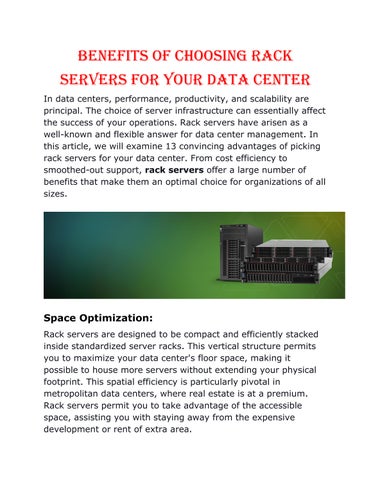
Benefits of Choosing RaCk seRveRs foR YouR Data CenteR In data centers, performance, productivity, and scalability are principal. The choice of server infrastructure can essentially affect the success of your operations. Rack servers have arisen as a well-known and flexible answer for data center management. In this article, we will examine 13 convincing advantages of picking rack servers for your data center. From cost efficiency to smoothed-out support, rack servers offer a large number of benefits that make them an optimal choice for organizations of all sizes.
Space Optimization: Rack servers are designed to be compact and efficiently stacked inside standardized server racks. This vertical structure permits you to maximize your data center's floor space, making it possible to house more servers without extending your physical footprint. This spatial efficiency is particularly pivotal in metropolitan data centers, where real estate is at a premium. Rack servers permit you to take advantage of the accessible space, assisting you with staying away from the expensive development or rent of extra area.
Scalability: Rack servers offer great scalability, permitting you to add or eliminate servers as your needs change. This scalability guarantees that your data center can adjust to growing conditions without the issue of extensive reconfiguration. The modular nature of rack servers means that you can undoubtedly increase your infrastructure or down as your business develops or if you need to adjust resources because of fluctuating workloads.
Energy Efficiency: Rack servers are known for their energy efficacy. They often come equipped with power-saving components, for example, high-efficiency power supplies and cooling technologies, helping reduce energy utilization and operating expenses. The energy savings related to rack servers lead to cost reductions as well as add to ecological maintainability, a vital concern in the present data center industry.
Simplified Cable Management: With rack servers, the cable management turns out to be more simple. Servers are perfectly organized within the rack, reducing cable mess and ensuring efficient airflow. It improves the server's cooling as well as simplifies maintenance and troubleshooting. The cable organization in rack servers brings about a cleaner and more visually appealing data center, making it easy for IT teams to identify and resolve issues.
Enhanced Cooling: Rack servers are built with advanced cooling features. Their design allows for hot and cold aisle configurations, further developing heat dissipation inside the data center. It evokes a cooler operating environment for your servers, which can extend their life and improve performance. Effective cooling management is essential in preventing server overheating, which can cause hardware failovers and disturb business operations.
Ease of Maintenance: Rack servers are easily accessible for maintenance and replacement. This accommodation limits downtime, as IT teams quickly swap out or service individual servers without disturbing the entire data center operation. This feature is vital for missioncritical applications where uninterrupted service is essential, as it allows for scheduled maintenance without disturbing activities. Conclusion: Rack servers offer a wide range of advantages for data centers, from space optimization to cost-effectiveness, security, and versatility. These benefits make them an appealing choice for organizations hoping to upgrade their data center activities while reducing operating expenses and improving reliability. As data centers continue to be a critical component in the digital age, the benefits of picking rack servers couldn't be more significant, and their adoption stays essential for organizations planning to remain competitive and efficient in a quickly developing scene. https://www.lenovo.com/au/en/c/servers-storage/servers/racks/