The
gateway A P u b l i cat i o n o f C h a r l e st o n Day S c h o o l
3
Judith Arnstein Visits Charleston Day School
4
Public Speaking Curriculum: A CDS Tradition
8
CDS Volleyball: Preparing to Win
spring 2018
10
Professional Development: Guided Math Gurus & Alumni Spotlight
Scholarship | Integrity | Respect | Responsibility
Thoughtful Change
Table of Contents CDS Kindergarten Judith Arnstein Visit
3 3
Public Speaking
4-5
Fifth grader Sam Applegate delivers his speech, “How will Global Warming Affect Charleston?”
Gibbes Junior Docent Program 5 As Seen on Social Media 6-7 CDS Girls’ Volleyball
8
Coach Dantzler with the eighth grade girls’ volleyball team.
The Run for Adela Equity and Inclusion Statement Alumni Spotlight Guided Math Gurus Excellence in Teaching Award Birthday Books Distinguished Service Award CDS’ 3D Printer 2017 Fiscal Year
9 9 10-11 10 12 13 13 14 15
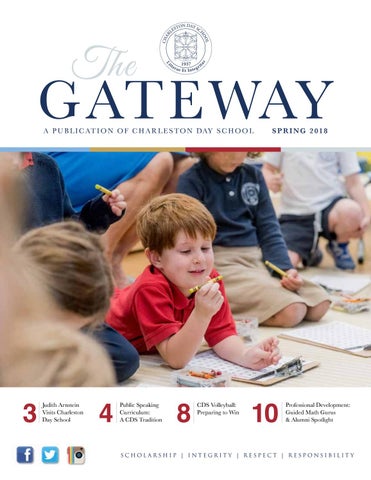
About the Cover Anderson Shortridge selects a crayon for a kindergarten math lesson. He is the son of third grade teacher Emily Shortridge and brother of third grader, Graham.
2 | spring 2018
Dear Friends, Writing this piece for The Gateway means I am coming close to the end of my term as Interim Head of School. The year has gone by quickly, and as I write this, we have only about fifty school days until commencement. With the time slipping away, I thought it would be appropriate to share some reflections on the year. Thinking back to last July and coming to a new home and a new school and job, I do recall some butterflies, but not any anxiety or trepidation. From previous experiences, Ann and I knew we would have the Charleston Day School community to welcome us and help us to feel at home. What we did not know was just how welcoming that would be. With notes, gift certificates, plants, tips on restaurants, dog biscuits, and a welcome mat (literally), a soft landing and pleasant start were ensured. We thank y’all for having made it so. Once underway, this has been a year of change for students, faculty, parents, and the entire school community. We are often quick to say change is hard. It can be. But, it also can be energizing; it can be enjoyable; and, it is essential to learning. Looking back over the year, above all else, I hope that what I have helped to provide Charleston Day School is a greater comfort with change. Thoughtful change preserves and strengthens core values while instilling a confidence to question and evolve. Thoughtful change will allow the school to remain a school of distinction. To that point, last week we invited a group of senior alumni and friends for lunch and an update on the school. One attendee recalled school ending at 2:00 p.m. and everyone going home for lunch. Our schedule and many other aspects of school life have changed since those days, but—and this is far more than semantics— “changed” and “different” are not the same. The generational, even annual, changes do not mean the core principles of Charleston Day School are different. Instilling commitment to scholarship, integrity, respect and responsibility has been our guiding principle, no matter where we were located, how society was changing, or how educational practices were shifting. The Charleston Day School mission is that essential and that strong. Additionally, if you fully accept the school’s mission, then change is to be expected; it is inherent in the mission. Learning and change are inextricably linked. We learn by experiencing change, and whenever we learn we are changed. In elementary years, we become readers and a new world is opened to us. As we grow, we read Miss Rumphius, Shane, To Kill a Mockingbird, (insert your favorites), and learn and are changed by the experience. The same can be said for other awakening moments: in history (One does not view Custer the same when meeting him at ten and then again at eighteen.); in art (“Those drips on canvas are art?!”); in science (“How could we have been so wrong about the solar system for so long?”); or in math (“Now I get it, and there is a beauty in logic, isn’t there?”). Learning changes us, and accepting change helps us to continue to learn. Soon it will be time for another change. I will miss being a part of the next phase of Charleston Day School’s development. The goals of the strategic plan are exciting and ambitious. The opportunities are great. The board is talented and committed to the mission and vision of the school. The faculty is exceptional in its willingness to know and reach every child. All the right stuff is here. I am confident the school is well poised to welcome Judith Arnstein and work with her to plan and implement the next steps to maintain Charleston Day School’s tradition of excellence. I will watch from afar with great interest all the good moments that are to come. As Ann and I continue to enjoy our days here, we will begin to anticipate the move from Charleston Day School, the Holy City and Lowcountry to the White Mountain School, Bethlehem, New Hampshire, and the High Country. We will do so thankful for what we have learned here and grateful for how Charleston Day School has enriched our lives. Tom Reid Interim Head of School
A Year of Firsts
I
n August, the faculty, staff and student body eagerly welcomed Charleston Day’s first kindergarten class, the youngest and smallest members of our community. Over the year, they’ve grown in confidence, maturity and stature. Whether listening to the 8th grade speeches at Assembly, participating in the Holiday Show with the story of the “Littlest Tree” or joining the 1st through 3rd graders at the Easter Egg Hunt, the kindergartners are fully engaged in life at Charleston Day. They have learned to greet visitors with eye contact and a handshake, stick with a buddy when walking off “We have watched them campus and try new foods at lunch. (The class show kindness to one another favorite is “Rudolph toast and antlers,” which and to each one of us. They have is French toast with raspberries and bacon.)
truly stolen our hearts! Confident and prepared, these kindergarteners will join the incoming students to make up next year’s first grade class.” – Garden Blincow, Kindergarten Teacher
Top: Annie Liipfert and Burkely Mullin. Left: CJ Seaman, Benton Goodwin and Anderson Shortridge. Right: Burkely Mullin, CJ Seaman and Annie Liipfert.
Number of Lil’ Scorps 1st and 2nd grade basketball players:
54
Incoming Head of School Visit Incoming Head of School Judith Foley Arnstein visited Charleston Day School in March in preparation for her move to Charleston this summer. She greeted students during morning carpool, visited classrooms, ate lunch with students and met with parents, teachers and administrators. Judith has extensive experience in enrollment management and marketing and a deep appreciation for independent school education and the K-8 model in particular. She will be moving to Charleston with her husband, Peter, an executive coach and former investment banker. Judith and Peter have three children, Ben, Joe and Mary Alice, who live in California and Illinois. Their bearded collie, Charlotte, will also join them in Charleston. We look forward to welcoming Judith and her family to the Charleston Day School community for the 2018-2019 school year!
Mrs. Arnstein visited several classes during her visit. In the kindergarten room, she played a math game.
spring 2018
| 3
P u b l i c S p e a k i n g C u rr i c u l u m :
Finding Their Voices, Facing Their Fears By Elizabeth Cook
during the first grade Community Helpers show, performing in French during the fourth grade Lion King play or reciting Shakespeare in the seventh grade Dramatic Reading. Two highlights of the public speaking curriculum are the fifth grade Speech Contest and the eighth grade Personal Speech.
Fifth Grade Speech Contest
Interim Head of School Tom Reid with eighth grader Gardiner Willis.
S
he scans the audience and notices her parents, a classmate’s mom, and a teacher who helped her prepare. Every student and teacher in the school waits attentively. Several cameras and video cameras point to her. She’s 10 years old — 10 and 3/4 to be exact. “I noticed that everyone was staring at me, and I was like, ‘Oh no, this is my time to shine,” said Lilly Mullin, a fifth grader at Charleston Day School and one of the six finalists to compete in the Speech Contest. She approaches the lectern, looks at the judges, takes a deep breath and begins. For the next five minutes, she tells the audience about compassion and provides examples of how to show it to others. Five of her classmates follow her, also delivering speeches they researched and wrote in class. The rest of her classmates present dramatic readings. Not one of them delivers a disappointing performance, and the same can be said year after year, for as long as anyone can remember. “Satisfied,” is the word Sam Applegate used to describe how he felt when it was over. “I didn’t really care about actually winning. I really just cared that I did well,” he said. Sam placed first for his speech, “How Will Global Warming Affect Charleston?”
A CDS Tradition For 35 years, Charleston Day students have been through this experience. The program was started by Mrs. Dottie Rhett, a fifth grade language arts teacher who firmly believed that every child should acquire public speaking skills. The contest was named in her honor after her death in 2014. Her husband, the Rev. Dr. William Rhett, Jr. attends each year. Public speaking instruction is woven throughout Charleston Day’s curriculum beginning in kindergarten. As students advance through the grades, they always have a speaking part, whether as the mayor
4 | spring 2018
Fifth grade students returned from Thanksgiving break with three possible topics for their speeches. By January, each had picked one. As a class, they visited the Charleston County Library to gather books for research. Over the next several months, students learned skills such as taking notes, forming outlines, and citing sources, following MLA style. The research challenged the students, said their teacher Mrs. Misty Boling. “Preparing bibliography cards, conducting the literature review, creating notecards, and then transposing what they learned from research into their own words and voice without plagiarism was difficult,” she said. “It was also the most rewarding part of the process for me, as I guided each student through the challenges and shared their satisfaction as they reached the end and could suddenly see the big picture and understand how well the process works.” While they learned in-depth knowledge about their topic of choice, they also learned how to be an effective speaker. Fear of public speaking is American’s biggest phobia, according to a 2017 Chapman University Survey on American Fears. “That fear is the hardest thing to overcome,” Mrs. Boling said. “My role is to provide them with the opportunity to have those experiences in this safe environment.” She introduced public speaking by modeling what not to do. She slouched, leaned over the podium and mumbled. Then, they talked about proper posture, deliberate pausing and enunciation. They watched videos of past speech contests and even judged the speakers using the same rubric that would be used to assess them. They also prepared for when things go wrong. “If you make a mistake, remember what we practiced,” Mrs. Boling told them before they presented. “Every single person who has ever presented a speech will have little things that don’t go just right. The key is to take a breath because that is a nice pause.”
While the fifth grade speech is factual, the eighth grade speech reveals a student’s passion or personal experience.
Continues on next page
Gibbes Museum of Art Junior Docent Program For years, Charleston Day School 8th graders have served as docents at the Gibbes Museum of Art. The students first visit the museum in January to select a piece of art they want to study further. Over the following months, they research the artwork and artist to become an “expert” on their piece. Then, they invite the younger students to share what they’ve learned. Wando senior and CDS graduate Virginia Howell (’14), was awarded the Fellowship for Art History at Sewanee, where she will attend this fall. As part of her application, she wrote about her experience at CDS’ Junior Docent program. She remembers walking to the Gibbes Museum of Art each year to listen as the eighth graders taught the students about the artwork. In an essay she submitted as part of her application, Virginia wrote: “From first to seventh grade, I went to the Gibbes at least once a year, if not more, and I counted down the years until I was able to do my Junior Docent project at the museum.” Top right: Students took the first step toward becoming junior docents at the Gibbes. This spring, they will guide our younger students through the museum, teaching what they’ve learned about the artwork. We love this project because it combines research, writing and presentation skills. Students love that they get to venture off campus and choose their own piece of art.
Number of CDS Gibbes Junior Docents over the past 3 years:
Taylor Howell (CDS ’10) and Virginia Howell (CDS ’14) on a recent visit to Sewanee.
82
Public Speaking continued
Eighth Grade Speech The fifth grade experience in the spotlight helps prepare students for the ultimate public speaking role at Charleston Day: the eighth grade speech, which is a capstone of the public speaking curriculum. “The eighth grade speech is bigger because it really can be the thing that determines how people remember you, the impact you left on them,” said eighth grader James Parsell. Preparing for the speech provides the most significant opportunity for growth, second only to the high school placement process, said Steve Garnett, an eighth grade teacher Number of grades who works one-on-one with students. that have While the fifth grade speech is factual, public speaking the eighth grade speech reveals a student’s in curriculum: passion or personal experience. The speakers often share past struggles or lessons learned. Garnett said he encourages students to consider the significance of the experience and to teach the audience something. Each student takes a turn presenting the speech to the entire school community during weekly assemblies throughout the year. Some topics this year include learning through failure, an appreciation for historical places, a family’s trip to Africa, and the value of manual labor. Back row: The Rev. Dr. William Rhett, Jr., with judges Allison Leggett, MUSC “Everybody’s looking at you. There’s nobody else to blame. Medical College Director of Communications, Robert Behre, editor of The Post There’s nobody else to fall back on. You are the most exposed and Courier; and Dirk Bedford, Meeting Street Academy principal. you’ll ever be,” Garnett said. “I love when they come in Front row: Fifth graders Spencer Edgerton, Sam Applegate, and Meade Cogswell. (afterwards) and say, ‘That was so much fun.’”
9
spring 2018
| 5
As Seen On A favorite CDS tradition shines the spotlight on our students—both those just joining our community as well as our oldest students. The 8th graders introduce the 1st graders one by one, sharing their favorite ice cream flavor, song or hobby and pointing out things they have in common. When we see the 8th graders stand side by side with the 1st graders, we really appreciate the growth they experience during their time with us. #publicspeaking
Number of non-profit organizations aided by school-sponsored projects:
18
Nearly 40 years ago, CDS 1st graders recited ’Twas the Night Before Christmas. When Chrystal Hawkins joined the faculty, music and dance were added, turning the classic poem into a full Christmas show. Some of the original set is still used and has been touched up by local artist and CDS grandparent, Sally Smith.
He didn’t want to be a prince, so this 2nd grader chose to be the green pea. Teachers can’t remember a student ever choosing to write from the pea’s point of view. “I got smooshed by 20 mattresses and a princess all night.” He’s writing the fairy tale from his perspective in preparation for the Fairy Tale Festival.
#traditions
Members from Charleston Day’s Class of 2014 are now seniors at 8 different high schools, and they reunited over winter break. We love seeing their grown up faces and look forward to hearing about the adventures that await them after high school.
#engagedlearners
#ouramazingalumni How wonderful it was to welcome these former faculty members to campus! The traditions and culture they established continue to benefit Charleston Day students.
#ouramazingfaculty
Eighth graders hosted their lunch buddies from Memminger Elementary for a holiday party. As part of character education class, the 8th grade partners with the preschool students at Memminger. Each week, our students walk the few blocks to the school, and they visit with them during lunch and recess.
#charlestonisourcampus 6 | spring 2018
Vision Statement Charleston Day School partners with families to provide a superior academic, artistic, athletic and ethical foundation, preparing each student for a lifetime of achievement.
Imagine reading more than 600 minutes (10 hours) outside of school within one week. Two 3rd graders logged that many minutes during last week’s 3rd Grade Read-A-Thon, and every student contributed by reading a lot more than usual. They asked friends and family to pledge money per minute read, and they raised $6,520 for the Sea Turtle Hospital at the Aquarium. What a thrill it was to present the check and get to see the turtles first hand! #communityservice During the 5th grade overnight field trip to Williamsburg, VA, this 5th grader heard “Patrick Henry” deliver his rousing speech at the re-enactment of the Second Virginia Convention, the same speech this student recited during the speech contest in March.
#creativelearners
Each year at Halloween, Charleston Day students walk around the corner to visit our neighbors at the Canterbury House. The residents enjoy seeing the students in costume, while our students relish the attention. We sang songs from the 50s, and the National Anthem.
#loveourneighborhood Number of documented student volunteer hours in a year:
Each year the 4th grade develops a business as a class, giving them many opportunities to learn how to set prices, understand the difference between sales and profit, and how to learn from mistakes. In the past, they’ve made pies, soup, cookie mix, cocoa mix, and even held an old-fashioned lemonade stand. Students met after school weekly throughout the fall to create and assemble the items. This year’s Holiday Market raised more than $1,700 for hurricane relief victims. Great work! #kidscan
700
Our community gathers twice a year for an All Student Art Show, which features work from each student in all nine grades. “You can visually see the progression from grade to grade, and that inspires a lot of kids, especially the younger ones,” said Art Teacher Liz Barry. The students see themselves as artists, and the show offers a way for students to share their work.
#artisticachievements
The 7th graders participated in team building activities at Kanuga’s Mountain Trail Outdoor School in Hendersonville, NC. They learned about teamwork, community and leadership.
#collaborativetasks
Team “Spicy Scorpions” showed off their newly acquired culinary skills at the Cut Throat Kitchen competition. In round 1, they made Fried Rice – with orzo pasta instead of rice – thanks to a sabotage ingredient swap from Porter-Gaud. For round 2, they had to incorporate box mac and cheese into Chicken Alfredo. Our team recovered by selling it as a dish that “touches to home.” Thanks to Chef Nick, who worked with the students after school for weeks to prepare for the event.
#funkitchencompetition spring 2018
| 7
P r e pa r i n g t o W i n :
Lessons of a Losing Season By Elizabeth Cook After the crushing loss in that second game, doubt set in and became one of the biggest challenges of the season, said Walker Givens. “We had to overcome ourselves, our minds telling us we can’t win.” The level of focus during practice immediately intensified, their coach said. “Their attitude changed so much when they saw Cario and schools like that play,” said Dantzler. They started asking to stay after practice or to come early to work with her. “They struggled with losing, and that made them work incredibly hard,” she said. “They got so eager, and they were incredibly fun to coach because they really did want to learn.”
Skills Developed with 100 Percent Effort
Left to right Callie Liberatos, Lilly Claypoole, Walker Givens, Coach Katherine Dantzler, Gardiner Willis, Emmy Keogh, Kennedy Burnett and Grace Kuyk.
F
ear set in during warm-ups as they watched their opponents, who played year-round travel volleyball. The tall, strong girls served overhand with ease and returned powerful strikes. Plus, the teams had about 14 players, offering plenty of substitutes. In contrast, the Charleston Day team consisted of only seven players. None played travel volleyball. Their coach was in her first season. Game after game they were, in their words, “blown off the court.” Humbled and intimidated are words the girls used to describe their feelings those first few games. After an initial win, they lost every other game. Yet, when Emmy Keogh described the season in her eighth grade speech, she said this: “We had a better, more satisfying year than any other year at CDS. Just to play in that league felt better than the last three championships combined.” These girls had been playing together since fifth grade, and winning had become easy and expected. They didn’t even get nervous before games. So, at the end of their undefeated season in seventh grade, they all agreed to advance to the A League, where they would face larger schools and more competitive play. One might think they regret moving to the more competitive league, but they don’t. Their only regret is that they can’t play all of the games again, not as the team they were at first but as they had become—a stronger team shaped by loss. Charleston Day maintains a no-cut policy, and all interested students are encouraged to participate in sports. While winning is not the focus of the program, preparing and competing to win is. That preparation helps students develop character traits aligned with the mission of the school, such as perseverance, tenacity and teamwork.
The Mental Battle During the first few practices, the girls were bubbly and constantly talking about Taylor Swift, said their coach, Katherine Dantzler.
8 | spring 2018
The Charleston Day team studied the other players during warm-ups. “Even though they might be better than us, we would take some of their techniques and improve our own skills,” said Gardiner Willis. “The season was definitely not boring.” They started working on jumping for spikes and not letting a ball drop between two people. Also, they became a lot more aggressive. “We actually had to dive for the balls and run across the court,” said Lilly Claypoole. They discovered why they needed knee pads. “We never used our knee pads (before),” said Kennedy Burnett. “This year we were on the ground 24 - 7.” By the end of the season, coaches from other teams were complimenting them on how much their skills had improved. “Of course you want to win, but knowing they had accomplished things they had never attempted before in volleyball made it really rewarding,” Dantzler said. “They really did learn a lot and really are ready for next year.”
Teamwork While improving their skills, the teammates continually encouraged each other. Even after a loss, Emmy said, they never described the game negatively. “Instead, we’d say, ‘Oh, Kennedy had a great serving game.’ ” They also used constructive criticism. “Instead of saying, ‘you need to get better at spiking,’ we would say, ‘try extending your arm out farther,’” Lilly added. This positive attitude was consistent. “I don’t remember anybody ever saying anything negative to another person on the team,” Dantzler said. She recalled when one player finally achieved her overhand serve in a game for the first time. “Everyone was so excited for her, even though we were losing.” After the last game, a close loss, the team remained wrapped in a huddle that lasted about 10 minutes. They were each crying as they realized it would be the last time they would play together in a Charleston Day uniform. Emmy recalled that huddle in her speech and said, “All of us knew deep in our hearts that it wasn’t about the trophy. It just wasn’t. It was about the process. It was about pushing ourselves, getting better at our skills, and supporting each other, whether the ball went in or out.”
E
stablished in 2010 in memory of a Charleston Day School graduate, Adela Holmes Cook (class of ’05), the Run for Adela is the only 5K on the beach at Sullivan’s Island. Charleston Day students and families rally to honor the memory of this young woman while helping to support a scholarship in her name. Starting a month ahead of the run, the CDS Running Club begins training physically to run the 5K on the sand or a 1-mile fun run/walk for the younger set.
The Run for Adela
“The Run for Adela is a highlight every spring for all of our students,” said athletic director Gigi Wallace. “They know how Adela loved CDS, and each student can find her on the mural in the gym.” This year, the organizers dedicated the run “to our collective friends and family watching from above, especially our namesake Adela Holmes Cook and our race director and fearless leader for the first seven years, Dicksie Johnson.”
CDS Board of Trustees Update As part of its ongoing discussions and efforts to increase diversity at CDS, in January 2018, the Board of Trustees approved the Equity and Inclusion Statement printed below. The statement is intended as a complement to our mission, providing a foundation for our inclusion efforts and the aspirations we have for our students. The Board recognizes the benefits and importance of providing an inclusive community for our students, families and faculty. We will use this statement and guidelines from NAIS to define diversity for Charleston Day School and develop our goals and initiatives. —Board Chair Ellen Smith
Equity and Inclusion Statement: As members of the Charleston Day School Community, we will treat all with dignity and respect to create a culture of inclusion, and we will be champions of difference to advance intellectual and personal growth while becoming engaged citizens of the world.
spring 2018
| 9
Alumni Spotlight
Zachary Kronsberg ’14 1. What about your experiences with Charleston Day prepared you for life as a senior at Academic Magnet? Academically, Charleston Day prepared me better for Magnet than I could have ever hoped. From the writing skills instilled in me to my Spanish speaking to an incredible background in math, the transition into upper level classes has not been challenging. Additionally, being at Charleston Day for eight years resulted in me falling in love with and truly caring about my school, which I have extended to Academic Magnet, allowing me to be as passionate about student leadership as possible. Charleston Day taught me how to build strong relationships with my teachers and administration, which has enabled me to succeed both academically and in my leadership roles. Finally, Charleston Day taught me how to become a confident public speaker, which I believe has been immeasurably vital in my life, as well as becoming an activity I truly enjoy. 2. As student body president, what’s been your biggest achievement? What’s been the biggest challenge, and how did you overcome it? As Student Body President, my greatest achievement has been bringing back intercom announcements as a way of keeping the students informed. My greatest challenge has most likely been balancing the different parties in student government matters, as in trying to fulfill the assignments placed on me by administration, while gauging the opinion of teachers and keeping the student body’s best interest in mind. Though this challenge is a continuous struggle and a concern with every decision I make, I place myself in an unbiased role outside of these interested parties and always do whatever I believe will help the school community. Continues on next page
Guided Math Gurus As part of professional development for Charleston Day faculty, third grade teachers Emily Shortridge and Kerry Murphy appreciate attending teacher conferences. Teaching partners at CDS for a decade, the two decided a few years ago to begin applying to present what they know to other teachers at these conferences as well as learning and networking. They now have given their presentation, “Become a Guided Math Guru,” six times and are looking forward to more presentations in the upcoming year. The Guided Math model is an innovative approach to teaching math in small homogenous groups with heavy teacher support. It utilizes technology, differentiated instruction, fact fluency practice, and high interest games. The intended end result is that all children feel successful, love math, and learn the baseline objectives for their grade.
Mrs. Shortridge leads a math game with third graders.
10 | s p r i n g 2 0 1 8
Alumni Spotlight continued 3. What are your plans for the future? What are your next steps and future career goals? As of right now, I know I am going to go to college next year; however, I am not yet sure where. I plan to study political science and public policy with an intention of going down a career path where I can use such knowledge with my dream being to serve in the US Senate. I am currently volunteering with a South Carolina gubernatorial campaign in order to gain experience and knowledge in the field of politics.
The best advice I could give to an eighth grader preparing to attend high school is to find something that you are truly passionate about and stick with it. If you try to do everything, you will not truly enjoy anything. Also, remember to mange your time well because you do not want to procrastinate and become overwhelmed. Both these lessons have been invariably important in my life. 7. What do you do for fun outside of school? How do you balance your life with academics? This is a constant struggle for me. I have strived to find the free time in my life but sometimes it has just been nonexistent. However, when I do have free time, my favorite thing to do is go see movies, which are truly relaxing for me. I also compete on my school’s Academic Team, do award predictions, and write film reviews, all of which help take my mind off of academics. Finally, I love spending time with my family, and the evenings I spend with my family help balance out the stresses of my school life. 8. Not only did your family choose to send three children to CDS, but you’ve been generous in beginning endowment funds that support future students and learning opportunities. What prompted this support?
Zachary teaches a math lesson in Mrs. Weisskopf’s 6th grade class.
4. What is your favorite CDS memory? I have so many amazing memories of being at Charleston Day for eight years that it is very difficult to choose one memory. One of my greatest memories was when I was in fifth grade and delivered my speech on Theodore Roosevelt, who at the time was my favorite president and seven years later remains my favorite president, winning the annual speech contest with a topic that reflected my continued fascination of American history and politics. Also, I fondly remember the pleasure of being Headmaster for a day in October of my seventh grade year, as well as probably the most conflicting morning of my life, the morning I graduated, which was both incredibly joyous and sad, as it was the end of my beautiful eight year journey. 5. What is your favorite piece of advice or wisdom from a CDS faculty member? Though it was not one specific piece of advice, during my first semester of eighth grade, Mr. Willits taught me how to handle anxiety, stress, and emotions by talking things through and taking a break from my hectic life once in a while to calm down. The conversations we had that year have enabled me to handle the great responsibilities I have taken on during my high school career and will without question continue to help me throughout my life. 6. What advice would you give to an 8th grader heading off to high school next year?
The endowment fund I was involved with started the summer after I graduated from CDS (2014). I had wanted to name the school’s math award after my math teacher, Justine Finch, who had retired from CDS after over 25 years. I proposed it to Mr. O’Shea (the former headmaster) and with the help of my parents and the staff of the school, I sent letters to alumni, students, parents, and other people associated with CDS to ask for support in creating the endowment to change the award name and financially support the math program. 9. You’ve been back on the campus of Charleston Day this year. What has been the occasion of your visits and what has it been like spending time here, not as a student, but as an alumnus? This semester, I am at CDS for about an hour every other day as the field experience for my Teacher Cadet class. Part of the curriculum of the class requires every Teacher Cadet to spend time in a classroom, observing and eventually teaching a lesson. I knew immediately that I wanted to come back to CDS because it has been such a vital part of my education and is like a second home to me. Luckily, with the permission of Mr. Reid and Mrs. Weisskopf, I am observing and assisting in Mrs. Weisskopf ’s 6th grade math class. It is so amazing to be back on campus, seeing what has changed and remained the same and interacting with many of my former teachers. Charleston Day is such a warm and welcoming place, and I feel like I have been welcomed back with kindness and without any hesitation. The most interesting part of the experience is that when I am talking to my former teachers, they talk to me as an adult, not as a the kid I was when they were my teachers, which is an odd, but amazing, feeling. 10. On final question - Red or Blue - which were you? I was on the Red team!
s p r i n g r 2 0 1 8 | 11
Excellence in Teaching Award In September, Mrs. Chrystal Hawkins, was named as the recipient of the Excellence in Teaching Award. The Fund was established in 2016 by a Charleston Day School alumni family who wanted to recognize and show appreciation for faculty members. Chrystal has served Charleston Day families by teaching music and inspiring students for the last 25 years. In addition to teaching music and leading productions — both grade level and school-wide, Chrystal sponsors the middle school drama elective class, which holds several performances a year. Students and faculty members alike treasure Chrystal’s friendly smile, positive attitude and affirming words. “Chrystal motivates all students to stretch their abilities and to produce at a level that surprises the students themselves, their parents, and the school community,” wrote one of her peers who nominated her. The middle school drama elective class presents Alice in Wonderland.
Music teacher Mrs. Chrystal Hawkins “motivates all students to stretch their abilities.” She was the first recipient of the Excellence in Teaching Award.
12 | s u p rmi m ng e r2 02 10 81 7
Distinguished Service Award:
Louise Maybank
Birthday Books
During their birthday months, Charleston Day students and
faculty members each receive a book donated to the Library in their honor. It’s presented to them during Assembly so that they can read it first before it enters circulation. We are grateful to Dr. Bob Calcote, a Charleston Day alumnus and local orthodontist, who supports the Birthday Book Program,
which has been instrumental in building our superb Library.
Books by the Numbers
books 300 Birthday given each year
16,000 Books in the Library checked out 6,648 Books during this year
Birthday Book Program
uses for 15+ Alternate the Library
A
Mrs. Louise Maybank with David Maybank, Ellen Smith and Tom Reid.
t the Former Trustee Luncheon in January, Mrs. Louise Maybank received The Distinguished Service Award. Generations of students have benefitted from her devotion to the school, said Board Chair Ellen Smith as she presented the award. “She has, for decades, shared her leadership abilities and her attention for what is right and appropriate for the future of the school,” Smith said. “It is because of her long-standing love and participation and superb leadership that we recognize Louise today.” The Award was established in 2016 to honor a member of the Board of Trustees or a valued school volunteer who the Board feels has made a significant impact to the Charleston Day School community, its future and to the mission of the school—to foster scholarship, integrity, respect and responsibility in our students. Last year’s recipient was Rich Leadem, former Trustee and parent of four Charleston Day graduates. Nearly 40 people attended the luncheon, which was held in the Library at the school. Interim Head of School Tom Reid provided a State-of-the-School address and highlighted the benefits of a K-8 model. The relationships formed at Charleston Day are the hallmark of the school, said Mrs. Maybank, as she accepted the award. Standing with her son David, she commented that her children have benefitted tremendously from the friendships formed during their years at Charleston Day.
Number of years Charleston Day School has been educating:
81
s p r i n g r 2 0 1 8 | 13
3D Printer Makes STEAM a Tangible Thing
T
his year, CDS middle school students have benefitted from the donation of a 3D printer. It has allowed new STEAM (Science, Technology, Engineering, Art and Mathematics) projects to be added
to the curriculum, specifically on engineering and design. Each 7th and 8th grade student designs and prints his or her own original object in Tinkercad, an online design program, utilizing the Engineering Design Loop — ask, imagine, select/plan, create, test and evaluate. After the designs are tested, students evaluate the changes that could be made to improve the design. One student who designed a phone stand took his previous research of cantilevers to redesign his object so it could hold the weight of his phone at a 45-degree angle without falling over.
Seventh grader, Ella Bragg displays her state of South Carolina key chain she made using CDS’ 3D printer. It took 45 minutes for the printer to make Ella’s designed keychain.
Number of minutes to 3D print a jewelry holder:
660
14 | s p r i n g 2 0 1 8
Number of minutes to 3D print a simple ring:
20
Charleston Day School Financial Information 2017 2017 Revenue Tuition & Fees Contributions Investment Income Supplemental Programs/ Other
2017 Expenses Salaries & Benefits Facilities Instruction & Student Services Administrative
Charleston Day School 2017 Annual Fund Participation by Constituency
92%
100%
100%
Parent Participation
Board Participation
Faculty Participation
spring 2018
| 15
15 Archdale Street Charleston, SC 29401
Mission Statement The mission of Charleston Day School is to foster scholarship, integrity, respect and responsibility in our students.
Fifth graders visit the exhibit “Sea Change” at the Halsey Institute of Contemporary Art. One installation is made completely of recycled plastic! “Sea Change” is a series of exhibitions and programs presented in collaboration with the South Carolina Aquarium to raise awareness of the plastic waste problem and its detrimental effects on the planet.
Non-Profit Organization Charleston, SC Permit No. 180