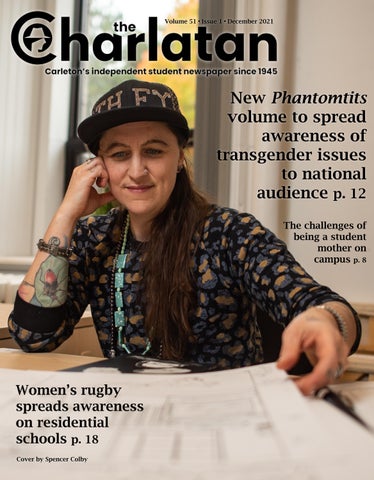
Volume 51•Issue 1•December 2021
New Phantomtits volume to spread awareness of transgender issues to national audience p. 12 The challenges of being a student mother on campus p. 8
Women’s rugby spreads awareness on residential schools p. 18 Cover by Spencer Colby
Editor’s Note
1 December 2021 Editor-in-Chief: Jillian Piper • editor.charlatan@gmail.com
This year, the Charlatan is bringing new meaning to the term ‘special issue.’ After nearly two years on a printing hiatus due to the COVID-19 pandemic, this issue commemorates the return of the Charlatan to the Carleton University campus. When the Charlatan staff returned to Room 531 at the beginning of this academic year, the newspaper had changed significantly from preCOVID times. We no longer print regularly, and are only publishing two special issues this year. Volunteers also can’t be in the office due to COVID-19 capacity limits. These changes sting. There are few feelings that can compare with the rush of a new author seeing their name in print or witnessing the look of joy on a source’s face as they hold their story in their hands. We miss hearing volunteers laughing in the office, mingling with editors and placing Charlatan stickers on every surface in sight. While some of the changes to our newsroom have been less than desirable, we’ve witnessed even bigger changes in the world. The COVID-19 pandemic has spotlighted some of the structural inequalities that have plagued the systems and institutions all around us. While these issues have always existed, the pandemic has sparked new conversations and reinforced ongoing activism. From the need to advocate for disability rights to racial equality to unlearning colonialism, the pandemic has emphasized the fact that we cannot go back to how the world operated pre-COVID. As institutions and stakeholders attempt to settle into the ‘new normal,’ advocates and everyday people continue their activism to make the new status quo more inclusive and equitable than before. To honour the ongoing fight to create a more just world, the Charlatan staff voted to center this issue around social justice. We hope to highlight stories of Carleton community members and others alike who are making their voices heard on issues that matter to them.
News
2 December 2021
How cancelling the ASP hurt Carleton students
Kimberley Chiasson, center, is seen with her mother Susan during a CU Care Walkout on Sept. 22, 2021.
PHOTO BY SPENCER COLBY
DOMINIQUE GENÉ AND ZOE FLEMING
As her peers sit in classrooms and lecture halls, fourth-year journalism student Kimberley Chiasson has to log in to Zoom from her home in Sudbury, Ont. and hope her internet does not cut out. Chiasson is one of many Carleton students with physical disabilities who could not live on campus this fall after the university suspended its Attendant Services Program (ASP) in May. The program offers students on-call attendants who help them facilitate basic needs, such as going to the cafeteria and doing laundry.
While the university announced the program will resume in January, the absence of ASP prevented clients from returning to campus alongside their peers earlier this academic year and had lasting effects. “Right now, [the ASP] is consuming my experience as a student,” Chiasson said. Not being able to return to campus meant Chiasson missed out on in-class discussion and collaborative work offered in-person. “It’s just taking a lot of more effort to keep up with my other classmates when they have certain advantages that I don’t,” Chiasson said.
Chiasson is not alone. First-year political science student Benjamin BourneFlosman was also unable to live on campus without the ASP. Missing out on in-person activities meant he cannot access the same networking opportunities as his peers, BourneFlosman added. “A big part of the university experience is making connections,” BourneFlosman said. “I want to be a politician or a lawyer, so it’s really important to me to make these connections to get into the workforce.”
charlatannews
December 2021 When BourneFlosman and Chiasson tried to hire personal caregivers to help them return to campus, the university denied them. Steven Reid, a spokesperson for Carleton, wrote in an email to the Charlatan that having individuals hire their own caregivers to return to campus was not possible. He wrote this solution was not viable for the same reasons the ASP was suspended. “The unique needs of the [ASP], the current pandemic, and public health and safety requirements means the program cannot be offered this fall in a safe manner,” Reid wrote in the email. Chiasson said she approached the university with a legal team in May asking to hire her own personal caregivers to help her return to campus. Chiasson added she would provide proof the workers were fully vaccinated and have them adhere to the university’s COVID-19 protocols, but Carleton University denied her proposal. BourneFlosman has been receiving care for most of his life through an agency called the Local Health Integration Network (LHIN). The agency is run by Ontario Health and connects clients with living assistance across the province.
“
Right now, [the ASP] is consuming my experience as a student
”
Kimberley Chiasson Carleton Student
BourneFlosman said he emailed the university in June asking if he could continue receiving care from attendants vetted by LHIN while he lived in residence. The university denied BourneFlosman’s request in August. Reid said allowing third-party attendants on campus introduced additional issues. “The university also reviewed the option of individuals hiring their own personal support workers,” Reid said. “This is not a possible option for the reasons previously stated as well as additional liability, risk and insurance requirements.” Time and effort spent trying to return this fall is not the only cost of the program’s suspension. Chiasson said the status of the ASP impacts her graduation timeline. She added she is currently taking a reduced course load
3
BourneFlosman was affected by the ASP cancellation.
and is expected to graduate in her fifth year. Not being able to return to campus impacted his mental health, BourneFlosman added. “Most of [my friends] went to university, so I don’t have as much of a social life. I’m home alone,” BourneFlosman said. “It is deeply saddening to sit at home and watch as my peers go to university.” Matthew Cole is the executive director of ASP. He emailed ASP clients in late October announcing the services would resume this winter. BourneFlosman and Chiasson spoke to the Charlatan in October, after the program’s return was announced. They said there is still
PHOTO PROVIDED BY BENJAMIN BOURNEFLOSMAN
more work to be done. “I’m really relieved that we’ve had gotten an answer,” Chiasson said. “The winter term is only a couple of months away now and people do need a lot of planning when it comes to being able to return to campus.” BourneFlosman said while he was “really thrilled” to hear the program would resume, he wished the initial statement explained why the ASP could not resume alongside other in-person services.
* Kimberley Chiasson has contributed to the Charlatan.
Protestors are seen during a CU Care Walkout on Sept. 22, 2021.
PHOTO BY ANYA SWETTENHAM
charlatannews
4
December 2021
Carleton Kinàmàgawin makes progress amid calls for communication MARK RAMZY AND KYRA VELLINGA
In May 2020, the Carleton University Strategic Indigenous Initiatives Committee (CUSIIC) released 41 calls to action in a report titled, Kinàmàgawin. More than a year later, Carleton is progressing slowly but surely through that list of actions.
“
Kinàmàgawin is about the future. Learning in the Indigenous way, the humility of seeking and sharing knowledge of all of our gifts will ensure that the next seven generations will benefit.
”
Elder Barbara Dumont-Hill Committee representative
In 2019, the CUSIIC hosted over 40 engagement sessions with Indigenous and non-Indigenous people within Carleton and the wider community to construct a formal report for the university to focus on. “Kinàmàgawin is about the future. Learning in the Indigenous way, the humility of seeking and sharing knowledge of all of our gifts will ensure that the next seven generations will benefit,” Elder Barbara Dumont-Hill wrote in the report’s opening. According to the report, Kinàmàgawin aims to cultivate safe environments for Indigenous knowledge, ensure all graduates understand Indigenous culture, increase Indigenous peoples’ representation within Carleton’s faculty and student body and recognize the need to combat institutional issues. Carleton interdisciplinary studies librarian Martha Attridge Bufton, who participated in the initial sessions, said the Kinàmàgawin calls to action are “visibly engaging steps towards creating positive change.” Attridge Bufton said the sessions were centered around consensus decision-making and embraced the voices of all participants. Third-year geophysics student Gavin Woodburn from Kwiakah First Nation said
the CUSIIC “did a great job at making us feel like the students are equally as important as some of the faculty members that are also working in this.” Kinàmàgawin was modelled after the federal government’s Truth and Reconciliation Commission’s (TRC) 2015 calls to action which have a section dedicated to “Education for Reconciliation.” The Kinàmàgawin report reflects some of the demands in the TRC, especially Call to Action #62ii which calls for the federal government to work with post-secondary institutions to better integrate Indigenous knowledge and teaching methods into classrooms.
GRAPHIC BY SARA MIZANNOJEHDEHI
Carmen Robertson, who is joint-appointed to Carleton’s School of Indigenous and Canadian Studies, said adequate progress has been made by the university. “I think Carleton has done an impressive job of beginning to follow through on the 41 calls to action with new programs, new hires and opportunities for change,” Robertson said. However, Woodburn cited COVID-19 as a barrier to some calls to action. “You can see some areas that they’re
working on and other areas where maybe once COVID is less of a thing they’ll be able to properly start working towards,” he said. At a Sept. 30 meeting of Carleton’s Board of Governors, Kinàmàgawin co-chairs Benny Michaud and Kahente Horn-Miller provided an update on the calls to action’s progress. They said Carleton’s progress can be seen through the hiring of Indigenous faculty, the launch of the Indigenous Peer Mentorship program and the introduction of the new Collaborative Indigenous Learning Bundles, among other ongoing projects. Attridge Bufton, Robertson and Woodburn also said there are now additional safe spaces on campus, additional funding for Indigenous research and new courses to promote Indigenous knowledge and culture. Moving forward, Robertson and Woodburn said they believe the school could improve in communicating its progress. “When we had started out with the Kinàmàgawin report, I saw in weekly or monthly newsletters a bit about the progress,” Woodburn said. “But in terms of, is there anywhere you can actually see the progress? There’s nothing that I know of.” Robertson agreed, saying “we need to be sure that the calls to action continue to be part of yearly planning.” She added that the school has yet to introduce Indigenous language and culture courses taught by native language speakers.
“
Is there anywhere you can actually see the progress? There’s nothing that I know of.
”
Gavin Woodburn Carleton student and committee representative
Woodburn said more work needs to be done but expressed hope in the steps Carleton is taking. “I think there will be lots to come,” Woodburn said.
National Study finds climate crisis and income equality intertwined
5 December 2021
Protestors hold signs during a climate strike on Sept. 24, 2021.
PHOTO BY SPENCER COLBY
ANGEL XING
A recent study conducted by University of Waterloo and University of Guelph researchers has found polarization between the rich and poor over addressing climate change exascerbates the issue. The researchers used game theory to create a social-climate mathematical model that investigates how low and high-income groups take climate mitigation actions. They found that a rise in polarization between the two groups leads to a global peak temperature increase of up to 0.7 C. The study found that individual socioeconomic conditions affect why an individual takes climate mitigation actions, but perceptions of the other group’s actions have a dominant effect on each other. “There’s more cost for the poorer group to pursue the climate mitigation strategy,” said Jyler Menard, a computational mathematics master’s student at U of W and co-author of the paper. He said the poor group faces other daily burdens such as living costs that make taking climate action more difficult.
“When you look and you see someone who is capable of mitigating the climate or seems to be in a better position than you not doing anything, then you might feel resentful or bitter that they’re asking you to do something,” Menard said. He added that the study was inspired by France’s 2018 Yellow Vest protests which demonstrated against President Emmanuel Macron’s green tax on fuel that disproportionately affected low-income groups who rely on vehicles for transportation. “Ostensibly, it’s a way to reduce carbon emissions, but now you are also punishing people who are already burdened,” Menard said. The study also investigated homophily—the extent to which one listens or is receptive to the opinions or ideas of external groups. They found that both income groups gather with like-minded people and form echo chambers where their opinions aren’t contested. “We find that these echo chambers are what can drive this polarization in re-
sponse to climate change,” said Thomas Bury, an applied mathematician at McGill University and co-author of the study. Bury, who conducted this research during his PhD at U of W, said the study’s mathematical model demonstrates a need for trust between income groups to achieve climate goals. “Methods of improving communication between richer and poorer groups are very important to mitigating climate change,” he added. Bury said people typically think that climate solutions involve reducing costs for products such as solar panels. But the research model found reducing costs is insufficient if polarization between the two groups is not reduced. “Using policies to achieve better communication is a prerequisite to achieving climate goals,” Bury said. “We can’t just focus on trying to make mitigation cheaper.” Ami Gagné, a director for the national non-profit association of communitybased environmental organizations Green Communities Canada and a Carleton University environmental studies and human geography student, agreed with the study’s conclusions. She said the climate crisis “is not just about mitigating your own greenhouse gas emissions. It has to be understood from a community level, from a national scale.” “The interconnection of these issues are going to be more and more apparent as it comes to a point when climate change reaches that irreversible tipping point,” Gagné said. Gagné said connecting the issues of climate change and wealth inequality is important to inciting climate action. “It’s all about positionality,” Gagne said. “You just have to know where you are in the world, how you can make a difference."
charlatannational
6
December 2021
Mount Royal unveils first-ever virtual reality class MACKLEN LINKE
An avatar of Tony Chaston in the VR world he built for the course.
As some students continue classes in online and socially-distanced settings, a new course at Mount Royal University is running via virtual reality (VR), which the school says is the first of its kind. The course, titled The Digital Frontier: Perception, Virtual Reality, and AI in Psychology, focuses on psychological theory, human perception of artificial intelligence and VR. The VR world created for the course serves as a hands-on format for the course material. Tony Chaston, an MRU psychology professor who created the course, has a research background in human sensation and perception of environments and light. After crafting the course content, Chaston decided VR would be the ideal format.
“We could learn by just experiencing things like, ‘What do you see around you? What do you hear? Do you see any of the rules and principles that we talked about?’ You can only do that if you’re in VR,” Chaston said. Chaston, inspired by the Rocky Mountains, filled his VR space with trees and lakes. Breakout rooms were replaced by campfires. Launched this fall, the first day of class was a new experience for the 20 enrolled students and Chaston alike. “I did have a little bit of a moment when on that first day of class, all my students actually made it successfully into my digital classroom and they were all in front of me and I was on stage for the first time on this platform,” Chaston said. “I
PHOTO PROVIDED BY TONY CHASTON
have to admit, that was pretty cool.” Ashlene Dembicki, a fifth-year honours psychology student enrolled in the course, said she sees much potential for VR in her future career as a psychologist. “I want to be the best psychologist I possibly can be one day, so I want to start perfecting using tools such as VR,” Dembicki said. “I ideally want to be working with trauma-based clients and VR works incredibly with them for mindfulness and for desensitization.” The potential of VR as a tool for psychology has been observed by other researchers. According to a study by Giuseppe Riva, a professor of psychology at the Catholic University of Milan, VR can create secure environments where patients
charlatannational
December 2021 can confront issues that may be difficult to discuss with a therapist in person.
“
Psychiatry is always going to be building towards trying to make everyone’s lives easier, more accessible, more equitable.
”
Quinta Seon Research Assistant, Douglas Mental Health University Institute
Exposure therapy, commonly used in VR therapy sessions, aims to tame fears and traumatic experiences through virtual exposure to triggers, according to Quinta Seon, a research assistant at the Douglas Mental Health University Institute in Montreal. She also said VR psychiatry is ideal for reaching remote communities and can be tailored to different cultures so participants feel more comfortable. “Psychiatry is always going to be building towards trying to make everyone’s lives easier, more accessible, more equitable,” Seon said. “That’s where VR is trying to go.” The accessibility of VR can also extend to classroom settings. As classes resume
in-person following a pause due to the COVID-19 pandemic, those who cannot return to studies on-campus could complete assignments using VR. Erik Christiansen is an MRU assistant professor and librarian with an IT background who helped Chaston troubleshoot issues during the course’s development. Christiansen said VR can be ideal for programs such as psychology and engineering that traditionally require handson demonstrations. He also said VR can be used to simulate medical procedures which can improve the quality of training for staff and students. “Rather than using dummies and dolls and things that have limited feedback, if there’s somebody on the other end playing the other character, there’s some really cool kind of role-playing and stuff that you could do to train people in those situations,” Christiansen said. Dembicki said she finds VR to be more engaging than an online or in-person class. “I actually think I focus better in this [class] than in person or during Zoom,” Dembicki said. “This way, I have no way to access my phone or emails or talk to
One of the VR working areas displays pages of a published research article for class discussion.
7 anyone. I am in my basement and forced to focus because I have to have my headset on at all times or I miss something.” Christiansen said students likely won’t be seeing their in-person classes go virtual. But the age of VR may just be starting. “VR in particular, I think, is really going to be the logical next step for online learning,” Christiansen said. “Ultimately, it’s an area of interest, not just for gaming, but for connection and communication.” In an era of online classes, Chaston said he believes holding more classes in VR could be a huge improvement from logging onto Zoom calls. “This is an opportunity to explore if this could be a new avenue for distance learning, something that would create a sense of interaction and community that traditional distance learning doesn’t,” Chaston said. Dembicki said VR’s true value is its ability to foster a sense of community. “It would be my dream to give everyone in the whole world a VR headset—so they are able to experience new sights and connect with people they would never have the opportunity to, especially the most vulnerable [populations],” she said.
PHOTO PROVIDED BY TONY CHASTON
Features
8 December 2021
‘Exposed’: The undue challenges student mothers face on campus
I
Dominique Gené reports on motherhood and mental health
n 2015, nearly four months after giving birth to her son, Christiane Lafleche enrolled at Carleton University to complete her master’s in social work. With a merit scholarship that covered the full cost of her two-year tuition, she said she felt privileged to continue her studies without worrying about having enough money to pay for school. Having her husband at home caring for their baby also bought her some relief. Lafleche wasn’t alone as a student mother. A 2011 study in the Canadian Journal of Higher Education found that from 1976 to 2005, between 11 and 16 per cent of post-secondary students had at least one child. Navigating being a mother and student turned out to be more challenging than Lafleche expected. From not having access to accommodations for mothers on campus to adjusting to her new identity as a mother, Lafleche said she had a difficult experience. “I thought that people would be totally understanding and supportive, but I think like most people, before you become a parent, you have no idea what you’re getting into,” Lafleche said. “I think I had a little bit of rose-coloured glasses about the experience.”
A challenging experience
In her first year, Lafleche took an intensive course that was offered during the first week of classes. The course ran from 9 a.m. to 4:30 p.m. with two 15-minute breaks and an hour for lunch. As a new mom, she said she needed to pump her breast milk frequently to keep her milk supply high and have enough milk for her baby once she gets home. According to the Canadian Breastfeeding Foundation, regular pumping also helps prevent health issues such as mastitis, a risk Lafleche said she was concerned about. The foundation categorizes mastitis as an infection that occurs when the breasts are not completely drained and become inflamed. Lafleche contacted her professor before the course began to ask for extra time to pump but was unsuccessful. “I had asked the professor via email if I could have a bit of a longer break because I needed to pump milk and the professor said no,” she said. “I wasn’t allowed to have a longer break.”
Lafleche decided to use her lunchtime to pump, but this led to another challenge—finding a comfortable and private space to pump on campus.
The need for lactation rooms
While the Ontario Human Rights Commission protects women’s rights to breastfeed in public spaces, some mothers like Lafleche prefer to have more privacy. Eventually, Lafleche reached out to the graduate administrator of the social work program and they reserved a room for her in Dunton Tower to pump. But the room was too far from her classroom in Leeds House, so she had to run between locations. “[I] didn’t even have time to eat,” Lafleche said. “It felt so stressful and unpleasant.” As a result, Lafleche said the next day she ended up having to pump in one of the dorm laundry rooms which was uncomfortable since young women and men would enter the room. “I just felt very exposed,” Lafleche said.
“
I think I had a little bit of rose-coloured glasses about the experience.
Christiane Lafleche Carleton graduate
”
She was not alone in her experience. Lafleche recalled seeing a mother recovering from a C-section struggle to go from the classroom to the accommodation room as well. The Ontario Public Health Association (OPHA) Breastfeeding Promotion Workgroup explains facilities for breastfeeding and pumping need to be clean and private, equipped with comfortable chairs with supportive arms for breastfeeding and small tables, chairs and electrical outlets for expressing breast milk. Appropriate signs that indicate the designated room is in use are also required. The Graduate Students’ Association (GSA) at Carleton provided a space where Lafleche could pump, but she said the lack of privacy still persisted. She added that having GSA’s support helped her in her experience.
December 2021
charlatanfeatures
Chichi Ayalogu, current GSA president and mother, said the association plans to work with the Dedicated Access Fund Committee (DAF) to create designated nursing rooms on campus. According to their online profile, DAF was created in 1991 to make existing buildings and facilities on campus more accessible.
9
Last year, the GSA proposed a project with the committee to offer baby changing stations in washrooms across Carleton’s campus. The GSA is also one of the few facilities on campus with a baby changing station, Ayalogu said. “This is something I noticed was missing. Every time I would come on campus, I did not have anywhere to change my baby’s diaper,” Ayalogu said.
charlatanfeatures
10
Changes on campus
In response to Lafleche’s experience, Carleton wrote in an email to the Charlatan that the school aims “to provide an inclusive environment for everyone in its community. Carleton’s Womxn’s Centre provides a quiet space on campus for breastfeeding.” The Womxn’s Centre, run by the Carleton University Students’ Association (CUSA), provides a safe and comfortable space for students who wish to breastfeed or pump. Located on the third floor of the University Centre, the space is fully equipped with desks, sofas, pillows and electrical outlets.
“
I just felt very exposed. Christiane Lafleche Carleton graduate
”
A sign is posted on the door to let people know when a mother is breastfeeding, according to Yumna Khan and Aminah Derman, the centre’s programming and administrative coordinators. The centre also offers free hygiene products such as pads and tampons, along with baby diapers. The coordinators said they plan to continue mother’s support groups this year that the centre started offering last year but were put on hold due to the pandemic. The support groups include monthly themes such as self-care for mothers. “At this point when you have a child, most of the mothers’ priority is given to that child,” Khan said. “We want to bring back priority to mothers.” The Colonel By Child Care Centre is also located on Carleton’s campus and provides programming for infants, toddlers and preschoolers.
The needs of breastfeeding mothers The need to accommodate nursing mothers exists beyond the university setting. Alanna Bamber, an industrial design Carleton alumna, designed a public breastfeeding seat as part of a capstone project during her final year.
December 2021
She named it the Sanctuary Public Breastfeeding Seat. The seat features a high armrest, a padded sidewall to reduce distractions for both the mom and the baby, a reclined padded backrest and a tabletop surface for personal belongings. It also only has an armrest on one side to cater to larger infants and toddlers and to allow the breastfeeder to still participate in the social environment. Bamber worked with the Canada Science and Technology Museum to make it an inclusive seat that meets the needs of breastfeeding mothers. The seat was selected along with another student’s work to be used at the museum’s central hub. Bamber’s mother, who was a breastfeeding coach in the 1980s, inspired her project. In the 1980s, accommodations were scarce and the social stigma against public breastfeeding was prevalent. Bamber said she conducted primary research by going to the museum to determine what types of seating were accessible. “One thing that I was hearing a lot was that there wasn’t a ton of space to breastfeed,” Bamber said. “Often if [those who breastfeed] didn’t have the opportunity to breastfeed, they had to leave the museum early.”
December 2021
charlatanfeatures
Through a survey Bamber conducted on her Facebook page, she said the biggest concern for a breastfeeding seat was comfort. Other concerns included making others uncomfortable, lack of arm support on chairs and distractions. Working on this project opened her mind to the discrimination nursing mothers and women still face, she said. “Our society is becoming really progressive in a lot of ways in terms of gender identity and sexual orientation, but then with this idea of breastfeeding, we’re still kind of stuck in this mindset of like ‘Oh no, a breast!’” Bamber said.
Motherhood and mental health
Pamela Green, a registered psychotherapist at Green Psychotherapy and Wellness, said a lack of accommodations for new mothers can have a negative impact on their entry into motherhood. “It’s so important for new moms and their mental health to not only have access to support but also access to services because that really impacts them mentally,” Green said.
11
“They’re entering into this journey, which for many, especially first-time moms, there’s a lot of fear and anxiety.” For student mothers, balancing studies while raising a child can take away from the enjoyment of being a new parent and potentially lead to depression, Green said. “There can be a lot of conflict for moms in that position, feeling like they don’t have a choice on how they’d like to parent,” Green said.
“
It’s so important for new moms and their mental health to not only have access to support but also access to services because that really impacts them mentally. Pamela Green Psychotherapist
”
Shaming women for breastfeeding or pumping in public spaces is another factor that affects a mother’s mental health and ability to adjust to motherhood. Green said making mothers feel like they are an inconvenience for others can cause them to make alternative choices they are not comfortable with such as dropping out of school. Green encourages mothers to recognize that the shaming is a result of other people’s discomfort or lack of available services to make breastfeeding possible. For positive experiences, mothers need to feel supported in public spaces, Green said. Lafleche said in her second year, she received support from her peers and instructors, some of whom were mothers themselves. But not meeting the needs of mothers makes it difficult for them to complete their studies, she said. Providing proper accommodations for mothers is about asking different students what they need to be comfortable, Lafleche said. “Why are we making it so much harder for them?”
Arts/Culture
12 December 2021 Arts Editor: Pippa Norman • arts.charlatan@gmail.com
Phantomtits to release second volume Graphic novel brings awareness of transgender issues to a national audience ZENITH WOLFE
Tierney holds volume one of their graphic novel, Phantomtits.
PHOTO BY SPENCER COLBY
After the positive reception of Phantomtits volume one, author and Carleton University graduate Cara Tierney hopes their upcoming second volume of the graphic novel will continue challenging readers’ preconceptions about the transgender community. The first of the stories’ three volumes, self-published in November 2020, explores the main character’s transgender identity through a semi-autobiographical retelling of Tierney’s double mastectomy, also known as top surgery in the transgender community. The main character discovers their family’s history with breast cancer and uses that knowledge to get top surgery. They decide to cremate their breasts and are then haunted by the breasts’ ghosts at the end of the novel. With plans to publish the second volume by early 2022, Tierney said the next instalment of the story will adopt a more fantastical tone which will further explore how trans people view their bodies in relation to gender. “The main character has to figure out what these ghost breasts do, what their powers are—if they have any powers—and then what their relationship is with the main character,” Tierney said. They added that this new tone will be used to comment on how the public perceives trans people. “Hopefully, the absurdity of being accompanied by ghost breasts will reflect upon some of the absurdity of anti-trans rhetoric,” Tierney said. The British Columbia Human Rights Tribunal ruled on Sept. 29 that classified purposeful misgendering in the workforce was a human rights violation. When asked about how this development would impact the story, Tierney said these types of subjects would likely be addressed in the third volume, to come at a later date, alongside commentary on activism, protests, freedom of expression and the invitation of
December 2021 controversial speakers to events. As the story evolves, the development process behind the novels has shifted too. Since volume one was based on Tierney’s unique experiences, they wrote most of the story and dialogue. The novel’s art was designed by Ottawa-based artist and illustrator Pascale Arpin, but the reference images were provided by Tierney, who took them during independent photoshoot sessions. The second volume’s tonal shift has made the development process with Arpin much more collaborative, according to Tierney. Writing and panel design have been done together, which has made the processes more efficient despite their busy schedules. Within Ottawa’s transgender community, there have been positive responses to volume one. Aaron Daniels Casey, a transgender man who works at the Comic Book Shoppe, said that Phantomtits provides good commentary on how hard getting top surgery can be. “It’s like this for all surgeries relating to trans folks,” Casey said. “I’ve been on a waitlist for three years for something that I don’t even know when it’s going to happen and it’s something I know will make me a lot more comfortable and happy with my body.” Casey added that because the novel is both educational and fun to read, it makes the subject of top surgery more approachable. “Medical stuff can be so scary and taboo to talk about,” he said. “When you can joke around and just be saying ‘boobs’ … as childish as it is, it makes people laugh.”
charlatanarts/culture
13
Tierney is a professor in history and theory of arts at uOttawa.
The Comic Book Shoppe sold its initial shipment of the first volume quickly. Now the shoppe is selling an additional shipment “pretty steadily,” according to Casey. Phantomtits has also been supported by other local businesses, such as Black Squirrel Books on Bank Street and the Ottawa Art Gallery. Tierney said that after selling their first copies at the Ottawa Art Gallery, they contacted bookstores in Nova Scotia, P.E.I., and Newfoundland. This gave them the opportunity to talk to bookstore owners in other provinces about the LGBTQ+ community. “I had a really wonderful conversation with a [bookstore] owner in P.E.I. who started it off by saying ‘I’m sorry if I ask questions that offend you, but I want to be a
Tierney flips through a draft of Phantomitits in their office at uOttawa.
PHOTO BY SPENCER COLBY
PHOTO BY SPENCER COLBY
space where queer people can come and find books,’” Tierney said. This P.E.I. bookstore owner, Nancy Quinn, runs the Seaside Bookshop. Quinn said she mostly sells used books, but she wanted to support Tierney’s novel because she felt it would help her and the community learn about transgender peoples’ experiences. “I didn’t even know the actual phrase— the correct phrase ‘top surgery,’” Quinn said. “I was like ‘Oh my god, this is kind of like discovering a new language. It’s awesome.’” Quinn said she has been mentioning the novel to people who browse the “sexuality” section of her store, where she sells books about feminism and LGBTQ+ subjects. When Phantomtits volume two is released, Quinn said she intends to sell it in her store. Independent of the novel and Tierney, she also reached out to PEERS Alliance, an LGBTQ+ support organization based in P.E.I., to offer her bookstore as a space for their meetings. “Maybe the conversation hasn’t started because there really isn’t a place for it, but maybe I can facilitate that,” she said. Tierney said they hope their work as an artist can help more people learn about LGBTQ+ identities and communities. “Figuring out I was queer and trans often felt like a very isolated and individual process, whereas identity is … something that we forge in the collective,” Tierney said. “Sometimes an artwork can be like a bridge into a community or conversation that you otherwise feel disconnected from,” they added. q
charlatanarts/culture
14
December 2021
New scholar-in-residence works with Carleton’s Transgender Media Lab MIKE HERMIDA
Cáel M. Keegan is bringing his cuttingedge research skills on queer media studies to Carleton University as a scholar-inresidence this academic year. During his stay, Keegan, an associate professor of women, gender and sexuality studies at Grand Valley State University in Michigan, is working with Carleton’s Transgender Media Lab (TML). TML investigates audio-visual work by transgender, Two Spirit, nonbinary, intersex and gender-nonconforming people. Keegan is collaborating with the lab on a research project related to misrepresentation of the transgender community in the media. Initially scheduled to come to Ottawa in the fall, Keegan has been working virtually due to COVID-19 restrictions and will arrive in the winter term instead. While working as a lecturer in American and ethnic studies after completing his PhD, Keegan met various leading scholars in queer media studies across North America. Laura Horak, an associate professor of film studies at Carleton, was introduced to Keegan at a conference on transgender studies. “We had an amazing time at this conference that was majority trans people. [It was] all people in trans studies presenting their work and thinking together,” Horak said.
“
“No one had looked at their work through a critical trans lens in academia.”
”
Cáel M. Keegan Scholar-in-residence
Once established in the queer academic circle, Keegan began working on a book looking at the work of transgender media producers, the Wachowski sisters, through a critical transgender lens. Lilly and Lana Wachoswki directed The Matrix series and
Speed Racer, and produced the film V for Vendetta along with the 2016 Netflix series Sense 8. Keegan began writing the book in 2014, only a few years after Lana Wachowski came out as a transgender woman. He said the book analyzed the “entire filmography until that point” of the Wachowskis’ movies and shows.
PHOTO PROVIDED BY CÁEL M. KEEGAN
“No one had looked at their work through a critical trans lens in academia,” he said. In 2016, while Keegan was still in the writing process, Lilly Wachowski came out as trans. “One day, I was sitting around and I suddenly got 100 Google alerts within four minutes … Then I realized what had happened,” Keegan said. Keegan published his book, Lana and Lilly Wachowski: Sensing Transgender, in late 2018. Rox Samer, professor of visual and performing arts at Clark University in
Massachusetts and longtime collaborator of Keegan’s, said this publication was one of Keegan’s “most intellectually rewarding” projects.
“
“I’ve had to work really hard as a person who’s out as trans and who writes about trans issues.”
”
Cáel M. Keegan
Scholar-in-residence
Samer said the excitement surrounding the work didn’t wear off, even after the initial release. “It was a real delight the next year, too, to see the book out in the world. To talk to other people who are reading it and countering it and engaging with Cáel’s ideas,” Samer said. With Keegan’s book publication in mind, Horak reconnected with Keegan in 2020 to invite him to a residency with the Faculty of Arts and Social Sciences at Carleton and to work with the TML. Currently, Keegan is writing a new book on the topic of trans representation that explores “bad trans movies,” with help from the Transgender Media Portal, an online database created by the TML team that holds resources and information on transgender media. “All the movies that people say we shouldn’t watch anymore because they’re transphobic or whatever—I’m staging a defence of ‘bad’, ‘cancelled’ media for being more productive in some ways than some of the more sanitized images of transness we’re getting,” Keegan said. In the future, Keegan said he would like to see more transgender scholars in academia. “I’m proud of the stuff I’ve done but I’m aware that a lot of other people are not getting the same opportunities,” he said. “I’ve had to work really hard as a person who’s out as trans and who writes about trans issues.” q
Opinion/Editorial
15 December 2021 Op/Ed Editor: Isabel Harder • oped.charlatan@gmail.com
Women’s rugby should be recognized for kneeling for anthem THE CHARLATAN
A pro-Palestinian protest is seen in Ottawa, Ont.
PHOTO BY SPENCER COLBY
An activist’s guide for first-time protestors MAKAYLA MORGAN
lifestyle blog Demonstrations are among the most effective ways to enact change. Whether against police brutality, advocating for Indigenous peoples’ rights or raising climate change awareness, people are taking to the streets to speak their minds and incite action. However, demonstrations can sometimes take violent or unpredictable turns. Here are some tips to stay safe while communicating your message effectively. Tell a friend. It is important that someone knows your whereabouts, preferably someone who is not attending the protest. Let them know when they can expect to hear from you to ensure you are safe. Give them the contact information of someone you know who, in case of emergency, will do whatever they can to find you (such as a parent). Charge your phone beforehand. Before leaving for the day, ensure your phone is well charged. Make sure you can communicate with any friends you bring with you in case you get separated. Be
prepared for your phone to die or have poor service. Write emergency contact numbers somewhere on your body for you or someone else to use if needed. Bring a buddy. Have someone keep an eye on you and vice versa. Make sure you can contact their friends or family and they can contact yours. Watch for police who may be pulling people from the crowd or onlookers who may be throwing objects. It is always good to have someone watch your back. Wear proper clothing. The COVID-19 pandemic is not over yet, so a mask should be an essential. Also on that list should be comfortable shoes and all-black clothes so it is easier to blend in with a crowd. You may want to cover up tattoos you have as well if possible so it is harder to discern you from others. While there is more you can do to prepare for protests, these are some bareminimum essentials to keep yourself safe. After you attend these events, follow up with your activism. Social justice does not happen overnight. Find more ways to help, become more informed and do your part as an activist. q
The Carleton Ravens women’s rugby team should be recognized for their decision to kneel for the national anthem at the beginning of their Sept. 25 game against the McGill Martlets. The team did so to honour Indigenous peoples and bring awareness to the horrific history of residential schools. Some players also wore orange tape on their wrists and legs and wrote “Every Child Matters” in Sharpie on their legs. The game came five days before Canada’s first-ever National Day for Truth and Reconciliation. Their decision took courage. It’s not easy to publicly take a stand on social justice, especially when kneeling for the anthem has been met with such fierce opposition in the past. When former NFL quarterback Colin Kaepernick knelt for the U.S. national anthem in 2016 to protest police brutality, it created a media storm of criticism. Kaepernick would go on to opt out of his contract at the end of the 2016 season and never play another NFL game again, with some suspecting he’d been blackballed from the league. Even though Kaepernick didn’t play in the 2017 season, other NFL players continued to kneel for the anthem. Former U.S. president Donald Trump said he wanted owners to “get that son of a bitch off the field right now” if anyone knelt, and kneeling for the anthem is still a controversial action all across the world. The student-athletes’ decision to kneel took courage and strong moral principles. By taking a knee, the women’s rugby team took a commendable stand. q
charlatanopinion/editorial
16
December 2021
Canada’s fight against racism needs focused government action
Prime Minister Justin Trudeau is seen at a Black Lives Matter rally. JAYDEN DILL
It has been 18 months since the death of George Floyd sparked a worldwide movement to fight for change. Eighteen months since many governing institutions were reminded of the deep-rooted racism that lies within them. Eighteen months, yet Canada’s progress towards change has been as minimal as it possibly could. When the Black Lives Matter movement took the world by storm in response to George Floyd’s egregious murder, I felt two things. The first was anger—I couldn’t stand to see another innocent Black man brutally murdered. The second was hope— for the first time in a while, I felt that a monumental step in the right direction was occurring. My flame of hope has since been blown out by the lack of real progress made by the Canadian government. I know that change can move slowly, but Canada is moving too slowly—so slowly that I worry it may come to a grinding halt and the momentum caused by anti-racism movements will die with it.
PHOTO BY SPENCER COLBY
This momentum will end if we do not carry it forward through education. Yes, it is true that Prime Minister Justin Trudeau’s government is giving up to $25 million over five years to organizations that aim to better the Black community. While uplifting the Black community is important in the fight to end inequality and racial prejudice, that alone won’t rid us of the racism that lies within many Canadian institutions. Financial support could give more opportunities to Black Canadians and support Black-led institutions. By including more minorities in the institutions that shape our society, power dynamics become more equal. On paper, this is a heavenly solution to a hell of an issue. But with relatively small initiatives such as Trudeau’s, it would take many generations to achieve anything. The federal initiative is neither bad nor useless. In fact, it is a step in the right direction. It’s just a step too small for a journey so long. To make that initiative work, it will take something much larger that affects every
aspect of government. One of the best ways to improve the inclusion of Black voices in our institutions is immediately amending our educational curriculum in all provinces. Education is one of the most vital institutions to Canada. It prepares the next generation and our future leaders to build a world we all want to live in. The United Nations Educational, Scientific and Cultural Organization (UNESCO) conducted a report in June 2020 emphasizing the need for teachers, students and staff to address their implicit racial biases. It also said that institutions need to revise curricula and represent their student bodies to improve learning outcomes. Systemic racism is rooted in institutions. Black Canadians, along with other minorities, suffer as a consequence. If our educational institution is racist, what does that say for the future of our world? In my final year of high school, other students and I tried to get a Black history course implemented into Ontario’s school curriculum. Although we faced many barriers, we were successful at my high school. While a for-credit Black history course has yet to be implemented provincewide, our small success demonstrates that real change is possible. If a small group of high school students can achieve it, then imagine the efforts of a committed government. Educating children of all ethnicities about Black history would help end institutional racism. We have to know where we came from to know where we can go. You cannot re-write the wrongs of the past. That’s over with. You can write a better future. Canada’s government must acknowledge, own and learn from the mistakes of the past—this mentality gets the job done. Focused action on education is what will sow equality and bring my flame of hope back to life. q
December 2021
charlatanopinion/editorial
17
Carleton’s mental health supports fail without education
The Carleton Technology Training Centre (CTTC). YIYING JIAO
Carleton University’s mental health and wellness framework is falling short of expectations and it will continue to until a strong education system is put in place. Universities are starting to take responsibility for promoting student mental wellness. Last year, the Mental Health Commission of Canada (MHCC) released national standards for postsecondary institutions’ support for students’ mental health. In 2020, Carleton released its Strategic Integrated Plan (SIP) which stressed the school’s commitment to upholding mental wellness and the health of all its students. Despite palpable surges in stress and anxiety amongst students due to the COVID-19 pandemic, the university has done little to fulfill its promise. It is hardly a coincidence that Carleton’s ranking in student satisfaction with mental health services dropped from seventh to 10th in this
PHOTO BY LOUIS YOON
year’s edition of Maclean’s annual university rankings. The drop serves as evidence the university is failing its community. Recently, Carleton published a draft of a new mental health framework which aims to comply with its strategic direction and the standards set by the MHCC. However, it seems that a comprehensive education infrastructure is still out of the picture.
Self-assessment which relies on student initiative will not support students. The draft says the university is looking to amplify its mental wellness system by implementing a network of selfassessment tools. This is hardly a change from the current mental wellness selfassessment system provided through Health and Counselling Services (HCS), which directs students to several links
that lead users to an error message. Neither system is enough. A study conducted by researchers in Carleton’s neuroscience and psychology departments that was published in May estimates as many as 80 per cent of post-secondary students suffering from mental illness do not actively seek support, reportedly due to a perceived lack of need or worries of stigmatization. Self-assessment which relies on student initiative will not support students. What students need is education on identifying signs of concerns and how they can seek help. Enhanced online navigation could alleviate confusion and misconception, but this won’t be sufficient. To address students’ needs, HCS needs to be more proactive in supporting students. An inclusive campus environment featuring an ongoing, educated conversation about mental wellness is crucial. The current drop-in workshops set up by HCS have short lifespans and are not enough for Carleton’s student body—students require in-depth educational tools instead of one- or two-hour workshops. Carleton must proactively educate students about available services, their delivery methods and healthcare system navigation. These efforts would drastically increase the accessibility of mental health care. Students would have knowledge about where they can turn to, what they could expect on each step and act accordingly when a crisis arises. For these reasons, education is pivotal in laying the groundwork for shaping students’ overall supportseeking experience. Carleton’s plan delineates an enchanting beacon of a diverse and inclusive mental health system. To see it come to fruition, the university needs to start by adorning it with education and enlightenment. q
Sports
18 December 2021 Sports Editor: Mark Colley • sports.charlatan@gmail.com
Women’s rugby spreads awareness on residential schools
Members of the Carleton Ravens women’s rugby team take a knee during the national anthem on Sept. 25, 2021.
MACKLEN LINKE The Carleton women’s rugby team spread awareness about residential schools and fostered a sense of unity by wearing orange tape and taking a knee during the national anthem. The act of solidarity took place ahead of a game against the McGill Martlets on Sept. 25, but the team has a long history of supporting social causes, including raising awareness for breast cancer. Following the game, Canada’s first National Day for Truth and Reconciliation was held on Sept. 30 to honour lost children
and survivors of residential schools. Canadians were encouraged to wear orange clothing to commemorate the day.
“
”
For me, it was definitely a no-brainer to kneel during the game. Lauryn Walker Women’s rugby player
When the idea to kneel was first proposed by a teammate to Lauryn Walker, a tighthead prop for the Ravens, she said the choice was easy for her to make. As a Black woman, Walker said Indigenous support
PHOTO BY SPENCER COLBY
for the Black Lives Matter movement was significant. “I felt like it was only right for me to stand with them, knowing that many [Indigenous Peoples] stood with us over the summer,” Walker said. “For me, it was definitely a no-brainer to kneel during the game.” Many players also wore orange tape and wrote “Every Child Matters” in Sharpie on their legs in reference to the recent uncovering of more than 1,300 unmarked graves at former residential schools. The Truth and Reconciliation Commission (TRC) estimates between
charlatansports
December 2021 4,100 and 6,000 children died in residential schools, although experts and Indigenous communities say the number could be larger. “[There are] a lot of the things that we stand for, whether it’s Black Lives Matter, whether it’s standing for Every Child Matters in residential schools, or whether it’s breast cancer,” Walker said. “We were encouraged by a very supportive community.” Athletes kneeling during national anthems has often received backlash. After former NFL quarterback Colin Kaepernick knelt for the U.S. anthem in 2016 to protest police brutality, former U.S. president Donald Trump referred to anthem kneelers as “sons of bitches.” Kaepernick went unsigned after the season in what many saw as the league blackballing him. However, the Carleton team said it has received no complaints since kneeling in September. “We’ve probably gotten more questions about the topic, which helps bring to light the National Day for Truth and Reconciliation, which was what we were trying to honour,” said David Luong, head coach of the women’s rugby team. Luong said the team’s actions prior to the game were entirely organized by the athletes. As coach, he said he saw his role as facilitating conversations that took place off the field. “We have many players on the team with different experiences,” Luong said. “My role is to hopefully create a safe
19
Carleton Ravens women’s rugby head coach David Luong.
environment where they are comfortable in sharing and educating other members of the team.”
“
”
The fact that we are having a conversation about this helps put the issues to light. David Luong Women’s rugby head coach
Luong said he believes the goal of spreading awareness has been achieved through ongoing conversations among the athletes and community members as a result of the team’s actions. “I think the fact that we are having a conversation about this helps put the issues to light,” Luong said. “We are able to continue having the conversation, which
Lauryn Walker, left, leads her team ahead of a matchup against McGill.
PHOTO BY SPENCER COLBY
PHOTO BY SPENCER COLBY
leads to more education on the matter.” Daylon Courchene, head coach of the Carleton baseball team, is Cree and said he saw a substantial shift in residential school awareness in the past year. “I think that it has increased and it’s started even more with the first [National Day for] Truth and Reconciliation,” Courchene said. “It’s still continuing. I still see orange shirts all around campus [and] the city of Ottawa.” Courchene said he believes Carleton has done a good job creating a safe environment for Indigenous Peoples. He cited the Centre for Indigenous Initiatives and the offering of Indigenous programs as examples, but also said the actions taken by the rugby team are equally important. “I think this just shows how super inclusive schools are and the studentathletes and students in general want to continue to raise this awareness,” Courchene said. Walker said she believes sports has a way of uniting people of all backgrounds. That sense of unity on the field and in the stands reminds her to keep fighting and raising awareness and hopefully bring a piece of that unity into the community, she said. “Yes, we’re here to play rugby, but we’re also here to build relationships. We’re also here to change people’s lives. We’re here to inspire. We’re here to educate,” Walker said. “I feel like any way we can do that is something that we’re going to take part in,” she added. q
charlatansports
20
December 2021
Everything you need to know about U Sports’ trans athlete policy BOBBY EROS AND MARK COLLEY The discussion of how transgender athletes compete in sports is an evolving conversation, with the International Olympic Committee set to update its trans policy after the 2022 Winter Olympics. It is also an evolving conversation at the university level. Three years ago, U Sports announced its policy governing trans student-athletes. While strides are being made for trans inclusivity, advocates say there is room for improvement in sports. THE POLICY U Sports announced a policy in August 2018 allowing transgender student-athletes to compete under their birth sex or their gender identity so long as they comply with the Canadian Anti-Doping Program (CADP). The anti-doping regulation is standard for athletes in university sports and is not unique to trans students, but it does create potential issues. Testosterone is given to people transitioning from female to male, but the CADP and World Anti-Doping Agency (WADA) prohibit athletes from using testosterone from an outside source. However, former U Sports chief operating officer David Goldstein told University Affairs in January 2019 that decisions and appeals on drug tests would be handled by the Canadian Centre for Ethics in Sport (CCES). CCES can grant “therapeutic use exemptions” for prohibited substances.
GRAPHIC BY SARA MIZANNOJEHDEHI
The U Sports policy does not require an athlete to undergo hormone therapy to compete under their gender identity. It does limit student-athletes to competing under one gender in a given academic year. Jennifer Brenning, Carleton’s assistant vice-president of recreation and athletics, wrote in an email to the Charlatan only one Carleton student has been barred from competing under CADP regulations in recent years and it was not due to testosterone or estrogen hormone therapy. Zoey McShane, a trans bachelor of arts student at Carleton, said she is concerned about the potential restrictions on transitioning. “I want trans athletes to feel safe transitioning while also competing because the peak time for athleticism is so small and the transition process is so big,” McShane said. “I just don’t want people to have to choose one or the other.” McShane also said she would like to see U Sports advocate for trans student-athletes competing internationally. Competition at the World University Games and World University Championships is governed by the International University Sports Federation (FISU). FISU’s trans policy is not publicly available and the federation did not respond to a request for comment in time for publication. TRANS INCLUSIVITY IN CARLETON ATHLETICS In addition to U Sports’ transgender policy, Carleton Athletics also has its own inclusion policy, which aims to “support and advocate for the inclusion of all players, regardless of gender identity and gender expression.” The policy allows transgender patrons of Athletics to use the change rooms, showers and toilet facilities of the gender they identify with. Athletics also offers gender-neutral facilities. The policy does recognize that varsity or club sports associations have their own policies on athlete eligibility and that “the department does not have control over governing body policies.” Brenning said Carleton Athletics will continue to make changes promoting inclusivity within the university. “We are working to make our department more inclusive and welcoming and still have work to do,” Brenning said. q
Photos
21 December 2021 Photo Editor: Spencer Colby • photo.charlatan@gmail.com
In Photos: A look back at a year unlike many PHOTOS BY ANYA SWETTENHAM, SAIF RAHMAN, LOUIS YOON AND NICOLA SCODRO
Captions from top-left to bottom-left: 1. Students are seen in the newly-opened Nicol Buidling, home to the Sprott School of Business, on Sept. 23, 2021. 2. A busy Ottawa road is seen as part of a photo essay exploring life as an international student living in residence. 3. Tremblay Station is seen taped off on Sept. 30, 2021 in Ottawa, Ont. as the Transportation and Safety Board (TSB) investigates a derailment.
Captions from top-right to bottom-right: 1. Canadian rock band April Wine performs at Bluesfest in one of the first inperson concerts in nearly two years on Sept. 24, 2021. 2. Protestors march towards Ottawa City Hall during a Black Lives Matter protest on June 6, 2021. 3. cuScreen attendants check COVID-19 self-assessments at University Centre on Sept, 10, 2021.